

- Industry Size (2025)
- USD 187.2 Mn
- Forecast (2035)
- USD 246.2 Mn
- CAGR (2025 to 2035)
- 2.8%
Demand for Temporary Fencing Panels in Japan Forecast and Outlook (2025-2035)
The demand for temporary fencing panels in Japan is expected to grow from USD 187.2 million in 2025 to USD 246.2 million by 2035, reflecting a compound annual growth rate (CAGR) of 2.8%. Temporary fencing panels are widely used for construction sites, public events, and security purposes. These panels provide safety, privacy, and crowd control, making them essential in various applications across both the public and private sectors. The growing emphasis on safety standards, particularly in the construction industry and large public gatherings, will continue to drive demand for high-quality temporary fencing solutions. The increased focus on outdoor events and infrastructure projects in Japan will also contribute to the industry’s expansion.
The overall demand for temporary fencing panels will continue to be supported by the rising need for safety, security, and organization in public and private spaces. As Japan continues to invest in urban development, large-scale events, and infrastructure projects, the use of temporary fencing will remain a vital component in maintaining safety and accessibility. Innovations in materials and design, such as lightweight, portable, and sustainable fencing options, will continue to enhance the appeal of temporary fencing panels, ensuring steady growth in demand throughout the forecast period.
Quick Stats of the Demand for Temporary Fencing Panels in Japan
- Demand for Temporary Fencing Panels in Japan Value (2025): USD 187.2 million
- Demand for Temporary Fencing Panels in Japan Forecast Value (2035): USD 246.2 million
- Demand for Temporary Fencing Panels in Japan Forecast CAGR (2025-2035): 2.8%
- Demand for Temporary Fencing Panels in Japan Leading Type: Standard
- Demand for Temporary Fencing Panels in Japan Key Growth Regions: Kyushu & Okinawa, Kanto, Kansai, Chubu, Tohoku, Rest of Japan
- Demand for Temporary Fencing Panels in Japan Top Players: Security Fence Company, Quickfence, Jinbiao Wire Mesh Fence Co., Ltd., Anping County YongMing Wire Mesh Fencing Co., Ltd., Jacksons Fencing
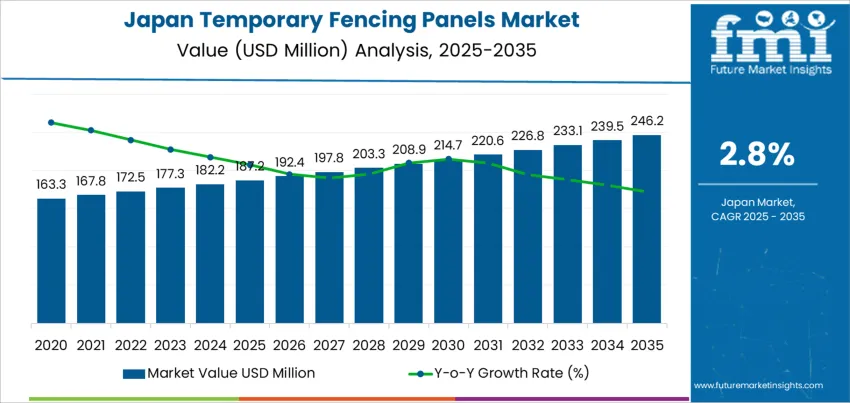
What is the Growth Forecast for Demand for Temporary Fencing Panels in Japan through 2035?
From 2025 to 2030, demand for temporary fencing panels in Japan is expected to grow from USD 187.2 million to USD 214.7 million, adding USD 27.5 million in value. This growth is driven by the continued rise in construction activities, public events, and temporary safety needs. As Japan’s infrastructure projects, including urban development and transportation expansion, progress, the demand for temporary fencing solutions will grow, particularly for securing construction sites and providing safety barriers for large-scale public events such as festivals, sporting events, and concerts. Furthermore, the need for more versatile and durable fencing options that are easy to install and transport will increase the adoption of temporary fencing panels in various industries.
From 2030 to 2035, the demand for temporary fencing panels will continue to rise from USD 214.7 million to USD 246.2 million, contributing USD 31.5 million in value. During this period, the demand for these fencing solutions will be supported by continued construction and infrastructure projects across Japan, particularly those related to urban redevelopment and public safety. The increasing focus on environmental sustainability will also drive the adoption of eco-friendly and reusable temporary fencing panels. The growing awareness of the importance of securing public spaces, especially during large public events and construction projects, will further solidify the demand for temporary fencing solutions.
Demand for Temporary Fencing Panels in Japan Key Takeaways
| Metric | Value |
|---|---|
| Demand for Temporary Fencing Panels in Japan Value (2025) | USD 187.2 million |
| Demand for Temporary Fencing Panels in Japan Forecast Value (2035) | USD 246.2 million |
| Demand for Temporary Fencing Panels in Japan Forecast CAGR (2025-2035) | 2.8% |
Why is the Demand for Temporary Fencing Panels in Japan Growing?
The demand for temporary fencing panels in Japan is increasing as industries and construction projects continue to require efficient and secure solutions for site safety and perimeter control. These fencing panels are widely used for a variety of applications, including construction sites, public events, and crowd control, providing both security and safety in areas that require quick and flexible setups. Their lightweight design, ease of installation, and adaptability make them a popular choice for temporary and mobile applications.
A key factor driving this growth is the ongoing development of infrastructure and construction projects across Japan. As urbanization and large-scale construction activities increase, the need for temporary fencing solutions to secure building sites, transport routes, and public spaces becomes more prominent. In addition, temporary fencing panels are essential for managing crowd control during public events and festivals, where safety is a priority. The growing number of events, alongside rising construction activities, is driving consistent demand for these panels.
Technological innovations in fencing materials and designs are further contributing to the increased adoption of temporary fencing panels. Newer, more durable, and weather-resistant materials ensure better longevity and safety in outdoor environments, enhancing the appeal of temporary fencing for both short- and long-term applications. As demand for construction and event services continues to grow, the demand for temporary fencing panels in Japan is expected to rise steadily through 2035.
What is the Segment-Wise Analysis of Demand for Temporary Fencing Panels in Japan?
Demand for temporary fencing panels in Japan is segmented by type, end user, material, and sales channel. By type, demand is divided into standard, round top, heavy-duty round top, and anti-climb. The demand is also segmented by end user, including commercial, residential, industrial, and others. In terms of material, the demand is primarily for metal, with other materials also contributing. The sales channel is divided into online retailers, bricks & mortar stores, and direct sales, with online retailers seeing increasing demand. Regionally, demand is divided into Kanto, Kinki, Chubu, Kyushu & Okinawa, Tohoku, and the Rest of Japan.
Why Does Standard Type Lead the Demand for Temporary Fencing Panels in Japan?
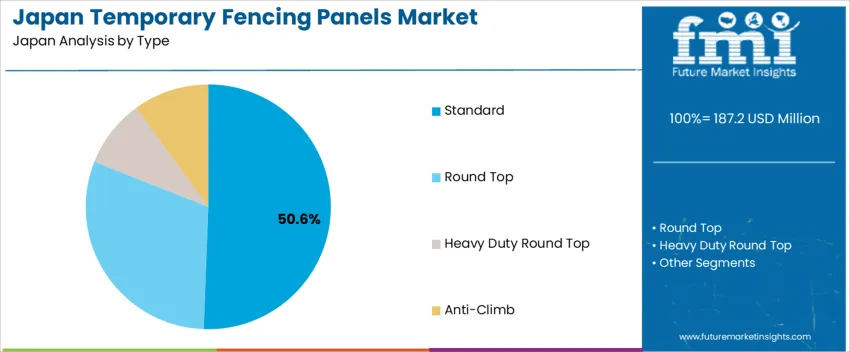
Standard temporary fencing panels account for 51% of the demand in Japan due to their versatility, cost-effectiveness, and ease of use. Standard panels are widely employed in a variety of applications, from construction sites to public events, as they provide a reliable solution for perimeter security and crowd control. Their simple design makes them easy to install and remove, while their durability ensures long-term use. Standard fencing is the most accessible and economical option, making it suitable for various industries, including commercial, residential, and industrial sectors. As demand for temporary fencing continues to rise across diverse applications, standard fencing remains the most popular type due to its practical benefits, cost efficiency, and adaptability.
Why Does Commercial End User Lead the Demand for Temporary Fencing Panels in Japan?
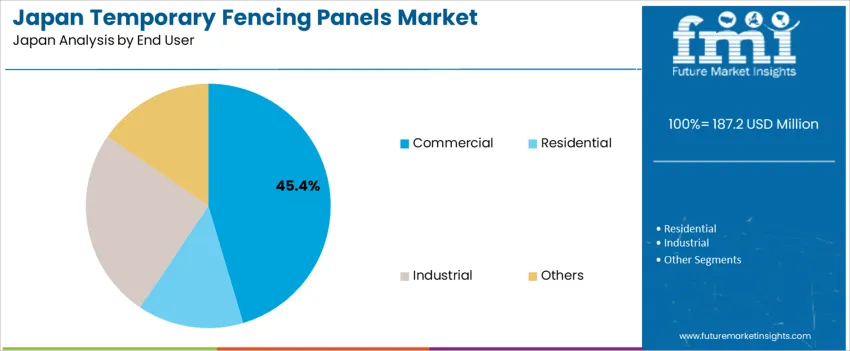
The commercial sector accounts for 45.4% of the demand for temporary fencing panels in Japan, driven by the need for perimeter security, crowd control, and site protection during construction, events, and other commercial activities. Businesses and event organizers require reliable fencing solutions to protect their property, ensure safety, and manage large crowds. The growing focus on safety and security standards in public and private sectors, along with an increase in the number of large-scale construction projects, drives the demand for temporary fencing. Commercial applications, such as outdoor events, festivals, and temporary enclosures, are some of the largest drivers of this demand. As the commercial sector continues to expand in Japan, particularly in urban areas, the demand for temporary fencing solutions is expected to remain strong.
What are the Key Trends, Drivers, and Restraints in Demand for Temporary Fencing Panels in Japan?
Demand for temporary fencing panels in Japan is rising as urban development, infrastructure work, and construction activity accelerate. These panels are increasingly used at construction sites, renovation zones, and redevelopment projects to ensure safety and control access. Another growing trend is use of temporary fencing for public‑event crowd control and site separation during festivals, exhibitions, and maintenance works. Portable and easy‑to‑install fence panels, including chain‑link, modular metal or wire‑mesh types, appeal due to flexibility and reusability. Growth is restrained by cost of materials and installation, regulatory compliance regarding site safety, and competition from alternative barrier or security systems.
Why is Demand for Temporary Fencing Panels Growing in Japan?
Demand is growing because Japan continues to experience urban redevelopment, infrastructure upgrades and renovation projects, especially in dense urban zones where safe demarcation of work zones is essential. Temporary fencing ensures worker and public safety, helps manage access, and meets regulatory or municipal safety requirements at construction or maintenance sites. For public events and scheduled works in populated areas, temporary fences offer a fast and effective way to segregate zones, manage crowd flow, and secure equipment or materials. The increasing emphasis on site safety and compliance with safety regulations further drives adoption of temporary fencing panels across construction, infrastructure, and event sectors.
How are Technological & Industry Innovations Driving Demand for Temporary Fencing Panels in Japan?
Advances in materials and design have improved temporary fencing panels’ usability and durability. Modern panels often utilize galvanized steel or treated wire mesh that resists corrosion useful in Japan’s varied weather and offer enhanced strength and stability. Modular, lightweight, and reusable designs make installation, removal, and relocation easier, which reduces labour and time costs. Some manufacturers also offer fence panel systems optimized for rapid assembly and disassembly, meeting the need of short‑term construction or event projects. Innovations in standardization and quality control help maintain safety while lowering long‑term maintenance costs, encouraging more frequent use.
What are the Key Challenges and Risks That Could Limit Temporary Fencing Panel Demand in Japan?
Fluctuating raw material costs for steel and metal components can raise the cost for panel producers, which may reduce adoption for cost‑sensitive small projects. Strict regulation and compliance requirements for safety standards at construction or public-work sites may increase certification or installation burdens. Competition from alternative security or barrier solutions (e.g. permanent fencing, concrete barriers, or more advanced perimeter‑security systems) could reduce reliance on temporary panels. For very short‑term applications or small-scale maintenance work, cost and logistics might outweigh benefits.
What is the Regional Demand Outlook for Temporary Fencing Panels in Japan?
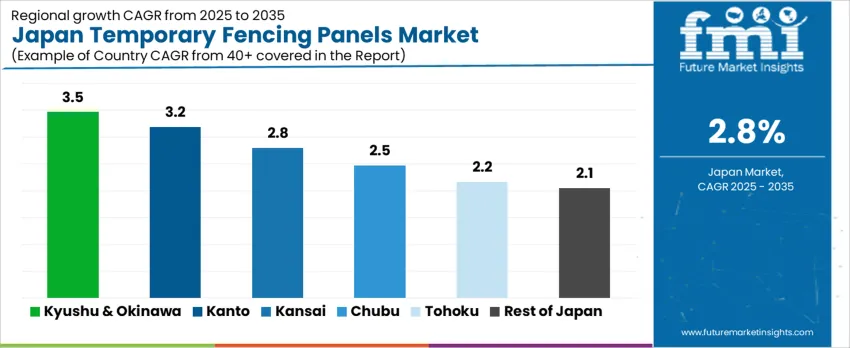
| Region | CAGR (%) |
|---|---|
| Kyushu & Okinawa | 3.5% |
| Kanto | 3.2% |
| Kansai | 2.8% |
| Chubu | 2.5% |
| Tohoku | 2.2% |
| Rest of Japan | 2.1% |
Demand for temporary fencing panels in Japan is growing steadily, with Kyushu & Okinawa leading at a 3.5% CAGR, supported by infrastructure development and tourism. Kanto follows with a 3.2% CAGR, driven by urbanization and large-scale public events. Kansai sees a 2.8% CAGR, with growth fueled by construction and event management. Chubu experiences a 2.5% CAGR, supported by industrial projects and public safety needs. Tohoku and the Rest of Japan see moderate growth at 2.2% and 2.1%, respectively, as regional construction and event activities increase demand for fencing solutions.
How is Demand for Temporary Fencing Panels Growing in Kyushu & Okinawa?
Kyushu & Okinawa leads the demand for temporary fencing panels, growing at a 3.5% CAGR. The region's growing construction and infrastructure projects are driving the need for temporary fencing panels for safety, security, and perimeter control. Temporary fencing is essential in construction sites, events, and public works, where it is used to cordon off areas and ensure public safety. As urbanization increases and new residential, commercial, and industrial developments take place, the demand for fencing solutions to secure these sites continues to rise. Okinawa’s tourism industry also contributes to the demand, with temporary fencing being used for crowd control at major events and festivals. As the need for flexible, cost-effective, and secure fencing solutions grows, Kyushu & Okinawa’s demand for temporary fencing panels is expected to remain strong and steadily increase.
Why is Demand for Temporary Fencing Panels Rising in Kanto?
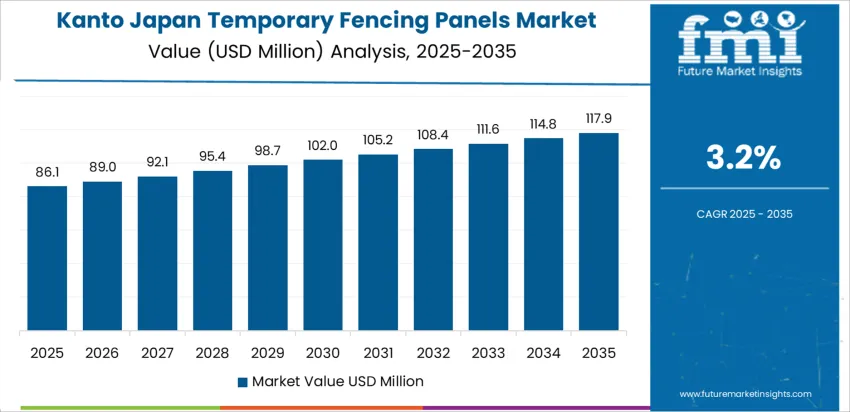
Kanto is experiencing steady demand for temporary fencing panels, with a 3.2% CAGR. The region’s dense urban population and large-scale infrastructure projects, such as urban development, transportation, and public events, are key drivers of this demand. In urban centers like Tokyo, temporary fencing is commonly used for safety, crowd control, and to secure construction zones. With ongoing urbanization, particularly in areas undergoing redevelopment or new construction, temporary fencing panels are essential for maintaining secure work sites and managing foot traffic. The rise in large-scale public events and festivals also contributes to this growth, as fencing is necessary for crowd management and securing event areas. As urban development and public safety concerns continue to rise, demand for temporary fencing panels in Kanto is expected to remain steady.
How is Demand for Temporary Fencing Panels Expanding in Kansai?
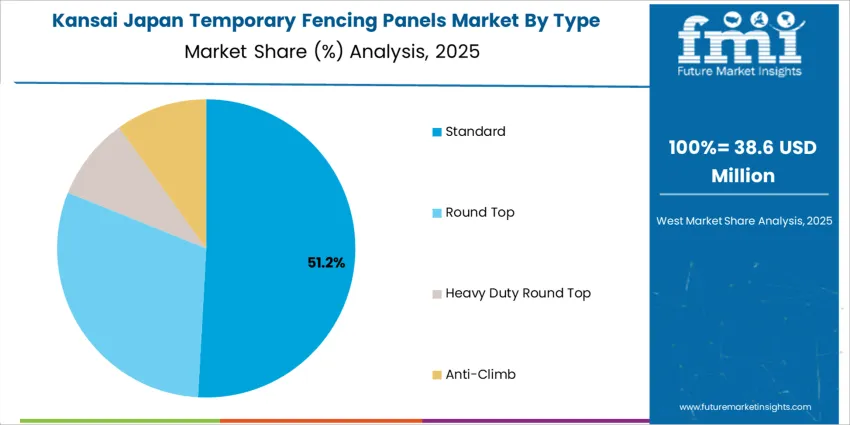
Kansai is seeing steady demand for temporary fencing panels, growing at a 2.8% CAGR. The region’s ongoing construction boom, particularly in cities like Osaka and Kyoto, is fueling the demand for reliable and secure fencing solutions. Temporary fencing panels are widely used in construction zones, industrial sites, and for public events. Kansai’s increasing emphasis on large infrastructure projects, including new transportation networks, urban renewal projects, and public works, drives the need for flexible and cost-effective fencing solutions. The rise in tourism and events in the region, especially in high-traffic areas, further boosts demand for fencing panels for crowd control and safety. As the region continues to develop, demand for temporary fencing panels is expected to grow steadily, fueled by construction, public safety, and event needs.
Why is Demand for Temporary Fencing Panels Growing in Chubu?
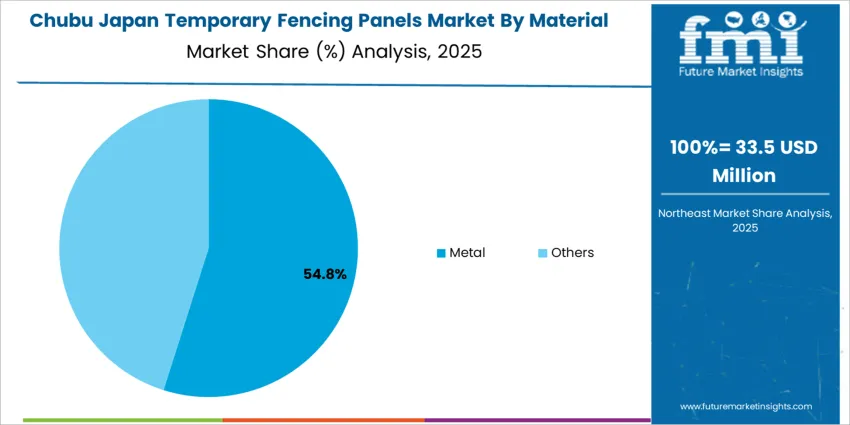
Chubu is experiencing steady demand for temporary fencing panels, with a 2.5% CAGR. The region’s industrial and construction sectors, particularly in cities like Nagoya, are key contributors to the growth. Temporary fencing is increasingly used at construction sites, industrial projects, and public events, where security and safety are paramount. As Chubu continues to expand its infrastructure, including transportation networks and residential developments, the demand for reliable, durable, and easy-to-install fencing solutions grows. As the region’s event scene develops, temporary fencing is becoming more common for crowd control and managing large gatherings. With a focus on safety and security in both construction and public events, Chubu’s demand for temporary fencing panels is expected to continue growing steadily.
How is Demand for Temporary Fencing Panels Expanding in Tohoku?
Tohoku is seeing moderate demand for temporary fencing panels, with a 2.2% CAGR. While the industry for fencing panels in Tohoku is smaller compared to more urbanized regions, the growth in construction and infrastructure projects, particularly in the wake of recovery efforts following natural disasters, is contributing to steady demand. Temporary fencing panels are increasingly used in construction zones, public works, and for securing event areas. As Tohoku’s infrastructure develops, including new housing and commercial projects, the demand for fencing solutions to ensure safety and security at these sites rises. As more events and festivals are held across the region, the need for temporary fencing for crowd control increases. Although growth is slower compared to other regions, demand for temporary fencing panels in Tohoku is expected to rise gradually as development and public safety concerns grow.
Why is Demand for Temporary Fencing Panels Steady in the Rest of Japan?
The Rest of Japan is experiencing steady demand for temporary fencing panels, growing at a 2.1% CAGR. While demand is lower in rural areas compared to major urban regions, there is consistent growth driven by the increasing need for fencing in construction, public safety, and event management. As infrastructure in rural areas continues to develop, the use of temporary fencing panels for construction and public works becomes more common. The rise in local festivals, industrys, and public gatherings contributes to steady demand for fencing solutions for crowd control. With the growing accessibility of temporary fencing products through retail and online platforms, the Rest of Japan is expected to see a gradual but steady increase in demand for fencing panels.
What is Driving the Demand for Temporary Fencing Panels in Japan and Who Are the Key Players Shaping the Industry?
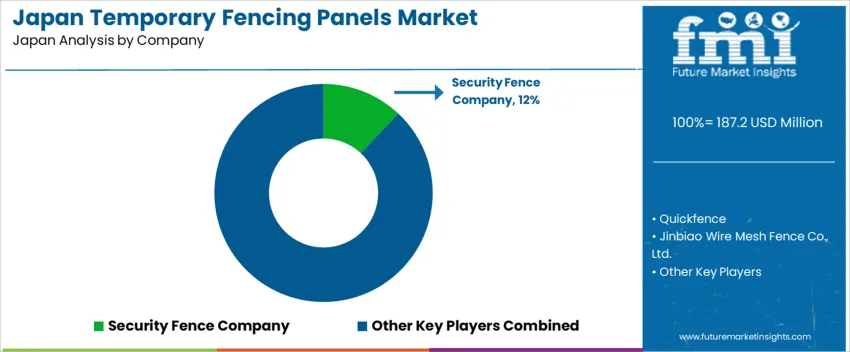
The demand for temporary fencing panels in Japan is increasing due to their widespread use in construction sites, events, and public safety applications. Temporary fences provide security, restrict access to certain areas, and ensure safety during large public gatherings, construction projects, and emergencies. With Japan's growing infrastructure projects, frequent large-scale events, and heightened awareness of safety standards, temporary fencing panels are becoming a common solution for managing crowd control and securing hazardous areas. The increasing need for privacy and security, particularly during construction or renovation work, is driving the industry for temporary fencing solutions. The ease of installation, portability, and durability of these panels make them an attractive option for short-term applications across various sectors.
Key players shaping the temporary fencing panels industry in Japan include Security Fence Company, Quickfence, Jinbiao Wire Mesh Fence Co., Ltd., Anping County YongMing Wire Mesh Fencing Co., Ltd., and Jacksons Fencing. Security Fence Company leads the industry with a notable 12.0% share, offering a range of high-quality fencing solutions designed to meet the specific needs of temporary security and safety applications. These companies are essential in providing customizable, reliable, and durable fencing panels for both commercial and residential projects. They also focus on improving the design and functionality of their products to enhance ease of installation, transportation, and overall performance.
The growth of the temporary fencing panels industry in Japan is also supported by the increasing number of construction and renovation projects, along with a rise in public events that require effective crowd control and security measures. As the demand for flexible, temporary safety solutions continues to grow across various industries, temporary fencing panels are expected to play a crucial role in enhancing safety and security in Japan. The industry is poised to continue expanding as both private and public sectors seek effective, adaptable solutions for short-term fencing needs.
Key Players in Japan Temporary Fencing Panels Demand
- Security Fence Company
- Quickfence
- Jinbiao Wire Mesh Fence Co., Ltd.
- Anping County YongMing Wire Mesh Fencing Co., Ltd.
- Jacksons Fencing
Scope of Report
| Items | Values |
|---|---|
| Quantitative Units (2025) | USD million |
| Type | Standard, Round Top, Heavy Duty Round Top, Anti-Climb |
| Material | Metal, Others |
| End User | Commercial, Residential, Industrial, Others |
| Sales Channel | Online Retailers, Bricks & Mortar Stores, Direct Sales |
| Region | Kyushu & Okinawa, Kanto, Kansai, Chubu, Tohoku, Rest of Japan |
| Countries Covered | Japan |
| Key Companies Profiled | Security Fence Company, Quickfence, Jinbiao Wire Mesh Fence Co., Ltd., Anping County YongMing Wire Mesh Fencing Co., Ltd., Jacksons Fencing |
| Additional Attributes | Dollar sales by type and material; regional CAGR and growth outlook; end-user preferences for different types of panels; adoption of online vs offline sales channels; trends in temporary fencing panel applications in commercial and industrial sectors. |
Japan Temporary Fencing Panels Demand by Key Segments
Type:
- Standard
- Round Top
- Heavy Duty Round Top
- Anti-Climb
Material:
- Metal
- Others
End User:
- Commercial
- Residential
- Industrial
- Others
Sales Channel:
- Online Retailers
- Bricks & Mortar Stores
- Direct Sales
Region:
- Kyushu & Okinawa
- Kanto
- Kansai
- Chubu
- Tohoku
- Rest of Japan
Frequently Asked Questions
How big is the demand for temporary fencing panels in Japan in 2025?
The demand for temporary fencing panels in Japan is estimated to be valued at USD 187.2 million in 2025.
What will be the size of temporary fencing panels in Japan in 2035?
The market size for the temporary fencing panels in Japan is projected to reach USD 246.2 million by 2035.
How much will be the demand for temporary fencing panels in Japan growth between 2025 and 2035?
The demand for temporary fencing panels in Japan is expected to grow at a 2.8% CAGR between 2025 and 2035.
What are the key product types in the temporary fencing panels in Japan?
The key product types in temporary fencing panels in Japan are standard, round top, heavy duty round top and anti-climb.
Which material segment is expected to contribute significant share in the temporary fencing panels in Japan in 2025?
In terms of material, metal segment is expected to command 55.0% share in the temporary fencing panels in Japan in 2025.
Preview the report firsthand - request a free sample
Get SampleGet the brochure for pricing and purchase details.
Get PDFTable of Content
- Executive Summary
- Japan Market Outlook
- Demand-side Trends
- Supply-side Trends
- Technology Roadmap Analysis
- Analysis and Recommendations
- Market Overview
- Market Coverage / Taxonomy
- Market Definition / Scope / Limitations
- Market Background
- Market Dynamics
- Drivers
- Restraints
- Opportunity
- Trends
- Scenario Forecast
- Demand in Optimistic Scenario
- Demand in Likely Scenario
- Demand in Conservative Scenario
- Opportunity Map Analysis
- Product Life Cycle Analysis
- Supply Chain Analysis
- Investment Feasibility Matrix
- Value Chain Analysis
- PESTLE and Porter’s Analysis
- Regulatory Landscape
- Regional Parent Market Outlook
- Production and Consumption Statistics
- Import and Export Statistics
- Market Dynamics
- Japan Market Analysis 2020 to 2024 and Forecast, 2025 to 2035
- Historical Market Size Value (USD Million) Analysis, 2020 to 2024
- Current and Future Market Size Value (USD Million) Projections, 2025 to 2035
- Y-o-Y Growth Trend Analysis
- Absolute $ Opportunity Analysis
- Japan Market Pricing Analysis 2020 to 2024 and Forecast 2025 to 2035
- Japan Market Analysis 2020 to 2024 and Forecast 2025 to 2035, By Type
- Introduction / Key Findings
- Historical Market Size Value (USD Million) Analysis By Type , 2020 to 2024
- Current and Future Market Size Value (USD Million) Analysis and Forecast By Type , 2025 to 2035
- Standard
- Round Top
- Heavy Duty Round Top
- Anti-Climb
- Y-o-Y Growth Trend Analysis By Type , 2020 to 2024
- Absolute $ Opportunity Analysis By Type , 2025 to 2035
- Japan Market Analysis 2020 to 2024 and Forecast 2025 to 2035, By Material
- Introduction / Key Findings
- Historical Market Size Value (USD Million) Analysis By Material, 2020 to 2024
- Current and Future Market Size Value (USD Million) Analysis and Forecast By Material, 2025 to 2035
- Metal
- Others
- Y-o-Y Growth Trend Analysis By Material, 2020 to 2024
- Absolute $ Opportunity Analysis By Material, 2025 to 2035
- Japan Market Analysis 2020 to 2024 and Forecast 2025 to 2035, By End User
- Introduction / Key Findings
- Historical Market Size Value (USD Million) Analysis By End User, 2020 to 2024
- Current and Future Market Size Value (USD Million) Analysis and Forecast By End User, 2025 to 2035
- Commercial
- Residential
- Industrial
- Others
- Y-o-Y Growth Trend Analysis By End User, 2020 to 2024
- Absolute $ Opportunity Analysis By End User, 2025 to 2035
- Japan Market Analysis 2020 to 2024 and Forecast 2025 to 2035, By Sales Channel
- Introduction / Key Findings
- Historical Market Size Value (USD Million) Analysis By Sales Channel, 2020 to 2024
- Current and Future Market Size Value (USD Million) Analysis and Forecast By Sales Channel, 2025 to 2035
- Online Retailers
- Bricks & Mortar Stores
- Direct Sales
- Y-o-Y Growth Trend Analysis By Sales Channel, 2020 to 2024
- Absolute $ Opportunity Analysis By Sales Channel, 2025 to 2035
- Market Structure Analysis
- Competition Dashboard
- Competition Benchmarking
- Market Share Analysis of Top Players
- By Regional
- By Type
- By Material
- By End User
- By Sales Channel
- Competition Analysis
- Competition Deep Dive
- Security Fence Company
- Overview
- Product Portfolio
- Profitability by Market Segments (Product/Age /Sales Channel/Region)
- Sales Footprint
- Strategy Overview
- Marketing Strategy
- Product Strategy
- Channel Strategy
- Quickfence
- Jinbiao Wire Mesh Fence Co., Ltd.
- Anping County YongMing Wire Mesh Fencing Co., Ltd.
- Jacksons Fencing
- Security Fence Company
- Competition Deep Dive
- Assumptions & Acronyms Used
- Research Methodology


