

- Industry Size (2025)
- USD 1.4 Bn
- Forecast (2035)
- USD 1.9 Bn
- CAGR (2025 to 2035)
- 3.5%
Demand for Temporary Fencing Panels in USA 2025 to 2035
The demand for temporary fencing panels in the USA is valued at USD 1.4 billion in 2025 and is projected to reach USD 1.9 billion by 2035, recording a CAGR of 3.5%. Demand reflects consistent installation requirements across construction, infrastructure upgrades, public events, and short-term property security applications. Contractors and facility operators rely on these systems to establish controlled site boundaries, restrict access, and improve safety compliance. Growth is further supported by industrial expansion and outdoor event activities that require rapid-deployment perimeter solutions.
Standard temporary panels represent the leading category due to widespread compatibility with construction sites, industrial zones, and municipal safety projects. These panels are preferred for quick assembly, reusability across multiple project cycles, and cost-efficient rental or procurement models. Manufacturers continue refining durability, corrosion resistance, and stabilization accessories to support longer operational life in variable weather conditions.
Quick Stats for USA Temporary Fencing Panels Demand
- USA Temporary Fencing Panels Sales Value (2025): USD 1.4 billion
- USA Temporary Fencing Panels Forecast Value (2035): USD 1.9 billion
- USA Temporary Fencing Panels Forecast CAGR (2025 to 2035): 3.5%
- Leading Category in USA Temporary Fencing Panels Demand: Standard Temporary Panels
- Key Growth Regions in USA Temporary Fencing Panels Demand: West USA, South USA, Northeast USA
- Top Players in USA Temporary Fencing Panels Demand: Master Halco, Inc., Ameristar Fence Products, Crown Atlantic Company, Superior Fence & Rail, Eastern Wholesale Fence
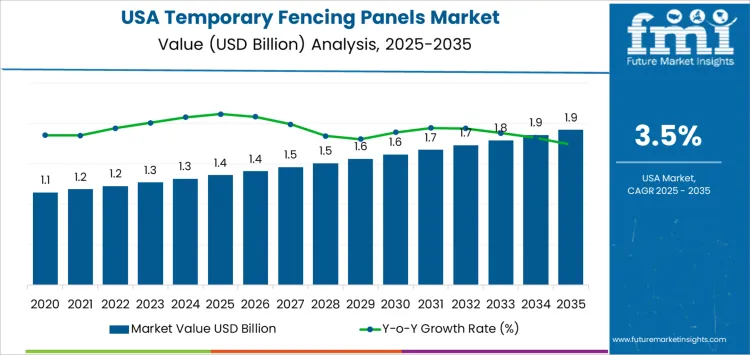
What is the Growth Forecast for Temporary Fencing Panels Industry in USA through 2035?
The West USA, South USA, and Northeast USA account for the highest utilization because of continuous commercial development, high-density urban projects, and extensive regional event schedules. These areas maintain strong networks of rental fleets and distribution service providers to ensure rapid mobilization. Major suppliers include Master Halco, Inc., Ameristar Fence Products, Crown Atlantic Company, Superior Fence & Rail, and Eastern Wholesale Fence. Their core focus includes scalable production, improved portability, and adherence to occupational safety and perimeter-security standards.
Early-stage growth for demand for temporary fencing panels in the United States is driven by active construction spending, infrastructure repair projects, and safety compliance requirements. Public and private sector investments in transportation and commercial development support frequent use of rented and purchased fencing systems. Event security needs contribute additional volume during the initial years as venues increase perimeter control and crowd management practices.
In later years, growth continues but at a more moderate rate as large infrastructure cycles stabilize and established rental fleets reach adequate capacity. Procurement shifts toward replacement and upgrades rather than new industry expansion. Urban construction plateaus in some regions, which reduces acceleration from new project starts. Cost efficiency initiatives encourage longer service life for existing panels, limiting strong incremental increases. The curve shows a transition from development-driven expansion to a steadier phase where activity aligns closely with construction and event schedules rather than major new demand sources. Positive direction remains due to ongoing safety regulations and seasonal event requirements.
USA Temporary Fencing Panels Key Takeaways
| Metric | Value |
|---|---|
| USA Temporary Fencing Panels Sales Value (2025) | USD 1.4 billion |
| USA Temporary Fencing Panels Forecast Value (2035) | USD 1.9 billion |
| USA Temporary Fencing Panels Forecast CAGR (2025-2035) | 3.5% |
Why is the Demand for Temporary Fencing Panels in the USA Growing?
Demand for temporary fencing panels in the USA is increasing because construction companies, event organizers and public agencies require flexible barriers that ensure safety and controlled access. Large construction projects in commercial and residential sectors rely on fencing to secure equipment, restrict entry and comply with site safety regulations. Infrastructure upgrades for transportation and energy also create steady demand for portable barriers that can be installed and removed quickly.
Sporting events, concerts and outdoor festivals use temporary fencing to guide crowd movement and protect restricted areas. Municipalities adopt fencing for roadwork zones, emergency response situations and public space management during seasonal activities. Rental companies expand inventories to support recurring short term projects, which stabilizes industry demand throughout the year.
Manufacturers supply panels with features such as anti-climb mesh and weather resistant coatings that perform well in diverse climates across the USA. Quick installation supports labor efficiency and reduces downtime for contractors and organizers. Constraints include price sensitivity among small builders and the need for storage and transportation after rental or purchase. High wind conditions may require anchoring solutions, adding cost for specific sites. Seasonal slowdowns in outdoor events can influence order timing.
Which Types, Materials, and End Users Lead Demand for Temporary Fencing Panels in the USA?
Demand for temporary fencing panels in the United States is driven by infrastructure upgrades, event management growth, and safety compliance requirements across industrial and construction sites. Quick installation, mobility, and reusability influence procurement decisions. Industry preference is shaped by durability, weather resistance, and compatibility with security accessories such as braces and privacy screens. Commercial and municipal projects significantly contribute to recurring purchases through long-term rentals and short-duration installations across work zones and public venues.
By Type, Standard Temporary Panels Hold the Largest Share
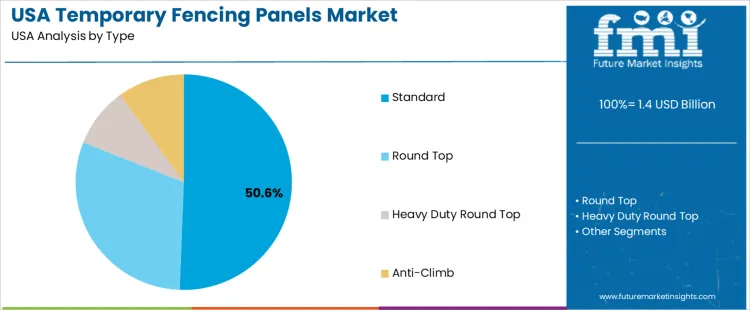
Standard fencing panels represent 50.6%, driven by wide adoption in construction, events, utilities, and public crowd-control applications. These structures deliver balance between affordability, durability, and installation efficiency. Round-top panels account for 30.4%, preferred for improved safety by eliminating sharp edges, supporting use in public access areas. Anti-climb designs hold 10.0%, demanded for higher security at risk-sensitive facilities such as refineries and defense projects. Heavy-duty round-top panels represent 9.0%, engineered for enhanced impact resistance in harsh industrial environments. Type distribution corresponds to USA requirements for OSHA-aligned safety and scalable perimeter protection solutions across rapidly changing job-site setups.
Key Points:
- Standard panels remain universal for multi-sector perimeter control
- Round-top structures reduce injury risk in high-traffic zones
- Anti-climb and heavy-duty options address elevated security and load needs
By Material, Metal Panels Lead Demand
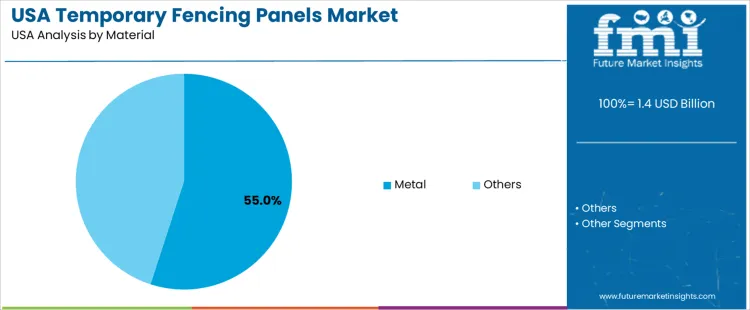
Metal materials account for 55.0%, supported by structural strength, long lifecycle performance, and suitability for outdoor deployments exposed to extreme weather. Steel mesh and welded metal frames are widely rented across commercial and industrial activities prioritizing vandal resistance and stability. Other materials represent 45.0%, including plastic and composite lightweight panels used in short-term installations, temporary pathways, and low-security environments. Material selection follows cost and durability priorities, with metal dominating professional usage and alternatives increasing in recreational and landscaping activities requiring easier handling.
Key Points:
- Metal ensures long-term durability and security performance
- Lightweight alternatives reduce handling effort for low-risk use
- Material choice depends on exposure conditions and rental economics
By End User, Commercial Segment Leads
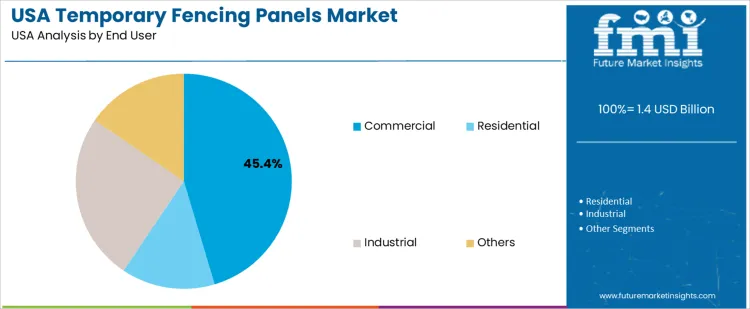
Commercial end users account for 45.4%, driven by construction projects, public infrastructure revamps, and event venue perimeter control. Industrial users represent 25.2%, utilizing reinforced systems around factories, utility zones, and hazardous equipment areas. The residential sector holds 14.0%, supporting lawn protection, renovations, and temporary property boundaries during building upgrades. Other users comprise 15.4%, covering government activities, crowd-control requirements, and disaster response deployment. End-use distribution reflects the scale of non-residential development and public safety initiatives encouraging temporary site enclosures nationwide.
Key Points:
- Commercial sites dominate purchases and rentals for regulated safety compliance
- Industrial usage ensures asset security and access restriction
- Residential fencing supports short-term home improvement needs
What are the Drivers, Restraints, and Key Trends of the Demand for Temporary Fencing Panels in the USA?
Growth of construction activity, expansion of outdoor events and increased compliance with safety regulations are driving demand.
In the United States, temporary fencing panels are widely used at commercial construction sites to secure equipment and restrict access while meeting local safety requirements. Infrastructure upgrades funded by federal and state programs increase demand from contractors who rotate panels across multiple projects each year. Outdoor events such as music festivals, sports tournaments and community fairs rely on crowd-control fencing to manage entry routes and protect staging areas.
Municipalities deploy temporary barriers during street improvements and emergency response operations to ensure public safety and protect traffic flow. Industrial facilities, utility companies and disaster recovery agencies also rent or purchase temporary fencing for short-term perimeter control. These varied applications support steady procurement across rental suppliers and distributors nationwide.
High transportation costs, competition from alternative barriers and weather-related durability issues restrain demand.
Temporary fences are bulky to transport, and rising fuel prices increase delivery and handling costs, particularly for remote locations. In lower-risk settings, cones, barricades or rope systems may be used instead to reduce rental expense. Severe weather including strong winds, heavy snow or coastal corrosion can shorten fence lifespan if materials are not reinforced, raising replacement cost considerations for rental operators. Some smaller contractors prefer portable plastic options for lightweight handling rather than metal panel systems. These operational and cost-based challenges moderate adoption in lower-budget segments.
Shift toward anti-climb and welded-mesh designs, increased rental service integration and rising demand from large event infrastructure define key trends.
Contractors and event planners choose reinforced mesh panels that reduce trespass and vandalism risks around valuable equipment and public venues. Rental companies expand value-added services such as on-site installation, branded screening and rapid redeployment to support contracting flexibility. Major cities require fencing for marathons, film productions and convention expansions, strengthening partnerships between event organizers and suppliers. Digital tracking of fence inventory improves logistics and ensures timely retrieval across multi-site projects. These developments indicate sustained, compliance-driven demand for temporary fencing panels throughout the United States construction, event management and public-safety ecosystem.
Analysis of the Demand for Temporary Fencing Panels in the USA by Region
Demand for temporary fencing panels in the United States reflects requirements across construction zones, event venues, industrial maintenance areas, and public-safety applications. Growth relates to infrastructure spending, private development activity, and security compliance at public gatherings. Rental models dominate procurement, where supply chains depend on local inventory availability and equipment-servicing networks. Event and festival organizers rely on modular barricade systems for crowd routing. Construction contractors adopt fencing to meet workplace perimeter-control standards. West USA leads at 4.0% CAGR, followed by South USA at 3.6%, Northeast USA at 3.2%, and Midwest USA at 2.8%.
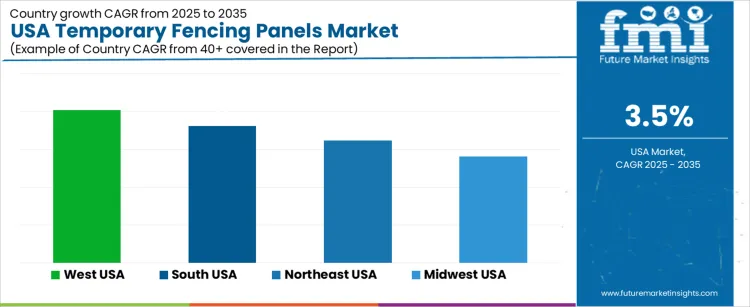
| Region | CAGR (2025-2035) |
|---|---|
| West USA | 4.0% |
| South USA | 3.6% |
| Northeast USA | 3.2% |
| Midwest USA | 2.8% |
How is the West USA driving demand for temporary fencing panels?
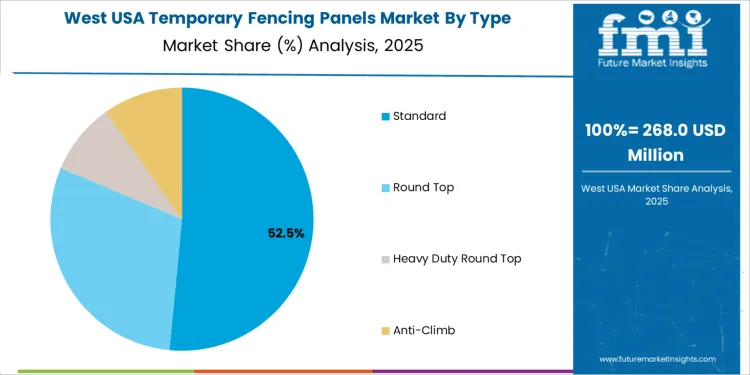
West USA shows 4.0% CAGR, supported by ongoing residential development, large event operations, and public-works project spending in California, Washington, Arizona, and Nevada. Sports and entertainment venues frequently require rapid perimeter configurations for concerts and seasonal attractions. Urban-expansion activities increase fencing use to separate work areas from pedestrian walkways. Government-funded infrastructure upgrades-transit improvements, water-system maintenance, and utility reinforcement-sustain continuous fleet deployment by rental companies.
Industrial facilities apply fencing during equipment installation and routine shutdowns to comply with workplace-safety rules. Procurement considers ease of transport, corrosion resistance, and connection-hardware durability to ensure cost-efficient redeployment.
- Event-driven rentals supporting recurring usage
- Municipal projects reinforcing baseline demand
- Construction safety requirements sustaining panel turnover
- Durability and transport criteria guiding supplier selection
How is the South USA shaping growth in temporary fencing usage?
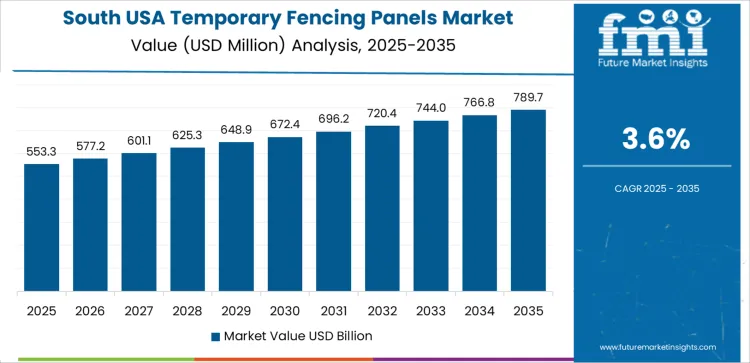
South USA posts 3.6% CAGR, driven by construction expansion across Texas, Florida, Georgia, and North Carolina. Housing-subdivision growth and logistics-center construction elevate perimeter-safety needs. Outdoor festival activity in warmer climates prompts seasonal procurement cycles. Industrial sectors rely on temporary barriers to secure equipment staging and contractor work areas. Rental operators expand distribution yards to shorten delivery timelines across large geographic zones. Buyers evaluate weathering performance under high humidity and coastal exposure, influencing coating and material choices.
- Residential construction programs widening consumption
- Event and festival operations shaping seasonal volume
- Industrial maintenance requiring controlled-access zones
- Coastal-climate durability affecting material preference
How is the Northeast USA influencing procurement behavior?
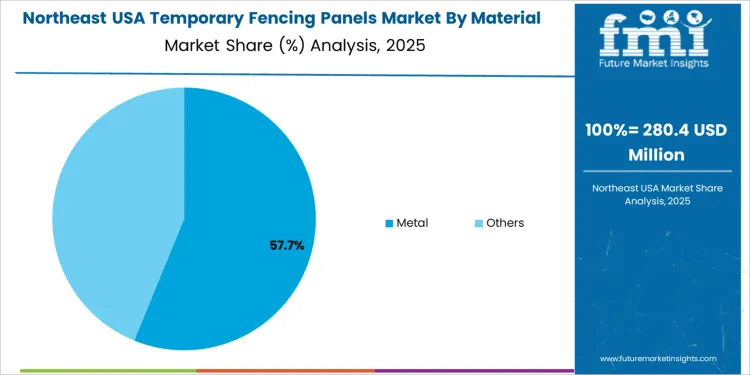
Northeast USA records 3.2% CAGR, supported by infrastructure modernization in urban centers including New York, New Jersey, and Massachusetts. Transit-system upgrades, commercial redevelopments, and utility trench-work require fast installation of temporary barriers in constrained environments. Universities and hospitals rent panels for construction adjacent to occupied facilities, emphasizing safety compliance. Event planners in dense cities utilize fencing to maintain controlled movement in limited-space venues. Buyers prioritize compact storage, secure locking connections, and anti-trip base designs for high-foot-traffic settings.
- Infrastructure renewal sustaining fencing deployment
- Public-facility projects demanding enhanced safety setups
- Event crowd-control shaping product specifications
- Compact configurations aiding placement in restricted sites
How is the Midwest USA contributing to overall industry expansion?
Midwest USA grows at 2.8% CAGR, influenced by industrial manufacturing projects and municipal upgrades across Illinois, Ohio, and Michigan. Large job-site footprints in suburban and rural areas increase reliance on rental fencing to maintain perimeter visibility. Agricultural fairs and local sports tournaments periodically raise seasonal rentals. Procurement emphasizes long-use cycles, stability in wind-exposed areas, and simplified maintenance due to labor-efficiency priorities. Distributors maintain balanced inventory based on predictable construction demand rather than rapid-growth surges.
- Industrial and municipal activity sustaining baseline use
- Seasonal community events reinforcing recurring rentals
- Stability and low-maintenance characteristics guiding choices
- Predictable demand aligning with measured stocking strategies
What does the competitive landscape for temporary fencing-panel demand in the United States look like?
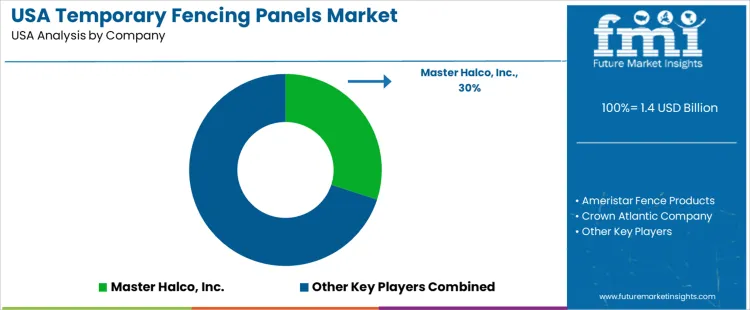
Demand for temporary fencing panels in the United States arises from construction sites, event venues, disaster relief, crowd control, and short-term security installations. Buyers prioritise ease of installation, portability, durability, and compliance with USA safety and building codes. Key procurement drivers include rapid deployment, minimal labour for set-up and takedown, corrosion resistance for outdoor use, and compatibility with rental-service logistics.
Master Halco, Inc. holds an estimated 30% share among panel suppliers, supported by a broad distribution network, wholesale supply to fencing contractors, and strong delivery footprint across major metropolitan areas. Their offerings meet needs for standard panel size, galvanised mesh strength, and reliable fastening systems. Ameristar Fence Products competes through heavy-gauge metal panels used by industrial-site contractors and large event organisers that require reinforced perimeter security. Crown Atlantic Company serves regions needing cost-effective chain-link-based panels for construction containment or utility-work fencing.
Superior Fence & Rail provides corrosion-resistant aluminium and steel panels used by coastal-area users and seasonal event providers. Eastern Wholesale Fence adds coverage in supply-heavy zones along the East Coast, offering flexible order quantities and rapid restocking for short-notice projects. Competition in the United States depends on consistency of panel quality, supply-chain reliability, inventory availability, and national distribution reach. Demand remains stable as infrastructure work, temporary-site security, and event-based fencing continue to require durable, easy-to-install temporary fencing panels capable of repeated use.
Key Players in USA Temporary Fencing Panels Demand
- Master Halco, Inc.
- Ameristar Fence Products
- Crown Atlantic Company
- Superior Fence & Rail
- Eastern Wholesale Fence
Scope of the Report
| Items | Values |
|---|---|
| Quantitative Units | USD billion |
| Type | Standard, Round Top, Heavy Duty Round Top, Anti-Climb |
| Material | Metal, Others |
| End User | Commercial, Residential, Industrial, Others |
| Sales Channel | Online Retailers, Bricks & Mortar Stores, Direct Sales |
| Regions Covered | West USA, South USA, Northeast USA, Midwest USA |
| Key Companies Profiled | Master Halco, Inc., Ameristar Fence Products, Crown Atlantic Company, Superior Fence & Rail, Eastern Wholesale Fence |
| Additional Attributes | Dollar sales by fencing panel type, end-user applications, material categories, and sales channels; growth driven by construction activities, events, and public infrastructure projects; demand for anti-climb designs for security and compliance needs; online procurement trends with fast onsite installation services; regional adoption driven by commercial property development and industrial project cycles across USA regions. |
USA Temporary Fencing Panels Demand by Segments
Type:
- Standard
- Round Top
- Heavy Duty Round Top
- Anti-Climb
Material:
- Metal
- Others
End User:
- Commercial
- Residential
- Industrial
- Others
Sales Channel:
- Online Retailers
- Bricks & Mortar Stores
- Direct Sales
Region:
- West USA
- South USA
- Northeast USA
- Midwest USA
Frequently Asked Questions
How big is the demand for temporary fencing panels in USA in 2025?
The demand for temporary fencing panels in USA is estimated to be valued at USD 1.4 billion in 2025.
What will be the size of temporary fencing panels in USA in 2035?
The market size for the temporary fencing panels in USA is projected to reach USD 1.9 billion by 2035.
How much will be the demand for temporary fencing panels in USA growth between 2025 and 2035?
The demand for temporary fencing panels in USA is expected to grow at a 3.5% CAGR between 2025 and 2035.
What are the key product types in the temporary fencing panels in USA?
The key product types in temporary fencing panels in USA are standard, round top, heavy duty round top and anti-climb.
Which material segment is expected to contribute significant share in the temporary fencing panels in USA in 2025?
In terms of material, metal segment is expected to command 55.0% share in the temporary fencing panels in USA in 2025.
Preview the report firsthand - request a free sample
Get SampleGet the brochure for pricing and purchase details.
Get PDFTable of Content
- Executive Summary
- USA Market Outlook
- Demand-side Trends
- Supply-side Trends
- Technology Roadmap Analysis
- Analysis and Recommendations
- Market Overview
- Market Coverage / Taxonomy
- Market Definition / Scope / Limitations
- Market Background
- Market Dynamics
- Drivers
- Restraints
- Opportunity
- Trends
- Scenario Forecast
- Demand in Optimistic Scenario
- Demand in Likely Scenario
- Demand in Conservative Scenario
- Opportunity Map Analysis
- Product Life Cycle Analysis
- Supply Chain Analysis
- Investment Feasibility Matrix
- Value Chain Analysis
- PESTLE and Porter’s Analysis
- Regulatory Landscape
- Regional Parent Market Outlook
- Production and Consumption Statistics
- Import and Export Statistics
- Market Dynamics
- USA Market Analysis 2020 to 2024 and Forecast, 2025 to 2035
- Historical Market Size Value (USD Million) Analysis, 2020 to 2024
- Current and Future Market Size Value (USD Million) Projections, 2025 to 2035
- Y-o-Y Growth Trend Analysis
- Absolute $ Opportunity Analysis
- USA Market Pricing Analysis 2020 to 2024 and Forecast 2025 to 2035
- USA Market Analysis 2020 to 2024 and Forecast 2025 to 2035, By Type
- Introduction / Key Findings
- Historical Market Size Value (USD Million) Analysis By Type , 2020 to 2024
- Current and Future Market Size Value (USD Million) Analysis and Forecast By Type , 2025 to 2035
- Standard
- Round Top
- Heavy Duty Round Top
- Anti-Climb
- Y-o-Y Growth Trend Analysis By Type , 2020 to 2024
- Absolute $ Opportunity Analysis By Type , 2025 to 2035
- USA Market Analysis 2020 to 2024 and Forecast 2025 to 2035, By Material
- Introduction / Key Findings
- Historical Market Size Value (USD Million) Analysis By Material, 2020 to 2024
- Current and Future Market Size Value (USD Million) Analysis and Forecast By Material, 2025 to 2035
- Metal
- Others
- Y-o-Y Growth Trend Analysis By Material, 2020 to 2024
- Absolute $ Opportunity Analysis By Material, 2025 to 2035
- USA Market Analysis 2020 to 2024 and Forecast 2025 to 2035, By End User
- Introduction / Key Findings
- Historical Market Size Value (USD Million) Analysis By End User, 2020 to 2024
- Current and Future Market Size Value (USD Million) Analysis and Forecast By End User, 2025 to 2035
- Commercial
- Residential
- Industrial
- Others
- Y-o-Y Growth Trend Analysis By End User, 2020 to 2024
- Absolute $ Opportunity Analysis By End User, 2025 to 2035
- USA Market Analysis 2020 to 2024 and Forecast 2025 to 2035, By Sales Channel
- Introduction / Key Findings
- Historical Market Size Value (USD Million) Analysis By Sales Channel, 2020 to 2024
- Current and Future Market Size Value (USD Million) Analysis and Forecast By Sales Channel, 2025 to 2035
- Online Retailers
- Bricks & Mortar Stores
- Direct Sales
- Y-o-Y Growth Trend Analysis By Sales Channel, 2020 to 2024
- Absolute $ Opportunity Analysis By Sales Channel, 2025 to 2035
- Market Structure Analysis
- Competition Dashboard
- Competition Benchmarking
- Market Share Analysis of Top Players
- By Regional
- By Type
- By Material
- By End User
- By Sales Channel
- Competition Analysis
- Competition Deep Dive
- Master Halco, Inc.
- Overview
- Product Portfolio
- Profitability by Market Segments (Product/Age /Sales Channel/Region)
- Sales Footprint
- Strategy Overview
- Marketing Strategy
- Product Strategy
- Channel Strategy
- Ameristar Fence Products
- Crown Atlantic Company
- Superior Fence & Rail
- Eastern Wholesale Fence
- Master Halco, Inc.
- Competition Deep Dive
- Assumptions & Acronyms Used
- Research Methodology


