

- Industry Size (2025)
- USD 2.5 Bn
- Forecast (2035)
- USD 8.9 Bn
- CAGR (2025 to 2035)
- 13.7%
Demand for Virtual Machines in Japan Forecast and Outlook 2025 to 2035
The demand for virtual machines in Japan is expected to grow from USD 2.5 billion in 2025 to USD 8.9 billion by 2035, reflecting a compound annual growth rate (CAGR) of 13.7%. Virtual machines are increasingly adopted across industries for their scalability and flexibility. As businesses move toward cloud computing and virtualization, demand for virtual machines is expected to rise significantly, driven by the growing need for efficient IT infrastructure, cost reduction, and business continuity solutions.
The market will experience steady and substantial growth, with demand increasing from USD 2.5 billion in 2025 to USD 2.8 billion in 2026, and USD 3.2 billion in 2027. The market will continue its upward trajectory, reaching USD 4.1 billion by 2029, USD 4.7 billion by 2030, and USD 5.3 billion by 2031. By 2035, the demand for virtual machines is forecasted to reach USD 8.9 billion, reflecting the increasing adoption of virtualized IT environments and the expansion of cloud services in Japan.
Quick Stats of the Demand for Virtual Machines in Japan
- Demand for Virtual Machines in Japan Value (2025): USD 2.5 billion
- Demand for Virtual Machines in Japan Forecast Value (2035): USD 8.9 billion
- Demand for Virtual Machines in Japan Forecast CAGR (2025-2035): 13.7%
- Demand for Virtual Machines in Japan Key Type: 80% System Virtual Machines
- Demand for Virtual Machines in Japan Key Growth Regions: Kyushu & Okinawa, Kanto, Kinki, Chubu, Tohoku, Rest of Japan
- Demand for Virtual Machines in Japan Key Players: VMware, Microsoft, Amazon Web Services (AWS), Google Cloud, Oracle
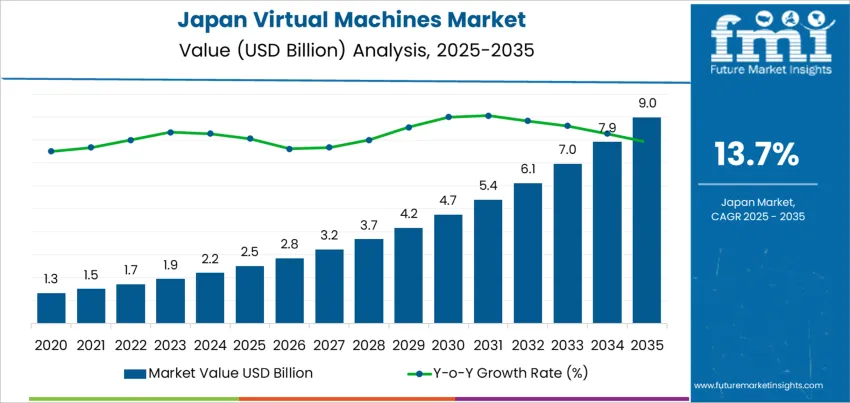
What is the Growth Forecast for the Virtual Machines Industry in Japan through 2035?
The virtual machines market in Japan is expected to see strong growth over the next decade. Starting at USD 2.5 billion in 2025, the market will rise to USD 2.8 billion in 2026 and USD 3.2 billion in 2027. By 2029, the market is projected to reach USD 4.1 billion, and by 2030, USD 4.7 billion. The growth will accelerate, with the market reaching USD 6.9 billion by 2033 and USD 8.9 billion by 2035. This growth will be driven by the increasing demand for virtualization technologies, the expansion of cloud infrastructure, and the rising trend of businesses adopting virtualized environments for operational efficiency.
The compound annual growth rate (CAGR) of 13.7% reflects strong and sustained growth in the virtual machines market. This impressive rate underscores the increasing reliance on virtualization for IT solutions, with businesses across industries looking to scale their operations and optimize computing resources through virtual machines. As cloud computing and digital transformation continue to evolve, virtual machines are expected to play a critical role in meeting the demands of modern IT infrastructure.
Key Takeaways of Virtual Machines Industry in Japan
| Metric | Value |
|---|---|
| Industry Sales Value (2025) | USD 2.5 billion |
| Industry Forecast Value (2035) | USD 8.9 billion |
| Industry Forecast CAGR (2025-2035) | 13.7% |
Why is the Demand for Virtual Machines in Japan Growing?
The demand for virtual machines (VMs) in Japan is increasing as businesses across various sectors accelerate their adoption of cloud computing and digital transformation initiatives. Virtual machines enable companies to scale IT infrastructure quickly, allowing them to run multiple operating systems and applications on a single physical server. This flexibility is particularly valuable as companies shift away from traditional on-premise hardware and move toward cloud based and hybrid cloud environments. VMs provide a cost effective and efficient solution, as they allow businesses to allocate computing resources dynamically based on demand, improving resource utilization and reducing capital expenses. With the growing emphasis on cloud native infrastructure, the adoption of VMs is expected to continue to rise as more companies modernize their IT systems and infrastructure.
Additionally, the rise of advanced applications such as artificial intelligence, data analytics, and the Internet of Things (IoT) in Japan is driving the demand for virtual machines. These applications often require significant computational power and flexibility, which VMs can provide by allowing companies to allocate resources as needed for processing large amounts of data or running complex algorithms. Furthermore, the need for enhanced security, data backup, and disaster recovery solutions also supports the adoption of virtual machines. VMs offer businesses the ability to isolate and protect workloads while ensuring business continuity in case of system failures or outages. As Japanese companies continue to expand their digital capabilities, the demand for virtual machines is expected to grow steadily in the coming years.
What Is the Current State of the Demand for Virtual Machines in Japan in Terms of Type and End-Use Industry?
The demand for virtual machines in Japan is primarily driven by type and end-use industry. The leading type is system virtual machines, capturing 80% of the market share, while IT & telecom is the dominant end-use industry, accounting for 34.4% of the demand. Virtual machines (VMs) play a key role in improving IT infrastructure efficiency by enabling multiple operating systems to run simultaneously on a single physical machine. As the need for flexible, scalable, and efficient computing solutions grows across various sectors, virtual machines continue to see strong adoption in Japan.
How Are System Virtual Machines Leading the Demand for Virtual Machines in Japan?
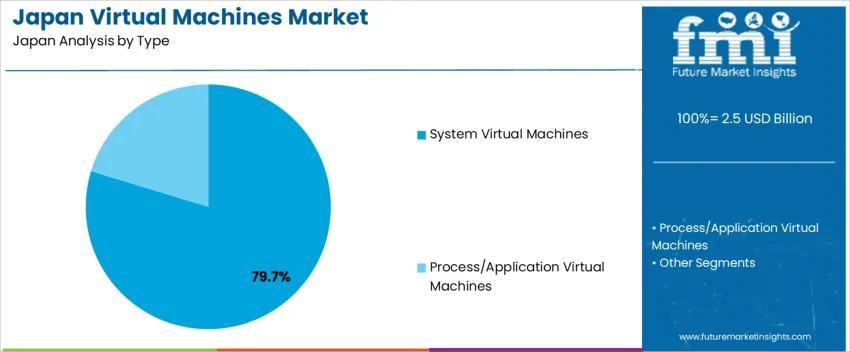
System virtual machines lead the demand for virtual machines in Japan, holding 80% of the market share. System virtual machines allow users to run entire operating systems (OS) within a host system, providing full virtualization of the hardware. This technology is widely used to create virtualized environments for server consolidation, testing, and running multiple operating systems on a single physical machine. System virtual machines offer significant cost savings and operational flexibility by allowing businesses to optimize their computing resources and manage workloads more effectively.
The demand for system virtual machines is driven by their ability to enhance IT infrastructure, improve resource utilization, and simplify management in data centers and enterprise environments. As businesses seek to reduce costs, improve scalability, and enable faster provisioning of computing resources, system virtual machines continue to be the preferred solution. With the increasing adoption of cloud computing and the growing need for efficient and flexible IT systems, the demand for system virtual machines is expected to remain dominant in Japan’s virtual machine market.
How Is IT & Telecom Leading the End-Use Industry Demand for Virtual Machines in Japan?
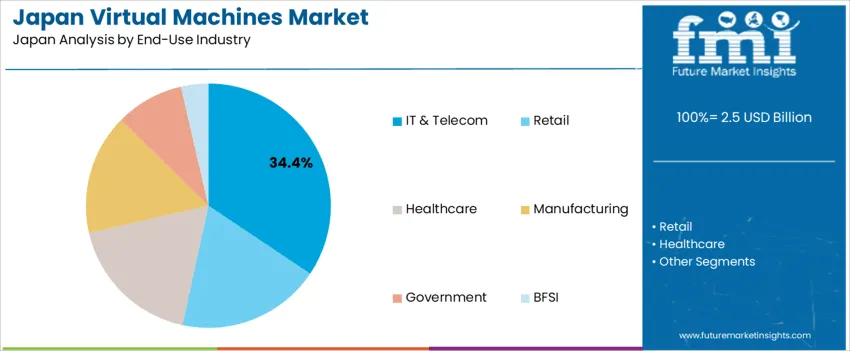
IT & telecom is the leading end-use industry for virtual machines in Japan, capturing 34.4% of the demand. In the IT and telecom sectors, virtual machines are used extensively to manage data centers, optimize server resources, and support cloud infrastructure. Virtualization allows for the efficient allocation of computing resources, which is essential in these industries where performance, scalability, and flexibility are critical. The use of virtual machines in IT & telecom is also fundamental in enabling the seamless operation of virtualized network functions, improving service delivery and reducing operational costs.
The demand for virtual machines in the IT & telecom industry is driven by the need for more efficient network management, better resource allocation, and the growing adoption of cloud services. As companies in Japan continue to migrate to cloud-based environments and implement more advanced IT solutions, virtual machines are central to these transitions, helping businesses scale their infrastructure and improve their overall IT operations. With the rapid evolution of cloud computing, big data, and telecommunications, the IT & telecom industry will continue to be a major driver of virtual machine adoption in Japan.
What is the Summary of Demand for Virtual Machines in Japan?
Demand for virtual machines in Japan is increasing as businesses transition to cloud computing, digital transformation, and flexible IT infrastructures. Virtual machines (VMs) are widely used for server virtualization and the creation of scalable, on demand computing environments. The growing reliance on cloud services, hybrid cloud models, and virtualization technologies across industries such as IT, finance, healthcare, and manufacturing contributes to this demand. VMs enable companies to optimize resource usage, reduce costs, and improve business continuity. With these benefits, the demand for virtual machines in Japan is expected to continue expanding.
What are the Drivers of Demand for Virtual Machines in Japan?
Several factors drive the demand for virtual machines in Japan. Cloud computing adoption is one of the main drivers as businesses increasingly migrate to the cloud to leverage scalable, cost efficient infrastructure. Virtual machines are integral to cloud services, enabling virtualization of servers, storage, and networking resources. The rise of digital transformation in industries such as finance, healthcare, and manufacturing also contributes to the growing use of VMs for data processing, automation, and resource management. Additionally, the increasing popularity of hybrid cloud models encourages the deployment of virtual machines to balance public and private cloud resources. Moreover, the demand for remote work solutions has boosted the adoption of virtual machines, as they provide centralized, secure computing environments that can be accessed remotely.
What are the Restraints on Demand for Virtual Machines in Japan?
Despite the growing demand, there are several restraints on the use of virtual machines in Japan. Security and compliance concerns are significant in sectors such as finance and healthcare, where strict data privacy regulations apply. Organizations may hesitate to fully migrate sensitive data to virtualized or public cloud environments due to fears of data breaches or non compliance with regulations. Cost is another potential barrier; although VMs can reduce the need for physical infrastructure, operational expenses can still be high, especially for resource intensive applications. Integration challenges with legacy systems can also slow adoption, as existing IT environments may not easily support virtualization. Finally, some businesses, particularly those with critical performance or low latency needs, may prefer dedicated physical servers over virtualized solutions.
What are the Key Trends Influencing Demand for Virtual Machines in Japan?
Key trends influencing the demand for virtual machines in Japan include the increasing adoption of hybrid cloud architectures, which use VMs to provide flexible and scalable infrastructure across public and private clouds. Another trend is the growing use of virtual machines to support data heavy applications like artificial intelligence, machine learning, and big data analytics, which require flexible, high performance computing environments. The rise of remote work and virtual desktop infrastructure (VDI) is also driving VM demand as organizations seek secure, centralized environments for their distributed workforce. Additionally, the ongoing modernization of legacy systems through virtualization allows businesses to upgrade their IT infrastructure without the need for costly hardware replacements. These trends suggest that virtual machines will continue to play a critical role in the future of Japan's IT and cloud computing sectors.
What is the Regional Demand Outlook for Virtual Machines in Japan?
The demand for virtual machines in Japan shows strong growth across regions, with Kyushu & Okinawa leading at a CAGR of 17.1%. Kanto follows with a CAGR of 15.7%, supported by the region's advanced IT infrastructure. The Kinki region shows steady growth at 13.8%, while Chubu, Tohoku, and the Rest of Japan exhibit moderate growth, with respective CAGRs of 12.1%, 10.6%, and 10.1%. These differences reflect varying levels of technological adoption, industrial focus, and regional initiatives in cloud computing and virtualization technologies.
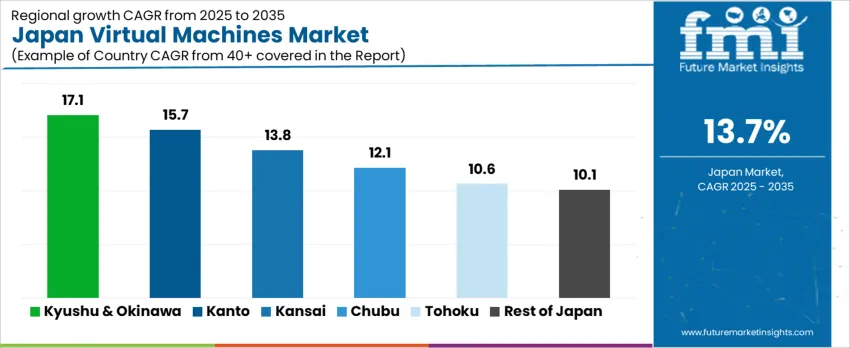
| Region | CAGR (%) |
|---|---|
| Kyushu & Okinawa | 17.1 |
| Kanto | 15.7 |
| Kinki | 13.8 |
| Chubu | 12.1 |
| Tohoku | 10.6 |
| Rest of Japan | 10.1 |
What factors are driving the demand for virtual machines in Kyushu & Okinawa?
The demand for virtual machines in Kyushu & Okinawa is projected to grow at a CAGR of 17.1%, driven by the region’s emphasis on digital transformation and IT infrastructure development. Kyushu & Okinawa are seeing a rise in cloud computing adoption, particularly in government and business sectors, as companies in the region increasingly rely on virtual machines for scaling their operations, improving IT efficiency, and enabling remote work. The region’s growing focus on innovation in information technology, combined with government initiatives to promote digital infrastructure, contributes to this rapid demand for virtual machines. The increasing adoption of virtualization technology across industries such as education, healthcare, and manufacturing further supports this growth.
Why is the demand for virtual machines increasing in Kanto?
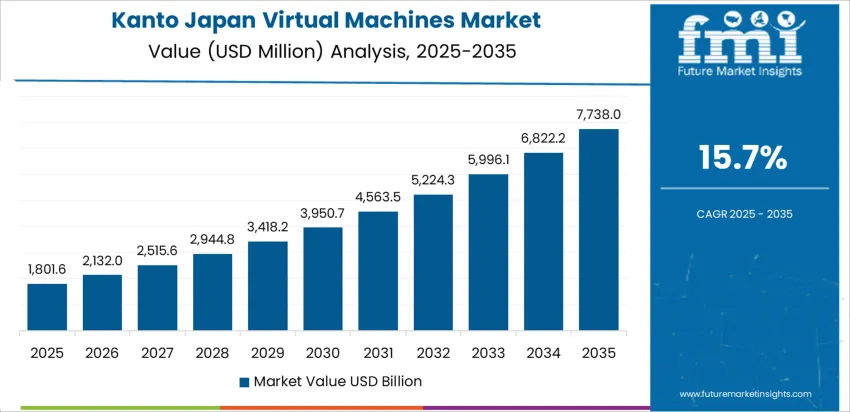
In Kanto, the demand for virtual machines is expected to grow at a CAGR of 15.7%, supported by the region’s strong technological and industrial base. Kanto, which includes Tokyo and its surrounding metropolitan area, has a high concentration of enterprises, including IT companies, financial institutions, and multinational corporations, all of which require advanced computing resources. The region’s push towards digital transformation and the increasing use of cloud services in various sectors are significant factors driving the need for virtual machines. As businesses look for flexible, scalable solutions to support their IT infrastructure, the demand for virtual machines continues to rise. Additionally, Kanto’s robust data center ecosystem and the increasing shift toward hybrid and multi-cloud environments are contributing to the growth of virtual machine adoption.
What influences the demand for virtual machines in Kinki?
The demand for virtual machines in Kinki is projected to grow at a CAGR of 13.8%, driven by the region’s diverse industrial and technological activities. Kinki, which includes major cities such as Osaka and Kyoto, is home to a variety of industries, including manufacturing, technology, and finance. The demand for virtual machines in the region is supported by the need for scalable IT solutions that can accommodate growing workloads and data management needs. As companies in Kinki continue to digitalize their operations and adopt cloud technologies, virtual machines are becoming an essential component of their IT strategy. The region’s established industrial base, combined with the rise in e-commerce and remote working, ensures sustained demand for virtualization technologies.
How is the demand for virtual machines growing in Chubu?
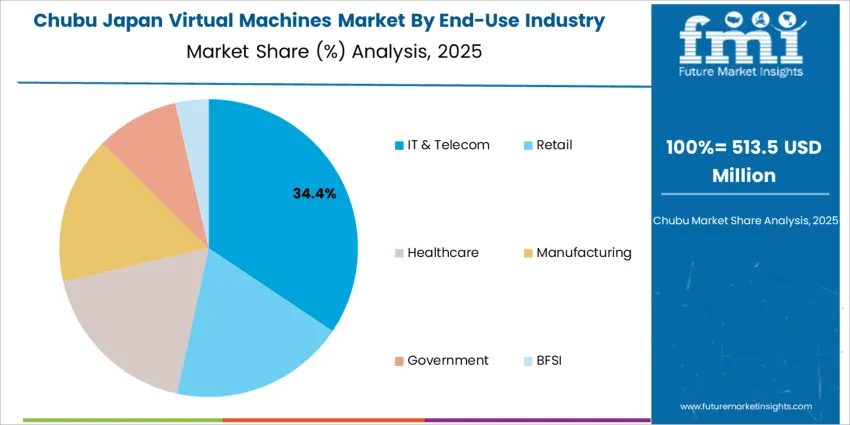
The demand for virtual machines in Chubu is expected to grow at a CAGR of 12.1%, reflecting steady growth driven by the region’s industrial sector. Chubu, home to Nagoya and other industrial centers, has a strong presence in manufacturing, automotive, and electronics industries. These industries are increasingly adopting virtualized IT environments to improve operational efficiency, enhance data security, and support remote work. The growing focus on cloud computing and digital transformation in Chubu is pushing companies to embrace virtual machines for flexibility and scalability. While growth in Chubu is slower compared to Kyushu & Okinawa and Kanto, the demand for virtual machines is expected to remain robust as industries continue to modernize and optimize their IT infrastructure.
What factors are influencing the demand for virtual machines in Tohoku?
In Tohoku, the demand for virtual machines is projected to grow at a CAGR of 10.6%, driven by the region’s ongoing efforts to modernize its industrial and technological sectors. Tohoku, which has a smaller industrial base compared to other regions, is seeing increasing adoption of digital technologies as businesses and government agencies in the region look to improve their IT infrastructure. The demand for virtual machines is rising as companies in Tohoku seek cost-effective and flexible computing solutions to support data processing, disaster recovery, and remote work. Additionally, Tohoku’s growing focus on innovation in renewable energy and industrial automation is driving the adoption of virtual machines in these sectors, contributing to moderate but steady growth in demand.
How is the demand for virtual machines evolving in the Rest of Japan?
In the Rest of Japan, the demand for virtual machines is expected to grow at a CAGR of 10.1%, reflecting moderate growth as smaller and less industrialized regions continue to adopt cloud computing and virtualization technologies. While the Rest of Japan has fewer large-scale data centers and IT hubs, the increasing focus on digitalization in rural areas is driving demand for virtual machines. Local businesses and government organizations are adopting virtual machines to improve efficiency, reduce costs, and support remote operations. As the region’s industries continue to digitalize and cloud adoption expands, demand for virtual machines is expected to grow steadily, contributing to overall market growth in Japan.
How Are Companies Competing in the Virtual Machines Industry in Japan?
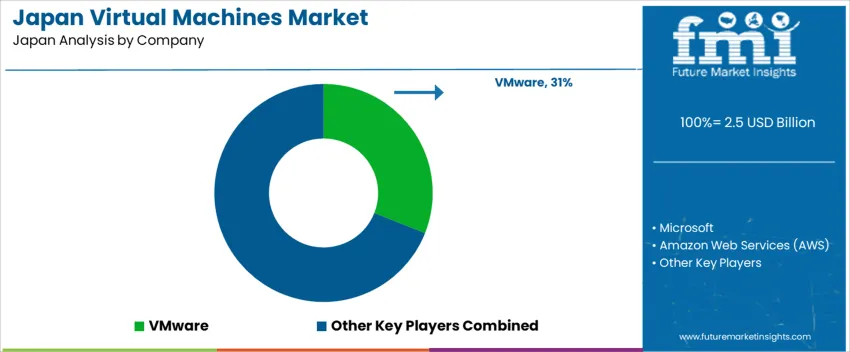
Demand for virtual machines (VMs) in Japan is rising as businesses across industries increase adoption of cloud computing, remote work infrastructure, and scalable IT environments. Leading providers in this market include VMware (holding about 31% market share), Microsoft, Amazon Web Services (AWS), Google Cloud, and Oracle. These companies supply VM services to enterprises looking for flexible compute power, workload isolation, and efficient resource allocation. Demand reflects needs in sectors such as finance, manufacturing, retail, and IT services, particularly where legacy applications are migrated to cloud or hybrid cloud environments.
Competition in this market centers on performance, ecosystem integration, and service reliability. Providers differentiate through VM performance metrics such as CPU, memory, I/O throughput, and uptime guarantees. Another axis of competition is integration with broader cloud platforms and enterprise tools — for example compatibility with existing IT infrastructure, managed services, and automation capabilities. Pricing flexibility, scalability, and data region compliance also influence enterprise decisions, especially in heavily regulated industries. Companies that offer strong security, data protection, and local support tend to gain preference among Japanese firms. Through optimized performance, flexible deployment models, and robust support, these providers aim to expand their share in Japan’s virtual machines market.
Key Players of the Virtual Machines Industry in Japan
- VMware
- Microsoft
- Amazon Web Services (AWS)
- Google Cloud
- Oracle
Scope of the Report
| Items | Details |
|---|---|
| Quantitative Units | USD Billion |
| Regions Covered | Japan |
| Type | Process/Application Virtual Machines, System Virtual Machines |
| End-Use Industry | IT & Telecom, Retail, Healthcare, Manufacturing, Government, BFSI |
| Key Companies Profiled | VMware, Microsoft, Amazon Web Services (AWS), Google Cloud, Oracle |
| Additional Attributes | The market analysis includes dollar sales by virtual machine type, end-use industry, and company categories. It also covers regional demand trends in Japan, driven by the increasing adoption of virtual machines across industries like IT, telecom, healthcare, and BFSI (Banking, Financial Services, and Insurance). The competitive landscape highlights key manufacturers focusing on innovations in virtual machine technologies, including system and application virtual machines. Trends in the growing demand for virtualized environments to improve scalability, efficiency, and resource management in cloud computing and enterprise IT infrastructures are explored, along with advancements in automation and security for virtualized systems. |
Key Segments of the Demand for Virtual Machines in Japan
Type:
- Process/Application Virtual Machines
- System Virtual Machines
End-Use Industry:
- IT & Telecom
- Retail
- Healthcare
- Manufacturing
- Government
- BFSI
Region:
- Kyushu & Okinawa
- Kanto
- Kinki
- Chubu
- Tohoku
- Rest of Japan
Frequently Asked Questions
How big is the demand for virtual machines in Japan in 2025?
The demand for virtual machines in Japan is estimated to be valued at USD 2.5 billion in 2025.
What will be the size of virtual machines in Japan in 2035?
The market size for the virtual machines in Japan is projected to reach USD 9.0 billion by 2035.
How much will be the demand for virtual machines in Japan growth between 2025 and 2035?
The demand for virtual machines in Japan is expected to grow at a 13.7% CAGR between 2025 and 2035.
What are the key product types in the virtual machines in Japan?
The key product types in virtual machines in Japan are system virtual machines and process/application virtual machines.
Which end-use industry segment is expected to contribute significant share in the virtual machines in Japan in 2025?
In terms of end-use industry, it & telecom segment is expected to command 34.4% share in the virtual machines in Japan in 2025.
Preview the report firsthand - request a free sample
Get SampleGet the brochure for pricing and purchase details.
Get PDFTable of Content
- Executive Summary
- Japan Market Outlook
- Demand-side Trends
- Supply-side Trends
- Technology Roadmap Analysis
- Analysis and Recommendations
- Market Overview
- Market Coverage / Taxonomy
- Market Definition / Scope / Limitations
- Market Background
- Market Dynamics
- Drivers
- Restraints
- Opportunity
- Trends
- Scenario Forecast
- Demand in Optimistic Scenario
- Demand in Likely Scenario
- Demand in Conservative Scenario
- Opportunity Map Analysis
- Product Life Cycle Analysis
- Supply Chain Analysis
- Investment Feasibility Matrix
- Value Chain Analysis
- PESTLE and Porter’s Analysis
- Regulatory Landscape
- Regional Parent Market Outlook
- Production and Consumption Statistics
- Import and Export Statistics
- Market Dynamics
- Japan Market Analysis 2020 to 2024 and Forecast, 2025 to 2035
- Historical Market Size Value (USD Million) Analysis, 2020 to 2024
- Current and Future Market Size Value (USD Million) Projections, 2025 to 2035
- Y-o-Y Growth Trend Analysis
- Absolute $ Opportunity Analysis
- Japan Market Pricing Analysis 2020 to 2024 and Forecast 2025 to 2035
- Japan Market Analysis 2020 to 2024 and Forecast 2025 to 2035, By Type
- Introduction / Key Findings
- Historical Market Size Value (USD Million) Analysis By Type , 2020 to 2024
- Current and Future Market Size Value (USD Million) Analysis and Forecast By Type , 2025 to 2035
- System Virtual Machines
- Process/Application Virtual Machines
- Y-o-Y Growth Trend Analysis By Type , 2020 to 2024
- Absolute $ Opportunity Analysis By Type , 2025 to 2035
- Japan Market Analysis 2020 to 2024 and Forecast 2025 to 2035, By End-Use Industry
- Introduction / Key Findings
- Historical Market Size Value (USD Million) Analysis By End-Use Industry, 2020 to 2024
- Current and Future Market Size Value (USD Million) Analysis and Forecast By End-Use Industry, 2025 to 2035
- IT & Telecom
- Retail
- Healthcare
- Manufacturing
- Government
- BFSI
- Y-o-Y Growth Trend Analysis By End-Use Industry, 2020 to 2024
- Absolute $ Opportunity Analysis By End-Use Industry, 2025 to 2035
- Market Structure Analysis
- Competition Dashboard
- Competition Benchmarking
- Market Share Analysis of Top Players
- By Regional
- By Type
- By End-Use Industry
- Competition Analysis
- Competition Deep Dive
- VMware
- Overview
- Product Portfolio
- Profitability by Market Segments (Product/Age /Sales Channel/Region)
- Sales Footprint
- Strategy Overview
- Marketing Strategy
- Product Strategy
- Channel Strategy
- Microsoft
- Amazon Web Services (AWS)
- Google Cloud
- Oracle
- VMware
- Competition Deep Dive
- Assumptions & Acronyms Used
- Research Methodology


