

- 2025 (base history)
- USD 1.03 Bn
- 2026 (current)
- USD 1.12 Bn
- 2036 (forecast)
- USD 2.69 Bn
- CAGR (2026–2036)
- 9.2%
How big is the jobsite battery charging infrastructure market in 2026?
USD 1.12 billion in 2026 and USD 2.69 billion by 2036 at a 9.2% CAGR.
The jobsite battery charging infrastructure industry value is forecast to grow from USD 1.03 billion in 2025 to USD 2.69 billion by 2036 at 9.2% CAGR as contractors, landscapers, rental yards and municipal crews move from loose single chargers to managed charging racks, mobile hubs and trailer-ready systems. Multi-port chargers are projected to represent 41.0% share in 2026 because crews need batch charging after each shift. Grid AC is expected to hold 57.0% share in 2026 as depots and job trailers use existing electrical supply.
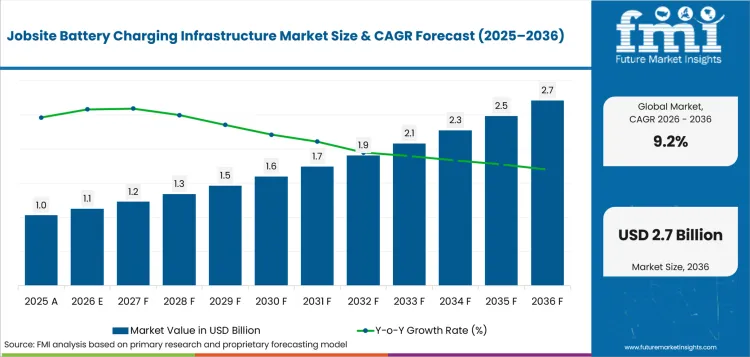
Jobsite Battery Charging Infrastructure Market Overview: Size and Forecast
- 2025 (base history): USD 1.03 billion
- 2026 (current): USD 1.12 billion
- 2036 (forecast): USD 2.69 billion
- CAGR (2026–2036): 9.2%
- Leading Product Type: Multi-port Chargers
- Multi-port Chargers Share in 2026: 41.0%
- Leading Power Source: Grid AC
- Grid AC Share in 2026: 57.0%
- Fastest-growing Country: India
- India CAGR: 11.3% by 2036
Summary of the Jobsite Battery Charging Infrastructure Market
- Demand and Growth Drivers
- Construction crews are adding more cordless tools per worker, raising the need for organized battery rotation.
- Landscaping fleets are shifting toward battery mowers, trimmers and blowers, making overnight charging capacity more important.
- Rental yards need visible pack status so returned battery kits can be checked before the next hire.
- Van and trailer integrators are turning charging systems into mobile workflow assets for route-based service teams.
- Product and Segment View
- Multi-port chargers are projected to lead Product Type with 41.0% share in 2026 as crews need batch charging after each shift.
- Grid AC is expected to lead Power Source with 57.0% share in 2026 as depots and job trailers use existing electrical supply.
- Landscaping is projected to lead End Use with 36.0% share in 2026 as battery mowing and trimming raise pack counts.
- Fixed racks are expected to lead Mobility with 44.0% share in 2026 as tool rooms centralize battery storage and charging.
- Dealer networks are projected to lead Sales Channel with 42.0% share in 2026 because buyers need platform advice and service support.
- Geography and Competitive Outlook
- India is projected to record 11.3% CAGR through 2036 as construction growth and dealer-led power-tool sales support adoption.
- China is expected to expand at 10.5% CAGR through 2036 as cordless-tool manufacturing scale supports local charging systems.
- The United States is forecast to grow at 10.1% CAGR through 2036 as rental yards, contractors and landscaping fleets manage larger battery pools.
- Competition is led by Stanley Black & Decker, Milwaukee Tool, STIHL, Husqvarna Group, Chervon, Bosch and Hilti.
- Analyst Opinion
- Nikhil Kaitwade, Senior Consultant at FMI, observes, “Jobsite charging is now a fleet logistics decision rather than an accessory purchase. Contractors are paying for uptime, outlet control and battery visibility. Suppliers that connect bay count, cooling and service coverage to the way crews leave and return to depots should gain stronger fleet accounts.”
Product planning is moving toward higher charging density and better battery visibility. Milwaukee launched the ROLL-ON power supply in March 2024 with 7,200W starting power and a 2.5 kWh battery. Bosch stated in September 2025 that its EXPERT EXAL18V-160 charger can charge an EXBA18V-80 pack in 39 minutes. EGO’s commercial PGX system is positioned to charge up to 70 batteries overnight. These examples show why professional buyers compare bay count, cooling and outlet limits before adding new cordless platforms.
The jobsite battery charging infrastructure market is expected to expand through 2036 as professional tool batteries move from kit-level accessories into fleet workflow systems. Demand is led by multi-port chargers, fixed racks and grid AC charging because contractors and landscapers need better pack rotation before crews leave depots, trailers and rental yards.
Country-wise CAGR Projections (2026–2036)
India leads growth at 11.3% CAGR through 2036, ahead of China at 10.5% and the USA at 10.1%, as construction expansion and cordless tool adoption drive regional demand for charging infrastructure.
- India: 11.3% CAGR
- China: 10.5% CAGR
- USA: 10.1% CAGR
Which factors support expansion in the jobsite battery charging infrastructure market?
Finished charging-system revenue and managed battery workflows support market value across professional jobsite channels.
- Market value is supported by higher jobsite battery counts before software and mobile hubs add incremental revenue.
- Supplier pricing reflects bay count, inverter capacity, outlet compatibility and cooling before fleet analytics affect replacement buying.
- Revenue improves as contractors shift from kit chargers to installed racks, mobile hubs and trailer-ready charging systems.
- Retail trust rises when charging systems show pack status and reduce loose-battery handling inside trailers and depots.
- Dealer networks support repeat demand when they link charger selection with battery platform, warranty support and jobsite layout advice.
Why is the jobsite battery charging infrastructure market growing?
Demand also connects with professional power tools because contractors evaluate chargers alongside platform expansion.
- Crews now run more cordless tools per worker, which raises battery rotation needs during each shift.
- Professional landscaping crews need overnight charging capacity for many battery packs after route work.
- Construction sites are replacing small fuel engines with battery equipment in concrete and cutting tasks.
- Rental yards need visible charging control because returned packs must be ready for the next customer.
- Van integrators are turning charging into a mobile workflow item for route-based service teams.
Charging bottlenecks are visible when a crew carries many batteries but has limited outlets. The U.S. Census Bureau estimated April 2026 construction spending at a seasonally adjusted annual rate of USD 2,172.4 billion. That project base creates scattered sites where battery tools must be charged without slowing crews. Higher-density charging racks can reduce loose chargers and wall-outlet clutter inside trailers. This supports premium demand for systems with thermal control, status lights and organized pack storage.
How is the jobsite battery charging infrastructure market segmented?
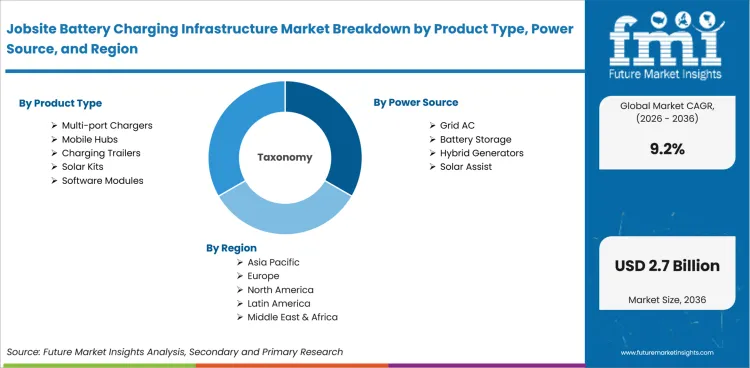
The jobsite battery charging infrastructure industry is segmented by product type, power source, end use, mobility, sales channel and region.
- Multi-port chargers are projected to account for 41.0% of Product Type demand in 2026 as crews replace loose single-bay chargers with gang charging.
- Grid AC is expected to lead Power Source demand with 57.0% share in 2026 through depot and trailer charging.
- Landscaping buyers are projected to account for 36.0% of End Use demand in 2026 with battery mowers and blowers driving pack count.
- Fixed racks are anticipated to hold 44.0% of Mobility demand in 2026 as tool rooms need controlled battery parking.
- Dealer networks are expected to direct 42.0% of Sales Channel revenue in 2026 with service support shaping platform choice.
Segmentation reflects how charging is bought in practice. A contractor may start with the charger inside a tool kit. Larger crews quickly need a rack, a power controller or a mobile hub. Bosch lists a six-bay GAL 18V6-80 charger for continuous charging and an EXPERT EXAL18V-160 charger with 16A current. Adjacent electric power tools and portable power stations raise pressure on shared battery systems.
Why do multi-port chargers lead the jobsite battery charging infrastructure market?
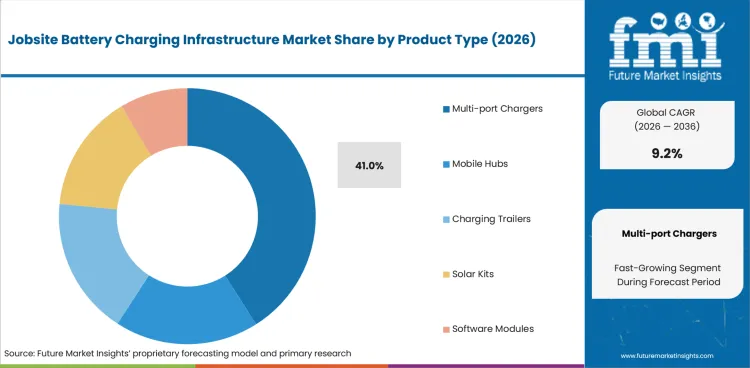
- Multi-port chargers are projected to hold 41.0% product share in 2026 as crews need one controlled charging point for many packs after each shift.
- Buyer comparison centers on bay count and cooling speed. Bosch’s 16A EXPERT charger can fill an EXBA18V-80 pack in 39 minutes.
Why does Grid AC lead power-source demand in the jobsite battery charging infrastructure market?
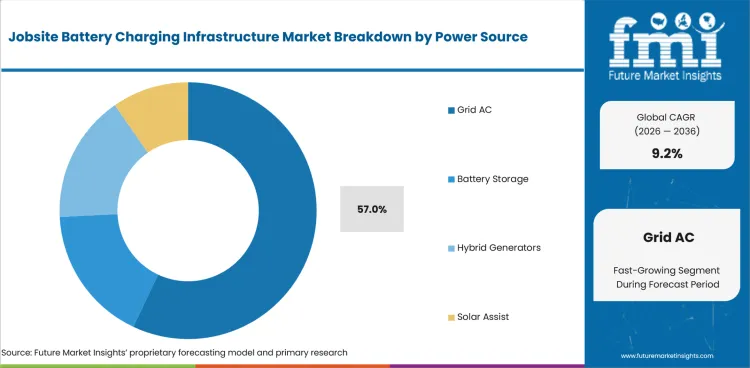
- Grid AC is estimated to hold 57.0% power-source share in 2026 as depots and job trailers already have usable 120V or 230V supply.
- The segment’s limit is outlet loading. STIHL’s CM 6 design supports multiple chargers from a standard job-trailer supply.
Why does landscaping lead end-use demand in the jobsite battery charging infrastructure market?
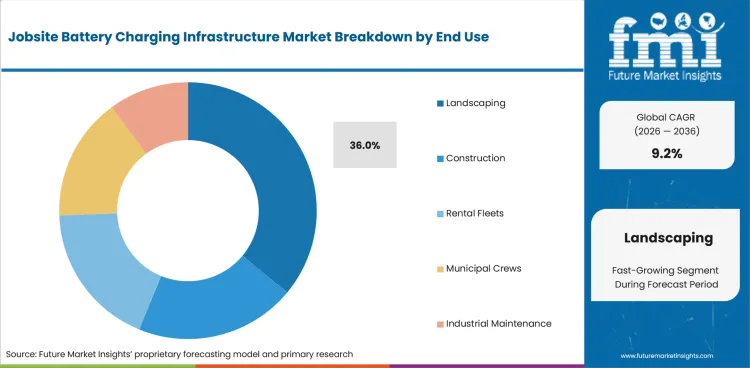
- Landscaping is anticipated to account for 36.0% end-use share in 2026 as crews charge batteries for mowing, trimming and blowing routes.
- Landscape buyers value overnight readiness over peak wattage. EGO’s PGX commercial charging system is positioned to charge up to 70 batteries overnight.
Why do fixed racks lead mobility demand in the jobsite battery charging infrastructure market?
- Fixed racks are expected to represent 44.0% mobility share in 2026 as tool rooms centralize batteries before crews leave the yard.
- Fixed racks reduce battery loss and fire exposure by moving loose packs off benches. This favors dealer-supplied cabinets and electrician-installed outlets.
Why do dealer networks lead jobsite battery charging infrastructure sales?
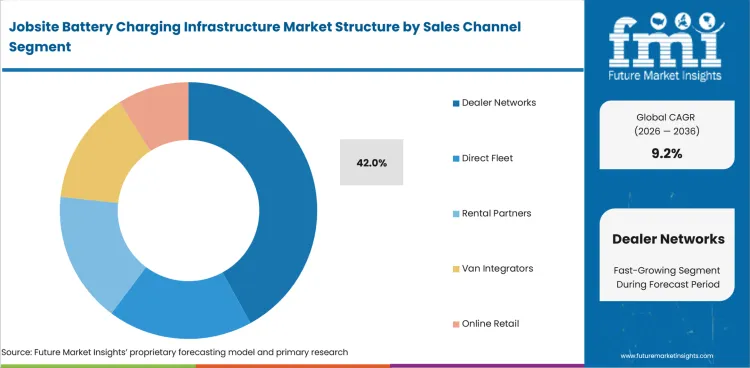
- Dealer networks are projected to account for 42.0% sales-channel share in 2026 as professional buyers need platform advice and warranty support.
- Dealer-led sales benefit from charger demos because buyers compare battery cooling, charging time and fit with existing tool platforms before standardizing purchases.
What are the drivers, restraints and opportunities in the jobsite battery charging infrastructure market?
Battery fleet growth supports charging infrastructure demand while temporary site power and mixed battery platforms restrain faster adoption.
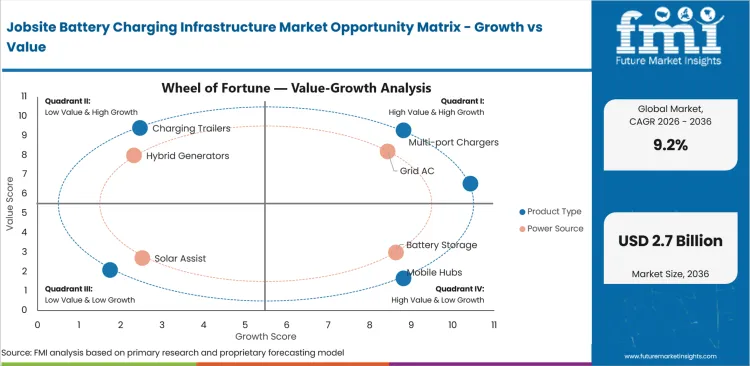
- Driver: Battery fleet growth raises the need for bay count, charger cooling and status visibility.
- Driver: Trailer electrification creates demand for 15A and 20A compatible charging layouts.
- Driver: Rental-yard workflows create demand for charging racks that show pack status before hire.
- Restraint: Power availability can limit fast-charger value on sites with weak temporary electrical supply.
- Opportunity: Software tied to charger location, battery health and fleet ownership can create higher-value service revenue.
Battery Rotation Bottlenecks
Battery rotation is the core driver because crews no longer run one cordless drill and one charger. Milwaukee’s ROLL-ON power supply was launched in March 2024 with two 20A GFCI duplex outlets and support for two to four operators per unit. As tools draw more energy, crews need chargers that can recover packs during breaks and overnight.
Trailer Outlet Limits
Trailer power is a real restraint because many sites have limited current and several chargers pulling from one circuit. Buyers are expected to prefer systems that prevent tripped breakers and battery overheating. This shifts product competition toward power control, thermal design and simple installation.
Jobsite Battery Charging Infrastructure Market Demand Outlook
Demand outlook is moving toward charging systems that can prove battery readiness before each work shift. Professional buyers are expected to compare charger density, outlet loading, temperature control and platform compatibility. Multi-port chargers give smaller fleets a starting point, while mobile hubs and racks serve larger contractors and rental yards.
Landscaping creates a strong use case because crews return with many depleted packs after route work. California’s incentive spending on professional landscaping equipment shows how quickly battery tools can enter commercial fleets once capital support is available. Charging infrastructure becomes the hidden requirement after the tool purchase.
Buyer planning is also related to battery energy storage systems when fleets consider stored power for depots and mobile trailers.
Who are the leading companies in the jobsite battery charging infrastructure market?
Stanley Black & Decker, Milwaukee Tool, STIHL, Husqvarna Group, Chervon, Bosch, Hilti and EGO Power+ are key companies in the jobsite battery charging infrastructure market.
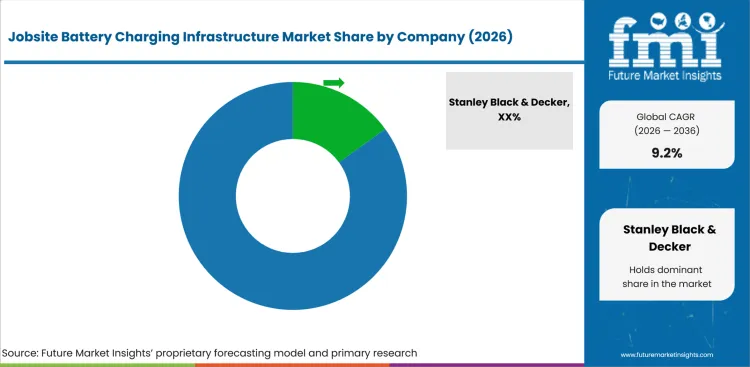
- Professional tool brands compete through battery platform scale, charging speed, bay count and dealer support.
- Landscaping equipment suppliers gain relevance where battery mowing, trimming and blowing require overnight charging discipline.
- Mobile jobsite power suppliers compete through inverter capacity, outlet control and trailer-ready charging layouts.
- Van-integration specialists gain share when they turn chargers, inverters and storage into route-ready mobile workstations.
Competition is led by professional tool brands, power-equipment suppliers and van-integration specialists. Stanley Black & Decker, Milwaukee Tool, STIHL, Husqvarna Group, Bosch and Hilti compete through battery platforms, charging speed, dealer service and field-ready accessories. Chervon and EGO strengthen the landscaping route through commercial battery systems.
The best-positioned suppliers are those that sell a charging plan rather than a charger alone. Fleet buyers are expected to prefer systems that combine bay count, cooling, installation support and service coverage. Dealer reach and platform lock-in should remain decisive through 2036.
How do top jobsite battery charging infrastructure companies compare?
Stanley Black & Decker and Milwaukee Tool score strongest on construction fleet relevance, while STIHL, Husqvarna Group and EGO Power+ are better positioned in commercial landscaping.
| Company | Charging Density | Battery Platform Scale | Mobile Jobsite Power | Dealer Coverage | Best-fit Channel |
|---|---|---|---|---|---|
| Stanley Black & Decker | High | High | Strong | Global | Construction fleets |
| Milwaukee Tool | High | High | Strong | North America and Europe | Contractors and trades |
| STIHL | High | High | Moderate | Global | Landscaping dealers |
| Husqvarna Group | Moderate | High | Moderate | Global | Landscaping fleets |
| Bosch Power Tools | High | High | Moderate | Global | Trade dealers |
| Hilti | Moderate | High | Strong | Global | Direct fleet |
| Chervon / EGO | High | High | Moderate | Global | Commercial landscaping |
Source: Future Market Insights competitive analysis, 2026.
Key Developments in Jobsite Battery Charging Infrastructure Market
- In January 2024, DEWALT unveiled POWERSHIFT as an electrified heavy-duty equipment system for concrete applications. The launch created a stronger need for chargers that support high-capacity construction batteries.
- In March 2024, Milwaukee Tool launched ROLL-ON with 7,200W starting power and a 2.5 kWh battery. The unit supports tool users who need mobile jobsite power and charging flexibility.
- In January 2024, Husqvarna Group stated that electrified products accounted for 42.0% of its motorized product sales. The disclosure supports the commercial shift toward battery equipment.
- In September 2025, Bosch Power Tools introduced EXPERT batteries and chargers for professional 18V users. The EXAL18V-160 charger supports high-current charging and faster pack recovery.
- In November 2025, Hilti launched Last Charged Location for Nuron batteries. The feature links battery data with jobsite visibility and tool control.
Who are the key players in the jobsite battery charging infrastructure market?
Key companies participating in the jobsite battery charging infrastructure market include:
Professional Tool and Battery Platform Companies
- Stanley Black & Decker
- Milwaukee Tool
- Bosch Power Tools
- Hilti
Landscaping and Outdoor Power Equipment Suppliers
- STIHL
- Husqvarna Group
- Chervon / EGO
Mobile Power and Worksite Integration Companies
- Generac Mobile Products
- Greenworks Commercial
- Sortimo
- Packout Vans
Which countries are growing fastest in the jobsite battery charging infrastructure market?
India 11.3% CAGR, China 10.5% CAGR, United States 10.1% CAGR, United Kingdom 9.8% CAGR, Germany 8.9% CAGR, France 8.5% CAGR, South Korea 8.1% CAGR and Japan 7.2% CAGR through 2036.
.webp "Top Country Growth Comparison Jobsite Battery Charging Infrastructure Market Cagr (2026 2036)")
| Country | CAGR |
|---|---|
| India | 11.3% |
| China | 10.5% |
| United States | 10.1% |
| United Kingdom | 9.8% |
| Germany | 8.9% |
| France | 8.5% |
| South Korea | 8.1% |
| Japan | 7.2% |
Source: Future Market Insights, 2026.
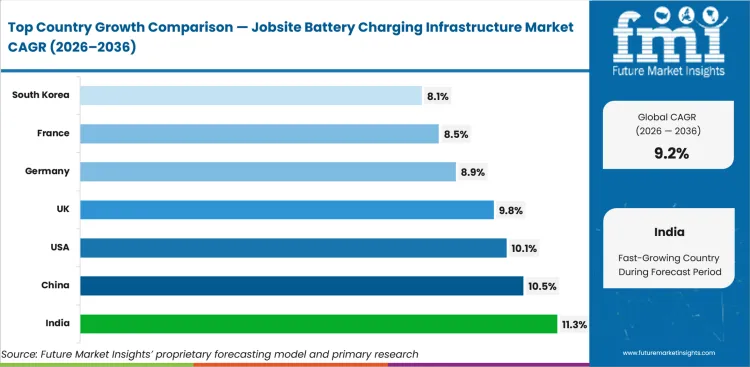
How do country-level CAGRs compare in the jobsite battery charging infrastructure market?
India leads country growth while Japan records the most cautious expansion outlook among profiled markets.
- India is projected to record 11.3% CAGR through 2036 as construction expansion and dealer-led power-tool sales support charging infrastructure adoption.
- China is expected to expand at 10.5% CAGR through 2036 as cordless-tool production and equipment-upgrade investment support local charger supply.
- The United States is forecast to grow at 10.1% CAGR through 2036 as contractors, rental yards and landscaping fleets add managed charging systems.
- The United Kingdom is projected to rise at 9.8% CAGR through 2036 as low-diesel site programs and tool-hire networks support controlled temporary charging.
- Germany is expected to grow at 8.9% CAGR through 2036 as Bosch, STIHL, Hilti and professional dealer networks anchor high-density charger access.
- France is forecast to expand at 8.5% CAGR through 2036 as public procurement and municipal maintenance fleets support depot charging.
- South Korea is projected to grow at 8.1% CAGR through 2036 as dense urban worksites and battery-manufacturing expertise support controlled charging formats.
- Japan is expected to advance at 7.2% CAGR through 2036 as compact urban work zones and disciplined rental operations support organized battery charging.
How fast is the jobsite battery charging infrastructure market growing in United States?
A 10.1% CAGR through 2036 reflects professional cordless tool adoption and managed charging needs across California and other work corridors.
Country Market Snapshot Table
| Parameter | Value |
|---|---|
| Market Size in 2025 (Value) | USD 258.9 million |
| Market Size in 2026 (Value) | USD 285.0 million |
| Market Forecast in 2036 (Value) | USD 746.0 million |
| CAGR (2026 to 2036) | 10.1% |
| Years Considered | 2021 to 2036 |
| Base Year | 2025 |
| Forecast Period | 2026 to 2036 |
| Units Considered | Value (USD million) |
| Leading Sub-Region | California, Texas, Florida, New York and Midwest rental corridors |
United States Jobsite Battery Charging Infrastructure Market Outlook
United States demand is influenced by professional tool electrification and the need to control battery readiness before crews leave depots or rental yards. Buyers are expected to prioritize bay count, outlet compatibility and service support over basic charger bundling.
Suppliers with clear installation guidance, safer battery storage and dealer support should gain stronger fleet confidence. Charging systems that fit existing site wiring are expected to move faster than complex power rooms.
Key Growth Drivers
- U.S. construction spending was estimated at USD 2,172.4 billion in April 2026, which supports scattered jobsites that need managed charging.
- California’s professional landscaping voucher program received a USD 30.0 million allocation, which supports battery equipment purchases that need depot charging.
- DEWALT POWERSHIFT and Milwaukee ROLL-ON are expected to raise charger density requirements for concrete and heavy-duty site crews.
- Rental yards are expected to add visible pack-status control before returned cordless kits go out on the next hire.
Key Restraints
- BLS reported 638,473 U.S. construction establishments with fewer than five employees in March 2025, which limits early uptake of larger charging rooms.
- Temporary site power limits are expected to reduce fast-charger value unless systems include current management.
- Small contractors are likely to delay premium racks when single-bay chargers still cover low battery counts.
What makes United States unique
The United States is unique because large construction spending, rental channels and California battery-equipment incentives create early fleet-charging demand.
Key Companies
- Stanley Black & Decker
- Milwaukee Tool
- Generac Mobile Products
- Greenworks Commercial
- EGO Power+
- Terex Utilities
- Packout Vans
Sales & Marketing Channels
- Professional tool dealers
- Rental yards
- Landscaping dealers
- Van integrators
- Municipal purchasing
- Online professional retail
Country Segment Breakdown Table
| Segment | Sub-Segments |
|---|---|
| By Product Type | Multi-port Chargers, Mobile Hubs, Charging Trailers, Solar Kits, Software Modules |
| By Power Source | Grid AC, Battery Storage, Hybrid Generators, Solar Assist |
| By End Use | Landscaping, Construction, Rental Fleets, Municipal Crews, Industrial Maintenance |
| By Mobility | Fixed Racks, Van-mounted, Trailer-mounted, Containerized |
| By Sales Channel | Dealer Networks, Direct Fleet, Rental Partners, Van Integrators, Online Retail |
Market Taxonomy and Sub-Regions Covered
| Key Sub-Regions Covered | Urban Retail and Worksite Clusters |
|---|---|
| California, Texas, Florida, New York and Midwest rental corridors | Professional tool dealers, Rental yards, Municipal depots, Van-service corridors |
Frequently Asked Questions
How fast is United States jobsite battery charging infrastructure market growing?
Sales in United States are projected to grow at 10.1% CAGR from 2026 to 2036, guided by cordless tool adoption and charging workflow needs.
Who leads United States jobsite battery charging infrastructure market?
Stanley Black & Decker, Milwaukee Tool, Generac Mobile Products and Greenworks Commercial compete through platform scale, mobile power and professional channel coverage.
What is driving adoption in United States jobsite battery charging infrastructure market?
Construction spending, rental-yard workflows and California battery-equipment incentives are moving contractors and landscapers toward managed charging systems.
How fast is the jobsite battery charging infrastructure market growing in United Kingdom?
A 9.8% CAGR through 2036 reflects professional cordless tool adoption and managed charging needs across Greater London and other work corridors.
Country Market Snapshot Table
| Parameter | Value |
|---|---|
| Market Size in 2025 (Value) | USD 78.3 million |
| Market Size in 2026 (Value) | USD 86.0 million |
| Market Forecast in 2036 (Value) | USD 219.0 million |
| CAGR (2026 to 2036) | 9.8% |
| Years Considered | 2021 to 2036 |
| Base Year | 2025 |
| Forecast Period | 2026 to 2036 |
| Units Considered | Value (USD million) |
| Leading Sub-Region | Greater London, South East England, Midlands, Manchester and Scotland project clusters |
United Kingdom Jobsite Battery Charging Infrastructure Market Outlook
United Kingdom demand is influenced by professional tool electrification and the need to control battery readiness before crews leave depots or rental yards. Buyers are expected to prioritize bay count, outlet compatibility and service support over basic charger bundling.
Suppliers with clear installation guidance, safer battery storage and dealer support should gain stronger fleet confidence. Charging systems that fit existing site wiring are expected to move faster than complex power rooms.
Key Growth Drivers
- ONS reported construction repair and maintenance output rose 3.4% in Q1 2026, which supports charger demand for maintenance and retrofit crews.
- DESNZ listed a GBP 4.5 million grant for the Element 1 low-carbon construction-site project in March 2025, which supports cleaner temporary power trials.
- Hire companies are expected to use charging racks to return batteries with clearer status before equipment redeployment.
- Urban contractors are expected to prefer quieter battery systems where diesel generators face tighter site restrictions.
Key Restraints
- DBT reported 5.64 million small UK private businesses at the start of 2025, which fragments purchasing for higher-priced fleet charging systems.
- Short-duration projects are expected to limit permanent rack installation because crews move tools between sites quickly.
- Temporary electrical capacity remains a practical constraint when several chargers draw power from the same site circuit.
What makes United Kingdom unique
The United Kingdom is unique because low-diesel site programs, hire networks and compact urban jobsites create demand for controlled temporary charging.
Key Companies
- Makita UK
- JCB Tools
- Hilti Great Britain
- Sunbelt Rentals UK
- Speedy Hire
- Sortimo UK
- GAP Hire Solutions
Sales & Marketing Channels
- Tool hire outlets
- Construction dealers
- Direct fleet procurement
- Van converters
- Municipal tenders
- Online professional retail
Country Segment Breakdown Table
| Segment | Sub-Segments |
|---|---|
| By Product Type | Multi-port Chargers, Mobile Hubs, Charging Trailers, Solar Kits, Software Modules |
| By Power Source | Grid AC, Battery Storage, Hybrid Generators, Solar Assist |
| By End Use | Landscaping, Construction, Rental Fleets, Municipal Crews, Industrial Maintenance |
| By Mobility | Fixed Racks, Van-mounted, Trailer-mounted, Containerized |
| By Sales Channel | Dealer Networks, Direct Fleet, Rental Partners, Van Integrators, Online Retail |
Market Taxonomy and Sub-Regions Covered
| Key Sub-Regions Covered | Urban Retail and Worksite Clusters |
|---|---|
| Greater London, South East England, Midlands, Manchester and Scotland project clusters | Professional tool dealers, Rental yards, Municipal depots, Van-service corridors |
Frequently Asked Questions
How fast is United Kingdom jobsite battery charging infrastructure market growing?
Sales in United Kingdom are projected to grow at 9.8% CAGR from 2026 to 2036, guided by cordless tool adoption and charging workflow needs.
Who leads United Kingdom jobsite battery charging infrastructure market?
Makita UK, JCB Tools, Hilti Great Britain, Sunbelt Rentals UK and Speedy Hire compete through tool hire, dealer reach and fleet charging support.
What is driving adoption in United Kingdom jobsite battery charging infrastructure market?
Low-diesel site programs and tool-hire networks are moving contractors toward controlled charging for compact urban worksites.
How fast is the jobsite battery charging infrastructure market growing in Germany?
A 8.9% CAGR through 2036 reflects professional cordless tool adoption and managed charging needs across North Rhine-Westphalia and other work corridors.
Country Market Snapshot Table
| Parameter | Value |
|---|---|
| Market Size in 2025 (Value) | USD 113.9 million |
| Market Size in 2026 (Value) | USD 124.0 million |
| Market Forecast in 2036 (Value) | USD 290.9 million |
| CAGR (2026 to 2036) | 8.9% |
| Years Considered | 2021 to 2036 |
| Base Year | 2025 |
| Forecast Period | 2026 to 2036 |
| Units Considered | Value (USD million) |
| Leading Sub-Region | North Rhine-Westphalia, Bavaria, Baden-Württemberg, Hesse and Lower Saxony |
Germany Jobsite Battery Charging Infrastructure Market Outlook
Germany demand is influenced by professional tool electrification and the need to control battery readiness before crews leave depots or rental yards. Buyers are expected to prioritize bay count, outlet compatibility and service support over basic charger bundling.
Suppliers with clear installation guidance, safer battery storage and dealer support should gain stronger fleet confidence. Charging systems that fit existing site wiring are expected to move faster than complex power rooms.
Key Growth Drivers
- Destatis reported 149,748 building-construction permits in 2025, which supports continued tool and charging needs across German worksites.
- Germany’s Federal Ministry of Finance reported EUR 24.0 billion from the infrastructure fund was disbursed in 2025, which supports public worksite exposure.
- Professional dealer networks are expected to bundle chargers with batteries and warranty advice for craft firms.
- EU battery compliance is expected to raise interest in controlled storage and traceable charging practices.
Key Restraints
- Eurostat reported Germany’s construction production was 1.9% lower year over year in January 2026, which can delay charger upgrades at active worksites.
- Craft firms using corded and pneumatic equipment are expected to switch charging infrastructure only after battery tools prove runtime.
- Premium rack pricing is expected to face resistance where small workshops already own platform-specific chargers.
What makes Germany unique
Germany is unique because Bosch, STIHL and professional dealers give buyers local access to high-density chargers and repair support.
Key Companies
- Robert Bosch Power Tools
- STIHL Group
- Husqvarna Deutschland
- Hilti Deutschland
- Sortimo International
- Metabo
- Festool
Sales & Marketing Channels
- Professional dealers
- Electrical wholesalers
- Construction rental firms
- Fleet-direct contracts
- Van-racking specialists
- Online trade stores
Country Segment Breakdown Table
| Segment | Sub-Segments |
|---|---|
| By Product Type | Multi-port Chargers, Mobile Hubs, Charging Trailers, Solar Kits, Software Modules |
| By Power Source | Grid AC, Battery Storage, Hybrid Generators, Solar Assist |
| By End Use | Landscaping, Construction, Rental Fleets, Municipal Crews, Industrial Maintenance |
| By Mobility | Fixed Racks, Van-mounted, Trailer-mounted, Containerized |
| By Sales Channel | Dealer Networks, Direct Fleet, Rental Partners, Van Integrators, Online Retail |
Market Taxonomy and Sub-Regions Covered
| Key Sub-Regions Covered | Urban Retail and Worksite Clusters |
|---|---|
| North Rhine-Westphalia, Bavaria, Baden-Württemberg, Hesse and Lower Saxony | Professional tool dealers, Rental yards, Municipal depots, Van-service corridors |
Frequently Asked Questions
How fast is Germany jobsite battery charging infrastructure market growing?
Sales in Germany are projected to grow at 8.9% CAGR from 2026 to 2036, guided by cordless tool adoption and charging workflow needs.
Who leads Germany jobsite battery charging infrastructure market?
Robert Bosch Power Tools, STIHL Group, Hilti Deutschland, Sortimo International and Metabo compete through local dealer access, platform support and charging hardware.
What is driving adoption in Germany jobsite battery charging infrastructure market?
Professional dealer networks, Bosch and STIHL platform access and infrastructure spending are supporting high-density charger adoption.
How fast is the jobsite battery charging infrastructure market growing in France?
A 8.5% CAGR through 2036 reflects professional cordless tool adoption and managed charging needs across Île-de-France and other work corridors.
Country Market Snapshot Table
| Parameter | Value |
|---|---|
| Market Size in 2025 (Value) | USD 64.5 million |
| Market Size in 2026 (Value) | USD 70.0 million |
| Market Forecast in 2036 (Value) | USD 158.3 million |
| CAGR (2026 to 2036) | 8.5% |
| Years Considered | 2021 to 2036 |
| Base Year | 2025 |
| Forecast Period | 2026 to 2036 |
| Units Considered | Value (USD million) |
| Leading Sub-Region | Île-de-France, Auvergne-Rhône-Alpes, Nouvelle-Aquitaine, Occitanie and Hauts-de-France |
France Jobsite Battery Charging Infrastructure Market Outlook
France demand is influenced by professional tool electrification and the need to control battery readiness before crews leave depots or rental yards. Buyers are expected to prioritize bay count, outlet compatibility and service support over basic charger bundling.
Suppliers with clear installation guidance, safer battery storage and dealer support should gain stronger fleet confidence. Charging systems that fit existing site wiring are expected to move faster than complex power rooms.
Key Growth Drivers
- INSEE reported construction production costs rose 1.6% year over year in Q4 2025, which makes downtime reduction a stronger buyer concern.
- OECD reported that 54.7% of French State procurement contracts included environmental considerations in 2023, which supports cleaner site-equipment buying.
- Municipal maintenance teams are expected to use depot chargers for parks, street works and public-building service routes.
- Battery documentation requirements are expected to push suppliers toward safer storage and clearer charging instructions.
Key Restraints
- INSEE reported construction output was 2.8% lower in Q1 2026 than one year earlier, which can delay charger upgrades outside maintenance work.
- Rental buyers are expected to require stronger service coverage before standardizing charging racks across branches.
- Fragmented subcontractor purchasing is expected to keep many buyers tied to basic chargers supplied inside tool kits.
What makes France unique
France is unique because public procurement rules and municipal maintenance fleets can connect battery tools with controlled depot charging.
Key Companies
- Hilti France
- Makita France
- Bosch Power Tools France
- Kiloutou
- Loxam
- Manitou Group
- Sortimo France
Sales & Marketing Channels
- Rental networks
- Public procurement
- Professional dealers
- Municipal fleet buyers
- Van converters
- Online professional retail
Country Segment Breakdown Table
| Segment | Sub-Segments |
|---|---|
| By Product Type | Multi-port Chargers, Mobile Hubs, Charging Trailers, Solar Kits, Software Modules |
| By Power Source | Grid AC, Battery Storage, Hybrid Generators, Solar Assist |
| By End Use | Landscaping, Construction, Rental Fleets, Municipal Crews, Industrial Maintenance |
| By Mobility | Fixed Racks, Van-mounted, Trailer-mounted, Containerized |
| By Sales Channel | Dealer Networks, Direct Fleet, Rental Partners, Van Integrators, Online Retail |
Market Taxonomy and Sub-Regions Covered
| Key Sub-Regions Covered | Urban Retail and Worksite Clusters |
| Île-de-France, Auvergne-Rhône-Alpes, Nouvelle-Aquitaine, Occitanie and Hauts-de-France | Professional tool dealers, Rental yards, Municipal depots, Van-service corridors |
Frequently Asked Questions
How fast is France jobsite battery charging infrastructure market growing?
Sales in France are projected to grow at 8.5% CAGR from 2026 to 2036, guided by cordless tool adoption and charging workflow needs.
Who leads France jobsite battery charging infrastructure market?
Hilti France, Makita France, Bosch Power Tools France, Kiloutou and Loxam compete through rental networks, professional dealers and public-fleet access.
What is driving adoption in France jobsite battery charging infrastructure market?
Public procurement rules and municipal maintenance fleets are connecting battery tools with controlled depot charging.
How fast is the jobsite battery charging infrastructure market growing in Japan?
A 7.2% CAGR through 2036 reflects professional cordless tool adoption and managed charging needs across Tokyo and other work corridors.
Country Market Snapshot Table
| Parameter | Value |
|---|---|
| Market Size in 2025 (Value) | USD 56.9 million |
| Market Size in 2026 (Value) | USD 61.0 million |
| Market Forecast in 2036 (Value) | USD 122.3 million |
| CAGR (2026 to 2036) | 7.2% |
| Years Considered | 2021 to 2036 |
| Base Year | 2025 |
| Forecast Period | 2026 to 2036 |
| Units Considered | Value (USD million) |
| Leading Sub-Region | Tokyo, Osaka, Nagoya, Fukuoka and Sapporo urban project corridors |
Japan Jobsite Battery Charging Infrastructure Market Outlook
Japan demand is influenced by professional tool electrification and the need to control battery readiness before crews leave depots or rental yards. Buyers are expected to prioritize bay count, outlet compatibility and service support over basic charger bundling.
Suppliers with clear installation guidance, safer battery storage and dealer support should gain stronger fleet confidence. Charging systems that fit existing site wiring are expected to move faster than complex power rooms.
Key Growth Drivers
- MLIT reported planned enterprise land investment of JPY 3,775.8 billion for FY2025, which supports jobsite activity tied to tools and charging.
- Japan’s FY2025 draft budget listed construction bond issuance of JPY 6,791.0 billion, which supports public works exposure for site equipment.
- Compact urban projects are expected to favor organized charging racks that reduce loose cords and battery misplacement.
- Rental firms are expected to prioritize charger systems that make returned batteries ready for the next booking.
Key Restraints
- Japan’s 2025 statistical handbook reported FY2023 construction investment at JPY 71.1 trillion, which shows charger suppliers must fit established procurement cycles.
- Brand-specific battery platforms are expected to slow standardization across mixed rental inventories.
- Smaller subcontractors are expected to delay rack purchases where single chargers meet daily tool needs.
What makes Japan unique
Japan is unique because compact urban work zones and disciplined rental operations favor organized charging over loose charger use.
Key Companies
- Makita Corporation
- HiKOKI
- Panasonic Holdings
- Yamabiko Corporation
- Actio Corporation
- Kanamoto
- Nishio Rent All
Sales & Marketing Channels
- Construction rental firms
- Professional dealers
- Direct fleet sales
- Municipal procurement
- Service-van integrators
- Online professional retail
Country Segment Breakdown Table
| Segment | Sub-Segments |
|---|---|
| By Product Type | Multi-port Chargers, Mobile Hubs, Charging Trailers, Solar Kits, Software Modules |
| By Power Source | Grid AC, Battery Storage, Hybrid Generators, Solar Assist |
| By End Use | Landscaping, Construction, Rental Fleets, Municipal Crews, Industrial Maintenance |
| By Mobility | Fixed Racks, Van-mounted, Trailer-mounted, Containerized |
| By Sales Channel | Dealer Networks, Direct Fleet, Rental Partners, Van Integrators, Online Retail |
Market Taxonomy and Sub-Regions Covered
| Key Sub-Regions Covered | Urban Retail and Worksite Clusters |
|---|---|
| Tokyo, Osaka, Nagoya, Fukuoka and Sapporo urban project corridors | Professional tool dealers, Rental yards, Municipal depots, Van-service corridors |
Frequently Asked Questions
How fast is Japan jobsite battery charging infrastructure market growing?
Sales in Japan are projected to grow at 7.2% CAGR from 2026 to 2036, guided by cordless tool adoption and charging workflow needs.
Who leads Japan jobsite battery charging infrastructure market?
Makita Corporation, HiKOKI, Panasonic Holdings, Yamabiko Corporation and major rental firms compete through local platform strength and organized tool channels.
What is driving adoption in Japan jobsite battery charging infrastructure market?
Compact urban projects and disciplined rental operations are supporting organized charging racks over loose charger use.
How fast is the jobsite battery charging infrastructure market growing in China?
A 10.5% CAGR through 2036 reflects professional cordless tool adoption and managed charging needs across Guangdong and other work corridors.
Country Market Snapshot Table
| Parameter | Value |
|---|---|
| Market Size in 2025 (Value) | USD 190.0 million |
| Market Size in 2026 (Value) | USD 210.0 million |
| Market Forecast in 2036 (Value) | USD 570.0 million |
| CAGR (2026 to 2036) | 10.5% |
| Years Considered | 2021 to 2036 |
| Base Year | 2025 |
| Forecast Period | 2026 to 2036 |
| Units Considered | Value (USD million) |
| Leading Sub-Region | Guangdong, Jiangsu, Zhejiang, Shanghai, Shandong and Beijing-Tianjin-Hebei clusters |
China Jobsite Battery Charging Infrastructure Market Outlook
China demand is influenced by professional tool electrification and the need to control battery readiness before crews leave depots or rental yards. Buyers are expected to prioritize bay count, outlet compatibility and service support over basic charger bundling.
Suppliers with clear installation guidance, safer battery storage and dealer support should gain stronger fleet confidence. Charging systems that fit existing site wiring are expected to move faster than complex power rooms.
Key Growth Drivers
- NBS reported fixed-asset investment excluding rural households at CNY 48,518.6 billion in 2025, which supports equipment purchasing exposure.
- SCIO reported equipment and tools investment rose 11.8% in 2025, which supports charger demand tied to worksite electrification.
- Domestic tool manufacturers are expected to localize multi-port chargers and mobile hubs for professional buyers.
- Municipal maintenance and industrial service teams are expected to adopt charging racks where battery tools replace fuel equipment.
Key Restraints
- NBS reported real estate development investment fell 17.2% in 2025, which weakens charger demand tied to property construction sites.
- Mixed battery platforms are expected to reduce willingness to buy fixed racks before contractors standardize tool brands.
- Price competition is expected to pressure suppliers that add software, cooling and safety hardware to basic chargers.
What makes China unique
China is unique because cordless-tool manufacturing scale and equipment-upgrade investment can support local charger production and lower unit costs.
Key Companies
- Chervon
- Positec Group
- Dongcheng Tools
- WORX China
- Kress China
- Greenworks China
- Lutian Machinery
Sales & Marketing Channels
- OEM-direct sales
- Industrial distributors
- Rental partners
- Online B2B platforms
- Municipal tenders
- Dealer networks
Country Segment Breakdown Table
| Segment | Sub-Segments |
|---|---|
| By Product Type | Multi-port Chargers, Mobile Hubs, Charging Trailers, Solar Kits, Software Modules |
| By Power Source | Grid AC, Battery Storage, Hybrid Generators, Solar Assist |
| By End Use | Landscaping, Construction, Rental Fleets, Municipal Crews, Industrial Maintenance |
| By Mobility | Fixed Racks, Van-mounted, Trailer-mounted, Containerized |
| By Sales Channel | Dealer Networks, Direct Fleet, Rental Partners, Van Integrators, Online Retail |
Market Taxonomy and Sub-Regions Covered
| Key Sub-Regions Covered | Urban Retail and Worksite Clusters |
|---|---|
| Guangdong, Jiangsu, Zhejiang, Shanghai, Shandong and Beijing-Tianjin-Hebei clusters | Professional tool dealers, Rental yards, Municipal depots, Van-service corridors |
Frequently Asked Questions
How fast is China jobsite battery charging infrastructure market growing?
Sales in China are projected to grow at 10.5% CAGR from 2026 to 2036, guided by cordless tool adoption and charging workflow needs.
Who leads China jobsite battery charging infrastructure market?
Chervon, Positec Group, Dongcheng Tools, WORX China and Greenworks China compete through local cordless-tool supply and industrial distribution.
What is driving adoption in China jobsite battery charging infrastructure market?
Cordless-tool manufacturing scale and equipment-upgrade investment are supporting local charger production and lower unit costs.
How fast is the jobsite battery charging infrastructure market growing in South Korea?
A 8.1% CAGR through 2036 reflects professional cordless tool adoption and managed charging needs across Seoul Capital Area and other work corridors.
Country Market Snapshot Table
| Parameter | Value |
|---|---|
| Market Size in 2025 (Value) | USD 35.2 million |
| Market Size in 2026 (Value) | USD 38.0 million |
| Market Forecast in 2036 (Value) | USD 82.8 million |
| CAGR (2026 to 2036) | 8.1% |
| Years Considered | 2021 to 2036 |
| Base Year | 2025 |
| Forecast Period | 2026 to 2036 |
| Units Considered | Value (USD million) |
| Leading Sub-Region | Seoul Capital Area, Busan, Incheon, Daegu and Ulsan industrial corridors |
South Korea Jobsite Battery Charging Infrastructure Market Outlook
South Korea demand is influenced by professional tool electrification and the need to control battery readiness before crews leave depots or rental yards. Buyers are expected to prioritize bay count, outlet compatibility and service support over basic charger bundling.
Suppliers with clear installation guidance, safer battery storage and dealer support should gain stronger fleet confidence. Charging systems that fit existing site wiring are expected to move faster than complex power rooms.
Key Growth Drivers
- KOSTAT reported construction orders rose 30.3% year over year in March 2026, which supports forward demand for tools and charging systems.
- U.S. International Trade Administration reported South Korea produced 407,009 EVs in 2025, which supports local battery and power-electronics capability.
- Battery-manufacturing expertise is expected to support safer charger design and thermal-control know-how.
- Dense city worksites are expected to favor organized charging that reduces loose cords and battery loss.
Key Restraints
- KDI reported construction decreased 7.3% month over month in March 2026, which can delay charger upgrades at active worksites.
- Mixed contractor fleets are expected to slow adoption where battery platforms are not standardized.
- Service coverage is expected to matter because buyers need fast repair for chargers used daily in rental and municipal work.
What makes South Korea unique
South Korea is unique because dense urban projects, battery-manufacturing expertise and service vans support controlled charging formats.
Key Companies
- LG Energy Solution
- Samsung SDI
- Hyundai Construction Equipment
- Korea Rental Corporation
- Kyungdong Navien
- Doosan Bobcat Korea
- Hilti Korea
Sales & Marketing Channels
- Industrial distributors
- Rental companies
- Direct fleet sales
- Municipal procurement
- Van integrators
- Online professional retail
Country Segment Breakdown Table
| Segment | Sub-Segments |
|---|---|
| By Product Type | Multi-port Chargers, Mobile Hubs, Charging Trailers, Solar Kits, Software Modules |
| By Power Source | Grid AC, Battery Storage, Hybrid Generators, Solar Assist |
| By End Use | Landscaping, Construction, Rental Fleets, Municipal Crews, Industrial Maintenance |
| By Mobility | Fixed Racks, Van-mounted, Trailer-mounted, Containerized |
| By Sales Channel | Dealer Networks, Direct Fleet, Rental Partners, Van Integrators, Online Retail |
Market Taxonomy and Sub-Regions Covered
| Key Sub-Regions Covered | Urban Retail and Worksite Clusters |
|---|---|
| Seoul Capital Area, Busan, Incheon, Daegu and Ulsan industrial corridors | Professional tool dealers, Rental yards, Municipal depots, Van-service corridors |
Frequently Asked Questions
How fast is South Korea jobsite battery charging infrastructure market growing?
Sales in South Korea are projected to grow at 8.1% CAGR from 2026 to 2036, guided by cordless tool adoption and charging workflow needs.
Who leads South Korea jobsite battery charging infrastructure market?
LG Energy Solution, Samsung SDI, Hyundai Construction Equipment, Korea Rental Corporation and Hilti Korea compete through battery expertise, rental access and fleet support.
What is driving adoption in South Korea jobsite battery charging infrastructure market?
Dense urban projects, battery-manufacturing expertise and service-van routes are supporting controlled charging formats.
How fast is the jobsite battery charging infrastructure market growing in India?
A 11.3% CAGR through 2036 reflects professional cordless tool adoption and managed charging needs across Delhi NCR and other work corridors.
Country Market Snapshot Table
| Parameter | Value |
|---|---|
| Market Size in 2025 (Value) | USD 43.1 million |
| Market Size in 2026 (Value) | USD 48.0 million |
| Market Forecast in 2036 (Value) | USD 140.0 million |
| CAGR (2026 to 2036) | 11.3% |
| Years Considered | 2021 to 2036 |
| Base Year | 2025 |
| Forecast Period | 2026 to 2036 |
| Units Considered | Value (USD million) |
| Leading Sub-Region | Delhi NCR, Maharashtra, Gujarat, Karnataka, Tamil Nadu and Telangana project corridors |
India Jobsite Battery Charging Infrastructure Market Outlook
India demand is influenced by professional tool electrification and the need to control battery readiness before crews leave depots or rental yards. Buyers are expected to prioritize bay count, outlet compatibility and service support over basic charger bundling.
Suppliers with clear installation guidance, safer battery storage and dealer support should gain stronger fleet confidence. Charging systems that fit existing site wiring are expected to move faster than complex power rooms.
Key Growth Drivers
- PIB reported India’s construction sector grew 9.4% in FY2024-25, which supports professional tool and charging demand.
- MOSPI reported construction grew 7.2% in Q2 FY2025-26, which supports continued jobsite equipment purchases.
- Dealer-led tool sales are expected to bundle batteries, chargers and platform advice for contractors entering cordless workflows.
- Service-van integrators are expected to turn chargers and inverters into mobile support units for route-based crews.
Key Restraints
- PIB reported AT&C losses fell to 15.37% in FY2023, which still shows grid reliability can shape depot-charging decisions.
- Price sensitivity is expected to limit premium mobile hubs when contractors can buy lower-cost chargers with tool kits.
- Battery-brand fragmentation is expected to slow investment in fixed charging racks across mixed tool fleets.
What makes India unique
India is unique because construction expansion, dealer-led power-tool sales and service vans create the fastest adoption setting among profiled countries.
Key Companies
- Stanley Black & Decker India
- Bosch India
- Makita Power Tools India
- Hilti India
- Tata Power EZ Charge
- Godrej & Boyce
- KPT Industries
Sales & Marketing Channels
- Dealer networks
- Direct fleet sales
- Rental partners
- Service-van integrators
- Municipal tenders
- Online professional retail
Country Segment Breakdown Table
| Segment | Sub-Segments |
|---|---|
| By Product Type | Multi-port Chargers, Mobile Hubs, Charging Trailers, Solar Kits, Software Modules |
| By Power Source | Grid AC, Battery Storage, Hybrid Generators, Solar Assist |
| By End Use | Landscaping, Construction, Rental Fleets, Municipal Crews, Industrial Maintenance |
| By Mobility | Fixed Racks, Van-mounted, Trailer-mounted, Containerized |
| By Sales Channel | Dealer Networks, Direct Fleet, Rental Partners, Van Integrators, Online Retail |
Market Taxonomy and Sub-Regions Covered
| Key Sub-Regions Covered | Urban Retail and Worksite Clusters |
|---|---|
| Delhi NCR, Maharashtra, Gujarat, Karnataka, Tamil Nadu and Telangana project corridors | Professional tool dealers, Rental yards, Municipal depots, Van-service corridors |
Frequently Asked Questions
How fast is India jobsite battery charging infrastructure market growing?
Sales in India are projected to grow at 11.3% CAGR from 2026 to 2036, guided by cordless tool adoption and charging workflow needs.
Who leads India jobsite battery charging infrastructure market?
Stanley Black & Decker India, Bosch India, Makita Power Tools India, Hilti India and KPT Industries compete through dealer networks, platform support and professional tool access.
What is driving adoption in India jobsite battery charging infrastructure market?
Construction expansion, dealer-led power-tool sales and service-van integration are supporting the fastest adoption among profiled countries.
Jobsite Battery Charging Infrastructure Market - Scope & Definition
| Attribute | Detail |
|---|---|
| Market Definition | Charging systems used to charge, organize and manage professional tool batteries on construction sites, landscaping routes, depots and rental yards. |
| Functions Covered | Battery charging, pack rotation, status visibility, thermal management, power control, mobile charging and fleet workflow support. |
| Applications Covered | Multi-port charging, fixed rack charging, van-mounted charging, trailer-mounted charging, charging hubs and software-assisted battery management. |
| End-Use Industries | Construction, landscaping, rental services, municipal maintenance, industrial maintenance and route-based service operations. |
| Power Sources Covered | Grid AC, battery storage, hybrid generators and solar-assist charging systems. |
| Inclusions | Commercially traded charging hardware, mobile hubs, charging trailers, solar-assist kits, power controllers and software modules for professional battery fleets. |
| Exclusions | Consumer household chargers, automotive EV chargers, telecom battery rooms, residential solar storage, grid-scale battery storage and general USB charging products. |
Jobsite Battery Charging Infrastructure Market - Research Methodology
| Method | Description |
|---|---|
| Primary Research | FMI analyst interviews with contractors, landscaping fleet owners, rental yards, tool dealers, municipal buyers and van-racking specialists across key markets. |
| Desk Research | Review of official construction output data, small-engine emission rules, company product documentation, charger specifications, battery-safety references and public equipment disclosures. |
| Market Sizing & Forecasting | Bottom-up product-boundary approach using professional charger pricing, battery platform count, cordless tool fleet expansion, jobsite energy requirements and country-level construction activity. |
| Data Validation | Cross-verification using company charger launches, public construction output, dealer-channel evidence, product price bands and parent-market checks for power tools and portable power systems. |
Jobsite Battery Charging Infrastructure Market - Report Scope
| Item | Value |
|---|---|
| Market size by 2036 | USD 2.69 billion |
| Growth rate | 9.2% CAGR from 2026 to 2036 |
| Forecast period | 2026 to 2036 |
| Base year value (2025) | USD 1.03 billion |
| By product type | Multi-port chargers, mobile hubs, charging trailers, solar kits, software modules |
| By power source | Grid AC, battery storage, hybrid generators, solar assist |
| By end use | Landscaping, construction, rental fleets, municipal crews, industrial maintenance |
| By mobility | Fixed racks, van-mounted, trailer-mounted, containerized |
| By sales channel | Dealer networks, direct fleet, rental partners, van integrators, online retail |
| Regions covered | North America, Latin America, Europe, East Asia, South Asia and Pacific, Middle East and Africa |
| Countries covered | United States, United Kingdom, Germany, France, Japan, China, South Korea, India |
| Key companies profiled | Stanley Black & Decker, Milwaukee Tool, STIHL, Husqvarna Group, Chervon, Bosch, Hilti |
| Approach | Bottom-up product-boundary approach using charger revenue, cordless tool fleet expansion, battery count, channel presence, and country-level construction activity |
| Source | Future Market Insights, 2026. |
Source: Future Market Insights, 2026.
Jobsite Battery Charging Infrastructure Market Breakdown by Product Type, Power Source, End Use, Mobility, Sales Channel, and Region
Jobsite Battery Charging Infrastructure Market Segmented by Product Type
- Multi-port Chargers
- Mobile Hubs
- Charging Trailers
- Solar Kits
- Software Modules
Jobsite Battery Charging Infrastructure Market Segmented by Power Source
- Grid AC
- Battery Storage
- Hybrid Generators
- Solar Assist
Jobsite Battery Charging Infrastructure Market Segmented by End Use
- Landscaping
- Construction
- Rental Fleets
- Municipal Crews
- Industrial Maintenance
Jobsite Battery Charging Infrastructure Market Segmented by Mobility
- Fixed Racks
- Van-mounted
- Trailer-mounted
- Containerized
Jobsite Battery Charging Infrastructure Market Segmented by Sales Channel
- Dealer Networks
- Direct Fleet
- Rental Partners
- Van Integrators
- Online Retail
Jobsite Battery Charging Infrastructure Market by Region
- North America
- Latin America
- Europe
- East Asia
- South Asia and Pacific
- Middle East and Africa
Research Sources and Bibliography
- U.S. Census Bureau. (2026, June 1). Monthly construction spending, April 2026. U.S. Department of Commerce.
- U.S. Bureau of Labor Statistics. (2025, March). Number of business establishments by size of establishment in selected private industries.
- California Air Resources Board. (2025, January 22). Clean Off-Road Equipment Voucher Incentive Project: Professional Landscape Service Equipment workgroup.
- Office for National Statistics. (2026, May 14). Construction output in Great Britain: March 2026, new orders and construction output price indices, January to March 2026.
- Department for Business and Trade. (2025, October 2). Business population estimates for the UK and regions 2025.
- Department for Energy Security and Net Zero. (2025, March 6). Element 1: Low-carbon construction-site energy project.
- Statistisches Bundesamt. (2026, February 18). Building permits for building construction in Germany.
- Eurostat. (2026, March 19). Production in construction down by 0.1% in the euro area and by 0.9% in the EU.
- Federal Government of Germany. (2026, March 25). Special Fund for Germany’s future.
- Bosch Power Tools. (2025, September). EXPERT batteries and chargers.
- Institut national de la statistique et des études économiques. (2026, March 24). In Q4 2025, production costs in construction rose by 0.2%.
- Institut national de la statistique et des études économiques. (2026, May 6). In March 2026, manufacturing output increased by 1.2%.
- Organisation for Economic Co-operation and Development. (2025, June 20). Country profile: France.
- Ministry of Land, Infrastructure, Transport and Tourism. (2025, September 2). Fiscal Year 2024 trends concerning land.
- Ministry of Finance Japan. (2024, December). Fiscal year 2025 draft budget.
- Statistics Bureau of Japan. (2025). Statistical handbook of Japan 2025.
- National Bureau of Statistics of China. (2026, January 20). Investment in fixed assets in 2025.
- State Council Information Office of the People’s Republic of China. (2026, January 19). China fixed-asset investment down 3.8% in 2025.
- National Bureau of Statistics of China. (2026, January 20). Investment in real estate development for 2025.
- Ministry of Data and Statistics. (2026, April 30). Monthly industrial statistics, March 2026.
- Korea Development Institute. (2026, June). Economic Bulletin, June 2026.
- U.S. International Trade Administration. (2025, July 21). South Korea electric vehicle market.
- Press Information Bureau. (2025, May 30). Provisional estimates of annual gross domestic product for FY 2024-25. Government of India.
- Ministry of Statistics and Programme Implementation. (2025, November 28). Quarterly estimates of gross domestic product for Q2 FY 2025-26.
- Press Information Bureau. (2025, January 1). Revamped Distribution Sector Scheme reduces AT&C losses. Government of India.
- Stanley Black & Decker. (2024, November 11). Industry acclaimed DEWALT POWERSHIFT now available across North America.
- Milwaukee Tool. (2024, March 3). Milwaukee redefines power on the jobsite.
- Husqvarna Group. (2024, January 15). 4 things you want to know about our electrification journey.
- Hilti. (2025, November 20). Last Charged Location for Nuron.
- EGO Power+. (2024). Commercial product catalog 2024.
This Report Answers
- What is the current and forecast value of the Jobsite Battery Charging Infrastructure Market from 2026 to 2036?
- What CAGR is expected for jobsite charging systems during the 2026 to 2036 forecast period?
- Which charging product type is projected to lead professional jobsite demand in 2026?
- Which end-use segment is expected to buy the largest share of jobsite charging infrastructure?
- What workflow bottlenecks are driving demand for multi-port chargers and mobile hubs?
- How do small-engine emission rules and battery regulations affect supplier strategy in this market?
- Which countries are projected to grow fastest in jobsite battery charging infrastructure demand?
- Which companies have the strongest position in charger ecosystems and mobile jobsite power?
- What products are included and excluded from the Jobsite Battery Charging Infrastructure Market?
- How did FMI size a niche market with limited direct public revenue reporting?
Frequently Asked Questions
What is the global market demand for Jobsite Battery Charging Infrastructure Market in 2026?
In 2026, the global Jobsite Battery Charging Infrastructure Market is expected to be worth USD 1.12 billion with multi-port chargers leading demand.
How much will the Jobsite Battery Charging Infrastructure Market be worth by 2036?
The Jobsite Battery Charging Infrastructure Market is forecast to reach USD 2.69 billion by 2036 as fleets add charging racks and mobile hubs.
What is the CAGR of the Jobsite Battery Charging Infrastructure Market?
The market is projected to grow at 9.2% CAGR from 2026 to 2036 as cordless jobsite battery pools expand.
Which product segment leads the Jobsite Battery Charging Infrastructure Market?
Multi-port chargers are projected to lead with 41.0% share in 2026 as crews need centralized overnight battery rotation.
Which end-use segment leads demand for jobsite battery charging systems?
Landscaping is expected to lead with 36.0% share in 2026 as commercial crews charge mower, blower and trimmer batteries.
Which country is expected to grow fastest in this market?
India is projected to grow fastest at 11.3% CAGR through 2036 as construction growth and dealer networks support cordless tool adoption.
What is included in the Jobsite Battery Charging Infrastructure Market?
The market includes multi-port chargers, charging racks, mobile hubs, charging trailers, van-mounted systems and software tied to battery fleets.
How is the Jobsite Battery Charging Infrastructure Market forecast built?
The forecast combines cordless tool adoption, charger pricing, country construction activity, battery fleet size and verified company product evidence.
Which charging setup is best for a landscaping crew?
A landscaping crew usually needs a multi-port or hub system that charges many packs overnight. Large fleets should compare bay count, outlet limits and battery cooling.
What are the main disadvantages of jobsite battery charging infrastructure?
The main disadvantages are upfront cost, limited site power and brand compatibility. Poor charging layout can trip breakers or leave crews with uncharged packs.
Preview the report firsthand - request a free sample
Get SampleGet the brochure for pricing and purchase details.
Get PDFTable of Content
- Key Takeaways
- Market Size and CAGR
- Top Growth Driver
- Fastest Growing Segment
- Leading Region
- Key Companies
- Emerging Opportunities
- Executive Summary
- Global Market Outlook
- Demand-side Trends
- Supply-side Trends
- Technology Roadmap Analysis
- Analysis and Recommendations
- Analyst Perspective (What is happening? Why now? What should investors know?)
- Key Questions Answered
- How large is the market?
- What is the CAGR?
- What are key trends?
- Which region dominates?
- Who are the leaders?
- Market Overview
- Market Coverage / Taxonomy
- Market Definition / Scope / Limitations
- Research Methodology
- Chapter Orientation
- Analytical Lens and Working Hypotheses
- Market Structure, Signals, and Trend Drivers
- Benchmarking and Cross-market Comparability
- Market Sizing, Forecasting, and Opportunity Mapping
- Research Design and Evidence Framework
- Desk Research Programme (Secondary Evidence)
- Expert Input and Fieldwork (Primary Evidence)
- Tooling, Models, and Reference Databases
- Data Engineering and Model Build
- Quality Assurance and Audit Trail
- Market Background
- Market Dynamics (Drivers, Restraints, Opportunity, Trends)
- Scenario Forecast (Optimistic, Likely, Conservative)
- Impact Analysis
- AI Impact
- Sustainability Impact
- Regulatory Impact
- Technology Impact
- Consumer / Buyer Analysis
- Purchase Drivers
- Adoption Barriers
- Buyer Journey
- Opportunity Map Analysis
- Product Life Cycle Analysis
- Supply Chain Analysis
- Investment Feasibility Matrix
- Value Chain Analysis
- PESTLE and Porter's Analysis
- Regulatory Landscape
- Regional Parent Market Outlook
- Production and Consumption Statistics
- Import and Export Statistics
- Global Market Analysis and Forecast, 2021 to 2036
- Historical Market Size Value (USD Million) Analysis, 2021 to 2025
- Current and Future Market Size Value (USD Million) Projections, 2026 to 2036
- Y-o-Y Growth Trend Analysis
- Absolute $ Opportunity Analysis
- Global Market Pricing Analysis, 2021 to 2036
- Global Market Analysis and Forecast, By Product, 2021 to 2036
- Introduction / Key Findings
- Historical Market Size Value (USD Million) Analysis By Product, 2021 to 2025
- Current and Future Market Size Value (USD Million) Analysis and Forecast By Product, 2026 to 2036
- Battery Charging Stations
- Multi Port Charging Stations
- Fast Charging Stations
- Portable Battery Chargers
- Compact Chargers
- Heavy Duty Portable Chargers
- Charging Cabinets And Lockers
- Secure Charging Cabinets
- Smart Charging Lockers
- Power Management Systems
- Load Balancing Systems
- Energy Monitoring Systems
- Battery Charging Stations
- Y-o-Y Growth Trend Analysis By Product, 2021 to 2025
- Absolute $ Opportunity Analysis By Product, 2026 to 2036
- Global Market Analysis and Forecast, By Battery Type, 2021 to 2036
- Introduction / Key Findings
- Historical Market Size Value (USD Million) Analysis By Battery Type, 2021 to 2025
- Current and Future Market Size Value (USD Million) Analysis and Forecast By Battery Type, 2026 to 2036
- Lithium Ion Battery Charging Infrastructure
- Standard Lithium Ion Batteries
- High Capacity Lithium Ion Batteries
- Nickel Metal Hydride Battery Charging Infrastructure
- Industrial Nickel Metal Hydride Batteries
- Legacy Tool Batteries
- Lead Acid Battery Charging Infrastructure
- Sealed Lead Acid Batteries
- Deep Cycle Batteries
- Lithium Ion Battery Charging Infrastructure
- Y-o-Y Growth Trend Analysis By Battery Type, 2021 to 2025
- Absolute $ Opportunity Analysis By Battery Type, 2026 to 2036
- Global Market Analysis and Forecast, By Charging Technology, 2021 to 2036
- Introduction / Key Findings
- Historical Market Size Value (USD Million) Analysis By Charging Technology, 2021 to 2025
- Current and Future Market Size Value (USD Million) Analysis and Forecast By Charging Technology, 2026 to 2036
- Fast Charging Technology
- Rapid Charge Systems
- High Output Charging Systems
- Smart Charging Technology
- Battery Health Monitoring Systems
- Connected Charging Platforms
- Conventional Charging Technology
- Standard Charge Systems
- Multi Battery Charging Systems
- Fast Charging Technology
- Y-o-Y Growth Trend Analysis By Charging Technology, 2021 to 2025
- Absolute $ Opportunity Analysis By Charging Technology, 2026 to 2036
- Global Market Analysis and Forecast, By Application, 2021 to 2036
- Introduction / Key Findings
- Historical Market Size Value (USD Million) Analysis By Application, 2021 to 2025
- Current and Future Market Size Value (USD Million) Analysis and Forecast By Application, 2026 to 2036
- Construction Sites
- Commercial Construction Projects
- Residential Construction Projects
- Industrial Jobsites
- Manufacturing Facilities
- Maintenance Operations
- Infrastructure Projects
- Road And Highway Projects
- Utility Installation Projects
- Mining Operations
- Surface Mining Sites
- Underground Mining Sites
- Construction Sites
- Y-o-Y Growth Trend Analysis By Application, 2021 to 2025
- Absolute $ Opportunity Analysis By Application, 2026 to 2036
- Global Market Analysis and Forecast, By End Use, 2021 to 2036
- Introduction / Key Findings
- Historical Market Size Value (USD Million) Analysis By End Use, 2021 to 2025
- Current and Future Market Size Value (USD Million) Analysis and Forecast By End Use, 2026 to 2036
- Construction Companies
- General Contractors
- Specialty Contractors
- Industrial Enterprises
- Manufacturing Operators
- Facility Management Companies
- Equipment Rental Companies
- Tool Rental Providers
- Construction Equipment Rental Firms
- Government And Public Utilities
- Municipal Infrastructure Departments
- Public Utility Operators
- Construction Companies
- Y-o-Y Growth Trend Analysis By End Use, 2021 to 2025
- Absolute $ Opportunity Analysis By End Use, 2026 to 2036
- Global Market Analysis and Forecast, By Power Source
- Introduction / Key Findings
- Historical Market Size Value (USD Million) Analysis By Power Source, 2021 to 2025
- Current and Future Market Size Value (USD Million) Analysis and Forecast By Power Source, 2026 to 2036
- Grid Connected Infrastructure
- Permanent Site Power Connections
- Temporary Utility Connections
- Generator Powered Infrastructure
- Diesel Generator Systems
- Hybrid Generator Systems
- Renewable Energy Powered Infrastructure
- Solar Powered Charging Systems
- Battery Energy Storage Integrated Systems
- Grid Connected Infrastructure
- Y-o-Y Growth Trend Analysis By Power Source, 2021 to 2025
- Absolute $ Opportunity Analysis By Power Source, 2026 to 2036
- Global Market Analysis and Forecast, By Region, 2021 to 2036
- Introduction
- Historical Market Size Value (USD Million) Analysis By Region, 2021 to 2025
- Current Market Size Value (USD Million) Analysis and Forecast By Region, 2026 to 2036
- North America
- Latin America
- Western Europe
- Eastern Europe
- East Asia
- South Asia and Pacific
- Middle East & Africa
- Market Attractiveness Analysis By Region
- North America Market Analysis and Forecast, By Country, 2021 to 2036
- Historical Market Size Value (USD Million) Trend Analysis By Market Taxonomy, 2021 to 2025
- Market Size Value (USD Million) Forecast By Market Taxonomy, 2026 to 2036
- By Country
- USA
- Canada
- Mexico
- By Product
- By Battery Type
- By Charging Technology
- By Application
- By End Use
- By Power Source
- By Country
- Market Attractiveness Analysis
- By Country
- By Product
- By Battery Type
- By Charging Technology
- By Application
- By End Use
- By Power Source
- Key Takeaways
- Latin America Market Analysis and Forecast, By Country
- Historical Market Size Value (USD Million) Trend Analysis By Market Taxonomy, 2021 to 2025
- Market Size Value (USD Million) Forecast By Market Taxonomy, 2026 to 2036
- By Country
- Brazil
- Chile
- Rest of Latin America
- By Product
- By Battery Type
- By Charging Technology
- By Application
- By End Use
- By Power Source
- By Country
- Market Attractiveness Analysis
- By Country
- By Product
- By Battery Type
- By Charging Technology
- By Application
- By End Use
- By Power Source
- Key Takeaways
- Western Europe Market Analysis and Forecast, By Country
- Historical Market Size Value (USD Million) Trend Analysis By Market Taxonomy, 2021 to 2025
- Market Size Value (USD Million) Forecast By Market Taxonomy, 2026 to 2036
- By Country
- Germany
- UK
- Italy
- Spain
- France
- Nordic
- BENELUX
- Rest of Western Europe
- By Product
- By Battery Type
- By Charging Technology
- By Application
- By End Use
- By Power Source
- By Country
- Market Attractiveness Analysis
- By Country
- By Product
- By Battery Type
- By Charging Technology
- By Application
- By End Use
- By Power Source
- Key Takeaways
- Eastern Europe Market Analysis and Forecast, By Country
- Historical Market Size Value (USD Million) Trend Analysis By Market Taxonomy, 2021 to 2025
- Market Size Value (USD Million) Forecast By Market Taxonomy, 2026 to 2036
- By Country
- Russia
- Poland
- Hungary
- Balkan & Baltic
- Rest of Eastern Europe
- By Product
- By Battery Type
- By Charging Technology
- By Application
- By End Use
- By Power Source
- By Country
- Market Attractiveness Analysis
- By Country
- By Product
- By Battery Type
- By Charging Technology
- By Application
- By End Use
- By Power Source
- Key Takeaways
- East Asia Market Analysis and Forecast, By Country
- Historical Market Size Value (USD Million) Trend Analysis By Market Taxonomy, 2021 to 2025
- Market Size Value (USD Million) Forecast By Market Taxonomy, 2026 to 2036
- By Country
- China
- Japan
- South Korea
- By Product
- By Battery Type
- By Charging Technology
- By Application
- By End Use
- By Power Source
- By Country
- Market Attractiveness Analysis
- By Country
- By Product
- By Battery Type
- By Charging Technology
- By Application
- By End Use
- By Power Source
- Key Takeaways
- South Asia and Pacific Market Analysis and Forecast, By Country
- Historical Market Size Value (USD Million) Trend Analysis By Market Taxonomy, 2021 to 2025
- Market Size Value (USD Million) Forecast By Market Taxonomy, 2026 to 2036
- By Country
- India
- ASEAN
- Australia & New Zealand
- Rest of South Asia and Pacific
- By Product
- By Battery Type
- By Charging Technology
- By Application
- By End Use
- By Power Source
- By Country
- Market Attractiveness Analysis
- By Country
- By Product
- By Battery Type
- By Charging Technology
- By Application
- By End Use
- By Power Source
- Key Takeaways
- Middle East & Africa Market Analysis and Forecast, By Country
- Historical Market Size Value (USD Million) Trend Analysis By Market Taxonomy, 2021 to 2025
- Market Size Value (USD Million) Forecast By Market Taxonomy, 2026 to 2036
- By Country
- Kingdom of Saudi Arabia
- Other GCC Countries
- Türkiye
- South Africa
- Other African Union
- Rest of Middle East & Africa
- By Product
- By Battery Type
- By Charging Technology
- By Application
- By End Use
- By Power Source
- By Country
- Market Attractiveness Analysis
- By Country
- By Product
- By Battery Type
- By Charging Technology
- By Application
- By End Use
- By Power Source
- Key Takeaways
- Key Countries Market Analysis
- USA
- Pricing Analysis
- Market Share Analysis, 2025
- By Product
- By Battery Type
- By Charging Technology
- By Application
- By End Use
- By Power Source
- Canada
- Pricing Analysis
- Market Share Analysis, 2025
- By Product
- By Battery Type
- By Charging Technology
- By Application
- By End Use
- By Power Source
- Mexico
- Pricing Analysis
- Market Share Analysis, 2025
- By Product
- By Battery Type
- By Charging Technology
- By Application
- By End Use
- By Power Source
- Brazil
- Pricing Analysis
- Market Share Analysis, 2025
- By Product
- By Battery Type
- By Charging Technology
- By Application
- By End Use
- By Power Source
- Chile
- Pricing Analysis
- Market Share Analysis, 2025
- By Product
- By Battery Type
- By Charging Technology
- By Application
- By End Use
- By Power Source
- Germany
- Pricing Analysis
- Market Share Analysis, 2025
- By Product
- By Battery Type
- By Charging Technology
- By Application
- By End Use
- By Power Source
- UK
- Pricing Analysis
- Market Share Analysis, 2025
- By Product
- By Battery Type
- By Charging Technology
- By Application
- By End Use
- By Power Source
- Italy
- Pricing Analysis
- Market Share Analysis, 2025
- By Product
- By Battery Type
- By Charging Technology
- By Application
- By End Use
- By Power Source
- Spain
- Pricing Analysis
- Market Share Analysis, 2025
- By Product
- By Battery Type
- By Charging Technology
- By Application
- By End Use
- By Power Source
- France
- Pricing Analysis
- Market Share Analysis, 2025
- By Product
- By Battery Type
- By Charging Technology
- By Application
- By End Use
- By Power Source
- India
- Pricing Analysis
- Market Share Analysis, 2025
- By Product
- By Battery Type
- By Charging Technology
- By Application
- By End Use
- By Power Source
- ASEAN
- Pricing Analysis
- Market Share Analysis, 2025
- By Product
- By Battery Type
- By Charging Technology
- By Application
- By End Use
- By Power Source
- Australia & New Zealand
- Pricing Analysis
- Market Share Analysis, 2025
- By Product
- By Battery Type
- By Charging Technology
- By Application
- By End Use
- By Power Source
- China
- Pricing Analysis
- Market Share Analysis, 2025
- By Product
- By Battery Type
- By Charging Technology
- By Application
- By End Use
- By Power Source
- Japan
- Pricing Analysis
- Market Share Analysis, 2025
- By Product
- By Battery Type
- By Charging Technology
- By Application
- By End Use
- By Power Source
- South Korea
- Pricing Analysis
- Market Share Analysis, 2025
- By Product
- By Battery Type
- By Charging Technology
- By Application
- By End Use
- By Power Source
- Russia
- Pricing Analysis
- Market Share Analysis, 2025
- By Product
- By Battery Type
- By Charging Technology
- By Application
- By End Use
- By Power Source
- Poland
- Pricing Analysis
- Market Share Analysis, 2025
- By Product
- By Battery Type
- By Charging Technology
- By Application
- By End Use
- By Power Source
- Hungary
- Pricing Analysis
- Market Share Analysis, 2025
- By Product
- By Battery Type
- By Charging Technology
- By Application
- By End Use
- By Power Source
- Kingdom of Saudi Arabia
- Pricing Analysis
- Market Share Analysis, 2025
- By Product
- By Battery Type
- By Charging Technology
- By Application
- By End Use
- By Power Source
- Türkiye
- Pricing Analysis
- Market Share Analysis, 2025
- By Product
- By Battery Type
- By Charging Technology
- By Application
- By End Use
- By Power Source
- South Africa
- Pricing Analysis
- Market Share Analysis, 2025
- By Product
- By Battery Type
- By Charging Technology
- By Application
- By End Use
- By Power Source
- USA
- Market Structure Analysis
- Competition Dashboard
- Competition Benchmarking
- Market Share Analysis of Top Players
- By Regional
- By Product
- By Battery Type
- By Charging Technology
- By Application
- By End Use
- By Power Source
- Emerging Startups
- Innovation Benchmarking
- Competition Analysis
- Competition Deep Dive
- ABB Ltd
- Overview
- Product Portfolio
- Profitability by Market Segments (Product/Region/Sales Channel)
- Sales Footprint
- Strategy Overview
- Marketing Strategy
- Product Strategy
- Channel Strategy
- Hitachi Ltd
- Exide Technologies
- ENERSYS
- GS Yuasa International
- Delta Q
- ABB Ltd
- Case Studies
- Success Stories
- Recent Developments
- Competition Deep Dive
- Assumptions & Acronyms Used


