

- Industry Size (2026)
- USD 3.5 Bn
- Forecast (2036)
- USD 6.6 Bn
- CAGR (2026 to 2036)
- 6.5%
Keratosis Treatment Market Forecast and Outlook 2026 to 2036
The keratosis treatment market is likely to be valued at USD 3.5 billion in 2026 and is projected to reach USD 6.6 billion by 2036, at a 6.5% CAGR during the forecast period. Demand is underpinned by the routine clinical management of actinic and seborrheic keratosis, where lesion clearance, recurrence control, and malignancy risk reduction determine treatment intensity. Actinic keratosis, in particular, drives consistent treatment volumes because of its established link to squamous cell carcinoma and the need for proactive intervention rather than observation. Treatment frequency is influenced by cumulative ultraviolet exposure, aging demographics, and regular dermatologic screening, which together increase both diagnosed prevalence and repeat treatment cycles across outpatient care settings.
From a supply and product strategy perspective, the market reflects steady utilization rather than episodic spikes in demand. Topical therapies remain central to treatment algorithms due to ease of administration and suitability for field-directed therapy, while procedural options supplement care for thicker or recurrent lesions. Manufacturers compete on tolerability profiles, treatment duration, and integration with clinic workflows, as patient adherence and follow-up burden directly affect prescribing behavior. Geographic expansion is shaped more by access to dermatology services and screening practices than by rapid therapeutic innovation. Long-term growth reflects sustained clinical need, repeat utilization, and incremental expansion of treated populations rather than disruptive shifts in treatment standards.
Quick Stats for Keratosis Treatment Market
- Keratosis Treatment Market Value (2026): USD 3.5 billion
- Keratosis Treatment Market Forecast Value (2036): USD 6.6 billion
- Keratosis Treatment Market Forecast CAGR 2026 to 2036: 6.5%
- Leading Product Type by Demand Share: Topical retinoids
- Fastest-Growing Countries: India, China, Brazil, USA, UK
- Top Players in Global Demand: Almirall, LEO Pharma, Bausch Health, Galderma, Pfizer
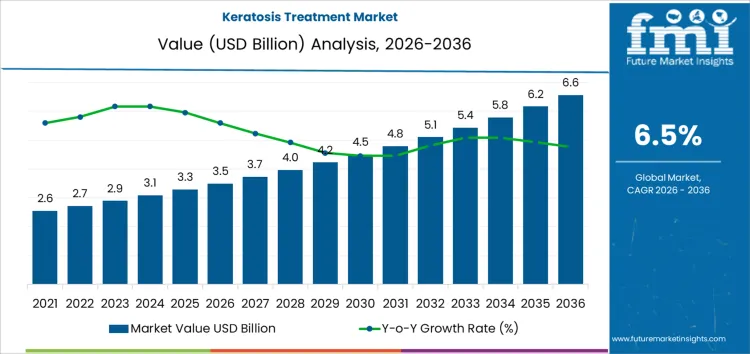
Keratosis Treatment Market Key Takeaways
| Metric | Value |
|---|---|
| Market Value (2026) | USD 3.5 billion |
| Market Forecast Value (2036) | USD 6.6 billion |
| Forecast CAGR 2026 to 2036 | 6.5% |
Why is the Demand for Keratosis Treatment Growing?
Rising prevalence of keratosis conditions, including actinic keratosis and seborrheic keratosis, has driven demand for targeted treatment options as dermatology practices and skin clinics address both medical risk and cosmetic concerns. Actinic keratosis lesions carry potential for progression toward squamous cell carcinoma, prompting dermatologists to implement proactive intervention strategies that combine lesion removal, field therapy, and follow-up monitoring. Advances in topical agents, photodynamic therapy, and minimally invasive procedures provide clinicians with options that balance efficacy and tolerability for patients across age groups and skin types. Clinics are investing in diagnostic imaging and lesion mapping tools that support precise identification, enhancing treatment planning and outcomes. Procurement teams emphasize products with robust clinical data, defined safety profiles, and streamlined application protocols that integrate with practice workflows and patient schedules.
Aging populations in developed regions and increased cumulative ultraviolet exposure from lifestyle and environmental factors continue to expand the pool of individuals seeking keratosis care. Providers observe heightened patient awareness about sun-induced skin changes, which influences earlier presentation and treatment uptake. Insurance and reimbursement frameworks are evolving to recognize medically indicated treatments, particularly where risk of malignant transformation exists, and this supports broader adoption by dermatology and primary care networks. In parallel, aesthetic dermatology segments integrate keratosis management with broader skin health services, reinforcing product selection that meets dual clinical and appearance goals. These clinical, demographic, and care delivery dynamics are contributing to sustained demand growth in the keratosis treatment market.
How Is the Keratosis Treatment Industry Segmented by Product Type, Application, and End User?
Demand for keratosis treatment is shaped by dermatological screening rates, aging populations, and emphasis on early lesion management. Clinical pathways prioritize lesion clearance, recurrence control, and cosmetic outcomes under routine dermatology care. Adoption reflects outpatient-focused treatment models, availability of topical therapies, and procedure-based interventions for resistant cases. Therapy selection considers lesion type, treatment tolerance, and follow-up intensity. Segmentation clarifies how therapeutic modality, disease indication, and care setting determine utilization patterns, procurement concentration, and treatment workflows across dermatology services.
Which Product Type Holds the Largest Share in Keratosis Treatment?
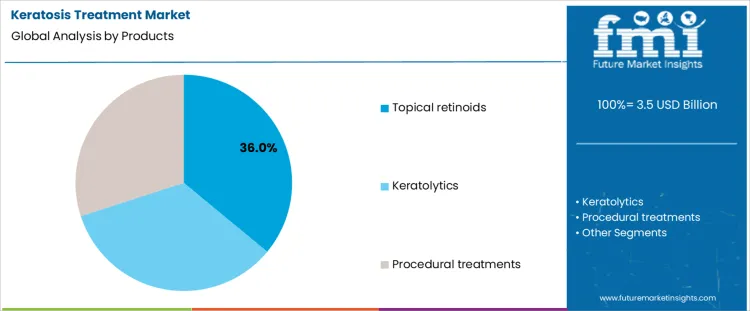
Topical retinoids hold 36.0%, representing the largest share among product types used in keratosis management. These agents normalize keratinocyte differentiation and support gradual lesion resolution with outpatient use. Prescription-based access allows controlled dosing and monitoring within dermatology practice. Long-standing clinical use supports familiarity among clinicians and patients. Keratolytics follow closely, offering exfoliative action suited for superficial lesions and maintenance therapy. Procedural treatments address thicker or recurrent lesions with higher resource involvement. Product segmentation reflects preference for pharmacologic options balancing effectiveness, tolerability, and ease of long-term management.
Key Points
- Retinoids address abnormal keratinization through topical therapy.
- Outpatient use supports continuity and adherence.
- Other options target exfoliation or resistant lesions.
Why Does Actinic Keratosis Represent the Largest Application Segment?
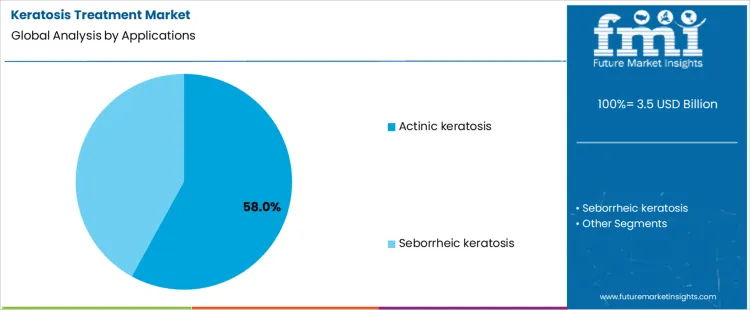
Actinic keratosis accounts for 58.0%, representing the largest share among clinical applications. Chronic ultraviolet exposure drives high lesion prevalence, particularly in older populations. Malignant transformation risk necessitates active treatment rather than observation. Regular skin examinations increase diagnosis and treatment initiation rates. Seborrheic keratosis follows with benign presentation and variable treatment motivation. Cosmetic concerns influence intervention frequency for these lesions. Application segmentation reflects concentration where cancer risk awareness, screening practices, and guideline-driven management elevate treatment intensity for actinic keratosis.
Key Points
- UV exposure contributes to high actinic lesion prevalence.
- Cancer risk prompts proactive treatment.
- Other keratoses involve more elective intervention.
Which End User Accounts for the Highest Share of Treatment Delivery?
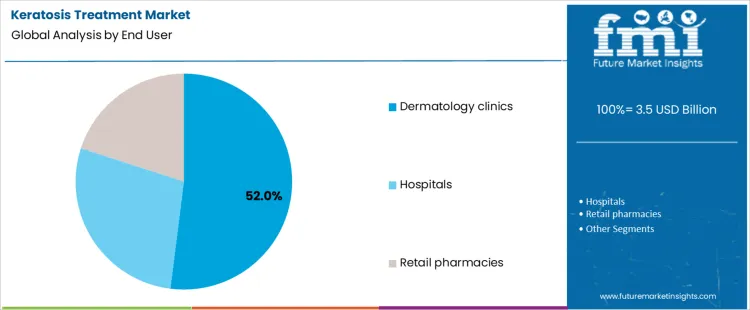
Dermatology clinics account for 52.0%, representing the largest share among end-user settings. Most keratosis cases are diagnosed and managed within outpatient dermatology practices. Clinics integrate evaluation, topical prescribing, and in-office procedures within a single care setting. Follow-up visits support treatment adjustment and lesion monitoring. Hospitals manage complex cases or procedural escalation with lower routine volume. Retail pharmacies dispense topical therapies supporting outpatient continuation. End-user segmentation reflects concentration where specialized expertise, accessibility, and procedural capability support efficient keratosis management.
Key Points
- Clinics serve as primary sites for diagnosis and treatment.
- Integrated care supports monitoring and adjustment.
- Other settings handle escalation or dispensing roles.
What are the Key Dynamics in the Keratosis Treatment Market?
Demand for keratosis treatments reflects clinical and cosmetic management needs for abnormal keratinization disorders affecting skin texture and appearance. Adoption concentrates in dermatology clinics, aesthetic practices, and outpatient care settings. Global scope aligns with rising diagnosis of actinic keratosis and benign keratotic conditions. Usage centers on topical therapies, procedural interventions, and lesion-directed treatments aimed at symptom control, lesion clearance, and malignancy risk reduction.
How do disease progression risk and patient-driven care preferences shape adoption?
Actinic keratosis carries potential for progression to squamous cell carcinoma, increasing emphasis on early detection and intervention. Demand increases where lesion burden, sun exposure history, and patient age elevate long-term risk. Treatment selection balances efficacy, tolerability, and cosmetic outcome, particularly for lesions on visible areas. Topical agents enable field treatment for diffuse lesions, while cryotherapy and procedural methods address isolated or thicker lesions. Patient adherence influences therapy choice, favoring regimens with manageable irritation profiles and shorter treatment durations. Dermatologists tailor approaches based on lesion type, recurrence history, and skin sensitivity. Adoption reflects combined clinical risk management and patient expectation for visible improvement.
How do treatment tolerability, recurrence patterns, and access variability influence market scalability?
Keratosis treatments often cause localized inflammation, erythema, and discomfort that affect adherence. Demand sensitivity rises where adverse skin reactions limit completion of topical regimens. High recurrence rates necessitate repeated treatment cycles, increasing long-term care burden. Procedural treatments require trained providers and clinic capacity, limiting scalability in underserved regions. Cost exposure varies by therapy type and insurance coverage, affecting patient access. Seasonal treatment patterns influence clinic demand variability. Lack of standardized progression markers complicates outcome assessment. Scalability remains constrained by tolerability management, recurrence-driven utilization, and dependence on specialist-led dermatologic care pathways.
How Is Demand for Keratosis Treatments Evolving Globally?
Demand for keratosis treatments is increasing globally due to rising dermatology consultation rates, improved lesion recognition, and expanding access to prescription and procedure-based care. Actinic keratosis screening programs and cosmetic dermatology overlap support treatment uptake. Topical therapies, cryotherapy, and device-based interventions remain central across care settings. Aging populations and cumulative sun exposure elevate treated patient pools. Growth rates in India at 8.2%, China at 8.0%, Brazil at 7.7%, USA at 7.1%, and the UK at 6.0% reflect steady expansion driven by diagnosis intensity, therapy persistence, and outpatient dermatology capacity rather than breakthrough drug launches.
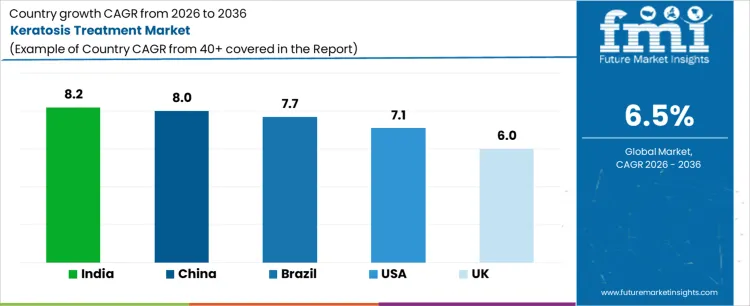
| Country | CAGR (%) |
|---|---|
| India | 8.2% |
| China | 8.0% |
| Brazil | 7.7% |
| USA | 7.1% |
| UK | 6.0% |
What Is Driving Growth Momentum for Keratosis Treatment Demand in India?
Demand for keratosis treatments in India is growing at a CAGR of 8.2%, shaped by expanding dermatology access and rising cosmetic awareness. Urban dermatology clinics report higher diagnosis of actinic and seborrheic keratosis during routine skin examinations. Increased use of topical prescription therapies supports outpatient management. Private insurance coverage for dermatology procedures improves affordability in urban centers. High UV exposure in several regions increases lesion incidence over time. Growth reflects service availability expansion and patient willingness to seek early treatment rather than aggressive adoption of advanced procedural interventions.
- Expansion of private dermatology clinic networks
- Increased outpatient use of topical therapies
- Insurance participation in dermatology procedures
- High cumulative UV exposure across regions
Why Is China Experiencing Steady Expansion in Keratosis Treatment Utilization?
Keratosis treatment demand in China is expanding at a CAGR of 8.0%, supported by hospital dermatology growth and preventive skin health initiatives. Large hospitals conduct routine lesion screening during dermatology visits. Public awareness of precancerous skin conditions improves consultation rates. Reimbursement inclusion for selected topical therapies supports adherence. Domestic pharmaceutical production improves access to standardized formulations. Growth reflects system-level screening expansion and outpatient treatment continuity rather than concentration of demand in cosmetic dermatology segments.
- Hospital-based dermatology screening activity
- Growing awareness of precancerous skin lesions
- Reimbursement support for topical treatments
- Domestic supply of standardized formulations
How Is Brazil Supporting Growth in Keratosis Treatment Demand?
Demand for keratosis treatments in Brazil is growing at a CAGR of 7.7%, influenced by high sun exposure and dermatology service utilization. Public health messaging emphasizes early treatment of actinic lesions. Dermatology clinics integrate cryotherapy and topical regimens within outpatient care. Judicial access pathways occasionally support coverage for prescribed therapies. Strong cosmetic dermatology culture increases lesion evaluation rates. Growth reflects environmental exposure factors and outpatient care expansion rather than reliance on newly introduced therapies.
- High sun exposure increasing lesion incidence
- Public messaging on early lesion treatment
- Outpatient integration of cryotherapy and topicals
- High dermatology consultation frequency
What Factors Are Driving Keratosis Treatment Growth in United States?
Keratosis treatment demand in the United States is expanding at a CAGR of 7.1%, driven by preventive dermatology practices and aging demographics. Routine skin cancer screening increases identification of actinic keratosis. Broad insurance coverage supports use of prescription topicals and in-office procedures. High dermatologist density enables early intervention and follow-up. Long-term sun exposure among older populations sustains treatment volumes. Growth reflects screening-driven diagnosis and therapy persistence rather than rapid shifts toward novel pharmacologic classes.
- Routine skin cancer screening practices
- Broad insurance coverage for dermatology care
- High dermatologist availability for early intervention
- Aging population with cumulative UV exposure
Why Is the UK Showing Moderate but Sustained Growth in Keratosis Treatments?
Demand for keratosis treatments in United Kingdom is growing at a CAGR of 6.0%, supported by NHS dermatology pathways and structured referral systems. Primary care identification leads to specialist referral for confirmed lesions. Cost-effectiveness considerations influence therapy selection toward established treatments. Aging demographics increase actinic keratosis prevalence. Limited cosmetic procedure emphasis moderates growth pace. Expansion remains steady, reflecting guideline-led care delivery and controlled access rather than rapid escalation in treatment intensity.
- NHS referral-led dermatology pathways
- Cost-effectiveness guided therapy selection
- Aging population increasing lesion prevalence
- Controlled emphasis on cosmetic interventions
What is the competitive landscape of demand for the keratosis treatment market globally?
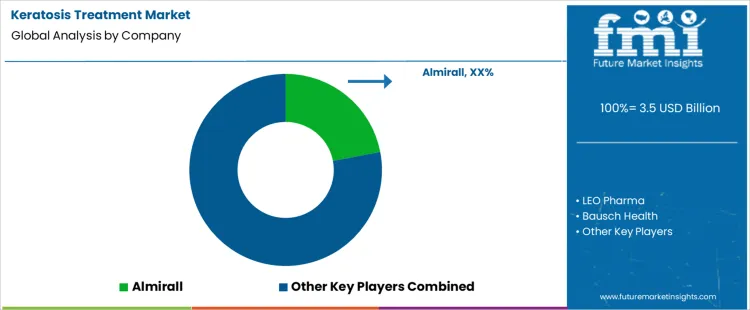
Demand for keratosis treatments is influenced by dermatology screening intensity, aging populations, and preventive oncology practices. Dermatologists assess lesion clearance rates, recurrence risk, tolerability, application duration, cosmetic outcomes, and suitability for field therapy. Buyer evaluation includes topical versus procedural fit, patient adherence expectations, safety labeling, and evidence from controlled clinical studies. Procurement behavior reflects formulary tiering, outpatient prescribing patterns, and preference for treatments manageable within routine clinic visits. Trend in the keratosis treatment market shows rising use of short-course topicals reducing treatment fatigue and follow-up burden. Demand concentration remains strongest in actinic keratosis management across primary dermatology and specialist care settings.
Almirall leads competitive positioning through differentiated topical therapies designed for short treatment duration and high lesion clearance. LEO Pharma competes with established dermatology portfolios and long-standing relationships within European and global dermatology networks. Bausch Health supports demand through legacy topical agents widely prescribed in outpatient dermatology and community practice environments. Galderma maintains relevance by leveraging dermatology specialization, physician education programs, and global commercial infrastructure. Pfizer participates selectively through dermatology-adjacent assets aligned with broader specialty pharmaceutical operations. Competitive differentiation depends on clearance durability, patient adherence, tolerability profiles, and access positioning across reimbursed markets.
Key Players in the Keratosis Treatment Market
- Almirall
- LEO Pharma
- Bausch Health
- Galderma
- Pfizer
- Others
Scope of the Report
| Items | Values |
|---|---|
| Quantitative Units | USD billion |
| Products | Topical retinoids; Keratolytics; Procedural treatments |
| Applications | Actinic keratosis; Seborrheic keratosis |
| End User | Dermatology clinics; Hospitals; Retail pharmacies |
| Regions Covered | Asia Pacific, Europe, North America, Latin America, Middle East & Africa |
| Countries Covered | India, China, Brazil, USA, UK, and 40+ countries |
| Key Companies Profiled | Almirall; LEO Pharma; Bausch Health; Galderma; Pfizer; Others |
| Additional Attributes | Dollar sales by product type, application, end user, and sales channel; treatment selection influenced by lesion severity, recurrence risk, and cosmetic outcomes; topical adherence patterns and procedure-driven care pathways in dermatology settings; safety profiles and tolerability guiding therapy choice; reimbursement coverage across outpatient and hospital settings; distribution dynamics spanning clinic dispensing, hospital procurement, and retail pharmacy fulfillment. |
Keratosis Treatment Market by Segment
Products:
- Topical retinoids
- Keratolytics
- Procedural treatments
Applications:
- Actinic keratosis
- Seborrheic keratosis
End User:
- Dermatology clinics
- Hospitals
- Retail pharmacies
Region:
- Asia Pacific
- China
- Japan
- South Korea
- India
- Australia & New Zealand
- ASEAN
- Rest of Asia Pacific
- Europe
- Germany
- United Kingdom
- France
- Italy
- Spain
- Nordic
- BENELUX
- Rest of Europe
- North America
- United States
- Canada
- Mexico
- Latin America
- Brazil
- Chile
- Rest of Latin America
- Middle East & Africa
- Kingdom of Saudi Arabia
- Other GCC Countries
- Turkey
- South Africa
- Other African Union
- Rest of Middle East & Africa
Bibliography
- American Academy of Dermatology Association. (2025). Guidelines of care for the management of actinic keratosis (2025 update). American Academy of Dermatology.
- British Association of Dermatologists. (2024). Actinic keratosis: Diagnosis, management, and follow-up guidance (2024 revision). British Association of Dermatologists.
- European Dermatology Forum. (2025). European consensus guideline on the management of actinic keratosis and field cancerization (2025 update). European Dermatology Forum.
Frequently Asked Questions
How big is the keratosis treatment market in 2026?
The global keratosis treatment market is estimated to be valued at USD 3.5 billion in 2026.
What will be the size of keratosis treatment market in 2036?
The market size for the keratosis treatment market is projected to reach USD 6.6 billion by 2036.
How much will be the keratosis treatment market growth between 2026 and 2036?
The keratosis treatment market is expected to grow at a 6.5% CAGR between 2026 and 2036.
What are the key product types in the keratosis treatment market?
The key product types in keratosis treatment market are topical retinoids, keratolytics and procedural treatments.
Which applications segment to contribute significant share in the keratosis treatment market in 2026?
In terms of applications, actinic keratosis segment to command 58.0% share in the keratosis treatment market in 2026.
Preview the report firsthand - request a free sample
Get SampleGet the brochure for pricing and purchase details.
Get PDFTable of Content
- Executive Summary
- Global Market Outlook
- Demand-side Trends
- Supply-side Trends
- Technology Roadmap Analysis
- Analysis and Recommendations
- Market Overview
- Market Coverage / Taxonomy
- Market Definition / Scope / Limitations
- Market Background
- Market Dynamics
- Drivers
- Restraints
- Opportunity
- Trends
- Scenario Forecast
- Demand in Optimistic Scenario
- Demand in Likely Scenario
- Demand in Conservative Scenario
- Opportunity Map Analysis
- Product Life Cycle Analysis
- Supply Chain Analysis
- Investment Feasibility Matrix
- Value Chain Analysis
- PESTLE and Porter’s Analysis
- Regulatory Landscape
- Regional Parent Market Outlook
- Production and Consumption Statistics
- Import and Export Statistics
- Market Dynamics
- Global Market Analysis 2021 to 2025 and Forecast, 2026 to 2036
- Historical Market Size Value (USD Million) Analysis, 2021 to 2025
- Current and Future Market Size Value (USD Million) Projections, 2026 to 2036
- Y-o-Y Growth Trend Analysis
- Absolute $ Opportunity Analysis
- Global Market Pricing Analysis 2021 to 2025 and Forecast 2026 to 2036
- Global Market Analysis 2021 to 2025 and Forecast 2026 to 2036, By Products
- Introduction / Key Findings
- Historical Market Size Value (USD Million) Analysis By Products , 2021 to 2025
- Current and Future Market Size Value (USD Million) Analysis and Forecast By Products , 2026 to 2036
- Topical retinoids
- Keratolytics
- Procedural treatments
- Topical retinoids
- Y-o-Y Growth Trend Analysis By Products , 2021 to 2025
- Absolute $ Opportunity Analysis By Products , 2026 to 2036
- Global Market Analysis 2021 to 2025 and Forecast 2026 to 2036, By Applications
- Introduction / Key Findings
- Historical Market Size Value (USD Million) Analysis By Applications, 2021 to 2025
- Current and Future Market Size Value (USD Million) Analysis and Forecast By Applications, 2026 to 2036
- Actinic keratosis
- Seborrheic keratosis
- Actinic keratosis
- Y-o-Y Growth Trend Analysis By Applications, 2021 to 2025
- Absolute $ Opportunity Analysis By Applications, 2026 to 2036
- Global Market Analysis 2021 to 2025 and Forecast 2026 to 2036, By End User
- Introduction / Key Findings
- Historical Market Size Value (USD Million) Analysis By End User, 2021 to 2025
- Current and Future Market Size Value (USD Million) Analysis and Forecast By End User, 2026 to 2036
- Dermatology clinics
- Hospitals
- Retail pharmacies
- Dermatology clinics
- Y-o-Y Growth Trend Analysis By End User, 2021 to 2025
- Absolute $ Opportunity Analysis By End User, 2026 to 2036
- Global Market Analysis 2021 to 2025 and Forecast 2026 to 2036, By Region
- Introduction
- Historical Market Size Value (USD Million) Analysis By Region, 2021 to 2025
- Current Market Size Value (USD Million) Analysis and Forecast By Region, 2026 to 2036
- North America
- Latin America
- Western Europe
- Eastern Europe
- East Asia
- South Asia and Pacific
- Middle East & Africa
- Market Attractiveness Analysis By Region
- North America Market Analysis 2021 to 2025 and Forecast 2026 to 2036, By Country
- Historical Market Size Value (USD Million) Trend Analysis By Market Taxonomy, 2021 to 2025
- Market Size Value (USD Million) Forecast By Market Taxonomy, 2026 to 2036
- By Country
- USA
- Canada
- Mexico
- By Products
- By Applications
- By End User
- By Country
- Market Attractiveness Analysis
- By Country
- By Products
- By Applications
- By End User
- Key Takeaways
- Latin America Market Analysis 2021 to 2025 and Forecast 2026 to 2036, By Country
- Historical Market Size Value (USD Million) Trend Analysis By Market Taxonomy, 2021 to 2025
- Market Size Value (USD Million) Forecast By Market Taxonomy, 2026 to 2036
- By Country
- Brazil
- Chile
- Rest of Latin America
- By Products
- By Applications
- By End User
- By Country
- Market Attractiveness Analysis
- By Country
- By Products
- By Applications
- By End User
- Key Takeaways
- Western Europe Market Analysis 2021 to 2025 and Forecast 2026 to 2036, By Country
- Historical Market Size Value (USD Million) Trend Analysis By Market Taxonomy, 2021 to 2025
- Market Size Value (USD Million) Forecast By Market Taxonomy, 2026 to 2036
- By Country
- Germany
- UK
- Italy
- Spain
- France
- Nordic
- BENELUX
- Rest of Western Europe
- By Products
- By Applications
- By End User
- By Country
- Market Attractiveness Analysis
- By Country
- By Products
- By Applications
- By End User
- Key Takeaways
- Eastern Europe Market Analysis 2021 to 2025 and Forecast 2026 to 2036, By Country
- Historical Market Size Value (USD Million) Trend Analysis By Market Taxonomy, 2021 to 2025
- Market Size Value (USD Million) Forecast By Market Taxonomy, 2026 to 2036
- By Country
- Russia
- Poland
- Hungary
- Balkan & Baltic
- Rest of Eastern Europe
- By Products
- By Applications
- By End User
- By Country
- Market Attractiveness Analysis
- By Country
- By Products
- By Applications
- By End User
- Key Takeaways
- East Asia Market Analysis 2021 to 2025 and Forecast 2026 to 2036, By Country
- Historical Market Size Value (USD Million) Trend Analysis By Market Taxonomy, 2021 to 2025
- Market Size Value (USD Million) Forecast By Market Taxonomy, 2026 to 2036
- By Country
- China
- Japan
- South Korea
- By Products
- By Applications
- By End User
- By Country
- Market Attractiveness Analysis
- By Country
- By Products
- By Applications
- By End User
- Key Takeaways
- South Asia and Pacific Market Analysis 2021 to 2025 and Forecast 2026 to 2036, By Country
- Historical Market Size Value (USD Million) Trend Analysis By Market Taxonomy, 2021 to 2025
- Market Size Value (USD Million) Forecast By Market Taxonomy, 2026 to 2036
- By Country
- India
- ASEAN
- Australia & New Zealand
- Rest of South Asia and Pacific
- By Products
- By Applications
- By End User
- By Country
- Market Attractiveness Analysis
- By Country
- By Products
- By Applications
- By End User
- Key Takeaways
- Middle East & Africa Market Analysis 2021 to 2025 and Forecast 2026 to 2036, By Country
- Historical Market Size Value (USD Million) Trend Analysis By Market Taxonomy, 2021 to 2025
- Market Size Value (USD Million) Forecast By Market Taxonomy, 2026 to 2036
- By Country
- Kingdom of Saudi Arabia
- Other GCC Countries
- Turkiye
- South Africa
- Other African Union
- Rest of Middle East & Africa
- By Products
- By Applications
- By End User
- By Country
- Market Attractiveness Analysis
- By Country
- By Products
- By Applications
- By End User
- Key Takeaways
- Key Countries Market Analysis
- USA
- Pricing Analysis
- Market Share Analysis, 2025
- By Products
- By Applications
- By End User
- Canada
- Pricing Analysis
- Market Share Analysis, 2025
- By Products
- By Applications
- By End User
- Mexico
- Pricing Analysis
- Market Share Analysis, 2025
- By Products
- By Applications
- By End User
- Brazil
- Pricing Analysis
- Market Share Analysis, 2025
- By Products
- By Applications
- By End User
- Chile
- Pricing Analysis
- Market Share Analysis, 2025
- By Products
- By Applications
- By End User
- Germany
- Pricing Analysis
- Market Share Analysis, 2025
- By Products
- By Applications
- By End User
- UK
- Pricing Analysis
- Market Share Analysis, 2025
- By Products
- By Applications
- By End User
- Italy
- Pricing Analysis
- Market Share Analysis, 2025
- By Products
- By Applications
- By End User
- Spain
- Pricing Analysis
- Market Share Analysis, 2025
- By Products
- By Applications
- By End User
- France
- Pricing Analysis
- Market Share Analysis, 2025
- By Products
- By Applications
- By End User
- India
- Pricing Analysis
- Market Share Analysis, 2025
- By Products
- By Applications
- By End User
- ASEAN
- Pricing Analysis
- Market Share Analysis, 2025
- By Products
- By Applications
- By End User
- Australia & New Zealand
- Pricing Analysis
- Market Share Analysis, 2025
- By Products
- By Applications
- By End User
- China
- Pricing Analysis
- Market Share Analysis, 2025
- By Products
- By Applications
- By End User
- Japan
- Pricing Analysis
- Market Share Analysis, 2025
- By Products
- By Applications
- By End User
- South Korea
- Pricing Analysis
- Market Share Analysis, 2025
- By Products
- By Applications
- By End User
- Russia
- Pricing Analysis
- Market Share Analysis, 2025
- By Products
- By Applications
- By End User
- Poland
- Pricing Analysis
- Market Share Analysis, 2025
- By Products
- By Applications
- By End User
- Hungary
- Pricing Analysis
- Market Share Analysis, 2025
- By Products
- By Applications
- By End User
- Kingdom of Saudi Arabia
- Pricing Analysis
- Market Share Analysis, 2025
- By Products
- By Applications
- By End User
- Turkiye
- Pricing Analysis
- Market Share Analysis, 2025
- By Products
- By Applications
- By End User
- South Africa
- Pricing Analysis
- Market Share Analysis, 2025
- By Products
- By Applications
- By End User
- USA
- Market Structure Analysis
- Competition Dashboard
- Competition Benchmarking
- Market Share Analysis of Top Players
- By Regional
- By Products
- By Applications
- By End User
- Competition Analysis
- Competition Deep Dive
- Almirall
- Overview
- Product Portfolio
- Profitability by Market Segments (Product/Age /Sales Channel/Region)
- Sales Footprint
- Strategy Overview
- Marketing Strategy
- Product Strategy
- Channel Strategy
- LEO Pharma
- Bausch Health
- Galderma
- Pfizer
- Others
- Almirall
- Competition Deep Dive
- Assumptions & Acronyms Used
- Research Methodology


