

- Market Size (2026)
- USD 640.7 Mn
- Forecast (2036)
- USD 1084.1 Mn
- CAGR (2026 to 2036)
- 5.4%
How big is Kiln Burner Nozzles Market in 2026?
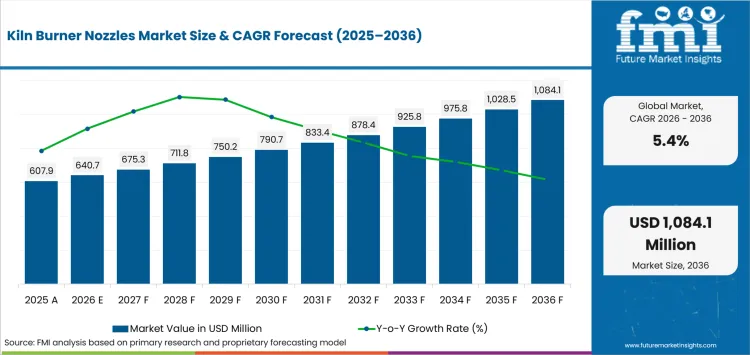
USD 640.7 million in 2026 and USD 1084.1 million by 2036 at a 5.4% CAGR.
Demand for kiln burner nozzles is projected to expand at 5.4% CAGR between 2026 and 2036, increasing valuation from USD 640.7 million to USD 1084.1 million. Brownfield firing upgrades underpin that forecast because plants can change fuel channels without replacing the entire kiln system. In March 2026, KHD reported that Amreyah Cement's upgrade includes a new Pyrojet main kiln burner beside alternative-fuel equipment. The Amreyah project ties industrial burner upgrades to installed kilns that need different fuel handling or flame-control settings.
Indonesia's 5.3% forecast exceeds Japan's 3.8%, but the gap reflects different operating conditions rather than current size. Japan's Ministry of Land, Infrastructure, Transport and Tourism projected fiscal 2025 cement demand at 33.0 million tonnes in October 2025, up 1.1% from the prior year. The modest demand outlook shifts Japan's commercial case toward rotary kiln monitoring, whereas Indonesia's higher forecast carries more fuel-conversion work.
Key Takeaways of Kiln Burner Nozzles Market
- Fuel switching and burner-mouth wear increase replacement demand as plants need stable firing without extending scheduled kiln shutdowns.
- By nozzle type, coal burner nozzles are estimated to hold 29.0% in 2026 owing to the installed base of pulverized-fuel firing channels.
- Heat-resistant alloy steel is likely to capture 38.0% of material revenue in 2026 attributable to thermal strength and repairability at the burner mouth.
- The kiln application category is forecast to be led by cement kilns at 66.0% share in 2026 due to continuous clinker firing duty.
- Site-specific geometry and commissioning risk can delay replacement because a poorly matched nozzle can alter flame shape during a costly outage.
- Fuller Technologies, KHD Humboldt Wedag, thyssenkrupp Polysius, Fives, Unitherm Cemcon, A TEC, FCT Combustion and Dynamis form the verified company register.
Analyst Perspective
"Kiln burner nozzle evaluation should start with fuel-channel geometry and target flame shape instead of component price alone. The strongest replacement case matches the existing burner pipe and reaches stable firing inside the scheduled kiln outage."
- Nikhil Kaitwade, Principal Consultant, Future Market Insights
How is the Kiln Burner Nozzles Market segmented?
The market is segmented by nozzle type, material, kiln application, replacement scope, sales model and region.
Kiln burner nozzles market segmentation covers nozzle type, material, kiln application, replacement scope, sales model and region. Nozzle types include coal, gas, oil, multi-fuel and low-NOx burners. Materials cover heat-resistant alloy steel, stainless steel, ceramic-lined and coated nozzles. Applications include cement, lime, mineral and waste co-processing kilns. Replacement scope covers nozzle tips, assemblies, pipe sections and conversion kits. Sales models include OEM spares, aftermarket replacements and shutdown contracts. Within the sales model category, aftermarket replacement is estimated to account for 45.0% in 2026 because operating kilns require compatible parts during recurring maintenance outages.
What makes coal burner nozzles central to the nozzle type category?
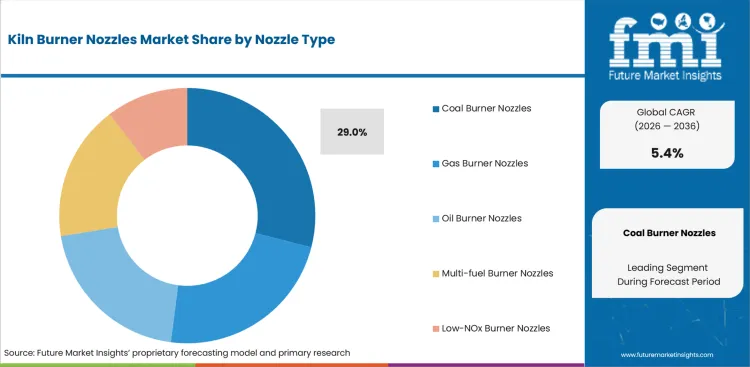
Rotary kilns retain pulverized coal or petcoke channels as alternative-fuel use increases, so burners still need a stable conventional-fuel path. In November 2025, KHD reported that South Valley Cement's modernization includes a new Pyrojet primary burner alongside Pyrorotor alternative-fuel equipment and an ID fan upgrade.
- Based on nozzle type, coal burner nozzles are projected to account for 29.0% in 2026 due to the installed base of pulverized-fuel firing channels.
- Plant engineers keep coal-path compatibility because ignition and flame momentum must remain controllable as alternative fuels change. Retrofit work therefore rewards nozzle geometry that matches existing fuel pipes and primary-air settings without forcing broader burner replacement.
Why does heat-resistant alloy steel lead the material category?
Burner-mouth hardware sits beside refractory cement at the kiln's radiant firing zone, where abrasive solids and thermal cycling attack exposed nozzle geometry. Heat-resistant alloy steel remains practical because damaged metal sections can be repaired during scheduled kiln maintenance.
- By material, heat-resistant alloy steel is forecast to represent 38.0% in 2026 driven by thermal strength and practical repairability during planned maintenance.
- Maintenance teams compare alloy life with repair time because nozzle distortion can change jet direction during recommissioning. In August 2025, thyssenkrupp Polysius reported heat and wear damage on polflame burners that required burner-tip and nozzle repair at its Neubeckum facility.
How do cement kilns anchor the kiln application category?
Cement kiln operators need a burner flame that holds clinker temperature as fuel properties change across continuous firing duty. Cement Europe reported in May 2026 that circular waste fuels supplied 56% of EU cement-sector thermal energy in 2023, making cement kiln co-processing fuels a recurring burner-control requirement.
- In 2026, cement kilns are expected to lead kiln application revenue with 66.0% share because clinker production keeps high-temperature burners in continuous service.
- Plant engineers carefully evaluate nozzle changes against clinker quality and flame stability during alternative-fuel substitution. A workable retrofit must preserve the kiln's established fuel-air arrangement without lengthening commissioning during a planned shutdown.
What supports nozzle tips within the replacement scope category?
Nozzle tips face concentrated heat and abrasion at the burner mouth, so localized wear can justify renewal before wider high-temperature burner designs reach end of life.
- The replacement scope category is forecast to be led by nozzle tips at 34.0% share in 2026 due to targeted mouthpiece renewal. Fuller reported in May 2025 that JETFLEX partial upgrades can retain the existing burner pipe while improving fuel-air mixing.
- Maintenance teams favor tip replacement once drawings confirm that the remaining burner body can stay in service. Exact fit and part availability then decide whether the smaller intervention suits the scheduled outage.
What are the drivers, restraints and opportunities in the Kiln Burner Nozzles Market?
Alternative-fuel conversions increase nozzle demand while site-specific qualification delays replacement and selective burner retrofits provide a brownfield revenue route.
- Driver: Alternative-fuel programs increase nozzle replacement whenever main burners need different injection velocity or primary-air settings.
- Restraint: Site-specific burner geometry requires technical qualification because a nozzle change can disturb flame shape during recommissioning.
- Opportunity: Selective burner conversions pair replacement nozzle hardware with commissioning support without requiring a complete kiln firing-system change.
Alternative-Fuel Programs Increase Burner Retrofit Demand
Alternative fuels change moisture and particle behavior at the firing point, which increases the mixing work assigned to nozzle geometry and combustion control systems. KHD reported in March 2026 that its Baoshan installation processed high-moisture biomass at 18 tph without kiln instability. A nozzle order becomes likely once that fuel change requires revised injection velocity or primary-air settings inside the existing burner train.
Qualification and Shutdown Risk Slow Component Decisions
The American Cement Association explained in April 2025 that 27 kiln conditions arise from combinations of burning-zone temperature, back-end temperature and exit oxygen. Nozzle geometry can disturb those combustion variables, so plant engineers review burner management systems before a replacement enters service. Combustion testing equipment then confirms whether the new geometry holds the required flame during recommissioning.
Selective Conversions Expand Brownfield Revenue
Selective conversions confine spending to the firing system and give brownfield plants a simpler route to alternative-fuel substitution before larger carbon capture systems alter plant energy balances across older lines. In February 2025, FCT Combustion commissioned a Turbu-Flex main burner and Eco-Boost satellite burner in Europe within a combustion system capable of firing 100% alternative fuels without fossil fuel support.
Which country CAGRs are profiled in the Kiln Burner Nozzles Market?
| Country | CAGR |
|---|---|
| Indonesia | 5.3% |
| Türkiye | 5.0% |
| USA | 4.5% |
| Germany | 4.1% |
| Japan | 3.8% |
How do country-level CAGRs compare in the Kiln Burner Nozzles Market?
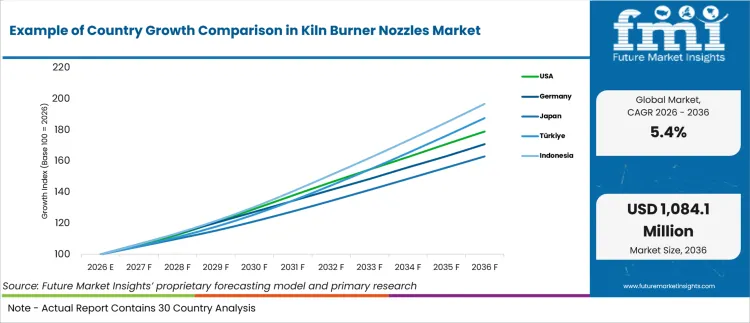
The five profiled countries form a compact 1.5 percentage-point range, with Indonesia and Türkiye in an upper retrofit band while the mature markets cluster below. The spread reflects firing-system renewal pressure rather than revenue scale, with alternative-fuel conversion separating the upper group from replacement-led conditions in Japan and the two mature Western markets.
- Indonesia's overcapacity favors short-payback fuel conversions on clinker lines.
- Türkiye's emissions certification makes burner documentation part of plant upgrades.
- US biomass-fuel rules make permitting fit necessary for nozzle conversions.
- Germany's mature clinker fleet favors repairable nozzles with measurable maintenance gains.
- Japan's dispersed kiln network favors predictable commissioning that protects clinker quality.
Similar CAGRs therefore produce different entry requirements because each market converts maintenance and fuel-policy pressure into orders differently. The full report provides country-level CAGR analysis across North America, Latin America, Europe, East Asia, South Asia, Oceania and the Middle East and Africa.
Country-wise Analysis
- Indonesian cement producers are increasing alternative-fuel capability while weak domestic cement volumes keep existing clinker kilns under tighter payback scrutiny. In October 2025, Indocement reported operating alternative-fuel feeding facilities at Semen Grobogan and Semen Maros during a 9M2025 market decline. Kiln burner nozzle demand in Indonesia is forecast to rise at 5.3% CAGR over the forecast period, supported by conversion work across installed lines. Local service and stocked wear parts can shorten outage exposure across Java and Sulawesi sites. Overcapacity still makes broad capital replacement harder to approve, so burner-nozzle firms need a clear fuel-efficiency case for each operating line.
- Turkish cement plants now operate within an industrial-emissions regime that links mineral sites to formal Green Transformation requirements and staged plant documentation. Türkiye is estimated to post 5.0% CAGR over the forecast period, shaped by carefully staged compliance work around existing kiln assets. The environment ministry reported in March 2025 that the Industrial Emissions Management Regulation had been published on January 14, establishing the current framework for industrial green-transition requirements. Local engineering can connect low-emission burner projects with planned modernization, but documentation requirements delay orders unless nozzle compatibility records match each certification stage and outage plan across covered cement sites.
- EPA's June 2025 forum on clean cellulosic biomass gave US cement plants a current regulatory route for evaluating biomass fuel changes. Mature kiln sites also rely on nearby field service to contain recommissioning time across a national network with little tolerance for production-loss time. Kiln burner nozzle sales in USA are forecast to expand at 4.5% CAGR by 2036, supported by replacement and fuel-conversion activity across established plants. Site-specific air permits and waste determinations can extend technical qualification for unfamiliar alternative fuel paths. Burner-nozzle firms therefore need verified dimensions and commissioning records that reduce repeated flame tuning during short outages at established cement plants.
- German cement plants operate with strict payback tests because lower clinker output leaves less room for burner-nozzle work that lacks measurable reliability gains across mature lines in domestic plants. Germany's kiln burner nozzles outlook is anticipated to advance at 4.1% CAGR over the assessment period, supported by repair-led modernization instead of large additions. The German Environment Agency reported in July 2025 that clinker production fell almost 9% in 2024 as clinker emissions declined 10%. Repairable components can clear that hurdle when engineering records show shorter maintenance exposure, giving established service firms an advantage over unfamiliar hardware during scheduled outages.
- Japanese cement producers manage a dispersed installed base that requires predictable service around long-established rotary-kiln lines across several production regions. The Japan Cement Association reported in July 2025 that 48 kilns operated across 26 plants at 78.5% utilization during fiscal 2024. Adoption of kiln burner nozzles in Japan is estimated to expand at 3.8% CAGR through 2036, shaped by incremental renewal across mature lines. Local technical teams favor gradual fuel and maintenance upgrades that preserve established clinker-quality controls during scheduled outages. Conservative qualification still favors durable designs and commissioning support that limit avoidable outage extensions during changes in waste-derived fuel use.
Who are the notable companies in the Kiln Burner Nozzles Market?
Fuller Technologies, KHD Humboldt Wedag, thyssenkrupp Polysius, Fives, Unitherm Cemcon, A TEC, FCT Combustion and Dynamis are the notable companies serving this market.
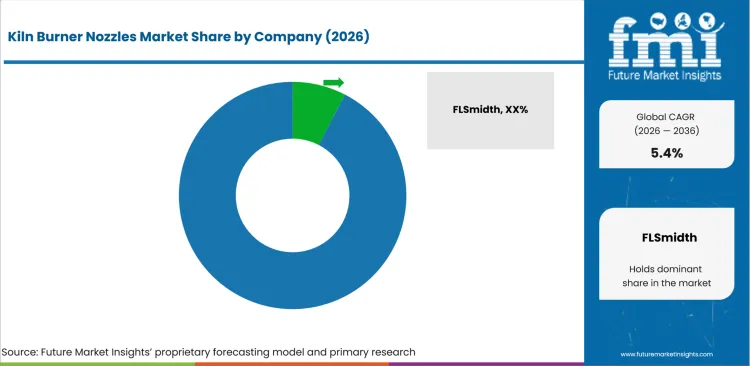
Kiln burner nozzles are concentrated around integrated cement-combustion OEMs and specialist retrofit firms. Competition centers on fuel flexibility and outage execution because plant engineers require proven fuel-channel geometry before approving replacement hardware. Accurate drawings and accessible field service reduce commissioning risk when a nozzle change could extend a clinker-line shutdown.
- Fuller Technologies, KHD Humboldt Wedag, thyssenkrupp Polysius and Fives combine main-burner engineering with wider cement pyroprocess service.
- Unitherm Cemcon, FCT Combustion and Dynamis specialize in configurable combustion hardware for plant-specific fuel and flame requirements.
- A TEC connects burner-related modification work with alternative-fuel preparation and broader cement retrofit engineering.
Competitive Benchmarking: Kiln Burner Nozzles Market
| Company | Multi-Fuel Nozzle Design | Flame-Control Evidence | Retrofit and Service Depth | Geographic Reach |
|---|---|---|---|---|
| Fuller Technologies | High | High | High | Global cement service network |
| KHD Humboldt Wedag | High | High | High | Global cement presence |
| thyssenkrupp Polysius | High | High | High | Global cement installed base |
| Fives | High | High | High | Global combustion network |
| Unitherm Cemcon | High | Medium | High | International rotary-kiln references |
| A TEC | High | Medium | High | International cement retrofit activity |
| FCT Combustion | High | High | High | Europe, Asia-Pacific and Americas |
| Dynamis | High | Medium | Medium | Brazil and international projects |
Key Developments in the Kiln Burner Nozzles Market
- In March 2026, KHD Humboldt Wedag received a Batisöke order for Türkiye's second Pyrorotor alternative-fuel system with commissioning support. The design targets calciner thermal substitution above 90% and extends KHD's installed Pyrorotor base in Türkiye.
- In November 2025, Fuller Technologies completed separation from FLSmidth Cement after Pacific Avenue's acquisition closed, transferring cement technology and service operations into the standalone company.
Key Players in the Kiln Burner Nozzles Market
Integrated Kiln-Combustion Platforms
- Fuller Technologies
- KHD Humboldt Wedag
- thyssenkrupp Polysius
- Fives
Specialist Burner Engineering
- Unitherm Cemcon
- FCT Combustion
- Dynamis
Cement Retrofit and Alternative-Fuel Engineering
- A TEC
Kiln Burner Nozzles Market - Report Scope
| Coverage field | Report scope |
|---|---|
| Market breakdown | By nozzle type, material, kiln application, replacement scope, sales model and region. |
| Quantitative Units | Revenue in USD million and CAGR in %. |
| Market Definition | Commercial revenue from kiln burner nozzle tips, nozzle assemblies, burner pipe sections and retrofit conversion kits used in defined rotary-kiln firing applications. |
| Regions Covered | North America, Latin America, Europe, East Asia, South Asia and Pacific, and Middle East and Africa. |
| Countries Covered | Indonesia, Türkiye, USA, Germany, Japan, and 20+ countries included in the full report. |
| Key Companies Profiled | Fuller Technologies, KHD Humboldt Wedag, thyssenkrupp Polysius, Fives, Unitherm Cemcon, A TEC, FCT Combustion, and Dynamis. |
| Forecast Period | 2026 to 2036. |
| Approach | Primary and secondary research with market triangulation. |
Kiln Burner Nozzles Market - Research Methodology
| Method | Approach |
|---|---|
| Primary Research | FMI analysts gathered input from manufacturers, service providers, technology developers, distributors, end users, procurement teams, and subject-matter experts. Interviews examined purchasing decisions, product or service evaluation, adoption barriers, approval requirements, pricing considerations, and expectations for technical or commercial support. Respondents were also asked what evidence is required before a trial, pilot, or initial order develops into regular purchasing. |
| Desk Research | Desk research covered government statistics, regulatory publications, trade data, industry associations, technical literature, standards, company filings, product information, and official corporate announcements. Sources were reviewed for relevance, publication date, geographic coverage, and consistency with the defined market scope. Claims relating to performance, applications, approvals, capacity, investment, and commercial activity were retained only when supported by credible public evidence. |
| Market Sizing and Forecasting | The market model combined the baseline value with historical performance, segment structure, pricing and volume indicators, adoption levels, company participation, and country-level demand conditions. Forecast assumptions considered economic activity, investment trends, regulatory developments, technology adoption, purchasing cycles, supply availability, and barriers to wider market use. Segment and regional estimates were reconciled before the final market total was calculated. |
| Data Validation | Estimates were checked against multiple independent indicators, including public data, company activity, trade patterns, industry developments, and findings from primary interviews. Validation also tested whether products, services, applications, and company revenues fell within the defined market boundaries. Adjacent categories, unsupported claims, overlapping revenues, and activities without direct market relevance were excluded to reduce double counting and maintain consistency across segments and countries. |
Kiln Burner Nozzles Market by Segments
Kiln Burner Nozzles Market segmented by Nozzle Type:
- Coal Burner Nozzles
- Gas Burner Nozzles
- Oil Burner Nozzles
- Multi-fuel Burner Nozzles
- Low-NOx Burner Nozzles
Kiln Burner Nozzles Market segmented by Material:
- Heat-resistant Alloy Steel
- Stainless Steel
- Ceramic-lined Nozzles
- Hardfaced / Coated Nozzles
Kiln Burner Nozzles Market segmented by Kiln Application:
- Cement Kilns
- Lime Kilns
- Mineral Kilns
- Waste Co-processing Kilns
Kiln Burner Nozzles Market segmented by Replacement Scope:
- Nozzle Tips
- Complete Nozzle Assemblies
- Burner Pipe Sections
- Retrofit Conversion Kits
Kiln Burner Nozzles Market segmented by Sales Model:
- OEM Spare
- Aftermarket Replacement
- Shutdown Maintenance Contract
Kiln Burner Nozzles Market by Region:
- North America
- United States
- Canada
- Latin America
- Brazil
- Mexico
- Chile
- Rest of Latin America
- Western Europe
- Germany
- United Kingdom
- Italy
- Spain
- France
- Nordics
- Benelux
- Rest of Western Europe
- Eastern Europe
- Russia
- Poland
- Hungary
- Balkan and Baltic States
- Rest of Eastern Europe
- East Asia
- China
- Japan
- South Korea
- South Asia and Pacific
- India
- ASEAN
- Australia and New Zealand
- Rest of South Asia and Pacific
- Middle East and Africa
- Kingdom of Saudi Arabia
- Other GCC Countries
- Türkiye
- South Africa
- Other African Union Countries
- Rest of Middle East and Africa
Research Sources and Bibliography
- KHD Humboldt Wedag. (2026, March 24). Amreyah Cement and KHD: A partnership for sustainable pyroprocess innovation.
- Ministry of Land, Infrastructure, Transport and Tourism. (2025, October 31).
- KHD Humboldt Wedag. (2025, November 12). Humboldt Wedag GmbH has been awarded a modernization project for South Valley Cement.
- thyssenkrupp Polysius. (2025, August 28). polflame® - High-Quality Repairs at our Neubeckum Facility.
- Cement Europe. (2026, May 28). Cement Europe Key facts & figures - May 2026.
- Fuller Technologies. (2025, May 1). Every Little Bit Counts.
- KHD Humboldt Wedag. (2026, March 18). KHD commissions second Pyrorotor® alternative fuel system in China.
- American Cement Association. (2025, April 24). Quarry to Clinker Webinar Series: 27 Kiln Conditions.
- FCT Combustion. (2025, February 14). Turbu-Flex™ and Eco-Boost satellite burner commissioned for 100% alternative fuels.
- PT Indocement Tunggal Prakarsa Tbk. (2025, October 31). Indocement Publishes Q3 2025 Financial Results.
- Republic of Türkiye Ministry of Environment, Urbanization and Climate Change. (2025, March 21). Endüstriyel Emisyonların Yönetimi Yönetmeliği Yayınlandı.
- USA Environmental Protection Agency. (2026, May 19). Smart Sectors Forum on Using Clean Cellulosic Biomass as Fuel in Cement Manufacturing.
- German Environment Agency. (2025, July 16). German emissions nearly halved in 20 years of trading.
- Japan Cement Association. (2025, July 1).
- KHD Humboldt Wedag. (2026, March 11). KHD expands Pyrorotor® footprint in Türkiye with Batisöke order.
- Fuller Technologies. (2025, November 3). Pacific Avenue’s Acquisition of FLSmidth Cement Closes; New Company Name and Brand Announced.
- Fives. (2025, September 22). Fives expands combustion activity in India with a new office in Kolkata.
- A TEC Plant Construction GmbH. A TEC Plant Construction GmbH. Retrieved August 11, 2026.
This bibliography is provided for reader reference and is not exhaustive. The full report contains the complete reference list and detailed citations
This Report Answers
- How large is the kiln burner nozzles market in 2026 and 2036?
- Which firing and maintenance conditions increase kiln burner nozzle replacement demand?
- Why do coal burner nozzles hold 29.0% of nozzle type revenue in 2026?
- How does heat-resistant alloy steel affect burner-mouth durability and maintenance?
- Why do cement kilns account for 66.0% of kiln application revenue in 2026?
- How do country growth rates differ across Indonesia, Türkiye, USA, Germany and Japan?
- Which companies combine burner engineering with retrofit and service?
- Which qualification and shutdown risks delay kiln burner nozzle replacement?
Frequently Asked Questions
How big is the Kiln Burner Nozzles Market in 2026?
The kiln burner nozzles market is valued at USD 640.7 million in 2026 and is projected to reach USD 1,084.1 million by 2036. Burner wear and fuel-conversion work sustain replacement demand across rotary kilns.
What is the CAGR of the Kiln Burner Nozzles Market from 2026 to 2036?
The kiln burner nozzles market is projected to grow at a CAGR of 5.4% between 2026 and 2036. Maintenance activity and changing fuel requirements support demand for compatible nozzle geometry.
Which nozzle type leads the Kiln Burner Nozzles Market?
Coal burner nozzles are projected to account for 29.0% of the kiln burner nozzles market in 2026. Their share reflects the installed base of pulverized-fuel firing channels in rotary-kiln systems.
Which replacement scope leads the Kiln Burner Nozzles Market?
Nozzle tips are projected to account for 34.0% of the kiln burner nozzles market in 2026. Targeted renewal restores the burner mouth without replacing serviceable pipe sections during planned maintenance.
Which companies are active in the Kiln Burner Nozzles Market?
Key companies include Fuller Technologies, KHD Humboldt Wedag, thyssenkrupp Polysius, Fives, Unitherm Cemcon, A TEC, FCT Combustion and Dynamis. They compete through firing-system engineering, burner retrofits and technical service.
Preview the report firsthand - request a free sample
Get SampleGet the brochure for pricing and purchase details.
Get PDFTable of Content
- Key Takeaways
- Market Size and CAGR
- Top Growth Driver
- Fastest Growing Segment
- Leading Region
- Key Companies
- Emerging Opportunities
- Executive Summary
- Global Market Outlook
- Demand-side Trends
- Supply-side Trends
- Technology Roadmap Analysis
- Analysis and Recommendations
- Analyst Perspective (What is happening? Why now? What should investors know?)
- Key Questions Answered
- How large is the market?
- What is the CAGR?
- What are key trends?
- Which region dominates?
- Who are the leaders?
- Market Overview
- Market Coverage / Taxonomy
- Market Definition / Scope / Limitations
- Research Methodology
- Chapter Orientation
- Analytical Lens and Working Hypotheses
- Market Structure, Signals, and Trend Drivers
- Benchmarking and Cross-market Comparability
- Market Sizing, Forecasting, and Opportunity Mapping
- Research Design and Evidence Framework
- Desk Research Programme (Secondary Evidence)
- Expert Input and Fieldwork (Primary Evidence)
- Tooling, Models, and Reference Databases
- Data Engineering and Model Build
- Quality Assurance and Audit Trail
- Market Background
- Market Dynamics (Drivers, Restraints, Opportunity, Trends)
- Scenario Forecast (Optimistic, Likely, Conservative)
- Impact Analysis
- AI Impact
- Sustainability Impact
- Regulatory Impact
- Technology Impact
- Consumer / Buyer Analysis
- Purchase Drivers
- Adoption Barriers
- Buyer Journey
- Opportunity Map Analysis
- Product Life Cycle Analysis
- Supply Chain Analysis
- Investment Feasibility Matrix
- Value Chain Analysis
- PESTLE and Porter's Analysis
- Regulatory Landscape
- Regional Parent Market Outlook
- Production and Consumption Statistics
- Import and Export Statistics
- Global Market Analysis and Forecast, 2021 to 2036
- Historical Market Size Value (USD Million) Analysis, 2021 to 2025
- Current and Future Market Size Value (USD Million) Projections, 2026 to 2036
- Y-o-Y Growth Trend Analysis
- Absolute $ Opportunity Analysis
- Global Market Pricing Analysis, 2021 to 2036
- Global Market Analysis and Forecast, By Nozzle Type, 2021 to 2036
- Introduction / Key Findings
- Historical Market Size Value (USD Million) Analysis By Nozzle Type, 2021 to 2025
- Current and Future Market Size Value (USD Million) Analysis and Forecast By Nozzle Type, 2026 to 2036
- Coal Burner Nozzles
- Gas Burner Nozzles
- Oil Burner Nozzles
- Multi-fuel Burner Nozzles
- Low-NOx Burner Nozzles
- Coal Burner Nozzles
- Y-o-Y Growth Trend Analysis By Nozzle Type, 2021 to 2025
- Absolute $ Opportunity Analysis By Nozzle Type, 2026 to 2036
- Global Market Analysis and Forecast, By Material, 2021 to 2036
- Introduction / Key Findings
- Historical Market Size Value (USD Million) Analysis By Material, 2021 to 2025
- Current and Future Market Size Value (USD Million) Analysis and Forecast By Material, 2026 to 2036
- Heat-resistant Alloy Steel
- Stainless Steel
- Ceramic-lined Nozzles
- Hardfaced / Coated Nozzles
- Heat-resistant Alloy Steel
- Y-o-Y Growth Trend Analysis By Material, 2021 to 2025
- Absolute $ Opportunity Analysis By Material, 2026 to 2036
- Global Market Analysis and Forecast, By Kiln Application, 2021 to 2036
- Introduction / Key Findings
- Historical Market Size Value (USD Million) Analysis By Kiln Application, 2021 to 2025
- Current and Future Market Size Value (USD Million) Analysis and Forecast By Kiln Application, 2026 to 2036
- Cement Kilns
- Lime Kilns
- Mineral Kilns
- Waste Co-processing Kilns
- Cement Kilns
- Y-o-Y Growth Trend Analysis By Kiln Application, 2021 to 2025
- Absolute $ Opportunity Analysis By Kiln Application, 2026 to 2036
- Global Market Analysis and Forecast, By Replacement Scope, 2021 to 2036
- Introduction / Key Findings
- Historical Market Size Value (USD Million) Analysis By Replacement Scope, 2021 to 2025
- Current and Future Market Size Value (USD Million) Analysis and Forecast By Replacement Scope, 2026 to 2036
- Nozzle Tips
- Complete Nozzle Assemblies
- Burner Pipe Sections
- Retrofit Conversion Kits
- Nozzle Tips
- Y-o-Y Growth Trend Analysis By Replacement Scope, 2021 to 2025
- Absolute $ Opportunity Analysis By Replacement Scope, 2026 to 2036
- Global Market Analysis and Forecast, By Sales Model, 2021 to 2036
- Introduction / Key Findings
- Historical Market Size Value (USD Million) Analysis By Sales Model, 2021 to 2025
- Current and Future Market Size Value (USD Million) Analysis and Forecast By Sales Model, 2026 to 2036
- Aftermarket Replacement
- OEM Spare
- Shutdown Maintenance Contract
- Aftermarket Replacement
- Y-o-Y Growth Trend Analysis By Sales Model, 2021 to 2025
- Absolute $ Opportunity Analysis By Sales Model, 2026 to 2036
- Global Market Analysis and Forecast, By Region, 2021 to 2036
- Introduction
- Historical Market Size Value (USD Million) Analysis By Region, 2021 to 2025
- Current Market Size Value (USD Million) Analysis and Forecast By Region, 2026 to 2036
- North America
- Latin America
- Western Europe
- Eastern Europe
- East Asia
- South Asia and Pacific
- Middle East & Africa
- Market Attractiveness Analysis By Region
- North America Market Analysis and Forecast, By Country, 2021 to 2036
- Historical Market Size Value (USD Million) Trend Analysis By Market Taxonomy, 2021 to 2025
- Market Size Value (USD Million) Forecast By Market Taxonomy, 2026 to 2036
- By Country
- USA
- Canada
- By Nozzle Type
- By Material
- By Kiln Application
- By Replacement Scope
- By Sales Model
- By Country
- Market Attractiveness Analysis
- By Country
- By Nozzle Type
- By Material
- By Kiln Application
- By Replacement Scope
- By Sales Model
- Key Takeaways
- Latin America Market Analysis and Forecast, By Country
- Historical Market Size Value (USD Million) Trend Analysis By Market Taxonomy, 2021 to 2025
- Market Size Value (USD Million) Forecast By Market Taxonomy, 2026 to 2036
- By Country
- Brazil
- Mexico
- Chile
- Rest of Latin America
- By Nozzle Type
- By Material
- By Kiln Application
- By Replacement Scope
- By Sales Model
- By Country
- Market Attractiveness Analysis
- By Country
- By Nozzle Type
- By Material
- By Kiln Application
- By Replacement Scope
- By Sales Model
- Key Takeaways
- Western Europe Market Analysis and Forecast, By Country
- Historical Market Size Value (USD Million) Trend Analysis By Market Taxonomy, 2021 to 2025
- Market Size Value (USD Million) Forecast By Market Taxonomy, 2026 to 2036
- By Country
- Germany
- UK
- Italy
- Spain
- France
- Nordic
- BENELUX
- Rest of Western Europe
- By Nozzle Type
- By Material
- By Kiln Application
- By Replacement Scope
- By Sales Model
- By Country
- Market Attractiveness Analysis
- By Country
- By Nozzle Type
- By Material
- By Kiln Application
- By Replacement Scope
- By Sales Model
- Key Takeaways
- Eastern Europe Market Analysis and Forecast, By Country
- Historical Market Size Value (USD Million) Trend Analysis By Market Taxonomy, 2021 to 2025
- Market Size Value (USD Million) Forecast By Market Taxonomy, 2026 to 2036
- By Country
- Russia
- Poland
- Hungary
- Balkan & Baltic
- Rest of Eastern Europe
- By Nozzle Type
- By Material
- By Kiln Application
- By Replacement Scope
- By Sales Model
- By Country
- Market Attractiveness Analysis
- By Country
- By Nozzle Type
- By Material
- By Kiln Application
- By Replacement Scope
- By Sales Model
- Key Takeaways
- East Asia Market Analysis and Forecast, By Country
- Historical Market Size Value (USD Million) Trend Analysis By Market Taxonomy, 2021 to 2025
- Market Size Value (USD Million) Forecast By Market Taxonomy, 2026 to 2036
- By Country
- China
- Japan
- South Korea
- By Nozzle Type
- By Material
- By Kiln Application
- By Replacement Scope
- By Sales Model
- By Country
- Market Attractiveness Analysis
- By Country
- By Nozzle Type
- By Material
- By Kiln Application
- By Replacement Scope
- By Sales Model
- Key Takeaways
- South Asia and Pacific Market Analysis and Forecast, By Country
- Historical Market Size Value (USD Million) Trend Analysis By Market Taxonomy, 2021 to 2025
- Market Size Value (USD Million) Forecast By Market Taxonomy, 2026 to 2036
- By Country
- India
- ASEAN
- Australia & New Zealand
- Rest of South Asia and Pacific
- By Nozzle Type
- By Material
- By Kiln Application
- By Replacement Scope
- By Sales Model
- By Country
- Market Attractiveness Analysis
- By Country
- By Nozzle Type
- By Material
- By Kiln Application
- By Replacement Scope
- By Sales Model
- Key Takeaways
- Middle East & Africa Market Analysis and Forecast, By Country
- Historical Market Size Value (USD Million) Trend Analysis By Market Taxonomy, 2021 to 2025
- Market Size Value (USD Million) Forecast By Market Taxonomy, 2026 to 2036
- By Country
- Kingdom of Saudi Arabia
- Other GCC Countries
- Türkiye
- South Africa
- Other African Union
- Rest of Middle East & Africa
- By Nozzle Type
- By Material
- By Kiln Application
- By Replacement Scope
- By Sales Model
- By Country
- Market Attractiveness Analysis
- By Country
- By Nozzle Type
- By Material
- By Kiln Application
- By Replacement Scope
- By Sales Model
- Key Takeaways
- Key Countries Market Analysis
- USA
- Pricing Analysis
- Market Share Analysis, 2025
- By Nozzle Type
- By Material
- By Kiln Application
- By Replacement Scope
- By Sales Model
- Canada
- Pricing Analysis
- Market Share Analysis, 2025
- By Nozzle Type
- By Material
- By Kiln Application
- By Replacement Scope
- By Sales Model
- Mexico
- Pricing Analysis
- Market Share Analysis, 2025
- By Nozzle Type
- By Material
- By Kiln Application
- By Replacement Scope
- By Sales Model
- Brazil
- Pricing Analysis
- Market Share Analysis, 2025
- By Nozzle Type
- By Material
- By Kiln Application
- By Replacement Scope
- By Sales Model
- Chile
- Pricing Analysis
- Market Share Analysis, 2025
- By Nozzle Type
- By Material
- By Kiln Application
- By Replacement Scope
- By Sales Model
- Germany
- Pricing Analysis
- Market Share Analysis, 2025
- By Nozzle Type
- By Material
- By Kiln Application
- By Replacement Scope
- By Sales Model
- UK
- Pricing Analysis
- Market Share Analysis, 2025
- By Nozzle Type
- By Material
- By Kiln Application
- By Replacement Scope
- By Sales Model
- Italy
- Pricing Analysis
- Market Share Analysis, 2025
- By Nozzle Type
- By Material
- By Kiln Application
- By Replacement Scope
- By Sales Model
- Spain
- Pricing Analysis
- Market Share Analysis, 2025
- By Nozzle Type
- By Material
- By Kiln Application
- By Replacement Scope
- By Sales Model
- France
- Pricing Analysis
- Market Share Analysis, 2025
- By Nozzle Type
- By Material
- By Kiln Application
- By Replacement Scope
- By Sales Model
- India
- Pricing Analysis
- Market Share Analysis, 2025
- By Nozzle Type
- By Material
- By Kiln Application
- By Replacement Scope
- By Sales Model
- ASEAN
- Pricing Analysis
- Market Share Analysis, 2025
- By Nozzle Type
- By Material
- By Kiln Application
- By Replacement Scope
- By Sales Model
- Australia & New Zealand
- Pricing Analysis
- Market Share Analysis, 2025
- By Nozzle Type
- By Material
- By Kiln Application
- By Replacement Scope
- By Sales Model
- China
- Pricing Analysis
- Market Share Analysis, 2025
- By Nozzle Type
- By Material
- By Kiln Application
- By Replacement Scope
- By Sales Model
- Japan
- Pricing Analysis
- Market Share Analysis, 2025
- By Nozzle Type
- By Material
- By Kiln Application
- By Replacement Scope
- By Sales Model
- South Korea
- Pricing Analysis
- Market Share Analysis, 2025
- By Nozzle Type
- By Material
- By Kiln Application
- By Replacement Scope
- By Sales Model
- Russia
- Pricing Analysis
- Market Share Analysis, 2025
- By Nozzle Type
- By Material
- By Kiln Application
- By Replacement Scope
- By Sales Model
- Poland
- Pricing Analysis
- Market Share Analysis, 2025
- By Nozzle Type
- By Material
- By Kiln Application
- By Replacement Scope
- By Sales Model
- Hungary
- Pricing Analysis
- Market Share Analysis, 2025
- By Nozzle Type
- By Material
- By Kiln Application
- By Replacement Scope
- By Sales Model
- Kingdom of Saudi Arabia
- Pricing Analysis
- Market Share Analysis, 2025
- By Nozzle Type
- By Material
- By Kiln Application
- By Replacement Scope
- By Sales Model
- Türkiye
- Pricing Analysis
- Market Share Analysis, 2025
- By Nozzle Type
- By Material
- By Kiln Application
- By Replacement Scope
- By Sales Model
- South Africa
- Pricing Analysis
- Market Share Analysis, 2025
- By Nozzle Type
- By Material
- By Kiln Application
- By Replacement Scope
- By Sales Model
- USA
- Market Structure Analysis
- Competition Dashboard
- Competition Benchmarking
- Market Share Analysis of Top Players
- By Regional
- By Nozzle Type
- By Material
- By Kiln Application
- By Replacement Scope
- By Sales Model
- Emerging Startups
- Innovation Benchmarking
- Competition Analysis
- Competition Deep Dive
- FLSmidth
- Overview
- Product Portfolio
- Profitability by Market Segments
- Sales Footprint
- Strategy Overview
- Marketing Strategy
- Product Strategy
- Channel Strategy
- KHD Humboldt Wedag
- thyssenkrupp Polysius
- Pillard / Fives
- Unitherm Cemcon
- A TEC
- IBAU Hamburg
- HGH
- Dalmia-OCL
- AGICO Cement
- FLSmidth
- Case Studies
- Success Stories
- Recent Developments
- Competition Deep Dive
- Assumptions & Acronyms Used


