

- Market Size (2026)
- USD 3.9 Bn
- Forecast (2036)
- USD 6.5 Bn
- CAGR (2026 to 2036)
- 5.4%
How big is Kiln Refractory Bricks Market in 2026?
USD 3.9 billion in 2026 and USD 6.6 billion by 2036 at a 5.4% CAGR.
Demand for kiln refractory bricks is projected to expand at 5.4% CAGR between 2026 and 2036, increasing valuation from USD 3.9 billion in 2026 to USD 6.6 billion by 2036. Recurring relining turns measured kiln wear into repeat orders as cement plants set replacement scope for planned maintenance. RHI Magnesita reported in December 2025 that its Lining Evaluation Scan was deployed at more than 48 Latin American cement plants. That installed assessment base connects measured wear with replacement scope ahead of outage material commitments.
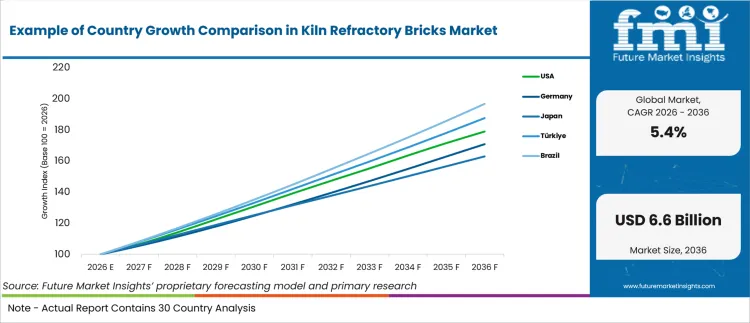
Country growth diverges as installed kiln capacity and new-line economics differ under similar refractory physics. Brazil is forecast at 5.1% CAGR versus 4.1% for Germany, although that gap does not establish a larger Brazilian market. ABCP reported in May 2026 that Brazil's cement industry operated with almost 40% idle capacity following nearly 40 factory additions between 2006 and 2015. Spare capacity favors relining and efficiency work over broad greenfield expansion while mature German plants remain heavily replacement-led.
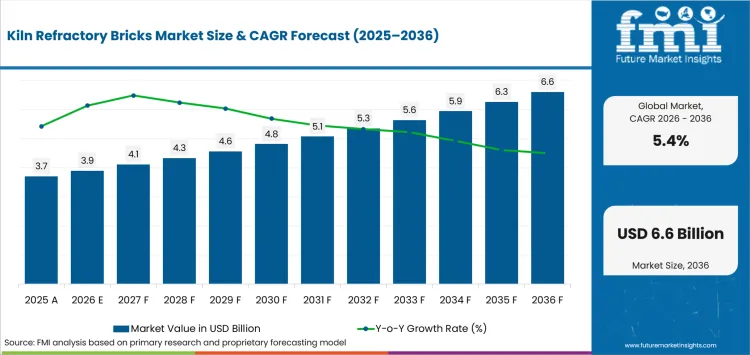
Key Takeaways of Kiln Refractory Bricks Market
- Recurring relining sustains demand as kiln operators replace worn hot-face materials during planned maintenance outages.
- In 2026, the burning zone is expected to lead kiln zone demand with 31.0% share because clinker contact increases wear.
- Shaped bricks are set to lead the form category with 61.0% share in 2026 due to geometry that simplifies rotary-kiln installation.
- Qualification risk and narrow outage windows slow refractory changes as premature wear or late deliveries can delay restart.
- Profiled companies include RHI Magnesita, Krosaki Harima, Shinagawa Refra, Calderys, Morgan Advanced Materials, IFGL Refractories and Resco Refratechnik.
Analyst Perspective
"Kiln teams should compare brick offers by expected campaign life at each zone, then confirm local stock and installation crews against the outage plan. Lower brick prices lose value if the chemistry fails early or missing shapes delay restart."
- Nikhil Kaitwade, Principal Consultant, Future Market Insights
How is the Kiln Refractory Bricks Market segmented?
The kiln refractory bricks market is segmented by brick chemistry, kiln zone, form, end use, sales channel and region.
Brick chemistry covers high alumina, magnesia spinel, magnesia chrome, fireclay, insulating and basic bricks, while kiln zone covers burning, transition, calcining, preheating and cooler or tertiary-air-duct positions. Form comprises shaped bricks, monolithics or castables and precast shapes, while end use includes cement, lime, metals and minerals and waste incineration. Sales channels include direct refractory supply, maintenance contractors, kiln OEM or EPC routes and distributors.
What makes high alumina bricks central to the brick chemistry category?
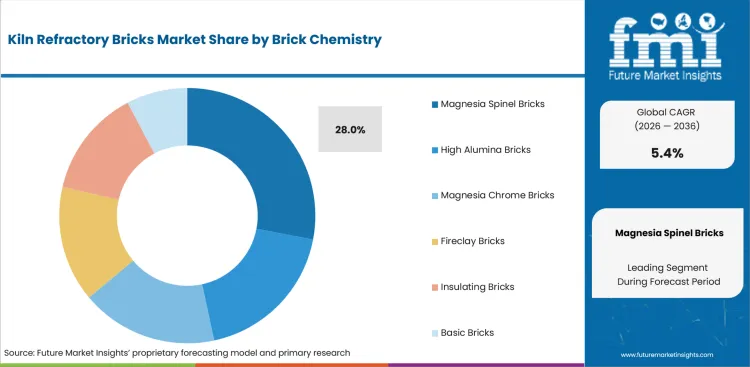
High alumina bricks serve abrasive kiln positions that require alumina materials to balance hot strength and thermal-cycling resistance outside the hottest basic zones. TRL Krosaki reported in January 2025 that its planned Gujarat factory would produce high alumina bricks and monolithics for cement and steel customers, adding regional production capacity once commissioned.
- Based on brick chemistry, magnesia spinel bricks are projected to account for 28% in 2026 due to broad use across non-basic high-temperature kiln duties.
- Cement plants stage familiar alumina shapes ahead of planned outages, reducing qualification and installation uncertainty across calcining and cooler-related positions that require repeatable replacement work.
Why does the burning zone lead the kiln zone category?
Burning-zone refractory systems use magnesium oxide against peak temperature and direct clinker contact inside rotary kilns. Joint integrity and refractory cement protect the shell during severe thermal cycling across each lining campaign.
- The kiln zone category is forecast to be led by the burning zone at 31.0% share in 2026 due to severe clinker-forming duty and wear.
- Burning-zone relining needs compatible brick shapes and predictable delivery, making supply critical to outage planning. Calderys reported in April 2026 that acidic and basic brick lines at its CAPES facility were scheduled to start later in 2026, leaving local benefits dependent on commissioning and qualification.
How do shaped bricks hold the leading form position?
Shaped bricks let crews build stable cylindrical linings with repeatable geometry around rotating kiln shells. High-temperature insulation and industrial insulation complement the lining as shaped brick dimensions control quantities and installation sequencing during relining. IFGL disclosed in April 2025 that Odisha authorities approved a Khurdha facility for DBM fired bricks plus ramming and fettling masses, pending completion.
- Shaped bricks are set to lead the form category with 61.0% share in 2026 due to repeatable geometry that simplifies rotary-kiln installation and material staging.
- Crews stage matched brick shapes ahead of demolition so installation can follow the measured lining plan without disrupting a fixed kiln restart date.
What supports cement as the leading end use?
Cement clinker production relies on rotary kilns with multiple refractory zones under different thermal and chemical duties. Lime kilns use calcium oxide production routes, while hydrated lime sits downstream from calcination and keeps refractory selection tied to firing conditions.
- By end use, cement is forecast to represent 66.0% in 2026 driven by recurring relining across installed clinker kilns. Cemex reported in April 2026 that eight US cement plants operated with 12.1 million tons of installed capacity, illustrating the asset base behind kiln maintenance demand.
- Multiple refractory zones turn each major inspection into a materials decision spanning bricks and monolithics, sustaining recurring purchasing beyond new-line construction.
What are the drivers, restraints and opportunities in the Kiln Refractory Bricks Market?
Recurring relining and changing kiln duty sustain demand, qualification risk slows switching and refractory recycling can reduce raw-material dependenceh
- Driver: Installed kilns require recurring refractory replacement as hot-face wear and operating changes trigger zone-specific relining during planned maintenance campaigns.
- Restraint: Qualification risk and compressed outage schedules slow material changes as premature lining failure can erase savings from a lower brick price.
- Opportunity: Recovered refractory can become qualified secondary feedstock once sorting and local processing preserve the properties required for new linings.
Installed Kilns Sustain Replacement Demand
Installed industrial furnaces and cement kilns need fresh refractory during scheduled maintenance as hot-face wear consumes the lining over time. Short replenishment routes matter for maintenance teams that need qualified materials on site ahead of demolition. RHI Magnesita completed its Resco acquisition in January 2025, adding seven US refractory plants plus two raw-material sites and expanding local availability for repeat relining orders.
Outage Risk Extends Qualification
Kiln relining must fit the planned shutdown, so a material change also depends on qualified installation crews. Calderys reported in May 2026 that its 18-month Supervisor Academy addresses a shortage of experienced refractory installation supervisors across EMEA. Limited supervision raises switching risk as new lining systems must be installed correctly for the kiln to restart on schedule.
Recycling Requires Controlled Recovery
RHI Magnesita reported in December 2025 that its 42-month ReSoURCE project completed development and demonstration of sensor-based sorting for used refractories. Sensor-based sorting can separate usable spent refractory from industrial waste incinerators and other kilns into secondary feedstock for new linings. Commercial use across waste-to-energy systems depends on controlled collection and application-specific qualification so recycled inputs do not replace virgin raw materials indiscriminately.
Which country CAGRs are profiled in the Kiln Refractory Bricks Market?
| Country | CAGR |
|---|---|
| Brazil | 5.1% |
| Türkiye | 5.0% |
| USA | 4.5% |
| Germany | 4.1% |
| Japan | 3.8% |
How do country-level CAGRs compare in the Kiln Refractory Bricks Market?
The country forecasts span 1.3 percentage points and form a compact distribution, with Brazil and Türkiye grouped above a lower mature-market band that includes Germany and Japan. The USA marks the transition because its replacement-led outlook sits between those clusters, while the spacing reflects operating conditions rather than current market size.
- Brazil's spare clinker capacity concentrates refractory spending on installed-kiln relining and inventory reliability.
- Türkiye's export exposure puts carbon-accounting costs directly into cement-kiln operating decisions.
- US purchasing stays outage-led as weaker cement consumption limits urgency for new-kiln construction.
- Germany's lower clinker output shifts differentiation toward lining durability across mature plants.
- Japan's concentrated plant ownership rewards qualification history and precise maintenance support.
Similar growth rates therefore translate into distinct service and qualification requirements across these markets.
The full report provides country-level CAGR analysis across North America, Latin America, Europe, East Asia, South Asia, Oceania and the Middle East and Africa.
Country-wise Analysis
- Brazilian cement plants operate across an extensive kiln base with substantial spare capacity, making scheduled relining and efficiency work more important than broad greenfield expansion for refractory demand across established producing states nationwide. ABCP reported in January 2026 that 2025 cement sales reached 67 million tonnes and rose 3.7%, yet restrictive financing continues to limit discretionary kiln upgrades and keeps inventory decisions focused on planned maintenance. Brazil is estimated to post 5.1% CAGR over the forecast period, supported by recurring relining that rewards local stock and field support able to protect campaign life during tightly scheduled shutdowns and predictable deliveries.
- Turkish cement producers run a large clinker base with substantial export exposure, placing refractory choices beside energy efficiency and carbon-accounting decisions during regular relining programs at integrated plants across major production regions. TÜRKÇİMENTO reported in February 2026 that members representing about 94% of the sector produced 75 million tonnes of clinker during the first eleven months of 2025, establishing a large operating base for recurring refractory maintenance. Adoption of kiln refractory bricks in Türkiye is estimated to expand at 5.0% CAGR through 2036, influenced by recurring maintenance while EU carbon-border exposure favors campaign stability and documented performance under changing kiln conditions.
- US cement plants schedule refractory purchases around planned outages and use domestic manufacturing plus contractor networks to stage critical shapes near dispersed operating sites across regional networks ahead of demolition and lining replacement. The USA kiln refractory bricks sector is projected to record 4.5% CAGR during the assessment period, supported by relining despite the American Cement Association forecasting in April 2026 that cement consumption would decline 2.5% in 2026 amid construction uncertainty. Softer cement demand raises price and inventory sensitivity without removing replacement requirements, so manufacturers with dependable lead times and field coordination are positioned to protect restart dates and limit emergency freight during maintenance campaigns.
- German cement plants operate a mature kiln base under tighter national carbon constraints, making refractory qualification depend on campaign evidence and compatibility with changing fuels and clinker formulations across established production assets. The German Environment Agency reported in July 2025 that clinker production fell almost 9% during 2024, reinforcing a replacement-led environment in which durable materials and operating records carry more weight than greenfield capacity additions. Kiln refractory brick demand in Germany is forecast to rise at 4.1% CAGR over the forecast period, supported by scheduled maintenance while lower clinker output keeps material qualification conservative and rewards documented service performance.
- Japanese cement purchasing is concentrated across a limited number of highly engineered plants with established refractory relationships, making qualification history and precise application records central to planned maintenance and material approval decisions nationwide. The Japan Cement Association reported that 26 plants owned by 15 companies held 47 million tonnes of clinker capacity as of July 2025, defining an installed base with few new-customer openings for refractory manufacturers. Kiln refractory brick sales in Japan are forecast to expand at 3.8% CAGR by 2036, supported by recurring relining but constrained by concentrated ownership that favors proven service history and measured campaign performance.
Who are the notable companies in the Kiln Refractory Bricks Market?
RHI Magnesita, Krosaki Harima, Shinagawa Refra, Calderys, Morgan Advanced Materials, IFGL Refractories and Refratechnik are the notable companies serving this market.
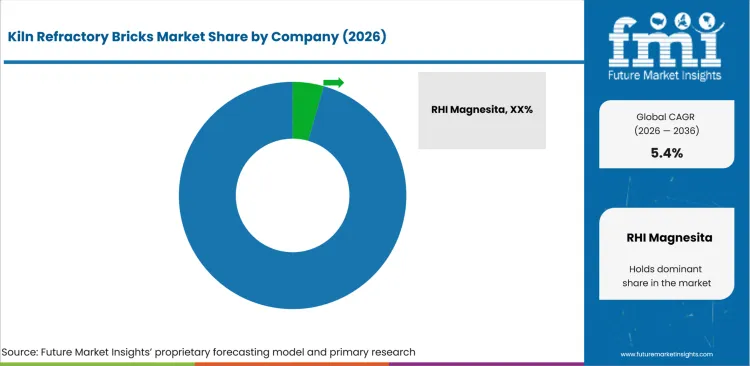
The kiln refractory bricks field combines integrated refractory groups with regional manufacturers focused on cement and other high-temperature linings. Competition depends on chemistry breadth by kiln zone and application engineering. A delayed restart can outweigh a lower brick price, making local inventory commercially relevant. New entrants need kiln references and field-service capacity to earn qualification for unfamiliar lining combinations at cement plants.
- RHI Magnesita, Calderys and Shinagawa Refra combine broad refractory ranges with engineering networks that cover multi-region relining programs.
- Krosaki Harima and IFGL Refractories pair refractory manufacturing with technical support across established Asian production bases and overseas operating companies.
- Morgan Advanced Materials and Refratechnik add regional brick and insulation routes alongside service support near customer sites.
Competitive Benchmarking: Kiln Refractory Bricks Market
| Company | Kiln Lining Breadth | Application Engineering | Regional Supply Coverage | Geographic Reach |
|---|---|---|---|---|
| RHI Magnesita | High | High | High | Global |
| Krosaki Harima | High | High | High | Asia, Europe and North America |
| Shinagawa Refra | High | High | High | Asia, Europe, Americas and Oceania |
| Calderys | High | High | High | Europe, Middle East, Asia and Americas |
| Morgan Advanced Materials | Medium | Medium | High | Global |
| IFGL Refractories | Medium | Medium | High | Asia, Europe and North America |
| Refratechnik | Medium | Medium | Medium | Europe |
Scoring basis: High kiln-lining breadth requires at least three verified in-scope form or chemistry families. Medium requires two and Low identifies one documented family. High application engineering requires design plus installation and service evidence. Medium requires two functions and Low identifies one. High regional supply coverage requires owned production or service capacity across at least three major regions. Medium covers two regions and Low covers one.
Key Developments in the Kiln Refractory Bricks Market
- In November 2025, Calderys and Binzagr entered a partnership for a 16,300 m² Jubail plant to produce monolithics and precast shapes from April 2026 for Gulf industries including cement.
- In November 2025, RHI Magnesita unveiled the RAPTOR mobile multisensor system for sorting mixed end-of-life refractories into high-purity secondary raw materials for qualified recycling.
- In May 2025, Shinagawa Refra completed the acquisition of a 60% stake in Reframax Engenharia to add refractory installation and engineering coverage across 21 locations in seven countries.
Key Players in the Kiln Refractory Bricks Market
Integrated Refractory and Engineering Platforms
- RHI Magnesita
- Calderys
- Shinagawa Refra
Kiln and Industrial Refractory Manufacturers
- Krosaki Harima
- IFGL Refractories
Insulation and Regional Lining Specialists
- Morgan Advanced Materials
- Refratechnik
Kiln Refractory Bricks Market - Report Scope
| Coverage field | Report scope |
|---|---|
| Market breakdown | By brick chemistry, kiln zone, form, end use, sales channel and region. |
| Quantitative Units | USD million. |
| Market Definition | Commercial kiln-lining refractory materials sold as shaped bricks, monolithics or castables and precast shapes across cement, lime, metals and minerals and waste incineration. Kiln equipment, EPC project value, standalone service revenue, downstream finished products and non-kiln refractory categories are excluded. |
| Regions Covered | North America, Latin America, Europe, East Asia, South Asia and Pacific and Middle East and Africa. |
| Countries Covered | Brazil, Türkiye, USA, Germany, Japan, and 20+ countries included in the full report. |
| Key Companies Profiled | RHI Magnesita, Krosaki Harima, Shinagawa Refra, Calderys, Morgan Advanced Materials, IFGL Refractories and Refratechnik. |
| Forecast Period | 2026 to 2036. |
| Approach | Primary and secondary research with market triangulation. |
Kiln Refractory Bricks Market - Research Methodology
| Method | Approach |
|---|---|
| Primary Research | FMI analysts gathered input from manufacturers, service providers, technology developers, distributors, end users, procurement teams, and subject-matter experts. Interviews examined purchasing decisions, product or service evaluation, adoption barriers, approval requirements, pricing considerations, and expectations for technical or commercial support. Respondents were also asked what evidence is required before a trial, pilot, or initial order develops into regular purchasing. |
| Desk Research | Desk research covered government statistics, regulatory publications, trade data, industry associations, technical literature, standards, company filings, product information, and official corporate announcements. Sources were reviewed for relevance, publication date, geographic coverage, and consistency with the defined market scope. Claims relating to performance, applications, approvals, capacity, investment, and commercial activity were retained only when supported by credible public evidence. |
| Market Sizing and Forecasting | The market model combined the baseline value with historical performance, segment structure, pricing and volume indicators, adoption levels, company participation, and country-level demand conditions. Forecast assumptions considered economic activity, investment trends, regulatory developments, technology adoption, purchasing cycles, supply availability, and barriers to wider market use. Segment and regional estimates were reconciled before the final market total was calculated. |
| Data Validation | Estimates were checked against multiple independent indicators, including public data, company activity, trade patterns, industry developments, and findings from primary interviews. Validation also tested whether products, services, applications, and company revenues fell within the defined market boundaries. Adjacent categories, unsupported claims, overlapping revenues, and activities without direct market relevance were excluded to reduce double counting and maintain consistency across segments and countries. |
Kiln Refractory Bricks Market by Segments
Kiln Refractory Bricks Market segmented by Brick Chemistry:
- High Alumina Bricks
- Magnesia Spinel Bricks
- Magnesia Chrome Bricks
- Fireclay Bricks
- Insulating Bricks
- Basic Bricks
Kiln Refractory Bricks Market segmented by Kiln Zone:
- Burning Zone
- Transition Zone
- Calcining Zone
- Preheating Zone
- Cooler / Tertiary Air Duct
Kiln Refractory Bricks Market segmented by Form:
- Shaped Bricks
- Monolithics / Castables
- Precast Shapes
Kiln Refractory Bricks Market segmented by End Use:
- Cement
- Lime
- Metals & Minerals
- Waste Incineration
Kiln Refractory Bricks Market segmented by Sales Channel:
- Direct Refractory Supply
- Maintenance Contractor
- Kiln OEM / EPC
- Distributors
Kiln Refractory Bricks Market by Region:
- North America
- United States
- Canada
- Latin America
- Brazil
- Mexico
- Chile
- Rest of Latin America
- Western Europe
- Germany
- United Kingdom
- Italy
- Spain
- France
- Nordics
- Benelux
- Rest of Western Europe
- Eastern Europe
- Russia
- Poland
- Hungary
- Balkan and Baltic States
- Rest of Eastern Europe
- East Asia
- China
- Japan
- South Korea
- South Asia and Pacific
- India
- ASEAN
- Australia and New Zealand
- Rest of South Asia and Pacific
- Middle East and Africa
- Kingdom of Saudi Arabia
- Other GCC Countries
- Türkiye
- South Africa
- Other African Union Countries
- Rest of Middle East and Africa
Research Sources and Bibliography
- RHI Magnesita. (2025, December 1). RHI Magnesita Wins Two Awards for Best Technical Presentation at Cement Industry Events.
- Associação Brasileira de Cimento Portland. (2026, May 13). Setor de cimento projeta desafios e defende investimentos em infraestrutura na coletiva da Coalizão Indústria.
- TRL Krosaki Limited. (2025, January 21). Foundation Stone Laying Ceremony of Gujarat Plant.
- Calderys. (2026, April 9). Calderys inaugurates Indian state-of-the-art facility in the presence of Odisha’s Chief Minister.
- IFGL Refractories Limited. (2025, April 21). Disclosure under Regulation 30- Approval of manufacturing facilities by Industrial Promotion & Investment Corporation of Odisha Limited for Dolo Burnt Magnesia (DBM) Fired Bricks, DBM Ramming Mass and DBM Fetting Mass in the District of Khurdha, Odisha.
- Cemex, S.A.B. de C.V. (2026, April 24). Form 20-F.
- RHI Magnesita. (2025, January 28). RHI Magnesita expands footprint in North America through Resco Group acquisition.
- Calderys. (2026, May 5). Calderys Academy for Supervisors: Securing the Future of Refractory Installation Expertise.
- RHI Magnesita. (2025, December 1). Successful Completion of ReSoURCE-RHI Magnesita’s First Coordinated Horizon Europe Project.
- Associação Brasileira de Cimento Portland. (2026, January 10). Vendas de cimento fecham 2025 com forte desempenho.
- TÜRKÇİMENTO. (2026, February 25). TÜRKÇİMENTO: Actual Emissions Must Be Taken into Account.
- American Cement Association. (2026, April 30). USA Cement Industry’s Economic Forecast Reflects Uncertainty of War’s Future; Recession Still Unlikely.
- German Environment Agency. (2025, July 16). German emissions nearly halved in 20 years of trading.
- Japan Cement Association. (2025, July). Statistics.
- Shinagawa Refra Co., Ltd. (2026, January 29). SHINAGAWA REFRA: Integrated Report 2025.
- Krosaki Harima Corporation. (2025, December 12). 2025 Integrated Report (For Printing).
- Morgan Advanced Materials. (2026, March 26). Morgan Advanced Materials Releases 2025 Annual Report: Unlocking our potential.
- IFGL Refractories Limited. (Retrieved August 11, 2026). IFGL Refractories - A Group of Companies.
- Calderys. (2025, November 18). Calderys and Binzagr announce strategic partnership to serve the evolving needs of the Middle East refractory market.
- RHI Magnesita. (2025, November 17). EU-backed RAPTOR system sets a new benchmark for refractory recycling, boosting EU competitiveness, security and Green Deal targets.
- Shinagawa Refra Co., Ltd. (2025, June 2). The Shinagawa Group announces the completion of its acquisition of a 60% stake in Reframax.
- Calderys. (2025, December 22). Calderys celebrates the internal opening of new Innovation Center in EMEA.
- HarbisonWalker International. (2026, January 29). Advancing Lightweight Refractory Performance Through Differentiated Raw Materials.
- RHI Magnesita. (2025, May 26). Brazil Steps into the Spotlight as Global Magnesite Hub at MagForum 2025.
- IFGL Refractories Limited. (Retrieved August 11, 2026). Quality Certificates.
- Calderys. (Retrieved August 11, 2026). Search Media.
- Krosaki Harima Corporation. (Retrieved August 11, 2026). Refractory Business.
- Krosaki Harima Corporation. (Retrieved August 11, 2026). Furnace Business.
- Krosaki Harima Corporation. (Retrieved August 11, 2026). Oversea associated companies.
- Shinagawa Refra Co., Ltd. (Retrieved August 11, 2026). Engineering Services.
- Shinagawa Refra Co., Ltd. (Retrieved August 11, 2026). Overseas Business Sites.
- Morgan Advanced Materials. (Retrieved August 11, 2026). Thermal Products.
This bibliography is provided for reader reference and is not exhaustive. The full report contains the complete reference list and detailed citations
This Report Answers
- What is the kiln refractory bricks market size in 2026 and value by 2036?
- Why does recurring relining matter more than finished-cement output for kiln refractory demand?
- Why do high alumina bricks lead the brick chemistry category?
- Why does burning-zone severity concentrate refractory value in kiln zones?
- How do growth and order-conversion conditions differ across the five profiled countries?
- What qualification and outage risks slow switching between refractory suppliers?
- Which capabilities distinguish integrated refractory platforms from regional lining specialists?
- How can recycling turn spent refractory into qualified lining feedstock?
Frequently Asked Questions
How big is the Kiln Refractory Bricks Market in 2026?
The kiln refractory bricks market is expected to be valued at USD 3.9 billion in 2026. Recurring relining sustains purchases as maintenance teams replace worn hot-face materials during planned kiln outages.
What is the CAGR of the Kiln Refractory Bricks Market from 2026 to 2036?
The kiln refractory bricks market is projected to expand at a 5.4% CAGR from 2026 to 2036. Replacement cycles remain the primary route as installed kilns require repeated lining inspection and renewal.
Which brick chemistry segment is projected to account for 23.0% of the Kiln Refractory Bricks Market?
The kiln refractory bricks market is expected to see magnesia spinel bricks account for 28.0% of brick chemistry demand in 2026. Their position reflects broad use across abrasive and thermally demanding non-basic kiln duties under recurring service conditions.
How much will the Kiln Refractory Bricks Market add between 2026 and 2036?
The kiln refractory bricks market is expected to add USD 2.6 billion between 2026 and 2036. The increase reflects recurring relining demand plus selective first-fill requirements from new or expanded kiln capacity.
Which companies are active in the Kiln Refractory Bricks Market?
The kiln refractory bricks market includes RHI Magnesita, Krosaki Harima, Shinagawa Refra, HarbisonWalker International, Calderys, Morgan Advanced Materials, IFGL Refractories and Resco Products. Their roles differ by lining breadth, engineering coverage and regional supply access during planned relining work.
Preview the report firsthand - request a free sample
Get SampleGet the brochure for pricing and purchase details.
Get PDFTable of Content
- Key Takeaways
- Market Size and CAGR
- Top Growth Driver
- Fastest Growing Segment
- Leading Region
- Key Companies
- Emerging Opportunities
- Executive Summary
- Global Market Outlook
- Demand-side Trends
- Supply-side Trends
- Technology Roadmap Analysis
- Analysis and Recommendations
- Analyst Perspective (What is happening? Why now? What should investors know?)
- Key Questions Answered
- How large is the market?
- What is the CAGR?
- What are key trends?
- Which region dominates?
- Who are the leaders?
- Market Overview
- Market Coverage / Taxonomy
- Market Definition / Scope / Limitations
- Research Methodology
- Chapter Orientation
- Analytical Lens and Working Hypotheses
- Market Structure, Signals, and Trend Drivers
- Benchmarking and Cross-market Comparability
- Market Sizing, Forecasting, and Opportunity Mapping
- Research Design and Evidence Framework
- Desk Research Programme (Secondary Evidence)
- Expert Input and Fieldwork (Primary Evidence)
- Tooling, Models, and Reference Databases
- Data Engineering and Model Build
- Quality Assurance and Audit Trail
- Market Background
- Market Dynamics (Drivers, Restraints, Opportunity, Trends)
- Scenario Forecast (Optimistic, Likely, Conservative)
- Impact Analysis
- AI Impact
- Sustainability Impact
- Regulatory Impact
- Technology Impact
- Consumer / Buyer Analysis
- Purchase Drivers
- Adoption Barriers
- Buyer Journey
- Opportunity Map Analysis
- Product Life Cycle Analysis
- Supply Chain Analysis
- Investment Feasibility Matrix
- Value Chain Analysis
- PESTLE and Porter's Analysis
- Regulatory Landscape
- Regional Parent Market Outlook
- Production and Consumption Statistics
- Import and Export Statistics
- Global Market Analysis and Forecast, 2021 to 2036
- Historical Market Size Value (USD Billion) Analysis, 2021 to 2025
- Current and Future Market Size Value (USD Billion) Projections, 2026 to 2036
- Y-o-Y Growth Trend Analysis
- Absolute $ Opportunity Analysis
- Global Market Pricing Analysis, 2021 to 2036
- Global Market Analysis and Forecast, By Brick Chemistry, 2021 to 2036
- Introduction / Key Findings
- Historical Market Size Value (USD Billion) Analysis By Brick Chemistry, 2021 to 2025
- Current and Future Market Size Value (USD Billion) Analysis and Forecast By Brick Chemistry, 2026 to 2036
- Magnesia Spinel Bricks
- High Alumina Bricks
- Magnesia Chrome Bricks
- Fireclay Bricks
- Insulating Bricks
- Basic Bricks
- Magnesia Spinel Bricks
- Y-o-Y Growth Trend Analysis By Brick Chemistry, 2021 to 2025
- Absolute $ Opportunity Analysis By Brick Chemistry, 2026 to 2036
- Global Market Analysis and Forecast, By Kiln Zone, 2021 to 2036
- Introduction / Key Findings
- Historical Market Size Value (USD Billion) Analysis By Kiln Zone, 2021 to 2025
- Current and Future Market Size Value (USD Billion) Analysis and Forecast By Kiln Zone, 2026 to 2036
- Burning Zone
- Transition Zone
- Calcining Zone
- Preheating Zone
- Cooler / Tertiary Air Duct
- Burning Zone
- Y-o-Y Growth Trend Analysis By Kiln Zone, 2021 to 2025
- Absolute $ Opportunity Analysis By Kiln Zone, 2026 to 2036
- Global Market Analysis and Forecast, By Form, 2021 to 2036
- Introduction / Key Findings
- Historical Market Size Value (USD Billion) Analysis By Form, 2021 to 2025
- Current and Future Market Size Value (USD Billion) Analysis and Forecast By Form, 2026 to 2036
- Shaped Bricks
- Monolithics / Castables
- Precast Shapes
- Shaped Bricks
- Y-o-Y Growth Trend Analysis By Form, 2021 to 2025
- Absolute $ Opportunity Analysis By Form, 2026 to 2036
- Global Market Analysis and Forecast, By End Use, 2021 to 2036
- Introduction / Key Findings
- Historical Market Size Value (USD Billion) Analysis By End Use, 2021 to 2025
- Current and Future Market Size Value (USD Billion) Analysis and Forecast By End Use, 2026 to 2036
- Cement
- Lime
- Metals & Minerals
- Waste Incineration
- Cement
- Y-o-Y Growth Trend Analysis By End Use, 2021 to 2025
- Absolute $ Opportunity Analysis By End Use, 2026 to 2036
- Global Market Analysis and Forecast, By Sales Channel, 2021 to 2036
- Introduction / Key Findings
- Historical Market Size Value (USD Billion) Analysis By Sales Channel, 2021 to 2025
- Current and Future Market Size Value (USD Billion) Analysis and Forecast By Sales Channel, 2026 to 2036
- Direct Refractory Supply
- Maintenance Contractor
- Kiln OEM / EPC
- Distributors
- Direct Refractory Supply
- Y-o-Y Growth Trend Analysis By Sales Channel, 2021 to 2025
- Absolute $ Opportunity Analysis By Sales Channel, 2026 to 2036
- Global Market Analysis and Forecast, By Region, 2021 to 2036
- Introduction
- Historical Market Size Value (USD Billion) Analysis By Region, 2021 to 2025
- Current Market Size Value (USD Billion) Analysis and Forecast By Region, 2026 to 2036
- North America
- Latin America
- Western Europe
- Eastern Europe
- East Asia
- South Asia and Pacific
- Middle East & Africa
- Market Attractiveness Analysis By Region
- North America Market Analysis and Forecast, By Country, 2021 to 2036
- Historical Market Size Value (USD Billion) Trend Analysis By Market Taxonomy, 2021 to 2025
- Market Size Value (USD Billion) Forecast By Market Taxonomy, 2026 to 2036
- By Country
- USA
- Canada
- By Brick Chemistry
- By Kiln Zone
- By Form
- By End Use
- By Sales Channel
- By Country
- Market Attractiveness Analysis
- By Country
- By Brick Chemistry
- By Kiln Zone
- By Form
- By End Use
- By Sales Channel
- Key Takeaways
- Latin America Market Analysis and Forecast, By Country
- Historical Market Size Value (USD Billion) Trend Analysis By Market Taxonomy, 2021 to 2025
- Market Size Value (USD Billion) Forecast By Market Taxonomy, 2026 to 2036
- By Country
- Brazil
- Mexico
- Chile
- Rest of Latin America
- By Brick Chemistry
- By Kiln Zone
- By Form
- By End Use
- By Sales Channel
- By Country
- Market Attractiveness Analysis
- By Country
- By Brick Chemistry
- By Kiln Zone
- By Form
- By End Use
- By Sales Channel
- Key Takeaways
- Western Europe Market Analysis and Forecast, By Country
- Historical Market Size Value (USD Billion) Trend Analysis By Market Taxonomy, 2021 to 2025
- Market Size Value (USD Billion) Forecast By Market Taxonomy, 2026 to 2036
- By Country
- Germany
- UK
- Italy
- Spain
- France
- Nordic
- BENELUX
- Rest of Western Europe
- By Brick Chemistry
- By Kiln Zone
- By Form
- By End Use
- By Sales Channel
- By Country
- Market Attractiveness Analysis
- By Country
- By Brick Chemistry
- By Kiln Zone
- By Form
- By End Use
- By Sales Channel
- Key Takeaways
- Eastern Europe Market Analysis and Forecast, By Country
- Historical Market Size Value (USD Billion) Trend Analysis By Market Taxonomy, 2021 to 2025
- Market Size Value (USD Billion) Forecast By Market Taxonomy, 2026 to 2036
- By Country
- Russia
- Poland
- Hungary
- Balkan & Baltic
- Rest of Eastern Europe
- By Brick Chemistry
- By Kiln Zone
- By Form
- By End Use
- By Sales Channel
- By Country
- Market Attractiveness Analysis
- By Country
- By Brick Chemistry
- By Kiln Zone
- By Form
- By End Use
- By Sales Channel
- Key Takeaways
- East Asia Market Analysis and Forecast, By Country
- Historical Market Size Value (USD Billion) Trend Analysis By Market Taxonomy, 2021 to 2025
- Market Size Value (USD Billion) Forecast By Market Taxonomy, 2026 to 2036
- By Country
- China
- Japan
- South Korea
- By Brick Chemistry
- By Kiln Zone
- By Form
- By End Use
- By Sales Channel
- By Country
- Market Attractiveness Analysis
- By Country
- By Brick Chemistry
- By Kiln Zone
- By Form
- By End Use
- By Sales Channel
- Key Takeaways
- South Asia and Pacific Market Analysis and Forecast, By Country
- Historical Market Size Value (USD Billion) Trend Analysis By Market Taxonomy, 2021 to 2025
- Market Size Value (USD Billion) Forecast By Market Taxonomy, 2026 to 2036
- By Country
- India
- ASEAN
- Australia & New Zealand
- Rest of South Asia and Pacific
- By Brick Chemistry
- By Kiln Zone
- By Form
- By End Use
- By Sales Channel
- By Country
- Market Attractiveness Analysis
- By Country
- By Brick Chemistry
- By Kiln Zone
- By Form
- By End Use
- By Sales Channel
- Key Takeaways
- Middle East & Africa Market Analysis and Forecast, By Country
- Historical Market Size Value (USD Billion) Trend Analysis By Market Taxonomy, 2021 to 2025
- Market Size Value (USD Billion) Forecast By Market Taxonomy, 2026 to 2036
- By Country
- Kingdom of Saudi Arabia
- Other GCC Countries
- Türkiye
- South Africa
- Other African Union
- Rest of Middle East & Africa
- By Brick Chemistry
- By Kiln Zone
- By Form
- By End Use
- By Sales Channel
- By Country
- Market Attractiveness Analysis
- By Country
- By Brick Chemistry
- By Kiln Zone
- By Form
- By End Use
- By Sales Channel
- Key Takeaways
- Key Countries Market Analysis
- USA
- Pricing Analysis
- Market Share Analysis, 2025
- By Brick Chemistry
- By Kiln Zone
- By Form
- By End Use
- By Sales Channel
- Canada
- Pricing Analysis
- Market Share Analysis, 2025
- By Brick Chemistry
- By Kiln Zone
- By Form
- By End Use
- By Sales Channel
- Mexico
- Pricing Analysis
- Market Share Analysis, 2025
- By Brick Chemistry
- By Kiln Zone
- By Form
- By End Use
- By Sales Channel
- Brazil
- Pricing Analysis
- Market Share Analysis, 2025
- By Brick Chemistry
- By Kiln Zone
- By Form
- By End Use
- By Sales Channel
- Chile
- Pricing Analysis
- Market Share Analysis, 2025
- By Brick Chemistry
- By Kiln Zone
- By Form
- By End Use
- By Sales Channel
- Germany
- Pricing Analysis
- Market Share Analysis, 2025
- By Brick Chemistry
- By Kiln Zone
- By Form
- By End Use
- By Sales Channel
- UK
- Pricing Analysis
- Market Share Analysis, 2025
- By Brick Chemistry
- By Kiln Zone
- By Form
- By End Use
- By Sales Channel
- Italy
- Pricing Analysis
- Market Share Analysis, 2025
- By Brick Chemistry
- By Kiln Zone
- By Form
- By End Use
- By Sales Channel
- Spain
- Pricing Analysis
- Market Share Analysis, 2025
- By Brick Chemistry
- By Kiln Zone
- By Form
- By End Use
- By Sales Channel
- France
- Pricing Analysis
- Market Share Analysis, 2025
- By Brick Chemistry
- By Kiln Zone
- By Form
- By End Use
- By Sales Channel
- India
- Pricing Analysis
- Market Share Analysis, 2025
- By Brick Chemistry
- By Kiln Zone
- By Form
- By End Use
- By Sales Channel
- ASEAN
- Pricing Analysis
- Market Share Analysis, 2025
- By Brick Chemistry
- By Kiln Zone
- By Form
- By End Use
- By Sales Channel
- Australia & New Zealand
- Pricing Analysis
- Market Share Analysis, 2025
- By Brick Chemistry
- By Kiln Zone
- By Form
- By End Use
- By Sales Channel
- China
- Pricing Analysis
- Market Share Analysis, 2025
- By Brick Chemistry
- By Kiln Zone
- By Form
- By End Use
- By Sales Channel
- Japan
- Pricing Analysis
- Market Share Analysis, 2025
- By Brick Chemistry
- By Kiln Zone
- By Form
- By End Use
- By Sales Channel
- South Korea
- Pricing Analysis
- Market Share Analysis, 2025
- By Brick Chemistry
- By Kiln Zone
- By Form
- By End Use
- By Sales Channel
- Russia
- Pricing Analysis
- Market Share Analysis, 2025
- By Brick Chemistry
- By Kiln Zone
- By Form
- By End Use
- By Sales Channel
- Poland
- Pricing Analysis
- Market Share Analysis, 2025
- By Brick Chemistry
- By Kiln Zone
- By Form
- By End Use
- By Sales Channel
- Hungary
- Pricing Analysis
- Market Share Analysis, 2025
- By Brick Chemistry
- By Kiln Zone
- By Form
- By End Use
- By Sales Channel
- Kingdom of Saudi Arabia
- Pricing Analysis
- Market Share Analysis, 2025
- By Brick Chemistry
- By Kiln Zone
- By Form
- By End Use
- By Sales Channel
- Türkiye
- Pricing Analysis
- Market Share Analysis, 2025
- By Brick Chemistry
- By Kiln Zone
- By Form
- By End Use
- By Sales Channel
- South Africa
- Pricing Analysis
- Market Share Analysis, 2025
- By Brick Chemistry
- By Kiln Zone
- By Form
- By End Use
- By Sales Channel
- USA
- Market Structure Analysis
- Competition Dashboard
- Competition Benchmarking
- Market Share Analysis of Top Players
- By Regional
- By Brick Chemistry
- By Kiln Zone
- By Form
- By End Use
- By Sales Channel
- Emerging Startups
- Innovation Benchmarking
- Competition Analysis
- Competition Deep Dive
- RHI Magnesita
- Overview
- Product Portfolio
- Profitability by Market Segments
- Sales Footprint
- Strategy Overview
- Marketing Strategy
- Product Strategy
- Channel Strategy
- Vesuvius
- Krosaki Harima
- Shinagawa Refractories
- Calderys
- Morgan Advanced Materials
- IFGL Refractories
- Dalmia Bharat Refractories
- Refratechnik
- RHI Magnesita
- Case Studies
- Success Stories
- Recent Developments
- Competition Deep Dive
- Assumptions & Acronyms Used


