

- Market Size (2026)
- USD 8.4 Bn
- Forecast (2036)
- USD 13.7 Bn
- CAGR (2026 to 2036)
- 5.0%
How big is Knitting Yarn Ball Retail Market size?
USD 8.4 billion in 2026 and USD 13.7 billion by 2036 at a 5.0% CAGR.
Sales of knitting yarn ball retail are estimated to rise at 5.0% CAGR through 2036, increasing valuation from USD 8.4 billion in 2026 to USD 13.7 billion by 2036. The Craft Industry Alliance surveyed 6,300 yarn consumers in May 2025. These active crafters started an average of 19 projects every year and successfully finished just over 16 of their creations. Such high project completion rates naturally motivate makers to buy fresh fiber supplies on a recurring basis.
Shoppers across Japan and Germany considerably prefer natural fibers and rely heavily on expert guidance from store staff. Buyers throughout the United Kingdom and North America focus primarily on shopping convenience and rapid inventory replenishment. Eurostat published data in February 2025 showing online purchasing activity among 77% of European Union internet users. This heavy mixed-channel shopping behavior forces retail stores to keep their online and in-store inventory records perfectly synchronized.
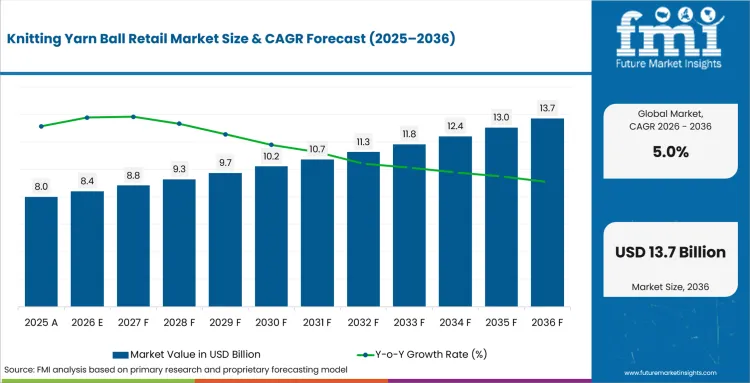
Key Takeaways for the Knitting Yarn Ball Retail Market
- Demand receives support from recurring knitting and crochet projects across garments and accessories.
- Individual consumers are set to garner 68.0% share of end user in 2026, backed by direct project control and repeat replenishment across personal purchases.
- Offline retail is estimated to lead distribution channel with 61.0% share in 2026, aided by tactile fiber review and immediate shade comparison during store purchases.
- Inventory complexity across colors and dye lots restrains conversion through substitutions and incomplete project replenishment.
- Competition focusses on Lion Brand Yarn Company, Spinrite Inc. (Yarnspirations brands: Bernat, Red Heart, and Patons), Stylecraft Yarns, DMC Group, Schachenmayr, Rowan, Cascade Yarns, and Hobbii, with providers differentiating based on yarn variety and retail reach.
Analyst Perspective
“Knitting yarn ball retail rewards suppliers converting craft interest into completed projects and repeat purchases. Commercial review begins with sell-through by shade and weight. Replenishment frequency provides a second test. Expansion lacking both measures raises inventory exposure and weakens returns.”
- Nikhil Kaitwade, Principal Analyst at Future Market Insights
How is Knitting Yarn Ball Retail Market segmented?
The knitting yarn ball retail sector is segmented by yarn type, weight, application, distribution channel, end user, and region.
The knitting yarn ball retail industry is segmented by yarn type, weight, application, distribution channel, end user, and region. Yarn Type includes natural, synthetic, blended, and specialty options. Weight coverage spans medium, light, bulky, and fine yarn families. Application analysis includes garments, home décor, craft projects, and accessories. Distribution Channel covers offline retail, online retail, and wholesale. End User includes individual consumers, commercial users, and educational institutions. Regional coverage includes North America, Europe, East Asia, South Asia and Pacific, Latin America, Middle East and Africa.
What keeps natural fiber yarn ahead within yarn type?
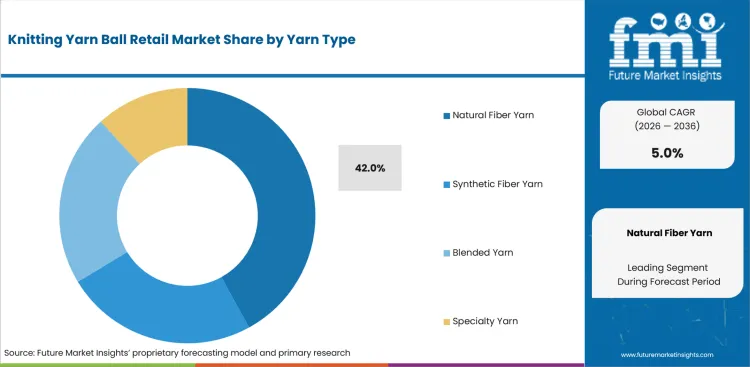
Natural fiber yarn benefits from tactile appeal and familiar garment performance. Cotton and silk address separate seasonal or project needs. Textile Exchange reported certified sources covering 34% of global cotton production in September 2025, supporting documented cotton and cotton-blend retail assortments. Buyer approval also requires credible labels and suitable care instructions. Vegetal Natural Fiber sourcing supports renewable material positioning across selected yarn ranges.
- Natural fiber yarn is expected to garner 42.0% share in 2026, driven by garment suitability and established pattern compatibility. Accurate fiber descriptions and complete project quantities protect repeat orders.
- Synthetic fiber yarn offers durability and accessible care across everyday projects. Blended Yarn combines performance traits across cotton and acrylic fibers.
What buying mechanism supports medium weight yarn in weight?
Worsted weight and Afghan weight provide clear stitch definition. In December 2025, Hobbii described an Aura Lapghan using medium-weight blended yarn. Project construction covered 10 motifs, 85 full-size hexagons, and 6 half hexagons, demonstrating medium-weight adaptability across substantial home projects. Worsted wool yarn patterns strengthen selection through familiar needle sizes and predictable fabric density. Medium Weight Yarn supports accessories and beginner projects through familiar gauges.
- In 2026, medium weight yarn is anticipated to account for 37.0% share owing to its wide application coverage and accessible project execution. Gauge guidance and quantity recommendations reduce selection errors.
- Light Weight Yarn supports drape across socks and warm-season garments. Bulky Yarn shortens project completion across blankets or accessories.
What supports garments within application?
Garments generate multi-ball purchases across sweaters and gloves. Pattern selection connects fiber behavior and quantity inside one purchase decision. Craft Industry Alliance recorded 3,076 respondents in May 2026, demonstrating extensive participation across knitting and crochet activities. Clothing projects nearly doubled as maker skill increased. Skill progression raises material use across advanced garment work. Needlecraft patterns translate design intent into exact yarn requirements.
- Based on application, garments are anticipated to account for 39.0% share since it is influenced by repeat wardrobe projects and higher yarn volume per finished item. Size-based quantities and matching dye lots improve completion.
- Home décor supports blankets and rugs across household projects. Polypropylene yarn supports selected utility projects needing moisture resistance.
Why does offline retail lead distribution channel?
Offline retail supports physical comparison across softness and shade. Specialty yarn stores and craft stores also provide pattern guidance or quantity checks. Craft Industry Alliance reported greater online yarn buying among 56% of respondents in May 2024, demonstrating demand across online purchasing routes. A separate 38% preferred in-person shopping, reinforcing store-led tactile review. Immediate store access reduces project interruption during urgent shade replacement.
- Offline retail is predicted to represent 61.0% share in 2026, helped by tactile assessment and direct help across fiber or shade decisions. Specialty yarn stores and department stores require complete project quantities.
- Online retail improves access to uncommon colors and specialty fibers. Wholesale supports distributors and craft supply dealers serving commercial or educational buyers.
How do individual consumers shape end user demand?
Individual Consumers purchase around personal projects and social inspiration. Hobby Knitters and Crochet Enthusiasts select fiber or weight according to project needs. USA Bureau of Labor Statistics reported 125 minutes of arts and crafts activity per participating day in January 2026, supporting repeat project buying among individual users. Handicraft interest supports handmade outcomes across personal and small commercial work.
- By end user, individual consumers are likely to hold 68.0% share in 2026, backed by direct control over project choice and purchase timing. Accessible guidance and stable shade availability improve project completion.
- Commercial users require consistent quantity and repeatable supply. Educational institutions need accessible materials for training centers and community workshops.
What are drivers, restraints, and opportunities in Knitting Yarn Ball Retail Market?
Recurring craft projects support yarn replenishment. Inventory complexity delays conversion. Project-linked retail models create expansion potential across guided purchases.
- Driver: Seasonal collections and newly issued patterns give consumers clear reasons to purchase yarn. Project timing also supports repeat visits for matching shades and required weights.
- Restraint: Shade availability and dye-lot differences complicate consistent replenishment across retail inventories. Retailers are likely to hold slow-moving colors when project demand shifts between seasons.
- Opportunity: Pattern-based kits can combine selected yarns with instructions for complete project preparation. Community workshops are expected to strengthen buyer confidence and encourage completion of purchased projects.
Seasonal pattern collections create clear project starts across gifts and home decoration. Hobbii published 24 Easter crochet and knitting patterns in February 2026, connecting seasonal inspiration with fiber and quantity selection. Retailers gain a practical sales route through complete project kits.
Online ordering exposes yarn buyers to delayed deliveries and incorrect products. Eurostat reported purchase problems among 35.4% of European Union online shoppers in March 2026, highlighting service failures affecting shade-sensitive projects. Accurate stock records and delivery information reduce corrective work.
Pattern-linked assortments connect design discovery with exact yarn purchases. Hobbii released 14 Garland patterns in February 2025, including 13 knitting designs and 1 crochet design. Coordinated patterns and named shades reduce search effort across project selection. Knitting machines guidance extends project support for selected commercial users.
How are country CAGRs aligned in Knitting Yarn Ball Retail Market?
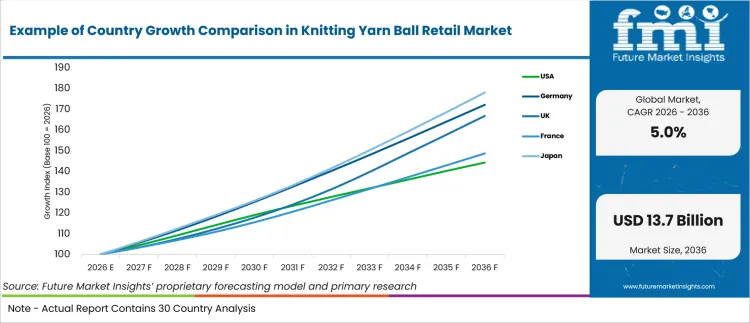
| Country or Market | CAGR |
|---|---|
| Japan | 5.9% |
| Germany | 5.6% |
| UK | 5.2% |
| Italy | 4.9% |
| Canada | 4.4% |
| France | 4.0% |
| USA | 3.7% |
Source: Future Market Insights country forecast analysis, 2026.
How do country-level CAGRs compare in Knitting Yarn Ball Retail Market?
Country comparison shows a gradual step-down across profiled markets. Japan occupies the upper position and Germany follows. The United Kingdom and Italy form the middle forecast band. Canada and France complete the next rate group. The United States closes the disclosed comparison. A 2.2 percentage-point spread separates Japan from United States. National positions reflect separate channel structures and project preferences.
- Japan is anticipated to lead the comparison based on specialist service and exact shade expectations.
- Germany is projected to follow Japan depending on structured product information and mixed-channel buying.
- UK is expected to occupy the next position led by independent stores and pattern-led purchasing.
- Italy and France form a gradual middle-to-lower progression under separate retail conditions.
- USA completes the comparison driven by an established craft retail base and extensive channel choice.
Markets carrying similar CAGRs are anticipated to present separate entry conditions. Assortment planning requires local evidence across service and pattern support. Full report coverage includes North America, Europe, East Asia, South Asia and Pacific, Latin America, Middle East and Africa.
Country-wise Analysis
- Knitting yarn ball retail sector in Japan is set to expand at 5.9% CAGR between 2026 and 2036, guided by specialist service and exact shade expectations. Online discovery improves access to uncommon yarn weights. Ministry of Economy, Trade and Industry reported a 9.8% business-to-consumer e-commerce ratio for 2024 in August 2025, supporting online access across retail channels. Specialist stores retain value through tactile review and careful shade matching.
- German Federal Statistical Office recorded online purchases during recent three-month periods among 70% of surveyed adults in November 2025, highlighting established online buying activity. Fiber composition and clear care instructions improve trust. Demand in Germany is estimated to rise at 5.6% CAGR during the study period, aided by substitute selection and project guidance across independent stores.
- Independent yarn shops and designer communities support mixed-channel discovery across UK buyers. Sector in United Kingdom is projected to record 5.2% CAGR from 2026 to 2036, reflecting pattern-led purchasing and specialist-store activity. Office for National Statistics recorded online retail at 27.4% of total retail sales during 2025 in its June 2026 release, demonstrating established online channel use. Workshops and immediate assistance support store conversion.
- Sales in Italy are anticipated to scale at 4.9% CAGR during the forecast period, underpinned by apparel orientation and specialist retail. Eurostat reported online purchasing among 62% of Italian internet users during 2025 in its 2026 edition, influencing mixed-channel purchasing. Local assortments and reliable delivery records support fragmented demand. Warm-weather fibers improve seasonal garment selection.
- Statistics Canada reported high-speed internet access across 96.4% of households in 2024 through its June 2026 update, highlighting nationwide online access. Stock accuracy and delivery clarity reduce project interruption across remote orders. Industry in Canada is predicted to grow at 4.4% CAGR during the assessment period, backed by local stores supporting urgent shade replacement.
- Handmade apparel and household projects support specialist purchasing across France. Demand in France is estimated to rise at 4.0% CAGR during the study period, aided by tutorials and beginner patterns serving younger buyers. National Institute of Statistics and Economic Studies reported online purchases among 84.0% of people aged 15 to 29 during 2025 in December 2025, demonstrating a connected younger buyer base.
- Established craft chains and online sellers create extensive choice across USA. Knitting yarn ball retail adoption in the United States is likely to increase at 3.7% CAGR between 2026 and 2036, guided by recurring hobby demand and extensive channel choice. USA Census Bureau reported e-commerce at 16.9% of total retail sales during first-quarter 2026 in May 2026, demonstrating continued online participation. Assortment competition raises pressure on shade depth and delivery performance.
Who are notable companies in Knitting Yarn Ball Retail Market?
Lion Brand Yarn Company, Spinrite Inc. (Yarnspirations brands: Bernat, Red Heart, and Patons) form an established brand group. Stylecraft Yarns, DMC, and Schachenmayr add specialist or regional depth. Rowan and Cascade Yarns contribute natural-fiber and independent-store strength. Hobbii adds an international online retail model.
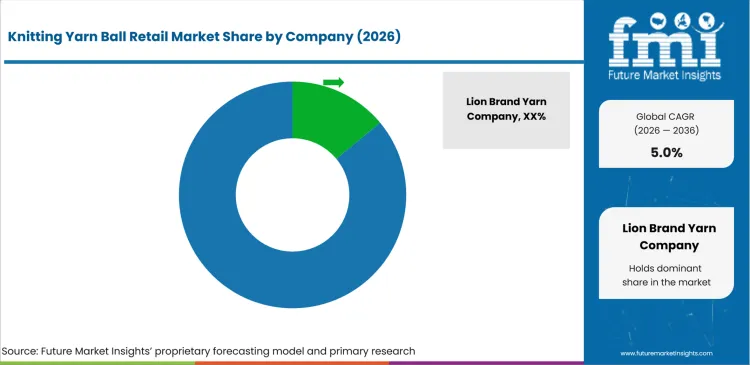
Competition in the market centers on assortment depth and project completion. Established brands combine recognizable yarn families with pattern libraries. Specialist suppliers emphasize fiber quality and curated palettes. Online participants connect tutorials and direct ordering. Buyer review covers replenishment reliability and substitution support.
- Lion Brand Yarn Company and Spinrite Inc. form established brand networks, with Spinrite represented through Bernat, Red Heart, and Patons.
- Stylecraft Yarns and Schachenmayr address color-led knitting and needlecraft projects. Portfolio strength rests on reliable specifications. Coordinated shade ranges support repeat purchasing.
- Rowan and Cascade Yarns compete depending on natural-fiber assortments and specialist-store relationships. Buyers assess texture and garment suitability. Designer patterns connect yarn selection with project intent.
- Hobbii connects direct online retail with collaborations and downloadable patterns. Customer retention rests on delivery quality and product accuracy. Community participation supports recurring project discovery.
Competitive Benchmarking: Knitting Yarn Ball Retail Market
| Company | Offer Breadth | Brand and Channel | Repeat Demand Position | Service Reach |
|---|---|---|---|---|
| Lion Brand Yarn Company | High | High | Established | Global |
| Spinrite Inc. (Yarnspirations brands: Bernat, Red Heart, and Patons) | High | High | Established | Multi-country |
| Stylecraft Yarns | Focused | High | Specialist | Regional |
| DMC | Focused | Medium | Specialist | Global |
| Schachenmayr | Selective | Medium | Specialist | Multi-country |
| Rowan | Selective | High | Specialist | Global |
| Cascade Yarns | Focused | Medium | Specialist | Multi-country |
| Hobbii | High | High | Online-led | International |
Source: Future Market Insights competitive analysis, 2026.
Key Developments in Knitting Yarn Ball Retail Market
- In January 2025, Lion Brand Yarn Company introduced its Show Us Your Glow contest around DIY Glow yarn. Company information connected glow-in-dark functionality and weekly project tutorials with defined purchasing across garments and decorative crafts.
- In March 2025, Yarnspirations released its Float Away Collection for spring garment and accessory projects. Company information connected named patterns and featured yarns with direct material selection across warm-season designs.
- In July 2025, Hobbii presented Bella Coco Merino through a crochet-focused collaboration. Company information connected Z-twist construction and curated colors with four free patterns for beginner-friendly project use.
Knitting Yarn Ball Retail Market Report Scope
| Coverage field | Report scope |
|---|---|
| Market breakdown | Knitting yarn ball retail market breakdown includes yarn type, weight, application, distribution channel, end user, and region. |
| Quantitative Units | Revenue in USD Million, CAGR in %. |
| Market Definition | Retail sale of yarn balls and skeins for knitting or crochet through craft stores, independent shops, marketplaces, brand websites, and mass retail. Finished yarn intended for consumer or small commercial projects is included. Industrial bulk yarn sold outside retail project channels is excluded. |
| Regions Covered | North America, Europe, East Asia, South Asia and Pacific, Latin America, Middle East and Africa. |
| Countries Covered | Japan, Germany, UK, Italy, Canada, France, USA, and additional countries included in full regional coverage. |
| Key Companies Profiled | Lion Brand Yarn Company, Spinrite Inc. (Yarnspirations brands: Bernat, Red Heart, and Patons), Stylecraft Yarns, DMC, Schachenmayr, Rowan, Cascade Yarns, and Hobbii. |
| Forecast Period | 2026 to 2036. |
| Approach | Hybrid bottom-up and top-down methodology uses market values, segment shares, country CAGRs, company participation, channel activity, and buyer evidence for reconciliation. |
Source: Future Market Insights report scope analysis, 2026.
Knitting Yarn Ball Retail Market - Research Methodology
| Method | Approach |
|---|---|
| Primary Research | FMI analysts gathered input from manufacturers, service providers, technology developers, distributors, end users, procurement teams, and subject-matter experts. Interviews examined purchasing decisions, product or service evaluation, adoption barriers, approval requirements, pricing considerations, and expectations for technical or commercial support. Respondents were also asked what evidence is required before a trial, pilot, or initial order develops into regular purchasing. |
| Desk Research | Desk research covered government statistics, regulatory publications, trade data, industry associations, technical literature, standards, company filings, product information, and official corporate announcements. Sources were reviewed for relevance, publication date, geographic coverage, and consistency with the defined market scope. Claims relating to performance, applications, approvals, capacity, investment, and commercial activity were retained only when supported by credible public evidence. |
| Market Sizing and Forecasting | The market model combined the baseline value with historical performance, segment structure, pricing and volume indicators, adoption levels, company participation, and country-level demand conditions. Forecast assumptions considered economic activity, investment trends, regulatory developments, technology adoption, purchasing cycles, supply availability, and barriers to wider market use. Segment and regional estimates were reconciled before the final market total was calculated. |
| Data Validation | Estimates were checked against multiple independent indicators, including public data, company activity, trade patterns, industry developments, and findings from primary interviews. Validation also tested whether products, services, applications, and company revenues fell within the defined market boundaries. Adjacent categories, unsupported claims, overlapping revenues, and activities without direct market relevance were excluded to reduce double counting and maintain consistency across segments and countries. |
Source: Future Market Insights research methodology, 2026.
Knitting Yarn Ball Retail Market by Segments
Knitting Yarn Ball Retail Market segmented by Yarn Type:
- Natural Fiber Yarn
- Synthetic Fiber Yarn
- Blended Yarn
- Specialty Yarn
Knitting Yarn Ball Retail Market segmented by Weight:
- Medium Weight Yarn
- Light Weight Yarn
- Bulky Yarn
- Fine Yarn
Knitting Yarn Ball Retail Market segmented by Application:
- Garments
- Home Décor
- Craft & DIY
- Accessories
Knitting Yarn Ball Retail Market segmented by Distribution Channel:
- Offline Retail
- Online Retail
- Wholesale
Knitting Yarn Ball Retail Market segmented by End User:
- Individual Consumers
- Commercial Users
- Educational Institutions
Knitting Yarn Ball Retail Market segmented by Region:
- North America
- United States
- Canada
- Latin America
- Brazil
- Mexico
- Argentina
- Chile
- Western Europe
- Germany
- France
- United Kingdom
- Italy
- Spain
- Benelux
- Nordics
- Eastern Europe
- Poland
- Czech Republic
- Romania
- Hungary
- East Asia
- China
- Japan
- South Korea
- South Asia and Pacific
- India
- ASEAN
- Australia and New Zealand
- Middle East and Africa
- GCC Countries
- South Africa
- Türkiye
- Israel
Research Sources and Bibliography
- Glassenberg, A. (2025, May 18). The Size of the Yarn Market: Yarn Consumer Survey Results 2025. Craft Industry Alliance.
- Eurostat. (2025, February 20). Online shopping in the EU keeps growing.
- Textile Exchange. (2025, September 18). Materials Market Report 2025.
- Hobbii. (2025, December 3). #FrostandBloomCAL - All Your Questions Answered!
- Glassenberg, A. (2026, May 26). Yarn Industry Consumer Survey Results 2026. Craft Industry Alliance.
- Glassenberg, A. (2024, May 14). The Size of the Yarn Market: Yarn Consumer Survey Results 2024. Craft Industry Alliance.
- USA Bureau of Labor Statistics. (2026, January 29). Baubles, bangles, and beads: Time spent on hobbies.
- Hobbii. (2026, February 27). 24 Adorable Crochet & Knitting Patterns for a Cozy Easter.
- Eurostat. (2026, March 11). More than a third of online shoppers face issues.
- Hobbii. (2025, February 11). Made with Garland: 14 Brand-New Patterns from Pom Pom.
- Ministry of Economy, Trade and Industry. (2025, August 26). Results of FY2024 E-Commerce Market Survey Compiled.
- German Federal Statistical Office. (2025, November 27). Internet users and online shoppers.
- Office for National Statistics. (2026, June 19). Internet sales as a percentage of total retail sales (ratio) (%).
- Eurostat. (2026). Digitalisation in Europe - 2026 edition.
- Statistics Canada. (2026, June 24). Telecommunications statistics.
- National Institute of Statistics and Economic Studies. (2025, December 2). Online shopping by age.
- USA Census Bureau. (2026, May 18). Quarterly Retail E-Commerce Sales: First Quarter 2026.
- Brunson, S. (2025, January 29). Lion Brand’s Show Us Your Glow Contest. Lion Brand Yarn Company.
- Yarnspirations. (2025, March 31). Float Away Collection Spring 2025 Lookbook.
- Hobbii. (2025, July 31). Meet the Designer: Bella Coco.
The bibliography entries provide reader reference and do not represent an exhaustive register. The full report coverage includes a complete source list and detailed citations.
This Report Answers
- How do segments influence demand across yarn type, weight, application, distribution channel, and end user coverage?
- What criteria guide yarn buyers evaluating fiber and quantity prior to purchase?
- Why do country CAGRs differ across profiled countries for knitting yarn ball retail?
- What companies compete through assortment and replenishment?
- How are forecasts validated through bottom-up and top-down analysis using independent indicators?
- What evidence supports retail assortment expansion across stores and online channels?
- Why do dye-lot continuity and stock accuracy influence supplier selection?
- How does inventory complexity limit return across seasonal and trend-led ranges?
- How do pattern guidance and exact quantities influence project completion?
- What company capabilities improve long-term confidence and repeat purchasing?
Frequently Asked Questions
How big is the Knitting Yarn Ball Retail Market in 2026?
The knitting yarn ball retail market is valued at USD 8.4 billion in 2026 and is forecast to reach USD 13.7 billion by 2036. Growth is supported by recurring maker activity, with Craft Industry Alliance survey data showing active crafters completing an average of 16 out of 19 annual projects, sustaining consistent and repeat fiber purchasing throughout the year.
What is the CAGR of the Knitting Yarn Ball Retail Market from 2026 to 2036?
The knitting yarn ball retail market grows at a CAGR of 5.0% between 2026 and 2036, supported by rising craft participation and expanding mixed-channel purchasing behavior, as retailers serving both in-store tactile review and online replenishment demand capture repeat buyers across garment and accessory project cycles.
Which yarn type leads the Knitting Yarn Ball Retail Market?
Natural fiber yarn accounts for 42.0% of the knitting yarn ball retail market by yarn type in 2026, driven by garment suitability, established pattern compatibility, and buyer preference for fiber authenticity, where credible sourcing labels and accurate fiber descriptions protect both initial selection and repeat project orders across seasonal ranges.
How much will the Knitting Yarn Ball Retail Market add between 2026 and 2036?
The knitting yarn ball retail market is set to add USD 5.3 billion between 2026 and 2036, growing from USD 8.4 billion to USD 13.7 billion as natural and blended fiber assortments, pattern-linked kits, and community workshop programs draw recurring buyers across offline specialty stores and expanding online retail channels in both established and emerging craft markets.
Who are the leading companies in the Knitting Yarn Ball Retail Market?
Eight companies lead the knitting yarn ball retail market, including Lion Brand Yarn Company, Spinrite Inc. through its Bernat, Red Heart, and Patons brands, Stylecraft Yarns, DMC Group, Schachenmayr, Rowan, Cascade Yarns, and Hobbii, competing through assortment depth, shade consistency, natural-fiber positioning, designer pattern libraries, and direct international online retail across craft store and digital purchasing channels worldwide.
Preview the report firsthand - request a free sample
Get SampleGet the brochure for pricing and purchase details.
Get PDFTable of Content
- Key Takeaways
- Market Size and CAGR
- Top Growth Driver
- Fastest Growing Segment
- Leading Region
- Key Companies
- Emerging Opportunities
- Executive Summary
- Global Market Outlook
- Demand-side Trends
- Supply-side Trends
- Technology Roadmap Analysis
- Analysis and Recommendations
- Analyst Perspective (What is happening? Why now? What should investors know?)
- Key Questions Answered
- How large is the market?
- What is the CAGR?
- What are key trends?
- Which region dominates?
- Who are the leaders?
- Market Overview
- Market Coverage / Taxonomy
- Market Definition / Scope / Limitations
- Research Methodology
- Chapter Orientation
- Analytical Lens and Working Hypotheses
- Market Structure, Signals, and Trend Drivers
- Benchmarking and Cross-market Comparability
- Market Sizing, Forecasting, and Opportunity Mapping
- Research Design and Evidence Framework
- Desk Research Programme (Secondary Evidence)
- Expert Input and Fieldwork (Primary Evidence)
- Tooling, Models, and Reference Databases
- Data Engineering and Model Build
- Quality Assurance and Audit Trail
- Market Background
- Market Dynamics (Drivers, Restraints, Opportunity, Trends)
- Scenario Forecast (Optimistic, Likely, Conservative)
- Impact Analysis
- AI Impact
- Sustainability Impact
- Regulatory Impact
- Technology Impact
- Consumer / Buyer Analysis
- Purchase Drivers
- Adoption Barriers
- Buyer Journey
- Opportunity Map Analysis
- Product Life Cycle Analysis
- Supply Chain Analysis
- Investment Feasibility Matrix
- Value Chain Analysis
- PESTLE and Porter's Analysis
- Regulatory Landscape
- Regional Parent Market Outlook
- Production and Consumption Statistics
- Import and Export Statistics
- Global Market Analysis and Forecast, 2021 to 2036
- Historical Market Size Value (USD Billion) Analysis, 2021 to 2025
- Current and Future Market Size Value (USD Billion) Projections, 2026 to 2036
- Y-o-Y Growth Trend Analysis
- Absolute $ Opportunity Analysis
- Global Market Pricing Analysis, 2021 to 2036
- Global Market Analysis and Forecast, By Yarn Type, 2021 to 2036
- Introduction / Key Findings
- Historical Market Size Value (USD Billion) Analysis By Yarn Type, 2021 to 2025
- Current and Future Market Size Value (USD Billion) Analysis and Forecast By Yarn Type, 2026 to 2036
- Natural Fiber Yarn
- Cotton Yarn
- Wool Yarn
- Silk Yarn
- Synthetic Fiber Yarn
- Acrylic Yarn
- Polyester Yarn
- Nylon Yarn
- Blended Yarn
- Cotton Blend Yarn
- Wool Blend Yarn
- Acrylic Blend Yarn
- Specialty Yarn
- Bamboo Yarn
- Organic Yarn
- Recycled Fiber Yarn
- Natural Fiber Yarn
- Y-o-Y Growth Trend Analysis By Yarn Type, 2021 to 2025
- Absolute $ Opportunity Analysis By Yarn Type, 2026 to 2036
- Global Market Analysis and Forecast, By Weight, 2021 to 2036
- Introduction / Key Findings
- Historical Market Size Value (USD Billion) Analysis By Weight, 2021 to 2025
- Current and Future Market Size Value (USD Billion) Analysis and Forecast By Weight, 2026 to 2036
- Medium Weight Yarn
- Worsted Weight
- Aran Weight
- Afghan Weight
- Light Weight Yarn
- Fingering Weight
- Sport Weight
- DK Weight
- Bulky Yarn
- Bulky Weight
- Super Bulky Weight
- Jumbo Weight
- Fine Yarn
- Lace Weight
- Crochet Thread
- Baby Yarn
- Medium Weight Yarn
- Y-o-Y Growth Trend Analysis By Weight, 2021 to 2025
- Absolute $ Opportunity Analysis By Weight, 2026 to 2036
- Global Market Analysis and Forecast, By Application, 2021 to 2036
- Introduction / Key Findings
- Historical Market Size Value (USD Billion) Analysis By Application, 2021 to 2025
- Current and Future Market Size Value (USD Billion) Analysis and Forecast By Application, 2026 to 2036
- Garments
- Sweaters
- Scarves
- Socks
- Home Décor
- Blankets
- Cushions
- Rugs
- Craft & DIY
- Crochet Projects
- Knitting Projects
- Amigurumi
- Accessories
- Hats
- Gloves
- Bags
- Garments
- Y-o-Y Growth Trend Analysis By Application, 2021 to 2025
- Absolute $ Opportunity Analysis By Application, 2026 to 2036
- Global Market Analysis and Forecast, By Distribution Channel, 2021 to 2036
- Introduction / Key Findings
- Historical Market Size Value (USD Billion) Analysis By Distribution Channel, 2021 to 2025
- Current and Future Market Size Value (USD Billion) Analysis and Forecast By Distribution Channel, 2026 to 2036
- Offline Retail
- Specialty Yarn Stores
- Craft Stores
- Department Stores
- Online Retail
- E-commerce Platforms
- Brand Websites
- Marketplaces
- Wholesale
- Distributors
- Bulk Retailers
- Craft Supply Dealers
- Offline Retail
- Y-o-Y Growth Trend Analysis By Distribution Channel, 2021 to 2025
- Absolute $ Opportunity Analysis By Distribution Channel, 2026 to 2036
- Global Market Analysis and Forecast, By End User, 2021 to 2036
- Introduction / Key Findings
- Historical Market Size Value (USD Billion) Analysis By End User, 2021 to 2025
- Current and Future Market Size Value (USD Billion) Analysis and Forecast By End User, 2026 to 2036
- Individual Consumers
- Hobby Knitters
- Professional Knitters
- Crochet Enthusiasts
- Commercial Users
- Boutique Manufacturers
- Fashion Designers
- Handmade Product Sellers
- Educational Institutions
- Art Schools
- Training Centers
- Community Workshops
- Individual Consumers
- Y-o-Y Growth Trend Analysis By End User, 2021 to 2025
- Absolute $ Opportunity Analysis By End User, 2026 to 2036
- Global Market Analysis and Forecast, By Region, 2021 to 2036
- Introduction
- Historical Market Size Value (USD Billion) Analysis By Region, 2021 to 2025
- Current Market Size Value (USD Billion) Analysis and Forecast By Region, 2026 to 2036
- North America
- Latin America
- Western Europe
- Eastern Europe
- East Asia
- South Asia and Pacific
- Middle East & Africa
- Market Attractiveness Analysis By Region
- North America Market Analysis and Forecast, By Country, 2021 to 2036
- Historical Market Size Value (USD Billion) Trend Analysis By Market Taxonomy, 2021 to 2025
- Market Size Value (USD Billion) Forecast By Market Taxonomy, 2026 to 2036
- By Country
- USA
- Canada
- By Yarn Type
- By Weight
- By Application
- By Distribution Channel
- By End User
- By Country
- Market Attractiveness Analysis
- By Country
- By Yarn Type
- By Weight
- By Application
- By Distribution Channel
- By End User
- Key Takeaways
- Latin America Market Analysis and Forecast, By Country
- Historical Market Size Value (USD Billion) Trend Analysis By Market Taxonomy, 2021 to 2025
- Market Size Value (USD Billion) Forecast By Market Taxonomy, 2026 to 2036
- By Country
- Brazil
- Mexico
- Chile
- Rest of Latin America
- By Yarn Type
- By Weight
- By Application
- By Distribution Channel
- By End User
- By Country
- Market Attractiveness Analysis
- By Country
- By Yarn Type
- By Weight
- By Application
- By Distribution Channel
- By End User
- Key Takeaways
- Western Europe Market Analysis and Forecast, By Country
- Historical Market Size Value (USD Billion) Trend Analysis By Market Taxonomy, 2021 to 2025
- Market Size Value (USD Billion) Forecast By Market Taxonomy, 2026 to 2036
- By Country
- Germany
- UK
- Italy
- Spain
- France
- Nordic
- BENELUX
- Rest of Western Europe
- By Yarn Type
- By Weight
- By Application
- By Distribution Channel
- By End User
- By Country
- Market Attractiveness Analysis
- By Country
- By Yarn Type
- By Weight
- By Application
- By Distribution Channel
- By End User
- Key Takeaways
- Eastern Europe Market Analysis and Forecast, By Country
- Historical Market Size Value (USD Billion) Trend Analysis By Market Taxonomy, 2021 to 2025
- Market Size Value (USD Billion) Forecast By Market Taxonomy, 2026 to 2036
- By Country
- Russia
- Poland
- Hungary
- Balkan & Baltic
- Rest of Eastern Europe
- By Yarn Type
- By Weight
- By Application
- By Distribution Channel
- By End User
- By Country
- Market Attractiveness Analysis
- By Country
- By Yarn Type
- By Weight
- By Application
- By Distribution Channel
- By End User
- Key Takeaways
- East Asia Market Analysis and Forecast, By Country
- Historical Market Size Value (USD Billion) Trend Analysis By Market Taxonomy, 2021 to 2025
- Market Size Value (USD Billion) Forecast By Market Taxonomy, 2026 to 2036
- By Country
- China
- Japan
- South Korea
- By Yarn Type
- By Weight
- By Application
- By Distribution Channel
- By End User
- By Country
- Market Attractiveness Analysis
- By Country
- By Yarn Type
- By Weight
- By Application
- By Distribution Channel
- By End User
- Key Takeaways
- South Asia and Pacific Market Analysis and Forecast, By Country
- Historical Market Size Value (USD Billion) Trend Analysis By Market Taxonomy, 2021 to 2025
- Market Size Value (USD Billion) Forecast By Market Taxonomy, 2026 to 2036
- By Country
- India
- ASEAN
- Australia & New Zealand
- Rest of South Asia and Pacific
- By Yarn Type
- By Weight
- By Application
- By Distribution Channel
- By End User
- By Country
- Market Attractiveness Analysis
- By Country
- By Yarn Type
- By Weight
- By Application
- By Distribution Channel
- By End User
- Key Takeaways
- Middle East & Africa Market Analysis and Forecast, By Country
- Historical Market Size Value (USD Billion) Trend Analysis By Market Taxonomy, 2021 to 2025
- Market Size Value (USD Billion) Forecast By Market Taxonomy, 2026 to 2036
- By Country
- Kingdom of Saudi Arabia
- Other GCC Countries
- Türkiye
- South Africa
- Other African Union
- Rest of Middle East & Africa
- By Yarn Type
- By Weight
- By Application
- By Distribution Channel
- By End User
- By Country
- Market Attractiveness Analysis
- By Country
- By Yarn Type
- By Weight
- By Application
- By Distribution Channel
- By End User
- Key Takeaways
- Key Countries Market Analysis
- USA
- Pricing Analysis
- Market Share Analysis, 2025
- By Yarn Type
- By Weight
- By Application
- By Distribution Channel
- By End User
- Canada
- Pricing Analysis
- Market Share Analysis, 2025
- By Yarn Type
- By Weight
- By Application
- By Distribution Channel
- By End User
- Mexico
- Pricing Analysis
- Market Share Analysis, 2025
- By Yarn Type
- By Weight
- By Application
- By Distribution Channel
- By End User
- Brazil
- Pricing Analysis
- Market Share Analysis, 2025
- By Yarn Type
- By Weight
- By Application
- By Distribution Channel
- By End User
- Chile
- Pricing Analysis
- Market Share Analysis, 2025
- By Yarn Type
- By Weight
- By Application
- By Distribution Channel
- By End User
- Germany
- Pricing Analysis
- Market Share Analysis, 2025
- By Yarn Type
- By Weight
- By Application
- By Distribution Channel
- By End User
- UK
- Pricing Analysis
- Market Share Analysis, 2025
- By Yarn Type
- By Weight
- By Application
- By Distribution Channel
- By End User
- Italy
- Pricing Analysis
- Market Share Analysis, 2025
- By Yarn Type
- By Weight
- By Application
- By Distribution Channel
- By End User
- Spain
- Pricing Analysis
- Market Share Analysis, 2025
- By Yarn Type
- By Weight
- By Application
- By Distribution Channel
- By End User
- France
- Pricing Analysis
- Market Share Analysis, 2025
- By Yarn Type
- By Weight
- By Application
- By Distribution Channel
- By End User
- India
- Pricing Analysis
- Market Share Analysis, 2025
- By Yarn Type
- By Weight
- By Application
- By Distribution Channel
- By End User
- ASEAN
- Pricing Analysis
- Market Share Analysis, 2025
- By Yarn Type
- By Weight
- By Application
- By Distribution Channel
- By End User
- Australia & New Zealand
- Pricing Analysis
- Market Share Analysis, 2025
- By Yarn Type
- By Weight
- By Application
- By Distribution Channel
- By End User
- China
- Pricing Analysis
- Market Share Analysis, 2025
- By Yarn Type
- By Weight
- By Application
- By Distribution Channel
- By End User
- Japan
- Pricing Analysis
- Market Share Analysis, 2025
- By Yarn Type
- By Weight
- By Application
- By Distribution Channel
- By End User
- South Korea
- Pricing Analysis
- Market Share Analysis, 2025
- By Yarn Type
- By Weight
- By Application
- By Distribution Channel
- By End User
- Russia
- Pricing Analysis
- Market Share Analysis, 2025
- By Yarn Type
- By Weight
- By Application
- By Distribution Channel
- By End User
- Poland
- Pricing Analysis
- Market Share Analysis, 2025
- By Yarn Type
- By Weight
- By Application
- By Distribution Channel
- By End User
- Hungary
- Pricing Analysis
- Market Share Analysis, 2025
- By Yarn Type
- By Weight
- By Application
- By Distribution Channel
- By End User
- Kingdom of Saudi Arabia
- Pricing Analysis
- Market Share Analysis, 2025
- By Yarn Type
- By Weight
- By Application
- By Distribution Channel
- By End User
- Türkiye
- Pricing Analysis
- Market Share Analysis, 2025
- By Yarn Type
- By Weight
- By Application
- By Distribution Channel
- By End User
- South Africa
- Pricing Analysis
- Market Share Analysis, 2025
- By Yarn Type
- By Weight
- By Application
- By Distribution Channel
- By End User
- USA
- Market Structure Analysis
- Competition Dashboard
- Competition Benchmarking
- Market Share Analysis of Top Players
- By Regional
- By Yarn Type
- By Weight
- By Application
- By Distribution Channel
- By End User
- Emerging Startups
- Innovation Benchmarking
- Competition Analysis
- Competition Deep Dive
- Lion Brand Yarn Company
- Overview
- Product Portfolio
- Profitability by Market Segments
- Sales Footprint
- Strategy Overview
- Marketing Strategy
- Product Strategy
- Channel Strategy
- Bernat
- Red Heart Yarns
- Patons
- Stylecraft Yarns
- DMC Group
- Schachenmayr
- ROWAN
- Cascade Yarns
- Hobbii
- Lion Brand Yarn Company
- Case Studies
- Success Stories
- Recent Developments
- Competition Deep Dive
- Assumptions & Acronyms Used


