

- Market Size (2026)
- USD 0.81 Bn
- Forecast (2036)
- USD 1.92 Bn
- CAGR (2026 to 2036)
- 9.0%
Krill Oil Softgels Market Size, Market Forecast and Outlook By FMI
USD 0.81 billion in 2026 and USD 1.92 billion by 2036 at a 9.0% CAGR.
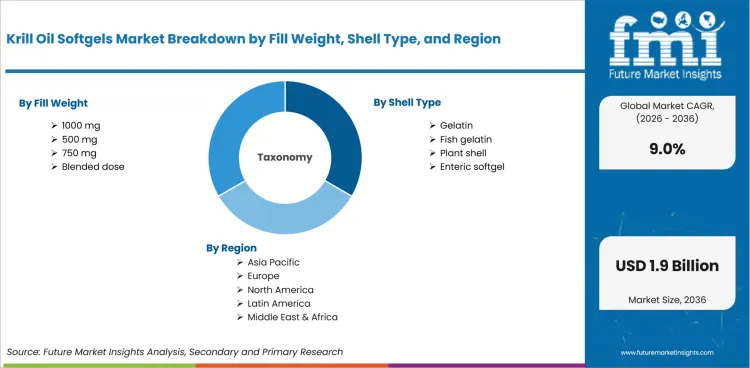
The krill oil softgels industry value is forecast to grow from USD 0.74 billion in 2025 to USD 1.92 billion by 2036 at a 9.0% CAGR as buyers compare phospholipid-bound EPA and DHA with fish oil alternatives. The 1000 mg format is forecast to represent 41.0% share in 2026 because brands use one-softgel serving language to reduce dosing friction. Gelatin softgels are expected to secure 68.0% share in 2026, led by established marine oil encapsulation lines.
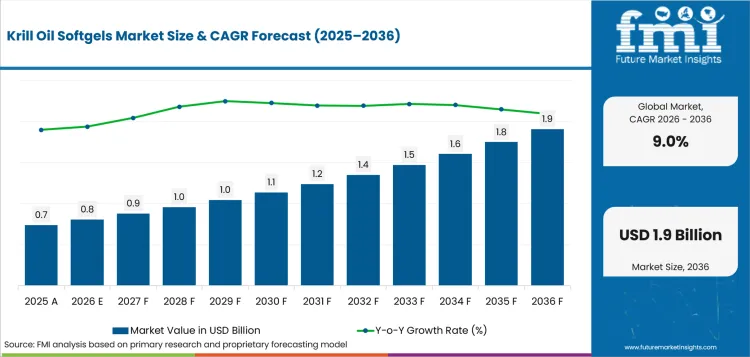
Krill Oil Softgels Market Overview: Size and Forecast
- 2026 Market Size: USD 0.81 billion
- 2036 Market Size: USD 1.92 billion
- Forecast CAGR: 9.0% from 2026 to 2036
- Leading Fill Weight: 1000 mg Softgels
- 1000 mg Softgels Share in 2026: 41.0%
- Leading Shell Type: Gelatin Softgels
- Gelatin Softgels Share in 2026: 68.0%
- Fastest-growing Country: India
- India CAGR: 10.6% by 2036
Summary of the Krill Oil Softgels Market
- Demand and Growth Drivers
- Phospholipid-bound omega-3 positioning supports premium pricing across krill oil supplements and related marine lipid formats.
- Verified Antarctic sourcing keeps supplier choice narrow, which gives integrated harvesters a stronger role in brand selection.
- Growing consumer preference for omega-3 supplements with enhanced bioavailability is driving demand for krill oil softgels, as phospholipid-bound omega-3s are perceived to offer superior absorption compared to conventional fish oil products.
- Expansion of e-commerce platforms and direct-to-consumer nutrition brands is improving product accessibility and market penetration, enabling manufacturers to reach a broader health-conscious consumer base across developed and emerging markets.
- Product and Segment View
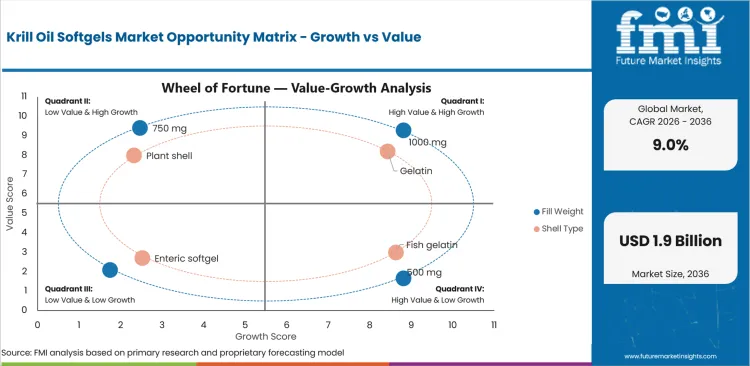
- The 1000 mg fill weight is expected to lead fill-weight demand with 41.0% share in 2026 as buyers favor fewer capsules.
- Gelatin is projected to lead shell type with 68.0% share in 2026 as contract manufacturers prefer proven oil capsule lines.
- Heart health is expected to lead claim focus with 43.0% share in 2026 due to established EPA and DHA recognition.
- E-commerce is projected to account for 36.0% share in 2026 as consumers compare dose, origin, and reviews online.
- Geography and Competitive Outlook
- The United States is projected at 7.6% CAGR, with drugstore brands and subscription e-commerce shaping repeat sales.
- Germany is expected to expand at 7.4% CAGR, supported by pharmacy-led supplement buying and strict notification norms.
- China and India are forecast above the global pace, with imported premium capsules selling through digital channels.
- Aker BioMarine, Rimfrost, Reckitt, Sports Research, NOW Foods, Doctor’s Best, and Life Extension form the verified benchmark set.
- Analyst Opinion
- Nandini Roy Choudhury, Principal Consultant for Food and Beverage at FMI says, “I see krill oil softgels as a trust market before I see them as an omega-3 market. Buyers are not only paying for EPA and DHA. They are paying for Antarctic origin, small capsule feel, lower aftertaste, phospholipid delivery, and proof that the ingredient was harvested under a recognized fishery system. The real pressure is coming from two sides. Consumers want a premium capsule that feels easier than fish oil. Regulators and retailers want clean labels, testing records, and responsible sourcing documents. Suppliers with vessel-to-capsule traceability will carry an edge. Brands that rely only on a generic omega-3 claim will struggle as shoppers learn to compare dose, source, and phospholipid content.”
- Krill Oil Softgels Market Value Analysis
- The market value is rising as premium capsule buyers shift from plain fish oil toward krill oil formats with phospholipids and astaxanthin.
- Softgel brands gain margin when they sell smaller capsules with higher perceived absorption and lower fishy aftertaste.
- Raw material access affects pricing because Antarctic krill catch is managed within defined CCAMLR fishery areas.
- Retailers favor products with third-party testing and sourcing claims, which raises the value of documented ingredient supply.
- Capsule count economics matter as 1000 mg formats reduce serving complexity and support premium shelf placement.
Quality control is the main pressure point for krill oil softgels as retailers review Antarctic sourcing, oxidation control, and contaminant testing. CCAMLR reported in April 2025 that the 2024 Antarctic krill catch in Area 48 reached a historically high level within the managed fishery. FDA guidance also requires dietary supplement makers to follow current good manufacturing practice controls. Suppliers with vessel-to-capsule traceability and clear EPA, DHA, phospholipid, and astaxanthin disclosures can secure buyer confidence more easily.
Why is the Krill Oil Softgels Market Growing?
Consumers choose krill oil softgels for phospholipid-bound EPA and DHA, which gives brands a clear difference from fish oil.
- Retailers favor small capsules with lower aftertaste claims as these formats reduce common fish oil complaints.
- Antarctic sourcing proof has become a buying filter as environmental scrutiny rises around krill harvest pressure.
- Premium e-commerce listings reward dose clarity, third-party testing, and branded ingredient names.
- Beauty and joint-positioned formulas expand use beyond heart health without changing the capsule platform.
Demand for Krill oil softgels is estimated to grow when consumers understand why the capsule differs from fish oil. The NIH Office of Dietary Supplements states that omega-3 supplements include fish oil, krill oil, cod liver oil, and algal oil, and these products provide a wide range of doses and forms. That classification gives krill oil a clear shelf identity inside the broader omega-3 set. The practical result is that brands can explain phospholipids, choline, and astaxanthin as added value within one capsule. Buyers then compare krill oil on format and source rather than only on EPA and DHA milligrams.
Supply discipline also shapes growth because Antarctic krill is not an open raw material pool. CCAMLR describes krill fishing areas and fishing methods in the Southern Ocean, including midwater trawls and continuous fishing systems. The fishery context creates a supply chain in which traceability, harvesting rights, and marine stewardship claims affect buyer confidence. This gives integrated ingredient suppliers a stronger role than typical supplement ingredient traders. The forecast therefore grows on premium conversion rather than unlimited volume expansion.
How is the krill oil softgels market segmented?
The krill oil softgels industry is segmented by fill weight, shell type, claim focus, sales channel, and sourcing position.
- With an estimated 41.0% share in 2026, 1000 mg softgels are expected to lead fill weight as shoppers compare dose per capsule.
- Gelatin softgels are projected to account for 68.0% of shell type demand in 2026 due to established oil encapsulation lines.
- Heart health formats are anticipated to hold 43.0% of claim focus in 2026 as EPA and DHA recognition supports repeat use.
- E-commerce buyers are projected to generate 36.0% of channel demand in 2026 through review-led discovery and subscription orders.
- MSC-certified and traceable harvest claims are expected to represent 48.0% of sourcing-positioned sales in 2026 as retailers ask for proof.
Segment behavior is shaped by how consumers buy supplements rather than by the oil alone. A capsule that says 1000 mg feels easier to compare than a lower-dose product that requires several softgels per day. Shell choice then follows manufacturing scale and leakage control. Claim focus stays anchored in heart health, but joint and beauty positioning create space for premium packs. E-commerce strengthens comparison behavior, which means fatty acid supplements with clearer dose and proof signals gain better conversion.
Why do 1000 mg softgels lead the krill oil softgels market?
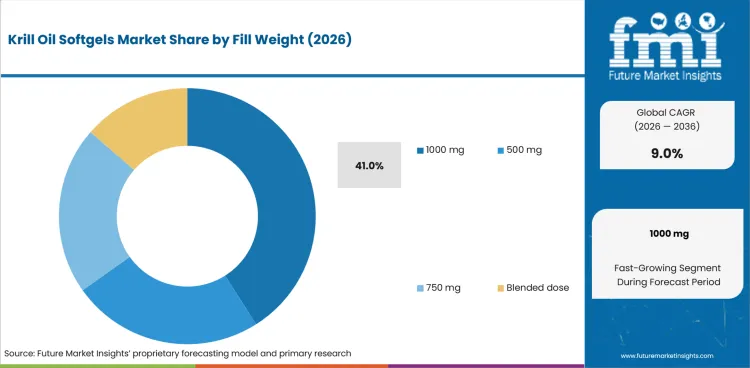
- The 1000 mg format is projected to account for 41.0% share in 2026 as buyers prefer one clear daily softgel over smaller multi-capsule routines.
- Higher-fill capsules need tighter odor control and seam stability, so contract manufacturers with marine oil softgel experience gain repeat brand orders.
Why do gelatin shells lead the krill oil softgels market?
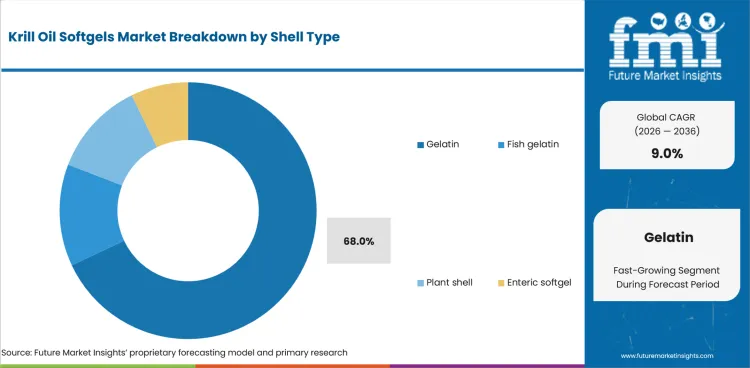
- Gelatin softgels are expected to hold 68.0% share in 2026 as they fit red oil filling lines and established moisture control practices.
- Plant shells serve vegan-adjacent shoppers poorly because krill is marine animal-derived, so their role is mainly allergen and religious-label customization.
Why does heart health lead claim focus in the krill oil softgels market?
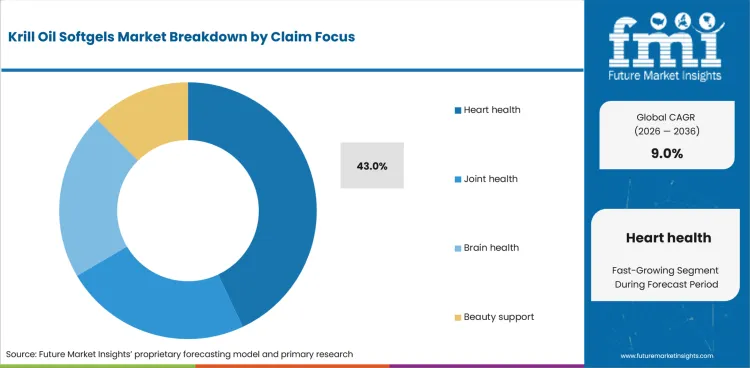
- Heart health softgels are anticipated to hold 43.0% share in 2026 as EPA and DHA recognition gives the claim a familiar entry point.
- Beauty support is gaining shelf space in Japan and South Korea, but it needs local functional-claim support before broad retail rollout.
Why is e-commerce leading krill oil softgels sales?
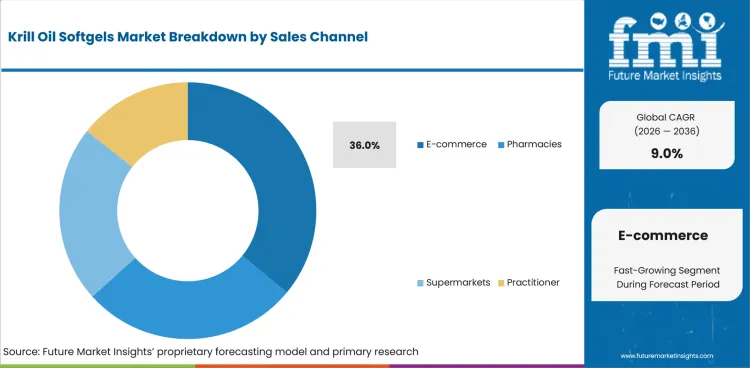
- E-commerce is projected to account for 36.0% share in 2026 as shoppers compare Antarctic origin, dose, and review volume before buying.
- Online channels expose weak labels faster, so brands without EPA, DHA, phospholipid, and astaxanthin disclosure face lower trust.
Why do MSC-certified sourcing claims matter in the krill oil softgels market?
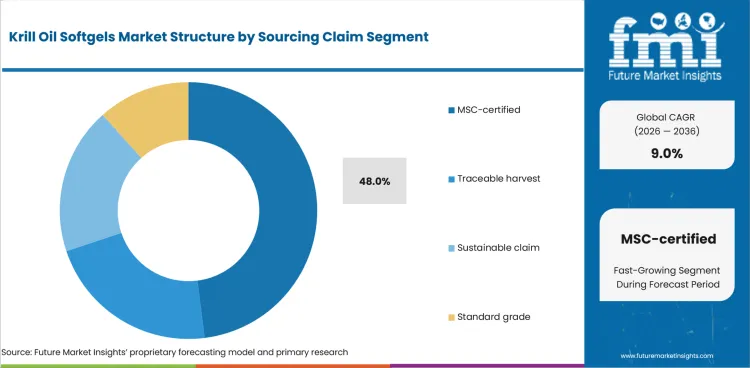
- MSC-certified and traceable harvest claims are estimated to represent 48.0% share in 2026 as premium buyers ask for Antarctic sourcing proof.
- Sourcing claims carry more weight for krill than for many marine oils, since environmental groups monitor concentrated fishing around predator feeding areas.
What drives and restrains the krill oil softgels market?
Phospholipid delivery supports premium pricing as krill oil softgels compete with omega-3 concentrates on format rather than pure potency.
- Small-capsule convenience raises repeat purchase as consumers avoid the size and aftertaste linked with fish oil.
- Small-capsule convenience raises repeat purchase as consumers avoid the size and aftertaste linked with fish oil.
- Traceable Antarctic sourcing gives integrated suppliers a commercial edge with national retailers.
- Fishery scrutiny can affect raw material planning if Southern Ocean catch rules tighten.
- Weak label disclosure can reduce trust when shoppers compare EPA, DHA, phospholipid, and astaxanthin content online.
- Beauty, joint, and active wellness claims create space for brands that can support claims without overpromising.
Phospholipid Dose Signaling
The strongest product driver is the shift from commodity omega-3 language to phospholipid dose signaling. Aker BioMarine states that Superba Krill is supported by more than 50 human clinical trials and 135 studies, giving branded ingredient buyers a science-backed story to place on pack. That does not turn every claim into an approved health claim, but it gives brands a stronger education base. Shoppers understand omega-3, but premium conversion improves when the capsule explains why krill oil is different. This supports higher value per bottle.
Antarctic Harvest Proof
Antarctic harvest proof is both a growth factor and a restraint. CCAMLR reported that 2024 Antarctic krill catches in Area 48 reached historically high levels, and the fishery remains under close ecosystem management. This supports raw material availability but keeps environmental attention high. Brands therefore need traceability, marine stewardship evidence, and clean contaminant testing to defend shelf space. Suppliers that treat sourcing proof as a document pack and not a slogan should win more retailer trust.
Softgel Quality Control
Softgel quality control creates a practical opportunity for contract manufacturers. Krill oil is naturally red and odor-sensitive, so leakage, oxidation, and capsule smell can damage reviews quickly. NOW Foods notes that krill oil products are tested for contaminants such as PCBs, dioxins, mercury, and heavy metals. That kind of testing language gives consumers a simple proof point. It also helps private-label brands separate premium EPA DHA omega-3 ingredients from low-cost marine oil blends.
Which countries are growing fastest in the krill oil softgels market?
India 10.6% CAGR, China 10.2% CAGR, South Korea 9.4% CAGR, Japan 8.6% CAGR, United States 7.6% CAGR, Germany 7.4% CAGR, United Kingdom 7.1% CAGR, and France 6.8% CAGR through 2036.
.webp "Top Country Growth Comparison Krill Oil Softgels Market Cagr (2026 2036)")
| Country | CAGR |
|---|---|
| India | 10.6% |
| China | 10.2% |
| South Korea | 9.4% |
| Japan | 8.6% |
| United States | 7.6% |
| Germany | 7.4% |
| United Kingdom | 7.1% |
| France | 6.8% |
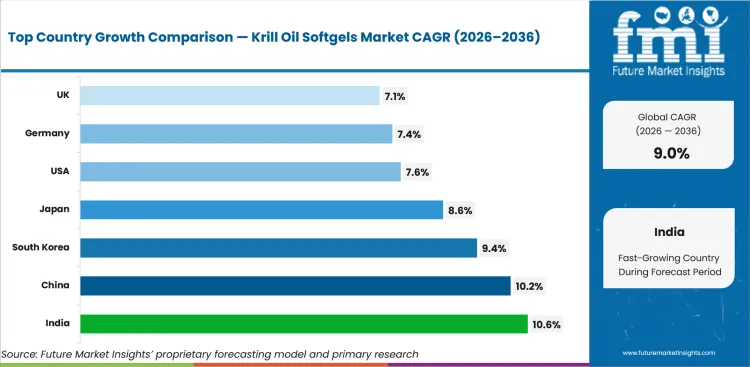
Source: Future Market Insights, 2026.
What is the krill oil softgels market outlook in the United States?
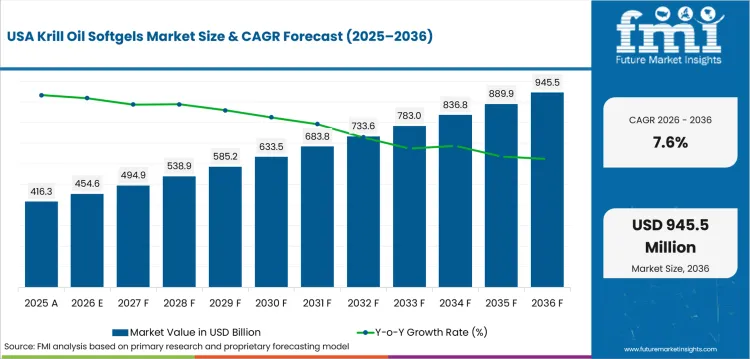
A 7.6% CAGR through 2036 is supported by subscription e-commerce, club retail and FDA-led supplement compliance.
Country Market Snapshot Table
| Parameter | Value |
|---|---|
| Market Size in 2025 (Value) | USD 158.0 million |
| Market Size in 2026 (Value) | USD 170.0 million |
| Market Forecast in 2036 (Value) | USD 353.6 million |
| CAGR (2026 to 2036) | 7.6% |
| Years Considered | 2021 to 2036 |
| Base Year | 2025 |
| Forecast Period | 2026 to 2036 |
| Units Considered | Value (USD million) |
| Leading Sub-Region | California, Florida, Texas and national club retail networks |
United States Krill Oil Softgels Market Outlook
United States krill oil softgel demand is shaped by mass supplement retail and digital subscription buying. Consumers compare EPA, DHA, capsule size and Antarctic sourcing before paying a premium over fish oil.
Retailers are expected to support brands that document current good manufacturing practice controls and contaminant testing. Club and online channels should favor softgels with clear bottle economics and low aftertaste claims.
Key Growth Drivers
- Heart health positioning has a large evidence context. CDC reported in October 2024 that about 86.0 million USA adults age 20 or older had total cholesterol levels above 200 mg/dL.
- Online supplement discovery remains a route to repeat purchase. The USA Census Bureau estimated first-quarter 2026 retail e-commerce sales at USD 302.3 billion.
- Club retail supports large bottle formats when brands can secure Antarctic krill ingredient supply and stable capsule quality.
- FDA supplement oversight encourages serious brands to maintain testing records and clear structure-function language.
Key Restraints
- Premium capsule pricing faces consumer budget checks because BLS reported the food index increased 3.1% over the 12 months ending May 2026.
- Seafood allergy warnings and anticoagulant cautions narrow use among some older consumers.
- Price comparison with fish oil and omega-3 concentrates can limit repeat use when labels do not explain phospholipid value.
What makes United States unique
The United States is unique because it can turn branded krill oil ingredients into mass retail and subscription softgel programs.
Key Companies
- Aker BioMarine
- Reckitt MegaRed
- Sports Research
- NOW Foods
- Doctor’s Best
- Life Extension
- Swanson Health Products
Sales & Marketing Channels
- Club retail programs
- Amazon subscription listings
- Drugstore vitamin aisles
- Practitioner nutrition stores
- Direct-to-consumer brand sites
- Private-label supplement programs
Country Segment Breakdown Table
| Segment | Sub-Segments |
|---|---|
| By Fill Weight | 500 mg · 750 mg · 1000 mg · Blended dose |
| By Shell Type | Gelatin · Fish gelatin · Plant shell · Enteric softgel |
| By Claim Focus | Heart health · Joint health · Brain health · Beauty support |
| By Sales Channel | E-commerce · Pharmacies · Supermarkets · Practitioner |
| By Sourcing Claim | MSC-certified · Traceable harvest · Sustainable claim · Standard grade |
| Key Sub-Regions Covered, Supplement Retail Corridors | California · Florida · Texas · New York · Midwest · Pacific Northwest |
Frequently Asked Questions
How fast is United States krill oil softgels market growing?
Sales in the United States are projected to expand at 7.6% CAGR from 2026 to 2036 through mass retail and subscription channels.
Who leads United States krill oil softgels market?
Aker BioMarine, Reckitt MegaRed, Sports Research, NOW Foods and Doctor’s Best compete through branded ingredient access and retail scale.
What is driving adoption in United States krill oil softgels market?
E-commerce comparison, club retail bottle formats and FDA-led quality expectations are moving buyers toward documented krill oil softgels.
How is the krill oil softgels market performing in the United Kingdom?
A 7.1% CAGR through 2036 reflects pharmacy credibility, omega-3 familiarity and controlled health-claim language.
Country Market Snapshot Table
| Parameter | Value |
|---|---|
| Market Size in 2025 (Value) | USD 51.4 million |
| Market Size in 2026 (Value) | USD 55.0 million |
| Market Forecast in 2036 (Value) | USD 109.2 million |
| CAGR (2026 to 2036) | 7.1% |
| Years Considered | 2021 to 2036 |
| Base Year | 2025 |
| Forecast Period | 2026 to 2036 |
| Units Considered | Value (USD million) |
| Leading Sub-Region | London and national pharmacy-led supplement corridors |
United Kingdom Krill Oil Softgels Market Outlook
United Kingdom krill oil softgel demand is influenced by omega-3 supplement familiarity and claims-aware retail. Imported products must explain Antarctic origin without overstating heart or joint outcomes.
Pharmacies and specialist health retailers should remain important because they give premium softgels a trust-led route. Online channels should continue to pressure price and capsule-count transparency.
Key Growth Drivers
- Omega-3 familiarity gives krill oil a switching base. The Food Standards Agency reported that 27% of Northern Ireland supplement-taking respondents used fish oils or omega-3 products.
- Online supplement discovery supports premium omega-3 softgels. ONS reported that online spending values rose 9.3% in the three months to April 2026 from the year-earlier period.
- Boots, Holland & Barrett and Amazon UK provide trusted access points for premium marine lipid softgels.
- Clear EPA, DHA and phospholipid labeling can support conversion from fish oil users seeking smaller capsules.
Key Restraints
- Premium krill oil pricing faces household pressure because Defra reported food and non-alcoholic beverage prices rose 4.5% in the 12 months to December 2025.
- Imported marine oil products must meet labeling and contaminant expectations before retailers widen shelf placement.
- Premium krill oil pricing faces substitution from fish oil capsules and multivitamin omega-3 blends.
What makes United Kingdom unique
The United Kingdom is unique because omega-3 use is established but retail language is highly claims-aware.
Key Companies
- Holland & Barrett International
- Boots UK
- Aker BioMarine UK partners
- Reckitt Benckiser Healthcare UK
- Vitabiotics Ltd
- Healthspan Ltd
- Oxford Healthspan channels
Sales & Marketing Channels
- Pharmacy chains
- Specialist health retailers
- Amazon UK
- Grocery wellness aisles
- Import distributors
- Practitioner channels
Country Segment Breakdown Table
| Segment | Sub-Segments |
|---|---|
| By Fill Weight | 500 mg · 750 mg · 1000 mg · Blended dose |
| By Shell Type | Gelatin · Fish gelatin · Plant shell · Enteric softgel |
| By Claim Focus | Heart health · Joint health · Brain health · Beauty support |
| By Sales Channel | E-commerce · Pharmacies · Supermarkets · Practitioner |
| By Sourcing Claim | MSC-certified · Traceable harvest · Sustainable claim · Standard grade |
| Key Sub-Regions Covered, Supplement Retail Corridors | London · Manchester · Birmingham · Leeds · Glasgow · Bristol |
Frequently Asked Questions
How fast is United Kingdom krill oil softgels market growing?
Demand in the United Kingdom is forecast to rise at 7.1% CAGR from 2026 to 2036 through pharmacy and specialist health retail.
Who leads United Kingdom krill oil softgels market?
Boots, Holland & Barrett, Reckitt, Vitabiotics and imported krill oil brands compete around pharmacy trust and label clarity.
What is driving adoption in United Kingdom krill oil softgels market?
Omega-3 familiarity and pharmacy-led supplement buying are moving users toward krill oil softgels with clearer sourcing proof.
What is the krill oil softgels market forecast for Germany?
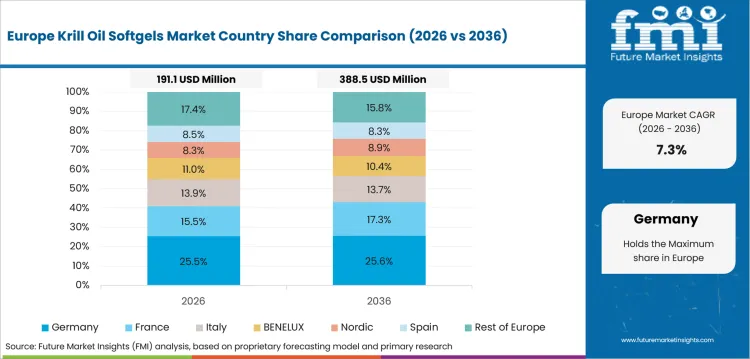
A 7.4% CAGR through 2036 reflects pharmacy trust, EU novel food clarity and formal supplement notification.
Country Market Snapshot Table
| Parameter | Value |
|---|---|
| Market Size in 2025 (Value) | USD 63.3 million |
| Market Size in 2026 (Value) | USD 68.0 million |
| Market Forecast in 2036 (Value) | USD 138.9 million |
| CAGR (2026 to 2036) | 7.4% |
| Years Considered | 2021 to 2036 |
| Base Year | 2025 |
| Forecast Period | 2026 to 2036 |
| Units Considered | Value (USD million) |
| Leading Sub-Region | North Rhine-Westphalia, Bavaria and mail-order pharmacy clusters |
Germany Krill Oil Softgels Market Outlook
Germany krill oil softgel demand is shaped by pharmacy-led supplement purchasing and strict documentation expectations. Buyers often require dose proof, origin traceability and compliant German labeling.
Retailers are expected to prefer suppliers that can manage notification work and provide stable purity files. Price sensitivity remains visible when krill oil is compared with fish oil and algal oil.
Key Growth Drivers
- Germany offers a large food and supplement setting. USDA FAS reported in March 2026 that Germany had 83.5 million consumers and was the largest EU food and beverage market.
- EU online buying supports supplement comparison. Eurostat reported that 78.0% of EU internet users bought goods or services online in 2025.
- Pharmacy-led purchasing supports premium marine oil brands with credible testing and origin documentation.
- EU novel food clarity supports authorized Antarctic krill oil use in supplement products.
Key Restraints
- Premium capsule pricing faces consumer pressure because Destatis reported Germany’s consumer prices rose 2.6% year on year in May 2026.
- Food supplement notification adds a compliance step before importers can move to broad distribution.
- Conservative health claim rules limit disease-prevention language for heart and joint positioning.
What makes Germany unique
Germany is unique because pharmacy credibility and formal supplement notification strongly influence krill oil softgel entry.
Key Companies
- Doppelherz Queisser Pharma
- Orthomol pharmazeutische Vertriebs GmbH
- Sunday Natural Products GmbH
- Aker BioMarine distribution partners
- Rimfrost ingredient partners
- Reckitt local channels
- Amazon Germany sellers
Sales & Marketing Channels
- Brick-and-mortar pharmacies
- Mail-order pharmacies
- Specialist supplement retailers
- Amazon Germany
- Import distributors
- Practitioner nutrition channels
Country Segment Breakdown Table
| Segment | Sub-Segments |
|---|---|
| By Fill Weight | 500 mg · 750 mg · 1000 mg · Blended dose |
| By Shell Type | Gelatin · Fish gelatin · Plant shell · Enteric softgel |
| By Claim Focus | Heart health · Joint health · Brain health · Beauty support |
| By Sales Channel | E-commerce · Pharmacies · Supermarkets · Practitioner |
| By Sourcing Claim | MSC-certified · Traceable harvest · Sustainable claim · Standard grade |
| Key Sub-Regions Covered, Supplement Retail Corridors | North Rhine-Westphalia · Bavaria · Baden-Württemberg · Berlin · Hamburg · Hesse |
Frequently Asked Questions
How fast is Germany krill oil softgels market growing?
Germany is projected to grow at 7.4% CAGR from 2026 to 2036 due to pharmacy-led supplement buying and documentation discipline.
Who leads Germany krill oil softgels market?
Doppelherz, Orthomol, Sunday Natural, imported krill oil brands and ingredient suppliers compete through pharmacies and online channels.
What is driving adoption in Germany krill oil softgels market?
Pharmacy trust, EU novel food clarity and traceability expectations are supporting premium krill oil softgel adoption.
How are krill oil softgels positioned in France?
A 6.8% CAGR through 2036 reflects pharmacy-led supplement trust and EU novel food oversight.
Country Market Snapshot Table
| Parameter | Value |
|---|---|
| Market Size in 2025 (Value) | USD 42.1 million |
| Market Size in 2026 (Value) | USD 45.0 million |
| Market Forecast in 2036 (Value) | USD 86.9 million |
| CAGR (2026 to 2036) | 6.8% |
| Years Considered | 2021 to 2036 |
| Base Year | 2025 |
| Forecast Period | 2026 to 2036 |
| Units Considered | Value (USD million) |
| Leading Sub-Region | Paris, Lyon, Marseille and pharmacy-led wellness corridors |
France Krill Oil Softgels Market Outlook
France krill oil softgel demand is concentrated in pharmacy and specialist wellness routes. Consumers require careful explanation around omega-3 value and marine origin before switching from lower-priced fish oil.
Brands should gain better acceptance when they use conservative claims and credible sourcing documentation. The market is expected to grow through premium wellness users rather than mass snack-style supplement buyers.
Key Growth Drivers
- Novel food recognition supports krill oil legitimacy because EFSA stated in July 2025 that more than 200 novel foods are approved in the European Union.
- Food-processing depth supports pharmacy and wellness channels. USDA FAS reported in April 2026 that the French agri-food industry included around 17,000 to 18,000 companies.
- Pharmacy advice supports premium marine lipid products when labels explain EPA, DHA, phospholipids and allergen cautions.
- EU-authorized ingredient framing helps brands separate Antarctic krill oil from generic marine oil capsules.
Key Restraints
- Premium packs face price caution because INSEE reported food prices were 1.1% higher year on year in May 2026.
- French buyers often need stronger pharmacy explanation before paying more for krill oil than fish oil.
- Origin and health-claim wording require careful control before premium retailers expand shelf space.
What makes France unique
France is unique because pharmacy trust and EU novel food framing matter more than mass e-commerce claims.
Key Companies
- Arkopharma
- Laboratoires Nutergia
- Laboratoires Santé Verte
- Fleurance Nature
- Aker BioMarine distribution partners
- Rimfrost ingredient partners
- Pharmacy private-label suppliers
Sales & Marketing Channels
- Pharmacies
- Parapharmacies
- Specialist wellness retailers
- Amazon France
- Direct-to-consumer wellness sites
- Practitioner nutrition channels
Country Segment Breakdown Table
| Segment | Sub-Segments |
|---|---|
| By Fill Weight | 500 mg · 750 mg · 1000 mg · Blended dose |
| By Shell Type | Gelatin · Fish gelatin · Plant shell · Enteric softgel |
| By Claim Focus | Heart health · Joint health · Brain health · Beauty support |
| By Sales Channel | E-commerce · Pharmacies · Supermarkets · Practitioner |
| By Sourcing Claim | MSC-certified · Traceable harvest · Sustainable claim · Standard grade |
| Key Sub-Regions Covered, Supplement Retail Corridors | Paris · Lyon · Marseille · Toulouse · Lille · Bordeaux |
Frequently Asked Questions
How fast is France krill oil softgels market growing?
France is expected to advance at 6.8% CAGR from 2026 to 2036 through pharmacy and specialist wellness channels.
Who leads France krill oil softgels market?
Arkopharma, Laboratoires Nutergia, Santé Verte, Fleurance Nature and imported krill oil suppliers compete around pharmacy credibility.
What is driving adoption in France krill oil softgels market?
Pharmacy trust, EU novel food recognition and omega-3 supplement familiarity are supporting careful krill oil softgel adoption.
What is the krill oil softgels market outlook in Japan?
An 8.6% CAGR through 2036 is supported by functional-claim discipline and beauty-from-within supplement buying.
Country Market Snapshot Table
| Parameter | Value |
|---|---|
| Market Size in 2025 (Value) | USD 64.5 million |
| Market Size in 2026 (Value) | USD 70.0 million |
| Market Forecast in 2036 (Value) | USD 159.7 million |
| CAGR (2026 to 2036) | 8.6% |
| Years Considered | 2021 to 2036 |
| Base Year | 2025 |
| Forecast Period | 2026 to 2036 |
| Units Considered | Value (USD million) |
| Leading Sub-Region | Tokyo, Osaka and national drugstore corridors |
Japan Krill Oil Softgels Market Outlook
Japan krill oil softgel demand is influenced by compact supplement formats and functional-claim discipline. Small capsules fit consumer preference when brands can support beauty, brain or heart positioning with evidence.
Drugstores and online platforms are expected to reward products with clear Japanese-language claims and documented ingredients. Imported brands need local evidence before they can move beyond premium listings.
Key Growth Drivers
- Functional claim pathways support premium positioning. Aker BioMarine stated in January 2026 that Superba Boost became Japan’s first omega-3 ingredient approved for a skin health claim.
- Online wellness discovery supports premium softgels because METI reported Japan’s domestic B-to-C e-commerce market rose 5.1% to JPY 26.1 trillion in 2024.
- Drugstore and mail-order channels support premium small-capsule formats for daily omega-3 use.
- Beauty-from-within demand creates a route for krill oil softgels beyond heart health.
Key Restraints
- Retail price sensitivity remains active because Japan’s Statistics Bureau reported the consumer price index rose 1.4% year on year in April 2026.
- High product standards and retail listing costs slow small foreign entrants.
- Translation and substantiation work can delay launches when brands adapt imported krill oil labels.
What makes Japan unique
Japan is unique because functional-claim rules can turn krill oil softgels into beauty and wellness products.
Key Companies
- Aker BioMarine Japan partners
- Suntory Wellness
- DHC Corporation
- Fancl Corporation
- Kobayashi Pharmaceutical
- Otsuka Pharmaceutical wellness channels
- Rakuten supplement sellers
Sales & Marketing Channels
- Drugstore chains
- Rakuten listings
- Amazon Japan
- Mail-order wellness catalogs
- Ingredient-backed brand partnerships
- Beauty supplement retailers
Country Segment Breakdown Table
| Segment | Sub-Segments |
|---|---|
| By Fill Weight | 500 mg · 750 mg · 1000 mg · Blended dose |
| By Shell Type | Gelatin · Fish gelatin · Plant shell · Enteric softgel |
| By Claim Focus | Heart health · Joint health · Brain health · Beauty support |
| By Sales Channel | E-commerce · Pharmacies · Supermarkets · Practitioner |
| By Sourcing Claim | MSC-certified · Traceable harvest · Sustainable claim · Standard grade |
| Key Sub-Regions Covered, Supplement Retail Corridors | Tokyo · Osaka · Yokohama · Nagoya · Fukuoka · Sapporo |
Frequently Asked Questions
How fast is Japan krill oil softgels market growing?
Japan is projected to rise at 8.6% CAGR from 2026 to 2036 through drugstores and functional-claim supplement channels.
Who leads Japan krill oil softgels market?
Aker BioMarine partners, Suntory Wellness, DHC, Fancl and Kobayashi compete through functional food and drugstore routes.
What is driving adoption in Japan krill oil softgels market?
Functional-claim discipline and beauty-from-within demand are moving krill oil softgels into premium wellness formats.
What is driving krill oil softgels growth in China?
A 10.2% CAGR through 2036 reflects cross-border e-commerce and premium imported supplement demand.
Country Market Snapshot Table
| Parameter | Value |
|---|---|
| Market Size in 2025 (Value) | USD 74.4 million |
| Market Size in 2026 (Value) | USD 82.0 million |
| Market Forecast in 2036 (Value) | USD 216.6 million |
| CAGR (2026 to 2036) | 10.2% |
| Years Considered | 2021 to 2036 |
| Base Year | 2025 |
| Forecast Period | 2026 to 2036 |
| Units Considered | Value (USD million) |
| Leading Sub-Region | Shanghai, Guangdong, Beijing and cross-border e-commerce corridors |
China Krill Oil Softgels Market Outlook
China krill oil softgel demand is shaped by digital discovery and premium wellness positioning. Imported brands can test demand through cross-border routes before moving into full domestic health-food registration.
Regulatory planning remains central because compliant domestic scale requires registration, filing and permitted health-function claims. Brands with Antarctic origin proof and clear capsule claims should gain better urban buyer trust.
Key Growth Drivers
- Cross-border e-commerce supports imported softgel testing. SCIO reported in January 2025 that China’s cross-border e-commerce imports and exports reached CNY 2.63 trillion in 2024.
- Consumer policy supports wellness demand because China’s 2025 consumption plan included 30 measures to boost consumption.
- Cross-border e-commerce lets premium krill oil brands test demand in Tier 1 and Tier 2 cities.
- Blue-hat registration can become a trust signal once ingredient and function documentation are accepted.
Key Restraints
- Low-cost competition narrows margins because NBS recorded brand-exclusive store retail sales declined 0.6% in 2025.
- Registration and filing rules can delay full domestic retail entry for imported krill oil softgels.
- Local omega-3 competitors can undercut premium imported products on price and pack count.
What makes China unique
China is unique because cross-border e-commerce can test premium demand before full domestic health-food scale.
Key Companies
- Aker BioMarine China partners
- By-health Co. Ltd.
- Blackmores China channels
- Swisse China channels
- JD Health sellers
- Tmall Global brands
- Import distributors
Sales & Marketing Channels
- Cross-border e-commerce
- Tmall Global
- JD Health
- Import distributors
- Health food specialty stores
- Pharmacy e-commerce
Country Segment Breakdown Table
| Segment | Sub-Segments |
|---|---|
| By Fill Weight | 500 mg · 750 mg · 1000 mg · Blended dose |
| By Shell Type | Gelatin · Fish gelatin · Plant shell · Enteric softgel |
| By Claim Focus | Heart health · Joint health · Brain health · Beauty support |
| By Sales Channel | E-commerce · Pharmacies · Supermarkets · Practitioner |
| By Sourcing Claim | MSC-certified · Traceable harvest · Sustainable claim · Standard grade |
| Key Sub-Regions Covered, Supplement Retail Corridors | Shanghai · Guangdong · Beijing · Zhejiang · Jiangsu · Chengdu-Chongqing corridor |
Frequently Asked Questions
How fast is China krill oil softgels market growing?
China is expected to post 10.2% CAGR from 2026 to 2036 through cross-border e-commerce and premium imported wellness capsules.
Who leads China krill oil softgels market?
Aker BioMarine partners, By-health, Swisse channels, Blackmores channels and cross-border sellers compete around origin and registration readiness.
What is driving adoption in China krill oil softgels market?
Online food and supplement discovery, imported origin claims and health-food registration routes are supporting krill oil softgel adoption.
How is the krill oil softgels market growing in South Korea?
A 9.4% CAGR through 2036 reflects health functional food demand and import-led supplement buying.
Country Market Snapshot Table
| Parameter | Value |
|---|---|
| Market Size in 2025 (Value) | USD 47.5 million |
| Market Size in 2026 (Value) | USD 52.0 million |
| Market Forecast in 2036 (Value) | USD 127.7 million |
| CAGR (2026 to 2036) | 9.4% |
| Years Considered | 2021 to 2036 |
| Base Year | 2025 |
| Forecast Period | 2026 to 2036 |
| Units Considered | Value (USD million) |
| Leading Sub-Region | Seoul Capital Area and home-shopping supplement networks |
South Korea Krill Oil Softgels Market Outlook
South Korea krill oil softgel demand is shaped by health functional food culture and import trust. Consumers compare function, safety and brand credibility before paying more for marine lipid capsules.
E-commerce and home shopping can explain EPA, DHA, phospholipids and astaxanthin. Claims must stay within Korean rules, which makes evidence and product registration work commercially important.
Key Growth Drivers
- Imported products already have a route to Korean consumers. USDA FAS reported in April 2026 that imports accounted for 28.4% of the health functional food industry.
- Online shopping supports supplement comparison because Statistics Korea reported online shopping transaction value rose 6.6% in August 2025 from a year earlier.
- Korean consumers reward brand credibility and visible functional benefits when labels remain compliant.
- E-commerce supports premium comparison across omega-3, krill oil and beauty supplement products.
Key Restraints
- Market crowding is a restraint because the USA International Trade Administration reported that approximately 5,000 new health functional food products are introduced annually.
- Health functional food claim rules limit unsupported product language.
- Premium krill oil faces price comparison with fish oil and red ginseng categories.
What makes South Korea unique
South Korea is unique because function-led supplement buying can reward krill oil when claims and safety evidence align.
Key Companies
- Aker BioMarine Korea partners
- Korea Ginseng Corp wellness channels
- CJ Wellcare
- Chong Kun Dang Health Care
- Dongwon F&B wellness channels
- Home-shopping supplement brands
- Import distributors
Sales & Marketing Channels
- Health functional food e-commerce
- Home shopping networks
- Pharmacy chains
- Department store wellness sections
- Import distributors
- Beauty-from-within channels
Country Segment Breakdown Table
| Segment | Sub-Segments |
|---|---|
| By Fill Weight | 500 mg · 750 mg · 1000 mg · Blended dose |
| By Shell Type | Gelatin · Fish gelatin · Plant shell · Enteric softgel |
| By Claim Focus | Heart health · Joint health · Brain health · Beauty support |
| By Sales Channel | E-commerce · Pharmacies · Supermarkets · Practitioner |
| By Sourcing Claim | MSC-certified · Traceable harvest · Sustainable claim · Standard grade |
| Key Sub-Regions Covered, Supplement Retail Corridors | Seoul · Incheon · Busan · Daegu · Daejeon · Gwangju |
Frequently Asked Questions
How fast is South Korea krill oil softgels market growing?
South Korea is forecast at 9.4% CAGR from 2026 to 2036 due to health functional food demand and imported supplement access.
Who leads South Korea krill oil softgels market?
Aker BioMarine partners, CJ Wellcare, Chong Kun Dang Health Care and home-shopping supplement brands compete through function-led channels.
What is driving adoption in South Korea krill oil softgels market?
Health functional food scale, imported supplement share and e-commerce comparison are supporting krill oil softgel demand.
What is the krill oil softgels market outlook in India?
A 10.6% CAGR through 2036 reflects premium nutraceutical demand and metro-led online supplement access.
Country Market Snapshot Table
| Parameter | Value |
|---|---|
| Market Size in 2025 (Value) | USD 36.2 million |
| Market Size in 2026 (Value) | USD 40.0 million |
| Market Forecast in 2036 (Value) | USD 109.5 million |
| CAGR (2026 to 2036) | 10.6% |
| Years Considered | 2021 to 2036 |
| Base Year | 2025 |
| Forecast Period | 2026 to 2036 |
| Units Considered | Value (USD million) |
| Leading Sub-Region | Mumbai, Delhi NCR, Bengaluru and premium nutraceutical corridors |
India Krill Oil Softgels Market Outlook
India krill oil softgel demand is concentrated in premium urban nutraceutical channels. Consumers compare imported brands, EPA-DHA disclosure and capsule count before moving from fish oil into krill oil.
Growth should begin in metros through e-commerce, pharmacies and practitioner-led recommendations. Brands need compliant labeling and price discipline before broader pharmacy penetration develops.
Key Growth Drivers
- Nutraceutical whitespace supports premium softgels because PIB stated in November 2024 that India held under 2.0% of an estimated USD 400.0 billion global nutraceutical market.
- Marine omega-3 labeling has a measurable benchmark because FSSAI’s January 2024 infant nutrition standards allow fish oil as a DHA source at a maximum 0.5% of total fatty acids.
- Premium urban buyers are testing marine omega-3 capsules through e-commerce and practitioner recommendations.
- Aker BioMarine’s India-focused commercial activity indicates supplier interest in education and local partnerships.
Key Restraints
- Premium pack adoption is price sensitive because MoSPI reported All India consumer food price inflation at 4.78% in May 2026.
- Import duties and currency movement can make krill oil costly for repeat users.
- Lower consumer awareness of phospholipid omega-3 limits conversion from fish oil.
What makes India unique
India is unique because growth is fastest but starts from premium urban nutraceutical and practitioner-led channels.
Key Companies
- Aker BioMarine India partners
- HealthKart channels
- Tata 1mg wellness sellers
- Himalaya Wellness adjacent channels
- Carbamide Forte-style online brands
- Apollo Pharmacy channels
- Import distributors
Sales & Marketing Channels
- Amazon India
- HealthKart-style platforms
- Premium pharmacies
- Nutritionist recommendation
- Import distributors
- Practitioner clinics
Country Segment Breakdown Table
| Segment | Sub-Segments |
|---|---|
| By Fill Weight | 500 mg · 750 mg · 1000 mg · Blended dose |
| By Shell Type | Gelatin · Fish gelatin · Plant shell · Enteric softgel |
| By Claim Focus | Heart health · Joint health · Brain health · Beauty support |
| By Sales Channel | E-commerce · Pharmacies · Supermarkets · Practitioner |
| By Sourcing Claim | MSC-certified · Traceable harvest · Sustainable claim · Standard grade |
| Key Sub-Regions Covered, Supplement Retail Corridors | Mumbai · Delhi NCR · Bengaluru · Hyderabad · Chennai · Pune |
Frequently Asked Questions
How fast is India krill oil softgels market growing?
India is projected to record 10.6% CAGR from 2026 to 2036 through premium urban nutraceutical channels.
Who leads India krill oil softgels market?
Aker BioMarine partners, HealthKart channels, Tata 1mg sellers and premium import distributors compete through online and pharmacy access.
What is driving adoption in India krill oil softgels market?
FSSAI nutraceutical standards, EPA-DHA label disclosure and metro e-commerce access are supporting krill oil softgel adoption.
Who are the leading companies in the krill oil softgels market?
Aker BioMarine, Rimfrost, NOW Foods, Sports Research, Nordic Naturals, Swanson, Viva Naturals, and Nutrigold are key companies in the krill oil softgels market.
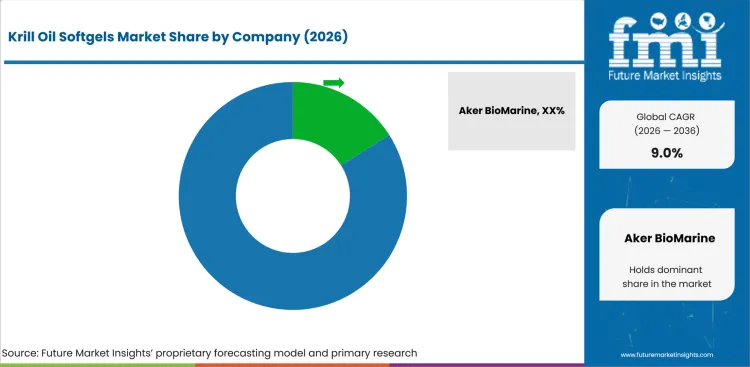
- Integrated krill oil suppliers compete through Antarctic sourcing access, MSC certification, traceability records, and phospholipid-content positioning.
- Softgel brands compete through 1000 mg dose formats, EPA and DHA disclosure, odor control, capsule stability, and subscription availability.
- Contract manufacturers gain relevance where brands need red oil filling expertise, seam stability, oxidation control, and contaminant testing.
- Online-first supplement brands gain share when labels clearly show krill source, astaxanthin content, phospholipid level, and capsule count.
The krill oil softgels market is shaped by sourcing proof, softgel quality, and label transparency. Integrated ingredient suppliers hold an advantage when they can provide Antarctic harvest documentation, marine stewardship evidence, and batch-level traceability. Finished supplement brands compete by turning those inputs into easy-to-compare softgels with clear dose, contaminant testing, and review-backed repeat purchase.
Aker BioMarine and Rimfrost are positioned around krill oil ingredient supply and sourcing documentation. NOW Foods, Sports Research, Nordic Naturals, Swanson, Viva Naturals, and Nutrigold compete through finished softgel brands sold across e-commerce, specialty retail, pharmacy, and wellness channels. Suppliers with stronger odor control, capsule stability, and sourcing documents are better placed to defend premium pricing.
How do top krill oil softgels companies compare?
Aker BioMarine and Rimfrost score highest on sourcing control, while online supplement brands compete through dose clarity, review volume, and consumer-facing label proof.
| Company | Antarctic Sourcing Proof | Softgel Brand Strength | Dose Disclosure | E-Commerce Reach | Geographic Footprint | Positioning |
|---|---|---|---|---|---|---|
| Aker BioMarine | Very High | High | High | Strong | Global | Integrated krill oil ingredient supplier |
| Rimfrost | Very High | Medium | High | Medium | Global | Krill oil ingredient and sourcing specialist |
| NOW Foods | High | High | High | Strong | North America, global exports | Broad supplement brand with tested krill oil products |
| Sports Research | High | High | High | Very Strong | North America | Online-led premium krill oil softgel brand |
| Nordic Naturals | High | High | High | Strong | North America, Europe | Premium omega-3 supplement brand |
| Swanson | Medium | High | Medium | Strong | North America | Value-positioned supplement retailer and brand |
| Viva Naturals | Medium | High | High | Very Strong | North America | E-commerce-focused omega-3 supplement brand |
| Nutrigold | Medium | Medium | High | Medium | North America | Clean-label supplement positioning |
Source: Future Market Insights competitive analysis, 2026.
Key Developments in Krill Oil Softgels Market
- In May 2024, Aker BioMarine received its first patent allowance for PL+ EPA/DHA delivery technology. The formulation uses krill phospholipids with EPA and DHA to support enhanced emulsions.
- In March 2025, Aker BioMarine reported that Human Health Ingredients revenue increased 25% in 2024. Krill oil sales rose 15% during the same period.
- In February 2026, Aker BioMarine reported 28% year-over-year Human Health Ingredients revenue growth in Q4 2025. Superba Krill Oil volumes supported the result.
- In April 2026, Aker BioMarine reported Q1 2026 Superba Krill Oil sales of USD 29.3 million. Sales increased 26% from the prior year.
- In May 2026, Aker BioMarine announced a new Lysoveta contract valued at about USD 4 million in the first year. The agreement supports advanced krill phospholipid applications.
Key Players in the Krill Oil Softgels Market
Ingredient Leaders
- Aker BioMarine
- Rimfrost
Branded Softgel Marketers
- Reckitt MegaRed
- Sports Research
- NOW Foods
- Doctor’s Best
Specialist Supplement Brands
- Life Extension
- Swanson Health Products
Krill Oil Softgels Market - Report Scope
| Item | Value |
|---|---|
| Market size by 2036 | USD 1.92 billion |
| Growth rate | 9.0% CAGR from 2026 to 2036 |
| Forecast period | 2026 to 2036 |
| Base year value (2025) | USD 0.74 billion |
| By fill weight | 500 mg, 750 mg, 1000 mg, blended dose |
| By shell type | Gelatin, fish gelatin, plant shell, enteric softgel |
| By claim focus | Heart health, joint health, brain health, beauty support |
| By sales channel | E-commerce, pharmacies, supermarkets, practitioner |
| By sourcing claim | MSC-certified, traceable harvest, sustainable claim, standard grade |
| Regions covered | North America, Latin America, Europe, East Asia, South Asia and Pacific, Middle East and Africa |
| Countries covered | United States, United Kingdom, Germany, France, Japan, China, South Korea, India |
| Key companies profiled | Aker BioMarine, Rimfrost, Reckitt MegaRed, Sports Research, NOW Foods, Doctor’s Best, Life Extension |
| Approach | Bottom-up product-boundary approach using krill fishery data, capsule pricing, ingredient supply and country-level supplement adoption |
Source: Future Market Insights, 2026.
Krill Oil Softgels Market - Scope & Definition
| Attribute | Detail |
|---|---|
| Market Definition | Finished dietary supplement softgels filled with oil extracted from Antarctic krill and sold for wellness, heart, joint, brain, or beauty positioning |
| Functions Covered | Omega-3 delivery, phospholipid-bound EPA and DHA delivery, softgel dosing, odor control, antioxidant positioning |
| Applications Covered | Heart health, joint comfort, brain support, beauty support, healthy aging and general wellness capsules |
| End-Use Industries | Dietary supplements, nutraceuticals, pharmacy retail, e-commerce wellness retail and practitioner nutrition |
| Grades Covered | MSC-certified, traceable harvest, sustainable claim and standard grade krill oil softgels |
| Inclusions | Commercially sold krill oil softgels across fill weights, shell types, claim focuses, sales channels and sourcing claims |
| Exclusions | Liquid krill oil bottles, krill meal, pet feed oils, fish oil-only capsules, algal oil capsules, prescription omega-3 drugs and bulk ingredients not sold as finished softgels |
Krill Oil Softgels Market - Research Methodology
| Method | Description |
|---|---|
| Primary Research | FMI analyst interviews with supplement brand owners, softgel contract manufacturers, ingredient suppliers, retail category teams and online channel managers across key markets |
| Desk Research | Review of CCAMLR fishery records, FDA supplement guidance, European novel food records, official country supplement rules, company filings and product disclosures |
| Market Sizing & Forecasting | Bottom-up product-boundary approach using Antarctic krill catch constraints, ingredient conversion assumptions, softgel pricing, regional supplement adoption and channel mix |
| Data Validation | Cross-verification using marine oil supply, retail softgel pricing, country-level supplement rules, company portfolios and market activity checks |
Krill Oil Softgels Market Breakdown by Fill Weight, Shell Type, Claim Focus, Sales Channel, Sourcing Claim, and Region
Krill Oil Softgels Market Segmented by Fill Weight
- 500 mg
- 750 mg
- 1000 mg
- Blended dose
Krill Oil Softgels Market Segmented by Shell Type
- Gelatin
- Fish gelatin
- Plant shell
- Enteric softgel
Krill Oil Softgels Market Segmented by Claim Focus
- Heart health
- Joint health
- Brain health
- Beauty support
Krill Oil Softgels Market Segmented by Sales Channel
- E-commerce
- Pharmacies
- Supermarkets
- Practitioner
Krill Oil Softgels Market Segmented by Sourcing Claim
- MSC-certified
- Traceable harvest
- Sustainable claim
- Standard grade
Krill Oil Softgels Market by Region
- North America
- Latin America
- Europe
- East Asia
- South Asia and Pacific
- Middle East and Africa
Research Sources and Bibliography
- Commission for the Conservation of Antarctic Marine Living Resources. (2025, April 7). Fishery report 2024: Euphausia superba in Area 48. CCAMLR Secretariat.
- Commission for the Conservation of Antarctic Marine Living Resources. (2025, February 11). Krill fisheries. CCAMLR.
- USA Food and Drug Administration. (2024, February 21). Questions and answers on dietary supplements. FDA.
- Centers for Disease Control and Prevention. (2024, October 24). High cholesterol facts. CDC.
- National Institutes of Health Office of Dietary Supplements. (2024). Omega-3 fatty acids: Fact sheet for health professionals. NIH.
- USA Census Bureau. (2026, May 20). Quarterly retail e-commerce sales: 1st quarter 2026. USA Department of Commerce.
- Food Standards Agency. (2024, November 26). Food and You 2: Northern Ireland Wave 7-8 key findings. FSA.
- Office for National Statistics. (2026, May 22). Retail sales, Great Britain: April 2026. ONS.
- USDA Foreign Agricultural Service. (2026, March 30). Food processing ingredients annual: Germany. USDA FAS.
- Eurostat. (2026). E-commerce statistics for individuals. European Commission.
- Federal Statistical Office of Germany. (2026, June 12). Inflation rate at +2.6% in May 2026. Destatis.
- European Food Safety Authority. (2025, July 22). Novel foods. EFSA.
- USA Bureau of Labor Statistics. (2026, June 11). Consumer price index: May 2026. USA Department of Labor.
- Institut national de la statistique et des études économiques. (2026, May). Consumer prices: Provisional results for May 2026. INSEE.
- Aker BioMarine. (2026, January 5). Aker BioMarine’s krill oil earns Japan’s first-ever omega-3 skin health claim. Aker BioMarine.
- Ministry of Economy, Trade and Industry. (2025, August 26). Results of FY2024 e-commerce market survey compiled. Government of Japan.
- Statistics Bureau of Japan. (2026). Consumer price index: April 2026 latest indicators. Ministry of Internal Affairs and Communications.
- State Council Information Office of the People’s Republic of China. (2025, January 13). China’s foreign trade hits new high in 2024. SCIO.
- National Bureau of Statistics of China. (2026, January 20). Total retail sales of consumer goods in 2025. NBS China.
- State Council of the People’s Republic of China. (2025, March 16). Special action plan to boost consumption. State Council.
- USDA Foreign Agricultural Service. (2026, April 6). Health functional food and supplements: Market brief for the Republic of Korea. USDA FAS.
- Statistics Korea. (2025, October 1). Online shopping in August 2025. Government of the Republic of Korea.
- USA International Trade Administration. (2025, July 21). South Korea health functional food. USA Department of Commerce.
- Press Information Bureau. (2026, February 6). Promotion of nutraceuticals and functional foods. Government of India.
- Food Safety and Standards Authority of India. (2024, January 4). Compendium of Food Safety and Standards Regulations: Infant nutrition, Version-II. FSSAI.
- Ministry of Statistics and Programme Implementation. (2026, June 12). Consumer price index: May 2026. Government of India.
- Aker BioMarine. (2025, March 31). Annual report 2024: A transformative year for Aker BioMarine. Aker BioMarine.
- Aker BioMarine. (2026, February 12). Fourth quarter 2025 results for Aker BioMarine. Aker BioMarine.
- Aker BioMarine. (2026, April 30). Aker BioMarine reports record krill oil revenues in the first quarter. Aker BioMarine.
- NOW Foods. (2026). Krill oil 500 mg softgels. NOW Foods.
- Rimfrost. (2026). Rimfrost krill. Rimfrost.
- Sports Research. (2026). Omega-3 Antarctic krill oil softgels. Sports Research.
- Department for Environment, Food & Rural Affairs. (2026, February 25). Food statistics in your pocket. GOV.UK.
This bibliography is provided for reader reference and is not exhaustive. The full report contains the complete reference list and detailed citations.
This Report Answers
- Market size estimates for 2026 and forecasts through 2036 for the krill oil softgels market.
- Insights across more than 30 regional and country-level markets.
- Analysis of demand drivers, consumer adoption patterns, claim positioning and purchasing behavior.
- Evaluation of leading fill weights, shell types, sourcing claims and sales channels.
- Assessment of regulatory frameworks, fishery management, novel food rules and supplement labeling controls.
- Identification of growth opportunities across heart health, joint health, brain health and beauty support claims.
- Evaluation of supply chain dynamics, Antarctic sourcing proof, softgel quality controls and brand competition.
- Country-level growth analysis covering the United States, United Kingdom, Germany, France, Japan, China, South Korea and India.
- Assessment of the competitive landscape, including leading krill oil ingredient suppliers and finished softgel brands.
- Analysis of consumer preferences, market penetration trends and emerging growth opportunities.
- Regional outlooks across North America, Europe, East Asia, South Asia and Pacific, and other global markets.
- Delivery of market data, forecasts and supporting analysis in PDF and Excel formats.
Frequently Asked Questions
What is the global market demand for Krill Oil Softgels Market in 2026?
In 2026, the global Krill Oil Softgels Market is expected to be worth USD 0.81 billion, supported by premium omega-3 capsule demand.
How big will the Krill Oil Softgels Market be by 2036?
By 2036, the Krill Oil Softgels Market is projected to reach USD 1.92 billion, with value growth tied to phospholipid positioning.
What CAGR is expected for the Krill Oil Softgels Market?
The Krill Oil Softgels Market is projected to grow at 9.0% CAGR from 2026 to 2036.
Which fill weight is expected to lead in 2026?
The 1000 mg fill weight is projected to lead with 41.0% share in 2026 as buyers prefer simpler daily dosing.
Which sales channel is projected to lead in 2026?
E-commerce is projected to account for 36.0% share in 2026 as shoppers compare dose, source, and reviews online.
Which country is expected to grow fastest in this market?
India is projected to record the fastest CAGR at 10.6%, supported by premium nutraceutical demand and online supplement access.
What products are included in the Krill Oil Softgels Market?
The market includes finished dietary supplement softgels filled with Antarctic krill oil and sold for wellness, heart, joint, brain, or beauty positioning.
How was the forecast calculated?
The forecast combines krill fishery supply, softgel pricing, regional supplement behavior, company portfolios, and channel growth across 2026 to 2036.
Which krill oil softgel is best for daily omega-3 use?
A 1000 mg softgel with clear EPA, DHA, phospholipid, astaxanthin, and sourcing disclosure is usually the clearest daily-use option for non-prescription wellness users.
What is the difference between krill oil and fish oil softgels?
Krill oil carries EPA and DHA in phospholipid form and naturally contains astaxanthin. Fish oil usually focuses on EPA and DHA potency at a lower price.
How much do krill oil softgels usually cost?
Krill oil softgels often cost more than fish oil capsules because Antarctic sourcing, phospholipid content, testing, and smaller supply pools raise production costs.
How long do krill oil softgels last?
Most krill oil softgels carry a shelf life of one to two years when stored away from heat, light, and moisture. Buyers should follow the bottle date.
What are the main disadvantages of krill oil softgels?
The main disadvantages are higher price, seafood allergy risk, possible interaction concerns for blood thinner users, and supply sensitivity tied to Antarctic fishery rules.
Preview the report firsthand - request a free sample
Get SampleGet the brochure for pricing and purchase details.
Get PDFTable of Content
- Executive Summary
- Global Market Outlook
- Demand to side Trends
- Supply to side Trends
- Technology Roadmap Analysis
- Analysis and Recommendations
- Market Overview
- Market Coverage / Taxonomy
- Market Definition / Scope / Limitations
- Research Methodology
- Chapter Orientation
- Analytical Lens and Working Hypotheses
- Market Structure, Signals, and Trend Drivers
- Benchmarking and Cross-market Comparability
- Market Sizing, Forecasting, and Opportunity Mapping
- Research Design and Evidence Framework
- Desk Research Programme (Secondary Evidence)
- Company Annual and Sustainability Reports
- Peer-reviewed Journals and Academic Literature
- Corporate Websites, Product Literature, and Technical Notes
- Earnings Decks and Investor Briefings
- Statutory Filings and Regulatory Disclosures
- Technical White Papers and Standards Notes
- Trade Journals, Industry Magazines, and Analyst Briefs
- Conference Proceedings, Webinars, and Seminar Materials
- Government Statistics Portals and Public Data Releases
- Press Releases and Reputable Media Coverage
- Specialist Newsletters and Curated Briefings
- Sector Databases and Reference Repositories
- FMI Internal Proprietary Databases and Historical Market Datasets
- Subscription Datasets and Paid Sources
- Social Channels, Communities, and Digital Listening Inputs
- Additional Desk Sources
- Expert Input and Fieldwork (Primary Evidence)
- Primary Modes
- Qualitative Interviews and Expert Elicitation
- Quantitative Surveys and Structured Data Capture
- Blended Approach
- Why Primary Evidence is Used
- Field Techniques
- Interviews
- Surveys
- Focus Groups
- Observational and In-context Research
- Social and Community Interactions
- Stakeholder Universe Engaged
- C-suite Leaders
- Board Members
- Presidents and Vice Presidents
- R&D and Innovation Heads
- Technical Specialists
- Domain Subject-matter Experts
- Scientists
- Physicians and Other Healthcare Professionals
- Governance, Ethics, and Data Stewardship
- Research Ethics
- Data Integrity and Handling
- Primary Modes
- Tooling, Models, and Reference Databases
- Desk Research Programme (Secondary Evidence)
- Data Engineering and Model Build
- Data Acquisition and Ingestion
- Cleaning, Normalisation, and Verification
- Synthesis, Triangulation, and Analysis
- Quality Assurance and Audit Trail
- Market Background
- Market Dynamics
- Drivers
- Restraints
- Opportunity
- Trends
- Scenario Forecast
- Demand in Optimistic Scenario
- Demand in Likely Scenario
- Demand in Conservative Scenario
- Opportunity Map Analysis
- Product Life Cycle Analysis
- Supply Chain Analysis
- Investment Feasibility Matrix
- Value Chain Analysis
- PESTLE and Porter’s Analysis
- Regulatory Landscape
- Regional Parent Market Outlook
- Production and Consumption Statistics
- Import and Export Statistics
- Market Dynamics
- Global Market Analysis 2021 to 2025 and Forecast, 2026 to 2036
- Historical Market Size Value (USD Million) Analysis, 2021 to 2025
- Current and Future Market Size Value (USD Million) Projections, 2026 to 2036
- Y to o to Y Growth Trend Analysis
- Absolute $ Opportunity Analysis
- Global Market Pricing Analysis 2021 to 2025 and Forecast 2026 to 2036
- Global Market Analysis 2021 to 2025 and Forecast 2026 to 2036, By Fill Weight
- Introduction / Key Findings
- Historical Market Size Value (USD Million) Analysis By Fill Weight , 2021 to 2025
- Current and Future Market Size Value (USD Million) Analysis and Forecast By Fill Weight , 2026 to 2036
- 1000 mg
- 500 mg
- 750 mg
- Blended dose
- 1000 mg
- Y to o to Y Growth Trend Analysis By Fill Weight , 2021 to 2025
- Absolute $ Opportunity Analysis By Fill Weight , 2026 to 2036
- Global Market Analysis 2021 to 2025 and Forecast 2026 to 2036, By Shell Type
- Introduction / Key Findings
- Historical Market Size Value (USD Million) Analysis By Shell Type, 2021 to 2025
- Current and Future Market Size Value (USD Million) Analysis and Forecast By Shell Type, 2026 to 2036
- Gelatin
- Fish gelatin
- Plant shell
- Enteric softgel
- Gelatin
- Y to o to Y Growth Trend Analysis By Shell Type, 2021 to 2025
- Absolute $ Opportunity Analysis By Shell Type, 2026 to 2036
- Global Market Analysis 2021 to 2025 and Forecast 2026 to 2036, By Claim Focus
- Introduction / Key Findings
- Historical Market Size Value (USD Million) Analysis By Claim Focus, 2021 to 2025
- Current and Future Market Size Value (USD Million) Analysis and Forecast By Claim Focus, 2026 to 2036
- Heart health
- Joint health
- Brain health
- Beauty support
- Heart health
- Y to o to Y Growth Trend Analysis By Claim Focus, 2021 to 2025
- Absolute $ Opportunity Analysis By Claim Focus, 2026 to 2036
- Global Market Analysis 2021 to 2025 and Forecast 2026 to 2036, By Sales Channel
- Introduction / Key Findings
- Historical Market Size Value (USD Million) Analysis By Sales Channel, 2021 to 2025
- Current and Future Market Size Value (USD Million) Analysis and Forecast By Sales Channel, 2026 to 2036
- E-commerce
- Pharmacies
- Supermarkets
- Practitioner
- E-commerce
- Y to o to Y Growth Trend Analysis By Sales Channel, 2021 to 2025
- Absolute $ Opportunity Analysis By Sales Channel, 2026 to 2036
- Global Market Analysis 2021 to 2025 and Forecast 2026 to 2036, By Sourcing Claim
- Introduction / Key Findings
- Historical Market Size Value (USD Million) Analysis By Sourcing Claim, 2021 to 2025
- Current and Future Market Size Value (USD Million) Analysis and Forecast By Sourcing Claim, 2026 to 2036
- MSC-certified
- Traceable harvest
- Sustainable claim
- Standard grade
- MSC-certified
- Y to o to Y Growth Trend Analysis By Sourcing Claim, 2021 to 2025
- Absolute $ Opportunity Analysis By Sourcing Claim, 2026 to 2036
- Global Market Analysis 2021 to 2025 and Forecast 2026 to 2036, By Region
- Introduction
- Historical Market Size Value (USD Million) Analysis By Region, 2021 to 2025
- Current Market Size Value (USD Million) Analysis and Forecast By Region, 2026 to 2036
- North America
- Latin America
- Western Europe
- Eastern Europe
- East Asia
- South Asia and Pacific
- Middle East & Africa
- Market Attractiveness Analysis By Region
- North America Market Analysis 2021 to 2025 and Forecast 2026 to 2036, By Country
- Historical Market Size Value (USD Million) Trend Analysis By Market Taxonomy, 2021 to 2025
- Market Size Value (USD Million) Forecast By Market Taxonomy, 2026 to 2036
- By Country
- USA
- Canada
- Mexico
- By Fill Weight
- By Shell Type
- By Claim Focus
- By Sales Channel
- By Sourcing Claim
- By Country
- Market Attractiveness Analysis
- By Country
- By Fill Weight
- By Shell Type
- By Claim Focus
- By Sales Channel
- By Sourcing Claim
- Key Takeaways
- Latin America Market Analysis 2021 to 2025 and Forecast 2026 to 2036, By Country
- Historical Market Size Value (USD Million) Trend Analysis By Market Taxonomy, 2021 to 2025
- Market Size Value (USD Million) Forecast By Market Taxonomy, 2026 to 2036
- By Country
- Brazil
- Chile
- Rest of Latin America
- By Fill Weight
- By Shell Type
- By Claim Focus
- By Sales Channel
- By Sourcing Claim
- By Country
- Market Attractiveness Analysis
- By Country
- By Fill Weight
- By Shell Type
- By Claim Focus
- By Sales Channel
- By Sourcing Claim
- Key Takeaways
- Western Europe Market Analysis 2021 to 2025 and Forecast 2026 to 2036, By Country
- Historical Market Size Value (USD Million) Trend Analysis By Market Taxonomy, 2021 to 2025
- Market Size Value (USD Million) Forecast By Market Taxonomy, 2026 to 2036
- By Country
- Germany
- UK
- Italy
- Spain
- France
- Nordic
- BENELUX
- Rest of Western Europe
- By Fill Weight
- By Shell Type
- By Claim Focus
- By Sales Channel
- By Sourcing Claim
- By Country
- Market Attractiveness Analysis
- By Country
- By Fill Weight
- By Shell Type
- By Claim Focus
- By Sales Channel
- By Sourcing Claim
- Key Takeaways
- Eastern Europe Market Analysis 2021 to 2025 and Forecast 2026 to 2036, By Country
- Historical Market Size Value (USD Million) Trend Analysis By Market Taxonomy, 2021 to 2025
- Market Size Value (USD Million) Forecast By Market Taxonomy, 2026 to 2036
- By Country
- Russia
- Poland
- Hungary
- Balkan & Baltic
- Rest of Eastern Europe
- By Fill Weight
- By Shell Type
- By Claim Focus
- By Sales Channel
- By Sourcing Claim
- By Country
- Market Attractiveness Analysis
- By Country
- By Fill Weight
- By Shell Type
- By Claim Focus
- By Sales Channel
- By Sourcing Claim
- Key Takeaways
- East Asia Market Analysis 2021 to 2025 and Forecast 2026 to 2036, By Country
- Historical Market Size Value (USD Million) Trend Analysis By Market Taxonomy, 2021 to 2025
- Market Size Value (USD Million) Forecast By Market Taxonomy, 2026 to 2036
- By Country
- China
- Japan
- South Korea
- By Fill Weight
- By Shell Type
- By Claim Focus
- By Sales Channel
- By Sourcing Claim
- By Country
- Market Attractiveness Analysis
- By Country
- By Fill Weight
- By Shell Type
- By Claim Focus
- By Sales Channel
- By Sourcing Claim
- Key Takeaways
- South Asia and Pacific Market Analysis 2021 to 2025 and Forecast 2026 to 2036, By Country
- Historical Market Size Value (USD Million) Trend Analysis By Market Taxonomy, 2021 to 2025
- Market Size Value (USD Million) Forecast By Market Taxonomy, 2026 to 2036
- By Country
- India
- ASEAN
- Australia & New Zealand
- Rest of South Asia and Pacific
- By Fill Weight
- By Shell Type
- By Claim Focus
- By Sales Channel
- By Sourcing Claim
- By Country
- Market Attractiveness Analysis
- By Country
- By Fill Weight
- By Shell Type
- By Claim Focus
- By Sales Channel
- By Sourcing Claim
- Key Takeaways
- Middle East & Africa Market Analysis 2021 to 2025 and Forecast 2026 to 2036, By Country
- Historical Market Size Value (USD Million) Trend Analysis By Market Taxonomy, 2021 to 2025
- Market Size Value (USD Million) Forecast By Market Taxonomy, 2026 to 2036
- By Country
- Kingdom of Saudi Arabia
- Other GCC Countries
- Turkiye
- South Africa
- Other African Union
- Rest of Middle East & Africa
- By Fill Weight
- By Shell Type
- By Claim Focus
- By Sales Channel
- By Sourcing Claim
- By Country
- Market Attractiveness Analysis
- By Country
- By Fill Weight
- By Shell Type
- By Claim Focus
- By Sales Channel
- By Sourcing Claim
- Key Takeaways
- Key Countries Market Analysis
- USA
- Pricing Analysis
- Market Share Analysis, 2025
- By Fill Weight
- By Shell Type
- By Claim Focus
- By Sales Channel
- By Sourcing Claim
- Canada
- Pricing Analysis
- Market Share Analysis, 2025
- By Fill Weight
- By Shell Type
- By Claim Focus
- By Sales Channel
- By Sourcing Claim
- Mexico
- Pricing Analysis
- Market Share Analysis, 2025
- By Fill Weight
- By Shell Type
- By Claim Focus
- By Sales Channel
- By Sourcing Claim
- Brazil
- Pricing Analysis
- Market Share Analysis, 2025
- By Fill Weight
- By Shell Type
- By Claim Focus
- By Sales Channel
- By Sourcing Claim
- Chile
- Pricing Analysis
- Market Share Analysis, 2025
- By Fill Weight
- By Shell Type
- By Claim Focus
- By Sales Channel
- By Sourcing Claim
- Germany
- Pricing Analysis
- Market Share Analysis, 2025
- By Fill Weight
- By Shell Type
- By Claim Focus
- By Sales Channel
- By Sourcing Claim
- UK
- Pricing Analysis
- Market Share Analysis, 2025
- By Fill Weight
- By Shell Type
- By Claim Focus
- By Sales Channel
- By Sourcing Claim
- Italy
- Pricing Analysis
- Market Share Analysis, 2025
- By Fill Weight
- By Shell Type
- By Claim Focus
- By Sales Channel
- By Sourcing Claim
- Spain
- Pricing Analysis
- Market Share Analysis, 2025
- By Fill Weight
- By Shell Type
- By Claim Focus
- By Sales Channel
- By Sourcing Claim
- France
- Pricing Analysis
- Market Share Analysis, 2025
- By Fill Weight
- By Shell Type
- By Claim Focus
- By Sales Channel
- By Sourcing Claim
- India
- Pricing Analysis
- Market Share Analysis, 2025
- By Fill Weight
- By Shell Type
- By Claim Focus
- By Sales Channel
- By Sourcing Claim
- ASEAN
- Pricing Analysis
- Market Share Analysis, 2025
- By Fill Weight
- By Shell Type
- By Claim Focus
- By Sales Channel
- By Sourcing Claim
- Australia & New Zealand
- Pricing Analysis
- Market Share Analysis, 2025
- By Fill Weight
- By Shell Type
- By Claim Focus
- By Sales Channel
- By Sourcing Claim
- China
- Pricing Analysis
- Market Share Analysis, 2025
- By Fill Weight
- By Shell Type
- By Claim Focus
- By Sales Channel
- By Sourcing Claim
- Japan
- Pricing Analysis
- Market Share Analysis, 2025
- By Fill Weight
- By Shell Type
- By Claim Focus
- By Sales Channel
- By Sourcing Claim
- South Korea
- Pricing Analysis
- Market Share Analysis, 2025
- By Fill Weight
- By Shell Type
- By Claim Focus
- By Sales Channel
- By Sourcing Claim
- Russia
- Pricing Analysis
- Market Share Analysis, 2025
- By Fill Weight
- By Shell Type
- By Claim Focus
- By Sales Channel
- By Sourcing Claim
- Poland
- Pricing Analysis
- Market Share Analysis, 2025
- By Fill Weight
- By Shell Type
- By Claim Focus
- By Sales Channel
- By Sourcing Claim
- Hungary
- Pricing Analysis
- Market Share Analysis, 2025
- By Fill Weight
- By Shell Type
- By Claim Focus
- By Sales Channel
- By Sourcing Claim
- Kingdom of Saudi Arabia
- Pricing Analysis
- Market Share Analysis, 2025
- By Fill Weight
- By Shell Type
- By Claim Focus
- By Sales Channel
- By Sourcing Claim
- Turkiye
- Pricing Analysis
- Market Share Analysis, 2025
- By Fill Weight
- By Shell Type
- By Claim Focus
- By Sales Channel
- By Sourcing Claim
- South Africa
- Pricing Analysis
- Market Share Analysis, 2025
- By Fill Weight
- By Shell Type
- By Claim Focus
- By Sales Channel
- By Sourcing Claim
- USA
- Market Structure Analysis
- Competition Dashboard
- Competition Benchmarking
- Market Share Analysis of Top Players
- By Regional
- By Fill Weight
- By Shell Type
- By Claim Focus
- By Sales Channel
- By Sourcing Claim
- Competition Analysis
- Competition Deep Dive
- Aker BioMarine
- Overview
- Product Portfolio
- Profitability by Market Segments (Product/Age /Sales Channel/Region)
- Sales Footprint
- Strategy Overview
- Marketing Strategy
- Product Strategy
- Channel Strategy
- Rimfrost
- NOW Foods
- Sports Research
- Nordic Naturals
- Swanson
- Viva Naturals
- Nutrigold
- Aker BioMarine
- Competition Deep Dive
- Assumptions & Acronyms Used


