

- Market Size (2026)
- USD 231.5 Mn
- Forecast (2036)
- USD 606.0 Mn
- CAGR (2026 to 2036)
- 10.1%
How big is Lactation Snack Market in 2026?
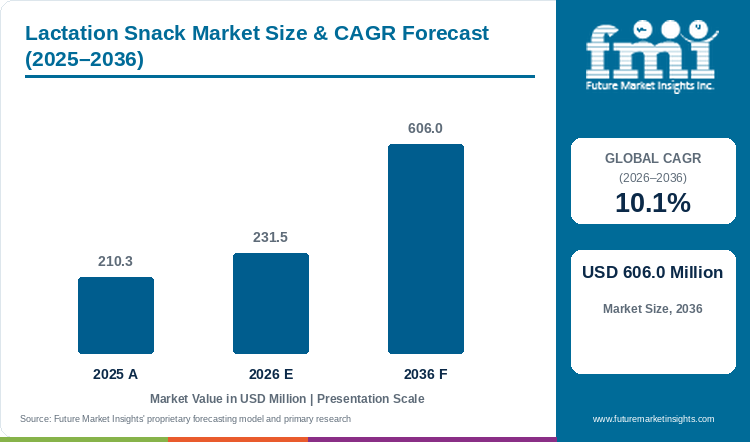
The market was valued at USD 210.3 Million in 2025 and is expected to reach USD 231.5 Million in 2026, with growth at a 10.1% CAGR from 2026 to 2036 taking its value to USD 606.0 Million by 2036.
Keeping a snack nearby can make eating easier when feeding or pumping interrupts a meal, giving portability and acceptable taste a direct role in this category. Cookies, bars and other formats need to offer a portion the buyer will enjoy repeatedly, with clear allergen information and value for money supporting the choice. Routines can change again when a parent returns to commuting or work, so resealable packs and flexible order quantities may be more useful than a fixed subscription that assumes the same consumption every month. Familiar oats and brewer’s yeast help buyers recognize a lactation recipe, although familiarity does not establish an effect on milk production. Suppliers need to make the food proposition understandable across retail packs and direct sales, with feeding concerns referred to qualified support. Demographic conditions in Japan and Germany also place attention on retaining buyers through eating quality and practical portions. [5]
Key Market Trends & Insights
- Lactation Cookies account for 41.6% of product type in 2026, with the familiar format making portions easy to keep nearby during feeding or pumping.
- Oats & Brewer's Yeast represents 48.6% of key ingredient in 2026, contributing familiar recipe characteristics while any milk-production claim needs evidence beyond ingredient presence.
- Gluten-Free holds 50.8% of dietary profile in 2026, with clear allergen information remaining necessary when buyers compare different recipes and dietary claims.
- Self-Purchase holds 49.1% of buyer in 2026, making accessible food information and practical pack quantities useful to households choosing a snack for immediate use.
Regional Highlights
- South Korea has the highest profiled CAGR at 10.6% during 2026–2036.
- The next two profiled growth rates are UK at 9.8% and USA at 9.5% over the same period.
Market Size & Forecast
| Metric | Value |
|---|---|
| 2025 market value | USD 210.3 Million |
| 2026 market estimate | USD 231.5 Million |
| 2036 market forecast | USD 606.0 Million |
| Forecast CAGR, 2026–2036 | 10.1% |
The market covers ready-to-eat packaged snacks explicitly positioned for breastfeeding or lactation support. Teas, beverages, drink mixes, capsules, breast pumps, infant formula and general snacks without the specified positioning are excluded.
Lactation snacks should not be confused with an assessed clinical nutrition intervention or with professional support for a feeding difficulty.
Nutrition evidence and practical use
| Documented operating context | Source |
|---|---|
| ACOG’s breastfeeding guidance prioritizes assessment of feeding difficulties before considering galactagogues. | [1] |
| NIH’s pregnancy nutrition guidance distinguishes nutrient requirements, dietary sources and supplement-related safety considerations. | [2] |
| FTC guidance requires health-product advertising claims to have appropriate scientific substantiation. | [3] |
| The U.S. Department of Labor explains workplace break-time protections for nursing employees. | [4] |
Analyst Perspective
A lactation snack needs to work as food that is enjoyable, convenient and clearly labeled when meal routines are disrupted. Pack sizes and flexible reordering can help households find a useful quantity, while ingredient and feeding claims need to remain clear enough that a familiar recipe is not mistaken for proof of increased milk production.
- Nandini Roy Choudhury, Principal Analyst at Future Market Insights
How is the lactation snack market segmented?
Product Type covers Lactation Cookies, Lactation Bars & Bites, Lactation Granola & Oatmeal, Savory Lactation Snacks and Others. Key Ingredient covers Oats & Brewer's Yeast, Flaxseed & Fenugreek-Free Blends, Moringa & Botanicals and Others. Dietary Profile covers Gluten-Free, Vegan and Conventional. Buyer covers Self-Purchase, Gifting and Subscription. Sales Channel covers Online / DTC, Retail Pharmacy, Supermarkets & Hypermarkets, Specialty & Health Stores and Others.
The women’s health supplements audience gives brands a recognizable life-stage channel, but a cookie’s food value and any milk-supply claim require separate consideration.
Why do Lactation Cookies lead product type demand?
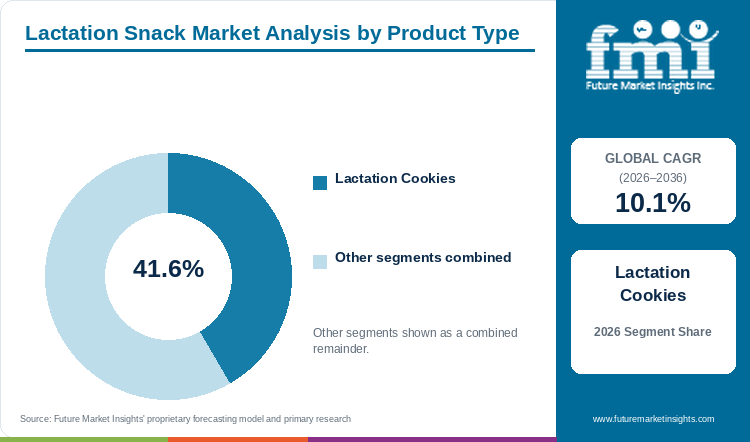
Lactation Cookies: 41.6% of product type in 2026.
Cookies provide a recognizable food format that can be portioned and carried with little preparation, helping explain their position in both retail and direct channels. Continued buying depends on flavor, texture and nutritional composition because the same customer may also consider bars, granola or savory alternatives. A well-made cookie can justify its place as convenient food without promising an effect on milk supply, while clear allergens and a suitable pack quantity help the household assess whether it fits daily use.
- The Lactation Cookies segment accounts for 41.6% of product type in 2026.
- Retail packs need to explain the food and serving quickly while direct channels have more room to discuss ingredients and intended use.
Why does Oats & Brewer's Yeast lead key ingredient demand?
Oats & Brewer's Yeast: 48.6% of key ingredient in 2026.
Oats and brewer’s yeast give many lactation recipes a familiar identity, with their flavor and texture influencing how readily a snack is accepted. Products within this ingredient category still need to be assessed as individual foods, since a recognizable recipe does not establish that eating it increases milk production. Suppliers can explain the ingredients and nutritional contribution while supporting any additional health claim with relevant evidence, allowing taste and convenience to provide a sound basis for repeat purchase.
- The Oats & Brewer's Yeast segment accounts for 48.6% of key ingredient in 2026.
- Munchkin's Milkmakers Lactation Cookie Bites list oats, brewer's yeast and flaxseed, while its savory Lactation Crisps use a different formulation path. The portfolio shows how brands can retain lactation positioning while varying taste and ingredient emphasis.
What are the drivers, restraints, and opportunities in the lactation snack market?
Convenience drives the lactation snack occasion
Breastfeeding and pumping can create repeated occasions when a ready-to-eat snack is useful. CDC data describe a substantial share of American mothers continuing breastfeeding for six months or longer. During that period routines may shift between home and work. A portable snack can address hunger when there is little time for food preparation. Brands need to make the product enjoyable enough to remain part of that routine. Predictable availability and manageable packs help more than an assumption that a longer feeding period automatically produces continuous purchases from the same brand.
Milk-supply claims face an evidence threshold
The selling proposition changes when a snack is advertised as increasing milk supply. Health-related claims need appropriate support and must not mislead customers. In the USA this is part of the FTC’s requirements for such advertising. Strong efficacy promises also create expectations the food may not meet. A feeding difficulty can have causes unrelated to the snack but a buyer may still judge the purchase against the promised outcome. Clear ingredient information and responsible referral to feeding support protect trust more effectively than an overstated benefit.
Honest food positioning supports broader distribution
A broader choice of snack formats can accommodate taste and dietary preferences without making larger physiological promises. Boobie Superfoods offers gluten-free cookie bites and other brands use fenugreek-free recipes or direct subscriptions. Each formulation still needs appropriate ingredient and production checks. A vegan or gluten-free label does not answer every allergy question. Suppliers can test smaller assortments and flexible repeat orders while explaining the ordinary food value. This lets new formats compete on convenience and enjoyment rather than depend on increasingly ambitious lactation claims.
Clear ingredient and portion information helps buyers distinguish a snack’s food contribution from the concentrated servings offered by dietary supplements, especially when both are already part of the household routine.
Which country and market CAGRs are profiled for lactation snack?
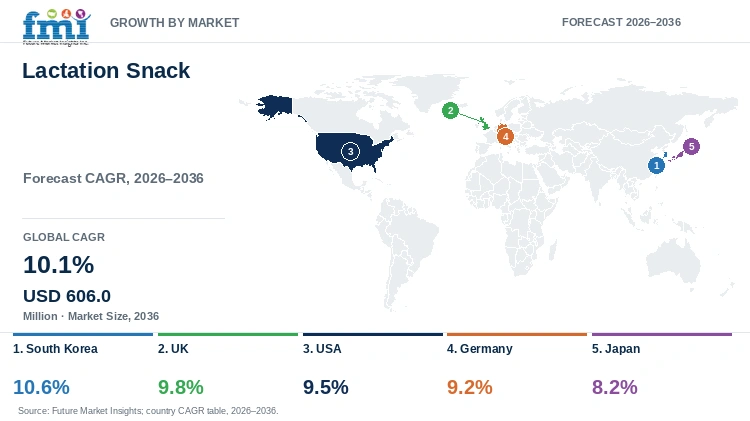
| Country | CAGR, 2026–2036 |
|---|---|
| South Korea | 10.6% |
| UK | 9.8% |
| USA | 9.5% |
| Germany | 9.2% |
| Japan | 8.2% |
Country-wise Analysis
South Korea
- In South Korea, lactation-snack suppliers need an offer that remains useful within the realities of a limited birth cohort, making retention and eating quality relevant alongside initial discovery. The market has the fastest profiled rate, at a 10.6% CAGR from 2026 to 2036. Convenient portions and understandable ingredient information can help a household choose a snack it will actually use, while familiar recipe claims require the same care as those made elsewhere in the category.
UK
- Portable food becomes particularly useful when UK buyers move between feeding at home, commuting and the workplace, because an easy-to-carry portion can fit gaps between meals. The 9.8% CAGR forecast for 2026 to 2036 places this convenience within a market where flavor and clear allergens still determine suitability. Brands can support repeat purchases through a pack size that matches real consumption and a food proposition that remains understandable without an expansive lactation claim.
USA
- American buyers may encounter lactation snacks at Target or on a brand’s own website, making consistency between pack information and online claims part of a reliable comparison. With a 9.5% CAGR forecast from 2026 to 2036, suppliers have reason to develop convenient portions and variety while maintaining clear support for advertised benefits. Feeding difficulties need qualified attention, so the snack should retain an intelligible role as food rather than imply that a purchase resolves the underlying concern.
Germany
- Resealable packs and suitable portions can help German households use a lactation snack without committing to more food than their routine requires. Demographic conditions make that practical fit relevant to retaining customers as the market grows at a forecast 9.2% CAGR from 2026 to 2036. Clear ingredients and eating quality give buyers a firmer reason to reorder than a broad feeding promise, particularly when the product competes with familiar snacks already kept at home.
Japan
- Trial quantities give Japanese buyers a way to assess taste and portion size before making a larger purchase, which is useful for a snack intended to fit an already demanding feeding routine. Japan has the lowest profiled forecast, at an 8.2% CAGR from 2026 to 2036, placing attention on a focused food offer and a manageable reorder. Suppliers can explain the recipe’s contribution plainly while keeping any milk-production claim within the evidence for the product.
Who are the notable companies in the lactation snack market?
Munchkin; Boobie Superfoods; Oat Mama; Milky Mama; Stork & Dove
Lactation snack brands compete through food qualities as well as life-stage positioning. Cookies and bars may serve the same moment but differ in sweetness and allergen content. Customers need enough choice to avoid flavor fatigue and enough information to judge the ordinary value of the pack.
Competitive Benchmarking: Lactation Snack Market
| Participant | Commercial focus | Buyer qualification priority |
|---|---|---|
| Munchkin | Milkmakers lactation snacks | Snack quality and clear ingredient disclosure |
| Boobie Superfoods | Lactation-positioned food products | Convenience and substantiated marketing |
| Oat Mama | Maternal snack products | Allergen transparency and repeat purchase |
| Milky Mama | Lactation-positioned snacks | Portion value and honest benefit claims |
| Stork & Dove | Booby Boons lactation cookies | Texture, packaging and ingredient suitability |
Key Developments in the Lactation Snack Market
- The U.S. Department of Labor explains workplace break-time protections for nursing employees. [4]
Key Players in the Lactation Snack Market
- Munchkin
- Boobie Superfoods
- Oat Mama
- Milky Mama
- Stork & Dove
Lactation Snack Market - Report Scope
| Coverage field | Report scope |
|---|---|
| Market breakdown | Product Type; Key Ingredient; Dietary Profile; Buyer; Sales Channel; Region |
| Quantitative unit | USD Million |
| Market definition | The market covers ready-to-eat packaged snacks explicitly positioned for breastfeeding or lactation support. Teas, beverages, drink mixes, capsules, breast pumps, infant formula and general snacks without the specified positioning are excluded. |
| Regions covered | North America; Latin America; Western Europe; Eastern Europe; East Asia; South Asia and Pacific; Middle East and Africa |
| Countries / markets profiled | South Korea; UK; USA; Germany; Japan |
| Key companies profiled | Munchkin; Boobie Superfoods; Oat Mama; Milky Mama; Stork & Dove |
| Base year / forecast period | 2026 / 2026–2036 |
| Estimate coverage | 2025 and 2026 market estimates; 2036 forecast; segment shares and country / market CAGRs. |
Lactation Snack Market - Research Methodology
| Method | Application |
|---|---|
| Market definition | The analysis follows the stated product or service boundary and distinguishes direct category revenue from adjacent activities. |
| Secondary research | Official technical, regulatory, research and company publications provide the documented operating context and recent developments cited in this report. |
| Forecast and segmentation | Market estimates, segment shares and geographic forecasts are presented as analytical estimates within the stated commercial scope. |
| Competitive assessment | Participants are compared by their relevant products or services, commercial role and buyer qualification requirements. |
| Interpretation | The assessment considers purchasing conditions and the scope of the documented product, service or performance claim. |
Lactation Snack Market by Segments
Product Type
- Lactation Cookies
- Lactation Bars & Bites
- Lactation Granola & Oatmeal
- Savory Lactation Snacks
- Others
Key Ingredient
- Oats & Brewer's Yeast
- Flaxseed & Fenugreek-Free Blends
- Moringa & Botanicals
- Others
Dietary Profile
- Gluten-Free
- Vegan
- Conventional
Buyer
- Self-Purchase
- Gifting
- Subscription
Sales Channel
- Online / DTC
- Retail Pharmacy
- Supermarkets & Hypermarkets
- Specialty & Health Stores
- Others
Lactation Snack Market by Region
- North America
- United States
- Canada
- Latin America
- Brazil
- Mexico
- Argentina
- Chile
- Western Europe
- Germany
- France
- United Kingdom
- Italy
- Spain
- Benelux
- Nordics
- Eastern Europe
- Poland
- Czech Republic
- Romania
- Hungary
- East Asia
- China
- Japan
- South Korea
- South Asia and Pacific
- India
- ASEAN
- Australia and New Zealand
- Middle East and Africa
- GCC Countries
- South Africa
- Türkiye
- Israel
Research Sources and Bibliography
- [1] American College of Obstetricians and Gynecologists. (2021, February). Breastfeeding Challenges.
- [2] National Institutes of Health, Office of Dietary Supplements. (n.d.). Dietary supplements and life stages: Pregnancy.
- [3] Federal Trade Commission. (2022, December 20). Health Products Compliance Guidance.
- [4] U.S. Department of Labor. (2025, December). Fact Sheet #73: FLSA Protections for Employees to Pump Breast Milk at Work.
- [5] Future Market Insights. (2026). Lactation Snack Market: Global industry analysis and opportunity assessment, 2026–2036.
This Report Answers
- How large is the lactation snack market in 2026?
- What value and CAGR are forecast through 2036?
- Which product type segment leads in 2026?
- Which key ingredient segment has the largest share?
- Which profiled country or market has the fastest forecast growth?
- Which participants are covered in the competitive assessment?
Frequently Asked Questions
How large is the lactation snack market in 2026?
The market was valued at USD 210.3 Million in 2025 and is expected to reach USD 231.5 Million in 2026.
What value and CAGR are forecast through 2036?
The market is projected to reach USD 606.0 Million by 2036, with a 10.1% CAGR during 2026–2036.
Which product type segment leads in 2026?
The Lactation Cookies segment accounts for 41.6% of product type in 2026.
Which key ingredient segment has the largest share?
The Oats & Brewer's Yeast segment accounts for 48.6% of key ingredient in 2026.
Which profiled country or market has the fastest forecast growth?
South Korea has the highest profiled CAGR at 10.6% during 2026–2036.
Which participants are covered in the competitive assessment?
The assessment covers Munchkin, Boobie Superfoods, Oat Mama, Milky Mama and Stork & Dove.
Preview the report firsthand - request a free sample
Get SampleGet the brochure for pricing and purchase details.
Get PDFTable of Content
- Key Takeaways
- Market Size and CAGR
- Top Growth Driver
- Fastest Growing Segment
- Leading Region
- Key Companies
- Emerging Opportunities
- Executive Summary
- Global Market Outlook
- Demand-side Trends
- Supply-side Trends
- Technology Roadmap Analysis
- Analysis and Recommendations
- Analyst Perspective (What is happening? Why now? What should investors know?)
- Key Questions Answered
- How large is the market?
- What is the CAGR?
- What are key trends?
- Which region dominates?
- Who are the leaders?
- Market Overview
- Market Coverage / Taxonomy
- Market Definition / Scope / Limitations
- Research Methodology
- Chapter Orientation
- Analytical Lens and Working Hypotheses
- Market Structure, Signals, and Trend Drivers
- Benchmarking and Cross-market Comparability
- Market Sizing, Forecasting, and Opportunity Mapping
- Research Design and Evidence Framework
- Desk Research Programme (Secondary Evidence)
- Expert Input and Fieldwork (Primary Evidence)
- Tooling, Models, and Reference Databases
- Data Engineering and Model Build
- Quality Assurance and Audit Trail
- Market Background
- Market Dynamics (Drivers, Restraints, Opportunity, Trends)
- Scenario Forecast (Optimistic, Likely, Conservative)
- Impact Analysis
- AI Impact
- Sustainability Impact
- Regulatory Impact
- Technology Impact
- Consumer / Buyer Analysis
- Purchase Drivers
- Adoption Barriers
- Buyer Journey
- Opportunity Map Analysis
- Product Life Cycle Analysis
- Supply Chain Analysis
- Investment Feasibility Matrix
- Value Chain Analysis
- PESTLE and Porter's Analysis
- Regulatory Landscape
- Regional Parent Market Outlook
- Production and Consumption Statistics
- Import and Export Statistics
- Global Market Analysis and Forecast, 2021 to 2036
- Historical Market Size Value (USD Million) Analysis, 2021 to 2025
- Current and Future Market Size Value (USD Million) Projections, 2026 to 2036
- Y-o-Y Growth Trend Analysis
- Absolute $ Opportunity Analysis
- Global Market Pricing Analysis, 2021 to 2036
- Global Market Analysis and Forecast, By Product Type, 2021 to 2036
- Introduction / Key Findings
- Historical Market Size Value (USD Million) Analysis By Product Type, 2021 to 2025
- Current and Future Market Size Value (USD Million) Analysis and Forecast By Product Type, 2026 to 2036
- Lactation Cookies
- Lactation Bars & Bites
- Lactation Granola & Oatmeal
- Savory Lactation Snacks
- Others
- Y-o-Y Growth Trend Analysis By Product Type, 2021 to 2025
- Absolute $ Opportunity Analysis By Product Type, 2026 to 2036
- Global Market Analysis and Forecast, By Key Ingredient, 2021 to 2036
- Introduction / Key Findings
- Historical Market Size Value (USD Million) Analysis By Key Ingredient, 2021 to 2025
- Current and Future Market Size Value (USD Million) Analysis and Forecast By Key Ingredient, 2026 to 2036
- Oats & Brewer's Yeast
- Flaxseed & Fenugreek-Free Blends
- Moringa & Botanicals
- Others
- Y-o-Y Growth Trend Analysis By Key Ingredient, 2021 to 2025
- Absolute $ Opportunity Analysis By Key Ingredient, 2026 to 2036
- Global Market Analysis and Forecast, By Dietary Profile, 2021 to 2036
- Introduction / Key Findings
- Historical Market Size Value (USD Million) Analysis By Dietary Profile, 2021 to 2025
- Current and Future Market Size Value (USD Million) Analysis and Forecast By Dietary Profile, 2026 to 2036
- Gluten-Free
- Vegan
- Conventional
- Y-o-Y Growth Trend Analysis By Dietary Profile, 2021 to 2025
- Absolute $ Opportunity Analysis By Dietary Profile, 2026 to 2036
- Global Market Analysis and Forecast, By Buyer, 2021 to 2036
- Introduction / Key Findings
- Historical Market Size Value (USD Million) Analysis By Buyer, 2021 to 2025
- Current and Future Market Size Value (USD Million) Analysis and Forecast By Buyer, 2026 to 2036
- Self-Purchase
- Gifting
- Subscription
- Y-o-Y Growth Trend Analysis By Buyer, 2021 to 2025
- Absolute $ Opportunity Analysis By Buyer, 2026 to 2036
- Global Market Analysis and Forecast, By Sales Channel, 2021 to 2036
- Introduction / Key Findings
- Historical Market Size Value (USD Million) Analysis By Sales Channel, 2021 to 2025
- Current and Future Market Size Value (USD Million) Analysis and Forecast By Sales Channel, 2026 to 2036
- Online / DTC
- Retail Pharmacy
- Supermarkets & Hypermarkets
- Specialty & Health Stores
- Others
- Y-o-Y Growth Trend Analysis By Sales Channel, 2021 to 2025
- Absolute $ Opportunity Analysis By Sales Channel, 2026 to 2036
- Global Market Analysis and Forecast, By Region, 2021 to 2036
- Introduction
- Historical Market Size Value (USD Million) Analysis By Region, 2021 to 2025
- Current Market Size Value (USD Million) Analysis and Forecast By Region, 2026 to 2036
- North America
- Latin America
- Western Europe
- Eastern Europe
- East Asia
- South Asia and Pacific
- Middle East and Africa
- Market Attractiveness Analysis By Region
- North America Market Analysis and Forecast, By Country, 2021 to 2036
- Historical Market Size Value (USD Million) Trend Analysis By Market Taxonomy, 2021 to 2025
- Market Size Value (USD Million) Forecast By Market Taxonomy, 2026 to 2036
- By Country
- United States
- Canada
- By Product Type
- By Key Ingredient
- By Dietary Profile
- By Buyer
- By Sales Channel
- By Country
- Market Attractiveness Analysis
- By Country
- By Product Type
- By Key Ingredient
- By Dietary Profile
- By Buyer
- By Sales Channel
- Key Takeaways
- Latin America Market Analysis and Forecast, By Country
- Historical Market Size Value (USD Million) Trend Analysis By Market Taxonomy, 2021 to 2025
- Market Size Value (USD Million) Forecast By Market Taxonomy, 2026 to 2036
- By Country
- Brazil
- Mexico
- Argentina
- Chile
- By Product Type
- By Key Ingredient
- By Dietary Profile
- By Buyer
- By Sales Channel
- By Country
- Market Attractiveness Analysis
- By Country
- By Product Type
- By Key Ingredient
- By Dietary Profile
- By Buyer
- By Sales Channel
- Key Takeaways
- Western Europe Market Analysis and Forecast, By Country
- Historical Market Size Value (USD Million) Trend Analysis By Market Taxonomy, 2021 to 2025
- Market Size Value (USD Million) Forecast By Market Taxonomy, 2026 to 2036
- By Country
- Germany
- France
- United Kingdom
- Italy
- Spain
- Benelux
- Nordics
- By Product Type
- By Key Ingredient
- By Dietary Profile
- By Buyer
- By Sales Channel
- By Country
- Market Attractiveness Analysis
- By Country
- By Product Type
- By Key Ingredient
- By Dietary Profile
- By Buyer
- By Sales Channel
- Key Takeaways
- Eastern Europe Market Analysis and Forecast, By Country
- Historical Market Size Value (USD Million) Trend Analysis By Market Taxonomy, 2021 to 2025
- Market Size Value (USD Million) Forecast By Market Taxonomy, 2026 to 2036
- By Country
- Poland
- Czech Republic
- Romania
- Hungary
- By Product Type
- By Key Ingredient
- By Dietary Profile
- By Buyer
- By Sales Channel
- By Country
- Market Attractiveness Analysis
- By Country
- By Product Type
- By Key Ingredient
- By Dietary Profile
- By Buyer
- By Sales Channel
- Key Takeaways
- East Asia Market Analysis and Forecast, By Country
- Historical Market Size Value (USD Million) Trend Analysis By Market Taxonomy, 2021 to 2025
- Market Size Value (USD Million) Forecast By Market Taxonomy, 2026 to 2036
- By Country
- China
- Japan
- South Korea
- By Product Type
- By Key Ingredient
- By Dietary Profile
- By Buyer
- By Sales Channel
- By Country
- Market Attractiveness Analysis
- By Country
- By Product Type
- By Key Ingredient
- By Dietary Profile
- By Buyer
- By Sales Channel
- Key Takeaways
- South Asia and Pacific Market Analysis and Forecast, By Country
- Historical Market Size Value (USD Million) Trend Analysis By Market Taxonomy, 2021 to 2025
- Market Size Value (USD Million) Forecast By Market Taxonomy, 2026 to 2036
- By Country
- India
- ASEAN
- Australia and New Zealand
- By Product Type
- By Key Ingredient
- By Dietary Profile
- By Buyer
- By Sales Channel
- By Country
- Market Attractiveness Analysis
- By Country
- By Product Type
- By Key Ingredient
- By Dietary Profile
- By Buyer
- By Sales Channel
- Key Takeaways
- Middle East and Africa Market Analysis and Forecast, By Country
- Historical Market Size Value (USD Million) Trend Analysis By Market Taxonomy, 2021 to 2025
- Market Size Value (USD Million) Forecast By Market Taxonomy, 2026 to 2036
- By Country
- GCC Countries
- South Africa
- Türkiye
- Israel
- By Product Type
- By Key Ingredient
- By Dietary Profile
- By Buyer
- By Sales Channel
- By Country
- Market Attractiveness Analysis
- By Country
- By Product Type
- By Key Ingredient
- By Dietary Profile
- By Buyer
- By Sales Channel
- Key Takeaways
- Key Countries Market Analysis
- United States
- Pricing Analysis
- Market Share Analysis, 2025
- By Product Type
- By Key Ingredient
- By Dietary Profile
- By Buyer
- By Sales Channel
- Canada
- Pricing Analysis
- Market Share Analysis, 2025
- By Product Type
- By Key Ingredient
- By Dietary Profile
- By Buyer
- By Sales Channel
- Mexico
- Pricing Analysis
- Market Share Analysis, 2025
- By Product Type
- By Key Ingredient
- By Dietary Profile
- By Buyer
- By Sales Channel
- Brazil
- Pricing Analysis
- Market Share Analysis, 2025
- By Product Type
- By Key Ingredient
- By Dietary Profile
- By Buyer
- By Sales Channel
- Chile
- Pricing Analysis
- Market Share Analysis, 2025
- By Product Type
- By Key Ingredient
- By Dietary Profile
- By Buyer
- By Sales Channel
- Germany
- Pricing Analysis
- Market Share Analysis, 2025
- By Product Type
- By Key Ingredient
- By Dietary Profile
- By Buyer
- By Sales Channel
- United Kingdom
- Pricing Analysis
- Market Share Analysis, 2025
- By Product Type
- By Key Ingredient
- By Dietary Profile
- By Buyer
- By Sales Channel
- Italy
- Pricing Analysis
- Market Share Analysis, 2025
- By Product Type
- By Key Ingredient
- By Dietary Profile
- By Buyer
- By Sales Channel
- Spain
- Pricing Analysis
- Market Share Analysis, 2025
- By Product Type
- By Key Ingredient
- By Dietary Profile
- By Buyer
- By Sales Channel
- France
- Pricing Analysis
- Market Share Analysis, 2025
- By Product Type
- By Key Ingredient
- By Dietary Profile
- By Buyer
- By Sales Channel
- India
- Pricing Analysis
- Market Share Analysis, 2025
- By Product Type
- By Key Ingredient
- By Dietary Profile
- By Buyer
- By Sales Channel
- ASEAN
- Pricing Analysis
- Market Share Analysis, 2025
- By Product Type
- By Key Ingredient
- By Dietary Profile
- By Buyer
- By Sales Channel
- Australia and New Zealand
- Pricing Analysis
- Market Share Analysis, 2025
- By Product Type
- By Key Ingredient
- By Dietary Profile
- By Buyer
- By Sales Channel
- China
- Pricing Analysis
- Market Share Analysis, 2025
- By Product Type
- By Key Ingredient
- By Dietary Profile
- By Buyer
- By Sales Channel
- Japan
- Pricing Analysis
- Market Share Analysis, 2025
- By Product Type
- By Key Ingredient
- By Dietary Profile
- By Buyer
- By Sales Channel
- South Korea
- Pricing Analysis
- Market Share Analysis, 2025
- By Product Type
- By Key Ingredient
- By Dietary Profile
- By Buyer
- By Sales Channel
- Poland
- Pricing Analysis
- Market Share Analysis, 2025
- By Product Type
- By Key Ingredient
- By Dietary Profile
- By Buyer
- By Sales Channel
- Hungary
- Pricing Analysis
- Market Share Analysis, 2025
- By Product Type
- By Key Ingredient
- By Dietary Profile
- By Buyer
- By Sales Channel
- Türkiye
- Pricing Analysis
- Market Share Analysis, 2025
- By Product Type
- By Key Ingredient
- By Dietary Profile
- By Buyer
- By Sales Channel
- South Africa
- Pricing Analysis
- Market Share Analysis, 2025
- By Product Type
- By Key Ingredient
- By Dietary Profile
- By Buyer
- By Sales Channel
- United States
- Market Structure Analysis
- Competition Dashboard
- Competition Benchmarking
- Market Share Analysis of Top Players
- By Regional
- By Product Type
- By Key Ingredient
- By Dietary Profile
- By Buyer
- By Sales Channel
- Emerging Startups
- Innovation Benchmarking
- Competition Analysis
- Competition Deep Dive
- Munchkin
- Overview
- Product Portfolio
- Profitability by Market Segments
- Sales Footprint
- Strategy Overview
- Marketing Strategy
- Product Strategy
- Channel Strategy
- Boobie Superfoods
- Oat Mama
- Milky Mama
- Stork & Dove
- Munchkin
- Case Studies
- Success Stories
- Recent Developments
- Competition Deep Dive
- Assumptions & Acronyms Used


