
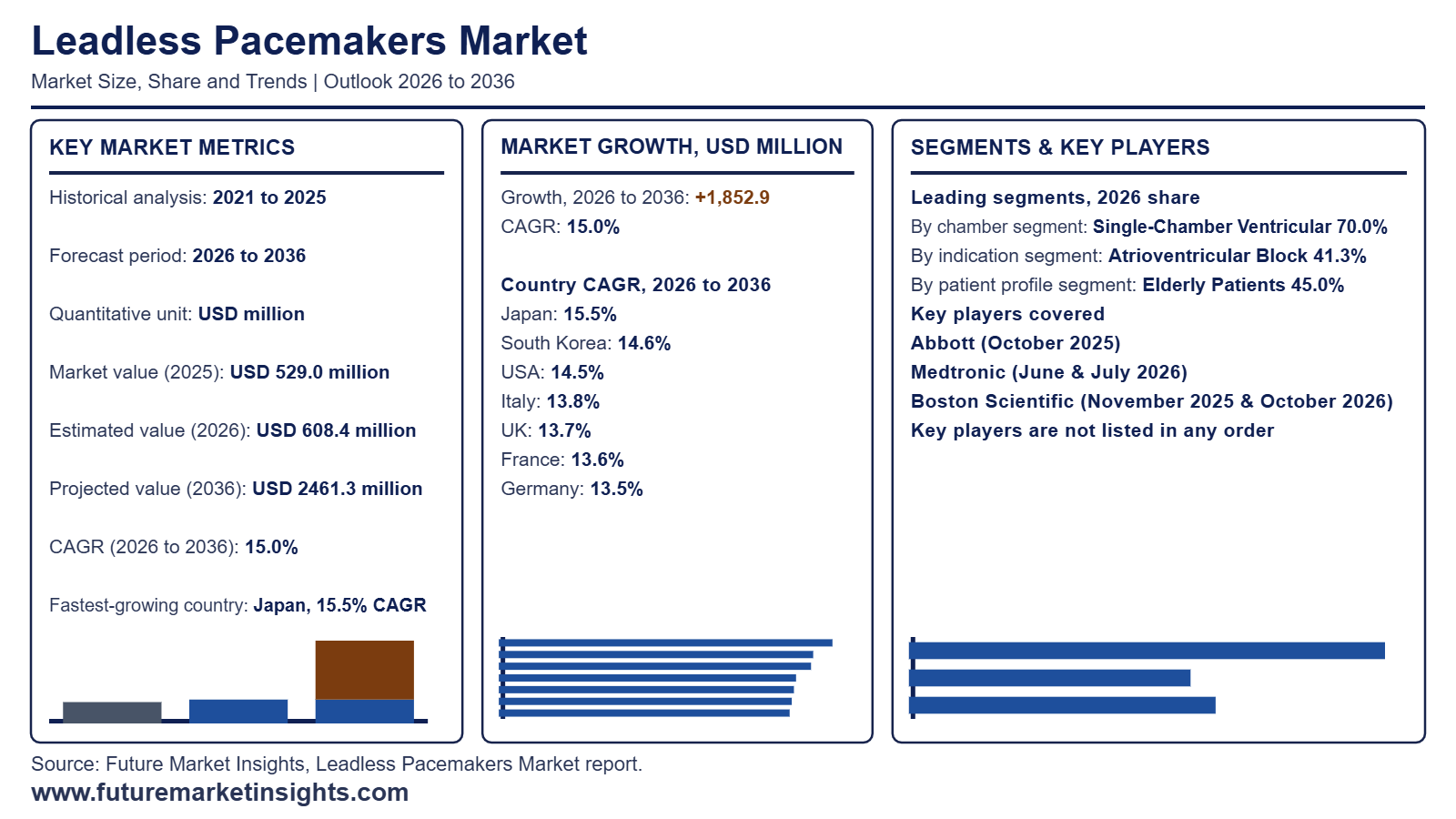
- Market Size (2026)
- USD 608.4 Mn
- Forecast (2036)
- USD 2461.3 Mn
- CAGR (2026 to 2036)
- 15.0%
How Big Is the Leadless Pacemakers Market in 2026?
The leadless pacemakers market valuation stood at USD 529.0 million in 2025 to USD 608.4 million in 2026 and is estimated by FMI to reach USD 2,461.3 million by 2036, expanding at a 15.0% CAGR during the forecast period and generating USD 1,852.9 million in incremental dollar opportunity.
| Market Metric | Valuation / Share / Forecast Benchmark |
|---|---|
| Market Size in 2025 (Historical) | USD 529.0 million |
| Market Size in 2026 (Estimated) | USD 608.4 million |
| Projected Market Size in 2036 | USD 2,461.3 million |
| 2026 to 2036 CAGR | 15.0% |
| 10-Year Incremental Opportunity (2026 to 2036) | USD 1,852.9 million |
| Dominant Chamber Segment (2026) | Single-Chamber Ventricular (70.0%) | Other Segment Combined (30.0%) | Total (100.0%) |
| Dominant Indication Segment (2026) | Atrioventricular Block (41.3%) | Other Segment Combined (58.7%) | Total (100.0%) |
| Dominant Patient Profile Segment (2026) | Elderly Patients (45.0%) | Other Segment Combined (55.0%) | Total (100.0%) |
| Dominant End User Segment (2026) | Public Hospitals (42.0%) | Other Segment Combined (58.0%) | Total (100.0%) |
| Dominant Country / Fastest-Growing Country | USA (38.0% share in 2026) / Japan (15.5% CAGR) |
| Notable Companies | Medtronic, Abbott, Boston Scientific |
Source: Future Market Insights analysis of the Leadless Pacemakers Market, 2026.
Executive Market Overview
Clinical adoption of leadless pacemakers is rising rapidly across cardiac electrophysiology suites as heart specialists seek to eliminate transvenous lead dislodgement and surgical pocket infections in bradycardia patients. Clinical outcomes published in the Journal of the American College of Cardiology (2025) document a 63% reduction in major acute lead-related complications among patients receiving catheter-delivered intracardiac capsules compared to conventional transvenous systems. The United States and Western Europe anchor clinical procedural volume through established reimbursement codes, while cardiac centers across Japan and South Korea reflect higher forecast CAGRs as hospital surgical teams complete certified transcatheter delivery training across cardiac rhythm management and pacemakers.
Medical technology innovators protect commercial margins by engineering communicating dual-chamber leadless systems, miniaturized retrieval sleeves, and extended battery architectures rather than selling single-chamber VVIR capsules. High initial capital acquisition costs and specialized femoral sheath training curves act as practical restraints on universal community hospital adoption. FMI projects dual-chamber leadless pacing systems to advance at a 16.2% CAGR and single-chamber ventricular capsules at a 13.8% CAGR through 2036, anchored by hospital inpatient conversions. Market sizing tracks clinical revenues from single-chamber and dual-chamber leadless transcatheter pacemaker capsules and delivery catheters, while excluding traditional transvenous pacemakers and external temporary pacemakers.
Analyst Perspective
"Hospital preference for avoiding transvenous leads turns into steady sales growth only when the pacing mode fits conduction needs and local payers cover the device premium. Suppliers face commercial restraint whenever end-of-service retrieval rules or evidence registries delay public tender sign-offs."
- Anurag Sharma, Principal Consultant, Future Market Insights.
Major Market Trends and Insights
- Dual-Chamber and Atrial Clearances Expand Clinical Sales Scope: At present, expanding from ventricular backup into paired atrial-ventricular pacing is lifting supplier sales across broader bradycardia populations. From what recent regulatory filings show, dual-chamber adoption is likely to grow faster, though it does not mean single-chamber capsules will lose baseline volume. The United States Food and Drug Administration (June 2025) proves that point by clearing Abbott's AVEIR AR 2 atrial supplement P150035S023, building on earlier dual-chamber clearances by Abbott (July 2023) in the USA and Abbott (June 2024) in Europe. To put that into simpler business terms, when Abbott (October 2025) launched AVEIR DR in India, it gave Asian centers wireless dual-chamber pacing that expands cardiac rhythm remote monitoring devices workflows.
- National Health Technology Assessments Govern Funded Hospital Adoption: European payers are defining exact patient boundaries rather than granting open reimbursement for every bradycardia case. France's Haute Autorité de Santé (April 2026) documented sufficient clinical service for Micra AV2 in high-risk adults needing resting synchrony, following its earlier Haute Autorité de Santé (February 2026) evaluation of AVEIR VR. Because of these targeted payer criteria, the likelihood of hospitals separating funded high-risk implants from experimental subcutaneous implantable defibrillator pairings is rising, which is expected to shape European sales growth through 2036.
- Catheter Delivery Upgrades and Modular Defibrillator Trials Advance: Buyer preferences among electrophysiologists suggest strong demand for safer catheter deployment and future defibrillator integration, as seen in recent FDA supplements and clinical trials. Specifically, the United States Food and Drug Administration (June 2026) cleared Micra scalable catheter delivery refinements under P150033S224, followed by United States Food and Drug Administration (July 2026) subassembly updates under P150033S229. Meanwhile, one-year MODULAR ATP outcomes reported by Lloyd et al. (November 2025) built on Boston Scientific (May 2024) trial endpoints for pairing EMPOWER with a subcutaneous implantable defibrillator system, setting up future industry expansion once commercial approvals arrive.
What Are the Main Drivers, Restraints, and Opportunities?
Prevention of pocket and lead complications drives specialist referrals, whereas higher device acquisition costs and uneven hospital reimbursement restrain routine adoption, leaving atrial and dual-chamber expansion as the primary commercial opportunity.
Driver: Eliminating Transvenous Leads and Surgical Pockets in High-Risk Patients
Patient protection for those with blocked veins or prior device infections from repeat transvenous hardware is driving sales of leadless capsules right now. On account of this clinical need, implanting teams increasingly refer dialysis and post-extraction patients where conventional leads carry steep infection risk. Documentation from the Haute Autorité de Santé (April 2026) proves that point by explicitly listing dialysis dependence and prior endocarditis as eligible Micra AV2 criteria. To put that into simpler business terms, when the Centers for Medicare & Medicaid Services (May 2026) added BIOTRONIK's LivIQ trial to its active coverage-with-evidence-development roster with Medtronic and Abbott studies, it meant payer support for leadless safety continues widening. Because of this clinical backing, steady hospital demand across wearable cardioverter defibrillator and pacing centers is expected to influence market growth through 2036.
Restraint: Device Price Premiums and Fragmented Hospital Reimbursement Frameworks
Higher unit acquisition prices compared with conventional pacemakers create a direct financial restraint whenever hospital episode payments fail to cover the gap. Physician preferences suggest that clinical interest is strong, yet budget limits still cap wider adoption, as noted in a national Italian survey by Rordorf et al. (March 2025) where cardiologists named device cost as the top barrier even at active implanting centers. Further contributing to this pricing pressure, a European procurement study by Osoro et al. (February 2026) documented wide national gaps in how public hospitals fund cardiac implants. From what these purchasing records show, public wards will keep reserving capsule implants for high-risk referrals until payer tariffs match unit costs, though this does not mean private centers will halt selective growth.
Opportunity: Paired Atrial-Ventricular Pacing and Emerging Market Commercialization
Broad commercial access from ventricular-only capsules into coordinated dual-chamber pacing opens a major growth opportunity across sinus node dysfunction and heart block. Abbott (October 2025) proved that commercial expansion is underway by launching its AVEIR DR dual-chamber platform in India, while Medtronic (2025) published multi-year battery longevity data for its Micra family to reassure buyers on lifecycle value. Meanwhile, Boston Scientific (October 2026) noted in its third-quarter operational highlights that its investigational EMPOWER system targets 2027 regulatory approval. To put that into simpler business terms, as dual-chamber systems prove battery durability and safe retrieval, the likelihood of hospitals shifting more routine bradycardia procedures to leadless platforms is rising through 2036.
How Is the Leadless Pacemakers Market Segmented?
Leadless Pacemakers Market is segmented by Chamber, Indication, Patient Profile, End User, and Region. Forecast period from 2026 to 2036.
| Primary Segmentation Axis | Dominant Sub-Segment (2026) | 2026 Share (%) | Complete Sub-Segment Breakdown & Commercial Scope |
|---|---|---|---|
| Chamber | Single-Chamber Ventricular | 70.0% | Single-Chamber Ventricular (70.0%) | Other Segment Combined (30.0%) | Total (100.0%) |
| Indication | Atrioventricular Block | 41.3% | Atrioventricular Block (41.3%) | Other Segment Combined (58.7%) | Total (100.0%) |
| Patient Profile | Elderly Patients | 45.0% | Elderly Patients (45.0%) | Other Segment Combined (55.0%) | Total (100.0%) |
| End User | Public Hospitals | 42.0% | Public Hospitals (42.0%) | Other Segment Combined (58.0%) | Total (100.0%) |
Source: Future Market Insights analysis of the Leadless Pacemakers Market, 2026.
Why Do Single-Chamber Ventricular Devices Account for 70.0% of Chamber Revenue in 2026?
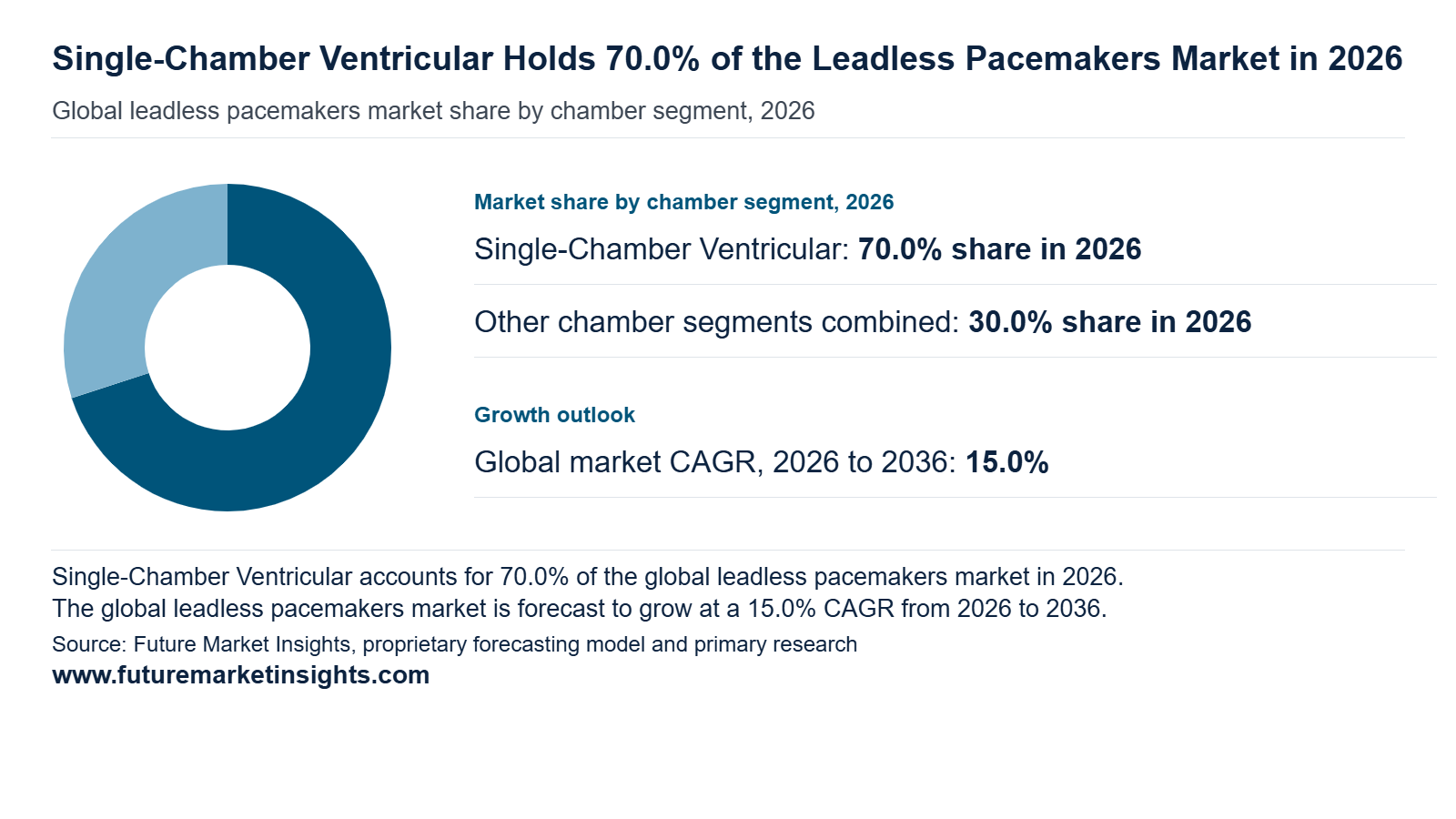
Single-Chamber Ventricular implants capture 70.0% of chamber revenue in 2026 because hospital teams already rely on single-capsule catheter workflows and established billing codes for right ventricular pacing. From what current procedure volumes show, dual-chamber implants are likely to gain share, while single-chamber ventricular units keep the lead; however, that does not mean dual-chamber pricing will immediately displace simpler ventricular cases. To put that into simpler business terms, the National Institute for Health and Care Excellence (February 2026) endorsed right ventricular leadless pacing as a standard option while imposing tighter evidence conditions on atrial and dual-chamber models. Product refinements also support this lead, as seen when the United States Food and Drug Administration (June 2026) cleared updated Micra delivery catheters building on earlier Medtronic (May 2023) and Medtronic (January 2024) Micra VR2 and AV2 clearances, keeping ventricular sales central to industry growth.
What Puts Atrioventricular Block at 41.3% of Indication Demand in 2026?
Atrioventricular Block represents 41.3% of indication demand in 2026 because interrupted conduction between heart chambers creates an immediate need for dependable ventricular activation. Clinician preferences suggest that electrophysiologists choose between ventricular-only backup and resting synchrony depending on each patient's conduction profile, which is expected to sustain steady demand across both single and dual-capsule designs. France's Haute Autorité de Santé (April 2026) proved that clinical priority by approving Micra AV2 specifically for high-risk adults with atrioventricular block requiring resting synchrony. Meanwhile, dual-chamber clearances by the United States Food and Drug Administration (June 2025) for AVEIR AR 2 and earlier United States Food and Drug Administration (April 2023) Micra reviews give hospitals wider options for managing conduction block through 2036.
Why Do Elderly Patients Represent 45.0% of Patient Profile Revenue in 2026?
Elderly Patients account for 45.0% of patient profile revenue in 2026 because older adults more often present with fragile veins, multiple comorbidities, and prior pocket infections that make transvenous leads risky. Due to these surgical risks, implanting teams weigh pocket avoidance heavily even though age alone does not dictate device selection. Survey findings by Rordorf et al. (March 2025) prove that point, showing most Italian cardiologists viewed patients over sixty as primary candidates for leadless capsules when infection or prior lead extraction was present. To put that into simpler business terms, longevity data published by Medtronic (2025) means clinicians can better match battery duration to older patient horizons, lowering the likelihood of repeat extraction surgeries and supporting steady adoption.
How Do Public Hospitals Shape 42.0% of End User Purchasing in 2026?
Public Hospitals generate 42.0% of end user revenue in 2026 because large tertiary centers concentrate electrophysiology labs, emergency cardiac referrals, and national payer oversight. Unlike smaller outpatient clinics, public hospital trusts run formal technology reviews and multi-year tenders before funding premium devices. Procurement analysis by Osoro et al. (February 2026) illustrates how European public hospitals compare capsule cost-effectiveness against transvenous care under national tariffs. Because of these institutional controls, policy updates such as the Health Insurance Review and Assessment Service, South Korea (November 2025) revising insertion material benefits directly govern public tender volumes and industry expansion through 2036.
Leadless Pacemakers Market by Region and Country (2026 to 2036)
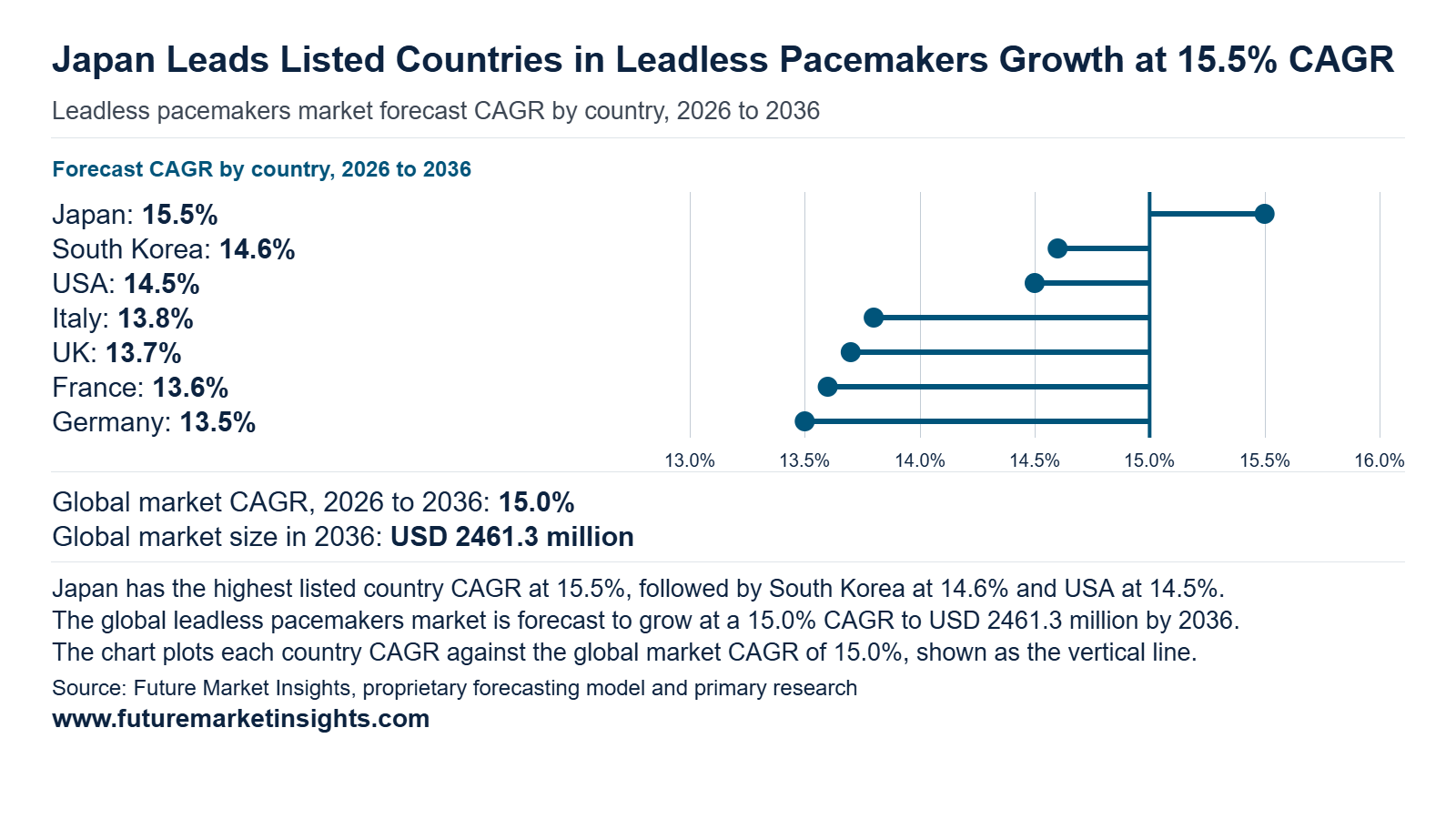
North America anchors global revenue in 2026 due to established Medicare coverage-with-evidence-development registries, while East Asia posts the fastest percentage expansion through 2036. FMI projects Japan to lead national growth at 15.5% CAGR, followed by South Korea at 14.6% CAGR and the USA at 14.5% CAGR, whereas Italy (13.8% CAGR), the UK (13.7% CAGR), France (13.6% CAGR), and Germany (13.5% CAGR) advance along structured national reimbursement pathways. This 2.0 percentage point spread reflects differences in dual-chamber regulatory timing and hospital episode funding rather than clinical need alone.
| Country | 2026 Revenue (USD Million) | 2036 Revenue (USD Million) | 10-Year Addition (USD Million) | 2026 to 2036 CAGR (%) | Global Share (2026 -> 2036) |
|---|---|---|---|---|---|
| USA | 231.2 | 895.0 | +663.8 | 14.5% | 38.0% -> 36.4% |
| Japan | 60.8 | 256.8 | +196.0 | 15.5% | 10.0% -> 10.4% |
| Germany | 48.7 | 172.8 | +124.1 | 13.5% | 8.0% -> 7.0% |
| France | 42.6 | 152.5 | +109.9 | 13.6% | 7.0% -> 6.2% |
| UK | 36.5 | 131.8 | +95.3 | 13.7% | 6.0% -> 5.4% |
| Italy | 30.4 | 110.7 | +80.3 | 13.8% | 5.0% -> 4.5% |
| South Korea | 24.3 | 95.0 | +70.7 | 14.6% | 4.0% -> 3.9% |
Source: Future Market Insights analysis of the Leadless Pacemakers Market, 2026.
USA
USA leadless pacemakers demand is projected to advance at a 14.5% CAGR through 2036, spurred by steady retail demand and growing consumer preference for certified products. FMI's analysis indicates that American sales lead globally because single-chamber and dual-chamber systems are both commercially cleared with active Medicare registries. To put that into simpler business terms, when the Centers for Medicare & Medicaid Services (May 2026) approved BIOTRONIK's LivIQ IDE study with Micra and AVEIR trials, it meant hospital billing pathways continue broadening beyond early ventricular indications. Supported by United States Food and Drug Administration (June 2025) clearances for AVEIR AR 2, hospital adoption in the USA is expected to sustain strong revenue expansion through 2036.
Japan
Japan leadless pacemakers demand is projected to advance at a 15.5% CAGR through 2036, anchored by expanding clinical adoption and recurring healthcare replenishment. In FMI's assessment, Japan's aging patient base and dual-chamber approvals give domestic cardiac centers strong incentive to adopt leadless pacing, though institutional qualification rules still pace rollout speed. Regulatory reviews by the Pharmaceuticals and Medical Devices Agency (September 2024) and Abbott Japan (October 2024) authorization for AVEIR DR, paired with updated clinical guidance from the Japanese Circulation Society and Japanese Heart Rhythm Society (2024), gave electrophysiologists clear chamber rules. Because of this structured clinical framework, Japanese hospital sales are projected to lead global growth through 2036.
Germany
Germany leadless pacemakers demand is projected to advance at a 13.5% CAGR through 2036, supported by expanding procurement agreements across specialized commercial distribution channels. FMI observes that German hospital purchasing is tightly governed by diagnosis-related group episode budgets, making device cost recovery decisive for ward administrators. European procurement research by Osoro et al. (February 2026) proves that point, documenting how national payment rules shape cardiac implant selection across public hospitals. While German clinicians value pocket-free pacing for infection-prone cases, budget discipline means routine orders will scale selectively through 2036.
France
France leadless pacemakers demand is projected to advance at a 13.6% CAGR through 2036, driven by continuous technical modernization and shifting institutional buyer preferences. FMI finds that device-by-device clinical assessments draw strict boundaries around eligible patients rather than allowing broad brand substitution. Specifically, the Haute Autorité de Santé (April 2026) approved Micra AV2 for adults requiring resting synchrony who cannot use conventional leads, building on its Haute Autorité de Santé (February 2026) review of AVEIR VR. Alignment of each cleared platform to these defined French clinical criteria will anchor steady hospital sales through 2036.
UK
UK leadless pacemakers demand is projected to advance at a 13.7% CAGR through 2036, reflecting sustained industrial usage and growing awareness of operational advantages. FMI notes that British guidance separates established right ventricular pacing from newer dual-chamber procedures requiring formal outcome tracking. In its updated policy, the National Institute for Health and Care Excellence (February 2026) backed routine right ventricular leadless implantation while attaching evidence-generation conditions to atrial and dual-chamber implants. As NHS trusts align local budgets with chamber-specific registries, UK procedural adoption is expected to expand steadily through 2036.
Italy
Italy leadless pacemakers demand is projected to advance at a 13.8% CAGR through 2036, sustained by long-term corporate supply contracts and resilient customer adoption. FMI believes that strong physician experience in Italy is held back by regional hospital budget ceilings that restrict routine replacement of wired pacemakers. A national clinician survey by Rordorf et al. (March 2025) confirmed that doctors prioritize infection risk and vascular access when choosing leadless devices, yet cited acquisition cost as the main restraint on higher volume. Regional tender alignment with infection-prevention savings will govern Italian industry conversion through 2036.
South Korea
South Korea leadless pacemakers demand is projected to advance at a 14.6% CAGR through 2036, strengthened by expanding regional network capabilities and favorable regulatory guidelines. FMI's analysis indicates that clearer national billing rules act as an immediate catalyst for tertiary cardiac centers adopting intracardiac capsules. The Health Insurance Review and Assessment Service, South Korea (November 2025) proved that administrative shift by amending insertion-material reimbursement rules effective December 2025. Because of this clearer claim pathway, South Korean hospital adoption is expected to outpace European growth averages through 2036.
Competitive Environment and Notable Companies
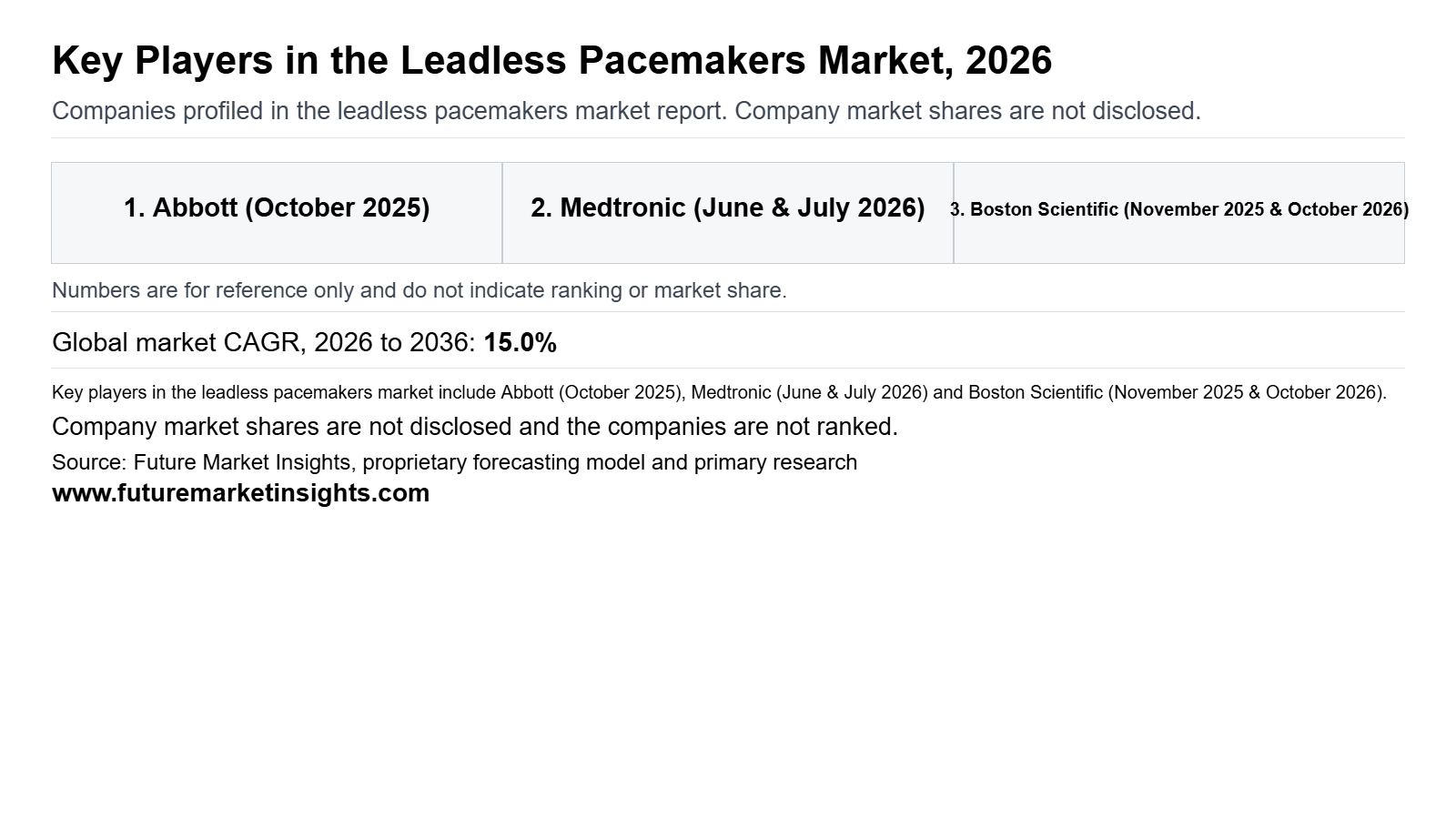
Competition centers on two commercialized platforms, Medtronic and Abbott, with Boston Scientific's investigational modular system and clinical trial entrants such as BIOTRONIK. Hospitals evaluate suppliers on chamber architecture, catheter delivery safety, battery longevity, and local reimbursement qualification rather than brand visibility alone.
How Are Companies Positioned in the Leadless Pacemakers Market?
Medtronic anchors single-chamber ventricular and mechanical atrial-sensing pacing with its Micra VR2 and Micra AV2 family, while Abbott markets both ventricular AVEIR VR and paired dual-chamber AVEIR DR systems. Boston Scientific is pursuing a modular ventricular capsule (EMPOWER) engineered to communicate with its EMBLEM subcutaneous defibrillator, targeting 2027 approval rather than immediate 2026 commercial revenue.
What Matters When a Hospital Selects a Leadless Pacemaker Supplier?
Procurement committees verify regulatory labeling for the intended chamber, operator catheter training, end-of-service retrieval or abandonment planning, and episode reimbursement coverage. Regulatory updates from the United States Food and Drug Administration (June 2026) and payer rules from the Haute Autorité de Santé (April 2026) directly determine which models qualify for funded hospital tenders.
Which Capabilities Distinguish Leadless Pacing Offers?
Product differentiation hinges on atrioventricular synchrony mechanisms, atrial pacing capability, and projected battery longevity. Abbott's AVEIR DR uses two communicating capsules for active dual-chamber pacing, whereas Medtronic's Micra AV2 tracks atrial mechanical motion from a single ventricular implant, offering distinct trade-offs in procedural complexity and device longevity.
How Does Geographic Reach Affect Competition?
Medtronic and Abbott hold commercial clearances across the USA and Europe, with Abbott also expanding dual-chamber commercialization into India in October 2025. By contrast, Boston Scientific's EMPOWER platform remains in multinational clinical trials as of October 2026, leaving near-term global commercial revenue concentrated among cleared platforms.
| Company Name & Date (Month Year) | Verified Development (Launch, Expansion, M&A, Patent, or Certification) | Commercial Impact on Market Growth & Buyer Adoption |
|---|---|---|
| Abbott (October 2025) | Launched AVEIR DR dual-chamber leadless pacemaker in India with wireless implant-to-implant communication (Abbott, October 2025). | Expands dual-chamber leadless access into high-growth Asian tertiary cardiac centers. |
| Medtronic (June & July 2026) | Received FDA PMA supplement approvals P150033S224 and P150033S229 for Micra scalable catheter delivery system and subassemblies (United States Food and Drug Administration, July 2026). | Refines catheter deployment reliability and manufacturing continuity for ventricular implants. |
| Boston Scientific (November 2025 & October 2026) | Published one-year MODULAR ATP trial outcomes (Lloyd et al., November 2025) and guided for expected 2027 EMPOWER approval (Boston Scientific, October 2026). | Builds clinical evidence for future S-ICD modular pacing without contributing 2026 commercial sales. |
Source: Verified corporate disclosures, regulatory records, and Future Market Insights analysis, 2026.
| Company Name | Headquarters & Tier | Core Leadless Pacemakers Portfolio & End-Use Focus |
|---|---|---|
| Medtronic | Ireland / USA; Tier-1 Commercial Leader | Micra VR2 and Micra AV2 ventricular leadless capsules with mechanical atrial sensing (United States Food and Drug Administration, July 2026). |
| Abbott | USA; Tier-1 Commercial Leader | AVEIR VR, AVEIR AR 2, and paired dual-chamber AVEIR DR leadless systems (Abbott, October 2025). |
| Boston Scientific | USA; Tier-1 Clinical Pipeline | Investigational EMPOWER leadless pacemaker paired with EMBLEM S-ICD for modular antitachycardia pacing (Boston Scientific, October 2026). |
Source: Verified corporate disclosures and Future Market Insights analysis, 2026.
Leadless Pacemakers Market Report Scope and Research Methodology
FMI analysts size the global leadless pacemakers market through primary interviews with electrophysiologists, hospital procurement committees, and cardiac device regulatory specialists, combined with secondary desk research across FDA premarket approval databases, national health technology assessments and peer-reviewed clinical trial publications. Baseline 2025 and 2026 valuations reconcile commercial ventricular, atrial, and dual-chamber capsule shipments across all seven tracked countries and regional clusters. Segment shares across Chamber, Indication, Patient Profile, and End User axes are validated against cleared device labeling and hospital procedure coding, while excluding physician implantation fees, standalone retrieval catheters and investigational systems lacking commercial authorization.
| Report Parameter | Specification |
|---|---|
| Base Year (Historical) | 2025 (USD 529.0 million) |
| Estimated Year (Base) | 2026 (USD 608.4 million) |
| Forecast Period | 2026 to 2036 (Projected USD 2,461.3 million; 15.0% CAGR) |
| Historical Data Horizon | 2021 to 2025 |
| 10-Year Incremental Opportunity | USD 1,852.9 million |
| Quantitative Units | USD Million for global and country valuations; CAGR (%) |
| Chamber Segments | Single-Chamber Ventricular, Dual-Chamber, Atrial Single-Chamber, Next-Generation and Other Devices |
| Indication Segments | Atrioventricular Block, Atrial Fibrillation with Slow Ventricular Response, Sinus Node Dysfunction |
| Patient Profile Segments | Elderly Patients, Patients with Limited Vascular Access, Dialysis and Infection-Prone Patients, Young and Active Patients |
| End User Segments | Public Hospitals, Private Hospitals, Cardiac Specialty Centres, Ambulatory Surgical Centres |
| Exclusions | Hospital implantation fees, standalone retrieval tools, transvenous pacemakers, ICDs, and investigational devices |
| Regions Covered | North America, Latin America, Western Europe, Eastern Europe, East Asia, South Asia and Pacific, Middle East and Africa |
| Countries Profiled | USA, Japan, Germany, France, UK, Italy, South Korea |
| Companies Profiled | Medtronic, Abbott, Boston Scientific |
| Research Approach | Primary clinician and procurement interviews combined with regulatory, reimbursement, and corporate filing triangulation |
Source: Future Market Insights analysis of the Leadless Pacemakers Market, 2026.
Research Sources and Bibliography
- Abbott. (2023, July 5). Abbott Receives FDA Approval for World's First Dual Chamber Leadless Pacemaker.
- Abbott. (2024, June 6). Abbott Receives CE Mark for AVEIR DR, the World's First Dual-Chamber Leadless Pacemaker System.
- Abbott. (2025, October 6). Abbott Launches AVEIR DR, The World's First Dual Chamber Leadless Pacemaker in India.
- Abbott Japan. (2024, October 3). AVEIR DR System Receives Japanese Regulatory Approval.
- Boston Scientific. (2024, May 18). MODULAR ATP Study of the mCRM System Meets Primary Safety and Efficacy Endpoints. https://news.bostonscientific.com/2024-05-18-MODULAR-ATP-Study-of-the-mCRM-TM-System-Meets-Primary-Safety-and-Efficacy-Endpoints
- Boston Scientific. (2026, October 28). Q3 2026 Financial and Operational Highlights. https://investors.bostonscientific.com/~/media/Files/B/Boston-Scientific-IR-V3/FOH/q3-2026-foh.pdf
- Centers for Medicare & Medicaid Services. (2017, January 18). National Coverage Determination 20.8.4: Leadless Pacemakers. https://www.cms.gov/medicare-coverage-database/view/ncd.aspx?NCDId=370&NCDver=1
- Centers for Medicare & Medicaid Services. (2026, May 11). Leadless Pacemakers: Coverage with Evidence Development Studies. https://www.cms.gov/medicare/coverage/evidence/leadless-pacemakers
- Haute Autorité de Santé. (2026, April 21). MICRA AV2: Commission Evaluation of the Medical Device. https://www.has-sante.fr/jcms/p_3953804/fr/micra-av2
- Haute Autorité de Santé. (2026, February 6). AVEIR VR: Commission Evaluation of the Medical Device. https://www.has-sante.fr/jcms/p_3756799/fr/aveir-vr
- Health Insurance Review and Assessment Service, South Korea. (2025, November 28). Amendment of Medical Device Reimbursement List, Notice 2025-198. https://www.hira.or.kr/bbsDummy.do?brdBltNo=11821&brdScnBltNo=4&pageIndex=1&pgmid=HIRAA020002000100
- Japanese Circulation Society and Japanese Heart Rhythm Society. (2024). JCS/JHRS 2024 Guideline Focused Update on Management of Cardiac Arrhythmias. https://www.jstage.jst.go.jp/article/circj/advpub/0/advpub_CJ-24-0073/_html/-char/en
- Lloyd et al. (2025, November 13). One-Year Outcomes of the MODULAR ATP Trial: A Novel Leadless Pacemaker in Wireless Communication With a Subcutaneous Implantable Cardioverter Defibrillator. https://pubmed.ncbi.nlm.nih.gov/41231774/
- Medtronic. (2023, May 1). Medtronic receives FDA approval for its next generation Micra leadless pacing systems. https://news.medtronic.com/2023-05-01-Medtronic-receives-FDA-approval-for-its-next-generation-Micra-leadless-pacing-systems
- Medtronic. (2024, January 5). Medtronic receives CE Mark for its next generation Micra leadless pacing systems. https://news.medtronic.com/2024-01-05-Medtronic-receives-CE-Mark-for-its-next-generation-Micra-leadless-pacing-systems
- Medtronic. (2025). Leadless Pacing Portfolio: Device Longevity of a Leadless Pacemaker Family. https://www.medtronic.com/en-us/healthcare-professionals/specialties/electrophysiology/product-portfolios/leadless-pacing-portfolio.html
- National Institute for Health and Care Excellence. (2026, February 25). Leadless cardiac pacemaker implantation for bradyarrhythmias: Recommendations (HTG770). https://www.nice.org.uk/guidance/htg770/chapter/1-Recommendations
- Osoro et al. (2026, February 18). Public procurement of cardiac implantable electronic devices across Europe: are we purchasing value or cost-effectiveness? https://academic.oup.com/europace/article/28/2/euaf323/8489995
- Pharmaceuticals and Medical Devices Agency. (2024, September). Review Reports: Medical Devices - Aveir LP Partial Change Approval. https://www.pmda.go.jp/english/review-services/reviews/approved-information/devices/0003.html
- Rordorf et al. (2025, March 24). Leadless pacemaker implantation in real-world clinical practice: An Italian survey promoted by the AIAC. https://onlinelibrary.wiley.com/doi/full/10.1002/joa3.70045
- United States Food and Drug Administration. (2023, April 20). Micra VR2 and Micra AV2 Transcatheter Pacing Systems: Premarket Approval Supplement P150033S161. https://www.accessdata.fda.gov/SCRIPTS/cdrh/devicesatfda/index.cfm?db=pma&id=516791
- United States Food and Drug Administration. (2025, June 17). AVEIR AR 2 Leadless Pacemaker: Premarket Approval Supplement P150035S023. https://www.accessdata.fda.gov/scripts/cdrh/cfdocs/cfpma/pma.cfm?ID=P150035S023
- United States Food and Drug Administration. (2026, July 31). Micra AV and VR Devices: Premarket Approval Supplement P150033S229. https://www.accessdata.fda.gov/scripts/cdrh/cfdocs/cfpma/pma.cfm?ID=P150033S229
- United States Food and Drug Administration. (2026, June 4). Micra Scalable Catheter Delivery System: Premarket Approval Supplement P150033S224. https://www.accessdata.fda.gov/scripts/cdrh/cfdocs/cfpma/pma.cfm?id=P150033S224
Table of Content
- Key Takeaways
- Market Size and CAGR
- Top Growth Driver
- Fastest Growing Segment
- Leading Region
- Key Companies
- Emerging Opportunities
- Executive Summary
- Global Market Outlook
- Demand-side Trends
- Supply-side Trends
- Technology Roadmap Analysis
- Analysis and Recommendations
- Analyst Perspective (What is happening? Why now? What should investors know?)
- Key Questions Answered
- How large is the market?
- What is the CAGR?
- What are key trends?
- Which region dominates?
- Who are the leaders?
Read More...
- Market Overview
- Market Coverage / Taxonomy
- Market Definition / Scope / Limitations
- Research Methodology
- Chapter Orientation
- Analytical Lens and Working Hypotheses
- Market Structure, Signals, and Trend Drivers
- Benchmarking and Cross-market Comparability
- Market Sizing, Forecasting, and Opportunity Mapping
- Research Design and Evidence Framework
- Desk Research Programme (Secondary Evidence)
- Expert Input and Fieldwork (Primary Evidence)
- Tooling, Models, and Reference Databases
- Data Engineering and Model Build
- Quality Assurance and Audit Trail
- Market Background
- Market Dynamics (Drivers, Restraints, Opportunity, Trends)
- Scenario Forecast (Optimistic, Likely, Conservative)
- Impact Analysis
- AI Impact
- Sustainability Impact
- Regulatory Impact
- Technology Impact
- Consumer / Buyer Analysis
- Purchase Drivers
- Adoption Barriers
- Buyer Journey
- Opportunity Map Analysis
- Product Life Cycle Analysis
- Supply Chain Analysis
- Investment Feasibility Matrix
- Value Chain Analysis
- PESTLE and Porter's Analysis
- Regulatory Landscape
- Regional Parent Market Outlook
- Production and Consumption Statistics
- Import and Export Statistics
- Global Market Analysis and Forecast, 2021 to 2036
- Historical Market Size Value (USD Million) Analysis, 2021 to 2025
- Current and Future Market Size Value (USD Million) Projections, 2026 to 2036
- Y-o-Y Growth Trend Analysis
- Absolute $ Opportunity Analysis
- Global Market Pricing Analysis, 2021 to 2036
- Global Market Analysis and Forecast, By Chamber, 2021 to 2036
- Introduction / Key Findings
- Historical Market Size Value (USD Million) Analysis By Chamber, 2021 to 2025
- Current and Future Market Size Value (USD Million) Analysis and Forecast By Chamber, 2026 to 2036
- Single-Chamber Ventricular
- Y-o-Y Growth Trend Analysis By Chamber, 2021 to 2025
- Absolute $ Opportunity Analysis By Chamber, 2026 to 2036
- Global Market Analysis and Forecast, By Indication, 2021 to 2036
- Introduction / Key Findings
- Historical Market Size Value (USD Million) Analysis By Indication, 2021 to 2025
- Current and Future Market Size Value (USD Million) Analysis and Forecast By Indication, 2026 to 2036
- Atrioventricular Block
- Y-o-Y Growth Trend Analysis By Indication, 2021 to 2025
- Absolute $ Opportunity Analysis By Indication, 2026 to 2036
- Global Market Analysis and Forecast, By Patient Profile, 2021 to 2036
- Introduction / Key Findings
- Historical Market Size Value (USD Million) Analysis By Patient Profile, 2021 to 2025
- Current and Future Market Size Value (USD Million) Analysis and Forecast By Patient Profile, 2026 to 2036
- Elderly Patients
- Y-o-Y Growth Trend Analysis By Patient Profile, 2021 to 2025
- Absolute $ Opportunity Analysis By Patient Profile, 2026 to 2036
- Global Market Analysis and Forecast, By End User, 2021 to 2036
- Introduction / Key Findings
- Historical Market Size Value (USD Million) Analysis By End User, 2021 to 2025
- Current and Future Market Size Value (USD Million) Analysis and Forecast By End User, 2026 to 2036
- Public Hospitals
- Y-o-Y Growth Trend Analysis By End User, 2021 to 2025
- Absolute $ Opportunity Analysis By End User, 2026 to 2036
- Global Market Analysis and Forecast, By Region, 2021 to 2036
- Introduction
- Historical Market Size Value (USD Million) Analysis By Region, 2021 to 2025
- Current Market Size Value (USD Million) Analysis and Forecast By Region, 2026 to 2036
- North America
- Western Europe
- East Asia
- South Asia and Pacific
- Market Attractiveness Analysis By Region
- North America Market Analysis and Forecast, By Country, 2021 to 2036
- Historical Market Size Value (USD Million) Trend Analysis By Market Taxonomy, 2021 to 2025
- Market Size Value (USD Million) Forecast By Market Taxonomy, 2026 to 2036
- By Country
- United States
- Canada
- By Chamber
- By Indication
- By Patient Profile
- By End User
- By Country
- Market Attractiveness Analysis
- By Country
- By Chamber
- By Indication
- By Patient Profile
- By End User
- Key Takeaways
- Western Europe Market Analysis and Forecast, By Country
- Historical Market Size Value (USD Million) Trend Analysis By Market Taxonomy, 2021 to 2025
- Market Size Value (USD Million) Forecast By Market Taxonomy, 2026 to 2036
- By Country
- United Kingdom
- Germany
- France
- By Chamber
- By Indication
- By Patient Profile
- By End User
- By Country
- Market Attractiveness Analysis
- By Country
- By Chamber
- By Indication
- By Patient Profile
- By End User
- Key Takeaways
- East Asia Market Analysis and Forecast, By Country
- Historical Market Size Value (USD Million) Trend Analysis By Market Taxonomy, 2021 to 2025
- Market Size Value (USD Million) Forecast By Market Taxonomy, 2026 to 2036
- By Country
- China
- Japan
- South Korea
- By Chamber
- By Indication
- By Patient Profile
- By End User
- By Country
- Market Attractiveness Analysis
- By Country
- By Chamber
- By Indication
- By Patient Profile
- By End User
- Key Takeaways
- South Asia and Pacific Market Analysis and Forecast, By Country
- Historical Market Size Value (USD Million) Trend Analysis By Market Taxonomy, 2021 to 2025
- Market Size Value (USD Million) Forecast By Market Taxonomy, 2026 to 2036
- By Country
- India
- Australia
- Rest of world aggregate
- By Chamber
- By Indication
- By Patient Profile
- By End User
- By Country
- Market Attractiveness Analysis
- By Country
- By Chamber
- By Indication
- By Patient Profile
- By End User
- Key Takeaways
- Key Countries Market Analysis
- United States
- Pricing Analysis
- Market Share Analysis, 2025
- By Chamber
- By Indication
- By Patient Profile
- By End User
- Canada
- Pricing Analysis
- Market Share Analysis, 2025
- By Chamber
- By Indication
- By Patient Profile
- By End User
- Germany
- Pricing Analysis
- Market Share Analysis, 2025
- By Chamber
- By Indication
- By Patient Profile
- By End User
- United Kingdom
- Pricing Analysis
- Market Share Analysis, 2025
- By Chamber
- By Indication
- By Patient Profile
- By End User
- France
- Pricing Analysis
- Market Share Analysis, 2025
- By Chamber
- By Indication
- By Patient Profile
- By End User
- India
- Pricing Analysis
- Market Share Analysis, 2025
- By Chamber
- By Indication
- By Patient Profile
- By End User
- China
- Pricing Analysis
- Market Share Analysis, 2025
- By Chamber
- By Indication
- By Patient Profile
- By End User
- Japan
- Pricing Analysis
- Market Share Analysis, 2025
- By Chamber
- By Indication
- By Patient Profile
- By End User
- South Korea
- Pricing Analysis
- Market Share Analysis, 2025
- By Chamber
- By Indication
- By Patient Profile
- By End User
- Australia
- Pricing Analysis
- Market Share Analysis, 2025
- By Chamber
- By Indication
- By Patient Profile
- By End User
- United States
- Market Structure Analysis
- Competition Dashboard
- Competition Benchmarking
- Market Share Analysis of Top Players
- By Regional
- By Chamber
- By Indication
- By Patient Profile
- By End User
- Emerging Startups
- Innovation Benchmarking
- Competition Analysis
- Competition Deep Dive
- Medtronic
- Overview
- Product Portfolio
- Profitability by Market Segments
- Sales Footprint
- Strategy Overview
- Marketing Strategy
- Product Strategy
- Channel Strategy
- Abbott
- Boston Scientific
- Medtronic
- Case Studies
- Success Stories
- Recent Developments
- Competition Deep Dive
- Assumptions & Acronyms Used
List of Tables
- Table 1: Global Market Value (USD Million) Forecast by Region, 2021 to 2036
- Table 2: Global Market Value (USD Million) Forecast by Chamber, 2021 to 2036
- Table 3: Global Market Value (USD Million) Forecast by Indication, 2021 to 2036
- Table 4: Global Market Value (USD Million) Forecast by Patient Profile, 2021 to 2036
- Table 5: Global Market Value (USD Million) Forecast by End User, 2021 to 2036
- Table 6: North America Market Value (USD Million) Forecast by Country, 2021 to 2036
- Table 7: North America Market Value (USD Million) Forecast by Chamber, 2021 to 2036
- Table 8: North America Market Value (USD Million) Forecast by Indication, 2021 to 2036
- Table 9: North America Market Value (USD Million) Forecast by Patient Profile, 2021 to 2036
- Table 10: North America Market Value (USD Million) Forecast by End User, 2021 to 2036
- Table 11: Western Europe Market Value (USD Million) Forecast by Country, 2021 to 2036
- Table 12: Western Europe Market Value (USD Million) Forecast by Chamber, 2021 to 2036
- Table 13: Western Europe Market Value (USD Million) Forecast by Indication, 2021 to 2036
- Table 14: Western Europe Market Value (USD Million) Forecast by Patient Profile, 2021 to 2036
- Table 15: Western Europe Market Value (USD Million) Forecast by End User, 2021 to 2036
- Table 16: East Asia Market Value (USD Million) Forecast by Country, 2021 to 2036
- Table 17: East Asia Market Value (USD Million) Forecast by Chamber, 2021 to 2036
- Table 18: East Asia Market Value (USD Million) Forecast by Indication, 2021 to 2036
- Table 19: East Asia Market Value (USD Million) Forecast by Patient Profile, 2021 to 2036
- Table 20: East Asia Market Value (USD Million) Forecast by End User, 2021 to 2036
- Table 21: South Asia and Pacific Market Value (USD Million) Forecast by Country, 2021 to 2036
- Table 22: South Asia and Pacific Market Value (USD Million) Forecast by Chamber, 2021 to 2036
- Table 23: South Asia and Pacific Market Value (USD Million) Forecast by Indication, 2021 to 2036
- Table 24: South Asia and Pacific Market Value (USD Million) Forecast by Patient Profile, 2021 to 2036
- Table 25: South Asia and Pacific Market Value (USD Million) Forecast by End User, 2021 to 2036
List of Figures
- Figure 1: Global Market Pricing Analysis
- Figure 2: Global Market Value (USD Million) Forecast 2021-2036
- Figure 3: Global Market Value Share and BPS Analysis by Chamber, 2026 and 2036
- Figure 4: Global Market Y-o-Y Growth Comparison by Chamber, 2026-2036
- Figure 5: Global Market Attractiveness Analysis by Chamber
- Figure 6: Global Market Value Share and BPS Analysis by Indication, 2026 and 2036
- Figure 7: Global Market Y-o-Y Growth Comparison by Indication, 2026-2036
- Figure 8: Global Market Attractiveness Analysis by Indication
- Figure 9: Global Market Value Share and BPS Analysis by Patient Profile, 2026 and 2036
- Figure 10: Global Market Y-o-Y Growth Comparison by Patient Profile, 2026-2036
- Figure 11: Global Market Attractiveness Analysis by Patient Profile
- Figure 12: Global Market Value Share and BPS Analysis by End User, 2026 and 2036
- Figure 13: Global Market Y-o-Y Growth Comparison by End User, 2026-2036
- Figure 14: Global Market Attractiveness Analysis by End User
- Figure 15: Global Market Value (USD Million) Share and BPS Analysis by Region, 2026 and 2036
- Figure 16: Global Market Y-o-Y Growth Comparison by Region, 2026-2036
- Figure 17: Global Market Attractiveness Analysis by Region
- Figure 18: North America Market Incremental Dollar Opportunity, 2026-2036
- Figure 19: Western Europe Market Incremental Dollar Opportunity, 2026-2036
- Figure 20: East Asia Market Incremental Dollar Opportunity, 2026-2036
- Figure 21: South Asia and Pacific Market Incremental Dollar Opportunity, 2026-2036
- Figure 22: North America Market Value Share and BPS Analysis by Country, 2026 and 2036
- Figure 23: North America Market Value Share and BPS Analysis by Chamber, 2026 and 2036
- Figure 24: North America Market Y-o-Y Growth Comparison by Chamber, 2026-2036
- Figure 25: North America Market Attractiveness Analysis by Chamber
- Figure 26: North America Market Value Share and BPS Analysis by Indication, 2026 and 2036
- Figure 27: North America Market Y-o-Y Growth Comparison by Indication, 2026-2036
- Figure 28: North America Market Attractiveness Analysis by Indication
- Figure 29: North America Market Value Share and BPS Analysis by Patient Profile, 2026 and 2036
- Figure 30: North America Market Y-o-Y Growth Comparison by Patient Profile, 2026-2036
- Figure 31: North America Market Attractiveness Analysis by Patient Profile
- Figure 32: North America Market Value Share and BPS Analysis by End User, 2026 and 2036
- Figure 33: North America Market Y-o-Y Growth Comparison by End User, 2026-2036
- Figure 34: North America Market Attractiveness Analysis by End User
- Figure 35: Western Europe Market Value Share and BPS Analysis by Country, 2026 and 2036
- Figure 36: Western Europe Market Value Share and BPS Analysis by Chamber, 2026 and 2036
- Figure 37: Western Europe Market Y-o-Y Growth Comparison by Chamber, 2026-2036
- Figure 38: Western Europe Market Attractiveness Analysis by Chamber
- Figure 39: Western Europe Market Value Share and BPS Analysis by Indication, 2026 and 2036
- Figure 40: Western Europe Market Y-o-Y Growth Comparison by Indication, 2026-2036
- Figure 41: Western Europe Market Attractiveness Analysis by Indication
- Figure 42: Western Europe Market Value Share and BPS Analysis by Patient Profile, 2026 and 2036
- Figure 43: Western Europe Market Y-o-Y Growth Comparison by Patient Profile, 2026-2036
- Figure 44: Western Europe Market Attractiveness Analysis by Patient Profile
- Figure 45: Western Europe Market Value Share and BPS Analysis by End User, 2026 and 2036
- Figure 46: Western Europe Market Y-o-Y Growth Comparison by End User, 2026-2036
- Figure 47: Western Europe Market Attractiveness Analysis by End User
- Figure 48: East Asia Market Value Share and BPS Analysis by Country, 2026 and 2036
- Figure 49: East Asia Market Value Share and BPS Analysis by Chamber, 2026 and 2036
- Figure 50: East Asia Market Y-o-Y Growth Comparison by Chamber, 2026-2036
- Figure 51: East Asia Market Attractiveness Analysis by Chamber
- Figure 52: East Asia Market Value Share and BPS Analysis by Indication, 2026 and 2036
- Figure 53: East Asia Market Y-o-Y Growth Comparison by Indication, 2026-2036
- Figure 54: East Asia Market Attractiveness Analysis by Indication
- Figure 55: East Asia Market Value Share and BPS Analysis by Patient Profile, 2026 and 2036
- Figure 56: East Asia Market Y-o-Y Growth Comparison by Patient Profile, 2026-2036
- Figure 57: East Asia Market Attractiveness Analysis by Patient Profile
- Figure 58: East Asia Market Value Share and BPS Analysis by End User, 2026 and 2036
- Figure 59: East Asia Market Y-o-Y Growth Comparison by End User, 2026-2036
- Figure 60: East Asia Market Attractiveness Analysis by End User
- Figure 61: South Asia and Pacific Market Value Share and BPS Analysis by Country, 2026 and 2036
- Figure 62: South Asia and Pacific Market Value Share and BPS Analysis by Chamber, 2026 and 2036
- Figure 63: South Asia and Pacific Market Y-o-Y Growth Comparison by Chamber, 2026-2036
- Figure 64: South Asia and Pacific Market Attractiveness Analysis by Chamber
- Figure 65: South Asia and Pacific Market Value Share and BPS Analysis by Indication, 2026 and 2036
- Figure 66: South Asia and Pacific Market Y-o-Y Growth Comparison by Indication, 2026-2036
- Figure 67: South Asia and Pacific Market Attractiveness Analysis by Indication
- Figure 68: South Asia and Pacific Market Value Share and BPS Analysis by Patient Profile, 2026 and 2036
- Figure 69: South Asia and Pacific Market Y-o-Y Growth Comparison by Patient Profile, 2026-2036
- Figure 70: South Asia and Pacific Market Attractiveness Analysis by Patient Profile
- Figure 71: South Asia and Pacific Market Value Share and BPS Analysis by End User, 2026 and 2036
- Figure 72: South Asia and Pacific Market Y-o-Y Growth Comparison by End User, 2026-2036
- Figure 73: South Asia and Pacific Market Attractiveness Analysis by End User
- Figure 74: Global Market - Tier Structure Analysis
- Figure 75: Global Market - Company Share Analysis
Frequently Asked Questions
What is the projected market size and CAGR through 2036?
Global leadless pacemaker sales are forecast to reach USD 2,461.3 million by 2036, expanding at a 15.0% CAGR and adding USD 1,852.9 million.
Which Chamber segment leads the leadless pacemakers market in 2026?
Single-Chamber Ventricular devices lead the Chamber axis with a 70.0% revenue share in 2026 due to established catheter workflows and reimbursement coding.
Which Indication segment accounts for the largest share?
Atrioventricular Block captures 41.3% of Indication revenue in 2026 because disrupted AV conduction creates immediate demand for reliable ventricular pacing.
Which Patient Profile segment holds the leading share in 2026?
Elderly Patients represent 45.0% of Patient Profile revenue in 2026 as clinicians prioritize avoiding pocket erosion and lead complications in older adults.
How much share do Public Hospitals hold in End User demand?
Public Hospitals account for 42.0% of End User revenue in 2026 because tertiary centers concentrate electrophysiology labs and national payer approvals.
Which countries are projected to grow fastest from 2026 to 2036?
Japan leads national growth at a 15.5% CAGR, followed by South Korea at 14.6% CAGR and the USA at 14.5% CAGR over the forecast decade.
Which companies are profiled in the leadless pacemakers market?
Profiled companies include commercial suppliers Medtronic and Abbott with Boston Scientific for its investigational EMPOWER modular pacing system.
Preview the report firsthand - request a free sample
Get SampleGet the brochure for pricing and purchase details.
Get PDF
