

- Market Size (2026)
- USD 2.7 Bn
- Forecast (2036)
- USD 7.1 Bn
- CAGR (2026 to 2036)
- 10.2%
How big is LGC VLGC LPG Shipyard Carrier Market in 2026?
USD 2.7 billion in 2026 and USD 7.1 billion by 2036 at a 10.2% CAGR.
Demand for LGC/VLGC shipyard carrier is projected to expand at 10.2% CAGR between 2026 and 2036, increasing valuation from USD 2.7 billion in 2026 to USD 7.1 billion by 2036. Ongoing innovation in gas-carrier vessel design is increasing demand for shipyard capabilities that support fuel flexibility, efficiency improvements, and long-term regulatory compliance. In September 2025 Lloyd’s Register granted approval in principle to an HD Hyundai Heavy Industries VLGC design with forward accommodation and wind-assisted propulsion. The design reserved space for future ammonia or hydrogen systems and showed how flexible machinery planning affects long-lived vessel value. Specifications for marine propulsion engines shape fuel use and machinery-space allocation across the financed operating life. Digital shipyards support production control through coordinated design records and milestone visibility across complex gas-carrier programs.
Norwegian owners use experienced maritime finance networks to assess lifecycle economics across internationally operated gas-carrier fleets. South Korean yards provide concentrated specialist capacity alongside Japanese builders that add detailed engineering and long service relationships for international owners. In October 2025 the International Maritime Organization adjourned net-zero framework talks and scheduled the discussions to resume during 2026. The unresolved timetable strengthens interest in LPG carriers that preserve practical space and safety provisions for later fuel-system changes. Established LNG bunkering networks provide a useful comparison for alternative-fuel infrastructure readiness across major ports and trading corridors. Low-carbon ammonia propulsion therefore requires coordinated decisions across cargo contracts and machinery specifications ahead of widespread commercial fuel access.
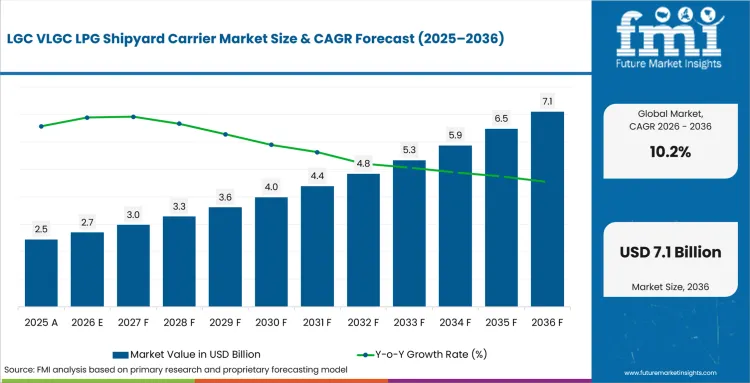
Key Takeaways of LGC/VLGC LPG Shipyard Carrier Market
- Funded cargo programs convert into shipyard revenue through long construction schedules and clearly assigned vessel acceptance responsibilities.
- Very large gas carriers are expected to represent 46.0% share in 2026 due to stronger unit economics across recurring long-haul LPG routes.
- Liquefied petroleum gas transportation is projected to capture 58.0% share by application in 2026, owing to repeat propane and butane cargo programs.
- Oil and gas companies are estimated to account for 44.0% share in 2026 due to coordinated cargo allocation and charter planning.
- Direct shipyard contracts lead the distribution channel category at 52.0% share in 2026, reflecting the integration required across hull, propulsion, and cargo-containment systems.
- Fully refrigerated designs account for 48.0% share in 2026 within refrigeration and pressurization, supporting high-volume transport across long international routes.
- Concentrated construction capacity and long equipment lead times can postpone vessel awards despite a commercially credible underlying cargo requirement.
- Competition includes HD Hyundai Heavy Industries, HD Hyundai Samho, Hanwha Ocean, and Kawasaki Heavy Industries, with Mitsubishi Shipbuilding and Namura Shipbuilding competing alongside Samsung Heavy Industries and Jiangnan Shipyard through specialized engineering and regional yard coverage.
Analyst Perspective
“VLGC economics depend on cargo density and terminal compatibility as much as nominal carrying capacity. A shipyard protects project value by integrating reliquefaction performance with fuel-system choices and an achievable equipment schedule. Owners should reserve construction capacity with charter coverage and acceptance responsibilities clear enough to survive a weak freight cycle.”
- Nikhil Kaitwade, Principal Analyst, Future Market Insights
How is the LGC VLGC LPG Shipyard Carrier segmented?
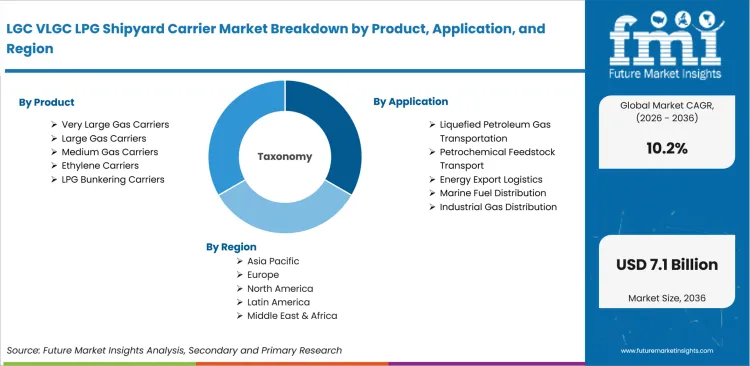
The LGC VLGC LPG Shipyard Carrier industry is segmented by product, application, end user, distribution channel, refrigeration and pressurization, and region.
Based on product market is separated by cargo capacity, pressure system, refrigeration design, and intended route length. Application identifies the commodity program that creates voyage revenue, including LPG trade, petrochemical feedstock movement, and marine fuel distribution. End user distinguishes energy groups, fleet operators, lessors, and public entities with different capital approval routes. Distribution channel records whether a shipowner contracts directly with a yard or uses an engineering intermediary. Refrigeration and pressurization separates cargo-control architectures according to cargo temperature, voyage duration, and maintenance burden. Regional analysis compares construction access, finance, classification support, and service coverage across major maritime centers.
What keeps very large gas carriers ahead within product?
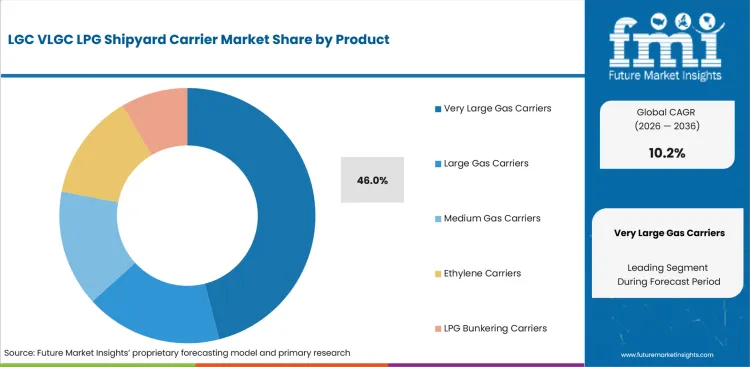
Long-haul propane and butane routes reward carriers that distribute fuel and crew costs across larger cargo parcels. In June 2025 Kawasaki Heavy Industries delivered the 86,700-cubic-meter CRYSTAL ODYSSEY with LPG fuel and ammonia-loading capability. The vessel retained access to major LPG terminals and added cargo flexibility for future ammonia movements. Marine bearings support propulsion reliability across long-haul service and deserve lifecycle review beside engine selection. That operating combination explains why large carriers remain attractive across routes with dependable parcel volumes and compatible berth infrastructure.
- Very large gas carriers are projected to hold 46.0% share in 2026 owing to stronger unit economics across recurring long-distance routes. Cargo programs must fill those larger parcels often enough to protect utilization across long ballast legs and seasonal demand shifts. Route density and terminal acceptance therefore determine whether nominal capacity becomes a durable financial advantage across the planned charter.
- Energy traders adopt VLGCs through repeat export-to-import programs that support regular loading across several LPG grades. Reliable fuel performance and flexible cargo handling improve voyage planning across terminals with different operating limits. The economic case weakens if berth restrictions or incomplete charter coverage leave the vessel idle between cargo cycles.
Which buying mechanism supports liquefied petroleum gas transportation in the application category?
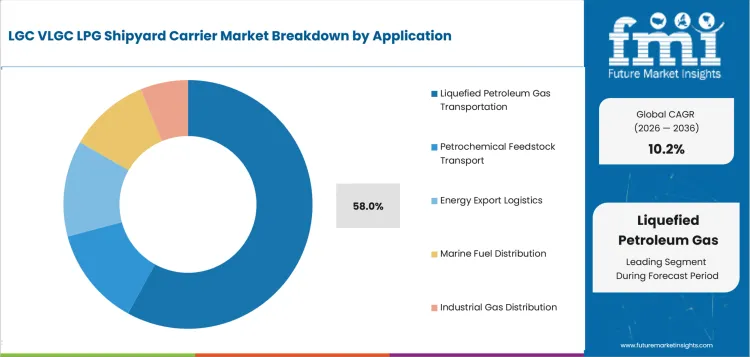
International LPG trade depends on recurring export programs that fill large refrigerated parcels across long routes. Propane and butane cargoes often share terminal infrastructure but follow different seasonal demand patterns and destination mixes. A new carrier becomes financeable only if expected liftings can support utilization through weak spot periods. Shipowners therefore compare shipment frequency with ballast exposure and terminal access before selecting vessel capacity.
- By application, liquefied petroleum gas transportation is estimated to hold 58.0% in 2026 owing to recurring seaborne cargo movements across established energy routes. The USA Energy Information Administration reported in March 2026 that domestic propane exports averaged a record 1.8 million barrels daily during 2025 with China and Japan among the five largest destinations.
- Integrated energy groups evaluate freight exposure beside usable cargo capacity across each planned trading pattern. Energy traders favor vessels that preserve capacity across LPG grades and several terminal conditions on major routes. Compatible marine loading arms reduce terminal-interface risk but recurring cargo commitments remain the necessary basis for a newbuild decision.
What supports oil and gas companies within the end-user category?
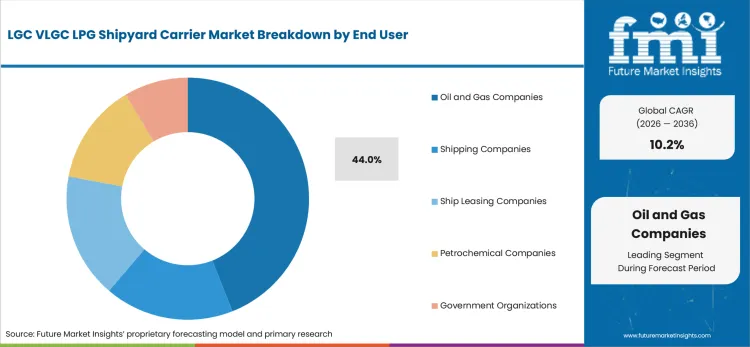
Integrated energy groups control production volumes and trading commitments across several regional routes and long-term charter programs. Their vessel decisions connect export availability with charter coverage and fleet balance across business units. Internal cargo access can reduce early utilization risk but does not protect a project from weak freight rates or poor terminal fit. Investment committees therefore test whether a proposed carrier serves several cargo programs without creating excessive ballast exposure.
- Oil and gas companies are likely to capture 44.0% share in 2026 attributable to their control over cargo origination and trading schedules. Central control over production and trading schedules reduces uncertainty during charter planning and vessel financing. Newbuild approval weakens if the operating unit lacks authority over cargo allocation or charter duration across the proposed route network.
- Energy groups select yards that document fuel performance and cargo-system reliability across comparable service profiles. In January 2025 Trafigura and CF Industries completed a co-loaded ammonia and propane voyage from the United States to Europe under Coast Guard review. The trial connected cargo planning with vessel flexibility without interrupting commercial propane transport across established trading routes.
Why do direct shipyard contracts lead the distribution channel category?
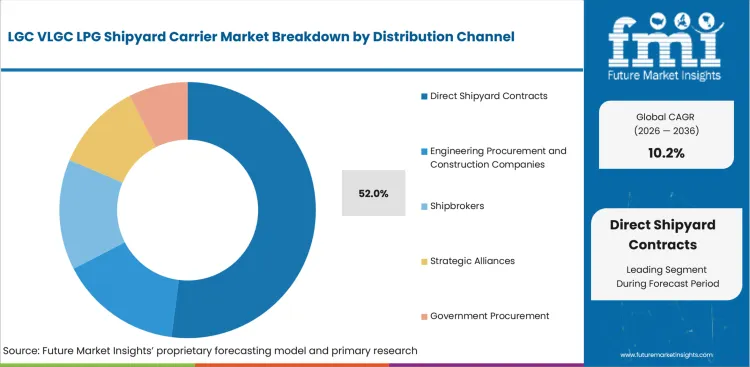
Large gas carriers require coordinated decisions across hull form and propulsion architecture with cargo containment and safety systems. In June 2026 Dorian LPG contracted HD Hyundai to build one 90,000-cubic-meter VLGC for delivery during July 2029. The agreement established a direct owner-to-yard route for an exact-market vessel and assigned delivery responsibility to the builder. Direct contracting therefore places class review and cargo-system decisions inside one accountable construction program throughout vessel delivery.
- Direct shipyard contracts are set to lead the distribution channel category with 52.0% share in 2026 due to the integration required across vessel and cargo systems. Owners protect construction schedules through one primary counterparty that carries clearly assigned technical obligations across integrated vessel systems. Direct contracting does not remove equipment risk but creates an accountable route for design changes and warranty closure.
- Shipowners use direct contracts to reserve production slots and control specification decisions through class review and sea trials. Experienced technical teams resolve comments quickly during design review and prevent repeated redesign across connected vessel systems. Smaller operators often use intermediaries due to limited internal engineering capacity for continuous review throughout a multi-year construction program.
How do fully refrigerated designs shape demand in the refrigeration and pressurization category?
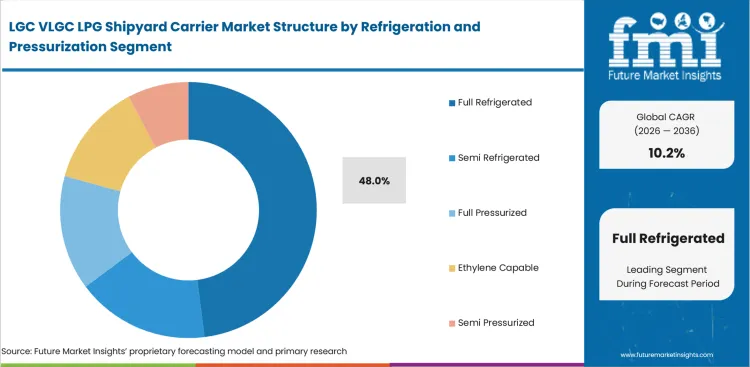
Large ocean-going LPG carriers use refrigerated cargo systems to preserve transport economics across high-volume routes. Compressors and heat exchangers manage vapor pressure during long voyages while control systems protect cargo quality and terminal acceptance. Marine battery systems can support auxiliary electrical loads but cannot replace reliable compressors during extended cargo voyages. The design choice therefore links voyage length and parcel size with maintenance coverage and energy consumption.
- Based on refrigeration and pressurization, fully refrigerated designs are projected to account for 48.0% in 2026 due to high-volume transport across long international routes. Active temperature control supports larger parcels and maintains manageable cargo pressure across extended voyages and changing ambient conditions. Reliable compressors and controls protect commercial value through lower downtime and stronger charter performance across long routes.
- Owners adopt fully refrigerated designs on routes that justify greater system complexity and higher service requirements. HD Korea Shipbuilding and Offshore Engineering reported in October 2025 that its commercial LPG cargo-handling system improved reliquefaction efficiency by 18% across 48 contracted shipsets. Marine coatings and trained maintenance teams protect cargo-area steel and preserve system reliability under harsh operating conditions.
What are the drivers, restraints, and opportunities in the LGC VLGC LPG Shipyard Carrier?
Recurring LPG cargo programs support vessel renewal while concentrated construction capacity and uncertain fuel pathways complicate investment timing.
- Driver: Rising propane and butane exports create repeat cargo programs that support larger carriers and longer charter commitments.
- Restraint: Concentrated specialist yard capacity increases delivery exposure across projects requiring integrated gas-carrier engineering and long equipment lead times.
- Opportunity: Ammonia-ready cargo and propulsion arrangements preserve vessel utility across evolving fuel standards and commodity routes.
Recurring LPG exports is driving the demand due to repeat cargo programs that support financed carrier construction. The Canada Energy Regulator reported in June 2025 that Canadian propane exports averaged 218.3 thousand barrels daily during 2024 and marine shipments represented 40.8%. The marine share establishes a direct route from export capacity to seaborne carrier demand across Asian destinations. Owners must confirm loading frequency and terminal compatibility before a cargo program supports another financed vessel.
Large vessel series reserve yard capacity years ahead of delivery and create a material restraint through construction schedules. BW LPG reported in May 2026 that eight 90,000-cubic-meter VLGCs from Hyundai Heavy Industries would arrive between early 2029 and the second quarter of 2030. A multi-vessel series can occupy design resources and production slots across several consecutive construction years. Later projects must accept delivery windows or evaluate a narrower group of qualified gas-carrier yards. Equipment responsibilities protect hull slots from misalignment with cargo-system schedules throughout the full construction program.
Ammonia-ready architecture creates a credible opportunity to preserve vessel utility across changing cargo and fuel pathways. In April 2025 the International Maritime Organization approved a draft fuel standard and emissions-pricing framework for large ocean-going ships. Formal adoption remained unresolved at the publication cutoff but the direction supports optionality in new vessel specifications. Builders can reserve machinery space and safety provisions that support technically feasible upgrades during planned maintenance. Uneven green ammonia availability across major ports favors upgradeable designs over assumptions about immediate commercial fuel access.
Which country CAGRs are profiled in the LGC VLGC LPG Shipyard Carrier?
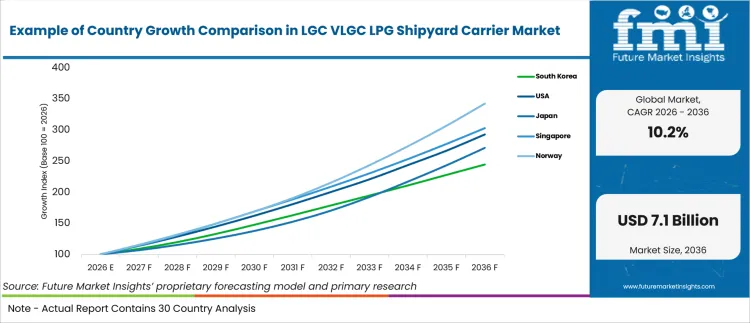
| Country | CAGR |
|---|---|
| Norway | 13.1% |
| Germany | 12.8% |
| Singapore | 11.7% |
| USA | 11.3% |
| Japan | 10.5% |
| South Korea | 9.4% |
| UK | 7.3% |
How do country-level CAGRs compare in the LGC VLGC LPG Shipyard Carrier?
The country spread equals 5.8 percentage points between Norway and the United Kingdom. Norway and Germany form a close pair through fleet ownership depth and engineering-led vessel evaluation. Singapore and the United States occupy the central range through trading-hub services and export cargo scale. Japan and South Korea combine specialist shipbuilding capability with different capacity and workforce pressures across domestic yards. The United Kingdom remains commercially relevant through finance and regulatory services despite a wider gap from the central group. Entry priorities should reflect contracting access and technical support rather than displayed rates alone during market entry.
- Norway combines experienced gas-carrier ownership with maritime finance that supports lifecycle evaluation across internationally operated fleets.
- Germany contributes engineering scrutiny and fleet-management depth but owners generally depend on overseas yards for large carrier construction.
- Singapore connects regional energy trading with ship finance and classification support across cross-border charter and ownership structures.
- The United States supplies recurring Gulf Coast propane volumes that support long-haul carrier utilization across several importing regions.
- Japan combines detailed gas-carrier engineering with a national effort to restore construction capacity and specialist maritime employment.
- South Korea provides concentrated gas-carrier production and equipment clusters but full orderbooks intensify slot and component competition.
- The United Kingdom influences projects through maritime finance and regulatory expertise despite limited domestic large-carrier construction.
Similar forecasts produce different entry conditions as local financing and yard access shape project execution. Resource commitments should follow verified technical partnerships and realistic construction schedules that reflect equipment availability and service access. The full report provides country-level CAGR analysis across North America, Latin America, Europe, East Asia, South Asia, Oceania and the Middle East and Africa.
Country-wise Analysis
- Norway combines experienced gas-carrier owners with maritime banks and technical managers that evaluate vessel economics across complete operating lives. The Norwegian LGC and VLGC shipyard carrier sector is projected to record 13.1% CAGR during the assessment period, underpinned by fleet renewal and fuel-flexible vessel planning across internationally managed fleets. Statistics Norway reported in January 2026 that the national merchant fleet contained 1,498 vessels during 2025. The operating base gives local owners direct access to charter analysis and vessel-management expertise across several ownership structures. Specialized finance and classification support provide a direct enabler for complex gas-carrier programs serving international routes. High project costs remain the main friction as owners protect returns across volatile freight cycles and lengthy construction schedules.
- German project reviews emphasize engineering documentation and European compliance across vessel equipment and terminal interfaces. In Germany, LGC and VLGC shipyard carrier demand is predicted to advance at 12.8% CAGR through 2036, enabled by engineering depth and fleet renewal among German owners. The Federal Ministry of Transport reported in August 2025 that German owners controlled 1,675 merchant ships above 100 gross tonnes at the end of 2024. That ownership base creates recurring demand for specification work and lifecycle review across vessels contracted from overseas yards. Engineering firms and classification organizations provide a direct enabler for propulsion and cargo-system integration across internationally contracted projects. Limited domestic large-carrier construction remains the main friction as owners coordinate German requirements with East Asian production schedules.
- Singapore links regional energy trading with ship finance and technical management across internationally operated gas-carrier fleets. LGC and VLGC shipyard carrier demand in Singapore is forecast to rise at 11.7% CAGR over the forecast period, linked to its concentration of international shipping groups and cross-border project services. The Maritime and Port Authority reported in January 2025 that Singapore hosted close to 200 international shipping groups. That concentration helps owners coordinate finance and classification support across several jurisdictions during one contracting process. Established technical services provide a direct enabler for future-fuel planning and complex owner reviews across regional vessel programs. Dense port geography remains a material friction as safety requirements constrain fuel storage and terminal expansion near active commercial areas.
- United States demand centers on Gulf Coast export terminals that load large propane volumes for overseas destinations. The USA's LGC and VLGC shipyard carrier outlook is anticipated to advance at 11.3% CAGR over the assessment period, influenced by record export flows and recurring long-haul cargo programs. The USA Energy Information Administration reported in June 2026 that propane exports reached 2.093 million barrels daily during April. Gulf Coast terminals accounted for 1.848 million barrels daily and provide concentrated loading demand for large carriers. High cargo throughput provides a direct enabler for repeat voyage programs across several importing regions. Freight exposure remains the main friction if vessel deliveries exceed cargo growth across weaker charter periods.
- Japan maintains deep ship-design expertise but faces pressure to restore construction scale and specialist maritime employment. The LGC and VLGC shipyard carrier market in Japan is estimated to post 10.5% CAGR over the forecast period, supported by capacity renewal and detailed engineering across specialist domestic yards. The Ministry of Land Infrastructure Transport and Tourism reported in December 2025 that Japan targeted annual shipbuilding capacity of 18 million gross tonnes by 2035 from about 9 million. Domestic yards provide a direct enabler through detailed design review and established equipment relationships across specialized maritime clusters. Workforce availability and yard modernization remain material frictions that directly affect delivery speed across demanding carrier programs. Project selection should favor programs with secured engineering resources and realistic construction sequencing across the complete newbuild schedule.
- South Korea combines dense shipbuilding clusters with engine and cargo-system manufacturers that support complex gas-carrier programs. LGC and VLGC shipyard carrier sales in South Korea are forecast to expand at 9.4% CAGR by 2036, reinforced by integrated production and fuel-flexible engineering. The Ministry of Trade, Industry and Energy reported in February 2025 that 17 research projects covered ammonia propulsion components and a dedicated fuel-supply vessel. Clustered expertise enables coordinated execution, but full orderbooks intensify slot competition and component lead times across reserved construction schedules.
- United Kingdom gas-carrier projects rely on maritime finance and classification expertise rather than domestic construction at scale. Adoption of fuel-flexible gas-carrier newbuilds in the UK is estimated to expand at 7.3% CAGR through 2036, shaped by finance and a defined ammonia-fuel approval route. The Maritime and Coastguard Agency published its ammonia process in April 2025 for vessels above 500 gross tonnes. London expertise enables international review, but overseas construction extends technical support and warranty response across several jurisdictions. Clear service responsibility protects schedules throughout construction and the warranty period.
Who are the notable companies in the LGC VLGC LPG Shipyard Carrier?
HD Hyundai Heavy Industries, HD Hyundai Samho, Hanwha Ocean, Kawasaki Heavy Industries, Mitsubishi Shipbuilding, Namura Shipbuilding, Samsung Heavy Industries, and Jiangnan Shipyard are notable shipyard and engineering participants within the defined market.
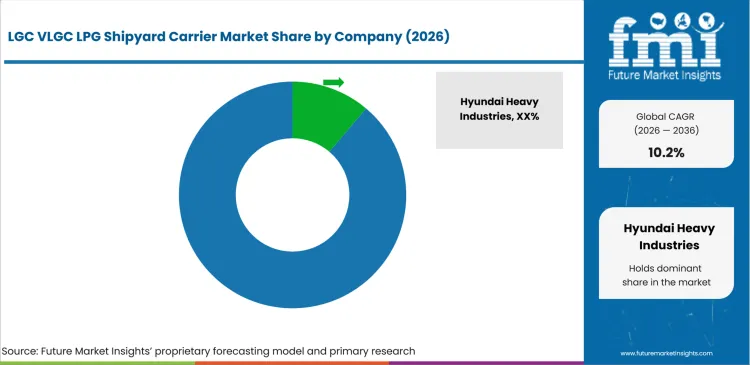
Competition centers on yards with documented large-carrier construction and specialized cargo-system engineering across several vessel sizes. Korean groups compete through production scale and integrated machinery across international programs for global shipowners. Japanese yards emphasize detailed engineering and class collaboration across alternative-fuel carrier designs. Current Chinese contracts expand available capacity through 90,000-cubic-meter vessel programs. Shipowners compare serial delivery performance and cargo-system integration with construction slots and warranty responsibility during final selection.
- HD Hyundai Heavy Industries and HD Hyundai Samho provide scaled Korean capacity for large gas-carrier programs. HD Hyundai completed its merger with HD Hyundai Mipo in December 2025 to consolidate large-vessel production and engineering resources. Mitsui O.S.K. Lines reported in February 2026 that HD Hyundai Samho delivered the 88,000-cubic-meter Energia Grandeur for TotalEnergies charter service.
- Kawasaki Heavy Industries and Mitsubishi Shipbuilding compete through documented gas-carrier engineering and alternative-fuel vessel design. Mitsubishi Heavy Industries reported in March 2025 that Namura Shipbuilding joined an ammonia-carrier program with MOL and Mitsubishi Shipbuilding. Detailed class review differentiates these Japanese yards during projects constrained by capacity renewal and specialist workforce limits.
- Hanwha Ocean and Samsung Heavy Industries add ammonia engineering depth to Korea’s large-vessel construction base. Hanwha partnered with Baker Hughes on marine ammonia turbines in February 2025, while Samsung secured Amogy module manufacturing rights in November 2025. Jiangnan Shipyard delivered a 99,000-cubic-meter ethane carrier in December 2025 with B-type containment suitable for ethane, ethylene, and LPG.
Competitive Benchmarking: LGC VLGC LPG Shipyard Carrier Market
| Company | Large LPG Carrier Construction | Cargo and Fuel Systems Engineering | Ammonia-Ready Capability | Geographic Reach |
|---|---|---|---|---|
| HD Hyundai Heavy Industries | High | High | High | Global |
| HD Hyundai Samho | High | High | Medium | Global |
| Hanwha Ocean | Medium | Medium | High | Global |
| Kawasaki Heavy Industries | High | High | High | Multi-country |
| Mitsubishi Shipbuilding | Medium | High | High | Multi-country |
| Namura Shipbuilding | Medium | Medium | High | Regional |
| Samsung Heavy Industries | Medium | High | High | Global |
| Jiangnan Shipyard | High | Medium | High | Global |
Key Developments in the LGC VLGC LPG Shipyard Carrier Market
- In January 2026, Jiangnan Shipyard signed contracts for two 90,000-cubic-meter very large ammonia carriers through China State Shipbuilding Corporation. Each vessel uses LPG dual-fuel propulsion and targets EEDI Phase III requirements within established Panama Canal dimensional constraints. The contracts provide current commercial evidence for exact-market construction and broaden internationally available capacity for ammonia-ready programs. The two contracts also add verified Chinese capacity for owners evaluating large ammonia-ready carrier programs.
- In September 2025, Kawasaki Heavy Industries received Approval in Principle from ClassNK for an ammonia-fueled LPG and ammonia carrier developed with MITSUI E&S. The class review covered the ammonia fuel-supply system and required protective measures through a detailed safety evaluation. The approval expands design options for owners seeking cargo flexibility and a defined pathway toward future ammonia propulsion and commercial service.
- In April 2026, HD Hyundai Heavy Industries held naming ceremonies for two 46,000-cubic-meter medium gas carriers built for EXMAR. The vessels were designed to transport LPG or ammonia and use dual-fuel engines that support ammonia propulsion. HD Hyundai stated that commercial deliveries were scheduled during May and July 2026 for the two carriers. The program converts ammonia-fuel engineering into completed ocean-going carriers with defined owner delivery schedules and cargo flexibility.
- In January 2026, Trafigura signed a memorandum with CF Industries and TFG Marine to develop low-carbon ammonia for marine fuel. The parties planned work across supply availability and bunkering logistics with future vessel demand and operations. The agreement supports fuel-flexible carrier specifications through a defined commercial collaboration across future marine-fuel programs. Final fuel standards and regional supply contracts remain necessary for large carrier orders that depend on ammonia propulsion.
Key Players in the LGC VLGC LPG Shipyard Carrier Market
Large Gas Carrier Shipyards
- HD Hyundai Heavy Industries
- HD Hyundai Samho
- Hanwha Ocean
Gas Carrier Engineering and Specialized Builders
- Kawasaki Heavy Industries
- Mitsubishi Shipbuilding
- Namura Shipbuilding
Additional Large Gas Carrier Builders
- Samsung Heavy Industries
- Jiangnan Shipyard
LGC VLGC LPG Shipyard Carrier Market - Report Scope
| Coverage field | Report scope |
|---|---|
| Market breakdown | Product, application, end user, distribution channel, refrigeration and pressurization, and region. |
| Quantitative Units | Revenue in USD Million, CAGR in %. |
| Market Definition | Newbuild shipyard revenue for large and very large LPG carriers including integrated cargo containment, refrigeration, propulsion, gas handling, testing, and delivery. |
| Regions Covered | North America, Latin America, Western Europe, Eastern Europe, East Asia, South Asia and Pacific, and Middle East and Africa. |
| Countries Covered | Norway, Germany, Singapore, USA, Japan, South Korea, and UK. |
| Key Companies Profiled | HD Hyundai Heavy Industries, HD Hyundai Samho, Hanwha Ocean, Kawasaki Heavy Industries, Mitsubishi Shipbuilding, Namura Shipbuilding, Samsung Heavy Industries, and Jiangnan Shipyard. |
| Forecast Period | 2026 to 2036. |
| Approach | Hybrid bottom-up and top-down market sizing supported by primary interviews and official desk research. |
LGC VLGC LPG Shipyard Carrier Market - Research Methodology
| Method | Approach |
|---|---|
| Primary Research | FMI analysts gathered input from manufacturers, service providers, technology developers, distributors, end users, sourcing teams, and subject-matter experts. Interviews examined purchasing decisions, product or service evaluation, adoption barriers, approval requirements, pricing considerations, and expectations for technical or commercial support. Respondents were also asked what evidence is required before a trial, pilot, or initial order develops into regular purchasing. |
| Desk Research | Desk research covered government statistics, regulatory publications, trade data, industry associations, technical literature, standards, company filings, product information, and official corporate announcements. Sources were reviewed for relevance, publication date, geographic coverage, and consistency with the defined market scope. Claims relating to performance, applications, approvals, capacity, investment, and commercial activity were retained only when supported by credible public evidence. |
| Market Sizing and Forecasting | The market model combined the baseline value with historical performance, segment structure, pricing and volume indicators, adoption levels, company participation, and country-level demand conditions. Forecast assumptions considered economic activity, investment trends, regulatory developments, technology adoption, purchasing cycles, supply availability, and barriers to wider market use. Segment and regional estimates were reconciled before the final market total was calculated. |
| Data Validation | Estimates were checked against multiple independent indicators, including public data, company activity, trade patterns, industry developments, and findings from primary interviews. Validation also tested whether products, services, applications, and company revenues fell within the defined market boundaries. Adjacent categories, unsupported claims, overlapping revenues, and activities without direct market relevance were excluded to reduce double counting and maintain consistency across segments and countries. |
LGC VLGC LPG Shipyard Carrier Market by Segments
LGC VLGC LPG Shipyard Carrier Market segmented by Product:
- Very Large Gas Carriers (VLGC)
- Full Refrigerated VLGC
- Dual Fuel VLGC
- Large Gas Carriers (LGC)
- Full Refrigerated LGC
- Semi Refrigerated LGC
- Medium Gas Carriers (MGC)
- Semi Pressurized Gas Carriers
- Fully Pressurized Gas Carriers
- Ethylene Carriers
- Multi Gas Ethylene Carriers
- Ethylene LPG Carriers
- LPG Bunkering Carriers
- Coastal LPG Bunkering Vessels
- Port Service LPG Carriers
LGC VLGC LPG Shipyard Carrier Market segmented by Application:
- Liquefied Petroleum Gas Transportation
- International LPG Trade
- Long Distance LPG Shipping
- Petrochemical Feedstock Transport
- Propylene Transport
- Butane Transport
- Energy Export Logistics
- Cross Border Energy Trade
- Strategic Energy Supply
- Marine Fuel Distribution
- Ship-to-Ship Fuel Transfer
- Port Fuel Supply
- Industrial Gas Distribution
- Bulk Industrial Gas Supply
- Chemical Feedstock Delivery
LGC VLGC LPG Shipyard Carrier Market segmented by End User:
- Oil and Gas Companies
- Integrated Energy Companies
- National Oil Companies
- Shipping Companies
- LPG Carrier Operators
- Commercial Fleet Operators
- Ship Leasing Companies
- Operating Lessors
- Financial Lessors
- Petrochemical Companies
- Downstream Petrochemical Producers
- Chemical Manufacturers
- Government Organizations
- State Energy Enterprises
- Public Maritime Agencies
LGC VLGC LPG Shipyard Carrier Market segmented by Distribution Channel:
- Direct Shipyard Contracts
- New Build Contracts
- Long-Term Supply Agreements
- Engineering, Procurement and Construction (EPC) Companies
- Turnkey EPC Contracts
- Custom Engineering Contracts
- Shipbrokers
- Global Shipbrokers
- Regional Shipbrokers
- Strategic Alliances
- Joint Ventures
- Technology Partnerships
- Government Procurement
- Public Energy Projects
- State-Owned Enterprise Contracts
LGC VLGC LPG Shipyard Carrier Market segmented by Refrigeration and Pressurization:
- Full Refrigerated
- VLGC Full Refrigerated
- LGC Full Refrigerated
- Semi Refrigerated
- LGC Semi Refrigerated
- Medium Gas Carrier Semi Refrigerated
- Fully Pressurized
- Small Pressurized Carriers
- Coastal LPG Carriers
- Semi Pressurized
- Short-Sea LPG Carriers
- Regional Distribution Carriers
- Ethylene Capable
- Ethylene-Ready Carriers
- Multi Gas Carriers
LGC VLGC LPG Shipyard Carrier Market by Region:
- North America
- United States
- Canada
- Latin America
- Brazil
- Mexico
- Argentina
- Chile
- Western Europe
- Germany
- France
- United Kingdom
- Italy
- Spain
- Benelux
- Nordics
- Eastern Europe
- Poland
- Czech Republic
- Romania
- Hungary
- East Asia
- China
- Japan
- South Korea
- South Asia and Pacific
- India
- ASEAN
- Australia and New Zealand
- Middle East and Africa
- GCC Countries
- South Africa
- Türkiye
- Israel
Research Sources and Bibliography
- Lloyd’s Register. (2025, September 11). LR grants AiP for innovative VLGC with forward accommodation and wind-assisted propulsion.
- International Maritime Organization. (2025, October 17). IMO net-zero shipping talks to resume in 2026.
- Kawasaki Heavy Industries. (2025, June 30). Delivery of the LPG-powered CRYSTAL ODYSSEY LPG/NH3 Carrier.
- USA Energy Information Administration. (2026, March 30). Natural gas plant liquids exports reached record highs in 2025.
- Trafigura. (2025, January 16). First-ever Ammonia and Propane Co-loaded Vessel Completes Voyage from US to Europe.
- Dorian LPG. (2026, June 23). Dorian LPG Ltd. Announces VLGC Newbuilding Contract, Forward Chartering Estimates and Memorandums of Agreement to Sell Three VLGCs.
- HD Hyundai. (2025, October 13). HD KSOE successfully commercializes next-generation LPG cargo handling system with 18% improvement in reliquefaction efficiency.
- Canada Energy Regulator. (2025, June 4). Market Snapshot: Annual Trade Summary - Natural Gas Liquids Exports.
- BW LPG. (2026, May 30). BW LPG enters into agreement for eight 90’cbm Panamax newbuildings with Hyundai Heavy Industries.
- International Maritime Organization. (2025, April 11). IMO approves net-zero regulations for global shipping.
- Statistics Norway. (2026, January 23). The Norwegian Merchant Fleet.
- Bundesministerium für Verkehr. (2025, August 6). Schifffahrtsstandort Deutschland.
- Maritime and Port Authority of Singapore. (2025, January 15). Strong growth momentum for Maritime Singapore.
- USA Energy Information Administration. (2026, June 30). Propane Exports.
- Ministry of Land, Infrastructure, Transport and Tourism. (2025, December 26). 2035
- Ministry of Trade, Industry and Energy. (2025, February 11).
- Maritime and Coastguard Agency. (2025, April 16). MCA customer process for alternative fuels - ammonia.
- HD Hyundai. (2025, December 1).
- Mitsui O.S.K. Lines. (2026, February 6). MOL Takes Delivery of LPG-powered Newbuilding LPG Carrier Energia Grandeur to Serve Total - Advancing Environmentally Friendly Fleet Development Under the 'BLUE' Series -
- Mitsubishi Heavy Industries. (2025, March 14). Approval in Principle (AiP) for the Basic Design of a Large Ammonia-Fueled Ammonia Carrier Obtained from Classification Society.
- Hanwha. (2025, February 12). Hanwha and Baker Hughes announce agreement for joint development of ammonia gas turbines.
- Samsung Heavy Industries. (2025, November 10). SHI to Exclusively Manufacture Amogy’s `Ammonia Powerpack` in Korea.
- China State Shipbuilding Corporation. (2025, December 9).
- China State Shipbuilding Corporation. (2026, January 7).
- Kawasaki Heavy Industries. (2025, September 8). Ammonia Fueled LPG/Ammonia Carrier Vessel Granted Approval in Principle.
- HD Hyundai. (2026, April 10). HD Hyundai Heavy Industries Builds World’s First Ammonia-Powered Vessel.
- Trafigura. (2026, January 15). CF Industries, Trafigura and TFG Marine sign MOU to advance low-carbon ammonia for maritime decarbonisation.
This bibliography is provided for reader reference and is not exhaustive. The full report contains the complete reference list and detailed citations.
This Report Answers
- How large is the LGC VLGC LPG Shipyard Carrier Market in 2026 and 2036?
- Which cargo and charter conditions support new large LPG carrier orders?
- Why do very large gas carriers hold the largest product share during 2026?
- How does LPG transportation influence shipyard demand across major trade routes?
- Why do direct shipyard contracts represent the largest distribution channel share?
- How do country growth rates compare across the seven profiled markets?
- Which shipyards demonstrate documented gas-carrier construction and ammonia-ready capability?
- What constraints can delay vessel awards despite rising LPG cargo activity?
- How can ammonia-ready specifications preserve vessel utility across evolving fuel pathways?
Frequently Asked Questions
How big is the LGC VLGC LPG Shipyard Carrier Market in 2026?
The LGC VLGC LPG shipyard carrier market is valued at USD 2.7 billion in 2026 and is forecast to reach USD 7.1 billion by 2036. Growth reflects ongoing innovation in gas-carrier vessel design that increases demand for shipyard capabilities supporting fuel flexibility and long-term regulatory compliance.
What is the CAGR of the LGC VLGC LPG Shipyard Carrier Market from 2026 to 2036?
The LGC VLGC LPG shipyard carrier market grows at a CAGR of 10.2% between 2026 and 2036, supported by rising propane and butane exports that create repeat cargo programs supporting larger carriers and longer charter commitments across major trade routes.
Which application leads the LGC VLGC LPG Shipyard Carrier Market?
Liquefied petroleum gas transportation accounts for 58.0% of the LGC VLGC LPG shipyard carrier market by application in 2026, owing to recurring seaborne cargo movements across established energy routes and repeat propane and butane loading programs worldwide.
How much will the LGC VLGC LPG Shipyard Carrier Market add between 2026 and 2036?
The LGC VLGC LPG shipyard carrier market is set to add USD 4.4 billion between 2026 and 2036, growing from USD 2.7 billion to USD 7.1 billion as fuel-flexible vessel construction extends across a widening base of long-haul cargo programs.
Who are the leading companies in the LGC VLGC LPG Shipyard Carrier Market?
Five companies lead the LGC VLGC LPG shipyard carrier market, including HD Hyundai Heavy Industries, HD Hyundai Samho, Hanwha Ocean, Kawasaki Heavy Industries, and Mitsubishi Shipbuilding, competing through specialized engineering, ammonia-ready capability, and regional yard coverage.
Preview the report firsthand - request a free sample
Get SampleGet the brochure for pricing and purchase details.
Get PDFTable of Content
- Key Takeaways
- Market Size and CAGR
- Top Growth Driver
- Fastest Growing Segment
- Leading Region
- Key Companies
- Emerging Opportunities
- Executive Summary
- Global Market Outlook
- Demand-side Trends
- Supply-side Trends
- Technology Roadmap Analysis
- Analysis and Recommendations
- Analyst Perspective (What is happening? Why now? What should investors know?)
- Key Questions Answered
- How large is the market?
- What is the CAGR?
- What are key trends?
- Which region dominates?
- Who are the leaders?
- Market Overview
- Market Coverage / Taxonomy
- Market Definition / Scope / Limitations
- Research Methodology
- Chapter Orientation
- Analytical Lens and Working Hypotheses
- Market Structure, Signals, and Trend Drivers
- Benchmarking and Cross-market Comparability
- Market Sizing, Forecasting, and Opportunity Mapping
- Research Design and Evidence Framework
- Desk Research Programme (Secondary Evidence)
- Expert Input and Fieldwork (Primary Evidence)
- Tooling, Models, and Reference Databases
- Data Engineering and Model Build
- Quality Assurance and Audit Trail
- Market Background
- Market Dynamics (Drivers, Restraints, Opportunity, Trends)
- Scenario Forecast (Optimistic, Likely, Conservative)
- Impact Analysis
- AI Impact
- Sustainability Impact
- Regulatory Impact
- Technology Impact
- Consumer / Buyer Analysis
- Purchase Drivers
- Adoption Barriers
- Buyer Journey
- Opportunity Map Analysis
- Product Life Cycle Analysis
- Supply Chain Analysis
- Investment Feasibility Matrix
- Value Chain Analysis
- PESTLE and Porter's Analysis
- Regulatory Landscape
- Regional Parent Market Outlook
- Production and Consumption Statistics
- Import and Export Statistics
- Global Market Analysis and Forecast, 2021 to 2036
- Historical Market Size Value (USD Billion) Analysis, 2021 to 2025
- Current and Future Market Size Value (USD Billion) Projections, 2026 to 2036
- Y-o-Y Growth Trend Analysis
- Absolute $ Opportunity Analysis
- Global Market Pricing Analysis, 2021 to 2036
- Global Market Analysis and Forecast, By Product, 2021 to 2036
- Introduction / Key Findings
- Historical Market Size Value (USD Billion) Analysis By Product, 2021 to 2025
- Current and Future Market Size Value (USD Billion) Analysis and Forecast By Product, 2026 to 2036
- Very Large Gas Carriers
- Full Refrigerated VLGC
- Dual Fuel VLGC
- Large Gas Carriers
- Full Refrigerated LGC
- Semi Refrigerated LGC
- Medium Gas Carriers
- Semi Pressurized Gas Carriers
- Fully Pressurized Gas Carriers
- Ethylene Carriers
- Multi Gas Ethylene Carriers
- Ethylene LPG Carriers
- LPG Bunkering Carriers
- Coastal LPG Bunkering Vessels
- Port Service LPG Carriers
- Very Large Gas Carriers
- Y-o-Y Growth Trend Analysis By Product, 2021 to 2025
- Absolute $ Opportunity Analysis By Product, 2026 to 2036
- Global Market Analysis and Forecast, By Application, 2021 to 2036
- Introduction / Key Findings
- Historical Market Size Value (USD Billion) Analysis By Application, 2021 to 2025
- Current and Future Market Size Value (USD Billion) Analysis and Forecast By Application, 2026 to 2036
- Liquefied Petroleum Gas Transportation
- International LPG Trade
- Long Distance LPG Shipping
- Petrochemical Feedstock Transport
- Propylene Transport
- Butane Transport
- Energy Export Logistics
- Cross Border Energy Trade
- Strategic Energy Supply
- Marine Fuel Distribution
- Ship to Ship Fuel Transfer
- Port Fuel Supply
- Industrial Gas Distribution
- Bulk Industrial Gas Supply
- Chemical Feedstock Delivery
- Liquefied Petroleum Gas Transportation
- Y-o-Y Growth Trend Analysis By Application, 2021 to 2025
- Absolute $ Opportunity Analysis By Application, 2026 to 2036
- Global Market Analysis and Forecast, By End User, 2021 to 2036
- Introduction / Key Findings
- Historical Market Size Value (USD Billion) Analysis By End User, 2021 to 2025
- Current and Future Market Size Value (USD Billion) Analysis and Forecast By End User, 2026 to 2036
- Oil and Gas Companies
- Integrated Energy Companies
- National Oil Companies
- Shipping Companies
- LPG Carrier Operators
- Commercial Fleet Operators
- Ship Leasing Companies
- Operating Lessors
- Financial Lessors
- Petrochemical Companies
- Downstream Petrochemical Producers
- Chemical Manufacturers
- Government Organizations
- State Energy Enterprises
- Public Maritime Agencies
- Oil and Gas Companies
- Y-o-Y Growth Trend Analysis By End User, 2021 to 2025
- Absolute $ Opportunity Analysis By End User, 2026 to 2036
- Global Market Analysis and Forecast, By Distribution Channel, 2021 to 2036
- Introduction / Key Findings
- Historical Market Size Value (USD Billion) Analysis By Distribution Channel, 2021 to 2025
- Current and Future Market Size Value (USD Billion) Analysis and Forecast By Distribution Channel, 2026 to 2036
- Direct Shipyard Contracts
- New Build Contracts
- Long Term Supply Agreements
- Engineering Procurement and Construction Companies
- Turnkey EPC Contracts
- Custom Engineering Contracts
- Shipbrokers
- Global Shipbrokers
- Regional Shipbrokers
- Strategic Alliances
- Joint Ventures
- Technology Partnerships
- Government Procurement
- Public Energy Projects
- State-Owned Enterprise Contracts
- Direct Shipyard Contracts
- Y-o-Y Growth Trend Analysis By Distribution Channel, 2021 to 2025
- Absolute $ Opportunity Analysis By Distribution Channel, 2026 to 2036
- Global Market Analysis and Forecast, By Refrigeration and Pressurization, 2021 to 2036
- Introduction / Key Findings
- Historical Market Size Value (USD Billion) Analysis By Refrigeration and Pressurization, 2021 to 2025
- Current and Future Market Size Value (USD Billion) Analysis and Forecast By Refrigeration and Pressurization, 2026 to 2036
- Full Refrigerated
- VLGC Full Refrigerated
- LGC Full Refrigerated
- Semi Refrigerated
- LGC Semi Refrigerated
- Medium Gas Carrier Semi Refrigerated
- Full Pressurized
- Small Pressurized Carriers
- Coastal LPG Carriers
- Ethylene Capable
- Ethylene Ready Carriers
- Multi Gas Carriers
- Semi Pressurized
- Short Sea LPG Carriers
- Regional Distribution Carriers
- Full Refrigerated
- Y-o-Y Growth Trend Analysis By Refrigeration and Pressurization, 2021 to 2025
- Absolute $ Opportunity Analysis By Refrigeration and Pressurization, 2026 to 2036
- Global Market Analysis and Forecast, By Region, 2021 to 2036
- Introduction
- Historical Market Size Value (USD Billion) Analysis By Region, 2021 to 2025
- Current Market Size Value (USD Billion) Analysis and Forecast By Region, 2026 to 2036
- North America
- Latin America
- Western Europe
- Eastern Europe
- East Asia
- South Asia and Pacific
- Middle East & Africa
- Market Attractiveness Analysis By Region
- North America Market Analysis and Forecast, By Country, 2021 to 2036
- Historical Market Size Value (USD Billion) Trend Analysis By Market Taxonomy, 2021 to 2025
- Market Size Value (USD Billion) Forecast By Market Taxonomy, 2026 to 2036
- By Country
- USA
- Canada
- By Product
- By Application
- By End User
- By Distribution Channel
- By Refrigeration and Pressurization
- By Country
- Market Attractiveness Analysis
- By Country
- By Product
- By Application
- By End User
- By Distribution Channel
- By Refrigeration and Pressurization
- Key Takeaways
- Latin America Market Analysis and Forecast, By Country
- Historical Market Size Value (USD Billion) Trend Analysis By Market Taxonomy, 2021 to 2025
- Market Size Value (USD Billion) Forecast By Market Taxonomy, 2026 to 2036
- By Country
- Brazil
- Mexico
- Chile
- Rest of Latin America
- By Product
- By Application
- By End User
- By Distribution Channel
- By Refrigeration and Pressurization
- By Country
- Market Attractiveness Analysis
- By Country
- By Product
- By Application
- By End User
- By Distribution Channel
- By Refrigeration and Pressurization
- Key Takeaways
- Western Europe Market Analysis and Forecast, By Country
- Historical Market Size Value (USD Billion) Trend Analysis By Market Taxonomy, 2021 to 2025
- Market Size Value (USD Billion) Forecast By Market Taxonomy, 2026 to 2036
- By Country
- Germany
- UK
- Italy
- Spain
- France
- Nordic
- BENELUX
- Rest of Western Europe
- By Product
- By Application
- By End User
- By Distribution Channel
- By Refrigeration and Pressurization
- By Country
- Market Attractiveness Analysis
- By Country
- By Product
- By Application
- By End User
- By Distribution Channel
- By Refrigeration and Pressurization
- Key Takeaways
- Eastern Europe Market Analysis and Forecast, By Country
- Historical Market Size Value (USD Billion) Trend Analysis By Market Taxonomy, 2021 to 2025
- Market Size Value (USD Billion) Forecast By Market Taxonomy, 2026 to 2036
- By Country
- Russia
- Poland
- Hungary
- Balkan & Baltic
- Rest of Eastern Europe
- By Product
- By Application
- By End User
- By Distribution Channel
- By Refrigeration and Pressurization
- By Country
- Market Attractiveness Analysis
- By Country
- By Product
- By Application
- By End User
- By Distribution Channel
- By Refrigeration and Pressurization
- Key Takeaways
- East Asia Market Analysis and Forecast, By Country
- Historical Market Size Value (USD Billion) Trend Analysis By Market Taxonomy, 2021 to 2025
- Market Size Value (USD Billion) Forecast By Market Taxonomy, 2026 to 2036
- By Country
- China
- Japan
- South Korea
- By Product
- By Application
- By End User
- By Distribution Channel
- By Refrigeration and Pressurization
- By Country
- Market Attractiveness Analysis
- By Country
- By Product
- By Application
- By End User
- By Distribution Channel
- By Refrigeration and Pressurization
- Key Takeaways
- South Asia and Pacific Market Analysis and Forecast, By Country
- Historical Market Size Value (USD Billion) Trend Analysis By Market Taxonomy, 2021 to 2025
- Market Size Value (USD Billion) Forecast By Market Taxonomy, 2026 to 2036
- By Country
- India
- ASEAN
- Australia & New Zealand
- Rest of South Asia and Pacific
- By Product
- By Application
- By End User
- By Distribution Channel
- By Refrigeration and Pressurization
- By Country
- Market Attractiveness Analysis
- By Country
- By Product
- By Application
- By End User
- By Distribution Channel
- By Refrigeration and Pressurization
- Key Takeaways
- Middle East & Africa Market Analysis and Forecast, By Country
- Historical Market Size Value (USD Billion) Trend Analysis By Market Taxonomy, 2021 to 2025
- Market Size Value (USD Billion) Forecast By Market Taxonomy, 2026 to 2036
- By Country
- Kingdom of Saudi Arabia
- Other GCC Countries
- Türkiye
- South Africa
- Other African Union
- Rest of Middle East & Africa
- By Product
- By Application
- By End User
- By Distribution Channel
- By Refrigeration and Pressurization
- By Country
- Market Attractiveness Analysis
- By Country
- By Product
- By Application
- By End User
- By Distribution Channel
- By Refrigeration and Pressurization
- Key Takeaways
- Key Countries Market Analysis
- USA
- Pricing Analysis
- Market Share Analysis, 2025
- By Product
- By Application
- By End User
- By Distribution Channel
- By Refrigeration and Pressurization
- Canada
- Pricing Analysis
- Market Share Analysis, 2025
- By Product
- By Application
- By End User
- By Distribution Channel
- By Refrigeration and Pressurization
- Mexico
- Pricing Analysis
- Market Share Analysis, 2025
- By Product
- By Application
- By End User
- By Distribution Channel
- By Refrigeration and Pressurization
- Brazil
- Pricing Analysis
- Market Share Analysis, 2025
- By Product
- By Application
- By End User
- By Distribution Channel
- By Refrigeration and Pressurization
- Chile
- Pricing Analysis
- Market Share Analysis, 2025
- By Product
- By Application
- By End User
- By Distribution Channel
- By Refrigeration and Pressurization
- Germany
- Pricing Analysis
- Market Share Analysis, 2025
- By Product
- By Application
- By End User
- By Distribution Channel
- By Refrigeration and Pressurization
- UK
- Pricing Analysis
- Market Share Analysis, 2025
- By Product
- By Application
- By End User
- By Distribution Channel
- By Refrigeration and Pressurization
- Italy
- Pricing Analysis
- Market Share Analysis, 2025
- By Product
- By Application
- By End User
- By Distribution Channel
- By Refrigeration and Pressurization
- Spain
- Pricing Analysis
- Market Share Analysis, 2025
- By Product
- By Application
- By End User
- By Distribution Channel
- By Refrigeration and Pressurization
- France
- Pricing Analysis
- Market Share Analysis, 2025
- By Product
- By Application
- By End User
- By Distribution Channel
- By Refrigeration and Pressurization
- India
- Pricing Analysis
- Market Share Analysis, 2025
- By Product
- By Application
- By End User
- By Distribution Channel
- By Refrigeration and Pressurization
- ASEAN
- Pricing Analysis
- Market Share Analysis, 2025
- By Product
- By Application
- By End User
- By Distribution Channel
- By Refrigeration and Pressurization
- Australia & New Zealand
- Pricing Analysis
- Market Share Analysis, 2025
- By Product
- By Application
- By End User
- By Distribution Channel
- By Refrigeration and Pressurization
- China
- Pricing Analysis
- Market Share Analysis, 2025
- By Product
- By Application
- By End User
- By Distribution Channel
- By Refrigeration and Pressurization
- Japan
- Pricing Analysis
- Market Share Analysis, 2025
- By Product
- By Application
- By End User
- By Distribution Channel
- By Refrigeration and Pressurization
- South Korea
- Pricing Analysis
- Market Share Analysis, 2025
- By Product
- By Application
- By End User
- By Distribution Channel
- By Refrigeration and Pressurization
- Russia
- Pricing Analysis
- Market Share Analysis, 2025
- By Product
- By Application
- By End User
- By Distribution Channel
- By Refrigeration and Pressurization
- Poland
- Pricing Analysis
- Market Share Analysis, 2025
- By Product
- By Application
- By End User
- By Distribution Channel
- By Refrigeration and Pressurization
- Hungary
- Pricing Analysis
- Market Share Analysis, 2025
- By Product
- By Application
- By End User
- By Distribution Channel
- By Refrigeration and Pressurization
- Kingdom of Saudi Arabia
- Pricing Analysis
- Market Share Analysis, 2025
- By Product
- By Application
- By End User
- By Distribution Channel
- By Refrigeration and Pressurization
- Türkiye
- Pricing Analysis
- Market Share Analysis, 2025
- By Product
- By Application
- By End User
- By Distribution Channel
- By Refrigeration and Pressurization
- South Africa
- Pricing Analysis
- Market Share Analysis, 2025
- By Product
- By Application
- By End User
- By Distribution Channel
- By Refrigeration and Pressurization
- USA
- Market Structure Analysis
- Competition Dashboard
- Competition Benchmarking
- Market Share Analysis of Top Players
- By Regional
- By Product
- By Application
- By End User
- By Distribution Channel
- By Refrigeration and Pressurization
- Emerging Startups
- Innovation Benchmarking
- Competition Analysis
- Competition Deep Dive
- Hyundai Heavy Industries
- Overview
- Product Portfolio
- Profitability by Market Segments
- Sales Footprint
- Strategy Overview
- Marketing Strategy
- Product Strategy
- Channel Strategy
- Hanwha Ocean
- Samsung Heavy Industries
- Kawasaki Heavy Industries
- Mitsubishi Heavy Industries
- Namura Shipbuilding
- BW LPG
- Dorian LPG
- EXMAR
- Kuwait Oil Tanker Company
- Hyundai Heavy Industries
- Case Studies
- Success Stories
- Recent Developments
- Competition Deep Dive
- Assumptions & Acronyms Used


