

- Industry Size (2026)
- USD 121 Mn
- Forecast (2036)
- USD 324 Mn
- CAGR (2026 to 2036)
- 10.2%
Low-Siloxane Silicone Sealants for Automotive Paint Shops Market Forecast and Outlook 2026 to 2036
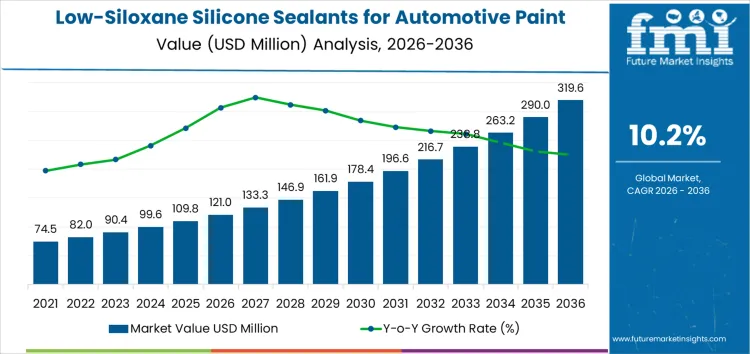
The low siloxane silicone sealants for automotive paint shops market is valued at USD 121 million in 2026 and is projected to reach USD 324 million by 2036, reflecting a CAGR of 10.2%. Demand over this period is driven by contamination control priorities rather than sealant consumption growth. Paint defect avoidance, rework reduction, and surface finish consistency shape purchasing decisions. Cost structures reflect formulation refinement, low volatility raw materials, and strict quality screening. Suppliers capable of maintaining stable siloxane profiles gain pricing leverage where paint line uptime is critical. Selection favors sealants that reduce downstream defect risk across high-throughput operations.
Between 2026 and 2036, value capture centers on risk mitigation within paint shop environments. Automotive manufacturers prioritize materials that protect yield and minimize surface imperfections during coating processes. Once approved, sealants remain fixed due to process calibration and revalidation cost. Entry barriers persist through extended plant trials and strict contamination audits. Strategic tradeoffs arise between formulation purity and production scalability. Firms investing in contamination testing and plant level support secure stronger positioning. Profit pools favor suppliers embedded in paint shop standards, where material reliability outweighs short term pricing considerations.
Quick Stats for Low Siloxane Silicone Sealants for Automotive Paint Shops Market
- Low Siloxane Silicone Sealants for Automotive Paint Shops Market Value (2026): USD 121 million
- Low Siloxane Silicone Sealants for Automotive Paint Shops Market Forecast Value (2036): USD 324 million
- Low Siloxane Silicone Sealants for Automotive Paint Shops Market Forecast CAGR (2026–2036): 10.2%
- Leading Type in Low Siloxane Silicone Sealants for Automotive Paint Shops Market: Sprayable low siloxane seam sealants
- Key Growth Regions in Low Siloxane Silicone Sealants for Automotive Paint Shops Market: Asia Pacific, Europe, North America
- Top Players in Low Siloxane Silicone Sealants for Automotive Paint Shops Market: Sika AG, Henkel AG & Co. KGaA, 3M Company, Dow, Wacker Chemie AG
What Is the Growth Forecast for Low Siloxane Silicone Sealants for Automotive Paint Shops Market through 2036?
Paint defect prevention requirements and surface finish quality targets define the early growth phase of the low siloxane silicone sealants for automotive paint shops market between 2026 and 2031. During this period, the market expands from USD 121 million to USD 181 million, adding USD 60 million in value. Annual progression from USD 66 million to USD 121 million reflects increasing use of low contamination sealants in body shops and OEM paint facilities. Historical growth was constrained by limited awareness of siloxane related defects and reliance on conventional silicone products. Future expansion in this phase is supported by stricter paint quality standards, higher repaint avoidance costs, and wider qualification of low siloxane formulations in sealing and masking applications.
Process optimization and line level standardization drive growth from 2031 to 2036. Over this period, the market increases from USD 181 million to USD 324 million, adding USD 143 million and representing the stronger expansion window. Annual values rise from USD 199 million to USD 324 million, indicating accelerating year over year momentum. Earlier demand focused on premium paint lines, while future growth reflects broader adoption across mass production facilities. Increased automation, tighter defect tolerances, and growing emphasis on first pass yield support sustained expansion as low siloxane sealants become standard materials in automotive paint shop operations.
Low Siloxane Silicone Sealants for Automotive Paint Shops Market Key Takeaways
| Metric | Value |
|---|---|
| Market Value (2026) | USD 121 million |
| Forecast Value (2036) | USD 324 million |
| Forecast CAGR (2026–2036) | 10.2% |
What Is Driving Demand in the Low-Siloxane Silicone Sealants for Automotive Paint Shops Market?
Demand for low-siloxane silicone sealants in automotive paint shops has grown from specific quality control challenges rather than general sealant substitution. Conventional silicone sealants contain cyclic siloxanes that can volatilise under paint shop conditions and deposit trace residues on vehicle surfaces. These residues cause paint defects such as fisheyes, craters, and poor adhesion during baking and curing. As OEMs and tier suppliers tightened aesthetic and durability standards, paint shop engineers identified siloxane contamination as a root cause in surface quality failures. Early adoption of low-siloxane formulations responded to these measurable defects rather than routine application change, making low-siloxane products a targeted solution where visual surface integrity is critical.
Future demand for low-siloxane silicone sealants will be shaped by formalised quality standards, documented defect thresholds, and integration into paint shop process controls rather than incremental performance preferences alone. Automotive manufacturers now specify maximum allowable siloxane levels in sealant formulations to comply with paint defect metrics measured during quality audits and customer feedback loops. Advances in silicone polymer design reduce volatile cyclic siloxane content while preserving cure speed, flexibility, and adhesion to substrates such as glass, trim, and body seams. Procurement policies increasingly require validated low-siloxane products that meet defined contamination limits under production conditions.
What Factors Are Affecting the Demand for Low Siloxane Silicone Sealants for Automotive Paint Shops Market in Terms of Sealant Type and Paint Shop Application?
The low siloxane silicone sealants market for automotive paint shops is driven by surface quality requirements, paint defect prevention, and tighter control of volatile silicone contamination. Demand focuses on sealants that deliver corrosion protection and sealing performance without causing fisheyes or coating adhesion issues. Adoption depends on compatibility with paint shop workflows, curing behavior, and long term durability. Market leadership reflects process reliability and defect risk reduction rather than material cost or sealing strength alone.
What Is Driving Leadership by Sealant Type in the Low Siloxane Silicone Sealants Market?
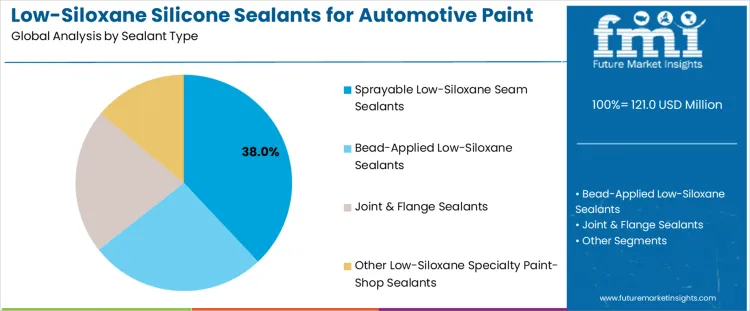
Sprayable low siloxane seam sealants account for about 38% of demand because they align well with automated paint shop operations and large surface coverage needs. These sealants are applied before e-coat or primer stages to seal body seams while minimizing silicone transfer risk. Their sprayable nature supports uniform thickness control across floors, roofs, and side panels without manual intervention. Automotive manufacturers favor these products because they integrate with robotic application systems and deliver consistent results across high volume production lines. Controlled siloxane content reduces paint defect risk while preserving elasticity and corrosion protection. Predictable curing behavior ensures compatibility with downstream baking cycles, reinforcing adoption in modern paint shops.
Bead-applied sealants, joint and flange sealants, and specialty formulations serve targeted roles but remain secondary. Bead-applied products address localized sealing but require more precise placement. Joint and flange sealants focus on closure integrity rather than broad seam coverage. Specialty low siloxane sealants support niche areas with unique exposure conditions. These products complement sprayable systems rather than replace them. Sealant type leadership therefore reflects coverage efficiency, automation compatibility, and defect prevention rather than versatility across all sealing tasks.
Sprayable formulations also reduce labor variability and rework risk. Their dominance is reinforced by quality assurance priorities and high cost of paint shop defects in automotive manufacturing environments globally today.
What Is Driving Leadership by Paint Shop Application in the Low Siloxane Silicone Sealants Market?
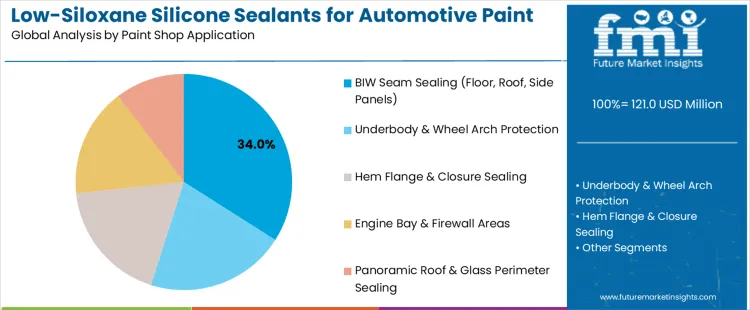
Body in white seam sealing represents about 34% of demand because it is a foundational step in corrosion protection and structural integrity. Floor, roof, and side panel seams must be sealed before coating to prevent moisture ingress and ensure long term durability. These areas involve extensive seam lengths, driving higher material consumption. Paint shops prioritize low siloxane products in BIW sealing to avoid contamination that could compromise visible exterior finishes. Integration with robotic spray systems supports consistent application at scale. The critical timing of seam sealing early in the paint process reinforces concentrated demand in this application.
Underbody protection, hem flange sealing, engine bay areas, and glass perimeter sealing contribute additional demand but at lower volumes. Underbody areas emphasize abrasion and corrosion resistance rather than paint appearance. Hem flanges and closures require precise sealing but involve shorter seam lengths. Engine bay and firewall zones face thermal exposure yet are less visible. Panoramic roof and glass perimeter sealing is sensitive but limited in area. Application leadership therefore reflects surface area, process positioning, and paint defect risk rather than functional importance alone within the vehicle assembly sequence.
How Are Low-Siloxane Silicone Sealants Being Applied Across Automotive Paint Shops?
Use appears in OEM and aftermarket vehicle painting operations where silicone contamination can cause defects such as fisheyes, cratering, or poor coating adhesion. Manufacturers adopt low-siloxane silicone sealants for body panel joints, trim bonding, and assembly seams to maintain surface integrity during painting and finishing. Paint shop operators integrate these sealants to reduce silicone outgassing, prevent coating failures, and maintain high-quality surface finishes. These applications reflect operational and quality priorities rather than aesthetic purposes, with adoption driven by defect reduction, process reliability, and paint performance.
What Operational and Material Conditions Support Adoption of Low-Siloxane Silicone Sealants?
Selection aligns with substrates such as metals, composites, and coated panels requiring adhesion without compromising surface finish. Sealants are formulated to minimize volatile siloxanes, ensure proper cure, and withstand thermal cycling during paint bake ovens. Assembly lines rely on precise bead application, tooling compatibility, and cleaning protocols to prevent contamination. Quality control evaluates adhesion, surface compatibility, and silicone residue levels to meet OEM and regulatory standards. These conditions emerge from operational efficiency, paint quality, and defect prevention priorities in structured automotive finishing workflows.
Which Practical Considerations Limit Wider Use of Low-Siloxane Silicone Sealants?
High material cost and specialized formulation requirements can restrict adoption in lower-end or high-volume paint operations. Compatibility with primers, coatings, and substrates must be verified. Process monitoring, curing control, and operator training are required to maintain low-siloxane performance. OEM and regional regulatory approvals influence usage. These factors lead to selective deployment where surface finish quality, defect reduction, and operational reliability justify incremental cost and workflow adaptation.
What is the Demand for Low Siloxane Silicone Sealants for Automotive Paint Shops by Country?
| Country | CAGR (%) |
|---|---|
| China | 12.0% |
| India | 11.5% |
| USA | 9.5% |
| Germany | 8.8% |
| Japan | 8.5% |
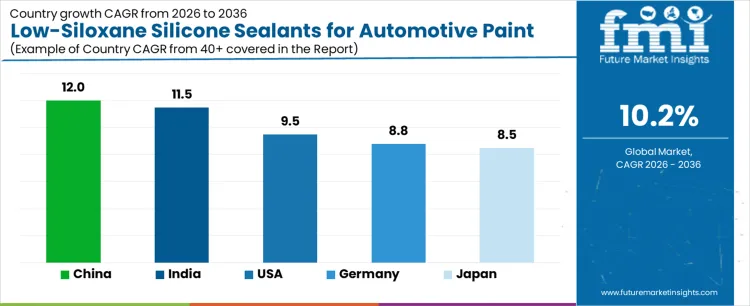
The demand for low siloxane silicone sealants for automotive paint shops varies across countries, driven by automotive production, paint shop modernization, and adoption of low emission sealants. China leads with a 12.0% CAGR, supported by expanding automotive manufacturing, regulatory focus on reducing volatile emissions, and adoption of advanced sealing technologies in paint shops. India follows at 11.5%, driven by growing vehicle production, paint shop upgrades, and eco-friendly adhesive usage. The USA grows at 9.5%, reflecting steady adoption in automotive OEMs and industrial paint facilities. Germany records 8.8%, shaped by mature automotive markets and regulatory compliance. Japan posts 8.5%, supported by adoption in vehicle manufacturing and sustainable paint shop operations.
How Are Low-Siloxane Silicone Sealants Expanding in Automotive Paint Shops in China?
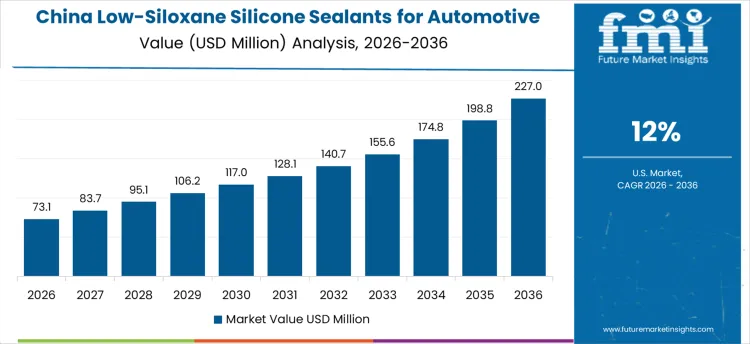
In China, the Low-Siloxane Silicone Sealants for Automotive Paint Shops Market is growing at a CAGR of 12% through 2036, driven by rapid expansion of automotive manufacturing and increasing focus on high-quality paint finishes. Automotive OEMs and paint shop suppliers are adopting low-siloxane sealants to prevent surface defects, improve adhesion, and ensure environmental compliance with VOC regulations. Demand is concentrated in automotive production hubs, industrial paint shops, and supplier networks. Compared to the USA, China emphasizes large-scale production integration and high-volume paint operations. Domestic suppliers provide high-performance, chemically compatible sealants suitable for recurring painting cycles and quality inspections.
- Automotive production hubs, industrial paint shops, and supplier networks drive adoption
- Sealants prevent surface defects and improve adhesion
- Domestic suppliers provide high-performance, chemically compatible solutions
- Recurring painting cycles and quality inspections sustain adoption
How Are Emerging Paint Shop Standards Driving Growth in India?
In India, revenue is growing at a CAGR of 11.5% through 2036, supported by increasing production of passenger and commercial vehicles and modernization of automotive paint shops. Manufacturers are integrating low-siloxane silicone sealants to reduce surface contamination, improve coating quality, and comply with environmental regulations. Demand is concentrated in urban automotive clusters, industrial paint facilities, and OEM supplier networks. Compared to China, adoption in India is more influenced by emerging industrial zones and regulatory incentives. Domestic suppliers provide cost-effective, high-performance sealants compatible with automated paint application systems and recurring production cycles.
- Urban automotive clusters, industrial paint facilities, and OEM suppliers drive adoption
- Sealants reduce surface contamination and improve coating quality
- Domestic suppliers provide cost-effective, high-performance solutions
- Recurring paint application cycles sustain adoption
How Are Automotive Finish Quality and Compliance Driving Growth in the United States?
In the United States, the market is expanding at a CAGR of 9.5% through 2036, driven by increasing adoption of premium automotive finishes and compliance with VOC and environmental standards. OEMs and paint shops are adopting low-siloxane silicone sealants to enhance surface quality, prevent paint defects, and ensure operational efficiency. Demand is concentrated in automotive manufacturing hubs, industrial paint facilities, and tier-one supplier networks. Compared to Germany, the U.S. emphasizes both operational efficiency and surface finish quality. Domestic suppliers provide high-performance sealants compatible with recurring automated painting processes.
- Automotive hubs, industrial paint shops, and supplier networks drive adoption
- Sealants enhance surface quality and prevent paint defects
- Domestic suppliers provide high-performance, production-compatible solutions
- Recurring automated painting cycles sustain adoption
How Are Environmental Regulations Supporting Adoption in Germany?
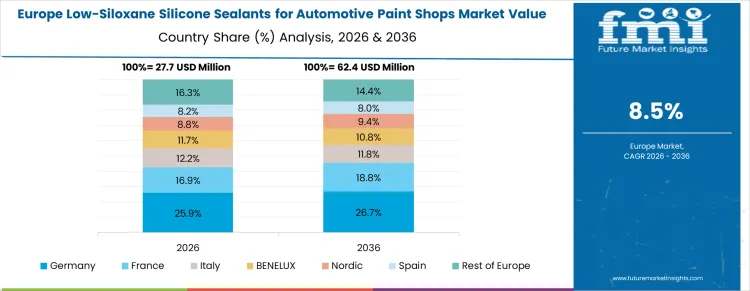
In Germany, revenue is growing at a CAGR of 8.8% through 2036, supported by EU VOC emission limits, automotive paint quality standards, and industrial safety regulations. Automotive manufacturers and paint shops are integrating low-siloxane silicone sealants to ensure defect-free finishes, comply with environmental mandates, and enhance productivity. Demand is concentrated in automotive clusters, industrial paint shops, and OEM supplier facilities. Compared to the U.S., Germany emphasizes compliance and precision over operational volume. Domestic suppliers provide EU-certified, high-performance sealants suitable for recurring paint application and quality inspection cycles.
- Automotive clusters, industrial paint shops, and OEM suppliers drive adoption
- Sealants ensure defect-free finishes and regulatory compliance
- Domestic suppliers provide EU-certified, high-performance solutions
- Recurring paint application and inspection cycles sustain adoption
How Are Automotive Quality Standards Driving Market Growth in Japan?
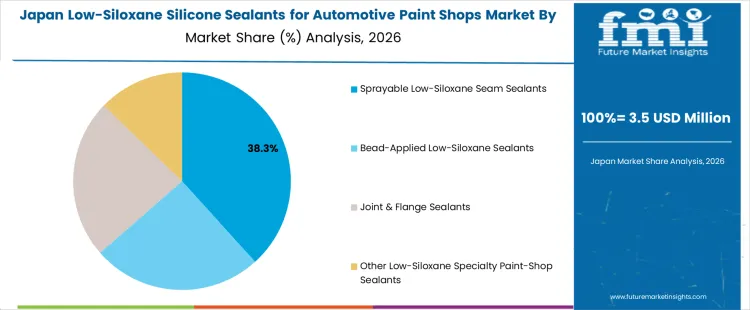
In Japan, the market is expanding at a CAGR of 8.5% through 2036, driven by demand for high-quality automotive paint finishes and adherence to domestic environmental standards. OEMs and paint shops are adopting low-siloxane silicone sealants to prevent surface defects, improve adhesion, and reduce VOC emissions. Demand is concentrated in automotive manufacturing hubs, industrial paint facilities, and supplier networks. Compared to China and India, adoption in Japan focuses on precision, quality, and compliance rather than high-volume integration. Domestic suppliers provide high-performance, chemically compatible sealants suitable for recurring paint application and inspection processes.
- Automotive hubs, industrial paint facilities, and supplier networks drive adoption
- Sealants prevent surface defects and improve adhesion
- Domestic suppliers provide high-performance, chemically compatible solutions
- Recurring paint application and inspection cycles sustain adoption
Which Strategic Approaches Define Competition in the Low Siloxane Silicone Sealants for Automotive Paint Shops Market under Defect Prevention Constraints?
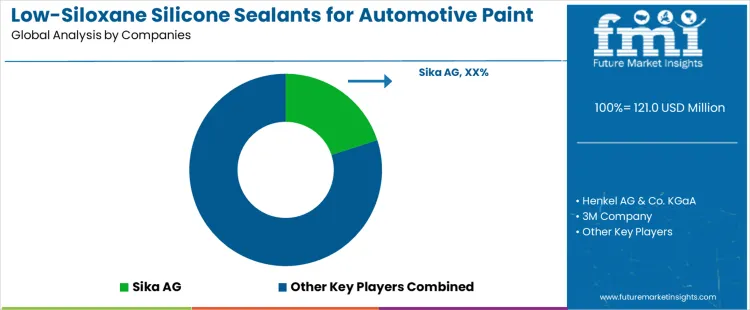
Competition in low siloxane silicone sealants for automotive paint shops is governed by paint defect risk rather than sealing performance alone. Sika AG and Henkel AG and Co. KGaA position their products around contamination control, focusing on ultra-low siloxane migration to prevent cratering and fisheyes during paint application. Their strategies emphasize tight raw material selection, controlled volatilization profiles, and validation within OEM paint shop environments. Dow, through DOWSIL silicone technologies, and Wacker Chemie AG compete by engineering silicone systems with minimized transferable species while preserving elasticity and adhesion needed for body sealing. Qualification centers on paint compatibility testing, aging behavior, and stability across bake cycles rather than cure speed or modulus.
Process integration and operational discipline shape secondary competition. 3M Company participates where low siloxane sealants intersect with masking, surface preparation, or multifunctional body shop applications, aligning materials with standardized shop practices. Across suppliers, strategies prioritize backward compatibility with existing dispensing equipment and minimal changeover disruption in paint shops. Extensive on site trials and conservative formulation evolution are used to protect approved paint processes. Competitive advantage is built through demonstrated defect avoidance, reproducibility across production shifts, and close collaboration with OEM paint engineering teams. Success depends on reducing rework risk and maintaining paint line uptime rather than expanding sealant portfolios or pursuing aggressive formulation changes.
Key Players in the Low Siloxane Silicone Sealants for Automotive Paint Shops Market
- Sika AG
- Henkel AG & Co. KGaA
- 3M Company
- Dow (DOWSIL Silicone Technologies)
- Wacker Chemie AG
Scope of the Report
| Items | Values |
|---|---|
| Quantitative Units (2026) | USD million |
| Type | Sprayable Low-Siloxane Seam Sealants, Bead-Applied Low-Siloxane Sealants, Joint and Flange Sealants, Other Low-Siloxane Specialty Paint-Shop Sealants |
| Application | BIW Seam Sealing for Floor Roof and Side Panels, Underbody and Wheel Arch Protection, Hem Flange and Closure Sealing, Engine Bay and Firewall Areas, Panoramic Roof and Glass Perimeter Sealing |
| End Users | Automotive OEM Paint Shops, Tier One Body and Paint Shop Suppliers, Vehicle Assembly Plants, Automotive Refinish and Specialty Paint Facilities |
| Regions Covered | Asia Pacific, Europe, North America, Latin America, Middle East and Africa |
| Countries Covered | China, India, United States, Germany, Japan, South Korea, United Kingdom, France, Italy, Canada, Mexico, Brazil, ASEAN countries, GCC countries, and other global regions |
| Key Companies Profiled | Sika AG, Henkel AG and Co. KGaA, 3M Company, Dow DOWSIL Silicone Technologies, Wacker Chemie AG |
| Additional Attributes | Dollar by sales across sealant type and paint shop application, siloxane contamination threshold compliance, paint defect prevention performance metrics, compatibility with automated spray and bead application systems, curing stability across paint bake cycles, regional adoption trends linked to paint shop modernization |
Low Siloxane Silicone Sealants for Automotive Paint Shops Market Segmentation
Sealant Type:
- Sprayable Low-Siloxane Seam Sealants
- Bead-Applied Low-Siloxane Sealants
- Joint & Flange Sealants
- Other Low-Siloxane Specialty Paint-Shop Sealants
Paint Shop Application:
- BIW Seam Sealing (Floor, Roof, Side Panels)
- Underbody & Wheel Arch Protection
- Hem Flange & Closure Sealing
- Engine Bay & Firewall Areas
- Panoramic Roof & Glass Perimeter Sealing
Vehicle Category:
- Passenger Cars
- SUVs & Crossovers
- Light Commercial Vehicles & Vans
- Heavy Commercial Vehicles (Trucks & Buses)
- Other Vehicles (Specialty, Performance, etc.)
Region
Asia Pacific
- China
- Japan
- South Korea
- India
- Australia & New Zealand
- ASEAN
- Rest of Asia Pacific
Europe
- Germany
- United Kingdom
- France
- Italy
- Spain
- Nordic
- BENELUX
- Rest of Europe
North America
- United States
- Canada
- Mexico
Latin America
- Brazil
- Chile
- Rest of Latin America
Middle East & Africa
- Kingdom of Saudi Arabia
- Other GCC Countries
- Turkey
- South Africa
- Other African Union
- Rest of Middle East & Africa
Frequently Asked Questions
How big is the low-siloxane silicone sealants for automotive paint shops market in 2026?
The global low-siloxane silicone sealants for automotive paint shops market is estimated to be valued at USD 121.0 million in 2026.
What will be the size of low-siloxane silicone sealants for automotive paint shops market in 2036?
The market size for the low-siloxane silicone sealants for automotive paint shops market is projected to reach USD 319.6 million by 2036.
How much will be the low-siloxane silicone sealants for automotive paint shops market growth between 2026 and 2036?
The low-siloxane silicone sealants for automotive paint shops market is expected to grow at a 10.2% CAGR between 2026 and 2036.
What are the key product types in the low-siloxane silicone sealants for automotive paint shops market?
The key product types in low-siloxane silicone sealants for automotive paint shops market are sprayable low-siloxane seam sealants, bead-applied low-siloxane sealants, joint & flange sealants and other low-siloxane specialty paint-shop sealants.
Which paint shop application segment to contribute significant share in the low-siloxane silicone sealants for automotive paint shops market in 2026?
In terms of paint shop application, biw seam sealing (floor, roof, side panels) segment to command 34.0% share in the low-siloxane silicone sealants for automotive paint shops market in 2026.
Preview the report firsthand - request a free sample
Get SampleGet the brochure for pricing and purchase details.
Get PDFTable of Content
- Executive Summary
- Global Market Outlook
- Demand-side Trends
- Supply-side Trends
- Technology Roadmap Analysis
- Analysis and Recommendations
- Market Overview
- Market Coverage / Taxonomy
- Market Definition / Scope / Limitations
- Market Background
- Market Dynamics
- Drivers
- Restraints
- Opportunity
- Trends
- Scenario Forecast
- Demand in Optimistic Scenario
- Demand in Likely Scenario
- Demand in Conservative Scenario
- Opportunity Map Analysis
- Product Life Cycle Analysis
- Supply Chain Analysis
- Investment Feasibility Matrix
- Value Chain Analysis
- PESTLE and Porter’s Analysis
- Regulatory Landscape
- Regional Parent Market Outlook
- Production and Consumption Statistics
- Import and Export Statistics
- Market Dynamics
- Global Market Analysis 2021 to 2025 and Forecast, 2026 to 2036
- Historical Market Size Value (USD Million) Analysis, 2021 to 2025
- Current and Future Market Size Value (USD Million) Projections, 2026 to 2036
- Y-o-Y Growth Trend Analysis
- Absolute $ Opportunity Analysis
- Global Market Pricing Analysis 2021 to 2025 and Forecast 2026 to 2036
- Global Market Analysis 2021 to 2025 and Forecast 2026 to 2036, By Sealant Type
- Introduction / Key Findings
- Historical Market Size Value (USD Million) Analysis By Sealant Type , 2021 to 2025
- Current and Future Market Size Value (USD Million) Analysis and Forecast By Sealant Type , 2026 to 2036
- Sprayable Low-Siloxane Seam Sealants
- Bead-Applied Low-Siloxane Sealants
- Joint & Flange Sealants
- Other Low-Siloxane Specialty Paint-Shop Sealants
- Sprayable Low-Siloxane Seam Sealants
- Y-o-Y Growth Trend Analysis By Sealant Type , 2021 to 2025
- Absolute $ Opportunity Analysis By Sealant Type , 2026 to 2036
- Global Market Analysis 2021 to 2025 and Forecast 2026 to 2036, By Paint Shop Application
- Introduction / Key Findings
- Historical Market Size Value (USD Million) Analysis By Paint Shop Application, 2021 to 2025
- Current and Future Market Size Value (USD Million) Analysis and Forecast By Paint Shop Application, 2026 to 2036
- BIW Seam Sealing (Floor, Roof, Side Panels)
- Underbody & Wheel Arch Protection
- Hem Flange & Closure Sealing
- Engine Bay & Firewall Areas
- Panoramic Roof & Glass Perimeter Sealing
- BIW Seam Sealing (Floor, Roof, Side Panels)
- Y-o-Y Growth Trend Analysis By Paint Shop Application, 2021 to 2025
- Absolute $ Opportunity Analysis By Paint Shop Application, 2026 to 2036
- Global Market Analysis 2021 to 2025 and Forecast 2026 to 2036, By Vehicle Category
- Introduction / Key Findings
- Historical Market Size Value (USD Million) Analysis By Vehicle Category, 2021 to 2025
- Current and Future Market Size Value (USD Million) Analysis and Forecast By Vehicle Category, 2026 to 2036
- Passenger Cars
- SUVs & Crossovers
- Light Commercial Vehicles & Vans
- Heavy Commercial Vehicles (Trucks & Buses)
- Other Vehicles (Specialty, Performance, etc.)
- Passenger Cars
- Y-o-Y Growth Trend Analysis By Vehicle Category, 2021 to 2025
- Absolute $ Opportunity Analysis By Vehicle Category, 2026 to 2036
- Global Market Analysis 2021 to 2025 and Forecast 2026 to 2036, By Region
- Introduction
- Historical Market Size Value (USD Million) Analysis By Region, 2021 to 2025
- Current Market Size Value (USD Million) Analysis and Forecast By Region, 2026 to 2036
- North America
- Latin America
- Western Europe
- Eastern Europe
- East Asia
- South Asia and Pacific
- Middle East & Africa
- Market Attractiveness Analysis By Region
- North America Market Analysis 2021 to 2025 and Forecast 2026 to 2036, By Country
- Historical Market Size Value (USD Million) Trend Analysis By Market Taxonomy, 2021 to 2025
- Market Size Value (USD Million) Forecast By Market Taxonomy, 2026 to 2036
- By Country
- USA
- Canada
- Mexico
- By Sealant Type
- By Paint Shop Application
- By Vehicle Category
- By Country
- Market Attractiveness Analysis
- By Country
- By Sealant Type
- By Paint Shop Application
- By Vehicle Category
- Key Takeaways
- Latin America Market Analysis 2021 to 2025 and Forecast 2026 to 2036, By Country
- Historical Market Size Value (USD Million) Trend Analysis By Market Taxonomy, 2021 to 2025
- Market Size Value (USD Million) Forecast By Market Taxonomy, 2026 to 2036
- By Country
- Brazil
- Chile
- Rest of Latin America
- By Sealant Type
- By Paint Shop Application
- By Vehicle Category
- By Country
- Market Attractiveness Analysis
- By Country
- By Sealant Type
- By Paint Shop Application
- By Vehicle Category
- Key Takeaways
- Western Europe Market Analysis 2021 to 2025 and Forecast 2026 to 2036, By Country
- Historical Market Size Value (USD Million) Trend Analysis By Market Taxonomy, 2021 to 2025
- Market Size Value (USD Million) Forecast By Market Taxonomy, 2026 to 2036
- By Country
- Germany
- UK
- Italy
- Spain
- France
- Nordic
- BENELUX
- Rest of Western Europe
- By Sealant Type
- By Paint Shop Application
- By Vehicle Category
- By Country
- Market Attractiveness Analysis
- By Country
- By Sealant Type
- By Paint Shop Application
- By Vehicle Category
- Key Takeaways
- Eastern Europe Market Analysis 2021 to 2025 and Forecast 2026 to 2036, By Country
- Historical Market Size Value (USD Million) Trend Analysis By Market Taxonomy, 2021 to 2025
- Market Size Value (USD Million) Forecast By Market Taxonomy, 2026 to 2036
- By Country
- Russia
- Poland
- Hungary
- Balkan & Baltic
- Rest of Eastern Europe
- By Sealant Type
- By Paint Shop Application
- By Vehicle Category
- By Country
- Market Attractiveness Analysis
- By Country
- By Sealant Type
- By Paint Shop Application
- By Vehicle Category
- Key Takeaways
- East Asia Market Analysis 2021 to 2025 and Forecast 2026 to 2036, By Country
- Historical Market Size Value (USD Million) Trend Analysis By Market Taxonomy, 2021 to 2025
- Market Size Value (USD Million) Forecast By Market Taxonomy, 2026 to 2036
- By Country
- China
- Japan
- South Korea
- By Sealant Type
- By Paint Shop Application
- By Vehicle Category
- By Country
- Market Attractiveness Analysis
- By Country
- By Sealant Type
- By Paint Shop Application
- By Vehicle Category
- Key Takeaways
- South Asia and Pacific Market Analysis 2021 to 2025 and Forecast 2026 to 2036, By Country
- Historical Market Size Value (USD Million) Trend Analysis By Market Taxonomy, 2021 to 2025
- Market Size Value (USD Million) Forecast By Market Taxonomy, 2026 to 2036
- By Country
- India
- ASEAN
- Australia & New Zealand
- Rest of South Asia and Pacific
- By Sealant Type
- By Paint Shop Application
- By Vehicle Category
- By Country
- Market Attractiveness Analysis
- By Country
- By Sealant Type
- By Paint Shop Application
- By Vehicle Category
- Key Takeaways
- Middle East & Africa Market Analysis 2021 to 2025 and Forecast 2026 to 2036, By Country
- Historical Market Size Value (USD Million) Trend Analysis By Market Taxonomy, 2021 to 2025
- Market Size Value (USD Million) Forecast By Market Taxonomy, 2026 to 2036
- By Country
- Kingdom of Saudi Arabia
- Other GCC Countries
- Turkiye
- South Africa
- Other African Union
- Rest of Middle East & Africa
- By Sealant Type
- By Paint Shop Application
- By Vehicle Category
- By Country
- Market Attractiveness Analysis
- By Country
- By Sealant Type
- By Paint Shop Application
- By Vehicle Category
- Key Takeaways
- Key Countries Market Analysis
- USA
- Pricing Analysis
- Market Share Analysis, 2025
- By Sealant Type
- By Paint Shop Application
- By Vehicle Category
- Canada
- Pricing Analysis
- Market Share Analysis, 2025
- By Sealant Type
- By Paint Shop Application
- By Vehicle Category
- Mexico
- Pricing Analysis
- Market Share Analysis, 2025
- By Sealant Type
- By Paint Shop Application
- By Vehicle Category
- Brazil
- Pricing Analysis
- Market Share Analysis, 2025
- By Sealant Type
- By Paint Shop Application
- By Vehicle Category
- Chile
- Pricing Analysis
- Market Share Analysis, 2025
- By Sealant Type
- By Paint Shop Application
- By Vehicle Category
- Germany
- Pricing Analysis
- Market Share Analysis, 2025
- By Sealant Type
- By Paint Shop Application
- By Vehicle Category
- UK
- Pricing Analysis
- Market Share Analysis, 2025
- By Sealant Type
- By Paint Shop Application
- By Vehicle Category
- Italy
- Pricing Analysis
- Market Share Analysis, 2025
- By Sealant Type
- By Paint Shop Application
- By Vehicle Category
- Spain
- Pricing Analysis
- Market Share Analysis, 2025
- By Sealant Type
- By Paint Shop Application
- By Vehicle Category
- France
- Pricing Analysis
- Market Share Analysis, 2025
- By Sealant Type
- By Paint Shop Application
- By Vehicle Category
- India
- Pricing Analysis
- Market Share Analysis, 2025
- By Sealant Type
- By Paint Shop Application
- By Vehicle Category
- ASEAN
- Pricing Analysis
- Market Share Analysis, 2025
- By Sealant Type
- By Paint Shop Application
- By Vehicle Category
- Australia & New Zealand
- Pricing Analysis
- Market Share Analysis, 2025
- By Sealant Type
- By Paint Shop Application
- By Vehicle Category
- China
- Pricing Analysis
- Market Share Analysis, 2025
- By Sealant Type
- By Paint Shop Application
- By Vehicle Category
- Japan
- Pricing Analysis
- Market Share Analysis, 2025
- By Sealant Type
- By Paint Shop Application
- By Vehicle Category
- South Korea
- Pricing Analysis
- Market Share Analysis, 2025
- By Sealant Type
- By Paint Shop Application
- By Vehicle Category
- Russia
- Pricing Analysis
- Market Share Analysis, 2025
- By Sealant Type
- By Paint Shop Application
- By Vehicle Category
- Poland
- Pricing Analysis
- Market Share Analysis, 2025
- By Sealant Type
- By Paint Shop Application
- By Vehicle Category
- Hungary
- Pricing Analysis
- Market Share Analysis, 2025
- By Sealant Type
- By Paint Shop Application
- By Vehicle Category
- Kingdom of Saudi Arabia
- Pricing Analysis
- Market Share Analysis, 2025
- By Sealant Type
- By Paint Shop Application
- By Vehicle Category
- Turkiye
- Pricing Analysis
- Market Share Analysis, 2025
- By Sealant Type
- By Paint Shop Application
- By Vehicle Category
- South Africa
- Pricing Analysis
- Market Share Analysis, 2025
- By Sealant Type
- By Paint Shop Application
- By Vehicle Category
- USA
- Market Structure Analysis
- Competition Dashboard
- Competition Benchmarking
- Market Share Analysis of Top Players
- By Regional
- By Sealant Type
- By Paint Shop Application
- By Vehicle Category
- Competition Analysis
- Competition Deep Dive
- Sika AG
- Overview
- Product Portfolio
- Profitability by Market Segments (Product/Age /Sales Channel/Region)
- Sales Footprint
- Strategy Overview
- Marketing Strategy
- Product Strategy
- Channel Strategy
- Henkel AG & Co. KGaA
- 3M Company
- Dow (DOWSIL Silicone Technologies)
- Wacker Chemie AG
- Sika AG
- Competition Deep Dive
- Assumptions & Acronyms Used
- Research Methodology


