

- Industry Size (2026)
- USD 583.7 Mn
- Forecast (2036)
- USD 1272.0 Mn
- CAGR (2026 to 2036)
- 8.1%
Low-VOC Degreasers for Metalworking Market Forecast and Outlook 2026 to 2036
The low-VOC degreasers for metalworking market is valued at USD 583.7 million in 2026 and is projected to reach USD 1,272.0 million by 2036, expanding at a CAGR of 8.1%. Growth is supported by tightening workplace exposure limits, restrictions on solvent emissions, and rising adoption of safer surface preparation practices across machining, fabrication, and assembly operations. Metalworking facilities prioritize low-VOC formulations to reduce health risks, simplify compliance, and maintain throughput without compromising cleaning performance.
Water-based degreasers represent leading chemical-type demand due to effective removal of oils, coolants, and particulates with minimal volatile emissions. These formulations offer compatibility with automated spray and immersion systems, lower flammability risk, and easier wastewater handling compared with solvent-based alternatives. Preference reflects process flexibility, reduced odor, and alignment with environmental management systems. Segment structure indicates continued replacement of solvent cleaners with aqueous systems optimized through surfactants, chelants, and corrosion inhibitors.
China, India, USA, Germany, and Japan emerge as fastest-growing countries, supported by manufacturing scale and regulatory enforcement. Competitive landscape includes Ecolab, BASF SE, 3M Company, Henkel AG & Co. KGaA, and ZEP Inc., focusing on high-efficiency aqueous chemistries, equipment compatibility, and reduced total cost of ownership.
Quick Stats for Low-VOC Degreasers for Metalworking Market
- Low-VOC Degreasers for Metalworking Market Value (2026): USD 583.7 million
- Low-VOC Degreasers for Metalworking Market Forecast Value (2036): USD 1,272.0 million
- Low-VOC Degreasers for Metalworking Market Forecast CAGR (2026–2036): 8.1%
- Leading Chemical Type in Global Demand: Water-Based Degreasers
- Fastest-Growing Countries: China, India, USA, Germany, Japan
- Top Players in Global Demand: Ecolab, BASF SE, 3M Company, Henkel AG & Co. KGaA, ZEP Inc.
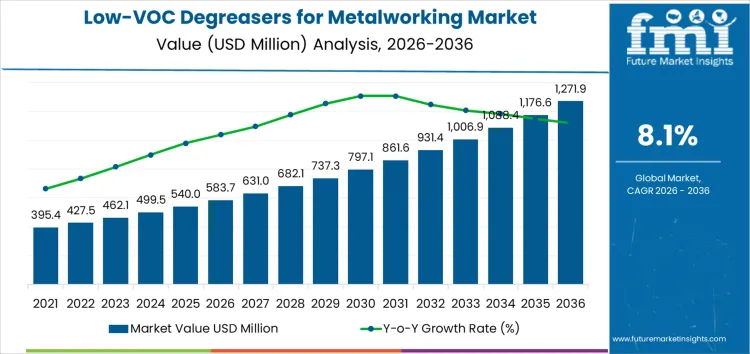
Low-VOC Degreasers for Metalworking Market Key Takeaways
| Metric | Value |
|---|---|
| Market Value (2026) | USD 583.7 million |
| Market Forecast Value (2036) | USD 1,272.0 million |
| Forecast CAGR (2026-2036) | 8.1% |
Why is the Demand for Low-VOC Degreasers for Metalworking Market Growing?
Demand for low-VOC degreasers for metalworking is growing globally due to tightening air quality regulations and heightened industry focus on occupational safety, environmental compliance, and sustainable manufacturing practices. Traditional metalworking degreasers often rely on solvents with high levels of volatile organic compounds that contribute to smog formation, toxic exposure risks, and regulatory non-compliance. Governments and environmental authorities across multiple regions enforce limits on VOC emissions and hazardous air pollutants, which motivates adoption of low-VOC formulations that meet strict environmental criteria. Automotive, aerospace, heavy machinery, and precision manufacturing sectors integrate low-VOC degreasers to maintain equipment performance while reducing worker exposure to harmful chemicals.
Clean technology and electronics production further strengthen need for solvent systems that deliver effective contaminant removal without compromising air quality standards within controlled facilities. Research and development improve performance of aqueous, terpene-based, and engineered low-VOC chemistries that support efficient removal of oils, greases, and particulate residues under varied process conditions. Corporate sustainability programs and supply chain requirements reinforce procurement of degreasers aligned with green chemistry principles. Adoption of these alternatives enhances compliance, reduces hazardous waste handling costs, and supports lifecycle performance across metalworking operations worldwide.
How Are the Segments Classified in the Low-VOC Degreasers for Metalworking Market?
Demand for low-VOC degreasers for metalworking globally is shaped by emission regulations, workplace safety standards, and substitution of solvent-intensive cleaning agents. Metalworking operators evaluate degreasing efficiency, evaporation behavior, material compatibility, and wastewater handling requirements. Adoption patterns reflect transition toward aqueous and bio-based systems across machining, fabrication, and surface preparation operations requiring compliant yet effective cleaning performance.
Which Chemical Type Represents the Largest Share of Global Demand?
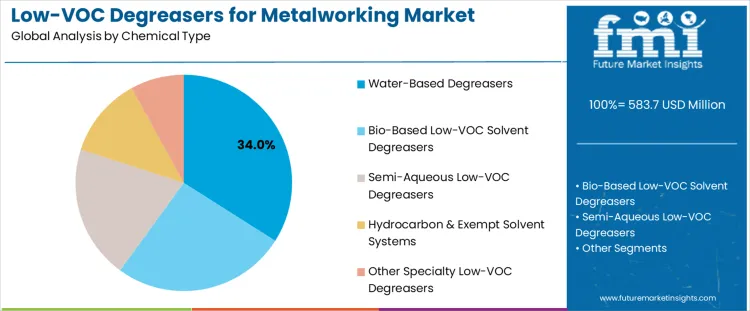
Water-based degreasers hold 34.0%, representing the largest share of global demand. These formulations support low VOC emissions, compatibility with automated cleaning systems, and reduced fire risk. Bio-based low-VOC solvent degreasers account for 26.0%, providing enhanced solvency for oils and greases with improved environmental profiles. Semi-aqueous low-VOC degreasers hold 20.0%, combining surfactants and solvents for difficult soils. Hydrocarbon and exempt solvent systems account for 12.0%, addressing niche performance requirements. Other specialty low-VOC degreasers hold 8.0%. Chemical-type distribution reflects preference for aqueous-dominant solutions under regulatory pressure.
Key Points
- Water-based degreasers lead due to compliance and safety benefits.
- Bio-based solvents enhance grease removal performance.
- Semi-aqueous systems balance solvency and low emissions.
Which Application Accounts for the Highest Share of Global Adoption?
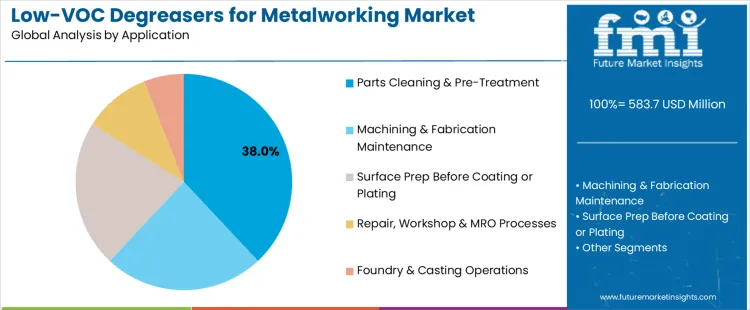
Parts cleaning and pre-treatment hold 38.0%, accounting for the highest share of global adoption. These steps are critical before machining, assembly, or coating operations. Machining and fabrication maintenance account for 24.0%, supporting routine equipment and tool cleaning. Surface preparation before coating or plating holds 22.0%, ensuring adhesion and finish quality. Repair, workshop, and MRO processes account for 10.0%, addressing maintenance needs. Foundry and casting operations hold 6.0%. Application distribution reflects concentration of degreasing demand in upstream metal preparation stages.
Key Points
- Parts cleaning dominates due to process-critical requirements.
- Machining maintenance supports operational efficiency.
- Surface preparation ensures coating and plating performance.
Which End-Use Industry Drives the Largest Share of Global Demand?
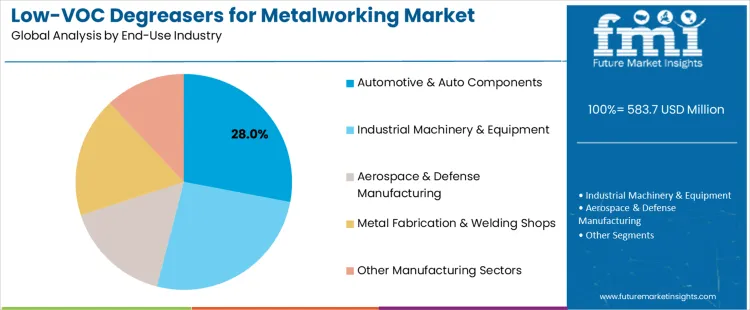
Automotive and auto components hold 28.0%, driving the largest share of global demand. These operations involve high-volume metal processing and stringent cleanliness standards. Industrial machinery and equipment account for 26.0%, requiring frequent degreasing during fabrication and assembly. Metal fabrication and welding shops hold 18.0%, supporting diverse cleaning needs. Aerospace and defense manufacturing account for 16.0%, emphasizing material compatibility and compliance. Other manufacturing sectors hold 12.0%. End-use distribution reflects alignment between metal-intensive production and adoption of compliant cleaning solutions.
Key Points
- Automotive sector leads due to scale and cleanliness standards.
- Machinery manufacturing requires routine degreasing.
- Aerospace applications emphasize controlled, low-VOC cleaning.
What are the Key Dynamics in the Low-VOC Degreasers for Metalworking Market?
Global demand rises as metalworking operations adopt low-VOC degreasers to meet tightening air quality standards, workplace safety expectations, and sustainability goals across manufacturing hubs. Low-VOC formulations support removal of oils, greases, and machining residues while reducing volatile organic compound emissions that contribute to smog formation and occupational exposure risks. Adoption spans automotive, aerospace, heavy equipment, and precision machining environments where solvent performance and compliance pressures overlap. Growth aligns with investment in advanced surface preparation, regulatory scrutiny on industrial emissions, and corporate commitments to reduce chemical footprints across production processes in diverse industrial regions worldwide.
How do regulatory air quality standards and industrial sustainability commitments shape global demand?
Air quality regulators across North America, Europe, and Asia-Pacific enforce limits on VOC emissions from industrial facilities to mitigate health and environmental impacts. Metalworking facilities respond by specifying degreasers formulated for low volatility and reduced hazard potential. Industrial sustainability initiatives and internal procurement policies emphasize safer chemical use, lifecycle impact reduction, and improved worker protection in cleaning operations. OEMs and tier suppliers integrate low-VOC degreasers into quality assurance and lean manufacturing programs where surface cleanliness affects final product performance. Public reporting and environmental certification frameworks reinforce interest in solutions that meet both performance and emissions criteria across diverse manufacturing contexts.
How do performance expectations, cost considerations, and application complexity influence market scalability?
Low-VOC degreasers must balance environmental profile with degreasing efficacy on varied soils encountered in metalworking, including cutting fluids, coolants, and particulate residues. Performance varies with substrate type, application method, and dwell time, requiring tailored selection and process tuning. Cost differentials relative to traditional solvent cleaners influence adoption timing, especially where cleaning volumes are high. Integration with automated cleaning stations, ultrasonic systems, or aqueous wash lines affects equipment and chemical interface design. Supply chain availability for specialized chemistries and regional differences in regulatory frameworks shape procurement planning. Market growth depends on continued innovation in formulations that deliver robust cleaning performance while supporting compliance and operational reliability across global manufacturing environments.
How Is Demand for Low-VOC Degreasers for Metalworking Evolving?
Demand for low-VOC degreasers for metalworking is increasing globally due to air emission regulation, worker exposure limits, and substitution of solvent-based cleaners. China leads with a 9.2% CAGR, supported by large-scale metal fabrication and enforcement of VOC controls. India follows at 8.8%, driven by automotive and engineering manufacturing growth and occupational safety enforcement. USA records a 7.4% CAGR, reflecting compliance with federal and state VOC limits in machining operations. Germany posts 6.9%, shaped by precautionary chemical regulation and efficiency-focused metal processing. Japan records 6.7%, supported by precision manufacturing standards and strict workplace air quality norms. Growth reflects global transition toward safer metal cleaning chemistries.
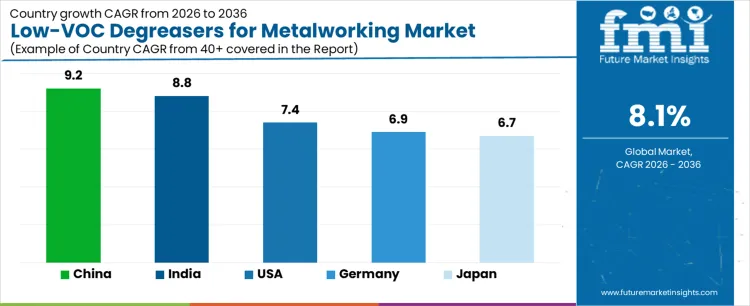
| Country | CAGR (%) |
|---|---|
| China | 9.2% |
| India | 8.8% |
| USA | 7.4% |
| Germany | 6.9% |
| Japan | 6.7% |
What factors are driving strong demand growth for low-VOC degreasers in China?
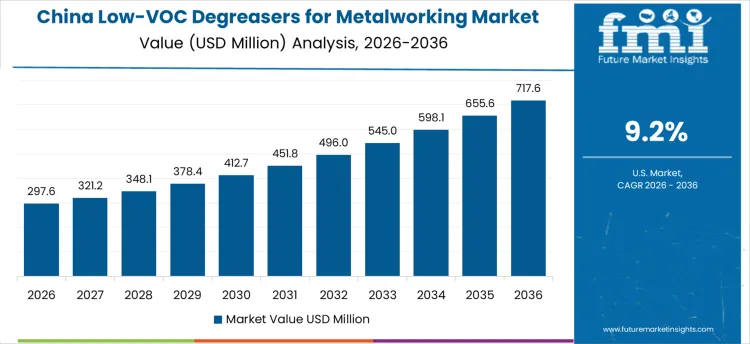
China demand is driven by extensive metalworking activity across automotive, machinery, and heavy equipment manufacturing. CAGR of 9.2% reflects replacement of solvent-rich degreasers with aqueous, semi-aqueous, and modified alcohol formulations. Environmental inspections enforce VOC emission limits within industrial parks. Centralized compliance frameworks encourage standardized degreasing solutions. High production volumes require consistent cleaning performance without emission penalties. Domestic chemical suppliers expand capacity for compliant formulations. Growth remains scale-driven and regulation-aligned, supported by industrial output and air pollution control mandates.
- Large-scale automotive and machinery manufacturing
- Enforcement of industrial VOC emission limits
- Shift toward aqueous and semi-aqueous degreasers
- Expansion of domestic compliant formulations
How is India sustaining high growth in low-VOC degreaser adoption?
India demand reflects expansion of automotive, rail, and general engineering manufacturing. CAGR of 8.8% is supported by adoption of low-VOC degreasers to meet workplace safety norms and export requirements. Export-oriented units align cleaning processes with global compliance standards. Fire safety and ventilation constraints favor low-volatility formulations. Small and mid-sized workshops adopt ready-to-use aqueous systems compatible with existing equipment. Growth remains infrastructure-led and compliance-focused, aligned with industrial growth and worker health protection.
- Growth in automotive and engineering sectors
- Export compliance and workplace safety alignment
- Preference for low-volatility formulations
- Compatibility with existing cleaning equipment
What regulatory drivers shape demand growth in the USA?
USA demand is shaped by federal and state regulations governing VOC emissions and hazardous air pollutants. CAGR of 7.4% reflects replacement of traditional solvent degreasers in machining, stamping, and fabrication operations. Facilities adopt low-VOC alkaline and neutral cleaners to comply with air permits. Occupational exposure limits influence chemical selection. Retrofit compatibility reduces adoption barriers. Growth remains regulation-driven and compliance-focused, aligned with air quality protection and worker safety objectives.
- Federal and state VOC emission regulations
- Replacement of solvent-based metal degreasers
- Occupational exposure limit compliance
- Retrofit-friendly cleaning solutions
Why does Germany show steady but controlled demand growth?
Germany demand reflects precautionary chemical regulation and emphasis on efficient metal processing. CAGR of 6.9% is supported by use of low-VOC degreasers within closed-loop and optimized cleaning systems. Manufacturers prioritize reduction of emissions and wastewater load. Integration with automated washing lines limits chemical consumption. Documentation and validation requirements guide procurement. Growth remains efficiency-led and stability-focused, aligned with established environmental and industrial safety frameworks.
- Precautionary chemical and air quality regulation
- Use within closed-loop metal cleaning systems
- Emphasis on emission and wastewater reduction
- Strong documentation and validation practices
What supports continued demand growth for low-VOC degreasers in Japan?
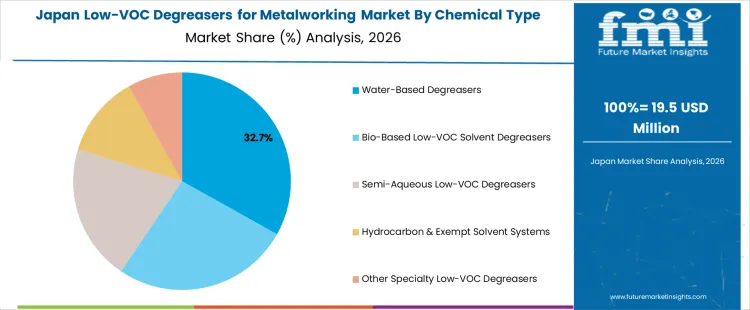
Japan demand reflects precision metalworking requirements and strict workplace air quality standards. CAGR of 6.7% is supported by adoption of low-VOC degreasers in electronics, automotive components, and tooling production. Manufacturers emphasize residue control, material compatibility, and process consistency. Regulatory oversight enforces exposure limits. Advanced monitoring enables optimized chemical use. Growth remains technology-driven and compliance-aligned, focused on quality assurance and occupational health protection.
- Precision metalworking and tooling production
- Strict workplace air quality enforcement
- Emphasis on residue control and compatibility
- Advanced monitoring and process optimization
What is the competitive landscape of demand for low-VOC degreasers for metalworking?
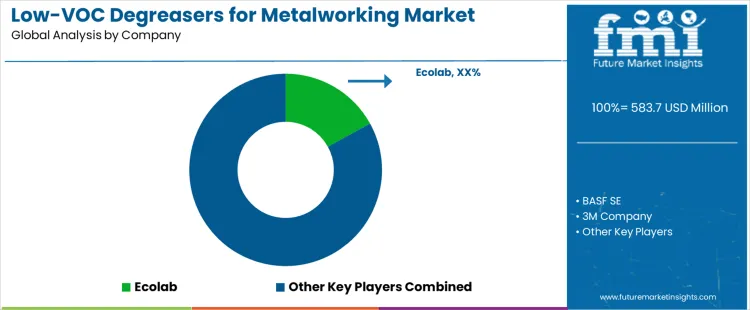
Demand for low-VOC degreasers for metalworking is driven by occupational safety standards, air emission limits, and productivity requirements across machining operations. Applications include removal of cutting fluids, lubricants, corrosion inhibitors, and particulate residues from metal parts before assembly or surface treatment. Buyers evaluate degreasing efficiency, flash point, material compatibility, residue control, and suitability for spray, immersion, and ultrasonic systems. Procurement teams prioritize compliance with global VOC regulations, reduced worker exposure risk, and stable performance under high-throughput production conditions. Trend in the global market reflects substitution of solvent-based cleaners with aqueous, semi-aqueous, and bio-derived formulations that support environmental compliance without sacrificing cleaning performance.
Ecolab maintains strong positioning through service-led metalworking cleaning programs combining low-VOC degreasers with process optimization support. BASF SE supplies specialty surfactants and solvent systems used in formulation of compliant metal cleaning solutions. 3M Company contributes engineered cleaning chemistries and surface preparation products applied in precision metalworking environments. Henkel AG & Co. KGaA supports demand with industrial cleaners integrated into broader metal pretreatment and finishing systems. ZEP Inc. participates through formulated low-VOC degreasers serving maintenance, repair, and production cleaning applications. Competitive differentiation depends on cleaning efficacy, regulatory readiness, operational safety profile, and ability to integrate with automated metalworking processes.
Key Players in the Low-VOC Degreasers for Metalworking Market
- Ecolab
- BASF SE
- 3M Company
- Henkel AG & Co. KGaA
- ZEP Inc.
Scope of the Report
| Items | Values |
|---|---|
| Quantitative Units | USD million |
| Chemical Type | Water-Based Degreasers; Bio-Based Low-VOC Solvent Degreasers; Semi-Aqueous Low-VOC Degreasers; Hydrocarbon & Exempt Solvent Systems; Other Specialty Low-VOC Degreasers |
| Application | Parts Cleaning & Pre-Treatment; Machining & Fabrication Maintenance; Surface Prep Before Coating or Plating; Repair, Workshop & MRO Processes; Foundry & Casting Operations |
| End-Use Industry | Automotive & Auto Components; Industrial Machinery & Equipment; Aerospace & Defense Manufacturing; Metal Fabrication & Welding Shops; Other Manufacturing Sectors |
| Regions Covered | Asia Pacific, Europe, North America, Latin America, Middle East & Africa |
| Countries Covered | China, India, USA, Germany, Japan, and 40+ countries |
| Key Companies Profiled | Ecolab; BASF SE; 3M Company; Henkel AG & Co. KGaA; ZEP Inc. |
| Additional Attributes | Dollar sales by chemical type and application; adoption trends for water-based and bio-based low-VOC degreasing formulations; cleaning efficiency and residue performance across machining and fabrication processes; compatibility with automated and manual metalworking cleaning systems; occupational safety, VOC compliance, and waste handling considerations; regulatory emission limits influencing degreaser formulation and selection. |
Low-VOC Degreasers for Metalworking Market by Segment
Chemical Type:
- Water-Based Degreasers
- Bio-Based Low-VOC Solvent Degreasers
- Semi-Aqueous Low-VOC Degreasers
- Hydrocarbon & Exempt Solvent Systems
- Other Specialty Low-VOC Degreasers
Application:
- Parts Cleaning & Pre-Treatment
- Machining & Fabrication Maintenance
- Surface Prep Before Coating or Plating
- Repair, Workshop & MRO Processes
- Foundry & Casting Operations
End-Use Industry:
- Automotive & Auto Components
- Industrial Machinery & Equipment
- Aerospace & Defense Manufacturing
- Metal Fabrication & Welding Shops
- Other Manufacturing Sectors
Region:
- Asia Pacific
- China
- Japan
- South Korea
- India
- Australia & New Zealand
- ASEAN
- Rest of Asia Pacific
- Europe
- Germany
- United Kingdom
- France
- Italy
- Spain
- Nordic
- BENELUX
- Rest of Europe
- North America
- United States
- Canada
- Mexico
- Latin America
- Brazil
- Chile
- Rest of Latin America
- Middle East & Africa
- Kingdom of Saudi Arabia
- Other GCC Countries
- Turkey
- South Africa
- Other African Union
- Rest of Middle East & Africa
Frequently Asked Questions
How big is the low-VOC degreasers for metalworking market in 2026?
The global low-VOC degreasers for metalworking market is estimated to be valued at USD 583.7 million in 2026.
What will be the size of low-VOC degreasers for metalworking market in 2036?
The market size for the low-VOC degreasers for metalworking market is projected to reach USD 1,271.9 million by 2036.
How much will be the low-VOC degreasers for metalworking market growth between 2026 and 2036?
The low-VOC degreasers for metalworking market is expected to grow at a 8.1% CAGR between 2026 and 2036.
What are the key product types in the low-VOC degreasers for metalworking market?
The key product types in low-VOC degreasers for metalworking market are water-based degreasers, bio-based low-VOC solvent degreasers, semi-aqueous low-VOC degreasers, hydrocarbon & exempt solvent systems and other specialty low-VOC degreasers.
Which application segment to contribute significant share in the low-VOC degreasers for metalworking market in 2026?
In terms of application, parts cleaning & pre-treatment segment to command 38.0% share in the low-VOC degreasers for metalworking market in 2026.
Preview the report firsthand - request a free sample
Get SampleGet the brochure for pricing and purchase details.
Get PDFTable of Content
- Executive Summary
- Global Market Outlook
- Demand-side Trends
- Supply-side Trends
- Technology Roadmap Analysis
- Analysis and Recommendations
- Market Overview
- Market Coverage / Taxonomy
- Market Definition / Scope / Limitations
- Market Background
- Market Dynamics
- Drivers
- Restraints
- Opportunity
- Trends
- Scenario Forecast
- Demand in Optimistic Scenario
- Demand in Likely Scenario
- Demand in Conservative Scenario
- Opportunity Map Analysis
- Product Life Cycle Analysis
- Supply Chain Analysis
- Investment Feasibility Matrix
- Value Chain Analysis
- PESTLE and Porter’s Analysis
- Regulatory Landscape
- Regional Parent Market Outlook
- Production and Consumption Statistics
- Import and Export Statistics
- Market Dynamics
- Global Market Analysis 2021 to 2025 and Forecast, 2026 to 2036
- Historical Market Size Value (USD Million) Analysis, 2021 to 2025
- Current and Future Market Size Value (USD Million) Projections, 2026 to 2036
- Y-o-Y Growth Trend Analysis
- Absolute $ Opportunity Analysis
- Global Market Pricing Analysis 2021 to 2025 and Forecast 2026 to 2036
- Global Market Analysis 2021 to 2025 and Forecast 2026 to 2036, By Chemical Type
- Introduction / Key Findings
- Historical Market Size Value (USD Million) Analysis By Chemical Type , 2021 to 2025
- Current and Future Market Size Value (USD Million) Analysis and Forecast By Chemical Type , 2026 to 2036
- Water-Based Degreasers
- Bio-Based Low-VOC Solvent Degreasers
- Semi-Aqueous Low-VOC Degreasers
- Hydrocarbon & Exempt Solvent Systems
- Other Specialty Low-VOC Degreasers
- Water-Based Degreasers
- Y-o-Y Growth Trend Analysis By Chemical Type , 2021 to 2025
- Absolute $ Opportunity Analysis By Chemical Type , 2026 to 2036
- Global Market Analysis 2021 to 2025 and Forecast 2026 to 2036, By Application
- Introduction / Key Findings
- Historical Market Size Value (USD Million) Analysis By Application, 2021 to 2025
- Current and Future Market Size Value (USD Million) Analysis and Forecast By Application, 2026 to 2036
- Parts Cleaning & Pre-Treatment
- Machining & Fabrication Maintenance
- Surface Prep Before Coating or Plating
- Repair, Workshop & MRO Processes
- Foundry & Casting Operations
- Parts Cleaning & Pre-Treatment
- Y-o-Y Growth Trend Analysis By Application, 2021 to 2025
- Absolute $ Opportunity Analysis By Application, 2026 to 2036
- Global Market Analysis 2021 to 2025 and Forecast 2026 to 2036, By End-Use Industry
- Introduction / Key Findings
- Historical Market Size Value (USD Million) Analysis By End-Use Industry, 2021 to 2025
- Current and Future Market Size Value (USD Million) Analysis and Forecast By End-Use Industry, 2026 to 2036
- Automotive & Auto Components
- Industrial Machinery & Equipment
- Aerospace & Defense Manufacturing
- Metal Fabrication & Welding Shops
- Other Manufacturing Sectors
- Automotive & Auto Components
- Y-o-Y Growth Trend Analysis By End-Use Industry, 2021 to 2025
- Absolute $ Opportunity Analysis By End-Use Industry, 2026 to 2036
- Global Market Analysis 2021 to 2025 and Forecast 2026 to 2036, By Region
- Introduction
- Historical Market Size Value (USD Million) Analysis By Region, 2021 to 2025
- Current Market Size Value (USD Million) Analysis and Forecast By Region, 2026 to 2036
- North America
- Latin America
- Western Europe
- Eastern Europe
- East Asia
- South Asia and Pacific
- Middle East & Africa
- Market Attractiveness Analysis By Region
- North America Market Analysis 2021 to 2025 and Forecast 2026 to 2036, By Country
- Historical Market Size Value (USD Million) Trend Analysis By Market Taxonomy, 2021 to 2025
- Market Size Value (USD Million) Forecast By Market Taxonomy, 2026 to 2036
- By Country
- USA
- Canada
- Mexico
- By Chemical Type
- By Application
- By End-Use Industry
- By Country
- Market Attractiveness Analysis
- By Country
- By Chemical Type
- By Application
- By End-Use Industry
- Key Takeaways
- Latin America Market Analysis 2021 to 2025 and Forecast 2026 to 2036, By Country
- Historical Market Size Value (USD Million) Trend Analysis By Market Taxonomy, 2021 to 2025
- Market Size Value (USD Million) Forecast By Market Taxonomy, 2026 to 2036
- By Country
- Brazil
- Chile
- Rest of Latin America
- By Chemical Type
- By Application
- By End-Use Industry
- By Country
- Market Attractiveness Analysis
- By Country
- By Chemical Type
- By Application
- By End-Use Industry
- Key Takeaways
- Western Europe Market Analysis 2021 to 2025 and Forecast 2026 to 2036, By Country
- Historical Market Size Value (USD Million) Trend Analysis By Market Taxonomy, 2021 to 2025
- Market Size Value (USD Million) Forecast By Market Taxonomy, 2026 to 2036
- By Country
- Germany
- UK
- Italy
- Spain
- France
- Nordic
- BENELUX
- Rest of Western Europe
- By Chemical Type
- By Application
- By End-Use Industry
- By Country
- Market Attractiveness Analysis
- By Country
- By Chemical Type
- By Application
- By End-Use Industry
- Key Takeaways
- Eastern Europe Market Analysis 2021 to 2025 and Forecast 2026 to 2036, By Country
- Historical Market Size Value (USD Million) Trend Analysis By Market Taxonomy, 2021 to 2025
- Market Size Value (USD Million) Forecast By Market Taxonomy, 2026 to 2036
- By Country
- Russia
- Poland
- Hungary
- Balkan & Baltic
- Rest of Eastern Europe
- By Chemical Type
- By Application
- By End-Use Industry
- By Country
- Market Attractiveness Analysis
- By Country
- By Chemical Type
- By Application
- By End-Use Industry
- Key Takeaways
- East Asia Market Analysis 2021 to 2025 and Forecast 2026 to 2036, By Country
- Historical Market Size Value (USD Million) Trend Analysis By Market Taxonomy, 2021 to 2025
- Market Size Value (USD Million) Forecast By Market Taxonomy, 2026 to 2036
- By Country
- China
- Japan
- South Korea
- By Chemical Type
- By Application
- By End-Use Industry
- By Country
- Market Attractiveness Analysis
- By Country
- By Chemical Type
- By Application
- By End-Use Industry
- Key Takeaways
- South Asia and Pacific Market Analysis 2021 to 2025 and Forecast 2026 to 2036, By Country
- Historical Market Size Value (USD Million) Trend Analysis By Market Taxonomy, 2021 to 2025
- Market Size Value (USD Million) Forecast By Market Taxonomy, 2026 to 2036
- By Country
- India
- ASEAN
- Australia & New Zealand
- Rest of South Asia and Pacific
- By Chemical Type
- By Application
- By End-Use Industry
- By Country
- Market Attractiveness Analysis
- By Country
- By Chemical Type
- By Application
- By End-Use Industry
- Key Takeaways
- Middle East & Africa Market Analysis 2021 to 2025 and Forecast 2026 to 2036, By Country
- Historical Market Size Value (USD Million) Trend Analysis By Market Taxonomy, 2021 to 2025
- Market Size Value (USD Million) Forecast By Market Taxonomy, 2026 to 2036
- By Country
- Kingdom of Saudi Arabia
- Other GCC Countries
- Turkiye
- South Africa
- Other African Union
- Rest of Middle East & Africa
- By Chemical Type
- By Application
- By End-Use Industry
- By Country
- Market Attractiveness Analysis
- By Country
- By Chemical Type
- By Application
- By End-Use Industry
- Key Takeaways
- Key Countries Market Analysis
- USA
- Pricing Analysis
- Market Share Analysis, 2025
- By Chemical Type
- By Application
- By End-Use Industry
- Canada
- Pricing Analysis
- Market Share Analysis, 2025
- By Chemical Type
- By Application
- By End-Use Industry
- Mexico
- Pricing Analysis
- Market Share Analysis, 2025
- By Chemical Type
- By Application
- By End-Use Industry
- Brazil
- Pricing Analysis
- Market Share Analysis, 2025
- By Chemical Type
- By Application
- By End-Use Industry
- Chile
- Pricing Analysis
- Market Share Analysis, 2025
- By Chemical Type
- By Application
- By End-Use Industry
- Germany
- Pricing Analysis
- Market Share Analysis, 2025
- By Chemical Type
- By Application
- By End-Use Industry
- UK
- Pricing Analysis
- Market Share Analysis, 2025
- By Chemical Type
- By Application
- By End-Use Industry
- Italy
- Pricing Analysis
- Market Share Analysis, 2025
- By Chemical Type
- By Application
- By End-Use Industry
- Spain
- Pricing Analysis
- Market Share Analysis, 2025
- By Chemical Type
- By Application
- By End-Use Industry
- France
- Pricing Analysis
- Market Share Analysis, 2025
- By Chemical Type
- By Application
- By End-Use Industry
- India
- Pricing Analysis
- Market Share Analysis, 2025
- By Chemical Type
- By Application
- By End-Use Industry
- ASEAN
- Pricing Analysis
- Market Share Analysis, 2025
- By Chemical Type
- By Application
- By End-Use Industry
- Australia & New Zealand
- Pricing Analysis
- Market Share Analysis, 2025
- By Chemical Type
- By Application
- By End-Use Industry
- China
- Pricing Analysis
- Market Share Analysis, 2025
- By Chemical Type
- By Application
- By End-Use Industry
- Japan
- Pricing Analysis
- Market Share Analysis, 2025
- By Chemical Type
- By Application
- By End-Use Industry
- South Korea
- Pricing Analysis
- Market Share Analysis, 2025
- By Chemical Type
- By Application
- By End-Use Industry
- Russia
- Pricing Analysis
- Market Share Analysis, 2025
- By Chemical Type
- By Application
- By End-Use Industry
- Poland
- Pricing Analysis
- Market Share Analysis, 2025
- By Chemical Type
- By Application
- By End-Use Industry
- Hungary
- Pricing Analysis
- Market Share Analysis, 2025
- By Chemical Type
- By Application
- By End-Use Industry
- Kingdom of Saudi Arabia
- Pricing Analysis
- Market Share Analysis, 2025
- By Chemical Type
- By Application
- By End-Use Industry
- Turkiye
- Pricing Analysis
- Market Share Analysis, 2025
- By Chemical Type
- By Application
- By End-Use Industry
- South Africa
- Pricing Analysis
- Market Share Analysis, 2025
- By Chemical Type
- By Application
- By End-Use Industry
- USA
- Market Structure Analysis
- Competition Dashboard
- Competition Benchmarking
- Market Share Analysis of Top Players
- By Regional
- By Chemical Type
- By Application
- By End-Use Industry
- Competition Analysis
- Competition Deep Dive
- Ecolab
- Overview
- Product Portfolio
- Profitability by Market Segments (Product/Age /Sales Channel/Region)
- Sales Footprint
- Strategy Overview
- Marketing Strategy
- Product Strategy
- Channel Strategy
- BASF SE
- 3M Company
- Henkel AG & Co. KGaA
- ZEP Inc.
- Ecolab
- Competition Deep Dive
- Assumptions & Acronyms Used
- Research Methodology


