

- Industry Size (2026)
- USD 225.3 Mn
- Forecast (2036)
- USD 476.4 Mn
- CAGR (2026 to 2036)
- 7.80%
Loyal Wingman Ghost Bat Drones Market Forecast and Outlook 2026 to 2036
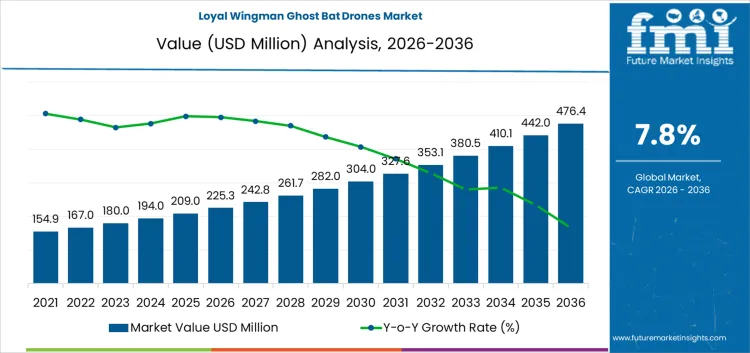
The loyal wingman Ghost Bat drones market is valued at USD 225.3 million in 2026 and is projected to reach USD 476.4 million by 2036, reflecting a CAGR of 7.8%. Market performance is shaped by advanced manufacturing, avionics integration, and regulatory approvals for military unmanned aerial systems. Cost structures are influenced by composite airframes, sensor systems, and autonomous control technologies. Pricing control is concentrated among suppliers able to deliver validated, mission-ready drones. Margin concentration favors companies that combine design, testing, and operational integration, capturing value from reliability and capability rather than unit volume.
Market outcomes depend on alignment with defense programs, government contracts, and fleet deployment schedules. Adoption varies according to military modernization strategies, operational requirements, and procurement cycles. Operators providing certified drones with proven autonomous functionality and integration achieve higher margins. Smaller or emerging suppliers face constraints from technology validation, compliance, and limited access to large-scale defense contracts. Value accrues to firms controlling production, certification, and fleet integration, while unit output alone does not determine market positioning or profitability.
Quick Stats of the Loyal Wingman Ghost Bat Drones Market
- Loyal Wingman Ghost Bat Drones Market Value (2026): USD 225.3 million
- Loyal Wingman Ghost Bat Drones Forecast Value (2036): USD 476.4 million
- Loyal Wingman Ghost Bat Drones Forecast CAGR 2026 to 2036: 7.8%
- Leading Mission Role in Loyal Wingman Ghost Bat Drones Market: ISR Escort (≈26 % share)
- Leading Autonomy Segment in Loyal Wingman Ghost Bat Drones Market: Human-On-Loop (≈44 % share)
- Key Growth Regions in Loyal Wingman Ghost Bat Drones Market: USA, UK, Australia, India
- Top Players in Loyal Wingman Ghost Bat Drones Market: Boeing Defence, Kratos Defense, General Atomics, Northrop Grumman, Airbus Defence, Turkish Aerospace Industries
What is the Growth Forecast for Loyal Wingman Ghost Bat Drones Market through 2036?
Between 2026 and 2031, the loyal wingman Ghost Bat drones market is projected to grow from USD 225.3 million to USD 304.2 million, generating an absolute increase of USD 78.9 million and reflecting a CAGR of 7.8%. Growth is driven by adoption of ISR escort, strike support, EW and decoy, and air defense penetration missions. Human-on-loop and supervised autonomy systems are primary enablers, while air forces and joint forces represent the main end users. Expansion is supported by increasing demand for force multipliers, cost-effective unmanned solutions, and advanced mission capabilities. Suppliers focus on reliability, system integration, and operational flexibility.
From 2031 to 2036, the market is expected to expand from USD 304.2 million to USD 476.4 million, adding USD 173.4 million. Growth is supported by broader adoption of high-autonomy drones, advanced mission payloads, and training platforms for air forces and allied defense programs. Market drivers include modernization of combat air capabilities, increased unmanned operations, and demand for scalable drone fleets. Competitive advantage favors companies with proven autonomous technologies, mission reliability, and strong defense partnerships. Leading companies include Boeing Defence, Kratos Defense, General Atomics, Northrop Grumman, Airbus Defence, and Turkish Aerospace Industries.
Loyal Wingman Ghost Bat Drones Market Key Takeaways
| Metric | Value |
|---|---|
| Market Value (2026) | USD 225.3 million |
| Forecast Value (2036) | USD 476.4 million |
| Forecast CAGR 2026 to 2036 | 7.80% |
What Is Driving Demand for Loyal Wingman Ghost Bat Drones?
Loyal Wingman Ghost Bat drones are increasingly adopted to enhance mission flexibility, force multiplication, and autonomous support in military operations. Historically, manned aircraft conducted all strike, reconnaissance, and surveillance missions, exposing pilots to risk and limiting operational endurance. Modern drones integrate autonomous navigation, sensor fusion, and AI-enabled mission planning to operate alongside crewed aircraft, perform complex tasks, and extend situational awareness. Defense contractors, air forces, and government agencies prioritize reliability, interoperability, and compliance with operational safety standards. Early adoption focused on experimental programs and limited operational trials, while current demand spans strategic, tactical, and surveillance missions driven by modern warfare requirements, cost efficiency, and reduced human exposure. Vehicle performance, payload capacity, and autonomy capabilities influence procurement decisions.
Increasing emphasis on unmanned systems, networked operations, and mission adaptability is shaping market growth. Compared with conventional drones, Loyal Wingman Ghost Bat platforms emphasize AI-enabled autonomy, modular payloads, and integration with existing aircraft and command networks. Cost structures depend on materials, avionics systems, and software development, concentrating margins among suppliers capable of delivering operationally certified, high-performance drones. Air forces adopt these drones to extend mission reach, reduce operational risk, and enhance real-time intelligence. By 2036, Loyal Wingman Ghost Bat drones are expected to become standard in advanced aerial operations, supporting autonomous mission execution, force efficiency, and operational resilience.
What Factors Are Shaping the Demand for Loyal Wingman Ghost Bat Drones in Terms of Mission Role and Autonomy?
The demand for Loyal Wingman Ghost Bat drones is segmented by mission role and autonomy. Mission roles include ISR escort, strike support, electronic warfare, decoy operations, air defense penetration, and training platforms. Autonomy levels cover human-on-loop, supervised autonomy, and high autonomy. Adoption is influenced by operational efficiency, tactical versatility, and integration with manned platforms. Uptake is driven by risk mitigation, fleet augmentation, and strategic flexibility. Mission role and autonomy choice depend on operational objectives, threat environment, and payload requirements, ensuring reliable, scalable, and adaptable drone performance in complex aerial operations.
Why Is ISR Escort Leading the Mission Role Segment in Loyal Wingman Ghost Bat Drones?
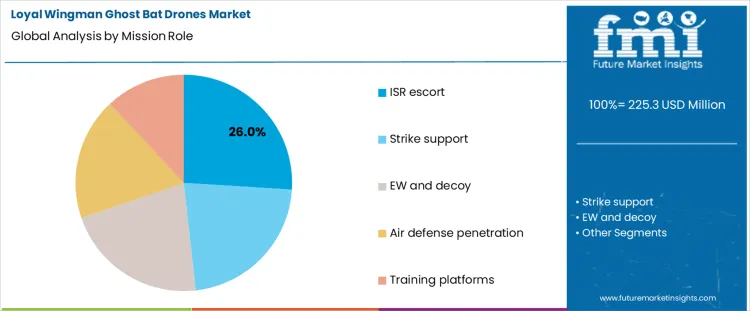
ISR escort accounts for approximately 26% of total mission role demand, making it the leading category. These drones provide continuous surveillance, threat monitoring, and situational data to manned aircraft. Adoption is driven by the need to maintain persistent coverage while reducing operational risk. ISR escort drones are equipped with electro-optical sensors, infrared cameras, and secure communication links for real-time intelligence. Mission planning includes flight path optimization, coordinated operations with manned aircraft, and automated tracking of moving targets to enhance tactical awareness and support decision-making during complex missions.
Operational factors further shape adoption. Drones must operate reliably under high-speed maneuvers, varying altitudes, and environmental conditions. Integration with command systems ensures timely data relay and sensor coordination. The segment leads because ISR escort operations provide measurable improvements in situational awareness, reduce risk to personnel, and increase mission effectiveness across military and strategic applications.
Why Is Human-On-Loop Representing the Largest Autonomy Segment in Loyal Wingman Ghost Bat Drones?
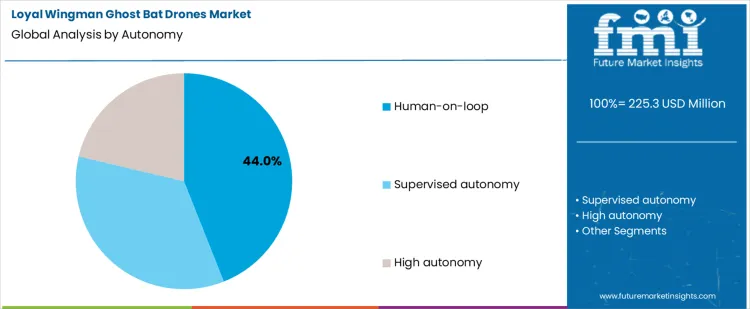
Human-on-loop autonomy accounts for approximately 44% of total autonomy demand, making it the largest category. Adoption is driven by the combination of automated functionality and human oversight, allowing operators to intervene for critical mission decisions. These drones execute ISR, strike, and decoy roles autonomously but remain under supervisory control to ensure safety and compliance. Operational protocols include real-time monitoring of telemetry, payload performance, and flight parameters. Vehicle design incorporates secure data links, intuitive control interfaces, and redundancy for safety and reliability during dynamic missions.
Operational factors further reinforce adoption. Drones must respond accurately to commands, maintain system integrity, and coordinate with manned aircraft and ground control. Redundant systems, fail-safe modes, and emergency recall capabilities ensure continuous performance. Human-on-loop autonomy leads because it balances automation with human judgment, offering operational flexibility, risk mitigation, and reliable mission performance in contested and complex air environments.
How Are Loyal Wingman Ghost Bat Drones Enhancing Military Aviation Capabilities?
Loyal Wingman Ghost Bat drones are increasingly adopted to operate alongside manned aircraft in reconnaissance, surveillance, and strike missions, extending operational reach while reducing pilot risk. Adoption is strongest in regions with advanced air forces, budget allocations for unmanned systems, and active modernization programs. Drones are valued for autonomous mission execution, modular payload flexibility, and stealth capabilities. Growth is driven by the need for force multiplication, mission adaptability, and reduced operational risk in contested airspaces. Investment focuses on AI-based flight control, low-observable materials, and secure communication networks. Operators prioritize drones that integrate seamlessly with manned platforms and enhance tactical effectiveness.
Why Are Regional Defense Modernization and Combat Readiness Initiatives Driving Demand?
Demand is influenced by government defense budgets, regional security challenges, and the strategic need for unmanned force multipliers. Militaries adopt Loyal Wingman drones to supplement manned aircraft in high-risk operations and extend reconnaissance coverage. Platforms offering autonomous navigation, interoperability with existing fleets, and modular payload adaptability gain preference. Adoption is concentrated in regions emphasizing air dominance, rapid deployment, and advanced aerial strategy. Operational readiness, tactical versatility, and risk mitigation drive procurement rather than cost. Suppliers providing validated, mission-ready drones gain a competitive advantage among defense contractors and armed forces.
What Operational and Technical Challenges Restrict Broader Deployment?
High development costs, sophisticated AI control requirements, and stealth material complexities limit adoption. Performance can be affected by communication jamming, environmental factors, and integration with manned aircraft. Certification and military testing processes extend deployment timelines. Smaller defense programs or countries with limited UAV infrastructure adopt drones more slowly. These factors concentrate early deployment among well-funded air forces, advanced defense contractors, and regions with comprehensive unmanned aerial system support.
How Are Technological Innovation and Strategic Partnerships Shaping Market Growth?
Recent innovations include AI-driven cooperative flight, modular sensor payloads, and low-observable composite structures. Collaboration between drone manufacturers, defense agencies, and research institutions ensures mission reliability, interoperability, and compliance with operational doctrines. Pilot programs test autonomous formation flying, sensor integration, and durability under combat scenarios before large-scale deployment. Focus is on operational safety, tactical effectiveness, and mission flexibility rather than cost or volume. Strategic partnerships drive adoption, enabling broader deployment of Loyal Wingman Ghost Bat drones to support modern aerial warfare and allied operational strategies.
What is the Demand for Loyal Wingman Ghost Bat Drones by Country?
| Country | CAGR (%) |
|---|---|
| USA | 8.0 |
| UK | 7.5 |
| Australia | 7.0 |
| India | 6.5 |
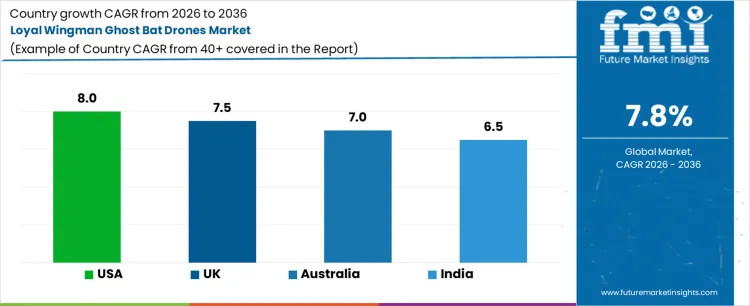
Demand for Loyal Wingman Ghost Bat drones is rising as defense organizations invest in autonomous and optionally manned unmanned aerial systems for reconnaissance, surveillance, and tactical operations. The USA leads with an 8.0% CAGR, driven by advanced military programs, adoption of AI-enabled drone swarms, and integration into existing combat fleets. The UK follows at 7.5%, supported by modernization of defense UAV capabilities and collaborative programs with allied nations. Australia records 7.0% growth, shaped by increasing defense spending and adoption of autonomous aerial platforms. India shows 6.5% CAGR, reflecting growing investment in drone technology and exploratory integration into tactical and reconnaissance missions.
How Is the United States Experiencing Growth in the Loyal Wingman Ghost Bat Drones Market?
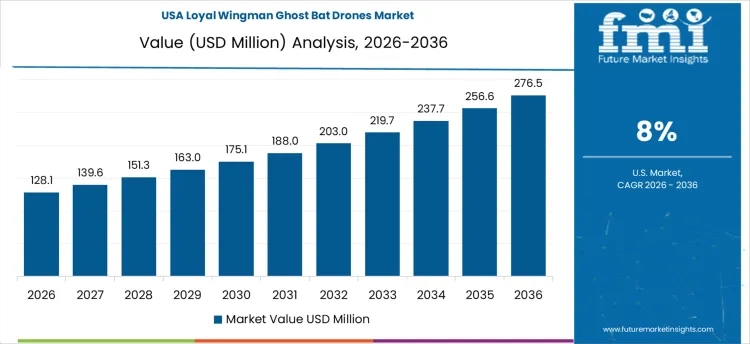
United States is experiencing growth at a CAGR of 8%, supported by adoption of Loyal Wingman Ghost Bat drones in military and defense applications for autonomous reconnaissance, force multiplication, and tactical support. Aerospace and defense contractors are producing drones optimized for endurance, stealth, and advanced sensor integration. Demand is concentrated in defense manufacturing hubs, military bases, and research and development facilities. Investments focus on material performance, autonomous system reliability, and compliance with defense standards rather than large-scale fleet expansion. Growth reflects increasing military modernization programs, industrial adoption of unmanned aerial systems, and strategic deployment of autonomous drones in operational theaters.
- Military modernization drives adoption.
- Drones optimize endurance, stealth, and sensor integration.
- Defense hubs and R&D facilities concentrate demand.
- Material performance and autonomous system reliability guide investment.
How Is the United Kingdom Witnessing Growth with Advanced Defense Programs?
United Kingdom is witnessing growth at a CAGR of 7.5%, supported by adoption of Loyal Wingman Ghost Bat drones for reconnaissance, tactical operations, and autonomous mission support in defense applications. Manufacturers and defense contractors are deploying drones optimized for stealth, operational range, and autonomous navigation. Demand is concentrated in military bases, aerospace defense hubs, and R&D centers. Investments prioritize material performance, system reliability, and regulatory compliance rather than large-scale deployment. Growth reflects defense modernization initiatives, adoption of autonomous aerial systems, and industrial focus on next-generation drone technologies.
- Advanced defense programs drive adoption.
- Drones provide stealth, operational range, and autonomy.
- Military bases and R&D centers concentrate demand.
- Material performance and system reliability guide investment.
How Is Australia Experiencing Expansion with Autonomous Drone Deployment?
Australia is experiencing growth at a CAGR of 7%, fueled by adoption of Loyal Wingman Ghost Bat drones in military applications for reconnaissance, surveillance, and force multiplication. Aerospace and defense contractors are producing drones optimized for endurance, stealth, and sensor integration. Demand is concentrated in defense bases, aerospace manufacturing hubs, and R&D facilities. Investments focus on material performance, autonomous system reliability, and compliance with defense standards rather than fleet-scale expansion. Growth reflects military modernization programs, adoption of unmanned aerial systems, and strategic deployment of autonomous drones in operational exercises.
- Autonomous drone deployment drives adoption.
- Drones optimize endurance, stealth, and surveillance capabilities.
- Defense bases and manufacturing hubs concentrate demand.
- Material performance and system reliability guide investment.
How Is India Witnessing Moderate Growth with Defense Modernization Initiatives?
India is witnessing growth at a CAGR of 6.5%, supported by adoption of Loyal Wingman Ghost Bat drones for autonomous reconnaissance, tactical support, and military operations. Defense contractors and aerospace manufacturers are deploying drones optimized for operational range, stealth, and sensor integration. Demand is concentrated in military bases, R&D centers, and defense manufacturing hubs. Investments prioritize material performance, autonomous system reliability, and compliance with defense regulations rather than large-scale deployment. Growth reflects government defense modernization programs, industrial adoption of unmanned aerial systems, and increasing integration of autonomous drones in strategic operations.
- Defense modernization drives adoption.
- Drones provide operational range, stealth, and autonomous capabilities.
- Military bases and R&D centers concentrate demand.
- Material performance and regulatory compliance guide investment.
Who Competes in the Loyal Wingman Ghost Bat Drones Market and What Defines Their Capabilities?
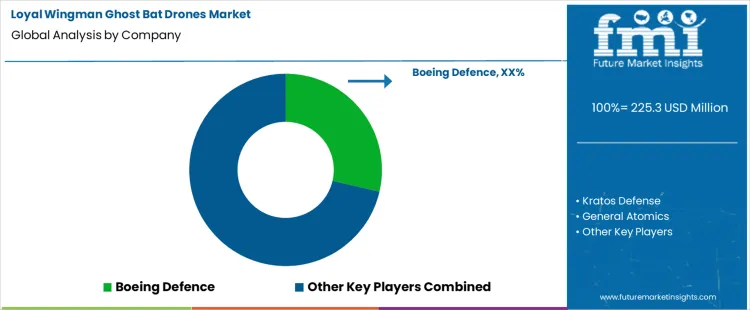
Competition in the loyal wingman Ghost Bat drones market is defined by autonomous flight systems, sensor integration, and interoperability with manned aircraft. Boeing Defence develops the Ghost Bat drone as a platform capable of operating alongside manned fighters, focusing on mission support and electronic communication links. Kratos Defense supplies unmanned air vehicles designed for autonomous operations, endurance, and integration with command and control systems. General Atomics provides UAVs with modular payload capabilities, suitable for reconnaissance and support roles. Northrop Grumman delivers autonomous drones with sensor fusion and navigation systems compatible with collaborative flight missions. Airbus Defence offers modular UAV platforms designed for mission flexibility and cooperative operations with manned aircraft.
Turkish Aerospace Industries develops autonomous drones for defense applications with focus on interoperability and mission-specific payloads. Other competitors include regional defense contractors and UAV developers supplying drones capable of autonomous or semi-autonomous flight alongside manned aircraft. Differentiation arises from flight control reliability, sensor and payload integration, endurance, and operational interoperability with existing air force platforms. Competitive positioning is shaped by technical maturity, integration capability with military systems, and compliance with airspace and operational standards. Companies with proven autonomous systems, tested integration with manned aircraft, and flexible mission payloads are considered relevant players in this segment.
Key Players in the Loyal Wingman Ghost Bat Drones Market
- Astroscale
- ClearSpace
- Northrop Grumman
- Airbus Defence & Space
- Lockheed Martin
- Thales Alenia Space
Scope of the Report
| Items | Values |
|---|---|
| Quantitative Units (2026) | USD million |
| Mission Role | ISR Escort, Strike Support, Electronic Warfare/Decoy, Air Defense Penetration, Training Platforms |
| Autonomy | Human-on-Loop, Supervised Autonomy, High Autonomy |
| End User | Air Forces, Joint Forces, Defense Agencies, Other Military Programs |
| Region | Asia Pacific, Europe, North America, Latin America, Middle East & Africa |
| Key Countries Covered | USA, UK, Australia, India, China, Japan, France, Germany, South Korea, Other |
| Key Companies Profiled | Boeing Defence, Kratos Defense, General Atomics, Northrop Grumman, Airbus Defence, Turkish Aerospace Industries |
| Additional Attributes | Dollar sales by mission role and autonomy; regional CAGR, value and volume growth projections; adoption across ISR, strike, EW, and air defense penetration missions; integration with manned aircraft and military command networks; compliance with operational safety standards; autonomous system reliability and mission repeatability; fleet deployment and training programs; sensor integration, stealth, and modular payload capabilities. |
Loyal Wingman Ghost Bat Drones Market Segmentation
- Astroscale
- ClearSpace
- Northrop Grumman
- Airbus Defence & Space
- Lockheed Martin
- Thales Alenia Space
Region
- Asia Pacific
- China
- Japan
- South Korea
- India
- Australia & New Zealand
- ASEAN
- Rest of Asia Pacific
- Europe
- Germany
- United Kingdom
- France
- Italy
- Spain
- Nordic
- BENELUX
- Rest of Europe
- North America
- United States
- Canada
- Mexico
- Latin America
- Brazil
- Chile
- Rest of Latin America
- Middle East & Africa
- Kingdom of Saudi Arabia
- Other GCC Countries
- Turkey
- South Africa
- Other African Union
- Rest of Middle East & Africa
Bibliography
U.S. Department of Defense. (2023, January 25). Department of Defense Directive 3000.09: Autonomy in Weapon Systems. Office of the Under Secretary of Defense for Policy.
Defense Innovation Unit. (2023). The Replicator Initiative (program overview). U.S. Department of Defense.
Royal Air Force. (2024, March 25). RAF Autonomous Collaborative Platform Strategy. UK Ministry of Defence.
NATO Science and Technology Organization. (2023). Meaningful Human Control of AI-based Systems Workshop (STO-MP-HFM-322): Meeting Proceedings. NATO STO.
RAND Corporation. (2023, April 26). Characterizing the Uncrewed Systems Industrial Base (RRA1474-1). RAND.
Stockholm International Peace Research Institute. (2024). SIPRI Yearbook 2024: Armaments, Disarmament and International Security. SIPRI.
Frequently Asked Questions
How big is the loyal wingman ghost bat drones market in 2026?
The global loyal wingman ghost bat drones market is estimated to be valued at USD 225.3 million in 2026.
What will be the size of loyal wingman ghost bat drones market in 2036?
The market size for the loyal wingman ghost bat drones market is projected to reach USD 476.4 million by 2036.
How much will be the loyal wingman ghost bat drones market growth between 2026 and 2036?
The loyal wingman ghost bat drones market is expected to grow at a 7.8% CAGR between 2026 and 2036.
What are the key product types in the loyal wingman ghost bat drones market?
The key product types in loyal wingman ghost bat drones market are isr escort, strike support, ew and decoy, air defense penetration and training platforms.
Which autonomy segment to contribute significant share in the loyal wingman ghost bat drones market in 2026?
In terms of autonomy, human-on-loop segment to command 44.0% share in the loyal wingman ghost bat drones market in 2026.
Preview the report firsthand - request a free sample
Get SampleGet the brochure for pricing and purchase details.
Get PDFTable of Content
- Executive Summary
- Global Market Outlook
- Demand-side Trends
- Supply-side Trends
- Technology Roadmap Analysis
- Analysis and Recommendations
- Market Overview
- Market Coverage / Taxonomy
- Market Definition / Scope / Limitations
- Market Background
- Market Dynamics
- Drivers
- Restraints
- Opportunity
- Trends
- Scenario Forecast
- Demand in Optimistic Scenario
- Demand in Likely Scenario
- Demand in Conservative Scenario
- Opportunity Map Analysis
- Product Life Cycle Analysis
- Supply Chain Analysis
- Investment Feasibility Matrix
- Value Chain Analysis
- PESTLE and Porter’s Analysis
- Regulatory Landscape
- Regional Parent Market Outlook
- Production and Consumption Statistics
- Import and Export Statistics
- Market Dynamics
- Global Market Analysis 2021 to 2025 and Forecast, 2026 to 2036
- Historical Market Size Value (USD Million) Analysis, 2021 to 2025
- Current and Future Market Size Value (USD Million) Projections, 2026 to 2036
- Y-o-Y Growth Trend Analysis
- Absolute $ Opportunity Analysis
- Global Market Pricing Analysis 2021 to 2025 and Forecast 2026 to 2036
- Global Market Analysis 2021 to 2025 and Forecast 2026 to 2036, By Mission Role
- Introduction / Key Findings
- Historical Market Size Value (USD Million) Analysis By Mission Role , 2021 to 2025
- Current and Future Market Size Value (USD Million) Analysis and Forecast By Mission Role , 2026 to 2036
- ISR escort
- Strike support
- EW and decoy
- Air defense penetration
- Training platforms
- ISR escort
- Y-o-Y Growth Trend Analysis By Mission Role , 2021 to 2025
- Absolute $ Opportunity Analysis By Mission Role , 2026 to 2036
- Global Market Analysis 2021 to 2025 and Forecast 2026 to 2036, By Autonomy
- Introduction / Key Findings
- Historical Market Size Value (USD Million) Analysis By Autonomy, 2021 to 2025
- Current and Future Market Size Value (USD Million) Analysis and Forecast By Autonomy, 2026 to 2036
- Human-on-loop
- Supervised autonomy
- High autonomy
- Human-on-loop
- Y-o-Y Growth Trend Analysis By Autonomy, 2021 to 2025
- Absolute $ Opportunity Analysis By Autonomy, 2026 to 2036
- Global Market Analysis 2021 to 2025 and Forecast 2026 to 2036, By End User
- Introduction / Key Findings
- Historical Market Size Value (USD Million) Analysis By End User, 2021 to 2025
- Current and Future Market Size Value (USD Million) Analysis and Forecast By End User, 2026 to 2036
- Air force
- Joint forces
- R&D and trials
- Air force
- Y-o-Y Growth Trend Analysis By End User, 2021 to 2025
- Absolute $ Opportunity Analysis By End User, 2026 to 2036
- Global Market Analysis 2021 to 2025 and Forecast 2026 to 2036, By Region
- Introduction
- Historical Market Size Value (USD Million) Analysis By Region, 2021 to 2025
- Current Market Size Value (USD Million) Analysis and Forecast By Region, 2026 to 2036
- North America
- Latin America
- Western Europe
- Eastern Europe
- East Asia
- South Asia and Pacific
- Middle East & Africa
- Market Attractiveness Analysis By Region
- North America Market Analysis 2021 to 2025 and Forecast 2026 to 2036, By Country
- Historical Market Size Value (USD Million) Trend Analysis By Market Taxonomy, 2021 to 2025
- Market Size Value (USD Million) Forecast By Market Taxonomy, 2026 to 2036
- By Country
- USA
- Canada
- Mexico
- By Mission Role
- By Autonomy
- By End User
- By Country
- Market Attractiveness Analysis
- By Country
- By Mission Role
- By Autonomy
- By End User
- Key Takeaways
- Latin America Market Analysis 2021 to 2025 and Forecast 2026 to 2036, By Country
- Historical Market Size Value (USD Million) Trend Analysis By Market Taxonomy, 2021 to 2025
- Market Size Value (USD Million) Forecast By Market Taxonomy, 2026 to 2036
- By Country
- Brazil
- Chile
- Rest of Latin America
- By Mission Role
- By Autonomy
- By End User
- By Country
- Market Attractiveness Analysis
- By Country
- By Mission Role
- By Autonomy
- By End User
- Key Takeaways
- Western Europe Market Analysis 2021 to 2025 and Forecast 2026 to 2036, By Country
- Historical Market Size Value (USD Million) Trend Analysis By Market Taxonomy, 2021 to 2025
- Market Size Value (USD Million) Forecast By Market Taxonomy, 2026 to 2036
- By Country
- Germany
- UK
- Italy
- Spain
- France
- Nordic
- BENELUX
- Rest of Western Europe
- By Mission Role
- By Autonomy
- By End User
- By Country
- Market Attractiveness Analysis
- By Country
- By Mission Role
- By Autonomy
- By End User
- Key Takeaways
- Eastern Europe Market Analysis 2021 to 2025 and Forecast 2026 to 2036, By Country
- Historical Market Size Value (USD Million) Trend Analysis By Market Taxonomy, 2021 to 2025
- Market Size Value (USD Million) Forecast By Market Taxonomy, 2026 to 2036
- By Country
- Russia
- Poland
- Hungary
- Balkan & Baltic
- Rest of Eastern Europe
- By Mission Role
- By Autonomy
- By End User
- By Country
- Market Attractiveness Analysis
- By Country
- By Mission Role
- By Autonomy
- By End User
- Key Takeaways
- East Asia Market Analysis 2021 to 2025 and Forecast 2026 to 2036, By Country
- Historical Market Size Value (USD Million) Trend Analysis By Market Taxonomy, 2021 to 2025
- Market Size Value (USD Million) Forecast By Market Taxonomy, 2026 to 2036
- By Country
- China
- Japan
- South Korea
- By Mission Role
- By Autonomy
- By End User
- By Country
- Market Attractiveness Analysis
- By Country
- By Mission Role
- By Autonomy
- By End User
- Key Takeaways
- South Asia and Pacific Market Analysis 2021 to 2025 and Forecast 2026 to 2036, By Country
- Historical Market Size Value (USD Million) Trend Analysis By Market Taxonomy, 2021 to 2025
- Market Size Value (USD Million) Forecast By Market Taxonomy, 2026 to 2036
- By Country
- India
- ASEAN
- Australia & New Zealand
- Rest of South Asia and Pacific
- By Mission Role
- By Autonomy
- By End User
- By Country
- Market Attractiveness Analysis
- By Country
- By Mission Role
- By Autonomy
- By End User
- Key Takeaways
- Middle East & Africa Market Analysis 2021 to 2025 and Forecast 2026 to 2036, By Country
- Historical Market Size Value (USD Million) Trend Analysis By Market Taxonomy, 2021 to 2025
- Market Size Value (USD Million) Forecast By Market Taxonomy, 2026 to 2036
- By Country
- Kingdom of Saudi Arabia
- Other GCC Countries
- Turkiye
- South Africa
- Other African Union
- Rest of Middle East & Africa
- By Mission Role
- By Autonomy
- By End User
- By Country
- Market Attractiveness Analysis
- By Country
- By Mission Role
- By Autonomy
- By End User
- Key Takeaways
- Key Countries Market Analysis
- USA
- Pricing Analysis
- Market Share Analysis, 2025
- By Mission Role
- By Autonomy
- By End User
- Canada
- Pricing Analysis
- Market Share Analysis, 2025
- By Mission Role
- By Autonomy
- By End User
- Mexico
- Pricing Analysis
- Market Share Analysis, 2025
- By Mission Role
- By Autonomy
- By End User
- Brazil
- Pricing Analysis
- Market Share Analysis, 2025
- By Mission Role
- By Autonomy
- By End User
- Chile
- Pricing Analysis
- Market Share Analysis, 2025
- By Mission Role
- By Autonomy
- By End User
- Germany
- Pricing Analysis
- Market Share Analysis, 2025
- By Mission Role
- By Autonomy
- By End User
- UK
- Pricing Analysis
- Market Share Analysis, 2025
- By Mission Role
- By Autonomy
- By End User
- Italy
- Pricing Analysis
- Market Share Analysis, 2025
- By Mission Role
- By Autonomy
- By End User
- Spain
- Pricing Analysis
- Market Share Analysis, 2025
- By Mission Role
- By Autonomy
- By End User
- France
- Pricing Analysis
- Market Share Analysis, 2025
- By Mission Role
- By Autonomy
- By End User
- India
- Pricing Analysis
- Market Share Analysis, 2025
- By Mission Role
- By Autonomy
- By End User
- ASEAN
- Pricing Analysis
- Market Share Analysis, 2025
- By Mission Role
- By Autonomy
- By End User
- Australia & New Zealand
- Pricing Analysis
- Market Share Analysis, 2025
- By Mission Role
- By Autonomy
- By End User
- China
- Pricing Analysis
- Market Share Analysis, 2025
- By Mission Role
- By Autonomy
- By End User
- Japan
- Pricing Analysis
- Market Share Analysis, 2025
- By Mission Role
- By Autonomy
- By End User
- South Korea
- Pricing Analysis
- Market Share Analysis, 2025
- By Mission Role
- By Autonomy
- By End User
- Russia
- Pricing Analysis
- Market Share Analysis, 2025
- By Mission Role
- By Autonomy
- By End User
- Poland
- Pricing Analysis
- Market Share Analysis, 2025
- By Mission Role
- By Autonomy
- By End User
- Hungary
- Pricing Analysis
- Market Share Analysis, 2025
- By Mission Role
- By Autonomy
- By End User
- Kingdom of Saudi Arabia
- Pricing Analysis
- Market Share Analysis, 2025
- By Mission Role
- By Autonomy
- By End User
- Turkiye
- Pricing Analysis
- Market Share Analysis, 2025
- By Mission Role
- By Autonomy
- By End User
- South Africa
- Pricing Analysis
- Market Share Analysis, 2025
- By Mission Role
- By Autonomy
- By End User
- USA
- Market Structure Analysis
- Competition Dashboard
- Competition Benchmarking
- Market Share Analysis of Top Players
- By Regional
- By Mission Role
- By Autonomy
- By End User
- Competition Analysis
- Competition Deep Dive
- Boeing Defence
- Overview
- Product Portfolio
- Profitability by Market Segments (Product/Age /Sales Channel/Region)
- Sales Footprint
- Strategy Overview
- Marketing Strategy
- Product Strategy
- Channel Strategy
- Kratos Defense
- General Atomics
- Northrop Grumman
- Airbus Defence
- Turkish Aerospace Industries
- Boeing Defence
- Competition Deep Dive
- Assumptions & Acronyms Used
- Research Methodology


