

- Market Size (2026)
- USD 179.2 Mn
- Forecast (2036)
- USD 537.1 Mn
- CAGR (2026 to 2036)
- 11.6%
How big is Microbial Root Coatings Market in 2026?
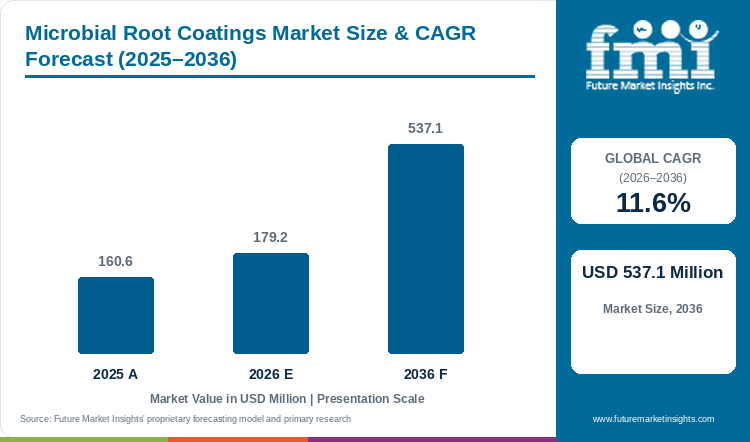
The microbial root coatings market is estimated at USD 160.6 million in 2025 and is expected to reach USD 179.2 million in 2026. Sales of microbial root coatings are projected to grow at an 11.6% CAGR between 2026 and 2036 and reach USD 537.1 million by 2036.
Adoption of microbial root coatings is moving past soybean inoculation into corn, small grains and transplanted crops, as growers place live bacteria and fungi on the seed or in the furrow at planting. In 2026, sales of microbial root coatings are expected to reach USD 179.2 million, up from an estimated USD 160.6 million a season earlier. From there, demand for microbial root coatings is forecast to rise at an 11.6% CAGR to USD 537.1 million by 2036. For example, Groundwork BioAg reported that Rootella mycorrhizal inoculant went onto 5.5 million acres in 23 commercial markets during 2025.[1] Coverage on that scale moves root coatings out of trial strips and into standard planting plans.
Two of Porter's five forces carry the most weight here. Supplier power is high, since only a handful of firms hold the strains, fermentation capacity and shelf-life data that seed treaters accept, and large crop input groups now license that know-how. For example, Syngenta agreed in July 2026 to sell Groundwork BioAg mycorrhizal technology under the Syngenta label for corn, soy, cereals and sunflower.[2] Licensing on that scale gives a strain owner access to a major grower base without building a sales force. The threat of substitutes ranks next, as mineral nitrogen and phosphate stay the default and a coating earns a place only by paying back per acre. As a result, FMI analysis shows strain owners with seed-company partners holding price, and single-product developers losing margin to the labels that resell them.
Key Market Trends & Insights
- In product type, single-strain products are expected to lead at 39.1% in 2026, with multi-strain consortia at 34.6%. Distribution of leading single strains is also changing hands. Among single-strain lines, Novonesis soybean and pulse inoculants such as Optimize, NodPro and Cell-Tech will move to Rovensa Next for United States sales from the 2027 season.[3] A specialist distributor taking over leading US soybean brands should widen retail coverage for single-strain inoculants.
- Cereals and grains are likely to hold 43.7% of crop type sales in 2026, ahead of oilseeds and pulses at 27%. Supporting the cereal lead, US corn plantings for 2025 came in 5% above 2024, according to USDA.[4] More corn acres enlarge the pool of fields that seed treaters can coat each spring.
- Soil application is projected to take 37% of 2026 application point sales, 2.5 points over seed coating, as placement beside the young root gives the organism the best start. In this segment, Pivot Bio added a dry planter box format for PROVEN G3 in November 2025.[5] A dry planter-box option removes the cold storage step, which opens soil application to retailers without cool rooms.
- Agri-input distributors are expected to carry 42.2% of sales channel demand in 2026, ahead of cooperatives at 23.4%. Seed company programs then follow at 21.6% as seed brands bundle a named inoculant with each bag.
Regional Highlights
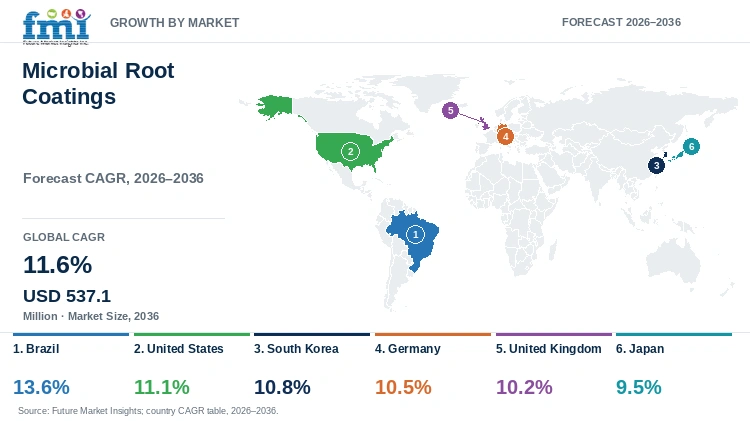
- Brazil grows fastest at 13.6% on the FMI outlook, supported by national soybean inoculation and a growing corn inoculant base.
- The United States is forecast at 11.1% on corn programs, and less than a point separates South Korea, Germany and the United Kingdom. At the low end, Japan, at 9.5%, is the only one of the six below 10%.
- Brazilian inoculation already runs at national scale. Anpii Bio member companies delivered 205.6 million inoculant doses in Brazil in the last harvest, with sales of R$ 527.5 million, Revista Cultivar reported in May 2025.[6] Volume on that scale makes inoculation a routine planting step, which supports the Brazilian lead among the six countries.
Market Size & Forecast
Table 1: Market Size and Forecast for the Microbial Root Coatings Market (USD million and percentage), 2025 to 2036
| Metric | Value |
|---|---|
| 2025 Market Size | USD 160.6 million |
| Estimated Market Size in 2026 | USD 179.2 million |
| Projected Market Size by 2036 | USD 537.1 million |
| CAGR, 2026 to 2036 | 11.6% |
| Added Revenue, 2026 to 2036 | USD 357.9 million |
| Market Expansion Multiple | 3.0x |
New formats are widening the pool of growers who can use a live inoculant at sowing. On the format side, Pivot Bio launched dry planter box versions of PROVEN G3 for corn and CERT-N for cotton in November 2025, adding a third application format.[5] Each added format lets the same strain reach growers with different planting equipment. The wider microbial seed treatment market is forecast at a 12.8% CAGR, and root coatings carry the live organisms within that group. On the FMI outlook, the microbial root coatings market nearly triples between 2026 and 2036, adding about USD 357.9 million in sales. Even so, short shelf life and uneven field response remain the main brakes on repeat orders.
Strains, Carriers and Planting Windows
Strains set the claim. For instance, a Bradyrhizobium coating on soybean or a mycorrhizal coating on corn targets one root function, and buyers compare treated and untreated strips in the same season. In Brazil, Bradyrhizobium products made up 57% of 2024 inoculant sales and 77% of doses, according to Anpii Bio data.[6] A single genus holding most doses shows how far single-strain products lead in oilseeds, and rivals need strip data to show that a second organism adds yield.
Carriers, in turn, set the logistics. Liquid inoculants need cool storage and a short window between treating and planting, and by comparison dry powders ride in the planter box. Pivot Bio says the dry carrier for PROVEN G3 adds micronutrients for early growth and root development.[5] Consequently, treaters and retailers will stock both forms through the planting window.
Table 2: Strain, Acreage and Channel Indicators for the Microbial Root Coatings Market (doses, acres and agreements), 2025 to 2026
| Indicator | Data Point | Relevance | Source |
|---|---|---|---|
| Rootella applied acreage, 2025 | 5.5 million acres in 23 markets | Scale of mycorrhizal root coating use | [1] |
| Brazil inoculant doses, last harvest (reported May 2025) | 205.6 million doses; R$ 527.5 million sales | Soybean and corn inoculation base | [6] |
| Bradyrhizobium share of Brazil doses, 2024 | 77% of doses; 57% of sales | Single-strain lead in oilseeds | [6] |
| Pivot Bio dry formats, November 2025 | PROVEN G3 Dry and CERT-N Dry | Planter box application point | [5] |
| Syngenta and Groundwork BioAg, July 2026 | Own-label mycorrhizal technology | Seed company and major channel reach | [2] |
| Rovensa Next and Novonesis, June 2026 | US inoculant sales from 2027 season | Distributor channel for soybean and pulse inoculants | [3] |
Analyst Perspective
“A grower judges a root coating on one strip at harvest, so the evidence has to come from the farm and not from the greenhouse. Suppliers that pair a named strain with a dry carrier, a stated shelf life and local strip data will keep reorders, and dry formats are opening a fresh lane for planter-box inoculants among retailers who never kept a cold room. My advice to seed companies is to license proven strains early and print viable counts at use on every bag, since a dead inoculant costs the brand more than the sale.”
- Nikhil Kaitwade, Principal Consultant, Future Market Insights.
How is the microbial root coatings market segmented?
The market is segmented into product type, crop type, application point, sales channel, and region. Single-strain products are expected to lead product type with 39.1% share in 2026, and cereals and grains lead crop type with 43.7%.
By product type: single-strain products, multi-strain consortia, and microbe and nutrient blends.
By crop type: cereals and grains, oilseeds and pulses, fruits and vegetables, and turf and ornamentals.
By application point: soil application, seed coating, transplant root dip, and fertigation.
By sales channel: agri-input distributors, cooperatives, seed company programs, and direct to grower.
By region: growers, seed companies, treaters and nurseries in North America, Latin America, Western Europe, Eastern Europe, East Asia, South Asia and Pacific, and Middle East and Africa.
Why do single-strain products lead microbial root coatings sales by product type?
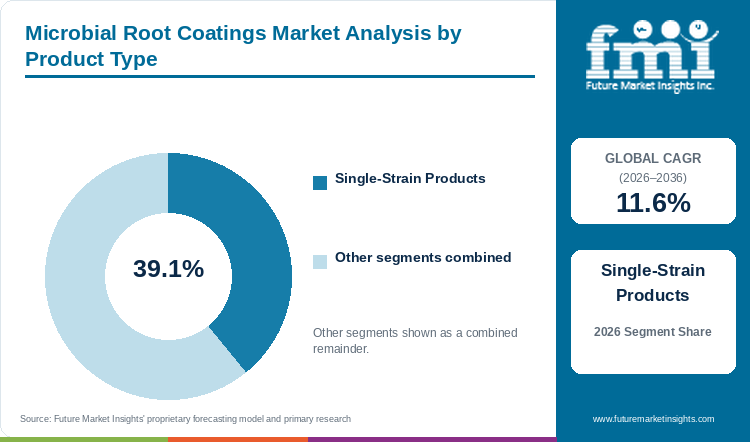
Single-strain products are expected to lead product type sales with 39.1% share in 2026, ahead of multi-strain consortia at 34.6% and microbe and nutrient blends at 26.3%.
Table 3: Product Type Share for the Microbial Root Coatings Market (percentage share), 2026
| Product Type | Estimated Share (2026) |
|---|---|
| Single-Strain Products | 39.1% |
| Multi-Strain Consortia | 34.6% |
| Microbe and Nutrient Blends | 26.3% |
| Total | 100.0% |
Table 4: Product Type Leadership and Market Growth for the Microbial Root Coatings Market (segment and CAGR percentage), 2026 to 2036
| Metric | Value |
|---|---|
| Global CAGR (2026 to 2036) | 11.6% |
| Leading Segment | Single-Strain Products |
Single-strain products are expected to hold 39.1% of product type demand in 2026, with one named organism and one root function on the label. Soybean rhizobia and single mycorrhizal species, in particular, are easy to count on the seed and easy to compare in a strip trial. On the other hand, multi-strain consortia, about 34.6%, pair a nitrogen fixer with a phosphorus mobiliser or a fungus, and need proof that the strains survive together in one pack. Meanwhile, microbe and nutrient blends, an estimated 26.3%, add micronutrients or starter fertility to the carrier and blur the line with plain fertilizer. Live microbes belong to the broader biofertilizers market, which is projected at an 8.5% CAGR. Oilseed inoculation gives the leading segment a deep base. Among single strains, Bradyrhizobium alone made up 77% of inoculant doses delivered in Brazil in 2024.[6] That concentration ties single-strain makers to the soybean cycle, so a weak soybean season would hit the segment first.
- Soybean rhizobia, single Glomus or Rhizophagus mycorrhizae and single Bacillus strains form the bulk of the segment.
- Makers are separating production from field sales. Under the June 2026 agreement, Rovensa Next will sell Optimize, NodPro and Cell-Tech soybean inoculants, and Novonesis keeps manufacturing them.[3] The split lets Novonesis focus on strains and fermentation and gives the brands a sales team built for retail.
Why do cereals and grains lead microbial root coatings sales by crop type?
Cereals and grains are likely to lead crop type sales with 43.7% share in 2026, with oilseeds and pulses at 27%, fruits and vegetables at 17.5% and turf and ornamentals at 11.8%.
Table 5: Crop Type Share for the Microbial Root Coatings Market (percentage share), 2026
| Crop Type | Estimated Share (2026) |
|---|---|
| Cereals and Grains | 43.7% |
| Oilseeds and Pulses | 27% |
| Fruits and Vegetables | 17.5% |
| Turf and Ornamentals | 11.8% |
| Total | 100.0% |
With the largest planted area of any crop group, cereals and grains are set to make up 43.7% of crop demand in 2026. In Germany, the cereal area for the 2025 harvest was about 5.86 million hectares, 3.2% above 2024, per Destatis.[7] A larger cereal area in a key European market adds fields for seed treaters to coat each autumn and spring. Oilseeds and pulses, about 27%, have the longest inoculation habit, as soybean and pea growers have coated seed with rhizobia for decades. Fruits and vegetables hold 17.5% and use root dips at transplanting. Lastly, turf and ornamentals, an estimated 11.8%, rely on nursery and sod growers who treat pots and new lawns.
- Corn, wheat, barley and rice carry most cereal treatments, with mycorrhizae and nitrogen-fixing bacteria the main organisms.
- Winter cereals gained the most ground in Germany. Winter wheat reached about 2.78 million hectares in Germany for the 2025 harvest, 12.2% more than a year earlier.[7] Autumn-sown wheat on that scale gives seed treaters a second annual window for root coatings.
Why does soil application lead microbial root coatings sales by application point?
Soil application is projected to lead application point sales with 37% share in 2026, ahead of seed coating at 34.5%, transplant root dip at 16.3% and fertigation at 12.2%.
Table 6: Application Point Share for the Microbial Root Coatings Market (percentage share), 2026
| Application Point | Estimated Share (2026) |
|---|---|
| Soil Application | 37% |
| Seed Coating | 34.5% |
| Transplant Root Dip | 16.3% |
| Fertigation | 12.2% |
| Total | 100.0% |
Soil application is projected to keep the lead, at 37% of 2026 placements, as in-furrow and planter-box placement puts the organism beside the young root. Seed coating, about 34.5%, fits seed companies and downstream treaters who apply the inoculant with the other seed treatments, though shelf life on coated seed is shorter. Further down, transplant root dip, an estimated 16.3%, serves vegetable, fruit and tree nurseries that soak plug roots before setting. Fertigation holds 12.2% and is used in drip-irrigated orchards and greenhouses. Format choice is also widening within soil application. Back in the soil segment, Pivot Bio now sells PROVEN G3 in three formats, including a dry planter box treatment for corn.[5] Three formats for one product let retailers match the treatment to each planter, which supports the segment lead.
- In-furrow liquids, planter-box powders and soil drenches at sowing make up most soil applications.
- Cost per acre is the main selling point for nitrogen-fixing coatings. Pivot Bio says PROVEN G3 costs about 30 percent less per acre than synthetic nitrogen inputs.[5] A saving of that size gives corn growers a direct reason to reorder, provided yields hold.
Why do agri-input distributors lead microbial root coatings sales by sales channel?
Agri-input distributors are expected to lead sales channel sales with 42.2% share in 2026, ahead of cooperatives at 23.4%, seed company programs at 21.6% and direct to grower at 12.8%.
Table 7: Sales Channel Share for the Microbial Root Coatings Market (percentage share), 2026
| Sales Channel | Estimated Share (2026) |
|---|---|
| Agri-Input Distributors | 42.2% |
| Cooperatives | 23.4% |
| Seed Company Programs | 21.6% |
| Direct to Grower | 12.8% |
| Total | 100.0% |
Agri-input distributors hold agronomists, cold storage and seasonal delivery routes, and are expected to carry 42.2% of channel sales in 2026. Next, cooperatives, about 23.4%, sell inoculants to members along with seed and fertilizer. Seed company programs account for an estimated 21.6%, as seed brands coat or bundle a named inoculant with each bag. By comparison, direct to grower sales hold 12.8% and suit large farms that buy in bulk from the developer. Makers are also handing field sales to specialist distributors. Alongside these routes, Rovensa Next will take over direct commercial responsibility for nine Novonesis inoculant and biological brands in the United States.[3] A distributor-led model for nine brands moves more volume into the agri-input channel.
- Ag retailers, regional distributors and custom applicators handle most distributor volume.
- Strain owners are using major labels to reach distributor shelves. Groundwork BioAg keeps manufacturing and supply under the July 2026 Syngenta deal, with Syngenta selling under the Syngenta label.[2] The Syngenta label carries the product into distributor networks beyond the reach of a specialist acting alone.
What are the drivers, restraints, and opportunities in the microbial root coatings market?
Fertilizer costs and nutrient rules push growers toward live root inoculants. Short shelf life and uneven field response slow repeat orders, and dry formats with seed-company partners widen the buyer base.
- Driver: Growers look for root inoculants that cut nitrogen or phosphate rates, and seed companies want branded treatments that set a bag apart.
- Restraint: Live organisms lose count in storage and on treated seed, and field response varies with soil, moisture and native microbes.
- Opportunity: Dry carriers, planter-box formats and licensed strains sold under major seed and crop input labels can reach growers outside trial programs.
Nutrient Costs Keep Growers Testing Inoculants
A root coating earns a reorder when the yield or fertilizer saving covers the product and the extra handling. For example, Anpii Bio member companies delivered 205.6 million inoculant doses in Brazil in the last harvest and expected 12.4% growth in 2025.[6] A double-digit growth outlook on that base shows that inoculants have become a routine input for Brazilian growers. Likewise, US growers planted 5% more corn in 2025, which adds acres to every corn inoculant program.[4] More corn acres and steady Brazilian dose growth together keep reorders rising in both countries.
Shelf Life and Field Variability Slow Repeat Orders
Viable counts fall from the day of formulation, and a coated seed lot that waits in a warehouse loses part of the claim. At the same time, native soil microbes compete with the inoculant, so response differs across fields. FMI analysis shows this gap affecting liquid seed-applied products hardest. Regulators are now asking for proof behind each claim. Japan issued labeling guidelines for biostimulants in May 2025 that ask suppliers to check the evidence behind each stated effect.[8] Therefore, buyers will ask for counts at use and replicated local data.
Dry Formats and Licensed Strains Reach New Growers
Dry carriers and planter-box powders remove the cold chain from the retailer shelf. In this vein, Pivot Bio expected the dry formats to sell out for the 2026 planting season.[5] A sell-out forecast in the first season shows retailers ready to stock live microbes once cold storage is no longer needed. Alongside this, licensing deals put strains in front of growers who already buy from a major brand, as Syngenta now sells Groundwork BioAg technology under the Syngenta name.[2] As a result, developers with strains and no field sales force will license more.
Which country CAGRs are profiled in the microbial root coatings market?
Table 8: Country CAGR Comparison for the Microbial Root Coatings Market (CAGR percentage), 2026 to 2036
| Country | CAGR (2026 to 2036) |
|---|---|
| Brazil | 13.6% |
| United States | 11.1% |
| South Korea | 10.8% |
| Germany | 10.5% |
| United Kingdom | 10.2% |
| Japan | 9.5% |
How do country-level CAGRs compare in the microbial root coatings market?
Brazilian soybean growers inoculate on a national scale, and the FMI outlook has Brazil growing fastest, at 13.6%, 2 points over the global rate. The United States grows at 11.1%, half a point short of the 11.6% rate for the market as a whole, with corn programs run through cooperatives and seed brands. Below that, South Korea and Germany are 0.3 points apart, at 10.8% and 10.5%, one on paddy rice and the other on wheat and barley. Finally, British growth comes in at 10.2%, and Japan, at 9.5%, waits for evidence under the new biostimulant labeling rules.
- Brazilian growers already inoculate most soybean lots, and corn and pasture adoption now adds volume, so suppliers with Azospirillum strains for grasses gain the next wave of orders.
- US corn growers want inoculants that ride in the planter box, which shifts demand toward dry formats; seed brands and distributors offering bundled programs collect most of that volume.
- With paddy area shrinking, Korean demand moves toward seedling trays for rice and vegetables, a small-volume niche that favours suppliers with root-dip formulations and local trial data.
- More winter wheat and less maize in Germany push treaters to add root coatings to cereal seed recipes. Strains that qualify under EU fertilising product rules have the clearest route to market.
- A sharp rise in English oilseed rape area moves seed treatment orders toward brassica seed, and merchants running local strip trials decide which coatings get recommended.
- New biostimulant labeling guidelines in Japan ask for evidence behind each claim. Sales therefore build slowly, and suppliers holding domestic trial data reach growers first.
Full report country CAGRs cover: every standard country by region, with Brazil, the United States, South Korea, Germany, the United Kingdom and Japan as key markets, from soybean inoculation at the top of the range to new labeling rules at the bottom.
Country-wise Analysis
Brazil Microbial Root Coatings Market Outlook (2026 to 2036)
Brazil has the deepest inoculation habit of the six countries. Anpii Bio member companies delivered 205.6 million inoculant doses in the last harvest, with sales of R$ 527.5 million.[6] Azospirillum products accounted for 29% of 2024 sales, and corn already represents 16% of the inoculant market.[6] Both shares show inoculation spreading from soybean into grasses, which widens the grower base for root coatings. Brazilian demand for microbial root coatings is set to compound at 13.6% a year as corn and pasture growers copy the soybean habit of coating every seed lot.
Key takeaway: Soybean habits spread to corn in Brazil.
United States Microbial Root Coatings Market Outlook (2026 to 2036)
US demand turns on corn acres. USDA put 2025 corn plantings 5% above 2024 and soybean plantings 4% lower.[4] More corn and fewer soybeans move inoculant volume toward corn programs. On the supply side, Rovensa Next will sell Novonesis soybean, corn, pulse and peanut inoculants across the country from the 2027 season.[3] Wider distributor coverage from 2027 should bring those inoculants to more retail counters. Per FMI, sales of microbial root coatings in the United States will grow at 11.1%, led by planter-box and seed-applied corn treatments.
Key takeaway: Corn programs and new distributor deals widen US reach.
South Korea Microbial Root Coatings Market Outlook (2026 to 2036)
South Korean rice farming is contracting. Rice area in South Korea fell 2.9% to 678,000 hectares in 2025, the lowest level since data collection began.[9] A smaller rice area limits field-scale volume, so suppliers focus on seedling trays. Those flooded paddies change soil oxygen and test how well a root inoculant colonizes young roots. Seedling-tray dips for transplanted rice and vegetables are the main entry point, and South Korean sales of microbial root coatings are forecast to rise 10.8% a year.
Key takeaway: Tray-grown rice seedlings open South Korea to root dips.
Germany Microbial Root Coatings Market Outlook (2026 to 2036)
German crop rotation is shifting from maize toward wheat. Destatis estimated grain maize at 484,500 hectares and silage maize at 1.94 million hectares for the 2025 harvest, both below 2024.[7] Winter wheat expanded instead, so cereal seed treaters add mycorrhizal and Bacillus coatings to standard recipes. FMI projects a 10.5% CAGR for Germany, with EU fertilising product rules deciding which strains qualify.
Key takeaway: Growth in Germany runs through cereal seed treaters.
United Kingdom Microbial Root Coatings Market Outlook (2026 to 2036)
English rotations swung toward oilseed rape in 2026. Oilseed rape area in England rose 36% to 276 thousand hectares in 2026, and wheat area fell 1.8%, Defra reported in October 2026.[10] This mix of more rape and fewer cereals shifts seed treatment orders toward brassica seed. Seed merchants and distributors running local strip trials guide British demand, which is projected to rise 10.2% a year.
Key takeaway: Rotation changes steer treatments in the United Kingdom.
Japan Microbial Root Coatings Market Outlook (2026 to 2036)
Japan has set clearer rules for biostimulant claims. MAFF issued labeling guidelines for biostimulants on 30 May 2025, covering the definition, effect claims, supporting evidence and safety.[8] As a result, suppliers of microbial products in Japan now state each effect together with the crop and the test that backs the claim. With rice and greenhouse growers waiting for domestic trial data, Japanese demand is likely to rise 9.5% a year, the lowest of the six country rates.
Key takeaway: Japan waits on domestic trial evidence.
Who are the notable companies in the microbial root coatings market?
Novonesis, Lallemand Plant Care, Rizobacter, Rovensa Next, Syngenta, Groundwork BioAg, Valent BioSciences, Pivot Bio, Kula Bio, Locus Agricultural Solutions and Indigo Ag are the profiled companies.
Suppliers fall into inoculant majors, mycorrhizal specialists and developers of nitrogen-fixing and seed-applied bacteria. Groundwork BioAg reports Rootella use on 5.5 million acres in 2025.[1] Acreage on that scale makes Groundwork BioAg the reference supplier for mycorrhizal coatings. On the bacteria side, Pivot Bio added dry planter box formats in November 2025.[5] Dry formats give the company a retail route without cold storage. Meanwhile, Novonesis keeps manufacturing soybean and pulse inoculants that Rovensa Next will sell in the United States.[3] The split lets Novonesis concentrate on strain output and Rovensa Next on field sales. FMI analysis places Lallemand Plant Care, Rizobacter, Valent BioSciences, Kula Bio, Locus Agricultural Solutions and Indigo Ag in the same supplier group.
- Inoculant majors: Novonesis, Lallemand Plant Care, Rizobacter, Rovensa Next and Syngenta.
- Mycorrhizal specialists: Groundwork BioAg and Valent BioSciences.
- Nitrogen-fixing and seed-applied bacteria developers: Pivot Bio, Kula Bio, Locus Agricultural Solutions and Indigo Ag.
Competitive Benchmarking: Microbial Root Coatings Market
Table 9: Competitive Benchmarking for the Microbial Root Coatings Market (qualitative ratings), 2026
| Company | Strain Ownership | Dry or Planter-Box Format | Channel Partners | Recent Activity |
|---|---|---|---|---|
| Groundwork BioAg | High | Medium | High | High |
| Pivot Bio | High | High | Medium | Medium |
| Novonesis | High | Low | High | High |
| Syngenta | Low | Low | High | High |
| Rovensa Next | Low | Low | High | High |
Ratings compare the companies on strain ownership, dry or planter-box formats and channel partners.
Key Developments in the Microbial Root Coatings Market
- Syngenta will sell Groundwork BioAg mycorrhizal technology under the Syngenta label, the two companies announced on 14 July 2026, which brings specialist strains into a major crop input channel.[2]
- Groundwork BioAg's update of 24 June 2026 showed Rootella use on 5.5 million acres across 23 commercial markets in 2025, evidence that mycorrhizal coatings have moved past trial scale.[1]
- On 11 June 2026, Novonesis named Rovensa Next to commercialize Optimize, NodPro, TagTeam, JumpStart and other inoculants in the United States from the 2027 season; for US retailers, this means a new commercial partner for leading soybean brands.[3]
- Pivot Bio launched PROVEN G3 Dry for corn and CERT-N Dry for cotton as planter box treatments in a 13 November 2025 release, opening corn and cotton retail to dry inoculants.[5]
- On 30 May 2025, MAFF issued labeling guidelines for biostimulants in Japan, which raises the evidence bar for microbial product claims.[8]
Key Players in the Microbial Root Coatings Market
Inoculant Majors
- Novonesis
- Lallemand Plant Care
- Rizobacter
- Rovensa Next
- Syngenta
Mycorrhizal Specialists
- Groundwork BioAg
- Valent BioSciences
Nitrogen-Fixing and Seed-Applied Bacteria Developers
- Pivot Bio
- Kula Bio
- Locus Agricultural Solutions
- Indigo Ag
Microbial Root Coatings Market - Report Scope
Table 10: Report Scope for the Microbial Root Coatings Market (coverage fields and definitions), 2026 to 2036
| Coverage field | Report scope |
|---|---|
| Market breakdown | Product type; crop type; application point; sales channel; region |
| Quantitative units | USD million |
| Market definition | Formulated live bacterial and fungal inoculants applied as a coating on seed, as a dip on transplant roots, or into the root zone at planting through in-furrow, planter-box, drench or fertigation placement, so that the organisms colonize crop roots. Foliar biologicals, non-microbial biostimulants, seed polymers and hydration coatings without live organisms, fertilizers, application equipment and carbon credits are excluded. |
| Regions covered | North America; Latin America; Western Europe; Eastern Europe; East Asia; South Asia and Pacific; Middle East and Africa |
| Countries covered | United States; Canada; Brazil; Mexico; Argentina; Chile; Germany; France; United Kingdom; Italy; Spain; Benelux; Nordics; Poland; Czech Republic; Romania; Hungary; China; Japan; South Korea; India; ASEAN; Australia and New Zealand; GCC Countries; South Africa; Türkiye; Israel |
| Key companies profiled | Novonesis, Lallemand Plant Care, Rizobacter, Rovensa Next, Syngenta, Groundwork BioAg, Valent BioSciences, Pivot Bio, Kula Bio, Locus Agricultural Solutions, Indigo Ag |
| Forecast period | 2026 to 2036 |
Microbial Root Coatings Market - Research Methodology
Table 11: Research Methodology for the Microbial Root Coatings Market (research methods and approach), 2026 edition
| Method | Approach |
|---|---|
| Data Sources | Company results, industry associations, government statistics and trade publications. |
| Desk Research | Desk research covers strains, carriers, application points, planted area and distribution agreements. |
| Market Sizing and Forecasting | Sizing starts from the 2026 base of USD 179.2 million and the 11.6% CAGR for 2026 to 2036. |
| Data Validation | Figures are cross-checked across company, industry and government sources. |
Microbial Root Coatings Market by Segments
Microbial Root Coatings Market segmented by Product Type:
- Single-Strain Products
- Multi-Strain Consortia
- Microbe and Nutrient Blends
Microbial Root Coatings Market segmented by Crop Type:
- Cereals and Grains
- Oilseeds and Pulses
- Fruits and Vegetables
- Turf and Ornamentals
Microbial Root Coatings Market segmented by Application Point:
- Soil Application
- Seed Coating
- Transplant Root Dip
- Fertigation
Microbial Root Coatings Market segmented by Sales Channel:
- Agri-Input Distributors
- Cooperatives
- Seed Company Programs
- Direct to Grower
Microbial Root Coatings Market by Region
- North America
- United States
- Canada
- Latin America
- Brazil
- Mexico
- Argentina
- Chile
- Western Europe
- Germany
- France
- United Kingdom
- Italy
- Spain
- Benelux
- Nordics
- Eastern Europe
- Poland
- Czech Republic
- Romania
- Hungary
- East Asia
- China
- Japan
- South Korea
- South Asia and Pacific
- India
- ASEAN
- Australia and New Zealand
- Middle East and Africa
- GCC Countries
- South Africa
- Türkiye
- Israel
Research Sources and Bibliography
- [1] Groundwork BioAg. (2026, June 24). Groundwork BioAg Issues First Verified Carbon Credits Under Rootella Carbon Program. https://groundworkbioag.com/groundwork-bioag-issues-first-verified-carbon-credits-under-rootella-carbon-program/
- [2] Groundwork BioAg. (2026, July 14). Syngenta and Groundwork BioAg Enter Partnership to Bring Innovation in Biologicals and Soil Carbon Solutions to Farmers. https://groundworkbioag.com/syngenta-and-groundwork-bioag-enter-partnership-to-bring-innovation-in-biologicals-and-soil-carbon-solutions-to-farmers/
- [3] Novonesis. (2026, June 11). Rovensa Next to distribute Novonesis biosolutions for Plant Health in the United States. https://www.novonesis.com/en/news/rovensa-next-distribute-novonesis-biosolutions-plant-health-united-states
- [4] U.S. Department of Agriculture, National Agricultural Statistics Service. (2025, June 30). Corn planted acreage up 5% from 2024, soybean acreage down 4% from last year. https://www.nass.usda.gov/Newsroom/2025/06-30-2025.php
- [5] Pivot Bio. (2025, November 13). Pivot Bio Expands Weatherproof Nitrogen Portfolio with New Dry Planter Box Treatments for Corn and Cotton. https://www.pivotbio.com/?p=4626
- [6] Revista Cultivar. (2025, May 23). Gramíneas são novo foco para os inoculantes biológicos. https://revistacultivar.com.br/noticias/gramineas-sao-novo-foco-para-os-inoculantes-biologicos
- [7] Statistisches Bundesamt (Destatis). (2025, May 19). Leichter Anstieg der Getreideanbaufläche zur Ernte 2025 nach Tiefststand im Vorjahr. https://www.destatis.de/DE/Presse/Pressemitteilungen/2025/05/PD25_177_412.html
- [8] Ministry of Agriculture, Forestry and Fisheries, Japan. (2025, May 30). Guidelines on labeling and related matters for biostimulants. https://www.maff.go.jp/j/press/syouan/nouan/250530.html
- [9] Korea JoongAng Daily. (2025, November 13). Rice production falls for fourth consecutive year. https://www.koreajoongangdaily.com/news/2025-11-13/business/economy/Rice-production-falls-for-fourth-consecutive-year/2453607
- [10] Department for Environment, Food & Rural Affairs. (2026, October 8). Provisional cereal and oilseed production estimates for England 2026. https://www.gov.uk/government/statistics/cereal-and-oilseed-rape-production/provisional-cereal-and-oilseed-production-estimates-for-england-2026
This bibliography is provided for reader reference. The full report contains the complete reference list and detailed citations.
This Report Answers
- How big is the microbial root coatings market during 2026?
- What market size is projected by 2036?
- Which product type holds notable share?
- Which crop type holds notable share?
- Which countries have notable growth?
- Which companies are notable in the market?
Frequently Asked Questions
How large is the microbial root coatings market expected in 2026?
FMI puts the microbial root coatings market at USD 179.2 million in 2026, from an estimated USD 160.6 million in 2025. Sales of microbial root coatings are projected to reach USD 537.1 million by 2036.
What CAGR is projected for the microbial root coatings market through 2036?
Sales of microbial root coatings are forecast to grow at an 11.6% CAGR through 2036. Fertilizer savings, dry planter-box formats and licensing deals with seed and crop input majors support that pace.
Which product type holds a notable market share in 2026?
Single-strain products are expected to hold 39.1% of product type sales in 2026, 4.5 points ahead of multi-strain consortia.
Which crop type holds a notable market share in 2026?
Cereals and grains are likely to account for 43.7% of crop type sales in 2026, against 27% for oilseeds and pulses.
Which country has a notable expansion outlook through 2036?
FMI projects the fastest growth for Brazil, at a 13.6% CAGR. The United States follows at 11.1%.
Who are the key companies in the microbial root coatings market?
Novonesis, Lallemand Plant Care, Rizobacter, Rovensa Next and Syngenta form the inoculant majors. Groundwork BioAg, Valent BioSciences, Pivot Bio, Kula Bio, Locus Agricultural Solutions and Indigo Ag complete the supplier group.
Preview the report firsthand - request a free sample
Get SampleGet the brochure for pricing and purchase details.
Get PDFTable of Content
- Key Takeaways
- Market Size and CAGR
- Top Growth Driver
- Fastest Growing Segment
- Leading Region
- Key Companies
- Emerging Opportunities
- Executive Summary
- Global Market Outlook
- Demand-side Trends
- Supply-side Trends
- Technology Roadmap Analysis
- Analysis and Recommendations
- Analyst Perspective (What is happening? Why now? What should investors know?)
- Key Questions Answered
- How large is the market?
- What is the CAGR?
- What are key trends?
- Which region dominates?
- Who are the leaders?
- Market Overview
- Market Coverage / Taxonomy
- Market Definition / Scope / Limitations
- Research Methodology
- Chapter Orientation
- Analytical Lens and Working Hypotheses
- Market Structure, Signals, and Trend Drivers
- Benchmarking and Cross-market Comparability
- Market Sizing, Forecasting, and Opportunity Mapping
- Research Design and Evidence Framework
- Desk Research Programme (Secondary Evidence)
- Expert Input and Fieldwork (Primary Evidence)
- Tooling, Models, and Reference Databases
- Data Engineering and Model Build
- Quality Assurance and Audit Trail
- Market Background
- Market Dynamics (Drivers, Restraints, Opportunity, Trends)
- Scenario Forecast (Optimistic, Likely, Conservative)
- Impact Analysis
- AI Impact
- Sustainability Impact
- Regulatory Impact
- Technology Impact
- Consumer / Buyer Analysis
- Purchase Drivers
- Adoption Barriers
- Buyer Journey
- Opportunity Map Analysis
- Product Life Cycle Analysis
- Supply Chain Analysis
- Investment Feasibility Matrix
- Value Chain Analysis
- PESTLE and Porter's Analysis
- Regulatory Landscape
- Regional Parent Market Outlook
- Production and Consumption Statistics
- Import and Export Statistics
- Global Market Analysis and Forecast, 2021 to 2036
- Historical Market Size Value (USD Million) Analysis, 2021 to 2025
- Current and Future Market Size Value (USD Million) Projections, 2026 to 2036
- Y-o-Y Growth Trend Analysis
- Absolute $ Opportunity Analysis
- Global Market Pricing Analysis, 2021 to 2036
- Global Market Analysis and Forecast, By Product Type, 2021 to 2036
- Introduction / Key Findings
- Historical Market Size Value (USD Million) Analysis By Product Type, 2021 to 2025
- Current and Future Market Size Value (USD Million) Analysis and Forecast By Product Type, 2026 to 2036
- Single-Strain Products
- Multi-Strain Consortia
- Microbe and Nutrient Blends
- Y-o-Y Growth Trend Analysis By Product Type, 2021 to 2025
- Absolute $ Opportunity Analysis By Product Type, 2026 to 2036
- Global Market Analysis and Forecast, By Crop Type, 2021 to 2036
- Introduction / Key Findings
- Historical Market Size Value (USD Million) Analysis By Crop Type, 2021 to 2025
- Current and Future Market Size Value (USD Million) Analysis and Forecast By Crop Type, 2026 to 2036
- Cereals and Grains
- Oilseeds and Pulses
- Fruits and Vegetables
- Turf and Ornamentals
- Y-o-Y Growth Trend Analysis By Crop Type, 2021 to 2025
- Absolute $ Opportunity Analysis By Crop Type, 2026 to 2036
- Global Market Analysis and Forecast, By Application Point, 2021 to 2036
- Introduction / Key Findings
- Historical Market Size Value (USD Million) Analysis By Application Point, 2021 to 2025
- Current and Future Market Size Value (USD Million) Analysis and Forecast By Application Point, 2026 to 2036
- Soil Application
- Seed Coating
- Transplant Root Dip
- Fertigation
- Y-o-Y Growth Trend Analysis By Application Point, 2021 to 2025
- Absolute $ Opportunity Analysis By Application Point, 2026 to 2036
- Global Market Analysis and Forecast, By Sales Channel, 2021 to 2036
- Introduction / Key Findings
- Historical Market Size Value (USD Million) Analysis By Sales Channel, 2021 to 2025
- Current and Future Market Size Value (USD Million) Analysis and Forecast By Sales Channel, 2026 to 2036
- Agri-Input Distributors
- Cooperatives
- Seed Company Programs
- Direct to Grower
- Y-o-Y Growth Trend Analysis By Sales Channel, 2021 to 2025
- Absolute $ Opportunity Analysis By Sales Channel, 2026 to 2036
- Global Market Analysis and Forecast, By Region, 2021 to 2036
- Introduction
- Historical Market Size Value (USD Million) Analysis By Region, 2021 to 2025
- Current Market Size Value (USD Million) Analysis and Forecast By Region, 2026 to 2036
- North America
- Latin America
- Western Europe
- Eastern Europe
- East Asia
- South Asia and Pacific
- Middle East and Africa
- Market Attractiveness Analysis By Region
- North America Market Analysis and Forecast, By Country, 2021 to 2036
- Historical Market Size Value (USD Million) Trend Analysis By Market Taxonomy, 2021 to 2025
- Market Size Value (USD Million) Forecast By Market Taxonomy, 2026 to 2036
- By Country
- United States
- Canada
- By Product Type
- By Crop Type
- By Application Point
- By Sales Channel
- By Country
- Market Attractiveness Analysis
- By Country
- By Product Type
- By Crop Type
- By Application Point
- By Sales Channel
- Key Takeaways
- Latin America Market Analysis and Forecast, By Country
- Historical Market Size Value (USD Million) Trend Analysis By Market Taxonomy, 2021 to 2025
- Market Size Value (USD Million) Forecast By Market Taxonomy, 2026 to 2036
- By Country
- Brazil
- Mexico
- Argentina
- Chile
- By Product Type
- By Crop Type
- By Application Point
- By Sales Channel
- By Country
- Market Attractiveness Analysis
- By Country
- By Product Type
- By Crop Type
- By Application Point
- By Sales Channel
- Key Takeaways
- Western Europe Market Analysis and Forecast, By Country
- Historical Market Size Value (USD Million) Trend Analysis By Market Taxonomy, 2021 to 2025
- Market Size Value (USD Million) Forecast By Market Taxonomy, 2026 to 2036
- By Country
- Germany
- France
- United Kingdom
- Italy
- Spain
- Benelux
- Nordics
- By Product Type
- By Crop Type
- By Application Point
- By Sales Channel
- By Country
- Market Attractiveness Analysis
- By Country
- By Product Type
- By Crop Type
- By Application Point
- By Sales Channel
- Key Takeaways
- Eastern Europe Market Analysis and Forecast, By Country
- Historical Market Size Value (USD Million) Trend Analysis By Market Taxonomy, 2021 to 2025
- Market Size Value (USD Million) Forecast By Market Taxonomy, 2026 to 2036
- By Country
- Poland
- Czech Republic
- Romania
- Hungary
- By Product Type
- By Crop Type
- By Application Point
- By Sales Channel
- By Country
- Market Attractiveness Analysis
- By Country
- By Product Type
- By Crop Type
- By Application Point
- By Sales Channel
- Key Takeaways
- East Asia Market Analysis and Forecast, By Country
- Historical Market Size Value (USD Million) Trend Analysis By Market Taxonomy, 2021 to 2025
- Market Size Value (USD Million) Forecast By Market Taxonomy, 2026 to 2036
- By Country
- China
- Japan
- South Korea
- By Product Type
- By Crop Type
- By Application Point
- By Sales Channel
- By Country
- Market Attractiveness Analysis
- By Country
- By Product Type
- By Crop Type
- By Application Point
- By Sales Channel
- Key Takeaways
- South Asia and Pacific Market Analysis and Forecast, By Country
- Historical Market Size Value (USD Million) Trend Analysis By Market Taxonomy, 2021 to 2025
- Market Size Value (USD Million) Forecast By Market Taxonomy, 2026 to 2036
- By Country
- India
- ASEAN
- Australia and New Zealand
- By Product Type
- By Crop Type
- By Application Point
- By Sales Channel
- By Country
- Market Attractiveness Analysis
- By Country
- By Product Type
- By Crop Type
- By Application Point
- By Sales Channel
- Key Takeaways
- Middle East and Africa Market Analysis and Forecast, By Country
- Historical Market Size Value (USD Million) Trend Analysis By Market Taxonomy, 2021 to 2025
- Market Size Value (USD Million) Forecast By Market Taxonomy, 2026 to 2036
- By Country
- GCC Countries
- South Africa
- Türkiye
- Israel
- By Product Type
- By Crop Type
- By Application Point
- By Sales Channel
- By Country
- Market Attractiveness Analysis
- By Country
- By Product Type
- By Crop Type
- By Application Point
- By Sales Channel
- Key Takeaways
- Key Countries Market Analysis
- United States
- Pricing Analysis
- Market Share Analysis, 2025
- By Product Type
- By Crop Type
- By Application Point
- By Sales Channel
- Canada
- Pricing Analysis
- Market Share Analysis, 2025
- By Product Type
- By Crop Type
- By Application Point
- By Sales Channel
- Mexico
- Pricing Analysis
- Market Share Analysis, 2025
- By Product Type
- By Crop Type
- By Application Point
- By Sales Channel
- Brazil
- Pricing Analysis
- Market Share Analysis, 2025
- By Product Type
- By Crop Type
- By Application Point
- By Sales Channel
- Chile
- Pricing Analysis
- Market Share Analysis, 2025
- By Product Type
- By Crop Type
- By Application Point
- By Sales Channel
- Germany
- Pricing Analysis
- Market Share Analysis, 2025
- By Product Type
- By Crop Type
- By Application Point
- By Sales Channel
- United Kingdom
- Pricing Analysis
- Market Share Analysis, 2025
- By Product Type
- By Crop Type
- By Application Point
- By Sales Channel
- Italy
- Pricing Analysis
- Market Share Analysis, 2025
- By Product Type
- By Crop Type
- By Application Point
- By Sales Channel
- Spain
- Pricing Analysis
- Market Share Analysis, 2025
- By Product Type
- By Crop Type
- By Application Point
- By Sales Channel
- France
- Pricing Analysis
- Market Share Analysis, 2025
- By Product Type
- By Crop Type
- By Application Point
- By Sales Channel
- India
- Pricing Analysis
- Market Share Analysis, 2025
- By Product Type
- By Crop Type
- By Application Point
- By Sales Channel
- ASEAN
- Pricing Analysis
- Market Share Analysis, 2025
- By Product Type
- By Crop Type
- By Application Point
- By Sales Channel
- Australia and New Zealand
- Pricing Analysis
- Market Share Analysis, 2025
- By Product Type
- By Crop Type
- By Application Point
- By Sales Channel
- China
- Pricing Analysis
- Market Share Analysis, 2025
- By Product Type
- By Crop Type
- By Application Point
- By Sales Channel
- Japan
- Pricing Analysis
- Market Share Analysis, 2025
- By Product Type
- By Crop Type
- By Application Point
- By Sales Channel
- South Korea
- Pricing Analysis
- Market Share Analysis, 2025
- By Product Type
- By Crop Type
- By Application Point
- By Sales Channel
- Poland
- Pricing Analysis
- Market Share Analysis, 2025
- By Product Type
- By Crop Type
- By Application Point
- By Sales Channel
- Hungary
- Pricing Analysis
- Market Share Analysis, 2025
- By Product Type
- By Crop Type
- By Application Point
- By Sales Channel
- Türkiye
- Pricing Analysis
- Market Share Analysis, 2025
- By Product Type
- By Crop Type
- By Application Point
- By Sales Channel
- South Africa
- Pricing Analysis
- Market Share Analysis, 2025
- By Product Type
- By Crop Type
- By Application Point
- By Sales Channel
- United States
- Market Structure Analysis
- Competition Dashboard
- Competition Benchmarking
- Market Share Analysis of Top Players
- By Regional
- By Product Type
- By Crop Type
- By Application Point
- By Sales Channel
- Emerging Startups
- Innovation Benchmarking
- Competition Analysis
- Competition Deep Dive
- Groundwork BioAg
- Overview
- Product Portfolio
- Profitability by Market Segments
- Sales Footprint
- Strategy Overview
- Marketing Strategy
- Product Strategy
- Channel Strategy
- Pivot Bio
- Novonesis
- Syngenta
- Rovensa Next
- Lallemand Plant Care
- Rizobacter
- Valent BioSciences
- Kula Bio
- Locus Agricultural Solutions
- Indigo Ag
- Groundwork BioAg
- Case Studies
- Success Stories
- Recent Developments
- Competition Deep Dive
- Assumptions & Acronyms Used


