

- Market Size (2026)
- USD 95.1 Mn
- Forecast (2036)
- USD 287.4 Mn
- CAGR (2026 to 2036)
- 11.7%
How big is Root Disease Suppressors Market in 2026?
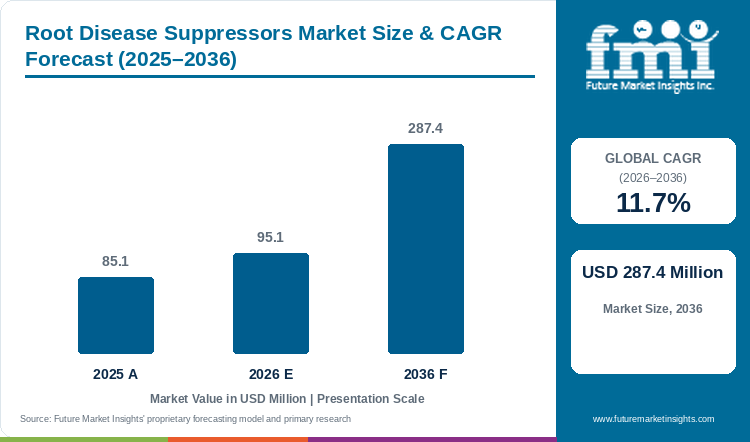
Demand for root disease suppressors is projected to expand at 11.7% CAGR between 2026 and 2036. Industry value grows from USD 85.1 million in 2025 to USD 95.1 million in 2026 and is projected to reach USD 287.4 million by 2036.
The global root disease suppressors market is expanding from USD 85.1 million in 2025 to USD 95.1 million in 2026 and reaching approximately USD 287.4 million by 2036. This growth is expected to reflect a CAGR of 11.7% between 2026 and 2036, which suggests that increasing incidences of Fusarium, Pythium, Rhizoctonia and Phytophthora is creating need for protecting roots before the damage becomes visible. Root disease suppressors are formulations applied through seed, transplant, soil and irrigation route. These products are finding application across crops. EPA records Bacillus and Trichoderma microbial disease suppressors, which shows movement beyond isolated trials.[1] Premium-grade formulations are gaining preference for storage and root colonization. According to FMI, products retaining the same control under field conditions will possibly witness higher repeat purchase.
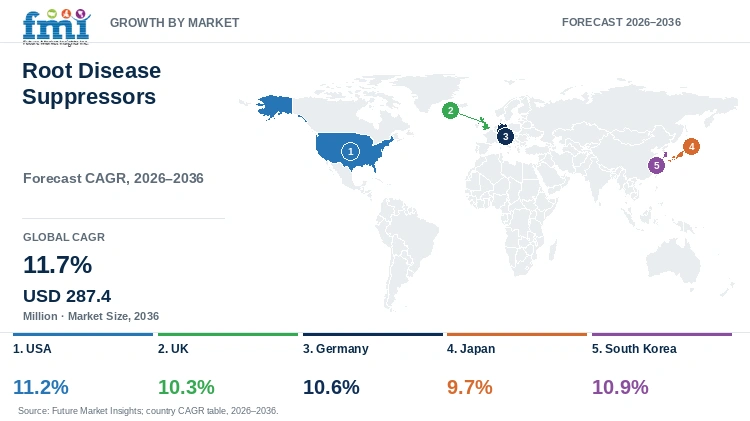
FMI believes that the adoption of root disease suppressors is developing along distinct regional outlooks, with the USA projected to grow at 11.2% CAGR, South Korea at 10.9%, and Germany at 10.6% through 2036. South Korea's Rural Development Administration dedicated funding in September 2025 under its 2026 smart agriculture and crop protection plan to accelerate biological field testing.[2] Germany updates its authorised-product database monthly and links approved active substances with specific crop uses. Therefore, South Korea's demand is more connected with surveillance-led public support, whereas Germany's demand depends on exact crop, pathogen and approved use. Local disease evidence, stable formulation, label conditions and application instructions will remain the final commercial filter.
Key Takeaways
- Preventive root-zone protection is expected to support demand when the product fits registration, handling and existing crop schedule.
- Based on active type, bacillus-based products are projected to account for 39.2% in 2026, owing to spore stability and easier at-plant handling.
- By crop type, cereals and grains are estimated to hold 46.0% in 2026, as one seed-zone treatment can be repeated over large planted area.
- In 2026, soil or drench is expected to lead with 43.3% share because the suppressor is placed close to the developing root.
- USA is projected to register 11.2% CAGR through 2036, followed closely by South Korea at 10.9%, although the factors supporting adoption remain different.
- Notable companies in the root disease suppressors market include Corteva Agriscience, FMC Corporation, Certis Biologicals, Koppert, Andermatt Group, ProFarm, and Biotalys.
Analyst Perspective
“Preventive root protection will gain demand where one planting pass completes treatment. Repeat purchase will favour products giving stable control under changing field conditions.”
- Nikhil Kaitwade, Principal Consultant, Future Market Insights.
How is the root disease suppressors market segmented?
Root disease suppressors market is segmented by five primary commercial axes and region: active type, crop type, application method, target setting, sales channel, and region. In 2026, bacillus-based products are projected at 39.2%, cereals and grains at 46.0%, soil or drench at 43.3%, open field at 42.5%, and agri-input distributors at 45.5%.
Root disease suppressors market is segmented by active type, crop type, application method, target setting, sales channel and region. As noted by FMI, the segmentation follows how the product is selected, placed near the root and supplied to the grower. Bacillus-based, cereals and grains, soil or drench, open field and agri-input distributors hold the leading positions in their respective categories. Their preference is mainly connected with storage stability, one-time planting operation, direct root placement, broad treated area and availability of local crop advice.
By active type: bacillus-based, trichoderma and fungal-based, botanical extracts, and bacteriophage and others.
By crop type: cereals and grains, fruits and vegetables, oilseeds and pulses, turf and ornamentals, and others.
By application method: soil or drench, foliar spray, seed or transplant treatment, and others.
By target setting: open field, protected cultivation, post-plant rescue, and others.
By sales channel: agri-input distributors, cooperatives, agri-retail chains, online or direct-to-farm, and others.
By region: North America, Latin America, Western Europe, Eastern Europe, East Asia, South Asia and Pacific, and Middle East and Africa.
Why does bacillus-based remain relevant within the active type category?
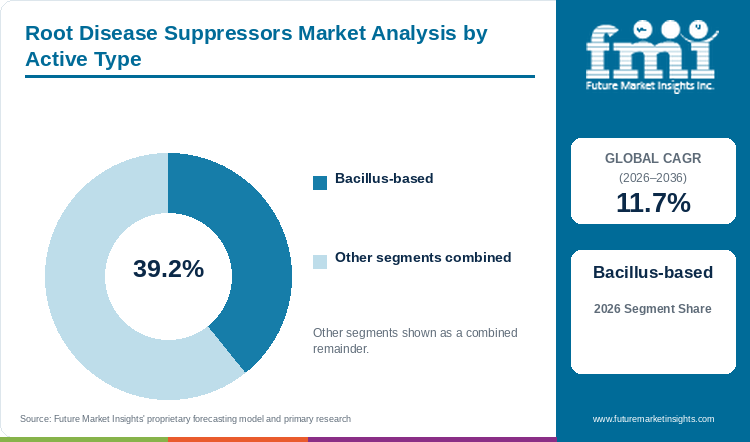
Based on active type, bacillus-based is projected to account for 39.2% in 2026, supported by stable spore-forming strains.
Bacillus strains form spores and this supports storage, transport and application through crop-input systems already used by growers. In September 2026, the U.S. EPA published registration actions for biofungicide active Bacillus amyloliquefaciens strain AT-332, expanding the documented library of spore-forming root protectants.[3] FMI research indicates that due to stable spore-forming nature, Bacillus products can be integrated into commercial programs as seedling defense primers and carried through familiar application systems. However, strain identity, formulation quality and approved crop label will decide whether the product can be used across a commercial crop program.
- Bacillus-based products are projected to hold 39.2% of active type demand in 2026. Spore stability and compatibility with familiar storage and application systems is expected to keep this segment ahead.
- Approved use still depends on strain identity, product stability, and crop-specific label directions.
What supports cereals and grains as a preferred crop category?
By crop type, cereals and grains are estimated to hold 46.0% in 2026, owing to repeatable at-plant treatment.
Large cereal acreage provides one common treatment point at the time of planting. The UK farming evidence pack records 6.1 million hectares of croppable area in 2025, while cereal farms used 33% of England's farmed area.[4] This allows seed-zone or in-furrow treatment using advanced seed treatment materials to cover a large planted area without creating one separate field operation. Owing to this repeatable application, cereals and grains are gaining preference in root disease suppressors market. However, on-seed survival and storage performance will decide whether planting programs continue with the treatment.
- Cereals and grains are estimated to hold 46.0% of crop type demand in 2026, as treatment can be repeated through one planting operation over large acreage.
- On-seed survival and storage performance determine whether planting programs retain the treatment.
How does soil or drench meet root-zone application needs?
In 2026, soil or drench is expected to lead application method with 43.3% share, driven by direct root placement.
Soil or drench places the biological active at the same location where developing roots and soil-borne pathogens interact, functioning alongside seed stress protectors during critical early establishment. Certis Biologicals reports that in-furrow Convergence trials increased corn yield by up to 4 bushels per acre and soybean yield by up to 3.5 bushels per acre.[5] Direct placement is therefore expected to support early colonization around the root area. However, water volume, soil moisture and colonization time changes between fields, due to which the same product may not deliver similar control in every commercial condition.
- Soil or drench is expected to account for 43.3% of application demand in 2026, as direct placement supports early root-zone colonization.
- Application success changes with water volume, soil moisture, and colonization time before infection.
Why does open field hold notable target setting demand?
By target setting, open field is forecast to represent 42.5% in 2026, reflecting its broad treated area.
Open-field programs give a broad treated area, but also exposes the organism to changing soil and weather conditions. In July 2026, the U.S. EPA launched a USD 30 million challenge for tools that can help farms grow food with fewer chemicals.[6] Biological root protection fits within this direction where planting equipment can deliver formulations alongside commercial biofertilizers to enhance crop vigor. Increasing use across broad-acre and outdoor horticulture is expected to support open field demand. However, local rate and disease timing will remain important as open-field conditions changes between seasons.
- Open field is forecast to represent 42.5% of target-setting demand in 2026, owing to broad-acre and outdoor horticulture use.
- Local rates and disease timing remain necessary because open-field conditions vary between seasons.
Which conditions keep agri-input distributors relevant in sales channels?
Agri-input distributors are set to lead sales channel with 45.5% share in 2026, underpinned by local agronomy access.
Root disease suppressors require advice on pathogen fit, storage, mixing and treatment timing. Germany's BVL updates the authorised-product database monthly and issues a concise bilingual list quarterly.[7] Agri-input distributors can connect the approved label with farm equipment, compatible agricultural surfactants, and actual disease pressure, which increases their importance in this market. The channel is expected to gain preference where seasonal inventory is supported by crop-level advice and not only by keeping the product on shelf.
- Agri-input distributors are projected to hold 45.5% of sales in 2026, supported by local agronomy access and product-use guidance.
- Distributor value increases when advisers can connect the label with farm equipment and disease pressure.
What are the drivers, restraints, and opportunities in the root disease suppressors market?
In the root disease suppressors market, the key driver is preventive IPM, the key restraint is field consistency, and the key opportunity is workflow integration.
- Driver: Growers add preventive biological disease tools when they fit wider integrated pest management programs.
- Restraint: Microbial performance can change with soil, moisture, temperature, pathogen pressure, handling, and treatment timing.
- Opportunity: At-plant delivery and workflow integration are expected to expand preventive biological adoption through 2036.
Preventive IPM Expands Biological Use
Preventive disease programs combine biological, cultural and chemical controls before visible root damage takes place. England's IPM guidance, updated in March 2025, places prevention, monitoring and biological methods before the selection of control.[8] Root disease suppressors can be applied during seed treatment, transplanting or in conjunction with microbial seed primers and therefore, growers do not have to wait for damaged roots. Increasing adoption of preventive IPM programs is expected to boost the demand, especially where one existing crop operation can also complete the treatment.
Field Conditions Change Biological Performance
Variation in microbial performance is one of the key factors restraining repeat use. Soil type, moisture, temperature, pathogen load, storage and treatment timing can change the activity of the same organism. A September 2026 study screened 100 Trichoderma isolates from 250 soil samples to evaluate bioactive Trichoderma metabolites, and selected isolates reached up to 80% mycelial inhibition under study conditions.[9] This shows high biological potential; however, it also makes evident that local validation cannot be ignored before wider commercial adoption.
At-Plant Delivery Reduces Extra Work
At-plant delivery can remove one additional field pass and places the treatment near young roots. In March 2025, Biotalys reported that BioFun-6 matched EVOCA disease suppression at lower dose rates in grape, cucumber and tomato trials.[10] Lower dose with retained control can improve handling and program fit. Owing to these advantages, seed-zone, transplant and irrigation-compatible formulations using specialized biological seed carriers are expected to create growth opportunities, provided the same performance is retained under commercial conditions.
Which country CAGRs are profiled in the root disease suppressors market?
| Country | CAGR |
|---|---|
| USA | 11.2% |
| UK | 10.3% |
| Germany | 10.6% |
| Japan | 9.7% |
| South Korea | 10.9% |
How do country-level CAGRs compare in the root disease suppressors market?
As per the analysis from FMI, country growth rates differ through 2036 because regulatory pathways, crop bases, and disease-surveillance systems are not uniform across markets. The USA and South Korea lead projected growth above 10.8 per cent, while Japan and the UK follow distinct crop-protection structures.
- USA demand gains from a broad microbial-registration route and established at-plant delivery channels across broad-acre crops.
- The UK combines large cereal acreage with national IPM guidelines encouraging biological disease management.
- Germany relies on product-specific authorization and strict crop and pest approval controls.
- Japan emphasizes detailed registration dossiers, local trial verification, and permitted crop-use standards.
- South Korea benefits from national pest surveillance and digital disease monitoring systems.
Full report country CAGRs cover: North America; Latin America; Western Europe; Eastern Europe; East Asia; South Asia and Pacific; Middle East and Africa.
Country-wise Analysis
- By 2036, the USA is projected to grow at 11.2% CAGR, supported by a broad microbial-registration base and established at-plant channels. Federal registration gives developers a defined route through the EPA biopesticide registry updated in July 2026, which recorded new microbial active Priestia megaterium strain SYM36613.[11] The list also retains Bacillus and Trichoderma strains used alongside commercial bioinsecticides in integrated crop-protection programs. Dealers can place suitable products beside seed treatment, fertilizer, or in-furrow programs where labels permit. This structure expands trial access, while repeat use still depends on crop-level efficacy, mixing compatibility, and local disease pressure.
- The UK root disease suppressors market is projected to grow at 10.3% CAGR through 2036, supported by extensive cereal acreage and national integrated pest management incentives. In June 2026, the Department for Environment, Food and Rural Affairs updated its Sustainable Farming Incentive standards under CIPM4, encouraging non-chemical arable disease and pest management.[12] Cereal growers and agronomists can apply biological root protectants alongside certified seed treatments. However, product uptake still requires proof of field performance under variable soil moisture and cool spring conditions. Farm-level trials and distributor support are expected to sustain UK commercial adoption through 2036.
- Germany's root disease suppressors outlook is anticipated to advance at 10.6% CAGR through 2036, supported by a product-specific authorization system. The BVL states that its online database is updated monthly, and a January 2026 reference connects authorized microbial products with permitted crops and target pathogens.[13] Advisers can therefore check the exact use before recommending a microbial treatment. This structure limits broad biological claims because each product must remain inside its authorized crop and disease conditions. It also gives distributors a practical reference for seasonal inventory, label training, and grower advice. Demand should expand where suppliers convert authorized uses into local trial evidence and simple treatment schedules.
- In Japan, root disease suppressor demand is predicted to advance at 9.7% CAGR through 2036, owing to detailed registration and crop-use controls. The national pesticide information system was updated on October 2, 2026 and allows searches by pesticide name, crop, pest, and active ingredient.[14] FMI data suggests that this structure helps buyers connect a microbial product with its permitted use rather than relying on a broad biological claim. Registrants still need stable quality, local efficacy records, and application directions that match Japanese cultivation. The same controls can slow a global strain's market entry, but approved products gain a clearer position with advisers. Growth therefore follows dossier quality and crop-level evidence more than portfolio breadth.
- South Korea is estimated to post 10.9% CAGR over the forecast period, backed by national pest monitoring and pesticide-information systems. The National Crop Pest Management System listed 9 cautions and 43 forecasts for October 2026.[15] The pesticide safety system also published 2026 training and registration notices for sellers and applicants. These tools shorten the path from disease observation to an approved control decision, which supports biological products when advisers can identify the pathogen early. Root suppressors still require evidence for local soils, moisture, and crop schedules because an alert does not prove product performance. Adoption should improve where monitoring records are converted into preventive treatment timing before root damage becomes visible.
Who are the notable companies in the root disease suppressors market?
Corteva Agriscience, FMC Corporation, Certis Biologicals, Koppert, Andermatt Group, ProFarm, and Biotalys are notable companies profiled in this market.
Competition in root disease suppressors market is moderately fragmented as no public evidence confirms one company holding a clear global share lead. Large crop-protection suppliers are competing through distribution and program integration, while biological specialists are focusing on strain libraries, disease evidence and formulation support. In the FMI report, competitive position is connected with root-zone claims and ease of adding the product into planting, irrigation or transplant work. Registration is necessary; however, field consistency and adviser confidence are expected to decide the stronger commercial position.
- Integrated crop-protection suppliers: Corteva Agriscience and FMC Corporation connect biological options with broader agronomy and distribution systems.
- Microbial disease specialists: Certis Biologicals, Koppert, and Andermatt Group maintain biofungicide or microbial platforms linked to soil and root disease control.
- Naturally derived platforms: ProFarm and Biotalys develop biological or protein-based crop-protection technologies with different modes of action.
Competitive Benchmarking: Root Disease Suppressors Market
| Company | Root-zone depth | Application fit | Current activity | Reach |
|---|---|---|---|---|
| Corteva Agriscience | Medium | High | High | High |
| FMC Corporation | High | High | High | High |
| Certis Biologicals | High | High | High | Medium |
| Koppert | High | High | High | High |
| Andermatt Group | High | Medium | High | High |
| ProFarm | Medium | High | High | Medium |
| Biotalys | Medium | Medium | Medium | Medium |
High represents broad public evidence across the stated capability, Medium represents narrower evidence, and Low represents limited documented breadth. These ratings describe public company capability and do not indicate product quality, revenue share or company ranking.
Key Developments in the Root Disease Suppressors Market
- In September 2026, Ascribe Bio received Brazilian regulatory approval for Phytalix biofungicide, extending a natural small-molecule platform into a major agricultural market.[16]
- In July 2026, Koppert published multi-location lettuce evidence for Trianum and described granular and water-dispersible formats for field and tunnel use.[17]
- In June 2026, Syngenta and Ascribe Bioscience announced a commercial partnership to distribute Phytalix biofungicide across Asian agricultural markets.[16]
- In May 2026, Biotalys reported product and regulatory progress for its protein-based crop-protection pipeline in its first-quarter business update.[18]
Key Players in the Root Disease Suppressors Market
Integrated crop-protection providers
- Corteva Agriscience
- FMC Corporation
Microbial and fungal biocontrol specialists
- Certis Biologicals
- Koppert
- Andermatt Group
Naturally derived technology platforms
- ProFarm
- Biotalys
Root Disease Suppressors Market - Report Scope
| Coverage field | Report scope |
|---|---|
| Market breakdown | Active type, crop type, application method, target setting, sales channel, and region. |
| Quantitative units | USD million. |
| Market definition | Supplier revenue from formulations marketed for direct suppression or prevention of soil-borne and root diseases. Conventional chemical fungicides, untreated crop value, and unrelated pest-control products are excluded. |
| Regions covered | North America; Latin America; Western Europe; Eastern Europe; East Asia; South Asia and Pacific; Middle East and Africa. |
| Countries covered | USA, UK, Germany, Japan, South Korea, and additional countries in the full report. |
| Key companies profiled | Corteva Agriscience, FMC Corporation, Certis Biologicals, Koppert, Andermatt Group, ProFarm, Biotalys. |
| Forecast period | 2026 to 2036. |
| Approach | The Future Market Insights report covers supplier activity, segment structure, application routes, and country adoption conditions within the stated market boundary. |
Root Disease Suppressors Market - Research Methodology
| Method | Approach |
|---|---|
| Primary Research | Analysts gathered input from manufacturers, service providers, technology developers, distributors, end users, procurement teams, and subject-matter experts. Interviews examined purchasing decisions, product evaluation, adoption barriers, approval requirements, pricing, and technical support. |
| Desk Research | Desk research covered government statistics, regulatory publications, trade data, industry associations, technical literature, standards, company filings, product information, and official corporate announcements. Sources were checked for date, geography, and direct market relevance. |
| Market Sizing and Forecasting | The model combined the baseline value with historical performance, segment structure, pricing and volume indicators, adoption levels, company participation, and country demand conditions. Forecast assumptions included regulation, technology use, purchasing cycles, and supply availability. |
| Data Validation | Estimates were checked against public data, company activity, trade patterns, and primary-research findings. Adjacent categories, unsupported claims, overlapping revenue, and activities outside the defined market were excluded. |
Root Disease Suppressors Market by Segments
Root Disease Suppressors Market segmented by Active Type:
- Bacillus-based
- Trichoderma and fungal-based
- Botanical extracts
- Bacteriophage and others
Root Disease Suppressors Market segmented by Crop Type:
- Cereals and grains
- Fruits and vegetables
- Oilseeds and pulses
- Turf and ornamentals
- Others
Root Disease Suppressors Market segmented by Application Method:
- Soil or drench
- Foliar spray
- Seed or transplant treatment
- Others
Root Disease Suppressors Market segmented by Target Setting:
- Open field
- Protected cultivation
- Post-plant rescue
- Others
Root Disease Suppressors Market segmented by Sales Channel:
- Agri-input distributors
- Cooperatives
- Agri-retail chains
- Online or direct-to-farm
- Others
Root Disease Suppressors Market by Region
- North America
- United States
- Canada
- Latin America
- Brazil
- Mexico
- Argentina
- Chile
- Western Europe
- Germany
- France
- United Kingdom
- Italy
- Spain
- Benelux
- Nordics
- Eastern Europe
- Poland
- Czech Republic
- Romania
- Hungary
- East Asia
- China
- Japan
- South Korea
- South Asia and Pacific
- India
- ASEAN
- Australia and New Zealand
- Middle East and Africa
- GCC Countries
- South Africa
- Türkiye
- Israel
Research Sources and Bibliography
- [1] U.S. Environmental Protection Agency. (2026, July 9). Biopesticide active ingredients.
- [2] Rural Development Administration, Republic of Korea. (2025, September 2). 2026 budget plan for smart agriculture and crop protection.
- [3] U.S. Environmental Protection Agency. (2026, September 4). Biopesticide active ingredients under review: Bacillus amyloliquefaciens strain AT-332.
- [4] Department for Environment, Food and Rural Affairs. (2026, September). Farming evidence pack: A high-level overview of the UK agricultural industry.
- [5] Certis Biologicals. (2026). Convergence biofungicide: Field trials and application information.
- [6] U.S. Environmental Protection Agency. (2026, July 1). EPA launches USD 30 million challenge to help American farmers grow healthy food with fewer chemicals.
- [7] German Federal Office of Consumer Protection and Food Safety. (2026, October). Authorised plant protection products.
- [8] Department for Environment, Food and Rural Affairs. (2025, March 13). Integrated pest management in farming.
- [9] Suvagiya, D. K., & Kothari, R. K. (2026, September 8). Native Trichoderma species as multifunctional biocontrol agents for soil-borne disease management. Frontiers in Microbiology, 17, 1880339.
- [10] Biotalys. (2025, March 11). Biotalys achieves strong results in field trials with second biofungicide.
- [11] U.S. Environmental Protection Agency. (2026, July 9). Biopesticide active ingredients registered through 2026.
- [12] Department for Environment, Food and Rural Affairs and Rural Payments Agency. (2026, June 17). CIPM4: No use of insecticide on arable crops and permanent crops, updated for SFI26.
- [13] German Federal Office of Consumer Protection and Food Safety. (2026, May). Concise list of plant protection products.
- [14] Ministry of Agriculture, Forestry and Fisheries of Japan. (2026, October 2). Pesticide registration information system.
- [15] Rural Development Administration. (2026, October). National Crop Pest Management System: October 2026 alerts and forecasts.
- [16] Ascribe Bio. (2026). Phytalix biofungicide and 2026 regulatory and partnership updates.
- [17] Koppert. (2026, July 15). A strong protection against soil-borne diseases in lettuce with Trianum.
- [18] Biotalys. (2026). First-quarter 2026 business and financial update.
- [19] Biotalys. (2025, December 2). Biotalys receives regulatory approval by U.S. EPA for EVOCA.
- [20] Certis Biologicals. (2025, March 5). First European authorization for NemaClean.
- [21] Andermatt Group AG. (2025, February 3). Andermatt Group establishes Italian subsidiary.
This bibliography is provided for reader reference. The full report contains the complete reference list and detailed citations.
This Report Answers
- What is Root Disease Suppressors Market worth during 2026?
- What value is Root Disease Suppressors Market projected by 2036?
- Which active type holds notable Root Disease Suppressors Market share?
- Which crop type holds notable Root Disease Suppressors Market share?
- Which countries have notable Root Disease Suppressors Market growth?
- Which companies are notable in Root Disease Suppressors Market today?
Frequently Asked Questions
How large is the Root Disease Suppressors Market expected to be in 2026?
Future Market Insights estimates that the root disease suppressors market will reach USD 95.1 million in 2026. The market is projected to expand further and reach USD 287.4 million by 2036.
What CAGR is forecast for the Root Disease Suppressors Market through 2036?
As per FMI, the root disease suppressors market is projected to grow at an 11.7% CAGR from 2026 to 2036. Growth is supported by increasing adoption of preventive biological disease tools in integrated pest management programs.
Which active type holds a notable root disease suppressors demand share in 2026?
Future Market Insights projects bacillus-based products to hold 39.2% of active type demand in 2026. The segment benefits from stable spore-forming properties and compatibility with familiar application equipment.
Which crop type holds a notable root disease suppressors share in 2026?
FMI finds that cereals and grains will hold 46.0% of crop type demand in 2026. Demand is supported by large planted acreage where one seed-zone treatment covers extensive field area.
Which country has a notable root disease suppressors expansion outlook during the forecast period?
Future Market Insights predicts the USA to expand at an 11.2% CAGR during the 2026 to 2036 assessment period. Growth is supported by a broad microbial-registration base and established at-plant distribution channels.
Which companies are active in the Root Disease Suppressors Market during 2026?
As per FMI analysis, notable companies include Corteva Agriscience, FMC Corporation, Certis Biologicals, Koppert, Andermatt Group, ProFarm, and Biotalys. These companies are focusing on strain development, registration expansion, and field efficacy validation.
Preview the report firsthand - request a free sample
Get SampleGet the brochure for pricing and purchase details.
Get PDFTable of Content
- Key Takeaways
- Market Size and CAGR
- Top Growth Driver
- Fastest Growing Segment
- Leading Region
- Key Companies
- Emerging Opportunities
- Executive Summary
- Global Market Outlook
- Demand-side Trends
- Supply-side Trends
- Technology Roadmap Analysis
- Analysis and Recommendations
- Analyst Perspective (What is happening? Why now? What should investors know?)
- Key Questions Answered
- How large is the market?
- What is the CAGR?
- What are key trends?
- Which region dominates?
- Who are the leaders?
- Market Overview
- Market Coverage / Taxonomy
- Market Definition / Scope / Limitations
- Research Methodology
- Chapter Orientation
- Analytical Lens and Working Hypotheses
- Market Structure, Signals, and Trend Drivers
- Benchmarking and Cross-market Comparability
- Market Sizing, Forecasting, and Opportunity Mapping
- Research Design and Evidence Framework
- Desk Research Programme (Secondary Evidence)
- Expert Input and Fieldwork (Primary Evidence)
- Tooling, Models, and Reference Databases
- Data Engineering and Model Build
- Quality Assurance and Audit Trail
- Market Background
- Market Dynamics (Drivers, Restraints, Opportunity, Trends)
- Scenario Forecast (Optimistic, Likely, Conservative)
- Impact Analysis
- AI Impact
- Sustainability Impact
- Regulatory Impact
- Technology Impact
- Consumer / Buyer Analysis
- Purchase Drivers
- Adoption Barriers
- Buyer Journey
- Opportunity Map Analysis
- Product Life Cycle Analysis
- Supply Chain Analysis
- Investment Feasibility Matrix
- Value Chain Analysis
- PESTLE and Porter's Analysis
- Regulatory Landscape
- Regional Parent Market Outlook
- Production and Consumption Statistics
- Import and Export Statistics
- Global Market Analysis and Forecast, 2021 to 2036
- Historical Market Size Value (USD Million) Analysis, 2021 to 2025
- Current and Future Market Size Value (USD Million) Projections, 2026 to 2036
- Y-o-Y Growth Trend Analysis
- Absolute $ Opportunity Analysis
- Global Market Pricing Analysis, 2021 to 2036
- Global Market Analysis and Forecast, By Active Type, 2021 to 2036
- Introduction / Key Findings
- Historical Market Size Value (USD Million) Analysis By Active Type, 2021 to 2025
- Current and Future Market Size Value (USD Million) Analysis and Forecast By Active Type, 2026 to 2036
- Bacillus-based
- Trichoderma and fungal-based
- Botanical extracts
- Bacteriophage and others
- Y-o-Y Growth Trend Analysis By Active Type, 2021 to 2025
- Absolute $ Opportunity Analysis By Active Type, 2026 to 2036
- Global Market Analysis and Forecast, By Crop Type, 2021 to 2036
- Introduction / Key Findings
- Historical Market Size Value (USD Million) Analysis By Crop Type, 2021 to 2025
- Current and Future Market Size Value (USD Million) Analysis and Forecast By Crop Type, 2026 to 2036
- Cereals and grains
- Fruits and vegetables
- Oilseeds and pulses
- Turf and ornamentals
- Others
- Y-o-Y Growth Trend Analysis By Crop Type, 2021 to 2025
- Absolute $ Opportunity Analysis By Crop Type, 2026 to 2036
- Global Market Analysis and Forecast, By Application Method, 2021 to 2036
- Introduction / Key Findings
- Historical Market Size Value (USD Million) Analysis By Application Method, 2021 to 2025
- Current and Future Market Size Value (USD Million) Analysis and Forecast By Application Method, 2026 to 2036
- Soil or drench
- Foliar spray
- Seed or transplant treatment
- Others
- Y-o-Y Growth Trend Analysis By Application Method, 2021 to 2025
- Absolute $ Opportunity Analysis By Application Method, 2026 to 2036
- Global Market Analysis and Forecast, By Target Setting, 2021 to 2036
- Introduction / Key Findings
- Historical Market Size Value (USD Million) Analysis By Target Setting, 2021 to 2025
- Current and Future Market Size Value (USD Million) Analysis and Forecast By Target Setting, 2026 to 2036
- Open field
- Protected cultivation
- Post-plant rescue
- Others
- Y-o-Y Growth Trend Analysis By Target Setting, 2021 to 2025
- Absolute $ Opportunity Analysis By Target Setting, 2026 to 2036
- Global Market Analysis and Forecast, By Sales Channel, 2021 to 2036
- Introduction / Key Findings
- Historical Market Size Value (USD Million) Analysis By Sales Channel, 2021 to 2025
- Current and Future Market Size Value (USD Million) Analysis and Forecast By Sales Channel, 2026 to 2036
- Agri-input distributors
- Cooperatives
- Agri-retail chains
- Online or direct-to-farm
- Others
- Y-o-Y Growth Trend Analysis By Sales Channel, 2021 to 2025
- Absolute $ Opportunity Analysis By Sales Channel, 2026 to 2036
- Global Market Analysis and Forecast, By Region, 2021 to 2036
- Introduction
- Historical Market Size Value (USD Million) Analysis By Region, 2021 to 2025
- Current Market Size Value (USD Million) Analysis and Forecast By Region, 2026 to 2036
- North America
- Latin America
- Western Europe
- Eastern Europe
- East Asia
- South Asia and Pacific
- Middle East and Africa
- Market Attractiveness Analysis By Region
- North America Market Analysis and Forecast, By Country, 2021 to 2036
- Historical Market Size Value (USD Million) Trend Analysis By Market Taxonomy, 2021 to 2025
- Market Size Value (USD Million) Forecast By Market Taxonomy, 2026 to 2036
- By Country
- United States
- Canada
- By Active Type
- By Crop Type
- By Application Method
- By Target Setting
- By Sales Channel
- By Country
- Market Attractiveness Analysis
- By Country
- By Active Type
- By Crop Type
- By Application Method
- By Target Setting
- By Sales Channel
- Key Takeaways
- Latin America Market Analysis and Forecast, By Country
- Historical Market Size Value (USD Million) Trend Analysis By Market Taxonomy, 2021 to 2025
- Market Size Value (USD Million) Forecast By Market Taxonomy, 2026 to 2036
- By Country
- Brazil
- Mexico
- Argentina
- Chile
- By Active Type
- By Crop Type
- By Application Method
- By Target Setting
- By Sales Channel
- By Country
- Market Attractiveness Analysis
- By Country
- By Active Type
- By Crop Type
- By Application Method
- By Target Setting
- By Sales Channel
- Key Takeaways
- Western Europe Market Analysis and Forecast, By Country
- Historical Market Size Value (USD Million) Trend Analysis By Market Taxonomy, 2021 to 2025
- Market Size Value (USD Million) Forecast By Market Taxonomy, 2026 to 2036
- By Country
- Germany
- France
- United Kingdom
- Italy
- Spain
- Benelux
- Nordics
- By Active Type
- By Crop Type
- By Application Method
- By Target Setting
- By Sales Channel
- By Country
- Market Attractiveness Analysis
- By Country
- By Active Type
- By Crop Type
- By Application Method
- By Target Setting
- By Sales Channel
- Key Takeaways
- Eastern Europe Market Analysis and Forecast, By Country
- Historical Market Size Value (USD Million) Trend Analysis By Market Taxonomy, 2021 to 2025
- Market Size Value (USD Million) Forecast By Market Taxonomy, 2026 to 2036
- By Country
- Poland
- Czech Republic
- Romania
- Hungary
- By Active Type
- By Crop Type
- By Application Method
- By Target Setting
- By Sales Channel
- By Country
- Market Attractiveness Analysis
- By Country
- By Active Type
- By Crop Type
- By Application Method
- By Target Setting
- By Sales Channel
- Key Takeaways
- East Asia Market Analysis and Forecast, By Country
- Historical Market Size Value (USD Million) Trend Analysis By Market Taxonomy, 2021 to 2025
- Market Size Value (USD Million) Forecast By Market Taxonomy, 2026 to 2036
- By Country
- China
- Japan
- South Korea
- By Active Type
- By Crop Type
- By Application Method
- By Target Setting
- By Sales Channel
- By Country
- Market Attractiveness Analysis
- By Country
- By Active Type
- By Crop Type
- By Application Method
- By Target Setting
- By Sales Channel
- Key Takeaways
- South Asia and Pacific Market Analysis and Forecast, By Country
- Historical Market Size Value (USD Million) Trend Analysis By Market Taxonomy, 2021 to 2025
- Market Size Value (USD Million) Forecast By Market Taxonomy, 2026 to 2036
- By Country
- India
- ASEAN
- Australia and New Zealand
- By Active Type
- By Crop Type
- By Application Method
- By Target Setting
- By Sales Channel
- By Country
- Market Attractiveness Analysis
- By Country
- By Active Type
- By Crop Type
- By Application Method
- By Target Setting
- By Sales Channel
- Key Takeaways
- Middle East and Africa Market Analysis and Forecast, By Country
- Historical Market Size Value (USD Million) Trend Analysis By Market Taxonomy, 2021 to 2025
- Market Size Value (USD Million) Forecast By Market Taxonomy, 2026 to 2036
- By Country
- GCC Countries
- South Africa
- Türkiye
- Israel
- By Active Type
- By Crop Type
- By Application Method
- By Target Setting
- By Sales Channel
- By Country
- Market Attractiveness Analysis
- By Country
- By Active Type
- By Crop Type
- By Application Method
- By Target Setting
- By Sales Channel
- Key Takeaways
- Key Countries Market Analysis
- United States
- Pricing Analysis
- Market Share Analysis, 2025
- By Active Type
- By Crop Type
- By Application Method
- By Target Setting
- By Sales Channel
- Canada
- Pricing Analysis
- Market Share Analysis, 2025
- By Active Type
- By Crop Type
- By Application Method
- By Target Setting
- By Sales Channel
- Mexico
- Pricing Analysis
- Market Share Analysis, 2025
- By Active Type
- By Crop Type
- By Application Method
- By Target Setting
- By Sales Channel
- Brazil
- Pricing Analysis
- Market Share Analysis, 2025
- By Active Type
- By Crop Type
- By Application Method
- By Target Setting
- By Sales Channel
- Chile
- Pricing Analysis
- Market Share Analysis, 2025
- By Active Type
- By Crop Type
- By Application Method
- By Target Setting
- By Sales Channel
- Germany
- Pricing Analysis
- Market Share Analysis, 2025
- By Active Type
- By Crop Type
- By Application Method
- By Target Setting
- By Sales Channel
- United Kingdom
- Pricing Analysis
- Market Share Analysis, 2025
- By Active Type
- By Crop Type
- By Application Method
- By Target Setting
- By Sales Channel
- Italy
- Pricing Analysis
- Market Share Analysis, 2025
- By Active Type
- By Crop Type
- By Application Method
- By Target Setting
- By Sales Channel
- Spain
- Pricing Analysis
- Market Share Analysis, 2025
- By Active Type
- By Crop Type
- By Application Method
- By Target Setting
- By Sales Channel
- France
- Pricing Analysis
- Market Share Analysis, 2025
- By Active Type
- By Crop Type
- By Application Method
- By Target Setting
- By Sales Channel
- India
- Pricing Analysis
- Market Share Analysis, 2025
- By Active Type
- By Crop Type
- By Application Method
- By Target Setting
- By Sales Channel
- ASEAN
- Pricing Analysis
- Market Share Analysis, 2025
- By Active Type
- By Crop Type
- By Application Method
- By Target Setting
- By Sales Channel
- Australia and New Zealand
- Pricing Analysis
- Market Share Analysis, 2025
- By Active Type
- By Crop Type
- By Application Method
- By Target Setting
- By Sales Channel
- China
- Pricing Analysis
- Market Share Analysis, 2025
- By Active Type
- By Crop Type
- By Application Method
- By Target Setting
- By Sales Channel
- Japan
- Pricing Analysis
- Market Share Analysis, 2025
- By Active Type
- By Crop Type
- By Application Method
- By Target Setting
- By Sales Channel
- South Korea
- Pricing Analysis
- Market Share Analysis, 2025
- By Active Type
- By Crop Type
- By Application Method
- By Target Setting
- By Sales Channel
- Poland
- Pricing Analysis
- Market Share Analysis, 2025
- By Active Type
- By Crop Type
- By Application Method
- By Target Setting
- By Sales Channel
- Hungary
- Pricing Analysis
- Market Share Analysis, 2025
- By Active Type
- By Crop Type
- By Application Method
- By Target Setting
- By Sales Channel
- Türkiye
- Pricing Analysis
- Market Share Analysis, 2025
- By Active Type
- By Crop Type
- By Application Method
- By Target Setting
- By Sales Channel
- South Africa
- Pricing Analysis
- Market Share Analysis, 2025
- By Active Type
- By Crop Type
- By Application Method
- By Target Setting
- By Sales Channel
- United States
- Market Structure Analysis
- Competition Dashboard
- Competition Benchmarking
- Market Share Analysis of Top Players
- By Regional
- By Active Type
- By Crop Type
- By Application Method
- By Target Setting
- By Sales Channel
- Emerging Startups
- Innovation Benchmarking
- Competition Analysis
- Competition Deep Dive
- Corteva Agriscience
- Overview
- Product Portfolio
- Profitability by Market Segments
- Sales Footprint
- Strategy Overview
- Marketing Strategy
- Product Strategy
- Channel Strategy
- FMC Corporation
- Certis Biologicals
- Koppert
- Andermatt Group
- ProFarm
- Biotalys
- Corteva Agriscience
- Case Studies
- Success Stories
- Recent Developments
- Competition Deep Dive
- Assumptions & Acronyms Used


