

- Market Size (2026)
- USD 200.3 Mn
- Forecast (2036)
- USD 563.6 Mn
- CAGR (2026 to 2036)
- 10.9%
How big is Microbial Disease Suppressors Market in 2026?
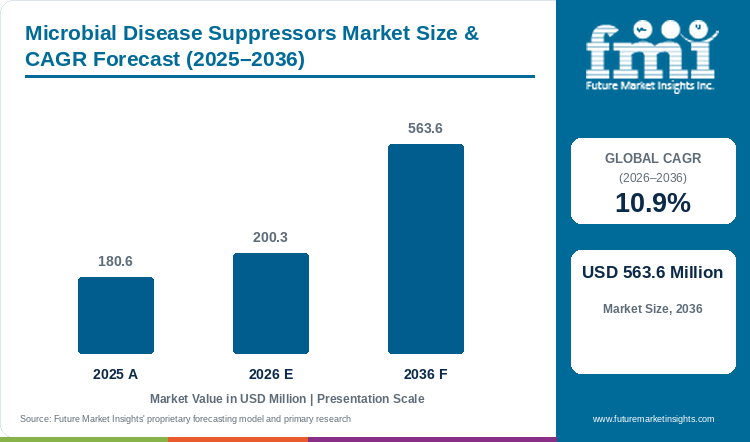
Demand for microbial disease suppressors is projected to grow at 10.9% CAGR between 2026 and 2036. Market value increases from USD 180.6 million in 2025 to USD 200.3 million in 2026 and is expected to reach USD 563.6 million by 2036.
Microbial disease suppressors market is expected to grow at 10.9% CAGR during 2026 to 2036, and the market value is projected to increase from USD 200.3 million in 2026 to USD 563.6 million by 2036. Apart from that, biorational pesticides is projected to grow at 15.8%, microbial seed treatment at 12.8%, microbiome crop protectants at 12.1%, and seed treatment materials at 10.0%. Microbial disease suppressors are used through seed, soil and foliar application for controlling crop diseases, due to which these products can be applied with the farm operations already performed during the crop cycle. Increasing use of agricultural microbials in planting, seed treatment and crop-protection programs is one of the primary factor expected to drive the growth of microbial disease suppressors market over the forecast period.
South Korea and Germany microbial disease suppressors market are projected to grow at 10.5% and 10.2% CAGR, respectively, during the forecast period. In March 2025, South Korea's Rural Development Administration moved cucumber disease-control microbes towards commercialization.[11] During the same month, Germany registered products containing Clonostachys rosea and Trichoderma atroviride. Increasing number of crop-specific approvals, growing availability of microbial disease-control products, and expansion of biocontrol agents in different crop applications are some of the prominent factors anticipated to support the microbial disease suppressors market revenue growth.
Key Takeaways
- Approved crop claims are expected to support the use of microbial disease suppressors in planting, seed-treatment, soil and foliar programs.
- Bacillus-based products are projected to account for 49.4% of active type demand in 2026, attributed to strain-specific claims and stable formulations.
- Cereals & grains are estimated to hold 48.9% of crop type demand in 2026, owing to large acreage and treatment during planting.
- Soil / drench is expected to represent 52.7% of application method demand in 2026, supported by root-zone application through planting or irrigation.
- South Korea is estimated to grow at 10.5% CAGR and Germany at 10.2% CAGR during the forecast period, supported by national approval routes.
- Some of the prominent players in the Microbial Disease Suppressors Market are Syngenta, Corteva Agriscience, FMC Corporation, Sumitomo Chemical, Certis Biologicals, Koppert, and Andermatt Group.
Analyst Perspective
“Microbial disease suppressors are gaining repeat demand when the approved claim and field result supports the same crop use. Products are increasingly entering crop programs where the application method can be used with the farm work already planned during the season.”
- Nandini Roy Choudhury, Principal Consultant, Future Market Insights.
How is the microbial disease suppressors market segmented?
Microbial Disease Suppressors Market is segmented by active type, crop type, application method, target setting, sales channel and region. In 2026, bacillus-based products are estimated to hold 49.4% share, cereals & grains 48.9% share, and soil / drench 52.7% share.
Microbial Disease Suppressors Market is segmented on the basis of active type, crop type, application method, target setting, sales channel and region.
On the basis of active type, microbial disease suppressors market is segmented into bacillus-based, trichoderma & fungal-based, botanical extracts, and bacteriophage & others.
On the basis of crop type, microbial disease suppressors market is segmented into cereals & grains, fruits & vegetables, oilseeds & pulses, turf & ornamentals, and others.
On the basis of application method, microbial disease suppressors market is segmented into soil / drench, foliar spray, seed / transplant treatment, and others.
On the basis of target setting, microbial disease suppressors market is segmented into open field, protected cultivation, post-plant rescue, and others.
On the basis of sales channel, microbial disease suppressors market is segmented into agri-input distributors, cooperatives, agri-retail chains, online / direct-to-farm, and others. Depending on the geographic region, the market is segmented into North America, Latin America, Western Europe, Eastern Europe, East Asia, South Asia and Pacific, and Middle East and Africa.
What supports bacillus-based products as a preferred active type choice?
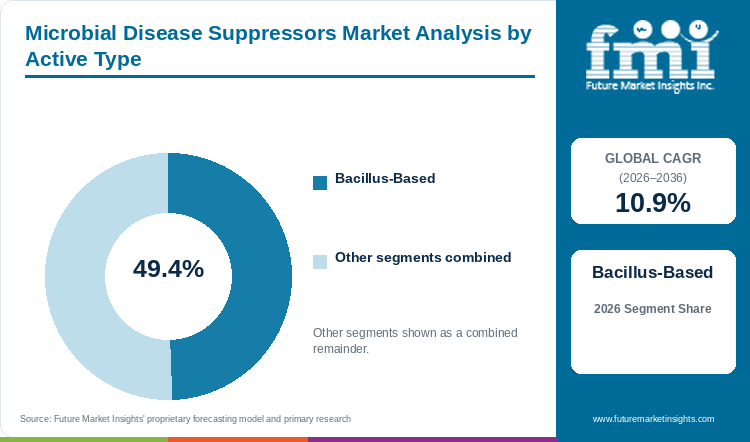
Bacillus-based products are expected to hold 49.4% of active type demand in 2026, owing to stable formulation and crop-specific use.
Bacillus-based products are widely used in crop disease-control programs owing to its formulation stability and application through existing farm work. Germany's March 2025 register included Bacillus subtilis strain IAB/BS03 as a crop-protection active.[9] Availability of crop-specific strain claims and consistent field result is expected to increase repeat demand for bacillus-based biofungicides.
- By active type, bacillus-based products are estimated to hold 49.4% share in 2026, supported by crop-specific strain claims and stable field handling.
- Storage life and crop-specific field results influences the repeat farm purchasing of approved Bacillus strains.
Why are buyers selecting cereals & grains within crop type today?
Cereals & grains are estimated to represent 48.9% of crop type demand in 2026, attributed to large planting programs.
Cereals & grains uses microbial products through seed treatment before crop planting. In March 2026, Corteva described biological seed treatments for early disease management.[12] Microbial seed treatment is applied with the normal planting schedule and does not require separate field pass over large cereal acreage. These factors are expected to support the cereals & grains segment growth.
- By crop type, cereals & grains are estimated to hold 48.9% share in 2026, attributed to broad-acre scale and treatment schedules linked with planting.
- Cereal programs are increasingly preferring products applied with seed or planting work, as the application does not require another pass over large fields.
How is soil / drench gaining use within application method programs?
Soil / drench is projected to hold 52.7% of application method demand in 2026, owing to preventive root-zone application.
Soil / drench application places microbial products near the root zone for controlling soil-borne diseases. Corteva's Bexfond information includes Bacillus amyloliquefaciens strain FZB42 for soil-borne disease control.[13] Increasing use of microbial disease suppressors through planting and irrigation systems is expected to drive the soil / drench segment growth and support seed health.
- In 2026, soil / drench is expected to lead application method demand with 52.7% share, owing to its use through planting and irrigation systems.
- Formulation viability in planting or irrigation systems is one of the prominent factor supporting the use of soil / drench products.
Which market conditions keep open field relevant within target setting?
Open field is anticipated to hold 51.1% of target setting demand in 2026, attributed to established broad-acre crop operations.
Open field crop programs are affected by changing soil and weather conditions, due to which microbial products requires consistent field performance. In October 2025, EPA proposed Priestia megaterium strain SYM36613 for cereal grains and other crop groups. [1] Expansion of crop labels for biorational pesticides is anticipated to support its use in open field disease control.
- By target setting, open field is forecast to represent 51.1% share in 2026, linked to regular disease control in broad-acre crop programs.
- Changing soil and weather conditions may affect microbial performance, due to which local field results remains important for repeat product purchasing.
How do agri-input distributors meet sales channel purchasing needs locally?
Agri-input distributors are expected to hold 42.1% of sales channel demand in 2026, supported by local label guidance and product availability.
Agri-input distributors supplies seed and crop-protection products through their existing relationship with local growers. Sumitomo Biorational's LEAP information directs buyers towards local distributors for product guidance. Availability of local stock, seed treatment materials and crop-specific label advice is expected to support the sales of microbial disease suppressors through agri-input distributors.
- Agri-input distributors are projected to hold 42.1% of sales channel demand in 2026, owing to local stock access and crop-specific label guidance.
- Distributor guidance supports correct product use by matching the label and handling direction with local crop program before repeat ordering.
What are the drivers, restraints, and opportunities in the microbial disease suppressors market?
Increasing use in integrated disease management is driving the market. However, strain-specific registration may hamper the growth, whereas equipment-compatible products is expected to create new opportunities.
- Driver: Increasing use of approved microbial products in planting, seed, soil and foliar disease-control programs is expected to drive the market growth.
- Restraint: Strain-specific registration and requirement of local field evidence may delay crop claims and repeat farm purchasing.
- Opportunity: Equipment-compatible microbial products used with planting or irrigation systems is expected to create growth opportunities over the forecast period.
Integrated Disease Programs Support Adoption
Integrated disease management has gained importance in crop protection as it combines biological, physical and chemical control practices. In March 2025, Defra's UK Pesticides National Action Plan included integrated pest management among three national objectives and placed biological controls beside the other control methods.[6] The plan provides a place for microbial disease suppressors in existing crop protection programs, due to which growers can carry out field trials before regular purchasing. Increasing adoption of integrated disease management is expected to drive the microbial disease suppressors market growth.
Strain-Level Review Slows Wider Use
Microbial pesticide registration is carried out on the basis of microbial strain identity, crop use and supporting evidence. In July 2025, Japan's MAFF published review materials containing submission requirements for microbial pesticides.[10] Lack of local field trials, storage evidence or crop-specific information can delay the product label. Absence of approved crop claim affects dealer recommendation and repeat purchasing, which may hamper the growth of microbial disease suppressors market.
Equipment-Compatible Application Routes Expand Use
Microbial disease suppressors that can be applied through equipment already used during planting are gaining high preference among growers. In March 2025, Koppert entered into partnership with Orion for expanding in-furrow biological crop protection in European row crops.[14] The product is placed during sowing and does not require another field pass. Apart from that, microbiome crop protectants can be used through in-furrow application where formulation and crop label supports its use. This is expected to create new growth avenues for microbial disease suppressors market.
Which country CAGRs are profiled in the microbial disease suppressors market?
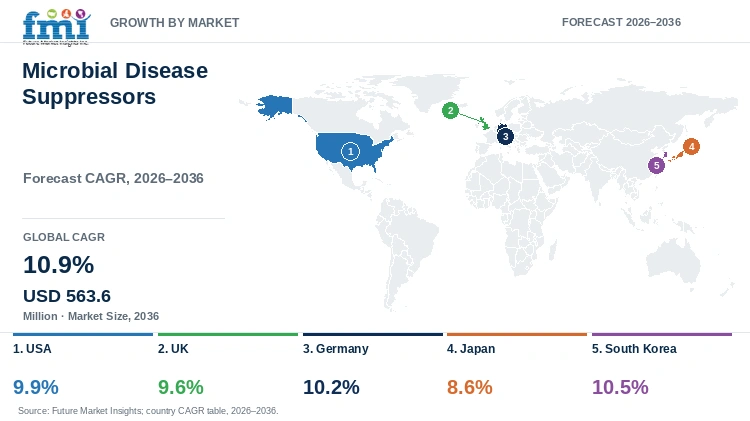
| Country | CAGR |
|---|---|
| USA | 9.9% |
| UK | 9.6% |
| Germany | 10.2% |
| Japan | 8.6% |
| South Korea | 10.5% |
How do country-level CAGRs compare in the microbial disease suppressors market?
Depending on the geographic region, microbial disease suppressors market is witnessing different growth rate owing to product registration, crop claims and local distribution. Products approved for seed treatment, soil application and foliar programs are increasingly used in crop programs. However, longer approval period and requirement of local field evidence delays the availability of crop-specific products, which in turn affect dealer recommendation and repeat purchasing.
- USA demand is supported by large row-crop programs where federal labels and dealer networks connect microbial products with recurring seed and soil treatment decisions.
- UK adoption is tied to integrated pest management policy, with repeat buying still dependent on approved uses and local field results.
- German demand benefits from registered microbial fungicides and large cereal programs that give suppliers repeated field-use opportunities.
- Japanese buyers face a dossier-led approval route, so strain identity and crop-specific directions influence how quickly products reach farm programs.
- South Korea uses separate microbial-pesticide criteria, giving suppliers a defined route from strain evidence to crop-specific registration.
Full report country CAGRs cover: North America; Latin America; Western Europe; Eastern Europe; East Asia; South Asia and Pacific; Middle East and Africa.
Country-wise Analysis
- USA microbial disease suppressors market is forecast to grow at 9.9% CAGR over the forecast period, owing to large row-crop acreage and established seed and soil treatment programs. In June 2026, USDA NASS estimated 95.3 million corn acres and 85.4 million soybean acres across the country. [5] Corn acreage exceeded soybean acreage by 9.9 million acres. Presence of large corn and soybean crop systems provides wider application area for microbial disease suppressors. However, changing soil and weather conditions may affect live microbial strains. Approved claims, storage life and local field results are expected to support repeat demand in USA.
- UK microbial disease suppressors market is projected to grow at 9.6% CAGR during the assessment period. In March 2025, Defra's UK Pesticides National Action Plan included integrated pest management among three national objectives and placed biological controls beside other control methods. Defra further reported 3.0 million hectares under cereals in December 2025.[8] Government support for integrated disease management and large cereal acreage is expected to support field trials and demand for seed and foliar microbial products. However, repeat purchase depends on field result and Great Britain crop labels.
- Germany microbial disease suppressors market is anticipated to grow at 10.2% CAGR during the projection period, attributed to large cereal area and registration of microbial fungicides. In May 2025, Destatis expected 5.86 million hectares of cereals, including around 2.78 million hectares of winter wheat.[27] Winter wheat accounts for nearly half of expected cereal area. March 2025 registration records included products containing Clonostachys rosea and Trichoderma atroviride. Availability of registered products for large cereal crop programs is expected to drive the market growth.
- Japan microbial disease suppressors market is projected to grow at 8.6% CAGR by 2036. In July 2026, MAFF revised the materials required for microbial pesticide registration and issued new dossier guidance. [2] The approval requires strain identity and supporting tests before crop-specific directions are provided. Protected-crop chemistry is already used through crop-specific instruction in these settings. Clear label regarding crop, disease target and application method is expected to support the adoption of microbial products in protected crop programs.
- South Korea microbial disease suppressors market is expected to exhibit 10.5% CAGR during the forecast period. In February 2026, the Rural Development Administration introduced separate registration criteria and reported 29 microbial pesticide products across 25 registered items. [3] The 29-to-25 difference indicates that some registered items supports more than one commercial product. Revised criteria removes tests that are not suitable for microbial products while retaining strain-specific evidence. Faster approval and availability of crop-specific labels is anticipated to support the market revenue growth.
Who are the notable companies in the microbial disease suppressors market?
Notable companies in the Microbial Disease Suppressors Market include Syngenta, Corteva Agriscience, FMC Corporation, Sumitomo Chemical, Certis Biologicals, Koppert, and Andermatt Group.
The global microbial disease suppressors market is highly fragmented due to the presence of large number of regional and global players. Syngenta and Corteva Agriscience offers biological products along with their crop-protection portfolio. FMC Corporation focuses on Bacillus products used in seed and root-zone disease control, whereas Certis Biologicals, Koppert and Andermatt Group provides specialist microbial crop-protection products. Sumitomo Chemical operates its biological products under a wider biorational business. Crop claim, application method, product availability and local technical support are some of the factors influencing microbial disease suppressors demand.
- Broad-acre platforms: Syngenta, Corteva Agriscience, and FMC Corporation combine biological products with crop-protection or seed-treatment routes.
- Specialist microbial platforms: Certis Biologicals, Koppert, and Andermatt Group focus on microbial products and application support.
- Biorational platform: Sumitomo Chemical operates Sumitomo Biorational Company LLC as its current biological and biorational business.
- Historical status: Pro Farm Group (Bioceres) remains in the record for continuity but is not treated as a current active company.
Competitive Benchmarking: Microbial Disease Suppressors Market
| Company | Disease-Control Breadth | Application-Pathway Coverage | Crop Access | Geographic Reach |
|---|---|---|---|---|
| Syngenta | High | Medium | High | High |
| Corteva Agriscience | Medium | Medium | High | High |
| FMC Corporation | Medium | Medium | High | High |
| Sumitomo Chemical | Medium | Medium | Medium | High |
| Certis Biologicals | High | High | High | Medium |
| Koppert | High | High | High | High |
| Andermatt Group | Medium | Medium | Medium | High |
The competitive benchmark includes disease-control range, application method, crop access and geographic presence. High rating indicates wider documented product coverage in several regions. Medium represents comparatively narrow coverage, whereas Low indicates limited application or regional presence. The rating describes company coverage and does not represent product quality or market share.
Key Developments in the Microbial Disease Suppressors Market
- In July 2026, Koppert published lettuce trial results for Trianum against soil-borne diseases including Fusarium and Rhizoctonia.[18] The development provides crop-specific product evidence.
- In April 2026, Sumitomo Biorational Company began operations following Sumitomo Chemical's combination of its core U.S. biorational businesses.[19] The development combined the stated businesses under one company.
- In November 2025, Andermatt Group reported progress towards European registration of T-77 for fungal disease management in grapevines.[20] The development supports the registration process in Europe.
Key Players in the Microbial Disease Suppressors Market
Broad-Acre Integrated Disease Management Platforms
- Syngenta
- Corteva Agriscience
- FMC Corporation
Specialist Microbial Crop Protection Platforms
- Certis Biologicals
- Koppert
- Andermatt Group
Biorational Disease Management Platform
- Sumitomo Chemical
Pro Farm Group (Bioceres) remains in the historical record. Its 2026 results classified the business as discontinued operations, so it is excluded from current active key players.[21]
Microbial Disease Suppressors Market - Report scope
| Coverage field | Report scope |
|---|---|
| Market breakdown | Active Type; Crop Type; Application Method; Target Setting; Sales Channel; Region |
| Quantitative Units | USD Million |
| Market Definition | Revenue from formulated microbial disease suppressors sold for crop disease prevention, control, or suppression within the stated segmentation universe. Downstream finished-product revenue and adjacent or substitute product revenue are excluded. |
| Regions Covered | North America; Latin America; Western Europe; Eastern Europe; East Asia; South Asia and Pacific; Middle East and Africa |
| Countries Covered | 30+ countries, including USA, UK, Germany, Japan, and South Korea. |
| Key Companies Covered | Syngenta; Corteva Agriscience; FMC Corporation; Sumitomo Chemical; Certis Biologicals; Koppert; Andermatt Group |
| Forecast Period | 2026 to 2036 |
| Approach | Primary and secondary research with market sizing, forecasting, triangulation and data validation. |
Microbial Disease Suppressors Market - Research Methodology
| Method | Approach |
|---|---|
| Primary Research | The research study includes primary interviews with manufacturers, service providers, technology developers, distributors, end users, purchasing teams and industry experts. Interviews covers purchasing decision, product evaluation, adoption barriers, approval requirement, pricing and technical support. Respondents were also asked about the evidence required before a trial or initial order changes into regular purchasing. |
| Desk Research | Desk research includes government statistics, regulatory publications, trade data, industry associations, technical literature, standards, company filings, product information and official company developments. Sources are checked for publication date, geographic coverage and relevance with the market scope. Claims are retained when supported by public evidence. |
| Market Sizing and Forecasting | Market sizing includes baseline value, historical performance, segment structure, price and volume indicators, adoption level, company participation and country demand. Forecast considers economic activity, investment, regulations, technology adoption, purchasing cycles, supply availability and market restraints. Segment and regional estimates are reconciled with the final market value. |
| Data Validation | Data is validated through public information, company activity, trade patterns, industry developments and primary interviews. Products, applications and company revenue are checked with the defined market boundary. Adjacent categories, overlapping revenue and unsupported claims are excluded to reduce double counting. |
Microbial Disease Suppressors Market by Segments
Microbial Disease Suppressors Market segmented by Active Type:
- Bacillus-Based
- Trichoderma & Fungal-Based
- Botanical Extracts
- Bacteriophage & Others
Microbial Disease Suppressors Market segmented by Crop Type:
- Cereals & Grains
- Fruits & Vegetables
- Oilseeds & Pulses
- Turf & Ornamentals
- Others
Microbial Disease Suppressors Market segmented by Application Method:
- Soil / Drench
- Foliar Spray
- Seed / Transplant Treatment
- Others
Microbial Disease Suppressors Market segmented by Target Setting:
- Open Field
- Protected Cultivation
- Post-Plant Rescue
- Others
Microbial Disease Suppressors Market segmented by Sales Channel:
- Agri-Input Distributors
- Cooperatives
- Agri-Retail Chains
- Online / Direct-to-Farm
- Others
Microbial Disease Suppressors Market by Region:
- North America
- United States
- Canada
- Latin America
- Brazil
- Mexico
- Argentina
- Chile
- Western Europe
- Germany
- France
- United Kingdom
- Italy
- Spain
- Benelux
- Nordics
- Eastern Europe
- Poland
- Czech Republic
- Romania
- Hungary
- East Asia
- China
- Japan
- South Korea
- South Asia and Pacific
- India
- ASEAN
- Australia and New Zealand
- Middle East and Africa
- GCC Countries
- South Africa
- Türkiye
- Israel
Research Sources and Bibliography
- [1] U.S. Environmental Protection Agency. (2025, October 23). EPA Announces Proposed Registration of New Biopesticide and Biopesticides Webpage. https://www.epa.gov/pesticides/epa-announces-proposed-registration-new-biopesticide-and-biopesticides-webpage
- [2] Ministry of Agriculture, Forestry and Fisheries, Japan. (2026, July 1). [Materials to be submitted when applying for registration of microbial pesticides]. https://www.maff.go.jp/j/nouyaku/n_touroku/
- [3] Rural Development Administration, Republic of Korea. (2026, February 6). [Expansion of microbial pesticide use through eased registration criteria]. https://www.rda.go.kr/board/board.do?dataNo=100000807523&mode=view&prgId=day_farmprmninfoEntry
- [4] European Food Safety Authority. (2026, July 24). Peer review of the pesticide risk assessment of the active substance Trichoderma atroviride 77B. https://connect.efsa.europa.eu/RM/s/consultations/publicconsultation2/a0lTk000000JxUD/pc0888
- [5] U.S. Department of Agriculture, National Agricultural Statistics Service. (2026, June 30). Corn planted acreage down 3% from 2025, soybean acreage up 5% from last year. https://www.nass.usda.gov/Newsroom/2026/06-30-2026.php
- [6] UK Department for Environment, Food & Rural Affairs and devolved governments. (2025, March 21). UK Pesticides National Action Plan 2025. https://www.gov.uk/government/publications/uk-pesticides-national-action-plan-2025
- [7] Department for Environment, Food & Rural Affairs. (2025, March 13). Integrated Pest Management (IPM) in farming. https://www.gov.uk/guidance/integrated-pest-management-ipm-in-farming
- [8] UK Department for Environment, Food & Rural Affairs. (2025, December 17). Agricultural Land Use in United Kingdom at 1 June 2025. https://www.gov.uk/government/statistics/agricultural-land-use-in-the-united-kingdom/agricultural-land-use-in-united-kingdom-at-1-june-2025
- [9] Federal Office of Consumer Protection and Food Safety, Germany. (2025, March). Registration reports for plant protection products. https://www.bvl.bund.de/DE/Arbeitsbereiche/04_Pflanzenschutzmittel/01_Aufgaben/02_ZulassungPSM/01_ZugelPSM/psm_ZugelPSM_node.html
- [10] Ministry of Agriculture, Forestry and Fisheries, Japan. (2025, July 18). [12th Biological Pesticide Evaluation Subcommittee meeting materials]. https://www.maff.go.jp/j/council/sizai/nouyaku/12/index.html
- [11] Rural Development Administration, Republic of Korea. (2025, March 19). [Commercialization of microbial technology for eco-friendly cucumber disease and pest control]. https://www.rda.go.kr/board/board.do?mode=view&prgId=day_farmprmninfoEntry
- [12] Corteva Agriscience. (2026, March). Understanding Biological Seed Treatments. https://www.corteva.com/resources/media-center/understanding-biological-seed-treatments.html
- [13] Corteva Agriscience. (2026). Fruiting Vegetable: Soil-Borne Disease Protection + Enhanced Root Development. https://www.corteva.us/products-and-solutions/crop-protection/bexfond.html
- [14] Koppert. (2025, March 13). Koppert and Orion's partnership boosts in-furrow biological crop protection in Europe. https://www.koppert.com/news-information/news/koppert-and-orions-partnership-boosts-in-furrow-biological-crop-protection-in-europe/
- [15] Koppert. (2025, June 2). Koppert and Amoéba sign major distribution agreement for innovative biofungicide solution. https://www.koppert.com/news-information/news/koppert-and-amoeba-sign-major-distribution-agreement-for-innovative-biofungicide-solution/
- [16] Syngenta. (2025, November 18). A natural breakthrough in protecting cereals and field crops. https://www.syngenta.com/media/media-releases/2025/a-natural-breakthrough-in-protecting-cereals-and-field-crops
- [17] FMC Corporation. (2025, July 10). Boost Winter Wheat Performance with Avodigen Biofungicide / Bionematicide. https://ag.fmc.com/uk/en/news/boost-winter-wheat-performance-avodigen-biofungicide-bionematicide
- [18] Koppert. (2026, July 15). A strong protection against soil-borne diseases in lettuce with Trianum. https://www.koppert.com/news-information/news/a-strong-protection-against-soil-borne-diseases-in-lettuce-with-trianum/
- [19] Sumitomo Biorational Company. (2026, April 8). Sumitomo Biorational Company Marks Official Launch with Inauguration Event. https://www.sumitomobiorational.com/news/sumitomo-biorational-company-marks-official-launch-with-inauguration-event/
- [20] Andermatt Group AG. (2025, November 5). Shielding Vines from Botrytis and Trunk Disease - T-77®’s Journey to European Vineyards. https://www.andermatt.com/shielding-vines-from-botrytis-and-trunk-disease-t-77s-journey-to-european-vineyards/
- [21] Bioceres Crop Solutions Corp. (2026, September 14). Bioceres Crop Solutions Reports Fiscal Fourth Quarter and Full-Year 2026 Financial and Operating Results. https://investors.biocerescrops.com/news/news-details/2026/Bioceres-Crop-Solutions-Reports-Fiscal-Fourth-Quarter-and-Full-Year-2026-Financial-and-Operating-Results/default.aspx
- [22] Certis Biologicals. (2026, April 28). Forecasts Point to Potential High Risk of Fire Blight Outbreak in Washington Apples for 2026 Season. https://www.certisbio.com/blog/2026-fireblight-pnw
- [23] Syngenta. (2026, February 19). From Chile’s Forests to Fields, Syngenta brings botanical-based biofungicide to the Americas. https://www.syngenta.com/media/media-releases/2026/from-chiles-forests-to-fields-syngenta-brings-botanical-based-biofungicide-to-the-americas
- [24] Sumitomo Biorational Company. (2026). LEAP Biological Insecticide, Bacterial Disease Management. https://www.sumitomobiorational.com/products/leap/
- [25] Koppert. (2025, July 23). Koppert invests in Amoéba to strengthen strategic collaboration. https://www.koppert.com/news-information/news/koppert-invests-in-amoeba-to-strengthen-strategic-collaboration/
- [26] Andermatt Group AG. (2025, February 6). Expanding Sustainability: Andermatt Group Establishes Italian Subsidiary. https://www.andermatt.com/expanding-sustainability-andermatt-group-establishes-italian-subsidiary/
- [27] Federal Statistical Office of Germany. (2025, May 19). Field crops: Expected acreage of important crops for harvest in 2025. https://www.destatis.de/EN/Press/2025/05/PE25_177_412.html
This bibliography is provided for reader reference. The full report contains the complete reference list and detailed citations.
This Report Answers
- What is the Microbial Disease Suppressors Market value in 2026?
- What value is forecast for Microbial Disease Suppressors Market by 2036?
- Which active type holds 49.4% of Microbial Disease Suppressors Market demand?
- Which country shows notable Microbial Disease Suppressors Market growth during forecast period?
- Which companies supply microbial disease suppressors in current crop programs?
- What products fall inside the Microbial Disease Suppressors Market scope?
Frequently Asked Questions
How big is the Microbial Disease Suppressors Market in 2026?
Future Market Insights estimates that the Microbial Disease Suppressors Market is valued at USD 200.3 million in 2026, compared to USD 180.6 million in 2025.
What value and CAGR are forecast for the Microbial Disease Suppressors Market by 2036?
Future Market Insights projects that the Microbial Disease Suppressors Market will grow at 10.9% CAGR from 2026 to 2036 and reach USD 563.6 million by 2036.
Which active type segment holds 49.4% share in 2026?
FMI analysis estimates that bacillus-based products hold 49.4% of active type demand in 2026.
Which application method segment holds 52.7% share in 2026?
Future Market Insights estimates that soil / drench holds 52.7% of application method demand in 2026.
Which country has a notable expansion outlook during the assessment period?
FMI analysis predicts that South Korea will grow at 10.5% CAGR during the assessment period, supported by separate microbial-pesticide registration criteria.
Which companies are active in the Microbial Disease Suppressors Market?
Future Market Insights identifies Syngenta, Corteva Agriscience, FMC Corporation, Sumitomo Chemical, Certis Biologicals, Koppert, and Andermatt Group as active companies in the Microbial Disease Suppressors Market.
Preview the report firsthand - request a free sample
Get SampleGet the brochure for pricing and purchase details.
Get PDFTable of Content
- Key Takeaways
- Market Size and CAGR
- Top Growth Driver
- Fastest Growing Segment
- Leading Region
- Key Companies
- Emerging Opportunities
- Executive Summary
- Global Market Outlook
- Demand-side Trends
- Supply-side Trends
- Technology Roadmap Analysis
- Analysis and Recommendations
- Analyst Perspective (What is happening? Why now? What should investors know?)
- Key Questions Answered
- How large is the market?
- What is the CAGR?
- What are key trends?
- Which region dominates?
- Who are the leaders?
- Market Overview
- Market Coverage / Taxonomy
- Market Definition / Scope / Limitations
- Research Methodology
- Chapter Orientation
- Analytical Lens and Working Hypotheses
- Market Structure, Signals, and Trend Drivers
- Benchmarking and Cross-market Comparability
- Market Sizing, Forecasting, and Opportunity Mapping
- Research Design and Evidence Framework
- Desk Research Programme (Secondary Evidence)
- Expert Input and Fieldwork (Primary Evidence)
- Tooling, Models, and Reference Databases
- Data Engineering and Model Build
- Quality Assurance and Audit Trail
- Market Background
- Market Dynamics (Drivers, Restraints, Opportunity, Trends)
- Scenario Forecast (Optimistic, Likely, Conservative)
- Impact Analysis
- AI Impact
- Sustainability Impact
- Regulatory Impact
- Technology Impact
- Consumer / Buyer Analysis
- Purchase Drivers
- Adoption Barriers
- Buyer Journey
- Opportunity Map Analysis
- Product Life Cycle Analysis
- Supply Chain Analysis
- Investment Feasibility Matrix
- Value Chain Analysis
- PESTLE and Porter's Analysis
- Regulatory Landscape
- Regional Parent Market Outlook
- Production and Consumption Statistics
- Import and Export Statistics
- Global Market Analysis and Forecast, 2021 to 2036
- Historical Market Size Value (USD Million) Analysis, 2021 to 2025
- Current and Future Market Size Value (USD Million) Projections, 2026 to 2036
- Y-o-Y Growth Trend Analysis
- Absolute $ Opportunity Analysis
- Global Market Pricing Analysis, 2021 to 2036
- Global Market Analysis and Forecast, By Active Type, 2021 to 2036
- Introduction / Key Findings
- Historical Market Size Value (USD Million) Analysis By Active Type, 2021 to 2025
- Current and Future Market Size Value (USD Million) Analysis and Forecast By Active Type, 2026 to 2036
- Bacillus-Based
- Trichoderma & Fungal-Based
- Botanical Extracts
- Bacteriophage & Others
- Y-o-Y Growth Trend Analysis By Active Type, 2021 to 2025
- Absolute $ Opportunity Analysis By Active Type, 2026 to 2036
- Global Market Analysis and Forecast, By Crop Type, 2021 to 2036
- Introduction / Key Findings
- Historical Market Size Value (USD Million) Analysis By Crop Type, 2021 to 2025
- Current and Future Market Size Value (USD Million) Analysis and Forecast By Crop Type, 2026 to 2036
- Cereals & Grains
- Fruits & Vegetables
- Oilseeds & Pulses
- Turf & Ornamentals
- Others
- Y-o-Y Growth Trend Analysis By Crop Type, 2021 to 2025
- Absolute $ Opportunity Analysis By Crop Type, 2026 to 2036
- Global Market Analysis and Forecast, By Application Method, 2021 to 2036
- Introduction / Key Findings
- Historical Market Size Value (USD Million) Analysis By Application Method, 2021 to 2025
- Current and Future Market Size Value (USD Million) Analysis and Forecast By Application Method, 2026 to 2036
- Soil / Drench
- Foliar Spray
- Seed / Transplant Treatment
- Others
- Y-o-Y Growth Trend Analysis By Application Method, 2021 to 2025
- Absolute $ Opportunity Analysis By Application Method, 2026 to 2036
- Global Market Analysis and Forecast, By Target Setting, 2021 to 2036
- Introduction / Key Findings
- Historical Market Size Value (USD Million) Analysis By Target Setting, 2021 to 2025
- Current and Future Market Size Value (USD Million) Analysis and Forecast By Target Setting, 2026 to 2036
- Open Field
- Protected Cultivation
- Post-Plant Rescue
- Others
- Y-o-Y Growth Trend Analysis By Target Setting, 2021 to 2025
- Absolute $ Opportunity Analysis By Target Setting, 2026 to 2036
- Global Market Analysis and Forecast, By Sales Channel, 2021 to 2036
- Introduction / Key Findings
- Historical Market Size Value (USD Million) Analysis By Sales Channel, 2021 to 2025
- Current and Future Market Size Value (USD Million) Analysis and Forecast By Sales Channel, 2026 to 2036
- Agri-Input Distributors
- Cooperatives
- Agri-Retail Chains
- Online / Direct-to-Farm
- Others
- Y-o-Y Growth Trend Analysis By Sales Channel, 2021 to 2025
- Absolute $ Opportunity Analysis By Sales Channel, 2026 to 2036
- Global Market Analysis and Forecast, By Region, 2021 to 2036
- Introduction
- Historical Market Size Value (USD Million) Analysis By Region, 2021 to 2025
- Current Market Size Value (USD Million) Analysis and Forecast By Region, 2026 to 2036
- North America
- Latin America
- Western Europe
- Eastern Europe
- East Asia
- South Asia and Pacific
- Middle East and Africa
- Market Attractiveness Analysis By Region
- North America Market Analysis and Forecast, By Country, 2021 to 2036
- Historical Market Size Value (USD Million) Trend Analysis By Market Taxonomy, 2021 to 2025
- Market Size Value (USD Million) Forecast By Market Taxonomy, 2026 to 2036
- By Country
- United States
- Canada
- By Active Type
- By Crop Type
- By Application Method
- By Target Setting
- By Sales Channel
- By Country
- Market Attractiveness Analysis
- By Country
- By Active Type
- By Crop Type
- By Application Method
- By Target Setting
- By Sales Channel
- Key Takeaways
- Latin America Market Analysis and Forecast, By Country
- Historical Market Size Value (USD Million) Trend Analysis By Market Taxonomy, 2021 to 2025
- Market Size Value (USD Million) Forecast By Market Taxonomy, 2026 to 2036
- By Country
- Brazil
- Mexico
- Argentina
- Chile
- By Active Type
- By Crop Type
- By Application Method
- By Target Setting
- By Sales Channel
- By Country
- Market Attractiveness Analysis
- By Country
- By Active Type
- By Crop Type
- By Application Method
- By Target Setting
- By Sales Channel
- Key Takeaways
- Western Europe Market Analysis and Forecast, By Country
- Historical Market Size Value (USD Million) Trend Analysis By Market Taxonomy, 2021 to 2025
- Market Size Value (USD Million) Forecast By Market Taxonomy, 2026 to 2036
- By Country
- Germany
- France
- United Kingdom
- Italy
- Spain
- Benelux
- Nordics
- By Active Type
- By Crop Type
- By Application Method
- By Target Setting
- By Sales Channel
- By Country
- Market Attractiveness Analysis
- By Country
- By Active Type
- By Crop Type
- By Application Method
- By Target Setting
- By Sales Channel
- Key Takeaways
- Eastern Europe Market Analysis and Forecast, By Country
- Historical Market Size Value (USD Million) Trend Analysis By Market Taxonomy, 2021 to 2025
- Market Size Value (USD Million) Forecast By Market Taxonomy, 2026 to 2036
- By Country
- Poland
- Czech Republic
- Romania
- Hungary
- By Active Type
- By Crop Type
- By Application Method
- By Target Setting
- By Sales Channel
- By Country
- Market Attractiveness Analysis
- By Country
- By Active Type
- By Crop Type
- By Application Method
- By Target Setting
- By Sales Channel
- Key Takeaways
- East Asia Market Analysis and Forecast, By Country
- Historical Market Size Value (USD Million) Trend Analysis By Market Taxonomy, 2021 to 2025
- Market Size Value (USD Million) Forecast By Market Taxonomy, 2026 to 2036
- By Country
- China
- Japan
- South Korea
- By Active Type
- By Crop Type
- By Application Method
- By Target Setting
- By Sales Channel
- By Country
- Market Attractiveness Analysis
- By Country
- By Active Type
- By Crop Type
- By Application Method
- By Target Setting
- By Sales Channel
- Key Takeaways
- South Asia and Pacific Market Analysis and Forecast, By Country
- Historical Market Size Value (USD Million) Trend Analysis By Market Taxonomy, 2021 to 2025
- Market Size Value (USD Million) Forecast By Market Taxonomy, 2026 to 2036
- By Country
- India
- ASEAN
- Australia and New Zealand
- By Active Type
- By Crop Type
- By Application Method
- By Target Setting
- By Sales Channel
- By Country
- Market Attractiveness Analysis
- By Country
- By Active Type
- By Crop Type
- By Application Method
- By Target Setting
- By Sales Channel
- Key Takeaways
- Middle East and Africa Market Analysis and Forecast, By Country
- Historical Market Size Value (USD Million) Trend Analysis By Market Taxonomy, 2021 to 2025
- Market Size Value (USD Million) Forecast By Market Taxonomy, 2026 to 2036
- By Country
- GCC Countries
- South Africa
- Türkiye
- Israel
- By Active Type
- By Crop Type
- By Application Method
- By Target Setting
- By Sales Channel
- By Country
- Market Attractiveness Analysis
- By Country
- By Active Type
- By Crop Type
- By Application Method
- By Target Setting
- By Sales Channel
- Key Takeaways
- Key Countries Market Analysis
- United States
- Pricing Analysis
- Market Share Analysis, 2025
- By Active Type
- By Crop Type
- By Application Method
- By Target Setting
- By Sales Channel
- Canada
- Pricing Analysis
- Market Share Analysis, 2025
- By Active Type
- By Crop Type
- By Application Method
- By Target Setting
- By Sales Channel
- Mexico
- Pricing Analysis
- Market Share Analysis, 2025
- By Active Type
- By Crop Type
- By Application Method
- By Target Setting
- By Sales Channel
- Brazil
- Pricing Analysis
- Market Share Analysis, 2025
- By Active Type
- By Crop Type
- By Application Method
- By Target Setting
- By Sales Channel
- Chile
- Pricing Analysis
- Market Share Analysis, 2025
- By Active Type
- By Crop Type
- By Application Method
- By Target Setting
- By Sales Channel
- Germany
- Pricing Analysis
- Market Share Analysis, 2025
- By Active Type
- By Crop Type
- By Application Method
- By Target Setting
- By Sales Channel
- United Kingdom
- Pricing Analysis
- Market Share Analysis, 2025
- By Active Type
- By Crop Type
- By Application Method
- By Target Setting
- By Sales Channel
- Italy
- Pricing Analysis
- Market Share Analysis, 2025
- By Active Type
- By Crop Type
- By Application Method
- By Target Setting
- By Sales Channel
- Spain
- Pricing Analysis
- Market Share Analysis, 2025
- By Active Type
- By Crop Type
- By Application Method
- By Target Setting
- By Sales Channel
- France
- Pricing Analysis
- Market Share Analysis, 2025
- By Active Type
- By Crop Type
- By Application Method
- By Target Setting
- By Sales Channel
- India
- Pricing Analysis
- Market Share Analysis, 2025
- By Active Type
- By Crop Type
- By Application Method
- By Target Setting
- By Sales Channel
- ASEAN
- Pricing Analysis
- Market Share Analysis, 2025
- By Active Type
- By Crop Type
- By Application Method
- By Target Setting
- By Sales Channel
- Australia and New Zealand
- Pricing Analysis
- Market Share Analysis, 2025
- By Active Type
- By Crop Type
- By Application Method
- By Target Setting
- By Sales Channel
- China
- Pricing Analysis
- Market Share Analysis, 2025
- By Active Type
- By Crop Type
- By Application Method
- By Target Setting
- By Sales Channel
- Japan
- Pricing Analysis
- Market Share Analysis, 2025
- By Active Type
- By Crop Type
- By Application Method
- By Target Setting
- By Sales Channel
- South Korea
- Pricing Analysis
- Market Share Analysis, 2025
- By Active Type
- By Crop Type
- By Application Method
- By Target Setting
- By Sales Channel
- Poland
- Pricing Analysis
- Market Share Analysis, 2025
- By Active Type
- By Crop Type
- By Application Method
- By Target Setting
- By Sales Channel
- Hungary
- Pricing Analysis
- Market Share Analysis, 2025
- By Active Type
- By Crop Type
- By Application Method
- By Target Setting
- By Sales Channel
- Türkiye
- Pricing Analysis
- Market Share Analysis, 2025
- By Active Type
- By Crop Type
- By Application Method
- By Target Setting
- By Sales Channel
- South Africa
- Pricing Analysis
- Market Share Analysis, 2025
- By Active Type
- By Crop Type
- By Application Method
- By Target Setting
- By Sales Channel
- United States
- Market Structure Analysis
- Competition Dashboard
- Competition Benchmarking
- Market Share Analysis of Top Players
- By Regional
- By Active Type
- By Crop Type
- By Application Method
- By Target Setting
- By Sales Channel
- Emerging Startups
- Innovation Benchmarking
- Competition Analysis
- Competition Deep Dive
- Syngenta
- Overview
- Product Portfolio
- Profitability by Market Segments
- Sales Footprint
- Strategy Overview
- Marketing Strategy
- Product Strategy
- Channel Strategy
- Corteva Agriscience
- FMC Corporation
- Sumitomo Chemical
- Certis Biologicals
- Koppert
- Andermatt Group
- Syngenta
- Case Studies
- Success Stories
- Recent Developments
- Competition Deep Dive
- Assumptions & Acronyms Used


