

- Market Size (2026)
- USD 314.0 Mn
- Forecast (2036)
- USD 975.4 Mn
- CAGR (2026 to 2036)
- 12.0%
How big is Seedling Defense Primers Market in 2026?
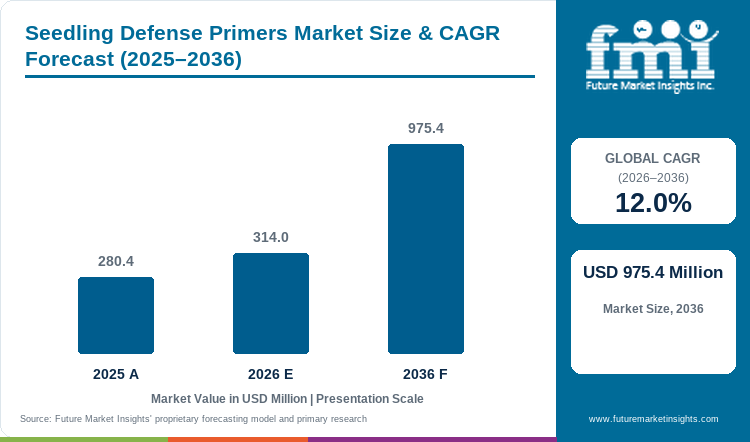
USD 314.0 Million in 2026 and USD 975.4 Million by 2036 at a 12.0% CAGR.
The Seedling Defense Primers market stood at USD 280.4 Million in 2025, is estimated at USD 314.0 Million in 2026, and is forecast to reach USD 975.4 Million by 2036 at a 12.0% CAGR from 2026 to 2036.
Seedling Defense Primers Market expands as growers move more crop-protection decisions into the establishment window. The value proposition is not simply replacing a conventional pesticide. It is protecting stand quality before early disease or pest pressure forces replanting, rescue treatment or yield compromise.
A Plant Health Progress review published on April 17, 2024 describes seed defense priming as a route to stronger plant resistance and improved seedling vigor through microbial or natural elicitors.
The US Environmental Protection Agency list updated on July 9, 2026 also shows several microbial active ingredients first registered during 2024 and 2025. These signals support products that can be placed at seed treatment, in-furrow or during the first planned crop-protection pass.
Purchasing rises fastest when biological protection fits existing equipment and avoids a separate field operation.
Country conversion depends on different operating thresholds. US buyers emphasize broad-acre fit and distributor support. Germany keeps product-level authorization and crop directions central to commercial use. UK HSE requires biopesticides to demonstrate safety and efficacy before sale.
Microbial evidence is normally assessed at strain level. Japan issued dedicated microbial pesticide dossier guidance on July 1, 2026. South Korea moved toward a more tailored route in February 2026 by creating separate microbial-pesticide registration criteria intended to reduce time and cost.
These systems can widen biological availability but they shape commercialization at different speeds. Interest becomes a purchase when a supplier combines regulatory fit with stable formulation and evidence of performance under the buyer's crop conditions.
Key Takeaways
- The market is estimated at USD 314.0 Million in 2026 and is forecast to reach USD 975.4 Million by 2036 at a 12.0% CAGR.
- Bacillus-Based leads the Active Type category in 2026. Cereals & Grains lead the Crop Type category in 2026.
- Soil / Drench leads the Application Method category in 2026. Open Field leads the Target Setting category in 2026. Agri-Input Distributors lead the Sales Channel category in 2026.
- Driver: Growers are allocating more attention to early stand protection and biological options that can reduce dependence on repeated synthetic intervention.
- Restraint: Strain-specific registration and variable field performance can delay qualification and reduce repeat-purchase confidence.
- Opportunity: Seed treatment, in-furrow and transplant-stage delivery can embed defense products into operations that growers already perform. the USA has the highest profiled country CAGR at 11.5%, compared with Japan at 9.8%.
Analyst Perspective
Revenue capture depends on proving biological performance inside existing farm workflows. Products need crop-specific labels and establishment-stage evidence.
- Nikhil Kaitwade, Principal Consultant, Future Market Insights
How is the Seedling Defense Primers Market segmented?
The market is analyzed by Active Type, Crop Type, Application Method, Target Setting, and Sales Channel.
Active Type separates microbial and naturally derived defense mechanisms that can act through plant responses or direct biological suppression. Crop Type captures the different economic value of stand establishment across broad-acre and specialty production.
Application Method distinguishes where the product enters the crop-protection workflow and how consistently it reaches the seedling or root zone. Target Setting separates exposure conditions in open fields, protected environments and post-plant rescue programs.
Sales Channel reflects who provides local agronomy support and manages seasonal product availability. Together these axes show that commercial success depends on biological mechanism, crop economics and execution rather than on the active ingredient alone.
What makes Bacillus-Based central to the Active Type category?
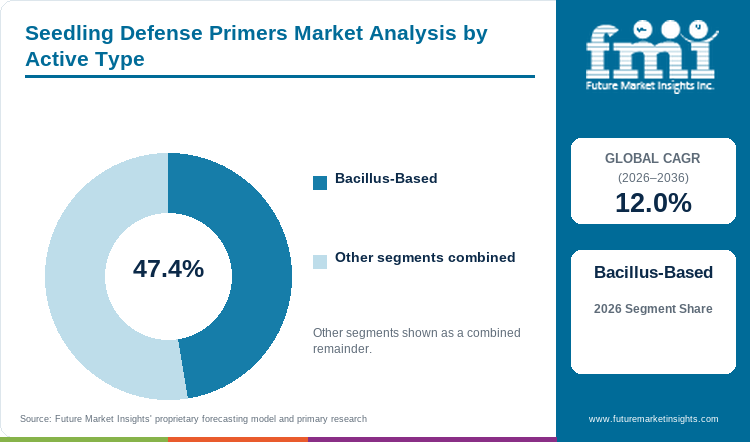
Bacillus-Based products lead because the genus supports several commercially useful crop-protection mechanisms and can be manufactured through established fermentation processes. Depending on the strain, products may compete with pathogens or produce metabolites that suppress disease.
Some strains can also support induced plant responses. This range gives formulators options across seed, in-furrow and foliar programs while maintaining a microbial positioning that distributors can explain to growers. The leadership logic is therefore practical as well as biological.
A repeatable production process and compatibility with common application formats reduce the gap between technical efficacy and routine field use. Compatible seed coating materials help a primer remain on the seed through handling.
- Bacillus-Based holds 47.4% of the Active Type category in 2026 because scalable fermentation and flexible placement support consistent commercial programs.
- Certis Biologicals announced Convergence biofungicide on January 8, 2024. The product uses Bacillus amyloliquefaciens strain D747 and targets soilborne fungal and bacterial diseases in row crops.
Why do Cereals & Grains lead the Crop Type category?
Cereals & Grains concentrate demand because their economics reward protection that can be applied across a large planted base without adding another field pass. Seed treatment and other early placement methods can protect the establishment phase at the same point growers already handle seed and planting inputs.
That makes the incremental workflow burden lower than a separate rescue intervention. The category also provides repeat seasonal demand because cereals are planted on predictable cycles and stand uniformity is visible early.
Biological defense products still need reliable performance across temperature and moisture ranges, but the crop segment offers a clear route from seed treatment to broad-acre scale.
- Cereals & Grains hold 40.6% of the Crop Type category in 2026 because large seasonal planting volumes make integrated early protection economically attractive.
- Koppert reported on May 13, 2024 that Cerall is a microbial seed treatment for cereal crops that protects against seed-borne fungal diseases and supports young plants through the fifth-leaf stage.
How does Soil / Drench support the Application Method category?
Soil / Drench placement leads because many seedling-stage threats originate near the seed, root surface or surrounding soil. Delivering a biological agent into that zone can improve contact with the intended target and reduces the dependence on later canopy coverage. The method also fits multiple operating formats.
Growers can use an in-furrow application during planting or a drench through irrigation in higher-value systems. Commercial acceptance depends on formulation stability and equipment compatibility because living organisms or complex biological preparations can behave differently from conventional chemistry.
Suppliers that simplify mixing and maintain viable performance at field scale lower a major execution barrier.
- Soil / Drench holds 49.1% of the Application Method category in 2026 because direct root-zone placement matches the timing and location of early biological defense.
- ProFarm announced US EPA registration of RinoTec Technology on March 18, 2025. The bacterial biocontrol platform can be used in products applied at planting in-furrow or through foliar programs after state registrations.
What supports Open Field leadership in the Target Setting category?
Open Field leads because the commercial opportunity extends across broad-acre crops and outdoor specialty production. The setting allows biological protection to be incorporated into seed, planting and first-spray decisions that already occur at scale. It also creates the hardest performance test.
Temperature swings, ultraviolet exposure and variable moisture can affect the persistence or activity of biological agents. That makes formulation quality and label clarity more important than in tightly controlled environments. Seed biostimulants face similar viability and field-performance checks.
Suppliers that demonstrate performance under variable field conditions can address a larger planted base. Protected cultivation remains attractive for intensive use, while post-plant rescue is more episodic and often begins after establishment risk has already materialized.
- Open Field holds 42.4% of the Target Setting category in 2026 because planting-stage treatment can be deployed across broad acreage despite greater environmental variability.
- Vestaron announced on February 17, 2026 that the US EPA approved BASIN bioinsecticide for outdoor agricultural use. The approval expanded its label beyond indoor and greenhouse crops.
What drives Agri-Input Distributors in the Sales Channel category?
Agri-Input Distributors lead because biological crop-protection products often require more explanation at the point of sale than standardized conventional inputs. Buyers need guidance on storage, mixing, application timing and compatibility with existing programs.
Local distributors also manage seasonal inventory and connect suppliers with crop advisers who influence treatment decisions. That service role is important when product performance depends on strain, formulation or environmental conditions.
Cooperatives can provide similar trust within member networks, while retail chains favor standardized products with simpler support needs. Online or direct-to-farm channels can serve knowledgeable buyers, but they are less effective when a product needs local agronomic troubleshooting before repeat purchase.
- Agri-Input Distributors hold 49.5% of the Sales Channel category in 2026 because technical support and seasonal availability are central to biological product adoption.
- Valent announced on October 20, 2025 that three Sumitomo Chemical biorational businesses would combine as Sumitomo Biorational Company in April 2026. The company said the structure was designed to simplify partner experience and global delivery.
What are the drivers, restraints, and opportunities in the Seedling Defense Primers Market?
Early-cycle biological protection supports demand, while registration and performance consistency limit conversion and integrated planting-stage delivery creates the clearest commercialization opportunity.
- Driver: Growers are allocating more attention to early stand protection and biological options that can reduce dependence on repeated synthetic intervention.
- Restraint: Strain-specific registration and variable field performance can delay qualification and reduce repeat-purchase confidence.
- Opportunity: Seed treatment, in-furrow and transplant-stage delivery can embed defense products into operations that growers already perform.
The demand mechanism starts with establishment risk. Disease or pest pressure during germination and early rooting can reduce stand quality before growers have many corrective options.
The April 17, 2024 Plant Health Progress review explains that defense priming can use microbial agents or natural compounds to induce plant resistance while also supporting seedling vigor. That mechanism is commercially relevant when it moves protection to the seed or early plant stage.
Growers gain more value when the product complements a normal treatment pass rather than replacing an entire crop-protection program. Suppliers therefore compete on how well biological defense fits the first operational decisions of the season.
The main restraint appears during qualification and repeat use. UK HSE states that biopesticides must be approved before sale and that microbial evidence is generally fulfilled at strain level unless a different case is justified.
This raises the burden for manufacturers because efficacy and safety cannot be transferred casually from one organism or formulation to another. Field conditions add a second test after registration. Viability, storage and performance can vary with temperature or moisture.
Buyers may trial a product without committing to broad acreage until they see local consistency. The result is delayed conversion rather than an absence of demand.
The strongest opening is to place defense biologicals inside a workflow the farm already owns. Certis Biologicals said on January 8, 2024 that Convergence can be used in row crops against soilborne diseases.
ProFarm followed with US EPA registration of RinoTec Technology on March 18, 2025 and described a path to in-furrow use at planting. These approaches reduce incremental labor because treatment can be paired with an existing field operation.
Seed treaters, agri-input distributors and suppliers with formulation expertise are best placed to capture the opportunity. They can standardize handling and generate crop-specific evidence at the point where growers make planting decisions.
Which country CAGRs are profiled in the Seedling Defense Primers Market?
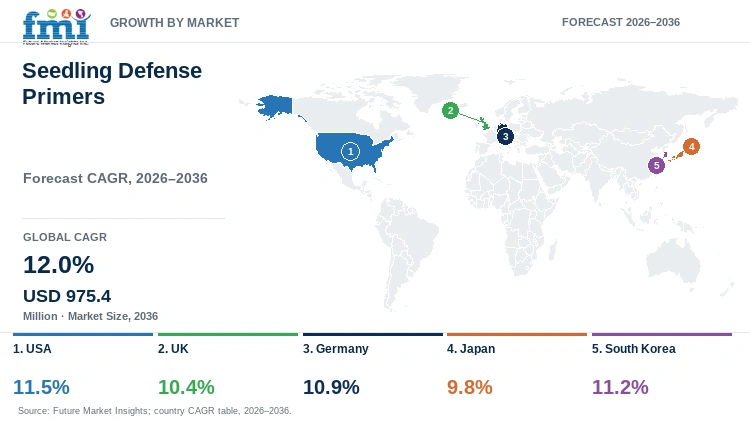
| Country | CAGR |
|---|---|
| USA | 11.5% |
| UK | 10.4% |
| Germany | 10.9% |
| Japan | 9.8% |
| South Korea | 11.2% |
How do country-level CAGRs compare in the Seedling Defense Primers Market?
The five profiled countries span a 1.7 percentage-point CAGR range between the USA at 11.5% and Japan at 9.8% from 2026 to 2036. The USA and South Korea form the upper band at 11.5% and 11.2%. Germany sits close behind at 10.9%, while UK follows at 10.4%. Japan forms the lower end at 9.8%.
The gaps are narrow enough that commercial execution can outweigh the headline growth-rate difference. Registration timing, crop fit and distributor capability can change how quickly a supplier converts a favorable market trajectory into orders.
CAGR should therefore guide timing rather than serve as a substitute for country-level go-to-market analysis.
- The USA leads South Korea by 0.3 percentage points. The small gap favors parallel investment when suppliers can support both regulatory pathways and local distribution.
- South Korea leads Germany by 0.3 percentage points. Korea offers faster growth on the forecast measure, while Germany demands disciplined authorization and field positioning.
- Germany leads the UK by 0.5 percentage points. The difference supports earlier scaling in Germany only when product registrations and adviser coverage are already in place.
- The UK leads Japan by 0.6 percentage points. The wider gap can affect launch sequencing, but both markets still require localized registration evidence before commercial scale.
Country CAGR does not indicate absolute market size or the addressable acreage available to a specific product. Supplier economics also depend on crop concentration, product registration, application method and channel margin.
The broader report therefore evaluates each profiled country within the same segmentation boundary and places those results alongside coverage of more than twenty-five additional countries. That approach keeps growth-rate comparisons separate from decisions about sales capacity and technical support.
Country-wise Analysis
- USA: US growers typically buy crop-protection inputs through distributor and agronomy systems that favor products fitting seed, in-furrow or planned early passes. Demand for Seedling Defense Primers in the USA is forecast to rise at 11.5% CAGR from 2026 to 2036. The US EPA active-ingredient list updated July 9, 2026 includes several Bacillus and Trichoderma entries first registered in 2024 plus Beauveria bassiana strain BW149 in 2025. The main friction is proving field consistency across crop zones without adding another operation. Suppliers need broad label utility and field evidence that quantifies establishment outcomes.
- UK: UK professional growers operate under a product-specific plant protection approval regime, so distributor adoption follows label status and evidence quality. Demand for Seedling Defense Primers in the UK is forecast to rise at 10.4% CAGR from 2026 to 2036. HSE updated its biopesticides guidance on September 3, 2025 and states that products must demonstrate safety and efficacy before approval. Microbial requirements are normally addressed at strain level. The pathway is clear but dossier work can slow entry. Suppliers need early regulatory engagement and UK-specific efficacy support for intended crops.
- Germany: German channel decisions are strongly authorization-led and crop-specific, which makes regulator-listed uses central to commercial positioning. Demand for Seedling Defense Primers in Germany is forecast to rise at 10.9% CAGR from 2026 to 2036. BVL registration reports dated March 17 through 26 March 2025 listed products containing Bacillus subtilis strain IAB/BS03, Trichoderma atroviride strain AT10 and Clonostachys rosea strain J1446. These additions widen microbial options but do not remove field-validation needs. Suppliers must pair German labels with adviser training and reliable open-field performance evidence.
- Japan: Japanese adoption is guided by formal pesticide registration and detailed documentation for intended use. Demand for Seedling Defense Primers in Japan is forecast to rise at 9.8% CAGR from 2026 to 2036. On July 1, 2026 Japan's Ministry of Agriculture, Forestry and Fisheries revised microbial pesticide submission requirements and issued dedicated dossier guidance. The clearer framework still places weight on strain characterization and local registration documents. Suppliers need Japanese technical support and precise application guidance. Commercial success also depends on evidence that biological performance transfers to local crop and growing conditions.
- South Korea: South Korean buyers often rely on registered pesticide recommendations and distributor or adviser support, so procedural changes can affect product availability. Demand for Seedling Defense Primers in South Korea is forecast to rise at 11.2% CAGR from 2026 to 2036. The Rural Development Administration announced separate microbial-pesticide registration criteria on February 6, 2026 to reduce time and cost and encourage registrations. The challenge is converting easier entry into repeatable farm results. Suppliers need Korean efficacy packages and clear positioning against established conventional programs.
Who are the notable companies in the Seedling Defense Primers Market?
Sumitomo Chemical and Certis Biologicals are profiled. Koppert and Andermatt Group are also covered. ProFarm (Bioceres) and Vestaron are also covered. BioWorks and e-nema complete the notable-company set.
Competition is defined less by corporate size than by the biological mechanism and delivery system a supplier can commercialize. Certis Biologicals, Koppert and BioWorks align closely with microbial seed or root-zone protection through bacterial or fungal products.
Sumitomo Chemical, Andermatt Group and ProFarm (Bioceres) operate broader biorational or fermentation platforms that can support multiple biological modes and channels. Vestaron and e-nema bring specialized approaches in the Other active category through peptide-based insect control and entomopathogenic nematodes.
These clusters compete on crop fit, formulation reliability and channel support rather than on a single universal performance metric. Buyers therefore compare the strength of an establishment-stage use case before evaluating portfolio breadth.
- Microbial Seed and Root Defense Specialists: Certis Biologicals, Koppert and BioWorks emphasize bacterial or fungal crop-protection tools with direct relevance to seedling or root-stage programs.
- Scaled Biorational and Fermentation Platforms: Sumitomo Chemical, Andermatt Group and ProFarm (Bioceres) combine broader biological portfolios with commercialization infrastructure.
- Targeted Biological Pest-Control Platforms: Vestaron and e-nema contribute specialized biological mechanisms that broaden the Bacteriophage & Others competitive field.
Competitive Benchmarking: Seedling Defense Primers Market
| Company | Seed / Root-Zone Applicability | Defense Mechanism Breadth | Commercialization Infrastructure | Geographic Reach |
|---|---|---|---|---|
| Sumitomo Chemical | Low | High | High | Global biorational organization with North American operating companies |
| Certis Biologicals | High | Medium | Medium | United States product registration and row-crop commercialization evidence |
| Koppert | High | High | High | Europe-based commercial evidence with global biological collaboration channels |
| Andermatt Group | Low | Medium | High | Europe and Canada with products supplied to growers worldwide |
| ProFarm (Bioceres) | High | Medium | Medium | United States registration evidence with row and specialty crop focus |
| Vestaron | Low | Low | Medium | United States outdoor crop approval evidence |
| BioWorks | High | Medium | Medium | North American product evidence; wider reach not assessed here |
| e-nema | Low | Low | Medium | Germany-based production with products transported to users worldwide |
Scoring basis: Seed / Root-Zone Applicability measures documented use at seed treatment, in-furrow, drench or early root-stage placement. Defense Mechanism Breadth measures the number of distinct biological approaches documented in the cited company evidence.
Commercialization Infrastructure measures evidence of product registration, manufacturing scale, organizational integration or route-to-market capability.
High indicates broad documented capability, Medium indicates credible but narrower evidence and Low indicates a documented specialization that limits breadth against that criterion. Unavailable public information is left low rather than treated as Low.
Key Developments in the Seedling Defense Primers Market
- In January 2024, Certis Biologicals launched Convergence biofungicide for corn, soybeans and peanuts. The product uses Bacillus amyloliquefaciens strain D747 and targets soilborne fungal and bacterial diseases. It can be integrated into row-crop protection programs around the early crop cycle. The launch gives distributors another Bacillus-based option for planting-stage disease management without requiring a move away from familiar field operations.
- In July 2024, Andermatt Group acquired BioTEPP Inc. and its Virosoft CP4 granulovirus biopesticide. Virosoft CP4 targets codling moth and oriental fruit moth larvae through a virus-based mechanism. The transaction expands Andermatt's access to a specialized biological platform and Canadian capabilities. It also broadens the Other active category beyond bacterial and fungal products used in early crop-defense programs.
- In December 2024, Koppert signed a memorandum of understanding with Amoéba to introduce AXPERA. The planned biofungicide is based on amoeba lysate and targets fungal disease through a mechanism outside conventional microbial strain categories. The agreement broadens Koppert's biological mechanism pipeline and could give distributors another non-synthetic disease-management option if regional approvals and commercial launch milestones are completed.
Key Players in the Seedling Defense Primers Market
Microbial Seed and Root Defense Specialists
- Certis Biologicals
- Koppert
- BioWorks
Scaled Biorational and Fermentation Platforms
- Sumitomo Chemical
- Andermatt Group
- ProFarm (Bioceres)
Targeted Biological Pest-Control Platforms
- Vestaron
- e-nema
Seedling Defense Primers Market - Report Scope
| Coverage field | Report scope |
|---|---|
| Market breakdown | Active Type, Crop Type, Application Method, Target Setting, and Sales Channel |
| Quantitative Units | USD Million |
| Market Definition | Seedling Defense Primers Market includes revenue from biological and naturally derived crop-protection products sold for seed, seedling, transplant, young-plant or immediate root-zone defense within the defined segmentation universe. It excludes downstream crop revenue, conventional synthetic pesticides, stand-alone nutrition or biostimulants without defense claims, and adjacent biological products used only outside early-establishment defense programs. |
| Regions Covered | North America, Latin America, Western Europe, Eastern Europe, East Asia, South Asia and Pacific, Middle East and Africa |
| Countries Covered | USA, UK, Germany, Japan, South Korea, and more than twenty-five additional countries in the full report |
| Key Companies Profiled | Sumitomo Chemical, Certis Biologicals, Koppert, Andermatt Group, ProFarm (Bioceres), Vestaron, BioWorks, e-nema |
| Forecast Period | 2026 to 2036 |
| Approach | Market sizing uses a hybrid bottom-up and top-down approach that reconciles product-level commercial evidence with crop exposure, application patterns and channel conditions within the defined revenue boundary. |
Seedling Defense Primers Market - Research Methodology
| Method | Approach |
|---|---|
| Primary Research | FMI consults biological crop-protection makers and agri-input distributors. Growers and crop advisers explain buying criteria and application fit. The research tests purchase criteria and adoption barriers. |
| Desk Research | FMI reviews regulatory registers and crop information. Product labels and scientific literature support crop-defense claims. Sources are retained when they support the defined market boundary. |
| Market Sizing and Forecasting | FMI reconciles product evidence with crop exposure and application frequency. Forecasts reflect pricing and channel adoption. Country conditions and channel structure are checked against the revenue boundary. |
| Data Validation | Findings are checked against independent evidence. The estimate excludes conventional synthetic pesticides and downstream crop value. Adjacent products without crop-defense claims are excluded. |
Seedling Defense Primers Market by Segments
Seedling Defense Primers Market segmented by Active Type:
- Bacillus-Based
- Trichoderma & Fungal-Based
- Botanical Extracts
- Bacteriophage & Others
Seedling Defense Primers Market segmented by Crop Type:
- Cereals & Grains
- Fruits & Vegetables
- Oilseeds & Pulses
- Turf & Ornamentals
- Others
Seedling Defense Primers Market segmented by Application Method:
- Soil / Drench
- Foliar Spray
- Seed / Transplant Treatment
- Others
Seedling Defense Primers Market segmented by Target Setting:
- Open Field
- Protected Cultivation
- Post-Plant Rescue
- Others
Seedling Defense Primers Market segmented by Sales Channel:
- Agri-Input Distributors
- Cooperatives
- Agri-Retail Chains
- Online / Direct-to-Farm
- Others
Seedling Defense Primers Market by Region:
- North America
- United States
- Canada
- Latin America
- Brazil
- Mexico
- Argentina
- Chile
- Western Europe
- Germany
- France
- United Kingdom
- Italy
- Spain
- Benelux
- Nordics
- Eastern Europe
- Poland
- Czech Republic
- Romania
- Hungary
- East Asia
- China
- Japan
- South Korea
- South Asia and Pacific
- India
- ASEAN
- Australia and New Zealand
- Middle East and Africa
- GCC Countries
- South Africa
- Türkiye
- Israel
Research Sources and Bibliography
- Bruno, Jobelle, and Jong Hyun Ham (2024, April 17). Seed Priming for Defense Priming: An Innovative Approach to Enhance the Resilience of Crop Plants to Biotic and Abiotic Stresses.
- US Environmental Protection Agency (2026, July 9). Biopesticide Active Ingredients.
- UK Health and Safety Executive (2025, September 3). Biopesticides.
- Federal Office of Consumer Protection and Food Safety (BVL) (2025, March 17). Registration Reports for Plant Protection Products.
- Ministry of Agriculture, Forestry and Fisheries of Japan (2026, July 1). 農薬の登録: 微生物農薬に関する通知.
- Rural Development Administration, Republic of Korea (2026, February 6). “등록 기준 완화” 미생물농약 사용 확대 꾀한다.
- Valent (2025, October 20). Valent BioSciences, MGK, and Valent North America Become Sumitomo Biorational Company.
- Certis Biologicals (2024, January 8). Certis Biologicals Launches Convergence Biofungicide, a Powerful Crop Protection Solution for Corn, Soybeans and Peanuts.
- Koppert (2024, May 13). Cerall: 100% Biological Seed Treatment Against Fungal Diseases.
- Koppert (2024, December 13). Koppert Partners with Amoéba to Launch Innovative Biofungicide Solution.
- Andermatt Group (2024, July 10). Andermatt Group Acquires BioTEPP Inc.: Strengthening Biological Crop Protection with Virosoft CP4.
- ProFarm (2025, March 18). RinoTec Technology from Pro Farm Group Granted EPA Registration.
- Vestaron (2026, February 17). Vestaron Secures EPA Approval for BASIN Bioinsecticide on Outdoor Crops.
- BioWorks (2026, August 5). RootShield.
- e-nema GmbH (2024, March 14). e-nema Develops New Innovative Nematode Formulation.
This bibliography is provided for reader reference and is not exhaustive. The full report contains the complete reference list and detailed citations.
This Report Answers
- What is the Seedling Defense Primers Market size in 2026 and how large is it projected to be by 2036?
- What crop-protection pressures support demand for seedling defense primers?
- Why does Bacillus-Based hold the leading Active Type position?
- How does Cereals & Grains shape downstream demand for seedling defense primers?
- Why does Soil / Drench hold the leading Application Method position?
- How do the profiled country growth rates compare for the Seedling Defense Primers market?
- Which product and commercialization roles are served by the profiled companies?
- What registration and performance constraints can slow adoption?
Frequently Asked Questions
What is driving growth in the Seedling Defense Primers Market?
Growth is driven by efforts to protect stand establishment earlier through microbial and naturally derived crop-protection tools. Demand strengthens when those products fit seed treatment, in-furrow or first-spray workflows at scale without requiring another field operation.
Who are the key players in the Seedling Defense Primers Market?
The profiled companies include Sumitomo Chemical and Certis Biologicals; Koppert and Andermatt Group; ProFarm (Bioceres) and Vestaron; plus BioWorks and e-nema. Their competitive positions differ through microbial depth, specialized biological mechanisms and commercialization routes that shape how products reach growers.
What notable restraint affects the Seedling Defense Primers Market?
Registration and qualification can be strain-specific, while living biological agents may respond differently to storage and field conditions. These factors can delay broad acreage commitments until growers see local efficacy, stable handling and repeatable performance.
Why should executives track the Seedling Defense Primers Market?
The market shifts crop-protection spending toward the earliest stage of crop establishment and can influence later rescue-treatment needs. Executives should track which suppliers can convert biological efficacy into repeatable products that fit existing planting and distribution systems.
What business problem does the Seedling Defense Primers Market address?
Seedling defense primers address the risk that disease or pest pressure weakens a crop before stand establishment is secure. They provide biological protection or defense activation during seed, transplant, root-zone and early canopy stages where early losses are costly.
What should crop-protection and seed-treatment decision-makers evaluate in the Seedling Defense Primers Market?
Decision-makers should compare crop-specific label fit, biological mechanism, formulation stability and compatibility with existing treatment equipment. They should also test local field performance and determine whether technical support is available through the intended distributor or cooperative channel.
What limits return on investment in the Seedling Defense Primers Market?
Return can be limited when a product requires a separate application pass or loses consistency under local environmental conditions. Storage constraints, mixing complexity and weak evidence of stand-level benefit can also reduce repeat use even after an initial trial.
What supports long-term commercial confidence in the Seedling Defense Primers Market?
Long-term confidence comes from expanding regulatory pathways for microbial crop protection and continued company investment in differentiated biological platforms. Commercial durability still depends on products proving consistent results at planting scale and earning repeat orders through agronomy-supported channels.
Preview the report firsthand - request a free sample
Get SampleGet the brochure for pricing and purchase details.
Get PDFTable of Content
- Key Takeaways
- Market Size and CAGR
- Top Growth Driver
- Fastest Growing Segment
- Leading Region
- Key Companies
- Emerging Opportunities
- Executive Summary
- Global Market Outlook
- Demand-side Trends
- Supply-side Trends
- Technology Roadmap Analysis
- Analysis and Recommendations
- Analyst Perspective (What is happening? Why now? What should investors know?)
- Key Questions Answered
- How large is the market?
- What is the CAGR?
- What are key trends?
- Which region dominates?
- Who are the leaders?
- Market Overview
- Market Coverage / Taxonomy
- Market Definition / Scope / Limitations
- Research Methodology
- Chapter Orientation
- Analytical Lens and Working Hypotheses
- Market Structure, Signals, and Trend Drivers
- Benchmarking and Cross-market Comparability
- Market Sizing, Forecasting, and Opportunity Mapping
- Research Design and Evidence Framework
- Desk Research Programme (Secondary Evidence)
- Expert Input and Fieldwork (Primary Evidence)
- Tooling, Models, and Reference Databases
- Data Engineering and Model Build
- Quality Assurance and Audit Trail
- Market Background
- Market Dynamics (Drivers, Restraints, Opportunity, Trends)
- Scenario Forecast (Optimistic, Likely, Conservative)
- Impact Analysis
- AI Impact
- Sustainability Impact
- Regulatory Impact
- Technology Impact
- Consumer / Buyer Analysis
- Purchase Drivers
- Adoption Barriers
- Buyer Journey
- Opportunity Map Analysis
- Product Life Cycle Analysis
- Supply Chain Analysis
- Investment Feasibility Matrix
- Value Chain Analysis
- PESTLE and Porter's Analysis
- Regulatory Landscape
- Regional Parent Market Outlook
- Production and Consumption Statistics
- Import and Export Statistics
- Global Market Analysis and Forecast, 2021 to 2036
- Historical Market Size Value (USD Million) Analysis, 2021 to 2025
- Current and Future Market Size Value (USD Million) Projections, 2026 to 2036
- Y-o-Y Growth Trend Analysis
- Absolute $ Opportunity Analysis
- Global Market Pricing Analysis, 2021 to 2036
- Global Market Analysis and Forecast, By Active Type, 2021 to 2036
- Introduction / Key Findings
- Historical Market Size Value (USD Million) Analysis By Active Type, 2021 to 2025
- Current and Future Market Size Value (USD Million) Analysis and Forecast By Active Type, 2026 to 2036
- Bacillus-Based
- Trichoderma & Fungal-Based
- Botanical Extracts
- Bacteriophage & Others
- Y-o-Y Growth Trend Analysis By Active Type, 2021 to 2025
- Absolute $ Opportunity Analysis By Active Type, 2026 to 2036
- Global Market Analysis and Forecast, By Crop Type, 2021 to 2036
- Introduction / Key Findings
- Historical Market Size Value (USD Million) Analysis By Crop Type, 2021 to 2025
- Current and Future Market Size Value (USD Million) Analysis and Forecast By Crop Type, 2026 to 2036
- Cereals & Grains
- Fruits & Vegetables
- Oilseeds & Pulses
- Turf & Ornamentals
- Others
- Y-o-Y Growth Trend Analysis By Crop Type, 2021 to 2025
- Absolute $ Opportunity Analysis By Crop Type, 2026 to 2036
- Global Market Analysis and Forecast, By Application Method, 2021 to 2036
- Introduction / Key Findings
- Historical Market Size Value (USD Million) Analysis By Application Method, 2021 to 2025
- Current and Future Market Size Value (USD Million) Analysis and Forecast By Application Method, 2026 to 2036
- Soil / Drench
- Foliar Spray
- Seed / Transplant Treatment
- Others
- Y-o-Y Growth Trend Analysis By Application Method, 2021 to 2025
- Absolute $ Opportunity Analysis By Application Method, 2026 to 2036
- Global Market Analysis and Forecast, By Target Setting, 2021 to 2036
- Introduction / Key Findings
- Historical Market Size Value (USD Million) Analysis By Target Setting, 2021 to 2025
- Current and Future Market Size Value (USD Million) Analysis and Forecast By Target Setting, 2026 to 2036
- Open Field
- Protected Cultivation
- Post-Plant Rescue
- Others
- Y-o-Y Growth Trend Analysis By Target Setting, 2021 to 2025
- Absolute $ Opportunity Analysis By Target Setting, 2026 to 2036
- Global Market Analysis and Forecast, By Sales Channel, 2021 to 2036
- Introduction / Key Findings
- Historical Market Size Value (USD Million) Analysis By Sales Channel, 2021 to 2025
- Current and Future Market Size Value (USD Million) Analysis and Forecast By Sales Channel, 2026 to 2036
- Agri-Input Distributors
- Cooperatives
- Agri-Retail Chains
- Online / Direct-to-Farm
- Others
- Y-o-Y Growth Trend Analysis By Sales Channel, 2021 to 2025
- Absolute $ Opportunity Analysis By Sales Channel, 2026 to 2036
- Global Market Analysis and Forecast, By Region, 2021 to 2036
- Introduction
- Historical Market Size Value (USD Million) Analysis By Region, 2021 to 2025
- Current Market Size Value (USD Million) Analysis and Forecast By Region, 2026 to 2036
- North America
- Latin America
- Western Europe
- Eastern Europe
- East Asia
- South Asia and Pacific
- Middle East and Africa
- Market Attractiveness Analysis By Region
- North America Market Analysis and Forecast, By Country, 2021 to 2036
- Historical Market Size Value (USD Million) Trend Analysis By Market Taxonomy, 2021 to 2025
- Market Size Value (USD Million) Forecast By Market Taxonomy, 2026 to 2036
- By Country
- United States
- Canada
- By Active Type
- By Crop Type
- By Application Method
- By Target Setting
- By Sales Channel
- By Country
- Market Attractiveness Analysis
- By Country
- By Active Type
- By Crop Type
- By Application Method
- By Target Setting
- By Sales Channel
- Key Takeaways
- Latin America Market Analysis and Forecast, By Country
- Historical Market Size Value (USD Million) Trend Analysis By Market Taxonomy, 2021 to 2025
- Market Size Value (USD Million) Forecast By Market Taxonomy, 2026 to 2036
- By Country
- Brazil
- Mexico
- Argentina
- Chile
- By Active Type
- By Crop Type
- By Application Method
- By Target Setting
- By Sales Channel
- By Country
- Market Attractiveness Analysis
- By Country
- By Active Type
- By Crop Type
- By Application Method
- By Target Setting
- By Sales Channel
- Key Takeaways
- Western Europe Market Analysis and Forecast, By Country
- Historical Market Size Value (USD Million) Trend Analysis By Market Taxonomy, 2021 to 2025
- Market Size Value (USD Million) Forecast By Market Taxonomy, 2026 to 2036
- By Country
- Germany
- France
- United Kingdom
- Italy
- Spain
- Benelux
- Nordics
- By Active Type
- By Crop Type
- By Application Method
- By Target Setting
- By Sales Channel
- By Country
- Market Attractiveness Analysis
- By Country
- By Active Type
- By Crop Type
- By Application Method
- By Target Setting
- By Sales Channel
- Key Takeaways
- Eastern Europe Market Analysis and Forecast, By Country
- Historical Market Size Value (USD Million) Trend Analysis By Market Taxonomy, 2021 to 2025
- Market Size Value (USD Million) Forecast By Market Taxonomy, 2026 to 2036
- By Country
- Poland
- Czech Republic
- Romania
- Hungary
- By Active Type
- By Crop Type
- By Application Method
- By Target Setting
- By Sales Channel
- By Country
- Market Attractiveness Analysis
- By Country
- By Active Type
- By Crop Type
- By Application Method
- By Target Setting
- By Sales Channel
- Key Takeaways
- East Asia Market Analysis and Forecast, By Country
- Historical Market Size Value (USD Million) Trend Analysis By Market Taxonomy, 2021 to 2025
- Market Size Value (USD Million) Forecast By Market Taxonomy, 2026 to 2036
- By Country
- China
- Japan
- South Korea
- By Active Type
- By Crop Type
- By Application Method
- By Target Setting
- By Sales Channel
- By Country
- Market Attractiveness Analysis
- By Country
- By Active Type
- By Crop Type
- By Application Method
- By Target Setting
- By Sales Channel
- Key Takeaways
- South Asia and Pacific Market Analysis and Forecast, By Country
- Historical Market Size Value (USD Million) Trend Analysis By Market Taxonomy, 2021 to 2025
- Market Size Value (USD Million) Forecast By Market Taxonomy, 2026 to 2036
- By Country
- India
- ASEAN
- Australia and New Zealand
- By Active Type
- By Crop Type
- By Application Method
- By Target Setting
- By Sales Channel
- By Country
- Market Attractiveness Analysis
- By Country
- By Active Type
- By Crop Type
- By Application Method
- By Target Setting
- By Sales Channel
- Key Takeaways
- Middle East and Africa Market Analysis and Forecast, By Country
- Historical Market Size Value (USD Million) Trend Analysis By Market Taxonomy, 2021 to 2025
- Market Size Value (USD Million) Forecast By Market Taxonomy, 2026 to 2036
- By Country
- GCC Countries
- South Africa
- Türkiye
- Israel
- By Active Type
- By Crop Type
- By Application Method
- By Target Setting
- By Sales Channel
- By Country
- Market Attractiveness Analysis
- By Country
- By Active Type
- By Crop Type
- By Application Method
- By Target Setting
- By Sales Channel
- Key Takeaways
- Key Countries Market Analysis
- United States
- Pricing Analysis
- Market Share Analysis, 2025
- By Active Type
- By Crop Type
- By Application Method
- By Target Setting
- By Sales Channel
- Canada
- Pricing Analysis
- Market Share Analysis, 2025
- By Active Type
- By Crop Type
- By Application Method
- By Target Setting
- By Sales Channel
- Mexico
- Pricing Analysis
- Market Share Analysis, 2025
- By Active Type
- By Crop Type
- By Application Method
- By Target Setting
- By Sales Channel
- Brazil
- Pricing Analysis
- Market Share Analysis, 2025
- By Active Type
- By Crop Type
- By Application Method
- By Target Setting
- By Sales Channel
- Chile
- Pricing Analysis
- Market Share Analysis, 2025
- By Active Type
- By Crop Type
- By Application Method
- By Target Setting
- By Sales Channel
- Germany
- Pricing Analysis
- Market Share Analysis, 2025
- By Active Type
- By Crop Type
- By Application Method
- By Target Setting
- By Sales Channel
- United Kingdom
- Pricing Analysis
- Market Share Analysis, 2025
- By Active Type
- By Crop Type
- By Application Method
- By Target Setting
- By Sales Channel
- Italy
- Pricing Analysis
- Market Share Analysis, 2025
- By Active Type
- By Crop Type
- By Application Method
- By Target Setting
- By Sales Channel
- Spain
- Pricing Analysis
- Market Share Analysis, 2025
- By Active Type
- By Crop Type
- By Application Method
- By Target Setting
- By Sales Channel
- France
- Pricing Analysis
- Market Share Analysis, 2025
- By Active Type
- By Crop Type
- By Application Method
- By Target Setting
- By Sales Channel
- India
- Pricing Analysis
- Market Share Analysis, 2025
- By Active Type
- By Crop Type
- By Application Method
- By Target Setting
- By Sales Channel
- ASEAN
- Pricing Analysis
- Market Share Analysis, 2025
- By Active Type
- By Crop Type
- By Application Method
- By Target Setting
- By Sales Channel
- Australia and New Zealand
- Pricing Analysis
- Market Share Analysis, 2025
- By Active Type
- By Crop Type
- By Application Method
- By Target Setting
- By Sales Channel
- China
- Pricing Analysis
- Market Share Analysis, 2025
- By Active Type
- By Crop Type
- By Application Method
- By Target Setting
- By Sales Channel
- Japan
- Pricing Analysis
- Market Share Analysis, 2025
- By Active Type
- By Crop Type
- By Application Method
- By Target Setting
- By Sales Channel
- South Korea
- Pricing Analysis
- Market Share Analysis, 2025
- By Active Type
- By Crop Type
- By Application Method
- By Target Setting
- By Sales Channel
- Poland
- Pricing Analysis
- Market Share Analysis, 2025
- By Active Type
- By Crop Type
- By Application Method
- By Target Setting
- By Sales Channel
- Hungary
- Pricing Analysis
- Market Share Analysis, 2025
- By Active Type
- By Crop Type
- By Application Method
- By Target Setting
- By Sales Channel
- Türkiye
- Pricing Analysis
- Market Share Analysis, 2025
- By Active Type
- By Crop Type
- By Application Method
- By Target Setting
- By Sales Channel
- South Africa
- Pricing Analysis
- Market Share Analysis, 2025
- By Active Type
- By Crop Type
- By Application Method
- By Target Setting
- By Sales Channel
- United States
- Market Structure Analysis
- Competition Dashboard
- Competition Benchmarking
- Market Share Analysis of Top Players
- By Regional
- By Active Type
- By Crop Type
- By Application Method
- By Target Setting
- By Sales Channel
- Emerging Startups
- Innovation Benchmarking
- Competition Analysis
- Competition Deep Dive
- Sumitomo Chemical
- Overview
- Product Portfolio
- Profitability by Market Segments
- Sales Footprint
- Strategy Overview
- Marketing Strategy
- Product Strategy
- Channel Strategy
- Certis Biologicals
- Koppert
- Andermatt Group
- ProFarm (Bioceres)
- Vestaron
- BioWorks
- e-nema
- Sumitomo Chemical
- Case Studies
- Success Stories
- Recent Developments
- Competition Deep Dive
- Assumptions & Acronyms Used


