

- Market Size (2026)
- USD 169.7 Mn
- Forecast (2036)
- USD 416.7 Mn
- CAGR (2026 to 2036)
- 9.4%
How big is Trichoderma Metabolites Market in 2026?
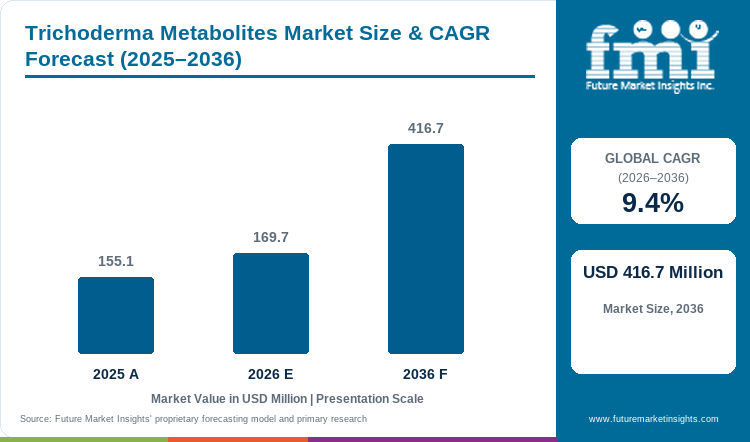
USD 169.7 million in 2026 and USD 416.7 million by 2036, expanding at 9.4% CAGR.
Sales of trichoderma metabolites are estimated to rise at 9.4% CAGR through 2036. Valuation rises from USD 155.1 million in 2025 to USD 169.7 million in 2026 and reaches USD 416.7 million by 2036. Crop-input labs are testing cell-free fractions to set practical dose levels and confirm shelf-life limits before wider commercial use. In June 2025, Syngenta reported integrating Novartis' Strains and Natural Products Collection earlier in the year. The collection gives Syngenta natural compounds and strains for agricultural microbials research and broader biological crop-input development. Commercial sales depend on batch markers that remain consistent during processing and storage so formulators can reproduce the same field dose.
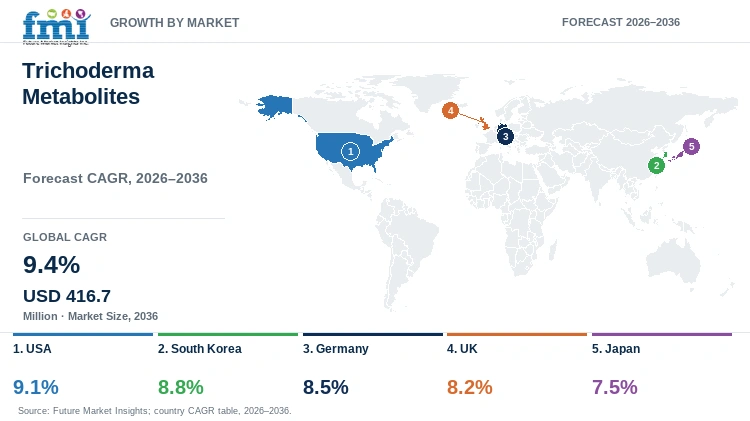
The USA is projected at 9.1% CAGR and Japan at 7.5% through 2036. Established federal review routes and national farm channels support US suppliers seeking wider grower access. In October 2025, EPA reported 15 new biopesticide active ingredients registered since January 2025. Japan supports lower-pesticide programs through national policy and local crop testing that helps validate product claims. Suppliers need local crop proof before expanding sales because approval paths differ across biological product classes. Those differences shape demand for biocontrol agents and influence how quickly suppliers move from trials into regular sales.
Key Takeaways
- Crop-input makers are testing cell-free actives that fit normal dosing without requiring live-organism shelf-life management.
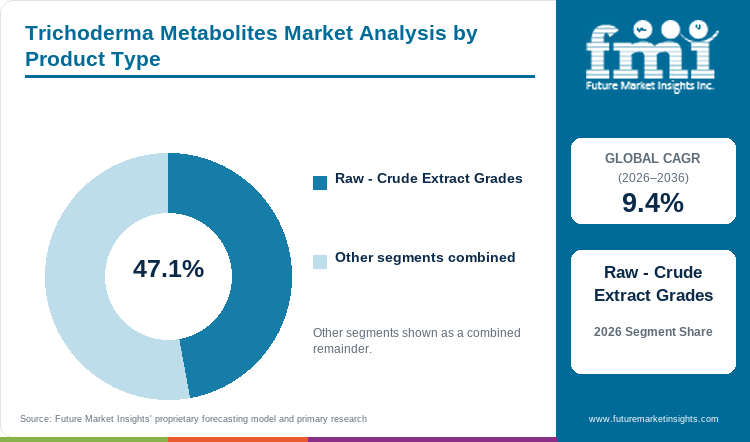
- Raw - crude extract grades are projected to hold 47.1% of product type revenue in 2026 owing to lower purification requirements.
- Cereals & grains are estimated at 41.9% of crop type revenue in 2026, driven by broad-acre programs that prioritize economical dosing.
- Soil application is expected to lead application method with 45.9% share in 2026, influenced by common root-zone use across biological programs.
- Batch qualification remains constrained by variation because producers must prove potency and shelf life before claim-specific field performance is accepted.
- Key participants include Amoéba, Syngenta, BASF SE, Koppert, Seipasa, Acadian Plant Health, Olmix Group, and Borregaard ASA.
Analyst Perspective
"Cell-free Trichoderma fractions offer a clearer commercial route because formulators can use a defined dose without managing live-organism shelf life. Adoption still depends on stable batch markers and repeatable crop trials that confirm potency through storage and field use."
- Nandini Roy Choudhury, Principal Consultant, Future Market Insights
How is the trichoderma metabolites market segmented?
The trichoderma metabolites market is segmented by Product Type, Crop Type, Application Method, Farm Type, Sales Channel, and Region.
The trichoderma metabolites market is segmented by product type, crop type, application method, farm type, sales channel and region. Product type includes raw - crude extract grades, refined & standardized fractions, formulated end-use blends and other grades. Crop type covers cereals & grains, fruits & vegetables, oilseeds & pulses, turf & ornamentals and other crops. Application method includes soil application, foliar application, fertigation - drip, seed application and other methods. Farm type covers large commercial farms, mid-size farms, smallholders, greenhouses & nurseries and other farm groups. Sales channel includes agri-input distributors, cooperatives, agri-retail chains, online - direct-to-farm routes and other channels.
What supports raw - crude extract grades within the product type category?
Crude grades retain several fungal compounds because producers use fewer clean-up steps during early processing. That simpler route lets producers set a practical potency marker without paying for narrower purified fractions. Batch strength can still vary as producers change the selected strain or feed source during processing. In June 2026, Amoéba received French marketing approval for its cell-free AXPERA biofungicide product. The approval gives crop-input producers a commercial example of a cell-free active with defined product claims and dosing requirements.
- Raw - crude extract grades are projected at 47.1% of product type revenue in 2026, attributable to limited purification and broad metabolite retention.
- Amoéba’s June 2026 approval gives crop-input producers a cell-free active example with defined commercial sales claims.
What supports cereals & grains within the crop type category?
Large crop areas favor products that fit seed treatment and soil use during early-season farm work. In November 2025, Syngenta and Amoéba agreed to develop a lysate biofungicide for cereals and field crops across Europe and the UK. The active is not a Trichoderma metabolite but follows a similar cell-free route for crop disease control. Its formulation supports a set dose across planned seasonal treatments without requiring management of a live fungal organism. Row-crop dealers already handle biostimulant products through seasonal plans that give new biological inputs an established sales route.
- Cereals & grains are estimated to hold 41.9% of crop type revenue in 2026, reinforced by broad-acre use and economical dosing requirements.
- The November 2025 agreement connects a cell-free disease-control active with sales channels serving cereal and field-crop growers.
What supports soil application within the application method category?
Soil application places the active near roots and soil-borne pests during the treatment stage. The route works with in-furrow dosing and selected fertility passes already used in field programs. In July 2026, Syngenta partnered with Groundwork BioAg to sell mycorrhizal products for field crops. Those products use live fungi rather than the cell-free Trichoderma metabolites covered by this market. The partnership strengthens dealer support for root-zone biological programs across established field-crop distribution channels. Producers need mix tests with soil treatment chemicals before combining biological products in one field pass.
- Soil application is expected to lead application method with 45.9% share in 2026, shaped by common root-zone use across biological crop programs.
- Syngenta's July 2026 agreement reinforces dealer support for root-zone biological products across field-crop programs.
How do large commercial farms shape the farm type category?
Large commercial farms compare biological inputs across side-by-side field strips under similar operating conditions. Larger test areas make weak batch control easier for farm teams to identify before routine adoption. In February 2025, Koppert launched its Stingray 25 product in France for planned field-crop programs. The product is a seaweed biostimulant rather than a Trichoderma metabolite covered by this market. Its launch places a biological input inside a planned field-crop program with established commercial support. Large farms can pair metabolite products with seed treatment materials once mix tests confirm compatibility for the planned field pass.
- Large commercial farms are forecast to represent 37.7% of farm type revenue in 2026, enabled by larger sites that support comparative field testing.
- Koppert's February 2025 launch is tied to an established sales channel that places biological inputs within routine field-crop programs.
What supports agri-input distributors within the sales channel category?
Dealers need clear field guidance before biological products can move into regular farm use. Agronomists translate crop timing and dose limits into practical advice that growers can follow during seasonal programs. In November 2025, Seipasa named Valent BioSciences as its exclusive US partner for Sweetsei. The agreement gives Seipasa a national route through established biological product channels and local technical support. Dealers handling probiotics for biopesticides need equally clear use directions before growers can add them to routine farm programs.
- Agri-input distributors are set to lead sales channels with 39.6% share in 2026, supported by local agronomy advice and routine farm guidance.
- Seipasa's November 2025 agreement is linked to a national US route for its specialist biological product.
What are the drivers, restraints and opportunities in the Trichoderma Metabolites Market?
Lower-pesticide crop programs support demand, batch and claim qualification slow scale, and stable formulation-ready fractions offer a clear commercial route.
- Driver: Growers use biological tools to cut pesticide risk and control crop disease.
- Restraint: Mixed metabolite batches need clear identity, potency tests and claim-specific evidence.
- Opportunity: Stable cell-free fractions give crop-input makers a defined active for formulation and label work.
Lower-pesticide crop programs widen the biological tool set
Growers use biological tools in crop programs that aim to reduce chemical-pesticide risk without weakening disease control. In October 2025, the UK Pesticides National Action Plan reported 20 biopesticides among 24 low-risk actives approved in Great Britain. That approval base supports a known national route for lower-risk biological products within crop-protection programs. Cell-free fungal fractions can meet the same farm need by providing a defined dose and a clear product claim. Crop advisers can combine them with Bacillus biofungicides when local trials confirm compatibility with the planned treatment program. Commercial use still requires evidence for the named crop and target before regular sales can expand. Suppliers also need batch specifications that keep performance consistent from production through field application.
Regulatory review and batch identity extend qualification
Complex metabolite mixtures require more approval work because regulators and buyers need a consistent identity for every commercial batch. Producers must define batch markers that remain stable through fermentation and clean-up before they can support repeatable product claims. EPA's April 2026 PRIA table gives five months for one pre-application biochemical classification decision in the United States. That timing covers one regulatory step rather than the full approval path required for a commercial product. Buyers also need shelf-life and tank-mix testing before products can move into routine field programs. Pest-control claims and plant-support claims require different evidence, which can extend qualification work across several review stages. Each added test increases time and cost before regular commercial sales can begin.
Stable fractions can move value beyond crude fermentation output
Defined fractions can earn more than crude fermentation output when producers control potency and shelf life for a commercial use. In April 2025, BASF launched Sokalan CP 301 as a biodegradable dispersant designed for stable agricultural formulations. Dispersants help difficult actives remain evenly mixed during tank preparation and storage before growers apply the final product. Crop-input producers use agricultural adjuvants for the same mixing problem across many formulated products. A concentrated fraction gives producers more control over product labels and pack sizes for different farm programs. The B2B sales route serves firms that already operate established channels and structured field trials. Those firms can test the final dose under commercial conditions and turn results into clear use directions for growers.
Which country CAGRs are profiled in the Trichoderma Metabolites Market?
| Country | CAGR |
|---|---|
| USA | 9.1% |
| South Korea | 8.8% |
| Germany | 8.5% |
| UK | 8.2% |
| Japan | 7.5% |
How do country-level CAGRs compare in the Trichoderma Metabolites Market?
The country CAGRs span 1.6 percentage points across the 2026 to 2036 forecast period. The USA records 9.1% CAGR, followed by South Korea at 8.8% through 2036. Germany is projected at 8.5% as the UK records 8.2% and Japan 7.5%. These figures compare forecast speed rather than current sales size, so they should not be treated as market rankings. Different approval routes and field-testing requirements influence how suppliers convert similar growth rates into commercial sales.
- Federal biopesticide review and established farm channels support a defined US route for approved biological crop products.
- Revised microbial-pesticide rules reduce approval work, while South Korea's small registered base leaves room for broader biological adoption.
- Clear product classes help German suppliers separate plant-protection claims from plant-strengthener and fertilizer routes before commercialization.
- Formal biopesticide review and expert scientific support help British suppliers prepare focused claims with suitable field evidence.
- National pesticide-reduction programs and local crop trials reinforce Japanese demand for products backed by repeatable field proof.
Similar CAGRs can lead to different sales paths because each country has different rules and field tests. The full report provides country-level CAGR analysis across North America, Latin America, Western Europe, Eastern Europe, East Asia, South Asia and Pacific, and the Middle East and Africa.
Country-wise Analysis
- US crop channels already handle microbial actives and new-use reviews across national farm programs. The USA is projected to grow at 9.1% CAGR through 2036, supported by federal review routes and established farm channels. In July 2026, EPA listed a Trichoderma atroviride AT10 new use covering food and non-food crops. The filing confirms that federal claim review remains part of the national route before suppliers can expand product sales. Cell-free fractions require a separate pathway because approval for a live strain does not transfer automatically. Dealers can scale approved products once labels provide clear terms and practical field steps for growers. Suppliers also need state sales support and local crop data before adoption can broaden across different production systems.
- South Korea is reducing some approval work for microbial pesticides under revised national rules. The country is estimated to post 8.8% CAGR through 2036, influenced by easier review steps and a small registered base. In February 2026, the Rural Development Administration reported 25 microbial-pesticide items sold through 29 registered products nationwide. Those products represented 0.8% of registered pesticides, leaving a limited commercial base for wider biological adoption. Cell-free fractions can follow a different claim route, so firms cannot assume microbial-pesticide rules apply unchanged. Dealers handling organic fertilizer inputs can support grower training through established crop channels and local agronomy networks. Korean partners can align trials with local crop systems and label limits before broader commercial use.
- German sellers separate plant-protection claims from plant-strengthener and fertilizer routes before choosing a national sales path. Germany is expected to record 8.5% CAGR through 2036, reinforced by clear product classes and focused claim choices. Category choice influences label wording and dealer training while setting the evidence required before a product can be sold. In June 2025, BVL published a national plant-strengthener list dated June 12 for non-pesticide product routes. Metabolite sellers still need both EU and German approval for each commercial use before national distribution. One fraction can support several plant functions, but local guidance must keep the approved claim clear for growers. Suppliers protect commercial value by matching stable specifications with a practical protocol for the approved use.
- Great Britain uses a defined biopesticide route for lower-risk crop-protection products under national approval rules. The UK is forecast to expand at 8.2% CAGR through 2036, linked to policy goals and formal biopesticide review. Metabolite suppliers must define the active so crop evidence supports one clear product claim. In September 2026, the UK Expert Committee on Pesticides reported activity from its Biopesticide Cloud. The program supported two HSE applications during 2025 and provided expert input on difficult scientific questions. Expert support can reduce uncertainty without removing identity or field-effect requirements from the approval process. A focused crop claim can limit unnecessary local proof before launch, while dealer training turns approved terms into farm guidance.
- Japanese crop programs place high value on repeatable field proof before products enter regular commercial use. Japan is projected to grow at 7.5% CAGR through 2036, shaped by pesticide-reduction plans and local crop review. In June 2026, MAFF adopted MIDORI BOOST to speed farm practices that reduce environmental load nationwide. Metabolite developers can align with that plan when trials confirm crop response and stable dosing under local conditions. Plant growth regulators follow separate product rules, so suppliers must keep each commercial claim focused. Local partners arrange field trials and turn approved directions into practical routines for each crop. Commercial progress depends on one supported crop claim and repeatable local proof before suppliers expand regular use.
Who are the notable companies in the Trichoderma Metabolites Market?
Amoéba, Syngenta, BASF SE, Koppert, Seipasa, Acadian Plant Health, Olmix Group, and Borregaard ASA are active within the defined biological and formulation boundary.
Four company types compete across the defined field and support different steps from active discovery to farm sales. Amoéba develops a cell-free crop active that differs from Trichoderma metabolites, while Koppert sells live-fungus Trichoderma biofungicides. Syngenta, BASF SE and Seipasa develop crop-protection products that move through established farm channels. Acadian Plant Health and Olmix Group focus on natural products that support plant response in commercial crop programs. Borregaard ASA supplies bio-based materials used by crop-input formulators to improve product mixing and handling. Public evidence does not identify a sales leader for this exact category, so the benchmark avoids unsupported share claims. Competitive entry depends on stable batch specifications and field proof that supports one clear product claim.
- Amoéba, Syngenta, BASF SE, Koppert and Seipasa work on crop bio-inputs and disease control.
- Acadian Plant Health and Olmix Group work on natural products that support plant response and growth.
- Borregaard ASA supplies bio-based materials that help crop-input makers mix active ingredients.
Competitive Benchmarking: Trichoderma Metabolites Market
| Company | Biological Active R&D | Formulation & Scale-Up | Agricultural Channel Access | Geographic Reach |
|---|---|---|---|---|
| Amoéba | High | Medium | Medium | Europe with partner-led expansion |
| Syngenta | High | High | High | Global |
| BASF SE | High | High | High | Global |
| Koppert | High | High | High | Global biological crop-input network |
| Seipasa | High | High | High | Europe, Americas, Africa and Asia |
| Acadian Plant Health | Medium | High | High | Multi-region crop programs |
| Olmix Group | Medium | High | Medium | Europe with international plant-care channels |
| Borregaard ASA | Low | High | Medium | Global materials network with agriculture support |
The benchmark compares four factors across all profiled companies and their documented crop businesses. Biological Active R&D scores reflect whether each firm develops its own crop biologicals or mainly supplies supporting materials. High scores require direct biological development, while Medium covers natural plant actives or biostimulants from the profiled firm. Low scores apply to suppliers that support formulations without developing their own crop active. Formulation and scale-up scores rely on public evidence of production capacity or formula control. Medium scale-up scores mark proven formulation work, while Low scores cover upstream material supply without the same production evidence. High channel access requires broad crop sales across several markets, while Medium reflects regional support and Low indicates limited public evidence.
Key Developments in the Trichoderma Metabolites Market
- In September 2026, Amoéba and Syngenta signed an exclusive European supply and sales deal for the cell-free AXP20 biofungicide.
- In May 2026, Acadian Plant Health introduced Stress Control Seed Treatment for arable crops at Madrid's NewAg conference.
- In March 2026, Seipasa launched Seithor in Portugal as a natural-origin bioherbicide with national product authorization.
Key Players in the Trichoderma Metabolites Market
Cell-free and biological crop-protection developers
- Amoéba
- Syngenta
- BASF SE
- Koppert
- Seipasa
Natural bioactive and biostimulant developers
- Acadian Plant Health
- Olmix Group
Formulation and bio-based material enablers
- Borregaard ASA
Trichoderma Metabolites Market - Report Scope
| Coverage field | Report scope |
|---|---|
| Market breakdown | By product type, crop type, application method, farm type, sales channel and region. |
| Quantitative Units | USD million. |
| Market Definition | Commercial Trichoderma-derived metabolite ingredients and preparations are included. Live Trichoderma inoculants are excluded when the microorganism itself is the sold active. |
| Regions Covered | North America, Latin America, Western Europe, Eastern Europe, East Asia, South Asia and Pacific, and Middle East and Africa. |
| Countries Covered | USA, South Korea, Germany, UK, Japan, and 20+ countries included in the full report. |
| Key Companies Profiled | Amoéba, Syngenta, BASF SE, Koppert, Seipasa, Acadian Plant Health, Olmix Group, Borregaard ASA. |
| Forecast Period | 2026 to 2036. |
| Approach | Primary and secondary research with market triangulation. |
Trichoderma Metabolites Market - Research Methodology
| Method | Approach |
|---|---|
| Primary Research | FMI analysts gathered input from manufacturers, service providers, technology developers, distributors, end users, procurement teams, and subject-matter experts. Interviews examined purchasing decisions, product or service evaluation, adoption barriers, approval requirements, pricing considerations, and expectations for technical or commercial support. Respondents were also asked what evidence is required before a trial, pilot, or initial order develops into regular purchasing. |
| Desk Research | Desk research covered government statistics, regulatory publications, trade data, industry associations, technical literature, standards, company filings, product information, and official corporate announcements. Sources were reviewed for relevance, publication date, geographic coverage, and consistency with the defined market scope. Claims relating to performance, applications, approvals, capacity, investment, and commercial activity were retained only when supported by credible public evidence. |
| Market Sizing and Forecasting | The market model combined the baseline value with historical performance, segment structure, pricing and volume indicators, adoption levels, company participation, and country-level demand conditions. Forecast assumptions considered economic activity, investment trends, regulatory developments, technology adoption, purchasing cycles, supply availability, and barriers to wider market use. Segment and regional estimates were reconciled before the final market total was calculated. |
| Data Validation | Estimates were checked against multiple independent indicators, including public data, company activity, trade patterns, industry developments, and findings from primary interviews. Validation also tested whether products, services, applications, and company revenues fell within the defined market boundaries. Adjacent categories, unsupported claims, overlapping revenues, and activities without direct market relevance were excluded to reduce double counting and maintain consistency across segments and countries. |
Trichoderma Metabolites Market by Segments
Trichoderma Metabolites Market segmented by Product Type:
- Raw - Crude Extract Grades
- Refined & Standardized Fractions
- Formulated End-Use Blends
- Others
Trichoderma Metabolites Market segmented by Crop Type:
- Cereals & Grains
- Fruits & Vegetables
- Oilseeds & Pulses
- Turf & Ornamentals
- Others
Trichoderma Metabolites Market segmented by Application Method:
- Soil Application
- Foliar Application
- Fertigation - Drip
- Seed Application
- Others
Trichoderma Metabolites Market segmented by Farm Type:
- Large Commercial Farms
- Mid-Size Farms
- Smallholders
- Greenhouses & Nurseries
- Others
Trichoderma Metabolites Market segmented by Sales Channel:
- Agri-Input Distributors
- Cooperatives
- Agri-Retail Chains
- Online - Direct-to-Farm
- Others
Trichoderma Metabolites Market by Region:
- North America
- United States
- Canada
- Latin America
- Brazil
- Mexico
- Chile
- Rest of Latin America
- Western Europe
- Germany
- United Kingdom
- Italy
- Spain
- France
- Nordics
- Benelux
- Rest of Western Europe
- Eastern Europe
- Russia
- Poland
- Hungary
- Balkan and Baltic States
- Rest of Eastern Europe
- East Asia
- China
- Japan
- South Korea
- South Asia and Pacific
- India
- ASEAN
- Australia and New Zealand
- Rest of South Asia and Pacific
- Middle East and Africa
- Kingdom of Saudi Arabia
- Other GCC Countries
- Türkiye
- South Africa
- Other African Union Countries
- Rest of Middle East and Africa
Research Sources and Bibliography
- Syngenta. (2025, June 30). Syngenta to become global leader in biologicals; expanding nature inspired solutions for farmers.
- U.S. Environmental Protection Agency. (2025, October 23). EPA announces proposed registration of new biopesticide and biopesticides webpage.
- Amoéba. (2026, June 30). Amoéba has received marketing authorization in France for its biofungicide AXPERA.
- Syngenta. (2025, November 18). A natural breakthrough in protecting cereals and field crops.
- Syngenta. (2026, July 14). Syngenta and Groundwork BioAg enter partnership to bring innovation in biologicals and soil carbon solutions to farmers.
- Koppert. (2025, February 20). Koppert launches Stingray 25 in France: A booster of crop growth and productivity.
- Seipasa. (2025, November 18). Seipasa and Valent BioSciences form strategic partnership to bring novel biostimulant products to the U.S. market.
- Department for Environment, Food & Rural Affairs. (2025, October 24). UK Pesticides National Action Plan 2025: Working for a more sustainable future.
- U.S. Environmental Protection Agency. (2026, April 17). PRIA fee category table - Biopesticides and Pollution Prevention Division: Other actions.
- BASF SE. (2025, April 7). BASF launches Sokalan CP 301: A readily biodegradable dispersant with optimal performance for stable agricultural formulations.
- U.S. Environmental Protection Agency. (2026, July 28). Biopesticides: Trichoderma atroviride AT10 new use notice.
- UK Expert Committee on Pesticides. (2026, September 17). UK Expert Committee on Pesticides: Annual report 2025.
- Federal Office of Consumer Protection and Food Safety, Germany. (2025, June 12). Authorised plant protection products and list of plant strengtheners.
- Ministry of Agriculture, Forestry and Fisheries, Japan. (2026, June 25). MIDORI BOOST plan adopted.
- Rural Development Administration, Republic of Korea. (2026, February 6). Registration criteria relaxed to expand use of microbial pesticides.
- Amoéba. (2026, September 8). Syngenta and Amoéba seal exclusive European distribution deal for a next-generation biofungicide.
- Acadian Plant Health. (2026, May 26). Advancing seed treatment biostimulant in EMEA.
- Seipasa. (2026, March 31). Seipasa introduces Seithor bioherbicide in Portugal, marking a new era in weed control.
- BASF SE. (2026, April 1). BASF Agricultural Solutions completes acquisition of AgBiTech, expanding its biological insect control portfolio.
- Koppert. (2025, June 2). Koppert and Amoéba sign major distribution agreement for innovative biofungicide solution.
- Syngenta. (2026, February 19). From Chile’s forests to fields, Syngenta brings botanical-based biofungicide to the Americas.
- Borregaard ASA. (2025, September 17). Opened new sales office and laboratories in Mumbai.
- Olmix Group. (2026, April 24). European PFC7 certification for Seamel PREVENT.
- Amoéba. (2026, May 6). Two new exceptional trial permits in the Netherlands in 2026 for Amoéba’s biocontrol solution.
- Syngenta. (2025, February 26). Syngenta strengthens global leadership in agricultural biologicals.
- BASF SE. (2026, May 11). BASF Agricultural Solutions successfully commissions new fermentation plant for crop protection products in Ludwigshafen.
- Koppert. (2026, July 15). A strong protection against soil-borne diseases in lettuce with Trianum.
- Seipasa. (2026, February 9). Seipasa launches Basei Mg for 360° crop protection.
- Acadian Plant Health. (2025, August 13). Acadian expands CE-marked biostimulant portfolio across Europe.
- Olmix Group. (2025, May 12). Algomel biosolutions’ performance validated by the world leader in seed potato production.
- Borregaard ASA. (2025, June 24). EU support for bio-based pest control in food production.
This bibliography is provided for reader reference and is not exhaustive. The full report contains the complete reference list and detailed citations.
This Report Answers
- What values define the trichoderma metabolites market in 2026 and 2036?
- Which farm needs support commercial adoption of cell-free Trichoderma fractions?
- Why do Raw - Crude Extract Grades hold 47.1% of product type revenue?
- Why do Cereals & Grains hold 41.9% of crop type revenue?
- Why does Soil Application hold 45.9% of application method revenue?
- How do forecast growth rates differ across the five profiled countries?
- Which batch-control and approval requirements create the main sales barriers?
- Which companies are active across the trichoderma metabolites value chain?
Frequently Asked Questions
How large is the trichoderma metabolites market globally during 2026?
The trichoderma metabolites market is valued at USD 169.7 million in 2026 and projected at USD 416.7 million by 2036. Stable cell-free fractions support regular sales when they maintain performance during storage and normal field use across farm programs.
What CAGR is projected for trichoderma metabolites between 2026 and 2036?
The trichoderma metabolites market is projected to grow at 9.4% CAGR between 2026 and 2036. Crop programs support that growth by requiring defined dosing, clear field proof and valid product claims before routine use.
Which product type leads trichoderma metabolites revenue globally during 2026?
Raw - crude extract grades are expected to hold 47.1% of product type revenue in 2026, supported by lower purification needs. Producers need stable batch markers before these grades can support regular commercial sales across farm channels.
Which application method holds the main 2026 share in the trichoderma metabolites market?
Soil application is expected to hold 45.9% of application method revenue in 2026, influenced by common root-zone use. Producers must confirm dilution and mix performance before combining these actives with other farm inputs during field dosing.
Which profiled countries record the faster forecast growth rates through 2036?
The USA is projected at 9.1% CAGR and South Korea at 8.8% through 2036. Germany records 8.5% while the UK records 8.2% and Japan records 7.5% under different approval and field-test paths.
Which companies are active across the trichoderma metabolites market today?
Key companies include Amoéba, Syngenta, BASF SE, Koppert, Seipasa, Acadian Plant Health, Olmix Group and Borregaard ASA. These firms work across active R&D and plant-response products while supporting farm channels and formulation programs.
Preview the report firsthand - request a free sample
Get SampleGet the brochure for pricing and purchase details.
Get PDFTable of Content
- Key Takeaways
- Market Size and CAGR
- Top Growth Driver
- Fastest Growing Segment
- Leading Region
- Key Companies
- Emerging Opportunities
- Executive Summary
- Global Market Outlook
- Demand-side Trends
- Supply-side Trends
- Technology Roadmap Analysis
- Analysis and Recommendations
- Analyst Perspective (What is happening? Why now? What should investors know?)
- Key Questions Answered
- How large is the market?
- What is the CAGR?
- What are key trends?
- Which region dominates?
- Who are the leaders?
- Market Overview
- Market Coverage / Taxonomy
- Market Definition / Scope / Limitations
- Research Methodology
- Chapter Orientation
- Analytical Lens and Working Hypotheses
- Market Structure, Signals, and Trend Drivers
- Benchmarking and Cross-market Comparability
- Market Sizing, Forecasting, and Opportunity Mapping
- Research Design and Evidence Framework
- Desk Research Programme (Secondary Evidence)
- Expert Input and Fieldwork (Primary Evidence)
- Tooling, Models, and Reference Databases
- Data Engineering and Model Build
- Quality Assurance and Audit Trail
- Market Background
- Market Dynamics (Drivers, Restraints, Opportunity, Trends)
- Scenario Forecast (Optimistic, Likely, Conservative)
- Impact Analysis
- AI Impact
- Sustainability Impact
- Regulatory Impact
- Technology Impact
- Consumer / Buyer Analysis
- Purchase Drivers
- Adoption Barriers
- Buyer Journey
- Opportunity Map Analysis
- Product Life Cycle Analysis
- Supply Chain Analysis
- Investment Feasibility Matrix
- Value Chain Analysis
- PESTLE and Porter's Analysis
- Regulatory Landscape
- Regional Parent Market Outlook
- Production and Consumption Statistics
- Import and Export Statistics
- Global Market Analysis and Forecast, 2021 to 2036
- Historical Market Size Value (USD Million) Analysis, 2021 to 2025
- Current and Future Market Size Value (USD Million) Projections, 2026 to 2036
- Y-o-Y Growth Trend Analysis
- Absolute $ Opportunity Analysis
- Global Market Pricing Analysis, 2021 to 2036
- Global Market Analysis and Forecast, By Product Type, 2021 to 2036
- Introduction / Key Findings
- Historical Market Size Value (USD Million) Analysis By Product Type, 2021 to 2025
- Current and Future Market Size Value (USD Million) Analysis and Forecast By Product Type, 2026 to 2036
- Raw - Crude Extract Grades
- Refined & Standardized Fractions
- Formulated End-Use Blends
- Others
- Y-o-Y Growth Trend Analysis By Product Type, 2021 to 2025
- Absolute $ Opportunity Analysis By Product Type, 2026 to 2036
- Global Market Analysis and Forecast, By Crop Type, 2021 to 2036
- Introduction / Key Findings
- Historical Market Size Value (USD Million) Analysis By Crop Type, 2021 to 2025
- Current and Future Market Size Value (USD Million) Analysis and Forecast By Crop Type, 2026 to 2036
- Cereals & Grains
- Fruits & Vegetables
- Oilseeds & Pulses
- Turf & Ornamentals
- Others
- Y-o-Y Growth Trend Analysis By Crop Type, 2021 to 2025
- Absolute $ Opportunity Analysis By Crop Type, 2026 to 2036
- Global Market Analysis and Forecast, By Application Method, 2021 to 2036
- Introduction / Key Findings
- Historical Market Size Value (USD Million) Analysis By Application Method, 2021 to 2025
- Current and Future Market Size Value (USD Million) Analysis and Forecast By Application Method, 2026 to 2036
- Soil Application
- Foliar Application
- Fertigation - Drip
- Seed Application
- Others
- Y-o-Y Growth Trend Analysis By Application Method, 2021 to 2025
- Absolute $ Opportunity Analysis By Application Method, 2026 to 2036
- Global Market Analysis and Forecast, By Farm Type, 2021 to 2036
- Introduction / Key Findings
- Historical Market Size Value (USD Million) Analysis By Farm Type, 2021 to 2025
- Current and Future Market Size Value (USD Million) Analysis and Forecast By Farm Type, 2026 to 2036
- Large Commercial Farms
- Mid-Size Farms
- Smallholders
- Greenhouses & Nurseries
- Others
- Y-o-Y Growth Trend Analysis By Farm Type, 2021 to 2025
- Absolute $ Opportunity Analysis By Farm Type, 2026 to 2036
- Global Market Analysis and Forecast, By Sales Channel, 2021 to 2036
- Introduction / Key Findings
- Historical Market Size Value (USD Million) Analysis By Sales Channel, 2021 to 2025
- Current and Future Market Size Value (USD Million) Analysis and Forecast By Sales Channel, 2026 to 2036
- Agri-Input Distributors
- Cooperatives
- Agri-Retail Chains
- Online - Direct-to-Farm
- Others
- Y-o-Y Growth Trend Analysis By Sales Channel, 2021 to 2025
- Absolute $ Opportunity Analysis By Sales Channel, 2026 to 2036
- Global Market Analysis and Forecast, By Region, 2021 to 2036
- Introduction
- Historical Market Size Value (USD Million) Analysis By Region, 2021 to 2025
- Current Market Size Value (USD Million) Analysis and Forecast By Region, 2026 to 2036
- North America
- Latin America
- Western Europe
- Eastern Europe
- East Asia
- South Asia and Pacific
- Middle East and Africa
- Market Attractiveness Analysis By Region
- North America Market Analysis and Forecast, By Country, 2021 to 2036
- Historical Market Size Value (USD Million) Trend Analysis By Market Taxonomy, 2021 to 2025
- Market Size Value (USD Million) Forecast By Market Taxonomy, 2026 to 2036
- By Country
- United States
- Canada
- By Product Type
- By Crop Type
- By Application Method
- By Farm Type
- By Sales Channel
- By Country
- Market Attractiveness Analysis
- By Country
- By Product Type
- By Crop Type
- By Application Method
- By Farm Type
- By Sales Channel
- Key Takeaways
- Latin America Market Analysis and Forecast, By Country
- Historical Market Size Value (USD Million) Trend Analysis By Market Taxonomy, 2021 to 2025
- Market Size Value (USD Million) Forecast By Market Taxonomy, 2026 to 2036
- By Country
- Brazil
- Mexico
- Chile
- Rest of Latin America
- By Product Type
- By Crop Type
- By Application Method
- By Farm Type
- By Sales Channel
- By Country
- Market Attractiveness Analysis
- By Country
- By Product Type
- By Crop Type
- By Application Method
- By Farm Type
- By Sales Channel
- Key Takeaways
- Western Europe Market Analysis and Forecast, By Country
- Historical Market Size Value (USD Million) Trend Analysis By Market Taxonomy, 2021 to 2025
- Market Size Value (USD Million) Forecast By Market Taxonomy, 2026 to 2036
- By Country
- Germany
- United Kingdom
- Italy
- Spain
- France
- Nordics
- Benelux
- Rest of Western Europe
- By Product Type
- By Crop Type
- By Application Method
- By Farm Type
- By Sales Channel
- By Country
- Market Attractiveness Analysis
- By Country
- By Product Type
- By Crop Type
- By Application Method
- By Farm Type
- By Sales Channel
- Key Takeaways
- Eastern Europe Market Analysis and Forecast, By Country
- Historical Market Size Value (USD Million) Trend Analysis By Market Taxonomy, 2021 to 2025
- Market Size Value (USD Million) Forecast By Market Taxonomy, 2026 to 2036
- By Country
- Russia
- Poland
- Hungary
- Balkan and Baltic States
- Rest of Eastern Europe
- By Product Type
- By Crop Type
- By Application Method
- By Farm Type
- By Sales Channel
- By Country
- Market Attractiveness Analysis
- By Country
- By Product Type
- By Crop Type
- By Application Method
- By Farm Type
- By Sales Channel
- Key Takeaways
- East Asia Market Analysis and Forecast, By Country
- Historical Market Size Value (USD Million) Trend Analysis By Market Taxonomy, 2021 to 2025
- Market Size Value (USD Million) Forecast By Market Taxonomy, 2026 to 2036
- By Country
- China
- Japan
- South Korea
- By Product Type
- By Crop Type
- By Application Method
- By Farm Type
- By Sales Channel
- By Country
- Market Attractiveness Analysis
- By Country
- By Product Type
- By Crop Type
- By Application Method
- By Farm Type
- By Sales Channel
- Key Takeaways
- South Asia and Pacific Market Analysis and Forecast, By Country
- Historical Market Size Value (USD Million) Trend Analysis By Market Taxonomy, 2021 to 2025
- Market Size Value (USD Million) Forecast By Market Taxonomy, 2026 to 2036
- By Country
- India
- ASEAN
- Australia and New Zealand
- Rest of South Asia and Pacific
- By Product Type
- By Crop Type
- By Application Method
- By Farm Type
- By Sales Channel
- By Country
- Market Attractiveness Analysis
- By Country
- By Product Type
- By Crop Type
- By Application Method
- By Farm Type
- By Sales Channel
- Key Takeaways
- Middle East and Africa Market Analysis and Forecast, By Country
- Historical Market Size Value (USD Million) Trend Analysis By Market Taxonomy, 2021 to 2025
- Market Size Value (USD Million) Forecast By Market Taxonomy, 2026 to 2036
- By Country
- Kingdom of Saudi Arabia
- Other GCC Countries
- Türkiye
- South Africa
- Other African Union Countries
- Rest of Middle East and Africa
- By Product Type
- By Crop Type
- By Application Method
- By Farm Type
- By Sales Channel
- By Country
- Market Attractiveness Analysis
- By Country
- By Product Type
- By Crop Type
- By Application Method
- By Farm Type
- By Sales Channel
- Key Takeaways
- Key Countries Market Analysis
- United States
- Pricing Analysis
- Market Share Analysis, 2025
- By Product Type
- By Crop Type
- By Application Method
- By Farm Type
- By Sales Channel
- Canada
- Pricing Analysis
- Market Share Analysis, 2025
- By Product Type
- By Crop Type
- By Application Method
- By Farm Type
- By Sales Channel
- Mexico
- Pricing Analysis
- Market Share Analysis, 2025
- By Product Type
- By Crop Type
- By Application Method
- By Farm Type
- By Sales Channel
- Brazil
- Pricing Analysis
- Market Share Analysis, 2025
- By Product Type
- By Crop Type
- By Application Method
- By Farm Type
- By Sales Channel
- Chile
- Pricing Analysis
- Market Share Analysis, 2025
- By Product Type
- By Crop Type
- By Application Method
- By Farm Type
- By Sales Channel
- Germany
- Pricing Analysis
- Market Share Analysis, 2025
- By Product Type
- By Crop Type
- By Application Method
- By Farm Type
- By Sales Channel
- United Kingdom
- Pricing Analysis
- Market Share Analysis, 2025
- By Product Type
- By Crop Type
- By Application Method
- By Farm Type
- By Sales Channel
- Italy
- Pricing Analysis
- Market Share Analysis, 2025
- By Product Type
- By Crop Type
- By Application Method
- By Farm Type
- By Sales Channel
- Spain
- Pricing Analysis
- Market Share Analysis, 2025
- By Product Type
- By Crop Type
- By Application Method
- By Farm Type
- By Sales Channel
- France
- Pricing Analysis
- Market Share Analysis, 2025
- By Product Type
- By Crop Type
- By Application Method
- By Farm Type
- By Sales Channel
- India
- Pricing Analysis
- Market Share Analysis, 2025
- By Product Type
- By Crop Type
- By Application Method
- By Farm Type
- By Sales Channel
- ASEAN
- Pricing Analysis
- Market Share Analysis, 2025
- By Product Type
- By Crop Type
- By Application Method
- By Farm Type
- By Sales Channel
- Australia and New Zealand
- Pricing Analysis
- Market Share Analysis, 2025
- By Product Type
- By Crop Type
- By Application Method
- By Farm Type
- By Sales Channel
- China
- Pricing Analysis
- Market Share Analysis, 2025
- By Product Type
- By Crop Type
- By Application Method
- By Farm Type
- By Sales Channel
- Japan
- Pricing Analysis
- Market Share Analysis, 2025
- By Product Type
- By Crop Type
- By Application Method
- By Farm Type
- By Sales Channel
- South Korea
- Pricing Analysis
- Market Share Analysis, 2025
- By Product Type
- By Crop Type
- By Application Method
- By Farm Type
- By Sales Channel
- Russia
- Pricing Analysis
- Market Share Analysis, 2025
- By Product Type
- By Crop Type
- By Application Method
- By Farm Type
- By Sales Channel
- Poland
- Pricing Analysis
- Market Share Analysis, 2025
- By Product Type
- By Crop Type
- By Application Method
- By Farm Type
- By Sales Channel
- Hungary
- Pricing Analysis
- Market Share Analysis, 2025
- By Product Type
- By Crop Type
- By Application Method
- By Farm Type
- By Sales Channel
- Kingdom of Saudi Arabia
- Pricing Analysis
- Market Share Analysis, 2025
- By Product Type
- By Crop Type
- By Application Method
- By Farm Type
- By Sales Channel
- Türkiye
- Pricing Analysis
- Market Share Analysis, 2025
- By Product Type
- By Crop Type
- By Application Method
- By Farm Type
- By Sales Channel
- South Africa
- Pricing Analysis
- Market Share Analysis, 2025
- By Product Type
- By Crop Type
- By Application Method
- By Farm Type
- By Sales Channel
- United States
- Market Structure Analysis
- Competition Dashboard
- Competition Benchmarking
- Market Share Analysis of Top Players
- By Regional
- By Product Type
- By Crop Type
- By Application Method
- By Farm Type
- By Sales Channel
- Emerging Startups
- Innovation Benchmarking
- Competition Analysis
- Competition Deep Dive
- Amoéba
- Overview
- Product Portfolio
- Profitability by Market Segments
- Sales Footprint
- Strategy Overview
- Marketing Strategy
- Product Strategy
- Channel Strategy
- Syngenta
- BASF SE
- Koppert
- Seipasa
- Acadian Plant Health
- Olmix Group
- Borregaard ASA
- Amoéba
- Case Studies
- Success Stories
- Recent Developments
- Competition Deep Dive
- Assumptions & Acronyms Used


