

- Market Size (2026)
- USD 237.0 Mn
- Forecast (2036)
- USD 626.1 Mn
- CAGR (2026 to 2036)
- 10.2%
How big is Bacillus Metabolites Market in 2026?
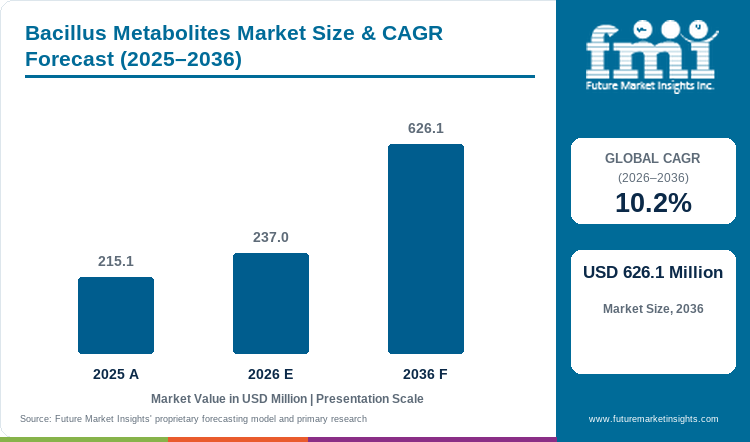
USD 237.0 million in 2026 and USD 626.1 million by 2036, expanding at 10.2% CAGR.
The bacillus metabolites market is projected to expand at 10.2% CAGR from 2026 to 2036. Valuation rises from USD 215.1 million in 2025 to USD 237.0 million in 2026 and reaches USD 626.1 million by 2036. Product teams currently favor cell-free crop effects because these ingredients are easier to store, blend, and standardize for routine formulation work. An April 2026 review found wide differences among Bacillus metabolites across production methods and compound profiles. Marker tests now help suppliers compare product lots before field trials assess crop response under normal farm conditions. Stable ingredients can then enter fertilizer and crop-protection programs without forcing growers to change established farm routines.
South Korea is projected to grow at 9.8% CAGR through 2036, while Japan is projected at 8.0%. In February 2026, South Korea's Rural Development Administration reported 25 microbial pesticide items and 29 registered products. The agency said those products made up 0.8% of registered pesticides. Microbial products remain a small registered category despite South Korea's defined approval route. That route currently gives product teams a clearer path from testing to farm sales. Japan places more weight on detailed product records and local field proof before biostimulants enter broader farm programs. In both countries, suppliers need crop-specific results and stable lot data that match national product rules.
Key Takeaways
- Growers and formulators seek biological crop tools that work with nutrient and crop-protection plans.
- Raw - crude extract grades are projected to hold 46.3% of Product Type revenue in 2026, owing to lower processing requirements.
- Cereals and grains are estimated to hold 38.7% of Crop Type demand in 2026, influenced by low dose costs across large fields.
- In 2026, soil application is expected to lead Application Method with 42.1% share, enabled by direct root-zone delivery.
- Lot changes and claim rules can slow approval despite useful crop effects from metabolite mixes.
- Key companies include Acadian Plant Health, Olmix Group, BioAtlantis, Hello Nature, SICIT Group, Tessenderlo Group, Algaia, and Certis Biologicals.
Analyst Perspective
"The commercial opportunity lies in stable cell-free Bacillus ingredients that fit fertilizer and crop-protection programs already used on farms. Adoption depends on suppliers proving consistent lot activity through marker tests and field trials before growers commit to repeat orders."
- Nandini Roy Choudhury, Principal Consultant, Future Market Insights
How is the bacillus metabolites market segmented?
The bacillus metabolites market is segmented by Product Type, Crop Type, Application Method, Farm Type, Sales Channel and Region. Forecast Period from 2026 to 2036.
Segmentation covers product type, crop type, application method, farm type and sales channel. Product type includes raw - crude extract grades, refined and standardized fractions, formulated end-use blends and others. Crop type includes cereals and grains, fruits and vegetables, oilseeds and pulses, turf and ornamentals and others. Application method includes soil, foliar, fertigation - drip, seed and others. Farm type includes large commercial farms, mid-size farms, smallholders, greenhouses and nurseries and others. Sales channel includes agri-input distributors, cooperatives, agri-retail chains, online - direct-to-farm and others.
How do raw - crude extract grades shape product type selection?
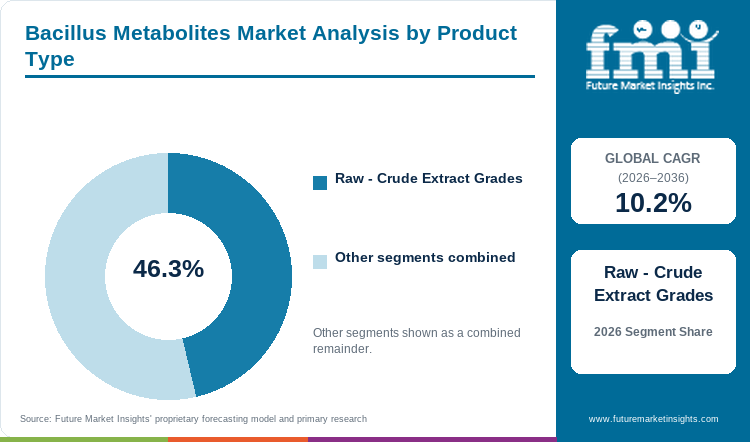
Raw - crude extract grades preserve several fermentation compounds in one mix instead of separating each fraction. Fewer processing steps can lower production cost, but they also make lot control more important for formulators. In March 2025, Algaia announced a new extraction plant during a wider expansion of complex bioactive production. The project increased capacity for complex seaweed extracts and illustrates how biological ingredients require controlled processing at scale. Bacillus suppliers face a similar lot-control problem because feed materials and fermentation output can vary between batches. Marker profiles help formulators compare lots before ingredients enter larger crop programs. Consistent lot checks protect the cost advantage of crude grades without sacrificing repeatable field performance.
- Based on Product Type, raw - crude extract grades are projected to account for 46.3% in 2026, driven by lower processing cost.
- Formulators use marker profiles to compare biostimulant formulations across ongoing crop programs.
Why do cereals and grains account for the largest crop type share?
Cereals and grains cover large farm areas, making dose cost an important part of product selection. Growers prefer crop tools that work with seed, soil, or fertilizer jobs already planned for the season. In April 2025, Germany's BVL authorized Toltek for cereal use with Bacillus amyloliquefaciens D747 as the active biological strain. The authorization places that Bacillus strain within a formal cereal disease program. This cereal use gives metabolite suppliers a practical field reference for grain crops. Suppliers still need results that remain stable across different soils and weather conditions. Stable field performance helps farms judge whether metabolite ingredients can support routine use across large treated areas.
- In 2026, cereals and grains are expected to lead Crop Type with 38.7% share, supported by low dose cost across large fields.
- Cereal programs compare metabolite ingredients with bacillus biofungicides used for seed and disease control.
How does soil application influence application-method demand?
Soil application places active material close to roots and uses field work already scheduled for nutrient delivery. In September 2025, South Korean researchers reported Bacillus trials on Napa cabbage under field conditions. The trials measured drought stress, soft rot, and root-zone effects within the same field program. Those results give cell-free metabolite suppliers a practical reference for designing soil-applied products. Suppliers still need to prove that stable compounds can deliver useful crop responses without relying on live cells. Repeatable root-zone performance helps farms compare metabolite products with familiar soil and nutrient practices across crop programs.
- By Application Method, soil application is forecast to represent 42.1% in 2026, reinforced by root access and routine soil work.
- Growers compare soil application with biofertilizer programs used for soil care and nutrient delivery.
What supports large commercial farms within the farm type category?
Large commercial farms can test biological inputs across enough acreage to compare treated and untreated fields within one crop cycle. In May 2025, Acadian Plant Health introduced a seed-treatment biostimulant after trials across several maize and soybean sites. The company said the product works with standard commercial seed-treatment equipment, reducing the need for separate handling systems. Large farms can expand biological use once field results justify the dose, cost, and equipment fit. Suppliers also need stable lots and enough product to serve short planting windows without delaying farm schedules. Reliable supply lets agronomy teams move from limited trials into broader seasonal programs using established equipment.
- Within Farm Type, large commercial farms are likely to capture 40.0% share in 2026, attributable to larger trials and treated acreage.
- Large farms compare metabolite inputs with biorational pesticides during crop-protection reviews.
Why are agri-input distributors important within the sales channel category?
Agri-input distributors keep products available locally and explain how biological ingredients fit existing crop plans. Product claims can change the legal route, so distributors need records that clearly separate approved uses and dose instructions. In June 2025, Certis Biologicals launched a Mexico website with local labels and approval updates for channel partners. The resource gives distributors one place to check product use and registration details before advising farms. Metabolite suppliers need current dose records, claim language, and application guidance for every product. Strong local support turns technical product information into practical farm advice and can help repeat purchases follow the approved use.
- Agri-input distributors are set to lead Sales Channel with 49.8% share in 2026, shaped by local crop advice and label support.
- Direct sales can serve experienced farms that manage product use themselves. Many farms need local help with dose, compatibility, and label rules.
What are the drivers, restraints and opportunities in the Bacillus Metabolites Market?
Biological crop programs support demand, composition control limits repeat use, and standardized fractions offer a route to higher-value ingredients.
- Driver: Growers are adding biological crop functions to programs that keep timing and field results.
- Restraint: Batch changes and claim rules can extend testing before metabolite ingredients reach farm use.
- Opportunity: Better marker tests and controlled separation can make fermentation output a consistent crop ingredient.
Biological crop programs expand the set of functions growers can buy
Growers now compare more biological tools with standard inputs during routine crop planning. From January through October 2025, EPA reported 15 new biopesticide active ingredients for farm use. Those additions give farm teams more low-risk options to review alongside established crop-protection products. Bacillus metabolites earn repeat consideration when each dose produces steady field results without disrupting planned farm work. Some growers combine biological choices with organic fertilizer programs during nutrient planning, reducing the need for separate decisions. Seed and soil delivery can also avoid another field pass and keep labor within existing schedules. Farms move toward repeat orders once field results justify the product cost and suppliers provide stable lots, clear directions, and practical storage.
Composition and claims can extend the route from sample to sale
Changes in metabolite composition make approval harder because regulators and buyers need a stable product identity. In January 2026, USDA APHIS updated guidance for plant growth enhancers and clarified the information importers must provide. Importers must list ingredients, explain product function, and address toxin or antibiotic details when those issues apply. Product teams pair marker tests with shelf-life data and field results to keep the product specification consistent. Extra testing can erase the price advantage of a crude grade, while some claims can trigger another legal route. Suppliers need a stable specification before a sample can move into regular farm purchasing.
Standardized fractions can support higher-value formulation work
Standardized fractions create a higher-value route when tighter composition control justifies the added processing cost. In May 2025, Japan's agriculture ministry issued national guidance requiring use, safety, and proof-of-effect information for biostimulant products. Defined fractions can simplify that review because buyers and regulators receive clearer information about product contents. Marker tests also help formulators compare lots before they commit to larger field trials. Standardized Bacillus fractions can then enter programs that combine plant growth regulators or nutrient inputs. Buyers still compare dose cost and field performance against lower-cost crude grades before accepting the premium. Better lot control must cover added processing costs for standardized fractions to support more focused crop uses.
Which country CAGRs are profiled in the Bacillus Metabolites Market?
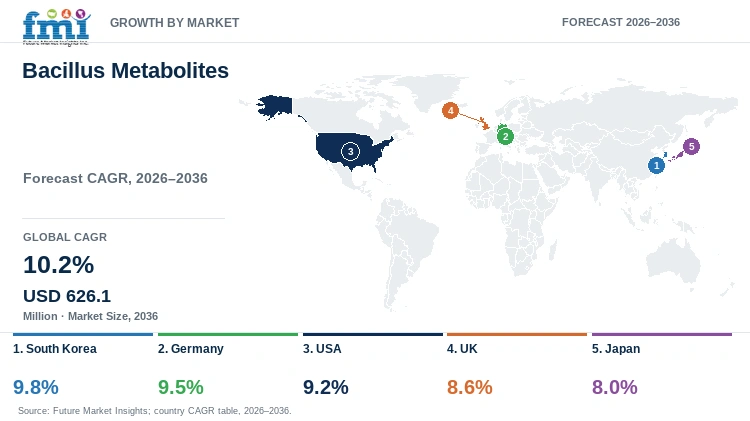
| Country | CAGR |
|---|---|
| South Korea | 9.8% |
| Germany | 9.5% |
| USA | 9.2% |
| UK | 8.6% |
| Japan | 8.0% |
How do country-level CAGRs compare in the Bacillus Metabolites Market?
The countries span a 1.8 percentage-point CAGR range through 2036, with South Korea and Germany carrying the higher forecast rates. The USA follows at 9.2%, while the UK and Japan remain lower within systems that apply different approval and field-proof requirements.
- South Korea's defined registration path gives biological product teams a clearer route from microbial testing into approved farm use.
- Germany's cereal disease programs give Bacillus suppliers a practical field setting for comparing biological performance across established crop-protection routines.
- US growers compare metabolite ingredients with a growing set of biopesticide options during crop-protection planning and product selection.
- UK distributors need clear dose records and use directions so farms can place biological inputs within established crop programs.
- Japan's national biostimulant guidance gives local partners a clearer framework for product labels and use information before farm distribution.
The full report provides country-level CAGR analysis across North America, Latin America, Western Europe, Eastern Europe, East Asia, South Asia and Pacific, and the Middle East and Africa.
Country-wise Analysis
- South Korea's public microbial research gives suppliers more local routes for crop-stress and disease testing. Adoption of bacillus metabolites is estimated to expand at 9.8% CAGR through 2036, reinforced by this established research base. In November 2025, the Rural Development Administration described Bacillus mesonae field use on apple farms. The agency also announced plans to expand climate-response microbial work with industry partners, creating more settings for crop-response trials. Cell-free metabolite suppliers still need stable lot activity and local evidence before making broad product claims. Firms serving seed health programs can use the same networks for trials and training. Regular use depends on crop results that growers can verify across local field conditions.
- Germany's bacillus metabolites outlook is anticipated to advance at 9.5% CAGR through 2036, linked to formal approval and product-record rules. Crop-input buyers currently follow defined product categories before adding a new biological tool to farm programs. In June 2025, BVL published its national list of plant strengtheners and maintained plant-protection products under a separate route. Those lists give suppliers distinct legal paths based on product contents, claims, and intended use. Cell-free metabolites need a category that matches their composition and stated function before sale. Suppliers of seed treatment materials also face quality checks during product review. Complete product records can shorten administrative work but cannot replace the approval steps required for sale.
- US growers use biological tools under federal pesticide rules and state fertilizer requirements that can create separate review steps. Bacillus metabolite demand is forecast to rise at 9.2% CAGR through 2036, shaped by this layered oversight and product classification. In July 2026, EPA listed new microbial ingredients used in biopesticides, including Priestia megaterium strain SYM36613 as first registered in 2026. That registration gives farms another microbial crop-protection option to review within existing compliance programs. Cell-free metabolite products still need clear contents and claims that match the correct legal route. Firms serving microbial seed treatments need labels that match approved uses and local requirements. Clear records and field support help distributors explain dose, use, and product status to farms.
- The UK bacillus metabolites sector is projected to record 8.6% CAGR through 2036, influenced by changing fertilizer rules and crop plans. Growers currently test biological inputs while suppliers adjust product files to changing conformity and claim requirements. In September 2026, Defra said its reform work covers newer materials and microorganisms used in fertilising products. The reform can change conformity work and the claims suppliers may use for biological products. Suppliers need complete composition files and must keep biostimulant claims separate from pesticide claims under the correct route. Local distributors also need clear use directions before placing products into farm programs. Clear guidance helps farms compare biological products without weakening the field evidence required for repeat buying.
- Buyers in Japan require clear product details and local crop evidence before expanding biological inputs across farm programs. Japan's bacillus metabolites market is estimated to post 8.0% CAGR through 2036, tied to local field proof and detailed product records. In March 2026, MAFF held a national meeting on biostimulant labels and use rules. The meeting covered the MIDORI strategy and current industry handling of biostimulant products. Metabolite suppliers need dose data that matches crops grown in Japan and ingredient lists that local partners can review. Local partners convert those product files into farm guidance without changing approved claims. Products used beside seed additives must also work within the same treatment plan and documented use route.
Who are the notable companies in the Bacillus Metabolites Market?
Acadian Plant Health, Olmix Group, BioAtlantis, Hello Nature, SICIT Group, Tessenderlo Group, Algaia, and Certis Biologicals are active in the competitive field.
Acadian Plant Health, Olmix Group, BioAtlantis, Hello Nature, and SICIT Group compete through farm-biological products and formulation platforms. Tessenderlo Group supplies crop-nutrition and crop-protection channels, while Algaia provides seaweed bioactives and Certis Biologicals contributes Bacillus fermentation experience. Public records do not confirm a dedicated Bacillus metabolite line for every company, so product activity and field support remain entry barriers.
- Biostimulant platforms: Acadian Plant Health, Olmix Group, BioAtlantis, Hello Nature and SICIT Group.
- Broader agricultural inputs: Tessenderlo Group and Algaia sell crop-nutrition or bioactive ingredient products.
- Bacillus biological crop protection: Certis Biologicals brings fermentation work and registered Bacillus products.
Competitive Benchmarking: Bacillus Metabolites Market
| Company | Bioactive Formulation Depth | Field-Application Integration | Agricultural Channel Reach | Geographic Reach |
|---|---|---|---|---|
| Acadian Plant Health | High | High | High | North America, Latin America, Europe and Asia-Pacific |
| Olmix Group | High | High | High | Europe and international plant-care markets |
| BioAtlantis | High | High | Medium | Europe and selected international crop markets |
| Hello Nature | High | High | High | More than 80 countries |
| SICIT Group | High | High | High | Europe, Asia and the Americas |
| Tessenderlo Group | Medium | Medium | High | Europe, North America and global agriculture markets |
| Algaia | Medium | Low | Low | Europe and international ingredient markets |
| Certis Biologicals | High | High | High | United States and more than 50 countries |
The benchmark uses three levels to compare formulation depth, field integration, and agricultural channel reach. High formulation depth requires several documented biological routes, while Medium marks a narrower role and Low marks limited public evidence. High field integration requires several crop-use settings, with Medium and Low reflecting progressively narrower field proof. High channel reach requires broad farm sales or distributor access across documented agricultural routes. Geographic reach describes the regions each company serves and does not change the other benchmark ratings.
Key Developments in the Bacillus Metabolites Market
- In May 2026, Acadian Plant Health introduced Stress Control Seed Treatment for EMEA arable crops and commercial seed-treatment systems.
- In March 2026, Tessenderlo Kerley signed an agreement to acquire a Swedish sulfate of potash plant from Cinis Fertilizer.
- In July 2025, Olmix Group received PFC 6 certification for Cormin SW as a non-microbial plant biostimulant for bulk-blended fertilizers.
Key Players in the Bacillus Metabolites Market
Crop biostimulant platforms
- Acadian Plant Health
- Olmix Group
- BioAtlantis
- Hello Nature
- SICIT Group
Broader agricultural bioactive inputs
- Tessenderlo Group
- Algaia
Bacillus biological crop protection
- Certis Biologicals
Bacillus Metabolites Market - Report Scope
| Coverage field | Report scope |
|---|---|
| Market breakdown | By product type, crop type, application method, farm type, sales channel and region. |
| Quantitative Units | USD million. |
| Market Definition | Commercial agricultural products with a Bacillus-derived metabolite, cell-free metabolite-rich extract or refined Bacillus fraction are included. Live Bacillus inoculants valued mainly for viable cells are excluded. |
| Regions Covered | North America, Latin America, Western Europe, Eastern Europe, East Asia, South Asia and Pacific, and Middle East and Africa. |
| Countries Covered | South Korea, Germany, USA, UK, Japan, and 20+ countries included in the full report. |
| Key Companies Profiled | Acadian Plant Health, Olmix Group, BioAtlantis, Hello Nature, SICIT Group, Tessenderlo Group, Algaia, and Certis Biologicals. |
| Forecast Period | 2026 to 2036. |
| Approach | Primary and secondary research with market triangulation. |
Bacillus Metabolites Market - Research Methodology
| Method | Approach |
|---|---|
| Primary Research | FMI analysts gathered input from manufacturers, service providers, technology developers, distributors, end users, procurement teams, and subject-matter experts. Interviews examined purchasing decisions, product or service evaluation, adoption barriers, approval requirements, pricing considerations, and expectations for technical or commercial support. Respondents were also asked what evidence is required before a trial, pilot, or initial order develops into regular purchasing. |
| Desk Research | Desk research covered government statistics, regulatory publications, trade data, industry associations, technical literature, standards, company filings, product information, and official corporate announcements. Sources were reviewed for relevance, publication date, geographic coverage, and consistency with the defined market scope. Claims relating to performance, applications, approvals, capacity, investment, and commercial activity were retained only when supported by credible public evidence. |
| Market Sizing and Forecasting | The market model combined the baseline value with historical performance, segment structure, pricing and volume indicators, adoption levels, company participation, and country-level demand conditions. Forecast assumptions considered economic activity, investment trends, regulatory developments, technology adoption, purchasing cycles, supply availability, and barriers to wider market use. Segment and regional estimates were reconciled before the final market total was calculated. |
| Data Validation | Estimates were checked against multiple independent indicators, including public data, company activity, trade patterns, industry developments, and findings from primary interviews. Validation also tested whether products, services, applications, and company revenues fell within the defined market boundaries. Adjacent categories, unsupported claims, overlapping revenues, and activities without direct market relevance were excluded to reduce double counting and maintain consistency across segments and countries. |
Bacillus Metabolites Market by Segments
Bacillus Metabolites Market segmented by Product Type:
- Raw - Crude Extract Grades
- Refined & Standardized Fractions
- Formulated End-Use Blends
- Others
Bacillus Metabolites Market segmented by Crop Type:
- Cereals & Grains
- Fruits & Vegetables
- Oilseeds & Pulses
- Turf & Ornamentals
- Others
Bacillus Metabolites Market segmented by Application Method:
- Soil Application
- Foliar Application
- Fertigation - Drip
- Seed Application
- Others
Bacillus Metabolites Market segmented by Farm Type:
- Large Commercial Farms
- Mid-Size Farms
- Smallholders
- Greenhouses & Nurseries
- Others
Bacillus Metabolites Market segmented by Sales Channel:
- Agri-Input Distributors
- Cooperatives
- Agri-Retail Chains
- Online - Direct-to-Farm
- Others
Bacillus Metabolites Market by Region:
- North America
- United States
- Canada
- Latin America
- Brazil
- Mexico
- Chile
- Rest of Latin America
- Western Europe
- Germany
- United Kingdom
- Italy
- Spain
- France
- Nordics
- Benelux
- Rest of Western Europe
- Eastern Europe
- Russia
- Poland
- Hungary
- Balkan and Baltic States
- Rest of Eastern Europe
- East Asia
- China
- Japan
- South Korea
- South Asia and Pacific
- India
- ASEAN
- Australia and New Zealand
- Rest of South Asia and Pacific
- Middle East and Africa
- Kingdom of Saudi Arabia
- Other GCC Countries
- Türkiye
- South Africa
- Other African Union Countries
- Rest of Middle East and Africa
Research Sources and Bibliography
- Lv, Y., Sun, H., Wang, T., Wang, X., Zhang, H., & Ma, H. (2026, April 24). Systematic categorization and functional diversity of secondary metabolites from Bacillus spp.: A review. Probiotics and Antimicrobial Proteins.
- Rural Development Administration, Republic of Korea. (2026, February 6). Microbial pesticide registration criteria eased to expand use.
- Algaia. (2025, March 24). Algaia takes a new step in its industrial ambition.
- Federal Office of Consumer Protection and Food Safety, Germany. (2025, April 3). Authorization report: Toltek (00B128-00/00), Bacillus amyloliquefaciens subsp. plantarum strain D747.
- Rural Development Administration, Republic of Korea. (2025, September 30). Effects of Bacillus strains H30-3 and KJ40 on drought stress and soft rot in Napa cabbage.
- Acadian Plant Health. (2025, May 13). Primed for potential: Advancing crop resilience with new seed treatment technology.
- Certis Biologicals. (2025, June 5). Certis Agro Mexico website officially launches to better serve Mexico's growers.
- U.S. Environmental Protection Agency. (2025, October 23). EPA announces proposed registration of new biopesticide and biopesticides webpage.
- U.S. Department of Agriculture, Animal and Plant Health Inspection Service. (2026, January 25). Importation of soil amendments or plant health enhancers.
- Ministry of Agriculture, Forestry and Fisheries, Japan. (2025, May 30). Guidelines for labeling and other information for biostimulants.
- U.S. Environmental Protection Agency. (2026, July). Biopesticide active ingredients.
- Federal Office of Consumer Protection and Food Safety, Germany. (2025, June 12). List of plant strengtheners.
- Department for Environment, Food & Rural Affairs. (2026, September 9). Marketing fertilising products in the UK: Regulatory reform.
- Ministry of Agriculture, Forestry and Fisheries, Japan. (2026, March 4). Information exchange meeting on guidelines for labeling and other information for biostimulants.
- Rural Development Administration, Republic of Korea. (2025, November 4). Expanding the use of microbial agents for climate-change response.
- Acadian Plant Health. (2026, May 26). Advancing seed treatment biostimulant in EMEA.
- Tessenderlo Group. (2026, March 20). Tessenderlo Kerley International signs agreement to acquire SOP production plant from Cinis Fertilizer AB.
- Olmix Group. (2025, July 17). European certification for Cormin SW, the Olmix biostimulant that boosts fertilizer efficiency.
- Acadian Plant Health. (2026, August 27). Acadian Plant Health and Koppert USA announce commercial transition in the U.S. biostimulant market.
- Tessenderlo Group. (2025, August). Tessenderlo Kerley opens a new liquid fertilizer production facility in Defiance, Ohio.
- Acadian Plant Health. (2026, August 25). Acadian Plant Health secures CE Mark for Ready for Stress, its first registered abiotic stress management product in the EU.
- Algaia. (2025, July 15). North Sea Farm 1: First seaweed harvest complete.
- Olmix Group. (2025, February 25). Olmix and INRAE renew their partnership through 2030 for animal and plant nutrition and health.
- Acadian Plant Health. (2025, February 19). Acadian Plant Health sets new standard for crop resilience with Abiotic Stress Management portfolio.
- Olmix Group. (2025, December 9). Olmix and Violleau strengthen their partnership for crop nutrition with new VIO ActiBoost solutions.
- BioAtlantis. (2026, July 7). BioAtlantis highlights first-year progress in the EU-funded VASEACAD project.
- Hello Nature. (2025, June 26). Hello Nature announces major expansion of Italian biostimulant production facility.
- SICIT Group. (2025, November 13). EcoVadis Platinum Rating confirmed again in 2025.
- Tessenderlo Group. (2025, October 3). Tessenderlo Kerley acquires Eastman's Metam labels in the U.S. and Canada.
- Algaia. (2026, June 24). Visit to LOCALITY agronomic trials in Poland.
- Certis Biologicals. (2025, March 5). Certis Biologicals announces the first EU authorization of NemaClean.
This bibliography is provided for reader reference and is not exhaustive. The full report contains the complete reference list and detailed citations.
This Report Answers
- How large does the bacillus metabolites market become through the 2036 forecast period?
- Which commercial factors currently support demand for bacillus metabolite products?
- Which product type accounts for the 46.3% share during 2026?
- Which crop type accounts for the 38.7% share during 2026?
- Which application method represents the 42.1% share of demand during 2026?
- How do country CAGRs compare across South Korea, Germany, USA, UK and Japan?
- Which companies compete across crop biologicals and Bacillus crop-protection products?
- Which composition controls and regulatory requirements can delay repeat farm orders?
- How do marker assays and fractionation influence value across Bacillus ingredients?
Frequently Asked Questions
How large is the bacillus metabolites market during the 2026 baseline?
The bacillus metabolites market totals USD 237.0 million in 2026 and is projected to reach USD 626.1 million by 2036. Formulators seek stable biological functions that work within existing farm programs and application routines.
What is the bacillus metabolites CAGR from 2026 to 2036?
The bacillus metabolites market is projected to grow at 10.2% CAGR from 2026 to 2036. Regular farm use depends on stable metabolite specifications and clear field evidence from crop programs.
Which product type leads the bacillus metabolites market in 2026?
By Product Type, raw - crude extract grades are projected to account for 46.3% of Product Type revenue in 2026. Lower processing needs keep these mixtures attractive to formulators that can manage lot testing.
Which application method holds the largest share of 2026 demand?
In 2026, soil application is expected to account for 42.1% of total Application Method demand. Root-zone delivery works with nutrient and planting routines that place inputs close to crop roots.
Which profiled countries show the highest forecast growth through 2036?
South Korea is projected at 9.8% CAGR through 2036, followed by Germany at 9.5% and the USA at 9.2%. Their growth paths differ because national approval rules and field-test systems vary by country.
Which companies are active across the bacillus metabolites competitive field?
Key companies include Acadian Plant Health, Olmix Group, BioAtlantis, Hello Nature, SICIT Group, Tessenderlo Group, Algaia, and Certis Biologicals. Their positions span biostimulants, crop nutrition, bioactive ingredients, and Bacillus crop-protection capability.
Preview the report firsthand - request a free sample
Get SampleGet the brochure for pricing and purchase details.
Get PDFTable of Content
- Key Takeaways
- Market Size and CAGR
- Top Growth Driver
- Fastest Growing Segment
- Leading Region
- Key Companies
- Emerging Opportunities
- Executive Summary
- Global Market Outlook
- Demand-side Trends
- Supply-side Trends
- Technology Roadmap Analysis
- Analysis and Recommendations
- Analyst Perspective (What is happening? Why now? What should investors know?)
- Key Questions Answered
- How large is the market?
- What is the CAGR?
- What are key trends?
- Which region dominates?
- Who are the leaders?
- Market Overview
- Market Coverage / Taxonomy
- Market Definition / Scope / Limitations
- Research Methodology
- Chapter Orientation
- Analytical Lens and Working Hypotheses
- Market Structure, Signals, and Trend Drivers
- Benchmarking and Cross-market Comparability
- Market Sizing, Forecasting, and Opportunity Mapping
- Research Design and Evidence Framework
- Desk Research Programme (Secondary Evidence)
- Expert Input and Fieldwork (Primary Evidence)
- Tooling, Models, and Reference Databases
- Data Engineering and Model Build
- Quality Assurance and Audit Trail
- Market Background
- Market Dynamics (Drivers, Restraints, Opportunity, Trends)
- Scenario Forecast (Optimistic, Likely, Conservative)
- Impact Analysis
- AI Impact
- Sustainability Impact
- Regulatory Impact
- Technology Impact
- Consumer / Buyer Analysis
- Purchase Drivers
- Adoption Barriers
- Buyer Journey
- Opportunity Map Analysis
- Product Life Cycle Analysis
- Supply Chain Analysis
- Investment Feasibility Matrix
- Value Chain Analysis
- PESTLE and Porter's Analysis
- Regulatory Landscape
- Regional Parent Market Outlook
- Production and Consumption Statistics
- Import and Export Statistics
- Global Market Analysis and Forecast, 2021 to 2036
- Historical Market Size Value (USD Million) Analysis, 2021 to 2025
- Current and Future Market Size Value (USD Million) Projections, 2026 to 2036
- Y-o-Y Growth Trend Analysis
- Absolute $ Opportunity Analysis
- Global Market Pricing Analysis, 2021 to 2036
- Global Market Analysis and Forecast, By Product Type, 2021 to 2036
- Introduction / Key Findings
- Historical Market Size Value (USD Million) Analysis By Product Type, 2021 to 2025
- Current and Future Market Size Value (USD Million) Analysis and Forecast By Product Type, 2026 to 2036
- Raw - Crude Extract Grades
- Refined & Standardized Fractions
- Formulated End-Use Blends
- Others
- Y-o-Y Growth Trend Analysis By Product Type, 2021 to 2025
- Absolute $ Opportunity Analysis By Product Type, 2026 to 2036
- Global Market Analysis and Forecast, By Crop Type, 2021 to 2036
- Introduction / Key Findings
- Historical Market Size Value (USD Million) Analysis By Crop Type, 2021 to 2025
- Current and Future Market Size Value (USD Million) Analysis and Forecast By Crop Type, 2026 to 2036
- Cereals & Grains
- Fruits & Vegetables
- Oilseeds & Pulses
- Turf & Ornamentals
- Others
- Y-o-Y Growth Trend Analysis By Crop Type, 2021 to 2025
- Absolute $ Opportunity Analysis By Crop Type, 2026 to 2036
- Global Market Analysis and Forecast, By Application Method, 2021 to 2036
- Introduction / Key Findings
- Historical Market Size Value (USD Million) Analysis By Application Method, 2021 to 2025
- Current and Future Market Size Value (USD Million) Analysis and Forecast By Application Method, 2026 to 2036
- Soil Application
- Foliar Application
- Fertigation - Drip
- Seed Application
- Others
- Y-o-Y Growth Trend Analysis By Application Method, 2021 to 2025
- Absolute $ Opportunity Analysis By Application Method, 2026 to 2036
- Global Market Analysis and Forecast, By Farm Type, 2021 to 2036
- Introduction / Key Findings
- Historical Market Size Value (USD Million) Analysis By Farm Type, 2021 to 2025
- Current and Future Market Size Value (USD Million) Analysis and Forecast By Farm Type, 2026 to 2036
- Large Commercial Farms
- Mid-Size Farms
- Smallholders
- Greenhouses & Nurseries
- Others
- Y-o-Y Growth Trend Analysis By Farm Type, 2021 to 2025
- Absolute $ Opportunity Analysis By Farm Type, 2026 to 2036
- Global Market Analysis and Forecast, By Sales Channel, 2021 to 2036
- Introduction / Key Findings
- Historical Market Size Value (USD Million) Analysis By Sales Channel, 2021 to 2025
- Current and Future Market Size Value (USD Million) Analysis and Forecast By Sales Channel, 2026 to 2036
- Agri-Input Distributors
- Cooperatives
- Agri-Retail Chains
- Online - Direct-to-Farm
- Others
- Y-o-Y Growth Trend Analysis By Sales Channel, 2021 to 2025
- Absolute $ Opportunity Analysis By Sales Channel, 2026 to 2036
- Global Market Analysis and Forecast, By Region, 2021 to 2036
- Introduction
- Historical Market Size Value (USD Million) Analysis By Region, 2021 to 2025
- Current Market Size Value (USD Million) Analysis and Forecast By Region, 2026 to 2036
- North America
- Latin America
- Western Europe
- Eastern Europe
- East Asia
- South Asia and Pacific
- Middle East and Africa
- Market Attractiveness Analysis By Region
- North America Market Analysis and Forecast, By Country, 2021 to 2036
- Historical Market Size Value (USD Million) Trend Analysis By Market Taxonomy, 2021 to 2025
- Market Size Value (USD Million) Forecast By Market Taxonomy, 2026 to 2036
- By Country
- United States
- Canada
- By Product Type
- By Crop Type
- By Application Method
- By Farm Type
- By Sales Channel
- By Country
- Market Attractiveness Analysis
- By Country
- By Product Type
- By Crop Type
- By Application Method
- By Farm Type
- By Sales Channel
- Key Takeaways
- Latin America Market Analysis and Forecast, By Country
- Historical Market Size Value (USD Million) Trend Analysis By Market Taxonomy, 2021 to 2025
- Market Size Value (USD Million) Forecast By Market Taxonomy, 2026 to 2036
- By Country
- Brazil
- Mexico
- Chile
- Rest of Latin America
- By Product Type
- By Crop Type
- By Application Method
- By Farm Type
- By Sales Channel
- By Country
- Market Attractiveness Analysis
- By Country
- By Product Type
- By Crop Type
- By Application Method
- By Farm Type
- By Sales Channel
- Key Takeaways
- Western Europe Market Analysis and Forecast, By Country
- Historical Market Size Value (USD Million) Trend Analysis By Market Taxonomy, 2021 to 2025
- Market Size Value (USD Million) Forecast By Market Taxonomy, 2026 to 2036
- By Country
- Germany
- United Kingdom
- Italy
- Spain
- France
- Nordics
- Benelux
- Rest of Western Europe
- By Product Type
- By Crop Type
- By Application Method
- By Farm Type
- By Sales Channel
- By Country
- Market Attractiveness Analysis
- By Country
- By Product Type
- By Crop Type
- By Application Method
- By Farm Type
- By Sales Channel
- Key Takeaways
- Eastern Europe Market Analysis and Forecast, By Country
- Historical Market Size Value (USD Million) Trend Analysis By Market Taxonomy, 2021 to 2025
- Market Size Value (USD Million) Forecast By Market Taxonomy, 2026 to 2036
- By Country
- Russia
- Poland
- Hungary
- Balkan and Baltic States
- Rest of Eastern Europe
- By Product Type
- By Crop Type
- By Application Method
- By Farm Type
- By Sales Channel
- By Country
- Market Attractiveness Analysis
- By Country
- By Product Type
- By Crop Type
- By Application Method
- By Farm Type
- By Sales Channel
- Key Takeaways
- East Asia Market Analysis and Forecast, By Country
- Historical Market Size Value (USD Million) Trend Analysis By Market Taxonomy, 2021 to 2025
- Market Size Value (USD Million) Forecast By Market Taxonomy, 2026 to 2036
- By Country
- China
- Japan
- South Korea
- By Product Type
- By Crop Type
- By Application Method
- By Farm Type
- By Sales Channel
- By Country
- Market Attractiveness Analysis
- By Country
- By Product Type
- By Crop Type
- By Application Method
- By Farm Type
- By Sales Channel
- Key Takeaways
- South Asia and Pacific Market Analysis and Forecast, By Country
- Historical Market Size Value (USD Million) Trend Analysis By Market Taxonomy, 2021 to 2025
- Market Size Value (USD Million) Forecast By Market Taxonomy, 2026 to 2036
- By Country
- India
- ASEAN
- Australia and New Zealand
- Rest of South Asia and Pacific
- By Product Type
- By Crop Type
- By Application Method
- By Farm Type
- By Sales Channel
- By Country
- Market Attractiveness Analysis
- By Country
- By Product Type
- By Crop Type
- By Application Method
- By Farm Type
- By Sales Channel
- Key Takeaways
- Middle East and Africa Market Analysis and Forecast, By Country
- Historical Market Size Value (USD Million) Trend Analysis By Market Taxonomy, 2021 to 2025
- Market Size Value (USD Million) Forecast By Market Taxonomy, 2026 to 2036
- By Country
- Kingdom of Saudi Arabia
- Other GCC Countries
- Türkiye
- South Africa
- Other African Union Countries
- Rest of Middle East and Africa
- By Product Type
- By Crop Type
- By Application Method
- By Farm Type
- By Sales Channel
- By Country
- Market Attractiveness Analysis
- By Country
- By Product Type
- By Crop Type
- By Application Method
- By Farm Type
- By Sales Channel
- Key Takeaways
- Key Countries Market Analysis
- United States
- Pricing Analysis
- Market Share Analysis, 2025
- By Product Type
- By Crop Type
- By Application Method
- By Farm Type
- By Sales Channel
- Canada
- Pricing Analysis
- Market Share Analysis, 2025
- By Product Type
- By Crop Type
- By Application Method
- By Farm Type
- By Sales Channel
- Mexico
- Pricing Analysis
- Market Share Analysis, 2025
- By Product Type
- By Crop Type
- By Application Method
- By Farm Type
- By Sales Channel
- Brazil
- Pricing Analysis
- Market Share Analysis, 2025
- By Product Type
- By Crop Type
- By Application Method
- By Farm Type
- By Sales Channel
- Chile
- Pricing Analysis
- Market Share Analysis, 2025
- By Product Type
- By Crop Type
- By Application Method
- By Farm Type
- By Sales Channel
- Germany
- Pricing Analysis
- Market Share Analysis, 2025
- By Product Type
- By Crop Type
- By Application Method
- By Farm Type
- By Sales Channel
- United Kingdom
- Pricing Analysis
- Market Share Analysis, 2025
- By Product Type
- By Crop Type
- By Application Method
- By Farm Type
- By Sales Channel
- Italy
- Pricing Analysis
- Market Share Analysis, 2025
- By Product Type
- By Crop Type
- By Application Method
- By Farm Type
- By Sales Channel
- Spain
- Pricing Analysis
- Market Share Analysis, 2025
- By Product Type
- By Crop Type
- By Application Method
- By Farm Type
- By Sales Channel
- France
- Pricing Analysis
- Market Share Analysis, 2025
- By Product Type
- By Crop Type
- By Application Method
- By Farm Type
- By Sales Channel
- India
- Pricing Analysis
- Market Share Analysis, 2025
- By Product Type
- By Crop Type
- By Application Method
- By Farm Type
- By Sales Channel
- ASEAN
- Pricing Analysis
- Market Share Analysis, 2025
- By Product Type
- By Crop Type
- By Application Method
- By Farm Type
- By Sales Channel
- Australia and New Zealand
- Pricing Analysis
- Market Share Analysis, 2025
- By Product Type
- By Crop Type
- By Application Method
- By Farm Type
- By Sales Channel
- China
- Pricing Analysis
- Market Share Analysis, 2025
- By Product Type
- By Crop Type
- By Application Method
- By Farm Type
- By Sales Channel
- Japan
- Pricing Analysis
- Market Share Analysis, 2025
- By Product Type
- By Crop Type
- By Application Method
- By Farm Type
- By Sales Channel
- South Korea
- Pricing Analysis
- Market Share Analysis, 2025
- By Product Type
- By Crop Type
- By Application Method
- By Farm Type
- By Sales Channel
- Russia
- Pricing Analysis
- Market Share Analysis, 2025
- By Product Type
- By Crop Type
- By Application Method
- By Farm Type
- By Sales Channel
- Poland
- Pricing Analysis
- Market Share Analysis, 2025
- By Product Type
- By Crop Type
- By Application Method
- By Farm Type
- By Sales Channel
- Hungary
- Pricing Analysis
- Market Share Analysis, 2025
- By Product Type
- By Crop Type
- By Application Method
- By Farm Type
- By Sales Channel
- Kingdom of Saudi Arabia
- Pricing Analysis
- Market Share Analysis, 2025
- By Product Type
- By Crop Type
- By Application Method
- By Farm Type
- By Sales Channel
- Türkiye
- Pricing Analysis
- Market Share Analysis, 2025
- By Product Type
- By Crop Type
- By Application Method
- By Farm Type
- By Sales Channel
- South Africa
- Pricing Analysis
- Market Share Analysis, 2025
- By Product Type
- By Crop Type
- By Application Method
- By Farm Type
- By Sales Channel
- United States
- Market Structure Analysis
- Competition Dashboard
- Competition Benchmarking
- Market Share Analysis of Top Players
- By Regional
- By Product Type
- By Crop Type
- By Application Method
- By Farm Type
- By Sales Channel
- Emerging Startups
- Innovation Benchmarking
- Competition Analysis
- Competition Deep Dive
- Acadian Plant Health
- Overview
- Product Portfolio
- Profitability by Market Segments
- Sales Footprint
- Strategy Overview
- Marketing Strategy
- Product Strategy
- Channel Strategy
- Olmix Group
- BioAtlantis
- Hello Nature
- SICIT Group
- Tessenderlo Group
- Algaia
- Certis Biologicals
- Acadian Plant Health
- Case Studies
- Success Stories
- Recent Developments
- Competition Deep Dive
- Assumptions & Acronyms Used


