

- Industry Size (2025)
- USD 52.2 Mn
- Forecast (2035)
- USD 146.0 Mn
- CAGR (2025 to 2035)
- 10.8%
Lactobacillus Lysates Market Forecast and Outlook 2025 to 2035
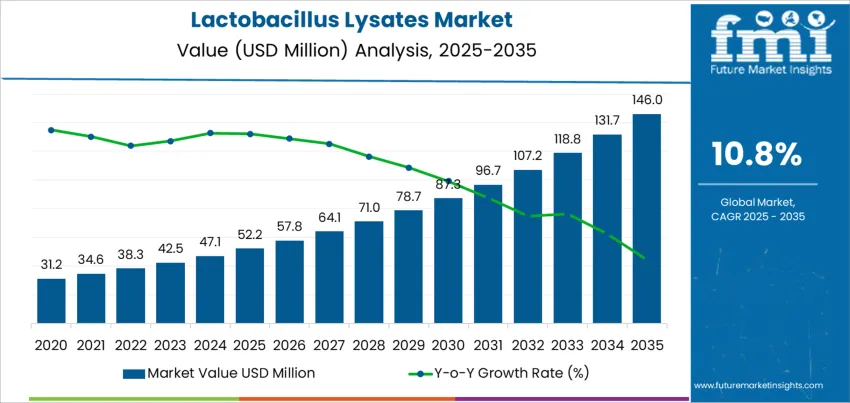
The global demand for Lactobacillus lysates is expected to grow from USD 52.2 million in 2025 to USD 146.0 million by 2035, reflecting a compound annual growth rate (CAGR) of 10.8%. Lactobacillus lysates, known for their immune-boosting and gut-health benefits, are increasingly being used in the food, beverage, and pharmaceutical industries, particularly in probiotic formulations. Market growth is driven by rising consumer interest in digestive health, immunity support, and natural, probiotic-based solutions. Lactobacillus lysates are increasingly seen as effective ingredients in functional foods, supplements, and skincare, contributing to the overall expansion of the market.
The market will experience steady growth, starting at USD 52.2 million in 2025 and rising to USD 57.8 million in 2026, USD 64.1 million in 2027, and USD 71.0 million in 2028. By 2029, demand for Lactobacillus lysates will rise to USD 78.7 million, continuing its upward trajectory through the 2030s. By 2035, the demand for Lactobacillus lysates is projected to reach USD 146.0 million, driven by increasing awareness of their health benefits, expanding applications in probiotics, and growing consumer demand for immune-supporting ingredients.
Quick Stats of the Lactobacillus Lysates Market
- Lactobacillus Lysates Market Value (2025): USD 52.2 million
- Lactobacillus Lysates Market Forecast Value (2035): USD 146.0 million
- Lactobacillus Lysates Market Forecast CAGR (2025-2035): 10.8%
- Lactobacillus Lysates Market Leading Product Form: Powder (16.4%)
- Lactobacillus Lysates Market Key Growth Regions: India, China, Japan, UK, Germany, USA
- Lactobacillus Lysates Market Key Players: BASF SE, Croda International, Evonik Industries, Symrise (incl. IFF/Givaudan actives), Dow / Dow Inc., Ashland, Clariant, Seppic
What is the Growth Forecast for the Global Lactobacillus Lysates Industry through 2035?
The compound absolute growth analysis for the Lactobacillus lysates market reveals a substantial increase in market value over the forecast period, with a total growth of USD 93.8 million from 2025 to 2035. Starting at USD 52.2 million in 2025, the market is expected to reach USD 146.0 million by 2035, marking a strong absolute increase. This growth is driven by the rising demand for probiotics and functional ingredients, particularly in the context of digestive health, immunity, and general well-being.
From 2025 to 2029, the market will grow by USD 26.5 million, driven by increasing consumer adoption of probiotic products and expanding product offerings. During the second half of the decade (2029-2035), the growth will accelerate, with the market increasing by USD 67.3 million. This period will see heightened demand for Lactobacillus lysates as consumers become more health-conscious, and the ingredient becomes more widely integrated into both dietary supplements and functional foods. The compound absolute growth analysis highlights the strong and sustained growth potential for Lactobacillus lysates, driven by the broadening applications and increasing market acceptance of probiotic-based solutions.
Lactobacillus Lysates Market Key Takeaways
| Metric | Value |
|---|---|
| Industry Sales Value (2025) | USD 52.2 million |
| Industry Forecast Value (2035) | USD 146 million |
| Industry Forecast CAGR (2025-2035) | 10.8% |
Why is the Demand for Lactobacillus Lysates Growing Globally?
Demand for Lactobacillus ferment lysate (LFL) is rising globally as skincare, personal care and wellness industries increasingly favour natural, bio derived and microbiome friendly ingredients. This lysate-derived from fermentation of beneficial Lactobacillus bacteria and then broken down so it is no longer a live microorganism-contains metabolites, peptides and enzymes that are believed to support skin barrier function, soothe irritation, enhance hydration, and promote a balanced skin microbiome. Many brands now include LFL in moisturizers, serums, masks, and other skin care products aimed at sensitive skin or anti aging, which strengthens its adoption. Interest in "clean beauty," gentle formulations and ingredients perceived as safer than synthetic actives further contributes to rising demand.
At the same time structural and market trends support expansion of the LFL market. The global market for probiotic or fermented ingredient cosmetics is growing strongly, with a significant share of growth attributed to postbiotic/lysate ingredients like LFL. The cosmetics and personal care segment accounts for a major share of LFL demand, as formulations targeting barrier repair, hydration, skin health maintenance or sensitive skin care increasingly rely on such bio actives.
Improvements in fermentation, extraction and processing technologies have enhanced consistency, purity and scalability of production-making LFL accessible to both premium and mass market skincare brands. As global awareness of skin microbiome importance spreads and demand for gentle, effective, and "clean label" products increases, the market for Lactobacillus lysates is expected to expand steadily in the coming years.
What Drives the Global Demand for Lactobacillus Lysates in Terms of Application and Product Form?
The global demand for lactobacillus lysates is primarily driven by application and product form. The leading end-use application is skin care, which accounts for 9.7% of the market share, while powder holds the largest share in the product form segment, capturing 16.4%. Lactobacillus lysates, known for their skin-soothing, anti-inflammatory, and microbiome-supporting properties, are increasingly used in personal care formulations. As demand for probiotic and microbiome-friendly beauty products grows, lactobacillus lysates are gaining prominence across various personal care categories globally.
Why Is Skin Care the Leading Application for Lactobacillus Lysates?
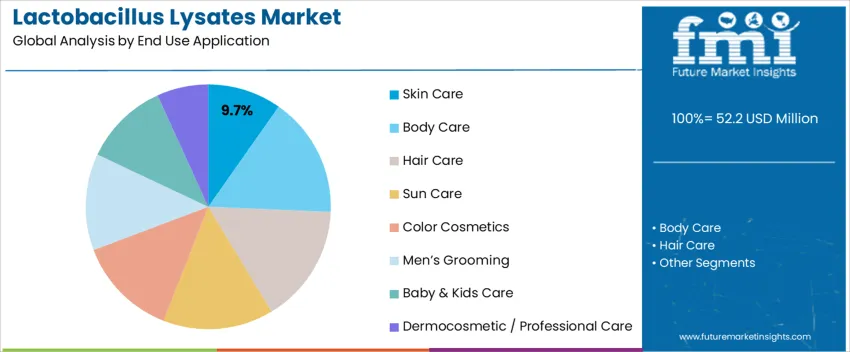
Skin care leads the end-use application demand for lactobacillus lysates, accounting for 9.7% of the market share. Lactobacillus lysates are highly valued in skincare products for their ability to support the skin’s natural microbiome, improve hydration, and reduce irritation. They are commonly included in moisturizers, serums, and masks, where they help calm inflammation, enhance skin barrier function, and maintain skin balance.
The demand for lactobacillus lysates in skin care is driven by the increasing consumer preference for natural and probiotic-based ingredients that support skin health. As consumers seek skincare solutions that not only address superficial concerns but also promote long-term skin wellness, lactobacillus lysates are gaining traction for their holistic skin benefits. With the rising interest in microbiome-focused beauty products and clean beauty formulations, lactobacillus lysates are expected to continue growing in demand globally.
Why Is Powder the Leading Product Form for Lactobacillus Lysates?
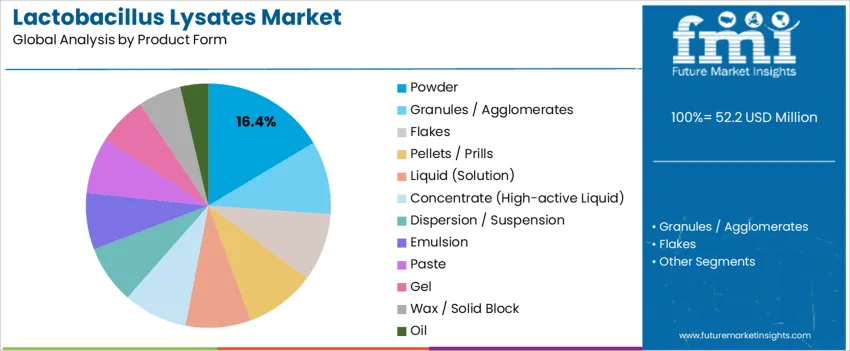
Powder is the leading product form for lactobacillus lysates globally, holding 16.4% of the market share. The powdered form is preferred for its stability, ease of incorporation into formulations, and longer shelf life compared to liquids or gels. It is highly versatile and can be used in various cosmetic products such as face creams, serums, and professional treatments, providing a concentrated form of the ingredient that is easy to handle and store.
The demand for powdered lactobacillus lysates is driven by its ability to deliver high-potency, stable formulations. Powders are also more cost-effective and easier to transport than liquid forms, making them ideal for large-scale manufacturing. As the trend toward personalized skincare and advanced beauty products grows, the flexibility and efficiency of powdered lactobacillus lysates ensure its continued prominence in the global market for probiotic skincare.
What is the Summary of Demand for Lactobacillus Lysates Globally?
Global demand for Lactobacillus lysates has been growing as skincare, cosmetic, and wellness brands increasingly incorporate probiotic derived or postbiotic ingredients. Lysates from Lactobacillus bacteria are valued for skin health benefits such as helping strengthen the skin barrier, reducing inflammation, supporting skin microbiome balance, promoting hydration, and potentially soothing irritation. These benefits have led to inclusion of Lactobacillus lysates in a wide variety of products, including creams, serums, lotions, masks and cleansers.
As awareness of skin microbiome health and gentle but effective skincare grows globally, Lactobacillus lysate has moved from a niche ingredient to a more mainstream component across regions. Recent industry data suggests the global lactobacillus fermentation lysate market is projected to grow from around USD 0.39 billion in 2025 to about USD 0.62 billion by 2034.
What are the Drivers of Global Demand for Lactobacillus Lysates?
One major driver is rising consumer interest in "probiotic" or "microbiome friendly" skin and personal care. As more people become aware of the role of skin microbiome in skin health, they gravitate toward products that support microbiome balance and barrier integrity - making bacterial lysates like Lactobacillus appealing. Growing prevalence of skin sensitivity, inflammation, pollution related stress, and environmental aggressors has increased demand for gentle, soothing, barrier supportive formulations - and Lactobacillus lysates are often positioned for those needs.
Advances in fermentation and lysate extraction technologies have improved safety, consistency, and scalability of lysate ingredients, making them suitable for global distribution and use in diverse product types. expansion of the broader probiotic market and growing consumer awareness of probiotic benefits for health and wellness - including skin health - fuel demand for probiotic derived cosmetic ingredients globally.
What are the Restraints on Global Demand for Lactobacillus Lysates?
Despite rising interest, there are constraints limiting adoption of Lactobacillus lysates. Quality control, standardization and regulatory compliance pose challenges: because lysates derive from microbial fermentation, ensuring consistent bio activity, purity, and safety across batches - especially for sensitive skin products - requires rigorous processes. Production costs for high quality lysates remain relatively high, which can limit use in low cost or mass market products and constrain penetration in price sensitive markets.
Some consumers remain skeptical about probiotic or postbiotic claims - particularly when scientific evidence is still emerging or when benefits may vary depending on skin type, climate, and formulation. Also, for some skin or cosmetic applications, traditional actives (like peptides, retinoids, synthetic antioxidants, etc.) may be preferred over lysate based ingredients due to established efficacy or cost effectiveness, which can reduce market share for lysate based solutions.
What are the Key Trends Influencing Global Demand for Lactobacillus Lysates?
A prominent trend is the rise of microbiome conscious skincare globally - consumers increasingly value ingredients that support skin barrier and microbiome balance, avoid harsh chemicals, and deliver gentle but effective results. This supports growth of lysate and postbiotic based formulations. There is also an increasing shift toward clean label, "natural," and probiotic/postbiotic cosmetic products, with brands highlighting bacterial derived ingredients as part of wellness oriented, sensitive skin, or "skin as ecosystem" positioning.
Use of Lactobacillus lysates is expanding beyond just face creams into broader personal care formats - including lotions, masks, cleansers, and even scalp or hair care in some cases - broadening the addressable market. Advances in fermentation, extraction, and formulation technologies are making lysates more stable, scalable, and cost effective, enabling wider distribution and adoption. Finally, growth in global beauty and wellness markets - especially in regions such as Asia Pacific, Europe, and North America - along with rising consumer spending on premium skincare and increased e commerce penetration is helping lysate based products reach diverse demographics across geographies.
What is the Regional Demand Outlook for the Lactobacillus Lysates Market?
The market for Lactobacillus lysates is experiencing solid growth worldwide, with India leading at a projected CAGR of 14.6%. China follows closely with a growth rate of 13.5%, while Japan is expected to grow at 12.5%. The UK, Germany, and the USA show steady growth with CAGRs of 11.4%, 10.3%, and 9.2%, respectively. Rising consumer interest in microbiome-friendly skincare, natural and fermentation-derived actives, and holistic wellness solutions drive this demand. As awareness grows around skin barrier health, hydration, and postbiotic benefits, Lactobacillus lysates are gaining traction across regions.
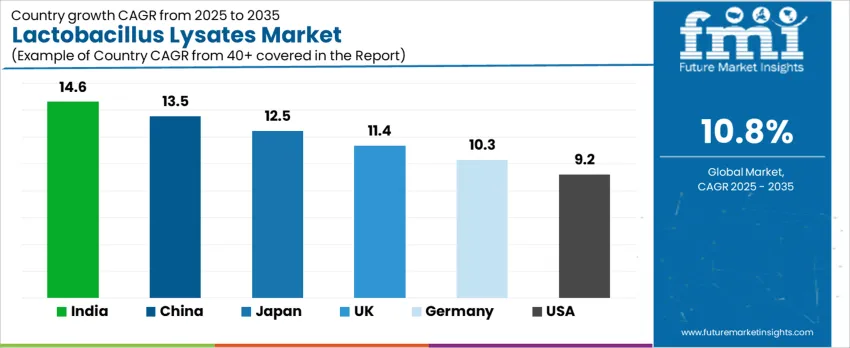
| Country | CAGR (%) |
|---|---|
| India | 14.6 |
| China | 13.5 |
| Japan | 12.5 |
| UK | 11.4 |
| Germany | 10.3 |
| USA | 9.2 |
What Drives Demand for Lactobacillus Lysates in India?
In India, the projected 14.6% CAGR for Lactobacillus lysates reflects a rapidly evolving beauty and personal care market. Growing consumer awareness about skin health, combined with increasing disposable incomes and urbanization, is pushing demand for advanced skincare ingredients. Lactobacillus lysates offer benefits such as improved skin hydration, barrier support, and microbiome balance-features increasingly valued by Indian consumers concerned about pollution, sensitivity, and skin aging.
The shift toward "clean beauty" and natural, fermentation-derived actives also boosts their popularity. Moreover, expanding distribution channels through e-commerce and increasing penetration of global beauty and wellness brands make lysate-based products more accessible. Given India’s youthful demographic and rising interest in skincare routines, the demand for Lactobacillus lysates is likely to continue strong growth.
Why is Lactobacillus Lysates Demand Growing in China?
In China, the 13.5% projected growth rate for Lactobacillus lysates reflects a robust appetite for modern, probiotic-inspired skincare and wellness products. Chinese consumers increasingly emphasize skin barrier health, hydration, and sensitivity relief-areas where Lactobacillus lysates perform well. These lysates can help reinforce the skin microbiome, soothe inflammation, and support moisture retention. The trend toward postbiotic and fermented-ingredient cosmetics is gaining traction, driven by rising health awareness and demand for gentler, microbiome-friendly formulations.
Urban populations, particularly in large cities, are adopting these products for daily skincare. In addition, growing interest in supplement and topical products that support skin and overall wellness supports broader adoption. As domestic brands adopt international standards of ingredient transparency and clean-label packaging, Lactobacillus lysates appear well-positioned to meet evolving consumer expectations.
What Supports the Adoption of Lactobacillus Lysates in Japan?
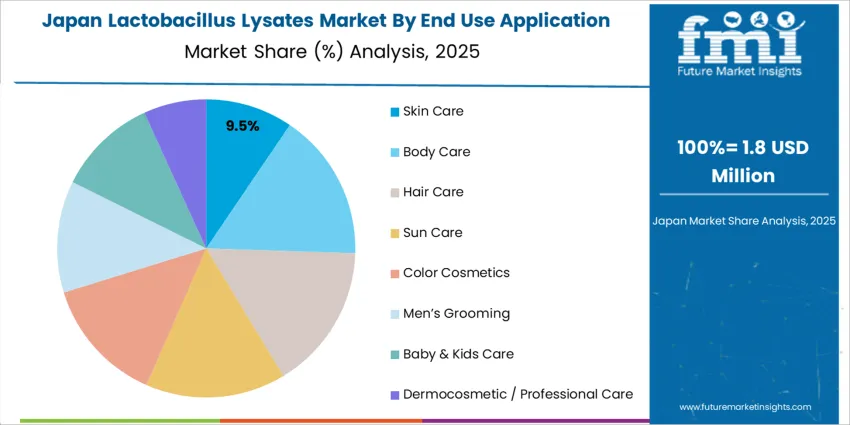
In Japan, the 12.5% CAGR corresponds with a well-established tradition of using fermented and microbiome-friendly skincare ingredients. Japanese consumers tend to prioritize gentle, effective, and scientifically backed formulations. Lactobacillus lysates offer moisturizing, soothing, and barrier-enhancing benefits without the potential irritants associated with more aggressive actives. As concern grows over pollution, skin sensitivity, and aging, demand increases for formulations that support skin resilience and microbiome balance. The mature beauty market in Japan, known for innovation and quality, provides fertile ground for lysate-based serums, creams, and barrier-repair products. Given these trends, Lactobacillus lysates are likely to maintain steady growth in the Japanese skincare segment.
Why is the Lactobacillus Lysates Market Growing Moderately in the UK?
In the UK, a projected CAGR of 11.4% signals rising consumer interest in clean beauty, skin-friendly formulations, and microbiome wellness. Lactobacillus lysates offer benefits such as improved hydration, skin barrier support, and reduction of irritation, making them suitable for consumers dealing with sensitive skin or seeking gentle daily skincare. As UK consumers become more ingredient-savvy and aware of the potential downsides of harsh actives, demand shifts toward postbiotic or fermentation-derived ingredients. The clean beauty movement, along with growing awareness about ingredient transparency, supports the adoption of lysate-based products. Additionally, growth in the wellness and functional skincare space, including products combining dermatological benefits with natural origins, further supports market expansion.
What Drives Growth of Lactobacillus Lysates in Germany?
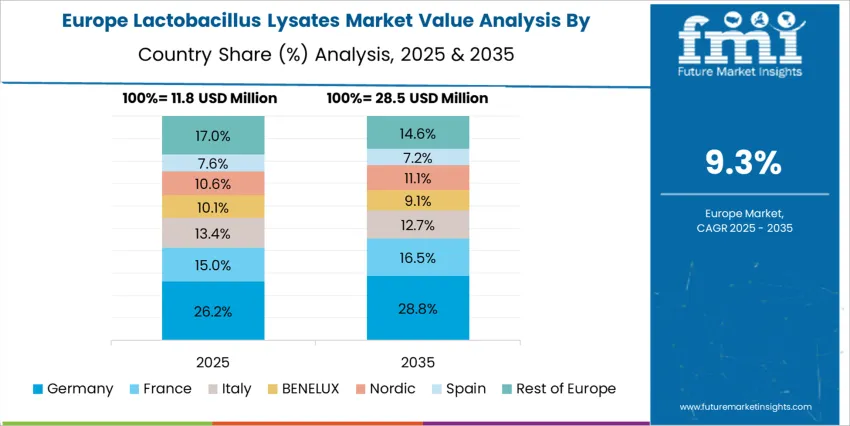
Germany’s projected CAGR of 10.3% reflects a combination of growing demand for scientifically backed skincare, natural formulations, and consumer interest in skin health. Lactobacillus lysates align with these values by offering microbiome-supportive, skin-conditioning, and barrier-enhancing properties. As German consumers increasingly seek out dermatologist-tested, clean, and gentle skincare options, demand rises for postbiotic ingredients that deliver efficacy without aggression. Germany’s strong focus on health and wellness, as well as its well-established functional food industry, supports the demand for Lactobacillus lysates. Rising awareness of skin sensitivities, environmental stressors, and the benefits of maintaining the skin barrier further fuel adoption of Lactobacillus-derived components.
Why is the United States Market Showing Rising Demand for Lactobacillus Lysates?
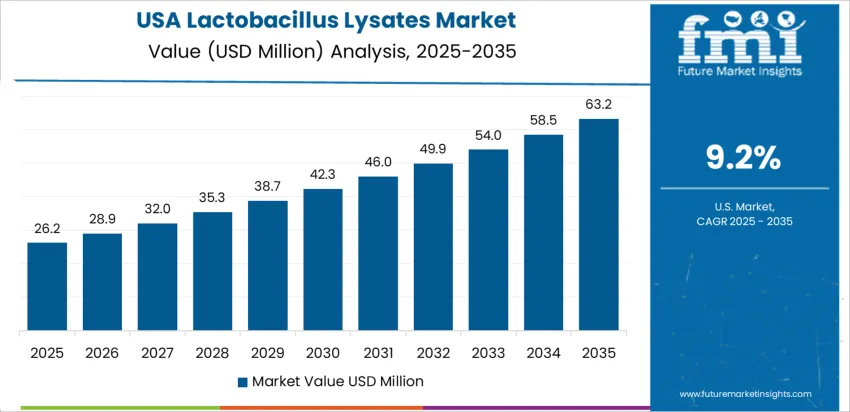
In the USA, the 9.2% projected CAGR reflects steady growth in demand for alternative probiotic-derived skincare ingredients. The USA market is increasingly embracing the concept of skin microbiome health, and Lactobacillus lysates offer benefits such as improved hydration, barrier repair, and microbial balance without the complexities of live probiotics. As consumers become more aware of skin sensitivities, pollution effects, and the benefits of gentle, functional skincare, interest in lysate-based products grows. Additionally, the broader global trend toward clean beauty, natural actives, and skin-friendly formulations supports gradual growth. While adoption rates may lag compared to markets with stronger fermented skincare tradition, steady demand from wellness-oriented and ingredient-savvy consumers supports ongoing market expansion.
What is the Competitive Landscape for the Global Lactobacillus Lysates Market?
Global demand for lactobacillus lysates is rising with growing interest in skincare and personal care products that support skin health, barrier integrity, and microbiome balance. Lysates derived from lactobacillus bacteria are valued for their potential to soothe irritation, support skin barrier repair, improve hydration, and reduce inflammation. These properties make them popular in formulations targeting sensitive, reactive, or ageing skin. Growing consumer awareness of microbiome friendly, gentle and clean label skincare fuels adoption of lactobacillus lysates across major cosmetic markets in North America, Europe, and Asia Pacific. The market expansion is driven by increasing demand for natural, bio active, and sustainable ingredients in personal care products.
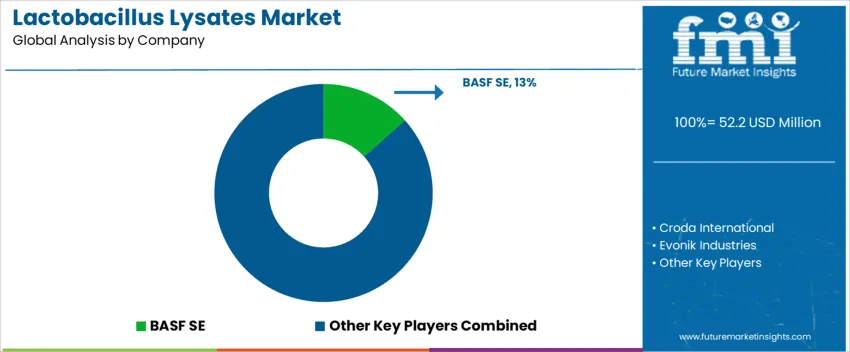
Competition in this market is concentrated among a group of global specialty ingredient firms. According to your listing, key suppliers include BASF SE, Croda International, Evonik Industries, Symrise (including IFF/Givaudan actives), Dow Inc., Ashland, Clariant and Seppic. Among these, BASF SE holds a significant share. These firms supply lysates in standardized, cosmetic grade form suitable for creams, serums, masks and related skincare formats. Competition centers on factors such as purity and consistency of lysate batches, sophistication of fermentation or lysis processes, regulatory and safety compliance, and capacity to scale production globally.
Some suppliers differentiate by offering broader portfolios of microbial derived actives or combining lysates with other bio actives to enable multifunctional skincare formulations. Others emphasize sustainable sourcing, traceability, and supply chain robustness. Suppliers that deliver high quality, well characterized lactobacillus lysates with strong quality control, stability, and sustainable practices are best placed to capture growing demand in the expanding market for microbiome supportive skincare.
Key Players of the Lactobacillus Lysates Market
- BASF SE
- Croda International
- Evonik Industries
- Symrise (incl. IFF/Givaudan actives)
- Dow / Dow Inc.
- Ashland
- Clariant
- Seppic
Scope of the Report
| Items | Details |
|---|---|
| Quantitative Units | USD Million |
| Regions Covered | North America, Europe, Asia Pacific, The Middle East & Africa, Latin America |
| Countries Covered | United States, Canada, United Kingdom, Germany, France, China, Japan, South Korea, Brazil, Australia |
| End Use Application | Skin Care, Body Care, Hair Care, Sun Care, Color Cosmetics, Men’s Grooming, Baby & Kids Care, Dermocosmetic / Professional Care |
| Product Form | Powder, Granules / Agglomerates, Flakes, Pellets / Prills, Liquid (Solution), Concentrate (High-active Liquid), Dispersion / Suspension, Emulsion, Paste, Gel, Wax / Solid Block, Oil |
| Key Companies Profiled | BASF SE, Croda International, Evonik Industries, Symrise (incl. IFF/Givaudan actives), Dow / Dow Inc., Ashland, Clariant, Seppic |
| Additional Attributes | Dollar sales by end-use application and product form show strong demand for inulin, particularly in skin care and body care products. Powder and liquid forms dominate, with concentrate and emulsion forms also growing in demand. Major companies like BASF, Evonik, and Ashland are key players, providing a wide range of inulin-based products for the cosmetic and dermocosmetic industries. The market is expected to grow with increasing demand for natural ingredients and innovative skincare solutions. |
Key Segments in the Lactobacillus Lysates Market
End Use Application
- Skin Care
- Body Care
- Hair Care
- Sun Care
- Color Cosmetics
- Men’s Grooming
- Baby & Kids Care
- Dermocosmetic / Professional Care
Product Form
- Powder
- Granules / Agglomerates
- Flakes
- Pellets / Prills
- Liquid (Solution)
- Concentrate (High-active Liquid)
- Dispersion / Suspension
- Emulsion
- Paste
- Gel
- Wax / Solid Block
- Oil
Region
- Asia Pacific
- China
- Japan
- South Korea
- India
- Australia & New Zealand
- ASEAN
- Rest of Asia Pacific
- Europe
- Germany
- United Kingdom
- France
- Italy
- Spain
- Nordic
- BENELUX
- Rest of Europe
- North America
- United States
- Canada
- Mexico
- Latin America
- Brazil
- Chile
- Rest of Latin America
- Middle East & Africa
- Kingdom of Saudi Arabia
- Other GCC Countries
- Turkey
- South Africa
- Other African Union
- Rest of Middle East & Africa
Frequently Asked Questions
How big is the lactobacillus lysates market in 2025?
The global lactobacillus lysates market is estimated to be valued at USD 52.2 million in 2025.
What will be the size of lactobacillus lysates market in 2035?
The market size for the lactobacillus lysates market is projected to reach USD 146.0 million by 2035.
How much will be the lactobacillus lysates market growth between 2025 and 2035?
The lactobacillus lysates market is expected to grow at a 10.8% CAGR between 2025 and 2035.
What are the key product types in the lactobacillus lysates market?
The key product types in lactobacillus lysates market are skin care, body care, hair care, sun care, color cosmetics, men’s grooming, baby & kids care and dermocosmetic / professional care.
Which product form segment to contribute significant share in the lactobacillus lysates market in 2025?
In terms of product form , powder segment to command 16.4% share in the lactobacillus lysates market in 2025.
Preview the report firsthand - request a free sample
Get SampleGet the brochure for pricing and purchase details.
Get PDFTable of Content
- Executive Summary
- Global Market Outlook
- Demand-side Trends
- Supply-side Trends
- Technology Roadmap Analysis
- Analysis and Recommendations
- Market Overview
- Market Coverage / Taxonomy
- Market Definition / Scope / Limitations
- Market Background
- Market Dynamics
- Drivers
- Restraints
- Opportunity
- Trends
- Scenario Forecast
- Demand in Optimistic Scenario
- Demand in Likely Scenario
- Demand in Conservative Scenario
- Opportunity Map Analysis
- Product Life Cycle Analysis
- Supply Chain Analysis
- Investment Feasibility Matrix
- Value Chain Analysis
- PESTLE and Porter’s Analysis
- Regulatory Landscape
- Regional Parent Market Outlook
- Production and Consumption Statistics
- Import and Export Statistics
- Market Dynamics
- Global Market Analysis 2020 to 2024 and Forecast, 2025 to 2035
- Historical Market Size Value (USD Million) Analysis, 2020 to 2024
- Current and Future Market Size Value (USD Million) Projections, 2025 to 2035
- Y-o-Y Growth Trend Analysis
- Absolute $ Opportunity Analysis
- Global Market Pricing Analysis 2020 to 2024 and Forecast 2025 to 2035
- Global Market Analysis 2020 to 2024 and Forecast 2025 to 2035, By End Use Application
- Introduction / Key Findings
- Historical Market Size Value (USD Million) Analysis By End Use Application , 2020 to 2024
- Current and Future Market Size Value (USD Million) Analysis and Forecast By End Use Application , 2025 to 2035
- Skin Care
- Body Care
- Hair Care
- Sun Care
- Color Cosmetics
- Men’s Grooming
- Baby & Kids Care
- Dermocosmetic / Professional Care
- Y-o-Y Growth Trend Analysis By End Use Application , 2020 to 2024
- Absolute $ Opportunity Analysis By End Use Application , 2025 to 2035
- Global Market Analysis 2020 to 2024 and Forecast 2025 to 2035, By Product Form
- Introduction / Key Findings
- Historical Market Size Value (USD Million) Analysis By Product Form, 2020 to 2024
- Current and Future Market Size Value (USD Million) Analysis and Forecast By Product Form, 2025 to 2035
- Powder
- Granules / Agglomerates
- Flakes
- Pellets / Prills
- Liquid (Solution)
- Concentrate (High-active Liquid)
- Dispersion / Suspension
- Emulsion
- Paste
- Gel
- Wax / Solid Block
- Y-o-Y Growth Trend Analysis By Product Form, 2020 to 2024
- Absolute $ Opportunity Analysis By Product Form, 2025 to 2035
- Global Market Analysis 2020 to 2024 and Forecast 2025 to 2035, By Region
- Introduction
- Historical Market Size Value (USD Million) Analysis By Region, 2020 to 2024
- Current Market Size Value (USD Million) Analysis and Forecast By Region, 2025 to 2035
- North America
- Latin America
- Western Europe
- Eastern Europe
- East Asia
- South Asia and Pacific
- Middle East & Africa
- Market Attractiveness Analysis By Region
- North America Market Analysis 2020 to 2024 and Forecast 2025 to 2035, By Country
- Historical Market Size Value (USD Million) Trend Analysis By Market Taxonomy, 2020 to 2024
- Market Size Value (USD Million) Forecast By Market Taxonomy, 2025 to 2035
- By Country
- USA
- Canada
- Mexico
- By End Use Application
- By Product Form
- By Country
- Market Attractiveness Analysis
- By Country
- By End Use Application
- By Product Form
- Key Takeaways
- Latin America Market Analysis 2020 to 2024 and Forecast 2025 to 2035, By Country
- Historical Market Size Value (USD Million) Trend Analysis By Market Taxonomy, 2020 to 2024
- Market Size Value (USD Million) Forecast By Market Taxonomy, 2025 to 2035
- By Country
- Brazil
- Chile
- Rest of Latin America
- By End Use Application
- By Product Form
- By Country
- Market Attractiveness Analysis
- By Country
- By End Use Application
- By Product Form
- Key Takeaways
- Western Europe Market Analysis 2020 to 2024 and Forecast 2025 to 2035, By Country
- Historical Market Size Value (USD Million) Trend Analysis By Market Taxonomy, 2020 to 2024
- Market Size Value (USD Million) Forecast By Market Taxonomy, 2025 to 2035
- By Country
- Germany
- UK
- Italy
- Spain
- France
- Nordic
- BENELUX
- Rest of Western Europe
- By End Use Application
- By Product Form
- By Country
- Market Attractiveness Analysis
- By Country
- By End Use Application
- By Product Form
- Key Takeaways
- Eastern Europe Market Analysis 2020 to 2024 and Forecast 2025 to 2035, By Country
- Historical Market Size Value (USD Million) Trend Analysis By Market Taxonomy, 2020 to 2024
- Market Size Value (USD Million) Forecast By Market Taxonomy, 2025 to 2035
- By Country
- Russia
- Poland
- Hungary
- Balkan & Baltic
- Rest of Eastern Europe
- By End Use Application
- By Product Form
- By Country
- Market Attractiveness Analysis
- By Country
- By End Use Application
- By Product Form
- Key Takeaways
- East Asia Market Analysis 2020 to 2024 and Forecast 2025 to 2035, By Country
- Historical Market Size Value (USD Million) Trend Analysis By Market Taxonomy, 2020 to 2024
- Market Size Value (USD Million) Forecast By Market Taxonomy, 2025 to 2035
- By Country
- China
- Japan
- South Korea
- By End Use Application
- By Product Form
- By Country
- Market Attractiveness Analysis
- By Country
- By End Use Application
- By Product Form
- Key Takeaways
- South Asia and Pacific Market Analysis 2020 to 2024 and Forecast 2025 to 2035, By Country
- Historical Market Size Value (USD Million) Trend Analysis By Market Taxonomy, 2020 to 2024
- Market Size Value (USD Million) Forecast By Market Taxonomy, 2025 to 2035
- By Country
- India
- ASEAN
- Australia & New Zealand
- Rest of South Asia and Pacific
- By End Use Application
- By Product Form
- By Country
- Market Attractiveness Analysis
- By Country
- By End Use Application
- By Product Form
- Key Takeaways
- Middle East & Africa Market Analysis 2020 to 2024 and Forecast 2025 to 2035, By Country
- Historical Market Size Value (USD Million) Trend Analysis By Market Taxonomy, 2020 to 2024
- Market Size Value (USD Million) Forecast By Market Taxonomy, 2025 to 2035
- By Country
- Kingdom of Saudi Arabia
- Other GCC Countries
- Turkiye
- South Africa
- Other African Union
- Rest of Middle East & Africa
- By End Use Application
- By Product Form
- By Country
- Market Attractiveness Analysis
- By Country
- By End Use Application
- By Product Form
- Key Takeaways
- Key Countries Market Analysis
- USA
- Pricing Analysis
- Market Share Analysis, 2024
- By End Use Application
- By Product Form
- Canada
- Pricing Analysis
- Market Share Analysis, 2024
- By End Use Application
- By Product Form
- Mexico
- Pricing Analysis
- Market Share Analysis, 2024
- By End Use Application
- By Product Form
- Brazil
- Pricing Analysis
- Market Share Analysis, 2024
- By End Use Application
- By Product Form
- Chile
- Pricing Analysis
- Market Share Analysis, 2024
- By End Use Application
- By Product Form
- Germany
- Pricing Analysis
- Market Share Analysis, 2024
- By End Use Application
- By Product Form
- UK
- Pricing Analysis
- Market Share Analysis, 2024
- By End Use Application
- By Product Form
- Italy
- Pricing Analysis
- Market Share Analysis, 2024
- By End Use Application
- By Product Form
- Spain
- Pricing Analysis
- Market Share Analysis, 2024
- By End Use Application
- By Product Form
- France
- Pricing Analysis
- Market Share Analysis, 2024
- By End Use Application
- By Product Form
- India
- Pricing Analysis
- Market Share Analysis, 2024
- By End Use Application
- By Product Form
- ASEAN
- Pricing Analysis
- Market Share Analysis, 2024
- By End Use Application
- By Product Form
- Australia & New Zealand
- Pricing Analysis
- Market Share Analysis, 2024
- By End Use Application
- By Product Form
- China
- Pricing Analysis
- Market Share Analysis, 2024
- By End Use Application
- By Product Form
- Japan
- Pricing Analysis
- Market Share Analysis, 2024
- By End Use Application
- By Product Form
- South Korea
- Pricing Analysis
- Market Share Analysis, 2024
- By End Use Application
- By Product Form
- Russia
- Pricing Analysis
- Market Share Analysis, 2024
- By End Use Application
- By Product Form
- Poland
- Pricing Analysis
- Market Share Analysis, 2024
- By End Use Application
- By Product Form
- Hungary
- Pricing Analysis
- Market Share Analysis, 2024
- By End Use Application
- By Product Form
- Kingdom of Saudi Arabia
- Pricing Analysis
- Market Share Analysis, 2024
- By End Use Application
- By Product Form
- Turkiye
- Pricing Analysis
- Market Share Analysis, 2024
- By End Use Application
- By Product Form
- South Africa
- Pricing Analysis
- Market Share Analysis, 2024
- By End Use Application
- By Product Form
- USA
- Market Structure Analysis
- Competition Dashboard
- Competition Benchmarking
- Market Share Analysis of Top Players
- By Regional
- By End Use Application
- By Product Form
- Competition Analysis
- Competition Deep Dive
- BASF SE
- Overview
- Product Portfolio
- Profitability by Market Segments (Product/Age /Sales Channel/Region)
- Sales Footprint
- Strategy Overview
- Marketing Strategy
- Product Strategy
- Channel Strategy
- Croda International
- Evonik Industries
- Symrise (incl. IFF/Givaudan actives)
- Dow / Dow Inc.
- Ashland
- Clariant
- Seppic
- BASF SE
- Competition Deep Dive
- Assumptions & Acronyms Used
- Research Methodology


