

- Industry Size (2025)
- USD 78.8 Mn
- Forecast (2035)
- USD 220.7 Mn
- CAGR (2025 to 2035)
- 10.8%
Lactobacillus Ferment Lysate Market Forecast and Outlook 2025 to 2035
The global demand for lactobacillus ferment lysate (LFL) is expected to grow from USD 78.8 million in 2025 to USD 220.7 million by 2035, reflecting a compound annual growth rate (CAGR) of 10.8%. Lactobacillus Ferment Lysate, known for its skin-soothing, anti-inflammatory, and moisturizing properties, is becoming increasingly popular in the cosmetics and skincare industries. The rising demand for probiotic and microbiome-friendly skincare products drives the market for LFL. As consumers continue to seek out products with beneficial, naturally derived ingredients, LFL’s adoption is expected to increase across a wide range of beauty and personal care formulations. The ingredient’s effectiveness in enhancing skin health and balancing the skin's natural microbiome is fueling its inclusion in more premium skincare products.
The market will experience steady growth, starting at USD 78.8 million in 2025 and rising to USD 87.4 million in 2026, USD 96.9 million in 2027, and USD 107.4 million in 2028. By 2029, demand for Lactobacillus Ferment Lysate will rise to USD 119.0 million, continuing its upward trajectory through the 2030s. By 2035, the demand for LFL is projected to reach USD 220.7 million, driven by the increasing consumer focus on health, wellness, and natural ingredients in their skincare products.
Quick Stats of the Lactobacillus Ferment Lysate Market
- Lactobacillus Ferment Lysate Market Value (2025): USD 78.8 million
- Lactobacillus Ferment Lysate Market Forecast Value (2035): USD 220.7 million
- Lactobacillus Ferment Lysate Market Forecast CAGR (2025-2035): 10.8%
- Lactobacillus Ferment Lysate Market Leading Product Form: Powder (17.8%)
- Lactobacillus Ferment Lysate Market Key Growth Regions: India, China, Japan, UK, Germany, USA
- Lactobacillus Ferment Lysate Market Key Players: BASF SE, Croda International, Evonik Industries, Symrise (incl. IFF/Givaudan actives), Dow / Dow Inc., Ashland, Clariant, Seppic
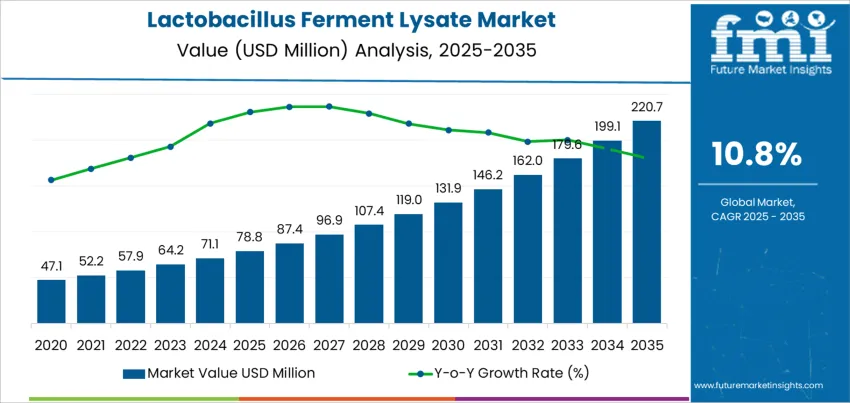
What is the Growth Forecast for the Global Lactobacillus Ferment Lysate Industry through 2035?
The absolute dollar opportunity for lactobacillus ferment lysate from 2025 to 2035 is substantial, with the market expected to grow by USD 141.9 million over the next decade. Starting at USD 78.8 million in 2025, the market will rise to USD 220.7 million by 2035, marking a total increase of USD 141.9 million. This growth represents a significant opportunity for businesses involved in the production and supply of LFL, as well as for formulators and cosmetic brands seeking to capitalize on the increasing consumer demand for natural, effective skincare ingredients.
The absolute dollar opportunity highlights the expanding role of Lactobacillus Ferment Lysate in the global skincare market, driven by the increasing trend of consumer preference for health-conscious, microbiome-supporting skincare products. With the market projected to grow steadily, stakeholders in the skincare industry can anticipate a strong demand for this ingredient, particularly in premium product lines targeting wellness-focused consumers.
Lactobacillus Ferment Lysate Market Key Takeaways
| Metric | Value |
|---|---|
| Industry Sales Value (2025) | USD 78.8 million |
| Industry Forecast Value (2035) | USD 220.7 million |
| Industry Forecast CAGR (2025-2035) | 10.8% |
Why is the Demand for Lactobacillus Ferment Lysate Growing Globally?
Demand for Lactobacillus ferment lysate is rising globally as consumers and manufacturers increasingly favour natural, bio-derived, and microbiome-friendly ingredients in personal-care and wellness products. LFL is derived from the fermentation of beneficial bacteria and contains bioactive compounds such as peptides, enzymes, and metabolites that support skin health. These compounds are valued for their potential to improve skin barrier function, soothe sensitivity, provide antioxidant benefits, and help maintain balanced skin microbiota. As awareness grows about skin-microbiome science and the benefits of clean beauty, more skincare, cosmetic, and personal-care brands incorporate LFL into serums, creams, masks, and toners. The shift toward gentle, effective, and sustainable skincare solutions across different regions is driving broader interest and adoption.
At the same time, structural trends in the global cosmetics and health-ingredients market support expansion of the LFL market. The global fermented-ingredient and postbiotic-lysate market, of which LFL is a key component, is growing as demand rises for functional, natural, and scientifically backed active ingredients. Improvements in fermentation and lysate-processing technologies have enhanced yield, purity, and consistency of LFL, making it more accessible for both premium and mass-market brands. Market forecasts indicate robust growth, driven primarily by skincare and cosmetic applications. As the beauty, wellness, and nutraceutical industries continue to expand globally and as consumer preference for microbiome-friendly, sustainable, and bioactive products grows, the demand for Lactobacillus ferment lysate is expected to rise substantially in coming years.
What Drives the Global Demand for Lactobacillus Ferment Lysate in Terms of Application and Product Form?
The global demand for lactobacillus ferment lysate is influenced by application and product form. The leading end-use application is skin care, which accounts for 10.0% of the market share, while powder is the dominant product form, holding 17.8% of the demand. Lactobacillus ferment lysate, known for its skin-protecting and anti-inflammatory properties, is increasingly incorporated into a wide range of personal care products. The demand for this ingredient is growing globally due to its ability to enhance skin health and its role in various beauty and personal care applications.
Why Is Skin Care the Leading Application for Lactobacillus Ferment Lysate?
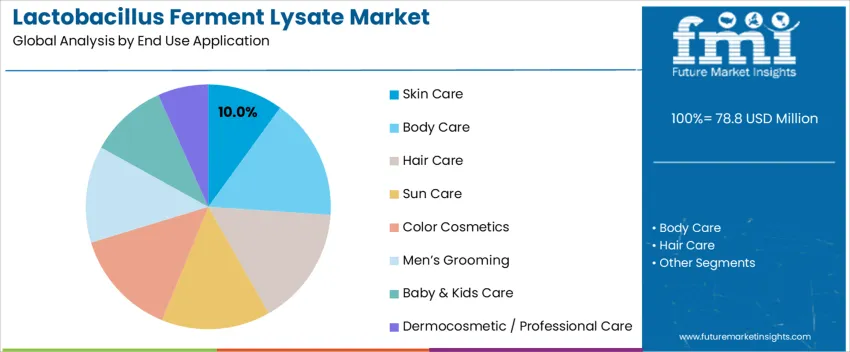
Skin care is the leading application for lactobacillus ferment lysate, accounting for 10.0% of the market share. This ingredient is prized for its ability to promote skin hydration, reduce irritation, and protect the skin's natural barrier. It is commonly found in moisturizers, serums, and other skincare products designed to improve skin health and restore its balance. Lactobacillus ferment lysate is particularly valued for its soothing properties and its ability to enhance the skin's resilience against environmental stressors.
The demand for lactobacillus ferment lysate in skin care is driven by the growing consumer preference for products with active ingredients that offer multiple skin benefits. As consumers become more interested in microbiome-based skincare and probiotics, lactobacillus ferment lysate’s popularity continues to rise. This trend is expected to expand as more consumers seek natural, effective solutions to improve skin health and address various skin conditions such as dryness, sensitivity, and inflammation.
Why Is Powder the Leading Product Form for Lactobacillus Ferment Lysate?
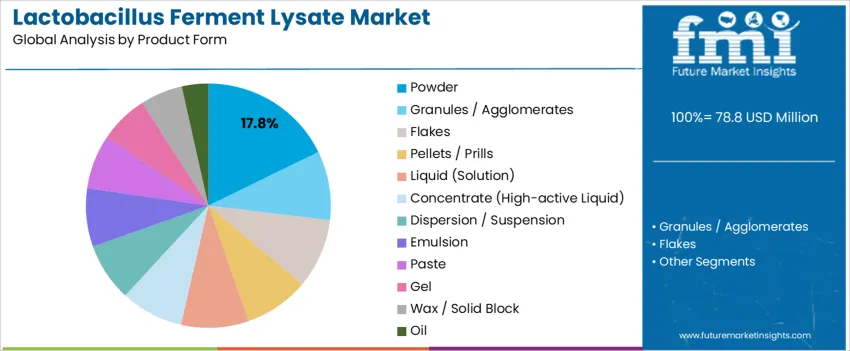
Powder is the leading product form for lactobacillus ferment lysate globally, holding 17.8% of the market share. Powdered forms of lactobacillus ferment lysate are popular because they offer stability, ease of storage, and precise dosing. These powders can be easily incorporated into a wide range of cosmetic formulations, such as creams, serums, and masks, and can be tailored for specific skin care needs. The powder form also has a longer shelf life compared to liquids, making it an attractive option for manufacturers.
The demand for powdered lactobacillus ferment lysate is driven by its versatility, cost-effectiveness, and the ability to create concentrated formulations. As the demand for customizable beauty products increases, powdered forms of active ingredients like lactobacillus ferment lysate provide flexibility for manufacturers to create high-performance products. With the growing trend of personalized skincare, the powdered form is expected to continue leading the market globally.
What is the Summary of Demand for Lactobacillus Ferment Lysate in the Global Market?
Demand for Lactobacillus Ferment Lysate (SFF) is rising globally as skincare, haircare, and cosmetic brands increasingly incorporate probiotic and fermented ingredients. Lactobacillus Ferment Lysate is valued for its skin benefits, such as improving the skin barrier, boosting hydration, providing antioxidant protection, and soothing irritation. It has gained popularity in personal care products, including serums, creams, masks, and hair care formulations. As global demand for natural, clean beauty and bio-derived ingredients grows, Lactobacillus Ferment Lysate is becoming a key ingredient in many skincare and beauty products worldwide.
What are the Drivers of Global Demand for Lactobacillus Ferment Lysate?
Several factors are driving the global demand for Lactobacillus Ferment Lysate. One major factor is the increasing preference for natural, fermentation-derived ingredients in skincare and personal care products. Consumers are increasingly seeking probiotics and bio-based ingredients that support skin health and microbiome balance. The growing popularity of multifunctional skincare products, which address a variety of skin concerns such as hydration, anti-aging, and soothing properties, makes Lactobacillus Ferment Lysate attractive to formulators. Additionally, advancements in fermentation and purification technologies have improved the consistency and efficacy of Lactobacillus Ferment Lysate, expanding its use in a variety of skincare formulations.
What are the Restraints on Global Demand for Lactobacillus Ferment Lysate?
Despite growing demand, several factors limit the widespread use of Lactobacillus Ferment Lysate. One challenge is that some consumers may have sensitivities or allergies to yeast-derived ingredients, which could limit its appeal, especially among those with skin conditions like fungal acne. Additionally, while Lactobacillus Ferment Lysate has proven benefits, the complexity of its production process and the associated costs may make it less attractive for budget-conscious brands or mass-market products. Regulatory barriers and safety assessments can also pose challenges in different regions, with stringent guidelines impacting product formulations and availability. Finally, consumer skepticism about the effectiveness of probiotic-based skincare ingredients in certain markets may slow adoption.
What are the Key Trends Shaping Global Demand for Lactobacillus Ferment Lysate?
A significant trend driving the demand for Lactobacillus Ferment Lysate is the growing interest in probiotic and microbiome-friendly skincare products. As consumers become more aware of the importance of a balanced skin microbiome, probiotic ingredients like Lactobacillus Ferment Lysate are being incorporated into products that promote skin health, barrier repair, and soothing effects. Another trend is the rise of clean beauty and sustainable skincare formulations, with Lactobacillus Ferment Lysate fitting into these categories due to its natural, bio-derived properties.
Additionally, innovations in product formulations, such as combining Lactobacillus Ferment Lysate with other active ingredients like hyaluronic acid and antioxidants, are expanding its uses and applications. The growing beauty markets in emerging economies are also helping drive global demand as these regions increasingly embrace premium skincare products. Finally, increasing scientific research and positive safety assessments are helping build confidence in the benefits and safety of Lactobacillus Ferment Lysate in cosmetics and personal care products.
What is the Regional Demand Outlook for the Lactobacillus Ferment Lysate Market?
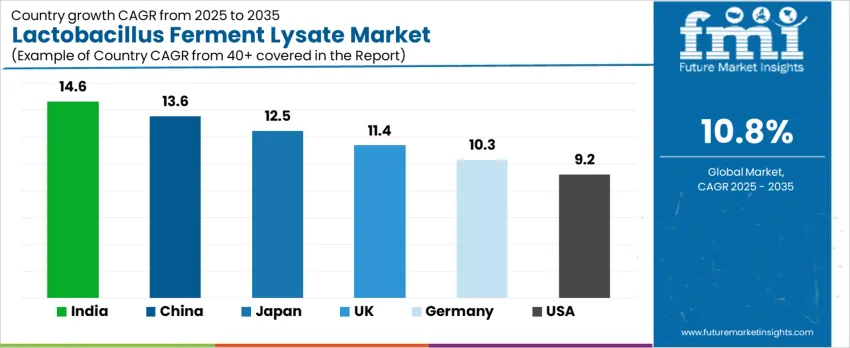
The demand for Lactobacillus Ferment Lysate (LFL) is growing globally, with India leading the charge at a projected CAGR of 14.6%. Following India, China shows a strong growth trajectory with a CAGR of 13.6%, while Japan has a projected growth rate of 12.5%. The UK is also experiencing notable demand for LFL, with a CAGR of 11.4%, while Germany is expected to grow at 10.3%, and the USA at 9.2%. These differences in regional growth reflect varying consumer preferences for probiotic and fermented ingredients in skincare and wellness products. As consumers continue to prioritize natural, skin-friendly, and effective ingredients, Lactobacillus Ferment Lysate is gaining traction due to its beneficial properties in skincare, including anti-inflammatory and moisturizing effects. The rise of clean beauty, increased awareness of microbiome health, and demand for probiotic skincare are driving growth in LFL across these regions.
| Country | CAGR (%) |
|---|---|
| India | 14.6 |
| China | 13.6 |
| Japan | 12.5 |
| UK | 11.4 |
| Germany | 10.3 |
| USA | 9.2 |
What is Driving the Demand for Lactobacillus Ferment Lysate in India?
In India, the demand for Lactobacillus Ferment Lysate is expected to grow at a robust CAGR of 14.6%. India’s growing skincare market, fueled by an expanding middle class and increasing consumer awareness of skincare ingredients, is a significant factor driving the demand for LFL. The rise of clean beauty and natural cosmetics in India, which often feature probiotics and fermented ingredients, is making LFL a key ingredient in beauty products. Consumers in India are becoming more health-conscious, and there is a growing trend of seeking out products that maintain or restore the skin's natural microbiome. Lactobacillus Ferment Lysate, known for its soothing, hydrating, and anti-inflammatory properties, is increasingly popular in skincare formulations, particularly for sensitive skin. Additionally, the demand for probiotics in wellness products-such as supplements and beverages-also supports the adoption of LFL. The rapid expansion of e-commerce platforms and the availability of international beauty brands further contribute to the increased accessibility of LFL-infused products, making India one of the fastest-growing markets for this ingredient.
Why is Lactobacillus Ferment Lysate Gaining Popularity in China?
In China, the demand for Lactobacillus Ferment Lysate is projected to grow at a CAGR of 13.6%. The Chinese market has a growing interest in skincare that focuses on probiotics and natural, bio-based ingredients. LFL is gaining popularity due to its anti-inflammatory and skin-repairing properties, making it a sought-after ingredient for addressing skin concerns such as acne, irritation, and dryness. China’s large and rapidly evolving skincare market, coupled with its increasing focus on health and wellness, supports the demand for products that enhance skin microbiome health. The rise in consumer awareness about the importance of a balanced microbiome for healthy skin further fuels the adoption of LFL. Additionally, the growing influence of K-beauty and J-beauty trends in China, which emphasize fermented ingredients in skincare, is pushing the popularity of Lactobacillus Ferment Lysate in Chinese beauty products. The increased penetration of digital retail channels and access to global beauty brands are also boosting the demand for probiotic and microbiome-focused skincare in the country.
How is Lactobacillus Ferment Lysate Gaining Traction in Japan?
In Japan, Lactobacillus Ferment Lysate is projected to experience a CAGR of 12.5%, reflecting the country’s long-standing history of using fermented ingredients in both food and skincare. Japanese consumers have traditionally embraced probiotics and fermented products, recognizing their benefits for both internal health and skin care. LFL’s ability to soothe, hydrate, and balance the skin's natural flora makes it an appealing ingredient in Japan’s premium skincare market, which values effective and gentle solutions. The growing trend for "clean beauty" products in Japan, combined with increasing awareness of skin microbiome health, drives the demand for LFL. Additionally, the Japanese beauty industry, known for its innovative formulations, is increasingly incorporating probiotic ingredients like Lactobacillus Ferment Lysate into products targeting sensitive or aging skin. Japanese consumers, who prioritize product efficacy and safety, are more likely to invest in products with scientifically proven benefits, further supporting LFL’s adoption. As global beauty trends continue to influence Japan, LFL is expected to maintain steady growth in the market.
Why is Lactobacillus Ferment Lysate Popular in the UK?
In the UK, the demand for Lactobacillus Ferment Lysate is expected to grow at a CAGR of 11.4%. The UK’s skincare market is seeing increasing interest in microbiome-focused products, driven by rising consumer awareness of the importance of maintaining skin health through natural and scientifically supported ingredients. LFL, with its proven benefits in soothing inflammation, reducing redness, and promoting hydration, is aligning well with these consumer needs. The growing popularity of clean beauty and sustainable skincare products in the UK also supports the use of probiotics and fermented ingredients like LFL. Additionally, the increasing consumer shift towards products with ethical sourcing, minimal chemicals, and transparent ingredients further accelerates demand. As the UK market becomes more health-conscious and prioritizes the natural balance of the skin’s microbiome, Lactobacillus Ferment Lysate is likely to see continued growth in demand in both skincare and wellness products.
What Drives the Demand for Lactobacillus Ferment Lysate in Germany?
Germany’s projected CAGR for Lactobacillus Ferment Lysate is 10.3%, reflecting a steady increase in the popularity of probiotics and fermented ingredients in skincare. Germany’s highly developed beauty industry has seen growing interest in microbiome-friendly and natural skincare solutions, which emphasize ingredients that support skin health and integrity. Lactobacillus Ferment Lysate, known for its anti-inflammatory and hydrating properties, fits into this demand by providing benefits like improved skin barrier function and reduced irritation. German consumers are increasingly turning to skincare products with clean, eco-friendly ingredients, and LFL fits into this trend due to its natural origins and scientifically backed efficacy. As the demand for products that maintain and enhance the skin’s microbiome grows in Germany, LFL’s adoption in skincare formulations is expected to rise steadily. The focus on product transparency, sustainability, and wellness in Germany ensures that probiotics like LFL will continue to be in demand.
What Supports the Growth of Lactobacillus Ferment Lysate in the USA?
In the USA, the demand for Lactobacillus Ferment Lysate is projected to grow at a CAGR of 9.2%. The rising trend toward probiotic-based skincare, coupled with increasing consumer interest in microbiome-friendly beauty products, is fueling growth in this market. LFL’s ability to balance and maintain healthy skin flora, reduce inflammation, and improve hydration aligns well with the needs of American consumers seeking products that are both effective and gentle on the skin. The growing popularity of clean beauty and natural ingredients, driven by concerns over synthetic chemicals, has also made probiotic skincare products like LFL more attractive. Additionally, the widespread availability of LFL-based products through e-commerce and retail channels allows for greater consumer access. As more people seek skincare that improves their skin’s natural barrier and overall health, the demand for LFL in the USA is expected to continue growing steadily.
What is the Competitive Landscape for the Global Lactobacillus Ferment Lysate Market?
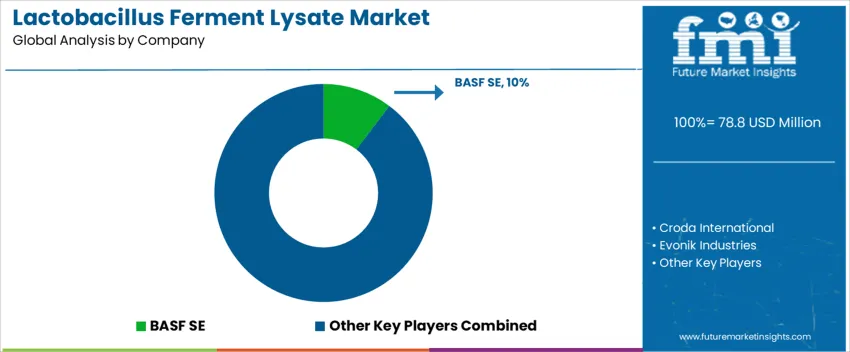
Demand for Lactobacillus Ferment Lysate (LFL) is increasing worldwide as cosmetic and personal care product manufacturers seek natural, fermentation-derived ingredients that promote skin health. LFL is recognized for its ability to soothe skin irritation, support the skin's microbiome, enhance hydration, and strengthen the skin barrier. Studies suggest that LFL can calm redness and sensitivity, improve skin integrity, and reduce inflammation. LFL and other probiotic extracts are gaining popularity as part of the clean-label and microbiome-friendly skincare trend. The global demand for natural, gentle, and effective skincare is especially strong in regions like North America, Europe, and parts of Asia Pacific, where consumers increasingly seek products with proven efficacy and minimal chemical content.
On the supply side, several key players dominate the LFL market. BASF SE holds a notable share, with other significant competitors including Croda International, Evonik Industries, Symrise (including IFF/Givaudan actives), Dow Inc., Ashland, Clariant, and a group of companies referred to as “Seppic / Others,” which includes firms like Seppic, Lubrizol, Lonza, and Inolex. These companies offer LFL in standardized forms suitable for cosmetic and skincare applications. Competition among these suppliers is focused on product purity, consistency, and performance. Companies differentiate through advanced fermentation processes that ensure stable, bioactive-rich lysates. Regulatory compliance and product safety are also important, as these ingredients must meet stringent cosmetic standards. Companies that provide multifunctional ingredients and maintain high-quality, sustainable sourcing practices are well positioned for growth in this expanding market.
Key Players of the Lactobacillus Ferment Lysate Market
- BASF SE
- Croda International
- Evonik Industries
- Symrise (incl. IFF/Givaudan actives)
- Dow / Dow Inc.
- Ashland
- Clariant
- Seppic
Scope of the Report
| Items | Details |
|---|---|
| Quantitative Units | USD Million |
| Regions Covered | North America, Europe, Asia Pacific, The Middle East & Africa, Latin America |
| Countries Covered | United States, Canada, United Kingdom, Germany, France, China, Japan, South Korea, Brazil, Australia |
| End Use Application | Skin Care, Body Care, Hair Care, Sun Care, Color Cosmetics, Men’s Grooming, Baby & Kids Care, Dermocosmetic / Professional Care |
| Product Form | Powder, Granules / Agglomerates, Flakes, Pellets / Prills, Liquid (Solution), Concentrate (High-active Liquid), Dispersion / Suspension, Emulsion, Paste, Gel, Wax / Solid Block, Oil |
| Key Companies Profiled | BASF SE, Croda International, Evonik Industries, Symrise (incl. IFF/Givaudan actives), Dow / Dow Inc., Ashland, Clariant, Seppic |
| Additional Attributes | Dollar sales by end-use application and product form highlight strong demand for saccharomyces ferment filtrate, particularly in skin care and body care products. Liquid solutions and emulsions are the most popular product forms, with concentrate forms also growing in demand. Major companies like BASF, Evonik, and Ashland dominate the market, offering a range of active ingredients for the cosmetic and dermocosmetic industries. The market is expected to grow with rising demand for innovative skincare solutions and natural ingredients. |
Key Segments in the Lactobacillus Ferment Lysate Market
End Use Application
- Skin Care
- Body Care
- Hair Care
- Sun Care
- Color Cosmetics
- Men’s Grooming
- Baby & Kids Care
- Dermocosmetic / Professional Care
Product Form
- Powder
- Granules / Agglomerates
- Flakes
- Pellets / Prills
- Liquid (Solution)
- Concentrate (High-active Liquid)
- Dispersion / Suspension
- Emulsion
- Paste
- Gel
- Wax / Solid Block
- Oil
Region
- Asia Pacific
- China
- Japan
- South Korea
- India
- Australia & New Zealand
- ASEAN
- Rest of Asia Pacific
- Europe
- Germany
- United Kingdom
- France
- Italy
- Spain
- Nordic
- BENELUX
- Rest of Europe
- North America
- United States
- Canada
- Mexico
- Latin America
- Brazil
- Chile
- Rest of Latin America
- Middle East & Africa
- Kingdom of Saudi Arabia
- Other GCC Countries
- Turkey
- South Africa
- Other African Union
- Rest of Middle East & Africa
Frequently Asked Questions
How big is the lactobacillus ferment lysate market in 2025?
The global lactobacillus ferment lysate market is estimated to be valued at USD 78.8 million in 2025.
What will be the size of lactobacillus ferment lysate market in 2035?
The market size for the lactobacillus ferment lysate market is projected to reach USD 220.7 million by 2035.
How much will be the lactobacillus ferment lysate market growth between 2025 and 2035?
The lactobacillus ferment lysate market is expected to grow at a 10.8% CAGR between 2025 and 2035.
What are the key product types in the lactobacillus ferment lysate market?
The key product types in lactobacillus ferment lysate market are skin care, body care, hair care, sun care, color cosmetics, men’s grooming, baby & kids care and dermocosmetic / professional care.
Which product form segment to contribute significant share in the lactobacillus ferment lysate market in 2025?
In terms of product form , powder segment to command 17.8% share in the lactobacillus ferment lysate market in 2025.
Preview the report firsthand - request a free sample
Get SampleGet the brochure for pricing and purchase details.
Get PDFTable of Content
- Executive Summary
- Global Market Outlook
- Demand-side Trends
- Supply-side Trends
- Technology Roadmap Analysis
- Analysis and Recommendations
- Market Overview
- Market Coverage / Taxonomy
- Market Definition / Scope / Limitations
- Market Background
- Market Dynamics
- Drivers
- Restraints
- Opportunity
- Trends
- Scenario Forecast
- Demand in Optimistic Scenario
- Demand in Likely Scenario
- Demand in Conservative Scenario
- Opportunity Map Analysis
- Product Life Cycle Analysis
- Supply Chain Analysis
- Investment Feasibility Matrix
- Value Chain Analysis
- PESTLE and Porter’s Analysis
- Regulatory Landscape
- Regional Parent Market Outlook
- Production and Consumption Statistics
- Import and Export Statistics
- Market Dynamics
- Global Market Analysis 2020 to 2024 and Forecast, 2025 to 2035
- Historical Market Size Value (USD Million) Analysis, 2020 to 2024
- Current and Future Market Size Value (USD Million) Projections, 2025 to 2035
- Y-o-Y Growth Trend Analysis
- Absolute $ Opportunity Analysis
- Global Market Pricing Analysis 2020 to 2024 and Forecast 2025 to 2035
- Global Market Analysis 2020 to 2024 and Forecast 2025 to 2035, By End Use Application
- Introduction / Key Findings
- Historical Market Size Value (USD Million) Analysis By End Use Application , 2020 to 2024
- Current and Future Market Size Value (USD Million) Analysis and Forecast By End Use Application , 2025 to 2035
- Skin Care
- Body Care
- Hair Care
- Sun Care
- Color Cosmetics
- Men’s Grooming
- Baby & Kids Care
- Dermocosmetic / Professional Care
- Y-o-Y Growth Trend Analysis By End Use Application , 2020 to 2024
- Absolute $ Opportunity Analysis By End Use Application , 2025 to 2035
- Global Market Analysis 2020 to 2024 and Forecast 2025 to 2035, By Product Form
- Introduction / Key Findings
- Historical Market Size Value (USD Million) Analysis By Product Form, 2020 to 2024
- Current and Future Market Size Value (USD Million) Analysis and Forecast By Product Form, 2025 to 2035
- Powder
- Granules / Agglomerates
- Flakes
- Pellets / Prills
- Liquid (Solution)
- Concentrate (High-active Liquid)
- Dispersion / Suspension
- Emulsion
- Paste
- Gel
- Wax / Solid Block
- Y-o-Y Growth Trend Analysis By Product Form, 2020 to 2024
- Absolute $ Opportunity Analysis By Product Form, 2025 to 2035
- Global Market Analysis 2020 to 2024 and Forecast 2025 to 2035, By Region
- Introduction
- Historical Market Size Value (USD Million) Analysis By Region, 2020 to 2024
- Current Market Size Value (USD Million) Analysis and Forecast By Region, 2025 to 2035
- North America
- Latin America
- Western Europe
- Eastern Europe
- East Asia
- South Asia and Pacific
- Middle East & Africa
- Market Attractiveness Analysis By Region
- North America Market Analysis 2020 to 2024 and Forecast 2025 to 2035, By Country
- Historical Market Size Value (USD Million) Trend Analysis By Market Taxonomy, 2020 to 2024
- Market Size Value (USD Million) Forecast By Market Taxonomy, 2025 to 2035
- By Country
- USA
- Canada
- Mexico
- By End Use Application
- By Product Form
- By Country
- Market Attractiveness Analysis
- By Country
- By End Use Application
- By Product Form
- Key Takeaways
- Latin America Market Analysis 2020 to 2024 and Forecast 2025 to 2035, By Country
- Historical Market Size Value (USD Million) Trend Analysis By Market Taxonomy, 2020 to 2024
- Market Size Value (USD Million) Forecast By Market Taxonomy, 2025 to 2035
- By Country
- Brazil
- Chile
- Rest of Latin America
- By End Use Application
- By Product Form
- By Country
- Market Attractiveness Analysis
- By Country
- By End Use Application
- By Product Form
- Key Takeaways
- Western Europe Market Analysis 2020 to 2024 and Forecast 2025 to 2035, By Country
- Historical Market Size Value (USD Million) Trend Analysis By Market Taxonomy, 2020 to 2024
- Market Size Value (USD Million) Forecast By Market Taxonomy, 2025 to 2035
- By Country
- Germany
- UK
- Italy
- Spain
- France
- Nordic
- BENELUX
- Rest of Western Europe
- By End Use Application
- By Product Form
- By Country
- Market Attractiveness Analysis
- By Country
- By End Use Application
- By Product Form
- Key Takeaways
- Eastern Europe Market Analysis 2020 to 2024 and Forecast 2025 to 2035, By Country
- Historical Market Size Value (USD Million) Trend Analysis By Market Taxonomy, 2020 to 2024
- Market Size Value (USD Million) Forecast By Market Taxonomy, 2025 to 2035
- By Country
- Russia
- Poland
- Hungary
- Balkan & Baltic
- Rest of Eastern Europe
- By End Use Application
- By Product Form
- By Country
- Market Attractiveness Analysis
- By Country
- By End Use Application
- By Product Form
- Key Takeaways
- East Asia Market Analysis 2020 to 2024 and Forecast 2025 to 2035, By Country
- Historical Market Size Value (USD Million) Trend Analysis By Market Taxonomy, 2020 to 2024
- Market Size Value (USD Million) Forecast By Market Taxonomy, 2025 to 2035
- By Country
- China
- Japan
- South Korea
- By End Use Application
- By Product Form
- By Country
- Market Attractiveness Analysis
- By Country
- By End Use Application
- By Product Form
- Key Takeaways
- South Asia and Pacific Market Analysis 2020 to 2024 and Forecast 2025 to 2035, By Country
- Historical Market Size Value (USD Million) Trend Analysis By Market Taxonomy, 2020 to 2024
- Market Size Value (USD Million) Forecast By Market Taxonomy, 2025 to 2035
- By Country
- India
- ASEAN
- Australia & New Zealand
- Rest of South Asia and Pacific
- By End Use Application
- By Product Form
- By Country
- Market Attractiveness Analysis
- By Country
- By End Use Application
- By Product Form
- Key Takeaways
- Middle East & Africa Market Analysis 2020 to 2024 and Forecast 2025 to 2035, By Country
- Historical Market Size Value (USD Million) Trend Analysis By Market Taxonomy, 2020 to 2024
- Market Size Value (USD Million) Forecast By Market Taxonomy, 2025 to 2035
- By Country
- Kingdom of Saudi Arabia
- Other GCC Countries
- Turkiye
- South Africa
- Other African Union
- Rest of Middle East & Africa
- By End Use Application
- By Product Form
- By Country
- Market Attractiveness Analysis
- By Country
- By End Use Application
- By Product Form
- Key Takeaways
- Key Countries Market Analysis
- USA
- Pricing Analysis
- Market Share Analysis, 2024
- By End Use Application
- By Product Form
- Canada
- Pricing Analysis
- Market Share Analysis, 2024
- By End Use Application
- By Product Form
- Mexico
- Pricing Analysis
- Market Share Analysis, 2024
- By End Use Application
- By Product Form
- Brazil
- Pricing Analysis
- Market Share Analysis, 2024
- By End Use Application
- By Product Form
- Chile
- Pricing Analysis
- Market Share Analysis, 2024
- By End Use Application
- By Product Form
- Germany
- Pricing Analysis
- Market Share Analysis, 2024
- By End Use Application
- By Product Form
- UK
- Pricing Analysis
- Market Share Analysis, 2024
- By End Use Application
- By Product Form
- Italy
- Pricing Analysis
- Market Share Analysis, 2024
- By End Use Application
- By Product Form
- Spain
- Pricing Analysis
- Market Share Analysis, 2024
- By End Use Application
- By Product Form
- France
- Pricing Analysis
- Market Share Analysis, 2024
- By End Use Application
- By Product Form
- India
- Pricing Analysis
- Market Share Analysis, 2024
- By End Use Application
- By Product Form
- ASEAN
- Pricing Analysis
- Market Share Analysis, 2024
- By End Use Application
- By Product Form
- Australia & New Zealand
- Pricing Analysis
- Market Share Analysis, 2024
- By End Use Application
- By Product Form
- China
- Pricing Analysis
- Market Share Analysis, 2024
- By End Use Application
- By Product Form
- Japan
- Pricing Analysis
- Market Share Analysis, 2024
- By End Use Application
- By Product Form
- South Korea
- Pricing Analysis
- Market Share Analysis, 2024
- By End Use Application
- By Product Form
- Russia
- Pricing Analysis
- Market Share Analysis, 2024
- By End Use Application
- By Product Form
- Poland
- Pricing Analysis
- Market Share Analysis, 2024
- By End Use Application
- By Product Form
- Hungary
- Pricing Analysis
- Market Share Analysis, 2024
- By End Use Application
- By Product Form
- Kingdom of Saudi Arabia
- Pricing Analysis
- Market Share Analysis, 2024
- By End Use Application
- By Product Form
- Turkiye
- Pricing Analysis
- Market Share Analysis, 2024
- By End Use Application
- By Product Form
- South Africa
- Pricing Analysis
- Market Share Analysis, 2024
- By End Use Application
- By Product Form
- USA
- Market Structure Analysis
- Competition Dashboard
- Competition Benchmarking
- Market Share Analysis of Top Players
- By Regional
- By End Use Application
- By Product Form
- Competition Analysis
- Competition Deep Dive
- BASF SE
- Overview
- Product Portfolio
- Profitability by Market Segments (Product/Age /Sales Channel/Region)
- Sales Footprint
- Strategy Overview
- Marketing Strategy
- Product Strategy
- Channel Strategy
- Croda International
- Evonik Industries
- Symrise (incl. IFF/Givaudan actives)
- Dow / Dow Inc.
- Ashland
- Clariant
- Seppic
- BASF SE
- Competition Deep Dive
- Assumptions & Acronyms Used
- Research Methodology


