

- Market Size (2026)
- USD 56.6 Bn
- Forecast (2036)
- USD 106.3 Bn
- CAGR (2026 to 2036)
- 6.5%
How big is Corrosion Protection Coatings and Acid Proof Lining Market in 2026?
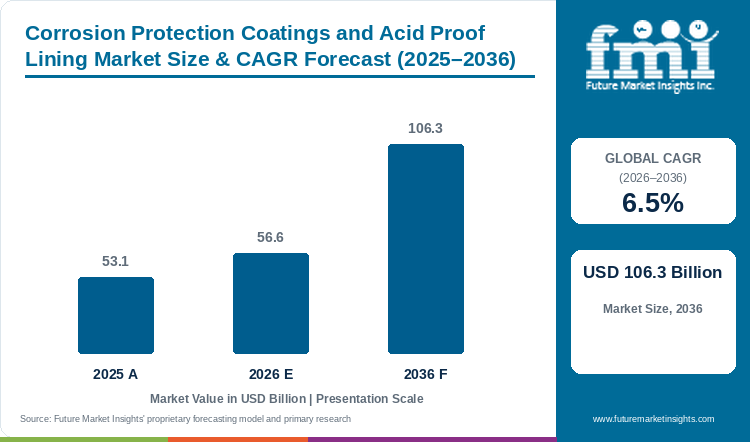
The corrosion protection coatings and acid proof lining market is estimated at USD 53.1 billion in 2025 and is likely to reach USD 56.6 billion in 2026. Sales of corrosion protection coatings and acid proof lining are predicted to grow at a 6.5% CAGR and reach USD 106.3 billion by 2036.
The corrosion protection coatings and acid proof lining market was estimated at USD 53.1 billion in 2025 and is projected to reach USD 56.6 billion in 2026, expanding at a 6.5% CAGR to USD 106.3 billion by 2036. Compared with the wider decorative and architectural coatings market, which rises and falls with housing starts and new construction cycles, this segment sits against a far larger liability pool, since AMPP's 2025 World Corrosion Awareness Day campaign put the annual global cost of corrosion above USD 2.5 trillion and estimated that proven control practices could save 15 to 35 percent of it. That gap explains why growth here is steadier and less cyclical, because spending is pulled forward by deferred maintenance on existing refineries, pipelines and bridges while new water and chemical plants specify linings at the design stage rather than as a later retrofit. In application terms, coating and lining systems are selected against ISO 12944 corrosivity categories, with high build epoxies, novolacs, glass flake and fiber reinforced polymer linings handling acid, chloride and abrasion exposure in tanks, digesters, flue gas ducts and process vessels, and inspection practice now referencing newer qualifications such as AMPP SP21632-2025 for coating and lining inspectors.
The binding limitation is application and access rather than material supply. Surface preparation must achieve the specified cleanliness and anchor profile, curing windows are tightly constrained by temperature and humidity, and work on live assets depends on turnaround scheduling, which is why 2026 refinery utilization is expected to stay high while Gulf Coast maintenance spending remains strong through first quarter shutdowns. Failures typically present as disbondment, blistering, holiday defects or underfilm corrosion at welds and edges, so tighter inspection regimes shorten repaint intervals and convert one-off projects into recurring scope. Actual demand is therefore set by compliance and condition data rather than discretionary capital. ASCE's 2025 Infrastructure Report Card held bridges at C with 6.8 percent rated poor and drinking water at C minus, FHWA's 2025 National Bridge Inventory still showed roughly 41,600 structures in poor condition, and EPA announced USD 3 billion in November 2025 through the state revolving fund for lead and water system work. Asset owners translating those inspection findings into funded repair scopes is what converts the forecast into signed lining and coating contracts.
Recent supplier results point to a sellers' market for heavy-duty systems. PPG reported double-digit organic sales growth in protective and marine coatings for Q2 2026, the 13th consecutive quarter of sales volume growth for that business.[1] As a result, steady volume growth at large suppliers means longer lead times for asset owners on certified epoxy systems and less room to bargain in peak maintenance seasons.
Supplier consolidation is also changing how owners buy, as the largest refinery and ship specifications concentrate among fewer global groups. AkzoNobel said on 15 October 2026 that the merged AkzoNobel and Axalta business will be called Axanzo, with closing expected in early 2027.[2] With fewer global bidders for large refinery and ship specifications, owners have a reason to sign multi-year frame agreements before closing. FMI analysis indicates that owners who standardise coating specifications across sites gain the most bargaining power in those talks.
Key Market Trends & Insights
- Epoxy is expected to lead resin type sales with 41.5% share in 2026, as zinc-rich and high-build epoxy primers form the first barrier on steel. Polyurethane topcoats follow at an estimated 22.4%.
- Solvent-borne systems are likely to hold 52.6% by technology, though water-borne grades at 31.8% are gaining in Europe on emission rules. Protective work is growing across both technologies. Among suppliers, Jotun reported particularly strong growth in Protective Coatings in Q2 2026.[3] Gains of that kind at a protective specialist point to firm applicator demand into 2027.
- Oil and gas is likely to remain the largest end-use industry, with 27.4% of sales, as refinery units, pipelines and offshore platforms face the harshest corrosion, with marine at 16.8%. Ship repair is the faster-moving part of that demand. On the marine side, Hempel grew Marine organic sales 9.8% to EUR 750 million in 2025.[4] Yards with full order cover are therefore buying more hull and tank coatings per docking slot.
Regional Highlights
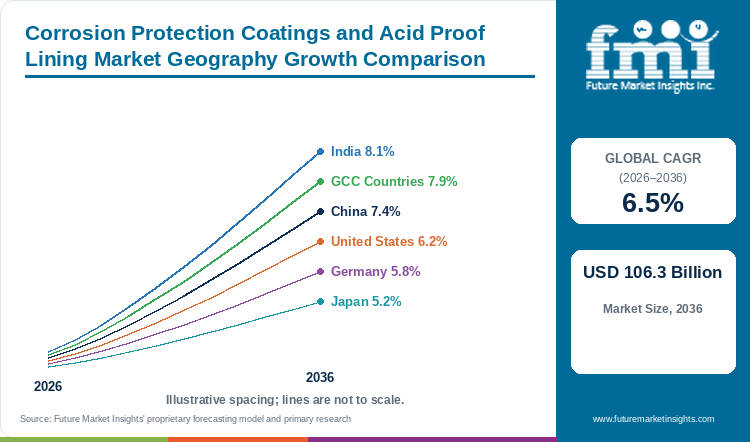
- Demand in India is set to expand at 8.1%, the fastest pace in FMI's outlook, as new refinery, fertiliser and water treatment plants specify linings at construction.
- GCC Countries are projected to grow at 7.9% as Gulf petrochemical complexes and desalination plants add capacity, and China at 7.4%. Mature markets expand more slowly, led by the United States on pipeline and water repairs at 6.2%, followed by Germany (5.8%) and Japan (5.2%).
- Federal water funding is the main policy support for US demand. The House Transportation and Infrastructure Committee approved H.R. 9497, the Water Resources Development Act of 2026, on 14 July 2026, and AMPP backed the bill for corrosion protection.[5] Passage would turn ports, levees and treatment plants into multi-year relining tenders for coating contractors.
Market Size & Forecast
Table 1: Market Size and Forecast for the Corrosion Protection Coatings and Acid Proof Lining Market (USD billion and percentage), 2025 to 2036
| Metric | Value |
|---|---|
| 2025 Market Size | USD 53.1 billion |
| Estimated Market Size in 2026 | USD 56.6 billion |
| Projected Market Size by 2036 | USD 106.3 billion |
| CAGR, 2026 to 2036 | 6.5% |
| Added Revenue, 2026 to 2036 | USD 49.7 billion |
| Market Expansion Multiple | 1.9x |
Owners of refineries, pipelines and bridges are bringing forward maintenance that was deferred, and suppliers of heavy-duty systems are seeing the effect in orders. For instance, RPM International reported Performance Coatings Group sales of USD 629.65 million for the quarter to August 2026, up 10.2%, with strength in energy and infrastructure projects.[6] Growth of that size in a protective segment suggests owners are keeping repaint cycles on schedule, which supports primer and lining volumes into 2027. Lining work grows alongside, and the acid proof lining market is predicted to show a 6.1% CAGR. Taken together, the corrosion protection coatings and acid proof lining market is expected to add close to USD 49.7 billion in annual sales by 2036 in the FMI outlook, nearly doubling the 2026 figure. The main risk is a fresh round of deferred maintenance in an oil price slump, which would hit refinery and upstream coating orders first.
Energy Assets, Ships and Water Infrastructure
Repeat demand from energy owners is uneven by region. Hempel said Energy sales were softer in 2025, mainly on oil and gas in the United States and the Middle East, though Asia-Pacific volume gains partly offset that.[4] As a result, suppliers with Asian refinery and LNG work hold volumes better than those tied to North American upstream projects. Ship repair is the firmer side of repeat demand. By comparison, Marine organic sales grew 9.8% at Hempel, with double-digit volume growth in drydock and newbuilding.[4] Shipowners and yards are therefore likely to keep paint orders high as fleets renew.
Funding decisions weigh more on water and civil assets than on process plants, as utilities and port authorities can reline or repaint only once budgets pass. AMPP backed the Water Resources Development Act of 2026, which covers ports, inland waterways, flood protection, drinking water and wastewater systems.[5] Once funded, these programmes turn into multi-year relining and repaint tenders for utilities and port authorities. Likewise, Sika said infrastructure investment remained at a solid level in H1 2026, with EMEA sales up 7.7% in local currencies.[7] Steady European civil work of that kind gives concrete protection and waterproofing suppliers a base that is less exposed to oil prices.
Table 2: Energy, Marine and Infrastructure Indicators for the Corrosion Protection Coatings and Acid Proof Lining Market (sales, growth and policy), 2026
| Indicator | Data Point | Relevance | Source |
|---|---|---|---|
| PPG protective and marine coatings, Q2 2026 | Double-digit organic growth; 13th quarter of volume growth | Demand from asset owners | [1] |
| RPM Performance Coatings Group, quarter to August 2026 | USD 629.65 million; up 10.2% | Energy and infrastructure coating projects | [6] |
| Hempel Marine organic sales, 2025 | EUR 750 million; up 9.8% | Drydock and newbuilding coatings | [4] |
| Jotun operating revenue, H1 2026 | NOK 17,554 million; 10% underlying growth | Protective coating growth | [3] |
| WRDA 2026, House committee vote | Approved 14 July 2026 | US water infrastructure coatings | [5] |
| Sika EMEA growth, H1 2026 | 7.7% in local currencies | European infrastructure work | [7] |
| AkzoNobel organic growth, Q3 2026 | 2%, driven by pricing | Coating price trend | [8] |
Analyst Perspective
“Owners of refineries, ships and treatment plants are, in my view, shifting from lowest-price tenders to life-cycle specifications, and that change favours epoxy and lining systems with proven service histories. Consolidation among the global suppliers will make the next two years a good window for owners to lock long frame agreements. I expect water and wastewater assets to become the most dependable new source of lining work.”
- Nikhil Kaitwade, Principal Consultant, Future Market Insights.
How is the corrosion protection coatings and acid proof lining market segmented?
The market is segmented into resin type, technology, end-use industry, and region. Epoxy is expected to lead resin type with 41.5% share in 2026, and solvent-borne systems lead technology at 52.6%.
By resin type: epoxy, polyurethane, alkyd, acrylic, chlorinated rubber, and others.
By technology: solvent-borne, water-borne, and powder coatings.
By end-use industry: oil and gas, marine, chemical processing, power generation, water and wastewater treatment, infrastructure, and others.
By region: asset owners and applicators across North America, Latin America, Western Europe, Eastern Europe, East Asia, South Asia and Pacific, and Middle East and Africa.
Why does epoxy lead corrosion protection coatings and acid proof lining sales by resin type?
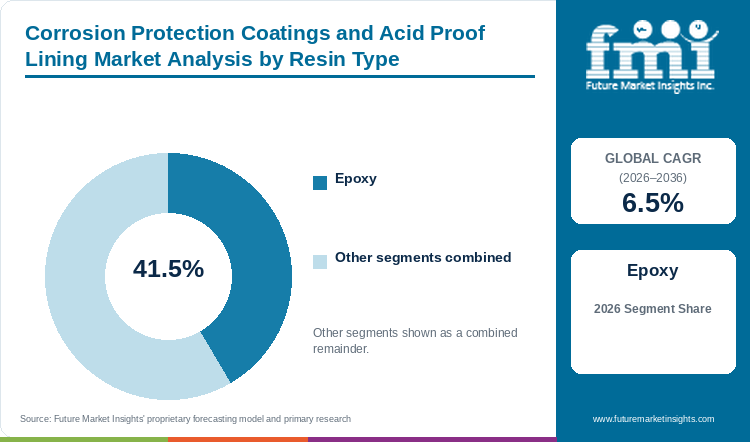
Epoxy is expected to lead resin type sales with 41.5% share in 2026, ahead of polyurethane at about 22.4% and acrylic at an estimated 11.3%.
Table 3: Resin Type Share for the Corrosion Protection Coatings and Acid Proof Lining Market (percentage share), 2026
| Resin Type | Estimated Share (2026) |
|---|---|
| Epoxy | 41.5% |
| Polyurethane | 22.4% |
| Acrylic | 11.3% |
| Alkyd | 10.6% |
| Others | 9% |
| Chlorinated Rubber | 5.2% |
| Total | 100.0% |
Table 4: Resin Type Leadership and Market Growth for the Corrosion Protection Coatings and Acid Proof Lining Market (segment and CAGR percentage), 2026 to 2036
| Metric | Value |
|---|---|
| Global CAGR (2026 to 2036) | 6.5% |
| Leading Segment | Epoxy |
Epoxy bonds hard to blasted steel and concrete and resists water, salt and many acids, so epoxy is expected to lead resin demand, at about 41.5% of 2026 sales. Polyurethane, about 22.4%, is mostly a topcoat that adds colour and UV resistance over epoxy, so the two are usually bought together. By comparison, acrylic, near 11.3%, and alkyd, an estimated 10.6%, serve lighter-duty steel and cost less, but last fewer years in harsh service. Meanwhile, chlorinated rubber holds 5.2% as owners phase out older systems, and other resins, including vinyl ester and polyurea, 9%. Within that group, fast-cure elastomers are taking some tank and pipe jobs, a shift reflected in the 6.3% CAGR projected for the polyurea coatings market. Protective specialists selling mostly epoxy systems are growing faster than the wider coatings industry. At the supplier level, underlying H1 2026 sales at Jotun were 10% higher, with particularly strong Q2 growth in Protective Coatings.[3] That pace keeps epoxy primer and tank lining volumes rising ahead of topcoat demand.
- Zinc-rich epoxy primers, high-build epoxy mid-coats, novolac tank linings and epoxy mortars form the epoxy segment.
- Large suppliers report firm orders for epoxy-based protective systems. Protective and marine coatings at PPG grew organically by a double-digit rate in Q2 2026.[1] Asset owners are therefore buying epoxy primers in larger lots.
Why do solvent-borne systems lead corrosion protection coatings and acid proof lining sales by technology?
Solvent-borne systems are projected to lead technology sales with 52.6% share in 2026, with water-borne at about 31.8% and powder coatings at an estimated 15.6%.
Table 5: Technology Share for the Corrosion Protection Coatings and Acid Proof Lining Market (percentage share), 2026
| Technology | Estimated Share (2026) |
|---|---|
| Solvent-borne | 52.6% |
| Water-borne | 31.8% |
| Powder Coatings | 15.6% |
| Total | 100.0% |
Field crews painting tanks, bridges and offshore structures need coatings that cure in cold, damp weather, so solvent-borne systems will lead technology sales at an estimated 52.6%. Water-borne grades, about 31.8%, on the other hand, meet emission limits in Europe and indoor work but cure slowly at low temperature. Powder coatings, an estimated 15.6%, give thick, solvent-free films on pipes, valves and rebar, but only in a factory oven. At the same time, owners of floating offshore assets are testing low-emission systems, and the low-VOC coatings for floating offshore structures market is forecast to expand at a 9.5% CAGR. Building work is the fastest-growing outlet for water-borne and solvent-free grades. Outside heavy industry, Sika reported double-digit growth in data center projects in H1 2026.[7] Data center floors, walls and plant rooms call for low-odour systems, which moves new-build volume toward water-borne grades.
- Two-part solvent-borne epoxies and polyurethanes form most field-applied volume.
- Price increases are carrying more of the growth than volume at the broad coating groups. AkzoNobel reported 2% organic sales growth in Q3 2026, driven by pricing.[8] Higher prices on solvent-borne grades narrow the cost gap with compliant water-borne systems.
Why does oil and gas lead corrosion protection coatings and acid proof lining sales by end-use industry?
Oil and gas is likely to lead end-use industry sales with 27.4% share in 2026, ahead of marine at about 16.8% and infrastructure at an estimated 15.2%.
Table 6: End-use Industry Share for the Corrosion Protection Coatings and Acid Proof Lining Market (percentage share), 2026
| End-use Industry | Estimated Share (2026) |
|---|---|
| Oil and Gas | 27.4% |
| Marine | 16.8% |
| Infrastructure | 15.2% |
| Chemical Processing | 13.6% |
| Power Generation | 10.5% |
| Water and Wastewater Treatment | 9.8% |
| Others | 6.7% |
| Total | 100.0% |
Refineries, pipelines and platforms face salt, sour gas and high temperatures, and every turnaround includes recoating, so oil and gas is estimated to lead end-use demand, near 27.4% of 2026 demand. Marine follows near 16.8% and buys antifouling and hull coatings on dry-dock cycles, and the marine coatings market has an expected CAGR of 5.6%. Infrastructure, about 15.2%, covers bridges and steel structures with long repaint intervals. Among the remaining industries, chemical processing holds an estimated 13.6%, the main user of acid proof lining, and power generation 10.5%. Water and wastewater treatment, 9.8%, and other uses, 6.7%, add steady relining work. Upstream budgets are the less stable part of oil and gas demand. Even so, Hempel cited weaker oil and gas sales in the United States and the Middle East in 2025.[4] Soft upstream work in those regions moves oil and gas coating volume toward refineries and Asian projects.
- Most oil and gas volume goes on refinery units, storage tanks, pipelines and offshore platforms.
- US energy and civil owners are keeping repair programmes on schedule. RPM cited strength in energy and infrastructure projects for the quarter to August 2026.[6] Contractors serving refineries and bridges can plan on steady lining and coating volumes.
What are the drivers, restraints, and opportunities in the corrosion protection coatings and acid proof lining market?
Ageing energy, marine and water assets keep demand for corrosion protection coatings and acid proof lining growing. Emission rules and skilled-labour shortages raise costs, and water infrastructure funding opens long relining programmes.
- Driver: Owners of ageing refineries, ships and bridges are shortening repaint intervals to avoid unplanned outages, which keeps primer, topcoat and lining orders rising.
- Restraint: Emission rules on solvent content and a shortage of certified applicators raise the cost of each project, which leads some owners to delay recoating.
- Opportunity: Public funding for water, port and flood assets favours long-life epoxy and lining systems with proven service histories.
Ageing Assets Bring Planned Recoating
Adoption of planned maintenance is rising among refinery, shipping and utility owners. Evidence of this comes from PPG, which reported a 13th consecutive quarter of volume growth in protective and marine coatings in Q2 2026.[1] Thirteen quarters of volume gains suggest recoating is now budgeted as routine work. Likewise, Hempel reported double-digit volume growth in drydock and newbuilding in 2025.[4] Owners will therefore keep budgets for recoating, as an unplanned outage costs far above the paint bill.
Emission Rules and Labour Costs Delay Projects
Key challenges in the corrosion protection coatings and acid proof lining market include solvent limits and scarce applicators. In FMI's view, smaller owners in Europe feel these costs most, as water-borne systems need warmer curing conditions. Coating prices are also rising faster than volumes. On the price side, AkzoNobel said Q3 2026 organic growth of 2% came from pricing.[8] In turn, higher prices and longer project times will lead some owners to stretch repaint intervals.
Water Infrastructure Funding Opens Relining Programmes
Water, port and flood assets are the steadiest new outlet. On the policy side, AMPP said protective coatings, corrosion control and inspections can extend infrastructure service life, and backed WRDA 2026.[5] Industry backing of this kind improves the odds that coating and inspection lines survive in the final bill. Alongside this, Sika said infrastructure investment stayed at a solid level in H1 2026.[7] Consequently, suppliers with approved potable water linings and concrete protection systems will gain multi-year utility contracts.
Which country CAGRs are profiled in the corrosion protection coatings and acid proof lining market?
Table 7: Country CAGR Comparison for the Corrosion Protection Coatings and Acid Proof Lining Market (CAGR percentage), 2026 to 2036
| Country | CAGR (2026 to 2036) |
|---|---|
| India | 8.1% |
| GCC Countries | 7.9% |
| China | 7.4% |
| United States | 6.2% |
| Germany | 5.8% |
| Japan | 5.2% |
How do country-level CAGRs compare in the corrosion protection coatings and acid proof lining market?
India is set to grow fastest among the six countries, at an 8.1% CAGR in the FMI outlook, as refinery, fertiliser and water treatment plants are added. GCC Countries follow at 7.9% on petrochemical and desalination plants. Next, China, at 7.4%, adds coatings for chemical plants and shipyards even as building construction slows. Among mature markets, the United States is forecast at 6.2%, three tenths under the global figure, with pipeline, power and water repairs making up most of the work. By comparison, Germany, at 5.8%, faces strict emission rules, and Japan, at 5.2%, has an ageing but well-maintained asset base.
- New refinery, fertiliser and municipal water plants in India are specified with epoxy and acid-resistant linings at construction, so Indian demand leans toward first-fit systems. Suppliers with local plants and approved potable water grades are best positioned for these tenders.
- Salt and sour gas shorten coating life on Gulf petrochemical and desalination assets, raising recoat frequency and favouring high-build epoxy and glass-flake linings. For suppliers, a regional applicator network counts as much as product approval.
- Building construction in China is weak, but chemical, shipyard and power plant work remains steady, and that mix moves Chinese sales toward acid linings and marine systems. Local producers compete hard on price, so global groups gain mainly on specified projects.
- Federal water bills and pipeline integrity rules are pushing US utilities and operators into multi-year repair programmes. For contractors with AMPP-certified crews, relining treatment plants and recoating transmission lines adds long contracts.
- As solvent limits tighten, German chemical parks and bridge owners are switching to water-borne and high-solids grades. Suppliers without compliant systems lose specification slots once older approvals expire.
- Long, well-kept repaint cycles on Japanese bridges, ships and power plants keep volume flat and favour premium long-life systems, with Chugoku Marine Paints, Kansai Paint and Nippon Paint holding most of the repeat work.
Full report country CAGRs cover: six named countries, India, GCC Countries, China, the United States, Germany and Japan, alongside regional figures for every other standard country.
Country-wise Analysis
India Corrosion Protection Coatings and Acid Proof Lining Market Outlook (2026 to 2036)
Indian refiners, fertiliser makers and municipal water boards are building plants that need epoxy coatings and acid-resistant linings from the start. On the supply side, Hempel said Asia-Pacific production reached a company high in 2025, which partly offset weaker energy sales elsewhere.[4] More regional output shortens delivery times for Indian projects, and these new plants keep India the quickest-growing country, at 8.1%.
Key takeaway: Greenfield plants lead India.
GCC Countries Corrosion Protection Coatings and Acid Proof Lining Market Outlook (2026 to 2036)
Gulf refineries, petrochemical complexes and desalination plants face high temperatures, salt and sour gas, which shortens coating life. However, Hempel cited softer energy sales in the Middle East in 2025.[4] Even with that dip, GCC Countries are projected by FMI to grow at a 7.9% CAGR, as new capacity and recoating cycles return.
Key takeaway: Harsh conditions bring Gulf recoating forward.
China Corrosion Protection Coatings and Acid Proof Lining Market Outlook (2026 to 2036)
Chinese demand is splitting between a weak building sector and steady heavy industry. Sika said the Chinese construction industry fell by a double-digit percentage in H1 2026.[7] Despite that drop, chemical plants, shipyards and power stations still order heavy-duty coatings and acid linings, which supports an expected 7.4% for China.
Key takeaway: Industry offsets Chinese building.
United States Corrosion Protection Coatings and Acid Proof Lining Market Outlook (2026 to 2036)
US demand is closely tied to federal funding for water and port assets. The House committee approved WRDA 2026 unanimously on 14 July 2026, and the Senate committee advanced S. 4949 the next day.[5] Progress in both chambers raises the chance of funded relining work from 2027. Meanwhile, RPM International grew Performance Coatings Group sales 10.2% in the quarter to August 2026.[6] Contractor demand of that size shows the repair cycle is already under way. With that funding in view, the United States is forecast at a 6.2% CAGR in the FMI outlook, led by water, pipeline and power repairs.
Key takeaway: Repairs lead the United States.
Germany Corrosion Protection Coatings and Acid Proof Lining Market Outlook (2026 to 2036)
Emission limits are reshaping product choice in Germany more than volume. German chemical parks and bridge owners specify low-emission systems, and Sika reported 7.7% growth in EMEA in H1 2026.[7] In this setting, water-borne and high-solids grades gain share, with growth near 5.8% expected.
Key takeaway: Emission rules guide Germany.
Japan Corrosion Protection Coatings and Acid Proof Lining Market Outlook (2026 to 2036)
Japanese owners run long maintenance cycles on bridges, ships and power plants, and Chugoku Marine Paints, Kansai Paint and Nippon Paint supply domestic yards and contractors. Long, steady cycles keep Japanese volume flat, and a 5.2% CAGR, the lowest of the six countries, is projected for Japan.
Key takeaway: Maintenance steadies Japan.
Who are the notable companies in the corrosion protection coatings and acid proof lining market?
AkzoNobel, PPG, Sherwin-Williams, Hempel, Jotun, RPM International, Kansai Paint, Nippon Paint, Axalta, BASF, Sika, Tnemec, Chugoku Marine Paints and KCC are the profiled companies.
In FMI analysis, global coating groups, marine and protective specialists, and construction chemical suppliers form the field, and scale decides who bids for the largest refinery and fleet specifications. Among them, Jotun reported H1 2026 operating revenue of NOK 17,554 million.[3] In addition, Hempel put 2025 revenue at EUR 2,165 million.[4] Both specialists are large enough to support site service across regions, which keeps them on most marine and offshore approval lists. AkzoNobel reported Q3 2026 revenue of EUR 2,538 million.[8] Combined with Axalta, the merged group will compete with PPG on breadth of industrial specifications. Sherwin-Williams, RPM International, Kansai Paint, Nippon Paint, BASF, Sika, Tnemec, Chugoku Marine Paints and KCC also compete for protective work.
- Global coating groups: AkzoNobel, PPG, Sherwin-Williams, Axalta, Kansai Paint and Nippon Paint.
- Protective and marine specialists: Hempel, Jotun, Chugoku Marine Paints, KCC and Tnemec.
- Construction and specialty chemical suppliers: RPM International, Sika and BASF.
Competitive Benchmarking: Corrosion Protection Coatings and Acid Proof Lining Market
Table 8: Competitive Benchmarking for the Corrosion Protection Coatings and Acid Proof Lining Market (qualitative ratings), 2026
| Company | Protective Coatings | Marine Coatings | Infrastructure | Recent Activity |
|---|---|---|---|---|
| PPG | High | High | Medium | High |
| Hempel | Medium | High | High | Medium |
| Jotun | High | Low | Low | High |
| RPM International | Medium | Low | High | High |
| AkzoNobel | Low | Low | Low | High |
Ratings compare the companies on protective coatings, marine coatings, infrastructure work and recent activity.
Key Developments in the Corrosion Protection Coatings and Acid Proof Lining Market
- Pricing drove the 2% organic growth AkzoNobel reported for the third quarter on 21 October 2026, a sign that coating groups are defending margins as volumes flatten.[8]
- AkzoNobel confirmed on 15 October 2026 that the merged AkzoNobel and Axalta business will be named Axanzo; owners negotiating frame agreements will face one fewer global bidder after closing.[2]
- In results issued 6 October 2026, RPM International pointed to energy and infrastructure strength in Performance Coatings Group, evidence that US repair work is holding up.[6]
- AMPP support for WRDA 2026, reported on 17 September 2026, adds industry weight to coating and inspection funding in the water bill.[5]
- Particularly strong Q2 2026 growth in Protective Coatings featured in the 20 August 2026 quarterly update from Jotun, pointing to firm orders from energy and infrastructure owners.[3]
- On 28 July 2026, PPG marked a 13th straight quarter of protective and marine volume growth, which shows maintenance demand holding through the cycle.[1]
- Sika said in the half-year report of 28 July 2026 that infrastructure investment held at a solid level in the first half; for concrete protection suppliers this means steady European tenders.[7]
- On 4 March 2026, Hempel announced 9.8% organic Marine growth for 2025, with yards and shipowners keeping dry-dock coating orders high.[4]
Key Players in the Corrosion Protection Coatings and Acid Proof Lining Market
Global Coating Groups
- AkzoNobel
- PPG
- Sherwin-Williams
- Axalta
- Kansai Paint
- Nippon Paint
Protective and Marine Specialists
- Hempel
- Jotun
- Chugoku Marine Paints
- KCC
- Tnemec
Construction and Specialty Chemical Suppliers
- RPM International
- Sika
- BASF
Corrosion Protection Coatings and Acid Proof Lining Market - Report Scope
Table 9: Report Scope for the Corrosion Protection Coatings and Acid Proof Lining Market (coverage fields and definitions), 2026 to 2036
| Coverage field | Report scope |
|---|---|
| Market breakdown | Resin type; technology; end-use industry; region |
| Quantitative units | USD billion |
| Market definition | Barrier coatings that protect metal and concrete from electrochemical attack, and acid proof linings for direct contact with concentrated acids, alkalis and solvents. |
| Regions covered | North America; Latin America; Western Europe; Eastern Europe; East Asia; South Asia and Pacific; Middle East and Africa |
| Countries covered | United States; Canada; Brazil; Mexico; Argentina; Chile; Germany; France; United Kingdom; Italy; Spain; Benelux; Nordics; Poland; Czech Republic; Romania; Hungary; China; Japan; South Korea; India; ASEAN; Australia and New Zealand; GCC Countries; South Africa; Türkiye; Israel |
| Key companies profiled | AkzoNobel, PPG, Sherwin-Williams, Hempel, Jotun, RPM International, Kansai Paint, Nippon Paint, Axalta, BASF, Sika, Tnemec, Chugoku Marine Paints, KCC |
| Forecast period | 2026 to 2036 |
Corrosion Protection Coatings and Acid Proof Lining Market - Research Methodology
Table 10: Research Methodology for the Corrosion Protection Coatings and Acid Proof Lining Market (research methods and approach), 2026 edition
| Method | Approach |
|---|---|
| Data Sources | Company results, industry associations, government statistics and trade publications. |
| Desk Research | Desk research covers protective and marine coating demand, water infrastructure funding, emission rules and supplier mergers. |
| Market Sizing and Forecasting | Sizing starts from the 2026 base of USD 56.6 billion and the 6.5% CAGR for 2026 to 2036. |
| Data Validation | Figures are cross-checked across company, industry and government sources. |
Corrosion Protection Coatings and Acid Proof Lining Market by Segments
Corrosion Protection Coatings and Acid Proof Lining Market segmented by Resin Type:
- Epoxy
- Polyurethane
- Alkyd
- Acrylic
- Chlorinated Rubber
- Others
Corrosion Protection Coatings and Acid Proof Lining Market segmented by Technology:
- Solvent-borne
- Water-borne
- Powder Coatings
Corrosion Protection Coatings and Acid Proof Lining Market segmented by End-use Industry:
- Oil and Gas
- Marine
- Chemical Processing
- Power Generation
- Water and Wastewater Treatment
- Infrastructure
- Others
Corrosion Protection Coatings and Acid Proof Lining Market by Region
- North America
- United States
- Canada
- Latin America
- Brazil
- Mexico
- Argentina
- Chile
- Western Europe
- Germany
- France
- United Kingdom
- Italy
- Spain
- Benelux
- Nordics
- Eastern Europe
- Poland
- Czech Republic
- Romania
- Hungary
- East Asia
- China
- Japan
- South Korea
- South Asia and Pacific
- India
- ASEAN
- Australia and New Zealand
- Middle East and Africa
- GCC Countries
- South Africa
- Türkiye
- Israel
Research Sources and Bibliography
- [1] PPG Industries, Inc. (2026, July 28). PPG reports second quarter 2026 financial results (Form 8-K, Exhibit 99). https://www.sec.gov/Archives/edgar/data/79879/000007987926000246/exhibit99-2q2026earningsre.htm
- [2] AkzoNobel. (2026, October 15). AkzoNobel and Axalta to be called Axanzo following merger. https://www.akzonobel.com/en/media/media-releases/akzonobel-and-axalta-to-be-called-axanzo-following-merger
- [3] Jotun. (2026, August 20). Jotun Group Quarterly Update Q2 2026. https://www.jotun.com/globalassets-b2b/locations/jotun-quarterly-update-q2_2026.pdf
- [4] Hempel A/S. (2026, March 4). Annual report 2025. https://www.hempel.com/about-us/media-and-news/news/2026/annual-report-2025
- [5] PCI Magazine. (2026, September 17). AMPP Backs WRDA 2026 as Water Infrastructure Bills Await Floor Action. https://www.pcimag.com/articles/115154-ampp-backs-wrda-2026-as-water-infrastructure-bills-await-floor-action
- [6] RPM International Inc. (2026, October 6). RPM Reports Record Fiscal 2027 First-Quarter Results (Form 8-K, Exhibit 99.1). https://www.sec.gov/Archives/edgar/data/0000110621/000119312526414916/d80757dex991.htm
- [7] Sika AG. (2026, July 28). Half-Year Report 2026. https://www.sika.com/en/media/media-releases/2026/half-year-report-2026.html
- [8] AkzoNobel. (2026, October 21). Q3 2026 results. https://www.akzonobel.com/en/media/media-releases/q3-2026
This bibliography is provided for reader reference. The full report contains the complete reference list and detailed citations.
This Report Answers
- How big is the corrosion protection coatings and acid proof lining market during 2026?
- What market size is projected by 2036?
- Which resin type holds notable share?
- Which technology holds notable share?
- Which countries have notable growth?
- Which companies are notable in the market?
Frequently Asked Questions
How large is the corrosion protection coatings and acid proof lining market expected in 2026?
FMI expects the corrosion protection coatings and acid proof lining market to reach USD 56.6 billion in 2026, from USD 53.1 billion in 2025. Sales of corrosion protection coatings and acid proof lining are projected to reach USD 106.3 billion by 2036.
What CAGR is projected for the corrosion protection coatings and acid proof lining market through 2036?
The corrosion protection coatings and acid proof lining market is forecast to grow at a 6.5% CAGR from 2026 to 2036. Recoating of energy, marine and water assets supports that rate.
Which resin type holds a notable market share in 2026?
Epoxy is expected to lead with 41.5% share in 2026. Polyurethane follows at an estimated 22.4%.
Which technology holds a notable market share in 2026?
Solvent-borne systems are likely to lead with 52.6% share. Water-borne grades hold an estimated 31.8%.
Which country has a notable expansion outlook through 2036?
FMI projects India to grow fastest, at an 8.1% CAGR. GCC Countries follow at 7.9%.
Who are the key companies in the corrosion protection coatings and acid proof lining market?
AkzoNobel, PPG, Sherwin-Williams, Axalta, Kansai Paint and Nippon Paint lead the global coating groups. Hempel, Jotun, Chugoku Marine Paints, KCC, Tnemec, RPM International, Sika and BASF complete the profiled companies.
Preview the report firsthand - request a free sample
Get SampleGet the brochure for pricing and purchase details.
Get PDFTable of Content
- Key Takeaways
- Market Size and CAGR
- Top Growth Driver
- Fastest Growing Segment
- Leading Region
- Key Companies
- Emerging Opportunities
- Executive Summary
- Global Market Outlook
- Demand-side Trends
- Supply-side Trends
- Technology Roadmap Analysis
- Analysis and Recommendations
- Analyst Perspective (What is happening? Why now? What should investors know?)
- Key Questions Answered
- How large is the market?
- What is the CAGR?
- What are key trends?
- Which region dominates?
- Who are the leaders?
- Market Overview
- Market Coverage / Taxonomy
- Market Definition / Scope / Limitations
- Research Methodology
- Chapter Orientation
- Analytical Lens and Working Hypotheses
- Market Structure, Signals, and Trend Drivers
- Benchmarking and Cross-market Comparability
- Market Sizing, Forecasting, and Opportunity Mapping
- Research Design and Evidence Framework
- Desk Research Programme (Secondary Evidence)
- Expert Input and Fieldwork (Primary Evidence)
- Tooling, Models, and Reference Databases
- Data Engineering and Model Build
- Quality Assurance and Audit Trail
- Market Background
- Market Dynamics (Drivers, Restraints, Opportunity, Trends)
- Scenario Forecast (Optimistic, Likely, Conservative)
- Impact Analysis
- AI Impact
- Sustainability Impact
- Regulatory Impact
- Technology Impact
- Consumer / Buyer Analysis
- Purchase Drivers
- Adoption Barriers
- Buyer Journey
- Opportunity Map Analysis
- Product Life Cycle Analysis
- Supply Chain Analysis
- Investment Feasibility Matrix
- Value Chain Analysis
- PESTLE and Porter's Analysis
- Regulatory Landscape
- Regional Parent Market Outlook
- Production and Consumption Statistics
- Import and Export Statistics
- Global Market Analysis and Forecast, 2021 to 2036
- Historical Market Size Value (USD Billion) Analysis, 2021 to 2025
- Current and Future Market Size Value (USD Billion) Projections, 2026 to 2036
- Y-o-Y Growth Trend Analysis
- Absolute $ Opportunity Analysis
- Global Market Pricing Analysis, 2021 to 2036
- Global Market Analysis and Forecast, By Resin Type, 2021 to 2036
- Introduction / Key Findings
- Historical Market Size Value (USD Billion) Analysis By Resin Type, 2021 to 2025
- Current and Future Market Size Value (USD Billion) Analysis and Forecast By Resin Type, 2026 to 2036
- Epoxy
- Polyurethane
- Alkyd
- Acrylic
- Chlorinated Rubber
- Others
- Y-o-Y Growth Trend Analysis By Resin Type, 2021 to 2025
- Absolute $ Opportunity Analysis By Resin Type, 2026 to 2036
- Global Market Analysis and Forecast, By Technology, 2021 to 2036
- Introduction / Key Findings
- Historical Market Size Value (USD Billion) Analysis By Technology, 2021 to 2025
- Current and Future Market Size Value (USD Billion) Analysis and Forecast By Technology, 2026 to 2036
- Solvent-borne
- Water-borne
- Powder Coatings
- Y-o-Y Growth Trend Analysis By Technology, 2021 to 2025
- Absolute $ Opportunity Analysis By Technology, 2026 to 2036
- Global Market Analysis and Forecast, By End-use Industry, 2021 to 2036
- Introduction / Key Findings
- Historical Market Size Value (USD Billion) Analysis By End-use Industry, 2021 to 2025
- Current and Future Market Size Value (USD Billion) Analysis and Forecast By End-use Industry, 2026 to 2036
- Oil and Gas
- Marine
- Chemical Processing
- Power Generation
- Water and Wastewater Treatment
- Infrastructure
- Others
- Y-o-Y Growth Trend Analysis By End-use Industry, 2021 to 2025
- Absolute $ Opportunity Analysis By End-use Industry, 2026 to 2036
- Global Market Analysis and Forecast, By Region, 2021 to 2036
- Introduction
- Historical Market Size Value (USD Billion) Analysis By Region, 2021 to 2025
- Current Market Size Value (USD Billion) Analysis and Forecast By Region, 2026 to 2036
- North America
- Latin America
- Western Europe
- Eastern Europe
- East Asia
- South Asia and Pacific
- Middle East and Africa
- Market Attractiveness Analysis By Region
- North America Market Analysis and Forecast, By Country, 2021 to 2036
- Historical Market Size Value (USD Billion) Trend Analysis By Market Taxonomy, 2021 to 2025
- Market Size Value (USD Billion) Forecast By Market Taxonomy, 2026 to 2036
- By Country
- United States
- Canada
- By Resin Type
- By Technology
- By End-use Industry
- By Country
- Market Attractiveness Analysis
- By Country
- By Resin Type
- By Technology
- By End-use Industry
- Key Takeaways
- Latin America Market Analysis and Forecast, By Country
- Historical Market Size Value (USD Billion) Trend Analysis By Market Taxonomy, 2021 to 2025
- Market Size Value (USD Billion) Forecast By Market Taxonomy, 2026 to 2036
- By Country
- Brazil
- Mexico
- Argentina
- Chile
- By Resin Type
- By Technology
- By End-use Industry
- By Country
- Market Attractiveness Analysis
- By Country
- By Resin Type
- By Technology
- By End-use Industry
- Key Takeaways
- Western Europe Market Analysis and Forecast, By Country
- Historical Market Size Value (USD Billion) Trend Analysis By Market Taxonomy, 2021 to 2025
- Market Size Value (USD Billion) Forecast By Market Taxonomy, 2026 to 2036
- By Country
- Germany
- France
- United Kingdom
- Italy
- Spain
- Benelux
- Nordics
- By Resin Type
- By Technology
- By End-use Industry
- By Country
- Market Attractiveness Analysis
- By Country
- By Resin Type
- By Technology
- By End-use Industry
- Key Takeaways
- Eastern Europe Market Analysis and Forecast, By Country
- Historical Market Size Value (USD Billion) Trend Analysis By Market Taxonomy, 2021 to 2025
- Market Size Value (USD Billion) Forecast By Market Taxonomy, 2026 to 2036
- By Country
- Poland
- Czech Republic
- Romania
- Hungary
- By Resin Type
- By Technology
- By End-use Industry
- By Country
- Market Attractiveness Analysis
- By Country
- By Resin Type
- By Technology
- By End-use Industry
- Key Takeaways
- East Asia Market Analysis and Forecast, By Country
- Historical Market Size Value (USD Billion) Trend Analysis By Market Taxonomy, 2021 to 2025
- Market Size Value (USD Billion) Forecast By Market Taxonomy, 2026 to 2036
- By Country
- China
- Japan
- South Korea
- By Resin Type
- By Technology
- By End-use Industry
- By Country
- Market Attractiveness Analysis
- By Country
- By Resin Type
- By Technology
- By End-use Industry
- Key Takeaways
- South Asia and Pacific Market Analysis and Forecast, By Country
- Historical Market Size Value (USD Billion) Trend Analysis By Market Taxonomy, 2021 to 2025
- Market Size Value (USD Billion) Forecast By Market Taxonomy, 2026 to 2036
- By Country
- India
- ASEAN
- Australia and New Zealand
- By Resin Type
- By Technology
- By End-use Industry
- By Country
- Market Attractiveness Analysis
- By Country
- By Resin Type
- By Technology
- By End-use Industry
- Key Takeaways
- Middle East and Africa Market Analysis and Forecast, By Country
- Historical Market Size Value (USD Billion) Trend Analysis By Market Taxonomy, 2021 to 2025
- Market Size Value (USD Billion) Forecast By Market Taxonomy, 2026 to 2036
- By Country
- GCC Countries
- South Africa
- Türkiye
- Israel
- By Resin Type
- By Technology
- By End-use Industry
- By Country
- Market Attractiveness Analysis
- By Country
- By Resin Type
- By Technology
- By End-use Industry
- Key Takeaways
- Key Countries Market Analysis
- United States
- Pricing Analysis
- Market Share Analysis, 2025
- By Resin Type
- By Technology
- By End-use Industry
- Canada
- Pricing Analysis
- Market Share Analysis, 2025
- By Resin Type
- By Technology
- By End-use Industry
- Mexico
- Pricing Analysis
- Market Share Analysis, 2025
- By Resin Type
- By Technology
- By End-use Industry
- Brazil
- Pricing Analysis
- Market Share Analysis, 2025
- By Resin Type
- By Technology
- By End-use Industry
- Chile
- Pricing Analysis
- Market Share Analysis, 2025
- By Resin Type
- By Technology
- By End-use Industry
- Germany
- Pricing Analysis
- Market Share Analysis, 2025
- By Resin Type
- By Technology
- By End-use Industry
- United Kingdom
- Pricing Analysis
- Market Share Analysis, 2025
- By Resin Type
- By Technology
- By End-use Industry
- Italy
- Pricing Analysis
- Market Share Analysis, 2025
- By Resin Type
- By Technology
- By End-use Industry
- Spain
- Pricing Analysis
- Market Share Analysis, 2025
- By Resin Type
- By Technology
- By End-use Industry
- France
- Pricing Analysis
- Market Share Analysis, 2025
- By Resin Type
- By Technology
- By End-use Industry
- India
- Pricing Analysis
- Market Share Analysis, 2025
- By Resin Type
- By Technology
- By End-use Industry
- ASEAN
- Pricing Analysis
- Market Share Analysis, 2025
- By Resin Type
- By Technology
- By End-use Industry
- Australia and New Zealand
- Pricing Analysis
- Market Share Analysis, 2025
- By Resin Type
- By Technology
- By End-use Industry
- China
- Pricing Analysis
- Market Share Analysis, 2025
- By Resin Type
- By Technology
- By End-use Industry
- Japan
- Pricing Analysis
- Market Share Analysis, 2025
- By Resin Type
- By Technology
- By End-use Industry
- South Korea
- Pricing Analysis
- Market Share Analysis, 2025
- By Resin Type
- By Technology
- By End-use Industry
- Poland
- Pricing Analysis
- Market Share Analysis, 2025
- By Resin Type
- By Technology
- By End-use Industry
- Hungary
- Pricing Analysis
- Market Share Analysis, 2025
- By Resin Type
- By Technology
- By End-use Industry
- Türkiye
- Pricing Analysis
- Market Share Analysis, 2025
- By Resin Type
- By Technology
- By End-use Industry
- South Africa
- Pricing Analysis
- Market Share Analysis, 2025
- By Resin Type
- By Technology
- By End-use Industry
- GCC Countries
- Pricing Analysis
- Market Share Analysis, 2025
- By Resin Type
- By Technology
- By End-use Industry
- United States
- Market Structure Analysis
- Competition Dashboard
- Competition Benchmarking
- Market Share Analysis of Top Players
- By Regional
- By Resin Type
- By Technology
- By End-use Industry
- Emerging Startups
- Innovation Benchmarking
- Competition Analysis
- Competition Deep Dive
- PPG
- Overview
- Product Portfolio
- Profitability by Market Segments
- Sales Footprint
- Strategy Overview
- Marketing Strategy
- Product Strategy
- Channel Strategy
- Hempel
- Jotun
- RPM International
- AkzoNobel
- Sherwin-Williams
- Axalta
- Kansai Paint
- Nippon Paint
- Chugoku Marine Paints
- KCC
- Tnemec
- Sika
- BASF
- PPG
- Case Studies
- Success Stories
- Recent Developments
- Competition Deep Dive
- Assumptions & Acronyms Used


