

- Market Size (2026)
- USD 15.5 Bn
- Forecast (2036)
- USD 33.2 Bn
- CAGR (2026 to 2036)
- 7.9%
How big is Moderation & Low/No-Alcohol Beverage Trend Market in 2026?
USD 15.5 billion in 2026 and USD 33.2 billion by 2036 at a 7.9% CAGR.
Sales of moderation and low/no-alcohol beverages are projected to expand at 7.9% CAGR from 2026 to 2036. The industry valuation is estimated to rise from USD 15.5 billion in 2026 to USD 33.2 billion by 2036. Demand is expected to come from adults who want social drinking occasions with lower alcohol exposure and clearer health cues.
Alcohol removal still needs careful control since aroma and body are easy to lose during processing. Vacuum distillation and reverse osmosis are used in different ways to lower alcohol while keeping flavor. Beverage processing equipment is expected to rise where producers need repeatable taste across beer-style and cocktail-style products.
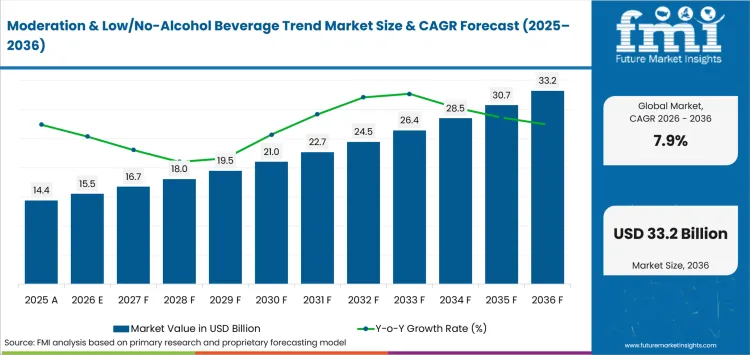
Key Takeaways of Moderation & Low/No-Alcohol Beverage Trend Market
- Demand for moderation and low/no-alcohol beverages is shaped by the need to maintain adult flavor credibility, support health-led purchase occasions, and sustain repeat buying after initial trial across mainstream retail and foodservice channels.
- By product, NA Beer holds 40.9% share in 2026, while Health accounts for 62.8% share in 2026 within driver, reflecting familiar brewing assets and broad shelf placement alongside wellness-led purchasing without leaving social occasions.
- Spain leads country growth at 8.1% CAGR through 2036, followed by the UK at 7.7% and the USA at 7.3%, shaped by alcohol-free beer acceptance, moderation behavior, descriptor reform, and specialist brand expansion.
- Competition centers on Anheuser-Busch InBev, Heineken, Diageo, and Pernod Ricard, spanning global beer brand scale, 0.0 portfolio reach, and alcohol-free extensions protecting cocktail and pub occasions.
- Sensory performance after alcohol removal, label descriptor compliance with local alcohol thresholds, flavor and price competitiveness, and retail barcode handling remain key considerations for wider channel adoption.
- Commercial expansion is expected to follow proven repeat purchase in NA Beer before wider wine and cocktail-style extensions are scaled, with health messaging calibrated to moderation language for broader occasion fit.
Analyst Perspective
"The moderation & low/no-alcohol beverage trend market is increasingly driven by repeat purchase rather than initial consumer trial. Brands are evaluating sensory consistency, shelf stability, and alcohol-threshold compliance across retail and foodservice channels. Products that deliver a convincing drinking experience while maintaining consistent labeling and quality will be better positioned to sustain demand and support category expansion."
— Nandini Roy Choudhury, Principal Analyst at Future Market Insights
Source: FMI's proprietary forecasting model and primary research
How is the Moderation & Low/No-Alcohol Beverage Trend Market segmented?
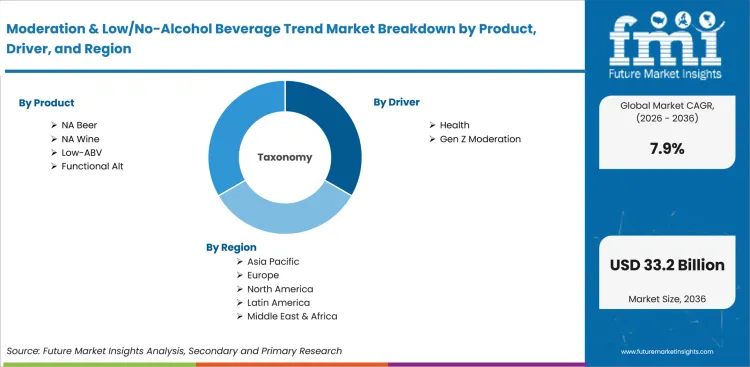
The moderation & low/no-alcohol beverage trend industry is segmented by product, driver, sales channel, and region.
Product analysis covers NA Beer and NA Wine Alongside Low-ABV and Functional Alt. NA Beer is the leading category. Driver analysis separates Health from Gen Z Moderation. Health is the largest driver. Sales channel analysis covers Hypermarkets/Supermarkets and Convenience Stores alongside Specialty Stores, Online Retail and Foodservice/HoReCa. Regional analysis shows how label rules and drinking habits change adoption across countries.
What supports demand for NA beer within the product category?
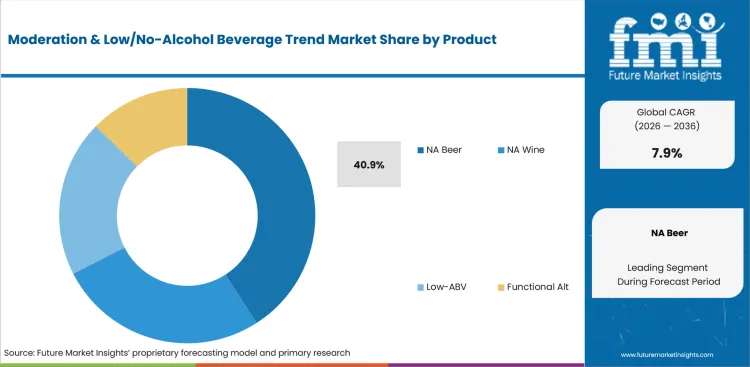
NA Beer keeps the most familiar adult-drink format while lowering alcohol exposure. Brewers understand malt, hops and foam better than unfamiliar zero-proof formats. The non-alcoholic beer provides a useful comparison for products where taste credibility and retail execution decide repeat buying.
- NA Beer is expected to hold 40.9% share in 2026 due to its fit with mainstream beer production and supermarket shelf space. It gives shoppers a familiar pack when they want a lower-alcohol option.
- Brewers need tight sensory control after alcohol removal weakens aroma and body. Products that protect foam and finish are expected to hold repeat purchase better.
How does health shape demand within the driver category?
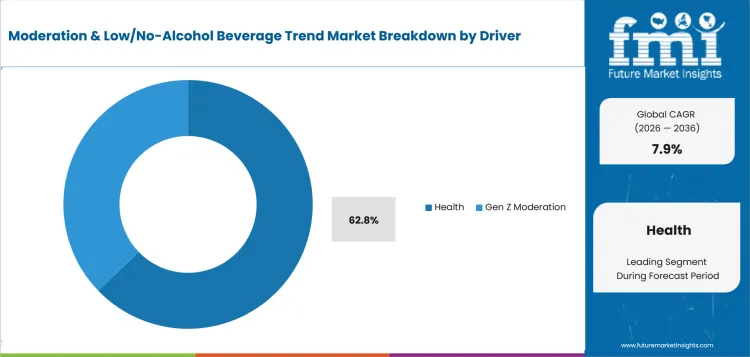
Health is the clearest purchase reason when consumers reduce alcohol without leaving social occasions. The U.S. Surgeon General stated in January 2025 that alcohol consumption is causally connected with at least seven cancer types.
- By driver, Health is projected to account for 62.8% share in 2026 as lower-alcohol drinking occasions and wellness-led purchasing. The driver is strongest when the drink keeps familiar flavor cues.
- Brands need careful health messaging since sober-only wording narrows the audience. Moderation language is expected to fit lunch and weekday occasions more naturally.
Why are hypermarkets/supermarkets central to the sales channel category?
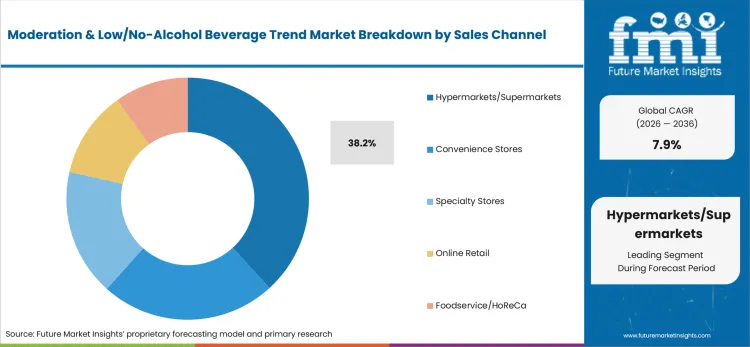
Hypermarkets and supermarkets give NA beer and low/no alternatives the visibility needed for trial. The channel supports multi-pack pricing and direct comparison with regular beer and soft drinks. Simple shelf placement helps low-alcohol beverages during routine grocery trips.
- Hypermarkets/Supermarkets are forecast to represent 38.2% share in 2026 through pack visibility and household replenishment behavior. Large retailers test price and flavor across repeat grocery visits.
- Retail teams need clear descriptor language and consistent barcode handling. Unclear alcohol thresholds are expected to slow listings even when the product is ready.
What are the drivers, restraints, and opportunities in the Moderation & Low/No-Alcohol Beverage Trend Market?
Health-led moderation, better alcohol-removal methods and mainstream retail placement are expected to define the next phase of market expansion.
- Driver: Health messaging and flexible drinking are expected to lift demand for NA beer, low-ABV formats and alcohol-free spirit alternatives.
- Restraint: Label thresholds and sensory trade-offs are expected to slow launches when products miss local descriptor rules or regular-beverage taste expectations.
- Opportunity: Flavor reconstruction and channel-specific packs are expected to open higher-value occasions beyond Dry January and short abstinence campaigns.
The demand case is expected to move from abstinence to flexible drinking. Beverage companies are expected to add alcohol-free beer and non-alcoholic RTD beverages where the product supports repeat buying.
The main restraint is the cost of proving taste and label fit in each country. TTB guidance states that non-alcoholic malt beverages must contain less than 0.5% alcohol by volume. Japan uses a clear liquor boundary for products with alcohol content of one degree or more. These rules make alcohol control a production issue as well as a packaging issue.
The primary opportunity is concentrated in products that protect mouthfeel and fit a familiar occasion. Ready-to-drink beverages offer a useful comparison for convenience-led single-serve packs. Producers that manage aroma recovery and carbonation are expected to gain more room across beer-style and cocktail-style alternatives.
Which country CAGRs are profiled in the Moderation & Low/No-Alcohol Beverage Trend Market?
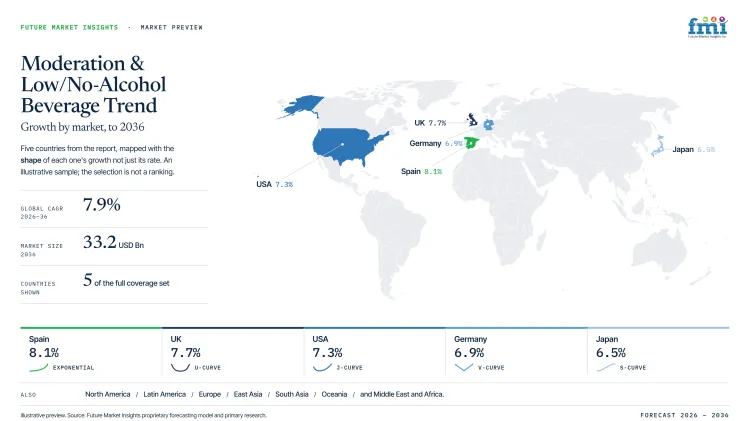
| Country | CAGR |
|---|---|
| USA | 7.3% |
| Germany | 6.9% |
| Spain | 8.1% |
| UK | 7.7% |
| Japan | 6.5% |
How do country-level CAGRs compare in the Moderation & Low/No-Alcohol Beverage Trend Market?
A global growth rate represents the weighted average of all markets included in the analysis. It can exceed several individual country rates when markets with greater forecast weight expand more quickly. The global CAGR of 7.9% sits above four profiled countries but remains below Spain. This comparison suggests that markets not shown may include rates on both sides of the global average. The five countries presented are illustrative examples and their comparison with the global figure makes this variation visible.
- The countries are distinguished less by their CAGRs and more by the commercial routes supporting moderation-led beverage adoption. The complete range between Spain and Japan is 1.6 percentage points. Each adjacent position is separated by 0.4 percentage points which creates a compressed comparison without a pronounced break.
- Spain and the UK form a closely aligned upper group through alcohol-free beer acceptance and established social drinking channels. Spain benefits from broader acceptance of 0.0% beer while the UK combines supermarket visibility with changing descriptor rules.
- The USA occupies a measured middle position through health messaging and specialist brand activity. Germany remains close to the USA but follows a different route through established alcohol-free brewing capacity and direct taste comparisons with conventional beer.
- Markets with broadly similar CAGRs can therefore create different entry conditions for beverage companies. Launch timing depends on label thresholds and retail access while repeat buying depends on aroma retention and familiar adult-drink cues.
The full report examines these dynamics for every market included in the study. The full report provides country-level CAGR analysis across North America, Latin America, Europe, East Asia, South Asia, Oceania and the Middle East and Africa.
Country-wise Analysis
- Spain combines beer culture with a broad retail and foodservice base that is ready for alcohol-free beer. Moderation and low/no-alcohol beverage demand in Spain is forecast to rise at 8.1% CAGR from 2026 to 2036. Spain INE reported in March 2026 that the share of people who did not consume alcohol rose from 31.3% in 2022 to 33.9% in 2025. The figure supports more shelf space for 0.0% beer and alcohol-free cocktail alternatives.
- The UK has a strong pub culture and a grocery channel that already gives alcohol-free beer visible placement. The UK market is projected to advance at 7.7% CAGR through 2036. NHS England Digital reported in January 2026 that 24% of adults had not drunk alcohol in the last 12 months. UK Parliament stated in June 2026 that the government planned to consult on raising the alcohol-free upper limit to 0.5% ABV. Brand teams need careful descriptor language until the reform path is settled.
- United States demand is shaped by health messaging and a large grocery base able to trial NA beer across several pack sizes. The public-health message supports weekday moderation and driving occasions. Companies still need state-aware retail execution since alcohol-style products often face conservative age checks even at low ABV.
- Germany offers a large beer production base and established alcohol-free beer habits. Demand in Germany is projected to expand at 6.9% CAGR from 2026 to 2036. Investment has to protect aroma and foam since German shoppers compare NA beer directly with lager and wheat beer styles.
- Japan has strong convenience-store reach and a consumer base familiar with 0.00% beer-taste drinks. Japanese demand is anticipated to grow at 6.5% CAGR during the forecast period. Suntory reported in August 2025 that Japan’s non-alcoholic beverage market reached 45.84 million cases in 2024. METI reported in August 2025 that food, drinks and liquor e-commerce reached 3.1163 trillion yen in 2024. Companies need clear alcohol classification and taste cues before low/no products replace regular beer occasions.
Who are the notable companies in the Moderation & Low/No-Alcohol Beverage Trend Market?
Anheuser-Busch InBev and Heineken alongside Diageo, Pernod Ricard and Suntory are the notable companies shaping this market.
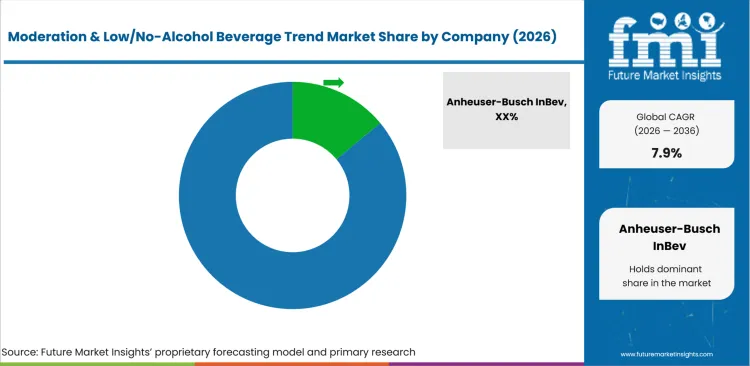
The competitive outlook combines global beer companies with spirits groups able to protect adult drinking occasions without full alcohol strength. Beer companies compete through brand familiarity and 0.0% production scale. Spirits companies compete through alcohol-free gin and cocktail cues that keep the serve familiar for bars and at-home mixing.
Anheuser-Busch InBev and Heineken compete through broad beer distribution and global sports activation. Their commercial test is repeat buying after the first trial since NA beer has to taste close to regular beer. Zero sugar beverages provide an adjacent reference point for health-led choices where the product still needs a strong taste cue.
Diageo and Pernod Ricard use alcohol-free brand extensions to defend pub and cocktail occasions. Suntory brings a Japan-focused 0.00% portfolio that includes beer-taste and RTD-style products. Non-alcoholic malt beverages are expected to remain a useful bridge between beer taste and wellness-led drinking occasions.
Competitive Benchmarking: Moderation & Low/No-Alcohol Beverage Trend Market
| Company | Beer and Malt Strength | Spirits or Cocktail Strength | Retail and On-trade Reach | Geographic Reach |
|---|---|---|---|---|
| Anheuser-Busch InBev | High | Low | High | Global |
| Heineken | High | Low | High | Global |
| Diageo | Medium | Medium | High | Global |
| Pernod Ricard | Low | High | Medium | Global |
| Suntory | High | Medium | High | Japan and selected international markets |
Scoring basis: High indicates a documented core capability within the exact low/no-alcohol workflow and a dedicated commercial offer. Medium indicates direct support through an adjacent brand or channel. Low indicates limited direct evidence within the named capability.
Key Developments in the Moderation & Low/No-Alcohol Beverage Trend Market
- In June 2024, Guinness announced that it and Guinness 0.0 would become the Official Beer and Official Non-Alcoholic Beer of the Premier League, with Guinness also named the Official Responsible Drinking Partner of the League. The four-year agreement gives Guinness 0.0 a pub and sports channel role for non-alcoholic beer occasions.
- In September 2025 Heineken announced that Heineken 0.0 draught had reached its 10,000th outlet in Europe. The company said it had iinstalled an average of 14 new outlets per day from the start of 2025.
Key Players in the Moderation & Low/No-Alcohol Beverage Trend Market
Global Beer Companies
- Anheuser-Busch InBev
- Heineken
- Suntory
Spirits and Cocktail Portfolio Companies
- Diageo
- Pernod Ricard
Moderation & Low/No-Alcohol Beverage Trend Market - Report Scope
| Coverage field | Report scope |
|---|---|
| Market breakdown | Product, driver, sales channel, and region. |
| Quantitative Units | Revenue in USD Billion, CAGR in %. |
| Market Definition | Commercial low-alcohol and non-alcoholic beverage products that preserve adult drinking occasions while reducing or removing alcohol content. The scope covers NA beer and NA wine alongside low-ABV formats, functional alternatives and retail or foodservice channels. |
| Regions Covered | North America; Latin America; Europe; East Asia; South Asia; Oceania; and Middle East and Africa. |
| Countries Covered | USA and Germany alongside Spain, UK and Japan; 30+ countries are covered in the full report. |
| Key Companies Profiled | Anheuser-Busch InBev and Heineken alongside Diageo, Pernod Ricard and Suntory |
| Forecast Period | 2026 to 2036. |
| Approach | Hybrid bottom-up and top-down market sizing supported by primary interviews and official desk research. |
Moderation & Low/No-Alcohol Beverage Trend Market - Research Methodology
| Method | Approach |
|---|---|
| Primary Research | FMI analysts gathered input from manufacturers, service providers, technology developers, distributors, end users, procurement teams, and subject-matter experts. Interviews examined purchasing decisions, product or service evaluation, adoption barriers, approval requirements, pricing considerations, and expectations for technical or commercial support. Respondents were also asked what evidence is required before a trial, pilot, or initial order develops into regular purchasing. |
| Desk Research | Desk research covered government statistics, regulatory publications, trade data, industry associations, technical literature, standards, company filings, product information, and official corporate announcements. Sources were reviewed for relevance, publication date, geographic coverage, and consistency with the defined market scope. Claims relating to performance, applications, approvals, capacity, investment, and commercial activity were retained only when supported by credible public evidence. |
| Market Sizing and Forecasting | The market model combined the baseline value with historical performance, segment structure, pricing and volume indicators, adoption levels, company participation, and country-level demand conditions. Forecast assumptions considered economic activity, investment trends, regulatory developments, technology adoption, purchasing cycles, supply availability, and barriers to wider market use. Segment and regional estimates were reconciled before the final market total was calculated. |
| Data Validation | Estimates were checked against multiple independent indicators, including public data, company activity, trade patterns, industry developments, and findings from primary interviews. Validation also tested whether products, services, applications, and company revenues fell within the defined market boundaries. Adjacent categories, unsupported claims, overlapping revenues, and activities without direct market relevance were excluded to reduce double counting and maintain consistency across segments and countries. |
Moderation & Low/No-Alcohol Beverage Trend Market by Segments
Moderation & Low/No-Alcohol Beverage Trend Market segmented by Product:
- NA Beer
- NA Wine
- Low-ABV
- Functional Alt
Moderation & Low/No-Alcohol Beverage Trend Market segmented by Driver:
- Health
- Gen Z Moderation
Moderation & Low/No-Alcohol Beverage Trend Market segmented by Sales Channel:
- Hypermarkets/Supermarkets
- Convenience Stores
- Specialty Stores
- Online Retail
- Foodservice/HoReCa
Moderation & Low/No-Alcohol Beverage Trend Market by Region:
- North America
- United States
- Canada
- Latin America
- Brazil
- Mexico
- Argentina
- Chile
- Western Europe
- Germany
- France
- United Kingdom
- Italy
- Spain
- Benelux
- Nordics
- Eastern Europe
- Poland
- Czech Republic
- Romania
- Hungary
- East Asia
- China
- Japan
- South Korea
- South Asia and Pacific
- India
- ASEAN
- Australia and New Zealand
- Middle East and Africa
- GCC Countries
- South Africa
- Türkiye
- Israel
Research Sources and Bibliography
- USA Department of Health and Human Services. (2025, January 17). Alcohol and cancer risk.
- Instituto Nacional de Estadistica. (2026, March 30). Living Conditions Survey: Health module, year 2025.
- NHS England Digital. (2026, January 27). Adults health-related behaviours: Health Survey for England, 2024.
- Ministry of Economy, Trade and Industry. (2025, August 26). Results of FY2024 E-Commerce Market Survey compiled.
- Anheuser-Busch InBev. (2024, January 12). International Olympic Committee and AB InBev announce worldwide Olympic partnership.
- Diageo. (2024, June 12). Guinness announces first-ever global partnership in football as the official beer of the Premier League.
- Heineken N.V. (2025, September 10). HEINEKEN expands 0.0 draught to 10,000 outlets across Europe.
- Heineken N.V. (2026, March 12). Heineken 0.0 unveils first zero alcohol, zero calorie, and zero sugar brew.
This bibliography is provided for reader reference and is not exhaustive. The full report contains the complete reference list and detailed citations.
This Report Answers
- How large is the moderation & low/no-alcohol beverage trend market in 2026 and 2036?
- Which product category is projected to lead demand in 2026?
- How does health-led moderation influence purchase occasions?
- Why do hypermarkets and supermarkets hold the leading sales-channel share?
- How do country growth rates differ across Spain, the UK, the USA, Germany and Japan?
- Which companies shape competition across beer, spirits and 0.00% beverage formats?
- What limits wider adoption of alcohol-free and low-ABV products?
- How does label language affect launch timing across countries?
Frequently Asked Questions
How big is the Moderation & Low/No-Alcohol Beverage Trend Market in 2026?
The moderation and low/no-alcohol beverage trend market is valued at USD 15.5 billion in 2026 and is forecast to reach USD 33.2 billion by 2036, rising from USD 14.4 billion in 2025, driven by adults seeking social drinking occasions with lower alcohol exposure and clearer health cues.
What is the CAGR of the Moderation & Low/No-Alcohol Beverage Trend Market from 2026 to 2036?
The moderation and low/no-alcohol beverage trend market is projected to grow at a CAGR of 7.9% between 2026 and 2036, supported by health-led purchasing behavior, expanding retail placement of NA beer formats, and improving alcohol-removal techniques that protect flavor and aroma through production.
Which product leads the Moderation & Low/No-Alcohol Beverage Trend Market?
NA Beer accounts for 40.9% of the moderation and low/no-alcohol beverage trend market by product in 2026, driven by its fit with mainstream brewing assets, familiar supermarket shelf placement, and consumer preference for a recognizable adult-drink format that reduces alcohol exposure without leaving social occasions.
Which country is growing fastest in the Moderation & Low/No-Alcohol Beverage Trend Market?
The moderation and low/no-alcohol beverage trend market in Spain is projected to grow at a CAGR of 8.1% through 2036, supported by broad consumer acceptance of 0.0% beer, a strong retail and foodservice base, and a rising share of adults who do not consume alcohol, reaching 33.9% in 2025.
Who are the leading companies in the Moderation & Low/No-Alcohol Beverage Trend Market?
Leading companies in the moderation and low/no-alcohol beverage trend market include Anheuser-Busch InBev, Heineken, Diageo, Pernod Ricard, and Suntory, spanning global beer distribution at 0.0% scale, alcohol-free spirits and cocktail extensions, and Japan-focused zero-alcohol ready-to-drink formats.
Preview the report firsthand - request a free sample
Get SampleGet the brochure for pricing and purchase details.
Get PDFTable of Content
- Key Takeaways
- Market Size and CAGR
- Top Growth Driver
- Fastest Growing Segment
- Leading Region
- Key Companies
- Emerging Opportunities
- Executive Summary
- Global Market Outlook
- Demand-side Trends
- Supply-side Trends
- Technology Roadmap Analysis
- Analysis and Recommendations
- Analyst Perspective (What is happening? Why now? What should investors know?)
- Key Questions Answered
- How large is the market?
- What is the CAGR?
- What are key trends?
- Which region dominates?
- Who are the leaders?
- Market Overview
- Market Coverage / Taxonomy
- Market Definition / Scope / Limitations
- Research Methodology
- Chapter Orientation
- Analytical Lens and Working Hypotheses
- Market Structure, Signals, and Trend Drivers
- Benchmarking and Cross-market Comparability
- Market Sizing, Forecasting, and Opportunity Mapping
- Research Design and Evidence Framework
- Desk Research Programme (Secondary Evidence)
- Expert Input and Fieldwork (Primary Evidence)
- Tooling, Models, and Reference Databases
- Data Engineering and Model Build
- Quality Assurance and Audit Trail
- Market Background
- Market Dynamics (Drivers, Restraints, Opportunity, Trends)
- Scenario Forecast (Optimistic, Likely, Conservative)
- Impact Analysis
- AI Impact
- Sustainability Impact
- Regulatory Impact
- Technology Impact
- Consumer / Buyer Analysis
- Purchase Drivers
- Adoption Barriers
- Buyer Journey
- Opportunity Map Analysis
- Product Life Cycle Analysis
- Supply Chain Analysis
- Investment Feasibility Matrix
- Value Chain Analysis
- PESTLE and Porter's Analysis
- Regulatory Landscape
- Regional Parent Market Outlook
- Production and Consumption Statistics
- Import and Export Statistics
- Global Market Analysis and Forecast, 2021 to 2036
- Historical Market Size Value (USD Billion) Analysis, 2021 to 2025
- Current and Future Market Size Value (USD Billion) Projections, 2026 to 2036
- Y-o-Y Growth Trend Analysis
- Absolute $ Opportunity Analysis
- Global Market Pricing Analysis, 2021 to 2036
- Global Market Analysis and Forecast, By Product, 2021 to 2036
- Introduction / Key Findings
- Historical Market Size Value (USD Billion) Analysis By Product, 2021 to 2025
- Current and Future Market Size Value (USD Billion) Analysis and Forecast By Product, 2026 to 2036
- NA Beer
- NA Wine
- Low-ABV
- Functional Alt
- NA Beer
- Y-o-Y Growth Trend Analysis By Product, 2021 to 2025
- Absolute $ Opportunity Analysis By Product, 2026 to 2036
- Global Market Analysis and Forecast, By Driver, 2021 to 2036
- Introduction / Key Findings
- Historical Market Size Value (USD Billion) Analysis By Driver, 2021 to 2025
- Current and Future Market Size Value (USD Billion) Analysis and Forecast By Driver, 2026 to 2036
- Health
- Gen Z Moderation
- Health
- Y-o-Y Growth Trend Analysis By Driver, 2021 to 2025
- Absolute $ Opportunity Analysis By Driver, 2026 to 2036
- Global Market Analysis and Forecast, By Sales Channel, 2021 to 2036
- Introduction / Key Findings
- Historical Market Size Value (USD Billion) Analysis By Sales Channel, 2021 to 2025
- Current and Future Market Size Value (USD Billion) Analysis and Forecast By Sales Channel, 2026 to 2036
- Hypermarkets/Supermarkets
- Convenience Stores
- Specialty Stores
- Online Retail
- Foodservice/HoReCa
- Hypermarkets/Supermarkets
- Y-o-Y Growth Trend Analysis By Sales Channel, 2021 to 2025
- Absolute $ Opportunity Analysis By Sales Channel, 2026 to 2036
- Global Market Analysis and Forecast, By Region, 2021 to 2036
- Introduction
- Historical Market Size Value (USD Billion) Analysis By Region, 2021 to 2025
- Current Market Size Value (USD Billion) Analysis and Forecast By Region, 2026 to 2036
- North America
- Latin America
- Western Europe
- Eastern Europe
- East Asia
- South Asia and Pacific
- Middle East & Africa
- Market Attractiveness Analysis By Region
- North America Market Analysis and Forecast, By Country, 2021 to 2036
- Historical Market Size Value (USD Billion) Trend Analysis By Market Taxonomy, 2021 to 2025
- Market Size Value (USD Billion) Forecast By Market Taxonomy, 2026 to 2036
- By Country
- USA
- Canada
- By Product
- By Driver
- By Sales Channel
- By Country
- Market Attractiveness Analysis
- By Country
- By Product
- By Driver
- By Sales Channel
- Key Takeaways
- Latin America Market Analysis and Forecast, By Country
- Historical Market Size Value (USD Billion) Trend Analysis By Market Taxonomy, 2021 to 2025
- Market Size Value (USD Billion) Forecast By Market Taxonomy, 2026 to 2036
- By Country
- Brazil
- Mexico
- Chile
- Rest of Latin America
- By Product
- By Driver
- By Sales Channel
- By Country
- Market Attractiveness Analysis
- By Country
- By Product
- By Driver
- By Sales Channel
- Key Takeaways
- Western Europe Market Analysis and Forecast, By Country
- Historical Market Size Value (USD Billion) Trend Analysis By Market Taxonomy, 2021 to 2025
- Market Size Value (USD Billion) Forecast By Market Taxonomy, 2026 to 2036
- By Country
- Germany
- UK
- Italy
- Spain
- France
- Nordic
- BENELUX
- Rest of Western Europe
- By Product
- By Driver
- By Sales Channel
- By Country
- Market Attractiveness Analysis
- By Country
- By Product
- By Driver
- By Sales Channel
- Key Takeaways
- Eastern Europe Market Analysis and Forecast, By Country
- Historical Market Size Value (USD Billion) Trend Analysis By Market Taxonomy, 2021 to 2025
- Market Size Value (USD Billion) Forecast By Market Taxonomy, 2026 to 2036
- By Country
- Russia
- Poland
- Hungary
- Balkan & Baltic
- Rest of Eastern Europe
- By Product
- By Driver
- By Sales Channel
- By Country
- Market Attractiveness Analysis
- By Country
- By Product
- By Driver
- By Sales Channel
- Key Takeaways
- East Asia Market Analysis and Forecast, By Country
- Historical Market Size Value (USD Billion) Trend Analysis By Market Taxonomy, 2021 to 2025
- Market Size Value (USD Billion) Forecast By Market Taxonomy, 2026 to 2036
- By Country
- China
- Japan
- South Korea
- By Product
- By Driver
- By Sales Channel
- By Country
- Market Attractiveness Analysis
- By Country
- By Product
- By Driver
- By Sales Channel
- Key Takeaways
- South Asia and Pacific Market Analysis and Forecast, By Country
- Historical Market Size Value (USD Billion) Trend Analysis By Market Taxonomy, 2021 to 2025
- Market Size Value (USD Billion) Forecast By Market Taxonomy, 2026 to 2036
- By Country
- India
- ASEAN
- Australia & New Zealand
- Rest of South Asia and Pacific
- By Product
- By Driver
- By Sales Channel
- By Country
- Market Attractiveness Analysis
- By Country
- By Product
- By Driver
- By Sales Channel
- Key Takeaways
- Middle East & Africa Market Analysis and Forecast, By Country
- Historical Market Size Value (USD Billion) Trend Analysis By Market Taxonomy, 2021 to 2025
- Market Size Value (USD Billion) Forecast By Market Taxonomy, 2026 to 2036
- By Country
- Kingdom of Saudi Arabia
- Other GCC Countries
- Türkiye
- South Africa
- Other African Union
- Rest of Middle East & Africa
- By Product
- By Driver
- By Sales Channel
- By Country
- Market Attractiveness Analysis
- By Country
- By Product
- By Driver
- By Sales Channel
- Key Takeaways
- Key Countries Market Analysis
- USA
- Pricing Analysis
- Market Share Analysis, 2025
- By Product
- By Driver
- By Sales Channel
- Canada
- Pricing Analysis
- Market Share Analysis, 2025
- By Product
- By Driver
- By Sales Channel
- Mexico
- Pricing Analysis
- Market Share Analysis, 2025
- By Product
- By Driver
- By Sales Channel
- Brazil
- Pricing Analysis
- Market Share Analysis, 2025
- By Product
- By Driver
- By Sales Channel
- Chile
- Pricing Analysis
- Market Share Analysis, 2025
- By Product
- By Driver
- By Sales Channel
- Germany
- Pricing Analysis
- Market Share Analysis, 2025
- By Product
- By Driver
- By Sales Channel
- UK
- Pricing Analysis
- Market Share Analysis, 2025
- By Product
- By Driver
- By Sales Channel
- Italy
- Pricing Analysis
- Market Share Analysis, 2025
- By Product
- By Driver
- By Sales Channel
- Spain
- Pricing Analysis
- Market Share Analysis, 2025
- By Product
- By Driver
- By Sales Channel
- France
- Pricing Analysis
- Market Share Analysis, 2025
- By Product
- By Driver
- By Sales Channel
- India
- Pricing Analysis
- Market Share Analysis, 2025
- By Product
- By Driver
- By Sales Channel
- ASEAN
- Pricing Analysis
- Market Share Analysis, 2025
- By Product
- By Driver
- By Sales Channel
- Australia & New Zealand
- Pricing Analysis
- Market Share Analysis, 2025
- By Product
- By Driver
- By Sales Channel
- China
- Pricing Analysis
- Market Share Analysis, 2025
- By Product
- By Driver
- By Sales Channel
- Japan
- Pricing Analysis
- Market Share Analysis, 2025
- By Product
- By Driver
- By Sales Channel
- South Korea
- Pricing Analysis
- Market Share Analysis, 2025
- By Product
- By Driver
- By Sales Channel
- Russia
- Pricing Analysis
- Market Share Analysis, 2025
- By Product
- By Driver
- By Sales Channel
- Poland
- Pricing Analysis
- Market Share Analysis, 2025
- By Product
- By Driver
- By Sales Channel
- Hungary
- Pricing Analysis
- Market Share Analysis, 2025
- By Product
- By Driver
- By Sales Channel
- Kingdom of Saudi Arabia
- Pricing Analysis
- Market Share Analysis, 2025
- By Product
- By Driver
- By Sales Channel
- Türkiye
- Pricing Analysis
- Market Share Analysis, 2025
- By Product
- By Driver
- By Sales Channel
- South Africa
- Pricing Analysis
- Market Share Analysis, 2025
- By Product
- By Driver
- By Sales Channel
- USA
- Market Structure Analysis
- Competition Dashboard
- Competition Benchmarking
- Market Share Analysis of Top Players
- By Regional
- By Product
- By Driver
- By Sales Channel
- Emerging Startups
- Innovation Benchmarking
- Competition Analysis
- Competition Deep Dive
- Anheuser-Busch InBev
- Overview
- Product Portfolio
- Profitability by Market Segments
- Sales Footprint
- Strategy Overview
- Marketing Strategy
- Product Strategy
- Channel Strategy
- Heineken
- Diageo
- Pernod Ricard
- Suntory
- Athletic Brewing
- Lyre's
- Anheuser-Busch InBev
- Case Studies
- Success Stories
- Recent Developments
- Competition Deep Dive
- Assumptions & Acronyms Used


