

- Market Size (2026)
- USD 4.2 Bn
- Forecast (2036)
- USD 8.9 Bn
- CAGR (2026 to 2036)
- 7.8%
How big is the Molded Fiber & Bio-Foam Protective Packaging Market size?
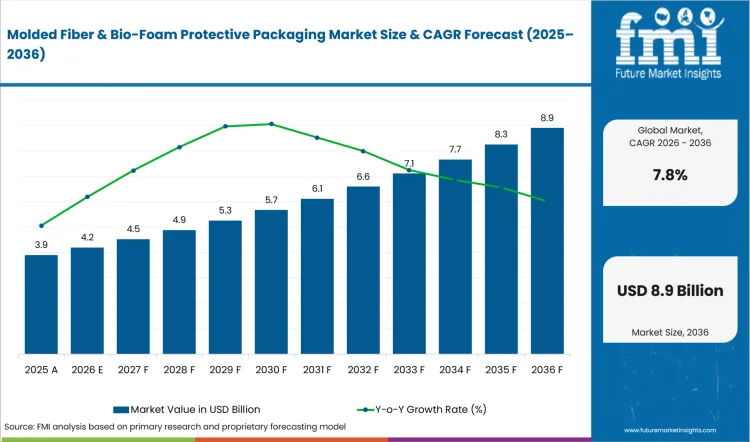
USD 4.2 billion in 2026 and USD 8.9 billion by 2036 at a 7.8% CAGR.
The molded fiber and bio-foam protective packaging industry is set to move from USD 4.2 billion in 2026 to USD 8.9 billion by 2036, reflecting a 7.8% CAGR across the forecast period. Online retailers are actively eliminating plastic cushioning from delivery boxes, creating a strong need for sustainable inserts capable of protecting fragile items during shipping. Large-scale conversion programs demonstrate how rapidly the industry is shifting toward paper-based alternatives. Amazon announced in June 2024 stating 95.0% of plastic air pillows in North American delivery packaging had been replaced with paper filler. Such widespread material changes encourage packaging engineers to rely on molded fiber and bio-foam inserts for reliable carton security.
Regional packaging teams look for different performance features on selecting new cushioning materials. Purchasing leaders in the United States and Japan focus heavily on damage-test records and strict qualification rules. Engineering groups in China and India prioritize fast tooling speed and local molding support. Expanding digital commerce continuously pushes companies to ship more individual parcels safely to consumers. Eurostat reported in February 2026 stating EU enterprises generated 19.49% of total turnover from e-sales in 2024. High online sales volumes motivate logistics providers to closely examine molded fiber options for their protective shipping programs.
Key Takeaways of Molded Fiber & Bio-Foam Protective Packaging Market
- Demand for molded fiber and bio-foam protective packaging is driven by shippers connecting product protection with plastic-foam reduction, with account decisions reflecting material consistency and converting access near assembly locations.
- By sales channel, B2B direct is expected to lead with 71.0% share in 2026, aided by direct testing cycles between converters and brand owners.
- Trays & inserts are the dominant format segment, projected to hold 44.0% share in 2026, led by direct foam-replacement use inside cartons.
- Molded pulp (recycled fiber) is estimated to lead the material category with 46.0% share in 2026, helped by established forming behavior and available fiber inputs.
- Compression performance and corner-drop testing remain critical to supplier qualification, as electronics and appliance packagers screen cushions against damage claims before shifting away from foam blocks.
- India, China, and Germany are expected to form the higher-growth country tier, advancing at 9.8%, 9.1%, and 8.2% CAGR respectively through 2036, supported by parcel scale, seller onboarding, and recyclability proof requirements.
- Competition centers on Huhtamaki, Stora Enso, UFP Technologies, Sonoco, PulPac, and Genera, with vendors differentiating through forming process knowledge, protective design experience, and repeatable part quality.
Analyst Perspective
"The molded fiber and bio-foam protective packaging market is gaining momentum as manufacturers and e-commerce brands seek protective solutions that reduce plastic use without compromising packaging performance. Commercial decisions are increasingly influenced by cushioning effectiveness, production compatibility, and the ability to scale efficiently across high-volume packaging operations. Suppliers that provide application engineering, tooling expertise, and dependable converting support are expected to establish stronger relationships as sustainable packaging programs move from pilot projects to mainstream adoption."
- Nandini Roy Choudhury, Principal Consultant for Packaging at Future Market Insights
Source: Future Market Insights analysis, 2026.
How is Molded Fiber & Bio-Foam Protective Packaging Market segmented?
The molded fiber & bio-foam protective packaging industry is segmented by material, process, product, end use, channel, and region.
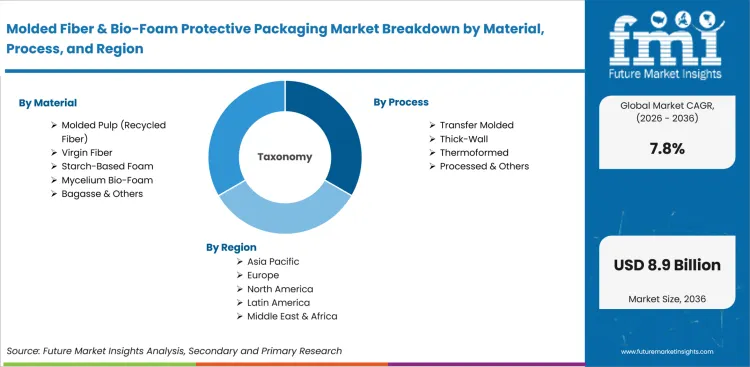
The molded fiber & bio-foam protective packaging market covers six parent segments. Material coverage includes molded pulp (recycled fiber) alongside virgin fiber, starch-based foam, mycelium bio-foam, and bagasse & others. Process coverage includes transfer molded, thick-wall, thermoformed, and processed & others. Product coverage includes trays & inserts, end caps & corners, clamshells, and blocks & others. End-use coverage includes electronics, e-commerce, appliances, food & beverage, and industrial. Channel coverage includes b2b direct and distributors. Regional coverage includes North America and Latin America. Coverage also Includes Europe, East Asia, South Asia, Oceania, and Middle East and Africa.
How does molded pulp (recycled fiber) shape material purchasing?
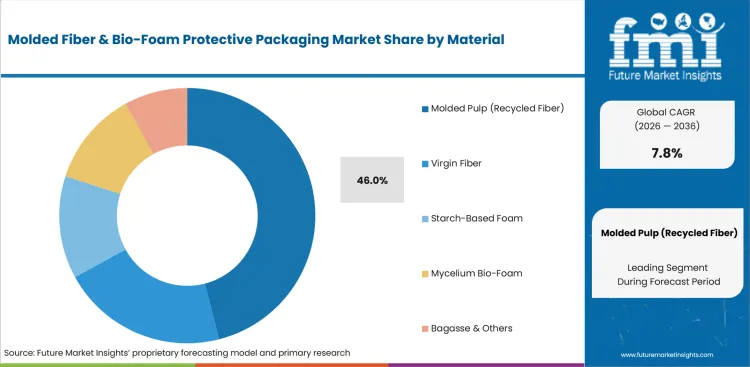
Molded pulp (recycled fiber) is estimated to lead material purchasing as packaging teams need a proven substitute for plastic-foam inserts. European Commission stated in 2026 reporting for 40.0% of plastics used in the EU are in packaging, strengthening buyer review of recycled-fiber protective formats. Material approval is expected to favor paper packaging systems with recycling compatibility and stable molded-part behavior.
- Based on material, molded pulp (recycled fiber) is anticipated to represent 46.0% share in 2026 due to available inputs and established forming routes. Packaging teams assess recycled-fiber cushions through compression and clean-release checks before approving replacement programs.
- Virgin fiber and bagasse & others address cleaner surface needs and alternative bio-based cushioning goals. Molded pulp (recycled fiber) retains selection strength as converters need predictable fiber behavior during repeated part production.
How does transfer molded support process demand?
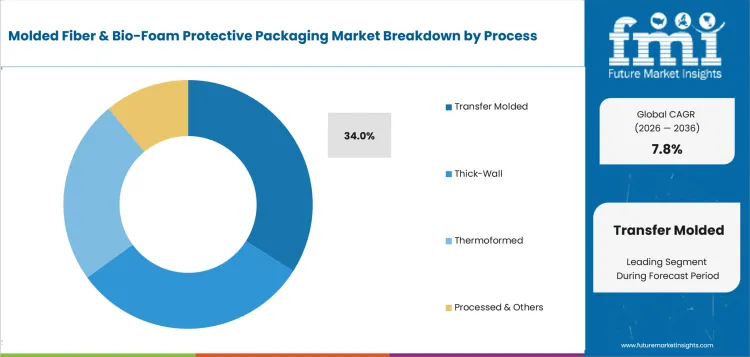
PulPac reported in November 2024 claiming the Modula converts 2.6 metric tons in 24 hours for coffee lids, showing process productivity relevant to scaled fiber-forming economics. Equipment review is expected to connect with molded pulp packaging machines as converters prepare for higher-quality protective formats. Transfer molded is anticipated to support process demand as thicker molded walls help absorb heavier impacts during parcel movement.
- In 2026, transfer molded is projected to account for 34.0% share as wall thickness and part rigidity support fragile goods shipping. Packaging engineers approve process selection after molded parts show repeatable cushioning across trial shipments.
- Thermoformed and processed & others address smoother finish requirements and special geometry needs. Transfer molded continues to guide process selection as converters seek impact absorption without excessive carton redesign.
How do trays & inserts guide product demand?
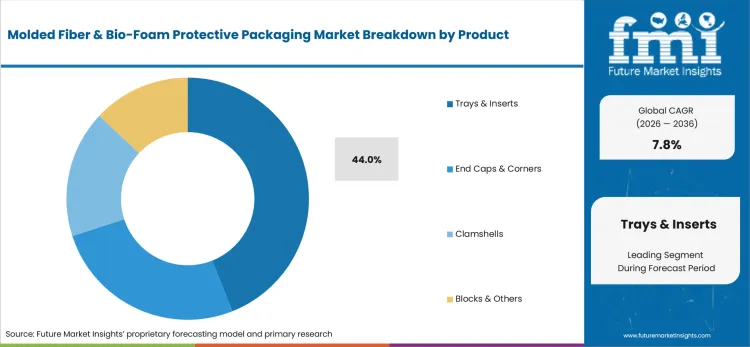
Trays & inserts are projected to guide product demand as packaging teams need molded cushions keeping products away from carton walls. Amazon reported in its 2024 sustainability report stating 10 billion items were delivered same day or next day around the world, highlighting insert design needs for products moving through faster fulfillment networks. Product review is likely to favor protective packaging formats shaped around each appliance or fragile component.
- By product, trays & inserts are expected to capture 44.0% share in 2026 since inserts directly support product separation inside cartons. Buyers evaluate each tray through corner-drop behavior and line-side handling.
- End caps & corners and blocks & others serve shipment profiles needing edge protection or enclosed product holding. Trays & inserts keep account attention as pack-out teams use them to control product movement during parcel sorting and truck loading.
How does electronics influence end-use demand?
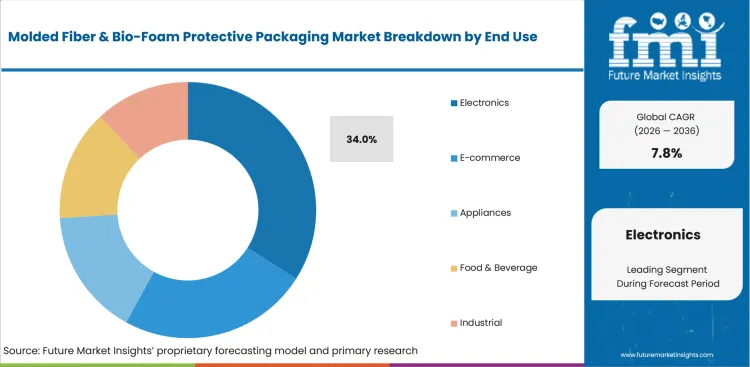
Electronics is expected to lead end-use demand as fragile devices need cushioning controlling impact without leaving dust or surface marks. Apple reported in October 2025 stating fiscal 2025 revenue reached USD 416 billion, supporting protective packaging review for high-value electronic device shipment programs. Such shipment intensity is projected to raise testing pressure around molded trays and fiber inserts for accessories and handheld devices.
- Electronics are estimated to secure 34.0% share in 2026, backed by fragile products require shaped protection and documented drop-test results. Electronics packaging teams evaluate molded parts based on corner-drop evidence and surface-finish control.
- Food & beverage and industrial applications add varied cushion needs across parcel flows and heavier goods. Electronics remains central to end-use review as damage risk is easier to measure depending on return claims and product inspection records.
How does B2B direct support channel demand?
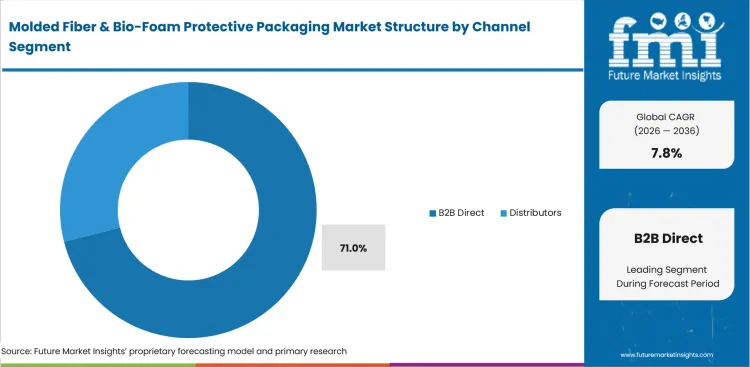
B2B Direct is anticipated to support channel demand as brand owners and converters need repeated technical exchanges before approving new molded cushions. Universal Postal Union reported on December 2025 claiming its statistical database covers over 200 countries and about 100 indicators, highlighting the importance of structured delivery records in packaging and logistics decisions. Channel selection is expected to favor direct relationships as molded fiber approvals require pack-out trials and rapid correction cycles.
- B2B direct is projected to account for 71.0% share of channel in 2026, led by buyers needing converter access during specification and line validation. Direct engagement helps packaging teams adjust nesting design and material finish before recurring orders.
- Distributors support smaller buyers seeking standard molded parts and shorter purchase cycles. B2B Direct maintains selection strength as protective packaging decisions often require engineering review before any large shipment program begins.
What are drivers, restraints, and opportunities in Molded Fiber & Bio-Foam Protective Packaging Market?
Purchases gain support from product-protection proof and plastic-foam reduction, as moisture exposure and requalification costs delay wider pack-out conversion.
- Driver: Protective packaging buyers are converting selected inserts and end caps from plastic foam to molded fiber and bio-foam formats as brand owners seek lower plastic exposure and reliable damage protection.
- Restraint: Moisture resistance and repeatable impact performance slow adoption as suppliers need proof across drop testing and production-line handling.
- Opportunity: Custom-molded trays and inserts create account entry points for suppliers able to document cushioning performance and mold close to buyer assembly locations.
World Bank’s 2026 What a Waste 3.0 profile projected municipal solid waste rising from 2.56 billion tonnes in 2022 to 3.86 billion tonnes by 2050 without action, strengthening buyer interest in source-reduction packaging and recoverable fiber formats. Such waste pressure supports molded fiber and bio-foam trials if inserts reduce plastic use without raising product returns.
EUR-Lex stated on September 26, 2025 that grouped, transport, and e-commerce packaging filled by economic operators must not exceed 50.0% empty space by 2030, increasing design pressure on protective inserts that fill less void without losing impact protection. Such rules are likely to slow rushed conversions as buyers need dimensional proof and cushioning records before changing pack-outs.
ANDRITZ announced on September 26, 2024 that Dry Molded Fiber is a nearly waterless process for molding cellulose fibers into three-dimensional packaging products, supporting opportunity for converters evaluating fiber-based shapes beyond food-grade items. Process partnerships are expected to improve supplier access to molded protective formats serving electronics, appliance, and parcel-ready retail programs.
What country CAGRs are profiled in Molded Fiber & Bio-Foam Protective Packaging Market?
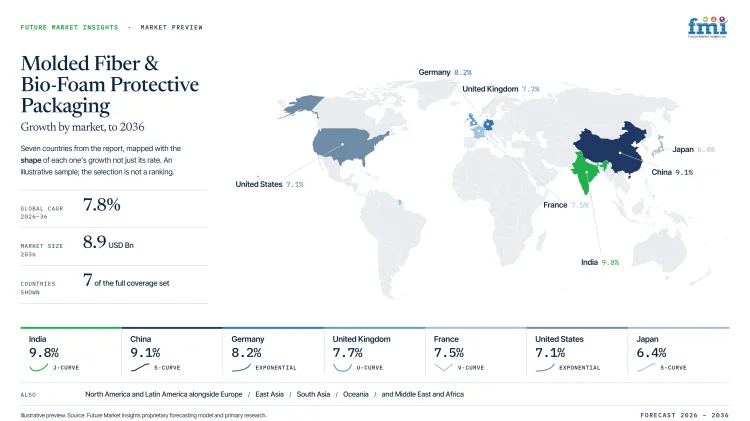
| Country | CAGR |
|---|---|
| India | 9.8% |
| China | 9.1% |
| Germany | 8.2% |
| United Kingdom | 7.7% |
| France | 7.5% |
| United States | 7.1% |
| Japan | 6.4% |
Source: Future Market Insights analysis, 2026.
How do country-level CAGRs compare in the Molded Fiber & Bio-Foam Protective Packaging Market?
The country comparison spans 3.4 percentage points and highlights three well-defined growth tiers across the molded fiber & bio-foam protective packaging market. India and China form the leading group with just 0.7 percentage points between them. Germany, the United Kingdom and France create a closely clustered middle tier within a 0.7-point range. The United States and Japan complete the comparison, separated by 0.7 percentage points. The pattern reflects differences in sustainable packaging adoption, manufacturing capacity and the pace of plastic replacement across end-use industries.
- India leads the comparison with a CAGR of 9.8%. Expanding domestic packaging production and growing use of fiber-based cushioning for electronics, consumer goods and e-commerce shipments are creating favorable conditions for molded fiber and bio-foam protective packaging solutions.
- China follows at 9.1%, only 0.7 percentage points behind India. High export volumes and increasing adoption of recyclable protective packaging continue to encourage manufacturers to incorporate molded fiber components and bio-based cushioning materials into shipping applications.
- Germany records a CAGR of 8.2%, placing it 0.9 percentage points below China. Demand is associated with greater use of sustainable industrial packaging and continued substitution of plastic protective materials with fiber-based alternatives that align with environmental objectives.
- The United Kingdom reaches 7.7%, remaining 0.5 percentage points behind Germany. Packaging suppliers and consumer goods manufacturers are increasing the use of recyclable protective materials as businesses work to reduce single-use plastic content across distribution networks.
- France posts a CAGR of 7.5%, only 0.2 percentage points below the United Kingdom. Market activity reflects wider adoption of eco-designed packaging formats and increasing preference for renewable cushioning materials across food, cosmetics and retail packaging applications.
- At 7.1%, the United States stands 0.4 percentage points behind France. Interest in molded fiber packaging continues to grow as brand owners and logistics providers seek protective solutions that combine damage reduction with lower plastic consumption.
- Japan completes the comparison with a CAGR of 6.4%, trailing the United States by 0.7 percentage points. Demand is linked to precision packaging requirements, efficient material utilization and continued development of recyclable protective packaging for electronics and high-value consumer products.
Comparable CAGRs can still produce different market entry conditions. Differences in packaging regulations, material availability, converting capacity and sustainability priorities influence supplier positioning and long-term commercial opportunities. The full report provides country-level CAGR analysis across North America, Latin America, Europe, East Asia, South Asia, Oceania and the Middle East and Africa.
Country-wise Analysis
Country outlooks point to adoption defined by electronics shipment needs and packaging policy pressure. India and China move ahead of other profiled countries as seller onboarding and local converting needs support quicker approval cycles.
- The market in India is anticipated to expand at 9.8% CAGR by 2036, helped by seller onboarding and packaging support linked to online commerce access. Ministry of Micro, Small and Medium Enterprises stated in December 2025 highlighting the MSME-TEAM initiative aims to assist 5 lakh micro and small enterprises, influencing packaging material and design support needs among smaller sellers.
- State Post Bureau data reported by China’s State Council in December 2025 stated express delivery handled 180.74 billion parcels during the first 11 months of 2025, promoting molded cushion needs across high-volume parcel flows. Sector in China is projected to rise at 9.1% CAGR from 2026 to 2036 as parcel density and fast tooling cycles support protective packaging conversion.
- Packaging buyers in Germany are expected to advance at 8.2% CAGR during the study period, guided by recyclability proof and disciplined technical qualification. German Federal Statistical Office reported in 2026 demonstrating the retail trade outside stores or markets having declined 10.1% year over year in April 2026, making damage control and right-sized shipping important for sellers managing softer online conditions.
- Office for National Statistics reported in 2026 reflecting internet sales representing 27.9% of total retail sales in Q1 2026, impacting protective insert review as parcel-based retail keeps pressure on pack-out performance. Industry in the United Kingdom is likely to record 7.7% CAGR during the forecast period since online retail habits keep molded fiber trials active across consumer goods and appliance shipments.
- Sales in France are forecast to expand at 7.5% CAGR during the assessment period, shaped by e-commerce parcel activity and retailer pressure for lower-plastic protective formats. Ecommerce Europe reported in September 2025 showing the 41.6 million French people made at least one online purchase in 2024, strengthening demand for trays and inserts protecting consumer parcels.
- United States suppliers are projected to rise 7.1% CAGR by 2036, driven by parcel-ready retail programs increasing need for protective formats proven through ship-in-own-packaging trials. USA Census Bureau reported in May 2026 announcing e-commerce having accounted for 16.9% of total retail sales in Q1 2026, supporting molded fiber and bio-foam testing around damage control in online orders.
- Japan’s Ministry of Economy, Trade and Industry reported in August 2025 claiming domestic electrical appliances and peripherals having recorded a 43.03% EC ratio in 2024, encouraging compact parcel protection formats with clean finish and careful presentation. Sector in Japan is expected to progress at 6.4% CAGR between 2026 and 2036, helped by buyers place greater weight on surface finish and qualification discipline.
Who are notable companies in Molded Fiber & Bio-Foam Protective Packaging Market?
Huhtamaki and Stora Enso are expected to shape account review through fiber-packaging scale and brand-owner access. UFP Technologies and Sonoco add protective-design experience across engineered packaging use cases. Brødrene Hartmann and Genera support bio-based cushioning and commercial packaging applications.
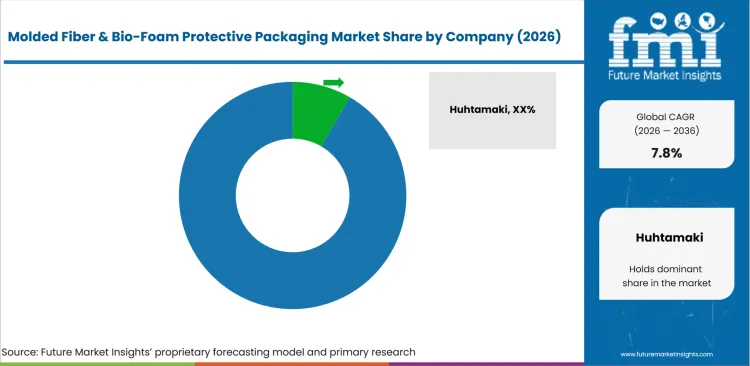
Competition in molded fiber and bio-foam protective packaging is anticipated to center on material consistency and tooling support. Surface finish and line-side handling guide final vendor review. Account teams are anticipated to compare suppliers based on evidence packages and support for repeat pack-out programs after trial approval. Huhtamaki and Stora Enso are expected to receive review attention due to fiber expertise. UFP Technologies is likely to add custom protective design support. Sonoco is projected to compete due to paper-based protection and packaging relationships. PulPac is estimated to compete based on Dry Molded Fiber technology. PAPACKS and Ecovative are forecast to support buyer demand through molded-fiber and mycelium-based packaging. Novolex and Genera are likely to add molded packaging scale and application coverage.
- Huhtamaki and Stora Enso gain account attention based on fiber packaging and customer access. Fiber-material experience promotes programs needing technical files and repeated converting discipline.
- UFP Technologies and Sonoco compete through protective-design depth and packaging qualification support. Account progress improves as buyers assess molded inserts before replacing foam.
- PulPac and PAPACKS support demand through molded-fiber technology and application development. Ecovative helps buyers compare mycelium cushioning for specialized protective uses.
- Novolex and Genera gain review strength through molded packaging scale and production access. Vendor attention improves as brand owners need fiber-based protection at recurring order volumes.
Competitive Benchmarking: Molded Fiber & Bio-Foam Protective Packaging Market
| Company | Portfolio Depth | Material Match | Protective Design Support | Service Reach |
|---|---|---|---|---|
| Huhtamaki | High | High | Medium | Global |
| Stora Enso | High | High | Medium | Global |
| UFP Technologies | High | Medium | High | United States |
| Sonoco | High | Medium | High | Global |
| PulPac | Medium | High | Medium | Europe |
| PAPACKS | Medium | High | Medium | Europe |
| Ecovative | Medium | Medium | High | United States |
| Novolex | High | Medium | Medium | North America |
| Brødrene Hartmann | Medium | High | Medium | Europe |
| Genera | Medium | High | Medium | United States |
Source: Future Market Insights competitive analysis, 2026.
Key Developments in Molded Fiber & Bio-Foam Protective Packaging Market
- In June 2025, Stora Enso and Matrix Pack entered a strategic partnership to accelerate formed fiber packaging innovation. Matrix Pack operated 8 manufacturing facilities in 5 countries, supporting formed-fiber scale across global customer programs.
- In May 2026, PAPACKS stated its Fiber Box won four WorldStar Packaging Awards 2026 across the Food, Packaging Materials and Components, and Transit categories, along with a Special Award recognition for packaging that saves food.
Key Players in Molded Fiber & Bio-Foam Protective Packaging Market
Fiber packaging and molded-pulp companies
- Huhtamaki
- Stora Enso
- Sonoco
- Brødrene Hartmann
- Genera
Protective packaging and engineered packaging companies
- UFP Technologies
- Novolex
- PAPACKS
Bio-based and technology specialists
- PulPac
- Ecovative
- Vericool
- TemperPack
Molded Fiber & Bio-Foam Protective Packaging Market - Report Scope
| Coverage field | Report scope |
|---|---|
| Market breakdown | Molded Fiber & Bio-Foam Protective Packaging Market breakdown by material alongside process, product, end use, channel, and region |
| Market Definition | Molded fiber and bio-foam protective packaging includes molded pulp, fiber-based, starch-based, mycelium-based, and bagasse-based protective formats used to cushion, brace, and organize products during storage and shipment. |
| Regions Covered | North America and Latin America alongside Europe, East Asia, South Asia, Oceania, and Middle East and Africa |
| Countries Covered | United States and Germany alongside United Kingdom, France, China, Japan, India, Canada, Brazil, Mexico, Italy, Spain, South Korea, Australia, New Zealand, GCC countries, South Africa, and Türkiye |
| Key Companies Profiled | Huhtamaki and Stora Enso alongside UFP Technologies, Sonoco, PulPac, PAPACKS, Ecovative, Novolex, Brødrene Hartmann, Genera, Vericool, and TemperPack |
| Forecast Period | 2026 to 2036 |
| Approach | Hybrid bottom-up and top-down methodology using segment share, country CAGR, protective packaging needs, material performance, process readiness, company portfolio depth, and service exposure |
Source: Future Market Insights analysis, 2026.
Molded Fiber & Bio-Foam Protective Packaging Market - Research Methodology
| Method | Approach |
|---|---|
| Primary Research | FMI analysts gathered input from manufacturers, service providers, technology developers, distributors, end users, sourcing teams, and subject-matter experts. Interviews examined purchasing decisions, product or service evaluation, adoption barriers, approval requirements, pricing considerations, and expectations for technical or commercial support. Respondents were also asked what evidence is required before a trial, pilot, or initial order develops into regular purchasing. |
| Desk Research | Desk research covered government statistics, regulatory publications, trade data, industry associations, technical literature, standards, company filings, product information, and official corporate announcements. Sources were reviewed for relevance, publication date, geographic coverage, and consistency with the defined market scope. Claims relating to performance, applications, approvals, capacity, investment, and commercial activity were retained only when supported by credible public evidence. |
| Market Sizing and Forecasting | The market model combined the baseline value with historical performance, segment structure, pricing and volume indicators, adoption levels, company participation, and country-level demand conditions. Forecast assumptions considered economic activity, investment trends, regulatory developments, technology adoption, purchasing cycles, supply availability, and barriers to wider market use. Segment and regional estimates were reconciled before the final market total was calculated. |
| Data Validation | Estimates were checked against multiple independent indicators, including public data, company activity, trade patterns, industry developments, and findings from primary interviews. Validation also tested whether products, services, applications, and company revenues fell within the defined market boundaries. Adjacent categories, unsupported claims, overlapping revenues, and activities without direct market relevance were excluded to reduce double counting and maintain consistency across segments and countries. |
Source: Future Market Insights analysis, 2026.
Molded Fiber & Bio-Foam Protective Packaging Market by Segments
Molded Fiber & Bio-Foam Protective Packaging Market segmented by Material:
- Molded Pulp (Recycled Fiber)
- Virgin Fiber
- Starch-Based Foam
- Mycelium Bio-Foam
- Bagasse & Others
Molded Fiber & Bio-Foam Protective Packaging Market segmented by Process:
- Transfer Molded
- Thick-Wall
- Thermoformed
- Processed & Others
Molded Fiber & Bio-Foam Protective Packaging Market segmented by Product:
- Trays & Inserts
- End Caps & Corners
- Clamshells
- Blocks & Others
Molded Fiber & Bio-Foam Protective Packaging Market segmented by End Use:
- Electronics
- E-commerce
- Appliances
- Food & Beverage
- Industrial
Molded Fiber & Bio-Foam Protective Packaging Market segmented by Channel:
- B2B Direct
- Distributors
Molded Fiber & Bio-Foam Protective Packaging Market by Region:
- North America
- United States
- Canada
- Latin America
- Brazil
- Mexico
- Argentina
- Europe
- Germany
- United Kingdom
- France
- Italy
- Spain
- East Asia
- China
- Japan
- South Korea
- South Asia
- India
- Thailand
- Indonesia
- Oceania
- Australia
- New Zealand
- Middle East and Africa
- GCC countries
- South Africa
- Türkiye
Research Sources and Bibliography
- Amazon Staff. (2024, June 20). Amazon announces its largest reduction in plastic packaging in North America to date.
- Amazon. (2025). 2024 Amazon Sustainability Report.
- ANDRITZ. (2024, September 26). ANDRITZ to offer complete Dry Molded Fiber lines.
- China State Council. (2025, December 16). China’s express delivery sector posts double-digit growth in first 11 months.
- Ecommerce Europe. (2025, September 1). Fevad releases the 2025 edition of Key figures for e-commerce in France.
- European Commission. (2026). Packaging waste.
- Eurostat. (2026, February). E-commerce statistics.
- EUR-Lex. (2025, September 26). Packaging and packaging waste from 2026.
- German Federal Statistical Office. (2026). Retail trade: Short-term indicators.
- Huhtamäki Oyj. (2025, February 14). Huhtamaki to separate Fiber Foodservice business segment into two distinct segments: Fiber Packaging and Foodservice Europe-Asia-Oceania.
- Apple. (2025, October 30). Apple reports fourth quarter results.
- Ministry of Micro, Small and Medium Enterprises. (2025, December 1). The Trade Enablement and Marketing Scheme leverages Digital Public Infrastructure to empower MSMEs.
- Ministry of Economy, Trade and Industry. (2025, August 26). Results of FY2024 e-commerce market survey compiled.
- Office for National Statistics. (2026, June 19). Internet sales as a percentage of total retail sales ratio.
- PAPACKS Sales GmbH. (2026, May 8). PAPACKS Fiber Box wins WorldStar Award: Special Prize and three categories.
- PulPac. (2024, November 20). What is the right fit for your packaging needs?
- Stora Enso. (2025, June 12). Stora Enso and Matrix Pack partner to accelerate formed fiber packaging innovation.
- Universal Postal Union. (2025, December 18). Postal statistics.
- USA. Census Bureau. (2026, May 18). Quarterly retail e-commerce sales report.
- World Bank. (2026). What a Waste 3.0.
- This bibliography is provided for reader reference and is not exhaustive. The full report contains the complete reference list and detailed citations.
This Report Answers
- What segments shape demand across material, process, product, end use, and channel?
- How do packaging buyers evaluate molded fiber and bio-foam protective packaging before replacing plastic foam?
- How do country CAGRs differ across profiled markets?
- What companies compete through molded-fiber depth and protective packaging service?
- How are forecasts validated using a hybrid bottom-up and top-down approach?
- What factors do account teams address before larger account expansion?
- How do drop-test records and material files affect vendor selection?
- What limits return on investment for teams adding molded fiber protective formats?
- How do tooling records and product-damage evidence influence account approval?
- What vendor capabilities improve long-term account confidence?
Frequently Asked Questions
What supports demand in molded fiber & bio-foam protective packaging market?
Demand is likely to be supported by packaging teams needing protective inserts reducing plastic-foam use and keep shipped goods intact. Accounts are expected to favor vendors combining drop-test proof and service response.
Who are key players in molded fiber & bio-foam protective packaging market?
Key companies are anticipated to include Huhtamaki and Stora Enso among others supporting competition. Competition is likely to be based on protective design depth and regional service coverage.
What restraint affects molded fiber & bio-foam protective packaging market?
A major restraint is the proof burden created during moisture testing and impact-performance review across buyer approval teams. Accounts slow adoption if molded parts lack damage evidence or tooling support needed for pack-out approval.
Why do executives track molded fiber & bio-foam protective packaging market?
Executives are expected to track molded fiber and bio-foam protective packaging as packaging choices affect plastic exposure and customer returns. Factors such as drop-test records and converter support shape buyer reviews.
What business problem does molded fiber & bio-foam protective packaging market address?
Molded fiber and bio-foam protective packaging addresses the operational gap created by fragile goods needing protection without plastic foam. Brand owners and e-commerce shippers need molded formats supporting repeatable cushioning and field-ready supply evidence.
What do account teams evaluate before selecting vendors?
Account teams are likely to evaluate impact absorption and repeat-part quality before vendor approval. Material files and tooling response are expected to guide final vendor review.
What limits return on investment for purchasing teams?
Return on investment weakens if pack-out performance or account acceptance is not proven before deployment. Product damage and delayed approvals reduce expected margin gains.
How do vendors build long-term account confidence?
Vendors build account confidence by providing consistent molded-part quality and evidence specific to protective packaging. Trial records and responsive troubleshooting support are expected to influence repeat-order trust.
Preview the report firsthand - request a free sample
Get SampleGet the brochure for pricing and purchase details.
Get PDFTable of Content
- Key Takeaways
- Market Size and CAGR
- Top Growth Driver
- Fastest Growing Segment
- Leading Region
- Key Companies
- Emerging Opportunities
- Executive Summary
- Global Market Outlook
- Demand-side Trends
- Supply-side Trends
- Technology Roadmap Analysis
- Analysis and Recommendations
- Analyst Perspective (What is happening? Why now? What should investors know?)
- Key Questions Answered
- How large is the market?
- What is the CAGR?
- What are key trends?
- Which region dominates?
- Who are the leaders?
- Market Overview
- Market Coverage / Taxonomy
- Market Definition / Scope / Limitations
- Research Methodology
- Chapter Orientation
- Analytical Lens and Working Hypotheses
- Market Structure, Signals, and Trend Drivers
- Benchmarking and Cross-market Comparability
- Market Sizing, Forecasting, and Opportunity Mapping
- Research Design and Evidence Framework
- Desk Research Programme (Secondary Evidence)
- Expert Input and Fieldwork (Primary Evidence)
- Tooling, Models, and Reference Databases
- Data Engineering and Model Build
- Quality Assurance and Audit Trail
- Market Background
- Market Dynamics (Drivers, Restraints, Opportunity, Trends)
- Scenario Forecast (Optimistic, Likely, Conservative)
- Impact Analysis
- AI Impact
- Sustainability Impact
- Regulatory Impact
- Technology Impact
- Consumer / Buyer Analysis
- Purchase Drivers
- Adoption Barriers
- Buyer Journey
- Opportunity Map Analysis
- Product Life Cycle Analysis
- Supply Chain Analysis
- Investment Feasibility Matrix
- Value Chain Analysis
- PESTLE and Porter's Analysis
- Regulatory Landscape
- Regional Parent Market Outlook
- Production and Consumption Statistics
- Import and Export Statistics
- Global Market Analysis and Forecast, 2021 to 2036
- Historical Market Size Value (USD Billion) Analysis, 2021 to 2025
- Current and Future Market Size Value (USD Billion) Projections, 2026 to 2036
- Y-o-Y Growth Trend Analysis
- Absolute $ Opportunity Analysis
- Global Market Pricing Analysis, 2021 to 2036
- Global Market Analysis and Forecast, By Material, 2021 to 2036
- Introduction / Key Findings
- Historical Market Size Value (USD Billion) Analysis By Material, 2021 to 2025
- Current and Future Market Size Value (USD Billion) Analysis and Forecast By Material, 2026 to 2036
- Molded Pulp (Recycled Fiber)
- Virgin Fiber
- Starch-Based Foam
- Mycelium Bio-Foam
- Bagasse & Others
- Molded Pulp (Recycled Fiber)
- Y-o-Y Growth Trend Analysis By Material, 2021 to 2025
- Absolute $ Opportunity Analysis By Material, 2026 to 2036
- Global Market Analysis and Forecast, By Process, 2021 to 2036
- Introduction / Key Findings
- Historical Market Size Value (USD Billion) Analysis By Process, 2021 to 2025
- Current and Future Market Size Value (USD Billion) Analysis and Forecast By Process, 2026 to 2036
- Transfer Molded
- Thick-Wall
- Thermoformed
- Processed & Others
- Transfer Molded
- Y-o-Y Growth Trend Analysis By Process, 2021 to 2025
- Absolute $ Opportunity Analysis By Process, 2026 to 2036
- Global Market Analysis and Forecast, By Product, 2021 to 2036
- Introduction / Key Findings
- Historical Market Size Value (USD Billion) Analysis By Product, 2021 to 2025
- Current and Future Market Size Value (USD Billion) Analysis and Forecast By Product, 2026 to 2036
- Trays & Inserts
- End Caps & Corners
- Clamshells
- Blocks & Others
- Trays & Inserts
- Y-o-Y Growth Trend Analysis By Product, 2021 to 2025
- Absolute $ Opportunity Analysis By Product, 2026 to 2036
- Global Market Analysis and Forecast, By End Use, 2021 to 2036
- Introduction / Key Findings
- Historical Market Size Value (USD Billion) Analysis By End Use, 2021 to 2025
- Current and Future Market Size Value (USD Billion) Analysis and Forecast By End Use, 2026 to 2036
- Electronics
- E-commerce
- Appliances
- Food & Beverage
- Industrial
- Electronics
- Y-o-Y Growth Trend Analysis By End Use, 2021 to 2025
- Absolute $ Opportunity Analysis By End Use, 2026 to 2036
- Global Market Analysis and Forecast, By Channel, 2021 to 2036
- Introduction / Key Findings
- Historical Market Size Value (USD Billion) Analysis By Channel, 2021 to 2025
- Current and Future Market Size Value (USD Billion) Analysis and Forecast By Channel, 2026 to 2036
- B2B Direct
- Distributors
- B2B Direct
- Y-o-Y Growth Trend Analysis By Channel, 2021 to 2025
- Absolute $ Opportunity Analysis By Channel, 2026 to 2036
- Global Market Analysis and Forecast, By Region, 2021 to 2036
- Introduction
- Historical Market Size Value (USD Billion) Analysis By Region, 2021 to 2025
- Current Market Size Value (USD Billion) Analysis and Forecast By Region, 2026 to 2036
- North America
- Latin America
- Western Europe
- Eastern Europe
- East Asia
- South Asia and Pacific
- Middle East & Africa
- Market Attractiveness Analysis By Region
- North America Market Analysis and Forecast, By Country, 2021 to 2036
- Historical Market Size Value (USD Billion) Trend Analysis By Market Taxonomy, 2021 to 2025
- Market Size Value (USD Billion) Forecast By Market Taxonomy, 2026 to 2036
- By Country
- USA
- Canada
- By Material
- By Process
- By Product
- By End Use
- By Channel
- By Country
- Market Attractiveness Analysis
- By Country
- By Material
- By Process
- By Product
- By End Use
- By Channel
- Key Takeaways
- Latin America Market Analysis and Forecast, By Country
- Historical Market Size Value (USD Billion) Trend Analysis By Market Taxonomy, 2021 to 2025
- Market Size Value (USD Billion) Forecast By Market Taxonomy, 2026 to 2036
- By Country
- Brazil
- Mexico
- Chile
- Rest of Latin America
- By Material
- By Process
- By Product
- By End Use
- By Channel
- By Country
- Market Attractiveness Analysis
- By Country
- By Material
- By Process
- By Product
- By End Use
- By Channel
- Key Takeaways
- Western Europe Market Analysis and Forecast, By Country
- Historical Market Size Value (USD Billion) Trend Analysis By Market Taxonomy, 2021 to 2025
- Market Size Value (USD Billion) Forecast By Market Taxonomy, 2026 to 2036
- By Country
- Germany
- UK
- Italy
- Spain
- France
- Nordic
- BENELUX
- Rest of Western Europe
- By Material
- By Process
- By Product
- By End Use
- By Channel
- By Country
- Market Attractiveness Analysis
- By Country
- By Material
- By Process
- By Product
- By End Use
- By Channel
- Key Takeaways
- Eastern Europe Market Analysis and Forecast, By Country
- Historical Market Size Value (USD Billion) Trend Analysis By Market Taxonomy, 2021 to 2025
- Market Size Value (USD Billion) Forecast By Market Taxonomy, 2026 to 2036
- By Country
- Russia
- Poland
- Hungary
- Balkan & Baltic
- Rest of Eastern Europe
- By Material
- By Process
- By Product
- By End Use
- By Channel
- By Country
- Market Attractiveness Analysis
- By Country
- By Material
- By Process
- By Product
- By End Use
- By Channel
- Key Takeaways
- East Asia Market Analysis and Forecast, By Country
- Historical Market Size Value (USD Billion) Trend Analysis By Market Taxonomy, 2021 to 2025
- Market Size Value (USD Billion) Forecast By Market Taxonomy, 2026 to 2036
- By Country
- China
- Japan
- South Korea
- By Material
- By Process
- By Product
- By End Use
- By Channel
- By Country
- Market Attractiveness Analysis
- By Country
- By Material
- By Process
- By Product
- By End Use
- By Channel
- Key Takeaways
- South Asia and Pacific Market Analysis and Forecast, By Country
- Historical Market Size Value (USD Billion) Trend Analysis By Market Taxonomy, 2021 to 2025
- Market Size Value (USD Billion) Forecast By Market Taxonomy, 2026 to 2036
- By Country
- India
- ASEAN
- Australia & New Zealand
- Rest of South Asia and Pacific
- By Material
- By Process
- By Product
- By End Use
- By Channel
- By Country
- Market Attractiveness Analysis
- By Country
- By Material
- By Process
- By Product
- By End Use
- By Channel
- Key Takeaways
- Middle East & Africa Market Analysis and Forecast, By Country
- Historical Market Size Value (USD Billion) Trend Analysis By Market Taxonomy, 2021 to 2025
- Market Size Value (USD Billion) Forecast By Market Taxonomy, 2026 to 2036
- By Country
- Kingdom of Saudi Arabia
- Other GCC Countries
- Türkiye
- South Africa
- Other African Union
- Rest of Middle East & Africa
- By Material
- By Process
- By Product
- By End Use
- By Channel
- By Country
- Market Attractiveness Analysis
- By Country
- By Material
- By Process
- By Product
- By End Use
- By Channel
- Key Takeaways
- Key Countries Market Analysis
- USA
- Pricing Analysis
- Market Share Analysis, 2025
- By Material
- By Process
- By Product
- By End Use
- By Channel
- Canada
- Pricing Analysis
- Market Share Analysis, 2025
- By Material
- By Process
- By Product
- By End Use
- By Channel
- Mexico
- Pricing Analysis
- Market Share Analysis, 2025
- By Material
- By Process
- By Product
- By End Use
- By Channel
- Brazil
- Pricing Analysis
- Market Share Analysis, 2025
- By Material
- By Process
- By Product
- By End Use
- By Channel
- Chile
- Pricing Analysis
- Market Share Analysis, 2025
- By Material
- By Process
- By Product
- By End Use
- By Channel
- Germany
- Pricing Analysis
- Market Share Analysis, 2025
- By Material
- By Process
- By Product
- By End Use
- By Channel
- UK
- Pricing Analysis
- Market Share Analysis, 2025
- By Material
- By Process
- By Product
- By End Use
- By Channel
- Italy
- Pricing Analysis
- Market Share Analysis, 2025
- By Material
- By Process
- By Product
- By End Use
- By Channel
- Spain
- Pricing Analysis
- Market Share Analysis, 2025
- By Material
- By Process
- By Product
- By End Use
- By Channel
- France
- Pricing Analysis
- Market Share Analysis, 2025
- By Material
- By Process
- By Product
- By End Use
- By Channel
- India
- Pricing Analysis
- Market Share Analysis, 2025
- By Material
- By Process
- By Product
- By End Use
- By Channel
- ASEAN
- Pricing Analysis
- Market Share Analysis, 2025
- By Material
- By Process
- By Product
- By End Use
- By Channel
- Australia & New Zealand
- Pricing Analysis
- Market Share Analysis, 2025
- By Material
- By Process
- By Product
- By End Use
- By Channel
- China
- Pricing Analysis
- Market Share Analysis, 2025
- By Material
- By Process
- By Product
- By End Use
- By Channel
- Japan
- Pricing Analysis
- Market Share Analysis, 2025
- By Material
- By Process
- By Product
- By End Use
- By Channel
- South Korea
- Pricing Analysis
- Market Share Analysis, 2025
- By Material
- By Process
- By Product
- By End Use
- By Channel
- Russia
- Pricing Analysis
- Market Share Analysis, 2025
- By Material
- By Process
- By Product
- By End Use
- By Channel
- Poland
- Pricing Analysis
- Market Share Analysis, 2025
- By Material
- By Process
- By Product
- By End Use
- By Channel
- Hungary
- Pricing Analysis
- Market Share Analysis, 2025
- By Material
- By Process
- By Product
- By End Use
- By Channel
- Kingdom of Saudi Arabia
- Pricing Analysis
- Market Share Analysis, 2025
- By Material
- By Process
- By Product
- By End Use
- By Channel
- Türkiye
- Pricing Analysis
- Market Share Analysis, 2025
- By Material
- By Process
- By Product
- By End Use
- By Channel
- South Africa
- Pricing Analysis
- Market Share Analysis, 2025
- By Material
- By Process
- By Product
- By End Use
- By Channel
- USA
- Market Structure Analysis
- Competition Dashboard
- Competition Benchmarking
- Market Share Analysis of Top Players
- By Regional
- By Material
- By Process
- By Product
- By End Use
- By Channel
- Emerging Startups
- Innovation Benchmarking
- Competition Analysis
- Competition Deep Dive
- Huhtamaki
- Overview
- Product Portfolio
- Profitability by Market Segments
- Sales Footprint
- Strategy Overview
- Marketing Strategy
- Product Strategy
- Channel Strategy
- UFP Technologies
- Sonoco
- Stora Enso
- Brødrene Hartmann
- Pactiv Evergreen
- Ecovative
- PulPac
- Papacks
- Genera
- Huhtamaki
- Case Studies
- Success Stories
- Recent Developments
- Competition Deep Dive
- Assumptions & Acronyms Used


