

- Market Size (2026)
- USD 14.7 Bn
- Forecast (2036)
- USD 23.2 Bn
- CAGR (2026 to 2036)
- 4.7%
How big is Molybdenum Market in 2026?
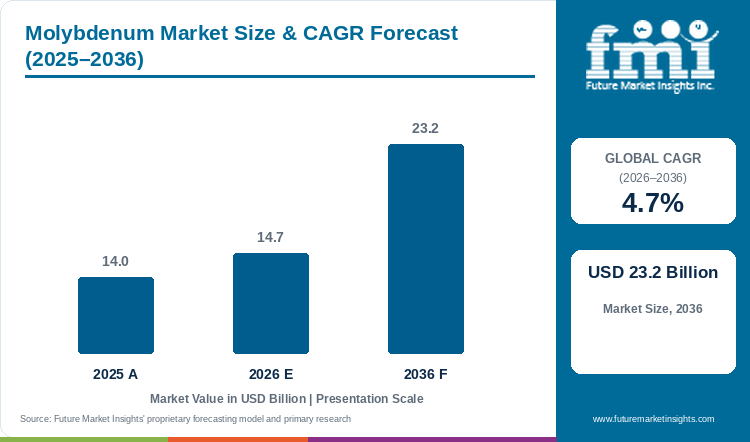
The molybdenum market is estimated at USD 14.0 billion in 2025, is expected to reach USD 14.7 billion in 2026 and is forecast at USD 23.2 billion by 2036, at a 4.7% CAGR.
Molybdenum revenue is estimated at USD 14.0 billion in 2025 and is projected to reach USD 14.7 billion in 2026. Sales will grow at a 4.7% CAGR and are likely to reach USD 23.2 billion by 2036. Most new supply comes from copper concentrators, and falling ore grades at large copper mines are cutting the by-product tonnes that steel mills rely on. Antofagasta produced 9.0 thousand tonnes of molybdenum in the first nine months of 2026, down 21.1%, mainly on lower grades at Los Pelambres.[1] Fewer by-product tonnes from Chile leave buyers leaning on primary mines with higher unit costs, so sales value is set to outpace tonnage.
Recent results point to a seller's market for molybdenum. Freeport-McMoRan realised $28.75 per pound of molybdenum over April to June 2026, against $21.10 a year earlier.[2] Centerra Gold suspended operations at the Langeloth Metallurgical Facility near Pittsburgh after an explosion on 29 January 2026.[3] For steel mills, higher realised prices pass straight into alloy surcharges, and buyers on annual contracts have little room to press for lower oxide prices. Loss of a US roaster also narrows conversion choice for American mills, so purchasing teams are likely to seek offtake agreements with copper producers holding roasting capacity on two continents.
Key Market Trends & Insights
- Application sales are led by full alloy steel grades at 19.0%, and stainless steel grade molybdenum is likely to hold 15.7% of 2026 sales.
- End-use demand is led by oil and gas at 19.0% in 2026, with chemicals and petrochemicals at 15.7%. Trekor Metals sold molybdenum at an average of US$29.63 per pound in the second quarter of 2026.[4]
- Roasted molybdenum oxide holds about 46.0% (estimated) of product sales, ahead of ferromolybdenum at an estimated 32.5%.
- Industrial grade molybdenum is estimated to hold 64.0% of purity grade sales, and high purity grades hold about 26.5%. Freeport-McMoRan's Climax and Henderson mines produce high-purity, chemical-grade concentrate.[5]
Regional Highlights
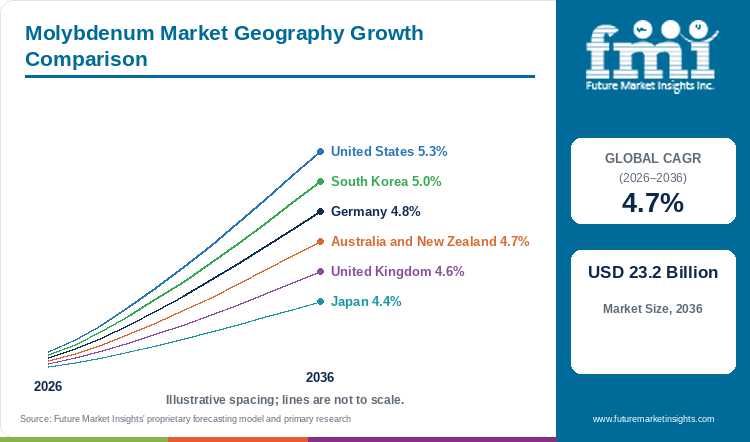
- The United States is forecast to grow at the fastest profiled CAGR, 5.3% from 2026 to 2036, on Colorado mines and Gulf Coast energy projects.
- South Korea follows at 5.0%, Germany at 4.8%, Australia and New Zealand at 4.7% and the United Kingdom at 4.6%, and Japan is the lowest at 4.4%.
- US mine production of molybdenum concentrate rose an estimated 18% to 40,000 tons in 2025.[6]
Market Size & Forecast
Table 1: Market Size and Forecast for the Molybdenum Market (USD billion and percentage), 2025 to 2036
| Metric | Value |
|---|---|
| 2025 Market Size | USD 14.0 billion |
| Estimated Market Size in 2026 | USD 14.7 billion |
| Projected Market Size by 2036 | USD 23.2 billion |
| CAGR, 2026 to 2036 | 4.7% |
| Added Revenue, 2026 to 2036 | USD 8.5 billion |
| Market Expansion Multiple | 1.6x |
Copper mine plans set the timing of new molybdenum supply, since most new tonnes arrive as by-product from copper concentrators. Rising molybdenum consumption has led many copper producers to upgrade facilities to extract molybdenite, the US Geological Survey reported.[6] World mine production reached an estimated 260,000 metric tons in 2025, with China, Chile, the United States, Peru and Mexico producing 90% of world output.[6] New copper projects in Chile, Peru and the United States will therefore decide supply growth more than primary mine restarts. Mines are adding automation to hold unit costs, and the smart mining market is projected to grow at a 10.9% CAGR from 2026 to 2036, which will help by-product producers keep molybdenum recovery profitable at lower grades. FMI expects the market to add USD 8.5 billion between 2026 and 2036, a 1.6x expansion. Falling ore grades at large copper mines such as Los Pelambres are the main risk to by-product supply.
Price, Cost and Supply Shocks in Molybdenum
Antofagasta produced 9.0 thousand tonnes of molybdenum in the first nine months of 2026, down 21.1%, mainly on lower grades at Los Pelambres.[1] Group cash costs before by-product credits rose 19.6% to $2.81 per pound of copper on higher prices for diesel and sulphuric acid.[1] Centerra Gold suspended operations at the Langeloth Metallurgical Facility near Pittsburgh after an explosion on 29 January 2026.[3] A single roaster outage tightens oxide supply for American steel mills, because concentrate then has to travel to other conversion plants.
China imposed export controls on molybdenum powders in February 2025, and the United States and other countries began seeking alternative sources.[6] CMOC's molybdenum revenue rose 33.11% to RMB 3.93 billion in the first half of 2026.[7] Trekor Metals quoted a molybdenum price of US$32.00 per pound in early August 2026.[4] Western buyers of powder and chemical grades will sign longer contracts with US and Chilean suppliers to avoid export licence delays.
Table 2: Price, Cost and Supply Indicators for the Molybdenum Market (prices, costs and volumes), 2025 to 2026
| Indicator | Data Point | Relevance | Source |
|---|---|---|---|
| Freeport-McMoRan realised molybdenum price, Q2 2026 | $28.75 per pound | Higher price per tonne sold. | [2] |
| Climax and Henderson unit net cash cost, Q2 2026 | $19.20 per pound | Cost squeeze on primary mines. | [2] |
| Freeport-McMoRan 2026 molybdenum mine cost guidance, January 2026 | About $16.60 per pound | Starting point for 2026 cost plans. | [5] |
| Antofagasta molybdenum output, nine months 2026 | 9.0 thousand tonnes, down 21.1% | Lower Chilean by-product supply. | [1] |
| World mine production, 2025 | 260,000 metric tons | Global supply base. | [6] |
| China export controls | Molybdenum powders, from February 2025 | Supply risk for powder buyers. | [6] |
| CMOC molybdenum revenue, H1 2026 | RMB 3.93 billion, up 33.11% | Price gains in China. | [7] |
| Langeloth outage | Operations suspended after 29 January 2026 explosion | US roasting capacity shock. | [3] |
Analyst Perspective
“Primary molybdenum producers should sign tolling contracts with roasters in the United States and Europe now, because the Langeloth outage showed the risk of relying on one conversion plant. I would also have them buy into copper projects with molybdenite circuits, since by-product tonnes are the cheapest supply in the market. Producers that lock in both will set contract terms with steel mills through the next decade.”
- Nikhil Kaitwade, Principal Consultant, Future Market Insights.
How is the molybdenum market segmented?
Four product axes and region describe demand for molybdenum. Full alloy steel leads application at 19.0%, oil and gas leads end use at 19.0%, molybdenum oxide leads product at an estimated 46.0% and industrial grade leads purity at about 64.0% in 2026.
By application: full alloy molybdenum, stainless steel grade molybdenum, HSLA, tool grade, carbon based, cast iron, catalyst grade, molybdenum metal alloy, superalloy, and other.
By end use industry: chemicals and petrochemicals, oil and gas, automotive, mechanical engineering, building and construction, power generation, aerospace and defence, electronics and medical, process industry, and other industries.
By product: molybdenum oxide (technical grade), ferromolybdenum, molybdenum chemicals, and molybdenum metal products.
By purity grade: industrial grade, high purity grade, and ultra high purity grade.
By region: All seven standard regions are covered, North America, Latin America, Western Europe, Eastern Europe, East Asia, South Asia and Pacific, and Middle East and Africa.
Why do full alloy steel grades lead molybdenum application sales?
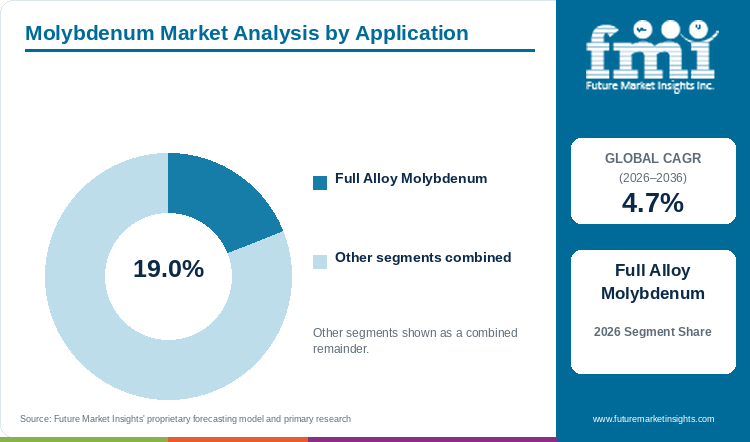
Full alloy steel grades lead application with 19.0% share in 2026, ahead of stainless steel grades at 15.7% and HSLA at an estimated 13.5%.
Table 3: Application Share for the Molybdenum Market (percentage share), 2026
| Application | Estimated Share (2026) |
|---|---|
| Full Alloy Molybdenum | 19.0% |
| Stainless Steel Grade Molybdenum | 15.7% |
| HSLA | 13.5% |
| Catalyst Grade | 9.0% |
| Molybdenum Metal Alloy | 8.5% |
| Cast Iron | 6.5% |
| Tool Grade | 6.0% |
| Carbon Based | 5.5% |
| Superalloy | 5.3% |
| Other | 11.0% |
| Total | 100.0% |
Table 4: Application Leadership and Market Growth for the Molybdenum Market (segment and CAGR percentage), 2026 to 2036
| Metric | Value |
|---|---|
| Global CAGR (2026 to 2036) | 4.7% |
| Leading Segment | Full Alloy Molybdenum |
Full alloy molybdenum is expected to lead with 19.0% share in 2026, because engineering steels for gears, shafts, pressure vessels and drill pipe need molybdenum for hardenability. Stainless steel grades, at 15.7% in 2026, use molybdenum mainly in 316 and duplex types, and most stainless output is 304 with no molybdenum, which keeps stainless second. Stainless producers are still adding duplex capacity, and the stainless steel market is projected to grow at a 5.4% CAGR from 2026 to 2036, so molybdenum-bearing grades will gain share inside stainless. HSLA plate and pipe steel, at an estimated 13.5%, use small additions per tonne. Catalyst grade, near 9.0% by estimate, follows refinery hydrotreating cycles, and molybdenum metal alloys hold an estimated 8.5%. Cast iron, tool grade, carbon based steels and superalloys each hold between 5.3% and 6.5% on estimate, and other uses such as lubricants and pigments are likely to hold about 11.0%. New machines, pipelines and power plants all use full alloy steels, so the grade stays first through 2036.
- Full alloy grades go into gears, crankshafts, bearings, pressure vessels and oil country tubular goods.
- Freeport-McMoRan's July 2026 results show a realised molybdenum price of $28.75 per pound for the second quarter.[2]
Why does oil and gas lead molybdenum end-use sales?
Oil and gas leads end use with 19.0% share in 2026, ahead of chemicals and petrochemicals at 15.7% and automotive at an estimated 12.5%.
Table 5: End Use Industry Share for the Molybdenum Market (percentage share), 2026
| End Use Industry | Estimated Share (2026) |
|---|---|
| Oil and Gas | 19.0% |
| Chemicals and Petrochemicals | 15.7% |
| Automotive | 12.5% |
| Mechanical Engineering | 11.5% |
| Building and Construction | 10.0% |
| Power Generation | 9.0% |
| Aerospace and Defence | 7.0% |
| Process Industry | 6.3% |
| Electronics and Medical | 5.0% |
| Other Industries | 4.0% |
| Total | 100.0% |
Oil and gas is projected to lead with 19.0% share in 2026, since sour wells, offshore risers and LNG plants need steels and alloys that resist hydrogen sulphide and chloride attack. Molybdenum is the alloying element that gives that resistance. Chemicals and petrochemicals, at 15.7%, buy molybdenum in duplex vessels and in hydrotreating catalysts. Refiners making low-sulphur fuel run molybdenum catalysts, and the very low sulphur fuel oil market will grow at a 1.9% CAGR from 2026 to 2036, which holds demand for replacement catalysts flat in that use. Automotive holds an estimated 12.5% through gear and engine steels, and mechanical engineering about 11.5%. Building and construction holds near 10.0% by estimate, power generation around 9.0%, aerospace and defence about 7.0%, process industries 6.3%, electronics and medical 5.0% and other industries 4.0%, each on estimate. Oil and gas will stay first because each deepwater project uses far more alloy per tonne of steel than a car.
- Sour-gas wells, offshore risers and LNG plants account for most alloy use in the segment.
- The US Geological Survey estimated 2025 world mine production at 260,000 metric tons in February 2026.[6]
Why does molybdenum oxide lead molybdenum product sales?
Roasted molybdenum oxide leads product with an estimated 46.0% share in 2026, ahead of ferromolybdenum at about 32.5%.
Table 6: Product Share for the Molybdenum Market (percentage share), 2026
| Product | Estimated Share (2026) |
|---|---|
| Molybdenum Oxide (Technical Grade) | 46.0% |
| Ferromolybdenum | 32.5% |
| Molybdenum Chemicals | 12.0% |
| Molybdenum Metal Products | 9.5% |
| Total | 100.0% |
Molybdenum oxide is estimated to lead with 46.0% share in 2026. Roasters turn molybdenite concentrate into technical oxide, and steel mills add that oxide straight into the furnace, so oxide is the main traded form. Ferromolybdenum, near 32.5% (estimated), costs more to make but dissolves faster in ladle additions for clean steels. Molybdenum chemicals hold about 12.0% by estimate as catalyst makers and lubricant blenders buy sulphide and molybdate salts. Freeport-McMoRan's Climax and Henderson concentrate is usually processed further into value-added chemical products.[5] Metal products such as powder, rod, wire and sheet hold about 9.5% (estimated), mainly for furnace parts, electronics and sputtering targets. Oxide will keep the lead as long as steel mills buy most molybdenum.
- Technical oxide roasted from molybdenite concentrate is the main form added to steel furnaces.
- Centerra Gold suspended operations at the Langeloth conversion facility after an explosion in January 2026.[3]
Why does industrial grade lead molybdenum purity sales?
Industrial grade material leads purity grade with about 64.0% share in 2026 by estimate, ahead of high purity grade at an estimated 26.5% and ultra high purity at around 9.5%.
Table 7: Purity Grade Share for the Molybdenum Market (percentage share), 2026
| Purity Grade | Estimated Share (2026) |
|---|---|
| Industrial Grade | 64.0% |
| High Purity Grade | 26.5% |
| Ultra High Purity Grade | 9.5% |
| Total | 100.0% |
Industrial grade will lead with 64.0% share in 2026. Steel alloying needs only technical oxide and ferromolybdenum, and steel mills buy most molybdenum. High purity grades, near 26.5% (estimated), serve catalysts, chemicals and lubricants, and chemical-grade concentrate from Climax and Henderson feeds that tier.[5] Ultra high purity metal, about 9.5% by estimate, goes into semiconductor sputtering targets and medical imaging parts. Superalloy and electronics makers pay the highest premiums, and the superalloys market is forecast to grow at an 8.5% CAGR from 2026 to 2036, so high and ultra high purity grades will take a larger part of value than of tonnage.
- Technical oxide and ferromolybdenum for steel alloying form the industrial grade.
- CMOC reported first-half 2026 molybdenum revenue of RMB 3.93 billion in August 2026.[7]
What are the drivers, restraints, and opportunities in the molybdenum market?
Firm prices and steady demand for alloy steel are raising molybdenum sales value faster than tonnage. Higher energy and labour costs squeeze primary mines, and copper projects adding molybdenite recovery bring new by-product supply to contract.
- Driver: Steel mills making stainless, tool and high-strength alloy grades have few substitutes for molybdenum, so tight concentrate supply lets producers pass higher prices through alloy surcharges.
- Restraint: Rising diesel, labour and consumables costs fall hardest on primary mines with declining ore grades, cutting margins and leaving those operations exposed to any price downturn.
- Opportunity: Copper producers adding molybdenite flotation circuits can turn a by-product stream into offtake contracts with roasters and steel mills seeking supply outside concentrated sources.
Higher Prices Raise Sales Value
Demand for molybdenum in alloy steels is meeting a tighter supply chain, FMI's review indicates, and realised prices rose through 2025 and 2026. Freeport-McMoRan's average realised price was $22.63 per pound in 2025, against $21.77 in 2024.[5] The price reached $28.75 per pound in the second quarter of 2026.[2] Each $2 per pound change in the second-half 2026 price moves Freeport-McMoRan's operating cash flow by about $45 million.[2] Steel mills will absorb the increase through alloy surcharges, and sales value will grow ahead of tonnage in 2026.
Rising Energy and Labour Costs Squeeze Primary Mines
Rising energy, labour and supplies costs are squeezing primary molybdenum mines in the United States. Freeport-McMoRan expected molybdenum mine unit net cash costs of about $16.60 per pound for 2026 in January.[5] By July the company expected about $17.91 per pound, after second-quarter costs reached $19.20.[2] Producers are therefore steering more concentrate into value-added chemical products and leaning on by-product tonnes from copper mines, which carry lower unit costs. Primary mines with falling grades will be the first to cut output in a price downturn.
Copper Projects with Molybdenite Circuits Open Supply Contracts
New molybdenum supply will come from copper projects that add molybdenite flotation circuits in the Americas. US mine production rose an estimated 18% to 40,000 tons in 2025.[6] Gibraltar in Canada produced 380 thousand pounds of molybdenum alongside 34 million pounds of copper in the third quarter of 2026.[8] Steel mills and roasters will sign offtake agreements with these copper producers, and tool steel makers will join them as the tool steel market grows at a 6.2% CAGR from 2026 to 2036.
Which country CAGRs are profiled in the molybdenum market?
Table 8: Country CAGR Comparison for the Molybdenum Market (CAGR percentage), 2026 to 2036
| Country | CAGR (2026 to 2036) |
|---|---|
| United States | 5.3% |
| South Korea | 5.0% |
| Germany | 4.8% |
| Australia and New Zealand | 4.7% |
| United Kingdom | 4.6% |
| Japan | 4.4% |
How do country-level CAGRs compare in the molybdenum market?
Climax and Henderson in Colorado produced 24 million and 13 million pounds of molybdenum in 2025, the primary mine base of the United States.[5] FMI's analysis gives the United States a 5.3% CAGR from 2026 to 2036, South Korea 5.0%, Germany 4.8%, Australia and New Zealand 4.7%, the United Kingdom 4.6% and Japan 4.4%, against a 4.7% global CAGR. The United States, South Korea and Germany are expected to grow above the 4.7% global CAGR, and the United Kingdom and Japan grow below the global figure. Shale and LNG projects in the United States, shipyards and refineries in Korea, and machinery steel in Germany shape purchases in each country.
- Sour-service pipe for US shale and LNG projects carries high molybdenum content.
- LNG carrier orders at Korean yards keep duplex stainless piping in demand.
- Gear and shaft steel for German machinery is the main German outlet.
- Approvals of new mines and LNG trains decide purchases of wear-resistant steel in Australia and New Zealand.
- Offshore wind, defence and North Sea work form demand in the United Kingdom.
- Bearing and tool steel exports drive purchases in Japan.
Full report country CAGRs cover: Profiled countries span the United States in North America, Germany and the United Kingdom in Western Europe, Japan and South Korea within East Asia, Australia and New Zealand within South Asia and Pacific, and regional tables for Latin America, Eastern Europe, and Middle East and Africa.
Country-wise Analysis
United States Molybdenum Market Outlook (2026 to 2036)
Molybdenum sales in the United States will grow at a 5.3% CAGR from 2026 to 2036 on rising mine output, the fastest profiled rate, FMI projects. The United States is a net exporter of molybdenum, and US mine production rose an estimated 18% to 40,000 tons in 2025.[6] The Langeloth explosion in January 2026 suspended operations at a key US conversion plant.[3] Domestic mines, roasting capacity and demand for sour-service steel from oil and gas will support sales in the United States.
Key takeaway: Mine supply and oil and gas buyers come together in the United States.
South Korea Molybdenum Market Outlook (2026 to 2036)
Duplex and super-austenitic stainless piping goes into every LNG carrier built in Korean yards, and FMI sees molybdenum sales in South Korea rising at a 5.0% CAGR from 2026 to 2036. Refiners in Ulsan and Yeosu also buy hydrotreating catalysts. Korean buyers source molybdenum from overseas mines, so contract supply from Chile and the United States will matter as China controls powder exports.
Key takeaway: Shipbuilding and refining set demand for molybdenum in South Korea.
Germany Molybdenum Market Outlook (2026 to 2036)
German machinery and automotive gear makers buy alloy steels from domestic mills, and FMI projects Germany at a 4.8% CAGR from 2026 to 2036. Energy costs at German steel plants will decide the split between domestic alloy steel and imports.
Key takeaway: Machinery steel keeps demand in Germany close to the global rate.
Australia and New Zealand Molybdenum Market Outlook (2026 to 2036)
Slurry pipelines, crushers and LNG trains in Western Australia and Queensland need steels that resist wear and corrosion. Imports of alloy steel and fabricated parts supply those projects, and FMI expects sales in Australia and New Zealand to grow at the 4.7% global CAGR from 2026 to 2036.
Key takeaway: Mine and LNG projects support demand in Australia and New Zealand.
United Kingdom Molybdenum Market Outlook (2026 to 2036)
Offshore wind foundations, naval shipbuilding and North Sea decommissioning use alloy and stainless steels, and molybdenum sales in the United Kingdom are anticipated to grow at a 4.6% CAGR from 2026 to 2036. Purchases by British fabricators will follow offshore wind auction rounds.
Key takeaway: Offshore wind and defence projects set the pace in the United Kingdom.
Japan Molybdenum Market Outlook (2026 to 2036)
Specialty steel mills in Japan ship bearing and tool steels to carmakers across Asia. Home demand for construction steel is flat, and Japan is predicted to grow at a 4.4% CAGR from 2026 to 2036 in FMI's forecast, the lowest profiled rate. Demand in Japan will follow carmaker output in Thailand, India and China.
Key takeaway: Specialty steel exports sustain Japanese mills.
Who are the notable companies in the molybdenum market?
Freeport-McMoRan, Grupo México, CMOC, Antofagasta, Centerra Gold, Antamina, Collahuasi, BHP, Jinduicheng Molybdenum and American CuMo Mining are the profiled companies.
Copper groups producing molybdenum as a by-product and a few primary mines with roasting plants supply the market. Freeport-McMoRan produced 92 million pounds of molybdenum in 2025.[5] The company expects 2026 molybdenum sales of about 93 million pounds.[2] CMOC raised molybdenum revenue to RMB 3.93 billion in the first half of 2026.[7] Centerra Gold owns the Langeloth Metallurgical Facility near Pittsburgh.[3]
- Copper and by-product producers: Freeport-McMoRan, Grupo México, Antofagasta, Antamina, Collahuasi, and BHP.
- Chinese molybdenum producers: CMOC, and Jinduicheng Molybdenum.
- Primary mines and projects: Centerra Gold, and American CuMo Mining.
Competitive Benchmarking: Molybdenum Market
Table 9: Competitive Benchmarking for the Molybdenum Market (qualitative documentation ratings), 2026
| Company | Primary Mines | By-product Supply | Roasting and Conversion | Recency |
|---|---|---|---|---|
| Freeport-McMoRan | High | High | High | High |
| Antofagasta | Low | High | Low | High |
| CMOC | High | Medium | Medium | High |
| Centerra Gold | Medium | Low | High | High |
| Grupo México | Low | High | Medium | Low |
Each grid score reflects the dated company material on that attribute and carries no ranking by output or sales.
Key Developments in the Molybdenum Market
- In October 2026, Antofagasta reported nine-month molybdenum output of 9.0 thousand tonnes, down 21.1%.[1]
- In October 2026, Trekor Metals reported 380 thousand pounds of third-quarter molybdenum output at Gibraltar.[8]
- In August 2026, CMOC reported first-half molybdenum revenue of RMB 3.93 billion.[7]
- In August 2026, Trekor Metals reported an average second-quarter molybdenum price of US$29.63 per pound.[4]
- In July 2026, Freeport-McMoRan reported a realised molybdenum price of $28.75 per pound for the second quarter.[2]
- In February 2026, the US Geological Survey estimated 2025 world mine production at 260,000 metric tons.[6]
- In January 2026, Centerra Gold suspended operations at Langeloth after an explosion.[3]
- In January 2026, Freeport-McMoRan reported 2025 molybdenum production of 92 million pounds.[5]
Key Players in the Molybdenum Market
Copper and By-product Producers
- Freeport-McMoRan
- Grupo México
- Antofagasta
- Antamina
- Collahuasi
- BHP
Chinese Molybdenum Producers
- CMOC
- Jinduicheng Molybdenum
Primary Mines and Projects
- Centerra Gold
- American CuMo Mining
Molybdenum Market - Report Scope
Table 10: Report Scope for the Molybdenum Market (coverage fields and definitions), 2026 to 2036
| Coverage field | Report scope |
|---|---|
| Market breakdown | Application; end use industry; product; purity grade; region |
| Quantitative units | USD billion |
| Market definition | Molybdenum oxide, ferromolybdenum, molybdenum chemicals and molybdenum metal products used in steels, superalloys, catalysts, lubricants and electronics. |
| Regions covered | North America; Latin America; Western Europe; Eastern Europe; East Asia; South Asia and Pacific; Middle East and Africa |
| Countries covered | United States; Canada; Brazil; Mexico; Argentina; Chile; Germany; France; United Kingdom; Italy; Spain; Benelux; Nordics; Poland; Czech Republic; Romania; Hungary; China; Japan; South Korea; India; ASEAN; Australia and New Zealand; GCC Countries; South Africa; Türkiye; Israel |
| Key companies profiled | Freeport-McMoRan, Grupo México, CMOC, Antofagasta, Centerra Gold, Antamina, Collahuasi, BHP, Jinduicheng Molybdenum, American CuMo Mining |
| Forecast period | 2026 to 2036 |
Molybdenum Market - Research Methodology
Table 11: Research Methodology for the Molybdenum Market (research methods and approach), 2026 edition
| Method | Approach |
|---|---|
| Data Sources | Miner results and production reports, a US Geological Survey commodity summary and company releases dated May 2025 or later. |
| Desk Research | Desk research covers realised prices, mine costs, by-product supply, roasting outages and export controls. |
| Market Sizing and Forecasting | Sizing starts from the 2025 base of USD 14.0 billion, built on USGS world mine output, the 2025 average molybdic oxide price and roasting and chemical conversion value, and the 4.7% CAGR from 2026 to 2036. |
| Data Validation | Price and output figures follow miner quarterly releases and the USGS summary, and the 2025 base was checked against Freeport-McMoRan molybdenum volumes and realised prices. |
Molybdenum Market by Segments
Molybdenum Market segmented by Application:
- Full Alloy Molybdenum
- Stainless Steel Grade Molybdenum
- HSLA
- Tool Grade
- Carbon Based
- Cast Iron
- Catalyst Grade
- Molybdenum Metal Alloy
- Superalloy
- Other
Molybdenum Market segmented by End Use Industry:
- Oil and Gas
- Chemicals and Petrochemicals
- Automotive
- Mechanical Engineering
- Building and Construction
- Power Generation
- Aerospace and Defence
- Electronics and Medical
- Process Industry
- Other Industries
Molybdenum Market segmented by Product:
- Molybdenum Oxide (Technical Grade)
- Ferromolybdenum
- Molybdenum Chemicals
- Molybdenum Metal Products
Molybdenum Market segmented by Purity Grade:
- Industrial Grade
- High Purity Grade
- Ultra High Purity Grade
Molybdenum Market by Region
- North America
- United States
- Canada
- Latin America
- Brazil
- Mexico
- Argentina
- Chile
- Western Europe
- Germany
- France
- United Kingdom
- Italy
- Spain
- Benelux
- Nordics
- Eastern Europe
- Poland
- Czech Republic
- Romania
- Hungary
- East Asia
- China
- Japan
- South Korea
- South Asia and Pacific
- India
- ASEAN
- Australia and New Zealand
- Middle East and Africa
- GCC Countries
- South Africa
- Türkiye
- Israel
Research Sources and Bibliography
- [1] Antofagasta plc. (2026, October 15). Q3 2026 Production Report. https://www.antofagasta.co.uk/investors/news/2026/q3-2026-production-report/
- [2] Freeport-McMoRan Inc. (2026, July 23). Freeport Reports Second-Quarter and Six-Month 2026 Results. https://s22.q4cdn.com/529358580/files/doc_news/2026/FCX_260723_2Q_2026_Earnings_Release.pdf
- [3] Centerra Gold Inc. (2026, January 30). Centerra Gold Reports Explosion at Langeloth; No Fatalities or Significant Environmental Releases. https://www.centerragold.com/investor-news/news-details/2026/Centerra-Gold-Reports-Explosion-at-Langeloth-No-Fatalities-or-Significant-Environmental-Releases/default.aspx
- [4] Trekor Metals Limited. (2026, August 5). Trekor Announces $125 Million of Adjusted EBITDA in Second Quarter. https://trekormetals.com/investors/news/trekor-announces-125-million-of-adjusted-ebitda-in-second-quarter/
- [5] Freeport-McMoRan Inc. (2026, January 22). Freeport Reports Fourth-Quarter and Year Ended 2025 Results. https://s22.q4cdn.com/529358580/files/doc_news/2026/FCX_260122.pdf
- [6] U.S. Geological Survey. (2026, February). Mineral Commodity Summaries 2026, Molybdenum. https://pubs.usgs.gov/periodicals/mcs2026/mcs2026-molybdenum.pdf
- [7] CMOC Group. (2026, August 20). CMOC H1 Net Profit Surges 86% to Record High. https://en.cmoc.com/html/2026/News_0820/97.html
- [8] Trekor Metals Limited. (2026, October 8). Trekor Announces 41 Million Pounds of Copper Production from Gibraltar and Florence Copper in the Third Quarter. https://trekormetals.com/investors/news/trekor-announces-41-million-pounds-of-copper-production-from-gibraltar-and-florence-copper-in-the-third-quarter/
This bibliography is provided for reader reference. The full report contains the complete reference list and detailed citations.
This Report Answers
- How big is the molybdenum market during 2026?
- What market size is projected by 2036?
- Which application holds notable share?
- Which end use industry holds notable share?
- Which countries have notable growth?
- Which companies are notable in the market?
Frequently Asked Questions
How large is the molybdenum market expected in 2026?
Molybdenum sales are expected at USD 14.7 billion in 2026 and USD 23.2 billion by 2036. Sales were estimated at USD 14.0 billion in 2025.
What CAGR is projected for the molybdenum market through 2036?
Molybdenum sales are forecast to grow at a 4.7% CAGR from 2026 to 2036, as per FMI. Alloy steels for energy projects, refinery catalysts and superalloys drive that growth.
Which application holds a notable market share in 2026?
Full alloy molybdenum is expected to lead with 19.0% share in 2026, on demand from engineering steels. Stainless steel grades are likely to hold 15.7%.
Which end use industry holds a notable market share in 2026?
Oil and gas is projected to lead with 19.0% share in 2026, on demand from deepwater projects, sour wells and LNG plants. Chemicals and petrochemicals rank second at 15.7%.
Which country has a notable expansion outlook through 2036?
The United States is predicted to grow at the top profiled rate, a 5.3% CAGR from 2026 to 2036, on mine-backed supply, according to FMI. South Korea follows at 5.0%.
Who are the key companies in the molybdenum market?
Freeport-McMoRan, CMOC, Antofagasta and Grupo México are the largest documented suppliers among the profiled companies. Centerra Gold, BHP, Antamina, Collahuasi and Jinduicheng Molybdenum complete the profiled group.
Preview the report firsthand - request a free sample
Get SampleGet the brochure for pricing and purchase details.
Get PDFTable of Content
- Key Takeaways
- Market Size and CAGR
- Top Growth Driver
- Fastest Growing Segment
- Leading Region
- Key Companies
- Emerging Opportunities
- Executive Summary
- Global Market Outlook
- Demand-side Trends
- Supply-side Trends
- Technology Roadmap Analysis
- Analysis and Recommendations
- Analyst Perspective (What is happening? Why now? What should investors know?)
- Key Questions Answered
- How large is the market?
- What is the CAGR?
- What are key trends?
- Which region dominates?
- Who are the leaders?
- Market Overview
- Market Coverage / Taxonomy
- Market Definition / Scope / Limitations
- Research Methodology
- Chapter Orientation
- Analytical Lens and Working Hypotheses
- Market Structure, Signals, and Trend Drivers
- Benchmarking and Cross-market Comparability
- Market Sizing, Forecasting, and Opportunity Mapping
- Research Design and Evidence Framework
- Desk Research Programme (Secondary Evidence)
- Expert Input and Fieldwork (Primary Evidence)
- Tooling, Models, and Reference Databases
- Data Engineering and Model Build
- Quality Assurance and Audit Trail
- Market Background
- Market Dynamics (Drivers, Restraints, Opportunity, Trends)
- Scenario Forecast (Optimistic, Likely, Conservative)
- Impact Analysis
- AI Impact
- Sustainability Impact
- Regulatory Impact
- Technology Impact
- Consumer / Buyer Analysis
- Purchase Drivers
- Adoption Barriers
- Buyer Journey
- Opportunity Map Analysis
- Product Life Cycle Analysis
- Supply Chain Analysis
- Investment Feasibility Matrix
- Value Chain Analysis
- PESTLE and Porter's Analysis
- Regulatory Landscape
- Regional Parent Market Outlook
- Production and Consumption Statistics
- Import and Export Statistics
- Global Market Analysis and Forecast, 2021 to 2036
- Historical Market Size Value (USD Billion) Analysis, 2021 to 2025
- Current and Future Market Size Value (USD Billion) Projections, 2026 to 2036
- Y-o-Y Growth Trend Analysis
- Absolute $ Opportunity Analysis
- Global Market Pricing Analysis, 2021 to 2036
- Global Market Analysis and Forecast, By Application, 2021 to 2036
- Introduction / Key Findings
- Historical Market Size Value (USD Billion) Analysis By Application, 2021 to 2025
- Current and Future Market Size Value (USD Billion) Analysis and Forecast By Application, 2026 to 2036
- Full Alloy Molybdenum
- Stainless Steel Grade Molybdenum
- HSLA
- Tool Grade
- Carbon Based
- Cast Iron
- Catalyst Grade
- Molybdenum Metal Alloy
- Superalloy
- Other
- Y-o-Y Growth Trend Analysis By Application, 2021 to 2025
- Absolute $ Opportunity Analysis By Application, 2026 to 2036
- Global Market Analysis and Forecast, By End Use Industry, 2021 to 2036
- Introduction / Key Findings
- Historical Market Size Value (USD Billion) Analysis By End Use Industry, 2021 to 2025
- Current and Future Market Size Value (USD Billion) Analysis and Forecast By End Use Industry, 2026 to 2036
- Oil and Gas
- Chemicals and Petrochemicals
- Automotive
- Mechanical Engineering
- Building and Construction
- Power Generation
- Aerospace and Defence
- Electronics and Medical
- Process Industry
- Other Industries
- Y-o-Y Growth Trend Analysis By End Use Industry, 2021 to 2025
- Absolute $ Opportunity Analysis By End Use Industry, 2026 to 2036
- Global Market Analysis and Forecast, By Product, 2021 to 2036
- Introduction / Key Findings
- Historical Market Size Value (USD Billion) Analysis By Product, 2021 to 2025
- Current and Future Market Size Value (USD Billion) Analysis and Forecast By Product, 2026 to 2036
- Molybdenum Oxide (Technical Grade)
- Ferromolybdenum
- Molybdenum Chemicals
- Molybdenum Metal Products
- Y-o-Y Growth Trend Analysis By Product, 2021 to 2025
- Absolute $ Opportunity Analysis By Product, 2026 to 2036
- Global Market Analysis and Forecast, By Purity Grade, 2021 to 2036
- Introduction / Key Findings
- Historical Market Size Value (USD Billion) Analysis By Purity Grade, 2021 to 2025
- Current and Future Market Size Value (USD Billion) Analysis and Forecast By Purity Grade, 2026 to 2036
- Industrial Grade
- High Purity Grade
- Ultra High Purity Grade
- Y-o-Y Growth Trend Analysis By Purity Grade, 2021 to 2025
- Absolute $ Opportunity Analysis By Purity Grade, 2026 to 2036
- Global Market Analysis and Forecast, By Region, 2021 to 2036
- Introduction
- Historical Market Size Value (USD Billion) Analysis By Region, 2021 to 2025
- Current Market Size Value (USD Billion) Analysis and Forecast By Region, 2026 to 2036
- North America
- Latin America
- Western Europe
- Eastern Europe
- East Asia
- South Asia and Pacific
- Middle East and Africa
- Market Attractiveness Analysis By Region
- North America Market Analysis and Forecast, By Country, 2021 to 2036
- Historical Market Size Value (USD Billion) Trend Analysis By Market Taxonomy, 2021 to 2025
- Market Size Value (USD Billion) Forecast By Market Taxonomy, 2026 to 2036
- By Country
- United States
- Canada
- By Application
- By End Use Industry
- By Product
- By Purity Grade
- By Country
- Market Attractiveness Analysis
- By Country
- By Application
- By End Use Industry
- By Product
- By Purity Grade
- Key Takeaways
- Latin America Market Analysis and Forecast, By Country
- Historical Market Size Value (USD Billion) Trend Analysis By Market Taxonomy, 2021 to 2025
- Market Size Value (USD Billion) Forecast By Market Taxonomy, 2026 to 2036
- By Country
- Brazil
- Mexico
- Argentina
- Chile
- By Application
- By End Use Industry
- By Product
- By Purity Grade
- By Country
- Market Attractiveness Analysis
- By Country
- By Application
- By End Use Industry
- By Product
- By Purity Grade
- Key Takeaways
- Western Europe Market Analysis and Forecast, By Country
- Historical Market Size Value (USD Billion) Trend Analysis By Market Taxonomy, 2021 to 2025
- Market Size Value (USD Billion) Forecast By Market Taxonomy, 2026 to 2036
- By Country
- Germany
- France
- United Kingdom
- Italy
- Spain
- Benelux
- Nordics
- By Application
- By End Use Industry
- By Product
- By Purity Grade
- By Country
- Market Attractiveness Analysis
- By Country
- By Application
- By End Use Industry
- By Product
- By Purity Grade
- Key Takeaways
- Eastern Europe Market Analysis and Forecast, By Country
- Historical Market Size Value (USD Billion) Trend Analysis By Market Taxonomy, 2021 to 2025
- Market Size Value (USD Billion) Forecast By Market Taxonomy, 2026 to 2036
- By Country
- Poland
- Czech Republic
- Romania
- Hungary
- By Application
- By End Use Industry
- By Product
- By Purity Grade
- By Country
- Market Attractiveness Analysis
- By Country
- By Application
- By End Use Industry
- By Product
- By Purity Grade
- Key Takeaways
- East Asia Market Analysis and Forecast, By Country
- Historical Market Size Value (USD Billion) Trend Analysis By Market Taxonomy, 2021 to 2025
- Market Size Value (USD Billion) Forecast By Market Taxonomy, 2026 to 2036
- By Country
- China
- Japan
- South Korea
- By Application
- By End Use Industry
- By Product
- By Purity Grade
- By Country
- Market Attractiveness Analysis
- By Country
- By Application
- By End Use Industry
- By Product
- By Purity Grade
- Key Takeaways
- South Asia and Pacific Market Analysis and Forecast, By Country
- Historical Market Size Value (USD Billion) Trend Analysis By Market Taxonomy, 2021 to 2025
- Market Size Value (USD Billion) Forecast By Market Taxonomy, 2026 to 2036
- By Country
- India
- ASEAN
- Australia and New Zealand
- By Application
- By End Use Industry
- By Product
- By Purity Grade
- By Country
- Market Attractiveness Analysis
- By Country
- By Application
- By End Use Industry
- By Product
- By Purity Grade
- Key Takeaways
- Middle East and Africa Market Analysis and Forecast, By Country
- Historical Market Size Value (USD Billion) Trend Analysis By Market Taxonomy, 2021 to 2025
- Market Size Value (USD Billion) Forecast By Market Taxonomy, 2026 to 2036
- By Country
- GCC Countries
- South Africa
- Türkiye
- Israel
- By Application
- By End Use Industry
- By Product
- By Purity Grade
- By Country
- Market Attractiveness Analysis
- By Country
- By Application
- By End Use Industry
- By Product
- By Purity Grade
- Key Takeaways
- Key Countries Market Analysis
- United States
- Pricing Analysis
- Market Share Analysis, 2025
- By Application
- By End Use Industry
- By Product
- By Purity Grade
- Canada
- Pricing Analysis
- Market Share Analysis, 2025
- By Application
- By End Use Industry
- By Product
- By Purity Grade
- Mexico
- Pricing Analysis
- Market Share Analysis, 2025
- By Application
- By End Use Industry
- By Product
- By Purity Grade
- Brazil
- Pricing Analysis
- Market Share Analysis, 2025
- By Application
- By End Use Industry
- By Product
- By Purity Grade
- Chile
- Pricing Analysis
- Market Share Analysis, 2025
- By Application
- By End Use Industry
- By Product
- By Purity Grade
- Germany
- Pricing Analysis
- Market Share Analysis, 2025
- By Application
- By End Use Industry
- By Product
- By Purity Grade
- United Kingdom
- Pricing Analysis
- Market Share Analysis, 2025
- By Application
- By End Use Industry
- By Product
- By Purity Grade
- Italy
- Pricing Analysis
- Market Share Analysis, 2025
- By Application
- By End Use Industry
- By Product
- By Purity Grade
- Spain
- Pricing Analysis
- Market Share Analysis, 2025
- By Application
- By End Use Industry
- By Product
- By Purity Grade
- France
- Pricing Analysis
- Market Share Analysis, 2025
- By Application
- By End Use Industry
- By Product
- By Purity Grade
- India
- Pricing Analysis
- Market Share Analysis, 2025
- By Application
- By End Use Industry
- By Product
- By Purity Grade
- ASEAN
- Pricing Analysis
- Market Share Analysis, 2025
- By Application
- By End Use Industry
- By Product
- By Purity Grade
- Australia and New Zealand
- Pricing Analysis
- Market Share Analysis, 2025
- By Application
- By End Use Industry
- By Product
- By Purity Grade
- China
- Pricing Analysis
- Market Share Analysis, 2025
- By Application
- By End Use Industry
- By Product
- By Purity Grade
- Japan
- Pricing Analysis
- Market Share Analysis, 2025
- By Application
- By End Use Industry
- By Product
- By Purity Grade
- South Korea
- Pricing Analysis
- Market Share Analysis, 2025
- By Application
- By End Use Industry
- By Product
- By Purity Grade
- Poland
- Pricing Analysis
- Market Share Analysis, 2025
- By Application
- By End Use Industry
- By Product
- By Purity Grade
- Hungary
- Pricing Analysis
- Market Share Analysis, 2025
- By Application
- By End Use Industry
- By Product
- By Purity Grade
- Türkiye
- Pricing Analysis
- Market Share Analysis, 2025
- By Application
- By End Use Industry
- By Product
- By Purity Grade
- South Africa
- Pricing Analysis
- Market Share Analysis, 2025
- By Application
- By End Use Industry
- By Product
- By Purity Grade
- United States
- Market Structure Analysis
- Competition Dashboard
- Competition Benchmarking
- Market Share Analysis of Top Players
- By Regional
- By Application
- By End Use Industry
- By Product
- By Purity Grade
- Emerging Startups
- Innovation Benchmarking
- Competition Analysis
- Competition Deep Dive
- Freeport-McMoRan
- Overview
- Product Portfolio
- Profitability by Market Segments
- Sales Footprint
- Strategy Overview
- Marketing Strategy
- Product Strategy
- Channel Strategy
- Antofagasta
- CMOC
- Centerra Gold
- Grupo México
- Antamina
- Collahuasi
- BHP
- Jinduicheng Molybdenum
- American CuMo Mining
- Freeport-McMoRan
- Case Studies
- Success Stories
- Recent Developments
- Competition Deep Dive
- Assumptions & Acronyms Used


