

- Industry Size (2026)
- USD 178.0 Bn
- Forecast (2036)
- USD 214.9 Bn
- CAGR (2026 to 2036)
- 1.9%
Very Low Sulphur Fuel Oil Market Forecast and Outlook 2026 to 2036
The very low Sulphur fuel oil market is likely to be valued at USD 178.0 billion in 2026 and is forecasted to reach USD 214.9 billion by 2036, reflecting a CAGR of 1.9%. Demand formation is anchored in regulatory compliance rather than discretionary fuel switching. Consumption remains structurally tied to global maritime trade volumes, fleet deployment intensity, and enforcement of Sulphur emission caps across international shipping lanes. Refinery output allocation toward compliant fuel streams influences availability, while bunker procurement decisions prioritize specification certainty over price arbitrage. Incremental volume growth aligns with vessel activity stability rather than expansion in fuel intensity per ship.
Scalability remains constrained by refining economics, fuel blending complexity, and substitution pressure from alternative compliance pathways. Hydrodesulfurization capacity requirements elevate production costs and limit rapid output adjustments during demand fluctuations. Price exposure to crude differentials and low sulphur blendstock availability affects purchasing strategies for ship operators and industrial users. Scrubber adoption moderates long-term volume dependence on compliant fuels in selected fleets. Energy transition policies, LNG bunkering infrastructure, and emerging biofuel blends introduce competitive displacement risk. Market progression reflects regulatory persistence and trade continuity rather than structural acceleration in consumption patterns.
Quick Stats for Very Low Sulphur Fuel Oil Market
- Very Low Sulphur Fuel Oil Market Value (2026): USD 178.0 billion
- Very Low Sulphur Fuel Oil Market Forecast Value (2036): USD 214.9 billion
- Very Low Sulphur Fuel Oil Market Forecast CAGR 2026 to 2036: 1.9%
- Leading End Use by Demand Share: Marine Shipping
- Fastest-Growing Countries: China, Singapore, South Korea, USA, Japan
- Top Players in Global Demand: Shell, ExxonMobil, BP, TotalEnergies, Sinopec
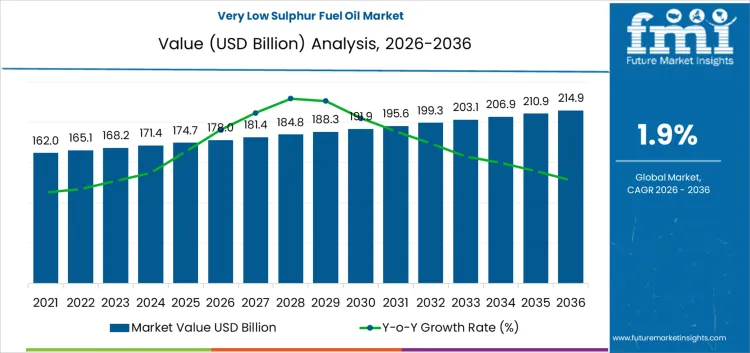
Very Low Sulphur Fuel Oil Market Key Takeaways
| Metric | Value |
|---|---|
| Market Value (2026) | USD 178.0 billion |
| Market Forecast Value (2036) | USD 214.9 billion |
| Forecast CAGR 2026 to 2036 | 1.9% |
Why is the Demand for Very Low Sulphur Fuel Oil Market Growing?
Demand for very low Sulphur fuel oil is rising as maritime operators adapt to stringent emission standards that require reduced Sulphur content in bunker fuels. Global shipping routes incorporate vessels that must meet sulfur oxide limitations to gain port access and avoid punitive charges. Refiners adjust crude processing configurations to produce fuels with lower Sulphur concentrations to support compliance. Cargo carriers prioritize fuel types that align with operational permits issued by regulatory bodies overseeing emission control areas. Industrial users with stationary combustion equipment specify very low Sulphur fuel oil to limit furnace corrosion and particulate formation that can shorten service intervals and increase maintenance workloads.
Refining industry planning reflects changes in product slates because producers seek markets for streams removed during hydrodesulfurization. Blending facilities and supply terminals expand capacity to handle specialized low Sulphur products and coordinate deliveries to meet varied demand across regions. Fuel traders adjust logistics to balance inventories that cater to power generation and shipping sectors sensitive to Sulphur limits. Analysts in energy markets monitor shifts in consumption patterns tied to global trade volumes and refinery utilization. Product testing and certification services ensure specification adherence prior to distribution.
How Are the Segments Classified in the Very Low Sulphur Fuel Oil Market?
Demand for very low sulphur fuel oil is shaped by mandatory sulphur emission limits governing marine fuel consumption and selected stationary combustion applications. Adoption reflects compliance requirements under international maritime regulations rather than discretionary fuel substitution. End-use classification aligns with sectors operating under enforceable sulphur thresholds, while grade differentiation reflects allowable sulphur limits under specific regulatory frameworks. Distribution segmentation reflects bunker supply logistics, refinery allocation strategies, and contract-based procurement practices that prioritize specification certainty and delivery reliability.
Which end use represents the largest share of demand?
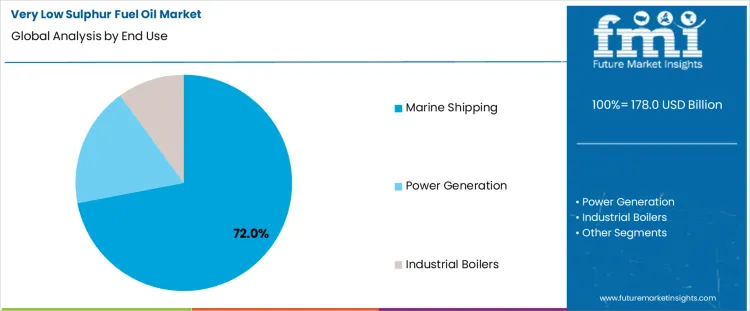
Marine shipping dominates the market, accounting for 72.0% of demand. Strict sulfur emission regulations, particularly under the IMO 2020 sulfur cap, have driven shipping companies to transition to very low Sulphur fuel oils. VLSFO enables compliance with these regulations while minimizing operational disruptions in global maritime transport. Marine shipping remains the dominant end use due to mandatory sulphur compliance requirements governing marine bunker fuel consumption, with vessels worldwide making the shift to lower Sulphur fuels to meet environmental standards.
Key Points
- Driven by regulatory compliance in the maritime sector
- Essential for reducing sulfur emissions in shipping
- Supports global shipping operations with minimal disruption
Which Sulphur content grade accounts for the highest share of demand?
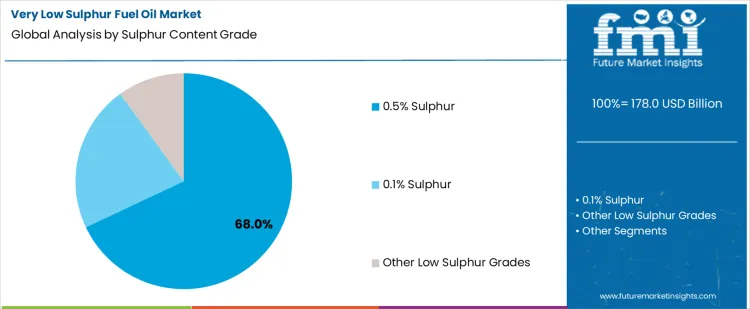
The 0.5% sulfur grade leads demand with a 68.0% share, due to its widespread use in marine shipping and power generation. The 0.5% sulfur grade offers a balance between regulatory compliance and cost efficiency, making it a preferred choice for many shipping operators and power plants. It is widely available and fits within most regulatory requirements while ensuring a cost-effective solution for fuel needs. This grade remains central due to regulatory acceptance and widespread compatibility with existing marine fuel systems.
Key Points
- Balances compliance with cost-efficiency in fuel procurement
- Widely adopted across marine and power generation sectors
- Meets international emission regulations while maintaining operational efficiency
Which distribution channel holds the highest share of demand?
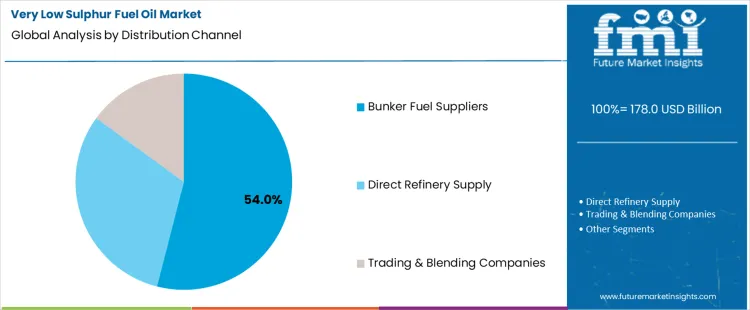
Bunker fuel suppliers capture the largest share of the distribution channel market, holding 54.0%. These suppliers provide fuel directly to ships at ports, offering VLSFO as a solution to meet regulatory sulfur emission caps. As shipping lines increasingly transition to lower Sulphur fuels, bunker fuel suppliers play a crucial role in ensuring fuel availability and compliance in maritime regions globally. Their infrastructure supports bulk deliveries, making them the main channel for VLSFO distribution to the marine shipping sector.
Key Points
- Primary fuel source for ships at ports worldwide
- Ensures compliance with sulfur emission regulations in marine transport
- Key player in the maritime fuel supply chain
What are the Key Dynamics in the very low Sulphur fuel oil market?
Demand dynamics in the very low sulphur fuel oil market reflect enforceable sulphur emission limits across marine, industrial, and power generation applications. Activity centers on compliance with IMO 2020 sulphur thresholds and regional emission control regimes. Value formation depends on sulphur content specification, fuel availability, and procurement cost stability. Purchasing decisions align with compliance assurance, supply reliability, and exposure to price volatility rather than discretionary fuel selection.
How Do Regulatory Compliance and Cost Structure Shape Adoption?
Adoption increases as shipping companies, power plants, and industrial users seek to comply with sulfur emission regulations, particularly the IMO 2020 sulfur cap that mandates a maximum of 0.5% sulfur content in marine fuels. Demand strengthens in the maritime industry, where shipowners and operators transition to very low Sulphur fuel oil to avoid penalties and maintain regulatory compliance. Industrial facilities and power generation units operating under sulphur limits contribute incremental demand where alternative fuels remain unavailable. The availability of compliant fuel, coupled with cost-effective pricing strategies, accelerates adoption, especially in regions with stringent emissions controls. Increasing interest in scrubbers as a compliance option further influences market dynamics, as some sectors balance between adopting low-sulfur fuels and installing scrubber technology.
How do fuel supply challenges and price volatility influence market scalability?
Market scalability faces constraints from supply chain challenges and price volatility associated with very low Sulphur fuel oil production. Demand encounters resistance where refineries face high production costs in processing low-sulfur fuels, impacting fuel price stability and affordability. Inconsistent supply across different regions complicates procurement strategies for large-scale fuel consumers, particularly in remote or offshore locations. Increased global demand and limited refining capacity raise concerns over supply chain resilience, which could lead to fuel shortages or distribution delays. Refining sector adjustments to meet global sulfur cap regulations add further pressure on production timelines. Pricing fluctuations driven by crude oil market dynamics and environmental policy changes further complicate long-term market expansion.
How Is Demand for Very Low Sulphur Fuel Oil Evolving Globally?
Demand for very low sulphur fuel oil is expanding globally due to maritime emission compliance, fleet fuel switching, and port-level enforcement of sulphur limits. Shipping operators rely on VLSFO to meet IMO 2020 requirements without installing exhaust gas scrubbers. Consumption aligns closely with bunker fuel demand, vessel traffic intensity, and trade route stability. Refinery blending capabilities and port bunker availability shape regional uptake. Growth rates in China at 2.6%, Singapore at 2.4%, South Korea at 2.1%, USA at 1.8%, and Japan at 1.6% indicate measured expansion driven by compliance-led fuel demand, fleet utilization patterns, and replacement of higher-sulphur marine fuels rather than shipping volume growth alone.
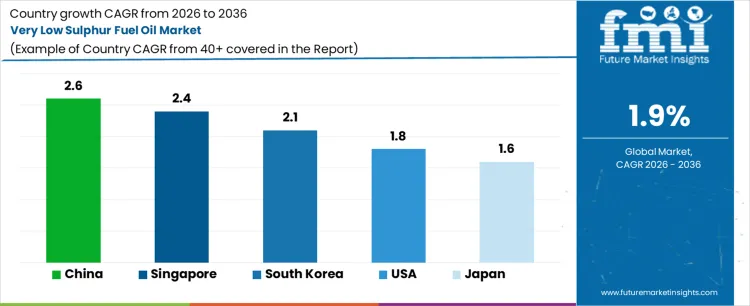
| Country | CAGR (%) |
|---|---|
| China | 2.6% |
| Singapore | 2.4% |
| South Korea | 2.1% |
| USA | 1.8% |
| Japan | 1.6% |
What Is Driving Incremental Growth of VLSFO Demand in China?
Demand for very low sulphur fuel oil in China is growing at a CAGR of 2.6%, supported by large-scale maritime trade and strict coastal emission controls. Major ports enforce sulphur compliance across domestic and international shipping lanes. Refinery upgrades enable consistent VLSFO blending to meet marine specifications. High container and bulk cargo throughput sustains bunker fuel consumption. Coastal emission control areas increase reliance on compliant fuels even for short-sea shipping. Growth reflects regulatory enforcement and port activity scale rather than rapid expansion of ocean-going fleet capacity.
- Extensive coastal emission control areas
- High bunker demand from major container ports
- Refinery blending capacity for compliant fuels
- Strong domestic and export shipping activity
Why Is Singapore Maintaining Steady Growth in VLSFO Consumption?
Very low sulphur fuel oil demand in Singapore is expanding at a CAGR of 2.4%, driven by its role as a global bunkering hub. High vessel call frequency sustains consistent fuel turnover. Ship operators favor VLSFO availability and quality assurance at major ports. Blending infrastructure and fuel testing standards support reliable supply. Demand aligns with transshipment volumes and fleet compliance strategies. Growth remains steady, reflecting hub-based bunker demand and service reliability rather than regional shipping expansion.
- Global bunkering hub with high vessel calls
- Strong fuel quality and testing standards
- Reliable blending and storage infrastructure
- Transshipment-driven bunker fuel demand
How Is South Korea Supporting Demand for Very Low Sulphur Fuel Oil?
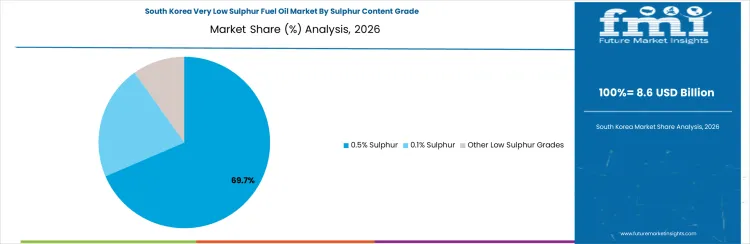
VLSFO demand in South Korea is growing at a CAGR of 2.1%, shaped by industrial port activity and compliance with international maritime standards. Shipbuilding, steel exports, and container traffic sustain marine fuel requirements. Ports serving energy and raw material imports rely on compliant bunker fuels. Refinery integration supports stable VLSFO supply. Fleet operators prioritize fuel switching over scrubber retrofits. Growth reflects trade-linked bunker consumption and regulatory adherence rather than acceleration in vessel traffic growth.
- Industrial export-driven port activity
- Compliance with international sulphur regulations
- Integrated refinery and bunker supply chains
- Preference for fuel switching over scrubbers
What Factors Are Influencing VLSFO Demand Growth in United States?
Very low sulphur fuel oil demand in the United States is expanding at a CAGR of 1.8%, supported by coastal shipping and international trade lanes. Emission control areas enforce low-sulphur fuel use near shorelines. Gulf Coast and West Coast ports sustain bunker demand for container and bulk vessels. Refinery configuration favors production of compliant marine fuels. Domestic shipping volumes remain stable. Growth reflects regulatory compliance and steady port operations rather than expansion of deep-sea shipping capacity.
- Emission control area enforcement near coastlines
- Stable container and bulk shipping volumes
- Refinery capability for compliant marine fuels
- Consistent bunker demand at major ports
Why Is Japan Showing Modest Expansion in VLSFO Demand?
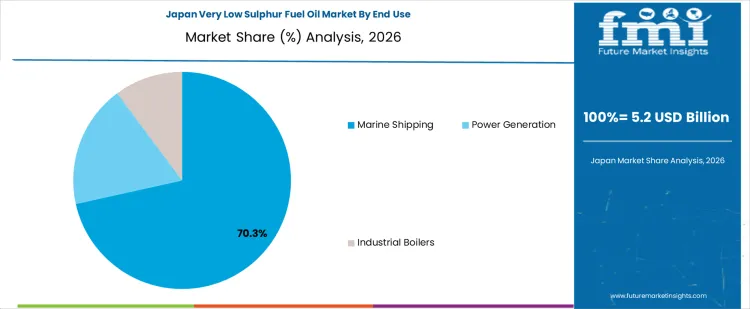
Demand for very low sulphur fuel oil in Japan is growing at a CAGR of 1.6%, driven by mature shipping operations and compliance-focused fuel usage. Major ports support energy imports and manufactured exports requiring compliant bunker fuels. Fleet modernization emphasizes efficiency and regulatory adherence. Limited growth in shipping volumes moderates fuel demand expansion. Refinery optimization ensures availability of low-sulphur blends. Growth remains modest, reflecting a mature maritime sector and stable trade flows rather than new route development.
- Mature shipping and port infrastructure
- Compliance-driven fuel consumption patterns
- Stable import and export shipping activity
- Refinery optimization for low-sulphur blends
What is the competitive landscape of demand for the very low Sulphur fuel oil market globally?
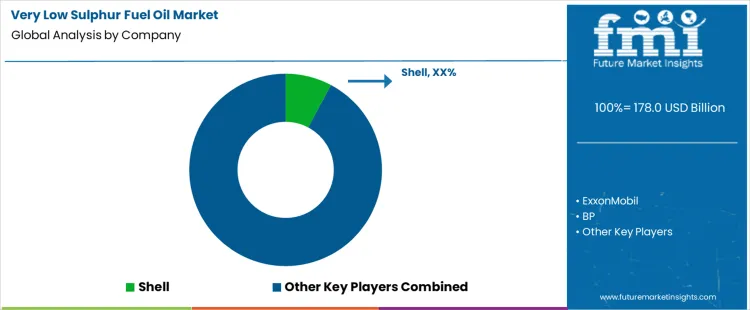
Demand for very low Sulphur fuel oil is driven by stringent sulphur emission regulations, including the IMO 2020 sulphur cap, and the shipping industry's need for compliant fuels. Buyers evaluate sulfur content, fuel stability, energy density, storage compatibility, and cost efficiency. Procurement behavior emphasizes supply reliability, adherence to global environmental standards, and stable pricing. Purchasing decisions prioritize the ability to meet regulatory deadlines, fuel quality consistency, and the capacity to support large fleets or industrial operations. Trend in the market reflects growing demand for low sulfur fuels in marine transportation and a shift towards alternative fuel sources like LNG and biofuels.
Shell leads competitive positioning through its extensive global refining capacity, robust supply chain infrastructure, and compliance expertise. ExxonMobil supports demand by providing high-quality low sulfur fuel options backed by large-scale production and distribution networks. BP competes by offering fuel oil solutions with strong market presence, focused on regulatory compliance and environmental standards. TotalEnergies maintains relevance by leveraging its refining capabilities and strategic partnerships to ensure consistent fuel supply. Sinopec participates with large-scale production capacity, serving both domestic and international markets. Competitive differentiation depends on supply chain security, fuel quality consistency, regulatory compliance, and pricing flexibility.
Key Players in the Very Low Sulphur Fuel Oil Market
- Shell
- ExxonMobil
- BP
- TotalEnergies
- Sinopec
Scope of the Report
| Items | Values |
|---|---|
| Quantitative Units | USD billion |
| End Use | Marine Shipping; Power Generation; Industrial Boilers |
| Sulphur Content Grade | 0.5% Sulphur; 0.1% Sulphur; Other Low Sulphur Grades |
| Distribution Channel | Bunker Fuel Suppliers; Direct Refinery Supply; Trading & Blending Companies |
| Regions Covered | Asia Pacific, Europe, North America, Latin America, Middle East & Africa |
| Countries Covered | China, Singapore, South Korea, USA, Japan, and 40+ countries |
| Key Companies Profiled | Shell; ExxonMobil; BP; TotalEnergies; Sinopec |
| Additional Attributes | Dollar sales by end use, Sulphur content grade, and distribution channel; fuel viscosity, sulfur content control, and combustion efficiency across marine, power generation, and industrial applications; regulatory compliance with IMO sulfur regulations; supply chain dynamics influenced by bunker fuel suppliers, direct refinery contracts, and trading companies; market growth influenced by global shipping regulations and industrial fuel consumption patterns. |
Very Low Sulphur Fuel Oil Market by Segment
End Use:
- Marine Shipping
- Power Generation
- Industrial Boilers
Sulphur Content Grade:
- 0.5% Sulphur
- 0.1% Sulphur
- Other Low Sulphur Grades
Distribution Channel:
- Bunker Fuel Suppliers
- Direct Refinery Supply
- Trading & Blending Companies
Region:
- Asia Pacific
- China
- Japan
- South Korea
- India
- Australia & New Zealand
- ASEAN
- Rest of Asia Pacific
- Europe
- Germany
- United Kingdom
- France
- Italy
- Spain
- Nordic
- BENELUX
- Rest of Europe
- North America
- United States
- Canada
- Mexico
- Latin America
- Brazil
- Chile
- Rest of Latin America
- Middle East & Africa
- Kingdom of Saudi Arabia
- Other GCC Countries
- Turkey
- South Africa
- Other African Union
- Rest of Middle East & Africa
Bibliography
- International Energy Agency. (2023). Oil 2023: Analysis and forecast to 2028. International Energy Agency.
- International Maritime Organization. (2019). 2019 guidelines for consistent implementation of the 0.50% sulphur limit under MARPOL Annex VI (Resolution MEPC.320(74)). Author.
- International Organization for Standardization. (2019). Petroleum products—Fuels (class F)—Considerations for fuel suppliers and users regarding marine fuel quality in view of the implementation of maximum 0.50% sulphur in 2020 (ISO/PAS 23263:2019). International Organization for Standardization.
Frequently Asked Questions
How big is the very low sulphur fuel oil market in 2026?
The global very low sulphur fuel oil market is estimated to be valued at USD 178.0 billion in 2026.
What will be the size of very low sulphur fuel oil market in 2036?
The market size for the very low sulphur fuel oil market is projected to reach USD 214.9 billion by 2036.
How much will be the very low sulphur fuel oil market growth between 2026 and 2036?
The very low sulphur fuel oil market is expected to grow at a 1.9% CAGR between 2026 and 2036.
What are the key product types in the very low sulphur fuel oil market?
The key product types in very low sulphur fuel oil market are marine shipping, power generation and industrial boilers.
Which sulphur content grade segment to contribute significant share in the very low sulphur fuel oil market in 2026?
In terms of sulphur content grade, 0.5% sulphur segment to command 68.0% share in the very low sulphur fuel oil market in 2026.
Preview the report firsthand - request a free sample
Get SampleGet the brochure for pricing and purchase details.
Get PDFTable of Content
- Executive Summary
- Global Market Outlook
- Demand-side Trends
- Supply-side Trends
- Technology Roadmap Analysis
- Analysis and Recommendations
- Market Overview
- Market Coverage / Taxonomy
- Market Definition / Scope / Limitations
- Market Background
- Market Dynamics
- Drivers
- Restraints
- Opportunity
- Trends
- Scenario Forecast
- Demand in Optimistic Scenario
- Demand in Likely Scenario
- Demand in Conservative Scenario
- Opportunity Map Analysis
- Product Life Cycle Analysis
- Supply Chain Analysis
- Investment Feasibility Matrix
- Value Chain Analysis
- PESTLE and Porter’s Analysis
- Regulatory Landscape
- Regional Parent Market Outlook
- Production and Consumption Statistics
- Import and Export Statistics
- Market Dynamics
- Global Market Analysis 2021 to 2025 and Forecast, 2026 to 2036
- Historical Market Size Value (USD Million) Analysis, 2021 to 2025
- Current and Future Market Size Value (USD Million) Projections, 2026 to 2036
- Y-o-Y Growth Trend Analysis
- Absolute $ Opportunity Analysis
- Global Market Pricing Analysis 2021 to 2025 and Forecast 2026 to 2036
- Global Market Analysis 2021 to 2025 and Forecast 2026 to 2036, By End Use
- Introduction / Key Findings
- Historical Market Size Value (USD Million) Analysis By End Use, 2021 to 2025
- Current and Future Market Size Value (USD Million) Analysis and Forecast By End Use, 2026 to 2036
- Marine Shipping
- Power Generation
- Industrial Boilers
- Marine Shipping
- Y-o-Y Growth Trend Analysis By End Use, 2021 to 2025
- Absolute $ Opportunity Analysis By End Use, 2026 to 2036
- Global Market Analysis 2021 to 2025 and Forecast 2026 to 2036, By Sulphur Content Grade
- Introduction / Key Findings
- Historical Market Size Value (USD Million) Analysis By Sulphur Content Grade, 2021 to 2025
- Current and Future Market Size Value (USD Million) Analysis and Forecast By Sulphur Content Grade, 2026 to 2036
- 0.5% Sulphur
- 0.1% Sulphur
- Other Low Sulphur Grades
- 0.5% Sulphur
- Y-o-Y Growth Trend Analysis By Sulphur Content Grade, 2021 to 2025
- Absolute $ Opportunity Analysis By Sulphur Content Grade, 2026 to 2036
- Global Market Analysis 2021 to 2025 and Forecast 2026 to 2036, By Distribution Channel
- Introduction / Key Findings
- Historical Market Size Value (USD Million) Analysis By Distribution Channel, 2021 to 2025
- Current and Future Market Size Value (USD Million) Analysis and Forecast By Distribution Channel, 2026 to 2036
- Bunker Fuel Suppliers
- Direct Refinery Supply
- Trading & Blending Companies
- Bunker Fuel Suppliers
- Y-o-Y Growth Trend Analysis By Distribution Channel, 2021 to 2025
- Absolute $ Opportunity Analysis By Distribution Channel, 2026 to 2036
- Global Market Analysis 2021 to 2025 and Forecast 2026 to 2036, By Region
- Introduction
- Historical Market Size Value (USD Million) Analysis By Region, 2021 to 2025
- Current Market Size Value (USD Million) Analysis and Forecast By Region, 2026 to 2036
- North America
- Latin America
- Western Europe
- Eastern Europe
- East Asia
- South Asia and Pacific
- Middle East & Africa
- Market Attractiveness Analysis By Region
- North America Market Analysis 2021 to 2025 and Forecast 2026 to 2036, By Country
- Historical Market Size Value (USD Million) Trend Analysis By Market Taxonomy, 2021 to 2025
- Market Size Value (USD Million) Forecast By Market Taxonomy, 2026 to 2036
- By Country
- USA
- Canada
- Mexico
- By End Use
- By Sulphur Content Grade
- By Distribution Channel
- By Country
- Market Attractiveness Analysis
- By Country
- By End Use
- By Sulphur Content Grade
- By Distribution Channel
- Key Takeaways
- Latin America Market Analysis 2021 to 2025 and Forecast 2026 to 2036, By Country
- Historical Market Size Value (USD Million) Trend Analysis By Market Taxonomy, 2021 to 2025
- Market Size Value (USD Million) Forecast By Market Taxonomy, 2026 to 2036
- By Country
- Brazil
- Chile
- Rest of Latin America
- By End Use
- By Sulphur Content Grade
- By Distribution Channel
- By Country
- Market Attractiveness Analysis
- By Country
- By End Use
- By Sulphur Content Grade
- By Distribution Channel
- Key Takeaways
- Western Europe Market Analysis 2021 to 2025 and Forecast 2026 to 2036, By Country
- Historical Market Size Value (USD Million) Trend Analysis By Market Taxonomy, 2021 to 2025
- Market Size Value (USD Million) Forecast By Market Taxonomy, 2026 to 2036
- By Country
- Germany
- UK
- Italy
- Spain
- France
- Nordic
- BENELUX
- Rest of Western Europe
- By End Use
- By Sulphur Content Grade
- By Distribution Channel
- By Country
- Market Attractiveness Analysis
- By Country
- By End Use
- By Sulphur Content Grade
- By Distribution Channel
- Key Takeaways
- Eastern Europe Market Analysis 2021 to 2025 and Forecast 2026 to 2036, By Country
- Historical Market Size Value (USD Million) Trend Analysis By Market Taxonomy, 2021 to 2025
- Market Size Value (USD Million) Forecast By Market Taxonomy, 2026 to 2036
- By Country
- Russia
- Poland
- Hungary
- Balkan & Baltic
- Rest of Eastern Europe
- By End Use
- By Sulphur Content Grade
- By Distribution Channel
- By Country
- Market Attractiveness Analysis
- By Country
- By End Use
- By Sulphur Content Grade
- By Distribution Channel
- Key Takeaways
- East Asia Market Analysis 2021 to 2025 and Forecast 2026 to 2036, By Country
- Historical Market Size Value (USD Million) Trend Analysis By Market Taxonomy, 2021 to 2025
- Market Size Value (USD Million) Forecast By Market Taxonomy, 2026 to 2036
- By Country
- China
- Japan
- South Korea
- By End Use
- By Sulphur Content Grade
- By Distribution Channel
- By Country
- Market Attractiveness Analysis
- By Country
- By End Use
- By Sulphur Content Grade
- By Distribution Channel
- Key Takeaways
- South Asia and Pacific Market Analysis 2021 to 2025 and Forecast 2026 to 2036, By Country
- Historical Market Size Value (USD Million) Trend Analysis By Market Taxonomy, 2021 to 2025
- Market Size Value (USD Million) Forecast By Market Taxonomy, 2026 to 2036
- By Country
- India
- ASEAN
- Australia & New Zealand
- Rest of South Asia and Pacific
- By End Use
- By Sulphur Content Grade
- By Distribution Channel
- By Country
- Market Attractiveness Analysis
- By Country
- By End Use
- By Sulphur Content Grade
- By Distribution Channel
- Key Takeaways
- Middle East & Africa Market Analysis 2021 to 2025 and Forecast 2026 to 2036, By Country
- Historical Market Size Value (USD Million) Trend Analysis By Market Taxonomy, 2021 to 2025
- Market Size Value (USD Million) Forecast By Market Taxonomy, 2026 to 2036
- By Country
- Kingdom of Saudi Arabia
- Other GCC Countries
- Turkiye
- South Africa
- Other African Union
- Rest of Middle East & Africa
- By End Use
- By Sulphur Content Grade
- By Distribution Channel
- By Country
- Market Attractiveness Analysis
- By Country
- By End Use
- By Sulphur Content Grade
- By Distribution Channel
- Key Takeaways
- Key Countries Market Analysis
- USA
- Pricing Analysis
- Market Share Analysis, 2025
- By End Use
- By Sulphur Content Grade
- By Distribution Channel
- Canada
- Pricing Analysis
- Market Share Analysis, 2025
- By End Use
- By Sulphur Content Grade
- By Distribution Channel
- Mexico
- Pricing Analysis
- Market Share Analysis, 2025
- By End Use
- By Sulphur Content Grade
- By Distribution Channel
- Brazil
- Pricing Analysis
- Market Share Analysis, 2025
- By End Use
- By Sulphur Content Grade
- By Distribution Channel
- Chile
- Pricing Analysis
- Market Share Analysis, 2025
- By End Use
- By Sulphur Content Grade
- By Distribution Channel
- Germany
- Pricing Analysis
- Market Share Analysis, 2025
- By End Use
- By Sulphur Content Grade
- By Distribution Channel
- UK
- Pricing Analysis
- Market Share Analysis, 2025
- By End Use
- By Sulphur Content Grade
- By Distribution Channel
- Italy
- Pricing Analysis
- Market Share Analysis, 2025
- By End Use
- By Sulphur Content Grade
- By Distribution Channel
- Spain
- Pricing Analysis
- Market Share Analysis, 2025
- By End Use
- By Sulphur Content Grade
- By Distribution Channel
- France
- Pricing Analysis
- Market Share Analysis, 2025
- By End Use
- By Sulphur Content Grade
- By Distribution Channel
- India
- Pricing Analysis
- Market Share Analysis, 2025
- By End Use
- By Sulphur Content Grade
- By Distribution Channel
- ASEAN
- Pricing Analysis
- Market Share Analysis, 2025
- By End Use
- By Sulphur Content Grade
- By Distribution Channel
- Australia & New Zealand
- Pricing Analysis
- Market Share Analysis, 2025
- By End Use
- By Sulphur Content Grade
- By Distribution Channel
- China
- Pricing Analysis
- Market Share Analysis, 2025
- By End Use
- By Sulphur Content Grade
- By Distribution Channel
- Japan
- Pricing Analysis
- Market Share Analysis, 2025
- By End Use
- By Sulphur Content Grade
- By Distribution Channel
- South Korea
- Pricing Analysis
- Market Share Analysis, 2025
- By End Use
- By Sulphur Content Grade
- By Distribution Channel
- Russia
- Pricing Analysis
- Market Share Analysis, 2025
- By End Use
- By Sulphur Content Grade
- By Distribution Channel
- Poland
- Pricing Analysis
- Market Share Analysis, 2025
- By End Use
- By Sulphur Content Grade
- By Distribution Channel
- Hungary
- Pricing Analysis
- Market Share Analysis, 2025
- By End Use
- By Sulphur Content Grade
- By Distribution Channel
- Kingdom of Saudi Arabia
- Pricing Analysis
- Market Share Analysis, 2025
- By End Use
- By Sulphur Content Grade
- By Distribution Channel
- Turkiye
- Pricing Analysis
- Market Share Analysis, 2025
- By End Use
- By Sulphur Content Grade
- By Distribution Channel
- South Africa
- Pricing Analysis
- Market Share Analysis, 2025
- By End Use
- By Sulphur Content Grade
- By Distribution Channel
- USA
- Market Structure Analysis
- Competition Dashboard
- Competition Benchmarking
- Market Share Analysis of Top Players
- By Regional
- By End Use
- By Sulphur Content Grade
- By Distribution Channel
- Competition Analysis
- Competition Deep Dive
- Shell
- Overview
- Product Portfolio
- Profitability by Market Segments (Product/Age /Sales Channel/Region)
- Sales Footprint
- Strategy Overview
- Marketing Strategy
- Product Strategy
- Channel Strategy
- ExxonMobil
- BP
- TotalEnergies
- Sinopec
- Shell
- Competition Deep Dive
- Assumptions & Acronyms Used
- Research Methodology


