

- Industry Size (2026)
- USD 60.61 Bn
- Forecast (2036)
- USD 94.13 Bn
- CAGR (2026 to 2036)
- 4.5%
Enhanced Oil Recovery Market Size, Market Forecast and Outlook By FMI

The enhanced oil recovery market was valued at USD 58.00 billion in 2025, projected to reach USD 60.61 billion in 2026, and is forecast to expand to USD 94.13 billion by 2036 at a 4.5% CAGR. Maturing conventional oil field production profiles and sustained global petroleum demand are compelling operators to deploy enhanced oil recovery techniques that extend reservoir productive life and increase ultimate recovery factors. As per FMI, the convergence of CO2 injection with carbon capture and storage mandates is creating a dual revenue stream where EOR operators receive both incremental oil production value and carbon sequestration credits, which is reshaping project economics across North American and European fields.
Summary of Enhanced Oil Recovery Market
- Market Overview
- The market is valued at USD 58.00 billion in 2025 and is projected to reach USD 94.13 billion by 2036.
- The industry is expected to grow at a 4.5% CAGR from 2026 to 2036, creating an incremental opportunity of USD 33.52 billion.
- The market is a petroleum technology services category where reservoir engineering expertise, EOR technology portfolio breadth, and carbon credit integration capability define competitive positioning.
- Demand and Growth Drivers
- Demand is driven by maturing conventional field production profiles that require enhanced recovery techniques to maintain output and delay field abandonment.
- CO2-EOR convergence with carbon capture and storage regulatory incentives is creating dual revenue streams that improve project economics beyond pure petroleum value.
- Heavy oil reservoir development using thermal injection techniques continues to expand in major producing regions where conventional recovery factors remain below 30%.
- Among countries, China (6.1% CAGR), India (5.6% CAGR), Germany (5.2% CAGR), France (4.7% CAGR), UK (4.3% CAGR), USA (3.8% CAGR), Brazil (3.4% CAGR).
- Product and Segment View
- Thermal Injection leads by Technology with 23.6% share in 2026.
- Onshore leads by Location of Deployment with 64.7% share in 2026.
- Geography and Competitive Outlook
- China and India are the fastest growing markets, while mature economies sustain demand through compliance, technology upgrade, and replacement procurement cycles.
- Key players include ExxonMobil Corporation, BP plc, China Petroleum & Chemical Corporation, Total SA, Royal Dutch Shell plc, Chevron Corporation, Petroleo Brasileiro S.A..
- Analyst Opinion at FMI
- Nikhil Kaitwade, Principal Consultant for Oil and Gas, opines,: 'In my analysis, I have observed that the enhanced oil recovery market is being reshaped by the convergence of CO2-EOR economics with carbon sequestration incentive programs. Operators who can structure EOR projects to capture both incremental production revenue and Section 45Q or EU ETS carbon credits are achieving project returns that pure petroleum economics cannot deliver, which is accelerating CO2-EOR investment in regions where carbon pricing mechanisms are active.'
- Strategic Implications / Executive Takeaways
- EOR operators must structure project economics to capture both incremental petroleum production revenue and carbon sequestration credits under applicable regulatory frameworks to maximize field development returns.
- Petroleum technology service companies should invest in chemical and microbial EOR capability to diversify beyond thermal and gas injection into growing technology segments where screening criteria are expanding.
- Reservoir engineering teams need to integrate carbon storage capacity assessment into EOR field screening workflows as dual-purpose CO2-EOR/CCS projects become the preferred development pathway in regulated jurisdictions.
Enhanced Oil Recovery Market Key Takeaways
| Metric | Details |
|---|---|
| Industry Size (2026) | USD 60.61 Billion |
| Industry Value (2036) | USD 94.13 Billion |
| CAGR (2026 to 2036) | 4.5% |
Source: Future Market Insights, 2026
The incremental opportunity of USD 33.52 billion between 2026 and 2036 reflects cumulative investment in mature field revitalization programs, expanding thermal injection deployments in heavy oil reservoirs, and growing chemical and microbial injection pilot programs transitioning to commercial scale. Thermal injection holds a 23.6% technology share because steam-based methods remain the primary technique for heavy oil extraction in major producing regions including California, Alberta, and Venezuela. Onshore deployments dominate with 64.7% location share because the majority of mature conventional fields requiring EOR intervention are land based, and onshore operations have lower capital thresholds than offshore EOR implementations.
All major regional markets reflect differentiated growth trajectories. China leads with a 6.1% CAGR, India follows at 5.6%, Germany follows at 5.2%, France follows at 4.7%, UK follows at 4.3%, USA follows at 3.8%, and Brazil registers 3.4% growth. China's lead growth rate reflects its national energy security strategy that prioritizes maximizing domestic conventional oil recovery. India's pace is supported by mature onshore field revitalization programs operated by state oil companies. Germany and France maintain growth through CO2-EOR pilot programs linked to European carbon capture and storage regulatory frameworks. The USA and Brazil contribute through shale-adjacent CO2 injection and deep-water pre-salt chemical injection programs respectively.
Enhanced Oil Recovery Market Definition
The enhanced oil recovery market encompasses technologies and services deployed to increase petroleum extraction beyond primary and secondary recovery phases. Technology categories include gas injection (CO2, nitrogen, hydrocarbon), thermal injection (steam, in-situ combustion), chemical injection (surfactant, polymer, alkaline), microbial injection, and other advanced techniques. Deployments occur in onshore and offshore reservoir environments to extend field productive life and raise ultimate recovery factors from mature conventional and unconventional reservoirs.
Enhanced Oil Recovery Market Inclusions
Market scope includes EOR technology equipment, chemical consumables, and operational services sold across all technology categories and deployment locations. Global and regional market sizes, technology and deployment location segment breakdowns, and forecast projections from 2026 to 2036 are covered.
Enhanced Oil Recovery Market Exclusions
The scope excludes primary and secondary (waterflooding) recovery operations, upstream exploration and appraisal drilling, midstream pipeline and transportation infrastructure, and carbon capture systems deployed exclusively for industrial emission reduction without EOR application.
Enhanced Oil Recovery Market Research Methodology
- Primary Research:Analysts engaged with reservoir engineering directors, EOR project managers, and petroleum technology service company executives to map technology selection criteria, field screening methodology, and project economics benchmarks.
- Desk Research:Data collection aggregated published petroleum production statistics, EOR project databases, carbon storage regulatory frameworks, and reservoir engineering conference proceedings.
- Market Sizing and Forecasting:Baseline values derive from a bottom up aggregation of enhanced oil recovery procurement volumes by segment, applying regional pricing benchmarks and adoption rates to project market growth.
- Data Validation and Update Cycle:Projections are tested against published manufacturer revenue disclosures, industry association statistics, and regulatory compliance adoption surveys.
Why is the Enhanced Oil Recovery Market Growing?
The enhanced oil recovery market is experiencing steady growth, driven by the increasing global demand for crude oil and the need to optimize production from mature oil fields. Investments in advanced recovery technologies are being prioritized to maximize output from existing reservoirs while reducing environmental impact. The market growth is being supported by rising oil prices, coupled with the economic feasibility of deploying advanced recovery methods that improve extraction efficiency.
Technological innovations such as gas injection, chemical flooding, and thermal recovery are enabling operators to extract hydrocarbons more effectively from challenging reservoirs. Growing emphasis on operational efficiency, sustainability, and reduction of greenhouse gas emissions is further influencing adoption of advanced recovery techniques. As onshore and offshore oil fields mature, the ability to implement cost-effective recovery technologies is being increasingly valued by energy companies.
In parallel, regulatory frameworks and government incentives in multiple regions are encouraging investments in enhanced recovery projects With rising global energy demand and continued focus on optimizing production from aging reservoirs, the enhanced oil recovery market is expected to sustain robust growth over the coming decade.
Segmental Analysis
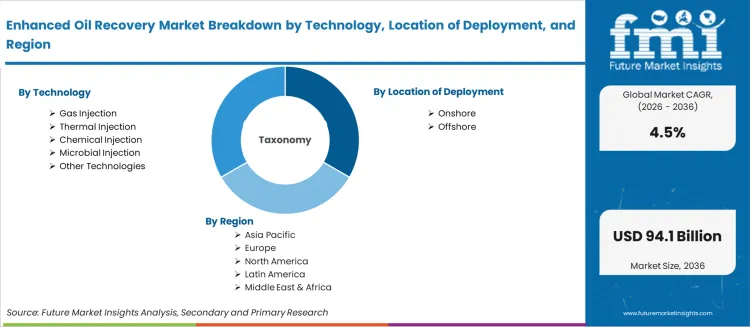
The enhanced oil recovery market is segmented by technology, location of deployment, and geographic regions. By technology, enhanced oil recovery market is divided into Gas Injection, Thermal Injection, Chemical Injection, Microbial Injection, and Other Technologies. In terms of location of deployment, enhanced oil recovery market is classified into Onshore and Offshore. Regionally, the enhanced oil recovery industry is classified into North America, Latin America, Western Europe, Eastern Europe, Balkan & Baltic Countries, Russia & Belarus, Central Asia, East Asia, South Asia & Pacific, and the Middle East & Africa.
Insights into the Gas Injection Technology Segment

The gas injection technology segment is projected to hold 22.8% of the enhanced oil recovery market revenue share in 2026, making it the leading technology type. This leadership is being supported by its proven ability to improve reservoir pressure and enhance hydrocarbon displacement efficiency, thereby increasing the overall recovery factor. Gas injection is favored for its adaptability to a wide range of reservoir conditions and its compatibility with both onshore and offshore fields.
Technological advancements have improved gas management, injection control, and monitoring systems, allowing for more precise recovery operations and reduced operational costs. The segment is also benefiting from the ability to utilize available gas resources efficiently, including natural gas and carbon dioxide, which can be captured and reinjected, contributing to sustainability objectives.
Continuous adoption in mature oil fields where primary and secondary recovery methods have reached their limits is further reinforcing the segment’s leadership The cost efficiency, scalability, and proven performance of gas injection methods are expected to sustain their prominence in enhanced oil recovery initiatives globally.
Insights into the Onshore Location of Deployment Segment

The onshore segment is anticipated to account for 64.7% of the enhanced oil recovery market revenue share in 2026, establishing it as the dominant deployment location. This leadership is being driven by the relative ease of access, lower operational complexity, and reduced logistical costs associated with onshore fields compared to offshore operations. Onshore deployments benefit from established infrastructure, including pipelines, processing facilities, and storage systems, which support efficient and cost-effective implementation of advanced recovery technologies such as gas injection.
The segment is also being bolstered by the high prevalence of mature onshore fields in regions such as North America, the Middle East, and parts of Asia-Pacific, where enhanced recovery techniques are essential to sustain production levels. Regulatory and safety considerations are typically less complex than offshore operations, enabling faster deployment and monitoring of recovery projects.
Additionally, technological integration for reservoir management, monitoring, and injection control is more readily achievable in onshore settings, further enhancing operational efficiency The combination of accessibility, cost advantages, and established infrastructure ensures that onshore locations continue to dominate the enhanced oil recovery market.
Analysis of Enhanced Oil Recovery Market By Key Countries
.webp "Top Country Growth Comparison Enhanced Oil Recovery Market Cagr (2026 2036)")
| Country | CAGR |
|---|---|
| China | 6.1% |
| India | 5.6% |
| Germany | 5.2% |
| France | 4.7% |
| UK | 4.3% |
| USA | 3.8% |
| Brazil | 3.4% |

Country-wise Analysis
The Enhanced Oil Recovery Market is expected to register a CAGR of 4.5% during the forecast period, exhibiting varied country level momentum. China leads with the highest CAGR of 6.1%, followed by India at 5.6%. Developed markets such as Germany, France, and the UK continue to expand steadily, while the USA is likely to grow at consistent rates. Brazil posts the lowest CAGR at 3.4%, yet still underscores a broadly positive trajectory for the global Enhanced Oil Recovery Market. In 2024, Germany held a dominant revenue in the Western Europe market and is expected to grow with a CAGR of 5.2%. The USA Enhanced Oil Recovery Market is estimated to be valued at USD 19.9 billion in 2026 and is anticipated to reach a valuation of USD 29.0 billion by 2036. Sales are projected to rise at a CAGR of 3.8% over the forecast period between 2026 and 2036. While Japan and South Korea markets are estimated to be valued at USD 3.2 billion and USD 2.0 billion respectively in 2026.
Key Players in the Enhanced Oil Recovery Market

- ExxonMobil Corporation
- BP plc
- China Petroleum & Chemical Corporation
- Total SA
- Royal Dutch Shell plc
- Chevron Corporation
- Petróleo Brasileiro S.A.
- LUKOIL
- Cenovus Energy, Inc.
- Equinor ASA
Scope of the Report
| Metric | Value |
|---|---|
| Quantitative Units | USD 60.61 Billion to USD 94.13 Billion, at a CAGR of 4.5% |
| Market Definition | The enhanced oil recovery market encompasses technologies and services deployed to increase petroleum extraction beyond primary and secondary recovery phases. Technology categories include gas injecti... |
| Segmentation | Technology: Gas Injection, Thermal Injection, Chemical Injection, Microbial Injection, Other Technologies; Location of Deployment: Onshore, Offshore |
| Regions Covered | North America, Latin America, Europe, East Asia, South Asia, Oceania, Middle East & Africa |
| Countries Covered | China, India, Germany, France, UK, USA, Brazil, and 40 plus countries |
| Key Companies Profiled | ExxonMobil Corporation, BP plc, China Petroleum & Chemical Corporation, Total SA, Royal Dutch Shell plc, Chevron Corporation, Petroleo Brasileiro S.A., LUKOIL, Cenovus Energy, Inc., Equinor ASA |
| Forecast Period | 2026 to 2036 |
| Approach | Hybrid bottom up methodology combining primary research, supply chain analysis, and proprietary forecasting models. |
Enhanced Oil Recovery Market by Segments
Technology:
- Gas Injection
- Thermal Injection
- Chemical Injection
- Microbial Injection
- Other Technologies
Location of Deployment:
- Onshore
- Offshore
Region:
- North America
- USA
- Canada
- Mexico
- Latin America
- Brazil
- Chile
- Rest of Latin America
- Western Europe
- Germany
- UK
- Italy
- Spain
- France
- Nordic
- BENELUX
- Rest of Western Europe
- Eastern Europe
- Russia
- Poland
- Hungary
- Balkan & Baltic
- Rest of Eastern Europe
- East Asia
- China
- Japan
- South Korea
- South Asia and Pacific
- India
- ASEAN
- Australia & New Zealand
- Rest of South Asia and Pacific
- Middle East & Africa
- Kingdom of Saudi Arabia
- Other GCC Countries
- Turkiye
- South Africa
- Other African Union
- Rest of Middle East & Africa
Bibliography
- 1. International Energy Agency. (2025). World energy outlook 2025: Oil supply and enhanced recovery. IEA.
- 2. USA Department of Energy. (2024). Enhanced oil recovery: Technology and project status report. DOE.
- 3. Society of Petroleum Engineers. (2024). EOR technology review: Global implementation survey. SPE.
- 4. ExxonMobil Corporation. (2025). Annual report 2024: Upstream technology and enhanced recovery. ExxonMobil.
- 5. European Commission. (2024). Carbon capture, utilization and storage: Regulatory framework update. European Commission.
- 6. Organisation for Economic Co-operation and Development. (2024). Oil market report: Supply-side analysis. OECD.
This bibliography is provided for reader reference. The full Future Market Insights report contains the complete reference list with primary research documentation.
Frequently Asked Questions
How large is the demand for Enhanced Oil Recovery in the global market in 2026?
Demand for Enhanced Oil Recovery in the global market is estimated to be valued at USD 60.61 billion in 2026.
What will be the market size of Enhanced Oil Recovery by 2036?
Market size for Enhanced Oil Recovery is projected to reach USD 94.13 billion by 2036.
What is the expected demand growth between 2026 and 2036?
Demand for Enhanced Oil Recovery is expected to grow at a CAGR of 4.5% between 2026 and 2036.
Which Technology is poised to lead global sales by 2026?
Thermal Injection accounts for 23.6% share in 2026.
How significant is Onshore in driving adoption in 2026?
Onshore represents 64.7% of segment share in 2026.
What is driving demand in China?
China leads with a 6.1% CAGR through 2036.
What is Enhanced Oil Recovery and what is it mainly used for?
The enhanced oil recovery market encompasses technologies and services deployed to increase petroleum extraction beyond primary and secondary recovery phases. Technology categories include gas injecti.
What is included in the scope of this report?
Market scope includes EOR technology equipment, chemical consumables, and operational services sold across all technology categories and deployment locations. Global and regional market sizes, technology and deployment location segment breakdowns, and forecast projections from 2026 to 2036 are covered.
Preview the report firsthand - request a free sample
Get SampleGet the brochure for pricing and purchase details.
Get PDFTable of Content
- Executive Summary
- Global Market Outlook
- Demand-side Trends
- Supply-side Trends
- Technology Roadmap Analysis
- Analysis and Recommendations
- Market Overview
- Market Coverage / Taxonomy
- Market Definition / Scope / Limitations
- Research Methodology
- Chapter Orientation
- Analytical Lens and Working Hypotheses
- Market Structure, Signals, and Trend Drivers
- Benchmarking and Cross-market Comparability
- Market Sizing, Forecasting, and Opportunity Mapping
- Research Design and Evidence Framework
- Desk Research Programme (Secondary Evidence)
- Company Annual and Sustainability Reports
- Peer-reviewed Journals and Academic Literature
- Corporate Websites, Product Literature, and Technical Notes
- Earnings Decks and Investor Briefings
- Statutory Filings and Regulatory Disclosures
- Technical White Papers and Standards Notes
- Trade Journals, Industry Magazines, and Analyst Briefs
- Conference Proceedings, Webinars, and Seminar Materials
- Government Statistics Portals and Public Data Releases
- Press Releases and Reputable Media Coverage
- Specialist Newsletters and Curated Briefings
- Sector Databases and Reference Repositories
- FMI Internal Proprietary Databases and Historical Market Datasets
- Subscription Datasets and Paid Sources
- Social Channels, Communities, and Digital Listening Inputs
- Additional Desk Sources
- Expert Input and Fieldwork (Primary Evidence)
- Primary Modes
- Qualitative Interviews and Expert Elicitation
- Quantitative Surveys and Structured Data Capture
- Blended Approach
- Why Primary Evidence is Used
- Field Techniques
- Interviews
- Surveys
- Focus Groups
- Observational and In-context Research
- Social and Community Interactions
- Stakeholder Universe Engaged
- C-suite Leaders
- Board Members
- Presidents and Vice Presidents
- R&D and Innovation Heads
- Technical Specialists
- Domain Subject-matter Experts
- Scientists
- Physicians and Other Healthcare Professionals
- Governance, Ethics, and Data Stewardship
- Research Ethics
- Data Integrity and Handling
- Primary Modes
- Tooling, Models, and Reference Databases
- Desk Research Programme (Secondary Evidence)
- Data Engineering and Model Build
- Data Acquisition and Ingestion
- Cleaning, Normalisation, and Verification
- Synthesis, Triangulation, and Analysis
- Quality Assurance and Audit Trail
- Market Background
- Market Dynamics
- Drivers
- Restraints
- Opportunity
- Trends
- Scenario Forecast
- Demand in Optimistic Scenario
- Demand in Likely Scenario
- Demand in Conservative Scenario
- Opportunity Map Analysis
- Product Life Cycle Analysis
- Supply Chain Analysis
- Investment Feasibility Matrix
- Value Chain Analysis
- PESTLE and Porter’s Analysis
- Regulatory Landscape
- Regional Parent Market Outlook
- Production and Consumption Statistics
- Import and Export Statistics
- Market Dynamics
- Global Market Analysis 2021 to 2025 and Forecast, 2026 to 2036
- Historical Market Size Value (USD Million) Analysis, 2021 to 2025
- Current and Future Market Size Value (USD Million) Projections, 2026 to 2036
- Y-o-Y Growth Trend Analysis
- Absolute $ Opportunity Analysis
- Global Market Pricing Analysis 2021 to 2025 and Forecast 2026 to 2036
- Global Market Analysis 2021 to 2025 and Forecast 2026 to 2036, By Technology
- Introduction / Key Findings
- Historical Market Size Value (USD Million) Analysis By Technology , 2021 to 2025
- Current and Future Market Size Value (USD Million) Analysis and Forecast By Technology , 2026 to 2036
- Gas Injection
- Thermal Injection
- Chemical Injection
- Microbial Injection
- Other Technologies
- Gas Injection
- Y-o-Y Growth Trend Analysis By Technology , 2021 to 2025
- Absolute $ Opportunity Analysis By Technology , 2026 to 2036
- Global Market Analysis 2021 to 2025 and Forecast 2026 to 2036, By Location of Deployment
- Introduction / Key Findings
- Historical Market Size Value (USD Million) Analysis By Location of Deployment, 2021 to 2025
- Current and Future Market Size Value (USD Million) Analysis and Forecast By Location of Deployment, 2026 to 2036
- Onshore
- Offshore
- Onshore
- Y-o-Y Growth Trend Analysis By Location of Deployment, 2021 to 2025
- Absolute $ Opportunity Analysis By Location of Deployment, 2026 to 2036
- Global Market Analysis 2021 to 2025 and Forecast 2026 to 2036, By Region
- Introduction
- Historical Market Size Value (USD Million) Analysis By Region, 2021 to 2025
- Current Market Size Value (USD Million) Analysis and Forecast By Region, 2026 to 2036
- North America
- Latin America
- Western Europe
- Eastern Europe
- East Asia
- South Asia and Pacific
- Middle East & Africa
- Market Attractiveness Analysis By Region
- North America Market Analysis 2021 to 2025 and Forecast 2026 to 2036, By Country
- Historical Market Size Value (USD Million) Trend Analysis By Market Taxonomy, 2021 to 2025
- Market Size Value (USD Million) Forecast By Market Taxonomy, 2026 to 2036
- By Country
- USA
- Canada
- Mexico
- By Technology
- By Location of Deployment
- By Country
- Market Attractiveness Analysis
- By Country
- By Technology
- By Location of Deployment
- Key Takeaways
- Latin America Market Analysis 2021 to 2025 and Forecast 2026 to 2036, By Country
- Historical Market Size Value (USD Million) Trend Analysis By Market Taxonomy, 2021 to 2025
- Market Size Value (USD Million) Forecast By Market Taxonomy, 2026 to 2036
- By Country
- Brazil
- Chile
- Rest of Latin America
- By Technology
- By Location of Deployment
- By Country
- Market Attractiveness Analysis
- By Country
- By Technology
- By Location of Deployment
- Key Takeaways
- Western Europe Market Analysis 2021 to 2025 and Forecast 2026 to 2036, By Country
- Historical Market Size Value (USD Million) Trend Analysis By Market Taxonomy, 2021 to 2025
- Market Size Value (USD Million) Forecast By Market Taxonomy, 2026 to 2036
- By Country
- Germany
- UK
- Italy
- Spain
- France
- Nordic
- BENELUX
- Rest of Western Europe
- By Technology
- By Location of Deployment
- By Country
- Market Attractiveness Analysis
- By Country
- By Technology
- By Location of Deployment
- Key Takeaways
- Eastern Europe Market Analysis 2021 to 2025 and Forecast 2026 to 2036, By Country
- Historical Market Size Value (USD Million) Trend Analysis By Market Taxonomy, 2021 to 2025
- Market Size Value (USD Million) Forecast By Market Taxonomy, 2026 to 2036
- By Country
- Russia
- Poland
- Hungary
- Balkan & Baltic
- Rest of Eastern Europe
- By Technology
- By Location of Deployment
- By Country
- Market Attractiveness Analysis
- By Country
- By Technology
- By Location of Deployment
- Key Takeaways
- East Asia Market Analysis 2021 to 2025 and Forecast 2026 to 2036, By Country
- Historical Market Size Value (USD Million) Trend Analysis By Market Taxonomy, 2021 to 2025
- Market Size Value (USD Million) Forecast By Market Taxonomy, 2026 to 2036
- By Country
- China
- Japan
- South Korea
- By Technology
- By Location of Deployment
- By Country
- Market Attractiveness Analysis
- By Country
- By Technology
- By Location of Deployment
- Key Takeaways
- South Asia and Pacific Market Analysis 2021 to 2025 and Forecast 2026 to 2036, By Country
- Historical Market Size Value (USD Million) Trend Analysis By Market Taxonomy, 2021 to 2025
- Market Size Value (USD Million) Forecast By Market Taxonomy, 2026 to 2036
- By Country
- India
- ASEAN
- Australia & New Zealand
- Rest of South Asia and Pacific
- By Technology
- By Location of Deployment
- By Country
- Market Attractiveness Analysis
- By Country
- By Technology
- By Location of Deployment
- Key Takeaways
- Middle East & Africa Market Analysis 2021 to 2025 and Forecast 2026 to 2036, By Country
- Historical Market Size Value (USD Million) Trend Analysis By Market Taxonomy, 2021 to 2025
- Market Size Value (USD Million) Forecast By Market Taxonomy, 2026 to 2036
- By Country
- Kingdom of Saudi Arabia
- Other GCC Countries
- Turkiye
- South Africa
- Other African Union
- Rest of Middle East & Africa
- By Technology
- By Location of Deployment
- By Country
- Market Attractiveness Analysis
- By Country
- By Technology
- By Location of Deployment
- Key Takeaways
- Key Countries Market Analysis
- USA
- Pricing Analysis
- Market Share Analysis, 2025
- By Technology
- By Location of Deployment
- Canada
- Pricing Analysis
- Market Share Analysis, 2025
- By Technology
- By Location of Deployment
- Mexico
- Pricing Analysis
- Market Share Analysis, 2025
- By Technology
- By Location of Deployment
- Brazil
- Pricing Analysis
- Market Share Analysis, 2025
- By Technology
- By Location of Deployment
- Chile
- Pricing Analysis
- Market Share Analysis, 2025
- By Technology
- By Location of Deployment
- Germany
- Pricing Analysis
- Market Share Analysis, 2025
- By Technology
- By Location of Deployment
- UK
- Pricing Analysis
- Market Share Analysis, 2025
- By Technology
- By Location of Deployment
- Italy
- Pricing Analysis
- Market Share Analysis, 2025
- By Technology
- By Location of Deployment
- Spain
- Pricing Analysis
- Market Share Analysis, 2025
- By Technology
- By Location of Deployment
- France
- Pricing Analysis
- Market Share Analysis, 2025
- By Technology
- By Location of Deployment
- India
- Pricing Analysis
- Market Share Analysis, 2025
- By Technology
- By Location of Deployment
- ASEAN
- Pricing Analysis
- Market Share Analysis, 2025
- By Technology
- By Location of Deployment
- Australia & New Zealand
- Pricing Analysis
- Market Share Analysis, 2025
- By Technology
- By Location of Deployment
- China
- Pricing Analysis
- Market Share Analysis, 2025
- By Technology
- By Location of Deployment
- Japan
- Pricing Analysis
- Market Share Analysis, 2025
- By Technology
- By Location of Deployment
- South Korea
- Pricing Analysis
- Market Share Analysis, 2025
- By Technology
- By Location of Deployment
- Russia
- Pricing Analysis
- Market Share Analysis, 2025
- By Technology
- By Location of Deployment
- Poland
- Pricing Analysis
- Market Share Analysis, 2025
- By Technology
- By Location of Deployment
- Hungary
- Pricing Analysis
- Market Share Analysis, 2025
- By Technology
- By Location of Deployment
- Kingdom of Saudi Arabia
- Pricing Analysis
- Market Share Analysis, 2025
- By Technology
- By Location of Deployment
- Turkiye
- Pricing Analysis
- Market Share Analysis, 2025
- By Technology
- By Location of Deployment
- South Africa
- Pricing Analysis
- Market Share Analysis, 2025
- By Technology
- By Location of Deployment
- USA
- Market Structure Analysis
- Competition Dashboard
- Competition Benchmarking
- Market Share Analysis of Top Players
- By Regional
- By Technology
- By Location of Deployment
- Competition Analysis
- Competition Deep Dive
- ExxonMobil Corporation
- Overview
- Product Portfolio
- Profitability by Market Segments (Product/Age /Sales Channel/Region)
- Sales Footprint
- Strategy Overview
- Marketing Strategy
- Product Strategy
- Channel Strategy
- BP plc
- China Petroleum & Chemical Corporation
- Total SA
- Royal Dutch Shell plc
- Chevron Corporation
- Petróleo Brasileiro S.A.
- LUKOIL
- Cenovus Energy, Inc.
- Equinor ASA
- ExxonMobil Corporation
- Competition Deep Dive
- Assumptions & Acronyms Used


