

- Market Size (2026)
- USD 999.9 Mn
- Forecast (2036)
- USD 1660.0 Mn
- CAGR (2026 to 2036)
- 5.2%
How big is Mud Motor Rotors Market in 2026?
USD 999.9 million in 2026 and USD 1660.0 million by 2036 at a 5.2% CAGR.
Demand for mud motor rotors is projected to expand at 5.2% CAGR between 2026 and 2036, increasing valuation from USD 999.9 million in 2026 to USD 1660.0 million by 2036. Longer horizontal sections keep positive-displacement motors circulating for more hours, increasing rotor-stator run-life requirements and the cost of a mismatch. The period adds USD 660.1 million. In August 2026, the USA Energy Information Administration recorded an average 2025 Permian lateral length of 10,867 feet.
Country demand follows drilling programs instead of one global specification for all buyers. Brazilian orders carry greater offshore qualification exposure than USA land-based horizontal work with dense repair coverage. EPE's 2026 national energy balance recorded 97.6% of Brazilian oil production from maritime fields. Offshore concentration raises qualified-component value since retrieval logistics and rig time make an avoidable motor trip expensive.
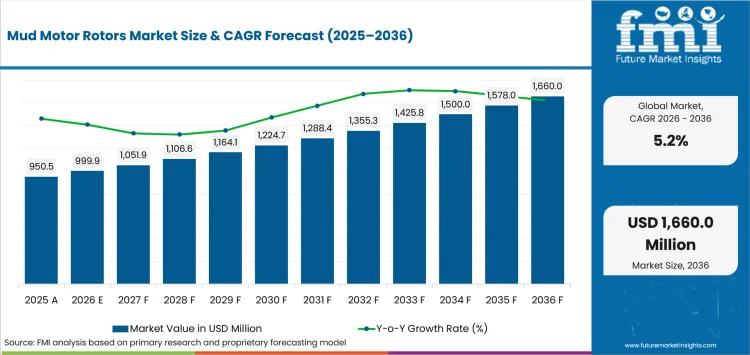
Key Takeaways
- Longer horizontal and directional sections increase rotor run-life requirements as each motor must retain torque and sealing performance for more circulating hours.
- By rotor type, standard mud motor rotors are estimated to hold 31.0% in 2026 owing to compatibility with established power-section and repair practices.
- By motor size, the 4.75-6.75 inch category is forecast to represent 36.0% in 2026 since it fits common directional and horizontal hole programs.
- Chrome plated rotors are projected to hold 39.0% of coating demand in 2026 owing to familiar machining and refurbishment practices.
- Abrasive solids, aggressive drilling fluids and rotor-stator mismatch can shorten coating life and weaken the economics of a lower-priced replacement.
- Some of the key players in this market include NOV, Baker Hughes, Halliburton, SLB, Weatherford, Patterson-UTI Energy, Inc., Nabors Industries Ltd., KLX Energy Services Holdings, Inc., PHX Energy Services Corp., and Scientific Drilling International.
Analyst Perspective
"Rotor economics turn on footage per run, rotor-stator fit and the repair path attached to each power section. A lower purchase price loses its advantage if coating wear or elastomer mismatch forces an avoidable trip before the planned interval is finished."
- Nikhil Kaitwade, Principal Consultant, Future Market Insights
How is the mud motor rotors market segmented?
The mud motor rotors market is segmented by rotor type, motor size, coating, end use and sales channel.
Rotor type covers standard, even-wall, high-torque, hard-coated and custom lobe rotors, while motor size spans four bands from below 4.75 inch to above 8 inch. Coating includes chrome plated, tungsten carbide coated, nitrided and elastomer-compatible surfaces, while end use covers onshore, offshore, directional and horizontal drilling. Sales channels include drilling tool OEMs, directional service companies, aftermarket refurbishment and machine shops.
How does chrome plated retain the leading coating position?
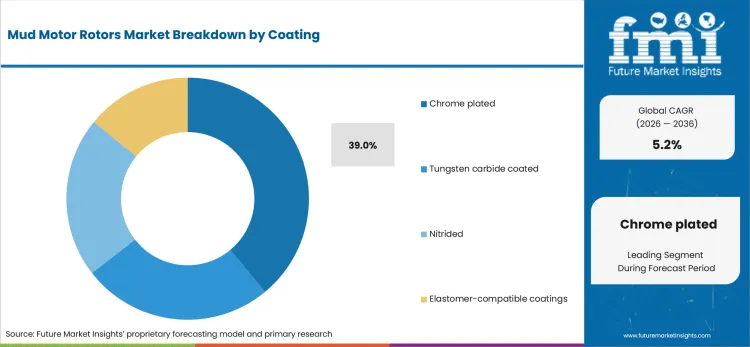
Chrome plated rotors fit familiar grinding and refurbishment routes, but the surface must retain integrity against abrasive solids and aggressive fluids. Alternatives gain ground if corrosion or severe wear changes expected run-life economics.
- By coating, chrome plated rotors are forecast to represent 39.0% of demand in 2026 due to familiar machining practices and a large installed repair base.
- In February 2025, ECHA opened consultations on chromium trioxide authorization applications covering hard and functional chrome plating. The process keeps compliance and surface-treatment qualification inside the purchasing decision for chrome-based rotor routes.
What makes standard mud motor rotors central to the rotor type category?
Standard rotors suit fleets that prioritize interchangeable power sections and predictable rebuild practice instead of maximum output for every well. Their commercial advantage comes from fitting familiar inspection, grinding and stator-matching routines in service.
- By rotor type, standard mud motor rotors are estimated to hold 31.0% in 2026 owing to broad compatibility with established positive-displacement motor architectures.
- Patterson-UTI Energy's 2025 Form 10-K, filed in February 2026, documents proprietary downhole motors. The owned fleet keeps conventional rotor-stator configurations relevant for routine replacement and service.
Why does 4.75-6.75 inch lead the motor size category?
The 4.75-6.75 inch range covers a large share of production-hole work without moving into slimhole tools or larger top-hole assemblies. Motor engineers can vary lobe count and stage length within this envelope and retain familiar BHA interfaces.
- In 2026, the 4.75-6.75 inch category is expected to lead motor size with 36.0% share given its fit with common horizontal and directional drilling programs.
- PHX Energy's February 2026 results put its Atlas fleet at about 915 motors, with several sizes inside this band. Fleet breadth keeps matched replacement inventory practical in North American service hubs.
What supports onshore drilling as the leading end use?
Onshore programs generate repeated motor runs within serviceable basin networks, which turns inspection and rebuild speed into a purchasing factor. Long shale laterals also keep the power section under load for extended periods.
- Onshore drilling is projected to hold 38.0% of end-use demand in 2026 owing to large horizontal programs and frequent motor refurbishment cycles.
- The Railroad Commission of Texas issued 750 original drilling permits in June 2026. Continued well starts sustain rotor demand, and basin service density lets operators return worn power sections to repair facilities without offshore logistics.
Why do drilling tool OEMs lead the sales channel category?
Drilling tool OEMs control where rotor geometry is matched with the stator, transmission and motor assembly. That role captures first-fit demand and gives the channel responsibility for power-section performance ahead of deployment.
- Drilling tool OEMs are set to lead the sales channel with 39.0% share in 2026 due to matched rotor-stator engineering being specified with the complete motor architecture.
- NOV reported in July 2025 that a MONZA 40 motor with a 7-inch ERT power section drilled 5,200 feet in 22.5 hours. The field result ties component choice directly to an integrated BHA performance target.
What are the drivers, restraints and opportunities in the Mud Motor Rotors Market?
Longer laterals raise rotor run-life requirements, torsional loading increases failure exposure, and regional repair capacity improves the economics of qualified replacement power sections.
- Driver: Extended horizontal intervals increase circulating hours and make torque retention over a complete section more valuable.
- Restraint: Torsional vibration, abrasive fluids and surface damage can shorten motor life before the planned interval is finished.
- Opportunity: Integrated motor repair and regional refurbishment can reduce turnaround time without sacrificing matched rotor-stator performance.
Longer laterals raise power-section run-life requirements
Long shale intervals keep one motor under load for more hours and raise the cost of an avoidable trip. In April 2025, NOV reported an ERT-powered motor completed a 5.7-mile single-bit section during a high-output drilling campaign. Rotor qualification therefore shifts toward profiles that retain torque and sealing through the planned fluid system for the complete interval.
Downhole vibration raises failure exposure
Torsional loading can damage a BHA even if the rotor surface meets dimensional requirements. Baker Hughes launched GuardVibe in June 2025 after field work exceeding 350 drilling runs targeted high-frequency torsional oscillation. Qualification therefore extends beyond coating hardness to motor assemblies that tolerate sustained vibration without sacrificing run life or steering response.
Regional repair capacity improves replacement economics
Repair access becomes commercially important once a motor fleet cycles components through inspection and rebuild. KLX Energy Services stated in its 2025 Form 10-K that it operated more than 60 service facilities and maintained K-series mud motors with in-house repair capability. Regional capacity can shorten fleet downtime and keep matched replacement parts under the same refurbishment controls.
Which country CAGRs are profiled in the Mud Motor Rotors Market?
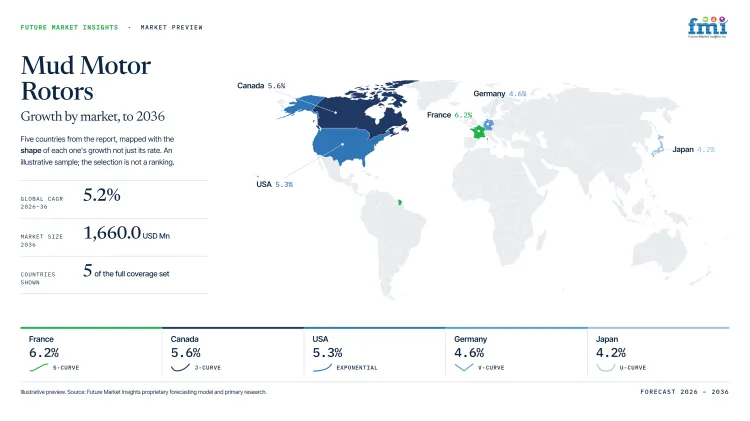
| Country | CAGR |
|---|---|
| France | 6.2% |
| Brazil | 5.9% |
| Canada | 5.6% |
| USA | 5.3% |
| Italy | 4.9% |
| Germany | 4.6% |
| Japan | 4.2% |
How do country-level CAGRs compare in the Mud Motor Rotors Market?
The 2.0-point spread separates three operating models within the seven profiled countries. France, Brazil and Canada sit above 5.5%, though geothermal projects, offshore campaigns and horizontal fleet turnover produce different purchasing cycles. The USA and Italy form the middle band, whereas Germany and Japan depend more heavily on project-led geothermal drilling.
- France converts geothermal tenders after drilling schedules firm.
- Brazil needs stocked power sections for offshore campaigns.
- Canada turns basin density into faster refurbishment cycles.
- The USA prices rotor value against footage per run.
- Italy converts permits into project-batched equipment orders.
- Germany relies on deep-geothermal project conversion and reliability.
- Japan depends more on specialist geothermal execution capacity.
Service coverage and project timing make similar CAGRs produce different order conditions. The full report uses North America, Latin America, Western Europe, Eastern Europe, East Asia, South Asia and Pacific, and Middle East and Africa.
Country-wise Analysis
- French geothermal rotor orders depend on well designs that tolerate high temperature and uncertain reservoir behavior ahead of a firm drilling schedule. BRGM's May 2026 Géoscan results mapped deep-geothermal opportunities in Île-de-France and noted heating at almost 45% of the region's final energy use. Mud motor rotor demand in France is forecast to rise at 6.2% CAGR through 2036, owing to a deeper project pipeline and better subsurface definition. Permitting and reservoir risk can delay orders, so companies need geothermal-ready surfaces and application support matched to each planned well. Rotor qualification also requires temperature, corrosion and elastomer compatibility during purchase qualification.
- Brazilian rotor purchasing is anchored in offshore campaigns where rig time and long retrieval routes make a failed power section expensive. ANP confirmed in June 2026 that national oil production rose 12% during 2025, keeping pre-salt and other producing assets active for current offshore drilling services. Mud motor rotor demand in Brazil is projected to expand at 5.9% CAGR through 2036, tied to sustained offshore well construction and replacement work. Long logistics are the main friction for imported components serving offshore campaigns. Companies with qualified inventory near service bases can shorten replacement time without relaxing corrosion resistance or run-life requirements during multiwell campaigns.
- Canadian motor fleets work inside concentrated western basins where horizontal programs turn repair turnaround into a visible footage-per-run cost. Mud motor rotor sales in Canada are forecast to expand at 5.6% CAGR by 2036, supported by a deep horizontal-well base and nearby service capacity. The Alberta Energy Regulator noted in June 2025 that more than 99% of new crude oil wells placed on production during 2024 were horizontal. Capital discipline limits speculative inventory, so refurbishment economics and matched replacement stock carry more weight once a qualified rotor can return the motor to service. Fleet ownership also favors planned spare inventory between basin campaigns and repair cycles.
- USA directional fleets judge rotors against footage per run since extended shale laterals expose more operating hours to torque loss and coating wear. The Railroad Commission of Texas issued 693 original drilling permits in July 2026, keeping a steady flow of new work in major onshore basins. Longer laterals raise failure costs even with dense service coverage and short routes to repair shops. Mud motor rotor demand in the USA is expected to register 5.3% CAGR over the assessment period, given first-fit and replacement demand from large horizontal fleets with rapid inspection and refurbishment. Permit cadence keeps replacement stock commercially relevant between new wells and motor rebuilds.
- Italian rotor demand follows geothermal projects from permit work into scheduled drilling, so order timing is more project-specific than in shale basins. Regione Toscana opened the Cisanello geothermal research-permit process in April 2026 for an area covering 11.80 square kilometers near Pisa and neighboring municipalities. Mud motor rotor demand in Italy is expected to maintain 4.9% CAGR through 2036, aided by continued exploration and regional project development. Local authorization sets the pacing factor for equipment order conversion in Tuscany. Early inventory has limited value unless the selected rotor surface is qualified for the planned well and service is available once drilling dates become firm.
- Germany's deep-geothermal projects carry high drilling exposure as reservoir uncertainty makes a failed motor trip costly for each developer. In July 2025, the federal economics ministry proposed a geothermal acceleration law with a one-year target for relevant mining-law approval procedures. Mud motor rotor sales in Germany are projected to record 4.6% CAGR during the forecast period, because shorter approval paths can move qualified projects toward drilling sooner. Geological risk lies outside equipment companies' control and cannot be solved through inventory. Field reliability records therefore carry more weight until a project clears its subsurface and permitting gates. The order path therefore stays project-led instead of following broad fleet replacement.
- Japanese demand is concentrated in geothermal development, so specialist skills and field support influence motor acceptance more than domestic unconventional fleet scale. Mud motor rotor demand in Japan is forecast to advance at 4.2% CAGR through 2036, attributable to continued geothermal capability building and national resource development. JOGMEC documented 48 participants in its 2025 geothermal development training course in May 2026, with drilling included in the curriculum and younger-engineer shortages still noted. Training expands the technical base, though smaller teams continue to value clear operating records and responsive field support for temperature-sensitive drilling programs. Application support must bridge well design with the smaller drilling workforce available locally.
Who are the notable companies in the Mud Motor Rotors Market?
NOV, Baker Hughes, Halliburton, SLB, Weatherford, Patterson-UTI Energy, Inc., Nabors Industries Ltd., KLX Energy Services Holdings, Inc., PHX Energy Services Corp., and Scientific Drilling International are the notable companies serving this market.
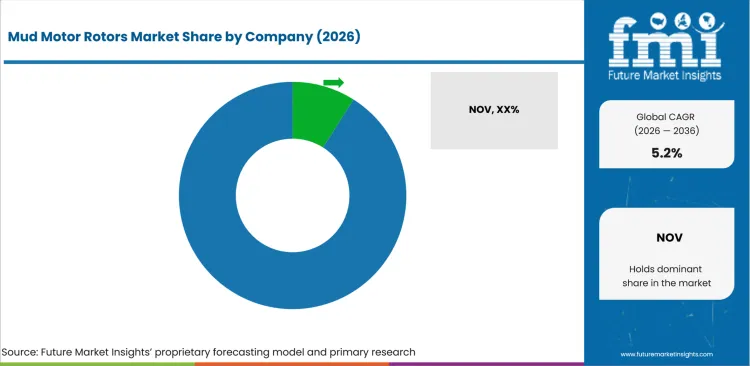
Competition divides between integrated drilling groups, proprietary motor fleets and specialized directional operators. Power-section engineering, field evidence and repair coverage set entry barriers since rotor qualification occurs inside the complete motor and BHA.
- Integrated drilling and BHA platforms: Baker Hughes, Halliburton, SLB and Weatherford.
- Motor and power-section engineering platforms: NOV, Patterson-UTI Energy, Inc. and PHX Energy Services Corp.
- Directional drilling and specialized motor services: Nabors Industries Ltd., KLX Energy Services Holdings, Inc. and Scientific Drilling International.
Competitive Benchmarking: Mud Motor Rotors Market
| Company | Rotor/Power-Section Engineering | Harsh-Environment Capability | Motor-BHA Integration | Geographic Reach |
|---|---|---|---|---|
| NOV | High | High | High | Global |
| Baker Hughes | High | High | High | Global |
| Halliburton | High | High | High | Global |
| SLB | High | High | High | Global |
| Weatherford | High | High | High | Global |
| Patterson-UTI Energy, Inc. | High | Medium | High | United States and selected international markets |
| Nabors Industries Ltd. | Medium | Medium | High | North America, Middle East and selected international markets |
| KLX Energy Services Holdings, Inc. | High | Medium | Medium | United States |
| PHX Energy Services Corp. | High | Medium | High | Canada and United States |
| Scientific Drilling International | High | High | High | North America and international drilling markets |
Scoring basis: Engineering scores High for proprietary motor or power-section design. Medium covers controlled motor fleets and Low covers limited component roles. Harsh-environment scores High for documented extended-reach or HPHT work. Medium covers narrower demanding-service evidence. Motor-BHA integration scores High for documented use with MWD or RSS. Medium and Low reflect narrower integration.
Key Developments in the Mud Motor Rotors Market
- In May 2026, Scientific Drilling International documented a Smart Motor with an integrated at-bit sensor drilling inside the targeted oil-saturated window. Near-bit data gave directional teams direct motor-yield feedback for steering.
- In October 2025, NOV reported Vector drilling motors with ERT power sections drilling several sections of an operator's first Bahrain tight-gas well. Multi-section use raises the value of reliable power sections.
- In August 2025, Weatherford documented a HyperLine motor and EMx MWD drilling a six-leg Canadian multilateral in one run for 12,461 meters. Motor life became part of multilateral BHA continuity.
Key Players in the Mud Motor Rotors Market
Integrated drilling motor and BHA platforms
- Baker Hughes
- Halliburton
- SLB
- Weatherford
Motor and power-section engineering platforms
- NOV
- Patterson-UTI Energy, Inc.
- PHX Energy Services Corp.
Directional drilling and specialized motor services
- Nabors Industries Ltd.
- KLX Energy Services Holdings, Inc.
- Scientific Drilling International
Mud Motor Rotors Market - Report Scope
| Coverage field | Report scope |
|---|---|
| Market breakdown | By rotor type, motor size, coating, end use, sales channel and region. |
| Quantitative Units | USD million. |
| Market Definition | Revenue includes new and replacement mud motor rotors sold as components or attributable rotor value within positive-displacement motor power sections. Complete motor revenue beyond rotor value, stators, bearing assemblies, bits, RSS, MWD and directional-drilling service revenue are excluded. |
| Regions Covered | North America, Latin America, Western Europe, Eastern Europe, East Asia, South Asia and Pacific, and Middle East and Africa. |
| Countries Covered | France, Brazil, Canada, USA, Italy, Germany, Japan, and more than 25 additional countries in the full report. |
| Key Companies Profiled | NOV, Baker Hughes, Halliburton, SLB, Weatherford, Patterson-UTI Energy, Inc., Nabors Industries Ltd., KLX Energy Services Holdings, Inc., PHX Energy Services Corp., Scientific Drilling International. |
| Forecast Period | 2026 to 2036. |
| Approach | Primary and secondary research with market triangulation. |
Mud Motor Rotors Market - Research Methodology
| Method | Approach |
|---|---|
| Primary Research | FMI analysts gathered input from manufacturers, service providers, technology developers, distributors, end users, procurement teams, and subject-matter experts. Interviews examined purchasing decisions, product or service evaluation, adoption barriers, approval requirements, pricing considerations, and expectations for technical or commercial support. Respondents were also asked what evidence is required before a trial, pilot, or initial order develops into regular purchasing. |
| Desk Research | Desk research covered government statistics, regulatory publications, trade data, industry associations, technical literature, standards, company filings, product information, and official corporate announcements. Sources were reviewed for relevance, publication date, geographic coverage, and consistency with the defined market scope. Claims relating to performance, applications, approvals, capacity, investment, and commercial activity were retained only when supported by credible public evidence. |
| Market Sizing and Forecasting | The market model combined the baseline value with historical performance, segment structure, pricing and volume indicators, adoption levels, company participation, and country-level demand conditions. Forecast assumptions considered economic activity, investment trends, regulatory developments, technology adoption, purchasing cycles, supply availability, and barriers to wider market use. Segment and regional estimates were reconciled before the final market total was calculated. |
| Data Validation | Estimates were checked against multiple independent indicators, including public data, company activity, trade patterns, industry developments, and findings from primary interviews. Validation also tested whether products, services, applications, and company revenues fell within the defined market boundaries. Adjacent categories, unsupported claims, overlapping revenues, and activities without direct market relevance were excluded to reduce double counting and maintain consistency across segments and countries. |
Mud Motor Rotors Market by Segments
Mud Motor Rotors Market segmented by Rotor Type:
- Standard mud motor rotors
- Even-wall rotors
- High-torque rotors
- Hard-coated rotors
- Custom lobe rotors
Mud Motor Rotors Market segmented by Motor Size:
- 4.75-6.75 inch
- Below 4.75 inch
- 6.75-8 inch
- Above 8 inch
Mud Motor Rotors Market segmented by Coating:
- Chrome plated
- Tungsten carbide coated
- Nitrided
- Elastomer-compatible coatings
Mud Motor Rotors Market segmented by End Use:
- Onshore drilling
- Offshore drilling
- Directional drilling
- Horizontal drilling
Mud Motor Rotors Market segmented by Sales Channel:
- Drilling tool OEMs
- Directional drilling service companies
- Aftermarket refurbishment
- Machine shops
Mud Motor Rotors Market by Region:
- North America
- United States
- Canada
- Latin America
- Brazil
- Mexico
- Argentina
- Chile
- Western Europe
- Germany
- France
- United Kingdom
- Italy
- Spain
- Benelux
- Nordics
- Eastern Europe
- Poland
- Czech Republic
- Romania
- Hungary
- East Asia
- China
- Japan
- South Korea
- South Asia and Pacific
- India
- ASEAN
- Australia and New Zealand
- Middle East and Africa
- GCC Countries
- South Africa
- Türkiye
- Israel
Research Sources and Bibliography
- USA Energy Information Administration. (2026, August 19). Longer wells boost Permian crude oil and natural gas production.
- Empresa de Pesquisa Energética. (2026, July). Balanço Energético Nacional 2026.
- Patterson-UTI Energy, Inc.. (2026, February 10). Annual Report on Form 10-K for the fiscal year ended December 31, 2025.
- PHX Energy Services Corp.. (2026, February 24). PHX Energy Announces a Special Dividend and Record Fourth Quarter and Annual Revenue Supported by Strong RSS Activity.
- European Chemicals Agency. (2025, February 12). ECHA Weekly - 12 February 2025.
- Railroad Commission of Texas. (2026, July 2). Texas Drilling Permit and Completion Statistics for June 2026.
- NOV Inc.. (2025, July 28). NOV Reports Second Quarter 2025 Results.
- NOV Inc.. (2025, April 28). NOV Reports First Quarter 2025 Results.
- Baker Hughes. (2025, June 26). Baker Hughes Launches GuardVibe, a New Approach to Mitigating Drill String Vibration.
- KLX Energy Services Holdings, Inc.. (2026, March 12). Annual Report on Form 10-K for the fiscal year ended December 31, 2025.
- BRGM. (2026, May 19). Deep geothermal energy in Île-de-France (the Paris region): results of the Géoscan project.
- Agência Nacional do Petróleo, Gás Natural e Biocombustíveis. (2026, June 30). ANP divulga dados consolidados do setor regulado em 2025.
- Alberta Energy Regulator. (2025, June). Crude Oil Well Activity.
- Railroad Commission of Texas. (2026, August 6). Texas Drilling Permit and Completion Statistics for July 2026.
- Regione Toscana. (2026, April 22). Bollettino Ufficiale della Regione Toscana - n. 16.
- Bundesministerium für Wirtschaft und Energie. (2025, July 4). BMWE legt Entwurf zum Gesetz zur Beschleunigung des Ausbaus von Geothermieanlagen, Groß-Wärmepumpen, Wärmespeicher und Fernwärmeleitungen (GeoBG) vor.
- JOGMEC. (2026, May 12).
- Baker Hughes Company. (2026, February 5). Annual Report on Form 10-K for the fiscal year ended December 31, 2025.
- Halliburton Company. (2026, February 6). Annual Report on Form 10-K for the fiscal year ended December 31, 2025.
- SLB. (2026, January 23). Annual Report on Form 10-K for the fiscal year ended December 31, 2025.
- Weatherford International plc. (2026, February 4). Annual Report on Form 10-K for the fiscal year ended December 31, 2025.
- Nabors Industries Ltd.. (2026, February 13). Annual Report on Form 10-K for the fiscal year ended December 31, 2025.
- Scientific Drilling International. (2026, May 21). Motor With Integrated At-Bit Sensor Drills Horizontal Well in Oil-Saturated Window.
- NOV Inc.. (2025, October 27). NOV Reports Third Quarter 2025 Results and Appointment of Jose Bayardo to Board of Directors.
- Weatherford International. (2025, August 1). HyperLine Motor, MWD Technology Drill 6-Leg Multilateral in 1 Run, Set New Record in Distance Drilled in 12-hr Shift, Improve ROP Efficiency.
- SLB. (2025, June 23). SLB Announces Digital Collaboration With Cactus Drilling.
- Halliburton. (2025, October 30). Halliburton introduces StreamStar wired drill pipe interface system.
- Halliburton. (2025, February 26). Halliburton and Sekal deliver world's first automated on-bottom drilling system for Equinor in the North Sea.
- SLB. (2025, March 31). SLB Awarded Major Drilling Contract by Woodside Energy for Ultra-deepwater Trion Development, Offshore Mexico.
- Nabors Industries Ltd.. (2025, September 25). Caturus Energy and Nabors Industries Deploy the Most Powerful Onshore Drilling Rig in the USA.
- NOV Inc.. (2026, April 27). NOV Reports First Quarter 2026 Earnings.
- Baker Hughes. (2026, May 20). Baker Hughes and H&P Collaborate to Advance USA Geothermal Development.
- Halliburton. (2026, July 9). Eni and Halliburton achieve industry first with closed-loop rig automation in deepwater Indonesia.
- SLB. (2026, February 12). SLB Awarded Multiple Offshore Drilling Contracts by Mubadala Energy for Tangkulo Deepwater Development in Indonesia.
- Weatherford International. (2026, May 15). Seamless Execution of Openhole Sidetracks: Dual-Telemetry MWD Powers Fast, Accurate Multilateral Drilling in Clearwater Formation.
- Patterson-UTI Energy, Inc.. (2026, July 29). Patterson-UTI Energy Reports Financial Results for the Quarter Ended June 30, 2026.
- Nabors Industries Ltd.. (2026, February 12). Expanding Our Operational Capabilities in Abu Dhabi.
- KLX Energy Services Holdings, Inc.. (2026, August 10). KLX Energy Services Holdings, Inc. Reports Second Quarter 2026 Results.
- PHX Energy Services Corp.. (2026, August 4). PHX Energy Announces Highest Second Quarter Revenue in its History and Continued Record RSS Activity.
- Scientific Drilling International. (2026, January 13). Replacement Lateral Drilled Using Magnetic Ranging.
This bibliography is provided for reader reference and is not exhaustive. The full report contains the complete reference list and detailed citations
This Report Answers
- How large is the mud motor rotors market?
- What raises rotor run-life requirements?
- Why do standard rotors lead?
- Why does 4.75-6.75 inch lead?
- Why does chrome plating lead?
- How do profiled country CAGRs differ?
- Which companies compete in this market?
- How does repair access affect replacement economics?
Frequently Asked Questions
How big is the Mud Motor Rotors Market in 2026?
The mud motor rotors market is valued at USD 999.9 million in 2026 and is projected to reach USD 1,660.0 million by 2036. Longer laterals increase motor hours and failure-related trip costs.
What is the CAGR of the Mud Motor Rotors Market from 2026 to 2036?
The mud motor rotors market is projected to grow at a CAGR of 5.2% between 2026 and 2036. Expansion is supported by longer directional sections and repeated motor rebuild cycles.
Which rotor type leads the Mud Motor Rotors Market?
The standard mud motor rotors segment is expected to hold 31.0% of the mud motor rotors market in 2026, attributable to familiar power-section and repair practices. Specialized designs serve narrower high-output or temperature requirements.
Which motor size leads the Mud Motor Rotors Market?
The 4.75-6.75 inch segment is expected to hold 36.0% of the mud motor rotors market in 2026, supported by common production-hole and directional programs. The range accommodates varied lobe counts and stage configurations within familiar BHA interfaces.
How much value will the Mud Motor Rotors Market add between 2026 and 2036?
The mud motor rotors market is expected to add USD 660.1 million in value between 2026 and 2036. Longer directional intervals and motor rebuilds keep replacement demand tied to power-section run life.
Which countries are projected to record the highest growth in the Mud Motor Rotors Market?
France is projected to grow at 6.2% CAGR, followed by Brazil at 5.9% and Canada at 5.6% through 2036. Geothermal projects, offshore drilling and horizontal fleets create different service requirements.
Which companies are active in the Mud Motor Rotors Market?
Key companies operating in the market include NOV, Baker Hughes, Halliburton, SLB, Weatherford, Patterson-UTI Energy, Inc., Nabors Industries Ltd., KLX Energy Services Holdings, Inc., PHX Energy Services Corp., and Scientific Drilling International. They compete through motor engineering, BHA integration, rentals and regional service coverage.
Preview the report firsthand - request a free sample
Get SampleGet the brochure for pricing and purchase details.
Get PDFTable of Content
- Key Takeaways
- Market Size and CAGR
- Top Growth Driver
- Fastest Growing Segment
- Leading Region
- Key Companies
- Emerging Opportunities
- Executive Summary
- Global Market Outlook
- Demand-side Trends
- Supply-side Trends
- Technology Roadmap Analysis
- Analysis and Recommendations
- Analyst Perspective (What is happening? Why now? What should investors know?)
- Key Questions Answered
- How large is the market?
- What is the CAGR?
- What are key trends?
- Which region dominates?
- Who are the leaders?
- Market Overview
- Market Coverage / Taxonomy
- Market Definition / Scope / Limitations
- Research Methodology
- Chapter Orientation
- Analytical Lens and Working Hypotheses
- Market Structure, Signals, and Trend Drivers
- Benchmarking and Cross-market Comparability
- Market Sizing, Forecasting, and Opportunity Mapping
- Research Design and Evidence Framework
- Desk Research Programme (Secondary Evidence)
- Expert Input and Fieldwork (Primary Evidence)
- Tooling, Models, and Reference Databases
- Data Engineering and Model Build
- Quality Assurance and Audit Trail
- Market Background
- Market Dynamics (Drivers, Restraints, Opportunity, Trends)
- Scenario Forecast (Optimistic, Likely, Conservative)
- Impact Analysis
- AI Impact
- Sustainability Impact
- Regulatory Impact
- Technology Impact
- Consumer / Buyer Analysis
- Purchase Drivers
- Adoption Barriers
- Buyer Journey
- Opportunity Map Analysis
- Product Life Cycle Analysis
- Supply Chain Analysis
- Investment Feasibility Matrix
- Value Chain Analysis
- PESTLE and Porter's Analysis
- Regulatory Landscape
- Regional Parent Market Outlook
- Production and Consumption Statistics
- Import and Export Statistics
- Global Market Analysis and Forecast, 2021 to 2036
- Historical Market Size Value (USD Million) Analysis, 2021 to 2025
- Current and Future Market Size Value (USD Million) Projections, 2026 to 2036
- Y-o-Y Growth Trend Analysis
- Absolute $ Opportunity Analysis
- Global Market Pricing Analysis, 2021 to 2036
- Global Market Analysis and Forecast, By Rotor Type, 2021 to 2036
- Introduction / Key Findings
- Historical Market Size Value (USD Million) Analysis By Rotor Type, 2021 to 2025
- Current and Future Market Size Value (USD Million) Analysis and Forecast By Rotor Type, 2026 to 2036
- Standard mud motor rotors
- Even-wall rotors
- High-torque rotors
- Hard-coated rotors
- Custom lobe rotors
- Standard mud motor rotors
- Y-o-Y Growth Trend Analysis By Rotor Type, 2021 to 2025
- Absolute $ Opportunity Analysis By Rotor Type, 2026 to 2036
- Global Market Analysis and Forecast, By Motor Size, 2021 to 2036
- Introduction / Key Findings
- Historical Market Size Value (USD Million) Analysis By Motor Size, 2021 to 2025
- Current and Future Market Size Value (USD Million) Analysis and Forecast By Motor Size, 2026 to 2036
- 4.75–6.75 inch
- Below 4.75 inch
- 6.75–8 inch
- Above 8 inch
- 4.75–6.75 inch
- Y-o-Y Growth Trend Analysis By Motor Size, 2021 to 2025
- Absolute $ Opportunity Analysis By Motor Size, 2026 to 2036
- Global Market Analysis and Forecast, By Coating, 2021 to 2036
- Introduction / Key Findings
- Historical Market Size Value (USD Million) Analysis By Coating, 2021 to 2025
- Current and Future Market Size Value (USD Million) Analysis and Forecast By Coating, 2026 to 2036
- Chrome plated
- Tungsten carbide coated
- Nitrided
- Elastomer-compatible coatings
- Chrome plated
- Y-o-Y Growth Trend Analysis By Coating, 2021 to 2025
- Absolute $ Opportunity Analysis By Coating, 2026 to 2036
- Global Market Analysis and Forecast, By End Use, 2021 to 2036
- Introduction / Key Findings
- Historical Market Size Value (USD Million) Analysis By End Use, 2021 to 2025
- Current and Future Market Size Value (USD Million) Analysis and Forecast By End Use, 2026 to 2036
- Onshore drilling
- Offshore drilling
- Directional drilling
- Horizontal drilling
- Onshore drilling
- Y-o-Y Growth Trend Analysis By End Use, 2021 to 2025
- Absolute $ Opportunity Analysis By End Use, 2026 to 2036
- Global Market Analysis and Forecast, By Sales Channel, 2021 to 2036
- Introduction / Key Findings
- Historical Market Size Value (USD Million) Analysis By Sales Channel, 2021 to 2025
- Current and Future Market Size Value (USD Million) Analysis and Forecast By Sales Channel, 2026 to 2036
- Drilling tool OEMs
- Directional drilling service companies
- Aftermarket refurbishment
- Machine shops
- Drilling tool OEMs
- Y-o-Y Growth Trend Analysis By Sales Channel, 2021 to 2025
- Absolute $ Opportunity Analysis By Sales Channel, 2026 to 2036
- Global Market Analysis and Forecast, By Region, 2021 to 2036
- Introduction
- Historical Market Size Value (USD Million) Analysis By Region, 2021 to 2025
- Current Market Size Value (USD Million) Analysis and Forecast By Region, 2026 to 2036
- North America
- Latin America
- Western Europe
- Eastern Europe
- East Asia
- South Asia and Pacific
- Middle East & Africa
- Market Attractiveness Analysis By Region
- North America Market Analysis and Forecast, By Country, 2021 to 2036
- Historical Market Size Value (USD Million) Trend Analysis By Market Taxonomy, 2021 to 2025
- Market Size Value (USD Million) Forecast By Market Taxonomy, 2026 to 2036
- By Country
- USA
- Canada
- By Rotor Type
- By Motor Size
- By Coating
- By End Use
- By Sales Channel
- By Country
- Market Attractiveness Analysis
- By Country
- By Rotor Type
- By Motor Size
- By Coating
- By End Use
- By Sales Channel
- Key Takeaways
- Latin America Market Analysis and Forecast, By Country
- Historical Market Size Value (USD Million) Trend Analysis By Market Taxonomy, 2021 to 2025
- Market Size Value (USD Million) Forecast By Market Taxonomy, 2026 to 2036
- By Country
- Brazil
- Mexico
- Chile
- Rest of Latin America
- By Rotor Type
- By Motor Size
- By Coating
- By End Use
- By Sales Channel
- By Country
- Market Attractiveness Analysis
- By Country
- By Rotor Type
- By Motor Size
- By Coating
- By End Use
- By Sales Channel
- Key Takeaways
- Western Europe Market Analysis and Forecast, By Country
- Historical Market Size Value (USD Million) Trend Analysis By Market Taxonomy, 2021 to 2025
- Market Size Value (USD Million) Forecast By Market Taxonomy, 2026 to 2036
- By Country
- Germany
- UK
- Italy
- Spain
- France
- Nordic
- BENELUX
- Rest of Western Europe
- By Rotor Type
- By Motor Size
- By Coating
- By End Use
- By Sales Channel
- By Country
- Market Attractiveness Analysis
- By Country
- By Rotor Type
- By Motor Size
- By Coating
- By End Use
- By Sales Channel
- Key Takeaways
- Eastern Europe Market Analysis and Forecast, By Country
- Historical Market Size Value (USD Million) Trend Analysis By Market Taxonomy, 2021 to 2025
- Market Size Value (USD Million) Forecast By Market Taxonomy, 2026 to 2036
- By Country
- Russia
- Poland
- Hungary
- Balkan & Baltic
- Rest of Eastern Europe
- By Rotor Type
- By Motor Size
- By Coating
- By End Use
- By Sales Channel
- By Country
- Market Attractiveness Analysis
- By Country
- By Rotor Type
- By Motor Size
- By Coating
- By End Use
- By Sales Channel
- Key Takeaways
- East Asia Market Analysis and Forecast, By Country
- Historical Market Size Value (USD Million) Trend Analysis By Market Taxonomy, 2021 to 2025
- Market Size Value (USD Million) Forecast By Market Taxonomy, 2026 to 2036
- By Country
- China
- Japan
- South Korea
- By Rotor Type
- By Motor Size
- By Coating
- By End Use
- By Sales Channel
- By Country
- Market Attractiveness Analysis
- By Country
- By Rotor Type
- By Motor Size
- By Coating
- By End Use
- By Sales Channel
- Key Takeaways
- South Asia and Pacific Market Analysis and Forecast, By Country
- Historical Market Size Value (USD Million) Trend Analysis By Market Taxonomy, 2021 to 2025
- Market Size Value (USD Million) Forecast By Market Taxonomy, 2026 to 2036
- By Country
- India
- ASEAN
- Australia & New Zealand
- Rest of South Asia and Pacific
- By Rotor Type
- By Motor Size
- By Coating
- By End Use
- By Sales Channel
- By Country
- Market Attractiveness Analysis
- By Country
- By Rotor Type
- By Motor Size
- By Coating
- By End Use
- By Sales Channel
- Key Takeaways
- Middle East & Africa Market Analysis and Forecast, By Country
- Historical Market Size Value (USD Million) Trend Analysis By Market Taxonomy, 2021 to 2025
- Market Size Value (USD Million) Forecast By Market Taxonomy, 2026 to 2036
- By Country
- Kingdom of Saudi Arabia
- Other GCC Countries
- Türkiye
- South Africa
- Other African Union
- Rest of Middle East & Africa
- By Rotor Type
- By Motor Size
- By Coating
- By End Use
- By Sales Channel
- By Country
- Market Attractiveness Analysis
- By Country
- By Rotor Type
- By Motor Size
- By Coating
- By End Use
- By Sales Channel
- Key Takeaways
- Key Countries Market Analysis
- USA
- Pricing Analysis
- Market Share Analysis, 2025
- By Rotor Type
- By Motor Size
- By Coating
- By End Use
- By Sales Channel
- Canada
- Pricing Analysis
- Market Share Analysis, 2025
- By Rotor Type
- By Motor Size
- By Coating
- By End Use
- By Sales Channel
- Mexico
- Pricing Analysis
- Market Share Analysis, 2025
- By Rotor Type
- By Motor Size
- By Coating
- By End Use
- By Sales Channel
- Brazil
- Pricing Analysis
- Market Share Analysis, 2025
- By Rotor Type
- By Motor Size
- By Coating
- By End Use
- By Sales Channel
- Chile
- Pricing Analysis
- Market Share Analysis, 2025
- By Rotor Type
- By Motor Size
- By Coating
- By End Use
- By Sales Channel
- Germany
- Pricing Analysis
- Market Share Analysis, 2025
- By Rotor Type
- By Motor Size
- By Coating
- By End Use
- By Sales Channel
- UK
- Pricing Analysis
- Market Share Analysis, 2025
- By Rotor Type
- By Motor Size
- By Coating
- By End Use
- By Sales Channel
- Italy
- Pricing Analysis
- Market Share Analysis, 2025
- By Rotor Type
- By Motor Size
- By Coating
- By End Use
- By Sales Channel
- Spain
- Pricing Analysis
- Market Share Analysis, 2025
- By Rotor Type
- By Motor Size
- By Coating
- By End Use
- By Sales Channel
- France
- Pricing Analysis
- Market Share Analysis, 2025
- By Rotor Type
- By Motor Size
- By Coating
- By End Use
- By Sales Channel
- India
- Pricing Analysis
- Market Share Analysis, 2025
- By Rotor Type
- By Motor Size
- By Coating
- By End Use
- By Sales Channel
- ASEAN
- Pricing Analysis
- Market Share Analysis, 2025
- By Rotor Type
- By Motor Size
- By Coating
- By End Use
- By Sales Channel
- Australia & New Zealand
- Pricing Analysis
- Market Share Analysis, 2025
- By Rotor Type
- By Motor Size
- By Coating
- By End Use
- By Sales Channel
- China
- Pricing Analysis
- Market Share Analysis, 2025
- By Rotor Type
- By Motor Size
- By Coating
- By End Use
- By Sales Channel
- Japan
- Pricing Analysis
- Market Share Analysis, 2025
- By Rotor Type
- By Motor Size
- By Coating
- By End Use
- By Sales Channel
- South Korea
- Pricing Analysis
- Market Share Analysis, 2025
- By Rotor Type
- By Motor Size
- By Coating
- By End Use
- By Sales Channel
- Russia
- Pricing Analysis
- Market Share Analysis, 2025
- By Rotor Type
- By Motor Size
- By Coating
- By End Use
- By Sales Channel
- Poland
- Pricing Analysis
- Market Share Analysis, 2025
- By Rotor Type
- By Motor Size
- By Coating
- By End Use
- By Sales Channel
- Hungary
- Pricing Analysis
- Market Share Analysis, 2025
- By Rotor Type
- By Motor Size
- By Coating
- By End Use
- By Sales Channel
- Kingdom of Saudi Arabia
- Pricing Analysis
- Market Share Analysis, 2025
- By Rotor Type
- By Motor Size
- By Coating
- By End Use
- By Sales Channel
- Türkiye
- Pricing Analysis
- Market Share Analysis, 2025
- By Rotor Type
- By Motor Size
- By Coating
- By End Use
- By Sales Channel
- South Africa
- Pricing Analysis
- Market Share Analysis, 2025
- By Rotor Type
- By Motor Size
- By Coating
- By End Use
- By Sales Channel
- USA
- Market Structure Analysis
- Competition Dashboard
- Competition Benchmarking
- Market Share Analysis of Top Players
- By Regional
- By Rotor Type
- By Motor Size
- By Coating
- By End Use
- By Sales Channel
- Emerging Startups
- Innovation Benchmarking
- Competition Analysis
- Competition Deep Dive
- NOV
- Overview
- Product Portfolio
- Profitability by Market Segments
- Sales Footprint
- Strategy Overview
- Marketing Strategy
- Product Strategy
- Channel Strategy
- Baker Hughes
- Halliburton
- SLB
- Weatherford
- Dyna-Drill
- Hunting Energy Services
- Cougar Drilling Solutions
- BICO Drilling Tools
- Toro Downhole Tools
- NOV
- Case Studies
- Success Stories
- Recent Developments
- Competition Deep Dive
- Assumptions & Acronyms Used


