

- Industry Size (2025)
- USD 214.7 Mn
- Forecast (2035)
- USD 403.7 Mn
- CAGR (2025 to 2035)
- 6.5%
Nano Bubble Generators Market Size, Market Forecast and Outlook By FMI
Summary of the Nano Bubble Generators Market
- Demand and Growth Drivers
- Water treatment industry demand for chemical-free purification and enhanced dissolved oxygen delivery is likely to sustain adoption of nanobubble generators across municipal, industrial, and agricultural applications.
- Growth in aquaculture production requiring improved water quality management is expected to increase procurement of nanobubble systems for oxygenation and pathogen control during the forecast period.
- Environmental remediation and wastewater treatment mandates are likely to create incremental demand for nanobubble technology as an energy-efficient alternative to conventional aeration through 2036.
- Product and Segment View
- Gas-Water Circulation Type is likely to account for 54.3% of the product type segment, reflecting sustained procurement across primary end-use categories.
- Gas Injection Nano Bubble Generation is likely to account for 48.7% of the technology segment, reflecting sustained procurement across primary end-use categories.
- Water Treatment is likely to account for 38.9% of the application segment, reflecting sustained procurement across primary end-use categories.
- Geography and Competitive Outlook
- China is likely to remain a key market at 18.4%, supported by rapid water treatment infrastructure investment.
- India is likely to sustain growth at 17.0%, driven by expanding water treatment infrastructure.
- Companies that combine product breadth with end-use customer access and regional distribution are likely to strengthen competitive positioning during the forecast period.
- Analyst Opinion
- Nandini Roy Choudhury, Principal Consultant at FMI says, 'The nano bubble generators market is transitioning from early-adopter pilot deployments toward commercial-scale water treatment and aquaculture operations. Producers that can demonstrate quantified performance improvements, operating cost savings, and reliable system operation at scale are positioned to accelerate adoption across conservative utility and aquaculture procurement environments.'
- The nano bubble generators market is evolving from pilot technology toward commercial-scale water treatment and aquaculture deployment.
- Adoption is increasing due to water treatment demand for chemical-free purification and enhanced oxygenation.
- Demand is further supported by aquaculture production growth requiring improved dissolved oxygen management.
- Producers with demonstrated performance data, scalable systems, and application engineering support are likely to accelerate adoption.
Key Takeaways
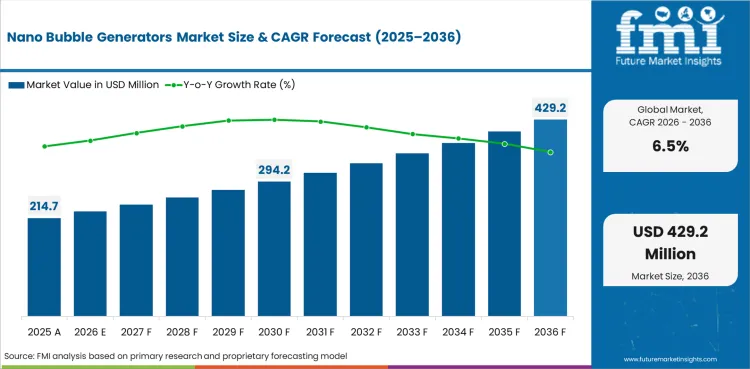
- The nano bubble generators market was valued at USD 214.7 million in 2025.
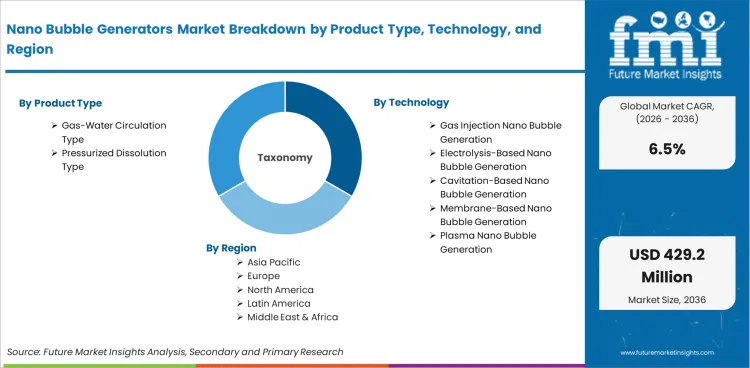
- By 2036, the Nano Bubble Generators Market is expected to be worth USD 429.2 million.
- From 2026 to 2036, the market is projected to expand at a CAGR of 6.5%.
- The market is projected to create an incremental opportunity of USD 200.6 million between 2026 and 2036.
- In 2026, gas-water circulation type is expected to account for 54.3% of the product type segment, driven by growing water treatment industry adoption of nanobubble technology for enhanced dissolved oxygen delivery, contaminant removal, and chemical-free water purification.
- China (18.4%) and India (17.0%) are two of the fastest-growing markets in the world.
Nano Bubble Generators Market Definition
The nano bubble generators market includes equipment that produces nanoscale gas bubbles (below 200 nanometers) in water for enhanced dissolved oxygen delivery, contaminant removal, and water quality improvement across municipal water treatment, aquaculture, agriculture, environmental remediation, and industrial process applications.
Nano Bubble Generators Market Inclusions
Market scope encompasses all commercially traded nano bubble generators categorized by product type (gas-water circulation type, pressurized dissolution type, ultrasonic type, others), technology (gas injection, hydrodynamic cavitation, electrolysis, pressurized dissolution), end use (water treatment, aquaculture, agriculture, environmental remediation, food processing, industrial cleaning), capacity, and distribution channel (direct sales, distributors, system integrators). The range of revenue sizes is from 2026 to 2036.
Nano Bubble Generators Market Exclusions
The scope does not include conventional macro-bubble aeration equipment, fine bubble diffuser systems above 200 nanometers, or laboratory-scale nanobubble research equipment not designed for commercial-scale applications.
Nano Bubble Generators Market Research Methodology
- Primary Research: FMI analysts conducted interviews with manufacturers, end-use procurement teams, and distribution partners across key markets.
- Desk Research: Combined data from industry associations, regulatory filings, trade publications, and manufacturer disclosures.
- Market sizing and forecasting: Bottom-up aggregation across product types, end-use applications, and regional adoption curves, validated against industry benchmarks.
- Data validation: Cross-checked every quarter against production data, trade statistics, and manufacturer-reported figures.
Why is the Nano Bubble Generators Market Growing?
- Water treatment demand for chemical-free purification and enhanced oxygenation is creating sustained adoption of nanobubble generators across municipal, industrial, and aquaculture applications.
- Aquaculture production growth requiring improved dissolved oxygen management is increasing procurement of nanobubble systems for fish farm water quality optimization.
- China (18.4%) and India (17.0%) lead growth, reflecting rapid water treatment infrastructure investment and expanding aquaculture production requiring advanced water quality management.
The nano bubble generators market is expanding at 6.5% CAGR, reflecting growing adoption of nanobubble technology for water treatment, aquaculture, and environmental remediation applications. Gas-water circulation type accounts for 54.3% of the product segment, reflecting the preference for continuous nanobubble generation systems that deliver consistent dissolved gas levels in treatment applications.
Gas injection nanobubble generation accounts for 48.7% of the technology segment, reflecting the direct gas infusion method used in high-volume water treatment operations. Water treatment accounts for 38.9% of the end-use segment, representing the largest single-application demand category.
Nanobubble technology delivers enhanced gas transfer efficiency compared to conventional aeration, with bubbles remaining suspended for extended periods due to their small diameter and neutral buoyancy. This extended residence time improves dissolved oxygen delivery, enhances contaminant flotation, and supports pathogen reduction without chemical additives.
Market Segmentation Analysis
- Gas-Water Circulation Type accounts for 54.3% of the product type segment, reflecting consistent demand across primary commercial applications.
- Gas Injection Nano Bubble Generation accounts for 48.7% of the technology segment, reflecting consistent demand across primary commercial applications.
- Water Treatment accounts for 38.9% of the application segment, reflecting consistent demand across primary commercial applications.
The nano bubble generators market is segmented by product type, technology, application, end use. Each segmentation dimension reflects distinct procurement patterns and end-use requirements.
Insights into the Gas-Water Circulation Type Product Type Segment
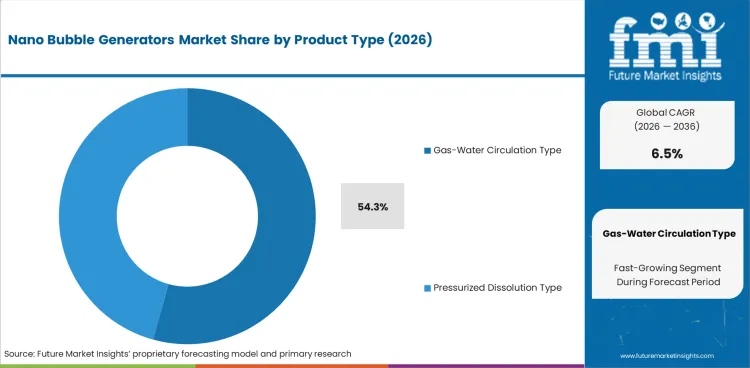
In 2026, gas-water circulation type is expected to account for 54.3% of the product type segment. Demand reflects procurement preferences where performance consistency and specification compliance are critical selection criteria.
Competitive positioning within this segment depends on production capability, quality certification, and the ability to meet evolving end-use requirements. Suppliers with established relationships and proven track records are likely to maintain share.
Insights into the Gas Injection Nano Bubble Generation Technology Segment
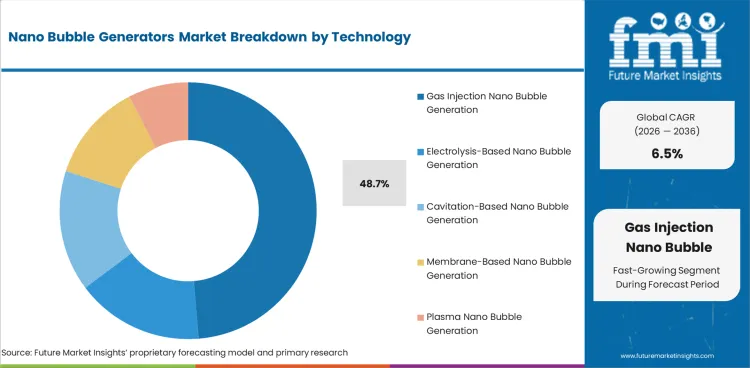
In 2026, gas injection nano bubble generation is expected to account for 48.7% of the technology segment. Demand reflects procurement preferences where performance consistency and specification compliance are critical selection criteria.
Competitive positioning within this segment depends on production capability, quality certification, and the ability to meet evolving end-use requirements. Suppliers with established relationships and proven track records are likely to maintain share.
Nano Bubble Generators Market Drivers, Restraints, and Opportunities
- Water treatment demand for chemical-free purification and aquaculture water quality management are creating sustained adoption of nanobubble generators across multiple application categories.
- Technology awareness gaps and limited established performance data constrain adoption velocity in conservative water treatment markets where conventional aeration has established operational precedent.
- Environmental remediation mandates and wastewater treatment requirements are creating incremental demand for energy-efficient nanobubble alternatives to conventional aeration systems.
The nano bubble generators market reflects water treatment technology evolution, aquaculture production growth, and environmental compliance requirements driving adoption of enhanced gas transfer solutions.
Water Treatment Technology Adoption
Municipal and industrial water treatment facilities adopt nanobubble generators for enhanced dissolved oxygen delivery, improved contaminant removal, and reduced chemical usage. Operating cost reduction compared to conventional aeration supports procurement justification.
Technology Awareness and Performance Data Gaps
Limited operational track record compared to established aeration technologies creates adoption hesitancy in conservative utility procurement environments. Demonstrated performance data from pilot installations and reference sites is critical for market expansion.
Aquaculture Water Quality Management
Fish farm operations require consistent dissolved oxygen levels for healthy stock production. Nanobubble generators deliver extended oxygenation residence time that supports fish health and growth while reducing mortality from oxygen depletion events.
Analysis of Nano Bubble Generators Market By Key Countries
.webp "Top Country Growth Comparison Nano Bubble Generators Market Cagr (2026 2036)")
| Country | CAGR |
|---|---|
| China | 18.4% |
| India | 17.0% |
| Germany | 15.7% |
| Brazil | 14.3% |
| USA | 12.9% |
| UK | 11.6% |
| Japan | 10.2% |
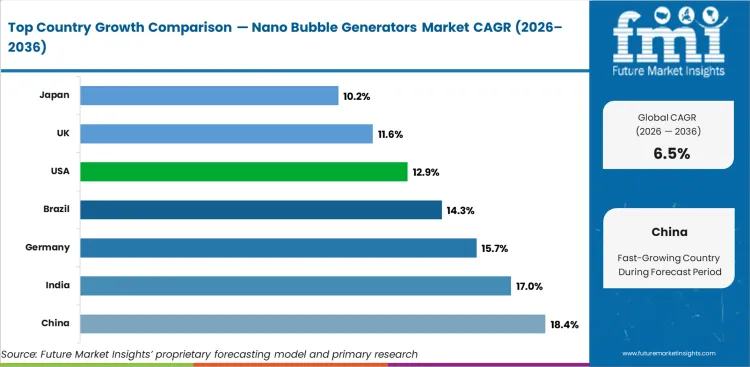
- China leads with 18.4%, supported by rapid water treatment infrastructure investment.
- India at 17.0%, reflecting expanding water treatment infrastructure.
- Germany at 15.7%, reflecting advanced water treatment technology adoption.
The global nano bubble generators market is expected to grow at a rate of 6.5% per year from 2026 to 2036. The study covers more than 30 countries, and the main markets are listed below.
Demand Outlook for Nano Bubble Generators Market in China
China is expected to grow at 18.4% through 2036, reflecting rapid water treatment infrastructure investment, large aquaculture production base, and government environmental remediation programs.
- Water treatment infrastructure investment drives adoption.
- Large aquaculture base sustains oxygenation system demand.
- Environmental programs create remediation procurement.
Future Outlook for Nano Bubble Generators Market in India
India is expected to grow at 17.0% through 2036, reflecting expanding water treatment infrastructure, growing aquaculture production, and industrial wastewater treatment requirements.
- Water treatment expansion creates infrastructure demand.
- Aquaculture growth sustains dissolved oxygen system procurement.
- Industrial wastewater mandates drive technology adoption.
Opportunity Analysis of Nano Bubble Generators Market in Germany
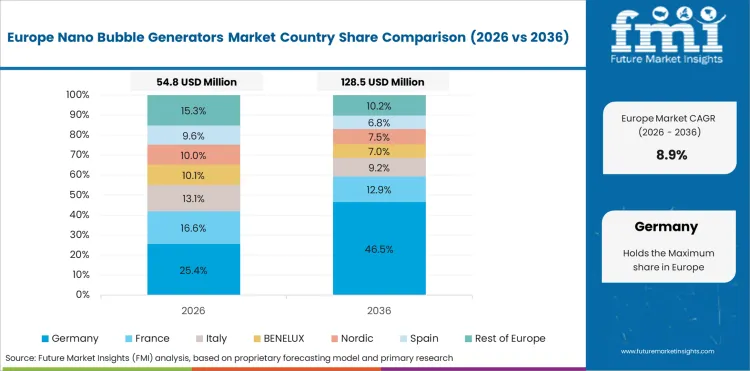
Germany is expected to grow at 15.7% through 2036, reflecting advanced water treatment technology adoption, strict environmental regulations, and industrial wastewater compliance requirements.
- Advanced technology adoption supports nanobubble demand.
- Strict regulations drive wastewater treatment investment.
- Industrial compliance requirements sustain equipment procurement.
In-depth Analysis of Nano Bubble Generators Market in Brazil
Brazil is expected to grow at 14.3% through 2036, reflecting water treatment infrastructure expansion, agricultural water management demand, and aquaculture production growth.
- Water infrastructure expansion creates procurement opportunity.
- Agricultural water management drives system demand.
- Aquaculture growth sustains oxygenation equipment orders.
Sales Analysis of Nano Bubble Generators Market in USA
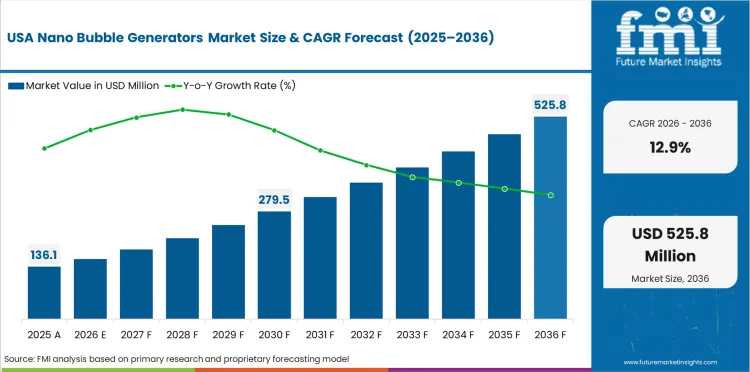
USA is expected to grow at 12.9% through 2036, reflecting established water treatment infrastructure, environmental remediation demand, and aquaculture water quality management.
- Established infrastructure supports technology upgrades.
- Environmental remediation creates specialized demand.
- Aquaculture management sustains oxygenation procurement.
Growth Analysis of Nano Bubble Generators Market in UK
UK is expected to grow at 11.6% through 2036, reflecting water treatment modernization, environmental regulation compliance, and growing adoption of advanced purification technologies.
- Water treatment modernization drives technology adoption.
- Environmental compliance sustains equipment procurement.
- Advanced purification adoption supports market growth.
Market Outlook for Nano Bubble Generators Market in Japan
Japan is expected to grow at 10.2% through 2036, reflecting advanced water treatment technology, precision aquaculture management, and environmental remediation technology leadership.
- Technology leadership supports advanced system adoption.
- Precision aquaculture management drives specialized demand.
- Environmental technology supports remediation procurement.
Competitive Landscape and Strategic Positioning
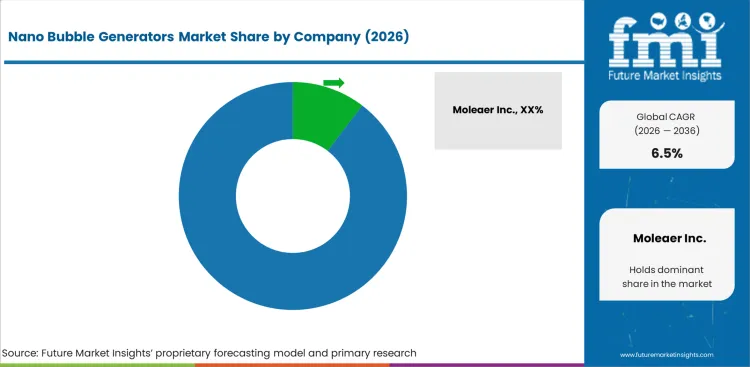
- Moleaer Inc. and Acniti LLC lead through broad product portfolios and established end-use customer relationships.
- Mid-tier producers compete through regional specialization and targeted product development for specific application segments.
- New entrants are focusing on technology-differentiated products and specialized applications to establish market presence.
Moleaer Inc. holds a strong position through technology leadership and established customer relationships. Acniti LLC competes through complementary capabilities and regional strength.
Inteccon Inc. and Pure Water Enterprises Private Limited maintain positions through specialized offerings and technical capabilities.
Barriers include established relationships, regulatory requirements, technology expertise, and manufacturing scale. Strategic priorities include technology advancement, regulatory compliance, and geographic expansion.
Key Companies in the Nano Bubble Generators Market
Key global companies leading the nano bubble generators market include:
- Moleaer Inc., Acniti LLC, Inteccon Inc. hold leading positions through technology leadership and established customer relationships.
- Pure Water Enterprises Private Limited, ASUPLUS NANOBUBBLE TECHNOLOGY have established positions through specialized offerings and regional expertise.
- Fine Bubble Technologies, Tenka Nanobubble Solutions, Nobubble represent emerging participants with growth potential through technology differentiation.
Competitive Benchmarking: Nano Bubble Generators Market
| Company | Bubble Technology | Application Range | System Scale | Geographic Reach |
|---|---|---|---|---|
| Moleaer Inc. | High | High | High | Global |
| Acniti LLC | High | Medium | High | Global |
| Inteccon Inc. | Medium | Medium | Medium | Global |
| Pure Water Enterprises Private Limited | Medium | Moderate | Medium | Regional |
| ASUPLUS NANOBUBBLE TECHNOLOGY | Moderate | Moderate | Moderate | Regional |
| Nano Bubble Technologies PTY LTD | Moderate | Low | Moderate | Regional |
| Fine Bubble Technologies | Low | Low | Low | Niche |
| Tenka Nanobubble Solutions | Low | Low | Low | Niche |
| Nobubble | Low | Low | Low | Niche |
| Anzai Kantetsu Co., Ltd. | Low | Low | Low | Niche |
Source: Future Market Insights competitive analysis, 2026.
Key Developments in Nano Bubble Generators Market
- In 2025, Moleaer Inc. expanded its nanobubble generator product line with a high-capacity industrial system targeting municipal water treatment and large-scale aquaculture operations.
- In 2025, Acniti LLC launched a compact nanobubble generator designed for small-scale aquaculture and agricultural irrigation applications in emerging markets.
Key Players in the Nano Bubble Generators Market
Major Global Players
- Moleaer Inc.
- Acniti LLC
- Inteccon Inc.
- Pure Water Enterprises Private Limited
- ASUPLUS NANOBUBBLE TECHNOLOGY
- Nano Bubble Technologies PTY LTD
- AquaPro Solutions Pte Ltd
Emerging Players/Startups
- Fine Bubble Technologies
- Tenka Nanobubble Solutions
- Nobubble
- Anzai Kantetsu Co., Ltd.
- GAO Tek Inc.
Report Scope and Coverage
| Quantitative Units | USD 228.7 Million to USD 429.2 Million, at a CAGR of 6.5% |
|---|---|
| Market Definition | The nano bubble generators market encompasses gas-water circulation and gas injection nanobubble generators used for water treatment, aquaculture oxygenation, environmental remediation, and industrial process applications. |
| Regions Covered | North America, Latin America, Europe, East Asia, South Asia and Pacific, Middle East and Africa |
| Countries Covered | China, India, Germany, Brazil, USA, UK, Japan, 30 plus countries |
| Key Companies Profiled | Moleaer Inc., Acniti LLC, Inteccon Inc., Pure Water Enterprises Private Limited, ASUPLUS NANOBUBBLE TECHNOLOGY, Nano Bubble Technologies PTY LTD, AquaPro Solutions Pte Ltd, NanoKriti, Rapid Water Technologies, Shanghai Edon Mechanical & Electrical Equipment Co, Trident Bubble Technologies LLC, Qingdao Ozonier Purification Equipment Co., Ltd. |
| Forecast Period | 2026 to 2036 |
| Approach | Hybrid bottom-up and top-down methodology starting with verified transaction data, projecting adoption velocity across segments and regions. |
Segmentation
Nano Bubble Generators Market Segmented by Product Type:
- Gas-Water Circulation Type
- Pressurized Dissolution Type
Nano Bubble Generators Market Segmented by Technology:
- Gas Injection Nano Bubble Generation
- Electrolysis-Based Nano Bubble Generation
- Cavitation-Based Nano Bubble Generation
- Membrane-Based Nano Bubble Generation
- Plasma Nano Bubble Generation
Nano Bubble Generators Market Segmented by Application:
- Water Treatment
- Agriculture & Aquaculture
- Healthcare & Medicine
- Industrial & Manufacturing
- Food & Beverage
- Cosmetics & Personal Care
- HVAC & Environmental Applications
Nano Bubble Generators Market Segmented by End Use:
- Municipal Sector
- Water Utilities
- Public Water Systems
- Urban Utilities
- Wastewater Authorities
- Sewage Treatment Plants
- Recycling Facilities
- Water Utilities
- Aquaculture Industry
- Commercial Farms
- Large Scale Farms
- Export Oriented Farms
- Small Scale Farms
- Local Farms
- Family Owned Farms
- Commercial Farms
- Agriculture Sector
- Commercial Agriculture
- Large Scale Farming
- Greenhouse Farming
- Smallholder Farming
- Open Field Farming
- Mixed Farming
- Commercial Agriculture
- Industrial Sector
- Food And Beverage Companies
- Processing Plants
- Packaging Units
- Chemical And Manufacturing Companies
- Chemical Plants
- Industrial Processing Units
- Food And Beverage Companies
Nano Bubble Generators Market by Region:
- North America
- USA
- Canada
- Mexico
- Latin America
- Brazil
- Chile
- Rest of Latin America
- Western Europe
- Germany
- UK
- Italy
- Spain
- France
- Nordic
- BENELUX
- Rest of Western Europe
- Eastern Europe
- Russia
- Poland
- Hungary
- Balkan & Baltic
- Rest of Eastern Europe
- East Asia
- China
- Japan
- South Korea
- South Asia and Pacific
- India
- ASEAN
- Australia & New Zealand
- Rest of South Asia and Pacific
- Middle East & Africa
- Kingdom of Saudi Arabia
- Other GCC Countries
- Turkiye
- South Africa
- Other African Union
- Rest of Middle East & Africa
Research Sources and Bibliography
- World Health Organization. (2024). WHO Guidelines on Water Treatment Technology Assessment. WHO.
- USA Environmental Protection Agency. (2025). EPA Report on Advanced Water Treatment Technologies. EPA.
- Food and Agriculture Organization. (2025). FAO Review of Aquaculture Water Quality Management Technologies. FAO.
- International Organization for Standardization. (2024). ISO 20480: Fine Bubble Technology, General Principles. ISO.
- European Commission. (2024). EU Water Framework Directive: Advanced Treatment Technology Requirements. EC.
This bibliography is provided for reader reference. The full Future Market Insights report contains the complete reference list with publication dates, URLs, and supporting data for all cited works.
This Report Answers
- Estimating the size of the market and revenue from 2026 to 2036.
- Segmentation analysis across all product, application, and end-use categories.
- Regional insights covering more than 30 markets worldwide.
- Technology and material analysis relevant to market applications.
- Competitive landscape assessment including company benchmarking.
- Identification of investment opportunities across high-growth segments and regions.
- Supply chain analysis and distribution channel assessment.
- Data delivery in PDF and Excel formats.
Frequently Asked Questions
What is the global market demand for Nano Bubble Generators Market in 2026?
In 2026, the global nano bubble generators market is expected to be worth USD 228.7 million.
How big will the Nano Bubble Generators Market be in 2036?
By 2036, the nano bubble generators market is expected to be worth USD 429.2 million.
How much is demand for Nano Bubble Generators Market expected to grow between 2026 and 2036?
Between 2026 and 2036, demand for the nano bubble generators market is expected to grow at a CAGR of 6.5%.
Which Product Type segment is likely to lead globally in 2026?
Gas-Water Circulation Type is expected to account for 54.3% of the product type segment in 2026, reflecting strong end-use demand.
What is causing demand to rise in China?
China is expected to grow at 18.4% through 2036, reflecting rapid water treatment infrastructure investment, large aquaculture production base, and government environmental remediation programs.
What is causing demand to rise in India?
India is expected to grow at 17.0% through 2036, reflecting expanding water treatment infrastructure, growing aquaculture production, and industrial wastewater treatment requirements.
What does this report mean by 'Nano Bubble Generators Market definition'?
The nano bubble generators market encompasses gas-water circulation and gas injection nanobubble generators used for water treatment, aquaculture oxygenation, environmental remediation, and industrial process applications.
How does FMI make the Nano Bubble Generators Market forecast and validate it?
Forecasting models use a hybrid bottom-up and top-down approach, starting with verified transaction data and validating against industry production statistics and manufacturer disclosures.
Preview the report firsthand - request a free sample
Get SampleGet the brochure for pricing and purchase details.
Get PDFTable of Content
- Executive Summary
- Global Market Outlook
- Demand-side Trends
- Supply-side Trends
- Technology Roadmap Analysis
- Analysis and Recommendations
- Market Overview
- Market Coverage / Taxonomy
- Market Definition / Scope / Limitations
- Research Methodology
- Chapter Orientation
- Analytical Lens and Working Hypotheses
- Market Structure, Signals, and Trend Drivers
- Benchmarking and Cross-market Comparability
- Market Sizing, Forecasting, and Opportunity Mapping
- Research Design and Evidence Framework
- Desk Research Programme (Secondary Evidence)
- Company Annual and Sustainability Reports
- Peer-reviewed Journals and Academic Literature
- Corporate Websites, Product Literature, and Technical Notes
- Earnings Decks and Investor Briefings
- Statutory Filings and Regulatory Disclosures
- Technical White Papers and Standards Notes
- Trade Journals, Industry Magazines, and Analyst Briefs
- Conference Proceedings, Webinars, and Seminar Materials
- Government Statistics Portals and Public Data Releases
- Press Releases and Reputable Media Coverage
- Specialist Newsletters and Curated Briefings
- Sector Databases and Reference Repositories
- FMI Internal Proprietary Databases and Historical Market Datasets
- Subscription Datasets and Paid Sources
- Social Channels, Communities, and Digital Listening Inputs
- Additional Desk Sources
- Expert Input and Fieldwork (Primary Evidence)
- Primary Modes
- Qualitative Interviews and Expert Elicitation
- Quantitative Surveys and Structured Data Capture
- Blended Approach
- Why Primary Evidence is Used
- Field Techniques
- Interviews
- Surveys
- Focus Groups
- Observational and In-context Research
- Social and Community Interactions
- Stakeholder Universe Engaged
- C-suite Leaders
- Board Members
- Presidents and Vice Presidents
- R&D and Innovation Heads
- Technical Specialists
- Domain Subject-matter Experts
- Scientists
- Physicians and Other Healthcare Professionals
- Governance, Ethics, and Data Stewardship
- Research Ethics
- Data Integrity and Handling
- Primary Modes
- Tooling, Models, and Reference Databases
- Desk Research Programme (Secondary Evidence)
- Data Engineering and Model Build
- Data Acquisition and Ingestion
- Cleaning, Normalisation, and Verification
- Synthesis, Triangulation, and Analysis
- Quality Assurance and Audit Trail
- Market Background
- Market Dynamics
- Drivers
- Restraints
- Opportunity
- Trends
- Scenario Forecast
- Demand in Optimistic Scenario
- Demand in Likely Scenario
- Demand in Conservative Scenario
- Opportunity Map Analysis
- Product Life Cycle Analysis
- Supply Chain Analysis
- Investment Feasibility Matrix
- Value Chain Analysis
- PESTLE and Porter’s Analysis
- Regulatory Landscape
- Regional Parent Market Outlook
- Production and Consumption Statistics
- Import and Export Statistics
- Market Dynamics
- Global Market Analysis 2021 to 2025 and Forecast, 2026 to 2036
- Historical Market Size Value (USD Million) Analysis, 2021 to 2025
- Current and Future Market Size Value (USD Million) Projections, 2026 to 2036
- Y-o-Y Growth Trend Analysis
- Absolute $ Opportunity Analysis
- Global Market Pricing Analysis 2021 to 2025 and Forecast 2026 to 2036
- Global Market Analysis 2021 to 2025 and Forecast 2026 to 2036, By Product Type
- Introduction / Key Findings
- Historical Market Size Value (USD Million) Analysis By Product Type , 2021 to 2025
- Current and Future Market Size Value (USD Million) Analysis and Forecast By Product Type , 2026 to 2036
- Gas-Water Circulation Type
- Pressurized Dissolution Type
- Gas-Water Circulation Type
- Y-o-Y Growth Trend Analysis By Product Type , 2021 to 2025
- Absolute $ Opportunity Analysis By Product Type , 2026 to 2036
- Global Market Analysis 2021 to 2025 and Forecast 2026 to 2036, By Technology
- Introduction / Key Findings
- Historical Market Size Value (USD Million) Analysis By Technology, 2021 to 2025
- Current and Future Market Size Value (USD Million) Analysis and Forecast By Technology, 2026 to 2036
- Gas Injection Nano Bubble Generation
- Electrolysis-Based Nano Bubble Generation
- Cavitation-Based Nano Bubble Generation
- Membrane-Based Nano Bubble Generation
- Plasma Nano Bubble Generation
- Gas Injection Nano Bubble Generation
- Y-o-Y Growth Trend Analysis By Technology, 2021 to 2025
- Absolute $ Opportunity Analysis By Technology, 2026 to 2036
- Global Market Analysis 2021 to 2025 and Forecast 2026 to 2036, By Application
- Introduction / Key Findings
- Historical Market Size Value (USD Million) Analysis By Application, 2021 to 2025
- Current and Future Market Size Value (USD Million) Analysis and Forecast By Application, 2026 to 2036
- Water Treatment
- Agriculture & Aquaculture
- Healthcare & Medicine
- Industrial & Manufacturing
- Food & Beverage
- Cosmetics & Personal Care
- HVAC & Environmental Applications
- Water Treatment
- Y-o-Y Growth Trend Analysis By Application, 2021 to 2025
- Absolute $ Opportunity Analysis By Application, 2026 to 2036
- Global Market Analysis 2021 to 2025 and Forecast 2026 to 2036, By End Use
- Introduction / Key Findings
- Historical Market Size Value (USD Million) Analysis By End Use, 2021 to 2025
- Current and Future Market Size Value (USD Million) Analysis and Forecast By End Use, 2026 to 2036
- Municipal Sector
- Water Utilities
- Public Water Systems
- Urban Utilities
- Wastewater Authorities
- Sewage Treatment Plants
- Recycling Facilities
- Aquaculture Industry
- Commercial Farms
- Large Scale Farms
- Export Oriented Farms
- Small Scale Farms
- Local Farms
- Agriculture Sector
- Commercial Agriculture
- Large Scale Farming
- Greenhouse Farming
- Smallholder Farming
- Open Field Farming
- Industrial Sector
- Food And Beverage Companies
- Processing Plants
- Packaging Value (USD Million)s
- Chemical And Manufacturing Companies
- Chemical Plants
- Municipal Sector
- Y-o-Y Growth Trend Analysis By End Use, 2021 to 2025
- Absolute $ Opportunity Analysis By End Use, 2026 to 2036
- Global Market Analysis 2021 to 2025 and Forecast 2026 to 2036, By Region
- Introduction
- Historical Market Size Value (USD Million) Analysis By Region, 2021 to 2025
- Current Market Size Value (USD Million) Analysis and Forecast By Region, 2026 to 2036
- North America
- Latin America
- Western Europe
- Eastern Europe
- East Asia
- South Asia and Pacific
- Middle East & Africa
- Market Attractiveness Analysis By Region
- North America Market Analysis 2021 to 2025 and Forecast 2026 to 2036, By Country
- Historical Market Size Value (USD Million) Trend Analysis By Market Taxonomy, 2021 to 2025
- Market Size Value (USD Million) Forecast By Market Taxonomy, 2026 to 2036
- By Country
- USA
- Canada
- Mexico
- By Product Type
- By Technology
- By Application
- By End Use
- By Country
- Market Attractiveness Analysis
- By Country
- By Product Type
- By Technology
- By Application
- By End Use
- Key Takeaways
- Latin America Market Analysis 2021 to 2025 and Forecast 2026 to 2036, By Country
- Historical Market Size Value (USD Million) Trend Analysis By Market Taxonomy, 2021 to 2025
- Market Size Value (USD Million) Forecast By Market Taxonomy, 2026 to 2036
- By Country
- Brazil
- Chile
- Rest of Latin America
- By Product Type
- By Technology
- By Application
- By End Use
- By Country
- Market Attractiveness Analysis
- By Country
- By Product Type
- By Technology
- By Application
- By End Use
- Key Takeaways
- Western Europe Market Analysis 2021 to 2025 and Forecast 2026 to 2036, By Country
- Historical Market Size Value (USD Million) Trend Analysis By Market Taxonomy, 2021 to 2025
- Market Size Value (USD Million) Forecast By Market Taxonomy, 2026 to 2036
- By Country
- Germany
- UK
- Italy
- Spain
- France
- Nordic
- BENELUX
- Rest of Western Europe
- By Product Type
- By Technology
- By Application
- By End Use
- By Country
- Market Attractiveness Analysis
- By Country
- By Product Type
- By Technology
- By Application
- By End Use
- Key Takeaways
- Eastern Europe Market Analysis 2021 to 2025 and Forecast 2026 to 2036, By Country
- Historical Market Size Value (USD Million) Trend Analysis By Market Taxonomy, 2021 to 2025
- Market Size Value (USD Million) Forecast By Market Taxonomy, 2026 to 2036
- By Country
- Russia
- Poland
- Hungary
- Balkan & Baltic
- Rest of Eastern Europe
- By Product Type
- By Technology
- By Application
- By End Use
- By Country
- Market Attractiveness Analysis
- By Country
- By Product Type
- By Technology
- By Application
- By End Use
- Key Takeaways
- East Asia Market Analysis 2021 to 2025 and Forecast 2026 to 2036, By Country
- Historical Market Size Value (USD Million) Trend Analysis By Market Taxonomy, 2021 to 2025
- Market Size Value (USD Million) Forecast By Market Taxonomy, 2026 to 2036
- By Country
- China
- Japan
- South Korea
- By Product Type
- By Technology
- By Application
- By End Use
- By Country
- Market Attractiveness Analysis
- By Country
- By Product Type
- By Technology
- By Application
- By End Use
- Key Takeaways
- South Asia and Pacific Market Analysis 2021 to 2025 and Forecast 2026 to 2036, By Country
- Historical Market Size Value (USD Million) Trend Analysis By Market Taxonomy, 2021 to 2025
- Market Size Value (USD Million) Forecast By Market Taxonomy, 2026 to 2036
- By Country
- India
- ASEAN
- Australia & New Zealand
- Rest of South Asia and Pacific
- By Product Type
- By Technology
- By Application
- By End Use
- By Country
- Market Attractiveness Analysis
- By Country
- By Product Type
- By Technology
- By Application
- By End Use
- Key Takeaways
- Middle East & Africa Market Analysis 2021 to 2025 and Forecast 2026 to 2036, By Country
- Historical Market Size Value (USD Million) Trend Analysis By Market Taxonomy, 2021 to 2025
- Market Size Value (USD Million) Forecast By Market Taxonomy, 2026 to 2036
- By Country
- Kingdom of Saudi Arabia
- Other GCC Countries
- Turkiye
- South Africa
- Other African Union
- Rest of Middle East & Africa
- By Product Type
- By Technology
- By Application
- By End Use
- By Country
- Market Attractiveness Analysis
- By Country
- By Product Type
- By Technology
- By Application
- By End Use
- Key Takeaways
- Key Countries Market Analysis
- USA
- Pricing Analysis
- Market Share Analysis, 2025
- By Product Type
- By Technology
- By Application
- By End Use
- Canada
- Pricing Analysis
- Market Share Analysis, 2025
- By Product Type
- By Technology
- By Application
- By End Use
- Mexico
- Pricing Analysis
- Market Share Analysis, 2025
- By Product Type
- By Technology
- By Application
- By End Use
- Brazil
- Pricing Analysis
- Market Share Analysis, 2025
- By Product Type
- By Technology
- By Application
- By End Use
- Chile
- Pricing Analysis
- Market Share Analysis, 2025
- By Product Type
- By Technology
- By Application
- By End Use
- Germany
- Pricing Analysis
- Market Share Analysis, 2025
- By Product Type
- By Technology
- By Application
- By End Use
- UK
- Pricing Analysis
- Market Share Analysis, 2025
- By Product Type
- By Technology
- By Application
- By End Use
- Italy
- Pricing Analysis
- Market Share Analysis, 2025
- By Product Type
- By Technology
- By Application
- By End Use
- Spain
- Pricing Analysis
- Market Share Analysis, 2025
- By Product Type
- By Technology
- By Application
- By End Use
- France
- Pricing Analysis
- Market Share Analysis, 2025
- By Product Type
- By Technology
- By Application
- By End Use
- India
- Pricing Analysis
- Market Share Analysis, 2025
- By Product Type
- By Technology
- By Application
- By End Use
- ASEAN
- Pricing Analysis
- Market Share Analysis, 2025
- By Product Type
- By Technology
- By Application
- By End Use
- Australia & New Zealand
- Pricing Analysis
- Market Share Analysis, 2025
- By Product Type
- By Technology
- By Application
- By End Use
- China
- Pricing Analysis
- Market Share Analysis, 2025
- By Product Type
- By Technology
- By Application
- By End Use
- Japan
- Pricing Analysis
- Market Share Analysis, 2025
- By Product Type
- By Technology
- By Application
- By End Use
- South Korea
- Pricing Analysis
- Market Share Analysis, 2025
- By Product Type
- By Technology
- By Application
- By End Use
- Russia
- Pricing Analysis
- Market Share Analysis, 2025
- By Product Type
- By Technology
- By Application
- By End Use
- Poland
- Pricing Analysis
- Market Share Analysis, 2025
- By Product Type
- By Technology
- By Application
- By End Use
- Hungary
- Pricing Analysis
- Market Share Analysis, 2025
- By Product Type
- By Technology
- By Application
- By End Use
- Kingdom of Saudi Arabia
- Pricing Analysis
- Market Share Analysis, 2025
- By Product Type
- By Technology
- By Application
- By End Use
- Turkiye
- Pricing Analysis
- Market Share Analysis, 2025
- By Product Type
- By Technology
- By Application
- By End Use
- South Africa
- Pricing Analysis
- Market Share Analysis, 2025
- By Product Type
- By Technology
- By Application
- By End Use
- USA
- Market Structure Analysis
- Competition Dashboard
- Competition Benchmarking
- Market Share Analysis of Top Players
- By Regional
- By Product Type
- By Technology
- By Application
- By End Use
- Competition Analysis
- Competition Deep Dive
- Moleaer Inc.
- Overview
- Product Portfolio
- Profitability by Market Segments (Product/Age /Sales Channel/Region)
- Sales Footprint
- Strategy Overview
- Marketing Strategy
- Product Strategy
- Channel Strategy
- Acniti LLC
- Inteccon Inc.
- Pure Water Enterprises Private Limited
- ASUPLUS NANOBUBBLE TECHNOLOGY
- Nano Bubble Technologies PTY LTD
- AquaPro Solutions Pte Ltd
- NanoKriti
- Rapid Water Technologies
- Shanghai Edon Mechanical & Electrical Equipment Co
- Trident Bubble Technologies LLC
- Qingdao Ozonier Purification Equipment Co., Ltd.
- Moleaer Inc.
- Competition Deep Dive
- Assumptions & Acronyms Used


