

- Industry Size (2025)
- USD 11.2 Mn
- Forecast (2035)
- USD 18.1 Mn
- CAGR (2025 to 2035)
- 4.9%
Demand for Nano Bubble Generators in Japan Forecast and Outlook 2025 to 2035
The demand for nano bubble generators in Japan is expected to grow from USD 11.2 million in 2025 to USD 18.1 million by 2035, reflecting a compound annual growth rate (CAGR) of 4.9%. Nano bubble generators are used across various sectors, including agriculture, water treatment, and food processing, for their ability to generate ultra-fine bubbles that improve efficiency in applications like wastewater treatment, plant growth enhancement, and oxygenation. The growing recognition of the benefits of nano bubbles, including their ability to improve chemical reactions and enhance biological processes, is driving demand for these systems.
Year-over-year (Y-o-Y) growth will be steady, with the market expanding from USD 11.2 million in 2025 to USD 11.8 million in 2026, and USD 12.3 million in 2027. As demand for innovative and efficient solutions increases in sectors like agriculture and environmental management, the market will continue to grow, reaching USD 13.6 million by 2029. By 2035, the market is expected to reach USD 18.1 million, reflecting a stable and steady increase driven by growing adoption across various industries.
Quick Stats of the Demand for Nano Bubble Generators in Japan
- Demand for Nano Bubble Generators in Japan Value (2025): USD 11.2 million
- Demand for Nano Bubble Generators in Japan Forecast Value (2035): USD 18.1 million
- Demand for Nano Bubble Generators in Japan Forecast CAGR (2025-2035): 4.9%
- Demand for Nano Bubble Generators in Japan Product Type: 60% Gas-Water Circulation Type
- Demand for Nano Bubble Generators in Japan Key Growth Regions: Kyushu & Okinawa, Kanto, Kinki, Chubu, Tohoku, Rest of Japan
- Demand for Nano Bubble Generators in Japan Key Players: SMI Co., LTD., Nano Bubble Research Institute, OK Engineering Co., Ltd., LIVING ENERGIES & Co., NAC Co., Ltd., Kaku-Ichi Aqua Solution
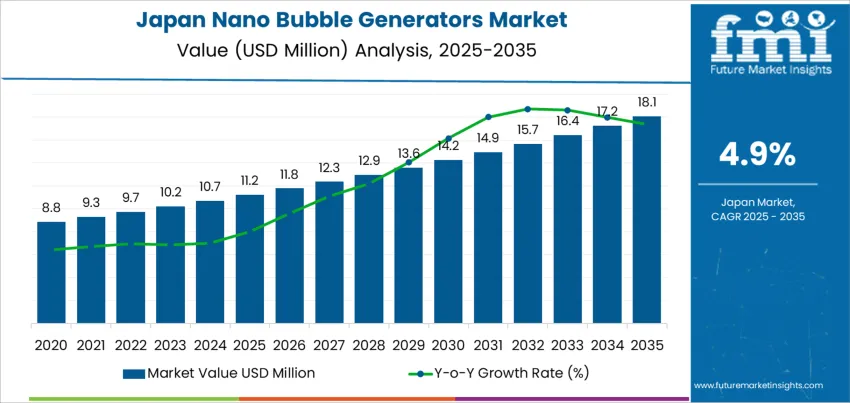
What is the Growth Forecast for the Nano Bubble Generators Industry in Japan through 2035?
The nano bubble generators market in Japan is expected to grow steadily over the next decade. Starting at USD 11.2 million in 2025, the market will gradually increase to USD 11.8 million in 2026 and USD 12.3 million in 2027. By 2029, demand will rise to USD 13.6 million, continuing to grow through the 2030s, with the market reaching USD 14.9 million by 2031 and USD 16.4 million by 2033. By 2035, the demand for nano bubble generators in Japan is forecasted to reach USD 18.1 million, driven by ongoing innovation and adoption in various applications, including agriculture, environmental sustainability, and industrial processes.
The compound absolute growth analysis reveals a consistent upward trend over the forecast period, with each year contributing to a stable increase in market value. The absolute growth from 2025 to 2035 is projected to be USD 6.9 million, indicating steady growth in the sector. This growth is driven by the expanding use of nano bubble technology across industries seeking improved operational efficiency and enhanced environmental benefits. Each year shows a gradual increase, with the overall market contributing steadily to the total growth, emphasizing the ongoing adoption of this technology in Japan's industrial landscape.
Key Takeaways of Nano Bubble Generators Industry in Japan
| Metric | Value |
|---|---|
| Industry Sales Value (2025) | USD 11.2 million |
| Industry Forecast Value (2035) | USD 18.1 million |
| Industry Forecast CAGR (2025-2035) | 4.9% |
Why is the Demand for Nano Bubble Generators in Japan Growing?
The demand for nano bubble generators in Japan is rising as multiple sectors increasingly adopt nano bubble technology for water treatment, agriculture, aquaculture, and industrial cleaning. Nano bubbles produce ultrafine gas bubbles that remain suspended in liquids, improving gas transfer efficiency and enhancing dissolved oxygen levels. This makes them well suited for wastewater treatment, industrial effluent management, and water purification tasks-needs that are growing as Japan modernizes infrastructure and strengthens environmental regulation. The technology’s ability to improve water quality and reduce dependence on chemical treatments drives interest among municipal utilities, industrial plants and environmental service providers.
At the same time agriculture, aquaculture and high tech industries in Japan are contributing to rising demand. In agriculture and irrigation, nano bubble systems help improve oxygenation and nutrient uptake in soil and water, boosting crop yields and reducing chemical input. Fish farms and aquaculture operations use nano bubbles to maintain dissolved oxygen levels, promote aquatic health, and support efficient, sustainable fish production. These advantages support demand in aquaculture and agriculture where efficiency and eco friendly practices are increasingly valued. In addition, industries requiring high purity water-such as semiconductor manufacturing, electronics, and food processing-are exploring nano bubble generators for water cleaning, sterilization, and process water treatment, leveraging the technology’s micro bubble behaviour for improved contaminant removal. As environmental awareness, resource efficiency needs, and regulatory pressure increase across sectors, the market for nano bubble generators in Japan is likely to expand steadily in coming years.
What Is the Current State of the Demand for Nano Bubble Generators in Japan in Terms of Product Types and Technologies?
The demand for nano bubble generators in Japan is primarily driven by product types and technologies. The leading product type is gas-water circulation type, capturing 60% of the market share, while gas injection nano bubble generation is the dominant technology, accounting for 35% of the demand. Nano bubble generators are used in various applications, including water treatment, agriculture, and industrial cleaning, where they help improve efficiency, enhance oxygenation, and increase chemical reaction rates. The increasing interest in sustainable and efficient technologies continues to drive demand for these systems.
How Is Gas-Water Circulation Type Leading the Demand for Nano Bubble Generators in Japan?
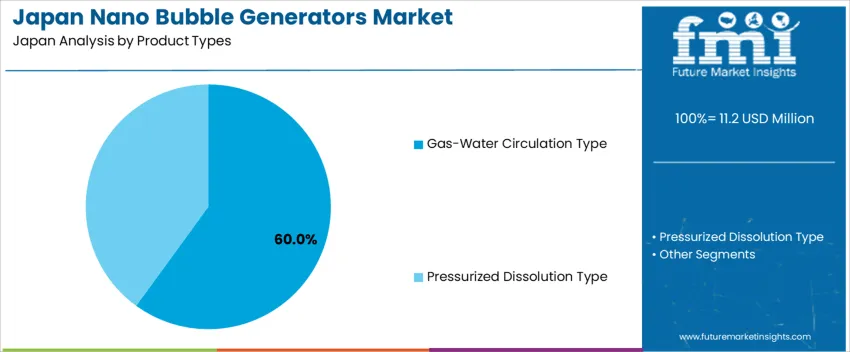
Gas-water circulation type nano bubble generators lead the demand in Japan, holding 60% of the market share. This type of system works by circulating gas and water to produce nano-sized bubbles that are dispersed throughout the liquid. The gas-water circulation method is widely used because it is efficient in producing a high concentration of nano bubbles, which can enhance oxygen transfer in water, improve water quality, and optimize various industrial processes.
The demand for gas-water circulation type systems is driven by their versatility and effectiveness in a wide range of applications. These systems are used in water treatment, aquaculture, agriculture, and even in the food and beverage industry for tasks such as cleaning and oxygenation. The ease of integration into existing infrastructure, combined with their ability to deliver consistent and high concentrations of nano bubbles, ensures that gas-water circulation type generators remain the preferred choice in Japan. As industries continue to look for innovative and sustainable technologies, this product type is expected to continue leading the market.
How Is Gas Injection Nano Bubble Generation Leading the Technology Demand for Nano Bubble Generators in Japan?
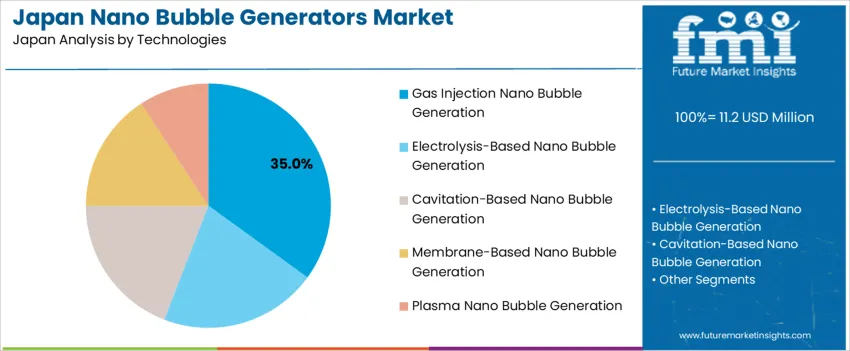
Gas injection nano bubble generation leads the demand for technologies in nano bubble generators in Japan, capturing 35% of the market share. This technology works by injecting gas into water under specific conditions to produce extremely small bubbles. The gas injection method is highly efficient and is known for its ability to generate a stable concentration of nano bubbles, which are ideal for enhancing processes like water purification, wastewater treatment, and agricultural applications.
The demand for gas injection nano bubble generation is driven by its ability to provide precise control over bubble size and concentration, making it ideal for applications where uniformity and efficiency are critical. It is particularly valued for its effectiveness in water treatment processes, where the introduction of nano bubbles helps to improve oxygenation, accelerate chemical reactions, and enhance the removal of contaminants. As the demand for environmentally friendly and high-efficiency technologies grows across industries, gas injection nano bubble generation is expected to remain the leading technology in Japan's growing nano bubble generator market.
What is the Summary of Demand for Nano Bubble Generators in Japan?
The demand for nano bubble generators in Japan is growing as industries such as water treatment, aquaculture, agriculture, and industrial cleaning increasingly adopt this technology. Nano bubbles enhance water quality, improve oxygen levels, and reduce the need for chemicals, which aligns with environmental regulations and sustainability efforts. These systems are gaining popularity in aquaculture for better fish yields and in agriculture for improved crop growth. With tightening environmental standards and increasing interest in more efficient water treatment processes, the demand for nano bubble generators in Japan is expected to expand steadily over the coming years.
What are the Drivers of Demand for Nano Bubble Generators in Japan?
Several key factors are driving the demand for nano bubble generators in Japan. First, the increasing need for effective water treatment solutions in wastewater management and aquaculture is a major driver. Nano bubbles enhance oxygen levels in water, making them particularly beneficial for aquaculture, where they improve fish health and yield. In agriculture, nano bubble technology helps improve plant growth and nutrient uptake. Additionally, environmental regulations encouraging the reduction of chemicals in water treatment systems are fueling interest in alternative technologies like nano bubbles. These factors, along with a growing demand for sustainable practices, support the adoption of nano bubble generators.
What are the Restraints on Demand for Nano Bubble Generators in Japan?
Despite the growing demand, several restraints limit the adoption of nano bubble generators in Japan. One key issue is the high initial cost of purchasing and installing these systems, which can be prohibitive for smaller operations. The technology's long-term effectiveness on a large scale is still being studied, leading to hesitation among potential users. Many industries continue to rely on traditional, well-established methods for water treatment and may be reluctant to switch due to uncertainty around the return on investment. Additionally, the complexity of retrofitting existing infrastructure with nano bubble systems can deter adoption, especially in older facilities.
What are the Key Trends Influencing Demand for Nano Bubble Generators in Japan?
Several key trends are shaping the demand for nano bubble generators in Japan. One significant trend is the growing adoption of these systems across various sectors such as aquaculture, agriculture, and industrial cleaning, where they are valued for their ability to improve water quality and reduce chemical use. Additionally, there is increasing interest in high-efficiency nano bubble systems that consume less energy while providing better performance. The shift towards retrofitting existing infrastructure rather than requiring full replacements is another trend driving adoption. Furthermore, ongoing research and development are improving the technology’s efficiency and expanding its applications, which will further increase its use in Japan.
What is the Regional Demand Outlook for Nano Bubble Generators in Japan?
The demand for nano bubble generators in Japan is growing steadily, with Kyushu & Okinawa leading at a CAGR of 6.1%. Kanto follows with a CAGR of 5.6%, driven by industrial and environmental applications. Kinki shows moderate growth at 4.9%, while Chubu, Tohoku, and the Rest of Japan show slower growth, with respective CAGRs of 4.3%, 3.8%, and 3.6%. These regional differences reflect varying levels of industrial and environmental activity, as well as growing awareness of nano bubble technology in sectors like aquaculture and wastewater treatment.
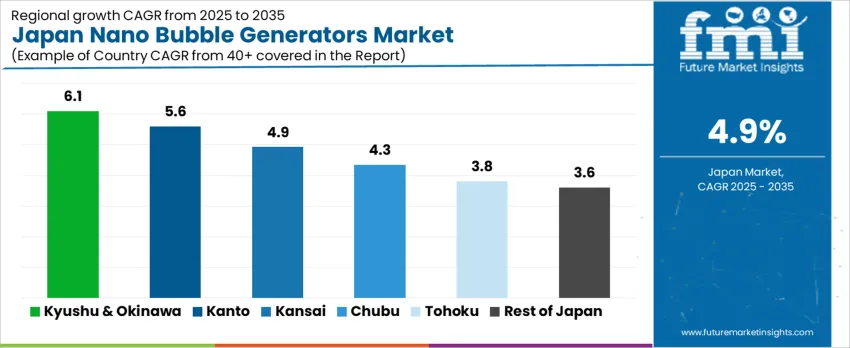
| Region | CAGR (%) |
|---|---|
| Kyushu & Okinawa | 6.1 |
| Kanto | 5.6 |
| Kinki | 4.9 |
| Chubu | 4.3 |
| Tohoku | 3.8 |
| Rest of Japan | 3.6 |
What factors are driving the demand for nano bubble generators in Kyushu & Okinawa?
The demand for nano bubble generators in Kyushu & Okinawa is projected to grow at a CAGR of 6.1%, driven by the region’s focus on sustainable aquaculture and water treatment. These areas, known for their fisheries and coastal industries, require efficient oxygenation and water purification systems. Nano bubble technology is becoming increasingly popular as it improves water quality and reduces the need for chemicals in both agricultural and industrial applications. The region's efforts to preserve its natural resources also contribute to the rising adoption of this technology.
Why is the demand for nano bubble generators increasing in Kanto?
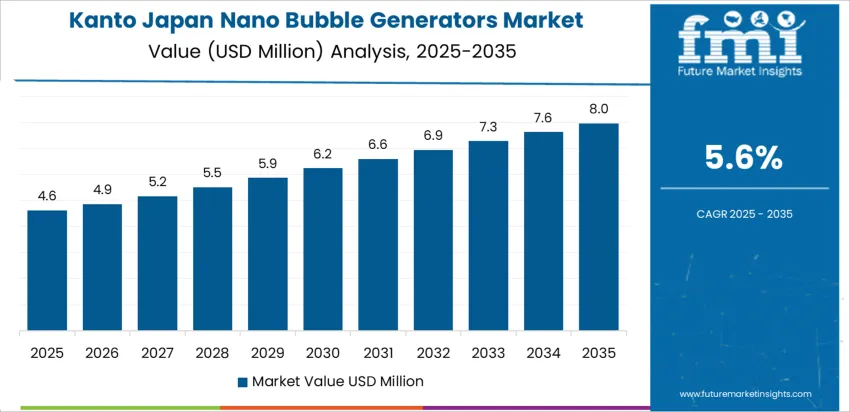
In Kanto, the demand for nano bubble generators is expected to grow at a CAGR of 5.6%, driven by the region’s industrial sector and commitment to sustainability. Kanto, home to Tokyo and several major manufacturing hubs, has a high demand for advanced water treatment solutions and more efficient industrial processes. As regulations around water pollution tighten and industries seek ways to reduce chemical use, nano bubble generators offer a promising solution. Additionally, the growth in environmental awareness among consumers and industries contributes to the rising adoption of this technology.
What influences the demand for nano bubble generators in Kinki?
In Kinki, the demand for nano bubble generators is projected to grow at a CAGR of 4.9%, supported by the region’s industrial activities and sustainable agricultural practices. Kinki, including major cities like Osaka, has a strong manufacturing base, particularly in food processing, chemicals, and textiles, where nano bubble generators can improve water quality and process efficiency. The region’s focus on reducing environmental impact and increasing the use of non chemical treatments is driving the demand for nano bubbles in both industrial and agricultural applications.
How is the demand for nano bubble generators growing in Chubu?
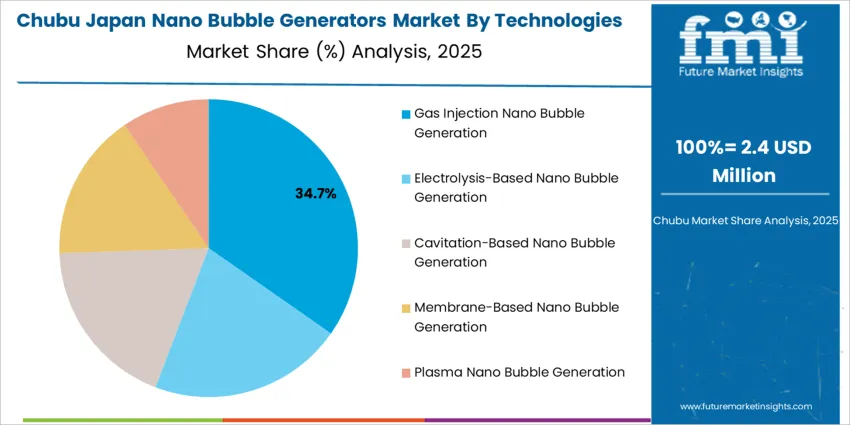
The demand for nano bubble generators in Chubu is expected to grow at a CAGR of 4.3%, influenced by the region’s industrial and environmental needs. Chubu, home to Nagoya and other industrial centers, is an important hub for automotive and manufacturing sectors that require efficient water management and wastewater treatment. As industries in the region increasingly adopt eco friendly technologies, nano bubble generators are becoming a preferred solution for improving water quality and reducing the environmental footprint. The slow but steady growth in demand reflects the region’s focus on industrial optimization and sustainability.
What factors are influencing the demand for nano bubble generators in Tohoku?
In Tohoku, the demand for nano bubble generators is projected to grow at a CAGR of 3.8%, reflecting moderate adoption. While the region has a less developed industrial base compared to more urbanized areas, there is a growing interest in sustainable agriculture and water treatment solutions. Nano bubble generators are being adopted in aquaculture and small-scale farming operations to enhance water quality and promote healthier environments. As Tohoku continues to modernize its agricultural practices and focus on environmental sustainability, demand for these systems will gradually rise.
How is the demand for nano bubble generators evolving in the Rest of Japan?
In the Rest of Japan, the demand for nano bubble generators is expected to grow at a CAGR of 3.6%, driven by smaller-scale industrial and agricultural applications. Although the region is less industrialized, the growing awareness of environmental issues and the need for more efficient water treatment solutions are contributing to a steady increase in demand. The adoption of nano bubble technology in local farming, aquaculture, and environmental applications is helping improve productivity and reduce water contamination, leading to moderate growth in the demand for nano bubble generators.
How Are Companies Competing in the Nano Bubble Generators Market in Japan?
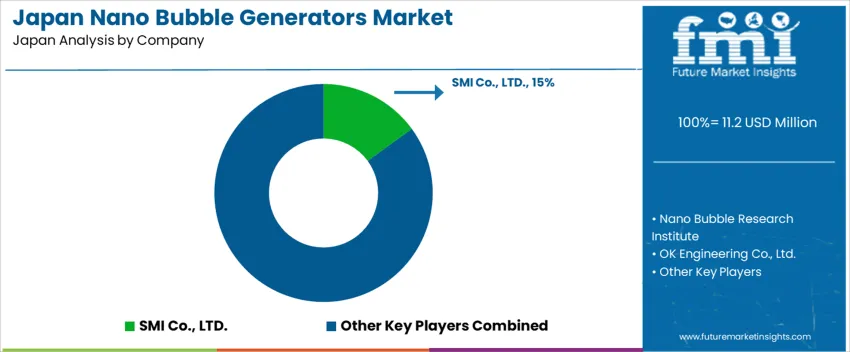
Demand for nano bubble generators in Japan is rising as industries in water treatment, aquaculture, agriculture, and environmental management seek more efficient oxygenation and cleaning technologies. Companies such as SMI Co., Ltd. (holding approximately 15% market share), Nano Bubble Research Institute, OK Engineering Co., Ltd., LIVING ENERGIES & Co., NAC Co., Ltd., and Kaku-Ichi Aqua Solution are active suppliers. These firms provide equipment that generates ultra-fine bubbles for enhanced gas–liquid transfer, improved water quality, and reduced chemical usage in diverse applications. As environmental regulations tighten and stakeholders prioritize water efficiency, demand for nano bubble systems has increased across both commercial and municipal sectors.
Competition in this market is shaped by generator performance, adaptability to application, and after sales support. Providers emphasize bubble size control, oxygen transfer efficiency, energy consumption, and compatibility with different water chemistries. Some companies focus on modular designs that can scale from small aquaculture ponds to large wastewater treatment facilities. Another competitive element is ease of installation and maintenance, especially for clients transitioning from traditional aeration systems. Firms that combine technical performance with reliable local support and demonstration data tend to win larger contracts. Marketing materials often reference dissolved oxygen levels, treatment throughput, energy use per cubic meter, and maintenance intervals. By aligning their offerings with Japan’s growing need for water efficient, eco conscious and cost effective treatment technologies, these companies aim to expand their presence in the Japanese nano bubble generators market.
Key Players of the Nano Bubble Generators Industry in Japan
- SMI Co., LTD.
- Nano Bubble Research Institute
- OK Engineering Co., Ltd.
- LIVING ENERGIES & Co.
- NAC Co., Ltd.
- Kaku-Ichi Aqua Solution
Scope of the Report
| Items | Details |
|---|---|
| Quantitative Units | USD Million |
| Regions Covered | Japan |
| Product Types | Gas-Water Circulation Type, Pressurized Dissolution Type |
| Technologies | Gas Injection Nano Bubble Generation, Electrolysis-Based Nano Bubble Generation, Cavitation-Based Nano Bubble Generation, Membrane-Based Nano Bubble Generation, Plasma Nano Bubble Generation |
| Application | Water Treatment, Agriculture, Healthcare and Medicine, Manufacturing, Food and Beverage Processing, Cosmetics and Personal Care |
| Key Companies Profiled | SMI Co., LTD., Nano Bubble Research Institute, OK Engineering Co., Ltd., LIVING ENERGIES & Co., NAC Co., Ltd., Kaku-Ichi Aqua Solution |
| Additional Attributes | The market analysis includes dollar sales by product type, technology, application, and company categories. It also covers regional demand trends in Japan, driven by the increasing adoption of nano bubble generators in water treatment, agriculture, and food and beverage processing. The competitive landscape highlights key manufacturers focusing on innovations in nano bubble generation technologies, such as electrolysis-based and plasma-based methods. Trends in the growing demand for nano bubble solutions across various industries, including healthcare, cosmetics, and manufacturing, are explored, along with advancements in technology that improve efficiency and effectiveness in generating nano bubbles for specialized applications. |
Key Segments of the Nano Bubble Generators Industry in Japan
Product Types:
- Gas-Water Circulation Type
- Pressurized Dissolution Type
Technologies:
- Gas Injection Nano Bubble Generation
- Electrolysis-Based Nano Bubble Generation
- Cavitation-Based Nano Bubble Generation
- Membrane-Based Nano Bubble Generation
- Plasma Nano Bubble Generation
Application:
- Water Treatment
- Agriculture
- Healthcare and Medicine
- Manufacturing
- Food and Beverage Processing
- Cosmetics and Personal Care
Region:
- Kyushu & Okinawa
- Kanto
- Kinki
- Chubu
- Tohoku
- Rest of Japan
Frequently Asked Questions
How big is the demand for nano bubble generators in Japan in 2025?
The demand for nano bubble generators in Japan is estimated to be valued at USD 11.2 million in 2025.
What will be the size of nano bubble generators in Japan in 2035?
The market size for the nano bubble generators in Japan is projected to reach USD 18.1 million by 2035.
How much will be the demand for nano bubble generators in Japan growth between 2025 and 2035?
The demand for nano bubble generators in Japan is expected to grow at a 4.9% CAGR between 2025 and 2035.
What are the key product types in the nano bubble generators in Japan?
The key product types in nano bubble generators in Japan are gas-water circulation type and pressurized dissolution type.
Which technologies segment is expected to contribute significant share in the nano bubble generators in Japan in 2025?
In terms of technologies, gas injection nano bubble generation segment is expected to command 35.0% share in the nano bubble generators in Japan in 2025.
Preview the report firsthand - request a free sample
Get SampleGet the brochure for pricing and purchase details.
Get PDFTable of Content
- Executive Summary
- Japan Market Outlook
- Demand-side Trends
- Supply-side Trends
- Technology Roadmap Analysis
- Analysis and Recommendations
- Market Overview
- Market Coverage / Taxonomy
- Market Definition / Scope / Limitations
- Market Background
- Market Dynamics
- Drivers
- Restraints
- Opportunity
- Trends
- Scenario Forecast
- Demand in Optimistic Scenario
- Demand in Likely Scenario
- Demand in Conservative Scenario
- Opportunity Map Analysis
- Product Life Cycle Analysis
- Supply Chain Analysis
- Investment Feasibility Matrix
- Value Chain Analysis
- PESTLE and Porter’s Analysis
- Regulatory Landscape
- Regional Parent Market Outlook
- Production and Consumption Statistics
- Import and Export Statistics
- Market Dynamics
- Japan Market Analysis 2020 to 2024 and Forecast, 2025 to 2035
- Historical Market Size Value (USD Million) Analysis, 2020 to 2024
- Current and Future Market Size Value (USD Million) Projections, 2025 to 2035
- Y-o-Y Growth Trend Analysis
- Absolute $ Opportunity Analysis
- Japan Market Pricing Analysis 2020 to 2024 and Forecast 2025 to 2035
- Japan Market Analysis 2020 to 2024 and Forecast 2025 to 2035, By Product Types
- Introduction / Key Findings
- Historical Market Size Value (USD Million) Analysis By Product Types , 2020 to 2024
- Current and Future Market Size Value (USD Million) Analysis and Forecast By Product Types , 2025 to 2035
- Gas-Water Circulation Type
- Pressurized Dissolution Type
- Y-o-Y Growth Trend Analysis By Product Types , 2020 to 2024
- Absolute $ Opportunity Analysis By Product Types , 2025 to 2035
- Japan Market Analysis 2020 to 2024 and Forecast 2025 to 2035, By Technologies
- Introduction / Key Findings
- Historical Market Size Value (USD Million) Analysis By Technologies, 2020 to 2024
- Current and Future Market Size Value (USD Million) Analysis and Forecast By Technologies, 2025 to 2035
- Gas Injection Nano Bubble Generation
- Electrolysis-Based Nano Bubble Generation
- Cavitation-Based Nano Bubble Generation
- Membrane-Based Nano Bubble Generation
- Plasma Nano Bubble Generation
- Y-o-Y Growth Trend Analysis By Technologies, 2020 to 2024
- Absolute $ Opportunity Analysis By Technologies, 2025 to 2035
- Japan Market Analysis 2020 to 2024 and Forecast 2025 to 2035, By Application
- Introduction / Key Findings
- Historical Market Size Value (USD Million) Analysis By Application, 2020 to 2024
- Current and Future Market Size Value (USD Million) Analysis and Forecast By Application, 2025 to 2035
- Water Treatment
- Agriculture
- Healthcare and Medicine
- Manufacturing
- Food and Beverage Processing
- Cosmetics and Personal Care
- Y-o-Y Growth Trend Analysis By Application, 2020 to 2024
- Absolute $ Opportunity Analysis By Application, 2025 to 2035
- Market Structure Analysis
- Competition Dashboard
- Competition Benchmarking
- Market Share Analysis of Top Players
- By Regional
- By Product Types
- By Technologies
- By Application
- Competition Analysis
- Competition Deep Dive
- SMI Co., LTD.
- Overview
- Product Portfolio
- Profitability by Market Segments (Product/Age /Sales Channel/Region)
- Sales Footprint
- Strategy Overview
- Marketing Strategy
- Product Strategy
- Channel Strategy
- Nano Bubble Research Institute
- OK Engineering Co., Ltd.
- LIVING ENERGIES & Co.
- NAC Co., Ltd.
- Kaku-Ichi Aqua Solution
- SMI Co., LTD.
- Competition Deep Dive
- Assumptions & Acronyms Used
- Research Methodology


