

- Industry Size (2026)
- USD 105 Mn
- Forecast (2036)
- USD 292.8 Mn
- CAGR (2026 to 2036)
- 10.8%
National Grant-Funded rHDPE Innovation Projects Market Forecast and Outlook 2026 to 2036
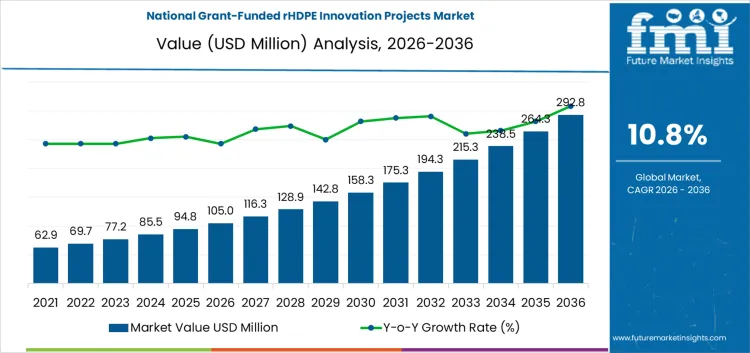
The national grant funded rHDPE innovation projects market is valued at USD 105 million in 2026 and is projected to reach USD 292.8 million by 2036, reflecting a CAGR of 10.8%. Growth is influenced by concentrated regional funding programs favoring areas with strong research infrastructure and supportive regulatory frameworks. Adoption rates vary as some regions prioritize circular economy mandates while others progress gradually due to administrative or logistical barriers. Cost advantages accrue in geographies with lower operational expenses, established feedstock networks, and proximity to technical expertise, allowing select project hubs to scale more efficiently than dispersed initiatives.
Between 2026 and 2036, uneven uptake persists, as grant intensity and local policy frameworks dictate project viability. Regions with high grant density capture disproportionate value and attract complementary private investments. Infrastructure readiness and skilled workforce availability further concentrate benefits, while peripheral regions face slower project implementation. Project outcomes rely on efficient coordination of local incentives, technical execution, and regulatory compliance. Operators managing multi region collaborations maintain higher margin resilience and consistent progress toward scale, whereas fragmented programs exhibit delayed ramp ups and weaker value realization.
Quick Stats for National Grant-Funded rHDPE Innovation Projects Market
- National Grant-Funded rHDPE Innovation Projects Market Value (2026): USD 105 million
- National Grant-Funded rHDPE Innovation Projects Market Forecast Value (2036): USD 292.8 million
- National Grant-Funded rHDPE Innovation Projects Market Forecast CAGR (2026 to 2036): 10.8%
- Leading Type in National Grant-Funded rHDPE Innovation Projects Market: Post-consumer rHDPE collection and recycling
- Key Growth Regions in National Grant-Funded rHDPE Innovation Projects Market: Asia Pacific, Europe, and North America
- Top Players in National Grant-Funded rHDPE Innovation Projects Market: Veolia, KW Plastics, Plastipak Holdings, Envision Plastics, ALPLA Group, Biffa, Indorama Ventures
What Is the Growth Forecast for National Grant-Funded rHDPE Innovation Projects Market through 2036?
The national grant-funded rHDPE innovation projects market is valued at USD 105 million in 2026 and is projected to reach USD 292.8 million by 2036, reflecting a CAGR of 10.8%. Growth over this period is shaped by increased government and industry support for circular economy initiatives, targeted innovation funding, and the scaling of pilot projects into commercial demonstration. Cost structures are influenced by project complexity, regulatory compliance requirements, and multi-year research funding cycles. Value capture favors organizations demonstrating measurable technical improvements, validated quality assurance processes, and scalable recycling or additive integration methods rather than those focused solely on raw throughput.
Between 2026 and 2036, market outcomes are driven by collaboration between recyclers, technology developers, and packaging manufacturers. Post-consumer rHDPE collection and recycling projects account for 44% of funded initiatives, while food-grade packaging applications hold 42% of use focus. Innovation projects emphasizing process optimization, pilot-scale testing, material characterization, and additive development capture stronger long-term support. Companies such as Veolia, KW Plastics, Plastipak Holdings, Envision Plastics, ALPLA Group, Biffa, and Indorama Ventures strengthen positioning by aligning grant objectives with demonstrable improvements in recyclate quality, processing efficiency, and regulatory compliance, ensuring sustainable adoption across multiple rHDPE applications.
National Grant Funded rHDPE Innovation Projects Market Key Takeaways
| Metric | Value |
|---|---|
| Market Value (2026) | USD 105 million |
| Forecast Value (2036) | USD 292.8 million |
| Forecast CAGR (2026 to 2036) | 10.8% |
What Role Do National Grant-Funded Initiatives Play in Advancing rHDPE Recycling Innovation?
Government supported rHDPE innovation projects focus on de risking novel recycling technologies and improving material circularity. Historically, small scale experiments addressed technical hurdles such as polymer degradation, contaminant removal, and food contact compliance, but lacked funding for broader implementation. Grant programs target pilot and demonstration projects that validate mechanical and chemical recycling methods, assess solvent cleaning efficacy, and optimize feedstock logistics. Funding prioritizes collaboration between research institutes, recyclers, and packaging producers.
Outcomes inform policy development, technical standards, and regulatory pathways. Public investment also offsets early stage capital requirements, encouraging private sector participation. Evaluation metrics emphasize recyclate quality, process efficiency, and environmental impact rather than immediate commercial profit, shaping priorities across national innovation agendas.
Future activity is influenced by regulatory mandates, national circular economy goals, and funding cycle structures rather than market demand alone. Adoption accelerates where validated project outcomes demonstrate reliable feedstock handling, polymer property retention, and integration potential with existing industrial operations.
Compared with prior unsponsored trials, grant funded projects embed structured reporting, performance benchmarking, and independent verification. Cost exposure remains limited for participating recyclers, while knowledge transfer spreads technological capability across regions. Collaboration frameworks ensure reproducibility and scalability of novel processes, while policy alignment fosters alignment with recycled content targets. Successful projects generate both intellectual property and operational blueprints, laying the groundwork for commercial scale rHDPE recycling under evolving regulatory landscapes.
What Factors Are Shaping the Demand for National Grant Funded rHDPE Innovation Projects in Terms of Project Type and Application?
The demand for national grant funded rHDPE innovation projects is segmented by project type and application focus. Project type segmentation reflects areas supported by government or institutional funding, including post-consumer rHDPE collection and recycling, process optimization and pilot scale testing, material characterization and quality assurance, and additive or compatibilizer development. Application segmentation highlights where the resulting outputs are applied, such as food grade packaging, non-food rigid packaging, industrial components, and construction or pipe systems. Segment selection is guided by regulatory priorities, technical feasibility, and alignment with circular economy objectives. Demand is driven by funding availability, policy incentives, and the strategic importance of demonstrating scalable and compliant rHDPE processes.
What Is Driving the Leading Focus on Post-Consumer rHDPE Collection and Recycling in Grant Funded Projects?
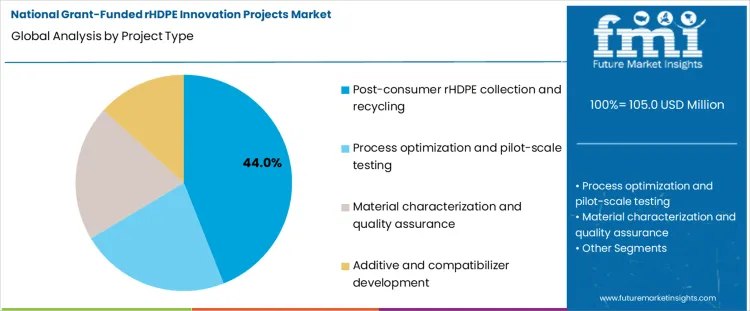
Post-consumer rHDPE collection and recycling accounts for 44% of total project focus, making it the leading category. This share reflects the central role of collection systems in supplying clean, traceable feedstock for recycled applications. Funded projects prioritize developing efficient sorting, cleaning, and logistics systems to maximize recovery rates and minimize contamination. Collection initiatives also support compliance with PPWR and other regulatory mandates for recycled content in packaging. The emphasis is on creating scalable, replicable systems that can feed downstream recycling processes.
Demand for post-consumer collection projects is driven by both material availability and environmental objectives. Establishing robust collection infrastructure enables reliable supply for industrial and food grade applications. Projects also explore optimization of transportation, storage, and pre processing efficiency to reduce costs and environmental impact. Investment in collection systems is favored because it underpins the success of subsequent recycling stages and ensures that grant outcomes meet policy and compliance goals. The segment leads due to its foundational importance in building a functional rHDPE circular economy.
Why Does Food Grade Packaging Represent the Largest Application Segment in Grant Funded rHDPE Innovation Projects?
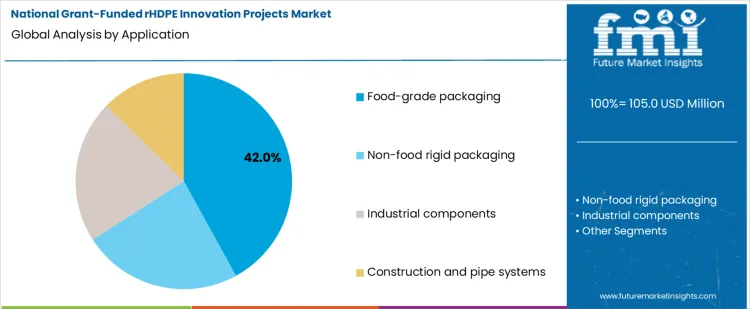
Food grade packaging represents 42% of total application demand, making it the largest end use segment. This share reflects the regulatory and commercial emphasis on integrating recycled HDPE into food contact containers, bottles, and closures. Grant funded projects prioritize food grade applications to demonstrate compliance with safety standards, material performance, and traceability. Food packaging provides high visibility for recycled content adoption and establishes benchmarks for broader material uptake.
Demand for food grade packaging projects is shaped by regulatory compliance, risk mitigation, and the potential for scaling proven solutions. Projects focus on testing decontamination, melt stability, and additive performance to meet stringent food safety requirements. Brand owners and regulators view successful pilot results as validation for wider commercial integration. The segment leads because food grade packaging combines high material throughput, strict compliance needs, and strategic relevance, making it the primary target for grant supported rHDPE innovation projects.
How is national grant funded rHDPE innovation projects shaping recycled polymer adoption strategies?
National grant funded rHDPE innovation projects are accelerating development of compliant recycling pathways by reducing financial risk for early stage technologies. Funding concentrates on process optimization, contaminant removal, and traceability solutions aligned with domestic recycled content regulations. Projects often target high priority sectors such as food contact packaging or multilayer films. Grants enable pilot and demonstration plants to validate process performance under local waste profiles. Adoption reflects risk mitigation and regulatory alignment rather than market demand expansion. Outcomes influence policy interpretation, provide technical evidence for standards, and support technology transfer to commercial recyclers within national boundaries.
Why do local policy objectives and funding incentives drive investment in rHDPE innovation projects?
Demand is driven by government priorities to increase recycled content use and meet circular economy targets. National programs provide grants to offset capital and operational costs of pilot or demonstration initiatives. Brand owners and recyclers engage with funded projects to access process validation and compliance guidance. The driver is policy alignment rather than commercial margin improvement. Successful projects establish technology credibility, creating preferential adoption pathways for domestic converters. Local incentives, combined with structured reporting requirements, reinforce project selection and execution, linking innovation directly to enforceable regulatory frameworks and national recycled material targets.
What operational and structural barriers slow the impact of grant funded rHDPE projects?
Barriers include project timeline constraints, reporting obligations, and limited scalability of pilot initiatives. Some funded projects struggle with feedstock variability, reducing reproducibility. High technical complexity and specialized staff requirements raise operational costs despite grant support. Regulatory approval may lag project completion, limiting commercial deployment speed. Coordination across multiple stakeholders, including universities, recyclers, and brand owners, introduces organizational friction. These factors constrain the immediate effect of grant funded projects on broader industrial adoption, with tangible impact often delayed until demonstration results are integrated into certified commercial processes.
How are collaboration and project structuring trends evolving in national rHDPE innovation initiatives?
Trends indicate increased integration between academic institutions, recyclers, and packaging brand owners. Multi partner consortia allow knowledge sharing, risk distribution, and early alignment with regulatory expectations. Funding structures now favor staged milestones, emphasizing demonstrable process performance and compliance data. Digital traceability and analytical monitoring are becoming standard to validate outcomes. Some projects incorporate pilot scale validation directly into grant requirements. The trend emphasizes evidence generation and operational transferability over rapid commercialization. Success is measured by reproducible, compliant process outcomes that can be scaled into industrial operations within nationally defined regulatory frameworks.
What is the Demand for National Grant-Funded rHDPE Innovation Projects by Country?
| Country | CAGR (%) |
|---|---|
| USA | 8.1% |
| UK | 7.7% |
| China | 10.0% |
| India | 11.5% |
| Brazil | 9.1% |
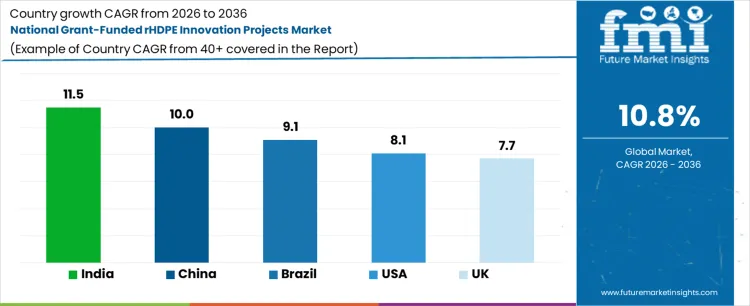
Demand for national grant-funded rHDPE innovation projects is rising as governments and industry collaborate to advance high-purity recycling technologies and circular economy targets. India leads with an 11.5% CAGR, supported by domestic policy incentives, rapid expansion of rHDPE infrastructure, and grants targeting solvent-based and food-grade recycling processes. China follows at 10%, driven by state-backed innovation hubs, pilot programs, and technology demonstration projects to increase recycled content in rigid and multilayer packaging. Brazil records 9.1% growth, reflecting targeted grants for beverage and personal care packaging recyclers. The USA grows at 8.1%, supported by federal and state funding initiatives for closed-loop rHDPE solutions. The UK shows moderate growth at 7.7%, shaped by selective grant allocation and technology validation projects within existing recycling networks.
How Are Federal Initiatives Driving rHDPE Innovation Projects in the United States?
In the United States, the national grant-funded rHDPE innovation projects market is expanding at a CAGR of 8.1%, supported by federal funding programs targeting advanced recycling technologies and sustainable packaging initiatives. Grants focus on process optimization, solvent-based and mechanical recycling integration, and pilot validation for food-grade and multilayer applications. Demand is concentrated among established recyclers and research institutions aiming to accelerate technology readiness while minimizing financial risk. Projects emphasize demonstration of compliance, material quality, and scalability rather than immediate commercial throughput. Innovation outcomes feed into national recycling infrastructure improvement and support domestic packaging industry competitiveness.
- Federal funding incentivizes development of advanced rHDPE recycling technologies.
- Grants prioritize pilot and demonstration projects over full-scale deployment.
- Research and industry collaboration accelerates process validation.
- Food-grade and multilayer applications drive project focus.
Why Are Policy-Linked Innovation Programs Expanding rHDPE Development in the United Kingdom?
Across the United Kingdom, the national grant-funded rHDPE innovation projects market is growing at a CAGR of 7.7%, driven by government-backed programs supporting circular economy objectives and recycled content integration. Projects focus on improving purification processes, yield enhancement, and standardization of feedstock for multilayer packaging. Funding schemes favor collaborative research between universities, recyclers, and converters. Demand emphasizes reproducible results, regulatory compliance, and integration into commercial operations. Growth reflects structured, policy-aligned innovation rather than rapid capacity expansion.
- Government-backed programs promote circular economy-focused projects.
- Collaboration between academia and industry is encouraged.
- Process standardization improves feedstock reliability.
- Funding supports reproducible and regulatory-compliant solutions.
How Is Export-Driven Packaging Manufacturing Shaping rHDPE Innovation in China?
China is witnessing strong growth in the national grant-funded rHDPE innovation projects market at a CAGR of 10%, fueled by programs supporting advanced recycling methods for export-oriented packaging. Grants target high-purity solvent-cleaned feedstock, multilayer compatibility, and process traceability. Recyclers and converters collaborate to meet international brand and regulatory requirements. Funding emphasizes rapid technology adoption, performance documentation, and scale-up readiness. Growth is primarily influenced by compliance expectations of overseas buyers rather than domestic regulations.
- Export-oriented packaging requirements drive innovation priorities.
- Grants support solvent-cleaned and multilayer-compatible feedstock development.
- Industry-university collaboration accelerates technical validation.
- Documentation and compliance readiness are central objectives.
Why Is Rapid Packaging Expansion Encouraging rHDPE Innovation Projects in India?
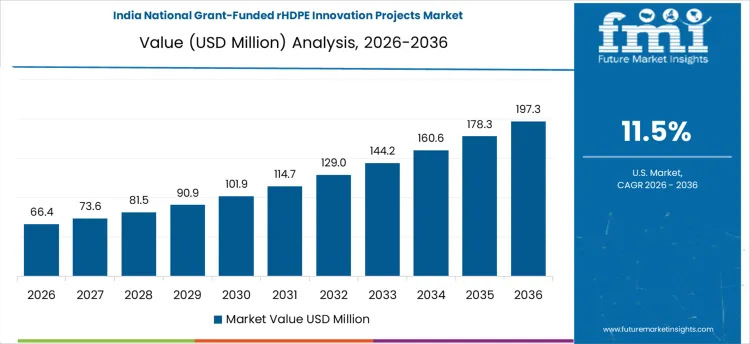
India shows the fastest growth in the national grant-funded rHDPE innovation projects market, expanding at a CAGR of 11.5%, driven by increasing packaged food and consumer goods production. Grants support pilot and demonstration projects for solvent-based recycling, multilayer integration, and quality assurance systems. Organized recyclers and research institutions collaborate to accelerate technology adoption while meeting international brand standards. Projects focus on scalable process validation and reproducibility rather than immediate mass production. Growth reflects both domestic capacity building and alignment with global sourcing expectations.
- Packaged goods expansion motivates innovation in recycling technologies.
- Pilot and demonstration projects are prioritized under grant schemes.
- Collaboration accelerates process validation and knowledge transfer.
- Multinational brand compliance influences project focus.
How Is Packaging Sector Modernization Sustaining Innovation Projects in Brazil?
Brazil is experiencing steady growth in the national grant-funded rHDPE innovation projects market at a CAGR of 9.1%, supported by modernization initiatives in the domestic recycling and packaging sector. Grants fund pilot-scale solvent cleaning, multilayer feedstock development, and integration testing for compliance with international standards. Recycling operators and converters collaborate to improve process reliability and material quality. Investment emphasizes risk reduction, proof-of-concept, and documentation rather than immediate volume expansion. Growth is concentrated in industrial clusters supplying multinational consumer goods brands.
- Industrial modernization drives investment in grant-funded projects.
- Collaboration between recyclers and converters ensures practical outcomes.
- Pilot-scale validation and quality improvement are primary objectives.
- International brand requirements guide project selection and priorities.
How Are National Grant-Funded Projects Advancing rHDPE Recycling Innovation?
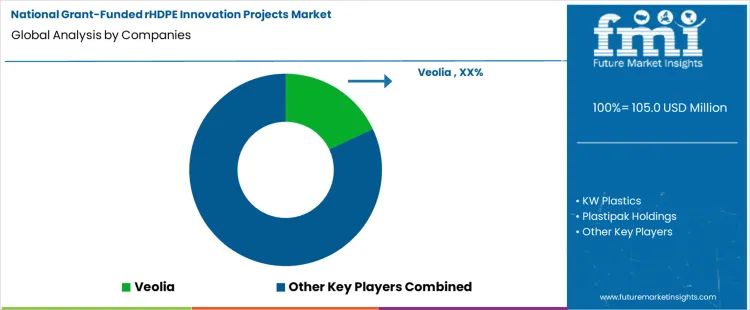
National grant-funded rHDPE innovation projects are expanding as governments and industry partners prioritize circular economy targets, recycled content mandates, and material traceability. Funding programs support pilot trials, process optimization, and validation of high quality recycled HDPE suitable for food and consumer packaging.
Research focuses on decontamination efficiency, polymer property retention, and integration with industrial scale converters. Projects encourage collaboration among recyclers, technology developers, and packaging manufacturers to align innovations with regulatory and sustainability requirements. Firms such as Veolia and KW Plastics participate through demonstration initiatives that validate advanced sorting, washing, and extrusion approaches for consistent rHDPE output.
The landscape includes diverse participants contributing complementary capabilities. Plastipak Holdings and Envision Plastics focus on scaling innovative feedstock processing within circular packaging supply chains. ALPLA Group and Biffa provide infrastructure, collection integration, and regional deployment support.
Indorama Ventures participates in material validation and process adaptation to meet performance specifications. Projects succeed where funding drives rigorous testing, knowledge transfer, and process reproducibility. Adoption is supported by multi-stakeholder coordination, regulatory engagement, and technical guidance, enabling higher volumes of food grade compliant rHDPE in packaging applications.
Key Players in the National Grant-Funded rHDPE Innovation Projects Market
- Veolia
- KW Plastics
- Plastipak Holdings
- Envision Plastics
- ALPLA Group
- Biffa
- Indorama Ventures
Scope of the Report
| Items | Values |
|---|---|
| Quantitative Units (2026) | USD million |
| Project Type | Post-consumer rHDPE collection and recycling, Process optimization and pilot-scale testing, Material characterization and quality assurance, Additive and compatibilizer development |
| Application | Food-grade packaging, Non-food rigid packaging, Industrial components, Construction and pipe systems |
| Regions Covered | Asia Pacific, Europe, North America, Latin America, Middle East & Africa |
| Countries Covered | United States, United Kingdom, Germany, France, Italy, Spain, China, India, Japan, South Korea, Brazil, and other national innovation program regions |
| Key Companies Profiled | Veolia, KW Plastics, Plastipak Holdings, Envision Plastics, ALPLA Group, Biffa, Indorama Ventures |
| Additional Attributes | Dollar sales by project type and application, grant funding allocation and regional adoption trends, regulatory alignment and compliance demonstration, pilot and demonstration scale validation, process reproducibility and knowledge transfer, collaboration between recyclers, technology developers, and packaging manufacturers |
National Grant-Funded rHDPE Innovation Projects Market Segmentation
By Project Type:
- Post-consumer rHDPE collection and recycling
- Process optimization and pilot-scale testing
- Material characterization and quality assurance
- Additive and compatibilizer development
By Application:
- Food-grade packaging
- Non-food rigid packaging
- Industrial components
- Construction and pipe systems
By Region
- Asia Pacific
- China
- Japan
- South Korea
- India
- Australia & New Zealand
- ASEAN
- Rest of Asia Pacific
- Europe
- Germany
- United Kingdom
- France
- Italy
- Spain
- Nordic
- BENELUX
- Rest of Europe
- North America
- United States
- Canada
- Mexico
- Latin America
- Brazil
- Chile
- Rest of Latin America
- Middle East & Africa
- Kingdom of Saudi Arabia
- Other GCC Countries
- Turkey
- South Africa
- Other African Union
- Rest of Middle East & Africa
Frequently Asked Questions
How big is the national grant-funded rHDPE innovation projects market in 2026?
The global national grant-funded rHDPE innovation projects market is estimated to be valued at USD 105.0 million in 2026.
What will be the size of national grant-funded rHDPE innovation projects market in 2036?
The market size for the national grant-funded rHDPE innovation projects market is projected to reach USD 292.8 million by 2036.
How much will be the national grant-funded rHDPE innovation projects market growth between 2026 and 2036?
The national grant-funded rHDPE innovation projects market is expected to grow at a 10.8% CAGR between 2026 and 2036.
What are the key project types in the national grant-funded rHDPE innovation projects market?
The key project types in national grant-funded rHDPE innovation projects market are post-consumer rHDPE collection and recycling, process optimization and pilot-scale testing, material characterization and quality assurance and additive and compatibilizer development.
Which application segment will contribute significant share in the national grant-funded rHDPE innovation projects market in 2026?
In terms of application, food-grade packaging segment to command 42.0% share in the national grant-funded rHDPE innovation projects market in 2026.
Preview the report firsthand - request a free sample
Get SampleGet the brochure for pricing and purchase details.
Get PDFTable of Content
- Executive Summary
- Global Market Outlook
- Demand-side Trends
- Supply-side Trends
- Technology Roadmap Analysis
- Analysis and Recommendations
- Market Overview
- Market Coverage / Taxonomy
- Market Definition / Scope / Limitations
- Market Background
- Market Dynamics
- Drivers
- Restraints
- Opportunity
- Trends
- Scenario Forecast
- Demand in Optimistic Scenario
- Demand in Likely Scenario
- Demand in Conservative Scenario
- Opportunity Map Analysis
- Product Life Cycle Analysis
- Supply Chain Analysis
- Investment Feasibility Matrix
- Value Chain Analysis
- PESTLE and Porter’s Analysis
- Regulatory Landscape
- Regional Parent Market Outlook
- Production and Consumption Statistics
- Import and Export Statistics
- Market Dynamics
- Global Market Analysis 2021 to 2025 and Forecast, 2026 to 2036
- Historical Market Size Value (USD Million) Analysis, 2021 to 2025
- Current and Future Market Size Value (USD Million) Projections, 2026 to 2036
- Y-o-Y Growth Trend Analysis
- Absolute $ Opportunity Analysis
- Global Market Pricing Analysis 2021 to 2025 and Forecast 2026 to 2036
- Global Market Analysis 2021 to 2025 and Forecast 2026 to 2036, By Project Type
- Introduction / Key Findings
- Historical Market Size Value (USD Million) Analysis By Project Type , 2021 to 2025
- Current and Future Market Size Value (USD Million) Analysis and Forecast By Project Type , 2026 to 2036
- Post-consumer rHDPE collection and recycling
- Process optimization and pilot-scale testing
- Material characterization and quality assurance
- Additive and compatibilizer development
- Post-consumer rHDPE collection and recycling
- Y-o-Y Growth Trend Analysis By Project Type , 2021 to 2025
- Absolute $ Opportunity Analysis By Project Type , 2026 to 2036
- Global Market Analysis 2021 to 2025 and Forecast 2026 to 2036, By Application
- Introduction / Key Findings
- Historical Market Size Value (USD Million) Analysis By Application, 2021 to 2025
- Current and Future Market Size Value (USD Million) Analysis and Forecast By Application, 2026 to 2036
- Food-grade packaging
- Non-food rigid packaging
- Industrial components
- Construction and pipe systems
- Food-grade packaging
- Y-o-Y Growth Trend Analysis By Application, 2021 to 2025
- Absolute $ Opportunity Analysis By Application, 2026 to 2036
- Global Market Analysis 2021 to 2025 and Forecast 2026 to 2036, By Region
- Introduction
- Historical Market Size Value (USD Million) Analysis By Region, 2021 to 2025
- Current Market Size Value (USD Million) Analysis and Forecast By Region, 2026 to 2036
- North America
- Latin America
- Western Europe
- Eastern Europe
- East Asia
- South Asia and Pacific
- Middle East & Africa
- Market Attractiveness Analysis By Region
- North America Market Analysis 2021 to 2025 and Forecast 2026 to 2036, By Country
- Historical Market Size Value (USD Million) Trend Analysis By Market Taxonomy, 2021 to 2025
- Market Size Value (USD Million) Forecast By Market Taxonomy, 2026 to 2036
- By Country
- USA
- Canada
- Mexico
- By Project Type
- By Application
- By Country
- Market Attractiveness Analysis
- By Country
- By Project Type
- By Application
- Key Takeaways
- Latin America Market Analysis 2021 to 2025 and Forecast 2026 to 2036, By Country
- Historical Market Size Value (USD Million) Trend Analysis By Market Taxonomy, 2021 to 2025
- Market Size Value (USD Million) Forecast By Market Taxonomy, 2026 to 2036
- By Country
- Brazil
- Chile
- Rest of Latin America
- By Project Type
- By Application
- By Country
- Market Attractiveness Analysis
- By Country
- By Project Type
- By Application
- Key Takeaways
- Western Europe Market Analysis 2021 to 2025 and Forecast 2026 to 2036, By Country
- Historical Market Size Value (USD Million) Trend Analysis By Market Taxonomy, 2021 to 2025
- Market Size Value (USD Million) Forecast By Market Taxonomy, 2026 to 2036
- By Country
- Germany
- UK
- Italy
- Spain
- France
- Nordic
- BENELUX
- Rest of Western Europe
- By Project Type
- By Application
- By Country
- Market Attractiveness Analysis
- By Country
- By Project Type
- By Application
- Key Takeaways
- Eastern Europe Market Analysis 2021 to 2025 and Forecast 2026 to 2036, By Country
- Historical Market Size Value (USD Million) Trend Analysis By Market Taxonomy, 2021 to 2025
- Market Size Value (USD Million) Forecast By Market Taxonomy, 2026 to 2036
- By Country
- Russia
- Poland
- Hungary
- Balkan & Baltic
- Rest of Eastern Europe
- By Project Type
- By Application
- By Country
- Market Attractiveness Analysis
- By Country
- By Project Type
- By Application
- Key Takeaways
- East Asia Market Analysis 2021 to 2025 and Forecast 2026 to 2036, By Country
- Historical Market Size Value (USD Million) Trend Analysis By Market Taxonomy, 2021 to 2025
- Market Size Value (USD Million) Forecast By Market Taxonomy, 2026 to 2036
- By Country
- China
- Japan
- South Korea
- By Project Type
- By Application
- By Country
- Market Attractiveness Analysis
- By Country
- By Project Type
- By Application
- Key Takeaways
- South Asia and Pacific Market Analysis 2021 to 2025 and Forecast 2026 to 2036, By Country
- Historical Market Size Value (USD Million) Trend Analysis By Market Taxonomy, 2021 to 2025
- Market Size Value (USD Million) Forecast By Market Taxonomy, 2026 to 2036
- By Country
- India
- ASEAN
- Australia & New Zealand
- Rest of South Asia and Pacific
- By Project Type
- By Application
- By Country
- Market Attractiveness Analysis
- By Country
- By Project Type
- By Application
- Key Takeaways
- Middle East & Africa Market Analysis 2021 to 2025 and Forecast 2026 to 2036, By Country
- Historical Market Size Value (USD Million) Trend Analysis By Market Taxonomy, 2021 to 2025
- Market Size Value (USD Million) Forecast By Market Taxonomy, 2026 to 2036
- By Country
- Kingdom of Saudi Arabia
- Other GCC Countries
- Turkiye
- South Africa
- Other African Union
- Rest of Middle East & Africa
- By Project Type
- By Application
- By Country
- Market Attractiveness Analysis
- By Country
- By Project Type
- By Application
- Key Takeaways
- Key Countries Market Analysis
- USA
- Pricing Analysis
- Market Share Analysis, 2025
- By Project Type
- By Application
- Canada
- Pricing Analysis
- Market Share Analysis, 2025
- By Project Type
- By Application
- Mexico
- Pricing Analysis
- Market Share Analysis, 2025
- By Project Type
- By Application
- Brazil
- Pricing Analysis
- Market Share Analysis, 2025
- By Project Type
- By Application
- Chile
- Pricing Analysis
- Market Share Analysis, 2025
- By Project Type
- By Application
- Germany
- Pricing Analysis
- Market Share Analysis, 2025
- By Project Type
- By Application
- UK
- Pricing Analysis
- Market Share Analysis, 2025
- By Project Type
- By Application
- Italy
- Pricing Analysis
- Market Share Analysis, 2025
- By Project Type
- By Application
- Spain
- Pricing Analysis
- Market Share Analysis, 2025
- By Project Type
- By Application
- France
- Pricing Analysis
- Market Share Analysis, 2025
- By Project Type
- By Application
- India
- Pricing Analysis
- Market Share Analysis, 2025
- By Project Type
- By Application
- ASEAN
- Pricing Analysis
- Market Share Analysis, 2025
- By Project Type
- By Application
- Australia & New Zealand
- Pricing Analysis
- Market Share Analysis, 2025
- By Project Type
- By Application
- China
- Pricing Analysis
- Market Share Analysis, 2025
- By Project Type
- By Application
- Japan
- Pricing Analysis
- Market Share Analysis, 2025
- By Project Type
- By Application
- South Korea
- Pricing Analysis
- Market Share Analysis, 2025
- By Project Type
- By Application
- Russia
- Pricing Analysis
- Market Share Analysis, 2025
- By Project Type
- By Application
- Poland
- Pricing Analysis
- Market Share Analysis, 2025
- By Project Type
- By Application
- Hungary
- Pricing Analysis
- Market Share Analysis, 2025
- By Project Type
- By Application
- Kingdom of Saudi Arabia
- Pricing Analysis
- Market Share Analysis, 2025
- By Project Type
- By Application
- Turkiye
- Pricing Analysis
- Market Share Analysis, 2025
- By Project Type
- By Application
- South Africa
- Pricing Analysis
- Market Share Analysis, 2025
- By Project Type
- By Application
- USA
- Market Structure Analysis
- Competition Dashboard
- Competition Benchmarking
- Market Share Analysis of Top Players
- By Regional
- By Project Type
- By Application
- Competition Analysis
- Competition Deep Dive
- Veolia
- Overview
- Product Portfolio
- Profitability by Market Segments (Product/Age /Sales Channel/Region)
- Sales Footprint
- Strategy Overview
- Marketing Strategy
- Product Strategy
- Channel Strategy
- KW Plastics
- Plastipak Holdings
- Envision Plastics
- ALPLA Group
- Biffa
- Indorama Ventures
- Veolia
- Competition Deep Dive
- Assumptions & Acronyms Used
- Research Methodology


