

- Market Size (2026)
- USD 2.0 Bn
- Forecast (2036)
- USD 27.6 Bn
- CAGR (2026 to 2036)
- 30.0%
How big is the Naval Unmanned Surface Vessels (USV) Market in 2026?
Demand for naval unmanned surface vessels (USV) is projected to expand at 30.0% CAGR between 2026 and 2036, increasing valuation from USD 2.0 billion in 2026 to USD 27.6 billion by 2036.
Demand for naval unmanned surface vessels stands at USD 2.0 billion in 2026 and climbs to USD 27.6 billion by 2036, growing at a 30.0% CAGR, among the fastest growth rates in maritime defense hardware. Growth is driven by navies replacing crewed patrol and mine-countermeasure missions with unmanned platforms that cut personnel exposure in contested or high-risk waters, while extending surveillance and strike-support reach without adding to fleet manning requirements. Coastal patrol forces, larger navies pursuing distributed maritime operations, and border-security agencies are each adopting USVs for a distinct mix of reconnaissance, mine-hunting, and escort roles, which is pushing vendors to build platforms across a wider range of hull sizes rather than a single standard class.
Autonomy reliability in contested electronic environments, integration with existing fleet command systems, and the cost of hardening vessels against jamming and cyber threats work against faster fleet-wide adoption. Navies also weigh how a USV program fits alongside crewed vessels rather than replacing them outright, since doctrine for mixed manned-unmanned operations is still maturing in most forces. The stronger opportunities lie in swarming and multi-vessel coordination, modular payload systems that let one hull serve multiple mission types, and export programs aimed at smaller navies seeking maritime domain awareness without large crewed fleets. By type, size, component, end user, and business model, procurement paths and technical requirements differ enough to warrant separate treatment. Regionally, the United States and China lead on large-scale program investment, while several Middle Eastern and Asia-Pacific navies are moving quickly on smaller patrol-class USVs to extend coastal surveillance.
-market-value-analysis.webp "Naval Unmanned Surface Vessels (usv) Market Value Analysis")
Key Takeaways of Naval Unmanned Surface Vessels (USV) Market
- Demand for naval unmanned surface vessels is driven by maritime security priorities, with emphasis on persistent surveillance and operational efficiency supporting continued fleet expansion across naval forces.
- By type, attritable strike USVs are expected to lead with 38.0% share in 2026, reflecting naval priorities around intelligence missions and expendable strike capability.
- Small vessels (<12 m) are the dominant size segment, projected to hold 46.0% share in 2026, favored for maneuverability and deployment flexibility.
- Platforms are estimated to lead the component category with 50.0% share in 2026, remaining the primary investment area across autonomous vessel programs.
- Autonomous navigation, payload modularity, and communication security remain critical to program selection, supporting mission endurance and maritime reliability.
- The United States and Asia-Pacific are expected to remain key markets, with North America maintaining technology leadership while Asia-Pacific expands procurement through coastal security and defence capability enhancement.
- Competition centers on autonomous mission control, sensor integration, modular payload architecture, and lifecycle support, with vendors differentiating through integrated unmanned systems and long-term programme value.
Analyst Perspective
"The autonomous naval vessels market is evolving around operational readiness rather than platform sophistication alone. Naval forces are assessing autonomous systems on mission endurance, navigational resilience, and their ability to integrate with existing maritime operations under demanding conditions. Market momentum will be driven by proven deployment performance, secure autonomy, and sustained capability upgrades rather than feature expansion."
- Nikhil Kaitwade, Principal Consultant at FMI
How is the Naval Unmanned Surface Vessels (USV) Market segmented?
The naval unmanned surface vessels (USV) market is segmented by Type, Size, Component, End User, and Business Model, and Region.
Type includes attritable strike USVs. Size includes small (<12 m) USVs. Component includes platforms. End users include navies. Business model includes programs of record. Regional analysis covers North America, Latin America, Europe, East Asia, South Asia, Oceania, and the Middle East & Africa.
Why do attritable strike USVs lead by type?
-market-analysis-by-type.webp "Naval Unmanned Surface Vessels (usv) Market Analysis By Type")
Attritable strike USVs are prioritized where naval planners need lower-cost autonomous surface assets that can support distributed missions, force protection, and high-risk maritime operations without exposing crewed platforms.
- Attritable strike USVs lead type demand with a 38.0% share in 2026. Procurement interest is supported by distributed maritime operations, mission flexibility, and growing emphasis on autonomous surface platforms that can be fielded at scale.
- Manufacturers continue refining hull efficiency, autonomous navigation, and modular mission architecture to improve operational performance across coastal and offshore environments. Expanded payload compatibility further strengthens platform utilisation across changing mission profiles.
Why do small (<12 m) USVs lead by size?
-market-analysis-by-size.webp "Naval Unmanned Surface Vessels (usv) Market Analysis By Size")
Small (<12 m) USVs are easier to deploy from ports, patrol craft, and support vessels. Their lower operating complexity supports coastal monitoring, harbour security, and rapid mission trials across naval programmes.
- Small (<12 m) USVs account for 46.0% share in 2026. Navies favour compact unmanned platforms where launch flexibility, lower procurement cost, and rapid mission adaptation matter more than large payload capacity.
- Defence organisations increasingly integrate advanced radar, electro-optical sensors, satellite communications, and artificial intelligence to strengthen situational awareness throughout extended maritime operations.
Why do platforms account for the largest component share?
-market-analysis-by-component.webp "Naval Unmanned Surface Vessels (usv) Market Analysis By Component")
Platforms form the core value of USV procurement because hull design, autonomy-ready architecture, onboard power, and payload mounting determine operational reliability before mission systems are added.
- Platforms hold 50.0% share in 2026. Defence buyers evaluate hull durability, autonomy integration, communications readiness, and payload compatibility when approving unmanned surface vessel programmes.
- Platform selection is shaped by hull durability, mission-readiness, payload fit, autonomy integration, and long-term support requirements.
What are the drivers, restraints, and opportunities in the Naval Unmanned Surface Vessels (USV) Market?
Growing investment in maritime autonomy continues encouraging procurement of unmanned surface vessels across naval and security organisations. Complex integration requirements remain an important implementation challenge, whereas advances in artificial intelligence and autonomous navigation continue creating additional opportunities for future deployment.
- Driver: Defence organisations continue strengthening investment in autonomous maritime systems that improve surveillance capability and operational efficiency.
- Restraint: Integration with existing naval command networks and fleet infrastructure continues extending procurement and deployment programmes.
- Opportunity: Progress in autonomous navigation, intelligent mission management, and modular payload integration continues expanding future operational applications.
Maritime forces continue expanding unmanned capability to strengthen intelligence gathering, coastal monitoring, and force protection while reducing operational exposure for personnel. Autonomous surface vessels support longer deployment periods and continuous maritime observation across strategically important waterways.
Deployment programmes continue involving extensive technical validation before operational approval. Procurement authorities evaluate navigation resilience, cyber protection, communication security, environmental performance, payload flexibility, and long-term support capability before selecting autonomous vessel platforms. Multi-stage qualification therefore continues influencing procurement schedules across naval modernization programmes.
Artificial intelligence continues improving autonomous decision support, collision avoidance, route optimisation, and coordinated fleet operation. Advances in sensor fusion and autonomous mission software are enabling unmanned surface vessels to perform increasingly sophisticated maritime assignments with greater operational consistency. Companies delivering dependable autonomous capability together with adaptable platform architecture are expected to strengthen future commercial opportunities across naval security programmes.
Which country CAGRs are profiled in the Naval Unmanned Surface Vessels (USV) Market?
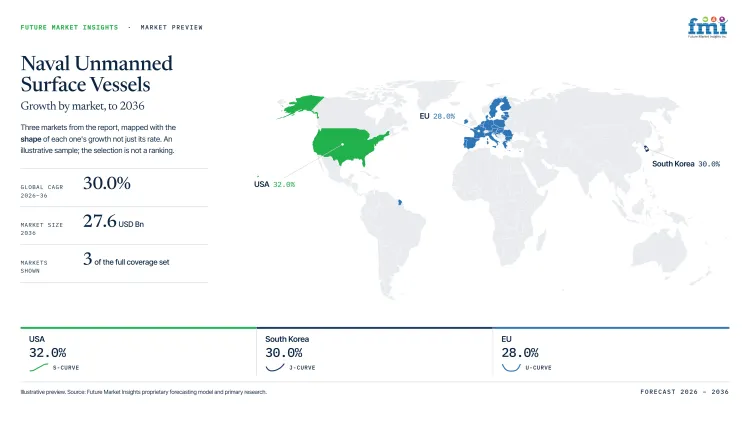
| Country | CAGR |
|---|---|
| USA | 32.0% |
| EU | 28.0% |
| South Korea | 30.0% |
Source: FMI proprietary forecasting model and primary research.
How do country-level CAGRs compare in the Naval Unmanned Surface Vessels (USV) Market?
The comparison spans 4.0 percentage points across the naval unmanned surface vessels (USV) market. The United States records the highest CAGR at 32.0%, followed by South Korea at 30.0% and the European Union at 28.0%. The ranking reflects different levels of investment in autonomous maritime platforms for naval and maritime security operations.
- The United States leads with a CAGR of 32.0%. Naval modernization programs continue incorporating unmanned surface vessels for intelligence gathering, maritime surveillance, mine countermeasure support and persistent operations in contested waters.
- South Korea follows at 30.0%, 2.0 percentage points below the United States. Defense organizations are expanding the evaluation of autonomous surface vessels for coastal surveillance, maritime security and fleet support missions, with emphasis on integrating unmanned platforms into broader naval operations.
- The European Union records a CAGR of 28.0%, 2.0 percentage points behind South Korea. Investment is directed toward unmanned surface vessel technologies that strengthen maritime domain awareness, border surveillance and naval capability development. Deployment differs among member states because defense priorities, naval procurement programs and operational requirements are not uniform.
Comparable CAGRs do not indicate identical market conditions. Differences in naval modernization strategies, maritime security priorities, defense investment and autonomous vessel integration influence deployment patterns and long-term commercial opportunities. The full report provides country-level CAGR analysis across North America, Latin America, Europe, East Asia, South Asia, Oceania and the Middle East and Africa.
Source: FMI proprietary forecasting model and primary research.
Who are the notable companies in the Naval Unmanned Surface Vessels (USV) Market?
Companies active in this market include Saronic (US), Exail (FR), Saab (SE), Textron (US), HD Hyundai (KR).
-market-analysis-by-company.webp "Naval Unmanned Surface Vessels (usv) Market Analysis By Company")
Competition is assessed around product relevance, deployment fit, service capability, and ability to support procurement or integration requirements within this market.
Saronic (US), Exail (FR), Saab (SE), Textron (US), HD Hyundai (KR) represent the principal company group profiled in this report.
Competitive Benchmarking: Naval Unmanned Surface Vessels (USV) Market
| Company | Autonomous Technology | Mission Capability | Platform Innovation | Geographic Presence |
|---|---|---|---|---|
| Saronic (US) | High | High | High | Global |
| Exail (FR) | High | High | High | Global |
| Saab (SE) | High | High | High | Global |
| Textron (US) | High | High | Medium | Global |
| HD Hyundai (KR) | High | High | High | Global |
Assessment reflects autonomous capability, operational deployment, technology advancement, and international defence presence.
Source: FMI proprietary competitive assessment based on company portfolios and primary research.
Key Players
- Saronic (US)
- Exail (FR)
- Saab (SE)
- Textron (US)
- HD Hyundai (KR)
Naval Unmanned Surface Vessels (USV) Market Report Scope
-market-breakdown-by-type,-size,-and-region.webp "Naval Unmanned Surface Vessels (usv) Market Breakdown By Type, Size, And Region")
| Attribute | Details |
|---|---|
| Leading Companies | Saronic (US), Exail (FR), Saab (SE), Textron (US), HD Hyundai (KR) |
| Revenue Forecast | Revenue in USD Million, CAGR in %. |
| Market Definition | Naval unmanned surface vessels are autonomous or remotely operated maritime platforms designed to perform surveillance, reconnaissance, mine countermeasure, force protection, and other naval missions without onboard crew. |
| Regional Coverage | North America, Latin America, Europe, East Asia, South Asia, Oceania, and the Middle East & Africa. |
| Country Coverage | United States, Germany, United Kingdom, France, China, Japan, South Korea, Australia, and additional countries. |
| Key Companies Profiled | Saronic (US), Exail (FR), Saab (SE), Textron (US), HD Hyundai (KR) |
| Forecast Period | 2026 to 2036 |
| Base Year | 2025 |
| Research Methodology | Market estimates were established through primary interviews, defence procurement analysis, company benchmarking, autonomous maritime technology assessment, product portfolio evaluation, and regional demand validation. |
Source: FMI proprietary research and primary interviews.
Research Methodology
| Method | Approach |
|---|---|
| Primary Research | FMI analysts gathered input from manufacturers, service providers, technology developers, distributors, end users, procurement teams, and subject-matter experts. Interviews examined purchasing decisions, product or service evaluation, adoption barriers, approval requirements, pricing considerations, and expectations for technical or commercial support. Respondents were also asked what evidence is required before a trial, pilot, or initial order develops into regular purchasing. |
| Desk Research | Desk research covered government statistics, regulatory publications, trade data, industry associations, technical literature, standards, company filings, product information, and official corporate announcements. Sources were reviewed for relevance, publication date, geographic coverage, and consistency with the defined market scope. Claims relating to performance, applications, approvals, capacity, investment, and commercial activity were retained only when supported by credible public evidence. |
| Market Sizing and Forecasting | The market model combined the baseline value with historical performance, segment structure, pricing and volume indicators, adoption levels, company participation, and country-level demand conditions. Forecast assumptions considered economic activity, investment trends, regulatory developments, technology adoption, purchasing cycles, supply availability, and barriers to wider market use. Segment and regional estimates were reconciled before the final market total was calculated. |
| Data Validation | Estimates were checked against multiple independent indicators, including public data, company activity, trade patterns, industry developments, and findings from primary interviews. Validation also tested whether products, services, applications, and company revenues fell within the defined market boundaries. Adjacent categories, unsupported claims, overlapping revenues, and activities without direct market relevance were excluded to reduce double counting and maintain consistency across segments and countries. |
Source: Future Market Insights proprietary methodology and primary research
Naval Unmanned Surface Vessels (USV) Market Segmentation
By Type
-
Attributable Strike USVs
- Patrol & ISR USVs
- Survey & Logistics USVs
By Size
-
Small (<12 m)
- Medium (12–25 m)
- Large (>25 m)
By Component
- Platforms
- Autonomy & C2 Systems
- Payloads & Services
By End User
- Navies
- Coast Guards
- Commercial & Research
By Business Model
- Programs of Record
- Rapid-Acquisition Buys
- Experimentation Contracts
By Region:
- North America
- United States
- Canada
- Latin America
- Brazil
- Mexico
- Argentina
- Europe
- Germany
- United Kingdom
- France
- Italy
- Spain
- Rest of Europe
- East Asia
- China
- Japan
- South Korea
- South Asia
- India
- ASEAN
- Rest of South Asia
- Oceania
- Australia
- New Zealand
- Middle East & Africa
- GCC Countries
- South Africa
- Rest of Middle East & Africa
Research Sources and Bibliography
- Future Market Insights analysis and primary research.
- Company public materials reviewed for market relevance: Saronic (US), Exail (FR), Saab (SE), Textron (US), HD Hyundai (KR).
- Public robotics, automation, defence, hospitality, maritime, and industrial sources reviewed for market context where applicable.
This Report Answers
- What is the projected valuation of the naval unmanned surface vessels (USV) market by 2036?
- Which CAGR is anticipated for the naval unmanned surface vessels (USV) market between 2026 and 2036?
- Which size category contributes the leading market share?
- Why do attritable strike USVs remain the principal type?
- Attritable strike USVs lead by type as navies increasingly prioritize distributed autonomous platforms for high-risk and scalable maritime operations.
- How do country growth prospects compare throughout the forecast period?
- Which companies continue influencing competition across the naval unmanned surface vessels (USV) market?
- Companies active in this market include Saronic (US), Exail (FR), Saab (SE), Textron (US), HD Hyundai (KR).
- Which operational considerations influence procurement decisions?
- How does Future Market Insights estimate and validate market forecasts?
Frequently Asked Questions
What is encouraging demand for naval unmanned surface vessels (USVs)?
Growing investment in maritime security, autonomous naval operations, and defence modernization continues encouraging procurement across naval organizations worldwide.
Which size category records the leading market share?
Small (<12 m) USVs lead by size because they are easier to deploy, adapt, and procure for coastal monitoring, harbour security, and distributed naval missions.
Why does intelligence, surveillance & reconnaissance remain the dominant mission?
Attritable strike USVs lead by type as navies increasingly prioritize distributed autonomous platforms for high-risk and scalable maritime operations.
Which component accounts for the largest share?
Platforms account for the largest component share because hull durability, autonomy integration, and payload compatibility define core procurement value.
Who are the major companies operating in the naval unmanned surface vessels (USV) market?
Companies active in this market include Saronic (US), Exail (FR), Saab (SE), Textron (US), HD Hyundai (KR).
What remains the principal challenge for industry participants?
Integration with existing naval command systems, cybersecurity requirements, and lengthy defence procurement programmes continue influencing deployment schedules.
Which regions continue generating attractive opportunities?
North America, Europe, and Asia-Pacific continue expanding opportunities through naval modernization programmes, autonomous maritime initiatives, and coastal security investment.
Preview the report firsthand - request a free sample
Get SampleGet the brochure for pricing and purchase details.
Get PDFTable of Content
- Key Takeaways
- Market Size and CAGR
- Top Growth Driver
- Fastest Growing Segment
- Leading Region
- Key Companies
- Emerging Opportunities
- Executive Summary
- Global Market Outlook
- Demand-side Trends
- Supply-side Trends
- Technology Roadmap Analysis
- Analysis and Recommendations
- Analyst Perspective (What is happening? Why now? What should investors know?)
- Key Questions Answered
- How large is the market?
- What is the CAGR?
- What are key trends?
- Which region dominates?
- Who are the leaders?
- Market Overview
- Market Coverage / Taxonomy
- Market Definition / Scope / Limitations
- Research Methodology
- Chapter Orientation
- Analytical Lens and Working Hypotheses
- Market Structure, Signals, and Trend Drivers
- Benchmarking and Cross-market Comparability
- Market Sizing, Forecasting, and Opportunity Mapping
- Research Design and Evidence Framework
- Desk Research Programme (Secondary Evidence)
- Expert Input and Fieldwork (Primary Evidence)
- Tooling, Models, and Reference Databases
- Data Engineering and Model Build
- Quality Assurance and Audit Trail
- Market Background
- Market Dynamics (Drivers, Restraints, Opportunity, Trends)
- Scenario Forecast (Optimistic, Likely, Conservative)
- Impact Analysis
- AI Impact
- Sustainability Impact
- Regulatory Impact
- Technology Impact
- Consumer / Buyer Analysis
- Purchase Drivers
- Adoption Barriers
- Buyer Journey
- Opportunity Map Analysis
- Product Life Cycle Analysis
- Supply Chain Analysis
- Investment Feasibility Matrix
- Value Chain Analysis
- PESTLE and Porter's Analysis
- Regulatory Landscape
- Regional Parent Market Outlook
- Production and Consumption Statistics
- Import and Export Statistics
- Global Market Analysis and Forecast, 2021 to 2036
- Historical Market Size Value (USD Billion) Analysis, 2021 to 2025
- Current and Future Market Size Value (USD Billion) Projections, 2026 to 2036
- Y-o-Y Growth Trend Analysis
- Absolute $ Opportunity Analysis
- Global Market Pricing Analysis, 2021 to 2036
- Global Market Analysis and Forecast, By Type, 2021 to 2036
- Introduction / Key Findings
- Historical Market Size Value (USD Billion) Analysis By Type, 2021 to 2025
- Current and Future Market Size Value (USD Billion) Analysis and Forecast By Type, 2026 to 2036
- Attritable strike USVs
- Patrol & ISR USVs
- Survey & logistics USVs
- Attritable strike USVs
- Y-o-Y Growth Trend Analysis By Type, 2021 to 2025
- Absolute $ Opportunity Analysis By Type, 2026 to 2036
- Global Market Analysis and Forecast, By Size, 2021 to 2036
- Introduction / Key Findings
- Historical Market Size Value (USD Billion) Analysis By Size, 2021 to 2025
- Current and Future Market Size Value (USD Billion) Analysis and Forecast By Size, 2026 to 2036
- Small (<12 m)
- Medium (12-25 m)
- Large (>25 m)
- Small (<12 m)
- Y-o-Y Growth Trend Analysis By Size, 2021 to 2025
- Absolute $ Opportunity Analysis By Size, 2026 to 2036
- Global Market Analysis and Forecast, By Component, 2021 to 2036
- Introduction / Key Findings
- Historical Market Size Value (USD Billion) Analysis By Component, 2021 to 2025
- Current and Future Market Size Value (USD Billion) Analysis and Forecast By Component, 2026 to 2036
- Platforms
- Autonomy & C2 systems
- Payloads & services
- Platforms
- Y-o-Y Growth Trend Analysis By Component, 2021 to 2025
- Absolute $ Opportunity Analysis By Component, 2026 to 2036
- Global Market Analysis and Forecast, By End User, 2021 to 2036
- Introduction / Key Findings
- Historical Market Size Value (USD Billion) Analysis By End User, 2021 to 2025
- Current and Future Market Size Value (USD Billion) Analysis and Forecast By End User, 2026 to 2036
- Navies
- Coast guards
- Commercial & research
- Navies
- Y-o-Y Growth Trend Analysis By End User, 2021 to 2025
- Absolute $ Opportunity Analysis By End User, 2026 to 2036
- Global Market Analysis and Forecast, By Business Model, 2021 to 2036
- Introduction / Key Findings
- Historical Market Size Value (USD Billion) Analysis By Business Model, 2021 to 2025
- Current and Future Market Size Value (USD Billion) Analysis and Forecast By Business Model, 2026 to 2036
- Programs of record
- Rapid-acquisition buys
- Experimentation contracts
- Programs of record
- Y-o-Y Growth Trend Analysis By Business Model, 2021 to 2025
- Absolute $ Opportunity Analysis By Business Model, 2026 to 2036
- Global Market Analysis and Forecast, By Region, 2021 to 2036
- Introduction
- Historical Market Size Value (USD Billion) Analysis By Region, 2021 to 2025
- Current Market Size Value (USD Billion) Analysis and Forecast By Region, 2026 to 2036
- North America
- Latin America
- Western Europe
- Eastern Europe
- East Asia
- South Asia and Pacific
- Middle East & Africa
- Market Attractiveness Analysis By Region
- North America Market Analysis and Forecast, By Country, 2021 to 2036
- Historical Market Size Value (USD Billion) Trend Analysis By Market Taxonomy, 2021 to 2025
- Market Size Value (USD Billion) Forecast By Market Taxonomy, 2026 to 2036
- By Country
- USA
- Canada
- By Type
- By Size
- By Component
- By End User
- By Business Model
- By Country
- Market Attractiveness Analysis
- By Country
- By Type
- By Size
- By Component
- By End User
- By Business Model
- Key Takeaways
- Latin America Market Analysis and Forecast, By Country
- Historical Market Size Value (USD Billion) Trend Analysis By Market Taxonomy, 2021 to 2025
- Market Size Value (USD Billion) Forecast By Market Taxonomy, 2026 to 2036
- By Country
- Brazil
- Mexico
- Chile
- Rest of Latin America
- By Type
- By Size
- By Component
- By End User
- By Business Model
- By Country
- Market Attractiveness Analysis
- By Country
- By Type
- By Size
- By Component
- By End User
- By Business Model
- Key Takeaways
- Western Europe Market Analysis and Forecast, By Country
- Historical Market Size Value (USD Billion) Trend Analysis By Market Taxonomy, 2021 to 2025
- Market Size Value (USD Billion) Forecast By Market Taxonomy, 2026 to 2036
- By Country
- Germany
- UK
- Italy
- Spain
- France
- Nordic
- BENELUX
- Rest of Western Europe
- By Type
- By Size
- By Component
- By End User
- By Business Model
- By Country
- Market Attractiveness Analysis
- By Country
- By Type
- By Size
- By Component
- By End User
- By Business Model
- Key Takeaways
- Eastern Europe Market Analysis and Forecast, By Country
- Historical Market Size Value (USD Billion) Trend Analysis By Market Taxonomy, 2021 to 2025
- Market Size Value (USD Billion) Forecast By Market Taxonomy, 2026 to 2036
- By Country
- Russia
- Poland
- Hungary
- Balkan & Baltic
- Rest of Eastern Europe
- By Type
- By Size
- By Component
- By End User
- By Business Model
- By Country
- Market Attractiveness Analysis
- By Country
- By Type
- By Size
- By Component
- By End User
- By Business Model
- Key Takeaways
- East Asia Market Analysis and Forecast, By Country
- Historical Market Size Value (USD Billion) Trend Analysis By Market Taxonomy, 2021 to 2025
- Market Size Value (USD Billion) Forecast By Market Taxonomy, 2026 to 2036
- By Country
- China
- Japan
- South Korea
- By Type
- By Size
- By Component
- By End User
- By Business Model
- By Country
- Market Attractiveness Analysis
- By Country
- By Type
- By Size
- By Component
- By End User
- By Business Model
- Key Takeaways
- South Asia and Pacific Market Analysis and Forecast, By Country
- Historical Market Size Value (USD Billion) Trend Analysis By Market Taxonomy, 2021 to 2025
- Market Size Value (USD Billion) Forecast By Market Taxonomy, 2026 to 2036
- By Country
- India
- ASEAN
- Australia & New Zealand
- Rest of South Asia and Pacific
- By Type
- By Size
- By Component
- By End User
- By Business Model
- By Country
- Market Attractiveness Analysis
- By Country
- By Type
- By Size
- By Component
- By End User
- By Business Model
- Key Takeaways
- Middle East & Africa Market Analysis and Forecast, By Country
- Historical Market Size Value (USD Billion) Trend Analysis By Market Taxonomy, 2021 to 2025
- Market Size Value (USD Billion) Forecast By Market Taxonomy, 2026 to 2036
- By Country
- Kingdom of Saudi Arabia
- Other GCC Countries
- Türkiye
- South Africa
- Other African Union
- Rest of Middle East & Africa
- By Type
- By Size
- By Component
- By End User
- By Business Model
- By Country
- Market Attractiveness Analysis
- By Country
- By Type
- By Size
- By Component
- By End User
- By Business Model
- Key Takeaways
- Key Countries Market Analysis
- USA
- Pricing Analysis
- Market Share Analysis, 2025
- By Type
- By Size
- By Component
- By End User
- By Business Model
- Canada
- Pricing Analysis
- Market Share Analysis, 2025
- By Type
- By Size
- By Component
- By End User
- By Business Model
- Mexico
- Pricing Analysis
- Market Share Analysis, 2025
- By Type
- By Size
- By Component
- By End User
- By Business Model
- Brazil
- Pricing Analysis
- Market Share Analysis, 2025
- By Type
- By Size
- By Component
- By End User
- By Business Model
- Chile
- Pricing Analysis
- Market Share Analysis, 2025
- By Type
- By Size
- By Component
- By End User
- By Business Model
- Germany
- Pricing Analysis
- Market Share Analysis, 2025
- By Type
- By Size
- By Component
- By End User
- By Business Model
- UK
- Pricing Analysis
- Market Share Analysis, 2025
- By Type
- By Size
- By Component
- By End User
- By Business Model
- Italy
- Pricing Analysis
- Market Share Analysis, 2025
- By Type
- By Size
- By Component
- By End User
- By Business Model
- Spain
- Pricing Analysis
- Market Share Analysis, 2025
- By Type
- By Size
- By Component
- By End User
- By Business Model
- France
- Pricing Analysis
- Market Share Analysis, 2025
- By Type
- By Size
- By Component
- By End User
- By Business Model
- India
- Pricing Analysis
- Market Share Analysis, 2025
- By Type
- By Size
- By Component
- By End User
- By Business Model
- ASEAN
- Pricing Analysis
- Market Share Analysis, 2025
- By Type
- By Size
- By Component
- By End User
- By Business Model
- Australia & New Zealand
- Pricing Analysis
- Market Share Analysis, 2025
- By Type
- By Size
- By Component
- By End User
- By Business Model
- China
- Pricing Analysis
- Market Share Analysis, 2025
- By Type
- By Size
- By Component
- By End User
- By Business Model
- Japan
- Pricing Analysis
- Market Share Analysis, 2025
- By Type
- By Size
- By Component
- By End User
- By Business Model
- South Korea
- Pricing Analysis
- Market Share Analysis, 2025
- By Type
- By Size
- By Component
- By End User
- By Business Model
- Russia
- Pricing Analysis
- Market Share Analysis, 2025
- By Type
- By Size
- By Component
- By End User
- By Business Model
- Poland
- Pricing Analysis
- Market Share Analysis, 2025
- By Type
- By Size
- By Component
- By End User
- By Business Model
- Hungary
- Pricing Analysis
- Market Share Analysis, 2025
- By Type
- By Size
- By Component
- By End User
- By Business Model
- Kingdom of Saudi Arabia
- Pricing Analysis
- Market Share Analysis, 2025
- By Type
- By Size
- By Component
- By End User
- By Business Model
- Türkiye
- Pricing Analysis
- Market Share Analysis, 2025
- By Type
- By Size
- By Component
- By End User
- By Business Model
- South Africa
- Pricing Analysis
- Market Share Analysis, 2025
- By Type
- By Size
- By Component
- By End User
- By Business Model
- USA
- Market Structure Analysis
- Competition Dashboard
- Competition Benchmarking
- Market Share Analysis of Top Players
- By Regional
- By Type
- By Size
- By Component
- By End User
- By Business Model
- Emerging Startups
- Innovation Benchmarking
- Competition Analysis
- Competition Deep Dive
- Saronic (US)
- Overview
- Product Portfolio
- Profitability by Market Segments
- Sales Footprint
- Strategy Overview
- Marketing Strategy
- Product Strategy
- Channel Strategy
- Exail (FR)
- Saab (SE)
- Textron (US)
- HD Hyundai (KR)
- Saronic (US)
- Case Studies
- Success Stories
- Recent Developments
- Competition Deep Dive
- Assumptions & Acronyms Used


