

- Industry Size (2026)
- USD 1.0 Bn
- Forecast (2036)
- USD 1.6 Bn
- CAGR (2026 to 2036)
- 4.6%
Neutral Floor Cleaners Market Forecast and Outlook 2026 to 2036
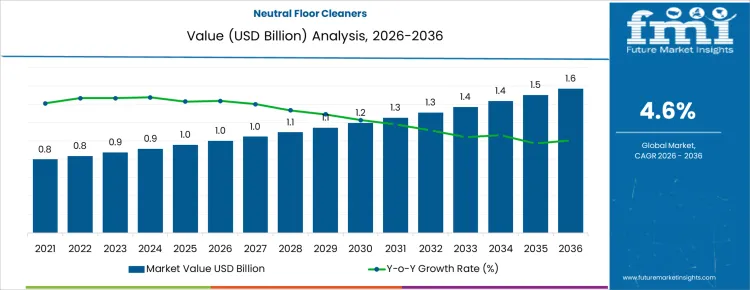
The neutral floor cleaners market is expected to expand from USD 1 billion in 2026 to USD 1.6 billion by 2036, representing a CAGR of 4.6%. Early growth is concentrated in commercial facilities, offices, and institutional buildings adopting safer, low-odor, and multi-surface floor cleaning solutions. Between 2028 and 2032, penetration in mature markets begins to slow as most large facilities standardize their cleaning protocols.
Post-2032, growth is driven by smaller enterprises, niche commercial spaces, and emerging regions. Innovation in eco-friendly formulations, enzyme-based cleaners, and concentrated systems supporting water and chemical reduction becomes key to sustaining market expansion. Providers emphasizing cost-efficiency, regulatory compliance, and compatibility with automated floor-care equipment are positioned to capture incremental value as saturation in primary markets increases.
Quick Stats of the Neutral Floor Cleaners Market:
- Neutral Floor Cleaners Market Value (2026): USD 1.0 billion
- Neutral Floor Cleaners Market Forecast Value (2036): USD 1.6 billion
- Neutral Floor Cleaners Market Forecast CAGR (2026 to 2036): 4.6%
- Leading Chemistry System in the Market: Surfactant-Based Neutral Cleaners (42%)
- Key Growth Regions in the Market: China, Brazil, USA, UK, Germany
- Top Players in the Market: Ecolab, Solenis (Diversey), SC Johnson Professional, 3M, Zep, Betco, Spartan Chemical, CloroxPro, P&G Professional, Unilever Professional
What is the Growth Forecast for the Neutral Floor Cleaners Market through 2036?
From 2026 to 2031, the neutral floor cleaners market grows from USD 1.0 billion to approximately USD 1.3 billion, representing the early adoption phase. Growth in this period is driven by commercial buildings, office complexes, retail outlets, and healthcare facilities seeking pH-neutral formulations that are safe for multiple floor types and reduce maintenance costs. Annual value additions increase gradually from USD 0.02 billion to USD 0.06 billion, with North America and Europe accounting for around 65% of total consumption due to stringent hygiene regulations and cleaning standards. Early adoption is concentrated in high-traffic, multi-use facilities where neutral cleaners are integrated into daily maintenance protocols.
Between 2031 and 2036, the market expands from roughly USD 1.3 billion to USD 1.6 billion, illustrating the late adoption curve characterized by broader penetration across mass-market facilities and institutional applications. Annual increments increase modestly to USD 0.06-0.08 billion, driven by repeat procurement, multi-site deployment, and integration into automated floor-cleaning systems. Growth is reinforced by standardization of cleaning protocols, increasing awareness of surface protection benefits, and broader adoption across schools, hospitals, and commercial spaces. Early growth relied on selective high-value sites, while later expansion reflects structural normalization across global facility management operations.
Neutral Floor Cleaners Market Key Takeaways
| Metric | Value |
|---|---|
| Market Value (2026) | USD 1.0 billion |
| Forecast Value (2036) | USD 1.6 billion |
| Forecast CAGR (2026 to 2036) | 4.6% |
Why Are Neutral Floor Cleaners Market Becoming a Defined Choice in Facility Maintenance?
Early demand for neutral floor cleaners emerged from limitations in traditional alkaline or acidic cleaners when used on a variety of floor surfaces found in commercial, institutional, and residential settings. Strong pH cleaners removed heavy soils but also altered floor finishes, dulling sealants, degrading grout, or lifting protective coatings over repeated use. Facility managers and cleaning professionals sought formulations that cleaned effectively without damaging substrates. Neutral floor cleaners were introduced with balanced pH near neutral to reduce risk of finish removal, surface etching, and residue buildup. Historical adoption was gradual and driven by observed surface degradation rather than proactive cleaning standards. Usage clustered where polished or coated floors required maintenance without compromising appearance or wear resistance.
Future demand for neutral floor cleaners is expected to reflect structured maintenance specifications, surface longevity targets, and occupational health considerations rather than reliance on general-purpose cleaning alone. Organizations are formalizing floor care protocols tied to lifecycle cost management, warranty requirements from surface manufacturers, and documented slip resistance outcomes after cleaning. Procurement decisions increasingly emphasize products tested for compatibility with specific floor materials, defined residue profiles, and minimal impact on indoor air quality. Advances in surfactant technology and biodegradable formulations are improving cleaning performance on both soils and soils bound by surface tension without leaving films that attract dirt. Unlike historical use driven by reactive surface preservation, future adoption will align with documented maintenance standards, regulatory expectations for building hygiene, and integration with automated cleaning equipment.
What Factors Are Affecting the Demand for Neutral Floor Cleaners Market in Terms of Chemistry System and Format or Dilution?
Demand for neutral floor cleaners is segmented by chemistry system and format or dilution across commercial, institutional, and residential maintenance settings. Surfactant based neutral cleaners account for about 42% of total demand, making them the leading chemistry system. Low foam neutral formulations, bio based or plant derived neutrals, and specialty neutral cleaners represent additional systems without disclosed share splits. These chemistries differ in soil removal mechanism, residue control, and surface compatibility. Format and dilution segmentation reflects handling practice and dosing control. Bulk concentrates account for about 28% of demand, followed by super concentrates, ready to use products, auto dilution cartridges, and wipes or other formats. Together, these segments explain demand formation shaped by surface care requirements, labor efficiency, and chemical control rather than cleaning frequency alone.
What Drives Demand by Chemistry System in the Neutral Floor Cleaners Market?
Surfactant based neutral cleaners lead demand with a 42% share due to broad compatibility with resilient flooring, stone, and sealed surfaces. These systems remove soils effectively without attacking finishes or leaving alkaline residue. Low foam neutral formulations are specified for scrubbers and automated equipment where foam control is critical. Bio based and plant derived neutrals are adopted where ingredient sourcing and odor profile matter. Specialty neutral products address polish safe or slip resistance requirements in sensitive environments. Chemistry selection reflects surface protection and maintenance consistency rather than aggressive cleaning power. Demand therefore aligns with routine floor care protocols and material preservation needs rather than episodic deep cleaning.
Chemistry driven demand remains stable because floor care programs are standardized. Surfactant based neutrals are embedded in daily cleaning routines. Low foam products scale with machine use. Bio based systems grow selectively where procurement standards apply. Specialty neutrals remain limited to defined use cases. These patterns constrain rapid substitution. Chemistry system segmentation highlights reliance on predictable surface safe performance. Demand therefore follows facility maintenance standards rather than short term product trends.
How Does Format or Dilution Shape Demand for Neutral Floor Cleaners Market?
Bulk concentrates account for about 28% of total demand, making them the leading format. Their use reflects cost efficiency and suitability for high volume cleaning operations. Super concentrates reduce storage and transport requirements where precise dilution control is available. Ready to use formats support convenience and small area cleaning. Auto dilution cartridges are applied where dosing accuracy and staff safety are priorities. Wipes and other formats address spot cleaning needs. Format selection depends on labor structure, storage capacity, and dosing discipline. Demand follows workflow efficiency rather than chemistry performance differences.
Bulk concentrate demand remains steady due to widespread use in commercial facilities. Super concentrates scale with centralized dilution systems. RTU products persist in light duty applications. Auto dilution systems are adopted where consistency is enforced. Wipes remain supplemental. Operators avoid frequent format changes to maintain training simplicity. This stabilizes demand by format. Format and dilution segmentation therefore reinforces concentration in concentrated systems.
How Are Neutral Floor Cleaners Market Being Applied Across Commercial and Institutional Facilities?
Use appears in environments where daily floor maintenance requires cleaning without damaging surfaces or leaving residues. Schools, hospitals, offices, and retail spaces adopt neutral floor cleaners to maintain gloss, prevent streaking, and protect sensitive finishes on vinyl, tile, or sealed wood. Hospitality and food service operators apply them for routine maintenance in high-traffic areas to ensure safety and hygiene. These applications reflect operational and surface preservation priorities rather than fragrance or aesthetic objectives, with adoption driven by efficacy, surface compatibility, and ease of use.
What Operational and Material Conditions Support Adoption of Neutral Floor Cleaners Market?
Selection aligns with facilities needing safe, effective cleaning across varied flooring types. Formulations are optimized for pH neutrality to prevent etching, discoloration, or coating degradation. Cleaning teams rely on ready-to-use or diluted concentrates compatible with mop, autoscrubber, or spray systems. Health and safety teams prioritize products that minimize chemical exposure to staff and occupants. These conditions emerge from operational efficiency, surface protection, and user safety priorities in structured floor maintenance workflows.
Which Practical Considerations Limit Wider Use of Neutral Floor Cleaners Market?
Effectiveness may vary with heavy soil or grease accumulation, requiring pre-treatment or additional cleaning steps. Cost per use can be higher than highly alkaline or acidic alternatives. Compatibility must be ensured for all floor finishes in multi-surface facilities. Concentrate dilution, storage, and handling require training to maintain consistent performance. These factors lead to selective deployment where surface preservation, staff safety, and operational convenience justify incremental cost and procedural attention.
What is the Demand for Neutral Floor Cleaners Market by Country?
| Country | CAGR (%) |
|---|---|
| USA | 4.7% |
| Germany | 4.1% |
| China | 5.6% |
| UK | 4.3% |
| Brazil | 5.4% |
The demand for neutral floor cleaners varies across countries, driven by commercial cleaning requirements, hygiene standards, and urban infrastructure growth. China leads with a 5.6% CAGR, supported by large scale commercial and institutional cleaning, as well as rapid urbanization. Brazil follows at 5.4%, driven by expanding commercial and residential cleaning needs. The USA grows at 4.7%, reflecting steady adoption across offices, hotels, and industrial facilities. Germany records 4.1%, shaped by mature cleaning markets and stringent hygiene regulations. The UK posts 4.3%, supported by consistent demand in commercial buildings, healthcare facilities, and institutional cleaning operations.
How Is Surface Maintenance Driving Growth in the United States?
In the United States, revenue from the Neutral Floor Cleaners Market is expanding at a CAGR of 4.7% through 2035, driven by adoption of pH-neutral cleaning formulations that maintain floor integrity while removing dirt, grease, and stains in commercial, industrial, and institutional facilities. Manufacturers are integrating neutral floor cleaners in daily maintenance programs for vinyl, tile, laminate, and hardwood surfaces. Demand is concentrated in offices, hospitals, schools, and retail establishments. Domestic suppliers provide high-performance, surface-compatible formulations suitable for automated and manual cleaning equipment. Hygiene standards, regulatory compliance, and recurring cleaning schedules are sustaining predictable procurement nationwide.
- Offices, hospitals, schools, and retail facilities drive neutral floor cleaner adoption
- Additives remove dirt, grease, and stains without damaging surfaces
- Domestic suppliers provide surface-compatible, high-performance formulations
- Recurring cleaning schedules sustain predictable procurement
How Are Hygiene Regulations Supporting Growth in Germany?
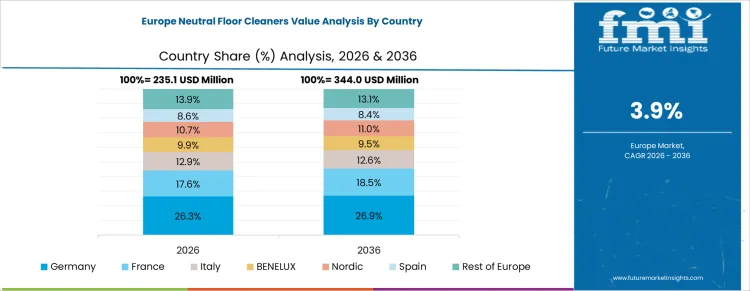
Germany continues to record steady growth in the Neutral Floor Cleaners Market at a CAGR of 4.1% through 2035, supported by stringent hygiene and maintenance standards in commercial and industrial facilities. Manufacturers are integrating pH-neutral cleaners to maintain floor safety, appearance, and durability in offices, hospitals, schools, and retail environments. Demand is concentrated in institutional facilities, commercial buildings, and healthcare centers. Domestic suppliers provide high-quality, surface-compatible cleaning formulations engineered for durability and safety. Compliance with hygiene regulations and recurring cleaning programs are sustaining measured adoption nationwide.
- Offices, hospitals, schools, and retail facilities anchor demand
- Neutral cleaners maintain floor safety, appearance, and durability
- Domestic suppliers provide surface-compatible, high-quality formulations
- Recurring cleaning programs sustain steady procurement
How Is Industrial and Commercial Expansion Accelerating Adoption in China?
In China, revenue from the Neutral Floor Cleaners Market is growing at a CAGR of 5.6% through 2035, driven by rapid growth of commercial, industrial, and institutional facilities. Manufacturers are adopting pH-neutral floor cleaners to maintain surface integrity while removing dirt, grease, and stains efficiently. Demand is strong across offices, hospitals, schools, hotels, and industrial facilities. Domestic suppliers are scaling production of high-performance, surface-safe formulations compatible with manual and automated cleaning systems. Expanding facility construction and structured cleaning schedules are sustaining rapid adoption nationwide.
- Offices, hospitals, schools, hotels, and industrial facilities drive adoption
- Neutral cleaners maintain surface integrity and remove dirt efficiently
- Domestic suppliers scale high-performance, surface-safe formulations
- Structured cleaning schedules sustain consistent adoption
How Is Commercial Hygiene Driving Growth in the United Kingdom?
In the United Kingdom, revenue from the Neutral Floor Cleaners Market is expanding at a CAGR of 4.3% through 2035, supported by hygiene regulations and increased commercial and institutional facility operations. Manufacturers are integrating neutral cleaners in offices, hospitals, schools, and retail environments to remove dirt and grease while protecting floor surfaces. Demand is concentrated in commercial buildings, healthcare facilities, and educational institutions. Domestic suppliers provide high-quality, surface-compatible formulations suitable for automated and manual cleaning equipment. Recurring cleaning schedules, regulatory compliance, and consistent facility operations are sustaining predictable procurement nationwide.
- Offices, hospitals, schools, and retail facilities anchor demand
- Neutral cleaners remove dirt and grease while preserving floor surfaces
- Domestic suppliers provide surface-compatible, high-quality formulations
- Recurring cleaning schedules sustain predictable procurement
How Is Facility Expansion Supporting Adoption in Brazil?
Brazil is seeing strong growth in the Neutral Floor Cleaners Market at a CAGR of 5.4% through 2035, supported by expanding commercial, industrial, and institutional facilities. Manufacturers are adopting pH-neutral cleaners to maintain floor safety, appearance, and cleanliness across offices, hospitals, schools, and retail spaces. Demand is concentrated in commercial buildings, healthcare, and educational facilities. Domestic suppliers are expanding production of high-performance, surface-compatible formulations suitable for manual and automated cleaning systems. Facility expansion, hygiene compliance, and recurring cleaning cycles are sustaining robust procurement nationwide.
- Offices, hospitals, schools, and retail facilities drive neutral floor cleaner adoption
- Cleaners maintain floor safety, appearance, and cleanliness
- Domestic suppliers expand production of high-performance, surface-compatible formulations
- Recurring cleaning cycles sustain robust procurement
Which Companies Compete in The Neutral Floor Cleaners Market Based On Facility Maintenance Practice and Surface Protection Needs?
Neutral floor cleaners are specified primarily to preserve floor finishes while supporting routine maintenance in commercial and institutional facilities. Selection is driven by compatibility with coated surfaces, slip resistance requirements, and residue control rather than cleaning aggressiveness. Ecolab and Solenis, through the Diversey portfolio, influence this market by embedding neutral cleaners within standardized floor care programs used across healthcare, education, retail, and hospitality sites. SC Johnson Professional, P&G Professional, and Unilever Professional supply formulations aligned with global facility hygiene standards, where consistency across locations and staff turnover is a key consideration. Performance acceptance is based on appearance retention, ease of rinsing, and predictable behavior during frequent damp mopping and automated cleaning cycles.
Competitive dynamics are shaped by distributor relationships and day to day facility operations. Zep, Betco, and Spartan Chemical maintain strong positions through regionally supported product lines tailored to different floor materials, including vinyl, stone, and sealed concrete. CloroxPro participates where neutral cleaning is coordinated with broader sanitation protocols. 3M contributes through floor care systems and maintenance solutions rather than detergent volume leadership. Local suppliers influence purchasing decisions by aligning dilution control, packaging formats, and training support with janitorial workflows. Competitive positioning depends on reliability in routine use, compatibility with equipment, and continuity of supply rather than formulation complexity or brand prominence.
Key Players in the Neutral Floor Cleaners Market
- Ecolab
- Solenis (Diversey)
- SC Johnson Professional
- 3M
- Zep
- Betco
- Spartan Chemical
- CloroxPro
- P&G Professional
- Unilever Professional
Scope of the Report
| Items | Values |
|---|---|
| Quantitative Units (2026) | USD million |
| Chemistry System | Surfactant-Based Neutral Cleaners; Low-Foam Neutral Formulations; Bio-Based / Plant-Derived Neutrals; Specialty Neutral (polish-safe/anti-slip) |
| Format / Dilution | Bulk Concentrates; Super-Concentrates; Ready-to-Use (RTU); Auto-Dilution Cartridges; Wipes / Other Formats |
| End-Use Setting | Commercial Offices; Hospitality; Healthcare & Institutions; Retail & Other Facilities |
| Procurement Channel | Distributors & Wholesalers; Direct Service Contracts; Contract Cleaning Firms; Online / Small-Buyer Orders |
| Region | Asia Pacific; Europe; North America; Latin America; Middle East & Africa |
| Countries Covered | China; Japan; South Korea; India; Australia & New Zealand; ASEAN; Rest of Asia Pacific; Germany; United Kingdom; France; Italy; Spain; Nordic; BENELUX; Rest of Europe; United States; Canada; Mexico; Brazil; Chile; Rest of Latin America; Kingdom of Saudi Arabia; Other GCC Countries; Turkey; South Africa; Other African Union; Rest of Middle East & Africa |
| Key Companies Profiled | Ecolab; Solenis (Diversey); SC Johnson Professional; 3M; Zep; Betco; Spartan Chemical; CloroxPro; P&G Professional; Unilever Professional |
| Additional Attributes | Dollar by sales across chemistry systems and format/dilution; Surfactant-based cleaners lead due to broad surface compatibility; Bulk concentrates dominate commercial facilities for cost efficiency; Low-foam and super concentrates support automated cleaning; Adoption driven by hygiene compliance, surface protection, and operational efficiency; Early growth concentrated in offices, hospitals, and high-traffic facilities, later growth from emerging facilities and niche segments; Procurement influenced by distributors, service contracts, and direct contracts; Growth post-saturation supported by enzyme-based, eco-friendly formulations and integration with automated floor-care systems; Operational reliability, dosing accuracy, and equipment compatibility guide competitive positioning. |
Neutral Floor Cleaners Market Segmentation
Chemistry System:
- Surfactant-Based Neutral Cleaners
- Low-Foam Neutral Formulations
- Bio-Based / Plant-Derived Neutrals
- Specialty Neutral (polish-safe/anti-slip)
Format / Dilution:
- Bulk Concentrates
- Super-Concentrates
- Ready-to-Use (RTU)
- Auto-Dilution Cartridges
- Wipes / Other Formats
End-Use Setting:
- Commercial Offices
- Hospitality
- Healthcare & Institutions
- Retail & Other Facilities
Procurement Channel:
- Distributors & Wholesalers
- Direct Service Contracts
- Contract Cleaning Firms
- Online / Small-Buyer Orders
Region
- Asia Pacific
- China
- Japan
- South Korea
- India
- Australia & New Zealand
- ASEAN
- Rest of Asia Pacific
- Europe
- Germany
- United Kingdom
- France
- Italy
- Spain
- Nordic
- BENELUX
- Rest of Europe
- North America
- United States
- Canada
- Mexico
- Latin America
- Brazil
- Chile
- Rest of Latin America
- Middle East & Africa
- Kingdom of Saudi Arabia
- Other GCC Countries
- Turkey
- South Africa
- Other African Union
- Rest of Middle East & Africa
Frequently Asked Questions
How big is the neutral floor cleaners in 2026?
The global neutral floor cleaners is estimated to be valued at USD 1.0 billion in 2026.
What will be the size of neutral floor cleaners in 2036?
The market size for the neutral floor cleaners is projected to reach USD 1.6 billion by 2036.
How much will be the neutral floor cleaners growth between 2026 and 2036?
The neutral floor cleaners is expected to grow at a 4.6% CAGR between 2026 and 2036.
What are the key product types in the neutral floor cleaners?
The key product types in neutral floor cleaners are surfactant-based neutral cleaners, low-foam neutral formulations, bio-based / plant-derived neutrals and specialty neutral (polish-safe/anti-slip).
Which format or dilution segment to contribute significant share in the neutral floor cleaners in 2026?
In terms of format or dilution, bulk concentrates segment to command 28.0% share in the neutral floor cleaners in 2026.
Preview the report firsthand - request a free sample
Get SampleGet the brochure for pricing and purchase details.
Get PDFTable of Content
- Executive Summary
- Global Market Outlook
- Demand-side Trends
- Supply-side Trends
- Technology Roadmap Analysis
- Analysis and Recommendations
- Market Overview
- Market Coverage / Taxonomy
- Market Definition / Scope / Limitations
- Market Background
- Market Dynamics
- Drivers
- Restraints
- Opportunity
- Trends
- Scenario Forecast
- Demand in Optimistic Scenario
- Demand in Likely Scenario
- Demand in Conservative Scenario
- Opportunity Map Analysis
- Product Life Cycle Analysis
- Supply Chain Analysis
- Investment Feasibility Matrix
- Value Chain Analysis
- PESTLE and Porter’s Analysis
- Regulatory Landscape
- Regional Parent Market Outlook
- Production and Consumption Statistics
- Import and Export Statistics
- Market Dynamics
- Global Market Analysis 2021 to 2025 and Forecast, 2026 to 2036
- Historical Market Size Value (USD Million) Analysis, 2021 to 2025
- Current and Future Market Size Value (USD Million) Projections, 2026 to 2036
- Y-o-Y Growth Trend Analysis
- Absolute $ Opportunity Analysis
- Global Market Pricing Analysis 2021 to 2025 and Forecast 2026 to 2036
- Global Market Analysis 2021 to 2025 and Forecast 2026 to 2036, By Chemistry System
- Introduction / Key Findings
- Historical Market Size Value (USD Million) Analysis By Chemistry System , 2021 to 2025
- Current and Future Market Size Value (USD Million) Analysis and Forecast By Chemistry System , 2026 to 2036
- Surfactant-Based Neutral Cleaners
- Low-Foam Neutral Formulations
- Bio-Based / Plant-Derived Neutrals
- Specialty Neutral (polish-safe/anti-slip)
- Y-o-Y Growth Trend Analysis By Chemistry System , 2021 to 2025
- Absolute $ Opportunity Analysis By Chemistry System , 2026 to 2036
- Global Market Analysis 2021 to 2025 and Forecast 2026 to 2036, By Format or Dilution
- Introduction / Key Findings
- Historical Market Size Value (USD Million) Analysis By Format or Dilution, 2021 to 2025
- Current and Future Market Size Value (USD Million) Analysis and Forecast By Format or Dilution, 2026 to 2036
- Bulk Concentrates
- Super-Concentrates
- Ready-to-Use (RTU)
- Auto-Dilution Cartridges
- Wipes / Other Formats
- Y-o-Y Growth Trend Analysis By Format or Dilution, 2021 to 2025
- Absolute $ Opportunity Analysis By Format or Dilution, 2026 to 2036
- Global Market Analysis 2021 to 2025 and Forecast 2026 to 2036, By End-Use Setting
- Introduction / Key Findings
- Historical Market Size Value (USD Million) Analysis By End-Use Setting, 2021 to 2025
- Current and Future Market Size Value (USD Million) Analysis and Forecast By End-Use Setting, 2026 to 2036
- Commercial Offices
- Hospitality
- Healthcare & Institutions
- Retail & Other Facilities
- Y-o-Y Growth Trend Analysis By End-Use Setting, 2021 to 2025
- Absolute $ Opportunity Analysis By End-Use Setting, 2026 to 2036
- Global Market Analysis 2021 to 2025 and Forecast 2026 to 2036, By Procurement Channel
- Introduction / Key Findings
- Historical Market Size Value (USD Million) Analysis By Procurement Channel, 2021 to 2025
- Current and Future Market Size Value (USD Million) Analysis and Forecast By Procurement Channel, 2026 to 2036
- Distributors & Wholesalers
- Direct Service Contracts
- Contract Cleaning Firms
- Online / Small-Buyer Orders
- Y-o-Y Growth Trend Analysis By Procurement Channel, 2021 to 2025
- Absolute $ Opportunity Analysis By Procurement Channel, 2026 to 2036
- Global Market Analysis 2021 to 2025 and Forecast 2026 to 2036, By Region
- Introduction
- Historical Market Size Value (USD Million) Analysis By Region, 2021 to 2025
- Current Market Size Value (USD Million) Analysis and Forecast By Region, 2026 to 2036
- North America
- Latin America
- Western Europe
- Eastern Europe
- East Asia
- South Asia and Pacific
- Middle East & Africa
- Market Attractiveness Analysis By Region
- North America Market Analysis 2021 to 2025 and Forecast 2026 to 2036, By Country
- Historical Market Size Value (USD Million) Trend Analysis By Market Taxonomy, 2021 to 2025
- Market Size Value (USD Million) Forecast By Market Taxonomy, 2026 to 2036
- By Country
- USA
- Canada
- Mexico
- By Chemistry System
- By Format or Dilution
- By End-Use Setting
- By Procurement Channel
- By Country
- Market Attractiveness Analysis
- By Country
- By Chemistry System
- By Format or Dilution
- By End-Use Setting
- By Procurement Channel
- Key Takeaways
- Latin America Market Analysis 2021 to 2025 and Forecast 2026 to 2036, By Country
- Historical Market Size Value (USD Million) Trend Analysis By Market Taxonomy, 2021 to 2025
- Market Size Value (USD Million) Forecast By Market Taxonomy, 2026 to 2036
- By Country
- Brazil
- Chile
- Rest of Latin America
- By Chemistry System
- By Format or Dilution
- By End-Use Setting
- By Procurement Channel
- By Country
- Market Attractiveness Analysis
- By Country
- By Chemistry System
- By Format or Dilution
- By End-Use Setting
- By Procurement Channel
- Key Takeaways
- Western Europe Market Analysis 2021 to 2025 and Forecast 2026 to 2036, By Country
- Historical Market Size Value (USD Million) Trend Analysis By Market Taxonomy, 2021 to 2025
- Market Size Value (USD Million) Forecast By Market Taxonomy, 2026 to 2036
- By Country
- Germany
- UK
- Italy
- Spain
- France
- Nordic
- BENELUX
- Rest of Western Europe
- By Chemistry System
- By Format or Dilution
- By End-Use Setting
- By Procurement Channel
- By Country
- Market Attractiveness Analysis
- By Country
- By Chemistry System
- By Format or Dilution
- By End-Use Setting
- By Procurement Channel
- Key Takeaways
- Eastern Europe Market Analysis 2021 to 2025 and Forecast 2026 to 2036, By Country
- Historical Market Size Value (USD Million) Trend Analysis By Market Taxonomy, 2021 to 2025
- Market Size Value (USD Million) Forecast By Market Taxonomy, 2026 to 2036
- By Country
- Russia
- Poland
- Hungary
- Balkan & Baltic
- Rest of Eastern Europe
- By Chemistry System
- By Format or Dilution
- By End-Use Setting
- By Procurement Channel
- By Country
- Market Attractiveness Analysis
- By Country
- By Chemistry System
- By Format or Dilution
- By End-Use Setting
- By Procurement Channel
- Key Takeaways
- East Asia Market Analysis 2021 to 2025 and Forecast 2026 to 2036, By Country
- Historical Market Size Value (USD Million) Trend Analysis By Market Taxonomy, 2021 to 2025
- Market Size Value (USD Million) Forecast By Market Taxonomy, 2026 to 2036
- By Country
- China
- Japan
- South Korea
- By Chemistry System
- By Format or Dilution
- By End-Use Setting
- By Procurement Channel
- By Country
- Market Attractiveness Analysis
- By Country
- By Chemistry System
- By Format or Dilution
- By End-Use Setting
- By Procurement Channel
- Key Takeaways
- South Asia and Pacific Market Analysis 2021 to 2025 and Forecast 2026 to 2036, By Country
- Historical Market Size Value (USD Million) Trend Analysis By Market Taxonomy, 2021 to 2025
- Market Size Value (USD Million) Forecast By Market Taxonomy, 2026 to 2036
- By Country
- India
- ASEAN
- Australia & New Zealand
- Rest of South Asia and Pacific
- By Chemistry System
- By Format or Dilution
- By End-Use Setting
- By Procurement Channel
- By Country
- Market Attractiveness Analysis
- By Country
- By Chemistry System
- By Format or Dilution
- By End-Use Setting
- By Procurement Channel
- Key Takeaways
- Middle East & Africa Market Analysis 2021 to 2025 and Forecast 2026 to 2036, By Country
- Historical Market Size Value (USD Million) Trend Analysis By Market Taxonomy, 2021 to 2025
- Market Size Value (USD Million) Forecast By Market Taxonomy, 2026 to 2036
- By Country
- Kingdom of Saudi Arabia
- Other GCC Countries
- Turkiye
- South Africa
- Other African Union
- Rest of Middle East & Africa
- By Chemistry System
- By Format or Dilution
- By End-Use Setting
- By Procurement Channel
- By Country
- Market Attractiveness Analysis
- By Country
- By Chemistry System
- By Format or Dilution
- By End-Use Setting
- By Procurement Channel
- Key Takeaways
- Key Countries Market Analysis
- USA
- Pricing Analysis
- Market Share Analysis, 2025
- By Chemistry System
- By Format or Dilution
- By End-Use Setting
- By Procurement Channel
- Canada
- Pricing Analysis
- Market Share Analysis, 2025
- By Chemistry System
- By Format or Dilution
- By End-Use Setting
- By Procurement Channel
- Mexico
- Pricing Analysis
- Market Share Analysis, 2025
- By Chemistry System
- By Format or Dilution
- By End-Use Setting
- By Procurement Channel
- Brazil
- Pricing Analysis
- Market Share Analysis, 2025
- By Chemistry System
- By Format or Dilution
- By End-Use Setting
- By Procurement Channel
- Chile
- Pricing Analysis
- Market Share Analysis, 2025
- By Chemistry System
- By Format or Dilution
- By End-Use Setting
- By Procurement Channel
- Germany
- Pricing Analysis
- Market Share Analysis, 2025
- By Chemistry System
- By Format or Dilution
- By End-Use Setting
- By Procurement Channel
- UK
- Pricing Analysis
- Market Share Analysis, 2025
- By Chemistry System
- By Format or Dilution
- By End-Use Setting
- By Procurement Channel
- Italy
- Pricing Analysis
- Market Share Analysis, 2025
- By Chemistry System
- By Format or Dilution
- By End-Use Setting
- By Procurement Channel
- Spain
- Pricing Analysis
- Market Share Analysis, 2025
- By Chemistry System
- By Format or Dilution
- By End-Use Setting
- By Procurement Channel
- France
- Pricing Analysis
- Market Share Analysis, 2025
- By Chemistry System
- By Format or Dilution
- By End-Use Setting
- By Procurement Channel
- India
- Pricing Analysis
- Market Share Analysis, 2025
- By Chemistry System
- By Format or Dilution
- By End-Use Setting
- By Procurement Channel
- ASEAN
- Pricing Analysis
- Market Share Analysis, 2025
- By Chemistry System
- By Format or Dilution
- By End-Use Setting
- By Procurement Channel
- Australia & New Zealand
- Pricing Analysis
- Market Share Analysis, 2025
- By Chemistry System
- By Format or Dilution
- By End-Use Setting
- By Procurement Channel
- China
- Pricing Analysis
- Market Share Analysis, 2025
- By Chemistry System
- By Format or Dilution
- By End-Use Setting
- By Procurement Channel
- Japan
- Pricing Analysis
- Market Share Analysis, 2025
- By Chemistry System
- By Format or Dilution
- By End-Use Setting
- By Procurement Channel
- South Korea
- Pricing Analysis
- Market Share Analysis, 2025
- By Chemistry System
- By Format or Dilution
- By End-Use Setting
- By Procurement Channel
- Russia
- Pricing Analysis
- Market Share Analysis, 2025
- By Chemistry System
- By Format or Dilution
- By End-Use Setting
- By Procurement Channel
- Poland
- Pricing Analysis
- Market Share Analysis, 2025
- By Chemistry System
- By Format or Dilution
- By End-Use Setting
- By Procurement Channel
- Hungary
- Pricing Analysis
- Market Share Analysis, 2025
- By Chemistry System
- By Format or Dilution
- By End-Use Setting
- By Procurement Channel
- Kingdom of Saudi Arabia
- Pricing Analysis
- Market Share Analysis, 2025
- By Chemistry System
- By Format or Dilution
- By End-Use Setting
- By Procurement Channel
- Turkiye
- Pricing Analysis
- Market Share Analysis, 2025
- By Chemistry System
- By Format or Dilution
- By End-Use Setting
- By Procurement Channel
- South Africa
- Pricing Analysis
- Market Share Analysis, 2025
- By Chemistry System
- By Format or Dilution
- By End-Use Setting
- By Procurement Channel
- USA
- Market Structure Analysis
- Competition Dashboard
- Competition Benchmarking
- Market Share Analysis of Top Players
- By Regional
- By Chemistry System
- By Format or Dilution
- By End-Use Setting
- By Procurement Channel
- Competition Analysis
- Competition Deep Dive
- Ecolab
- Overview
- Product Portfolio
- Profitability by Market Segments (Product/Age /Sales Channel/Region)
- Sales Footprint
- Strategy Overview
- Marketing Strategy
- Product Strategy
- Channel Strategy
- Solenis (Diversey)
- SC Johnson Professional
- 3M
- Zep
- Betco
- Spartan Chemical
- CloroxPro
- P&G Professional
- Unilever Professional
- Ecolab
- Competition Deep Dive
- Assumptions & Acronyms Used
- Research Methodology


