

- Market Size (2026)
- USD 638.9 Mn
- Forecast (2036)
- USD 1001.7 Mn
- CAGR (2026 to 2036)
- 4.6%
Anti-Smudge and Anti-Streak Additives for Glass Cleaners Market Size, Forecast, and Outlook By FMI
Summary of the Anti-Smudge and Anti-Streak Additives for Glass Cleaners Market
- Demand and Growth Drivers
- Household cleaner brands use anti-smudge and anti-streak additives to improve wipe marks on glass and mirrors after drying.
- Commercial cleaning products need faster drying and lower residue since facility staff clean larger glass areas during short service windows.
- Formulators are using surfactants for wetting control and soil lift in glass cleaner blends.
- Product and Segment View
- Ready-to-use sprays are estimated to hold 46.0% share of finished product form demand in 2026 led by simple retail application.
- Glass and windows are anticipated to represent 44.0% share of target surface demand in 2026 as household cleaning habits center on windows and panels.
- Surfactants and wetting agents are expected to lead functional additive demand with 34.0% share in 2026 since surface tension control directly affects streak marks.
- Geography and Competitive Outlook
- China is projected to record 5.6% CAGR by 2036 led by urban housing growth and higher use of branded home cleaning products.
- United States demand is expected to expand at 4.4% CAGR by 2036 as premium retail cleaners keep using streak-free product claims.
- Competition depends on wetting performance and residue control across home care ingredient suppliers.
- Analyst Opinion
- Nikhil Kaitwade, Principal Analyst for Industrial Equipment at FMI, says “In practice, glass cleaner brands do not pay a premium for an ingredient choice. That shifts the burden of proof to suppliers, who must demonstrate consistently low film formation, tight batch-to-batch repeatability, and an odor profile that stays balanced in scaled production. Looking ahead, the pace at which premium polymer systems move from niche to mass retail will be shaped less by lab performance alone and more by compliance: evolving solvent restrictions and safer-chemistry screening will determine which technologies can scale without sacrificing the streak-free promise.”
- Anti-Smudge and Anti-Streak Additives for Glass Cleaners Market Value Analysis
- Production of anti-smudge and anti-streak additives for glass cleaners is moving from manual batch checks toward controlled dosing and inspection systems.
- PLC and SCADA use is expanding as formulation plants need tighter surfactant concentration control.
- Sensors and machine vision tools reduce fill errors. IIoT tools help reduce batch variation.
- Automation investment is supported by cleaning product producers seeking steadier output and lower rework. More consistent glass-cleaning performance remains the operational target.
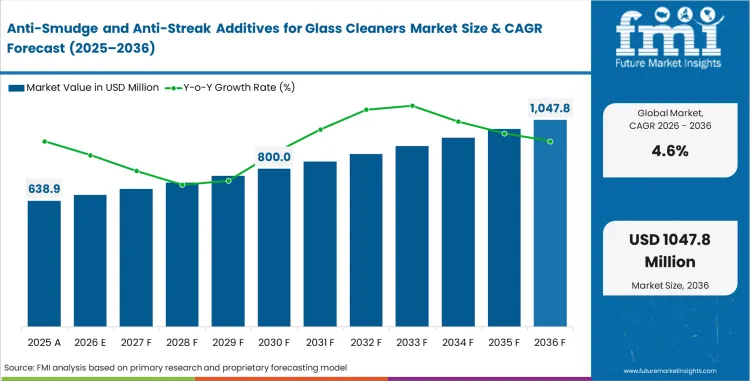
Key Takeaways, Market Size, and Forecast
- The anti-smudge and anti-streak additives for glass cleaners industry value is estimated at USD 610.8 million in 2025.
- Industry value is projected to reach USD 1,001.7 million by 2036.
- The sector is expected to expand at a 4.6% CAGR from 2026 to 2036.
- The sector is projected to create an incremental opportunity of USD 362.8 million between 2026 and 2036.
- Water-based systems are expected to account for 62.0% share in 2026 as low-odor household cleaners need polymer and surfactant packages compatible with water.
- China at 5.6% CAGR and Brazil at 5.4% CAGR are expected to post the quickest rise through 2036 since urban home care purchases expand from a lower use base.
Anti-Smudge and Anti-Streak Additives for Glass Cleaners Market Definition
The anti-smudge and anti-streak additives for glass cleaners sector covers surfactants, wetting agents, solvents, co-solvents, chelants, builders, polymers, and shine agents added to glass cleaning formulations to reduce filming, residue, wipe marks, water spots, and smudge return. Finished glass cleaner bottles, cleaning tools, glass coatings sold as separate treatments, wipes without additive attribution, and general hard surface cleaners without glass performance claims stay outside value counted in this study.
Anti-Smudge and Anti-Streak Additives for Glass Cleaners Market Inclusions
The study includes functional additive type, finished product form, target surface, end use, formulation base, sales channel, and geography across global additive demand. Counted applications include household glass cleaners, commercial window products, automotive glass care, mirror cleaners, hospitality glass cleaning products, ammonia-free cleaners, low-VOC products, and refill concentrate formulations.
Anti-Smudge and Anti-Streak Additives for Glass Cleaners Market Exclusions
Finished retail glass cleaner revenue, spray bottles, mop systems, microfiber cloths, glass manufacturing chemicals, architectural glass coatings, automotive windshield coatings, generic detergent chemicals without glass-cleaner attribution, fragrance-only additives, disinfectant-only actives, and private-label retail margins stay outside this study.
Anti-Smudge and Anti-Streak Additives for Glass Cleaners Market Research Methodology
- Primary Research: FMI analysts reviewed ingredient suppliers together with home care formulators and contract cleaner manufacturers active in glass cleaner additive selection.
- Desk Research: The desk review used FMI datasets and public regulatory releases with company product information and supplier announcements covering home care chemicals.
- Market Sizing and Forecasting: The forecast aligned FMI values with household cleaner use intensity and country-level home care product adoption.
- Data Validation: Segment balance and country growth were checked against public source signals and supplier actions in 2026.
Why is the Anti-Smudge and Anti-Streak Additives for Glass Cleaners Market Growing?
- PLC and SCADA systems improve dosing control for surfactants used in anti-smudge and anti-streak glass cleaner additives.
- Sensors and in-line checks help formulation plants keep fill level and blend strength consistent.
- Machine vision checks labels before finished glass cleaners move into retail or institutional channels.
- IIoT tools give plant teams faster downtime alerts and batch-variation alerts during high-volume cleaning product production.
Manufacturing automation is moving from isolated equipment upgrades to factory-wide performance programs. Unilever’s July 2025, factory update reported pilots across 13 factory sites with potential for a 28% improvement in productivity and operational health and safety metrics. The same program recorded a 27% improvement in productivity metrics and a 41% improvement in waste-reduction metrics across three out of four sites from 2020 to 2024. This company development supports a clear adoption path for glass cleaner additive producers as automated dosing and inspection can reduce rework and improve batch repeatability.
Market Segmentation Analysis
- Water-based systems are expected to account for 62.0% share in 2026 as low-odor glass cleaners need additive packages compatible with household dilution and refill formats.
- Household use is likely to secure 55.0% share in 2026 since windows and mirrors create frequent home cleaning occasions for retail brands.
- Ready-to-use sprays are estimated to represent 46.0% share in 2026 as consumers prefer finished products with no dilution step before application.
- Glass and windows are projected to contribute 44.0% share in 2026 because standard window cleaning remains the main surface target for glass cleaner additive use.
The anti-smudge and anti-streak additives for glass cleaners market is segmented by additive type, covering non-ionic surfactants, polymer anti-redeposition agents, silicone-based agents, fluorine-free repellency agents, chelating agents, and solvent-compatible additives with non-ionic surfactants leading because of reliable wetting and low-residue cleaning. Function segmentation covers anti-smudge protection and anti-streak performance. Wetting control, residue reduction, soil suspension, and shine enhancement form the remaining function groups, with anti-streak performance remaining dominant. By cleaner format and application surface, the market comprises sprays, concentrates, wipes, trigger cleaners, automotive glass, architectural glass, mirrors, and appliance glass supported by repeat household and commercial cleaning use. End use and sales channel segmentation cover household care brands and institutional cleaning suppliers. Automotive detailing products, direct supply, distributors, and specialty chemical suppliers form the remaining route-to-market groups.
Anti-Smudge and Anti-Streak Additives for Glass Cleaners Market Analysis by Functional Additive Type
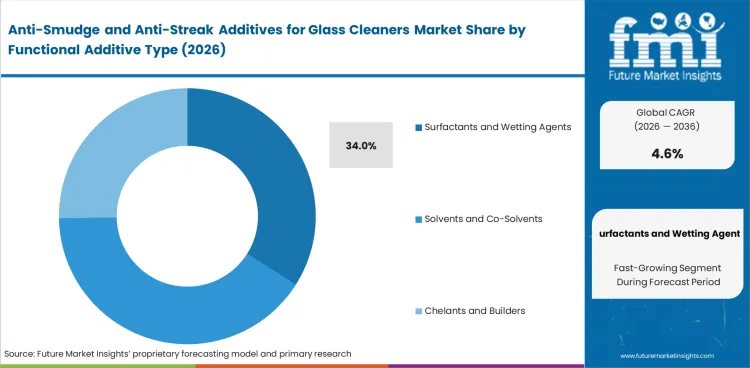
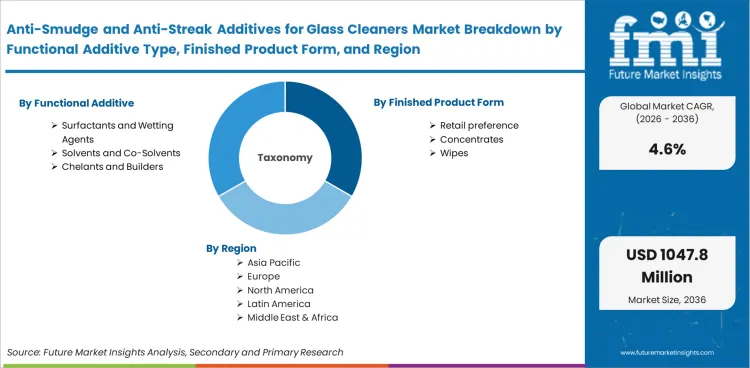
- Surfactants and wetting agents are forecast to hold a 34.0% share in 2026, supported by their role in reducing surface tension and enabling uniform liquid spread on glass before wiping.
- Solvents and co-solvents support rapid drying in ammonia-free products needing residue control without harsh odor.
Insights into the Anti-Streak Polymers and Shine Agents Segment
- Anti-streak polymers gain from premium glass cleaner formulas needing lower film build-up after repeated use on mirrors and windows.
- Shine agents help cleaner brands support clear finish claims if polymer dose remains low enough to avoid tacky residue.
Anti-Smudge and Anti-Streak Additives for Glass Cleaners Market Analysis by Finished Product Form
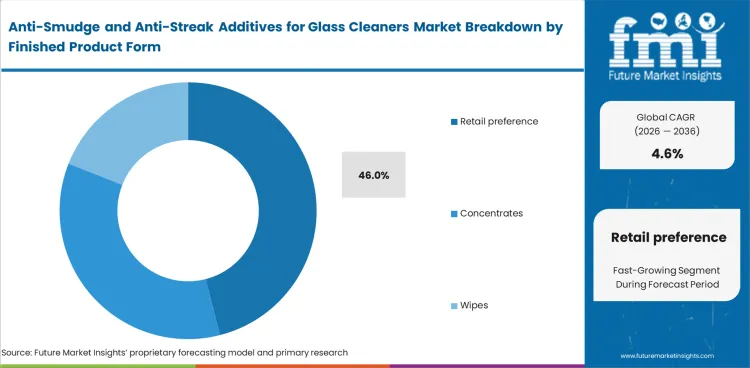
- Retail preference for instant‑use cleaning solutions is expected to push ready‑to‑use sprays to a 46.0% share by 2026.
- Concentrates serve refill formats and commercial cleaning programs needing lower packaging weight per cleaning cycle.
Insights into the Wipes Segment
- Wipes use additive blends suited to pre-dosed cleaning sheets for mirrors and touch surfaces needing controlled residue.
- Foam and aerosol formats remain smaller since glass users often prefer spray coverage and simple wipe-off behavior.
Anti-Smudge and Anti-Streak Additives for Glass Cleaners Market Analysis by Target Surface
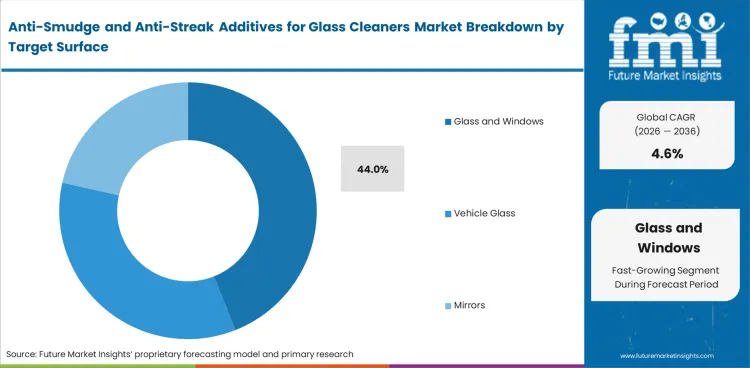
- Consistent wetting and streak control in standard cleaning influence a 44.0% share for glass and windows in 2026.
- Mirrors require low-residue additives because of bathroom humidity exposing haze left by poorly balanced formulations.
Insights into the Vehicle Glass Segment
- Vehicle glass demand is aligned to aftermarket windshield and interior glass cleaning products requiring fast drying in confined cabins.
- Automotive care brands need smudge resistance led by interior film reducing driver clarity after repeated cabin cleaning.
Anti-Smudge and Anti-Streak Additives for Glass Cleaners Market Analysis by End Use
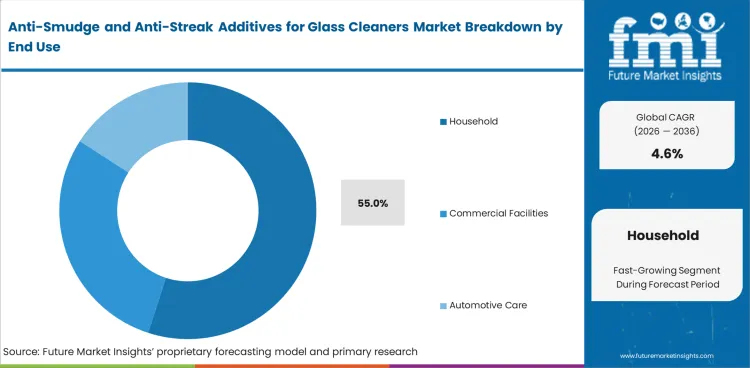
- Retail glass cleaners positioned around streak‑free performance are expected to keep household applications leading at a 55.0% share in 2026.
- Commercial facilities use additive-backed cleaners for lobbies and partitions needing repeat cleaning without film build-up.
Insights into the Automotive Care Segment
- Automotive care products use anti-smudge additives to reduce interior haze on windshields and display-adjacent glass areas.
- Detailer channels prefer concentrated formats if dilution control can protect wipe marks and drying speed.
Anti-Smudge and Anti-Streak Additives for Glass Cleaners Market Analysis by Formulation Base
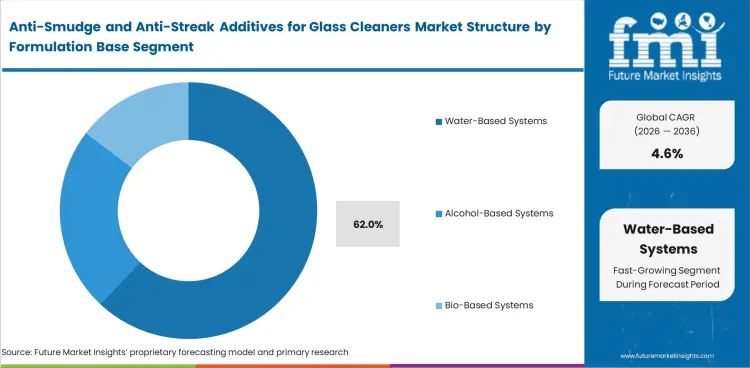
- Water-based systems are likely to account for 62.0% share in 2026 led by household glass cleaners requiring lower odor and easier safer-chemistry positioning.
- Alcohol-based systems remain useful for faster evaporation in cleaners aimed at mirrors and vehicle glass.
Insights into the Bio-Based Systems Segment
- Bio-based systems benefit from retailer and ecolabel interest in surfactants made for lower environmental load.
- Hybrid systems combine water and solvent inputs for brands balancing drying speed with safer ingredient expectations.
Anti-Smudge and Anti-Streak Additives for Glass Cleaners Market Analysis by Sales Channel
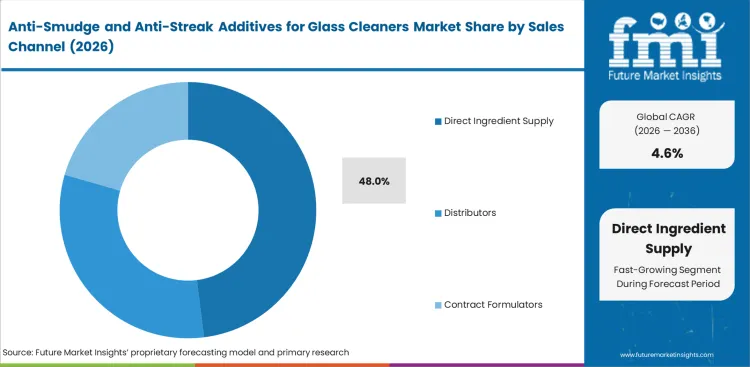
- Direct ingredient supply is projected to hold a 48.0% share in 2026, reflecting large cleaner brands’ need for formulation testing support and reliable supply.
- Distributors serve regional cleaner makers needing smaller pack sizes and short lead times for additive blends.
Insights into the Contract Formulators Segment
- Contract formulators buy additives for private-label cleaner programs needing rapid reformulation after retailer specification changes.
- Retail brand supply grows if ingredient producers support formula files and product claim documentation for store brands.
Anti-Smudge and Anti-Streak Additives for Glass Cleaners Market Drivers Restraints and Opportunities
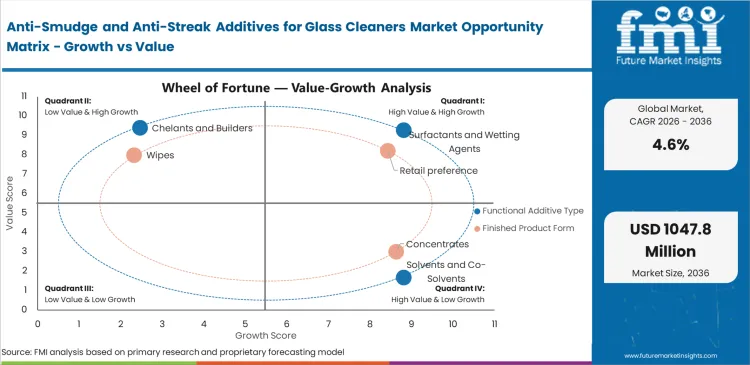
- Demand for streak-free claims will sustain additive use in household glass cleaners through 2036.
- Low-VOC and solvent-safety rules can raise reformulation cost for high-evaporation cleaner systems.
- Refill concentrates are likely to add revenue prospects for suppliers able to protect performance after dilution.
Glass cleaner formulators are expected to balance faster drying with larger residue control through the forecast period. Faster evaporation can shorten wiping time. Weak additive balance may leave haze or streaks after drying. Suppliers that combine wetting agents with low-film polymers are likely to secure more repeat approvals from cleaning brands. Safer formulation requirements will shape product development as retailers and professional cleaning users ask for clearer safety support. Additive suppliers will need stricter safety data and finished-product testing before brands scale anti-smudge or anti-streak claims across product lines.
Import Dependence and Trade Flow Analysis
Trade in anti-smudge and anti-streak additives for glass cleaners is closely linked with non-ionic surface-active agents and cleaning preparations because these inputs improve wetting and reduce residue on glass surfaces. WTO reported world merchandise exports at USD 26.26 trillion in 2025 with export value rising 7% from 2024. This expansion shows active cross-border movement of chemical inputs and finished cleaning formulations across major supply routes. Additive buyers remain exposed to freight changes and tariff revisions as surfactants and specialty cleaning inputs often move through international supplier networks. Over the forecast period, companies with stable sourcing contracts. Regional blending capacity are expected to manage trade risk better as glass cleaner brands seek consistent additive quality and controlled landed costs.
Technology Adoption and Automation Penetration Analysis
Automation adoption in the anti-smudge and anti-streak additives for glass cleaners sector is increasingly focused on batch dosing, tank mixing, and in-line quality control. Producers are prioritizing tighter control of surfactant concentration and low-residue performance to improve formulation consistency. PLC and SCADA systems now underpin routine plant operations, while sensors and machine vision enhance fill accuracy and label inspection across finished glass cleaner lines.
In 2025, Unilever reported the results of AI, robotics, and digital technology pilots across 13 factory sites, demonstrating the operational impact of automation at scale. The program showed potential productivity and operational health and safety improvements of up to 28%, while three out of four participating sites recorded a 27% increase in productivity and a 41% reduction in waste between 2020 and 2024. These outcomes highlight a practical adoption pathway for additive producers and cleaning formulation plants, where automation reduces rework and supports steadier output across high-volume production lines.
Regional Analysis
.webp "Top Country Growth Comparison Anti Smudge And Anti Streak Additives For Glass Cleaners Market Cagr (2026 2036)")
| Country | CAGR 2026 to 2036 |
|---|---|
| China | 5.6% |
| Brazil | 5.4% |
| United States | 4.4% |
| United Kingdom | 4.4% |
| Germany | 4.3% |
| South Korea | 4.2% |
| Japan | 3.6% |
Source: Future Market Insights global country outlook and Future Market Insights analysis based on public source checks in 2026.
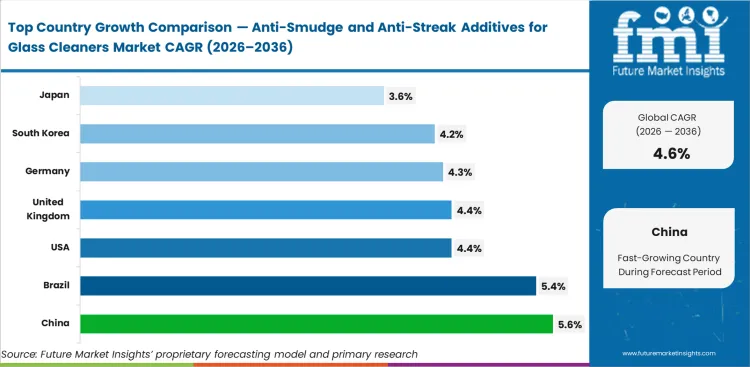
Analysis of Anti-Smudge and Anti-Streak Additives for Glass Cleaners Market by Key Countries
- China is likely to post the fastest pace at 5.6% CAGR by 2036 led by local home care production and urban retail channels influencing higher use of wetting and anti-film additives.
- Brazil is expected to follow at 5.4% CAGR by 2036 because of private-label cleaner output and supermarket-led household cleaning sales creating a larger base for anti-streak formulations.
- United States demand is projected at 4.4% CAGR by 2036 as ammonia-free glass cleaners and residue-free claims keep additive adoption steady in household and professional products.
- The United Kingdom is projected at 4.4% CAGR by 2036 influenced by safer home care formulations and retailer quality checks resulting in additive systems with clearer safety data.
- Germany is forecast at 4.3% CAGR by 2036. South Korea at 4.2% CAGR and Japan at 3.6% CAGR expand on mature cleaning product systems with steadier replacement demand.
Country growth differs with home care production scale and cleaner formulation standards. China leads as local manufacturing and packaged cleaning product availability expand together. Brazil follows as retail cleaning brands increase output from a smaller specialty additive base. United States demand advances through ammonia-free and streak-free cleaner claims. The United Kingdom and Germany grow through safety-led formulation checks. South Korea and Japan maintain steadier adoption as mature household care brands refine cleaner performance rather than add large new volume.
Demand Outlook for Anti-Smudge and Anti-Streak Additives for Glass Cleaners in China
Demand for anti-smudge and anti-streak additives for glass cleaners in China is projected to rise at 5.6% CAGR by 2036 as local cleaner production and urban household product sales support stronger additive intake. Domestic formulators need wetting agents and low-film polymers that can deliver faster wipe-off across mirrors and household glass. China leads the country outlook because of larger home care manufacturing depth and wider retail availability.
- Local home care manufacturing supports repeat additive use because of cleaner brands requiring stable wetting control across higher-volume spray cleaner lines.
- Urban retail channels raise demand for glass cleaners that offer clear finish and easier wipe-off for apartments and commercial interiors.
- Specialty chemical suppliers gain more room to serve local formulators that need steady additive quality and faster technical support.
Demand Outlook for Anti-Smudge and Anti-Streak Additives for Glass Cleaners in Brazil
The sector in Brazil is expected to expand at 5.4% CAGR by 2036 led by private-label household cleaning production and supermarket-led distribution influencing demand from a smaller base. Local cleaner brands need additives that reduce haze after drying and keep glass cleaners affordable for repeat household use.
- Private-label cleaner production supports additive intake as retailers seek lower-cost formulations with clear anti-streak performance.
- Household cleaning brands use wetting agents to improve wipe spread and reduce visible residue after the surface dries.
- Local blending demand creates opportunities for suppliers able to provide stable additive quality with shorter delivery cycles.
Demand Outlook for Anti-Smudge and Anti-Streak Additives for Glass Cleaners in the United States
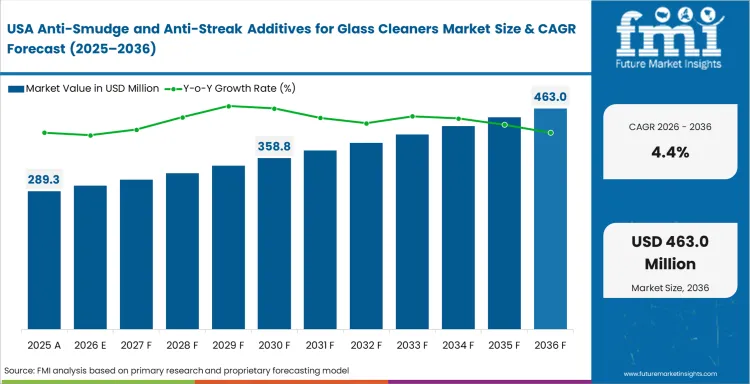
Sales of anti-smudge and anti-streak additives for glass cleaners in the United States are likely to increase at 4.4% CAGR by 2036 influenced by ammonia-free claims and residue-free positioning sustaining cleaner reformulation. Established home care brands need additive systems that work across glass and hard shiny surfaces. The United States maintains steady growth led by product improvement centering on cleaner finish and safer formulation profiles.
- Ammonia-free cleaner formats support demand for alternative wetting and anti-film additives that maintain clear glass performance.
- Professional cleaning channels need consistent low-residue results across office glass and building maintenance applications.
- Spray cleaner brands require additives that protect finish quality without raising odor or surface compatibility concerns.
Demand Outlook for Anti-Smudge and Anti-Streak Additives for Glass Cleaners in the United Kingdom
Industry in United Kingdom is projected to record 4.4% CAGR by 2036 as retailers and cleaning brands place more attention on safer home care chemistry. Additive suppliers need safety data and finished-product support before brands scale new anti-smudge or anti-streak claims. United Kingdom demand remains steady as household cleaners compete on safer positioning and dependable surface finish.
- Retailer quality checks support additives with clear safety documentation and predictable performance in finished cleaner formulas.
- Household cleaner brands use anti-streak additives to improve wipe results on mirrors and indoor glass surfaces.
- Institutional cleaning suppliers need low-residue formulations that can work across repeated cleaning cycles in offices and public facilities.
Demand Outlook for Anti-Smudge and Anti-Streak Additives for Glass Cleaners in Germany
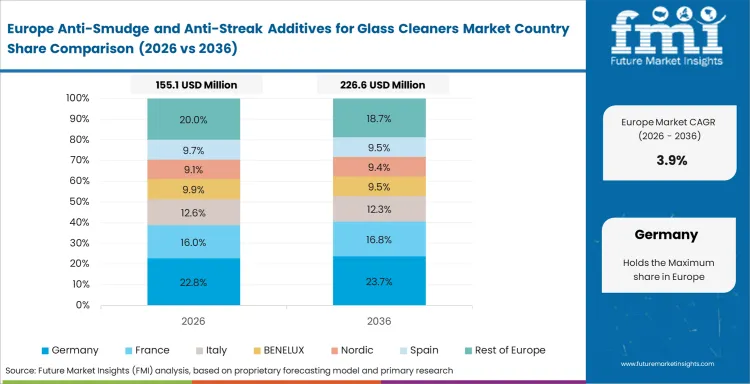
Anti-smudge and anti-streak additive demand in Germany is projected to advance at 4.3% CAGR by 2036, supported by sustainability rules and consumer caution influencing cleaner chemistry. German formulators focus on residue control and safer ingredient profiles. Germany grows at a measured pace influenced by mature home care production implementing established formulation standards.
- Cleaner brands in Germany require additive systems that support low-residue performance with stronger safety and ingredient documentation.
- Institutional cleaning demand sustains regular use of glass cleaners across offices, retail interiors and public buildings.
- Local formulators favor additive suppliers that can provide consistent batches and test support for finished cleaner claims.
Demand Outlook for Anti-Smudge and Anti-Streak Additives for Glass Cleaners in South Korea
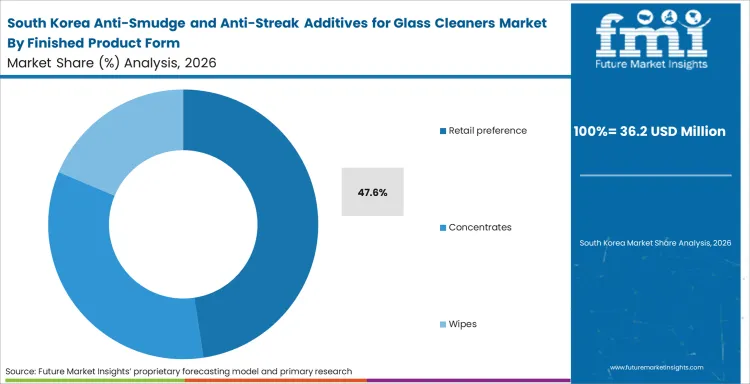
Demand for the sector in South Korea is expected to post 4.2% CAGR by 2036 because of compact housing and frequent household cleaning propelling demand for mirror and glass surface cleaners. Local brands need additive packages that reduce smudge marks on shiny indoor surfaces.
- Compact apartments support repeat use of glass and mirror cleaners for bathrooms, windows and interior surfaces.
- Retail cleaner brands need anti-smudge additives that improve finish quality without heavy fragrance or harsh solvent feel.
- Product differentiation centers on clearer surfaces and faster wipe-off across household spray cleaner formats.
Demand Outlook for Anti-Smudge and Anti-Streak Additives for Glass Cleaners in Japan
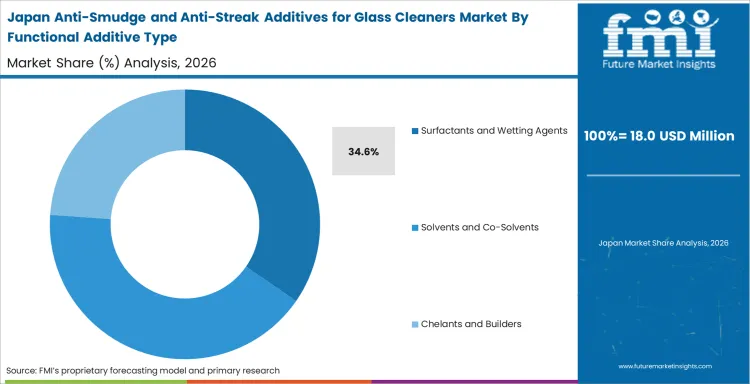
The sector in Japan is expected to grow at 3.6% CAGR through 2036 as mature home care demand keeps additive adoption steady. Cleaner makers focus on mild odor, clear finish and dependable performance across mirrors and household glass.
- Mature household cleaner demand influences steady additive adoption in formulas that need consistent finish quality.
- Japanese cleaner makers need low-odor additive systems that reduce haze without relying on harsh solvent positioning.
- Surface care brands use anti-streak additives to maintain clear results across mirrors and indoor glass applications.
Competitive Positioning and Strategic Supplier Strength
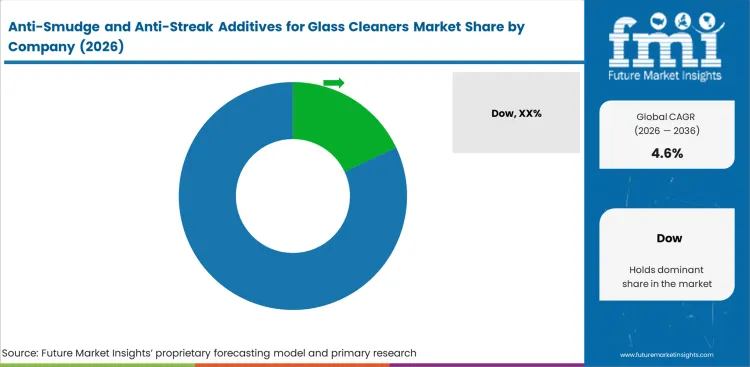
- Competition is moderately concentrated across specialty chemical suppliers with surfactant depth and polymer knowledge. Home care testing support remains a selection factor.
- BASF holds a firm position through surfactants and water-soluble polymers used in detergents and cleaning products.
- Dow competes through ACUSOL polymer lines, including grades listed for glass cleaners and institutional cleaning applications.
- Nouryon strengthens supplier choice through Berol surfactants and Dissolvine chelates for household and institutional cleaning.
Competition in anti-smudge and anti-streak additives centers on wetting control and low-residue performance after wipe-off. Cleaner brands approve suppliers after stability checks and finished-product surface tests. Technical support influences account retention as small formulation changes can affect haze and streaking on mirrors or glass.
BASF and Dow hold firmer positions through polymer depth and established home care ingredient portfolios. Nouryon competes through surfactants with cleaning and wetting functions, including Berol 185 for glass cleaner applications. Evonik adds strength in specialty wetting agents and surface additive knowledge, with TEGO Wet 270 eCO launched in 2025 as a mass-balanced substrate wetting agent.
Suppliers with sample access and application lab support can complete reformulation trials faster for household cleaner brands. Local inventory helps customers reduce lead-time risk for small additive volumes used in spray cleaners. Price does not promote repeat business after a brand confirms low-residue performance and safety documentation.
Key Companies in the Anti-Smudge and Anti-Streak Additives for Glass Cleaners Market
Competition spans surfactant producers, polymer additive suppliers and specialty wetting-agent firms with different strengths.
- Global surfactant producers: BASF, Nouryon and Evonik compete through cleaning-grade surfactants and home care application support. BASF lists surfactants and water-soluble polymers for detergent and cleaner use.
- Polymer additive suppliers: Dow and BASF compete through water-soluble polymers used in hard surface and institutional cleaning. Dow lists ACUSOL PRO Hard Surface Care Polymer for streak-free hard surface cleaners.
- Wetting-agent specialists: Evonik and Nouryon compete through substrate wetting and non-ionic surfactant lines for aqueous cleaner systems. Nouryon lists Berol 185 for glass cleaner and hard surface cleaning use.
Competitive Benchmarking: Anti-Smudge and Anti-Streak Additives for Glass Cleaners Market
| Company | Product Breadth | Residue Control | Formulation Support | Footprint |
|---|---|---|---|---|
| Dow | Large | Large | Large | Global |
| BASF | Large | Moderate | Large | Global |
| Nouryon | Moderate | Moderate | Large | Global |
| Evonik | Moderate | Large | Moderate | Global |
| Clariant | Large | Moderate | Large | Global |
| Stepan Company | Large | Moderate | Moderate | North America and Global |
| Kao Chemicals | Moderate | Moderate | Moderate | Asia and Europe |
Source: Future Market Insights competitive analysis based on company updates and covered country narratives in 2026.
Key Developments in Anti-Smudge and Anti-Streak Additives for Glass Cleaners Market
- In August 2024, Ecolab made its Ammonia-Free Pro Glass Cleaner available through The Home Depot for windows and mirrors with streak-free and residue-free finish claims.
- In November 2025, BASF inaugurated expanded Alkyl Polyglucosides production capacity at Bangpakong in Thailand to support personal care, home care and industrial cleaning applications.
- In November 2025, Clariant completed its CHF 80 million Care Chemicals expansion at Daya Bay in China to strengthen personal care, home care and specialty chemical output.
Key Players in the Anti-Smudge and Anti-Streak Additives for Glass Cleaners Market
Major Global Players
- Dow
- BASF
- Nouryon
- Evonik
- Clariant
- Huntsman
- Stepan Company
- Kao Chemicals
- Solvay
- Sasol
Specialty and Regional Participants
- Croda International
- Pilot Chemical
- Colonial Chemical
- Sasol Chemicals
- Galaxy Surfactants
- Innospec
Report Scope and Coverage
| Item | Value |
|---|---|
| Market value in 2025 | USD 610.8 million |
| Market value in 2026 | USD 638.9 million |
| Market value in 2036 | USD 1,001.7 million |
| CAGR from 2026 to 2036 | 4.6% |
| Quantitative units | USD million |
| Market definition | Additives used in glass cleaner formulations to reduce smudge return, streaking, filming, and wipe marks |
| By functional additive type | Surfactants and wetting agents, solvents and co-solvents, chelants and builders, anti-streak polymers and shine agents |
| By finished product form | Ready-to-use sprays, concentrates, wipes, foam and aerosol formats |
| By target surface | Glass and windows, vehicle glass, mirrors, stainless fixtures |
| By end use | Household, commercial facilities, automotive care, hospitality and foodservice |
| By formulation base | Water-based systems, alcohol-based systems, bio-based systems, hybrid systems |
| By sales channel | Direct ingredient supply, distributors, contract formulators, retail brand supply |
| Regions covered | North America, Latin America, Europe, East Asia, South Asia and Pacific, Middle East and Africa |
| Countries covered | United States, United Kingdom, China, Brazil, Germany, South Korea, Japan, 30+ countries |
| Key companies profiled | Dow, BASF, Nouryon, Evonik, Clariant, Huntsman, Stepan Company, Kao Chemicals, Solvay, Sasol |
| Forecast period | 2026 to 2036 |
| Approach | FMI public demand model aligned with additive type, finished product form, country narratives, and verified company updates |
Source: Future Market Insights analysis 2026.
Anti-Smudge and Anti-Streak Additives for Glass Cleaners Market Breakdown by Functional Additive Type and Finished Product Form and Target Surface and End Use and Formulation Base and Sales Channel and Region
Anti-Smudge and Anti-Streak Additives for Glass Cleaners Market Segmented by Functional Additive Type
- Surfactants and Wetting Agents
- Solvents and Co-Solvents
- Chelants and Builders
- Anti-Streak Polymers and Shine Agents
Anti-Smudge and Anti-Streak Additives for Glass Cleaners Market Segmented by Finished Product Form
- Ready-to-Use Sprays
- Concentrates
- Wipes
- Foam and Aerosol Formats
Anti-Smudge and Anti-Streak Additives for Glass Cleaners Market Segmented by Target Surface
- Glass and Windows
- Vehicle Glass
- Mirrors
- Stainless Fixtures
Anti-Smudge and Anti-Streak Additives for Glass Cleaners Market Segmented by End Use
- Household
- Commercial Facilities
- Automotive Care
- Hospitality and Foodservice
Anti-Smudge and Anti-Streak Additives for Glass Cleaners Market Segmented by Formulation Base
- Water-Based Systems
- Alcohol-Based Systems
- Bio-Based Systems
- Hybrid Systems
Anti-Smudge and Anti-Streak Additives for Glass Cleaners Market Segmented by Sales Channel
- Direct Ingredient Supply
- Distributors
- Contract Formulators
- Retail Brand Supply
Anti-Smudge and Anti-Streak Additives for Glass Cleaners Market by Region
- North America
- United States
- Canada
- Mexico
- Latin America
- Brazil
- Chile
- Rest of Latin America
- Europe
- Germany
- United Kingdom
- France
- Italy
- Spain
- East Asia
- China
- Japan
- South Korea
- South Asia and Pacific
- India
- ASEAN
- Australia and New Zealand
- Middle East and Africa
- Saudi Arabia
- Other GCC Countries
- South Africa
Research Sources and Bibliography
- American Cleaning Institute. (2025, March 4). Are you ready to clean behind the couch? Americans list their spring cleaning targets.
- BASF. (2025, November 19). BASF inaugurates the expansion of production capacity for Alkyl Polyglucosides (APGs) in Bangpakong, Thailand.
- Clariant. (2025, November 5). Clariant celebrates Care Chemicals expansion at Daya Bay, strengthening its position in China.
- Council of the European Union. (2025, December 8). Consumer and environmental protection: Council approves the detergents and surfactants regulation.
- Ecolab. (2024, August 8). Ecolab’s latest high-quality cleaning solutions now available exclusively at The Home Depot.
- Ecolab. (2025, November 4). Ecolab expands partnership with The Home Depot to launch exclusive product line in Canada.
- Household & Commercial Products Association. (2025). HCPA’s 2024/2025 annual report: Innovation that leads.
- USA Environmental Protection Agency. (2024, August 8). EPA strengthens the Safer Choice Standard for commercial and household cleaning products.
- Unilever. (2025, July 22). How talent and technology are boosting factory performance and productivity.
- World Trade Organization. (2026, March). Global Trade Outlook and Statistics - March 2026.
The bibliography is provided for reader reference and direct source checking.
This Report Answers
- How large the anti-smudge and anti-streak additives for glass cleaners sector is in 2026 and how far it can rise by 2036?
- Which additive type, function and cleaner format hold the leading projected share positions in 2026?
- Why surfactants and wetting agents hold the clearest lead in current additive structure?
- Why anti-streak performance remains the main functional requirement for glass cleaner formulators?
- Why China and Brazil lead the country forecast set through 2036?
- How direct supply supports cleaner brands that need batch support and finished-product testing?
- Which supplier capabilities help companies defend position in wetting agents, anti-film polymers and safer cleaning formulations?
Frequently Asked Questions
How large is the anti-smudge and anti-streak additives for glass cleaners market in 2026?
The anti-smudge and anti-streak additives for glass cleaners industry is expected to reach USD 638.9 million in 2026.
What is the forecast value of the anti-smudge and anti-streak additives for glass cleaners market by 2036?
The industry is projected to reach USD 1,001.7 million by 2036 as streak-free and low-odor cleaner claims support additive demand.
What CAGR is expected for the Anti-Smudge and Anti-Streak Additives for Glass Cleaners Market?
The industry is expected to expand at 4.6% CAGR from 2026 to 2036 across the global forecast period.
Which segment leads the Anti-Smudge and Anti-Streak Additives for Glass Cleaners Market?
Water-based systems lead with an estimated 62.0% share in 2026 led by household glass cleaners requiring low odor and stable additive dispersion.
Which country grows fastest in the Anti-Smudge and Anti-Streak Additives for Glass Cleaners Market?
China grows fastest at an anticipated 5.6% CAGR by 2036 as urban home care product adoption expands from a lower base.
Preview the report firsthand - request a free sample
Get SampleGet the brochure for pricing and purchase details.
Get PDFTable of Content
- Executive Summary
- Global Market Outlook
- Demand-side Trends
- Supply-side Trends
- Technology Roadmap Analysis
- Analysis and Recommendations
- Market Overview
- Market Coverage / Taxonomy
- Market Definition / Scope / Limitations
- Research Methodology
- Chapter Orientation
- Analytical Lens and Working Hypotheses
- Market Structure, Signals, and Trend Drivers
- Benchmarking and Cross-market Comparability
- Market Sizing, Forecasting, and Opportunity Mapping
- Research Design and Evidence Framework
- Desk Research Programme (Secondary Evidence)
- Company Annual and Sustainability Reports
- Peer-reviewed Journals and Academic Literature
- Corporate Websites, Product Literature, and Technical Notes
- Earnings Decks and Investor Briefings
- Statutory Filings and Regulatory Disclosures
- Technical White Papers and Standards Notes
- Trade Journals, Industry Magazines, and Analyst Briefs
- Conference Proceedings, Webinars, and Seminar Materials
- Government Statistics Portals and Public Data Releases
- Press Releases and Reputable Media Coverage
- Specialist Newsletters and Curated Briefings
- Sector Databases and Reference Repositories
- FMI Internal Proprietary Databases and Historical Market Datasets
- Subscription Datasets and Paid Sources
- Social Channels, Communities, and Digital Listening Inputs
- Additional Desk Sources
- Expert Input and Fieldwork (Primary Evidence)
- Primary Modes
- Qualitative Interviews and Expert Elicitation
- Quantitative Surveys and Structured Data Capture
- Blended Approach
- Why Primary Evidence is Used
- Field Techniques
- Interviews
- Surveys
- Focus Groups
- Observational and In-context Research
- Social and Community Interactions
- Stakeholder Universe Engaged
- C-suite Leaders
- Board Members
- Presidents and Vice Presidents
- R&D and Innovation Heads
- Technical Specialists
- Domain Subject-matter Experts
- Scientists
- Physicians and Other Healthcare Professionals
- Governance, Ethics, and Data Stewardship
- Research Ethics
- Data Integrity and Handling
- Primary Modes
- Tooling, Models, and Reference Databases
- Desk Research Programme (Secondary Evidence)
- Data Engineering and Model Build
- Data Acquisition and Ingestion
- Cleaning, Normalisation, and Verification
- Synthesis, Triangulation, and Analysis
- Quality Assurance and Audit Trail
- Market Background
- Market Dynamics
- Drivers
- Restraints
- Opportunity
- Trends
- Scenario Forecast
- Demand in Optimistic Scenario
- Demand in Likely Scenario
- Demand in Conservative Scenario
- Opportunity Map Analysis
- Product Life Cycle Analysis
- Supply Chain Analysis
- Investment Feasibility Matrix
- Value Chain Analysis
- PESTLE and Porter’s Analysis
- Regulatory Landscape
- Regional Parent Market Outlook
- Production and Consumption Statistics
- Import and Export Statistics
- Market Dynamics
- Global Market Analysis 2021 to 2025 and Forecast, 2026 to 2036
- Historical Market Size Value (USD Million) Analysis, 2021 to 2025
- Current and Future Market Size Value (USD Million) Projections, 2026 to 2036
- Y-o-Y Growth Trend Analysis
- Absolute $ Opportunity Analysis
- Global Market Pricing Analysis 2021 to 2025 and Forecast 2026 to 2036
- Global Market Analysis 2021 to 2025 and Forecast 2026 to 2036, By Functional Additive Type
- Introduction / Key Findings
- Historical Market Size Value (USD Million) Analysis By Functional Additive Type , 2021 to 2025
- Current and Future Market Size Value (USD Million) Analysis and Forecast By Functional Additive Type , 2026 to 2036
- Surfactants and Wetting Agents
- Solvents and Co-Solvents
- Chelants and Builders
- Surfactants and Wetting Agents
- Y-o-Y Growth Trend Analysis By Functional Additive Type , 2021 to 2025
- Absolute $ Opportunity Analysis By Functional Additive Type , 2026 to 2036
- Global Market Analysis 2021 to 2025 and Forecast 2026 to 2036, By Finished Product Form
- Introduction / Key Findings
- Historical Market Size Value (USD Million) Analysis By Finished Product Form, 2021 to 2025
- Current and Future Market Size Value (USD Million) Analysis and Forecast By Finished Product Form, 2026 to 2036
- Retail preference
- Concentrates
- Wipes
- Retail preference
- Y-o-Y Growth Trend Analysis By Finished Product Form, 2021 to 2025
- Absolute $ Opportunity Analysis By Finished Product Form, 2026 to 2036
- Global Market Analysis 2021 to 2025 and Forecast 2026 to 2036, By Target Surface
- Introduction / Key Findings
- Historical Market Size Value (USD Million) Analysis By Target Surface, 2021 to 2025
- Current and Future Market Size Value (USD Million) Analysis and Forecast By Target Surface, 2026 to 2036
- Glass and Windows
- Vehicle Glass
- Mirrors
- Glass and Windows
- Y-o-Y Growth Trend Analysis By Target Surface, 2021 to 2025
- Absolute $ Opportunity Analysis By Target Surface, 2026 to 2036
- Global Market Analysis 2021 to 2025 and Forecast 2026 to 2036, By End Use
- Introduction / Key Findings
- Historical Market Size Value (USD Million) Analysis By End Use, 2021 to 2025
- Current and Future Market Size Value (USD Million) Analysis and Forecast By End Use, 2026 to 2036
- Household
- Commercial Facilities
- Automotive Care
- Household
- Y-o-Y Growth Trend Analysis By End Use, 2021 to 2025
- Absolute $ Opportunity Analysis By End Use, 2026 to 2036
- Global Market Analysis 2021 to 2025 and Forecast 2026 to 2036, By Formulation Base
- Introduction / Key Findings
- Historical Market Size Value (USD Million) Analysis By Formulation Base, 2021 to 2025
- Current and Future Market Size Value (USD Million) Analysis and Forecast By Formulation Base, 2026 to 2036
- Water-Based Systems
- Alcohol-Based Systems
- Bio-Based Systems
- Water-Based Systems
- Y-o-Y Growth Trend Analysis By Formulation Base, 2021 to 2025
- Absolute $ Opportunity Analysis By Formulation Base, 2026 to 2036
- Global Market Analysis 2021 to 2025 and Forecast 2026 to 2036, By Sales Channel
- Introduction / Key Findings
- Historical Market Size Value (USD Million) Analysis By Sales Channel, 2021 to 2025
- Current and Future Market Size Value (USD Million) Analysis and Forecast By Sales Channel, 2026 to 2036
- Direct Ingredient Supply
- Distributors
- Contract Formulators
- Direct Ingredient Supply
- Y-o-Y Growth Trend Analysis By Sales Channel, 2021 to 2025
- Absolute $ Opportunity Analysis By Sales Channel, 2026 to 2036
- Global Market Analysis 2021 to 2025 and Forecast 2026 to 2036, By Region
- Introduction
- Historical Market Size Value (USD Million) Analysis By Region, 2021 to 2025
- Current Market Size Value (USD Million) Analysis and Forecast By Region, 2026 to 2036
- North America
- Latin America
- Western Europe
- Eastern Europe
- East Asia
- South Asia and Pacific
- Middle East & Africa
- Market Attractiveness Analysis By Region
- North America Market Analysis 2021 to 2025 and Forecast 2026 to 2036, By Country
- Historical Market Size Value (USD Million) Trend Analysis By Market Taxonomy, 2021 to 2025
- Market Size Value (USD Million) Forecast By Market Taxonomy, 2026 to 2036
- By Country
- USA
- Canada
- Mexico
- By Functional Additive Type
- By Finished Product Form
- By Target Surface
- By End Use
- By Formulation Base
- By Sales Channel
- By Country
- Market Attractiveness Analysis
- By Country
- By Functional Additive Type
- By Finished Product Form
- By Target Surface
- By End Use
- By Formulation Base
- By Sales Channel
- Key Takeaways
- Latin America Market Analysis 2021 to 2025 and Forecast 2026 to 2036, By Country
- Historical Market Size Value (USD Million) Trend Analysis By Market Taxonomy, 2021 to 2025
- Market Size Value (USD Million) Forecast By Market Taxonomy, 2026 to 2036
- By Country
- Brazil
- Chile
- Rest of Latin America
- By Functional Additive Type
- By Finished Product Form
- By Target Surface
- By End Use
- By Formulation Base
- By Sales Channel
- By Country
- Market Attractiveness Analysis
- By Country
- By Functional Additive Type
- By Finished Product Form
- By Target Surface
- By End Use
- By Formulation Base
- By Sales Channel
- Key Takeaways
- Western Europe Market Analysis 2021 to 2025 and Forecast 2026 to 2036, By Country
- Historical Market Size Value (USD Million) Trend Analysis By Market Taxonomy, 2021 to 2025
- Market Size Value (USD Million) Forecast By Market Taxonomy, 2026 to 2036
- By Country
- Germany
- UK
- Italy
- Spain
- France
- Nordic
- BENELUX
- Rest of Western Europe
- By Functional Additive Type
- By Finished Product Form
- By Target Surface
- By End Use
- By Formulation Base
- By Sales Channel
- By Country
- Market Attractiveness Analysis
- By Country
- By Functional Additive Type
- By Finished Product Form
- By Target Surface
- By End Use
- By Formulation Base
- By Sales Channel
- Key Takeaways
- Eastern Europe Market Analysis 2021 to 2025 and Forecast 2026 to 2036, By Country
- Historical Market Size Value (USD Million) Trend Analysis By Market Taxonomy, 2021 to 2025
- Market Size Value (USD Million) Forecast By Market Taxonomy, 2026 to 2036
- By Country
- Russia
- Poland
- Hungary
- Balkan & Baltic
- Rest of Eastern Europe
- By Functional Additive Type
- By Finished Product Form
- By Target Surface
- By End Use
- By Formulation Base
- By Sales Channel
- By Country
- Market Attractiveness Analysis
- By Country
- By Functional Additive Type
- By Finished Product Form
- By Target Surface
- By End Use
- By Formulation Base
- By Sales Channel
- Key Takeaways
- East Asia Market Analysis 2021 to 2025 and Forecast 2026 to 2036, By Country
- Historical Market Size Value (USD Million) Trend Analysis By Market Taxonomy, 2021 to 2025
- Market Size Value (USD Million) Forecast By Market Taxonomy, 2026 to 2036
- By Country
- China
- Japan
- South Korea
- By Functional Additive Type
- By Finished Product Form
- By Target Surface
- By End Use
- By Formulation Base
- By Sales Channel
- By Country
- Market Attractiveness Analysis
- By Country
- By Functional Additive Type
- By Finished Product Form
- By Target Surface
- By End Use
- By Formulation Base
- By Sales Channel
- Key Takeaways
- South Asia and Pacific Market Analysis 2021 to 2025 and Forecast 2026 to 2036, By Country
- Historical Market Size Value (USD Million) Trend Analysis By Market Taxonomy, 2021 to 2025
- Market Size Value (USD Million) Forecast By Market Taxonomy, 2026 to 2036
- By Country
- India
- ASEAN
- Australia & New Zealand
- Rest of South Asia and Pacific
- By Functional Additive Type
- By Finished Product Form
- By Target Surface
- By End Use
- By Formulation Base
- By Sales Channel
- By Country
- Market Attractiveness Analysis
- By Country
- By Functional Additive Type
- By Finished Product Form
- By Target Surface
- By End Use
- By Formulation Base
- By Sales Channel
- Key Takeaways
- Middle East & Africa Market Analysis 2021 to 2025 and Forecast 2026 to 2036, By Country
- Historical Market Size Value (USD Million) Trend Analysis By Market Taxonomy, 2021 to 2025
- Market Size Value (USD Million) Forecast By Market Taxonomy, 2026 to 2036
- By Country
- Kingdom of Saudi Arabia
- Other GCC Countries
- Turkiye
- South Africa
- Other African Union
- Rest of Middle East & Africa
- By Functional Additive Type
- By Finished Product Form
- By Target Surface
- By End Use
- By Formulation Base
- By Sales Channel
- By Country
- Market Attractiveness Analysis
- By Country
- By Functional Additive Type
- By Finished Product Form
- By Target Surface
- By End Use
- By Formulation Base
- By Sales Channel
- Key Takeaways
- Key Countries Market Analysis
- USA
- Pricing Analysis
- Market Share Analysis, 2025
- By Functional Additive Type
- By Finished Product Form
- By Target Surface
- By End Use
- By Formulation Base
- By Sales Channel
- Canada
- Pricing Analysis
- Market Share Analysis, 2025
- By Functional Additive Type
- By Finished Product Form
- By Target Surface
- By End Use
- By Formulation Base
- By Sales Channel
- Mexico
- Pricing Analysis
- Market Share Analysis, 2025
- By Functional Additive Type
- By Finished Product Form
- By Target Surface
- By End Use
- By Formulation Base
- By Sales Channel
- Brazil
- Pricing Analysis
- Market Share Analysis, 2025
- By Functional Additive Type
- By Finished Product Form
- By Target Surface
- By End Use
- By Formulation Base
- By Sales Channel
- Chile
- Pricing Analysis
- Market Share Analysis, 2025
- By Functional Additive Type
- By Finished Product Form
- By Target Surface
- By End Use
- By Formulation Base
- By Sales Channel
- Germany
- Pricing Analysis
- Market Share Analysis, 2025
- By Functional Additive Type
- By Finished Product Form
- By Target Surface
- By End Use
- By Formulation Base
- By Sales Channel
- UK
- Pricing Analysis
- Market Share Analysis, 2025
- By Functional Additive Type
- By Finished Product Form
- By Target Surface
- By End Use
- By Formulation Base
- By Sales Channel
- Italy
- Pricing Analysis
- Market Share Analysis, 2025
- By Functional Additive Type
- By Finished Product Form
- By Target Surface
- By End Use
- By Formulation Base
- By Sales Channel
- Spain
- Pricing Analysis
- Market Share Analysis, 2025
- By Functional Additive Type
- By Finished Product Form
- By Target Surface
- By End Use
- By Formulation Base
- By Sales Channel
- France
- Pricing Analysis
- Market Share Analysis, 2025
- By Functional Additive Type
- By Finished Product Form
- By Target Surface
- By End Use
- By Formulation Base
- By Sales Channel
- India
- Pricing Analysis
- Market Share Analysis, 2025
- By Functional Additive Type
- By Finished Product Form
- By Target Surface
- By End Use
- By Formulation Base
- By Sales Channel
- ASEAN
- Pricing Analysis
- Market Share Analysis, 2025
- By Functional Additive Type
- By Finished Product Form
- By Target Surface
- By End Use
- By Formulation Base
- By Sales Channel
- Australia & New Zealand
- Pricing Analysis
- Market Share Analysis, 2025
- By Functional Additive Type
- By Finished Product Form
- By Target Surface
- By End Use
- By Formulation Base
- By Sales Channel
- China
- Pricing Analysis
- Market Share Analysis, 2025
- By Functional Additive Type
- By Finished Product Form
- By Target Surface
- By End Use
- By Formulation Base
- By Sales Channel
- Japan
- Pricing Analysis
- Market Share Analysis, 2025
- By Functional Additive Type
- By Finished Product Form
- By Target Surface
- By End Use
- By Formulation Base
- By Sales Channel
- South Korea
- Pricing Analysis
- Market Share Analysis, 2025
- By Functional Additive Type
- By Finished Product Form
- By Target Surface
- By End Use
- By Formulation Base
- By Sales Channel
- Russia
- Pricing Analysis
- Market Share Analysis, 2025
- By Functional Additive Type
- By Finished Product Form
- By Target Surface
- By End Use
- By Formulation Base
- By Sales Channel
- Poland
- Pricing Analysis
- Market Share Analysis, 2025
- By Functional Additive Type
- By Finished Product Form
- By Target Surface
- By End Use
- By Formulation Base
- By Sales Channel
- Hungary
- Pricing Analysis
- Market Share Analysis, 2025
- By Functional Additive Type
- By Finished Product Form
- By Target Surface
- By End Use
- By Formulation Base
- By Sales Channel
- Kingdom of Saudi Arabia
- Pricing Analysis
- Market Share Analysis, 2025
- By Functional Additive Type
- By Finished Product Form
- By Target Surface
- By End Use
- By Formulation Base
- By Sales Channel
- Turkiye
- Pricing Analysis
- Market Share Analysis, 2025
- By Functional Additive Type
- By Finished Product Form
- By Target Surface
- By End Use
- By Formulation Base
- By Sales Channel
- South Africa
- Pricing Analysis
- Market Share Analysis, 2025
- By Functional Additive Type
- By Finished Product Form
- By Target Surface
- By End Use
- By Formulation Base
- By Sales Channel
- USA
- Market Structure Analysis
- Competition Dashboard
- Competition Benchmarking
- Market Share Analysis of Top Players
- By Regional
- By Functional Additive Type
- By Finished Product Form
- By Target Surface
- By End Use
- By Formulation Base
- By Sales Channel
- Competition Analysis
- Competition Deep Dive
- Dow
- Overview
- Product Portfolio
- Profitability by Market Segments (Product/Age /Sales Channel/Region)
- Sales Footprint
- Strategy Overview
- Marketing Strategy
- Product Strategy
- Channel Strategy
- BASF
- Nouryon
- Evonik
- Clariant
- Huntsman
- Stepan Company
- Dow
- Competition Deep Dive
- Assumptions & Acronyms Used


