

- Industry Size (2026)
- USD 198 Mn
- Forecast (2036)
- USD 794.1 Mn
- CAGR (2026 to 2036)
- 14.9%
Night-Active Insect Lure-and-Kill Gel Market Forecast and Outlook 2026 to 2036
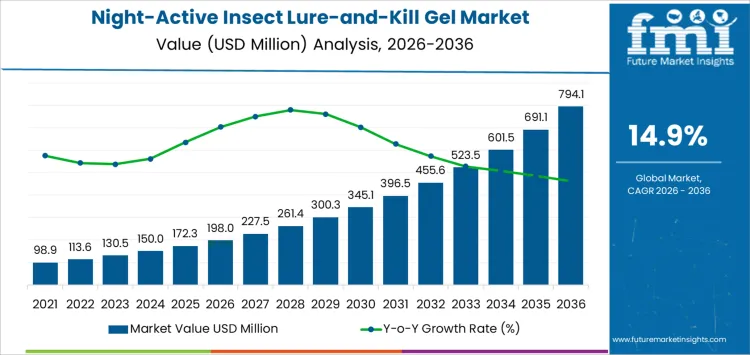
The night-active insect lure-and-kill gel market is projected to grow from USD 198 million in 2026 to USD 794.1 million by 2036, reflecting a compound annual growth rate (CAGR) of 14.9%. This innovative product, designed to attract and eliminate nocturnal insects, is gaining popularity due to its targeted, efficient, and eco-friendly pest control capabilities. With an increasing focus on sustainable solutions for home and outdoor pest management, these gels offer an effective alternative to traditional insecticides. The growing global awareness about the environmental impact of chemical pesticides and the shift toward safer, non-toxic alternatives are expected to drive the demand for night-active insect lure-and-kill gels, especially in residential and commercial applications.
The market is also benefiting from the increasing number of insect-related health issues and rising consumer concerns about the presence of pests, especially in outdoor spaces during the night. Innovations in gel formulations, which improve the efficacy and longevity of the product, are expected to further accelerate market growth. Additionally, the expanding retail channels and e-commerce platforms offering these products make it more accessible to a broader range of consumers globally, contributing to the overall market expansion.
Quick Stats of the Night-Active Insect Lure-and-Kill Gel Market
- Night-Active Insect Lure-and-Kill Gel Market Value (2026): USD 198 million
- Night-Active Insect Lure-and-Kill Gel Market Forecast Value (2036): USD 794.1 million
- Night-Active Insect Lure-and-Kill Gel Market Global Forecast CAGR (2026-2036): 14.9%
- Night-Active Insect Lure-and-Kill Gel Market Leading Segment: Pheromone-infused Gel Matrices 41%
- Key Growth Regions in Night-Active Insect Lure-and-Kill Gel Market: United States
- Top Players in Night-Active Insect Lure-and-Kill Gel Market: Koppert Biological Systems, Certis Biologicals, Andermatt Group, Marrone Bio Innovations, BioControle DMI, Others
What is the Growth Forecast for the Night-Active Insect Lure-and-Kill Gel Market through 2036?
The half-decade weighted growth analysis for the night-active insect lure-and-kill gel market shows consistent growth over the forecast period, with a notable acceleration in the middle years. Starting at USD 198 million in 2026, the market grows to USD 227.6 million in 2027 and USD 261.4 million in 2028, reflecting steady adoption of these insect control solutions. This initial growth phase highlights the increasing awareness and adoption of the product among consumers as an alternative to chemical-based pesticides.
From 2028 to 2030, the market experiences continued expansion, reaching USD 299.9 million in 2029 and USD 343.9 million in 2030. This period marks an acceleration as product efficacy improves, and more consumers adopt night-active insect lure-and-kill gels for both indoor and outdoor pest management. Between 2030 and 2035, the market accelerates further, reaching USD 394.4 million in 2031, USD 452.3 million in 2032, and USD 518.1 million in 2033, as the demand for sustainable pest control products continues to grow.
By 2035, the market is projected to reach USD 593.1 million, with the final market value of USD 794.1 million expected by 2036. The half-decade weighted growth analysis indicates that the market will see both steady volume increases and accelerating adoption, driven by consumer demand for effective, eco-friendly pest control solutions and continued innovations in gel formulations.
Night-Active Insect Lure-and-Kill Gel Market Key Takeaways
| Metric | Value |
|---|---|
| Industry Sales Value (2026) | USD 198 million |
| Industry Forecast Value (2036) | USD 794.1 million |
| Industry Forecast CAGR (2026-2036) | 14.9% |
What Is Driving the Demand for the Night-Active Insect Lure-and Kill Gel Market Globally?
The global demand for night active insect lure and kill gel is driven by rising concern over vector borne diseases, food crop damage, and nuisance insects that are most active during nocturnal hours. Mosquitoes, moths, beetles, and other pests that feed or breed at night contribute to public health risks and economic losses in agriculture, food storage, and residential settings. Traditional broad spectrum sprays and fumigation approaches can be disruptive, pose toxicity concerns, and require frequent re application. Night active lure and kill gels use attractants and insecticides formulated to appeal to target pest behavior after dusk, increasing the likelihood that pests will contact and ingest the active ingredient. These gels can be deployed in urban environments, agricultural settings, and around food storage or processing facilities, offering targeted control with lower risk of non target exposure. Regulatory emphasis in many regions on reducing pesticide drift and environmental impact supports adoption of bait based systems with precise application, while consumer preferences for products with reduced aerosol use and lower odor profile reinforce interest in gel formats that can be placed near pest entry points or activity zones.
Future demand for night active insect lure and kill gels is expected to grow as integrated pest management (IPM) practices expand and stakeholders seek solutions that balance efficacy with safety and sustainability. Advances in attractant chemistry, pheromone engineering, and species specific bait design will make gels more attractive to target insects and less appealing to non target organisms, improving outcome predictability and reducing overall pesticide usage. Growth in international trade and global travel increases the risk of pest introduction and spread, reinforcing the need for effective nocturnal pest control across agriculture and public health sectors. Population growth in urban and peri urban areas will further elevate expectations for pest control products that minimise human exposure and environmental contamination. Research into synergistic combinations of natural and synthetic attractants, along with integration of lure and kill strategies into smart monitoring systems, may expand utility and adoption. Regulatory frameworks that promote reduced chemical loading and encourage product registrations with clear safety profiles will influence how widely these gels are used. As global stakeholders prioritise targeted, efficient pest suppression under increasingly stringent environmental and health standards, the market for night active insect lure and kill gels is poised for steady expansion.
What is the Segment Analysis for the Night-Active Insect Lure-and-Kill Gel Market?
The night-active insect lure-and-kill gel market is driven by target insect groups and lure chemistry types. Moths & noctuid species lead the market, accounting for 38%, followed by other insects like night-active beetles and fruit borers. In lure chemistry, pheromone-infused gel matrices dominate, comprising 41% of the market, with food-based attractants and plant-volatile mimic blends also contributing. The demand for eco-friendly, efficient pest control solutions is driving the adoption of these gels, particularly in agriculture and residential areas. With growing interest in sustainable pest management, the market is expected to expand, fueled by targeted and precise solutions that minimize environmental impact.
What is Driving Growth in the Moths & Noctuid Species Segment of the Insect Lure-and-Kill Gel Market?
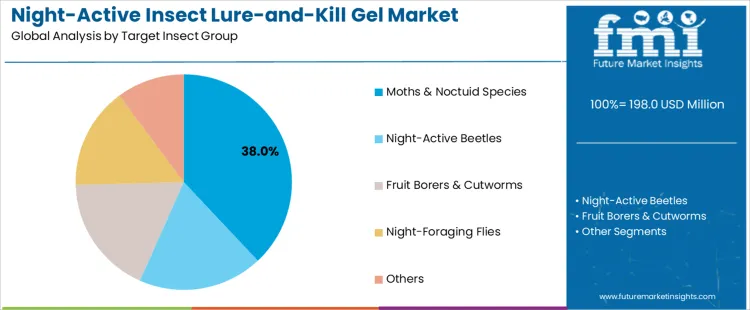
The moths & noctuid species segment is the largest target insect group in the night-active insect lure-and-kill gel market, comprising 38% of the market share. This growth is driven by the significant impact of moths and noctuid species on crops, particularly in agriculture, where they cause damage to stored grains, vegetables, and other crops. Night-active insect lures, especially those based on pheromone-infused gel matrices, are effective in attracting and trapping these pests, reducing crop damage and the need for chemical pesticides. The ability to provide precise, targeted pest control while minimizing the environmental impact of broad-spectrum chemical treatments is driving the adoption of lure-and-kill gels. With the increasing demand for eco-friendly pest control solutions and the growing need to protect crops from nocturnal pests, this segment is expected to continue its strong growth in the market.
What is Contributing to the Growth of Pheromone-Infused Gel Matrices in the Lure Chemistry Type Segment?
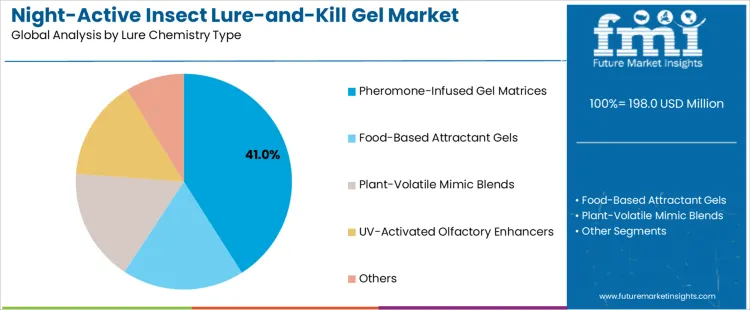
Pheromone-infused gel matrices are the leading lure chemistry type in the night-active insect lure-and-kill gel market, accounting for 41% of the market share. The popularity of these gels is driven by their ability to attract specific insect species, such as moths, noctuid species, and other night-active pests, through the use of natural pheromones. Pheromones are chemical signals used by insects to communicate, and their use in lure-and-kill gels ensures that only target species are attracted, providing highly efficient pest control. The growth of this segment is also supported by the increasing demand for sustainable, non-toxic pest control solutions, as pheromone-based gels offer an eco-friendly alternative to chemical pesticides. These gels are effective in both agricultural and residential settings, particularly for managing pests that are difficult to control through traditional methods. As the focus on environmental sustainability in pest control grows, the adoption of pheromone-infused gel matrices is expected to rise, driving continued growth in this segment.
What is the Key Dynamics of the Global Night-Active Insect Lure and Kill Gel Market?
The global night active insect lure and kill gel market is expanding as pest management professionals and consumers adopt targeted solutions for nocturnal pests such as cockroaches, crickets, ants and other creepers active after dark. These gels combine attractants with insecticides that draw insects at night and eliminate colonies with minimal environmental exposure. Growth reflects rising demand for discrete, effective pest control treatments in residential, commercial, hospitality and food handling environments. Adoption is supported by innovation in bait formulation and delivery that improves acceptance and control across diverse geographies.
What are the Key Drivers for the Global Night Active Insect Lure and Kill Gel Market?
One key driver is increasing concern about indoor pest pressure, especially in urban and peri urban areas where nocturnal insects are common. Pest control operators and facility managers seek products that work when pests are most active, improving efficiency and reducing repeat treatments. Advances in attractant chemistry and gel matrices increase palatability and persistence, supporting better uptake by target insects. Demand for low visibility, low mess options that fit integrated pest management strategies fuels interest. Growing awareness of hygiene and sanitation in foodservice, healthcare and hospitality settings reinforces need for targeted, performance oriented gels.
What are the Restraints for the Global Night Active Insect Lure and Kill Gel Market?
A restraint is the regulatory scrutiny on active ingredients used in lure and kill gels, which varies by region and influences registration timelines and product portfolios. Some potent actives may face restrictions or phase out pressures in certain markets, complicating supplier planning. Consumer perception about any pesticide use may restrain uptake where non chemical alternatives are preferred, especially in sensitive environments like schools and childcare facilities. Performance can vary with environmental conditions such as temperature and humidity, requiring careful product selection by professionals. Cost of premium formulations relative to traditional sprays and traps may affect adoption in price sensitive segments.
What is the Key Trends in the Global Night Active Insect Lure and Kill Gel Market?
A key trend is development of gels that incorporate behaviour based attractants fine tuned to nocturnal pest biology, increasing effectiveness and reducing non target contact. Manufacturers are integrating long lasting matrices that sustain activity through peak insect periods without frequent reapplication, enhancing convenience for users. Use of data from pest monitoring tools and digital platforms supports placement decisions that maximise lure and kill success. There is rising interest in combining gels with adjunct monitoring systems to track pest activity and measure treatment impact. Growth of professional service models that bundle advanced baiting solutions with scheduled maintenance supports broader market adoption.
What is the Country-Wise Analysis of the Night-Active Insect Lure-and-Kill Gel Market?
The night-active insect lure-and-kill gel market is projected to experience significant growth, driven by increasing demand for effective and eco-friendly pest control solutions. These gels attract and kill insects during the night, providing a more targeted and efficient method for managing pests in residential, commercial, and industrial settings. The market growth is supported by the rising concerns over the environmental impact of traditional insecticides and the increasing focus on sustainable, user-friendly pest control solutions. High-growth markets like the United States, Spain, and Brazil are experiencing strong demand due to the growing need for efficient insect management solutions, while China and Italy are seeing moderate growth driven by similar factors.
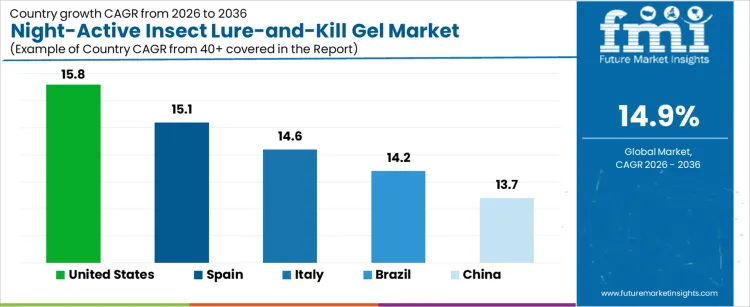
| Country | CAGR (2026-2036) |
|---|---|
| United States | 15.8% |
| Spain | 15.1% |
| Italy | 14.6% |
| Brazil | 14.2% |
| China | 13.7% |
What is the Growth Outlook for the Night-Active Insect Lure-and-Kill Gel Market in the United States?
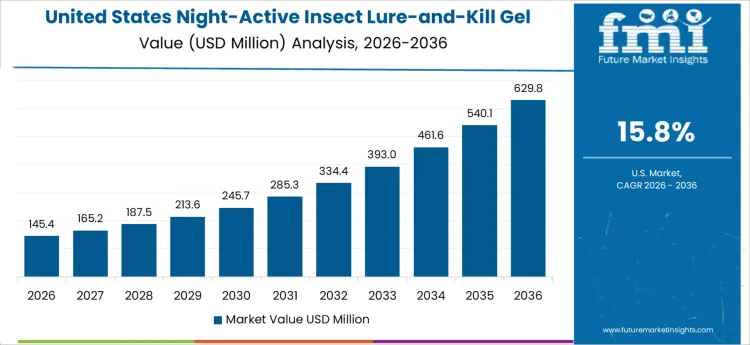
The night-active insect lure-and-kill gel market in the United States is expected to grow at a rapid pace, with a projected CAGR of 15.8%. The USA market is driven by increasing consumer demand for efficient, eco-friendly, and non-toxic insect control solutions. As people look for alternatives to chemical insecticides, the popularity of lure-and-kill gels is rising due to their targeted action and ease of use. The increasing awareness of the harmful effects of traditional pesticides and growing concerns about the health risks posed by insect-borne diseases are further supporting the adoption of these products. The market is expected to continue expanding as both residential and commercial users seek safer, more sustainable pest control options.
What is the Market Outlook for the Night-Active Insect Lure-and-Kill Gel Market in Spain?
The market for night-active insect lure-and-kill gels in Spain is expected to grow steadily, with a projected CAGR of 15.1%. Spain's climate and seasonal pest issues create a strong demand for efficient insect control methods, particularly during the warmer months. The rising preference for environmentally friendly products is further driving the adoption of lure-and-kill gels, which are seen as safer alternatives to traditional insecticides. With a growing awareness of health and environmental concerns, consumers in Spain are increasingly opting for sustainable pest control solutions. The market for night-active insect lure-and-kill gels is expected to continue growing as Spain’s residential, commercial, and hospitality sectors seek more effective and eco-conscious ways to manage insects.
What is the Growth Forecast for the Night-Active Insect Lure-and-Kill Gel Market in Italy?
The night-active insect lure-and-kill gel market in Italy is expected to grow at a steady pace, with a projected CAGR of 14.6%. The market is being driven by the increasing need for targeted pest control solutions and the rising consumer preference for eco-friendly alternatives to traditional insecticides. In Italy, seasonal insect problems, particularly in residential and agricultural areas, contribute to the demand for more efficient and less harmful pest management solutions. The adoption of night-active gels is expected to increase as both consumers and businesses seek products that offer greater precision, convenience, and sustainability. As the focus on environmentally responsible pest control solutions continues to grow, Italy’s market for these gels is set to expand steadily.
What is the Market Outlook for the Night-Active Insect Lure-and-Kill Gel Market in Brazil?
The night-active insect lure-and-kill gel market in Brazil is expected to grow at a solid pace, with a projected CAGR of 14.2%. Brazil's large agricultural sector and residential demand for effective pest control solutions are key drivers of market growth. The country's tropical climate leads to a higher prevalence of insects, especially during the warmer months, increasing the need for efficient pest control products. Additionally, Brazil's growing awareness of environmental issues is encouraging consumers to seek safer, eco-friendly alternatives to traditional chemical insecticides. As demand for targeted, non-toxic, and easy-to-use pest control solutions increases, Brazil is expected to see steady adoption of night-active insect lure-and-kill gels in both urban and rural areas.
What are the Growth Prospects for the Night-Active Insect Lure-and-Kill Gel Market in China?
The night-active insect lure-and-kill gel market in China is projected to grow at a moderate pace, with a projected CAGR of 13.7%. China’s large population, combined with increasing urbanization and seasonal pest problems, is driving the demand for effective and sustainable insect control solutions. With growing concerns over the health risks associated with insect-borne diseases and the environmental impact of traditional pesticides, consumers and businesses in China are seeking more targeted and environmentally friendly alternatives. The government’s increasing focus on environmental sustainability and regulations on chemical products is further encouraging the adoption of eco-friendly pest control methods. As a result, China’s market for night-active insect lure-and-kill gels is expected to grow steadily, driven by both domestic demand and regulatory changes.
What is the Competitive Landscape for the Night-Active Insect Lure-and-Kill Gel Market?
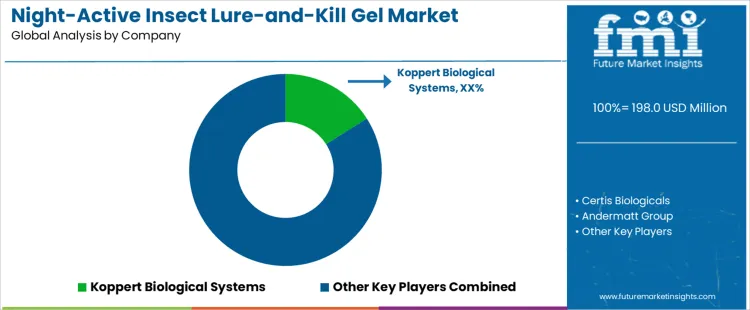
The night-active insect lure-and-kill gel market is growing rapidly, driven by the increasing demand for eco-friendly, effective pest control solutions. Koppert Biological Systems leads the market with its innovative insect lure-and-kill gels, designed to attract and eliminate night-active insects while minimizing environmental impact. Their focus on biological and sustainable pest control technologies has solidified their position as a market leader. Certis Biologicals, Andermatt Group, and Marrone Bio Innovations are major competitors, each offering advanced insect control products based on natural or biological solutions. Certis Biologicals focuses on eco-friendly pest management systems, while Andermatt Group and Marrone Bio Innovations specialize in using microorganisms and natural compounds for effective pest control.
BioControle DMI and Others add to the competitive landscape by offering innovative solutions targeting night-active insects. BioControle DMI specializes in developing biological pest control products that align with sustainable agricultural practices. These companies compete by focusing on product innovation, effectiveness in pest control, and sustainability, with an increasing emphasis on natural and environmentally responsible solutions. Their strategies are centered around providing safe and efficient alternatives to traditional chemical-based pest control methods, catering to the growing demand for environmentally conscious solutions in pest management.
Key Players of the Night-Active Insect Lure-and-Kill Gel Market
- Koppert Biological Systems
- Certis Biologicals
- Andermatt Group
- Marrone Bio Innovations
- BioControle DMI
- Others
Scope of the Report
| Items | Values |
|---|---|
| Quantitative Units (2026) | USD Million |
| Target Insect Group | Moths & Noctuid Species, Night-Active Beetles, Fruit Borers & Cutworms, Night-Foraging Flies, Others |
| Lure Chemistry Type | Pheromone-Infused Gel Matrices, Food-Based Attractant Gels, Plant-Volatile Mimic Blends, UV-Activated Olfactory Enhancers, Others |
| Deployment Method | Spot Gel Placement, Dispenser-Based Gel Stations, Band & Perimeter Application, Precision / Drone-Assisted Placement, Others |
| Companies | Koppert Biological Systems, Certis Biologicals, Andermatt Group, Marrone Bio Innovations, BioControle DMI, Others |
| Regions Covered | North America, Latin America, Western Europe, Eastern Europe, South Asia and Pacific, East Asia, Middle East & Africa |
| Countries Covered | United States, Canada, Mexico, Brazil, Argentina, Germany, France, United Kingdom, Italy, Spain, Netherlands, China, India, Japan, South Korea, ANZ, GCC Countries, South Africa |
| Additional Attributes | Dollar by sales by target insect group, lure chemistry type, deployment method, and region. Includes market trends in night-active insect lure-and-kill gels, focusing on pheromone-infused gel matrices, food-based attractants, and plant-volatile mimic blends. Highlights the role of UV-activated olfactory enhancers and drone-assisted placement in targeting moths, beetles, and flies. Focus on cost-effectiveness, sustainability, regulatory compliance, market share, and competitive positioning of key companies in the biological pest control market. |
Night-Active Insect Lure-and-Kill Gel Market Segmentation
Target Insect Group
- Moths & Noctuid Species
- Night-Active Beetles
- Fruit Borers & Cutworms
- Night-Foraging Flies
- Others
Lure Chemistry Type
- Pheromone-Infused Gel Matrices
- Food-Based Attractant Gels
- Plant-Volatile Mimic Blends
- UV-Activated Olfactory Enhancers
- Others
Deployment Method
- Spot Gel Placement
- Dispenser-Based Gel Stations
- Band & Perimeter Application
- Precision / Drone-Assisted Placement
- Others
Region
- Asia Pacific
- China
- Japan
- South Korea
- India
- Australia & New Zealand
- ASEAN
- Rest of Asia Pacific
- Europe
- Germany
- United Kingdom
- France
- Italy
- Spain
- Nordic
- BENELUX
- Rest of Europe
- North America
- United States
- Canada
- Mexico
- Latin America
- Brazil
- Chile
- Rest of Latin America
- Middle East & Africa
- Kingdom of Saudi Arabia
- Other GCC Countries
- Turkey
- South Africa
- Other African Union
- Rest of Middle East & Africa
Frequently Asked Questions
How big is the night-active insect lure-and-kill gel market in 2026?
The global night-active insect lure-and-kill gel market is estimated to be valued at USD 198.0 million in 2026.
What will be the size of night-active insect lure-and-kill gel market in 2036?
The market size for the night-active insect lure-and-kill gel market is projected to reach USD 794.1 million by 2036.
How much will be the night-active insect lure-and-kill gel market growth between 2026 and 2036?
The night-active insect lure-and-kill gel market is expected to grow at a 14.9% CAGR between 2026 and 2036.
What are the key product types in the night-active insect lure-and-kill gel market?
The key product types in night-active insect lure-and-kill gel market are moths & noctuid species, night-active beetles, fruit borers & cutworms, night-foraging flies and others.
Which lure chemistry type segment to contribute significant share in the night-active insect lure-and-kill gel market in 2026?
In terms of lure chemistry type, pheromone-infused gel matrices segment to command 41.0% share in the night-active insect lure-and-kill gel market in 2026.
Preview the report firsthand - request a free sample
Get SampleGet the brochure for pricing and purchase details.
Get PDFTable of Content
- Executive Summary
- Global Market Outlook
- Demand-side Trends
- Supply-side Trends
- Technology Roadmap Analysis
- Analysis and Recommendations
- Market Overview
- Market Coverage / Taxonomy
- Market Definition / Scope / Limitations
- Market Background
- Market Dynamics
- Drivers
- Restraints
- Opportunity
- Trends
- Scenario Forecast
- Demand in Optimistic Scenario
- Demand in Likely Scenario
- Demand in Conservative Scenario
- Opportunity Map Analysis
- Product Life Cycle Analysis
- Supply Chain Analysis
- Investment Feasibility Matrix
- Value Chain Analysis
- PESTLE and Porter’s Analysis
- Regulatory Landscape
- Regional Parent Market Outlook
- Production and Consumption Statistics
- Import and Export Statistics
- Market Dynamics
- Global Market Analysis 2021 to 2025 and Forecast, 2026 to 2036
- Historical Market Size Value (USD Million) Analysis, 2021 to 2025
- Current and Future Market Size Value (USD Million) Projections, 2026 to 2036
- Y-o-Y Growth Trend Analysis
- Absolute $ Opportunity Analysis
- Global Market Pricing Analysis 2021 to 2025 and Forecast 2026 to 2036
- Global Market Analysis 2021 to 2025 and Forecast 2026 to 2036, By Target Insect Group
- Introduction / Key Findings
- Historical Market Size Value (USD Million) Analysis By Target Insect Group , 2021 to 2025
- Current and Future Market Size Value (USD Million) Analysis and Forecast By Target Insect Group , 2026 to 2036
- Moths & Noctuid Species
- Night-Active Beetles
- Fruit Borers & Cutworms
- Night-Foraging Flies
- Others
- Y-o-Y Growth Trend Analysis By Target Insect Group , 2021 to 2025
- Absolute $ Opportunity Analysis By Target Insect Group , 2026 to 2036
- Global Market Analysis 2021 to 2025 and Forecast 2026 to 2036, By Lure Chemistry Type
- Introduction / Key Findings
- Historical Market Size Value (USD Million) Analysis By Lure Chemistry Type, 2021 to 2025
- Current and Future Market Size Value (USD Million) Analysis and Forecast By Lure Chemistry Type, 2026 to 2036
- Pheromone-Infused Gel Matrices
- Food-Based Attractant Gels
- Plant-Volatile Mimic Blends
- UV-Activated Olfactory Enhancers
- Others
- Y-o-Y Growth Trend Analysis By Lure Chemistry Type, 2021 to 2025
- Absolute $ Opportunity Analysis By Lure Chemistry Type, 2026 to 2036
- Global Market Analysis 2021 to 2025 and Forecast 2026 to 2036, By Deployment Method
- Introduction / Key Findings
- Historical Market Size Value (USD Million) Analysis By Deployment Method, 2021 to 2025
- Current and Future Market Size Value (USD Million) Analysis and Forecast By Deployment Method, 2026 to 2036
- Spot Gel Placement
- Dispenser-Based Gel Stations
- Band & Perimeter Application
- Precision / Drone-Assisted Placement
- Y-o-Y Growth Trend Analysis By Deployment Method, 2021 to 2025
- Absolute $ Opportunity Analysis By Deployment Method, 2026 to 2036
- Global Market Analysis 2021 to 2025 and Forecast 2026 to 2036, By Region
- Introduction
- Historical Market Size Value (USD Million) Analysis By Region, 2021 to 2025
- Current Market Size Value (USD Million) Analysis and Forecast By Region, 2026 to 2036
- North America
- Latin America
- Western Europe
- Eastern Europe
- East Asia
- South Asia and Pacific
- Middle East & Africa
- Market Attractiveness Analysis By Region
- North America Market Analysis 2021 to 2025 and Forecast 2026 to 2036, By Country
- Historical Market Size Value (USD Million) Trend Analysis By Market Taxonomy, 2021 to 2025
- Market Size Value (USD Million) Forecast By Market Taxonomy, 2026 to 2036
- By Country
- USA
- Canada
- Mexico
- By Target Insect Group
- By Lure Chemistry Type
- By Deployment Method
- By Country
- Market Attractiveness Analysis
- By Country
- By Target Insect Group
- By Lure Chemistry Type
- By Deployment Method
- Key Takeaways
- Latin America Market Analysis 2021 to 2025 and Forecast 2026 to 2036, By Country
- Historical Market Size Value (USD Million) Trend Analysis By Market Taxonomy, 2021 to 2025
- Market Size Value (USD Million) Forecast By Market Taxonomy, 2026 to 2036
- By Country
- Brazil
- Chile
- Rest of Latin America
- By Target Insect Group
- By Lure Chemistry Type
- By Deployment Method
- By Country
- Market Attractiveness Analysis
- By Country
- By Target Insect Group
- By Lure Chemistry Type
- By Deployment Method
- Key Takeaways
- Western Europe Market Analysis 2021 to 2025 and Forecast 2026 to 2036, By Country
- Historical Market Size Value (USD Million) Trend Analysis By Market Taxonomy, 2021 to 2025
- Market Size Value (USD Million) Forecast By Market Taxonomy, 2026 to 2036
- By Country
- Germany
- UK
- Italy
- Spain
- France
- Nordic
- BENELUX
- Rest of Western Europe
- By Target Insect Group
- By Lure Chemistry Type
- By Deployment Method
- By Country
- Market Attractiveness Analysis
- By Country
- By Target Insect Group
- By Lure Chemistry Type
- By Deployment Method
- Key Takeaways
- Eastern Europe Market Analysis 2021 to 2025 and Forecast 2026 to 2036, By Country
- Historical Market Size Value (USD Million) Trend Analysis By Market Taxonomy, 2021 to 2025
- Market Size Value (USD Million) Forecast By Market Taxonomy, 2026 to 2036
- By Country
- Russia
- Poland
- Hungary
- Balkan & Baltic
- Rest of Eastern Europe
- By Target Insect Group
- By Lure Chemistry Type
- By Deployment Method
- By Country
- Market Attractiveness Analysis
- By Country
- By Target Insect Group
- By Lure Chemistry Type
- By Deployment Method
- Key Takeaways
- East Asia Market Analysis 2021 to 2025 and Forecast 2026 to 2036, By Country
- Historical Market Size Value (USD Million) Trend Analysis By Market Taxonomy, 2021 to 2025
- Market Size Value (USD Million) Forecast By Market Taxonomy, 2026 to 2036
- By Country
- China
- Japan
- South Korea
- By Target Insect Group
- By Lure Chemistry Type
- By Deployment Method
- By Country
- Market Attractiveness Analysis
- By Country
- By Target Insect Group
- By Lure Chemistry Type
- By Deployment Method
- Key Takeaways
- South Asia and Pacific Market Analysis 2021 to 2025 and Forecast 2026 to 2036, By Country
- Historical Market Size Value (USD Million) Trend Analysis By Market Taxonomy, 2021 to 2025
- Market Size Value (USD Million) Forecast By Market Taxonomy, 2026 to 2036
- By Country
- India
- ASEAN
- Australia & New Zealand
- Rest of South Asia and Pacific
- By Target Insect Group
- By Lure Chemistry Type
- By Deployment Method
- By Country
- Market Attractiveness Analysis
- By Country
- By Target Insect Group
- By Lure Chemistry Type
- By Deployment Method
- Key Takeaways
- Middle East & Africa Market Analysis 2021 to 2025 and Forecast 2026 to 2036, By Country
- Historical Market Size Value (USD Million) Trend Analysis By Market Taxonomy, 2021 to 2025
- Market Size Value (USD Million) Forecast By Market Taxonomy, 2026 to 2036
- By Country
- Kingdom of Saudi Arabia
- Other GCC Countries
- Turkiye
- South Africa
- Other African Union
- Rest of Middle East & Africa
- By Target Insect Group
- By Lure Chemistry Type
- By Deployment Method
- By Country
- Market Attractiveness Analysis
- By Country
- By Target Insect Group
- By Lure Chemistry Type
- By Deployment Method
- Key Takeaways
- Key Countries Market Analysis
- USA
- Pricing Analysis
- Market Share Analysis, 2025
- By Target Insect Group
- By Lure Chemistry Type
- By Deployment Method
- Canada
- Pricing Analysis
- Market Share Analysis, 2025
- By Target Insect Group
- By Lure Chemistry Type
- By Deployment Method
- Mexico
- Pricing Analysis
- Market Share Analysis, 2025
- By Target Insect Group
- By Lure Chemistry Type
- By Deployment Method
- Brazil
- Pricing Analysis
- Market Share Analysis, 2025
- By Target Insect Group
- By Lure Chemistry Type
- By Deployment Method
- Chile
- Pricing Analysis
- Market Share Analysis, 2025
- By Target Insect Group
- By Lure Chemistry Type
- By Deployment Method
- Germany
- Pricing Analysis
- Market Share Analysis, 2025
- By Target Insect Group
- By Lure Chemistry Type
- By Deployment Method
- UK
- Pricing Analysis
- Market Share Analysis, 2025
- By Target Insect Group
- By Lure Chemistry Type
- By Deployment Method
- Italy
- Pricing Analysis
- Market Share Analysis, 2025
- By Target Insect Group
- By Lure Chemistry Type
- By Deployment Method
- Spain
- Pricing Analysis
- Market Share Analysis, 2025
- By Target Insect Group
- By Lure Chemistry Type
- By Deployment Method
- France
- Pricing Analysis
- Market Share Analysis, 2025
- By Target Insect Group
- By Lure Chemistry Type
- By Deployment Method
- India
- Pricing Analysis
- Market Share Analysis, 2025
- By Target Insect Group
- By Lure Chemistry Type
- By Deployment Method
- ASEAN
- Pricing Analysis
- Market Share Analysis, 2025
- By Target Insect Group
- By Lure Chemistry Type
- By Deployment Method
- Australia & New Zealand
- Pricing Analysis
- Market Share Analysis, 2025
- By Target Insect Group
- By Lure Chemistry Type
- By Deployment Method
- China
- Pricing Analysis
- Market Share Analysis, 2025
- By Target Insect Group
- By Lure Chemistry Type
- By Deployment Method
- Japan
- Pricing Analysis
- Market Share Analysis, 2025
- By Target Insect Group
- By Lure Chemistry Type
- By Deployment Method
- South Korea
- Pricing Analysis
- Market Share Analysis, 2025
- By Target Insect Group
- By Lure Chemistry Type
- By Deployment Method
- Russia
- Pricing Analysis
- Market Share Analysis, 2025
- By Target Insect Group
- By Lure Chemistry Type
- By Deployment Method
- Poland
- Pricing Analysis
- Market Share Analysis, 2025
- By Target Insect Group
- By Lure Chemistry Type
- By Deployment Method
- Hungary
- Pricing Analysis
- Market Share Analysis, 2025
- By Target Insect Group
- By Lure Chemistry Type
- By Deployment Method
- Kingdom of Saudi Arabia
- Pricing Analysis
- Market Share Analysis, 2025
- By Target Insect Group
- By Lure Chemistry Type
- By Deployment Method
- Turkiye
- Pricing Analysis
- Market Share Analysis, 2025
- By Target Insect Group
- By Lure Chemistry Type
- By Deployment Method
- South Africa
- Pricing Analysis
- Market Share Analysis, 2025
- By Target Insect Group
- By Lure Chemistry Type
- By Deployment Method
- USA
- Market Structure Analysis
- Competition Dashboard
- Competition Benchmarking
- Market Share Analysis of Top Players
- By Regional
- By Target Insect Group
- By Lure Chemistry Type
- By Deployment Method
- Competition Analysis
- Competition Deep Dive
- Koppert Biological Systems
- Overview
- Product Portfolio
- Profitability by Market Segments (Product/Age /Sales Channel/Region)
- Sales Footprint
- Strategy Overview
- Marketing Strategy
- Product Strategy
- Channel Strategy
- Certis Biologicals
- Andermatt Group
- Marrone Bio Innovations
- BioControle DMI
- Others
- Koppert Biological Systems
- Competition Deep Dive
- Assumptions & Acronyms Used
- Research Methodology


