

- Market Size (2026)
- USD 154.4 Mn
- Forecast (2036)
- USD 755.0 Mn
- CAGR (2026 to 2036)
- 17.2%
How big is Insect Frass & Organic Biofertilizer Market in 2026?
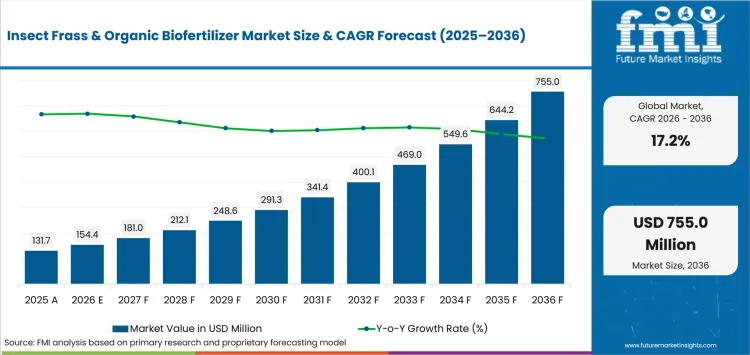
USD 154.4 million in 2026 and USD 755.0 million by 2036 at a 17.2% CAGR.
The insect frass & organic biofertilizer market is projected to expand at 17.2% CAGR between 2026 and 2036. Value is projected to rise from USD 154.4 million to USD 755.0 million as insect farms process residual material into specified crop inputs. USDA Agricultural Research Service reported in January 2025 that yellow mealworm frass raised soil carbon and nitrogen in a two-year field study while yields matched familiar nutrient sources.
Commercial interest converts into orders through local crop-input rules and field support. Dutch distributors need traceable product records, while Kenyan insect farms can work near organic-waste streams. Statistics Netherlands reported in April 2026 that certified organic farmland reached 86,900 hectares in 2025. That acreage gives distributors a defined set of crop programs that require documented input choices.
Key Takeaways of Insect Frass & Organic Biofertilizer Market
- Insect farms gain a commercial outlet for frass when drying, hygienization, nutrient analysis, and application guidance make it comparable with established crop inputs.
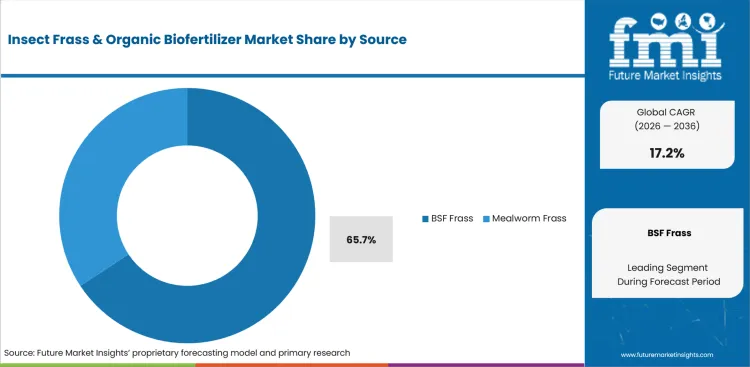
- By source, BSF frass is estimated to hold 65.7% in 2026 owing to industrial insect farms that generate recurring residual volumes.
- In 2026, soil amendment is expected to lead the application category with 38.5% share because advisers can position frass for organic matter and nutrient management.
- The crop category is forecast to be led by cereals and grains at 35.8% share in 2026 due to bulk application needs across broad-acre programs.
- Variation in feedstocks and processing conditions slows approval and distributor qualification because crop-input buyers require dependable analysis before repeat purchases.
- Protix, InnovaFeed, Beta Hatch, Chapul Farms, Hexafly, and Ÿnsect appear in the market record, although Ÿnsect’s current operating availability is constrained by liquidation.
Analyst Perspective
"A viable frass offer starts with a nutrient specification that an agronomist can use in a crop plan. The stronger commercial position comes from linking that record with storage guidance, application rates, and a channel that can support growers across a season."
- Nikhil Kaitwade, Principal Consultant, Future Market Insights
How is the Insect Frass & Organic Biofertilizer Market segmented?
The insect frass & organic biofertilizer market is segmented by source, application, crop, and region.
The insect frass & organic biofertilizer market is segmented by source, application, crop, and region. By source, the analysis covers BSF frass and mealworm frass. Application includes soil amendment, biostimulant, and fertilizer, while crop covers cereals and grains, oilseeds and pulses, fruits and vegetables, and specialty crops.
What makes BSF frass central to the source category?
Industrial black soldier fly farms produce frass beside protein and oil. That recurring material can become a crop input once processors control moisture, nutrient analysis, and hygienization. The commercial task is not insect production alone. It is creating a product record that a distributor can place beside established soil inputs.
- By source, BSF frass is projected to account for 65.7% in 2026 due to its recurring availability from industrial black soldier fly farms.
- In January 2025, InnovaFeed and Agryco announced French distribution for Hilucia Frass. The agreement puts a BSF-derived product into an agricultural sales route that already serves crop advisers and growers.
Why does soil amendment lead the application category?
Soil amendment fits frass because growers assess organic matter, nutrient release, and handling as one field decision. It does not need to replace every mineral fertilizer. Crop advisers can use it beside familiar soil programs when product records define nutrient content and application limits.
- In 2026, soil amendment is expected to lead the application category with 38.5% share because it combines soil-conditioning and nutrient functions.
- Wageningen University & Research reported in June 2025 that heat-treated BSF frass improved leaf area and shoot biomass in Brassica rapa. The finding makes processing control relevant to agricultural products that need repeatable field performance.
What supports cereals and grains in the crop category?
Cereals and grains provide a volume route for frass. Yet spreading and delivery costs can outweigh the product benefit if nutrient concentration is low. Field programs need application rates that fit broad-acre equipment, local freight economics, and existing soil-input routines.
- The cereals and grains segment is set to lead the crop category with 35.8% share in 2026 due to repeat bulk-application requirements.
- A 2025 icipe field study in Kenya reported stronger potato yields from insect-frass treatments than comparison treatments. Local trial results give advisers a practical basis for setting crop-specific rates before larger seasonal orders are placed.
What are the drivers, restraints, and opportunities in the insect frass & organic biofertilizer market?
Frass gains commercial relevance where performance, nutrient analysis, and compliance records support crop-input sales.
- Driver: Crop programs create demand when frass offers measurable soil and nutrient performance that growers can compare with familiar inputs.
- Restraint: Variable feedstocks and compliance documentation delay qualification for distributors and growers who need dependable analyses.
- Opportunity: Regional production paired with crop-input channels can convert insect-farm residual output into repeat agricultural orders.
Crop advisers need field evidence before they recommend a new soil input. The University of Arkansas Division of Agriculture reported in January 2026 that insect frass delivered two to four times greater nutrient efficiency than poultry litter in its study. The result gives growers a defined performance question for trials beside existing fertility plans.
Processors must show stable composition and safe handling records before distributors place frass in formal crop programs. England updated its Farming Rules for Water guidance in February 2026. The guidance requires fertilizer use to be planned against soil and crop need, which makes nutrient analysis and application advice part of the sales file.
Regional production becomes commercially useful when frass reaches a channel that already supports growers. InnovaFeed and Agryco announced the January 2025 distribution of Hilucia Frass in France. The arrangement gives the product an established route for ordering, local advice, and repeat seasonal purchasing.
Which country CAGRs are profiled in the insect frass & organic biofertilizer market?
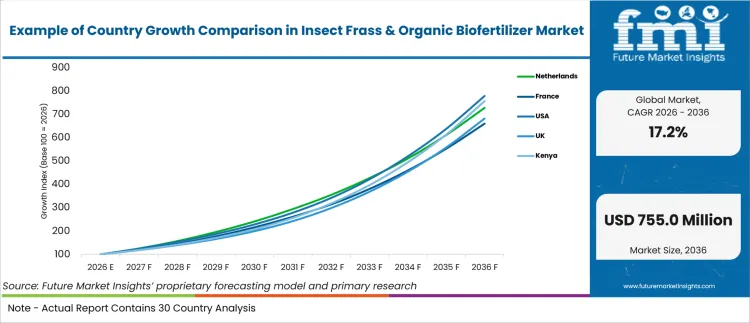
| Country | CAGR |
|---|---|
| USA | 22.8% |
| Kenya | 22.4% |
| Netherlands | 22.0% |
| UK | 21.2% |
| France | 20.8% |
How do country-level CAGRs compare in the insect frass & organic biofertilizer market?
The five profiled CAGRs span 2.0 percentage points, which indicates a narrow growth band rather than sharply different national trajectories. The split comes from commercial routes. The USA and Kenya combine local production with agricultural use cases. The Netherlands, the UK, and France depend more heavily on documented input placement and established distribution.
- USA crop-input channels can convert field results into seasonal orders once nutrient specifications meet adviser requirements.
- Kenyan insect farms can use nearby waste streams, although registration evidence and farmer training shape conversion.
- Dutch horticultural programs require traceable nutrient declarations and handling records before frass enters professional input schedules.
- UK farm plans place a premium on nutrient analysis and documented application guidance for soil-management compliance.
- French agricultural distributors can place frass more readily when suppliers provide crop-specific guidance alongside recognized input channels.
Comparable CAGRs can produce different order patterns because local registration, advisory coverage, and freight economics differ. The full report provides country-level CAGR analysis across North America, Latin America, Europe, East Asia, South Asia, Oceania, and the Middle East and Africa.
Country-wise Analysis
- US crop-input distributors need field-ready nutrient specifications before alternative fertilizers move beyond limited trials. The insect frass & organic biofertilizer market in the USA is forecast to rise at 22.8% CAGR over the forecast period, aided by interest in domestic nutrient sources. The University of Arkansas Division of Agriculture reported in January 2026 that insect frass delivered two to four times greater nutrient efficiency than poultry litter. Freight costs remain a restraint for bulky products. Suppliers therefore need application guidance that helps distributors turn local trial results into seasonal orders.
- Kenyan insect farms can rear larvae near municipal and agricultural waste streams, which reduces feedstock transport before frass reaches farm channels. Adoption of insect frass and organic biofertilizer in Kenya is estimated to expand at 22.4% CAGR through 2036, supported by local production potential. A 2025 icipe field study reported stronger potato yields from insect-frass treatments under local trial conditions. Registration evidence and farmer training remain material constraints. Commercial entry depends on locally validated rates, compliant dossiers, and resellers who can provide advisory support.
- Dutch horticultural programs use documented nutrient inputs and closely managed crop plans. Netherlands is estimated to post 22.0% CAGR over the forecast period, supported by professional distribution networks and demand for traceable soil inputs. Statistics Netherlands reported in April 2026 that certified organic farmland reached 86,900 hectares in 2025. Hygienization and moisture records still need to match crop-specific economics. Processors that provide verified analysis, storage guidance, and repeatable application instructions are better placed with specialist distributors.
- UK growers must fit frass into documented soil and crop plans instead of treating it as an informal amendment. The UK insect frass and organic biofertilizer sector is projected to record 21.2% CAGR during the assessment period, shaped by nutrient-use and handling rules. The Environment Agency updated Farming Rules for Water guidance in February 2026. Clear nutrient analysis can shorten distributor review. Product sales depend on advisers being able to link application rates with soil need and farm records.
- French market access depends on agricultural channels that can translate product specifications into farm use. In France, insect frass and organic biofertilizer demand is predicted to advance at 20.8% CAGR through 2036, aided by established input platforms. InnovaFeed and Agryco announced French distribution for Hilucia Frass in January 2025. Crop-specific guidance remains necessary before digital availability becomes repeat seasonal purchasing. Companies entering France need distributor relationships that connect product records with local advisory practices.
Who are the notable companies in the insect frass & organic biofertilizer market?
Protix, InnovaFeed, Beta Hatch, Chapul Farms, Hexafly, and Ÿnsect are the notable companies profiled in this market.
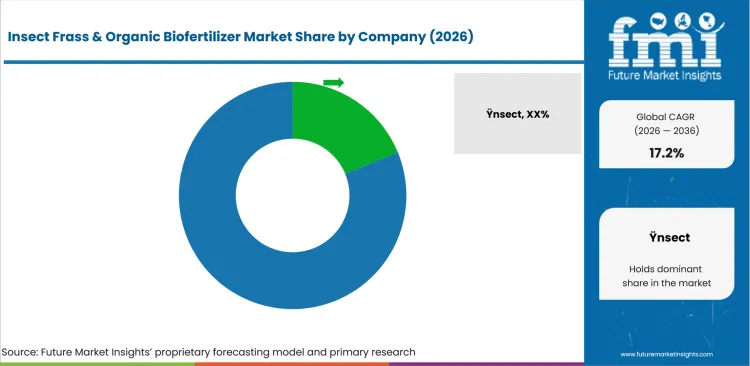
Competition is fragmented across industrial insect farms, specialist agricultural-product companies, and regional commercializers. Entry barriers arise from repeatable frass processing, nutrient records, hygienization, and access to crop advisers who can validate field use. Industrial scale alone does not secure a seasonal order. The company that supplies consistent material and supports application decisions holds the more credible position.
- Industrial BSF producers: Protix and InnovaFeed commercialize insect-derived outputs alongside broader industrial production platforms.
- North American specialists: Beta Hatch and Chapul Farms link mealworm or BSF production with plant-nutrition commercialization.
- European product references: Hexafly maintains a BSF-derived fertilizer position, while Ÿnsect’s liquidation limits its current supply role.
Competitive Benchmarking: Insect Frass & Organic Biofertilizer Market
| Company | Industrial Frass Supply Base | Farmer-Ready Plant Nutrition | Channel and Field Evidence | Geographic Reach |
|---|---|---|---|---|
| Protix | High | Medium | Medium | Netherlands and wider Europe |
| InnovaFeed | High | High | High | France, Europe, and the United States |
| Beta Hatch | Medium | Medium | Medium | United States |
| Chapul Farms | Medium | High | High | United States |
| Hexafly | Medium | Medium | Medium | Ireland and selected European markets |
| Ÿnsect | Low | Medium | Low | France; current availability constrained by liquidation |
Scoring basis: industrial frass supply base measures documented production depth. Farmer-ready plant nutrition measures defined agricultural positioning. Channel and field evidence measures documented sales routes or agronomic proof. High denotes broad evidence, medium denotes narrower evidence, and low identifies a documented limitation.
Key Developments in the Insect Frass & Organic Biofertilizer Market
- In December 2025, Ÿnsect entered judicial liquidation according to a Hauts-de-France public report. The event limits current commercial availability and requires distributors to separate historical authorization records from active supply.
- In June 2025, Wageningen University & Research published heat-treatment findings for BSF frass. The work linked controlled processing with improved Brassica rapa growth and gives processors a technical benchmark for crop-input qualification.
- In January 2025, InnovaFeed and Agryco announced a distribution agreement for Hilucia Frass. The partnership places the product within an agricultural-input route that can combine ordering with local advisory services.
Key Players in the Insect Frass & Organic Biofertilizer Market
Industrial BSF Production and Plant Nutrition
- Protix
- InnovaFeed
North American Specialist Commercialization
- Beta Hatch
- Chapul Farms
European Frass References
- Ÿnsect
- Hexafly
Insect Frass & Organic Biofertilizer Market - Report Scope
| Coverage field | Report scope |
|---|---|
| Market breakdown | Source; Application; Crop; Region |
| Quantitative Units | USD million. |
| Market Definition | Revenue includes insect frass and frass-based organic biofertilizer sold as plant-nutrition or soil-health inputs. It excludes insect protein, insect oil, equipment, and crop revenue. |
| Regions Covered | North America, Latin America, Europe, East Asia, South Asia and Pacific and Middle East and Africa. |
| Countries Covered | USA, Kenya, Netherlands, UK, France, and 20+ countries included in the full report. |
| Key Companies Profiled | Protix, InnovaFeed, Beta Hatch, Chapul Farms, Hexafly, Ÿnsect. |
| Forecast Period | 2026 to 2036. |
| Approach | Primary and secondary research with market triangulation. |
Insect Frass & Organic Biofertilizer Market - Research Methodology
| Method | Approach |
|---|---|
| Primary Research | FMI analysts gathered input from manufacturers, service providers, technology developers, distributors, end users, procurement teams, and subject-matter experts. Interviews examined purchasing decisions, product or service evaluation, adoption barriers, approval requirements, pricing considerations, and expectations for technical or commercial support. Respondents were also asked what evidence is required before a trial, pilot, or initial order develops into regular purchasing. |
| Desk Research | Desk research covered government statistics, regulatory publications, trade data, industry associations, technical literature, standards, company filings, product information, and official corporate announcements. Sources were reviewed for relevance, publication date, geographic coverage, and consistency with the defined market scope. Claims relating to performance, applications, approvals, capacity, investment, and commercial activity were retained only when supported by credible public evidence. |
| Market Sizing and Forecasting | The market model combined the baseline value with historical performance, segment structure, pricing and volume indicators, adoption levels, company participation, and country-level demand conditions. Forecast assumptions considered economic activity, investment trends, regulatory developments, technology adoption, purchasing cycles, supply availability, and barriers to wider market use. Segment and regional estimates were reconciled before the final market total was calculated. |
| Data Validation | Estimates were checked against multiple independent indicators, including public data, company activity, trade patterns, industry developments, and findings from primary interviews. Validation also tested whether products, services, applications, and company revenues fell within the defined market boundaries. Adjacent categories, unsupported claims, overlapping revenues, and activities without direct market relevance were excluded to reduce double counting and maintain consistency across segments and countries. |
Insect Frass & Organic Biofertilizer Market by Segments
Insect Frass & Organic Biofertilizer Market segmented by Source:
- BSF Frass
- Mealworm Frass
Insect Frass & Organic Biofertilizer Market segmented by Application:
- Soil Amendment
- Biostimulant
- Fertilizer
Insect Frass & Organic Biofertilizer Market segmented by Crop:
- Cereals & Grains
- Oilseeds & Pulses
- Fruits & Vegetables
- Specialty Crops
Insect Frass & Organic Biofertilizer Market by Region:
- North America
- United States
- Canada
- Latin America
- Brazil
- Mexico
- Argentina
- Chile
- Western Europe
- Germany
- France
- United Kingdom
- Italy
- Spain
- Benelux
- Nordics
- Eastern Europe
- Poland
- Czech Republic
- Romania
- Hungary
- East Asia
- China
- Japan
- South Korea
- South Asia and Pacific
- India
- ASEAN
- Australia and New Zealand
- Middle East and Africa
- GCC Countries
- South Africa
- Türkiye
- Israel
Research Sources and Bibliography
- USDA Agricultural Research Service. (2025, July 16). No Waste Left Behind: Insect Frass Can Improve Soil Fertility.
- Statistics Netherlands. (2026, April 10). 3.1 percent increase in organic farmland.
- Innovafeed. (2025, January 29). Innovafeed and Agryco announce strategic partnership to market frass, an innovative sustainable fertilizer.
- Wageningen University & Research. (2025, June 23). Heat treatment of black soldier fly frass for soil amendment enhances Brassica rapa growth.
- International Centre of Insect Physiology and Ecology. (2025). Unpacking the benefits of black soldier fly frass fertilizer towards nematode suppression and potato production.
- University of Arkansas Division of Agriculture. (2026, January 29). Study shows insect farming byproduct boosts soil health and crop performance.
- Department for Environment, Food & Rural Affairs and Environment Agency. (2026, February 4). How to comply with the Farming Rules for Water.
- Région Hauts-de-France. (2025, December 2). Communiqué de presse : réactions à la liquidation judiciaire d'Ynsect.
This bibliography is provided for reader reference and is not exhaustive. The full report contains the complete reference list and detailed citations.
This Report Answers
- How large is the insect frass & organic biofertilizer market in 2026 and 2036?
- Which production and qualification conditions support insect-frass commercialization?
- Why does BSF frass account for the largest source share in 2026?
- How does soil-amendment positioning change the crop-input sales route?
- Why do cereals and grains create a bulk-use route for insect frass?
- How do country growth rates differ across the five profiled markets?
- Which company roles shape industrial supply and crop-input commercialization?
- What documentation and field evidence should distributors review before ordering frass products?
- What should agricultural input buyers evaluate before purchasing insect frass & organic biofertilizer?
Frequently Asked Questions
How big is the Insect Frass & Organic Biofertilizer Market in 2026?
The insect frass & organic biofertilizer market is expected to be valued at USD 154.4 million in 2026 and reach USD 755.0 million by 2036. Growth depends on converting insect residues into specified crop inputs with documented field performance.
What is the CAGR of the Insect Frass & Organic Biofertilizer Market from 2026 to 2036?
The insect frass & organic biofertilizer market is projected to grow at a CAGR of 17.2% between 2026 and 2036. Expansion is supported by agricultural channels that can pair reliable nutrient analysis with practical application guidance.
Which source segment leads the Insect Frass & Organic Biofertilizer Market?
BSF frass is projected to account for 65.7% of the insect frass & organic biofertilizer market in 2026. Industrial black soldier fly platforms generate a repeatable residual stream that producers can process into plant-nutrition products.
Which application segment leads the Insect Frass & Organic Biofertilizer Market?
Soil amendment is projected to account for 38.5% of the insect frass & organic biofertilizer market in 2026. The segment combines organic-matter and nutrient functions, which helps advisers position frass within broader crop programs.
Which companies are active in the Insect Frass & Organic Biofertilizer Market?
Key companies in the insect frass & organic biofertilizer market include Protix, InnovaFeed, Beta Hatch, Chapul Farms, Hexafly, and Ÿnsect. They compete through industrial production, plant-nutrition positioning, agricultural channels, and field-evidence routes.
Preview the report firsthand - request a free sample
Get SampleGet the brochure for pricing and purchase details.
Get PDFTable of Content
- Key Takeaways
- Market Size and CAGR
- Top Growth Driver
- Fastest Growing Segment
- Leading Region
- Key Companies
- Emerging Opportunities
- Executive Summary
- Global Market Outlook
- Demand-side Trends
- Supply-side Trends
- Technology Roadmap Analysis
- Analysis and Recommendations
- Analyst Perspective (What is happening? Why now? What should investors know?)
- Key Questions Answered
- How large is the market?
- What is the CAGR?
- What are key trends?
- Which region dominates?
- Who are the leaders?
- Market Overview
- Market Coverage / Taxonomy
- Market Definition / Scope / Limitations
- Research Methodology
- Chapter Orientation
- Analytical Lens and Working Hypotheses
- Market Structure, Signals, and Trend Drivers
- Benchmarking and Cross-market Comparability
- Market Sizing, Forecasting, and Opportunity Mapping
- Research Design and Evidence Framework
- Desk Research Programme (Secondary Evidence)
- Expert Input and Fieldwork (Primary Evidence)
- Tooling, Models, and Reference Databases
- Data Engineering and Model Build
- Quality Assurance and Audit Trail
- Market Background
- Market Dynamics (Drivers, Restraints, Opportunity, Trends)
- Scenario Forecast (Optimistic, Likely, Conservative)
- Impact Analysis
- AI Impact
- Sustainability Impact
- Regulatory Impact
- Technology Impact
- Consumer / Buyer Analysis
- Purchase Drivers
- Adoption Barriers
- Buyer Journey
- Opportunity Map Analysis
- Product Life Cycle Analysis
- Supply Chain Analysis
- Investment Feasibility Matrix
- Value Chain Analysis
- PESTLE and Porter's Analysis
- Regulatory Landscape
- Regional Parent Market Outlook
- Production and Consumption Statistics
- Import and Export Statistics
- Global Market Analysis and Forecast, 2021 to 2036
- Historical Market Size Value (USD Million) Analysis, 2021 to 2025
- Current and Future Market Size Value (USD Million) Projections, 2026 to 2036
- Y-o-Y Growth Trend Analysis
- Absolute $ Opportunity Analysis
- Global Market Pricing Analysis, 2021 to 2036
- Global Market Analysis and Forecast, By Source, 2021 to 2036
- Introduction / Key Findings
- Historical Market Size Value (USD Million) Analysis By Source, 2021 to 2025
- Current and Future Market Size Value (USD Million) Analysis and Forecast By Source, 2026 to 2036
- BSF Frass
- Mealworm Frass
- BSF Frass
- Y-o-Y Growth Trend Analysis By Source, 2021 to 2025
- Absolute $ Opportunity Analysis By Source, 2026 to 2036
- Global Market Analysis and Forecast, By Application, 2021 to 2036
- Introduction / Key Findings
- Historical Market Size Value (USD Million) Analysis By Application, 2021 to 2025
- Current and Future Market Size Value (USD Million) Analysis and Forecast By Application, 2026 to 2036
- Soil Amendment
- Biostimulant
- Fertilizer
- Soil Amendment
- Y-o-Y Growth Trend Analysis By Application, 2021 to 2025
- Absolute $ Opportunity Analysis By Application, 2026 to 2036
- Global Market Analysis and Forecast, By Crop, 2021 to 2036
- Introduction / Key Findings
- Historical Market Size Value (USD Million) Analysis By Crop, 2021 to 2025
- Current and Future Market Size Value (USD Million) Analysis and Forecast By Crop, 2026 to 2036
- Cereals & Grains
- Oilseeds & Pulses
- Fruits & Vegetables
- Specialty Crops
- Cereals & Grains
- Y-o-Y Growth Trend Analysis By Crop, 2021 to 2025
- Absolute $ Opportunity Analysis By Crop, 2026 to 2036
- Global Market Analysis and Forecast, By Region, 2021 to 2036
- Introduction
- Historical Market Size Value (USD Million) Analysis By Region, 2021 to 2025
- Current Market Size Value (USD Million) Analysis and Forecast By Region, 2026 to 2036
- North America
- Latin America
- Western Europe
- Eastern Europe
- East Asia
- South Asia and Pacific
- Middle East & Africa
- Market Attractiveness Analysis By Region
- North America Market Analysis and Forecast, By Country, 2021 to 2036
- Historical Market Size Value (USD Million) Trend Analysis By Market Taxonomy, 2021 to 2025
- Market Size Value (USD Million) Forecast By Market Taxonomy, 2026 to 2036
- By Country
- USA
- Canada
- By Source
- By Application
- By Crop
- By Country
- Market Attractiveness Analysis
- By Country
- By Source
- By Application
- By Crop
- Key Takeaways
- Latin America Market Analysis and Forecast, By Country
- Historical Market Size Value (USD Million) Trend Analysis By Market Taxonomy, 2021 to 2025
- Market Size Value (USD Million) Forecast By Market Taxonomy, 2026 to 2036
- By Country
- Brazil
- Mexico
- Chile
- Rest of Latin America
- By Source
- By Application
- By Crop
- By Country
- Market Attractiveness Analysis
- By Country
- By Source
- By Application
- By Crop
- Key Takeaways
- Western Europe Market Analysis and Forecast, By Country
- Historical Market Size Value (USD Million) Trend Analysis By Market Taxonomy, 2021 to 2025
- Market Size Value (USD Million) Forecast By Market Taxonomy, 2026 to 2036
- By Country
- Germany
- UK
- Italy
- Spain
- France
- Nordic
- BENELUX
- Rest of Western Europe
- By Source
- By Application
- By Crop
- By Country
- Market Attractiveness Analysis
- By Country
- By Source
- By Application
- By Crop
- Key Takeaways
- Eastern Europe Market Analysis and Forecast, By Country
- Historical Market Size Value (USD Million) Trend Analysis By Market Taxonomy, 2021 to 2025
- Market Size Value (USD Million) Forecast By Market Taxonomy, 2026 to 2036
- By Country
- Russia
- Poland
- Hungary
- Balkan & Baltic
- Rest of Eastern Europe
- By Source
- By Application
- By Crop
- By Country
- Market Attractiveness Analysis
- By Country
- By Source
- By Application
- By Crop
- Key Takeaways
- East Asia Market Analysis and Forecast, By Country
- Historical Market Size Value (USD Million) Trend Analysis By Market Taxonomy, 2021 to 2025
- Market Size Value (USD Million) Forecast By Market Taxonomy, 2026 to 2036
- By Country
- China
- Japan
- South Korea
- By Source
- By Application
- By Crop
- By Country
- Market Attractiveness Analysis
- By Country
- By Source
- By Application
- By Crop
- Key Takeaways
- South Asia and Pacific Market Analysis and Forecast, By Country
- Historical Market Size Value (USD Million) Trend Analysis By Market Taxonomy, 2021 to 2025
- Market Size Value (USD Million) Forecast By Market Taxonomy, 2026 to 2036
- By Country
- India
- ASEAN
- Australia & New Zealand
- Rest of South Asia and Pacific
- By Source
- By Application
- By Crop
- By Country
- Market Attractiveness Analysis
- By Country
- By Source
- By Application
- By Crop
- Key Takeaways
- Middle East & Africa Market Analysis and Forecast, By Country
- Historical Market Size Value (USD Million) Trend Analysis By Market Taxonomy, 2021 to 2025
- Market Size Value (USD Million) Forecast By Market Taxonomy, 2026 to 2036
- By Country
- Kingdom of Saudi Arabia
- Other GCC Countries
- Türkiye
- South Africa
- Other African Union
- Rest of Middle East & Africa
- By Source
- By Application
- By Crop
- By Country
- Market Attractiveness Analysis
- By Country
- By Source
- By Application
- By Crop
- Key Takeaways
- Key Countries Market Analysis
- USA
- Pricing Analysis
- Market Share Analysis, 2025
- By Source
- By Application
- By Crop
- Canada
- Pricing Analysis
- Market Share Analysis, 2025
- By Source
- By Application
- By Crop
- Mexico
- Pricing Analysis
- Market Share Analysis, 2025
- By Source
- By Application
- By Crop
- Brazil
- Pricing Analysis
- Market Share Analysis, 2025
- By Source
- By Application
- By Crop
- Chile
- Pricing Analysis
- Market Share Analysis, 2025
- By Source
- By Application
- By Crop
- Germany
- Pricing Analysis
- Market Share Analysis, 2025
- By Source
- By Application
- By Crop
- UK
- Pricing Analysis
- Market Share Analysis, 2025
- By Source
- By Application
- By Crop
- Italy
- Pricing Analysis
- Market Share Analysis, 2025
- By Source
- By Application
- By Crop
- Spain
- Pricing Analysis
- Market Share Analysis, 2025
- By Source
- By Application
- By Crop
- France
- Pricing Analysis
- Market Share Analysis, 2025
- By Source
- By Application
- By Crop
- India
- Pricing Analysis
- Market Share Analysis, 2025
- By Source
- By Application
- By Crop
- ASEAN
- Pricing Analysis
- Market Share Analysis, 2025
- By Source
- By Application
- By Crop
- Australia & New Zealand
- Pricing Analysis
- Market Share Analysis, 2025
- By Source
- By Application
- By Crop
- China
- Pricing Analysis
- Market Share Analysis, 2025
- By Source
- By Application
- By Crop
- Japan
- Pricing Analysis
- Market Share Analysis, 2025
- By Source
- By Application
- By Crop
- South Korea
- Pricing Analysis
- Market Share Analysis, 2025
- By Source
- By Application
- By Crop
- Russia
- Pricing Analysis
- Market Share Analysis, 2025
- By Source
- By Application
- By Crop
- Poland
- Pricing Analysis
- Market Share Analysis, 2025
- By Source
- By Application
- By Crop
- Hungary
- Pricing Analysis
- Market Share Analysis, 2025
- By Source
- By Application
- By Crop
- Kingdom of Saudi Arabia
- Pricing Analysis
- Market Share Analysis, 2025
- By Source
- By Application
- By Crop
- Türkiye
- Pricing Analysis
- Market Share Analysis, 2025
- By Source
- By Application
- By Crop
- South Africa
- Pricing Analysis
- Market Share Analysis, 2025
- By Source
- By Application
- By Crop
- USA
- Market Structure Analysis
- Competition Dashboard
- Competition Benchmarking
- Market Share Analysis of Top Players
- By Regional
- By Source
- By Application
- By Crop
- Emerging Startups
- Innovation Benchmarking
- Competition Analysis
- Competition Deep Dive
- Ÿnsect
- Overview
- Product Portfolio
- Profitability by Market Segments
- Sales Footprint
- Strategy Overview
- Marketing Strategy
- Product Strategy
- Channel Strategy
- Protix
- InnovaFeed
- Beta Hatch
- Chapul Farms
- Hexafly
- Ÿnsect
- Case Studies
- Success Stories
- Recent Developments
- Competition Deep Dive
- Assumptions & Acronyms Used


