

- Market Size (2026)
- USD 780.0 Mn
- Forecast (2036)
- USD 1699.6 Mn
- CAGR (2026 to 2036)
- 8.1%
Organic Coconut Milk Market Size, Forecast and Outlook By FMI
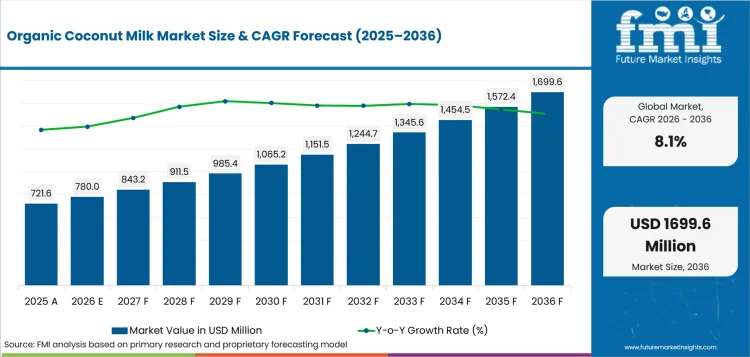
The organic coconut milk market value is expected to scale fromUSD 721.6 millionin 2025 toUSD 1,699.6 millionby 2036 at8.1% CAGR, supported by certified coconut processingandplant-based pantry use. USDA Organic and EU Organic equivalency areanticipatedto secure61.3%share in 2026 as major import markets require accepted certification marks before organic shelf placement. Full-fat organic coconut milk is projected torepresent57.8% share in 2026due tocookingand sauce applications requiringtexture consistency.
Key Takeaways, Market Size, and Forecast
- 2026 Market Size: USD 780.0 million
- 2036 Market Size: USD 1,699.6 million
- Forecast CAGR: 8.1% from 2026 to 2036
- Leading Certification Type: USDA Organic and EU Organic Equivalency
- USDA Organic and EU Organic Equivalency Share in 2026: 61.3%
- Leading Fat Content: Full-fat
- Full-fat Share in 2026: 57.8%
- Leading Packaging Format: Cans
- Cans Share in 2026: 52.7%
- Fastest-growing Country: Saudi Arabia
- Saudi Arabia CAGR: 9.4% by 2036
Summary of Organic Coconut Milk Market
- Demand and Growth Drivers
- Food brands are using organic coconut milk in dairy-free recipes requiring clean ingredient lists and certification proof.
- Retailers are expanding certified organic pantry shelves across cooking ingredients and premium private label ranges.
- Importers are tightening certification checks as organic labels require country-level acceptance before shelf placement.
- Product and Segment View
- USDA Organic and EU Organic equivalency are forecast to hold 61.3% share in 2026, driven by retailer acceptance in major importing markets.
- Full-fat organic coconut milk is projected to represent 57.8% share in 2026, influenced by cooking and dessert texture needs.
- Cans are expected to account for 52.7% share in 2026 due to ambient storage and recipe-based use.
- Geography and Competitive Outlook
- Saudi Arabia is projected to record 9.4% CAGR by 2036 owing to premium grocery imports and organic clearance controls.
- United States is forecast to expand at 8.5% CAGR by 2036 due to organic food sales and plant-based milk household reach.
- Sambu Group and Thai Coconut compete based on coconut sourcing and organic certification. Export pack depth adds another basis for supplier selection.
- McCormick’s Thai Kitchen and Danone’s Alpro compete through plant-based shelf presence and brand recognition.
- Analyst Opinion
- FMI Principal Consultant for Food and Beverage Nandini Roy Choudhury observes, “Organic coconut milk has moved beyond a specialty cooking item. Buyers now check certification equivalency and pack stability before approving suppliers. Producers able to prove certified coconut sourcing and consistent fat content should protect repeat orders more effectively.”
- Organic Coconut Milk Market Value Analysis
- Market value is driven by certified canned and carton coconut milk revenue before coconut cream and foodservice packs add incremental income.
- Supplier pricing reflects organic coconut availability and pack-format cost.
- Revenue improves as households use coconut milk in curries and coffee beverages.
- Retail trust rises as packs show clear organic seals and allergen guidance.
Certification checks now shape which organic coconut milk suppliers reach retail shelves first. USDA AMS made electronic NOP Import Certificates mandatory for certified organic shipments entering the United States from March 19, 2024. Exporters and importers therefore need certificate files ready before shipment planning. Carton suppliers also need stronger packaging proof for shelf reviews. Tetra Pak stated in April 2026 that its paper-based barrier carton raises renewable content to 90% and reduces carbon footprint by up to 50%.
That gives carton coconut milk brands a clearer claim for buyers reviewing packaging materials. Formula clarity is also important in canned coconut milk. Biona stated in April 2025 that its coconut milk uses two ingredients: organic coconut at 50% and water. Simple formulas give suppliers a cleaner label story and help retail buyers compare certified cans with beverage-style cartons more easily.
Why is Organic Coconut Milk Market Growing?
- Certified pantry products are moving from specialty stores into mainstream grocery aisles.
- Coconut milk benefits from cooking use and dairy-free beverage applications.
- Export processors are using organic certification to qualify for premium private label and branded supply programs.
Organic coconut milk demand is supported by a larger overlap between organic grocery buying and plant-based dairy alternatives. USA certified organic product sales reached USD 76.6 billion in 2025, while plant-based milk held 13.0% of total USA milk dollar sales in 2025. Canada’s organic food and beverage sales reached CAD 7.77 billion in 2024, supporting imported certified shelf-stable products in natural and mainstream grocery channels.
Market Segmentation Analysis
- Canned coconut milk is anticipated to account for 46.8% share in 2026 since cooking use in curries and sauces favors shelf-stable metal packaging.
- Cans are projected to capture 52.7% share in 2026 owing to established filling lines and acceptance among ethnic food retailers.
- USDA Organic and EU Organic equivalency are forecast to hold 61.3% share in 2026, supported by retailer preference for certification marks accepted in large importing markets.
- Full-fat organic coconut milk is expected to secure 57.8% share in 2026 as households and foodservice kitchens require texture stability in desserts and curries.
- Retail cooking applications are projected to represent 41.9% share in 2026 due to recipe-based use across soups and dairy-free meals.
- Supermarkets and hypermarkets are forecast to hold 44.6% share in 2026 as mainstream grocery chains expand organic pantry and plant-based beverage shelves.
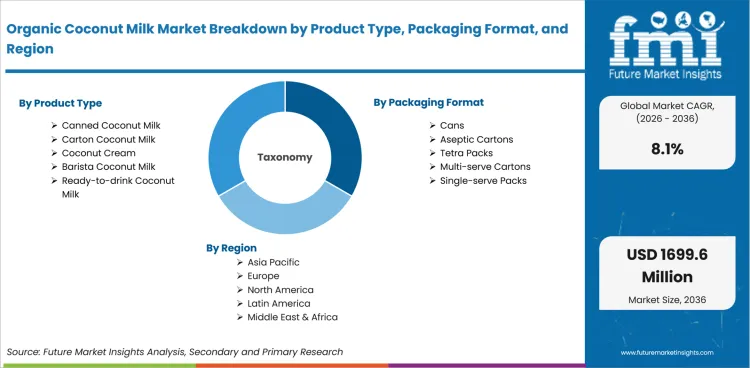
The organic coconut milk market is divided into six primary segment groups covering product type and packaging format. Certification type and fat content define the compliance and texture view. End use and sales channel define the demand view. Product type covers canned coconut milk and carton coconut milk. Coconut cream and barista coconut milk complete product scope with ready-to-drink coconut milk. Packaging format includes cans and aseptic cartons. Tetra packs and multi-serve cartons complete pack coverage with single-serve packs. Certification type includes USDA Organic and EU Organic. JAS Organic and Canada Organic complete certification scope with other equivalency schemes.
Fat content includes full-fat and reduced-fat products. Low-fat and cream-rich variants complete texture coverage with light variants. End use includes retail cooking and beverage use. Foodservice and bakery and desserts complete demand scope with food manufacturing. Sales channel coverage includes supermarkets and hypermarkets and natural food stores. Online retail and foodservice distributors complete channel scope with B2B ingredient supply.
Insights into Organic Coconut Milk Market by Product Type
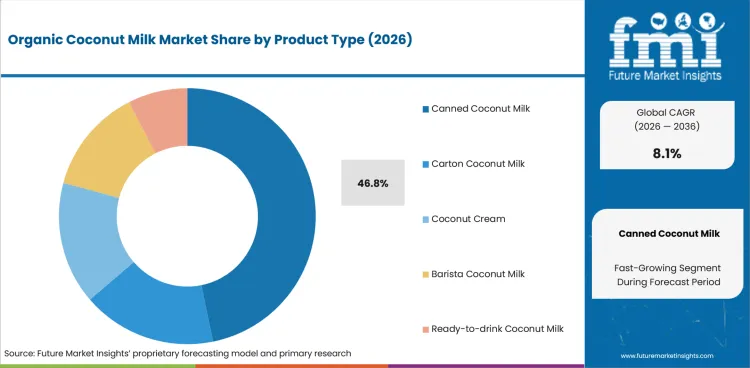
- Canned coconut milk is projected to hold 46.8% share in 2026, led by cooking recipes needing higher fat texture and long shelf life.
- Carton coconut milk gains use in beverage aisles as breakfast occasions and coffee mixing increase demand for pourable organic formats.
Insights into Organic Coconut Milk Market by Packaging Format
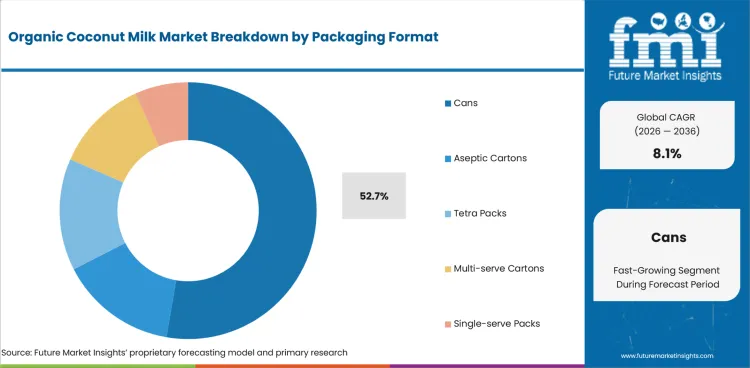
- Cans are forecast to hold 52.7% share in 2026, supported by ambient storage and established import logistics.
- Aseptic cartons gain retail placement as grocery chains add lighter packs for organic beverages and multi-serve pantry milk.
Insights into Organic Coconut Milk Market by Certification Type
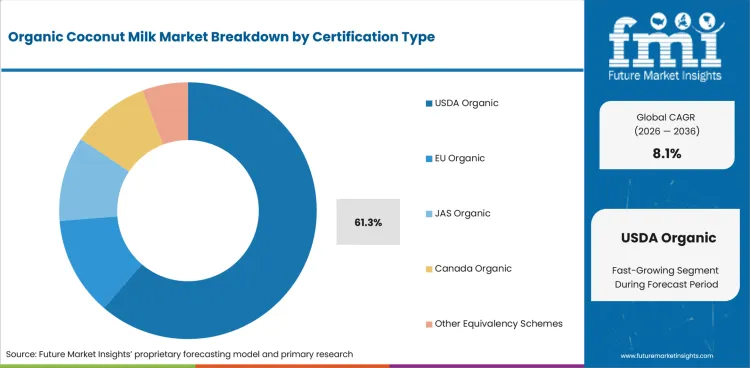
- USDA Organic and EU Organic equivalency are expected to account for 61.3% share in 2026, backed by acceptance in large importing markets.
- JAS Organic gains importance in Japan as organic label use requires compliance with Japanese Agricultural Standards.
Insights into Organic Coconut Milk Market by Fat Content
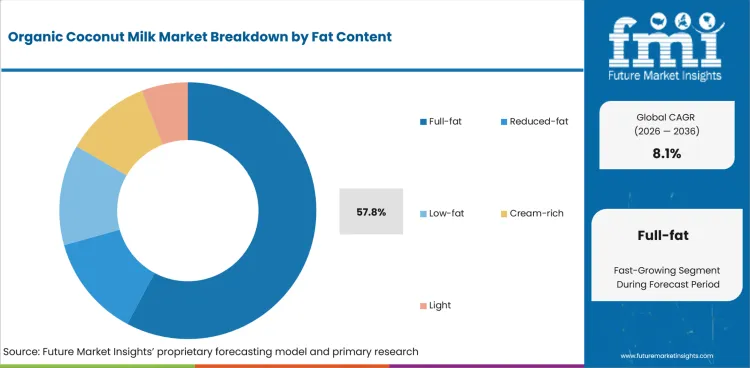
- Full-fat organic coconut milk is anticipated to represent 57.8% share in 2026, reflected by curries and dessert applications requiring texture.
- Reduced-fat and light variants gain use in beverages and breakfast recipes where lower fat content is more important than creaminess.
Insights into Organic Coconut Milk Market by End Use
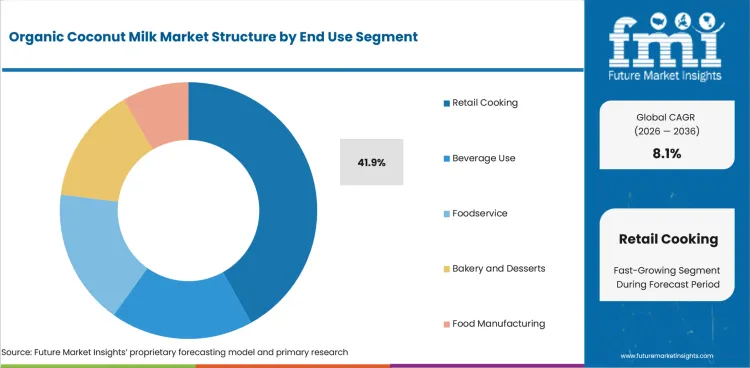
- Retail cooking applications are anticipated to represent 41.9% share in 2026, driven by curries and dessert preparation.
- Food manufacturing expands use in dairy-free sauces and bakery fillings requiring organic ingredient documentation.
Insights into Organic Coconut Milk Market by Sales Channel
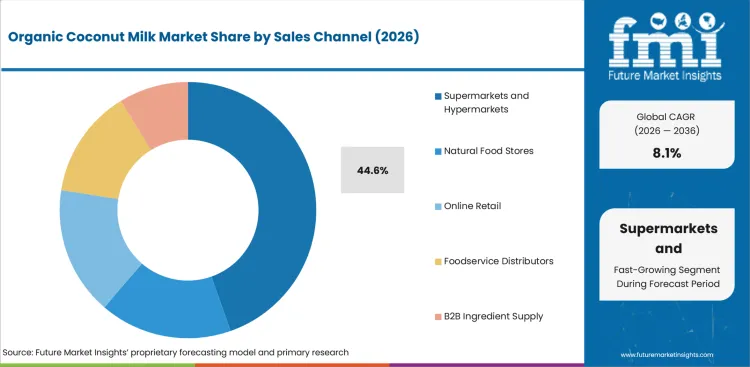
- Supermarkets and hypermarkets are projected to hold 44.6% share in 2026, supported by mainstream organic shelves and ethnic ingredient aisles.
- Online retail supports premium brands through subscription packs and long-tail organic SKUs unavailable in smaller stores.
Organic Coconut Milk Market Drivers, Restraints and Opportunities
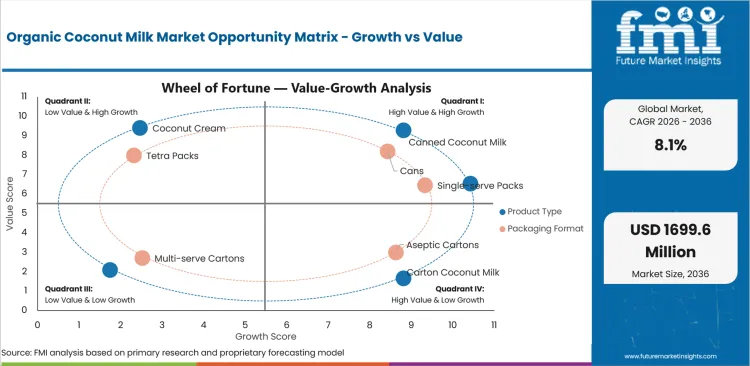
- Certified organic grocery shelves are expanding the addressable base for canned and carton coconut milk.
- Organic clearance requirements can delay supplier onboarding in import-led countries.
- Barista beverages and dessert applications can move coconut milk into higher-value usage occasions.
Certified Organic Grocery Shelves Expand the Addressable Base
Organic grocery demand is giving shelf-stable coconut milk stronger placement across pantry and ethnic cooking aisles. Dairy-alternative aisles add another route for shelf placement. UK organic market value reached GBP 3.7 billion in 2024 after 7.3% growth, while Soil Association’s 2026 report highlights 8.0% organic growth in supermarkets during 2025.
Organic Clearance Requirements Slow Supplier Qualification
Processed organic food exporters must meet country-level certification rules before labels can carry organic claims. Saudi Food and Drug Authority listed food clearance requirements in April 2025. Korea requires operators marketing processed foods as organic to be certified by NAQS-accredited bodies.
Barista Beverages and Dessert Uses Open Higher-Value Positions
Plant-based beverage ranges are creating additional use cases for coconut milk beyond cooking cans. Danone states Alpro covers plant-based drinks and desserts, while Alpro’s Barista Coconut product uses coconut milk in its ingredient base.
Consumption Occasion and Usage Pattern Analysis
Organic coconut milk consumption is expected to become more structured around planned meals and pantry restocking. Repeat household use becomes easier when packs work for everyday recipes. CBI stated in August 2025 that Europe’s coconut milk market is expected to grow by around 5.0% annually over the next five years. Use across plant-based foods and dairy applications supports that outlook. For suppliers, this points to stronger opportunity in products that connect organic certification with everyday recipe use. Brands with clear pack instructions and formats suited to sauces can support higher repeat purchases in shelf-stable pantry use.
02 Channel Preference and Shopping Journey Analysis
Organic coconut milk shopping is expected to move further into mixed grocery journeys where buyers shift between physical stores and pickup. Ahold Delhaize reported in May 2025 that online sales increased 13.7% in Q1 2025 at constant exchange rates. Double-digit online grocery growth across both regions supported the increase. For organic coconut milk brands, this makes digital shelf execution more important. Clear product images and availability across online grocery platforms can help brands convert shoppers before they reach the store aisle.
Analysis of Organic Coconut Milk Market by Key Countries
.webp "Top Country Growth Comparison Organic Coconut Milk Market Cagr (2026 2036)")
| Country | CAGR |
|---|---|
| Saudi Arabia | 9.4% |
| United States | 8.5% |
| Australia | 8.2% |
| Canada | 7.9% |
| United Kingdom | 7.6% |
| South Korea | 7.3% |
| Japan | 6.9% |
| Germany | 6.6% |
Source: Future Market Insights, 2026.
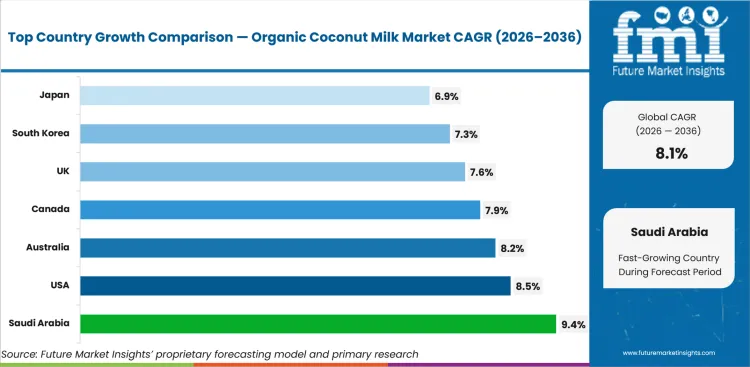
Organic Coconut Milk Market CAGR Analysis by Country
- Saudi Arabia is projected to record 9.4% CAGR by 2036, driven by premium grocery imports and organic clearance controls.
- United States is expected to expand at 8.5% CAGR by 2036, influenced by organic food sales and plant-based milk household reach.
- Australia is forecast to grow at 8.2% CAGR by 2036, backed by certified organic retail demand and Asian cooking exposure.
- Canada is expected to advance at 7.9% CAGR by 2036, aided by organic product spending and imported pantry assortments.
- United Kingdom is projected to rise at 7.6% CAGR by 2036, led by organic grocery growth and plant-based drink usage.
- South Korea is forecast at 7.3% CAGR by 2036, supported by imported premium foods and processed organic certification.
- Japan is expected to post 6.9% CAGR by 2036, guided by JAS label rules and premium imported food channels.
- Germany is projected to increase at 6.6% CAGR by 2036, reflected by large organic retail scale and plant-based milk penetration.
Sales Outlook for Organic Coconut Milk Market in Saudi Arabia
Established grocery import center · 2026 to 2036
Country Market Snapshot Table
| Parameter | Value |
|---|---|
| Market Size in 2025 (Value) | USD 28.0 million |
| Market Size in 2026 (Value) | USD 30.6 million |
| Market Forecast in 2036 (Value) | USD 75.1 million |
| CAGR (2026 to 2036) | 9.4% |
| Years Considered | 2021 to 2036 |
| Base Year | 2025 |
| Forecast Period | 2026 to 2036 |
| Units Considered | Value (USD million) |
| Leading Sub-Region | Riyadh and Jeddah premium grocery corridors |
Saudi Arabia Organic Coconut Milk Market Outlook
- Saudi Arabia organic coconut milk market is forecast to expand at 9.4% CAGR from 2026 to 2036, supported by specialty imported grocery demand and certification-led retail screening.
- Foodservice kitchens and established supermarkets are expected to favor shelf-stable cans and cartons combining organic documentation with halal-ready import files. Suppliers with reliable landed-cost control and distributor support in Riyadh and Jeddah can gain stronger repeat ordering.
Key Growth Drivers
- Premium grocery chains prefer certified shelf-stable coconut milk for imported organic sections serving expatriate and health-focused shoppers. Saudi Arabia’s food retail sales reached more than USD 50.0 billion in 2024.
- Hotel and restaurant kitchens use coconut milk in Thai and fusion menus requiring consistent fat content.
- Import-led grocery assortments support organic canned and carton coconut milk availability. Saudi Arabia relies on imports to meet 70.0% of food demand.
- Online grocery and established food delivery platforms support trial for imported organic pantry products.
Key Restraints
- Import cost exposure can limit repeated buying of certified coconut milk. Saudi Arabia imports more than USD 20.0 billion of food and agricultural products annually, making specialty organic pantry products sensitive to freight and supplier-country disruptions.
- Higher landed prices can limit repeat purchase outside Riyadh and Jeddah premium retail corridors.
- Importers must align halal documentation and organic certificates before listing premium coconut milk.
What makes Saudi Arabia unique
Saudi Arabia stands apart through import-led specialty grocery demand and concentrated organic retail activity across Riyadh and Jeddah.
Key Companies
- Organic Foods and Café
- Sambu Group
- Thai Coconut Public Company Limited
- McCormick and Company
- Danone S.A.
- Nature’s Charm
Sales & Marketing Channels
- Premium grocery chains
- Organic specialty stores
- Foodservice distributors
- Online grocery platforms
- Importer-led retail supply
- Hotel and restaurant distributors
Market Taxonomy and Sub-Regions Covered
| Segment | Sub-Segments |
|---|---|
| By Product Type | Canned Coconut Milk · Coconut Cream · Carton Coconut Milk · Ready-to-drink Coconut Milk · Barista Coconut Milk |
| By Packaging Format | Cans · Multi-serve Cartons · Aseptic Cartons · Tetra Packs · Single-serve Packs |
| By Certification Type | EU Organic · USDA Organic · Other Equivalency Schemes · JAS Organic · Canada Organic |
| By Fat Content | Full-fat · Cream-rich · Reduced-fat · Light · Low-fat |
| By End Use | Foodservice · Retail Cooking · Bakery and Desserts · Beverage Use · Food Manufacturing |
| By Sales Channel | Supermarkets and Hypermarkets · Foodservice Distributors · Online Retail · Natural Food Stores · B2B Ingredient Supply |
| Key Sub-Regions Covered, Premium Grocery Corridors | Riyadh · Jeddah · Dammam · Khobar · Makkah · Madinah |
Frequently Asked Questions
How fast is Saudi Arabia organic coconut milk market growing?
Saudi Arabia organic coconut milk market is forecast to record 9.4% CAGR from 2026 to 2036 due to specialty grocery imports.
Who leads Saudi Arabia organic coconut milk market?
Organic Foods and Café and Sambu Group compete through imported organic products. Thai Coconut and McCormick add retail availability. Danone and Nature’s Charm support branded imported options.
What is driving adoption in Saudi Arabia organic coconut milk market?
Specialty grocery shoppers and foodservice kitchens are increasing use of certified canned and carton coconut milk.
Industry Outlook for Organic Coconut Milk Market in United States
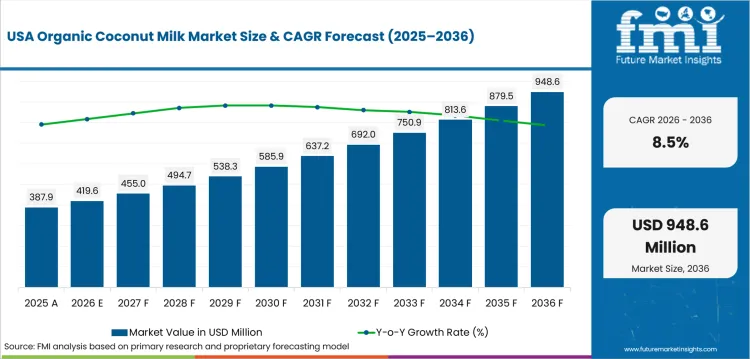
National organic retail and plant-based pantry center · 2026 to 2036
Country Market Snapshot Table
| Parameter | Value |
|---|---|
| Market Size in 2025 (Value) | USD 160.9 million |
| Market Size in 2026 (Value) | USD 174.6 million |
| Market Forecast in 2036 (Value) | USD 394.8 million |
| CAGR (2026 to 2036) | 8.5% |
| Years Considered | 2021 to 2036 |
| Base Year | 2025 |
| Forecast Period | 2026 to 2036 |
| Units Considered | Value (USD million) |
| Leading Sub-Region | California and Northeast natural retail corridors |
United States Organic Coconut Milk Market Outlook
- United States organic coconut milk market is forecast to expand at 8.5% CAGR from 2026 to 2036, driven by large certified organic retail shelves and wider use of coconut milk in dairy-free cooking.
- Retail buyers are expected to compare organic coconut milk against almond and cashew alternatives on pack price and repeat household use. Suppliers with USDA Organic certification and steady can or carton availability can protect shelf placement across natural and mainstream grocery chains.
Key Growth Drivers
- Organic pantry products benefit from a large retail base. USA organic sales reached USD 71.6 billion in 2024.
- Ethnic grocery aisles support canned coconut milk sales for Caribbean and vegan cooking.
- Plant-based beverage shelves give coconut milk a route into dairy-free use. Plant-based milk held 13.0% of total USA milk dollar sales in 2025.
- Natural retail chains support premium coconut milk brands requiring clean ingredient labels and organic seals.
Key Restraints
- Grocery inflation can weaken trial of premium organic coconut milk. USDA ERS reported USA food prices in April 2026 were 3.2% higher than in April 2025.
- Coconut milk competes with oat and almond milk for limited dairy-alternative shelf space.
- Value shoppers may choose conventional coconut milk cans instead of certified organic versions during price-sensitive grocery trips.
What makes United States unique
United States differs through national-scale organic retail and broad household use of plant-based milk alternatives.
Key Companies
- McCormick and Company
- Sambu Group
- Thai Coconut Public Company Limited
- The Vita Coco Company
- Native Forest
- Edward and Sons Trading Co.
Sales & Marketing Channels
- Supermarkets and hypermarkets
- Natural food stores
- Club stores
- Online retail
- Ethnic grocery chains
- Foodservice distributors
Market Taxonomy and Sub-Regions Covered
| Segment | Sub-Segments |
|---|---|
| By Product Type | Carton Coconut Milk · Canned Coconut Milk · Barista Coconut Milk · Coconut Cream · Ready-to-drink Coconut Milk |
| By Packaging Format | Aseptic Cartons · Cans · Multi-serve Cartons · Tetra Packs · Single-serve Packs |
| By Certification Type | USDA Organic · EU Organic · Other Equivalency Schemes · Canada Organic · JAS Organic |
| By Fat Content | Full-fat · Reduced-fat · Light · Cream-rich · Low-fat |
| By End Use | Retail Cooking · Beverage Use · Bakery and Desserts · Foodservice · Food Manufacturing |
| By Sales Channel | Supermarkets and Hypermarkets · Natural Food Stores · Online Retail · B2B Ingredient Supply · Foodservice Distributors |
| Key Sub-Regions Covered, Retail and Distribution Corridors | California · New York · Texas · Illinois · Florida · New Jersey |
Frequently Asked Questions
How fast is United States organic coconut milk market growing?
United States organic coconut milk market is projected at 8.5% CAGR from 2026 to 2036 due to organic retail demand and plant-based milk use.
Who leads United States organic coconut milk market?
McCormick and Sambu Group compete with branded certified products. Thai Coconut and Vita Coco add imported product reach. Native Forest and Edward and Sons support certified pantry availability.
What is driving adoption in United States organic coconut milk market?
Organic pantry growth and dairy-free beverage use are supporting canned and carton coconut milk sales.
Growth Outlook for Organic Coconut Milk Market in Australia
Certified organic retail and Asian cooking center · 2026 to 2036
Country Market Snapshot Table
| Parameter | Value |
|---|---|
| Market Size in 2025 (Value) | USD 35.2 million |
| Market Size in 2026 (Value) | USD 38.1 million |
| Market Forecast in 2036 (Value) | USD 83.8 million |
| CAGR (2026 to 2036) | 8.2% |
| Years Considered | 2021 to 2036 |
| Base Year | 2025 |
| Forecast Period | 2026 to 2036 |
| Units Considered | Value (USD million) |
| Leading Sub-Region | Sydney and Melbourne premium retail corridors |
Australia Organic Coconut Milk Market Outlook
- Australia organic coconut milk market is forecast to expand at 8.2% CAGR from 2026 to 2036, influenced by organic pantry buying and strong exposure to Asian cooking formats. Supermarkets and Asian grocery chains are expected to favor canned coconut milk for curries and dairy-free recipes while carton formats build space in beverage aisles.
- Importers with recognized organic certification and stable stock availability can gain better visibility in Sydney and Melbourne retail corridors.
Key Growth Drivers
- Organic food demand benefits from an established domestic sector. Australian Organic Limited cited the organic industry at AUD 2.6 billion in its 2025 to 2026 federal budget submission.
- Asian grocery networks support canned coconut milk use in curries and dairy-free recipes across metropolitan food retail corridors.
- Supermarket activity supports pantry purchases. ABS reported supermarket and grocery store sales rose 1.2% in June 2025.
- Importers serving grocery and specialty retail gain advantage through recognized certification marks and stable carton supply.
Key Restraints
- Domestic organic certification can be slow for producers. Australian Organic Limited states producer certification can take 1.0 to 3.0 years depending on past chemical usage and history.
- Organic label regulation remains a buyer concern in domestic retail.
- Specialty shelf prices can limit repeat purchase outside metropolitan natural food channels.
What makes Australia unique
Australia’s distinction lies in the mix of organic shopper trust and metropolitan specialty retail channels.
Key Companies
- Honest to Goodness
- Spiral Foods
- Sambu Group
- Thai Coconut Public Company Limited
- Nature’s Charm
- McCormick and Company
Sales & Marketing Channels
- Supermarkets
- Organic specialty stores
- Asian grocery chains
- Online pantry retailers
- Foodservice distributors
- Health food stores
Market Taxonomy and Sub-Regions Covered
| Segment | Sub-Segments |
|---|---|
| By Product Type | Canned Coconut Milk · Carton Coconut Milk · Coconut Cream · Barista Coconut Milk · Ready-to-drink Coconut Milk |
| By Packaging Format | Cans · Aseptic Cartons · Tetra Packs · Multi-serve Cartons · Single-serve Packs |
| By Certification Type | Other Equivalency Schemes · USDA Organic · EU Organic · Canada Organic · JAS Organic |
| By Fat Content | Full-fat · Cream-rich · Reduced-fat · Light · Low-fat |
| By End Use | Retail Cooking · Beverage Use · Foodservice · Bakery and Desserts · Food Manufacturing |
| By Sales Channel | Supermarkets and Hypermarkets · Natural Food Stores · Online Retail · Foodservice Distributors · B2B Ingredient Supply |
| Key Sub-Regions Covered, Organic Retail Corridors | New South Wales · Victoria · Queensland · Western Australia · South Australia · Australian Capital Territory |
Frequently Asked Questions
How fast is Australia organic coconut milk market growing?
Australia organic coconut milk market is forecast at 8.2% CAGR from 2026 to 2036 due to certified retail demand and Asian cooking use.
Who leads Australia organic coconut milk market?
Honest to Goodness and Spiral Foods compete through organic pantry channels. Sambu Group and Thai Coconut add imported coconut supply. Nature’s Charm and McCormick support branded retail availability.
What is driving adoption in Australia organic coconut milk market?
Organic retail demand and Asian cooking ingredient use are moving more certified coconut milk into grocery channels.
Demand Outlook for Organic Coconut Milk Market in Canada
Imported organic pantry and natural grocery center · 2026 to 2036
Country Market Snapshot Table
| Parameter | Value |
|---|---|
| Market Size in 2025 (Value) | USD 51.6 million |
| Market Size in 2026 (Value) | USD 55.7 million |
| Market Forecast in 2036 (Value) | USD 119.1 million |
| CAGR (2026 to 2036) | 7.9% |
| Years Considered | 2021 to 2036 |
| Base Year | 2025 |
| Forecast Period | 2026 to 2036 |
| Units Considered | Value (USD million) |
| Leading Sub-Region | Ontario and British Columbia natural retail corridors |
Canada Organic Coconut Milk Market Outlook
- Canada organic coconut milk market is anticipated to expand at 7.9% CAGR from 2026 to 2036, supported by imported organic pantry purchasing and bilingual retail compliance. Grocery chains and natural food stores are expected to prioritize certified coconut milk packs carrying accepted organic marks and ambient shelf-life advantages.
- Suppliers serving Ontario and British Columbia can gain from demand across both cooking aisles and dairy-alternative shelf sets.
Key Growth Drivers
- Organic product spending supports premium pantry goods. Canadians spent CAD 9.75 billion on organic products in 2024.
- Retailers use organic coconut milk in both cooking aisles and dairy-alternative shelf sets.
- Grocery retail scale supports shelf-stable imported products. Statistics Canada reported retail sales of CAD 70.2 billion in June 2025.
- Foodservice buyers use coconut milk in vegan soups, sauces, desserts, and beverages.
Key Restraints
- Grocery price pressure can limit repeat purchase of premium organic coconut milk. Statistics Canada reported food purchased from stores increased 3.5% year over year in April 2026.
- Bilingual labelling and certification proof can extend onboarding time for smaller brands.
- Freight and exchange-rate exposure can pressure landed costs for certified coconut milk importers.
What makes Canada unique
Canada is set apart by bilingual label requirements and strong natural retail presence in urban provinces.
Key Companies
- Grace Foods Canada
- Edward and Sons Trading Co.
- Sambu Group
- Thai Coconut Public Company Limited
- McCormick Canada
- Nature’s Charm
Sales & Marketing Channels
- National grocery chains
- Natural food stores
- Club stores
- Online grocery
- Foodservice distributors
- Ethnic grocery chains
Market Taxonomy and Sub-Regions Covered
| Segment | Sub-Segments |
|---|---|
| By Product Type | Canned Coconut Milk · Carton Coconut Milk · Coconut Cream · Ready-to-drink Coconut Milk · Barista Coconut Milk |
| By Packaging Format | Cans · Aseptic Cartons · Multi-serve Cartons · Tetra Packs · Single-serve Packs |
| By Certification Type | Canada Organic · USDA Organic · EU Organic · Other Equivalency Schemes · JAS Organic |
| By Fat Content | Full-fat · Reduced-fat · Cream-rich · Light · Low-fat |
| By End Use | Retail Cooking · Beverage Use · Bakery and Desserts · Foodservice · Food Manufacturing |
| By Sales Channel | Supermarkets and Hypermarkets · Natural Food Stores · Online Retail · Foodservice Distributors · B2B Ingredient Supply |
| Key Sub-Regions Covered, Natural Retail Corridors | Ontario · Quebec · British Columbia · Alberta · Manitoba · Saskatchewan |
Frequently Asked Questions
How fast is Canada organic coconut milk market growing?
Canada organic coconut milk market is projected at 7.9% CAGR from 2026 to 2036, backed by organic product spending.
Who leads Canada organic coconut milk market?
Grace Foods Canada and Edward and Sons compete in imported certified products. Sambu Group and Thai Coconut add coconut supply depth. McCormick Canada and Nature’s Charm support branded availability.
What is driving adoption in Canada organic coconut milk market?
Natural food retail and imported organic pantry demand are supporting canned and carton coconut milk use.
Demand Outlook for Organic Coconut Milk Market in United Kingdom
Organic grocery and plant-based drink center · 2026 to 2036
Country Market Snapshot Table
| Parameter | Value |
|---|---|
| Market Size in 2025 (Value) | USD 54.3 million |
| Market Size in 2026 (Value) | USD 58.4 million |
| Market Forecast in 2036 (Value) | USD 121.5 million |
| CAGR (2026 to 2036) | 7.6% |
| Years Considered | 2021 to 2036 |
| Base Year | 2025 |
| Forecast Period | 2026 to 2036 |
| Units Considered | Value (USD million) |
| Leading Sub-Region | London and Southeast England premium grocery corridors |
United Kingdom Organic Coconut Milk Market Outlook
- United Kingdom organic coconut milk market is forecast to expand at 7.6% CAGR from 2026 to 2036, influenced by supermarket organic ranges and dual placement across world-food and dairy-free aisles.
- Retailers are expected to assess coconut milk through price gap versus oat milk and suitability for both cooking and beverage occasions. Brands offering cans for recipes and cartons for plant-based drinks can serve a wider set of grocery buyers.
Key Growth Drivers
- Organic grocery demand supports certified coconut milk placement. UK organic market value reached GBP 3.7 billion in 2024.
- Retailers place coconut milk in both world-food aisles and dairy-alternative shelves.
- Online grocery supports imported pantry discovery. USDA FAS reported online purchases accounted for 13.1% of all UK grocery sales in 2024.
- Foodservice cafés use coconut milk in vegan beverages and dessert menus requiring non-dairy recipes.
Key Restraints
- Grocery concentration raises listing pressure for smaller imported brands. The top four UK retailers accounted for 67.0% of the market based on 2024 figures.
- Oat milk reduces space available for coconut drinks in the plant-based beverage aisle.
- UK organic supply remains import-reliant for many pantry products.
What makes United Kingdom unique
United Kingdom stands out through combined plant-based beverage habits and strong online grocery discovery for imported products.
Key Companies
- Biona Organic
- Clearspring
- Danone Alpro
- Sambu Group
- Thai Coconut Public Company Limited
- Nature’s Charm
Sales & Marketing Channels
- Supermarkets
- Organic retailers
- Online grocery
- Foodservice distributors
- Asian food specialists
- Coffee shop suppliers
Market Taxonomy and Sub-Regions Covered
| Segment | Sub-Segments |
|---|---|
| By Product Type | Carton Coconut Milk · Canned Coconut Milk · Barista Coconut Milk · Coconut Cream · Ready-to-drink Coconut Milk |
| By Packaging Format | Aseptic Cartons · Cans · Tetra Packs · Multi-serve Cartons · Single-serve Packs |
| By Certification Type | EU Organic · Other Equivalency Schemes · USDA Organic · Canada Organic · JAS Organic |
| By Fat Content | Reduced-fat · Full-fat · Light · Cream-rich · Low-fat |
| By End Use | Beverage Use · Retail Cooking · Foodservice · Bakery and Desserts · Food Manufacturing |
| By Sales Channel | Supermarkets and Hypermarkets · Online Retail · Natural Food Stores · Foodservice Distributors · B2B Ingredient Supply |
| Key Sub-Regions Covered, Grocery and Organic Retail Areas | England · Scotland · Wales · Northern Ireland · Midlands · Greater London |
Frequently Asked Questions
How fast is United Kingdom organic coconut milk market growing?
United Kingdom organic coconut milk sector is expected to increase at 7.6% CAGR by 2036 with organic grocery and plant-based drink use.
Who leads United Kingdom organic coconut milk market?
Biona Organic and Clearspring compete through organic pantry shelves. Danone Alpro and Sambu Group add plant-based range. Thai Coconut and Nature’s Charm support imported coconut availability.
What is driving adoption in United Kingdom organic coconut milk market?
Organic grocery expansion and non-dairy beverage use are increasing buyer review of certified coconut milk products.
Industry Analysis for Organic Coconut Milk Market in South Korea
Imported premium food and organic processed certification center · 2026 to 2036
Country Market Snapshot Table
| Parameter | Value |
|---|---|
| Market Size in 2025 (Value) | USD 31.9 million |
| Market Size in 2026 (Value) | USD 34.2 million |
| Market Forecast in 2036 (Value) | USD 69.2 million |
| CAGR (2026 to 2036) | 7.3% |
| Years Considered | 2021 to 2036 |
| Base Year | 2025 |
| Forecast Period | 2026 to 2036 |
| Units Considered | Value (USD million) |
| Leading Sub-Region | Seoul metropolitan premium grocery corridor |
South Korea Organic Coconut Milk Market Outlook
- South Korea organic coconut milk market is predicted to increase at 7.3% CAGR from 2026 to 2036, influenced by specialty imported food channels and processed organic certification requirements.
- Retail buyers are expected to favor smaller carton packs and products suited to desserts and urban pantry use. Suppliers prepared for Korean organic documentation can improve access to premium grocery chains and online grocery platforms.
Key Growth Drivers
- Imported consumer foods support premium coconut milk availability. Korea imported around USD 20.6 billion in consumer-oriented agricultural products in 2024.
- Seoul grocery channels support smaller pack sizes for households using coconut milk in beverages and desserts.
- Retail food scale supports imported certified pantry products. Korean retail food sales totaled USD 132.0 billion in 2024.
- Organic specialty retailers seek imported certified products for premium pantry assortments.
Key Restraints
- Channel concentration can limit shelf access for larger canned coconut milk packs. USDA FAS reported Korean retail food sales accounted for 31.0% of total retail sales excluding automobiles in 2024, keeping imported pantry brands dependent on competitive grocery shelf access.
- High retail prices can limit repeat purchase outside Seoul and other affluent districts.
- Convenience-led grocery formats can limit larger canned coconut milk pack placement.
What makes South Korea unique
South Korea’s edge comes from strict processed organic certification and strong online grocery access in Seoul-led markets.
Key Companies
- Maeil Dairies plant-based portfolio
- Sambu Group
- Thai Coconut Public Company Limited
- Danone Alpro
- Nature’s Charm
- McCormick and Company
Sales & Marketing Channels
- Premium grocery chains
- Department store food halls
- Online grocery platforms
- Organic specialty retailers
- Foodservice distributors
- Importer-led pantry channels
Market Taxonomy and Sub-Regions Covered
| Segment | Sub-Segments |
|---|---|
| By Product Type | Carton Coconut Milk · Ready-to-drink Coconut Milk · Canned Coconut Milk · Barista Coconut Milk · Coconut Cream |
| By Packaging Format | Aseptic Cartons · Tetra Packs · Single-serve Packs · Cans · Multi-serve Cartons |
| By Certification Type | Other Equivalency Schemes · USDA Organic · EU Organic · JAS Organic · Canada Organic |
| By Fat Content | Reduced-fat · Light · Full-fat · Low-fat · Cream-rich |
| By End Use | Beverage Use · Retail Cooking · Bakery and Desserts · Foodservice · Food Manufacturing |
| By Sales Channel | Online Retail · Supermarkets and Hypermarkets · Natural Food Stores · Foodservice Distributors · B2B Ingredient Supply |
| Key Sub-Regions Covered, Premium Retail Corridors | Seoul · Busan · Incheon · Gyeonggi · Daegu · Daejeon |
Frequently Asked Questions
How fast is South Korea organic coconut milk market growing?
South Korea organic coconut milk market is expected to scale 7.3% CAGR from 2026 to 2036 due to premium imported foods.
Who leads South Korea organic coconut milk market?
Maeil Dairies and Sambu Group compete through imported and plant-based channels. Thai Coconut and Danone Alpro add coconut product range. Nature’s Charm and McCormick support branded retail availability.
What is driving adoption in South Korea organic coconut milk market?
Imported premium foods and processed organic certification support certified coconut milk placement in urban grocery channels.
Growth Outlook for Organic Coconut Milk Market in Japan
JAS-certified organic and premium pantry center · 2026 to 2036
Country Market Snapshot Table
| Parameter | Value |
|---|---|
| Market Size in 2025 (Value) | USD 44.8 million |
| Market Size in 2026 (Value) | USD 47.9 million |
| Market Forecast in 2036 (Value) | USD 93.3 million |
| CAGR (2026 to 2036) | 6.9% |
| Years Considered | 2021 to 2036 |
| Base Year | 2025 |
| Forecast Period | 2026 to 2036 |
| Units Considered | Value (USD million) |
| Leading Sub-Region | Tokyo and Kansai premium retail corridors |
Japan Organic Coconut Milk Market Outlook
- Japan organic coconut milk market is anticipated to expand at 6.9% CAGR from 2026 to 2036, backed by JAS-aligned certification needs and premium imported food placement. Retailers are expected to prefer compact pack formats and products suited to desserts and small-household pantry use.
- Suppliers with JAS readiness and consistent carton or can quality can qualify faster for premium supermarkets and imported food stores.
Key Growth Drivers
- Specialty retail channels support imported certified products. Japan’s retail food sector totaled USD 193.0 billion in 2024.
- Tokyo premium grocery stores support imported coconut milk for dairy-free desserts and cooking.
- Food processing demand supports coconut milk use in desserts and shelf-stable recipes. Japan’s food processing sector stood at USD 174.0 billion in 2025.
- Smaller carton sizes suit urban households with limited pantry storage and frequent convenience shopping.
Key Restraints
- Food processor caution can slow new imported ingredient approvals. USDA FAS reported Japan’s food processing sector contracted 3.0% in 2025, increasing buyer caution around new organic imported ingredients.
- Coconut milk competes with soy-based drinks having longer local familiarity.
- Retail buyers often require precise Japanese labels before approving imported organic pantry products.
What makes Japan unique
Japan is differentiated by JAS label control and buyer preference for precise product documentation.
Key Companies
- Aeon Topvalu organic range
- Sambu Group
- Thai Coconut Public Company Limited
- Danone Alpro
- McCormick and Company
- Nature’s Charm
Sales & Marketing Channels
- Premium supermarkets
- Imported food stores
- Online grocery
- Convenience-linked retail
- Foodservice distributors
- Organic specialty stores
Market Taxonomy and Sub-Regions Covered
| Segment | Sub-Segments |
|---|---|
| By Product Type | Carton Coconut Milk · Canned Coconut Milk · Ready-to-drink Coconut Milk · Coconut Cream · Barista Coconut Milk |
| By Packaging Format | Tetra Packs · Aseptic Cartons · Cans · Single-serve Packs · Multi-serve Cartons |
| By Certification Type | JAS Organic · USDA Organic · EU Organic · Other Equivalency Schemes · Canada Organic |
| By Fat Content | Reduced-fat · Light · Full-fat · Low-fat · Cream-rich |
| By End Use | Beverage Use · Retail Cooking · Bakery and Desserts · Foodservice · Food Manufacturing |
| By Sales Channel | Supermarkets and Hypermarkets · Online Retail · Natural Food Stores · Foodservice Distributors · B2B Ingredient Supply |
| Key Sub-Regions Covered, Premium Food Retail Corridors | Kanto · Kansai · Chubu · Kyushu · Tohoku · Hokkaido |
Frequently Asked Questions
How fast is Japan organic coconut milk market growing?
Japan organic coconut milk industry is expected to record 6.9% CAGR during the projection period.
Who leads Japan organic coconut milk market?
Aeon Topvalu and Sambu Group compete through established retail channels. Thai Coconut and Danone Alpro add imported food reach. McCormick and Nature’s Charm support branded coconut availability.
What is driving adoption in Japan organic coconut milk market?
JAS-certified organic products and specialty imported food shelves are improving use of certified coconut milk.
Industry Analysis for Organic Coconut Milk Market in Germany
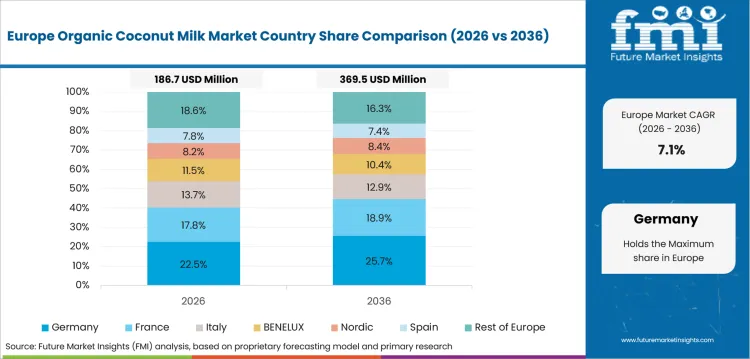
Large organic retail and plant-based milk center · 2026 to 2036
Country Market Snapshot Table
| Parameter | Value |
|---|---|
| Market Size in 2025 (Value) | USD 69.3 million |
| Market Size in 2026 (Value) | USD 73.9 million |
| Market Forecast in 2036 (Value) | USD 140.0 million |
| CAGR (2026 to 2036) | 6.6% |
| Years Considered | 2021 to 2036 |
| Base Year | 2025 |
| Forecast Period | 2026 to 2036 |
| Units Considered | Value (USD million) |
| Leading Sub-Region | North Rhine-Westphalia and Bavaria grocery corridors |
Germany Organic Coconut Milk Market Outlook
- Germany organic coconut milk market is set to rise at 6.6% CAGR from 2026 to 2036, supported by large organic grocery scale and private label interest in plant-based pantry products.
- Discount chains and organic specialty retailers are expected to evaluate coconut milk through EU Organic documentation and pack-format economics. Suppliers with traceable coconut sourcing and stable filling capacity can gain stronger access to high-volume retail programs.
Key Growth Drivers
- Organic retail scale supports certified imports. Germany’s organic sales reached EUR 17.0 billion in 2024.
- German private label programs support organic coconut milk in cooking and dairy-alternative aisles.
- Grocery retail scale supports certified shelf-stable coconut milk placement. Germany’s food retail sales reached USD 293.0 billion in 2024.
- Discount retail chains support larger carton orders for shelf-stable organic products.
Key Restraints
- Food and beverage wholesale costs keep buyers cautious. Destatis reported wholesale food and tobacco prices rose 0.8% year-on-year in February 2026.
- Price pressure from discount retail can reduce supplier margin on certified imports.
- Buyers often require full residue and certifier traceability before listing new imported SKUs.
What makes Germany unique
Germany remains distinct through large organic retail scale and high buyer attention to EU Organic documentation.
Key Companies
- Danone Alpro
- dmBio
- Rapunzel Naturkost
- Sambu Group
- Thai Coconut Public Company Limited
- McCormick and Company
Sales & Marketing Channels
- Discount grocery chains
- Drugstore chains
- Organic specialty retailers
- Online grocery platforms
- Foodservice distributors
- Private label importers
Market Taxonomy and Sub-Regions Covered
| Segment | Sub-Segments |
|---|---|
| By Product Type | Carton Coconut Milk · Canned Coconut Milk · Barista Coconut Milk · Coconut Cream · Ready-to-drink Coconut Milk |
| By Packaging Format | Aseptic Cartons · Tetra Packs · Cans · Multi-serve Cartons · Single-serve Packs |
| By Certification Type | EU Organic · USDA Organic · Other Equivalency Schemes · JAS Organic · Canada Organic |
| By Fat Content | Reduced-fat · Full-fat · Light · Low-fat · Cream-rich |
| By End Use | Beverage Use · Retail Cooking · Bakery and Desserts · Foodservice · Food Manufacturing |
| By Sales Channel | Supermarkets and Hypermarkets · Natural Food Stores · Online Retail · B2B Ingredient Supply · Foodservice Distributors |
| Key Sub-Regions Covered, Organic Grocery Corridors | North Rhine-Westphalia · Bavaria · Baden-Württemberg · Hesse · Lower Saxony · Hamburg |
Frequently Asked Questions
How fast is Germany organic coconut milk market growing?
Germany organic coconut milk sector is projected at 6.6% CAGR over the assessment period through organic retail and plant-based milk placement.
Who leads Germany organic coconut milk market?
Danone Alpro and dmBio compete through organic retail channels. Rapunzel Naturkost and Sambu Group add branded pantry depth. Thai Coconut and McCormick support imported coconut availability.
What is driving adoption in Germany organic coconut milk market?
Organic plant-based milk penetration and large organic retail value support certified coconut milk shelf placement.
Competitive Landscape and Strategic Positioning
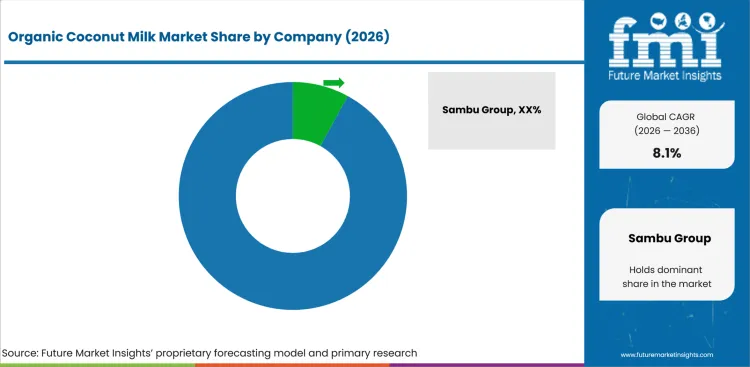
- Supplier selection is shaped by fat-content consistency and pack-format reliability.
- Coconut processors compete on organic certification depth and export documentation.
- Retail brand owners compete through private label support and branded pantry recognition.
- Beverage companies gain access when carton coconut milk supports coffee and ready-to-drink use.
- Importers shape success through bilingual labels and retail buyer relationships.
Competitive outlook is supported by suppliers combining certified coconut sourcing and pack-format range. Sambu Group competes based on Kara coconut milk products, supported by coconut product depth and brand recognition in Indonesia. Thai Coconut Public Company Limited competes depending on canned coconut milk and ready-to-eat food products under Thaicoco and Cocoburi. McCormick competes through Thai Kitchen organic coconut milk in North American retail, while Danone competes through Alpro plant-based drinks and desserts.
Supplier advantage is expected to come from accepted coconut sourcing and repeatable pack quality. Larger suppliers are best placed to support retailers requiring certified products across countries. Regional organic brands can gain if they offer shorter order cycles and clear certification files. Companies with both cooking-format cans and beverage-format cartons are best placed to win repeat programs.
Key Companies in the Organic Coconut Milk Market
Competitive structure is better understood through integrated coconut processors and retail brand owners. Organic specialty food brands add another competitive layer.
- Integrated Coconut Processors: Sambu Group and Thai Coconut Public Company Limited compete led by export documentation and organic product capability.
- Retail Brand Owners: McCormick and Company and Danone S.A. compete depending on retail distribution. Califia Farms adds brand recognition in plant-based shelves.
- Organic and Specialty Food Brands: Biona Organic and Clearspring compete based on organic pantry positioning. Native Forest, MALK Organics and MorgenLand add imported coconut product availability.
Competitive Benchmarking: Organic Coconut Milk Market
| Company | Organic Certification Depth | Coconut Sourcing Control | Canned Product Depth | Carton Product Depth | Geographic Footprint |
|---|---|---|---|---|---|
| Sambu Group | Very Strong | Very Strong | Strong | Strong | Asia, Europe, North America |
| Thai Coconut Public Company Limited | Strong | Strong | Very Strong | Strong | Global |
| McCormick and Company | Strong | Moderate | Very Strong | Moderate | North America and global |
| Danone S.A. | Moderate | Moderate | Moderate | Very Strong | Europe and global |
| Biona Organic | Very Strong | Moderate | Strong | Moderate | United Kingdom and Europe |
| Clearspring | Strong | Moderate | Strong | Moderate | United Kingdom and Europe |
| Native Forest | Strong | Moderate | Strong | Moderate | North America |
| MALK Organics | Very Strong | Moderate | Weak | Strong | North America |
| Califia Farms | Strong | Moderate | Weak | Very Strong | North America, selected international markets |
| MorgenLand | Very Strong | Strong | Strong | Strong | Europe |
Source: Future Market Insights competitive analysis, 2026.
Key Developments in Organic Coconut Milk Market
- In February 2025, MALK Organics launched Unsweetened Organic Coconut MALK as a certified organic coconut plant milk without gums or artificial additives. The launch expanded clean-label coconut milk options in refrigerated plant-based dairy shelves.
- In February 2025, MorgenLand introduced organic coconut milk and vegan whipped cream in updated Tetra Pak packaging. The move supported retail-ready organic coconut formats with ultra-high heat treatment and improved shelf handling.
- In January 2026, Califia Farms expanded its Simple & Organic portfolio with Organic Coconutmilk in a 32oz format. The product uses coconut cream and coconut water and is positioned for matcha and everyday plant-based use.
Key Players in the Organic Coconut Milk Market
- Sambu Group
- Thai Coconut Public Company Limited
- McCormick and Company
- Danone S.A.
- Biona Organic
- Clearspring
- Native Forest
- MALK Organics
- Califia Farms
- MorgenLand
Organic Coconut Milk Market - Scope & Definition
| Attribute | Detail |
|---|---|
| Market Definition | Certified organic liquid coconut milk and coconut cream supplied in cans, cartons, tetra packs, and foodservice packs for cooking, beverages, desserts, barista use, and food manufacturing |
| Functions Covered | Cooking base, dairy-free beverage base, dessert texture, barista preparation, food manufacturing ingredient |
| Applications Covered | Canned coconut milk, carton coconut milk, coconut cream, barista coconut milk, ready-to-drink coconut milk |
| End-Use Industries | Retail grocery, foodservice, bakery and desserts, plant-based beverages, food manufacturing |
| Grades Covered | Full-fat, reduced-fat, low-fat, cream-rich, and light organic coconut milk formats |
| Inclusions | Certified organic canned and carton coconut milk, coconut cream, ready-to-drink coconut milk, and barista coconut milk sold through retail, foodservice, online, and B2B ingredient channels |
| Exclusions | Conventional coconut milk, coconut water, coconut oil, coconut powder without liquid reconstitution positioning, non-certified natural coconut drinks, and dairy alternatives using coconut flavor without organic coconut milk as a base ingredient |
Organic Coconut Milk Market - Research Methodology
| Method | Description |
|---|---|
| Primary Research | FMI analyst interviews with coconut processors, importers, grocery buyers, private label managers, certifiers, and foodservice distributors across North America, Europe, East Asia, Oceania, and Gulf countries |
| Desk Research | Review of USDA, Organic Trade Association, Canada Organic Trade Association, Soil Association Certification, USDA FAS, Eurostat, Saudi Food and Drug Authority, MAFF Japan, NAQS Korea, Australian Organic Limited, and company disclosures |
| Market Sizing & Forecasting | Bottom-up product-boundary approach using eligible SKU revenue, channel presence, retail pricing, product positioning, certification acceptance, pack format depth, fat-content positioning, and country-level adoption |
| Data Validation | Cross-verification using organic retail sales, plant-based milk penetration, organic import rules, certified coconut supplier portfolios, and distributor presence across priority countries |
Organic Coconut Milk Market - Report Scope
| Item | Value |
|---|---|
| Market size by 2036 | USD 1,699.6 million |
| Growth rate | 8.1% CAGR from 2026 to 2036 |
| Forecast period | 2026 to 2036 |
| Base year value (2025) | USD 721.6 million |
| By product type | Canned coconut milk, carton coconut milk, coconut cream, barista coconut milk, ready-to-drink coconut milk |
| By packaging format | Cans, aseptic cartons, tetra packs, multi-serve cartons, single-serve packs |
| By certification type | USDA organic, EU organic, JAS organic, Canada organic, other equivalency schemes |
| By fat content | Full-fat, reduced-fat, low-fat, cream-rich, light |
| By end use | Retail cooking, beverage use, foodservice, bakery and desserts, food manufacturing |
| By sales channel | Supermarkets and hypermarkets, natural food stores, online retail, foodservice distributors, B2B ingredient supply |
| Regions covered | North America, Latin America, Europe, East Asia, South Asia, Oceania, Middle East and Africa |
| Countries covered | Saudi Arabia, United States, Australia, Canada, United Kingdom, South Korea, Japan, Germany |
| Key companies profiled | Sambu Group, Thai Coconut Public Company Limited, McCormick and Company, Danone S.A., Nature’s Charm, Biona Organic, Clearspring, Native Forest, Axelum Resources Corp., The Vita Coco Company |
| Approach | Bottom-up product-boundary approach using eligible SKU revenue, channel presence, retail pricing, product positioning, certification acceptance, pack format depth, fat-content positioning, and country-level adoption |
Source: Future Market Insights, 2026.
Organic Coconut Milk Market Breakdown by Segment
By Product Type
- Canned Coconut Milk
- Carton Coconut Milk
- Coconut Cream
- Barista Coconut Milk
- Ready-to-drink Coconut Milk
By Packaging Format
- Cans
- Aseptic Cartons
- Tetra Packs
- Multi-serve Cartons
- Single-serve Packs
By Certification Type
- USDA Organic
- EU Organic
- JAS Organic
- Canada Organic
- Other Equivalency Schemes
By Fat Content
- Full-fat
- Reduced-fat
- Low-fat
- Cream-rich
- Light
By End Use
- Retail Cooking
- Beverage Use
- Foodservice
- Bakery and Desserts
- Food Manufacturing
By Sales Channel
- Supermarkets and Hypermarkets
- Natural Food Stores
- Online Retail
- Foodservice Distributors
- B2B Ingredient Supply
By Region
- North America
- Europe
- East Asia
- Oceania
- GCC
- Middle East and Africa
Research Sources and Bibliography
- Australian Bureau of Statistics. (2025, July 31). Retail trade, Australia, June 2025.
- Australian Organic Limited. (2025, February 11). AOL completes 2025-26 Federal Budget Submission.
- Califia Farms. (2026, January 22). Califia Farms expands Simple & Organic portfolio with its first-ever soymilk launch.
- Canada Organic Trade Association. (2025, October 2). Canadian organic market reaches $9.75 billion as COTA prepares for 2025 Organic Summit.
- Destatis. (2026, March 13). Wholesale prices in February 2026: +1.2% on February 2025.
- FarmingUK Team. (2026, March 5). Organic market hits £3.9bn but UK production remains limited.
- Food Business News. (2026, May 18). Plant-based sales in the US continue to slide.
- MALK Organics. (2025, February 27). MALK Organics debuts coconut and soy SKUs.
- MorgenLand. (2025, February 5). NEW: MorgenLand Coconut Classics now in a practical Tetra Pak!
- Organic Research Centre. (2025, February 28). Organic Market Report 2025.
- Organic Trade Association. (2025, April 23). Growth of USA organic marketplace accelerated in 2024.
- Organic Trade Association. (2026, March 4). USA organic marketplace achieved significant growth in 2025.
- Saudi Food and Drug Authority. (2025, April). Conditions and requirements for food clearance.
- Statistics Canada. (2025, August 22). Retail trade, June 2025.
- Statistics Canada. (2026, May 19). Consumer Price Index, April 2026.
- The Stock Exchange of Thailand. (2026, June 12). COCOCO factsheet.
- USDA Economic Research Service. (2026, May 22). Food Price Outlook: Summary findings.
- USDA Foreign Agricultural Service. (2025, September 24). Retail foods annual: Saudi Arabia.
- USDA Foreign Agricultural Service. (2025, September 24). Retail foods annual: Germany.
- USDA Foreign Agricultural Service. (2025, November 19). Retail foods annual: South Korea.
- USDA Foreign Agricultural Service. (2025, November 19). Retail foods annual: Japan.
- USDA Foreign Agricultural Service. (2026, April 1). Food processing ingredients annual: Japan.
- USA Department of Agriculture, Agricultural Marketing Service. (2024, March 19). Electronic organic import certificates.
- Tetra Pak. (2026, April 22). Tetra Pak and Sterilgarda Alimenti launch industry-first 1-litre aseptic carton with paper-based barrier.
- Biona. (2025, April 7). “The Ferrari of coconut milks”: Why Biona coconut milk truly stands out.
- Centre for the Promotion of Imports from Developing Countries. (2025, August 12). The European market potential for coconut milk. CBI.
- Ahold Delhaize. (2025, May 7). Ahold Delhaize reports strong first quarter sales growth and reiterates 2025 outlook. Ahold Delhaize.
This bibliography is provided for reader reference and is not exhaustive. The full report contains the complete reference list and detailed citations.
This Report Answers
- What is the 2026 value and 2036 forecast for organic coconut milk market?
- Which certification type is projected to hold the leading share during the forecast period?
- Which fat-content type is expected to account for the leading 2026 share?
- How do organic certification and plant-based retail channels affect coconut milk demand?
- Which companies compete in the organic coconut milk market?
Frequently Asked Questions
What is the organic coconut milk market size in 2026?
The organic coconut milk market size is expected to cross USD 780.0 million in 2026 across certified canned and carton products.
What is the organic coconut milk market forecast for 2036?
The organic coconut milk industry revenue is forecast to reach USD 1,699.6 million by 2036 as certified pantry products and plant-based beverage applications expand.
What is the organic coconut milk market CAGR?
The organic coconut milk sector is projected to expand at 8.1% CAGR from 2026 to 2036.
What segment leads the organic coconut milk market?
USDA Organic and EU Organic equivalency are likely to garner 61.3% share in 2026 due to certification acceptance across major importing markets.
What country grows fastest in the organic coconut milk market?
Saudi Arabia is forecast to record 9.4% CAGR by 2036 owing to premium grocery imports and organic clearance controls.
Which companies compete in the organic coconut milk market?
Sambu Group and Thai Coconut compete through certification and sourcing. McCormick and Danone add branded distribution depth. Nature’s Charm and Biona Organic support specialty organic shelves. Clearspring, Native Forest, Axelum Resources and Vita Coco add pack-format range.
Preview the report firsthand - request a free sample
Get SampleGet the brochure for pricing and purchase details.
Get PDFTable of Content
- Executive Summary
- Global Market Outlook
- Demand to side Trends
- Supply to side Trends
- Technology Roadmap Analysis
- Analysis and Recommendations
- Market Overview
- Market Coverage / Taxonomy
- Market Definition / Scope / Limitations
- Research Methodology
- Chapter Orientation
- Analytical Lens and Working Hypotheses
- Market Structure, Signals, and Trend Drivers
- Benchmarking and Cross-market Comparability
- Market Sizing, Forecasting, and Opportunity Mapping
- Research Design and Evidence Framework
- Desk Research Programme (Secondary Evidence)
- Company Annual and Sustainability Reports
- Peer-reviewed Journals and Academic Literature
- Corporate Websites, Product Literature, and Technical Notes
- Earnings Decks and Investor Briefings
- Statutory Filings and Regulatory Disclosures
- Technical White Papers and Standards Notes
- Trade Journals, Industry Magazines, and Analyst Briefs
- Conference Proceedings, Webinars, and Seminar Materials
- Government Statistics Portals and Public Data Releases
- Press Releases and Reputable Media Coverage
- Specialist Newsletters and Curated Briefings
- Sector Databases and Reference Repositories
- FMI Internal Proprietary Databases and Historical Market Datasets
- Subscription Datasets and Paid Sources
- Social Channels, Communities, and Digital Listening Inputs
- Additional Desk Sources
- Expert Input and Fieldwork (Primary Evidence)
- Primary Modes
- Qualitative Interviews and Expert Elicitation
- Quantitative Surveys and Structured Data Capture
- Blended Approach
- Why Primary Evidence is Used
- Field Techniques
- Interviews
- Surveys
- Focus Groups
- Observational and In-context Research
- Social and Community Interactions
- Stakeholder Universe Engaged
- C-suite Leaders
- Board Members
- Presidents and Vice Presidents
- R&D and Innovation Heads
- Technical Specialists
- Domain Subject-matter Experts
- Scientists
- Physicians and Other Healthcare Professionals
- Governance, Ethics, and Data Stewardship
- Research Ethics
- Data Integrity and Handling
- Primary Modes
- Tooling, Models, and Reference Databases
- Desk Research Programme (Secondary Evidence)
- Data Engineering and Model Build
- Data Acquisition and Ingestion
- Cleaning, Normalisation, and Verification
- Synthesis, Triangulation, and Analysis
- Quality Assurance and Audit Trail
- Market Background
- Market Dynamics
- Drivers
- Restraints
- Opportunity
- Trends
- Scenario Forecast
- Demand in Optimistic Scenario
- Demand in Likely Scenario
- Demand in Conservative Scenario
- Opportunity Map Analysis
- Product Life Cycle Analysis
- Supply Chain Analysis
- Investment Feasibility Matrix
- Value Chain Analysis
- PESTLE and Porter’s Analysis
- Regulatory Landscape
- Regional Parent Market Outlook
- Production and Consumption Statistics
- Import and Export Statistics
- Market Dynamics
- Global Market Analysis 2021 to 2025 and Forecast, 2026 to 2036
- Historical Market Size Value (USD Million) Analysis, 2021 to 2025
- Current and Future Market Size Value (USD Million) Projections, 2026 to 2036
- Y to o to Y Growth Trend Analysis
- Absolute $ Opportunity Analysis
- Global Market Pricing Analysis 2021 to 2025 and Forecast 2026 to 2036
- Global Market Analysis 2021 to 2025 and Forecast 2026 to 2036, By Product Type
- Introduction / Key Findings
- Historical Market Size Value (USD Million) Analysis By Product Type , 2021 to 2025
- Current and Future Market Size Value (USD Million) Analysis and Forecast By Product Type , 2026 to 2036
- Canned Coconut Milk
- Carton Coconut Milk
- Coconut Cream
- Barista Coconut Milk
- Ready-to-drink Coconut Milk
- Canned Coconut Milk
- Y to o to Y Growth Trend Analysis By Product Type , 2021 to 2025
- Absolute $ Opportunity Analysis By Product Type , 2026 to 2036
- Global Market Analysis 2021 to 2025 and Forecast 2026 to 2036, By Packaging Format
- Introduction / Key Findings
- Historical Market Size Value (USD Million) Analysis By Packaging Format, 2021 to 2025
- Current and Future Market Size Value (USD Million) Analysis and Forecast By Packaging Format, 2026 to 2036
- Cans
- Aseptic Cartons
- Tetra Packs
- Multi-serve Cartons
- Single-serve Packs
- Cans
- Y to o to Y Growth Trend Analysis By Packaging Format, 2021 to 2025
- Absolute $ Opportunity Analysis By Packaging Format, 2026 to 2036
- Global Market Analysis 2021 to 2025 and Forecast 2026 to 2036, By Certification Type
- Introduction / Key Findings
- Historical Market Size Value (USD Million) Analysis By Certification Type, 2021 to 2025
- Current and Future Market Size Value (USD Million) Analysis and Forecast By Certification Type, 2026 to 2036
- USDA Organic
- EU Organic
- JAS Organic
- Canada Organic
- Other Equivalency Schemes
- USDA Organic
- Y to o to Y Growth Trend Analysis By Certification Type, 2021 to 2025
- Absolute $ Opportunity Analysis By Certification Type, 2026 to 2036
- Global Market Analysis 2021 to 2025 and Forecast 2026 to 2036, By Fat Content
- Introduction / Key Findings
- Historical Market Size Value (USD Million) Analysis By Fat Content, 2021 to 2025
- Current and Future Market Size Value (USD Million) Analysis and Forecast By Fat Content, 2026 to 2036
- Full-fat
- Reduced-fat
- Low-fat
- Cream-rich
- Light
- Full-fat
- Y to o to Y Growth Trend Analysis By Fat Content, 2021 to 2025
- Absolute $ Opportunity Analysis By Fat Content, 2026 to 2036
- Global Market Analysis 2021 to 2025 and Forecast 2026 to 2036, By End Use
- Introduction / Key Findings
- Historical Market Size Value (USD Million) Analysis By End Use, 2021 to 2025
- Current and Future Market Size Value (USD Million) Analysis and Forecast By End Use, 2026 to 2036
- Retail Cooking
- Beverage Use
- Foodservice
- Bakery and Desserts
- Food Manufacturing
- Retail Cooking
- Y to o to Y Growth Trend Analysis By End Use, 2021 to 2025
- Absolute $ Opportunity Analysis By End Use, 2026 to 2036
- Global Market Analysis 2021 to 2025 and Forecast 2026 to 2036, By Sales Channel
- Introduction / Key Findings
- Historical Market Size Value (USD Million) Analysis By Sales Channel, 2021 to 2025
- Current and Future Market Size Value (USD Million) Analysis and Forecast By Sales Channel, 2026 to 2036
- Supermarkets and Hypermarkets
- Natural Food Stores
- Online Retail
- Foodservice Distributors
- B2B Ingredient Supply
- Supermarkets and Hypermarkets
- Y to o to Y Growth Trend Analysis By Sales Channel, 2021 to 2025
- Absolute $ Opportunity Analysis By Sales Channel, 2026 to 2036
- Global Market Analysis 2021 to 2025 and Forecast 2026 to 2036, By Region
- Introduction
- Historical Market Size Value (USD Million) Analysis By Region, 2021 to 2025
- Current Market Size Value (USD Million) Analysis and Forecast By Region, 2026 to 2036
- North America
- Latin America
- Western Europe
- Eastern Europe
- East Asia
- South Asia and Pacific
- Middle East & Africa
- Market Attractiveness Analysis By Region
- North America Market Analysis 2021 to 2025 and Forecast 2026 to 2036, By Country
- Historical Market Size Value (USD Million) Trend Analysis By Market Taxonomy, 2021 to 2025
- Market Size Value (USD Million) Forecast By Market Taxonomy, 2026 to 2036
- By Country
- USA
- Canada
- Mexico
- By Product Type
- By Packaging Format
- By Certification Type
- By Fat Content
- By End Use
- By Sales Channel
- By Country
- Market Attractiveness Analysis
- By Country
- By Product Type
- By Packaging Format
- By Certification Type
- By Fat Content
- By End Use
- By Sales Channel
- Key Takeaways
- Latin America Market Analysis 2021 to 2025 and Forecast 2026 to 2036, By Country
- Historical Market Size Value (USD Million) Trend Analysis By Market Taxonomy, 2021 to 2025
- Market Size Value (USD Million) Forecast By Market Taxonomy, 2026 to 2036
- By Country
- Brazil
- Chile
- Rest of Latin America
- By Product Type
- By Packaging Format
- By Certification Type
- By Fat Content
- By End Use
- By Sales Channel
- By Country
- Market Attractiveness Analysis
- By Country
- By Product Type
- By Packaging Format
- By Certification Type
- By Fat Content
- By End Use
- By Sales Channel
- Key Takeaways
- Western Europe Market Analysis 2021 to 2025 and Forecast 2026 to 2036, By Country
- Historical Market Size Value (USD Million) Trend Analysis By Market Taxonomy, 2021 to 2025
- Market Size Value (USD Million) Forecast By Market Taxonomy, 2026 to 2036
- By Country
- Germany
- UK
- Italy
- Spain
- France
- Nordic
- BENELUX
- Rest of Western Europe
- By Product Type
- By Packaging Format
- By Certification Type
- By Fat Content
- By End Use
- By Sales Channel
- By Country
- Market Attractiveness Analysis
- By Country
- By Product Type
- By Packaging Format
- By Certification Type
- By Fat Content
- By End Use
- By Sales Channel
- Key Takeaways
- Eastern Europe Market Analysis 2021 to 2025 and Forecast 2026 to 2036, By Country
- Historical Market Size Value (USD Million) Trend Analysis By Market Taxonomy, 2021 to 2025
- Market Size Value (USD Million) Forecast By Market Taxonomy, 2026 to 2036
- By Country
- Russia
- Poland
- Hungary
- Balkan & Baltic
- Rest of Eastern Europe
- By Product Type
- By Packaging Format
- By Certification Type
- By Fat Content
- By End Use
- By Sales Channel
- By Country
- Market Attractiveness Analysis
- By Country
- By Product Type
- By Packaging Format
- By Certification Type
- By Fat Content
- By End Use
- By Sales Channel
- Key Takeaways
- East Asia Market Analysis 2021 to 2025 and Forecast 2026 to 2036, By Country
- Historical Market Size Value (USD Million) Trend Analysis By Market Taxonomy, 2021 to 2025
- Market Size Value (USD Million) Forecast By Market Taxonomy, 2026 to 2036
- By Country
- China
- Japan
- South Korea
- By Product Type
- By Packaging Format
- By Certification Type
- By Fat Content
- By End Use
- By Sales Channel
- By Country
- Market Attractiveness Analysis
- By Country
- By Product Type
- By Packaging Format
- By Certification Type
- By Fat Content
- By End Use
- By Sales Channel
- Key Takeaways
- South Asia and Pacific Market Analysis 2021 to 2025 and Forecast 2026 to 2036, By Country
- Historical Market Size Value (USD Million) Trend Analysis By Market Taxonomy, 2021 to 2025
- Market Size Value (USD Million) Forecast By Market Taxonomy, 2026 to 2036
- By Country
- India
- ASEAN
- Australia & New Zealand
- Rest of South Asia and Pacific
- By Product Type
- By Packaging Format
- By Certification Type
- By Fat Content
- By End Use
- By Sales Channel
- By Country
- Market Attractiveness Analysis
- By Country
- By Product Type
- By Packaging Format
- By Certification Type
- By Fat Content
- By End Use
- By Sales Channel
- Key Takeaways
- Middle East & Africa Market Analysis 2021 to 2025 and Forecast 2026 to 2036, By Country
- Historical Market Size Value (USD Million) Trend Analysis By Market Taxonomy, 2021 to 2025
- Market Size Value (USD Million) Forecast By Market Taxonomy, 2026 to 2036
- By Country
- Kingdom of Saudi Arabia
- Other GCC Countries
- Turkiye
- South Africa
- Other African Union
- Rest of Middle East & Africa
- By Product Type
- By Packaging Format
- By Certification Type
- By Fat Content
- By End Use
- By Sales Channel
- By Country
- Market Attractiveness Analysis
- By Country
- By Product Type
- By Packaging Format
- By Certification Type
- By Fat Content
- By End Use
- By Sales Channel
- Key Takeaways
- Key Countries Market Analysis
- USA
- Pricing Analysis
- Market Share Analysis, 2025
- By Product Type
- By Packaging Format
- By Certification Type
- By Fat Content
- By End Use
- By Sales Channel
- Canada
- Pricing Analysis
- Market Share Analysis, 2025
- By Product Type
- By Packaging Format
- By Certification Type
- By Fat Content
- By End Use
- By Sales Channel
- Mexico
- Pricing Analysis
- Market Share Analysis, 2025
- By Product Type
- By Packaging Format
- By Certification Type
- By Fat Content
- By End Use
- By Sales Channel
- Brazil
- Pricing Analysis
- Market Share Analysis, 2025
- By Product Type
- By Packaging Format
- By Certification Type
- By Fat Content
- By End Use
- By Sales Channel
- Chile
- Pricing Analysis
- Market Share Analysis, 2025
- By Product Type
- By Packaging Format
- By Certification Type
- By Fat Content
- By End Use
- By Sales Channel
- Germany
- Pricing Analysis
- Market Share Analysis, 2025
- By Product Type
- By Packaging Format
- By Certification Type
- By Fat Content
- By End Use
- By Sales Channel
- UK
- Pricing Analysis
- Market Share Analysis, 2025
- By Product Type
- By Packaging Format
- By Certification Type
- By Fat Content
- By End Use
- By Sales Channel
- Italy
- Pricing Analysis
- Market Share Analysis, 2025
- By Product Type
- By Packaging Format
- By Certification Type
- By Fat Content
- By End Use
- By Sales Channel
- Spain
- Pricing Analysis
- Market Share Analysis, 2025
- By Product Type
- By Packaging Format
- By Certification Type
- By Fat Content
- By End Use
- By Sales Channel
- France
- Pricing Analysis
- Market Share Analysis, 2025
- By Product Type
- By Packaging Format
- By Certification Type
- By Fat Content
- By End Use
- By Sales Channel
- India
- Pricing Analysis
- Market Share Analysis, 2025
- By Product Type
- By Packaging Format
- By Certification Type
- By Fat Content
- By End Use
- By Sales Channel
- ASEAN
- Pricing Analysis
- Market Share Analysis, 2025
- By Product Type
- By Packaging Format
- By Certification Type
- By Fat Content
- By End Use
- By Sales Channel
- Australia & New Zealand
- Pricing Analysis
- Market Share Analysis, 2025
- By Product Type
- By Packaging Format
- By Certification Type
- By Fat Content
- By End Use
- By Sales Channel
- China
- Pricing Analysis
- Market Share Analysis, 2025
- By Product Type
- By Packaging Format
- By Certification Type
- By Fat Content
- By End Use
- By Sales Channel
- Japan
- Pricing Analysis
- Market Share Analysis, 2025
- By Product Type
- By Packaging Format
- By Certification Type
- By Fat Content
- By End Use
- By Sales Channel
- South Korea
- Pricing Analysis
- Market Share Analysis, 2025
- By Product Type
- By Packaging Format
- By Certification Type
- By Fat Content
- By End Use
- By Sales Channel
- Russia
- Pricing Analysis
- Market Share Analysis, 2025
- By Product Type
- By Packaging Format
- By Certification Type
- By Fat Content
- By End Use
- By Sales Channel
- Poland
- Pricing Analysis
- Market Share Analysis, 2025
- By Product Type
- By Packaging Format
- By Certification Type
- By Fat Content
- By End Use
- By Sales Channel
- Hungary
- Pricing Analysis
- Market Share Analysis, 2025
- By Product Type
- By Packaging Format
- By Certification Type
- By Fat Content
- By End Use
- By Sales Channel
- Kingdom of Saudi Arabia
- Pricing Analysis
- Market Share Analysis, 2025
- By Product Type
- By Packaging Format
- By Certification Type
- By Fat Content
- By End Use
- By Sales Channel
- Turkiye
- Pricing Analysis
- Market Share Analysis, 2025
- By Product Type
- By Packaging Format
- By Certification Type
- By Fat Content
- By End Use
- By Sales Channel
- South Africa
- Pricing Analysis
- Market Share Analysis, 2025
- By Product Type
- By Packaging Format
- By Certification Type
- By Fat Content
- By End Use
- By Sales Channel
- USA
- Market Structure Analysis
- Competition Dashboard
- Competition Benchmarking
- Market Share Analysis of Top Players
- By Regional
- By Product Type
- By Packaging Format
- By Certification Type
- By Fat Content
- By End Use
- By Sales Channel
- Competition Analysis
- Competition Deep Dive
- Sambu Group
- Overview
- Product Portfolio
- Profitability by Market Segments (Product/Age /Sales Channel/Region)
- Sales Footprint
- Strategy Overview
- Marketing Strategy
- Product Strategy
- Channel Strategy
- Thai Coconut Public Company Limited
- McCormick and Company
- Danone S.A.
- Biona Organic
- Clearspring
- Native Forest
- MALK Organics
- Califia Farms
- MorgenLand
- Sambu Group
- Competition Deep Dive
- Assumptions & Acronyms Used


