

- Industry Size (2026)
- USD 600.0 Mn
- Forecast (2036)
- USD 5896.8 Mn
- CAGR (2026 to 2036)
- 25.7%
Black Soldier Fly Protein Ingredients Market Size, Market Forecast and Outlook By FMI
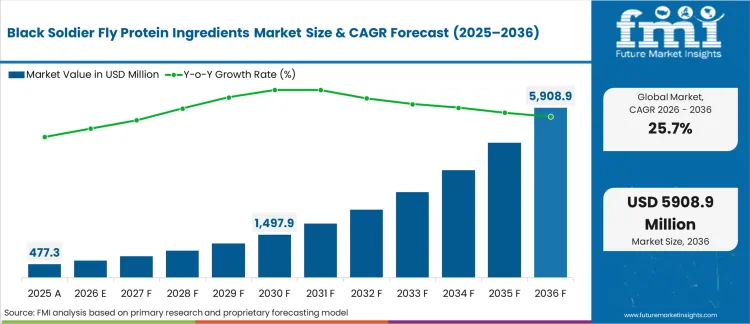
In 2025, the global black soldier fly protein ingredients market was valued at USD 485.0 million. Based on Future Market Insights analysis, the market is estimated to reach USD 600.0 million in 2026 and USD 5,896.8 million by 2036. FMI projects a CAGR of 25.7% between 2026 and 2036.
The market is therefore set to add USD 5,296.8 million in absolute value between 2026 and 2036, representing a near-tenfold expansion over the forecast decade. These projections reflect FMI's base case and are contingent on macroeconomic conditions, consumer spending trends, and regulatory changes in key markets. Growth is primarily driven by rising demand for sustainable protein inputs across aquaculture and companion animal nutrition, accelerating regulatory approvals for insect-derived ingredients in major markets, and the falling unit economics of industrial-scale black soldier fly production.
The sector has navigated a dual challenge since the early 2020s: demonstrating technical performance parity with conventional protein sources while managing the capital intensity of scaling novel bioprocessing infrastructure. The industry response is a combination of strategic co-location - positioning insect farms alongside agricultural or food processing by-product streams to reduce feedstock costs - and long-term offtake agreements that derisk investment at scale.
Summary of Black Soldier Fly Protein Ingredients Market
- Market Definition:
- The market measures commercial production and sale of protein meal, dried larvae, hydrolyzed concentrates, and co-extracted lipids derived from Hermetia illucens larvae, sold into aquafeed, animal feed, pet food, and human food ingredient applications.
- The scope includes industrial, medium-scale, and emerging small-scale operations selling to feed compounders and manufacturers, covering both direct B2B supply and third-party distributed ingredient channels.
- Both volume (metric tons of protein ingredient) and value (USD million at ingredient selling price) dimensions are covered across all seven reporting regions.
- Demand Drivers:
- Aquafeed formulators in China, Norway, and Southeast Asia are actively substituting 5-15% of fishmeal inclusion rates with BSF protein meal, driven by sustained fishmeal price inflation and tightening Marine Stewardship Council sustainability requirements for certified salmon and shrimp producers. [2]
- Premium pet food manufacturers in the United States and Western Europe are launching insect-protein product lines responding to a segment of high-income pet owners willing to pay a 20-35% premium for novel protein and hypoallergenic claims, driving growth in small-batch and specialty BSF ingredient procurement. [3]
- Regulatory approvals granted by the European Commission for BSF protein in poultry and pig feed, followed by expanded feed-chain approvals in Thailand, South Korea, and the Philippines, have unlocked volume growth in mass-market animal nutrition applications previously blocked by food safety rules.
- Key Segments Analysed in the FMI Report:
- Protein Meal - commanding approximately 55% of global market value in 2026, protein meal leads on volume because of its functional equivalence to fishmeal across a range of feed matrices, its extended shelf life relative to whole larvae, and its compatibility with existing feed mill equipment already optimized for powdered ingredients.
- Aquafeed Application - accounting for approximately 42% of revenue in 2026, aquafeed leads all application categories because of the nutritional match between BSF protein's amino acid profile and the dietary needs of salmonids and shrimp, the large and growing volumes of farmed seafood requiring certified sustainable inputs, and the strong commercial incentive for feed formulators to reduce fishmeal dependency.
- Europe Distribution - representing approximately 38% of global market value in 2026, Europe leads geographically because of its advanced regulatory framework, established production infrastructure concentrated in the Netherlands and France, and a well-developed purchaser network of certified aquafeed and pet food manufacturers willing to pay premiums for traceably produced, sustainability-certified insect ingredients.
- Analyst Opinion at FMI:
- Nandini Roy, Principal Consultant for Food and Beverages at Future Market Insights, observes that the black soldier fly protein ingredients market is entering a structural transition from pioneer-scale supply to industrial procurement. The early years were defined by proof-of-concept supply agreements and artisanal volumes; the next decade will be shaped by the economics of continuous, high-throughput bioprocessing tied to reliable organic waste feedstock streams. The analyst notes that markets where insect protein can command a functional premium - particularly in verified-sustainable aquafeed and grain-free pet food - will show faster value growth than volume growth, while emerging Asia markets will deliver the opposite pattern: large volume scaling at compressed price points driven by aquaculture output growth.
- Executive Takeaways:
- Aquafeed manufacturers sourcing for certified salmon or shrimp production should prioritize long-term offtake agreements with industrial-scale BSF protein producers in Europe and Southeast Asia now, before capacity constraints emerge post-2028, when several announced production facilities are expected to reach full utilization.
- Pet food brand owners targeting the premium independent pet specialty channel in North America and Western Europe should begin co-development of insect protein inclusion claims and life cycle analysis documentation with BSF ingredient suppliers, given that sustainability and allergen novelty are the two highest-converting claims in that retail segment.
- Investors evaluating the BSF ingredient sector should weight vertically integrated producers with secured waste feedstock contracts and adjacent industrial energy partnerships above standalone larval farming operations, as co-location economics are proving to be the primary differentiator between profitable and loss-making operations at scale.
Adoption patterns vary considerably across income levels and supply chain maturity. High-income markets - the United States, Germany, the Netherlands, and Canada - are in a premiumization phase, where early adoption in pet food and specialty aquafeed commands price premiums while volumes remain moderate. Europe leads in regulatory framework development and industrial-scale infrastructure, with the Netherlands and France housing the largest production facilities globally. In the volume-growth phase, China (CAGR 30.2%) and Thailand (31.5%) are scaling rapidly on the back of their dominant aquaculture industries and low-cost feedstock availability. Vietnam (32.0%) represents one of the most acute growth trajectories given its position as a major aquafeed consuming nation with abundant organic waste streams. Brazil (27.5%) and Australia (23.0%) offer significant mid-term potential as both poultry and aquaculture integration deepen. Among established markets, the USA is projected at 22.5%, Germany at 24.8%, the Netherlands at 26.0%, France at 25.5%, and Canada at 21.8%.
Black Soldier Fly Protein Ingredients Market Definition
The black soldier fly protein ingredients market encompasses the production, processing, and commercial distribution of protein-rich ingredients derived from the larvae of Hermetia illucens. Covered products include defatted protein meal (typically 55-70% crude protein by dry weight), full-fat dried larvae, hydrolyzed protein concentrates, and larvae-derived lipid fractions where sold as a co-ingredient. The market is classified by product format (meal, whole dried larvae, hydrolyzate, and oil), by application end use (aquafeed, livestock and poultry feed, companion animal and pet food, and human food ingredients), and by production scale (industrial, medium, and small-scale). Coverage spans both the business-to-business ingredient supply channel - where protein meal or oil is sold to feed compounders, pet food manufacturers, and aquafeed formulators - and the business-to-farm direct supply of dried or fresh larvae as a functional feed ingredient.
The scope covers both retail-facing formulated products containing BSF protein as a declared ingredient and bulk ingredient supply to industrial food and feed processors. Private-label and contract-manufactured ingredient formats are included where the underlying raw material originates from black soldier fly biomass. The market does not extend to downstream consumer food products sold at retail under branded labels; those fall within the broader alternative protein or sustainable food ingredients markets.
Black Soldier Fly Protein Ingredients Market Inclusions
The report covers a comprehensive assessment of the market for the historical period (2021 to 2025) and the projected period (2026 to 2036) for metric tons of protein ingredient output and value in USD million. It covers segmental breakdowns of the market by product type, application end use, production scale, distribution channel, and key regions, and tracks per-country volume and revenue trends across 30+ countries with detailed coverage of the United States, Germany, the Netherlands, France, China, Thailand, Canada, Vietnam, Brazil, and Australia.
Black Soldier Fly Protein Ingredients Market Exclusions
The report excludes insect protein derived from species other than Hermetia illucens, including mealworm (Tenebrio molitor), cricket (Acheta domesticus), and house fly (Musca domestica) derived ingredients. It does not include live larvae supplied solely for waste processing or composting services where no protein extraction takes place. Frass (insect frass fertilizer) is excluded from protein ingredient sizing, though the report notes frass revenues as a by-product value stream influencing production economics. Retail consumer food products positioned as finished goods - such as insect protein bars, snack chips, or pet food pouches sold to end consumers - are excluded from this ingredient market sizing and are tracked within adjacent market categories. The market also does not include seed capital, R&D grants, or non-commercial academic production.
Black Soldier Fly Protein Ingredients Market Research Methodology
- Primary Research: Structured interviews were conducted with relevant stakeholders across the value chain and key regions. Discussions focused on production and capacity trends, pricing dynamics, input sourcing, product performance in target applications, regulatory status, and near-term investment and expansion plans. Where feasible, interview insights were supplemented with on-ground checks such as product documentation reviews and operational assessments.
- Desk Research: Secondary research drew on a mix of company disclosures, industry and trade association publications, government and regulatory databases, patent and intellectual property sources, and peer-reviewed academic literature. Additional triangulation inputs included trade statistics, category-level market data, and public datasets relevant to demand and end-use trends.
- Market Sizing and Forecasting: A bottom-up model was developed at the country level using supply, demand, and pricing inputs. Supply estimates were built from capacity indicators and operating rate assumptions, adjusted for yield or conversion factors where applicable. These volumes were converted into market values using blended average selling prices by segment and scale tier. Forecasts were generated by applying scenario-based growth assumptions linked to end-market fundamentals and macro indicators, with results rolled up to regional and global totals and checked for internal consistency.
- Data Validation and Update Cycles: Findings from primary research were cross-verified against independent secondary sources such as public capacity disclosures, regulatory registries, trade data, and relevant consumption or expenditure indicators. Outliers and mismatches were addressed through targeted follow-ups and sensitivity checks. Where direct data was limited, estimates were calibrated using reasonable proxies and benchmarked against comparable markets, with periodic refresh cycles to incorporate new disclosures, regulatory changes, and market signals.
Segmental Analysis
Black Soldier Fly Protein Ingredients Market Analysis by Product Type
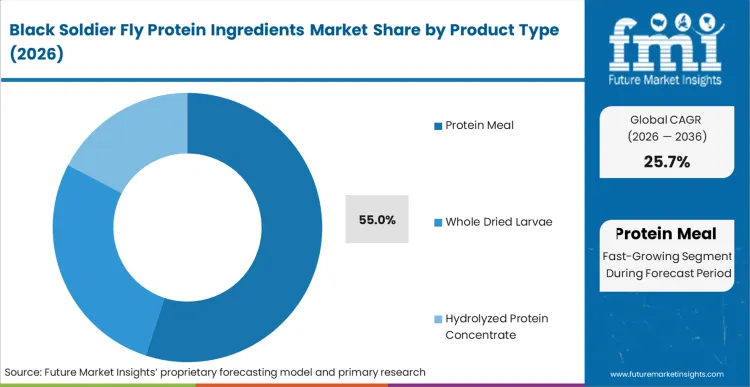
Protein meal holds the dominant product position, accounting for approximately 55% of global revenue in 2026. This leadership reflects its compatibility with existing feed mill infrastructure: the powdered format can be handled through standard feed processing lines without modification, making it the lowest-barrier substitute for fishmeal and soybean meal in aquafeed and poultry diet formulations. Demand is reinforced by the product's extended shelf life - typically 12 to 18 months when stored correctly - which allows feed manufacturers to hold inventory and reduce supply-chain risk. A practical example of the segment's trajectory is Protix's ProteinX product, which is demonstrated in peer-reviewed studies to reduce land use, water use, and greenhouse gas emissions relative to conventional protein meal inputs, giving procurement teams a documented sustainability rationale for specification change. [4]
- Whole dried larvae are growing at a faster CAGR than protein meal within the pet food segment, where visual product differentiation and textural novelty are used as premium marketing attributes; several European pet food manufacturers have launched dry and semi-moist formulations listing whole dried BSF larvae as a visible ingredient. [6]
Black Soldier Fly Protein Ingredients Market Analysis by Application
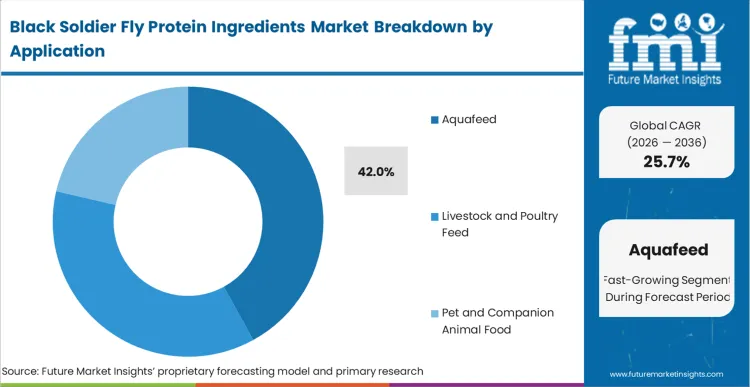
Aquafeed accounts for approximately 42% of global market revenue in 2026, anchored by the salmon industry's documented transition away from marine-derived protein. The Norwegian salmon farming industry's stated goal of making 100% of its supply chain sustainable by 2034 creates a structural procurement mandate for certified alternative proteins at scale, with BSF meal positioned as one of a small number of technically validated substitutes for fishmeal at inclusion rates of 10-25% in commercial diet formulations. The pet food application is the fastest-growing segment by revenue, driven by the premium positioning of insect-based pet nutrition in the United States, Germany, and the United Kingdom, where novel protein claims command price premiums of 20-40% above comparable weight-formatted conventional pet foods.
Black Soldier Fly Protein Ingredients Market Analysis by Distribution Channel
Direct B2B supply agreements between BSF producers and feed compounders represent the dominant channel, accounting for approximately 68% of global market value in 2026. The long lead times for certifying a new protein ingredient in commercial feed formulations - typically 12 to 24 months from submission to approved specification - mean that feed manufacturers tend to establish multi-year supply relationships rather than spot purchasing. The distributor channel, which handles approximately 22% of volumes, is particularly important in markets where no domestic BSF production exists and ingredient buyers rely on import brokers to source certified meal from Europe, Southeast Asia, or North America. Online and e-commerce channels remain nascent at less than 10% of market value, primarily serving small-scale aquaculture operators and independent pet food manufacturers who purchase in lower volumes than industrial buyers.
FMI's analysis of the insect protein pet food market covers demand drivers and retail channel dynamics for insect-derived ingredients in companion animal nutrition, providing a parallel view of the buyer profile that accounts for BSF protein's fastest-growing application segment.
Black Soldier Fly Protein Ingredients Market Drivers, Restraints and Opportunities
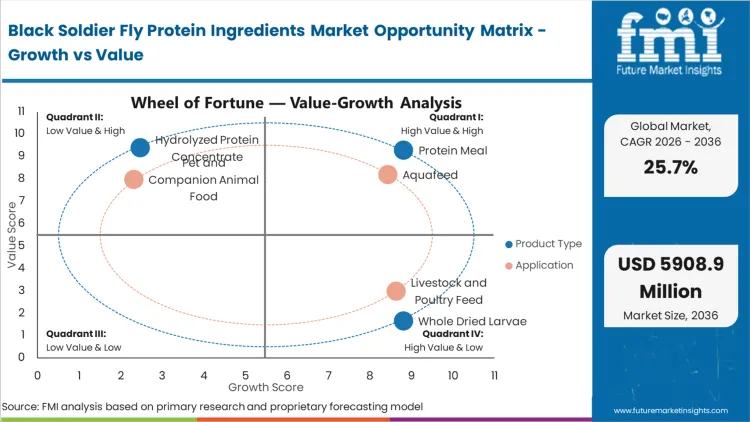
FMI assesses the BSF protein ingredients category as transitioning from niche specialty supply toward structured industrial procurement, driven by the convergence of three structural forces: an increasingly constrained supply of conventional protein inputs (fishmeal and soy), tightening sustainability requirements from major feed industry buyers, and cost improvements resulting from automation and scale. The regulatory environment has materially shifted in the producer's favor - the European Commission's authorization of BSF protein in aquafeed (2017), poultry (2021), and pig feed (2021), followed by EFSA's positive opinion on BSF oil for use in food in 2022, has provided a credibility framework that is referenced by regulators in the United States, China, and Southeast Asia as they develop their own approval pathways. [11]
Regional Analysis
FMI's regional analysis spans seven geographies: North America, Latin America, Eastern Europe, Western Europe, South Asia and Pacific, East Asia, and the Middle East and Africa. The full report covers more than 30 countries with market attractiveness scores, per-capita consumption assessments, and country-level revenue and volume forecasts. For the purposes of this article, the regional overview concentrates on the four major demand geographies while noting that Middle East and Africa, Eastern Europe, and South Asia and Pacific are covered in depth in the full report.
Country Wise Growth Comparison
.webp "Top Country Growth Comparison Black Soldier Fly Protein Ingredients Market Cagr (2026 2036)")
| Country | Value CAGR (2026 to 2036) |
|---|---|
| United States | 22.5% |
| Canada | 21.8% |
| Germany | 24.8% |
| Netherlands | 26.0% |
| France | 25.5% |
| China | 30.2% |
| Thailand | 31.5% |
| Vietnam | 32.0% |
| Brazil | 27.5% |
| Australia | 23.0% |
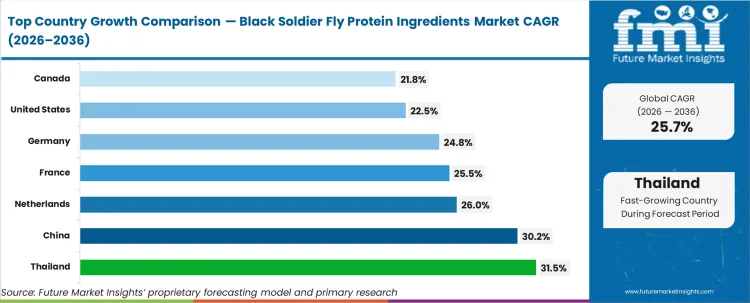
Source: Future Market Insights (FMI) analysis, based on proprietary forecasting model calibrated to non-commercial macroeconomic, demographic, and household consumption data, trade statistics, and company disclosures.
North America Market Analysis
North America is the second-largest regional market by value in 2025, with the United States accounting for approximately 76% of regional revenue. The region's development is characterized by strong venture capital and corporate strategic investment rather than by organic demand pull from end consumers - which distinguishes it from Europe, where demand from certified aquafeed manufacturers is the primary growth engine. The United States buyer profile for BSF protein is concentrated among three customer groups: large-scale pet food manufacturers seeking novel and hypoallergenic protein claims, domestic aquaculture operators targeting premium sustainable certification, and poultry feed compounders exploring cost optimization under elevated soybean meal prices.
- The United States is projected at a 22.5% CAGR, supported by the Tyson Foods/Protix joint venture announced in October 2023, which is developing the first large-scale BSF protein facility in the continental United States using food manufacturing by-products as feedstock - a structure that combines waste-stream economics with immediate proximity to major pet food and aquafeed manufacturing customers.
- Canada is projected at a 21.8% CAGR, with Enterra Feed Corporation operating the most commercially advanced domestic BSF production infrastructure, supplying both certified organic fertilizer and protein meal to poultry and aquaculture customers in British Columbia and Alberta.
The full FMI report covers North America in depth across all five major segmentation dimensions - product type, application, production scale, distribution channel, and end user - with country-level forecasts for the United States, Canada, and Mexico.
Latin America Market Analysis
Latin America is an emerging market for BSF protein ingredients, with Brazil leading regional development on the strength of its large domestic poultry and aquaculture industries. The region's competitive advantage is the abundance of agricultural by-products available as larval feedstock - sugarcane bagasse, fruit processing waste, and slaughterhouse by-products - which, when paired with BSF larvae, offer a cost structure that could eventually be competitive with fishmeal imports from Peru and Chile. Consumer price sensitivity and the dominance of conventional soybean meal in livestock nutrition represent short-term constraints on adoption, but the region's largest agri-food processors are beginning to evaluate pilot-scale BSF integration.
- Brazil is projected at a 27.5% CAGR, driven by regulatory progress under MAPA (Brazil's Ministry of Agriculture) on insect use in animal feed, and by the growing aquaculture sector - particularly tilapia and shrimp - which is a natural fit for BSF protein on both nutritional and sustainability grounds.
- Argentina and Chile show early-stage commercial development, primarily in aquaculture. Both countries have active government sustainability programs for salmon fish and trout farming that are creating early-adopter demand among certified producers willing to pay a premium for verified alternative protein sources.
The full FMI report provides country-level analysis for Brazil, Argentina, Chile, Colombia, and Mexico, including regulatory pathway assessments and capacity investment tracking.
Europe Market Analysis
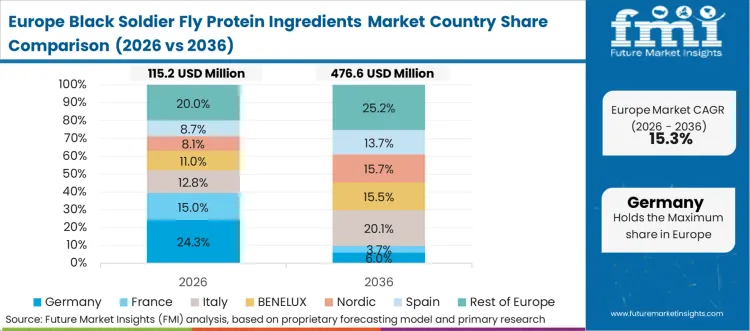
Europe holds the largest share of global BSF protein ingredient market value in 2025, driven by the Netherlands and France - home to Protix and InnovaFeed respectively - which together account for the majority of Western European production capacity. The European regulatory environment is the most proactive globally in providing approved ingredient frameworks: EFSA opinions covering aquafeed (2017), poultry and pig feed (2021 and 2022), and human food (positive opinion, 2022) have created a defined regulatory path that reduces commercial risk and supports investor confidence. The buyer profile in Europe is concentrated among certified aquafeed manufacturers - particularly salmon and trout producers operating under ASC or BAP standards - and premium pet food companies pursuing sustainability-differentiated formulations.
- The Netherlands is projected at a 26.0% CAGR, supported by Protix's flagship production facility in Bergen op Zoom and the country's strategic position as a hub for sustainable protein ingredient trading and export to Northern and Central European feed manufacturers. [14]
- Germany is projected at a 24.8% CAGR, reflecting demand from its sophisticated pet food manufacturing base and its role as a major transit market for certified sustainable aquafeed ingredients flowing from Dutch and French producers to aquaculture operations in Norway, Denmark, and Scotland.
The full FMI report covers all 27 EU member states plus the United Kingdom, Norway, and Switzerland, with detailed analysis of regulatory approval status, production capacity, and end-market demand trajectories by segment.
Asia Pacific Market Analysis
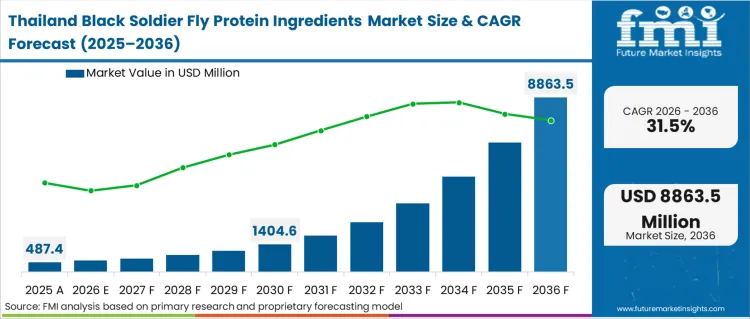
Asia Pacific is the fastest-growing regional market over the forecast period, driven by three concurrent forces: the world's largest and most rapidly expanding aquaculture industry (China, Thailand, Vietnam, and Indonesia together account for more than 60% of global farmed fish and shrimp output), a favorable regulatory stance toward insect use in animal feed in several key markets, and the lowest production cost environment for BSF larvae globally due to cheap feedstock availability and labor costs. The buyer profile in Asia Pacific is dominated by industrial-scale aquafeed manufacturers and vertically integrated aquaculture companies seeking to reduce fishmeal import dependency and improve feed cost predictability.
- China is projected at a 30.2% CAGR, reflecting the government's active promotion of circular bioeconomy models, investment in insect bioconversion infrastructure through the National Development and Reform Commission, and the sheer volume of organic waste generated by China's food processing sector available as BSF larval substrate.
- Vietnam is projected at the fastest country-level CAGR of 32.0%, driven by the expansion of its shrimp aquaculture industry - the country is among the world's top three shrimp exporters - and the operations of regional producers including Entobel and Nutrition Technologies, which have built commercial-scale facilities targeting domestic and export markets simultaneously. [15]
The full FMI report covers China, India, Japan, South Korea, Thailand, Vietnam, Indonesia, the Philippines, Australia, and New Zealand with country-level revenue and volume forecasts, regulatory pathway assessments, and competitive infrastructure mapping.
FMI's analysis of the mealworm protein flour market covers the European regulatory pathway and buyer dynamics for Tenebrio molitor-derived ingredients, complementing the supply-chain and demand structure developed in this report for black soldier fly protein. https://www.futuremarketinsights.com/reports/mealworm-protein-flour-market
Competitive Aligners for Market Players
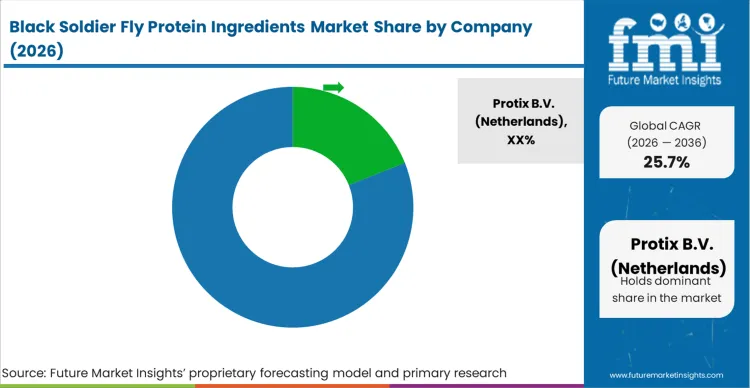
The BSF protein ingredients market is structured in three competitive tiers. The first tier consists of a small number of industrial-scale producers with vertically integrated operations, proprietary larval genetics programs, and established commercial relationships with major aquafeed and pet food manufacturers. Protix (Netherlands), InnovaFeed (France), Enterra (Canada), and EnviroFlight (USA) represent this tier. Their primary competitive variable is production scale and traceability: buyers procuring for certified feed programs require auditable supply chains, and only producers capable of delivering consistent volumes with documented sustainability credentials can access this segment.
The second tier comprises regional producers with annual protein output between 500 and 5,000 metric tons who hold approved positions in national feed catalogs but lack the global sales infrastructure to access premium multinational buyers. Competitive variables at this tier are feed cost efficiency and local feedstock relationships. The third tier includes small-scale and start-up operations typically producing below 500 metric tons per year, operating in markets with limited regulatory frameworks and serving local buyers at price points that reflect cost-plus rather than value-based pricing.
Retailer relationships and long-term offtake agreements are the primary determinants of market access, replacing the direct shelf space dynamics of consumer markets with feed specification approval processes that take 12 to 24 months to complete. Once a BSF protein meal is approved in a feed manufacturer's specification, it functions as a quasi-captive supply relationship: reformulation is costly and slow, meaning approved suppliers have meaningful pricing protection. The growth of own-label and integrated aquafeed manufacturers - such as Cargill's Aqua Nutrition division and BioMar - is reshaping this dynamic, as these companies increasingly evaluate vertical integration into insect protein production rather than relying solely on third-party ingredient supply.
Consumer behavior in this market is mediated through the feed value chain. Premium-oriented pet food buyers pay above-market prices for branded BSF protein claims and are loyal to specific ingredient brands - Protix's ProteinX, for example, appears by name on some European premium pet food labels, creating direct-to-consumer brand awareness that supports ingredient pricing power. Aquafeed buyers, by contrast, are price-sensitive above a minimum quality and traceability threshold: once a supplier has passed regulatory and quality audit requirements, procurement decisions are dominated by delivered cost per kilogram of crude protein. This bifurcation of buyer behavior - premium loyalty in pet food, cost-parity sensitivity in aquafeed - means that producers with a diversified application mix are better positioned to manage margin than those concentrated in a single end market.
Recent Developments:
- January 2024 - Protix secured EU funding through the European Investment Bank to construct a new flagship BSF production facility in Poland, expanding its European production footprint beyond the Netherlands. The planned facility will increase Protix's production capacity to serve growing demand from European aquafeed and pet food markets, while positioning the company for export expansion into North America and Asia Pacific.
- July 2024 - InnovaFeed completed the third expansion phase of its Nesle industrial facility in France, establishing it as the world's largest insect production site. The expansion enables full-scale commercialization of BSF protein meal and oil under the Hilucia™ brand for swine, poultry, and pet nutrition, delivering the multi-product biorefinery economics required to achieve profitability and supply security for industrial feed customers.
Key Players Covered in the Study
- Protix B.V. (Netherlands)
- InnovaFeed S.A. (France)
- EnviroFlight LLC (United States)
- Enterra Feed Corporation (Canada)
- AgriProtein Technologies Ltd. (South Africa)
- Nutrition Technologies Group (Singapore)
- Hexafly (Ireland)
- Entobel B.V. (Vietnam / Netherlands)
- nextProtein (France)
- BioflyTech (Spain)
- Entofood (Malaysia)
- Darling Ingredients Inc. (United States)
- Charoen Pokphand Group Company Ltd. (Thailand)
- FarmInsect GmbH (Germany)
- Entocycle Ltd. (United Kingdom)
- Protenga Pte. Ltd. (Singapore)
Report Scope
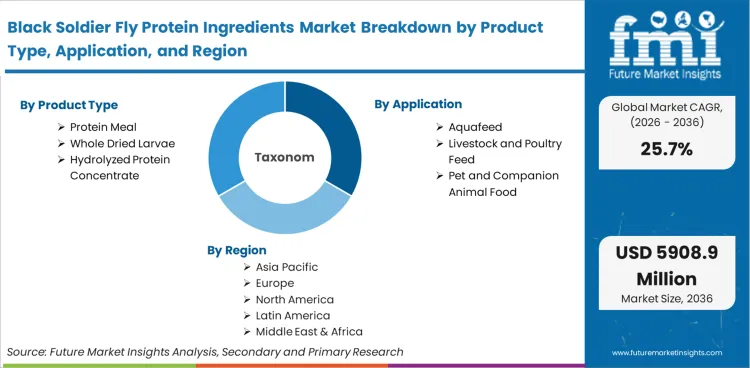
| Quantitative Units | USD 600.0 million in 2026 to USD 5,896.8 million by 2036 at a CAGR of 25.7% |
|---|---|
| Market Definition | Commercial production and sale of protein meal, dried larvae, hydrolyzed concentrates, and co-extracted lipids derived from Hermetia illucens larvae, sold into aquafeed, animal feed, pet food, and human food ingredient applications via B2B and distributor channels. |
| Product Type Segmentation | Protein Meal, Whole Dried Larvae, Hydrolyzed Protein Concentrate, Larvae Oil |
| Application Segmentation | Aquafeed, Livestock and Poultry Feed, Pet and Companion Animal Food, Human Food Ingredients |
| Production Scale Segmentation | Industrial Scale (>5,000 MT/year), Medium Scale (500-5,000 MT/year), Small Scale (<500 MT/year) |
| Distribution Channel Segmentation | Direct B2B Supply Agreement, Distributor / Broker, Online / E-commerce |
| End User Segmentation | Aquafeed Manufacturers, Pet Food Manufacturers, Feed Compounders, Direct Farm Supply, Human Food Processors |
| Regions Covered | North America, Latin America, Western Europe, Eastern Europe, South Asia and Pacific, East Asia, Middle East and Africa |
| Countries Covered | United States, Canada, Mexico, Brazil, Argentina, Chile, Germany, Netherlands, France, United Kingdom, Norway, Spain, Italy, Poland, China, India, Japan, South Korea, Thailand, Vietnam, Indonesia, Philippines, Australia, New Zealand, South Africa, UAE, Saudi Arabia, Egypt, Malaysia, Singapore |
| Key Players Covered in the Study | Protix B.V., InnovaFeed S.A., EnviroFlight LLC, Enterra Feed Corporation, AgriProtein Technologies Ltd., Nutrition Technologies Group, Hexafly, Entobel B.V., nextProtein, BioflyTech, Entofood, Darling Ingredients Inc., Charoen Pokphand Group Company Ltd., FarmInsect GmbH, Entocycle Ltd., Protenga Pte. Ltd. |
| Forecast Period | 2026 to 2036 |
| Approach | Volume-based bottom-up model by country, mapped against registered production capacity, per-larval biomass protein yield, end-market demand from aquafeed/pet food/livestock industries, and household income segmentation; validated through trade data cross-checks, capacity utilization interviews, and per-capita protein consumption rate modeling. |
Black Soldier Fly Protein Ingredients Market Analysis by Segments
By Product Type:
- Protein Meal
- Whole Dried Larvae
- Hydrolyzed Protein Concentrate
- Larvae Oil
By Application:
- Aquafeed
- Livestock and Poultry Feed
- Pet and Companion Animal Food
- Human Food Ingredients
By Production Scale:
- Industrial Scale (above 5,000 MT per year)
- Medium Scale (500 to 5,000 MT per year)
- Small Scale (below 500 MT per year)
By Distribution Channel:
- Direct B2B Supply Agreement
- Distributor / Broker Channel
- Online / E-commerce
By End User:
- Aquafeed Manufacturers
- Pet Food Manufacturers
- Feed Compounders
- Direct Farm Supply
- Human Food Processors
By Region:
- North America
- Latin America
- Western Europe
- Eastern Europe
- South Asia and Pacific
- East Asia
- Middle East and Africa
Bibliography
- [1] van der Meer, M. (CEO, Protix). Quoted in: Hollister, J. “Insect meal: can the sector still deliver on its 2030 promise?” The Fish Site, 16 December 2025.
- [2] Marine Stewardship Council. Marine Stewardship Council Annual Report 2023-24: Sustainable Fishing. MSC, London, 2024.
- [3] American Pet Products Association. 2023-2024 APPA National Pet Owners Survey. APPA, Stamford, CT, 2024.
- [4] Postepski, P. (CCO, Protix). “Protix insect ingredients show reduced environmental impact in peer review.” PetfoodIndustry.com, 29 October 2025.
- [5] InnovaFeed. “InnovaFeed completes the third expansion phase of its Nesle industrial site, demonstrating the strength of its biorefinery model.” Company press release, 14 July 2024.
- [6] Good Food Institute. State of the Industry Report: Alternative Seafood 2023. GFI, 2024.
- [7] Protix B.V. “Protix opens insect protein production plant in Bergen op Zoom, the Netherlands.” Company press release, 19 June 2019.
- [8] Fantom, L. “Insect farms are scaling up - and crossing the Atlantic - in a play for sustainable protein.” Civil Eats, 20 December 2022 (updated 2024).
- [9] EnviroFlight LLC. “EnviroFlight secures supply contract with US aquaculture company.” Company announcement, Q2 2025.
- [10] Nutrition Technologies. “New large-scale BSF larvae production facility inaugurated in Vietnam.” Company press release, Q3 2024.
- [11] Liguori, G. et al. “Novel foods: allergenicity assessment of insect proteins.” EFSA Journal, 2022; 20(12): e200910.
- [12] Hollister, J. “Insect meal: can the sector still deliver on its 2030 promise?” The Fish Site, 16 December 2025.
- [13] Nasekomo. “Nasekomo achieves 25% feed conversion ratio improvement with automated insect rearing system.” Company announcement, March 2025.
- [14] Protix B.V. “Protix secures EU-backed financing to develop a new insect protein facility in Poland.” Company news release, January 2024.
- [15] Food and Agriculture Organization of the United Nations. The State of World Fisheries and Aquaculture 2024. FAO, Rome, 2024.
- [16] InnovaFeed. “InnovaFeed expands insect-based ingredient production capacity at Nesle, France.” Company press release, July 2024.
- [17] Fantom, L. “Insect farms are scaling up - and crossing the Atlantic - in a play for sustainable protein.” Civil Eats, 20 December 2022 (updated 2024).
This Report Addresses
- Market intelligence enabling assessment of leading countries, product formats, and distribution channel performance for black soldier fly protein ingredients globally.
- Volume and revenue forecasts for the 2026 to 2036 period, validated through per-larval biomass yield modeling, per-capita aquafeed and pet food consumption rates, and trade data cross-checks.
- Growth opportunity mapping across production scale tiers - industrial, medium, and small-scale - with commercial positioning, pricing, and capital economics for each.
- Segment and regional revenue forecasts by product type, application, production scale, distribution channel, and end user across 30 countries.
- Competition strategy analysis covering producer positioning, offtake agreement structures, regulatory approval status, recent capacity investments, and market share analysis.
- Consumer economic context analysis covering GDP per capita, household consumption rates, and food expenditure shares across key markets, linked to aquafeed and pet food industry demand projections.
- Regulatory and certification compliance tracking aligned with EFSA, FDA, USDA, and national feed safety authority requirements across major producing and consuming markets.
- Report delivery in PDF, Excel, PowerPoint, and interactive dashboard formats, with optional country deep-dive addenda and quarterly data update subscriptions.
Frequently Asked Questions
How large is the demand for black soldier fly protein ingredients in the global market in 2026?
Based on FMI analysis, the global BSF protein ingredients market is estimated to reach USD 600.0 million in 2026, reflecting strong growth from the 2025 base of USD 485.0 million as industrial-scale production capacity in Europe, North America, and Southeast Asia ramps up to serve growing aquafeed and pet food demand.
What will be the market size of black soldier fly protein ingredients by 2036?
FMI projects the global BSF protein ingredients market to reach USD 5,896.8 million by 2036, representing a near-tenfold expansion from the 2026 base, driven by sustained volume growth in Asian aquafeed applications and premium value growth in North American and European pet food channels.
What is the expected demand growth rate for black soldier fly protein ingredients between 2026 and 2036?
FMI projects a CAGR of 25.7% for the global BSF protein ingredients market between 2026 and 2036, reflecting the compounding effect of capacity scaling, regulatory approvals in new markets, and the structural shift of aquafeed and pet food buyers toward certified sustainable protein inputs.
Which product format is expected to lead global sales of BSF protein ingredients?
Protein meal is expected to lead global sales throughout the forecast period, accounting for approximately 55% of market value in 2025. Its dominance reflects compatibility with existing feed processing infrastructure, extended shelf life, and functional equivalence to fishmeal in aquafeed and animal diet formulations.
How significant is the premium segment in driving category value versus volume?
The premium segment - primarily pet food and certified-sustainable aquafeed applications in high-income markets - is the dominant driver of value growth relative to volume. Premium BSF protein commands USD 4 to USD 8 per kilogram of protein in pet food applications, versus USD 1.5 to USD 3 per kilogram in bulk aquafeed supply, meaning value and volume growth trajectories diverge considerably by segment.
Which distribution channel accounts for the largest share of BSF protein ingredients sales?
Direct B2B supply agreements between producers and feed manufacturers account for approximately 68% of market value in 2025. Long-term offtake contracts dominate the commercial structure because the regulatory specification approval process for new protein ingredients creates multi-year procurement commitments once a supplier is certified.
How does household income growth influence per-capita consumption in emerging markets for BSF protein ingredients?
In Vietnam, Thailand, and China - where household food expenditure shares range from 28% to 38% of total spending - rising incomes translate directly into greater animal protein consumption, which drives aquafeed and livestock feed volumes and creates growing demand for cost-competitive BSF protein as a fishmeal substitute. As per FMI analysis, these markets will deliver the fastest volume CAGR figures through 2036.
Which regions are entering the premiumization phase for BSF protein ingredients and what is driving the shift?
North America and Western Europe are the primary premiumization regions, driven by pet food manufacturers positioning insect protein as a novel, hypoallergenic, and sustainability-certified ingredient. Premiumization is further supported by life cycle analysis documentation that allows pet food brand owners to substantiate environmental benefit claims to end consumers.
How does conventional protein price volatility affect BSF protein ingredient pricing and demand?
BSF protein meal pricing is benchmarked against fishmeal and soybean meal: when fishmeal prices trade above USD 1,400 per metric ton, BSF meal from industrial-scale producers is commercially competitive on a cost-per-unit-of-protein basis, accelerating adoption. Price compression in conventional protein markets represents a demand risk for BSF ingredients, particularly in price-sensitive aquafeed applications where the sustainability premium is not strong enough to maintain demand without a cost incentive.
What role do clean-label, organic, or functional claims play in BSF protein ingredient purchase decisions?
In the pet food segment, novel protein and hypoallergenic claims are the highest-converting positioning attributes, reflecting the needs of pet owners whose companion animals have sensitivities to conventional proteins such as chicken, beef, or salmon. In human food ingredient applications - where regulatory clearance is obtained - BSF protein is positioned on environmental sustainability and complete amino acid profile grounds, appealing to manufacturers of sports nutrition and functional food products targeting sustainability-conscious consumers.
Preview the report firsthand - request a free sample
Get SampleGet the brochure for pricing and purchase details.
Get PDFTable of Content
- Executive Summary
- Global Market Outlook
- Demand-side Trends
- Supply-side Trends
- Technology Roadmap Analysis
- Analysis and Recommendations
- Market Overview
- Market Coverage / Taxonomy
- Market Definition / Scope / Limitations
- Research Methodology
- Chapter Orientation
- Analytical Lens and Working Hypotheses
- Market Structure, Signals, and Trend Drivers
- Benchmarking and Cross-market Comparability
- Market Sizing, Forecasting, and Opportunity Mapping
- Research Design and Evidence Framework
- Desk Research Programme (Secondary Evidence)
- Company Annual and Sustainability Reports
- Peer-reviewed Journals and Academic Literature
- Corporate Websites, Product Literature, and Technical Notes
- Earnings Decks and Investor Briefings
- Statutory Filings and Regulatory Disclosures
- Technical White Papers and Standards Notes
- Trade Journals, Industry Magazines, and Analyst Briefs
- Conference Proceedings, Webinars, and Seminar Materials
- Government Statistics Portals and Public Data Releases
- Press Releases and Reputable Media Coverage
- Specialist Newsletters and Curated Briefings
- Sector Databases and Reference Repositories
- FMI Internal Proprietary Databases and Historical Market Datasets
- Subscription Datasets and Paid Sources
- Social Channels, Communities, and Digital Listening Inputs
- Additional Desk Sources
- Expert Input and Fieldwork (Primary Evidence)
- Primary Modes
- Qualitative Interviews and Expert Elicitation
- Quantitative Surveys and Structured Data Capture
- Blended Approach
- Why Primary Evidence is Used
- Field Techniques
- Interviews
- Surveys
- Focus Groups
- Observational and In-context Research
- Social and Community Interactions
- Stakeholder Universe Engaged
- C-suite Leaders
- Board Members
- Presidents and Vice Presidents
- R&D and Innovation Heads
- Technical Specialists
- Domain Subject-matter Experts
- Scientists
- Physicians and Other Healthcare Professionals
- Governance, Ethics, and Data Stewardship
- Research Ethics
- Data Integrity and Handling
- Primary Modes
- Tooling, Models, and Reference Databases
- Desk Research Programme (Secondary Evidence)
- Data Engineering and Model Build
- Data Acquisition and Ingestion
- Cleaning, Normalisation, and Verification
- Synthesis, Triangulation, and Analysis
- Quality Assurance and Audit Trail
- Market Background
- Market Dynamics
- Drivers
- Restraints
- Opportunity
- Trends
- Scenario Forecast
- Demand in Optimistic Scenario
- Demand in Likely Scenario
- Demand in Conservative Scenario
- Opportunity Map Analysis
- Product Life Cycle Analysis
- Supply Chain Analysis
- Investment Feasibility Matrix
- Value Chain Analysis
- PESTLE and Porter’s Analysis
- Regulatory Landscape
- Regional Parent Market Outlook
- Production and Consumption Statistics
- Import and Export Statistics
- Market Dynamics
- Global Market Analysis 2021 to 2025 and Forecast, 2026 to 2036
- Historical Market Size Value (USD Million) Analysis, 2021 to 2025
- Current and Future Market Size Value (USD Million) Projections, 2026 to 2036
- Y-o-Y Growth Trend Analysis
- Absolute $ Opportunity Analysis
- Global Market Pricing Analysis 2021 to 2025 and Forecast 2026 to 2036
- Global Market Analysis 2021 to 2025 and Forecast 2026 to 2036, By Product Type
- Introduction / Key Findings
- Historical Market Size Value (USD Million) Analysis By Product Type , 2021 to 2025
- Current and Future Market Size Value (USD Million) Analysis and Forecast By Product Type , 2026 to 2036
- Protein Meal
- Whole Dried Larvae
- Hydrolyzed Protein Concentrate
- Protein Meal
- Y-o-Y Growth Trend Analysis By Product Type , 2021 to 2025
- Absolute $ Opportunity Analysis By Product Type , 2026 to 2036
- Global Market Analysis 2021 to 2025 and Forecast 2026 to 2036, By Application
- Introduction / Key Findings
- Historical Market Size Value (USD Million) Analysis By Application, 2021 to 2025
- Current and Future Market Size Value (USD Million) Analysis and Forecast By Application, 2026 to 2036
- Aquafeed
- Livestock and Poultry Feed
- Pet and Companion Animal Food
- Aquafeed
- Y-o-Y Growth Trend Analysis By Application, 2021 to 2025
- Absolute $ Opportunity Analysis By Application, 2026 to 2036
- Global Market Analysis 2021 to 2025 and Forecast 2026 to 2036, By Region
- Introduction
- Historical Market Size Value (USD Million) Analysis By Region, 2021 to 2025
- Current Market Size Value (USD Million) Analysis and Forecast By Region, 2026 to 2036
- North America
- Latin America
- Western Europe
- Eastern Europe
- East Asia
- South Asia and Pacific
- Middle East & Africa
- Market Attractiveness Analysis By Region
- North America Market Analysis 2021 to 2025 and Forecast 2026 to 2036, By Country
- Historical Market Size Value (USD Million) Trend Analysis By Market Taxonomy, 2021 to 2025
- Market Size Value (USD Million) Forecast By Market Taxonomy, 2026 to 2036
- By Country
- USA
- Canada
- Mexico
- By Product Type
- By Application
- By Country
- Market Attractiveness Analysis
- By Country
- By Product Type
- By Application
- Key Takeaways
- Latin America Market Analysis 2021 to 2025 and Forecast 2026 to 2036, By Country
- Historical Market Size Value (USD Million) Trend Analysis By Market Taxonomy, 2021 to 2025
- Market Size Value (USD Million) Forecast By Market Taxonomy, 2026 to 2036
- By Country
- Brazil
- Chile
- Rest of Latin America
- By Product Type
- By Application
- By Country
- Market Attractiveness Analysis
- By Country
- By Product Type
- By Application
- Key Takeaways
- Western Europe Market Analysis 2021 to 2025 and Forecast 2026 to 2036, By Country
- Historical Market Size Value (USD Million) Trend Analysis By Market Taxonomy, 2021 to 2025
- Market Size Value (USD Million) Forecast By Market Taxonomy, 2026 to 2036
- By Country
- Germany
- UK
- Italy
- Spain
- France
- Nordic
- BENELUX
- Rest of Western Europe
- By Product Type
- By Application
- By Country
- Market Attractiveness Analysis
- By Country
- By Product Type
- By Application
- Key Takeaways
- Eastern Europe Market Analysis 2021 to 2025 and Forecast 2026 to 2036, By Country
- Historical Market Size Value (USD Million) Trend Analysis By Market Taxonomy, 2021 to 2025
- Market Size Value (USD Million) Forecast By Market Taxonomy, 2026 to 2036
- By Country
- Russia
- Poland
- Hungary
- Balkan & Baltic
- Rest of Eastern Europe
- By Product Type
- By Application
- By Country
- Market Attractiveness Analysis
- By Country
- By Product Type
- By Application
- Key Takeaways
- East Asia Market Analysis 2021 to 2025 and Forecast 2026 to 2036, By Country
- Historical Market Size Value (USD Million) Trend Analysis By Market Taxonomy, 2021 to 2025
- Market Size Value (USD Million) Forecast By Market Taxonomy, 2026 to 2036
- By Country
- China
- Japan
- South Korea
- By Product Type
- By Application
- By Country
- Market Attractiveness Analysis
- By Country
- By Product Type
- By Application
- Key Takeaways
- South Asia and Pacific Market Analysis 2021 to 2025 and Forecast 2026 to 2036, By Country
- Historical Market Size Value (USD Million) Trend Analysis By Market Taxonomy, 2021 to 2025
- Market Size Value (USD Million) Forecast By Market Taxonomy, 2026 to 2036
- By Country
- India
- ASEAN
- Australia & New Zealand
- Rest of South Asia and Pacific
- By Product Type
- By Application
- By Country
- Market Attractiveness Analysis
- By Country
- By Product Type
- By Application
- Key Takeaways
- Middle East & Africa Market Analysis 2021 to 2025 and Forecast 2026 to 2036, By Country
- Historical Market Size Value (USD Million) Trend Analysis By Market Taxonomy, 2021 to 2025
- Market Size Value (USD Million) Forecast By Market Taxonomy, 2026 to 2036
- By Country
- Kingdom of Saudi Arabia
- Other GCC Countries
- Turkiye
- South Africa
- Other African Union
- Rest of Middle East & Africa
- By Product Type
- By Application
- By Country
- Market Attractiveness Analysis
- By Country
- By Product Type
- By Application
- Key Takeaways
- Key Countries Market Analysis
- USA
- Pricing Analysis
- Market Share Analysis, 2025
- By Product Type
- By Application
- Canada
- Pricing Analysis
- Market Share Analysis, 2025
- By Product Type
- By Application
- Mexico
- Pricing Analysis
- Market Share Analysis, 2025
- By Product Type
- By Application
- Brazil
- Pricing Analysis
- Market Share Analysis, 2025
- By Product Type
- By Application
- Chile
- Pricing Analysis
- Market Share Analysis, 2025
- By Product Type
- By Application
- Germany
- Pricing Analysis
- Market Share Analysis, 2025
- By Product Type
- By Application
- UK
- Pricing Analysis
- Market Share Analysis, 2025
- By Product Type
- By Application
- Italy
- Pricing Analysis
- Market Share Analysis, 2025
- By Product Type
- By Application
- Spain
- Pricing Analysis
- Market Share Analysis, 2025
- By Product Type
- By Application
- France
- Pricing Analysis
- Market Share Analysis, 2025
- By Product Type
- By Application
- India
- Pricing Analysis
- Market Share Analysis, 2025
- By Product Type
- By Application
- ASEAN
- Pricing Analysis
- Market Share Analysis, 2025
- By Product Type
- By Application
- Australia & New Zealand
- Pricing Analysis
- Market Share Analysis, 2025
- By Product Type
- By Application
- China
- Pricing Analysis
- Market Share Analysis, 2025
- By Product Type
- By Application
- Japan
- Pricing Analysis
- Market Share Analysis, 2025
- By Product Type
- By Application
- South Korea
- Pricing Analysis
- Market Share Analysis, 2025
- By Product Type
- By Application
- Russia
- Pricing Analysis
- Market Share Analysis, 2025
- By Product Type
- By Application
- Poland
- Pricing Analysis
- Market Share Analysis, 2025
- By Product Type
- By Application
- Hungary
- Pricing Analysis
- Market Share Analysis, 2025
- By Product Type
- By Application
- Kingdom of Saudi Arabia
- Pricing Analysis
- Market Share Analysis, 2025
- By Product Type
- By Application
- Turkiye
- Pricing Analysis
- Market Share Analysis, 2025
- By Product Type
- By Application
- South Africa
- Pricing Analysis
- Market Share Analysis, 2025
- By Product Type
- By Application
- USA
- Market Structure Analysis
- Competition Dashboard
- Competition Benchmarking
- Market Share Analysis of Top Players
- By Regional
- By Product Type
- By Application
- Competition Analysis
- Competition Deep Dive
- Protix B.V. (Netherlands)
- Overview
- Product Portfolio
- Profitability by Market Segments (Product/Age /Sales Channel/Region)
- Sales Footprint
- Strategy Overview
- Marketing Strategy
- Product Strategy
- Channel Strategy
- InnovaFeed S.A. (France)
- EnviroFlight LLC (Value (USD Million)ed States)
- Enterra Feed Corporation (Canada)
- AgriProtein Technologies Ltd. (South Africa)
- Nutrition Technologies Group (Singapore)
- Hexafly (Ireland)
- Entobel B.V. (Vietnam / Netherlands)
- nextProtein (France)
- Protix B.V. (Netherlands)
- Competition Deep Dive
- Assumptions & Acronyms Used


