

- Market Size (2026)
- USD 5.2 Bn
- Forecast (2036)
- USD 10.9 Bn
- CAGR (2026 to 2036)
- 7.7%
How big is Non-Muscle Invasive Bladder Cancer Market in 2026?
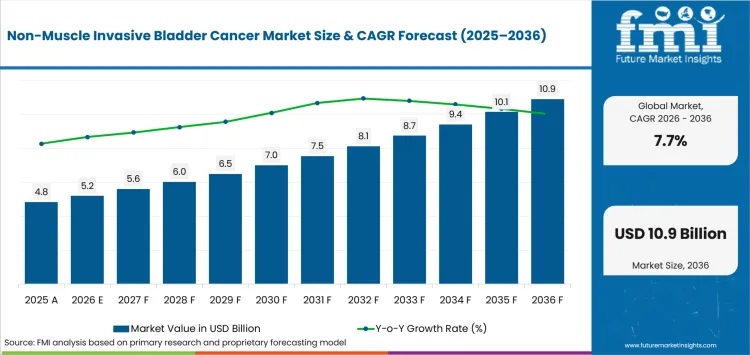
USD 5.2 billion in 2026 and USD 10.9 billion by 2036 at a 7.7% CAGR.
Global revenues of non-muscle invasive bladder cancer market are set to reach USD 5.2 billion in 2026. Non-muscle invasive bladder cancer covers urothelial tumors classified around Ta, T1 and carcinoma in situ, without invasion into the bladder muscle. The European Association of Urology 2026 guideline overview sets this scope and separates it from muscle-invasive and upper-tract disease. The National Cancer Institute describes transurethral tumor resection as the usual first treatment for early-stage disease, followed by intravesical therapy and cystoscopic surveillance. This creates a market that combines procedure-led care with recurring medicines, delivery systems and follow-up.
The clinical pathway changes with disease risk and response. The NCI stage-based treatment summary identifies mitomycin, gemcitabine and BCG as intravesical options after surgery. For patients with BCG-unresponsive high-risk disease and carcinoma in situ, the FDA lists pembrolizumab, nadofaragene firadenovec and nogapendekin alfa inbakicept-pmln among bladder-preserving options when cystectomy is not used. The category therefore extends across immunotherapy, chemotherapy, gene therapy and local delivery.
The FDA approved gemcitabine intravesical system in September 2025 and mitomycin intravesical solution in June 2025. In May 2026, it approved durvalumab with BCG for BCG-naive, high-risk NMIBC. These decisions enlarge the set of treatment and delivery choices that hospitals, urology practices and pharmacies must evaluate.
Key Takeaways of Non-Muscle Invasive Bladder Cancer Market
- Intravesical Immunotherapy leads the profiled treatment mix with a 39.0% share in 2026.
- Ta Stage accounts for 43.0% of disease-stage demand in 2026, ahead of T1 and CIS pathways in the defined taxonomy.
- Hospitals represent 47.0% of end-user demand in 2026, making procedure capacity and follow-up infrastructure central to adoption.
- Recurrence, BCG-unresponsive disease, repeated cystoscopy or resection and delayed cystectomy risk remain central constraints when treatment pathways are evaluated.
- Merck & Co., Inc., Johnson & Johnson, Pfizer Inc., Ferring Pharmaceuticals, CG Oncology, Bristol Myers Squibb, UroGen Pharma Ltd., AstraZeneca PLC, Roche Holding AG and ImmunityBio, Inc.
Analyst Perspective
"The market is shifting from a single BCG-centered pathway toward a portfolio of risk-specific and bladder-preserving options. Local delivery, durable response and repeatable follow-up will shape adoption as hospitals compare approved therapies with late-stage programs."
- Anurag Sharma, Principal Consultant at Future Market Insights
How is the Non-Muscle Invasive Bladder Cancer Market segmented?
The Non-Muscle Invasive Bladder Cancer industry is segmented by treatment type, disease stage, end user, distribution channel, therapy class and region.
By treatment type, the market includes Intravesical Immunotherapy, covering BCG Therapy and Novel Immunotherapies; Intravesical Chemotherapy, covering Mitomycin C and Gemcitabine; Surgical Treatment, covering Transurethral Resection of Bladder Tumor and Re-TURBT; and Others, covering Targeted Therapy and Combination Therapy. By disease stage, the market includes Ta Stage, covering Low-Grade Ta and High-Grade Ta; T1 Stage, covering Primary T1 and Recurrent T1; and Carcinoma in Situ, covering Primary CIS and Concurrent CIS. By end user, the market includes Hospitals, covering Cancer Hospitals and General Hospitals; Specialty Cancer Centers, covering Urology Clinics and Oncology Centers; Ambulatory Surgical Centers, covering Outpatient Surgery Centers and Day Care Centers; and Others, covering Research Institutes and Academic Medical Centers. By distribution channel, the market includes Hospital Pharmacies, covering Inpatient Pharmacies and Outpatient Pharmacies; Retail Pharmacies, covering Chain Pharmacies and Independent Pharmacies; Specialty Pharmacies, covering Oncology Pharmacies and Biologic Drug Providers; and Others, covering Government Procurement and Online Pharmacies. By therapy class, the market includes Immunotherapy, covering BCG-Based Therapy and Checkpoint Inhibitors; Chemotherapy, covering Intravesical Chemotherapy and Systemic Chemotherapy; Targeted Therapy, covering FGFR Inhibitors and Antibody-Based Therapy; and Others, covering Gene Therapy and Oncolytic Viral Therapy.
Why does Ta Stage lead demand within the disease stage category?
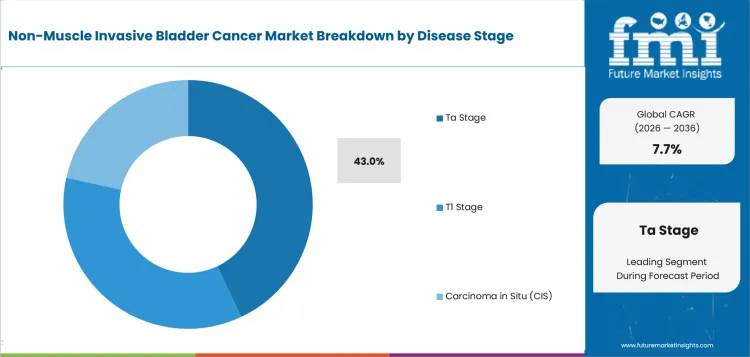
Ta Stage leads because these tumors remain in the innermost bladder lining and account for a broad set of low-grade and high-grade care decisions. The EAU staging overview defines NMIBC around Ta, T1 and CIS, while the National Cancer Institute separates low-, intermediate- and high-risk disease when describing treatment and surveillance.
- Ta Stage is projected to account for 43.0% share in 2026, reflecting the breadth of Ta pathways across low-grade and high-grade disease.
- Ta Stage includes Low-Grade Ta and High-Grade Ta. The grade, size, number of tumors and recurrence history influence the treatment intensity and follow-up required within this stage.
- T1 Stage includes Primary T1 and Recurrent T1. T1 disease has extended into connective tissue beneath the lining, so treatment selection requires closer risk assessment and progression monitoring.
- Carcinoma in Situ (CIS) includes Primary CIS and Concurrent CIS. CIS is a high-grade flat lesion that can occur alone or alongside papillary tumors, making accurate staging and response assessment important.
Why does Intravesical Immunotherapy lead demand within the treatment type category?
Intravesical immunotherapy leads because BCG remains a central treatment for higher-risk NMIBC after tumor resection, and newer immunotherapy combinations are extending the development pathway. The NCI treatment overview identifies BCG as a standard intravesical option, while the FDA's Anktiva approval demonstrates how an immune-stimulating agent can be paired with BCG in BCG-unresponsive CIS.
- Intravesical Immunotherapy is estimated to hold 39.0% share in 2026 because BCG-based care remains an anchor and newer combinations widen the treatment set.
- Intravesical Chemotherapy includes Mitomycin C and Gemcitabine. These agents are administered locally after resection or through newer sustained-release systems, with the NCI identifying both as intravesical treatment options.
- Surgical Treatment includes Transurethral Resection of Bladder Tumor (TURBT) and Re-TURBT. Repeat resection can be required when the initial procedure does not remove enough tumor or lacks an adequate muscle sample.
- Others includes Targeted Therapy and Combination Therapy. This branch captures treatment designs that combine mechanisms or focus on molecular features beyond the main intravesical immunotherapy, chemotherapy and surgical categories.
Why do Hospitals lead demand within the end user category?
Hospitals lead because they can connect TURBT or Re-TURBT, pathology, intravesical administration, cystoscopic surveillance and specialist escalation within one care network. The EAU guideline framework places diagnosis, risk classification, disease management and follow-up in a linked pathway, which favors settings with urology and oncology infrastructure.
- Hospitals hold a 47.0% share in 2026 because hospitals provide the procedure, treatment and monitoring infrastructure required by risk-stratified care.
- Specialty Cancer Centers include Urology Clinics and Oncology Centers. These settings concentrate disease-specific expertise, intravesical administration and clinical trial access.
- Ambulatory Surgical Centers include Outpatient Surgery Centers and Day Care Centers. They can support procedure-led treatment when patients do not require a full hospital stay.
- Others includes Research Institutes and Academic Medical Centers. These organizations support clinical research, translational work, training and evidence generation alongside patient care.
Why do Hospital Pharmacies lead demand within the distribution channel category?
Hospital Pharmacies lead because many NMIBC medicines are supplied into a supervised pathway that includes catheter-based instillation, treatment preparation, dosing controls and observation. The FDA label for Inlexzo describes a product inserted into the bladder with a co-packaged urinary catheter and scheduled removal, underscoring the role of institution-led distribution.
- Hospital Pharmacies account for 48.0% share in 2026 because treatment preparation and administration are closely linked to hospital or specialist workflows.
- Retail Pharmacies includes Chain Pharmacies and Independent Pharmacies. These channels can support prescribed medicines and related care, although intravesical therapies still require an appropriate clinical setting.
- Specialty Pharmacies includes Oncology Pharmacies and Biologic Drug Providers. Their role increases when products need cold-chain, patient-support or reimbursement coordination.
- Others includes Government Procurement and Online Pharmacies. The defined taxonomy captures institutional purchasing and remote ordering routes, subject to the administration and storage requirements of each therapy.
Why does Immunotherapy lead demand within the therapy class category?
Immunotherapy leads because BCG remains an established treatment foundation and recent approvals are adding checkpoint or immune-stimulating mechanisms. The FDA approved durvalumab with BCG for BCG-naive high-risk NMIBC in 2026, while Pfizer's CREST disclosure reported Phase 3 event-free survival results for sasanlimab with BCG.
- Immunotherapy represents 41.0% of therapy-class demand in 2026, supported by BCG-based care and newer immune-oncology combinations.
- Chemotherapy includes Intravesical Chemotherapy and Systemic Chemotherapy. The former includes mitomycin and gemcitabine delivery into the bladder, while systemic chemotherapy is used in selected broader urothelial cancer pathways.
- Targeted Therapy includes FGFR Inhibitors and Antibody-Based Therapy. These categories are retained for therapies directed at defined molecular or antigen-linked mechanisms as the taxonomy expands beyond standard intravesical care.
- Others includes Gene Therapy and Oncolytic Viral Therapy. Ferring's Adstiladrin and CG Oncology's cretostimogene program illustrate how local gene-based and oncolytic approaches add breadth to the development landscape.
What are the drivers, restraints and opportunities in the Non-Muscle Invasive Bladder Cancer Market?
- Driver: High recurrence risk and guideline-backed surveillance keep treatment, follow-up and re-treatment pathways active across Ta, T1 and CIS disease.
- Restraint: BCG-unresponsive disease, progression risk, repeat procedures and the need to avoid delaying cystectomy complicate treatment selection and commercial uptake.
- Opportunity: Sustained local delivery, gene-based therapy, oncolytic immunotherapy and earlier immunotherapy-plus-BCG regimens can widen bladder-preserving options.
Recurrence is the primary demand driver. The NCI treatment guidance notes that stage 0 and I disease often returns after surgery and therefore commonly receives intravesical therapy followed by surveillance. That recurring cycle supports demand for medicines, cystoscopy, resection, pathology and specialist care.
The main restraint is the clinical and operational gap between recurrence control and progression prevention. The FDA label for Anktiva warns that delaying cystectomy in persistent CIS can allow progression to muscle-invasive or metastatic disease. This creates a narrow decision window in which response durability, staging accuracy, patient preference and surgical readiness must be considered together.
The opportunity is to make bladder-preserving treatment more durable and less procedure-intensive. Johnson & Johnson's INLEXZO approval adds extended intravesical gemcitabine delivery for a BCG-unresponsive population, while CG Oncology's 2026 update describes Phase 3 and Phase 2 programs spanning high-risk, BCG-unresponsive, BCG-naive and intermediate-risk NMIBC. These approaches can expand the addressable treatment set if clinical durability, administration and reimbursement align.
Which country CAGRs are profiled in the Non-Muscle Invasive Bladder Cancer Market?
| Country | CAGR |
|---|---|
| USA | 8.1% |
| Japan | 7.0% |
| Germany | 7.4% |
| UK | 7.6% |
| Canada | 7.8% |
How do country-level CAGRs compare in the Non-Muscle Invasive Bladder Cancer Market?
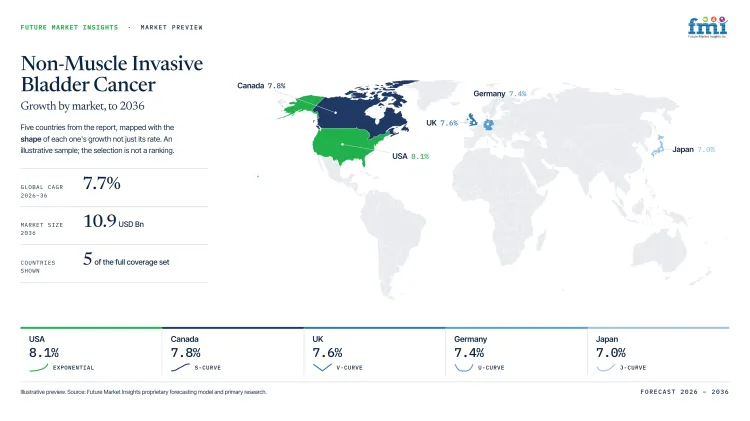
The country comparison spans 1.1 percentage points across the five profiled countries, with the USA at the high end and Japan at the lower end. Canada and the USA form the upper tier with a 0.3-point difference, while the UK and Germany create a closely aligned middle group separated by 0.2 percentage points. Japan remains at the lower end with a 0.4-point gap from Germany.
- Canada leads the comparison at a 7.8% CAGR through 2036, 0.3 percentage points above the USA. Continued demand for bladder-cancer diagnosis, treatment and surveillance supports market expansion across specialist care settings.
- The USA follows at an 8.1% CAGR, creating a 0.3-percentage-point gap above Canada. Treatment innovation, specialist urology infrastructure and recurring surveillance requirements support demand for non-muscle invasive bladder cancer therapies.
- The UK records a 7.6% CAGR, 0.5 percentage points below the USA. Risk-based treatment pathways, recurring cystoscopic surveillance and structured specialist care support continued market demand.
- Germany grows at a 7.4% CAGR, remaining 0.2 percentage points below the UK. Established urology infrastructure, risk-based treatment decisions and structured follow-up support demand for therapies and procedures.
- Japan records a 7.0% CAGR, 0.4 percentage points below Germany. Specialist treatment capacity, risk-based management and ongoing surveillance requirements provide a stable base for market growth.
Comparable CAGRs can still produce different market conditions. Differences in treatment access, specialist urology capacity, reimbursement, regulatory pathways, surveillance practices and adoption of bladder-preserving therapies influence non-muscle invasive bladder cancer demand across countries. The full report provides country-level CAGR analysis across major regions and individual markets within the non-muscle invasive bladder cancer market.
Country-wise Analysis
- USA: FDA approvals across BCG-unresponsive, recurrent low-grade and BCG-naive high-risk NMIBC are widening the available treatment pathway. The approved options include systemic immunotherapy, immune-stimulating therapy and sustained intravesical drug delivery.
- Japan: Japan’s public clinical-trial registry includes multinational studies of treatments for intermediate-risk NMIBC, while the Japanese Urological Association recommends risk-based use of TURBT, intravesical chemotherapy and BCG. This supports continued demand for specialist treatment and surveillance capacity.
- Germany: Germany follows the European Association of Urology framework for Ta, T1 and carcinoma in situ, with treatment decisions based on recurrence and progression risk. Updated guidance reinforces demand for accurate staging, intravesical treatment and structured follow-up.
- UK: NICE recommends risk-based intravesical treatment and scheduled cystoscopic follow-up for patients with NMIBC. The recurring surveillance pathway sustains demand for urology services, diagnostic procedures and hospital-administered therapies.
- Canada: Canada’s 2026 Meds Pipeline Monitor identifies late-stage NMIBC programs, including intravesical delivery systems for patients whose disease returns after BCG. The pipeline indicates future demand for regulatory assessment, reimbursement review and specialist administration.
Who are the notable companies in the Non-Muscle Invasive Bladder Cancer Market?
Merck & Co., Inc., Johnson & Johnson, Pfizer Inc., Ferring Pharmaceuticals, CG Oncology, Bristol Myers Squibb, UroGen Pharma Ltd., AstraZeneca PLC, Roche Holding AG and ImmunityBio, Inc. are the notable companies.
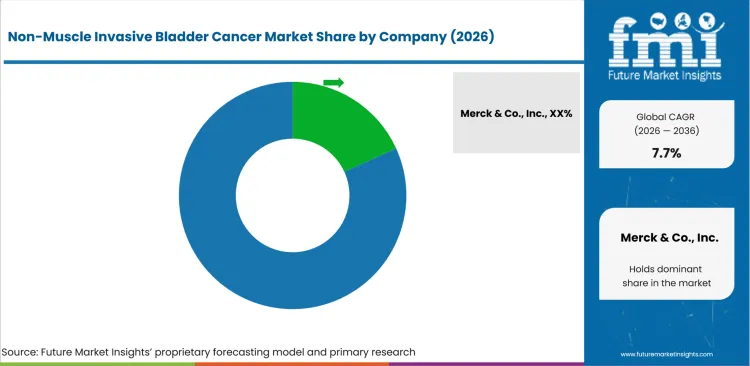
- Merck & Co., Inc. and AstraZeneca PLC: both have FDA-recognized immunotherapy pathways in NMIBC, with pembrolizumab addressing BCG-unresponsive high-risk disease and durvalumab plus BCG addressing BCG-naive high-risk disease.
- Johnson & Johnson, Ferring Pharmaceuticals and UroGen Pharma Ltd.: represent local-delivery platforms through the FDA-approved Inlexzo, Adstiladrin and Zusduri programs.
- Pfizer Inc. and CG Oncology: are advancing late-stage clinical programs that test immune-oncology combinations or intravesical oncolytic immunotherapy across risk and response groups.
- Bristol Myers Squibb and Roche Holding AG: bring checkpoint-inhibitor and bladder-cancer development experience with disclosed NMIBC trial activity or historical evidence.
- ImmunityBio, Inc. is a historical entry linked to the Vicineum program; its USA development was paused in 2022 and the company later merged with Carisma Therapeutics, so it should not be read as a current independent NMIBC supplier.
Competitive Benchmarking: Non-Muscle Invasive Bladder Cancer Market
Scoring basis: NMIBC-specific evidence is High for an established product or a disclosed Phase 3 NMIBC program, Medium for a verified clinical-trial or historical NMIBC program, and Low for historical evidence without current development. Local or intravesical delivery is High for a product or program administered into the bladder, Medium for a BCG combination with systemic therapy, and Low for systemic or adjacent evidence. Clinical maturity is High for an established product, Medium for Phase 2 or a late clinical history, and Low where the evidence is historical or the company has no current exact-market program. Coverage evidence records the public label, trial geography or historical program footprint and does not convert missing evidence into a performance rating.
| Company | NMIBC-specific evidence | Local / intravesical delivery | Clinical maturity | Coverage evidence |
|---|---|---|---|---|
| Merck & Co., Inc. | High - KEYTRUDA NMIBC indication | Low - systemic checkpoint | High - FDA approved | USA label; global oncology platform |
| Johnson & Johnson | High - INLEXZO / TAR-200 | High - intravesical gemcitabine system | High - FDA 2025 | USA label; multinational clinical program |
| Pfizer Inc. | High - Phase 3 CREST | Medium - BCG plus subcutaneous PD-1 | High - Phase 3 | Multinational CREST trial |
| Ferring Pharmaceuticals | High - ADSTILADRIN | High - intravesical gene therapy | High - FDA approved; Japan NDA | USA and Japan disclosures |
| CG Oncology | High - BOND-003 and PIVOT-006 | High - intravesical oncolytic | High - Phase 3; BLA planned | Multinational trials and access program |
| Bristol Myers Squibb | Medium - nivolumab NMIBC trials | Low - systemic checkpoint | Medium - clinical-trial history | Multinational oncology development |
| UroGen Pharma Ltd. | High - ZUSDURI | High - intravesical RTGel | High - FDA 2025 | USA label; multinational ENVISION |
| AstraZeneca PLC | High - IMFINZI plus BCG | Medium - systemic PD-L1 plus intravesical BCG | High - FDA 2026 | USA label; global oncology platform |
| Roche Holding AG | Medium - atezolizumab NMIBC trials | Low - systemic checkpoint | Low - Phase 3 ALBAN trial (2025) did not meet its primary endpoint; no current approved NMIBC label | Global oncology; ALBAN Phase 3 readout |
| ImmunityBio, Inc. | Low - historical Vicineum | High - historical intravesical program | Low - USA program paused; merged 2023 | Historical USA program |
Key Developments in the Non-Muscle Invasive Bladder Cancer Market
- In May 2026, the FDA approved AstraZeneca PLC's durvalumab with BCG for BCG-naive, high-risk NMIBC.
- In September 2025, the FDA approved Johnson & Johnson's INLEXZO gemcitabine intravesical system for BCG-unresponsive NMIBC.
- In June 2025, the FDA approved UroGen Pharma Ltd.'s ZUSDURI for recurrent low-grade intermediate-risk NMIBC.
Key Players in the Non-Muscle Invasive Bladder Cancer Market
Integrated Immuno-Oncology Platforms
- Merck & Co., Inc.
- Pfizer Inc.
- Bristol Myers Squibb
- AstraZeneca PLC
- Roche Holding AG
Intravesical Drug and Gene Therapy Specialists
- Johnson & Johnson
- Ferring Pharmaceuticals
- UroGen Pharma Ltd.
Bladder-Focused and Historical Local Programs
- CG Oncology
- ImmunityBio, Inc.
Non-Muscle Invasive Bladder Cancer Market - Report Scope
| Coverage field | Report scope |
|---|---|
| Market breakdown | By treatment type, disease stage, end user, distribution channel, therapy class and region. |
| Quantitative Units | Revenue in USD Billion and CAGR in %. |
| Market Definition | The market covers non-muscle invasive bladder cancer treatment pathways across procedures, therapies, delivery channels, end users and regional supply routes. |
| Regions Covered | North America, Latin America, Europe, East Asia, South Asia and Pacific and Middle East and Africa. |
| Countries Covered | USA, Japan, Germany, UK, Canada, Australia and South Korea. |
| Key Companies Profiled | Merck & Co., Inc., Johnson & Johnson, Pfizer Inc., Ferring Pharmaceuticals, CG Oncology, Bristol Myers Squibb, UroGen Pharma Ltd., AstraZeneca PLC, Roche Holding AG and ImmunityBio, Inc.. |
| Forecast Period | 2026-2036. |
| Approach | Primary and secondary research with market triangulation. |
Non-Muscle Invasive Bladder Cancer Market - Research Methodology
| Method | Approach |
|---|---|
| Primary Research | Analysts examined pharmaceutical developers, urology practices, hospitals, specialty cancer centers, pharmacies, surgical providers and subject-matter experts on risk classification, treatment selection, local administration, follow-up and adoption barriers. |
| Desk Research | The team reviewed official guidelines, regulatory labels, company releases, trial registries, regulatory sources, peer-reviewed literature and relevant market disclosures. |
| Market Sizing and Forecasting | Models combined the defined treatment type, disease stage, end-user, distribution-channel, therapy-class and country indicators across the 2026-2036 forecast period. |
| Data Validation | Findings were checked through source comparison, data triangulation and expert review across regional operating conditions. |
Non-Muscle Invasive Bladder Cancer Market by Segments
Non-Muscle Invasive Bladder Cancer Market segmented by Treatment Type:
- Intravesical Immunotherapy
- BCG Therapy
- Novel Immunotherapies
- Intravesical Chemotherapy
- Mitomycin C
- Gemcitabine
- Surgical Treatment
- Transurethral Resection of Bladder Tumor (TURBT)
- Re-TURBT
- Others
- Targeted Therapy
- Combination Therapy
Non-Muscle Invasive Bladder Cancer Market segmented by Disease Stage:
- Ta Stage
- Low-Grade Ta
- High-Grade Ta
- T1 Stage
- Primary T1
- Recurrent T1
- Carcinoma in Situ (CIS)
- Primary CIS
- Concurrent CIS
Non-Muscle Invasive Bladder Cancer Market segmented by End User:
- Hospitals
- Cancer Hospitals
- General Hospitals
- Specialty Cancer Centers
- Urology Clinics
- Oncology Centers
- Ambulatory Surgical Centers
- Outpatient Surgery Centers
- Day Care Centers
- Others
- Research Institutes
- Academic Medical Centers
Non-Muscle Invasive Bladder Cancer Market segmented by Distribution Channel:
- Hospital Pharmacies
- Inpatient Pharmacies
- Outpatient Pharmacies
- Retail Pharmacies
- Chain Pharmacies
- Independent Pharmacies
- Specialty Pharmacies
- Oncology Pharmacies
- Biologic Drug Providers
- Others
- Government Procurement
- Online Pharmacies
Non-Muscle Invasive Bladder Cancer Market segmented by Therapy Class:
- Immunotherapy
- BCG-Based Therapy
- Checkpoint Inhibitors
- Chemotherapy
- Intravesical Chemotherapy
- Systemic Chemotherapy
- Targeted Therapy
- FGFR Inhibitors
- Antibody-Based Therapy
- Others
- Gene Therapy
- Oncolytic Viral Therapy
Non-Muscle Invasive Bladder Cancer Market by Region:
- North America
- United States
- Canada
- Mexico
- Latin America
- Brazil
- Chile
- Rest of Latin America
- Western Europe
- Germany
- United Kingdom
- Italy
- Spain
- France
- Nordics
- Benelux
- Rest of Western Europe
- Eastern Europe
- Russia
- Poland
- Hungary
- Balkan and Baltic States
- Rest of Eastern Europe
- East Asia
- China
- Japan
- South Korea
- South Asia and Pacific
- India
- ASEAN
- Australia and New Zealand
- Rest of South Asia and Pacific
- Middle East and Africa
- Kingdom of Saudi Arabia
- Other GCC Countries
- Türkiye
- South Africa
- Other African Union Countries
- Rest of Middle East and Africa
Research Sources and Bibliography
- European Association of Urology (2026). Non-muscle-invasive Bladder Cancer - Introduction.
- European Association of Urology (2026). Pathological Staging and Classification Systems.
- National Cancer Institute (2024, September 12). Treatment of Bladder Cancer by Stage.
- USA Food and Drug Administration (2024, April 22). FDA approves nogapendekin alfa inbakicept-pmln for BCG-unresponsive non-muscle invasive bladder cancer.
- USA Food and Drug Administration (2025, June 12). FDA approves mitomycin intravesical solution for recurrent low-grade intermediate-risk non-muscle invasive bladder cancer.
- USA Food and Drug Administration (2025, September 9). FDA approves gemcitabine intravesical system for non-muscle invasive bladder cancer.
- USA Food and Drug Administration (2026, May 28). FDA approves durvalumab in combination with Bacillus Calmette-Guerin for high-risk non-muscle invasive bladder cancer.
- USA Food and Drug Administration (2024, August 8). BCG-Unresponsive Nonmuscle Invasive Bladder Cancer: Developing Drugs and Biological Products for Treatment.
- Merck & Co., Inc. (2020, January 8). FDA Approves Merck's KEYTRUDA for Patients with BCG-Unresponsive High-Risk NMIBC.
- Johnson & Johnson (2025, September 9). USA FDA approval of INLEXZO (gemcitabine intravesical system).
- Ferring Pharmaceuticals (2025, April 21). Initial Data from Phase 3 Trial in Japanese Patients with Nadofaragene Firadenovec.
- Ferring Japan (2025, September 11). PMDA Acceptance of NDA Filing for Nadofaragene Firadenovec.
- Pfizer Inc. (2025, April 26). Sasanlimab Combination Significantly Improves Event-Free Survival in BCG-Naive, High-Risk NMIBC.
- CG Oncology (2026, February 27). 2025 Year End Financial Results and Business Updates.
- UroGen Pharma Ltd. (2025, June 12). FDA Approves ZUSDURI (mitomycin) for Recurrent Low-Grade Intermediate-Risk NMIBC.
- Bristol Myers Squibb and ClinicalTrials.gov (n.d.). NCT04149574: Nivolumab and Bacterial Drugs in High-Risk Bladder Cancer.
- Roupret, M., et al., on behalf of ALBAN investigators (2025, October). ALBAN (GETUG-AFU 37): a phase III, randomized, open-label trial of atezolizumab and BCG versus BCG alone in BCG-naive high-risk NMIBC. Annals of Oncology.
- F. Hoffmann-La Roche Ltd, ClinicalTrials.gov (2021, September). NCT02792192: Safety and Pharmacology Study of Atezolizumab Alone and in Combination With BCG in High-Risk NMIBC (terminated).
- National Institute for Health and Care Excellence (2015, February 25). Bladder cancer: diagnosis and management.
- Patented Medicine Prices Review Board, Government of Canada (2026, April 27). Meds Pipeline Monitor 2026.
- Therapeutic Goods Administration (2023, June 8). AusPAR: Keytruda.
- Ministry of Food and Drug Safety (2025, August 21). Advanced Biopharmaceutical Long-Term Follow-up Information.
This bibliography is provided for reader reference and is not exhaustive. The full report contains the complete reference list and detailed citations.
This Report Answers
- How large is the Non-Muscle Invasive Bladder Cancer Market in 2026 and 2036?
- Which treatment type holds the leading share in 2026?
- How does disease stage shape treatment demand?
- Why do hospitals and hospital pharmacies anchor the market?
- Which therapy class leads the defined market taxonomy?
- How do country CAGRs compare across the approved forecast set?
- Which companies serve the Non-Muscle Invasive Bladder Cancer Market?
- What currently drives non-muscle invasive bladder cancer market adoption?
- What limits non-muscle invasive bladder cancer market adoption?
- How should decision-makers compare immunotherapy, chemotherapy, surgery, gene therapy and oncolytic approaches?
Frequently Asked Questions
How big is the Non-Muscle Invasive Bladder Cancer Market in 2026?
The non-muscle invasive bladder cancer market is valued at USD 5.2 billion in 2026 and is forecast to reach USD 10.9 billion by 2036. Growth is supported by high recurrence rates that sustain repeated intravesical therapy, cystoscopic surveillance and resection across risk-stratified treatment pathways.
What is the CAGR of the Non-Muscle Invasive Bladder Cancer Market from 2026 to 2036?
The non-muscle invasive bladder cancer market grows at a CAGR of 7.7% between 2026 and 2036, supported by recurrence-driven surveillance and an expanding set of BCG-based, chemotherapy, gene-based and bladder-preserving immunotherapy options entering hospital and specialty cancer center treatment pathways worldwide.
Which treatment type leads the Non-Muscle Invasive Bladder Cancer Market?
Intravesical immunotherapy accounts for 39.0% of the non-muscle invasive bladder cancer market by treatment type in 2026, driven by BCG-based care as an established anchor and newer immunotherapy combinations that extend bladder-preserving options for BCG-unresponsive and BCG-naive high-risk disease across hospital and specialty cancer center pathways.
How much will the Non-Muscle Invasive Bladder Cancer Market add between 2026 and 2036?
The non-muscle invasive bladder cancer market is set to add USD 5.7 billion between 2026 and 2036, growing from USD 5.2 billion to USD 10.9 billion as newer immunotherapy, gene therapy and sustained-release intravesical delivery options enter hospital and specialty cancer center treatment pathways.
Who are the leading companies in the Non-Muscle Invasive Bladder Cancer Market?
Ten companies lead the non-muscle invasive bladder cancer market, including Merck & Co., Johnson & Johnson, Pfizer, Ferring Pharmaceuticals, CG Oncology, Bristol Myers Squibb, UroGen Pharma, AstraZeneca, Roche Holding and ImmunityBio, competing through BCG-based immunotherapy, intravesical chemotherapy, gene therapy and oncolytic and checkpoint-inhibitor treatment programs.
Preview the report firsthand - request a free sample
Get SampleGet the brochure for pricing and purchase details.
Get PDFTable of Content
- Key Takeaways
- Market Size and CAGR
- Top Growth Driver
- Fastest Growing Segment
- Leading Region
- Key Companies
- Emerging Opportunities
- Executive Summary
- Global Market Outlook
- Demand-side Trends
- Supply-side Trends
- Technology Roadmap Analysis
- Analysis and Recommendations
- Analyst Perspective (What is happening? Why now? What should investors know?)
- Key Questions Answered
- How large is the market?
- What is the CAGR?
- What are key trends?
- Which region dominates?
- Who are the leaders?
- Market Overview
- Market Coverage / Taxonomy
- Market Definition / Scope / Limitations
- Research Methodology
- Chapter Orientation
- Analytical Lens and Working Hypotheses
- Market Structure, Signals, and Trend Drivers
- Benchmarking and Cross-market Comparability
- Market Sizing, Forecasting, and Opportunity Mapping
- Research Design and Evidence Framework
- Desk Research Programme (Secondary Evidence)
- Expert Input and Fieldwork (Primary Evidence)
- Tooling, Models, and Reference Databases
- Data Engineering and Model Build
- Quality Assurance and Audit Trail
- Market Background
- Market Dynamics (Drivers, Restraints, Opportunity, Trends)
- Scenario Forecast (Optimistic, Likely, Conservative)
- Impact Analysis
- AI Impact
- Sustainability Impact
- Regulatory Impact
- Technology Impact
- Consumer / Buyer Analysis
- Purchase Drivers
- Adoption Barriers
- Buyer Journey
- Opportunity Map Analysis
- Product Life Cycle Analysis
- Supply Chain Analysis
- Investment Feasibility Matrix
- Value Chain Analysis
- PESTLE and Porter's Analysis
- Regulatory Landscape
- Regional Parent Market Outlook
- Production and Consumption Statistics
- Import and Export Statistics
- Global Market Analysis and Forecast, 2021 to 2036
- Historical Market Size Value (USD Billion) Analysis, 2021 to 2025
- Current and Future Market Size Value (USD Billion) Projections, 2026 to 2036
- Y-o-Y Growth Trend Analysis
- Absolute $ Opportunity Analysis
- Global Market Pricing Analysis, 2021 to 2036
- Global Market Analysis and Forecast, By Treatment Type, 2021 to 2036
- Introduction / Key Findings
- Historical Market Size Value (USD Billion) Analysis By Treatment Type, 2021 to 2025
- Current and Future Market Size Value (USD Billion) Analysis and Forecast By Treatment Type, 2026 to 2036
- Intravesical Immunotherapy
- BCG Therapy
- Novel Immunotherapies
- Intravesical Chemotherapy
- Mitomycin C
- Gemcitabine
- Surgical Treatment
- Transurethral Resection of Bladder Tumor (TURBT)
- Re-TURBT
- Others
- Targeted Therapy
- Combination Therapy
- Intravesical Immunotherapy
- Y-o-Y Growth Trend Analysis By Treatment Type, 2021 to 2025
- Absolute $ Opportunity Analysis By Treatment Type, 2026 to 2036
- Global Market Analysis and Forecast, By Disease Stage, 2021 to 2036
- Introduction / Key Findings
- Historical Market Size Value (USD Billion) Analysis By Disease Stage, 2021 to 2025
- Current and Future Market Size Value (USD Billion) Analysis and Forecast By Disease Stage, 2026 to 2036
- Ta Stage
- Low-Grade Ta
- High-Grade Ta
- T1 Stage
- Primary T1
- Recurrent T1
- Carcinoma in Situ (CIS)
- Primary CIS
- Concurrent CIS
- Ta Stage
- Y-o-Y Growth Trend Analysis By Disease Stage, 2021 to 2025
- Absolute $ Opportunity Analysis By Disease Stage, 2026 to 2036
- Global Market Analysis and Forecast, By End User, 2021 to 2036
- Introduction / Key Findings
- Historical Market Size Value (USD Billion) Analysis By End User, 2021 to 2025
- Current and Future Market Size Value (USD Billion) Analysis and Forecast By End User, 2026 to 2036
- Hospitals
- Cancer Hospitals
- General Hospitals
- Specialty Cancer Centers
- Urology Clinics
- Oncology Centers
- Ambulatory Surgical Centers
- Outpatient Surgery Centers
- Day Care Centers
- Others
- Research Institutes
- Academic Medical Centers
- Hospitals
- Y-o-Y Growth Trend Analysis By End User, 2021 to 2025
- Absolute $ Opportunity Analysis By End User, 2026 to 2036
- Global Market Analysis and Forecast, By Distribution Channel, 2021 to 2036
- Introduction / Key Findings
- Historical Market Size Value (USD Billion) Analysis By Distribution Channel, 2021 to 2025
- Current and Future Market Size Value (USD Billion) Analysis and Forecast By Distribution Channel, 2026 to 2036
- Hospital Pharmacies
- Inpatient Pharmacies
- Outpatient Pharmacies
- Retail Pharmacies
- Chain Pharmacies
- Independent Pharmacies
- Specialty Pharmacies
- Oncology Pharmacies
- Biologic Drug Providers
- Others
- Government Procurement
- Online Pharmacies
- Hospital Pharmacies
- Y-o-Y Growth Trend Analysis By Distribution Channel, 2021 to 2025
- Absolute $ Opportunity Analysis By Distribution Channel, 2026 to 2036
- Global Market Analysis and Forecast, By Therapy Class, 2021 to 2036
- Introduction / Key Findings
- Historical Market Size Value (USD Billion) Analysis By Therapy Class, 2021 to 2025
- Current and Future Market Size Value (USD Billion) Analysis and Forecast By Therapy Class, 2026 to 2036
- Immunotherapy
- BCG-Based Therapy
- Checkpoint Inhibitors
- Chemotherapy
- Intravesical Chemotherapy
- Systemic Chemotherapy
- Targeted Therapy
- FGFR Inhibitors
- Antibody-Based Therapy
- Others
- Gene Therapy
- Oncolytic Viral Therapy
- Immunotherapy
- Y-o-Y Growth Trend Analysis By Therapy Class, 2021 to 2025
- Absolute $ Opportunity Analysis By Therapy Class, 2026 to 2036
- Global Market Analysis and Forecast, By Region, 2021 to 2036
- Introduction
- Historical Market Size Value (USD Billion) Analysis By Region, 2021 to 2025
- Current Market Size Value (USD Billion) Analysis and Forecast By Region, 2026 to 2036
- North America
- Latin America
- Western Europe
- Eastern Europe
- East Asia
- South Asia and Pacific
- Middle East & Africa
- Market Attractiveness Analysis By Region
- North America Market Analysis and Forecast, By Country, 2021 to 2036
- Historical Market Size Value (USD Billion) Trend Analysis By Market Taxonomy, 2021 to 2025
- Market Size Value (USD Billion) Forecast By Market Taxonomy, 2026 to 2036
- By Country
- USA
- Canada
- By Treatment Type
- By Disease Stage
- By End User
- By Distribution Channel
- By Therapy Class
- By Country
- Market Attractiveness Analysis
- By Country
- By Treatment Type
- By Disease Stage
- By End User
- By Distribution Channel
- By Therapy Class
- Key Takeaways
- Latin America Market Analysis and Forecast, By Country
- Historical Market Size Value (USD Billion) Trend Analysis By Market Taxonomy, 2021 to 2025
- Market Size Value (USD Billion) Forecast By Market Taxonomy, 2026 to 2036
- By Country
- Brazil
- Mexico
- Chile
- Rest of Latin America
- By Treatment Type
- By Disease Stage
- By End User
- By Distribution Channel
- By Therapy Class
- By Country
- Market Attractiveness Analysis
- By Country
- By Treatment Type
- By Disease Stage
- By End User
- By Distribution Channel
- By Therapy Class
- Key Takeaways
- Western Europe Market Analysis and Forecast, By Country
- Historical Market Size Value (USD Billion) Trend Analysis By Market Taxonomy, 2021 to 2025
- Market Size Value (USD Billion) Forecast By Market Taxonomy, 2026 to 2036
- By Country
- Germany
- UK
- Italy
- Spain
- France
- Nordic
- BENELUX
- Rest of Western Europe
- By Treatment Type
- By Disease Stage
- By End User
- By Distribution Channel
- By Therapy Class
- By Country
- Market Attractiveness Analysis
- By Country
- By Treatment Type
- By Disease Stage
- By End User
- By Distribution Channel
- By Therapy Class
- Key Takeaways
- Eastern Europe Market Analysis and Forecast, By Country
- Historical Market Size Value (USD Billion) Trend Analysis By Market Taxonomy, 2021 to 2025
- Market Size Value (USD Billion) Forecast By Market Taxonomy, 2026 to 2036
- By Country
- Russia
- Poland
- Hungary
- Balkan & Baltic
- Rest of Eastern Europe
- By Treatment Type
- By Disease Stage
- By End User
- By Distribution Channel
- By Therapy Class
- By Country
- Market Attractiveness Analysis
- By Country
- By Treatment Type
- By Disease Stage
- By End User
- By Distribution Channel
- By Therapy Class
- Key Takeaways
- East Asia Market Analysis and Forecast, By Country
- Historical Market Size Value (USD Billion) Trend Analysis By Market Taxonomy, 2021 to 2025
- Market Size Value (USD Billion) Forecast By Market Taxonomy, 2026 to 2036
- By Country
- China
- Japan
- South Korea
- By Treatment Type
- By Disease Stage
- By End User
- By Distribution Channel
- By Therapy Class
- By Country
- Market Attractiveness Analysis
- By Country
- By Treatment Type
- By Disease Stage
- By End User
- By Distribution Channel
- By Therapy Class
- Key Takeaways
- South Asia and Pacific Market Analysis and Forecast, By Country
- Historical Market Size Value (USD Billion) Trend Analysis By Market Taxonomy, 2021 to 2025
- Market Size Value (USD Billion) Forecast By Market Taxonomy, 2026 to 2036
- By Country
- India
- ASEAN
- Australia & New Zealand
- Rest of South Asia and Pacific
- By Treatment Type
- By Disease Stage
- By End User
- By Distribution Channel
- By Therapy Class
- By Country
- Market Attractiveness Analysis
- By Country
- By Treatment Type
- By Disease Stage
- By End User
- By Distribution Channel
- By Therapy Class
- Key Takeaways
- Middle East & Africa Market Analysis and Forecast, By Country
- Historical Market Size Value (USD Billion) Trend Analysis By Market Taxonomy, 2021 to 2025
- Market Size Value (USD Billion) Forecast By Market Taxonomy, 2026 to 2036
- By Country
- Kingdom of Saudi Arabia
- Other GCC Countries
- Türkiye
- South Africa
- Other African Union
- Rest of Middle East & Africa
- By Treatment Type
- By Disease Stage
- By End User
- By Distribution Channel
- By Therapy Class
- By Country
- Market Attractiveness Analysis
- By Country
- By Treatment Type
- By Disease Stage
- By End User
- By Distribution Channel
- By Therapy Class
- Key Takeaways
- Key Countries Market Analysis
- USA
- Pricing Analysis
- Market Share Analysis, 2025
- By Treatment Type
- By Disease Stage
- By End User
- By Distribution Channel
- By Therapy Class
- Canada
- Pricing Analysis
- Market Share Analysis, 2025
- By Treatment Type
- By Disease Stage
- By End User
- By Distribution Channel
- By Therapy Class
- Mexico
- Pricing Analysis
- Market Share Analysis, 2025
- By Treatment Type
- By Disease Stage
- By End User
- By Distribution Channel
- By Therapy Class
- Brazil
- Pricing Analysis
- Market Share Analysis, 2025
- By Treatment Type
- By Disease Stage
- By End User
- By Distribution Channel
- By Therapy Class
- Chile
- Pricing Analysis
- Market Share Analysis, 2025
- By Treatment Type
- By Disease Stage
- By End User
- By Distribution Channel
- By Therapy Class
- Germany
- Pricing Analysis
- Market Share Analysis, 2025
- By Treatment Type
- By Disease Stage
- By End User
- By Distribution Channel
- By Therapy Class
- UK
- Pricing Analysis
- Market Share Analysis, 2025
- By Treatment Type
- By Disease Stage
- By End User
- By Distribution Channel
- By Therapy Class
- Italy
- Pricing Analysis
- Market Share Analysis, 2025
- By Treatment Type
- By Disease Stage
- By End User
- By Distribution Channel
- By Therapy Class
- Spain
- Pricing Analysis
- Market Share Analysis, 2025
- By Treatment Type
- By Disease Stage
- By End User
- By Distribution Channel
- By Therapy Class
- France
- Pricing Analysis
- Market Share Analysis, 2025
- By Treatment Type
- By Disease Stage
- By End User
- By Distribution Channel
- By Therapy Class
- India
- Pricing Analysis
- Market Share Analysis, 2025
- By Treatment Type
- By Disease Stage
- By End User
- By Distribution Channel
- By Therapy Class
- ASEAN
- Pricing Analysis
- Market Share Analysis, 2025
- By Treatment Type
- By Disease Stage
- By End User
- By Distribution Channel
- By Therapy Class
- Australia & New Zealand
- Pricing Analysis
- Market Share Analysis, 2025
- By Treatment Type
- By Disease Stage
- By End User
- By Distribution Channel
- By Therapy Class
- China
- Pricing Analysis
- Market Share Analysis, 2025
- By Treatment Type
- By Disease Stage
- By End User
- By Distribution Channel
- By Therapy Class
- Japan
- Pricing Analysis
- Market Share Analysis, 2025
- By Treatment Type
- By Disease Stage
- By End User
- By Distribution Channel
- By Therapy Class
- South Korea
- Pricing Analysis
- Market Share Analysis, 2025
- By Treatment Type
- By Disease Stage
- By End User
- By Distribution Channel
- By Therapy Class
- Russia
- Pricing Analysis
- Market Share Analysis, 2025
- By Treatment Type
- By Disease Stage
- By End User
- By Distribution Channel
- By Therapy Class
- Poland
- Pricing Analysis
- Market Share Analysis, 2025
- By Treatment Type
- By Disease Stage
- By End User
- By Distribution Channel
- By Therapy Class
- Hungary
- Pricing Analysis
- Market Share Analysis, 2025
- By Treatment Type
- By Disease Stage
- By End User
- By Distribution Channel
- By Therapy Class
- Kingdom of Saudi Arabia
- Pricing Analysis
- Market Share Analysis, 2025
- By Treatment Type
- By Disease Stage
- By End User
- By Distribution Channel
- By Therapy Class
- Türkiye
- Pricing Analysis
- Market Share Analysis, 2025
- By Treatment Type
- By Disease Stage
- By End User
- By Distribution Channel
- By Therapy Class
- South Africa
- Pricing Analysis
- Market Share Analysis, 2025
- By Treatment Type
- By Disease Stage
- By End User
- By Distribution Channel
- By Therapy Class
- USA
- Market Structure Analysis
- Competition Dashboard
- Competition Benchmarking
- Market Share Analysis of Top Players
- By Regional
- By Treatment Type
- By Disease Stage
- By End User
- By Distribution Channel
- By Therapy Class
- Emerging Startups
- Innovation Benchmarking
- Competition Analysis
- Competition Deep Dive
- Merck & Co., Inc.
- Overview
- Product Portfolio
- Profitability by Market Segments
- Sales Footprint
- Strategy Overview
- Marketing Strategy
- Product Strategy
- Channel Strategy
- Johnson & Johnson
- Pfizer Inc.
- Ferring Pharmaceuticals
- CG Oncology
- Bristol Myers Squibb
- UroGen Pharma Ltd.
- AstraZeneca PLC
- Roche Holding AG
- ImmunityBio, Inc.
- Others
- Merck & Co., Inc.
- Case Studies
- Success Stories
- Recent Developments
- Competition Deep Dive
- Assumptions & Acronyms Used


