

- Industry Size (2026)
- USD 564.2 Mn
- Forecast (2036)
- USD 1275.6 Mn
- CAGR (2026 to 2036)
- 8.5%
Non-Toxic Scale Inhibitors for Cooling Towers Market Forecast and Outlook 2026 to 2036
The non-toxic scale inhibitors for cooling towers market is valued at USD 564.2 million in 2026 and is forecasted to reach USD 1,275.6 million by 2036, expanding at a CAGR of 8.5%. Growth is driven by tightening restrictions on phosphates and heavy-metal additives, combined with rising operational focus on water efficiency and asset longevity. Cooling tower operators prioritize scale control solutions that reduce blowdown frequency, support higher cycles of concentration, and comply with evolving environmental discharge standards.
Phosphonate-free organic scale inhibitors represent leading chemistry demand due to effective suppression of calcium carbonate, sulfate, and silica scaling without contributing to nutrient loading. These chemistries demonstrate strong threshold inhibition, dispersion capability, and compatibility with modern corrosion inhibitor programs. Adoption reflects shift toward formulations based on polycarboxylates, biodegradable polymers, and green dispersants that maintain heat-transfer efficiency while lowering regulatory risk. Segment structure indicates gradual replacement of legacy phosphonate systems across commercial and industrial cooling applications.
Quick Stats for Non-Toxic Scale Inhibitors for Cooling Towers Market
- Non-Toxic Scale Inhibitors for Cooling Towers Market Value (2026): USD 564.2 million
- Non-Toxic Scale Inhibitors for Cooling Towers Market Forecast Value (2036): USD 1,275.6 million
- Non-Toxic Scale Inhibitors for Cooling Towers Market Forecast CAGR (2026 to 2036): 8.5%
- Leading Inhibitor Chemistry in Global Demand: Phosphonate-Free Organic Scale Inhibitors
- Fastest-Growing Countries: China, India, USA, Germany, Brazil
- Top Players in Global Demand: Ecolab, Kemira, Solenis, BASF SE, Veolia Water Technologies
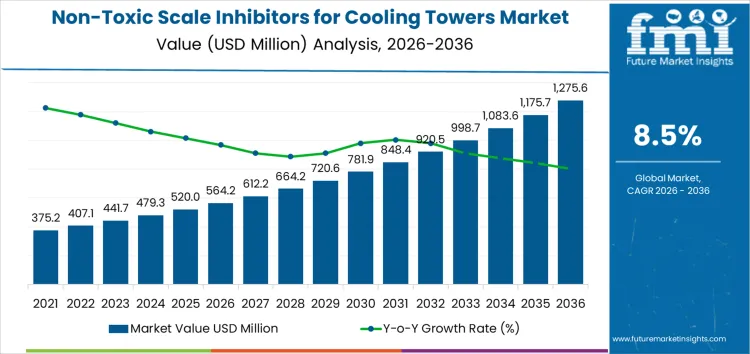
HVAC and commercial cooling systems represent leading end-use demand, reflecting large installed base and sensitivity to energy losses from scaling. China, India, USA, Germany, and Brazil emerge as fastest-growing countries due to urbanization, data center expansion, and commercial infrastructure upgrades. Competitive landscape includes Ecolab, Kemira, Solenis, BASF SE, and Veolia Water Technologies, emphasizing low-toxicity formulations, system compatibility, and performance under high-stress cooling conditions.
Non-Toxic Scale Inhibitors for Cooling Towers Market Key Takeaways
| Metric | Value |
|---|---|
| Market Value (2026) | USD 564.2 million |
| Market Forecast Value (2036) | USD 1,275.6 million |
| Forecast CAGR (2026 to 2036) | 8.5% |
Why is the Demand for Non-Toxic Scale Inhibitors for Cooling Towers Market Growing?
Demand for non-toxic scale inhibitors for cooling towers is growing globally due to rising environmental and health safety expectations along with stricter regulatory requirements governing water treatment chemicals. Traditional scale inhibitors often rely on phosphates, chromates, or other substances that pose ecological risks or contribute to eutrophication and toxic discharge concerns when released into waterways. Industrial facilities, power plants, and commercial buildings adopt non-toxic, environmentally benign inhibitors that prevent mineral buildup without introducing hazardous constituents into blowdown or wastewater streams.
Regulations in multiple regions limit use of harmful treatment chemicals and impose monitoring of effluent quality, which motivates procurement of safer alternatives that maintain compliance while protecting aquatic ecosystems. Growth in infrastructure development, combined with heightened emphasis on sustainability and corporate responsibility, reinforces adoption of scale control agents that align with eco-labeling criteria and green chemistry principles. Research and innovation improve performance of bio-based, threshold, and polymeric inhibitor formulations that deliver effective scale prevention under diverse pH, temperature, and conductivity conditions common in cooling systems. Operators benefit from reduced regulatory risk, improved worker safety, and easier integration of treatment programs into broader eco-friendly goals.
How Are the Segments Classified in the Non-Toxic Scale Inhibitors for Cooling Towers Market?
Demand for non-toxic scale inhibitors for cooling towers globally is shaped by water conservation pressure, discharge toxicity limits, and asset protection requirements. Operators evaluate scale control efficiency, compatibility with mixed metallurgy systems, biodegradability, and stability under high cycles of concentration. Adoption patterns reflect replacement of phosphonate-based chemistries with environmentally acceptable alternatives across commercial, industrial, and utility cooling operations.
Which Inhibitor Chemistry Represents the Largest Share of Global Demand?
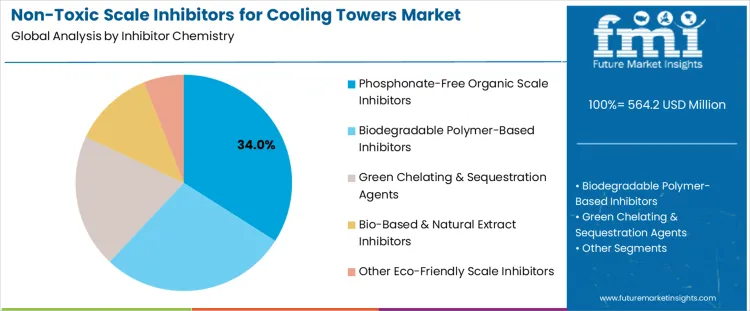
Phosphonate-free organic scale inhibitors hold 34.0%, representing the largest share of global demand. These chemistries provide effective calcium and magnesium scale control without contributing to nutrient loading. Biodegradable polymer-based inhibitors account for 28.0%, supporting dispersion and threshold inhibition with improved environmental profiles. Green chelating and sequestration agents hold 20.0%, enabling ion control under variable water quality conditions. Bio-based and natural extract inhibitors account for 12.0%, addressing low-toxicity requirements. Other eco-friendly scale inhibitors hold 6.0%. Chemistry distribution reflects preference for non-phosphorus solutions with predictable performance.
Key Points
- Phosphonate-free organics lead due to regulatory compatibility.
- Polymer-based inhibitors support dispersion and threshold control.
- Chelating agents address variable hardness conditions.
Which End-Use Industry Accounts for the Highest Share of Global Adoption?
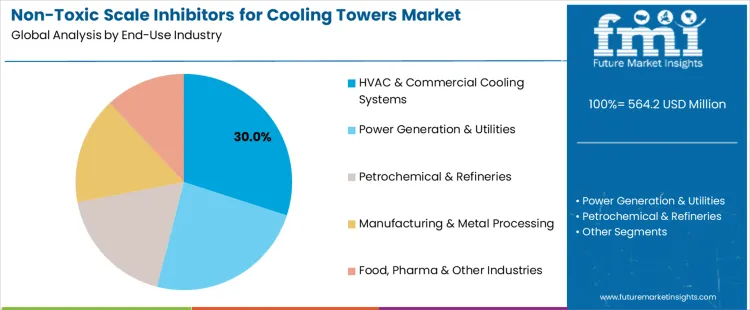
HVAC and commercial cooling systems hold 30.0%, accounting for the highest share of global adoption. These systems operate under public exposure and water discharge oversight. Power generation and utilities account for 24.0%, requiring continuous scale control to protect heat transfer efficiency. Petrochemical and refinery operations hold 18.0%, managing high-temperature and high-hardness cooling circuits. Manufacturing and metal processing account for 16.0%, supporting equipment longevity. Food, pharma, and other industries hold 12.0%. End-use distribution reflects concentration of cooling tower assets in building and utility infrastructure.
Key Points
- Commercial HVAC leads due to scale of installed systems.
- Utilities prioritize efficiency and uptime.
- Industrial users manage challenging water chemistries.
Which Treatment Method Holds the Largest Share of Global Demand?
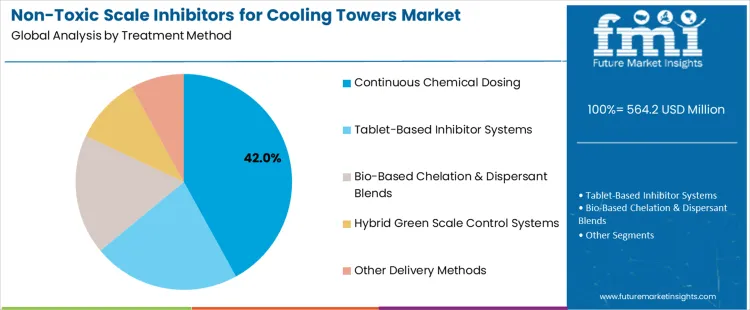
Continuous chemical dosing holds 42.0%, representing the largest share of global demand. This method enables stable scale control across fluctuating operating conditions. Tablet-based inhibitor systems account for 22.0%, supporting simplified handling and controlled release. Bio-based chelation and dispersant blends hold 18.0%, integrating multiple control mechanisms. Hybrid green scale control systems account for 10.0%, combining physical and chemical approaches. Other delivery methods hold 8.0%. Treatment-method distribution reflects preference for continuous, automated dosing in large cooling systems.
Key Points
- Continuous dosing dominates due to control consistency.
- Tablet systems support ease of handling.
- Hybrid methods address complex scaling environments.
What are the Key Dynamics in the Non-Toxic Scale Inhibitors for Cooling Towers Market?
Global demand rises as industrial, commercial, and power generation operators adopt non-toxic scale inhibitors to protect cooling tower systems while reducing environmental and health risks associated with conventional scale control chemistries. These inhibitors prevent mineral deposition and fouling in recirculating water systems, supporting heat transfer efficiency and equipment longevity. Adoption aligns with regulatory emphasis on reduced hazardous discharge, sustainability goals, and corporate commitments to safer chemical use across regions with diverse industrial activity. Usage spans manufacturing plants, data centers, petrochemical facilities, and commercial building portfolios requiring reliable scale control without persistent or toxic residues.
How do regulatory focus and sustainability expectations shape global demand?
Environmental regulations in North America, Europe, Asia-Pacific, and other regions limit discharge of hazardous substances and restrict use of heavy metals or persistent organics in cooling system treatments. Operators respond by specifying non-toxic, biodegradable scale inhibitors that minimize ecological impact and align with wastewater compliance criteria. Corporate environmental, social, and governance (ESG) strategies emphasize safer chemical profiles to reduce risk and improve reporting outcomes. Utilities, manufacturing firms, and facility managers integrate green inhibitors into water treatment regimes to satisfy stakeholder and community expectations for reduced chemical hazard. Public procurement standards and eco-certification programs further reinforce interest in inhibitors that support environmentally responsible operations without compromising cooling performance.
How do performance demands, cost pressures, and system complexity influence market scalability?
Non-toxic scale inhibitors must deliver effective control across varied cooling water chemistries, temperatures, and cycling regimes, requiring tailored formulation and dosing protocols. Performance parity with conventional chemistries impacts specification decisions, particularly in high-hardness or high-suspended solids applications. Cost considerations influence adoption timing, especially where green alternatives carry price premiums relative to legacy inhibitors. Integration into existing treatment systems demands monitoring and adjustment of dosing equipment and control logic.
Raw material supply variability and seasonal demand cycles influence pricing and availability across regions. Variable enforcement of environmental standards creates uneven urgency for adoption. Long-term market growth depends on continued innovation in robust, cost-effective non-toxic formulations and harmonized sustainability criteria that support wide use across global cooling tower applications.
How Is Demand for Non-Toxic Scale Inhibitors for Cooling Towers Evolving?
Demand for non-toxic scale inhibitors for cooling towers is increasing globally due to water conservation mandates, restrictions on hazardous phosphonates, and operational reliability needs. China leads with a 9.4% CAGR, supported by industrial cooling expansion and tighter wastewater controls. India follows at 9.1%, driven by power generation growth and water stress mitigation. USA records a 7.6% CAGR, reflecting regulatory compliance and optimization of existing cooling assets. Germany posts 7.0%, shaped by precautionary chemical regulation and efficiency-led water management. Brazil records 6.8%, supported by industrial cooling demand and environmental permitting. Growth reflects sustained shift toward safer, biodegradable scale control solutions worldwide.
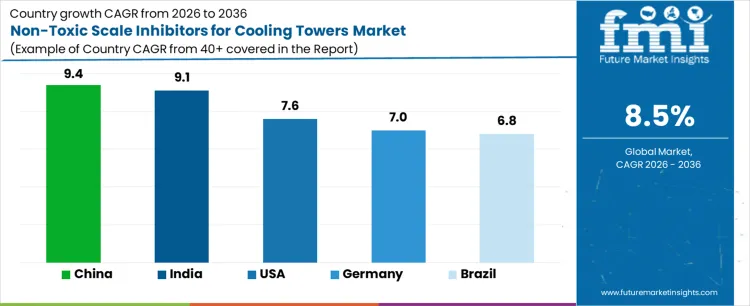
| Country | CAGR (%) |
|---|---|
| China | 9.4% |
| India | 9.1% |
| USA | 7.6% |
| Germany | 7.0% |
| Brazil | 6.8% |
What factors are driving strong adoption of non-toxic scale inhibitors in China?
China demand is driven by extensive industrial cooling systems across power, petrochemicals, and manufacturing. CAGR of 9.4% reflects replacement of phosphorus-rich and toxic inhibitors with biodegradable polymeric and organic alternatives. Regulatory scrutiny on cooling tower blowdown quality accelerates substitution. Industrial parks implement standardized water treatment programs to reduce scaling and corrosion risks. High cycles of concentration increase need for effective, low-toxicity scale control. Domestic suppliers scale production of compliant formulations. Growth remains scale-driven and regulation-aligned, supported by industrial output and water quality enforcement.
- Large industrial cooling tower installations
- Restrictions on phosphorus and toxic additives
- Standardized water treatment programs
- Expansion of domestic compliant formulations
How is India sustaining high growth in non-toxic scale inhibitor usage?
India demand reflects expansion of thermal power plants, refineries, and process industries under water scarcity conditions. CAGR of 9.1% is supported by adoption of non-toxic inhibitors enabling higher cooling cycles and reduced blowdown. Regulatory focus on wastewater discharge and reuse influences chemical selection. Operators prioritize formulations compatible with variable water quality. Retrofitting existing cooling systems without major capital investment supports uptake. Growth remains infrastructure-led and compliance-focused, aligned with water efficiency and operational continuity goals.
- Power and process industry cooling expansion
- Water scarcity-driven efficiency requirements
- Wastewater discharge and reuse compliance
- Retrofit compatibility with existing systems
What regulatory drivers shape demand growth in the USA?
USA demand is shaped by environmental permitting, cooling tower discharge limits, and corporate sustainability programs. CAGR of 7.6% reflects transition to non-toxic scale inhibitors in power generation, data centers, and manufacturing. Operators seek solutions minimizing environmental liability while maintaining heat transfer efficiency. State-level regulations influence chemical approvals. Monitoring and documentation requirements sustain consistent usage. Growth remains regulation-driven and operations-focused, aligned with risk management and asset optimization.
- Cooling tower discharge permitting requirements
- Sustainability initiatives in energy and industry
- Emphasis on liability and risk reduction
- Monitoring and compliance documentation
Why does Germany show steady but controlled demand growth?
Germany demand reflects precautionary chemical regulation and emphasis on minimizing aquatic toxicity. CAGR of 7.0% is supported by targeted use of non-toxic inhibitors within optimized cooling water management frameworks. Operators prioritize precise dosing, high efficiency, and low environmental persistence. Strong source control and water recycling reduce overall chemical intensity. Documentation and validation guide procurement. Growth remains efficiency-led and stability-focused, aligned with established environmental protection practices.
- Precautionary chemical and water regulations
- Focus on dosing precision and efficiency
- Integration with water recycling systems
- Strong documentation and validation standards
What supports continued demand growth for non-toxic scale inhibitors in Brazil?
Brazil demand is driven by industrial cooling requirements in power, mining, and manufacturing sectors. CAGR of 6.8% reflects increased adoption of non-toxic inhibitors to meet environmental licensing conditions. High ambient temperatures elevate scaling risks, increasing treatment needs. Operators favor solutions reducing blowdown and water consumption. Public investment supports industrial and energy infrastructure. Growth remains application-driven and compliance-aligned, supported by environmental oversight and infrastructure development.
- Industrial cooling demand across key sectors
- Environmental licensing and compliance needs
- Reduction of blowdown and water use
- Infrastructure expansion supporting adoption
What is the competitive landscape of demand for non-toxic scale inhibitors for cooling towers?
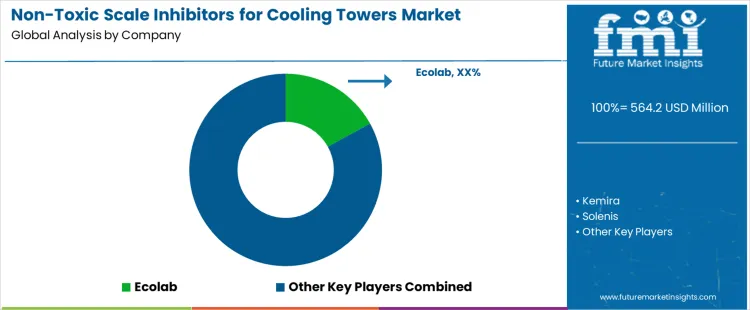
Demand for non-toxic scale inhibitors for cooling towers is driven by water conservation mandates, discharge toxicity limits, and asset protection requirements across industrial and commercial facilities. Applications focus on controlling calcium carbonate, calcium phosphate, silica, and mixed mineral scaling under high-cycle cooling operations. Buyers evaluate scale inhibition efficiency, thermal stability, compatibility with corrosion inhibitors and biocides, and performance under variable water chemistry. Procurement teams prioritize formulations with low aquatic toxicity, biodegradability alignment, and ability to sustain heat transfer efficiency while minimizing blowdown. Trend in the global market reflects transition away from phosphonate-heavy programs toward polymer-based and environmentally acceptable inhibitor chemistries supporting higher cycles of concentration.
Ecolab maintains strong positioning through service-integrated cooling water programs combining non-toxic scale inhibitors with monitoring and optimization tools. Kemira supplies environmentally aligned polymeric inhibitors used in industrial and utility cooling systems worldwide. Solenis supports demand with tailored scale control programs integrated into comprehensive water treatment strategies. BASF SE contributes specialty polymers and dispersants designed for effective scale inhibition with reduced environmental impact. Veolia Water Technologies provides non-toxic scale inhibitor solutions embedded within broader cooling water management and sustainability-driven treatment programs. Competitive differentiation depends on inhibition reliability, adaptability to diverse water sources, technical service depth, and ability to support regulatory compliance while maintaining operational efficiency.
Key Players in the Non-Toxic Scale Inhibitors for Cooling Towers Market
- Ecolab
- Kemira
- Solenis
- BASF SE
- Veolia Water Technologies
Scope of the Report
| Items | Values |
|---|---|
| Quantitative Units | USD million |
| Inhibitor Chemistry | Phosphonate-Free Organic Scale Inhibitors; Biodegradable Polymer-Based Inhibitors; Green Chelating & Sequestration Agents; Bio-Based & Natural Extract Inhibitors; Other Eco-Friendly Scale Inhibitors |
| End-Use Industry | HVAC & Commercial Cooling Systems; Power Generation & Utilities; Petrochemical & Refineries; Manufacturing & Metal Processing; Food, Pharma & Other Industries |
| Treatment Method | Continuous Chemical Dosing; Tablet-Based Inhibitor Systems; Bio-Based Chelation & Dispersant Blends; Hybrid Green Scale Control Systems; Other Delivery Methods |
| Regions Covered | Asia Pacific, Europe, North America, Latin America, Middle East & Africa |
| Countries Covered | China, India, USA, Germany, Brazil, and 40+ countries |
| Key Companies Profiled | Ecolab; Kemira; Solenis; BASF SE; Veolia Water Technologies |
| Additional Attributes | Dollar sales by inhibitor chemistry and treatment method; adoption trends for phosphonate-free and biodegradable scale control programs; scale inhibition performance across calcium carbonate, sulfate, and silica systems; compatibility with cooling tower metallurgy and water reuse practices; dosing stability, biodegradation, and discharge compliance considerations; regulatory and green standards influencing non-toxic scale inhibitor selection. |
Non-Toxic Scale Inhibitors for Cooling Towers Market by Segment
Inhibitor Chemistry:
- Phosphonate-Free Organic Scale Inhibitors
- Biodegradable Polymer-Based Inhibitors
- Green Chelating & Sequestration Agents
- Bio-Based & Natural Extract Inhibitors
- Other Eco-Friendly Scale Inhibitors
End-Use Industry:
- HVAC & Commercial Cooling Systems
- Power Generation & Utilities
- Petrochemical & Refineries
- Manufacturing & Metal Processing
- Food, Pharma & Other Industries
Treatment Method:
- Continuous Chemical Dosing
- Tablet-Based Inhibitor Systems
- Bio-Based Chelation & Dispersant Blends
- Hybrid Green Scale Control Systems
- Other Delivery Methods
Region:
- Asia Pacific
- China
- Japan
- South Korea
- India
- Australia & New Zealand
- ASEAN
- Rest of Asia Pacific
- Europe
- Germany
- United Kingdom
- France
- Italy
- Spain
- Nordic
- BENELUX
- Rest of Europe
- North America
- United States
- Canada
- Mexico
- Latin America
- Brazil
- Chile
- Rest of Latin America
- Middle East & Africa
- Kingdom of Saudi Arabia
- Other GCC Countries
- Turkey
- South Africa
- Other African Union
- Rest of Middle East & Africa
Frequently Asked Questions
How big is the non-toxic scale inhibitors for cooling towers market in 2026?
The global non-toxic scale inhibitors for cooling towers market is estimated to be valued at USD 564.2 million in 2026.
What will be the size of non-toxic scale inhibitors for cooling towers market in 2036?
The market size for the non-toxic scale inhibitors for cooling towers market is projected to reach USD 1,275.6 million by 2036.
How much will be the non-toxic scale inhibitors for cooling towers market growth between 2026 and 2036?
The non-toxic scale inhibitors for cooling towers market is expected to grow at a 8.5% CAGR between 2026 and 2036.
What are the key product types in the non-toxic scale inhibitors for cooling towers market?
The key product types in non-toxic scale inhibitors for cooling towers market are phosphonate-free organic scale inhibitors, biodegradable polymer-based inhibitors, green chelating & sequestration agents, bio-based & natural extract inhibitors and other eco-friendly scale inhibitors.
Which end-use industry segment to contribute significant share in the non-toxic scale inhibitors for cooling towers market in 2026?
In terms of end-use industry, hvac & commercial cooling systems segment to command 30.0% share in the non-toxic scale inhibitors for cooling towers market in 2026.
Preview the report firsthand - request a free sample
Get SampleGet the brochure for pricing and purchase details.
Get PDFTable of Content
- Executive Summary
- Global Market Outlook
- Demand-side Trends
- Supply-side Trends
- Technology Roadmap Analysis
- Analysis and Recommendations
- Market Overview
- Market Coverage / Taxonomy
- Market Definition / Scope / Limitations
- Market Background
- Market Dynamics
- Drivers
- Restraints
- Opportunity
- Trends
- Scenario Forecast
- Demand in Optimistic Scenario
- Demand in Likely Scenario
- Demand in Conservative Scenario
- Opportunity Map Analysis
- Product Life Cycle Analysis
- Supply Chain Analysis
- Investment Feasibility Matrix
- Value Chain Analysis
- PESTLE and Porter’s Analysis
- Regulatory Landscape
- Regional Parent Market Outlook
- Production and Consumption Statistics
- Import and Export Statistics
- Market Dynamics
- Global Market Analysis 2021 to 2025 and Forecast, 2026 to 2036
- Historical Market Size Value (USD Million) Analysis, 2021 to 2025
- Current and Future Market Size Value (USD Million) Projections, 2026 to 2036
- Y-o-Y Growth Trend Analysis
- Absolute $ Opportunity Analysis
- Global Market Pricing Analysis 2021 to 2025 and Forecast 2026 to 2036
- Global Market Analysis 2021 to 2025 and Forecast 2026 to 2036, By Inhibitor Chemistry
- Introduction / Key Findings
- Historical Market Size Value (USD Million) Analysis By Inhibitor Chemistry , 2021 to 2025
- Current and Future Market Size Value (USD Million) Analysis and Forecast By Inhibitor Chemistry , 2026 to 2036
- Phosphonate-Free Organic Scale Inhibitors
- Biodegradable Polymer-Based Inhibitors
- Green Chelating & Sequestration Agents
- Bio-Based & Natural Extract Inhibitors
- Other Eco-Friendly Scale Inhibitors
- Phosphonate-Free Organic Scale Inhibitors
- Y-o-Y Growth Trend Analysis By Inhibitor Chemistry , 2021 to 2025
- Absolute $ Opportunity Analysis By Inhibitor Chemistry , 2026 to 2036
- Global Market Analysis 2021 to 2025 and Forecast 2026 to 2036, By End-Use Industry
- Introduction / Key Findings
- Historical Market Size Value (USD Million) Analysis By End-Use Industry, 2021 to 2025
- Current and Future Market Size Value (USD Million) Analysis and Forecast By End-Use Industry, 2026 to 2036
- HVAC & Commercial Cooling Systems
- Power Generation & Utilities
- Petrochemical & Refineries
- Manufacturing & Metal Processing
- Food, Pharma & Other Industries
- HVAC & Commercial Cooling Systems
- Y-o-Y Growth Trend Analysis By End-Use Industry, 2021 to 2025
- Absolute $ Opportunity Analysis By End-Use Industry, 2026 to 2036
- Global Market Analysis 2021 to 2025 and Forecast 2026 to 2036, By Treatment Method
- Introduction / Key Findings
- Historical Market Size Value (USD Million) Analysis By Treatment Method, 2021 to 2025
- Current and Future Market Size Value (USD Million) Analysis and Forecast By Treatment Method, 2026 to 2036
- Continuous Chemical Dosing
- Tablet-Based Inhibitor Systems
- Bio-Based Chelation & Dispersant Blends
- Hybrid Green Scale Control Systems
- Other Delivery Methods
- Continuous Chemical Dosing
- Y-o-Y Growth Trend Analysis By Treatment Method, 2021 to 2025
- Absolute $ Opportunity Analysis By Treatment Method, 2026 to 2036
- Global Market Analysis 2021 to 2025 and Forecast 2026 to 2036, By Region
- Introduction
- Historical Market Size Value (USD Million) Analysis By Region, 2021 to 2025
- Current Market Size Value (USD Million) Analysis and Forecast By Region, 2026 to 2036
- North America
- Latin America
- Western Europe
- Eastern Europe
- East Asia
- South Asia and Pacific
- Middle East & Africa
- Market Attractiveness Analysis By Region
- North America Market Analysis 2021 to 2025 and Forecast 2026 to 2036, By Country
- Historical Market Size Value (USD Million) Trend Analysis By Market Taxonomy, 2021 to 2025
- Market Size Value (USD Million) Forecast By Market Taxonomy, 2026 to 2036
- By Country
- USA
- Canada
- Mexico
- By Inhibitor Chemistry
- By End-Use Industry
- By Treatment Method
- By Country
- Market Attractiveness Analysis
- By Country
- By Inhibitor Chemistry
- By End-Use Industry
- By Treatment Method
- Key Takeaways
- Latin America Market Analysis 2021 to 2025 and Forecast 2026 to 2036, By Country
- Historical Market Size Value (USD Million) Trend Analysis By Market Taxonomy, 2021 to 2025
- Market Size Value (USD Million) Forecast By Market Taxonomy, 2026 to 2036
- By Country
- Brazil
- Chile
- Rest of Latin America
- By Inhibitor Chemistry
- By End-Use Industry
- By Treatment Method
- By Country
- Market Attractiveness Analysis
- By Country
- By Inhibitor Chemistry
- By End-Use Industry
- By Treatment Method
- Key Takeaways
- Western Europe Market Analysis 2021 to 2025 and Forecast 2026 to 2036, By Country
- Historical Market Size Value (USD Million) Trend Analysis By Market Taxonomy, 2021 to 2025
- Market Size Value (USD Million) Forecast By Market Taxonomy, 2026 to 2036
- By Country
- Germany
- UK
- Italy
- Spain
- France
- Nordic
- BENELUX
- Rest of Western Europe
- By Inhibitor Chemistry
- By End-Use Industry
- By Treatment Method
- By Country
- Market Attractiveness Analysis
- By Country
- By Inhibitor Chemistry
- By End-Use Industry
- By Treatment Method
- Key Takeaways
- Eastern Europe Market Analysis 2021 to 2025 and Forecast 2026 to 2036, By Country
- Historical Market Size Value (USD Million) Trend Analysis By Market Taxonomy, 2021 to 2025
- Market Size Value (USD Million) Forecast By Market Taxonomy, 2026 to 2036
- By Country
- Russia
- Poland
- Hungary
- Balkan & Baltic
- Rest of Eastern Europe
- By Inhibitor Chemistry
- By End-Use Industry
- By Treatment Method
- By Country
- Market Attractiveness Analysis
- By Country
- By Inhibitor Chemistry
- By End-Use Industry
- By Treatment Method
- Key Takeaways
- East Asia Market Analysis 2021 to 2025 and Forecast 2026 to 2036, By Country
- Historical Market Size Value (USD Million) Trend Analysis By Market Taxonomy, 2021 to 2025
- Market Size Value (USD Million) Forecast By Market Taxonomy, 2026 to 2036
- By Country
- China
- Japan
- South Korea
- By Inhibitor Chemistry
- By End-Use Industry
- By Treatment Method
- By Country
- Market Attractiveness Analysis
- By Country
- By Inhibitor Chemistry
- By End-Use Industry
- By Treatment Method
- Key Takeaways
- South Asia and Pacific Market Analysis 2021 to 2025 and Forecast 2026 to 2036, By Country
- Historical Market Size Value (USD Million) Trend Analysis By Market Taxonomy, 2021 to 2025
- Market Size Value (USD Million) Forecast By Market Taxonomy, 2026 to 2036
- By Country
- India
- ASEAN
- Australia & New Zealand
- Rest of South Asia and Pacific
- By Inhibitor Chemistry
- By End-Use Industry
- By Treatment Method
- By Country
- Market Attractiveness Analysis
- By Country
- By Inhibitor Chemistry
- By End-Use Industry
- By Treatment Method
- Key Takeaways
- Middle East & Africa Market Analysis 2021 to 2025 and Forecast 2026 to 2036, By Country
- Historical Market Size Value (USD Million) Trend Analysis By Market Taxonomy, 2021 to 2025
- Market Size Value (USD Million) Forecast By Market Taxonomy, 2026 to 2036
- By Country
- Kingdom of Saudi Arabia
- Other GCC Countries
- Turkiye
- South Africa
- Other African Union
- Rest of Middle East & Africa
- By Inhibitor Chemistry
- By End-Use Industry
- By Treatment Method
- By Country
- Market Attractiveness Analysis
- By Country
- By Inhibitor Chemistry
- By End-Use Industry
- By Treatment Method
- Key Takeaways
- Key Countries Market Analysis
- USA
- Pricing Analysis
- Market Share Analysis, 2025
- By Inhibitor Chemistry
- By End-Use Industry
- By Treatment Method
- Canada
- Pricing Analysis
- Market Share Analysis, 2025
- By Inhibitor Chemistry
- By End-Use Industry
- By Treatment Method
- Mexico
- Pricing Analysis
- Market Share Analysis, 2025
- By Inhibitor Chemistry
- By End-Use Industry
- By Treatment Method
- Brazil
- Pricing Analysis
- Market Share Analysis, 2025
- By Inhibitor Chemistry
- By End-Use Industry
- By Treatment Method
- Chile
- Pricing Analysis
- Market Share Analysis, 2025
- By Inhibitor Chemistry
- By End-Use Industry
- By Treatment Method
- Germany
- Pricing Analysis
- Market Share Analysis, 2025
- By Inhibitor Chemistry
- By End-Use Industry
- By Treatment Method
- UK
- Pricing Analysis
- Market Share Analysis, 2025
- By Inhibitor Chemistry
- By End-Use Industry
- By Treatment Method
- Italy
- Pricing Analysis
- Market Share Analysis, 2025
- By Inhibitor Chemistry
- By End-Use Industry
- By Treatment Method
- Spain
- Pricing Analysis
- Market Share Analysis, 2025
- By Inhibitor Chemistry
- By End-Use Industry
- By Treatment Method
- France
- Pricing Analysis
- Market Share Analysis, 2025
- By Inhibitor Chemistry
- By End-Use Industry
- By Treatment Method
- India
- Pricing Analysis
- Market Share Analysis, 2025
- By Inhibitor Chemistry
- By End-Use Industry
- By Treatment Method
- ASEAN
- Pricing Analysis
- Market Share Analysis, 2025
- By Inhibitor Chemistry
- By End-Use Industry
- By Treatment Method
- Australia & New Zealand
- Pricing Analysis
- Market Share Analysis, 2025
- By Inhibitor Chemistry
- By End-Use Industry
- By Treatment Method
- China
- Pricing Analysis
- Market Share Analysis, 2025
- By Inhibitor Chemistry
- By End-Use Industry
- By Treatment Method
- Japan
- Pricing Analysis
- Market Share Analysis, 2025
- By Inhibitor Chemistry
- By End-Use Industry
- By Treatment Method
- South Korea
- Pricing Analysis
- Market Share Analysis, 2025
- By Inhibitor Chemistry
- By End-Use Industry
- By Treatment Method
- Russia
- Pricing Analysis
- Market Share Analysis, 2025
- By Inhibitor Chemistry
- By End-Use Industry
- By Treatment Method
- Poland
- Pricing Analysis
- Market Share Analysis, 2025
- By Inhibitor Chemistry
- By End-Use Industry
- By Treatment Method
- Hungary
- Pricing Analysis
- Market Share Analysis, 2025
- By Inhibitor Chemistry
- By End-Use Industry
- By Treatment Method
- Kingdom of Saudi Arabia
- Pricing Analysis
- Market Share Analysis, 2025
- By Inhibitor Chemistry
- By End-Use Industry
- By Treatment Method
- Turkiye
- Pricing Analysis
- Market Share Analysis, 2025
- By Inhibitor Chemistry
- By End-Use Industry
- By Treatment Method
- South Africa
- Pricing Analysis
- Market Share Analysis, 2025
- By Inhibitor Chemistry
- By End-Use Industry
- By Treatment Method
- USA
- Market Structure Analysis
- Competition Dashboard
- Competition Benchmarking
- Market Share Analysis of Top Players
- By Regional
- By Inhibitor Chemistry
- By End-Use Industry
- By Treatment Method
- Competition Analysis
- Competition Deep Dive
- Ecolab
- Overview
- Product Portfolio
- Profitability by Market Segments (Product/Age /Sales Channel/Region)
- Sales Footprint
- Strategy Overview
- Marketing Strategy
- Product Strategy
- Channel Strategy
- Kemira
- Solenis
- BASF SE
- Veolia Water Technologies
- Ecolab
- Competition Deep Dive
- Assumptions & Acronyms Used
- Research Methodology


