

- Market Size (2026)
- USD 6.5 Bn
- Forecast (2036)
- USD 15.0 Bn
- CAGR (2026 to 2036)
- 8.8%
Nanoscale Chemicals Market Size, Market Forecast and Outlook By FMI
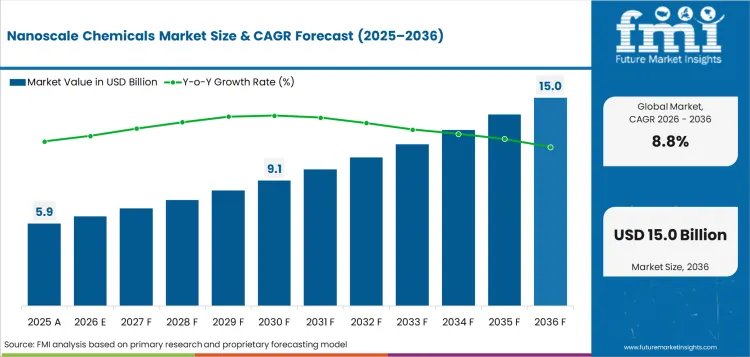
The nanoscale chemicals market was valued at USD 5.9 billion in 2025. The market is set to reach USD 6.5 billion by 2026-end and grow at a CAGR of 8.8% between 2026-2036 to reach USD 15.0 billion by 2036. Automotive will dominate with a 42.0% share, while Nanomaterials will lead with a 45.0% share.
Summary of the Nanoscale Chemicals Market
- Demand and Growth Drivers
- Semiconductor manufacturing at sub-5nm process nodes requires nanoscale chemical precursors, CMP slurries, and atomic layer deposition materials with precisely controlled particle size and purity specifications.
- Automotive lightweighting and surface performance requirements are driving adoption of nanocoatings for scratch resistance, corrosion protection, and self-cleaning functionality on exterior and interior vehicle surfaces.
- Development of energy storage technology on the basis of nano-structured cathode materials, conductive additives and electrolyte components for lithium-ion and solid state batteries to increase energy density and cycle life.
- Product and Segment View
- Nanomaterials hold 45.0% of the product segment in 2026, with nano-oxides, carbon nanomaterials, and metal nanoparticles serving electronics, energy, and healthcare applications.
- Automotive will hold 42.0% of end-use industry in 2026, with focused demand created for nano-coatings, nano-additives for lubricants and nano-catalysts for emission control.
- Electronics applications with nanoscale chemical materials being used for the fabrication of semiconductors and manufacturing of displays contribute 30.0 % of the application segment.
- Geography and Competitive Outlook
- South Korea leads at 9.2% CAGR, driven by Samsung and SK Hynix semiconductor fabrication consuming nanoscale chemicals, and Hyundai/Kia automotive nanocoating adoption.
- Japan at 9.1% reflects advanced materials R&D leadership, semiconductor manufacturing, and automotive industry nano-material integration.
- BASF SE holds the leading position with 18.0% market share through chemical industry scale, nano-material R&D capability, and application support across automotive, electronics, and coatings.
- Analyst Opinion
- The nanoscale chemicals market is positioned at the intersection of advanced manufacturing and material science, where nano-engineered materials enable performance characteristics unachievable with conventional chemicals.
- The combined effect of semiconductor node shrinkage, automotive coatings progress and development of battery technologies consumed more nanoscale chemicals, which resulted in a growth of 8.8% CAGR.
- BASF continues to be the industry leader through the scale of chemical production, dedicated nano-material divisions and application engineering capability serving automotive OEMs and electronics manufacturers.
- Companies that can produce reproducible nano-particle synthesis with tight size distribution control, high purity and scalable production economics can capture the premium positioning in the semiconductor and battery material supply chains.
- Investment in semiconductor-grade nano-materials, nano-structuring of battery material, and EHS (environment, health, safety) compliance documentation is anticipated to drive competitive positioning through 2036.
Key Takeaways, Market Size, and Forecast
- The nanoscale chemicals market was valued at USD 5.94 billion in 2025.
- By 2036, the Nanoscale Chemicals Market is expected to be worth USD 15.02 billion.
- From 2026 to 2036, the market is projected to expand at a CAGR of 8.8%.
- The market is projected to create an incremental opportunity of USD 8.56 billion between 2026 and 2036.
- In 2026, nanomaterials are expected to account for 45.0% of the product segment, driven by advanced material property requirements in electronics, automotive coatings, and energy storage applications.
- South Korea (9.2%) and Japan (9.1%) are two of the fastest growing markets in the world.
Nanoscale Chemicals Market Definition
The nanoscale chemicals market includes chemicals and materials engineered at the nanometer scale (1 to 100 nm) that exhibit unique properties compared to their bulk counterparts. Products include nanomaterials, nanopolymers, nanocoatings, and nanocatalysts serving automotive, electronics, medical, chemical, and environmental applications.
Nanoscale Chemicals Market Inclusions
Market scope includes nanomaterials, nanopolymers, nanocoatings, and nanocatalysts. Revenue is tracked by product, end-use industry, application, distribution channel, and technology from 2026 to 2036.
Nanoscale Chemicals Market Exclusions
The scope does not include bulk chemicals with incidental nano-scale particles, naturally occurring nanomaterials, or nanomedicine drug products regulated as pharmaceuticals.
Nanoscale Chemicals Market Research Methodology
- Primary Research: FMI analysts conducted interviews with nanochemical manufacturers, semiconductor fabrication material buyers, automotive coating formulators, and battery material suppliers.
- Desk Research: Combined data from advanced materials industry reports, semiconductor fabrication material consumption, automotive coatings market surveys, and manufacturer financial disclosures.
- Market Sizing and Forecasting: Bottom-up aggregation from semiconductor wafer starts, automotive production volumes, and battery cell output, multiplied by nanoscale chemical consumption rates and average pricing.
- Data Validation: Cross-checked quarterly against semiconductor industry data, automotive production statistics, and advanced materials manufacturer revenue disclosures.
Why is the Nanoscale Chemicals Market Growing?
- The transition to semiconductor process nodes below 5nm has created a mandatory need for nanoscale CMP slurries, ALD precursors and high purity nanoparticle dispersions with sub-nanometer particle size control.
- South Korea leads at 9.2% CAGR as Samsung and SK Hynix semiconductor fabs and Hyundai/Kia automotive production drive concentrated nanoscale chemical consumption.
- The production of carbon nanotube and graphene materials is scaling from the laboratory to commercial volumes, creating conductive additives, composite reinforcement and thermal interface applications.
The nanoscale chemicals market is growing as semiconductor manufacturing and automotive technology and energy storage development require materials with precisely engineered nanometer scale properties. Chemical materials at the nanoscale have fundamentally different surface area, reactivity, optical and mechanical properties from their bulk counterparts. Nano-titanium dioxide in coatings offers UV protection, nano-silver possesses antimicrobial properties, nano-silica improves reinforcement of rubber, and carbon nanomaterials offer electrical conductivity.
The most valuable nanoscale chemicals are used in the fabrication of semiconductors. With every process node advance, CMP (chemical mechanical planarization) slurries with controlled nanoparticle size distribution, ALD (atomic layer deposition) precursors, and photoresist nanoparticles are consumed. High-volume applications include automotive nanocoatings and battery nano-materials. The market is projected to rise at 8.8% CAGR during 2026-2036.
Market Segmentation Analysis
- The product segment is dominated by nanomaterials (45.0%), with nano-oxides (TiO2, SiO2, ZnO), carbon nanomaterials (CNT, graphene), and metal nanoparticles (Ag, Au, Cu) for various applications.
- Automotive is the end-use industry with the largest market share of 42.0% (nanocoatings, catalytic converters with nano-catalysts, and nano-additives for lubricants and fluids).
- Electronics applications 30.0% Semiconductor fabrication materials, display coatings and printed electronics using nanoscale chemicals.
Nanoscale chemicals market is segmented on the basis of product, end-use industry, application, distribution channel, and technology. Each dimension captures different specifications of the particle, the purity requirement and the performance criteria.
Insights into the Nanomaterials Product Segment
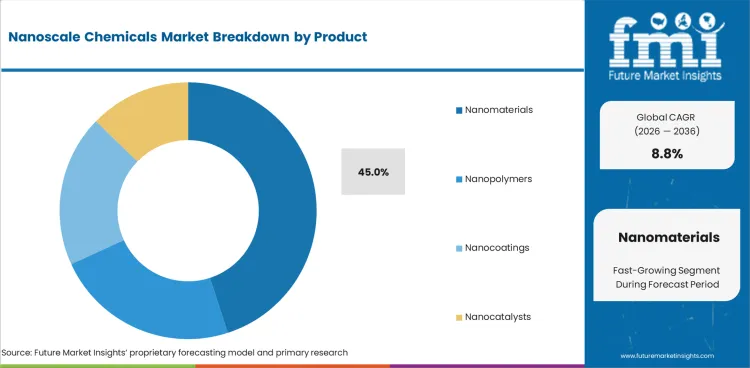
By product segment, nanomaterials are expected to account for 45.0% in 2026. The nano-oxides (TiO2 for UV protection, SiO2 for polishing and reinforcement, ZnO for antimicrobial and UV applications) are the largest volume category. Carbon nanomaterials (carbon nanotubes, graphene) give conductivity and mechanical reinforcement. Use of metal nanoparticles (silver, gold, copper) in electronics and health care.
The rest is made up of nanopolymers, nanocoatings and nanocatalysts. Nanopolymers impart barrier properties and mechanical enhancement. Nanocoatings give anti-fingerprint, self-cleaning and scratch resistance surfaces. Nanocatalysts can increase the efficiency and selectivity of chemical processes and they can control automotive emissions.
Insights into the Automotive End-Use Industry Segment
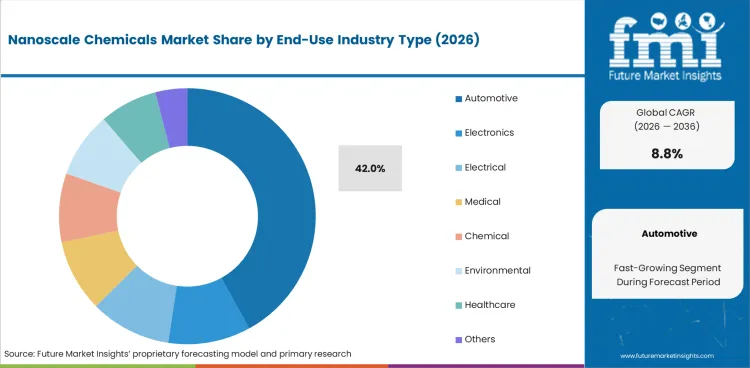
Automotive holds 42.0% of end-use in 2026. Nanocoatings on automotive glass, paint, and 42.0% end-use in 2026 Automotive Nanocoatings for automotive glass, paint and interior surfaces offer scratch resistance, water drops and UV protection. Nano-catalysts in catalytic converters improve emission conversion efficiency at low precious metal loading. Engine oil and transmission fluid contain nano-additives that lower friction and wear.
The rest of the share is for electronics, medical, chemical and environmental end uses. Electronics uses the highest amount of nanoscale chemicals per unit. Medical applications include drug delivery materials and diagnostic nanoparticles. Environmental applications include nano-catalysts for air and water treatment.
Nanoscale Chemicals Market Drivers, Restraints, and Opportunities
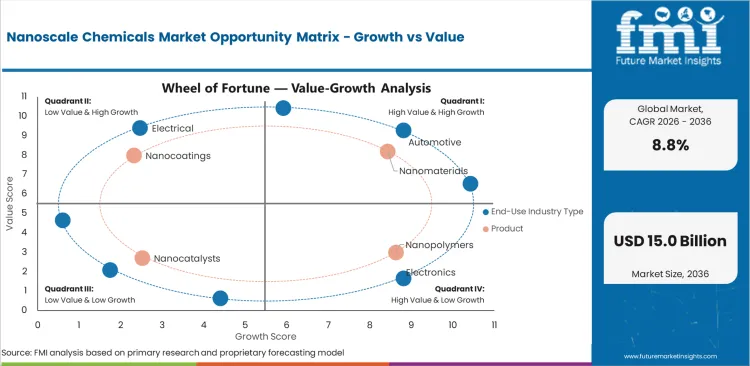
- Structural demand expansion independent of macroeconomic cycles driven by semiconductor node advancement and automotive coating specification upgrade.
- The EHS regulatory complexity for nano-materials (EU REACH nano-registration, EPA TSCA new chemical review) imposes compliance costs and market access barriers.
- The challenge for manufacturing remains scalable synthesis with the ability to control particle size and purity, and batch-to-batch variability limits adoption in semiconductor and battery applications.
The market for nanoscale chemicals is being shaped by semiconductor manufacturing, automotive technology and regulations. CAGR of 8.8% from 2026 to 2036 indicates changing material requirements.
Semiconductor Node Demand
The demand is driven by the development of semiconductor processes below 5 nm, which require CMP slurries with finer particles, ALD precursors with higher purity and advanced photoresist materials. Each node upgrade adds a nanoscale chemical content per wafer.
EHS Regulatory Complexity
Nano-specific requirements create regulatory barriers to adoption. EU REACH requires registration dossiers for nanoforms. EPA TSCA requires new chemical review of new nano-materials. “Compliance paperwork costs are a barrier for smaller manufacturers.
Manufacturing Scalability
The main technical challenge is scale-up of production from laboratory to commercial quantities with consistency in particle size distribution, purity and surface chemistry. In the semiconductor and battery markets, customers require batch-to-batch reproducibility within tight specifications.
Battery Material Nano-structuring
Nano-structured particles in lithium-ion battery cathode and anode materials boost energy density, charge rate and cycle life Silicon nanoparticle anodes and nano-coated cathode materials are the top growth battery application for nanoscale chemicals.
Analysis of Nanoscale Chemicals Market By Key Countries
.webp "Top Country Growth Comparison Nanoscale Chemicals Market Cagr (2026 2036)")
| Country | CAGR |
|---|---|
| South Korea | 9.2% |
| Japan | 9.1% |
| European Union | 9% |
| USA | 8.9% |
| UK | 8.7% |
Source: FMI analysis based on primary research and proprietary forecasting model
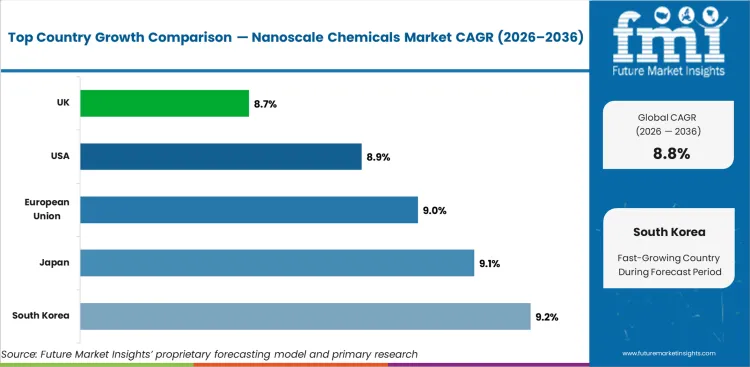
- South Korea at 9.2% CAGR reflects Samsung/SK Hynix semiconductor fabs and Hyundai/Kia automotive production creating concentrated demand.
- Japan at 9.1% is driven by advanced materials R&D leadership and semiconductor/automotive manufacturing.
- The European Union at 9.0% reflects automotive nanocoating adoption and EU chemical industry nano-material production.
- The USA at 8.9% is supported by semiconductor fab expansion and battery material manufacturing investment.
The global nanoscale chemicals market is estimated at USD 6.46 billion in 2026 and is projected to expand at 8.8% CAGR from 2026 to 2036. The analysis covers key markets.
Demand Outlook for Nanoscale Chemicals Market in South Korea
South Korea is expected to grow at a CAGR of 9.2% through 2036. Samsung Electronics and SK Hynix semiconductor fabrication consume CMP nano-slurries, ALD precursors and high-purity nanoparticle dispersions at sub-5nm and advanced DRAM nodes. Automotive production Hyundai, Kia Nanocoatings are used in automotive production to protect exterior paint and treat interior surfaces.
- Samsung and SK Hynix advanced semiconductor fabrication requires nanoscale CMP slurries with controlled abrasive particle distribution for sub-5nm planarization processes.
- Hyundai and Kia employ nanocoatings in automotive production Hyundai and Kia use nanocoatings for paint protection film, hydrophobic glass treatment and scratch-resistant interior surface finishing.
- Korean battery manufacturers (LG Energy Solution, Samsung SDI, SK On) gobble up nano-structured cathode materials and conductive additives from lithium-ion cell manufacturers.
Future Outlook for Nanoscale Chemicals Market in Japan
Japan is expected to grow at 9.1% CAGR through 2036. Japanese chemical companies are world leaders in R&D and production of nanoscale materials. The semiconductor-grade nano-slurries are made by Tokuyama, Nissan Chemical and Showa Denko. Production volume consumption of automotive nano-materials by Toyota, Honda, and Nissan.
- Tokuyama and Nissan Chemical produce CMP slurry, a material used in semiconductor fabrication for advanced process nodes by chipmakers in Japan, Korea and Taiwan.
- Toyota and Honda automotive research and development includes nano-catalysts for emissions reduction, nanocoatings for exterior durability and nano-additives for fuel cell membrane performance.
- Commercial technology development for carbon nanomaterials and functional nanoparticles With the support of: National Institute for Materials Science (NIMS) and AIST nano-material research program.
Opportunity Analysis of Nanoscale Chemicals Market in the European Union
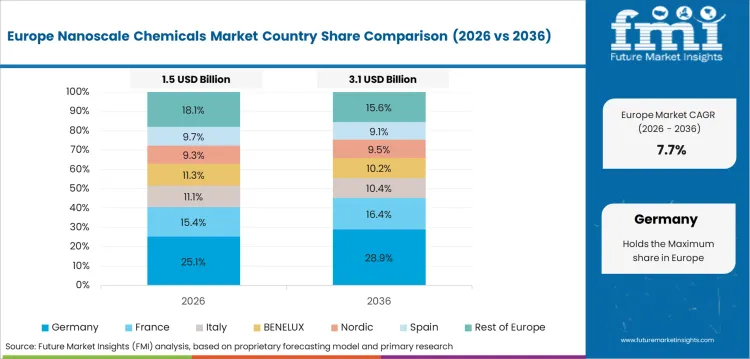
We forecast the European Union to expand at 9.0% CAGR until 2036. BASF, Evonik and Arkema produce nano-materials for the EU chemical industry in automotive, coatings and electronics applications. EU REACH nano-registration obligations have generated compliance frameworks that existing EU manufacturers can use to their advantage.
- BASF (Ludwigshafen) and Evonik (Essen) divisions for nano-materials produce nano-oxides, nano-silica and specialty nanoparticles for automotive, coatings and industrial applications on a European scale.
- EU REACH nano-form registration requirements create compliance barriers that protect established producers with completed dossiers from competition from non-compliant imports.
- Automotive OEM nano-coating specifications at BMW, Mercedes-Benz and Stellantis create structured demand for nano-material suppliers qualified in OEM supply chains.
In-depth Analysis of Nanoscale Chemicals Market in the USA
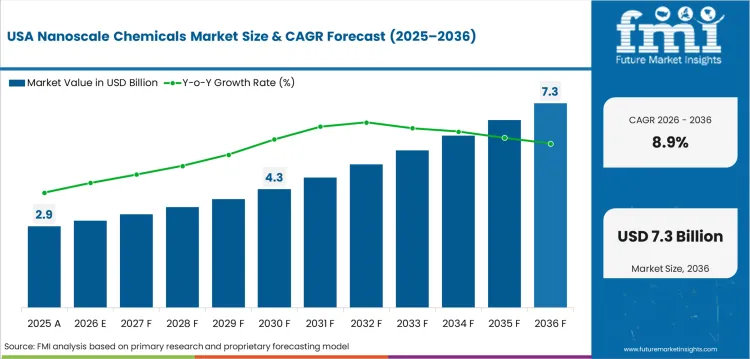
USA is expected to grow at a CAGR of 8.9% by 2036. Domestic nanoscale chemical demand growth is being driven by CHIPS Act semiconductor fab expansion at Intel, TSMC Arizona and Samsung Taylor. Construction of battery gigafactories (Panasonic, LG, SK) + consumption of battery nanomaterials.
- Intel (Ohio), TSMC (Arizona) and Samsung (Texas) semiconductor fab investments through CHIPS Act generate incremental US demand for CMP nano-slurries and ALD precursors
- Demand for nano-structured cathode and anode materials is rising due to the construction of battery gigafactories by Panasonic (Kansas), LG Energy (Georgia) and SK On (Tennessee).
- US-based producers of nanoscale materials for electronics, coatings and energy applications are Nanophase Technologies (Illinois) and Cabot Corporation.
Sales Analysis of Nanoscale Chemicals Market in the UK
UK is expected to grow at a CAGR of 8.7% till 2036. UK advanced materials research at Oxford, Cambridge and Imperial College feeds the commercial development of nano-material technology. Jaguar Land Rover and Nissan Sunderland automotive production generate demand for nanocoatings and nano-additives.
- UK university research on nano-materials at Oxford, Cambridge and Imperial College feeds commercial technology transfer in graphene, quantum dots and functional nanoparticles.
- Jaguar Land Rover and Nissan Sunderland use nanocoatings and nano-additives in their vehicles’ finishing and lubrication systems.
- UK National Graphene Institute (Manchester) Commercialization of graphene for battery, composite and coating applications
Competitive Landscape and Strategic Positioning
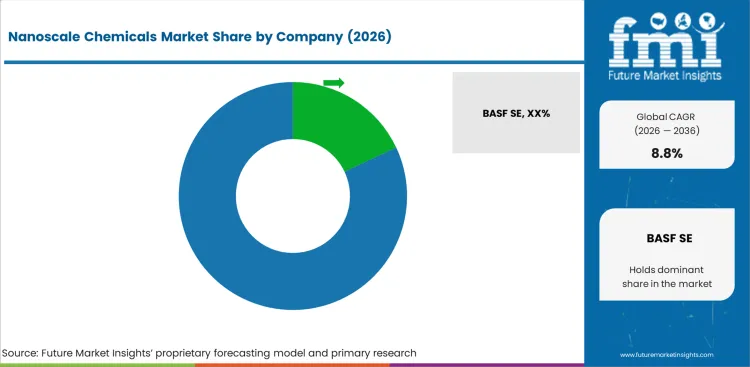
- With its scale of the chemical industry, nano-material R&D and application engineering in automotive and electronics, BASF SE has the leading position in the market with 18.0% share.
- Arkema, Evonik and Dow compete in specialty chemical nano-material production and application-specific portfolios.
- The competition includes diversified chemical conglomerates, specialized nano-material producers and suppliers of semiconductor materials.
BASF continues to lead the pack, thanks to the scale of its chemical production in Ludwigshafen and dedicated nano-material business units. Application engineering in the automotive, coatings and electronics fields supports customer integration from material specification through production optimization.
Arkema competes in the specialty polymer production and nano-material production (Graphistrength CNT, Nanostrength). Evonik sells specialty nanoparticles, nano-silica. Dow supplies nanomaterials for semiconductor manufacturing for electronics.
High barriers to entry due to nano-material synthesis technology, EHS regulatory compliance, semiconductor customer qualification and capital intensive production. Strategic priorities include expansion into semiconductor grade, battery material nano-structuring and sustainable manufacturing processes.
Key Companies in the Nanoscale Chemicals Market
Key global companies leading the nanoscale chemicals market include:
- BASF SE (Germany), Evonik Industries (Germany), and Arkema Group (France) hold leading positions through chemical industry scale and dedicated nano-material R&D and production.
- Dow Inc. (USA), Tokuyama (Japan), and Nanophase Technologies (USA) maintain positions through application-specific nano-material production for electronics, coatings, and energy.
- NanoMas Technologies (USA), Altair Nanotechnologies (USA), and Carbon Nanotechnologies serve specialized segments with focused nano-material production.
Competitive Benchmarking: Nanoscale Chemicals Market
| Company | Production Scale | R&D Capability | Semiconductor Supply | Geographic Reach |
|---|---|---|---|---|
| BASF SE | Very Large | Advanced | Moderate | Global |
| Arkema Group | Large | Advanced | Limited | Global |
| Evonik Industries | Large | Advanced | Moderate | Global |
| Dow Inc. | Large | Advanced | Strong | Global |
| Tokuyama | Medium | Advanced | Strong | Asia, Global |
| Nanophase Technologies | Medium | Advanced | Moderate | Americas |
| NanoMas Technologies | Small | Focused | Moderate | Americas |
| Qinhuangdao Taiji Ring | Medium | Moderate | Limited | China |
Source: Future Market Insights competitive analysis, 2026.
Key Developments in Nanoscale Chemicals Market
- In 2025, BASF SE commissioned a state-of-the-art production plant for automotive OEM coatings at its Muenster site in Germany, designed to produce high-runner products representing majority market demand, ensuring consistent product quality and enhanced production efficiency for automotive original equipment manufacturer paint systems.
- In 2024, Evonik Industries started production of ultra-high purity colloidal silica for the semiconductor industry at its new facility in Weston, Michigan (North America's first ultra-pure colloidal silica plant), supporting chemical mechanical planarization (CMP) slurry, electronics, and advanced semiconductor applications.
- In 2024, Arkema Group advanced its Graphistrength® multiwall carbon nanotube offerings for next-generation electric vehicle batteries, produced at its Mont (L'Isle-sur-la-Sorgue) facility in France, supporting battery conductive additives, energy storage materials, and advanced composite reinforcement applications.
Key Players in the Nanoscale Chemicals Market
Major Global Players
- BASF SE
- Arkema Group
- Evonik Industries AG
- Dow Inc.
- Qinhuangdao Taiji Ring Nano-Products Co. Ltd.
- NanoMas Technologies
Emerging Players/Startups
- Cabot Corporation
- Applied Nanotech Holdings
- Hyperion Catalysis
- OCSiAl (Tuball)
- Nanocyl SA
Report Scope and Coverage
| Parameter | Details |
|---|---|
| Quantitative Units | USD 6.46 billion to USD 15.02 billion, at a CAGR of 8.8% |
| Market Definition | The nanoscale chemicals market includes materials engineered at 1 to 100 nm providing unique properties for automotive, electronics, medical, and energy applications. |
| Regions Covered | North America, Latin America, Europe, East Asia, South Asia and Pacific, Middle East and Africa |
| Countries Covered | South Korea, Japan, European Union, USA, UK, 30 plus countries |
| Key Companies Profiled | BASF SE, Arkema Group, Evonik Industries AG, Dow Inc., Qinhuangdao Taiji Ring Nano-Products Co. Ltd., NanoMas Technologies, Akzo Nobel/Eka, Tokuyama, Nanophase Technologies, Altair Nanotechnologies, Carbon Nanotechnologies, Advanced Nano Products |
| Forecast Period | 2026 to 2036 |
| Approach | Hybrid bottom-up methodology using semiconductor wafer starts, automotive production, and battery output, triangulated with nano-material manufacturer revenue data. |
Segmentation
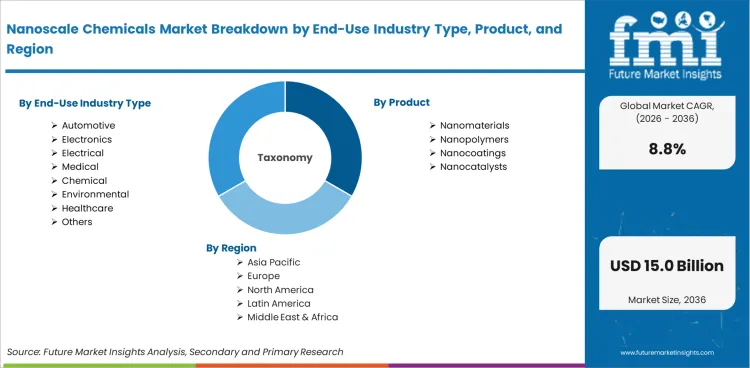
Nanoscale Chemicals Market Segmented by End-Use Industry Type:
- Automotive
- Electronics
- Electrical
- Medical
- Chemical
- Environmental
- Healthcare
- Others
Nanoscale Chemicals Market Segmented by Product:
- Nanomaterials
- Metal Nanoparticles
- Metal Oxide Nanoparticles
- Carbon Based Nanomaterials
- Nanopolymers
- Polymer Nanocomposites
- Dendrimers
- Nanocoatings
- Protective Nanocoatings
- Functional Nanocoatings
- Nanocatalysts
- Homogeneous Nanocatalysts
- Heterogeneous Nanocatalysts
Nanoscale Chemicals Market Segmented by Application:
- Electronics
- Semiconductor Manufacturing
- Printed Electronics
- Healthcare
- Drug Delivery Systems
- Medical Imaging
- Energy
- Battery Materials
- Solar Cells
- Coatings
- Protective Coatings
- Anti Corrosion Coatings
- Environmental
- Water Treatment
- Air Purification
Nanoscale Chemicals Market Segmented by Distribution Channel:
- Direct Sales
- Distributors and Traders
- Online Sales
Nanoscale Chemicals Market Segmented by Technology:
- Nanotechnology
- Bottom Up Synthesis
- Top Down Fabrication
- Surface Modification Technology
- Functionalization Techniques
- Coating Technologies
- Manufacturing Technology
- Chemical Vapor Deposition
- Sol Gel Process
Nanoscale Chemicals Market by Region:
- North America
- USA
- Canada
- Mexico
- Latin America
- Brazil
- Chile
- Rest of Latin America
- Western Europe
- Germany
- UK
- Italy
- Spain
- France
- Nordic
- BENELUX
- Rest of Western Europe
- Eastern Europe
- Russia
- Poland
- Hungary
- Balkan & Baltic
- Rest of Eastern Europe
- East Asia
- China
- Japan
- South Korea
- South Asia and Pacific
- India
- ASEAN
- Australia & New Zealand
- Rest of South Asia and Pacific
- Middle East & Africa
- Kingdom of Saudi Arabia
- Other GCC Countries
- Turkiye
- South Africa
- Other African Union
- Rest of Middle East & Africa
Research Sources and Bibliography
- 1. European Chemicals Agency. (2025). ECHA REACH Nano-form Registration Guidance. ECHA.
- 2. USA Environmental Protection Agency. (2025). EPA TSCA Nanoscale Chemical Substances Review. EPA.
- 3. Organisation for Economic Co-operation and Development. (2025). OECD Working Party on Nanomaterials Reports. OECD.
- 4. International Organization for Standardization. (2025). ISO Nanotechnology Standards. ISO.
- 5. World Health Organization. (2025). WHO Nanomaterials Safety Guidelines. WHO.
This bibliography is provided for reader reference. The full Future Market Insights report contains the complete reference list with publication dates, URLs, and supporting data for all cited works.
This Report Answers
- Estimating the size of the nanoscale chemicals market and revenue projections from 2026 to 2036.
- Segmentation by product, end-use industry, application, distribution channel, and technology.
- Insights across key regional markets.
- Analysis of semiconductor versus automotive and energy demand dynamics.
- Assessment of the competitive landscape across chemical conglomerates and specialty producers.
- Identification of investment opportunities in semiconductor materials, battery nano-structuring, and carbon nanomaterials.
- EHS regulatory tracking across EU REACH, EPA TSCA, and global frameworks.
- Delivery of data in PDF and Excel formats.
Frequently Asked Questions
What is the global market demand for Nanoscale Chemicals in 2026?
In 2026, the global nanoscale chemicals market is estimated at USD 6.46 billion.
How big will the Nanoscale Chemicals Market be in 2036?
By 2036, the market is projected to reach USD 15.02 billion.
How much is demand for the Nanoscale Chemicals Market expected to grow between 2026 and 2036?
Between 2026 and 2036, the market is projected to expand at a CAGR of 8.8%.
Which product is expected to lead in the Nanoscale Chemicals Market in 2026?
Nanomaterials are expected to hold 45.0% in 2026, with nano-oxides, carbon nanomaterials, and metal nanoparticles for electronics and automotive.
What is causing demand to rise in South Korea?
South Korea is expected to grow at 9.2% CAGR through 2036, driven by Samsung/SK Hynix semiconductor fabs and Hyundai/Kia automotive nanocoating adoption.
What is causing demand to rise in Japan?
Japan is expected to grow at 9.1% CAGR through 2036, supported by advanced materials R&D leadership and semiconductor/automotive manufacturing.
What does this report mean by Nanoscale Chemicals Market definition?
The market includes chemicals engineered at 1 to 100 nm for automotive, electronics, medical, and energy applications with properties distinct from bulk equivalents.
How does FMI make the Nanoscale Chemicals Market forecast and validate it?
Forecasting uses hybrid methodology with semiconductor, automotive, and battery production data, validated against nano-material manufacturer revenue.
Preview the report firsthand - request a free sample
Get SampleGet the brochure for pricing and purchase details.
Get PDFTable of Content
- Executive Summary
- Global Market Outlook
- Demand-side Trends
- Supply-side Trends
- Technology Roadmap Analysis
- Analysis and Recommendations
- Market Overview
- Market Coverage / Taxonomy
- Market Definition / Scope / Limitations
- Research Methodology
- Chapter Orientation
- Analytical Lens and Working Hypotheses
- Market Structure, Signals, and Trend Drivers
- Benchmarking and Cross-market Comparability
- Market Sizing, Forecasting, and Opportunity Mapping
- Research Design and Evidence Framework
- Desk Research Programme (Secondary Evidence)
- Company Annual and Sustainability Reports
- Peer-reviewed Journals and Academic Literature
- Corporate Websites, Product Literature, and Technical Notes
- Earnings Decks and Investor Briefings
- Statutory Filings and Regulatory Disclosures
- Technical White Papers and Standards Notes
- Trade Journals, Industry Magazines, and Analyst Briefs
- Conference Proceedings, Webinars, and Seminar Materials
- Government Statistics Portals and Public Data Releases
- Press Releases and Reputable Media Coverage
- Specialist Newsletters and Curated Briefings
- Sector Databases and Reference Repositories
- FMI Internal Proprietary Databases and Historical Market Datasets
- Subscription Datasets and Paid Sources
- Social Channels, Communities, and Digital Listening Inputs
- Additional Desk Sources
- Expert Input and Fieldwork (Primary Evidence)
- Primary Modes
- Qualitative Interviews and Expert Elicitation
- Quantitative Surveys and Structured Data Capture
- Blended Approach
- Why Primary Evidence is Used
- Field Techniques
- Interviews
- Surveys
- Focus Groups
- Observational and In-context Research
- Social and Community Interactions
- Stakeholder Universe Engaged
- C-suite Leaders
- Board Members
- Presidents and Vice Presidents
- R&D and Innovation Heads
- Technical Specialists
- Domain Subject-matter Experts
- Scientists
- Physicians and Other Healthcare Professionals
- Governance, Ethics, and Data Stewardship
- Research Ethics
- Data Integrity and Handling
- Primary Modes
- Tooling, Models, and Reference Databases
- Desk Research Programme (Secondary Evidence)
- Data Engineering and Model Build
- Data Acquisition and Ingestion
- Cleaning, Normalisation, and Verification
- Synthesis, Triangulation, and Analysis
- Quality Assurance and Audit Trail
- Market Background
- Market Dynamics
- Drivers
- Restraints
- Opportunity
- Trends
- Scenario Forecast
- Demand in Optimistic Scenario
- Demand in Likely Scenario
- Demand in Conservative Scenario
- Opportunity Map Analysis
- Product Life Cycle Analysis
- Supply Chain Analysis
- Investment Feasibility Matrix
- Value Chain Analysis
- PESTLE and Porter’s Analysis
- Regulatory Landscape
- Regional Parent Market Outlook
- Production and Consumption Statistics
- Import and Export Statistics
- Market Dynamics
- Global Market Analysis 2021 to 2025 and Forecast, 2026 to 2036
- Historical Market Size Value (USD Million) Analysis, 2021 to 2025
- Current and Future Market Size Value (USD Million) Projections, 2026 to 2036
- Y-o-Y Growth Trend Analysis
- Absolute $ Opportunity Analysis
- Global Market Pricing Analysis 2021 to 2025 and Forecast 2026 to 2036
- Global Market Analysis 2021 to 2025 and Forecast 2026 to 2036, By End-Use Industry Type
- Introduction / Key Findings
- Historical Market Size Value (USD Million) Analysis By End-Use Industry Type , 2021 to 2025
- Current and Future Market Size Value (USD Million) Analysis and Forecast By End-Use Industry Type , 2026 to 2036
- Automotive
- Electronics
- Electrical
- Medical
- Chemical
- Environmental
- Healthcare
- Others
- Automotive
- Y-o-Y Growth Trend Analysis By End-Use Industry Type , 2021 to 2025
- Absolute $ Opportunity Analysis By End-Use Industry Type , 2026 to 2036
- Global Market Analysis 2021 to 2025 and Forecast 2026 to 2036, By Product
- Introduction / Key Findings
- Historical Market Size Value (USD Million) Analysis By Product, 2021 to 2025
- Current and Future Market Size Value (USD Million) Analysis and Forecast By Product, 2026 to 2036
- Nanomaterials
- Metal Nanoparticles
- Metal Oxide Nanoparticles
- Carbon Based Nanomaterials
- Nanopolymers
- Polymer Nanocomposites
- Dendrimers
- Nanocoatings
- Protective Nanocoatings
- Functional Nanocoatings
- Nanocatalysts
- Homogeneous Nanocatalysts
- Heterogeneous Nanocatalysts
- Nanomaterials
- Y-o-Y Growth Trend Analysis By Product, 2021 to 2025
- Absolute $ Opportunity Analysis By Product, 2026 to 2036
- Global Market Analysis 2021 to 2025 and Forecast 2026 to 2036, By Application
- Introduction / Key Findings
- Historical Market Size Value (USD Million) Analysis By Application, 2021 to 2025
- Current and Future Market Size Value (USD Million) Analysis and Forecast By Application, 2026 to 2036
- Electronics
- Semiconductor Manufacturing
- Printed Electronics
- Healthcare
- Drug Delivery Systems
- Medical Imaging
- Energy
- Battery Materials
- Solar Cells
- Coatings
- Protective Coatings
- Anti Corrosion Coatings
- Environmental
- Water Treatment
- Air Purification
- Electronics
- Y-o-Y Growth Trend Analysis By Application, 2021 to 2025
- Absolute $ Opportunity Analysis By Application, 2026 to 2036
- Global Market Analysis 2021 to 2025 and Forecast 2026 to 2036, By Distribution Channel
- Introduction / Key Findings
- Historical Market Size Value (USD Million) Analysis By Distribution Channel, 2021 to 2025
- Current and Future Market Size Value (USD Million) Analysis and Forecast By Distribution Channel, 2026 to 2036
- Direct Sales
- Distributors and Traders
- Online Sales
- Direct Sales
- Y-o-Y Growth Trend Analysis By Distribution Channel, 2021 to 2025
- Absolute $ Opportunity Analysis By Distribution Channel, 2026 to 2036
- Global Market Analysis 2021 to 2025 and Forecast 2026 to 2036, By Technology
- Introduction / Key Findings
- Historical Market Size Value (USD Million) Analysis By Technology, 2021 to 2025
- Current and Future Market Size Value (USD Million) Analysis and Forecast By Technology, 2026 to 2036
- Nanotechnology
- Bottom Up Synthesis
- Top Down Fabrication
- Surface Modification Technology
- Functionalization Techniques
- Coating Technologies
- Manufacturing Technology
- Chemical Vapor Deposition
- Sol Gel Process
- Nanotechnology
- Y-o-Y Growth Trend Analysis By Technology, 2021 to 2025
- Absolute $ Opportunity Analysis By Technology, 2026 to 2036
- Global Market Analysis 2021 to 2025 and Forecast 2026 to 2036, By Region
- Introduction
- Historical Market Size Value (USD Million) Analysis By Region, 2021 to 2025
- Current Market Size Value (USD Million) Analysis and Forecast By Region, 2026 to 2036
- North America
- Latin America
- Western Europe
- Eastern Europe
- East Asia
- South Asia and Pacific
- Middle East & Africa
- Market Attractiveness Analysis By Region
- North America Market Analysis 2021 to 2025 and Forecast 2026 to 2036, By Country
- Historical Market Size Value (USD Million) Trend Analysis By Market Taxonomy, 2021 to 2025
- Market Size Value (USD Million) Forecast By Market Taxonomy, 2026 to 2036
- By Country
- USA
- Canada
- Mexico
- By End-Use Industry Type
- By Product
- By Application
- By Distribution Channel
- By Technology
- By Country
- Market Attractiveness Analysis
- By Country
- By End-Use Industry Type
- By Product
- By Application
- By Distribution Channel
- By Technology
- Key Takeaways
- Latin America Market Analysis 2021 to 2025 and Forecast 2026 to 2036, By Country
- Historical Market Size Value (USD Million) Trend Analysis By Market Taxonomy, 2021 to 2025
- Market Size Value (USD Million) Forecast By Market Taxonomy, 2026 to 2036
- By Country
- Brazil
- Chile
- Rest of Latin America
- By End-Use Industry Type
- By Product
- By Application
- By Distribution Channel
- By Technology
- By Country
- Market Attractiveness Analysis
- By Country
- By End-Use Industry Type
- By Product
- By Application
- By Distribution Channel
- By Technology
- Key Takeaways
- Western Europe Market Analysis 2021 to 2025 and Forecast 2026 to 2036, By Country
- Historical Market Size Value (USD Million) Trend Analysis By Market Taxonomy, 2021 to 2025
- Market Size Value (USD Million) Forecast By Market Taxonomy, 2026 to 2036
- By Country
- Germany
- UK
- Italy
- Spain
- France
- Nordic
- BENELUX
- Rest of Western Europe
- By End-Use Industry Type
- By Product
- By Application
- By Distribution Channel
- By Technology
- By Country
- Market Attractiveness Analysis
- By Country
- By End-Use Industry Type
- By Product
- By Application
- By Distribution Channel
- By Technology
- Key Takeaways
- Eastern Europe Market Analysis 2021 to 2025 and Forecast 2026 to 2036, By Country
- Historical Market Size Value (USD Million) Trend Analysis By Market Taxonomy, 2021 to 2025
- Market Size Value (USD Million) Forecast By Market Taxonomy, 2026 to 2036
- By Country
- Russia
- Poland
- Hungary
- Balkan & Baltic
- Rest of Eastern Europe
- By End-Use Industry Type
- By Product
- By Application
- By Distribution Channel
- By Technology
- By Country
- Market Attractiveness Analysis
- By Country
- By End-Use Industry Type
- By Product
- By Application
- By Distribution Channel
- By Technology
- Key Takeaways
- East Asia Market Analysis 2021 to 2025 and Forecast 2026 to 2036, By Country
- Historical Market Size Value (USD Million) Trend Analysis By Market Taxonomy, 2021 to 2025
- Market Size Value (USD Million) Forecast By Market Taxonomy, 2026 to 2036
- By Country
- China
- Japan
- South Korea
- By End-Use Industry Type
- By Product
- By Application
- By Distribution Channel
- By Technology
- By Country
- Market Attractiveness Analysis
- By Country
- By End-Use Industry Type
- By Product
- By Application
- By Distribution Channel
- By Technology
- Key Takeaways
- South Asia and Pacific Market Analysis 2021 to 2025 and Forecast 2026 to 2036, By Country
- Historical Market Size Value (USD Million) Trend Analysis By Market Taxonomy, 2021 to 2025
- Market Size Value (USD Million) Forecast By Market Taxonomy, 2026 to 2036
- By Country
- India
- ASEAN
- Australia & New Zealand
- Rest of South Asia and Pacific
- By End-Use Industry Type
- By Product
- By Application
- By Distribution Channel
- By Technology
- By Country
- Market Attractiveness Analysis
- By Country
- By End-Use Industry Type
- By Product
- By Application
- By Distribution Channel
- By Technology
- Key Takeaways
- Middle East & Africa Market Analysis 2021 to 2025 and Forecast 2026 to 2036, By Country
- Historical Market Size Value (USD Million) Trend Analysis By Market Taxonomy, 2021 to 2025
- Market Size Value (USD Million) Forecast By Market Taxonomy, 2026 to 2036
- By Country
- Kingdom of Saudi Arabia
- Other GCC Countries
- Turkiye
- South Africa
- Other African Union
- Rest of Middle East & Africa
- By End-Use Industry Type
- By Product
- By Application
- By Distribution Channel
- By Technology
- By Country
- Market Attractiveness Analysis
- By Country
- By End-Use Industry Type
- By Product
- By Application
- By Distribution Channel
- By Technology
- Key Takeaways
- Key Countries Market Analysis
- USA
- Pricing Analysis
- Market Share Analysis, 2025
- By End-Use Industry Type
- By Product
- By Application
- By Distribution Channel
- By Technology
- Canada
- Pricing Analysis
- Market Share Analysis, 2025
- By End-Use Industry Type
- By Product
- By Application
- By Distribution Channel
- By Technology
- Mexico
- Pricing Analysis
- Market Share Analysis, 2025
- By End-Use Industry Type
- By Product
- By Application
- By Distribution Channel
- By Technology
- Brazil
- Pricing Analysis
- Market Share Analysis, 2025
- By End-Use Industry Type
- By Product
- By Application
- By Distribution Channel
- By Technology
- Chile
- Pricing Analysis
- Market Share Analysis, 2025
- By End-Use Industry Type
- By Product
- By Application
- By Distribution Channel
- By Technology
- Germany
- Pricing Analysis
- Market Share Analysis, 2025
- By End-Use Industry Type
- By Product
- By Application
- By Distribution Channel
- By Technology
- UK
- Pricing Analysis
- Market Share Analysis, 2025
- By End-Use Industry Type
- By Product
- By Application
- By Distribution Channel
- By Technology
- Italy
- Pricing Analysis
- Market Share Analysis, 2025
- By End-Use Industry Type
- By Product
- By Application
- By Distribution Channel
- By Technology
- Spain
- Pricing Analysis
- Market Share Analysis, 2025
- By End-Use Industry Type
- By Product
- By Application
- By Distribution Channel
- By Technology
- France
- Pricing Analysis
- Market Share Analysis, 2025
- By End-Use Industry Type
- By Product
- By Application
- By Distribution Channel
- By Technology
- India
- Pricing Analysis
- Market Share Analysis, 2025
- By End-Use Industry Type
- By Product
- By Application
- By Distribution Channel
- By Technology
- ASEAN
- Pricing Analysis
- Market Share Analysis, 2025
- By End-Use Industry Type
- By Product
- By Application
- By Distribution Channel
- By Technology
- Australia & New Zealand
- Pricing Analysis
- Market Share Analysis, 2025
- By End-Use Industry Type
- By Product
- By Application
- By Distribution Channel
- By Technology
- China
- Pricing Analysis
- Market Share Analysis, 2025
- By End-Use Industry Type
- By Product
- By Application
- By Distribution Channel
- By Technology
- Japan
- Pricing Analysis
- Market Share Analysis, 2025
- By End-Use Industry Type
- By Product
- By Application
- By Distribution Channel
- By Technology
- South Korea
- Pricing Analysis
- Market Share Analysis, 2025
- By End-Use Industry Type
- By Product
- By Application
- By Distribution Channel
- By Technology
- Russia
- Pricing Analysis
- Market Share Analysis, 2025
- By End-Use Industry Type
- By Product
- By Application
- By Distribution Channel
- By Technology
- Poland
- Pricing Analysis
- Market Share Analysis, 2025
- By End-Use Industry Type
- By Product
- By Application
- By Distribution Channel
- By Technology
- Hungary
- Pricing Analysis
- Market Share Analysis, 2025
- By End-Use Industry Type
- By Product
- By Application
- By Distribution Channel
- By Technology
- Kingdom of Saudi Arabia
- Pricing Analysis
- Market Share Analysis, 2025
- By End-Use Industry Type
- By Product
- By Application
- By Distribution Channel
- By Technology
- Turkiye
- Pricing Analysis
- Market Share Analysis, 2025
- By End-Use Industry Type
- By Product
- By Application
- By Distribution Channel
- By Technology
- South Africa
- Pricing Analysis
- Market Share Analysis, 2025
- By End-Use Industry Type
- By Product
- By Application
- By Distribution Channel
- By Technology
- USA
- Market Structure Analysis
- Competition Dashboard
- Competition Benchmarking
- Market Share Analysis of Top Players
- By Regional
- By End-Use Industry Type
- By Product
- By Application
- By Distribution Channel
- By Technology
- Competition Analysis
- Competition Deep Dive
- BASF SE
- Overview
- Product Portfolio
- Profitability by Market Segments (Product/Age /Sales Channel/Region)
- Sales Footprint
- Strategy Overview
- Marketing Strategy
- Product Strategy
- Channel Strategy
- Arkema Group
- Evonik Industries AG
- Dow Inc.
- Qinhuangdao Taiji Ring Nano-Products Co. Ltd.
- NanoMas Technologies
- Akzo Nobel/Eka
- Tokuyama
- Nanophase Technologies
- Altair Nanotechnologies
- Carbon Nanotechnologies
- Advanced Nano Products
- BASF SE
- Competition Deep Dive
- Assumptions & Acronyms Used


