

- Market Size (2026)
- USD 9.4 Bn
- Forecast (2036)
- USD 18.7 Bn
- CAGR (2026 to 2036)
- 7.1%
How big is Non-Tyrosine Kinase Inhibitors Market in 2026?
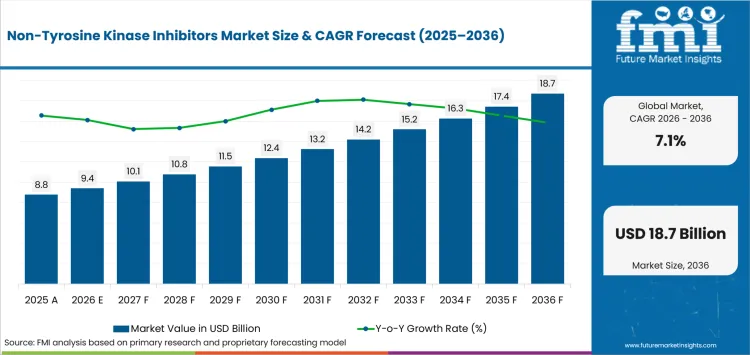
USD 9.4 billion in 2026 and USD 18.7 billion by 2036 at a 7.1% CAGR.
Demand for non-tyrosine kinase inhibitors is projected to expand at a 7.1% CAGR between 2026 and 2036, increasing valuation from USD 9.4 billion in 2026 to USD 18.7 billion by 2036. Commercial uptake depends on whether a product fits a defined disease pathway and can be supported through diagnosis, dosing and follow-up within routine care.
The International Agency for Research on Cancer estimated 20 million new cancer cases worldwide in 2022, with 53.5 million people alive within five years of diagnosis. Oncology therefore provides the largest demand base, but approved use is increasingly divided by hormone-receptor status, HER2 status, PIK3CA alteration, PTEN status or another label-defined feature. FDA approvals for ribociclib, inavolisib and capivasertib show how companion testing and combination regimens convert pathway science into addressable treatment populations.
Key Takeaways of Non-Tyrosine Kinase Inhibitors Market
- Biomarker-linked approvals expand demand when patient identification and treatment monitoring can be built into routine care.
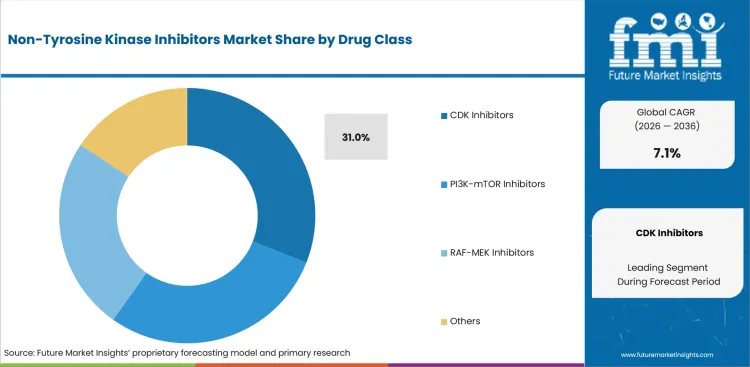
- CDK inhibitors are projected at 31.0% of drug-class demand in 2026 due to established use of CDK4/6 therapy in hormone-receptor-positive breast cancer.
- Oncology is estimated at 68.0% of application demand as pathway selection becomes more specific to molecular and disease features.
- Oral administration holds 74.0% share, while hospitals and hospital pharmacies lead the care and supply routes used for complex treatment monitoring.
- ECG checks, laboratory testing and boxed safety warnings can slow routine adoption after regulatory approval.
- Novartis AG, Pfizer Inc., Eli Lilly and Company, AstraZeneca PLC, Roche Holding AG, Bristol Myers Squibb, Incyte Corporation, AbbVie Inc., GSK plc and Sun Pharmaceutical Industries Ltd. serve oncology or immune-mediated pathway markets.
Analyst Perspective
"Commercial advantage comes from matching the right pathway to a patient group that can be identified and monitored in routine care. Suppliers should compare companion-diagnostic access and dose-management burden before treating an oral label as sufficient evidence of easy adoption."
- Anurag Sharma, Principal Consultant, Future Market Insights
How is the Non-Tyrosine Kinase Inhibitors Market segmented?
The non-tyrosine kinase inhibitors market is segmented by drug class, application, route of administration, end user, distribution channel and region.
The market structure connects pathway class with the setting in which treatment is selected, supplied and monitored. Drug class covers CDK, PI3K-mTOR, RAF-MEK and other listed inhibitors. Application spans oncology, autoimmune disease and inflammatory disease. Route of administration separates oral products from injectable and other delivery formats. End user identifies hospitals, specialty clinics and research settings, while distribution channel follows fulfillment through hospital, specialty and retail pharmacies.
Why do CDK inhibitors lead the drug-class category?
CDK4/6 inhibition has an established role in hormone-receptor-positive, HER2-negative breast cancer. The National Cancer Institute describes these products as blocking proteins that control cell division, which connects the class directly with treatment regimens designed to slow cancer-cell growth.
- Based on drug class, CDK inhibitors are projected to account for 31.0% in 2026. CDK4/6 inhibitors and pan-CDK inhibitors sit beneath the parent category.
- The FDA approval of ribociclib with an aromatase inhibitor for high-risk early breast cancer widened the addressable setting beyond advanced disease.
Why does oncology lead the application category?
Oncology concentrates demand because CDK, PI3K and AKT products are approved for patient groups defined by cancer type and molecular features. The IARC cancer burden estimate provides the underlying patient base, while regulator labels determine the smaller populations eligible for each regimen.
- Oncology is expected to hold 68.0% of application demand in 2026, with breast cancer, lung cancer and hematologic malignancies included beneath the parent segment.
- Recent FDA decisions link inavolisib to PIK3CA-mutated breast cancer and capivasertib to PTEN-deficient prostate cancer, showing how biomarker status shapes commercial use.
Why does oral administration lead the route category?
Tablets allow repeated dosing outside an infusion center, but they transfer more responsibility to refill continuity and dose management. Oral access therefore depends on reliable patient education and a monitoring plan rather than route convenience alone.
- Oral administration is projected to account for 74.0% of route demand in 2026 through tablet and capsule formats.
- The KISQALI label requires ECG and electrolyte review, while TRUQAP requires periodic fasting-glucose monitoring. These obligations keep clinical follow-up central to oral treatment.
Why do hospitals lead the end-user category?
Hospitals combine specialist prescribing with pathology, imaging and laboratory services used before and during treatment. This makes them the main setting for complex oncology regimens and for hematology products that require regular blood-count or liver-function review.
- Hospitals are estimated to hold 44.0% of end-user demand in 2026, including oncology hospitals and specialty care centers.
- Companion-diagnostic interpretation and treatment modification can be coordinated within one institutional pathway, supporting use when eligibility or toxicity must be reviewed repeatedly.
Why do hospital pharmacies lead the distribution-channel category?
Hospital pharmacies sit close to formulary approval, specialist prescribing and laboratory review. This position is important for high-cost products that require prior authorization, dose changes or rapid communication with the treating team.
- Hospital pharmacies are projected to capture 47.0% of distribution demand in 2026 through inpatient and outpatient pharmacy routes.
- Specialty pharmacies remain important for oral refill coordination and patient support, while retail and government channels serve narrower purchasing routes.
What are the drivers, restraints and opportunities in the Non-Tyrosine Kinase Inhibitors Market?
Biomarker-defined treatment expands demand while monitoring burden limits routine use as new oral pathway inhibitors enter oncology and immune-mediated care.
- Driver: Label-defined biomarkers and combination regimens convert pathway evidence into identifiable treatment populations.
- Restraint: ECG checks, laboratory testing and class safety warnings raise the operating burden after prescription.
- Opportunity: New JAK and TYK2 indications widen commercial demand beyond the leading oncology application.
The strongest demand driver is a clear link between pathway biology and treatment eligibility. The FDA approval of inavolisib includes a PIK3CA mutation requirement and an FDA-approved companion test, while capivasertib use in prostate cancer is tied to PTEN deficiency. These labels help health systems identify the target population and create a defined route for diagnostic and pharmacy services.
Monitoring requirements reduce the practical advantage of oral treatment. Ribociclib labeling calls for ECG, electrolyte and liver-function review, while capivasertib requires glucose surveillance. FDA safety communications for selected JAK inhibitors also require prominent risk information concerning serious cardiovascular events, malignancy, thrombosis and death in relevant inflammatory populations.
Expansion into immune-mediated disease creates a second route to growth. FDA approvals for deuruxolitinib in severe alopecia areata and upadacitinib in giant cell arteritis extend oral pathway inhibition into dermatology and rheumatology. Deucravacitinib approval for psoriatic arthritis in 2026 further broadens the treated population outside oncology.
Which country CAGRs are profiled in the Non-Tyrosine Kinase Inhibitors Market?
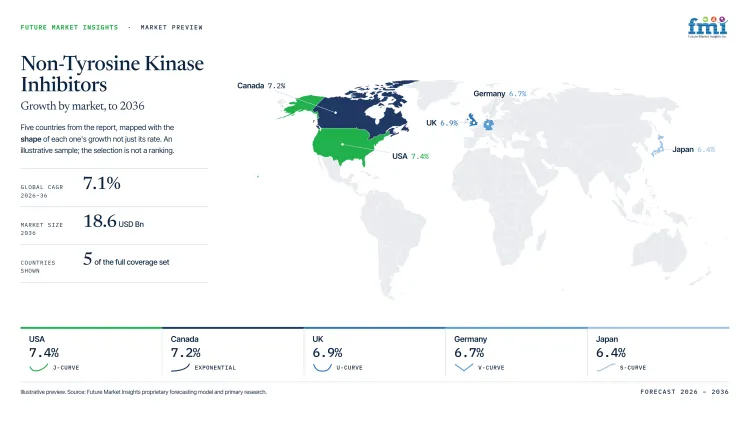
| Country | CAGR |
|---|---|
| South Korea | 7.9% |
| USA | 7.4% |
| Canada | 7.2% |
| UK | 6.9% |
| Australia | 6.8% |
| Germany | 6.7% |
| Japan | 6.4% |
How do country-level CAGRs compare in the Non-Tyrosine Kinase Inhibitors Market?
The seven profiled CAGRs span 1.5 percentage points. The range is narrow enough to show broad expansion, but each country places a different requirement between regulatory approval and routine reimbursement.
- South Korea leads the profiled set as national reimbursement criteria and precision-medicine infrastructure shape access to oncology products.
- The USA combines the largest set of recent FDA pathway approvals with companion-diagnostic requirements that define eligible populations.
- Canada pairs Health Canada authorization with public reimbursement review and periodic product-monograph updates.
- The UK relies on NICE technology appraisal to translate regulatory status into recommended National Health Service use.
- Australia connects TGA registration with Pharmaceutical Benefits Scheme decisions that determine subsidized access.
- Germany places formal additional-benefit assessment after European authorization, making comparative evidence central to market entry.
- Japan combines local clinical evidence with package-insert and reimbursement decisions, increasing the importance of country-specific regimen support.
Comparable CAGRs can therefore produce different launch sequences, evidence requirements and pharmacy workflows. The full report assesses these conditions across North America, Europe, East Asia, South Asia and Pacific, Latin America, and the Middle East and Africa.
Country-wise Analysis
- South Korean demand is forecast to expand at 7.9% CAGR through 2036. HIRA determines covered items and sets the scope, criteria and costs for health services that include medicines, making reimbursement design a direct market variable. The National Cancer Center also supports precision-medicine research and regional cancer infrastructure, giving biomarker-led treatment an institutional route from research into care.
- The USA market is projected to grow at 7.4% CAGR during the forecast period. FDA approvals for ribociclib, inavolisib and capivasertib show a strong route for label expansion across early breast cancer and biomarker-defined advanced disease. Companion diagnostics and product-specific monitoring remain necessary before regulatory activity becomes repeat prescribing.
- Canada is expected to record 7.2% CAGR through 2036. Health Canada lists KISQALI as a marketed oral tablet and published an updated product monograph in April 2026. Commercial use depends on how federal authorization aligns with provincial funding decisions and the evidence requested by reimbursement bodies.
- The UK market is forecast to advance at 6.9% CAGR over the assessment period. NICE TA1086 recommends ribociclib with an aromatase inhibitor for defined adults with high-risk HR-positive, HER2-negative early breast cancer. The appraisal route shows why comparative value and treatment eligibility influence adoption after product authorization.
- Australia is projected to grow at 6.8% CAGR through 2036. The TGA registered KISQALI for high-risk early breast cancer in March 2025, and PBS records show the medicine was listed for the relevant breast-cancer pathway in July 2025. Linking registration with subsidized access gives suppliers a clear sequence for evidence and commercial planning.
- Germany is estimated to post 6.7% CAGR during the forecast period. The G-BA completed its ribociclib benefit-assessment procedure for high-risk early breast cancer in June 2025. Suppliers therefore need evidence that supports the approved indication and the comparative-benefit discussion used in national pricing and reimbursement.
- Japan is forecast to expand at 6.4% CAGR through 2036. The National Cancer Center reported a Japan-led registration-directed trial of palbociclib plus tamoxifen in HR-positive, HER2-negative advanced or metastatic breast cancer. Local evidence generation and label interpretation remain important where regimens must fit Japanese practice and reimbursement conditions.
Who are the notable companies in the Non-Tyrosine Kinase Inhibitors Market?
Novartis AG, Pfizer Inc., Eli Lilly and Company, AstraZeneca PLC, Roche Holding AG, Bristol Myers Squibb, Incyte Corporation, AbbVie Inc., GSK plc and Sun Pharmaceutical Industries Ltd. are the notable companies serving the non-tyrosine kinase inhibitors market.
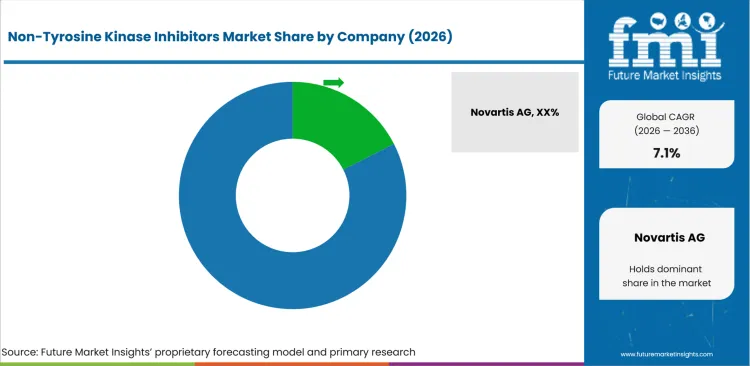
Competition spans oncology portfolios centered on CDK, PI3K and AKT pathways, and immunology or hematology portfolios centered on JAK and TYK2. Commercial positions differ by indication and monitoring burden, so product breadth should not be read as a direct revenue ranking.
Novartis, Pfizer and Eli Lilly anchor CDK4/6 competition. AstraZeneca and Roche have biomarker-linked AKT or PI3K products. Bristol Myers Squibb, Incyte, AbbVie, GSK and Sun Pharma extend the set into psoriasis, psoriatic arthritis, myelofibrosis, giant cell arteritis and severe alopecia areata.
- Novartis AG, Pfizer Inc. and Eli Lilly and Company combine established CDK4/6 products with oral oncology distribution.
- AstraZeneca PLC and Roche Holding AG compete through AKT or PI3K products linked to biomarker-defined cancer populations.
- Bristol Myers Squibb, Incyte Corporation, AbbVie Inc., GSK plc and Sun Pharmaceutical Industries Ltd. expand pathway inhibition across hematology and immune-mediated disease.
Competitive Benchmarking: Non-Tyrosine Kinase Inhibitors Market
| Company | Oncology or hematology evidence | Immune-mediated evidence | Oral product evidence | Verified market role |
|---|---|---|---|---|
| Novartis AG | High | Low | High | Ribociclib, CDK4/6 |
| Pfizer Inc. | High | High | High | Palbociclib, CDK4/6; tofacitinib, JAK |
| Eli Lilly and Company | High | High | High | Abemaciclib, CDK4/6; baricitinib, JAK |
| AstraZeneca PLC | High | Low | High | Capivasertib, AKT |
| Roche Holding AG | High | Low | High | Inavolisib, PI3K |
| Bristol Myers Squibb | Medium | High | High | Deucravacitinib, TYK2 |
| Incyte Corporation | High | Medium | High | Ruxolitinib, JAK1/JAK2 |
| AbbVie Inc. | Low | High | High | Upadacitinib, JAK |
| GSK plc | High | Low | High | Momelotinib, JAK1/JAK2/ACVR1 |
| Sun Pharmaceutical Industries Ltd. | Low | High | High | Deuruxolitinib, JAK |
Key Developments in the Non-Tyrosine Kinase Inhibitors Market
- In September 2024, the FDA approved Novartis ribociclib with an aromatase inhibitor for adults with high-risk HR-positive, HER2-negative early breast cancer.
- In October 2024, the FDA approved Roche and Genentech inavolisib with palbociclib and fulvestrant for endocrine-resistant, PIK3CA-mutated advanced breast cancer.
- In June 2026, the FDA approved AstraZeneca capivasertib with abiraterone and prednisone for PTEN-deficient metastatic hormone-sensitive prostate cancer, as detected by an FDA-authorized test, supported by data from the phase 3 CAPItello-281 trial.
Key Players in the Non-Tyrosine Kinase Inhibitors Market
CDK4/6 Oncology Portfolios
- Novartis AG
- Pfizer Inc.
- Eli Lilly and Company
PI3K and AKT Oncology Portfolios
- AstraZeneca PLC
- Roche Holding AG
JAK and TYK2 Portfolios
- Bristol Myers Squibb
- Incyte Corporation
- AbbVie Inc.
- GSK plc
- Sun Pharmaceutical Industries Ltd.
Non-Tyrosine Kinase Inhibitors Market - Report Scope
| Coverage field | Report scope |
|---|---|
| Market breakdown | By drug class, application, route of administration, end user, distribution channel and region. |
| Quantitative Units | Revenue in USD billion and CAGR in %. |
| Market Definition | Small-molecule inhibitors across the listed CDK, PI3K-mTOR, RAF-MEK and other pathway classes, assessed through their approved applications and supply routes. |
| Regions Covered | North America, Latin America, Europe, East Asia, South Asia and Pacific, and Middle East and Africa. |
| Countries Covered | South Korea, USA, Canada, UK, Australia, Germany, Japan, and 20+ countries included in the full report. |
| Key Companies Profiled | Novartis AG, Pfizer Inc., Eli Lilly and Company, AstraZeneca PLC, Roche Holding AG, Bristol Myers Squibb, Incyte Corporation, AbbVie Inc., GSK plc and Sun Pharmaceutical Industries Ltd. |
| Forecast Period | 2026 to 2036. |
| Approach | Primary and secondary research with market triangulation. |
Non-Tyrosine Kinase Inhibitors Market - Research Methodology
| Method | Approach |
|---|---|
| Primary Research | FMI analysts gathered input from pharmaceutical manufacturers, oncology and immunology specialists, hospital pharmacies, specialty clinics, distributors, payers and subject-matter experts. Interviews examined treatment selection, monitoring burden, reimbursement requirements and the evidence needed for regular prescribing. |
| Desk Research | Desk research covered regulator approvals, prescribing information, health technology assessments, reimbursement listings, safety communications, clinical evidence and official company announcements. Sources were reviewed for relevance, date and fit with the defined pathway classes. |
| Market Sizing and Forecasting | The model combined the 2026 baseline with segment structure, pricing and volume indicators, approved indications, treatment duration, country access conditions and company participation. Segment and regional estimates were reconciled with the market total. |
| Data Validation | Estimates were checked against multiple independent indicators. Unsupported product claims, adjacent therapies and overlapping revenues were excluded to reduce double counting and keep the defined market boundary consistent. |
Non-Tyrosine Kinase Inhibitors Market by Segments
Non-Tyrosine Kinase Inhibitors Market segmented by Drug Class:
- CDK Inhibitors
- CDK4-6 Inhibitors
- Pan-CDK Inhibitors
- PI3K-mTOR Inhibitors
- PI3K Inhibitors
- mTOR Inhibitors
- RAF-MEK Inhibitors
- BRAF Inhibitors
- MEK Inhibitors
- Others
- JAK Inhibitors
- AKT Inhibitors
- Aurora Kinase Inhibitors
Non-Tyrosine Kinase Inhibitors Market segmented by Application:
- Oncology
- Breast Cancer
- Lung Cancer
- Hematologic Malignancies
- Autoimmune Diseases
- Rheumatoid Arthritis
- Psoriatic Arthritis
- Inflammatory Diseases
- Inflammatory Bowel Disease
- Dermatological Disorders
- Others
- Rare Diseases
- Fibrotic Disorders
Non-Tyrosine Kinase Inhibitors Market segmented by Route of Administration:
- Oral
- Tablets
- Capsules
- Injectable
- Intravenous
- Subcutaneous
- Others
- Controlled Release
- Combination Delivery
Non-Tyrosine Kinase Inhibitors Market segmented by End User:
- Hospitals
- Oncology Hospitals
- Specialty Care Centers
- Specialty Clinics
- Cancer Clinics
- Rheumatology Clinics
- Academic & Research Institutes
- Clinical Research Centers
- Universities
- Others
- CROs
- Government Healthcare Facilities
Non-Tyrosine Kinase Inhibitors Market segmented by Distribution Channel:
- Hospital Pharmacies
- Inpatient Pharmacies
- Outpatient Pharmacies
- Specialty Pharmacies
- Oncology Specialty Pharmacies
- Biologics Distribution
- Retail Pharmacies
- Chain Pharmacies
- Independent Pharmacies
- Others
- Online Pharmacies
- Government Procurement
Non-Tyrosine Kinase Inhibitors Market by Region:
- North America
- United States
- Canada
- Latin America
- Brazil
- Chile
- Mexico
- Rest of Latin America
- Western Europe
- Germany
- United Kingdom
- Italy
- Spain
- France
- Nordics
- Benelux
- Rest of Western Europe
- Eastern Europe
- Russia
- Poland
- Hungary
- Balkan and Baltic States
- Rest of Eastern Europe
- East Asia
- China
- Japan
- South Korea
- South Asia and Pacific
- India
- ASEAN
- Australia and New Zealand
- Rest of South Asia and Pacific
- Middle East and Africa
- Kingdom of Saudi Arabia
- Other GCC Countries
- Türkiye
- South Africa
- Other African Union Countries
- Rest of Middle East and Africa
Research Sources and Bibliography
- International Agency for Research on Cancer. (2024, February 1). Global cancer burden growing, amidst mounting need for services.
- National Cancer Institute. (2021, October 6). Ribociclib Improves Survival in Advanced Breast Cancer.
- USA Food and Drug Administration. (2024, September 17). FDA approves ribociclib with an aromatase inhibitor for early high-risk breast cancer.
- USA Food and Drug Administration. (2024, October 10). FDA approves inavolisib with palbociclib and fulvestrant for PIK3CA-mutated advanced breast cancer.
- USA Food and Drug Administration. (2026, June 12). FDA approves capivasertib with abiraterone and prednisone for PTEN-deficient metastatic prostate cancer.
- USA Food and Drug Administration. (2025). KISQALI prescribing information.
- USA Food and Drug Administration. (2025). TRUQAP prescribing information.
- USA Food and Drug Administration. (2025). IBRANCE prescribing information.
- USA Food and Drug Administration. (2025). VERZENIO prescribing information.
- USA Food and Drug Administration. (2026). XELJANZ prescribing information.
- USA Food and Drug Administration. (2026). JAKAFI and JAKAFI XR prescribing information.
- USA Food and Drug Administration. (2021, September 1). Drug Safety Communication on selected JAK inhibitors.
- USA Food and Drug Administration. (2026, March 6). SOTYKTU approval for active psoriatic arthritis.
- USA Food and Drug Administration. (2025, April 29). RINVOQ approval for giant cell arteritis.
- USA Food and Drug Administration. (2024, July 25). LEQSELVI approval for severe alopecia areata.
- USA Food and Drug Administration. (2023, September 15). OJJAARA approval for myelofibrosis in adults with anemia.
- National Cancer Center Japan. (2024, January 15). Japan-led registration-directed trial of palbociclib plus tamoxifen.
- Gemeinsamer Bundesausschuss. (2025, June 5). Ribociclib benefit-assessment resolution for high-risk early breast cancer.
- National Institute for Health and Care Excellence. (2025, August 6). TA1086: Ribociclib with an aromatase inhibitor for high-risk early breast cancer.
- Health Canada. (2026, April 7). KISQALI product information and product monograph.
- Therapeutic Goods Administration. (2025, March 6). KISQALI registration for early breast cancer.
- Australian Government Pharmaceutical Benefits Scheme. (2025, July 1). RIBOCICLIB medicine listing status.
- Health Insurance Review & Assessment Service. HIRA English overview and oncology drug coverage criteria.
- National Cancer Center Korea. Research Institute and precision-medicine research overview.
This bibliography is provided for reader reference and is not exhaustive. The full report contains the complete reference list and detailed citations
This Report Answers
- How large is the Non-Tyrosine Kinase Inhibitors Market in 2026 and 2036?
- Which pathway and care conditions support sustained demand?
- Which drug class accounts for the largest approved 2026 share?
- Why does oncology remain the leading application?
- How does oral delivery affect monitoring and pharmacy workflows?
- How do country access systems change commercial entry conditions?
- Which companies have verified products across oncology and immune-mediated applications?
- Which recent approvals are changing the competitive landscape?
Frequently Asked Questions
How big is the Non-Tyrosine Kinase Inhibitors Market in 2026?
USD 9.4 billion represents the market value in 2026 across the listed drug classes and applications. The category is projected to reach USD 18.7 billion by 2036 as biomarker-linked oncology regimens and immune-mediated indications expand within monitored treatment pathways.
What is the CAGR of the Non-Tyrosine Kinase Inhibitors Market from 2026 to 2036?
A 7.1% CAGR is projected between 2026 and 2036. Growth depends on label expansion and reliable patient identification, while reimbursement review and post-prescription monitoring affect the speed of routine adoption.
Which drug class is projected to account for 31.0% of the market?
CDK inhibitors are projected to account for 31.0% of drug-class demand in 2026. Established CDK4/6 use in hormone-receptor-positive breast cancer supports the lead, with early-stage label expansion adding another treatment setting.
How much value will the market add between 2026 and 2036?
USD 9.2 billion is expected to be added between 2026 and 2036. The increase reflects broader oncology eligibility and additional oral pathway-inhibitor use in hematology, rheumatology and dermatology.
Which companies are active in the Non-Tyrosine Kinase Inhibitors Market?
Ten companies active in the assessed market include Novartis AG, Pfizer Inc., Eli Lilly and Company, AstraZeneca PLC, Roche Holding AG, Bristol Myers Squibb, Incyte Corporation, AbbVie Inc., GSK plc and Sun Pharmaceutical Industries Ltd. Their verified roles span CDK4/6, PI3K, AKT, JAK and TYK2 products.
Preview the report firsthand - request a free sample
Get SampleGet the brochure for pricing and purchase details.
Get PDFTable of Content
- Key Takeaways
- Market Size and CAGR
- Top Growth Driver
- Fastest Growing Segment
- Leading Region
- Key Companies
- Emerging Opportunities
- Executive Summary
- Global Market Outlook
- Demand-side Trends
- Supply-side Trends
- Technology Roadmap Analysis
- Analysis and Recommendations
- Analyst Perspective (What is happening? Why now? What should investors know?)
- Key Questions Answered
- How large is the market?
- What is the CAGR?
- What are key trends?
- Which region dominates?
- Who are the leaders?
- Market Overview
- Market Coverage / Taxonomy
- Market Definition / Scope / Limitations
- Research Methodology
- Chapter Orientation
- Analytical Lens and Working Hypotheses
- Market Structure, Signals, and Trend Drivers
- Benchmarking and Cross-market Comparability
- Market Sizing, Forecasting, and Opportunity Mapping
- Research Design and Evidence Framework
- Desk Research Programme (Secondary Evidence)
- Expert Input and Fieldwork (Primary Evidence)
- Tooling, Models, and Reference Databases
- Data Engineering and Model Build
- Quality Assurance and Audit Trail
- Market Background
- Market Dynamics (Drivers, Restraints, Opportunity, Trends)
- Scenario Forecast (Optimistic, Likely, Conservative)
- Impact Analysis
- AI Impact
- Sustainability Impact
- Regulatory Impact
- Technology Impact
- Consumer / Buyer Analysis
- Purchase Drivers
- Adoption Barriers
- Buyer Journey
- Opportunity Map Analysis
- Product Life Cycle Analysis
- Supply Chain Analysis
- Investment Feasibility Matrix
- Value Chain Analysis
- PESTLE and Porter's Analysis
- Regulatory Landscape
- Regional Parent Market Outlook
- Production and Consumption Statistics
- Import and Export Statistics
- Global Market Analysis and Forecast, 2021 to 2036
- Historical Market Size Value (USD Billion) Analysis, 2021 to 2025
- Current and Future Market Size Value (USD Billion) Projections, 2026 to 2036
- Y-o-Y Growth Trend Analysis
- Absolute $ Opportunity Analysis
- Global Market Pricing Analysis, 2021 to 2036
- Global Market Analysis and Forecast, By Drug Class, 2021 to 2036
- Introduction / Key Findings
- Historical Market Size Value (USD Billion) Analysis By Drug Class, 2021 to 2025
- Current and Future Market Size Value (USD Billion) Analysis and Forecast By Drug Class, 2026 to 2036
- CDK Inhibitors
- CDK4-6 Inhibitors
- Pan-CDK Inhibitors
- PI3K-mTOR Inhibitors
- PI3K Inhibitors
- mTOR Inhibitors
- RAF-MEK Inhibitors
- BRAF Inhibitors
- MEK Inhibitors
- Others
- JAK Inhibitors
- AKT Inhibitors
- Aurora Kinase Inhibitors
- CDK Inhibitors
- Y-o-Y Growth Trend Analysis By Drug Class, 2021 to 2025
- Absolute $ Opportunity Analysis By Drug Class, 2026 to 2036
- Global Market Analysis and Forecast, By Application, 2021 to 2036
- Introduction / Key Findings
- Historical Market Size Value (USD Billion) Analysis By Application, 2021 to 2025
- Current and Future Market Size Value (USD Billion) Analysis and Forecast By Application, 2026 to 2036
- Oncology
- Breast Cancer
- Lung Cancer
- Hematologic Malignancies
- Autoimmune Diseases
- Rheumatoid Arthritis
- Psoriatic Arthritis
- Inflammatory Diseases
- Inflammatory Bowel Disease
- Dermatological Disorders
- Others
- Rare Diseases
- Fibrotic Disorders
- Oncology
- Y-o-Y Growth Trend Analysis By Application, 2021 to 2025
- Absolute $ Opportunity Analysis By Application, 2026 to 2036
- Global Market Analysis and Forecast, By Route of Administration, 2021 to 2036
- Introduction / Key Findings
- Historical Market Size Value (USD Billion) Analysis By Route of Administration, 2021 to 2025
- Current and Future Market Size Value (USD Billion) Analysis and Forecast By Route of Administration, 2026 to 2036
- Oral
- Tablets
- Capsules
- Injectable
- Intravenous
- Subcutaneous
- Others
- Controlled Release
- Combination Delivery
- Oral
- Y-o-Y Growth Trend Analysis By Route of Administration, 2021 to 2025
- Absolute $ Opportunity Analysis By Route of Administration, 2026 to 2036
- Global Market Analysis and Forecast, By End User, 2021 to 2036
- Introduction / Key Findings
- Historical Market Size Value (USD Billion) Analysis By End User, 2021 to 2025
- Current and Future Market Size Value (USD Billion) Analysis and Forecast By End User, 2026 to 2036
- Hospitals
- Oncology Hospitals
- Specialty Care Centers
- Specialty Clinics
- Cancer Clinics
- Rheumatology Clinics
- Academic & Research Institutes
- Clinical Research Centers
- Universities
- Others
- CROs
- Government Healthcare Facilities
- Hospitals
- Y-o-Y Growth Trend Analysis By End User, 2021 to 2025
- Absolute $ Opportunity Analysis By End User, 2026 to 2036
- Global Market Analysis and Forecast, By Distribution Channel, 2021 to 2036
- Introduction / Key Findings
- Historical Market Size Value (USD Billion) Analysis By Distribution Channel, 2021 to 2025
- Current and Future Market Size Value (USD Billion) Analysis and Forecast By Distribution Channel, 2026 to 2036
- Hospital Pharmacies
- Inpatient Pharmacies
- Outpatient Pharmacies
- Specialty Pharmacies
- Oncology Specialty Pharmacies
- Biologics Distribution
- Retail Pharmacies
- Chain Pharmacies
- Independent Pharmacies
- Others
- Online Pharmacies
- Government Procurement
- Hospital Pharmacies
- Y-o-Y Growth Trend Analysis By Distribution Channel, 2021 to 2025
- Absolute $ Opportunity Analysis By Distribution Channel, 2026 to 2036
- Global Market Analysis and Forecast, By Region, 2021 to 2036
- Introduction
- Historical Market Size Value (USD Billion) Analysis By Region, 2021 to 2025
- Current Market Size Value (USD Billion) Analysis and Forecast By Region, 2026 to 2036
- North America
- Latin America
- Western Europe
- Eastern Europe
- East Asia
- South Asia and Pacific
- Middle East & Africa
- Market Attractiveness Analysis By Region
- North America Market Analysis and Forecast, By Country, 2021 to 2036
- Historical Market Size Value (USD Billion) Trend Analysis By Market Taxonomy, 2021 to 2025
- Market Size Value (USD Billion) Forecast By Market Taxonomy, 2026 to 2036
- By Country
- USA
- Canada
- By Drug Class
- By Application
- By Route of Administration
- By End User
- By Distribution Channel
- By Country
- Market Attractiveness Analysis
- By Country
- By Drug Class
- By Application
- By Route of Administration
- By End User
- By Distribution Channel
- Key Takeaways
- Latin America Market Analysis and Forecast, By Country
- Historical Market Size Value (USD Billion) Trend Analysis By Market Taxonomy, 2021 to 2025
- Market Size Value (USD Billion) Forecast By Market Taxonomy, 2026 to 2036
- By Country
- Brazil
- Mexico
- Chile
- Rest of Latin America
- By Drug Class
- By Application
- By Route of Administration
- By End User
- By Distribution Channel
- By Country
- Market Attractiveness Analysis
- By Country
- By Drug Class
- By Application
- By Route of Administration
- By End User
- By Distribution Channel
- Key Takeaways
- Western Europe Market Analysis and Forecast, By Country
- Historical Market Size Value (USD Billion) Trend Analysis By Market Taxonomy, 2021 to 2025
- Market Size Value (USD Billion) Forecast By Market Taxonomy, 2026 to 2036
- By Country
- Germany
- UK
- Italy
- Spain
- France
- Nordic
- BENELUX
- Rest of Western Europe
- By Drug Class
- By Application
- By Route of Administration
- By End User
- By Distribution Channel
- By Country
- Market Attractiveness Analysis
- By Country
- By Drug Class
- By Application
- By Route of Administration
- By End User
- By Distribution Channel
- Key Takeaways
- Eastern Europe Market Analysis and Forecast, By Country
- Historical Market Size Value (USD Billion) Trend Analysis By Market Taxonomy, 2021 to 2025
- Market Size Value (USD Billion) Forecast By Market Taxonomy, 2026 to 2036
- By Country
- Russia
- Poland
- Hungary
- Balkan & Baltic
- Rest of Eastern Europe
- By Drug Class
- By Application
- By Route of Administration
- By End User
- By Distribution Channel
- By Country
- Market Attractiveness Analysis
- By Country
- By Drug Class
- By Application
- By Route of Administration
- By End User
- By Distribution Channel
- Key Takeaways
- East Asia Market Analysis and Forecast, By Country
- Historical Market Size Value (USD Billion) Trend Analysis By Market Taxonomy, 2021 to 2025
- Market Size Value (USD Billion) Forecast By Market Taxonomy, 2026 to 2036
- By Country
- China
- Japan
- South Korea
- By Drug Class
- By Application
- By Route of Administration
- By End User
- By Distribution Channel
- By Country
- Market Attractiveness Analysis
- By Country
- By Drug Class
- By Application
- By Route of Administration
- By End User
- By Distribution Channel
- Key Takeaways
- South Asia and Pacific Market Analysis and Forecast, By Country
- Historical Market Size Value (USD Billion) Trend Analysis By Market Taxonomy, 2021 to 2025
- Market Size Value (USD Billion) Forecast By Market Taxonomy, 2026 to 2036
- By Country
- India
- ASEAN
- Australia & New Zealand
- Rest of South Asia and Pacific
- By Drug Class
- By Application
- By Route of Administration
- By End User
- By Distribution Channel
- By Country
- Market Attractiveness Analysis
- By Country
- By Drug Class
- By Application
- By Route of Administration
- By End User
- By Distribution Channel
- Key Takeaways
- Middle East & Africa Market Analysis and Forecast, By Country
- Historical Market Size Value (USD Billion) Trend Analysis By Market Taxonomy, 2021 to 2025
- Market Size Value (USD Billion) Forecast By Market Taxonomy, 2026 to 2036
- By Country
- Kingdom of Saudi Arabia
- Other GCC Countries
- Türkiye
- South Africa
- Other African Union
- Rest of Middle East & Africa
- By Drug Class
- By Application
- By Route of Administration
- By End User
- By Distribution Channel
- By Country
- Market Attractiveness Analysis
- By Country
- By Drug Class
- By Application
- By Route of Administration
- By End User
- By Distribution Channel
- Key Takeaways
- Key Countries Market Analysis
- USA
- Pricing Analysis
- Market Share Analysis, 2025
- By Drug Class
- By Application
- By Route of Administration
- By End User
- By Distribution Channel
- Canada
- Pricing Analysis
- Market Share Analysis, 2025
- By Drug Class
- By Application
- By Route of Administration
- By End User
- By Distribution Channel
- Mexico
- Pricing Analysis
- Market Share Analysis, 2025
- By Drug Class
- By Application
- By Route of Administration
- By End User
- By Distribution Channel
- Brazil
- Pricing Analysis
- Market Share Analysis, 2025
- By Drug Class
- By Application
- By Route of Administration
- By End User
- By Distribution Channel
- Chile
- Pricing Analysis
- Market Share Analysis, 2025
- By Drug Class
- By Application
- By Route of Administration
- By End User
- By Distribution Channel
- Germany
- Pricing Analysis
- Market Share Analysis, 2025
- By Drug Class
- By Application
- By Route of Administration
- By End User
- By Distribution Channel
- UK
- Pricing Analysis
- Market Share Analysis, 2025
- By Drug Class
- By Application
- By Route of Administration
- By End User
- By Distribution Channel
- Italy
- Pricing Analysis
- Market Share Analysis, 2025
- By Drug Class
- By Application
- By Route of Administration
- By End User
- By Distribution Channel
- Spain
- Pricing Analysis
- Market Share Analysis, 2025
- By Drug Class
- By Application
- By Route of Administration
- By End User
- By Distribution Channel
- France
- Pricing Analysis
- Market Share Analysis, 2025
- By Drug Class
- By Application
- By Route of Administration
- By End User
- By Distribution Channel
- India
- Pricing Analysis
- Market Share Analysis, 2025
- By Drug Class
- By Application
- By Route of Administration
- By End User
- By Distribution Channel
- ASEAN
- Pricing Analysis
- Market Share Analysis, 2025
- By Drug Class
- By Application
- By Route of Administration
- By End User
- By Distribution Channel
- Australia & New Zealand
- Pricing Analysis
- Market Share Analysis, 2025
- By Drug Class
- By Application
- By Route of Administration
- By End User
- By Distribution Channel
- China
- Pricing Analysis
- Market Share Analysis, 2025
- By Drug Class
- By Application
- By Route of Administration
- By End User
- By Distribution Channel
- Japan
- Pricing Analysis
- Market Share Analysis, 2025
- By Drug Class
- By Application
- By Route of Administration
- By End User
- By Distribution Channel
- South Korea
- Pricing Analysis
- Market Share Analysis, 2025
- By Drug Class
- By Application
- By Route of Administration
- By End User
- By Distribution Channel
- Russia
- Pricing Analysis
- Market Share Analysis, 2025
- By Drug Class
- By Application
- By Route of Administration
- By End User
- By Distribution Channel
- Poland
- Pricing Analysis
- Market Share Analysis, 2025
- By Drug Class
- By Application
- By Route of Administration
- By End User
- By Distribution Channel
- Hungary
- Pricing Analysis
- Market Share Analysis, 2025
- By Drug Class
- By Application
- By Route of Administration
- By End User
- By Distribution Channel
- Kingdom of Saudi Arabia
- Pricing Analysis
- Market Share Analysis, 2025
- By Drug Class
- By Application
- By Route of Administration
- By End User
- By Distribution Channel
- Türkiye
- Pricing Analysis
- Market Share Analysis, 2025
- By Drug Class
- By Application
- By Route of Administration
- By End User
- By Distribution Channel
- South Africa
- Pricing Analysis
- Market Share Analysis, 2025
- By Drug Class
- By Application
- By Route of Administration
- By End User
- By Distribution Channel
- USA
- Market Structure Analysis
- Competition Dashboard
- Competition Benchmarking
- Market Share Analysis of Top Players
- By Regional
- By Drug Class
- By Application
- By Route of Administration
- By End User
- By Distribution Channel
- Emerging Startups
- Innovation Benchmarking
- Competition Analysis
- Competition Deep Dive
- Novartis AG
- Overview
- Product Portfolio
- Profitability by Market Segments
- Sales Footprint
- Strategy Overview
- Marketing Strategy
- Product Strategy
- Channel Strategy
- Pfizer Inc.
- Eli Lilly and Company
- AstraZeneca PLC
- Bristol Myers Squibb
- Roche Holding AG
- Johnson & Johnson
- Bayer AG
- Merck KGaA
- Exelixis, Inc.
- Others
- Novartis AG
- Case Studies
- Success Stories
- Recent Developments
- Competition Deep Dive
- Assumptions & Acronyms Used


