

- Market Size (2026)
- USD 17.8 Bn
- Forecast (2036)
- USD 38.8 Bn
- CAGR (2026 to 2036)
- 8.1%
How big is the CDK4/6 Inhibitors Market in 2026?
USD 17.8 billion in 2026 and USD 38.8 billion by 2036 at an 8.1% CAGR.
Sales in the CDK4/6 inhibitors market are projected to grow at 8.1% CAGR through 2036, driving valuation to USD 38.8 billion by 2036 from USD 17.8 billion in 2026. Approved endocrine combinations support extended use across advanced and selected early breast cancer pathways under specialist monitoring.
Treatment planning begins with receptor status and disease stage since every inhibitor carries a distinct evidence package. The National Cancer Institute estimated 316,950 new female breast cancer cases in the United States during 2025. That clinical workload sustains recurring molecular testing and monitored oral therapy across specialist oncology networks.
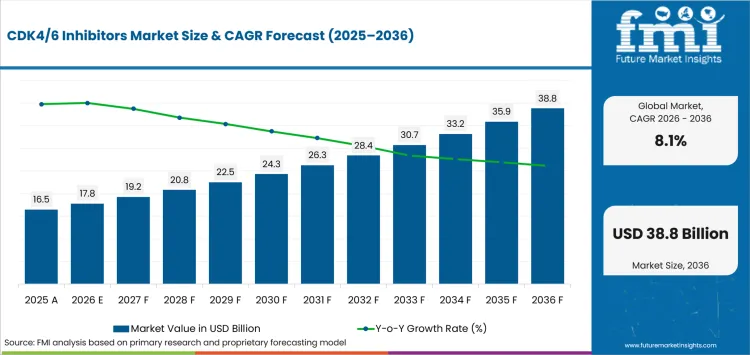
Key Takeaways of CDK4/6 Inhibitors Market
- Approved regimens expand demand across advanced disease, adjuvant care and biomarker-defined breast cancer combinations worldwide.
- Palbociclib is estimated at 41.0% of drug type demand in 2026 owing to established endocrine combinations.
- Advanced HR+/HER2- breast cancer is projected at 58.0% of application demand in 2026 driven by endocrine therapy.
- Hospital pharmacies are forecast at 45.0% of distribution activity in 2026 supported by protocol-linked oncology dispensing.
- Acquired resistance and reimbursement review restrict treatment duration across monitored national oncology systems and pathways.
- Pfizer Inc., Novartis AG, Eli Lilly and Company, Pharmacosmos A/S, BeOne Medicines Ltd., Jiangsu Hengrui Pharmaceuticals Co., Ltd., Incyclix Bio, LLC and Genor Biopharma Co., Ltd. represent the active company set across approved products and clinical-stage cell-cycle programs.
Analyst Perspective
"Portfolio strength depends on proven coverage across early disease, metastatic sequencing and HER2-directed maintenance rather than molecule familiarity alone. Resistance-focused programs require evidence that selective CDK4 or CDK2 activity improves outcomes without adding monitoring burdens."
- Anurag Sharma, Principal Consultant, Future Market Insights
How is the CDK4/6 Inhibitors Market segmented?
The CDK4/6 inhibitors industry is segmented by drug type, application, end user, distribution channel, therapy type and region.
The CDK4/6 inhibitors market is segmented by drug type, application, end user, distribution channel, therapy type and region. Drug type covers palbociclib, ribociclib, abemaciclib and next-generation inhibitors, while applications include advanced, metastatic and early breast cancer plus other solid tumors. End users cover hospitals, cancer centers, specialty clinics and research institutes, while distribution channels include hospital, retail, specialty and online pharmacies. Therapy types distinguish combination treatment, monotherapy, adjuvant therapy and neoadjuvant therapy across defined disease stages.
What makes HR+/HER2- advanced breast cancer central to the application category?
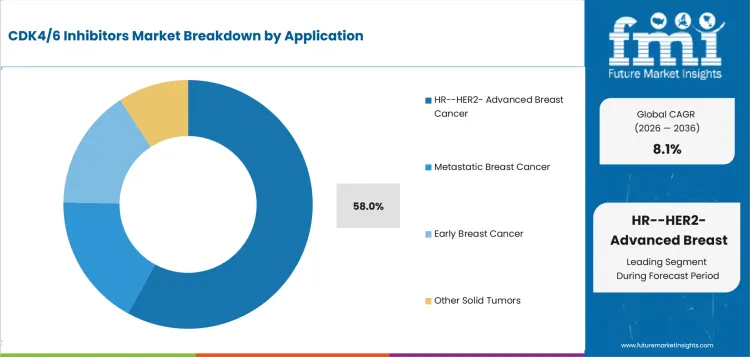
Advanced HR-positive disease sustains demand as oncology adjuvants and endocrine partners guide treatment following progression. Personalized medicine workflows separate regimens according to mutation status and prior exposure alongside expected toxicity. In July 2026, FDA approved gedatolisib with fulvestrant and optional palbociclib following a 392-adult trial that established a defined post-endocrine route.
- Based on application, HR+/HER2- advanced breast cancer is projected to account for 58.0% share in 2026 due to established endocrine combinations.
- Disease progression requires oncology teams to change the endocrine or targeted partner according to the tumor profile. Repeated imaging and laboratory review therefore sustain treatment activity beyond the initial specialist prescription decision.
What supports palbociclib within the drug type category?
Palbociclib established a broad commercial base among breast cancer drugs paired with endocrine therapy across advanced disease. Its position among anti-neoplastic agents reflects familiar dosing and extensive oncology experience across national treatment pathways.
- By drug type, palbociclib is estimated to hold 41.0% share in 2026 owing to physician familiarity and established dispensing coverage.
- Maintenance regimens require coordinated companion diagnostics that allow hospital pharmacies to release repeated treatment cycles under established oncology protocols. Linked laboratory records also help oncology teams manage interaction checks and dose interruptions without treating different CDK4/6 inhibitors as automatic substitutes in local formularies.
How do hospitals shape demand within the end user category?
Hospitals connect oncology prescribing with breast cancer diagnostics and laboratory review to establish treatment eligibility at initiation. Specialist teams use molecular diagnostics to establish receptor status and mutation profiles then manage organ function and interaction risks.
- In 2026, hospitals are expected to lead end user demand with 43.0% share because integrated oncology services coordinate testing and treatment.
- Biomarker-selected regimens depend on authorized testing that confirms treatment eligibility within hospital protocols at prescribing. In May 2026, FDA approved a FoundationOne CDx companion-diagnostic indication for PIK3CA detection with the inavolisib-palbociclib-fulvestrant regimen. Hospital networks connect next-generation cancer diagnostics with repeated dose monitoring across specialist reviews throughout treatment.
Why do hospital pharmacies lead the distribution channel category?
Hospital pharmacies align oral inhibitor dispensing with oncology protocols and scheduled laboratory reviews throughout prolonged therapy. Product-specific labels and interaction checks distinguish this channel from generic oncology drugs because they can change refill timing during extended treatment.
- The distribution channel category is forecast to be led by hospital pharmacies at 45.0% share in 2026 due to protocol-linked dispensing and monitoring.
- Inpatient teams coordinate treatment holds with prescribing oncologists during acute toxicity management across hospital services. Outpatient hospital pharmacies use linked clinical records to manage endocrine-partner changes and repeated refills throughout prolonged oral treatment cycles nationwide.
What are the drivers, restraints and opportunities in the CDK4/6 Inhibitors Market?
Label expansion broadens defined treatment pathways as resistance and monitoring limit duration under reimbursement pressure while selective cell-cycle programs address post-treatment escape.
- Driver: Adjuvant approvals and biomarker-defined combinations extend CDK4/6 inhibition across defined breast cancer treatment settings.
- Restraint: Acquired resistance and product-specific adverse events interrupt dosing and reduce the duration of reimbursed treatment.
- Opportunity: Selective CDK4 and CDK2 programs address biological escape following exposure to established inhibitor regimens.
Adjuvant regimens extend CDK4/6 treatment into recurrence prevention for selected patients with high-risk early disease. Longer courses increase monitored use of targeted oncology biologics across specialist services while preserving product-specific evidence requirements.
Resistance shortens commercial duration as tumors progress during established CDK4/6 treatment and require a different therapeutic sequence. Neutropenia and organ-specific safety requirements can interrupt dosing or return patients to specialist services for repeated dose-modification decisions.
Selective CDK4 and CDK2 programs target defined escape mechanisms associated with current class resistance across advanced disease. Developers must connect each mechanism with measurable benefit and manageable toxicity in clearly defined post-inhibitor populations.
Which country CAGRs are profiled in the CDK4/6 Inhibitors Market?
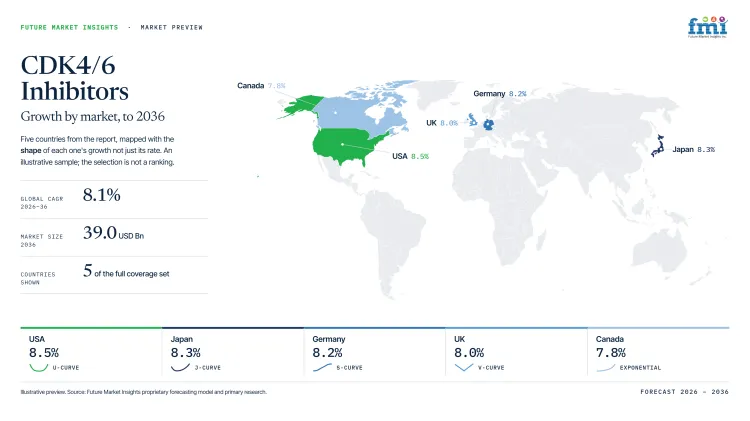
| Country | CAGR |
|---|---|
| United States | 8.5% |
| Japan | 8.3% |
| Germany | 8.2% |
| United Kingdom | 8.0% |
| Canada | 7.8% |
How do country-level CAGRs compare in the CDK4/6 Inhibitors Market?
Five country CAGRs span 0.7 percentage point across established oncology systems with different reimbursement pathways. The displayed rates describe forecast pace rather than current revenue or reimbursed patient volume alone.
- The United States forms the upper boundary as broad label coverage reaches metastatic and early breast cancer pathways.
- Japan remains close to the United States as specialist evaluation concentrates within experienced metropolitan cancer hospitals.
- Germany follows within the same cluster as national comparator review separates European authorization from reimbursed access.
- The United Kingdom reflects coordinated technology appraisal alongside regional NHS implementation and treatment capacity nationwide.
- Canada defines the lower boundary as provincial funding follows pan-Canadian review and separate formulary negotiations.
Comparable CAGRs can produce different entry conditions across national reimbursement systems and specialist oncology networks. The full report covers country growth across six regions with distinct national oncology and reimbursement systems.
Country-wise Analysis
- United States oncology networks combine specialist breast centers with molecular testing and hospital pharmacy routes across academic and community settings that support treatment initiation and long-term follow-up through referral networks and specialty pharmacy support. FDA approved ribociclib with an aromatase inhibitor for high-risk early breast cancer in September 2024 supported by the 5,101-adult NATALEE trial and an additional national pathway for monitored adjuvant treatment across specialist centers. Adoption of CDK4/6 inhibitors in the United States is estimated to expand at 8.5% CAGR through 2036 supported by multiple approved settings despite prior authorization and toxicity-monitoring delays across regional health plans.
- Japan relies on metropolitan cancer hospitals and structured clinical registries that connect specialist prescribing with locally generated safety evidence across concentrated referral networks and regional treatment programs serving patients through national referral routes. The jRCT record was updated in January 2026 for an 86-participant ribociclib and anastrozole study that supports local dosing evaluation and scheduled monitoring across Japanese treatment sites during complex combination treatment and toxicity review. CDK4/6 inhibitor sales in Japan are forecast to expand at 8.3% CAGR by 2036 reinforced by experienced oncology teams despite detailed documentation and limited specialist capacity outside major cities and university hospital networks.
- Germany combines university cancer centers with statutory insurance pathways that connect European authorization to national comparator review and negotiated reimbursement across regional oncology services serving insured populations through established hospital referral routes nationwide. The Federal Joint Committee completed its ribociclib early-breast-cancer assessment in June 2025 through a formal process that defines evidence requirements ahead of reimbursement negotiations and pricing agreements for indication-specific national pricing and prescribing decisions. The German CDK4/6 inhibitors sector is projected to record 8.2% CAGR during the assessment period shaped by specialist infrastructure despite comparator requirements that can narrow reimbursed use across insurance populations and delay access.
- United Kingdom breast cancer services use national technology appraisal and regional NHS networks to coordinate specialist prescribing with molecular testing and specialist hospital pharmacy delivery across defined referral pathways serving eligible adults across England. NICE published TA1086 in August 2025 and required routine funding within 90 days for eligible ribociclib use under the commercial arrangement and national implementation timetable for eligible patients across regional breast cancer services. CDK4/6 inhibitor demand in the United Kingdom is forecast to rise at 8.0% CAGR over the forecast period aided by coordinated funding despite diagnostic workload and staffing constraints across regional cancer services nationwide.
- Canada combines provincial cancer agencies with pan-Canadian evidence review that precedes funded access through hospital pharmacies and geographically dispersed oncology programs under separate public coverage frameworks serving patients across large regional service areas nationwide. Canada’s Drug Agency listed March 5, 2026 as the final recommendation issuance date for ribociclib while each jurisdiction retained authority over funding terms and prescribing criteria across participating public drug plans and provinces. Canada’s CDK4/6 inhibitors outlook is anticipated to advance at 7.8% CAGR over the assessment period influenced by common evidence standards despite provincial negotiations and formulary delays across public drug plans and territories.
Who are the notable companies in the CDK4/6 Inhibitors Market?
Pfizer Inc., Novartis AG, Eli Lilly and Company, Pharmacosmos A/S, BeOne Medicines Ltd., Jiangsu Hengrui Pharmaceuticals Co., Ltd., Incyclix Bio, LLC and Genor Biopharma Co., Ltd. are active across approved products and clinical-stage programs in this market.
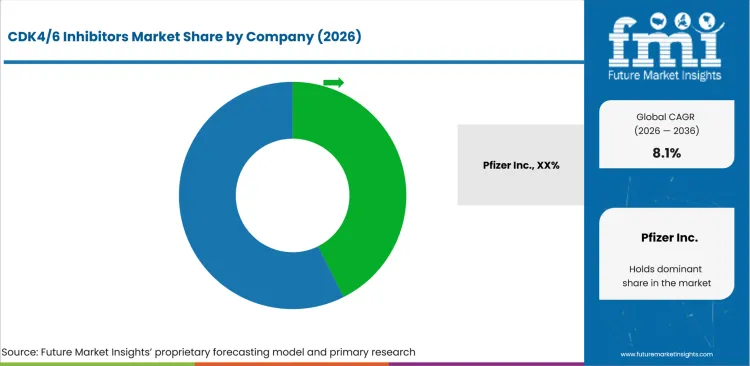
The market is concentrated around three global breast cancer franchises with a smaller group competing through China approvals, chemotherapy protection and selective resistance mechanisms. Entry depends on indication-specific outcomes, monitoring support and reimbursement evidence rather than corporate scale alone.
- Pfizer, Novartis and Eli Lilly compete through differentiated labels across advanced and early breast cancer pathways.
- Jiangsu Hengrui and Genor Biopharma compete in China through approved dalpiciclib and lerociclib combinations across multiple endocrine treatment pathways.
- Pharmacosmos supports chemotherapy protection as BeOne Medicines and Incyclix Bio pursue selective CDK4 or CDK2 programs.
Competitive Benchmarking: CDK4/6 Inhibitors Market
| Company | Approved CDK4/6 Portfolio | Early Breast Cancer Coverage | Combination or Resistance Position | Geographic Reach |
|---|---|---|---|---|
| Pfizer Inc. | High | Low | High | Global |
| Novartis AG | High | High | High | Global |
| Eli Lilly and Company | High | High | High | Global |
| Pharmacosmos A/S | Medium | Low | Medium | United States and Europe |
| BeOne Medicines Ltd. | Low | Low | Medium | Global clinical development |
| Jiangsu Hengrui Pharmaceuticals Co., Ltd. | High | High | High | China |
| Incyclix Bio, LLC | Low | Low | Medium | United States and Australia |
| Genor Biopharma Co., Ltd. | High | Low | High | China |
Key Developments in the CDK4/6 Inhibitors Market
- In June 2026, Jiangsu Hengrui Pharmaceuticals received NMPA approval for dalpiciclib with endocrine therapy in high-risk early breast cancer.
- In April 2026, Incyclix Bio raised USD 5 million to advance INX-315 for CDK4/6-resistant breast cancer.
- In March 2026, Pharmacosmos initiated phase III trilaciclib testing for myeloprotection during limited-stage small-cell lung cancer treatment.
Key Players in the CDK4/6 Inhibitors Market
Approved Breast Cancer Inhibitor Companies
- Pfizer Inc.
- Novartis AG
- Eli Lilly and Company
- Jiangsu Hengrui Pharmaceuticals Co., Ltd.
Licensed and Late-Stage CDK4/6 Developers
- Pharmacosmos A/S
- Genor Biopharma Co., Ltd.
Selective Cell-Cycle Pipeline Developers
- BeOne Medicines Ltd.
- Incyclix Bio, LLC
CDK4/6 Inhibitors Market - Report Scope
| Coverage field | Report scope |
|---|---|
| Market breakdown | By drug type, application, end user, distribution channel, therapy type and region. |
| Quantitative Units | Revenue in USD billion and CAGR in %. |
| Market Definition | CDK4/6 inhibitor products and selective cell-cycle programs used across approved or clinical oncology treatment pathways. |
| Regions Covered | North America, Latin America, Europe, East Asia, South Asia and Pacific, and Middle East and Africa. |
| Countries Covered | United States, Japan, Germany, United Kingdom, Canada, and 20+ countries included in the full report. |
| Key Companies Profiled | Pfizer Inc., Novartis AG, Eli Lilly and Company, Pharmacosmos A/S, BeOne Medicines Ltd., Jiangsu Hengrui Pharmaceuticals Co., Ltd., Incyclix Bio, LLC and Genor Biopharma Co., Ltd. |
| Forecast Period | 2026 to 2036. |
| Approach | Primary and secondary research with market triangulation. |
CDK4/6 Inhibitors Market - Research Methodology
| Method | Approach |
|---|---|
| Primary Research | FMI analysts gathered input from manufacturers, service providers, technology developers, distributors, end users, procurement teams, and subject-matter experts. Interviews examined purchasing decisions, product or service evaluation, adoption barriers, approval requirements, pricing considerations, and expectations for technical or commercial support. Respondents were also asked what evidence is required before a trial, pilot, or initial order develops into regular purchasing. |
| Desk Research | Desk research covered government statistics, regulatory publications, trade data, industry associations, technical literature, standards, company filings, product information, and official corporate announcements. Sources were reviewed for relevance, publication date, geographic coverage, and consistency with the defined market scope. Claims relating to performance, applications, approvals, capacity, investment, and commercial activity were retained only when supported by credible public evidence. |
| Market Sizing and Forecasting | The market model combined the baseline value with historical performance, segment structure, pricing and volume indicators, adoption levels, company participation, and country-level demand conditions. Forecast assumptions considered economic activity, investment trends, regulatory developments, technology adoption, purchasing cycles, supply availability, and barriers to wider market use. Segment and regional estimates were reconciled before the final market total was calculated. |
| Data Validation | Estimates were checked against multiple independent indicators, including public data, company activity, trade patterns, industry developments, and findings from primary interviews. Validation also tested whether products, services, applications, and company revenues fell within the defined market boundaries. Adjacent categories, unsupported claims, overlapping revenues, and activities without direct market relevance were excluded to reduce double counting and maintain consistency across segments and countries. |
CDK4/6 Inhibitors Market by Segments
CDK4/6 Inhibitors Market segmented by Drug Type:
- Palbociclib
- Original Branded Formulation
- Generic Palbociclib
- Ribociclib
- First-Line Therapy
- Combination Therapy
- Abemaciclib
- Monotherapy
- Combination Therapy
- Next-Generation CDK4/6 Inhibitors
- Selective CDK4 Inhibitors
- Dual CDK4/6 Inhibitors
CDK4/6 Inhibitors Market segmented by Application:
- HR+/HER2- Advanced Breast Cancer
- First-Line Treatment
- Second-Line Treatment
- Metastatic Breast Cancer
- Endocrine Resistant Disease
- Visceral Metastases
- Early Breast Cancer
- Adjuvant Therapy
- Neoadjuvant Therapy
- Other Solid Tumors
- Lung Cancer
- Ovarian Cancer
CDK4/6 Inhibitors Market segmented by End User:
- Hospitals
- Comprehensive Cancer Hospitals
- Tertiary Care Hospitals
- Cancer Centers
- Comprehensive Oncology Centers
- Specialty Cancer Clinics
- Specialty Clinics
- Medical Oncology Clinics
- Hematology Clinics
- Academic & Research Institutes
- University Hospitals
- Cancer Research Institutes
CDK4/6 Inhibitors Market segmented by Distribution Channel:
- Hospital Pharmacies
- Inpatient Pharmacies
- Outpatient Hospital Pharmacies
- Retail Pharmacies
- Chain Pharmacies
- Independent Pharmacies
- Specialty Pharmacies
- Oncology Specialty Pharmacies
- Mail-Order Specialty Pharmacies
- Online Pharmacies
- E-Pharmacy Platforms
- Manufacturer Online Supply
CDK4/6 Inhibitors Market segmented by Therapy Type:
- Combination Therapy
- CDK4/6 + Aromatase Inhibitors
- CDK4/6 + Fulvestrant
- Monotherapy
- Post-Endocrine Therapy
- Maintenance Therapy
- Adjuvant Therapy
- High-Risk Early Breast Cancer
- Post-Surgery Therapy
- Neoadjuvant Therapy
- Preoperative Treatment
- Tumor Downstaging
CDK4/6 Inhibitors Market by Region:
- North America
- United States
- Canada
- Mexico
- Latin America
- Brazil
- Chile
- Rest of Latin America
- Western Europe
- Germany
- United Kingdom
- Italy
- Spain
- France
- Nordics
- Benelux
- Rest of Western Europe
- Eastern Europe
- Russia
- Poland
- Hungary
- Balkan and Baltic States
- Rest of Eastern Europe
- East Asia
- China
- Japan
- South Korea
- South Asia and Pacific
- India
- ASEAN
- Australia and New Zealand
- Rest of South Asia and Pacific
- Middle East and Africa
- Kingdom of Saudi Arabia
- Other GCC Countries
- Türkiye
- South Africa
- Other African Union Countries
- Rest of Middle East and Africa
Research Sources and Bibliography
- National Cancer Institute. (2025, May 6). Common Cancer Types.
- USA Food and Drug Administration. (2026, July 14). FDA approves gedatolisib with fulvestrant, with or without palbociclib, for HR-positive, HER2-negative locally advanced or metastatic breast cancer.
- USA Food and Drug Administration. (2026, May 27). Premarket Approval (PMA).
- USA Food and Drug Administration. (2024, September 17). FDA approves ribociclib with an aromatase inhibitor and ribociclib and letrozole co-pack for early high-risk breast cancer.
- Japan Registry of Clinical Trials. (2026, January 19). Phase Ib/II Physician-Initiated Clinical Trials of Ribociclib in Combination with Anastrozole in Japanese patients with HR Positive, HER2 negative Metastatic or Recurrent Breast Cancer.
- Gemeinsamer Bundesausschuss. (2025, June 5). Nutzenbewertungsverfahren zum Wirkstoff Ribociclib (Neues Anwendungsgebiet: Mammakarzinom, HR+, HER2-, früh mit hohem Rezidivrisiko, adjuvante Therapie, Kombination mit Aromatasehemmer).
- National Institute for Health and Care Excellence. (2025, August 6). Ribociclib with an aromatase inhibitor for adjuvant treatment of hormone receptor-positive HER2-negative early breast cancer at high risk of recurrence.
- Canada's Drug Agency. (2026, February 5). ribociclib.
- Pfizer Inc. (2026, June 24). FDA Approves Pfizer’s IBRANCE Regimen for HR+, HER2+ Metastatic Breast Cancer Frontline Maintenance.
- Eli Lilly and Company. (2025, October 17). Lilly's Verzenio® (abemaciclib) prolonged survival in HR+, HER2-, high-risk early breast cancer with two years of treatment.
- BeOne Medicines Ltd. (2026, June 1). BeOne Medicines Highlights Accelerating Solid Tumor Pipeline with New Data at ASCO 2026.
- Incyclix Bio, LLC. (2026, April 8). Incyclix Bio Raises Additional $5 Million in Series B Financing to Advance Clinical Trial of INX-315 in Patients with CDK4/6 Inhibitor Resistant ER+/HER2- Breast Cancer or CCNE1-Amplified Solid Tumors.
- Pharmacosmos A/S. (2024, September 18). Pharmacosmos Group and G1 Therapeutics Announce Successful Closing of Tender Offer.
- Pharmacosmos A/S. (2026, March 17). PHARMACOSMOS INITIATES PHASE III CLINICAL TRIAL OF TRILACICLIB IN LIMITED-STAGE SMALL CELL LUNG CANCER.
- Pharmacosmos A/S. (2025, May 12). PHARMACOSMOS ASSUMES GLOBAL RIGHTS TO LEROCICLIB OUTSIDE ASIA-PACIFIC.
This bibliography is provided for reader reference and is not exhaustive. The full report contains the complete reference list and detailed citations.
This Report Answers
- How large is the market?
- What drives demand?
- Why does palbociclib hold share?
- How does advanced disease shape demand?
- Why are hospital channels central?
- How do countries compare?
- Which companies compete?
- What limits expansion?
Frequently Asked Questions
How big is the CDK4/6 Inhibitors Market in 2026?
The CDK4/6 inhibitors market is valued at USD 17.8 billion in 2026 and is forecast to reach USD 38.8 billion by 2036. Growth is supported by approved endocrine combinations that extend use across advanced and selected early breast cancer pathways under specialist monitoring worldwide.
What is the CAGR of the CDK4/6 Inhibitors Market from 2026 to 2036?
The CDK4/6 inhibitors market grows at a CAGR of 8.1% between 2026 and 2036, supported by adjuvant approvals and biomarker-defined combinations that extend CDK4/6 inhibition across defined breast cancer treatment settings and specialist oncology networks.
Which application leads the CDK4/6 Inhibitors Market?
Advanced HR+/HER2- breast cancer accounts for 58.0% of the CDK4/6 inhibitors market by application in 2026, driven by established endocrine combinations that guide treatment following disease progression under repeated imaging and laboratory review.
How much will the CDK4/6 Inhibitors Market add between 2026 and 2036?
The CDK4/6 inhibitors market is set to add USD 21.0 billion between 2026 and 2036, growing from USD 17.8 billion to USD 38.8 billion as approved regimens extend across advanced disease, adjuvant care and biomarker-defined breast cancer combinations worldwide.
Who are the leading companies in the CDK4/6 Inhibitors Market?
Eight companies lead the CDK4/6 inhibitors market consistently, including Pfizer Inc., Novartis AG, Eli Lilly and Company, Pharmacosmos A/S, BeOne Medicines Ltd., Jiangsu Hengrui Pharmaceuticals Co., Ltd., Incyclix Bio, LLC and Genor Biopharma Co., Ltd., competing through approved portfolio depth, early breast cancer coverage and combination or resistance position worldwide.
Preview the report firsthand - request a free sample
Get SampleGet the brochure for pricing and purchase details.
Get PDFTable of Content
- Key Takeaways
- Market Size and CAGR
- Top Growth Driver
- Fastest Growing Segment
- Leading Region
- Key Companies
- Emerging Opportunities
- Executive Summary
- Global Market Outlook
- Demand-side Trends
- Supply-side Trends
- Technology Roadmap Analysis
- Analysis and Recommendations
- Analyst Perspective (What is happening? Why now? What should investors know?)
- Key Questions Answered
- How large is the market?
- What is the CAGR?
- What are key trends?
- Which region dominates?
- Who are the leaders?
- Market Overview
- Market Coverage / Taxonomy
- Market Definition / Scope / Limitations
- Research Methodology
- Chapter Orientation
- Analytical Lens and Working Hypotheses
- Market Structure, Signals, and Trend Drivers
- Benchmarking and Cross-market Comparability
- Market Sizing, Forecasting, and Opportunity Mapping
- Research Design and Evidence Framework
- Desk Research Programme (Secondary Evidence)
- Expert Input and Fieldwork (Primary Evidence)
- Tooling, Models, and Reference Databases
- Data Engineering and Model Build
- Quality Assurance and Audit Trail
- Market Background
- Market Dynamics (Drivers, Restraints, Opportunity, Trends)
- Scenario Forecast (Optimistic, Likely, Conservative)
- Impact Analysis
- AI Impact
- Sustainability Impact
- Regulatory Impact
- Technology Impact
- Consumer / Buyer Analysis
- Purchase Drivers
- Adoption Barriers
- Buyer Journey
- Opportunity Map Analysis
- Product Life Cycle Analysis
- Supply Chain Analysis
- Investment Feasibility Matrix
- Value Chain Analysis
- PESTLE and Porter's Analysis
- Regulatory Landscape
- Regional Parent Market Outlook
- Production and Consumption Statistics
- Import and Export Statistics
- Global Market Analysis and Forecast, 2021 to 2036
- Historical Market Size Value (USD Billion) Analysis, 2021 to 2025
- Current and Future Market Size Value (USD Billion) Projections, 2026 to 2036
- Y-o-Y Growth Trend Analysis
- Absolute $ Opportunity Analysis
- Global Market Pricing Analysis, 2021 to 2036
- Global Market Analysis and Forecast, By Drug Type, 2021 to 2036
- Introduction / Key Findings
- Historical Market Size Value (USD Billion) Analysis By Drug Type, 2021 to 2025
- Current and Future Market Size Value (USD Billion) Analysis and Forecast By Drug Type, 2026 to 2036
- Palbociclib
- Original Branded Formulation
- Generic Palbociclib
- Ribociclib
- First-Line Therapy
- Combination Therapy
- Abemaciclib
- Monotherapy
- Combination Therapy
- Next-Generation CDK4-6 Inhibitors
- Selective CDK4 Inhibitors
- Dual CDK Inhibitors
- Palbociclib
- Y-o-Y Growth Trend Analysis By Drug Type, 2021 to 2025
- Absolute $ Opportunity Analysis By Drug Type, 2026 to 2036
- Global Market Analysis and Forecast, By Application, 2021 to 2036
- Introduction / Key Findings
- Historical Market Size Value (USD Billion) Analysis By Application, 2021 to 2025
- Current and Future Market Size Value (USD Billion) Analysis and Forecast By Application, 2026 to 2036
- HR--HER2- Advanced Breast Cancer
- First-Line Treatment
- Second-Line Treatment
- Metastatic Breast Cancer
- Endocrine Resistant Disease
- Visceral Metastases
- Early Breast Cancer
- Adjuvant Therapy
- Neoadjuvant Therapy
- Other Solid Tumors
- Lung Cancer
- Ovarian Cancer
- HR--HER2- Advanced Breast Cancer
- Y-o-Y Growth Trend Analysis By Application, 2021 to 2025
- Absolute $ Opportunity Analysis By Application, 2026 to 2036
- Global Market Analysis and Forecast, By End User, 2021 to 2036
- Introduction / Key Findings
- Historical Market Size Value (USD Billion) Analysis By End User, 2021 to 2025
- Current and Future Market Size Value (USD Billion) Analysis and Forecast By End User, 2026 to 2036
- Hospitals
- Comprehensive Cancer Hospitals
- Tertiary Care Hospitals
- Cancer Centers
- Comprehensive Oncology Centers
- Specialty Cancer Clinics
- Specialty Clinics
- Medical Oncology Clinics
- Hematology Clinics
- Academic & Research Institutes
- University Hospitals
- Cancer Research Institutes
- Hospitals
- Y-o-Y Growth Trend Analysis By End User, 2021 to 2025
- Absolute $ Opportunity Analysis By End User, 2026 to 2036
- Global Market Analysis and Forecast, By Distribution Channel, 2021 to 2036
- Introduction / Key Findings
- Historical Market Size Value (USD Billion) Analysis By Distribution Channel, 2021 to 2025
- Current and Future Market Size Value (USD Billion) Analysis and Forecast By Distribution Channel, 2026 to 2036
- Hospital Pharmacies
- Inpatient Pharmacies
- Outpatient Hospital Pharmacies
- Retail Pharmacies
- Chain Pharmacies
- Independent Pharmacies
- Specialty Pharmacies
- Oncology Specialty Pharmacies
- Mail-Order Specialty Pharmacies
- Online Pharmacies
- E-Pharmacy Platforms
- Manufacturer Online Supply
- Hospital Pharmacies
- Y-o-Y Growth Trend Analysis By Distribution Channel, 2021 to 2025
- Absolute $ Opportunity Analysis By Distribution Channel, 2026 to 2036
- Global Market Analysis and Forecast, By Therapy Type, 2021 to 2036
- Introduction / Key Findings
- Historical Market Size Value (USD Billion) Analysis By Therapy Type, 2021 to 2025
- Current and Future Market Size Value (USD Billion) Analysis and Forecast By Therapy Type, 2026 to 2036
- Combination Therapy
- CDK4-6 - Aromatase Inhibitors
- CDK4-6 - Fulvestrant
- Monotherapy
- Post-Endocrine Therapy
- Maintenance Therapy
- Adjuvant Therapy
- High-Risk Early Breast Cancer
- Post-Surgery Therapy
- Neoadjuvant Therapy
- Preoperative Treatment
- Tumor Downstaging
- Combination Therapy
- Y-o-Y Growth Trend Analysis By Therapy Type, 2021 to 2025
- Absolute $ Opportunity Analysis By Therapy Type, 2026 to 2036
- Global Market Analysis and Forecast, By Region, 2021 to 2036
- Introduction
- Historical Market Size Value (USD Billion) Analysis By Region, 2021 to 2025
- Current Market Size Value (USD Billion) Analysis and Forecast By Region, 2026 to 2036
- North America
- Latin America
- Western Europe
- Eastern Europe
- East Asia
- South Asia and Pacific
- Middle East & Africa
- Market Attractiveness Analysis By Region
- North America Market Analysis and Forecast, By Country, 2021 to 2036
- Historical Market Size Value (USD Billion) Trend Analysis By Market Taxonomy, 2021 to 2025
- Market Size Value (USD Billion) Forecast By Market Taxonomy, 2026 to 2036
- By Country
- USA
- Canada
- By Drug Type
- By Application
- By End User
- By Distribution Channel
- By Therapy Type
- By Country
- Market Attractiveness Analysis
- By Country
- By Drug Type
- By Application
- By End User
- By Distribution Channel
- By Therapy Type
- Key Takeaways
- Latin America Market Analysis and Forecast, By Country
- Historical Market Size Value (USD Billion) Trend Analysis By Market Taxonomy, 2021 to 2025
- Market Size Value (USD Billion) Forecast By Market Taxonomy, 2026 to 2036
- By Country
- Brazil
- Mexico
- Chile
- Rest of Latin America
- By Drug Type
- By Application
- By End User
- By Distribution Channel
- By Therapy Type
- By Country
- Market Attractiveness Analysis
- By Country
- By Drug Type
- By Application
- By End User
- By Distribution Channel
- By Therapy Type
- Key Takeaways
- Western Europe Market Analysis and Forecast, By Country
- Historical Market Size Value (USD Billion) Trend Analysis By Market Taxonomy, 2021 to 2025
- Market Size Value (USD Billion) Forecast By Market Taxonomy, 2026 to 2036
- By Country
- Germany
- UK
- Italy
- Spain
- France
- Nordic
- BENELUX
- Rest of Western Europe
- By Drug Type
- By Application
- By End User
- By Distribution Channel
- By Therapy Type
- By Country
- Market Attractiveness Analysis
- By Country
- By Drug Type
- By Application
- By End User
- By Distribution Channel
- By Therapy Type
- Key Takeaways
- Eastern Europe Market Analysis and Forecast, By Country
- Historical Market Size Value (USD Billion) Trend Analysis By Market Taxonomy, 2021 to 2025
- Market Size Value (USD Billion) Forecast By Market Taxonomy, 2026 to 2036
- By Country
- Russia
- Poland
- Hungary
- Balkan & Baltic
- Rest of Eastern Europe
- By Drug Type
- By Application
- By End User
- By Distribution Channel
- By Therapy Type
- By Country
- Market Attractiveness Analysis
- By Country
- By Drug Type
- By Application
- By End User
- By Distribution Channel
- By Therapy Type
- Key Takeaways
- East Asia Market Analysis and Forecast, By Country
- Historical Market Size Value (USD Billion) Trend Analysis By Market Taxonomy, 2021 to 2025
- Market Size Value (USD Billion) Forecast By Market Taxonomy, 2026 to 2036
- By Country
- China
- Japan
- South Korea
- By Drug Type
- By Application
- By End User
- By Distribution Channel
- By Therapy Type
- By Country
- Market Attractiveness Analysis
- By Country
- By Drug Type
- By Application
- By End User
- By Distribution Channel
- By Therapy Type
- Key Takeaways
- South Asia and Pacific Market Analysis and Forecast, By Country
- Historical Market Size Value (USD Billion) Trend Analysis By Market Taxonomy, 2021 to 2025
- Market Size Value (USD Billion) Forecast By Market Taxonomy, 2026 to 2036
- By Country
- India
- ASEAN
- Australia & New Zealand
- Rest of South Asia and Pacific
- By Drug Type
- By Application
- By End User
- By Distribution Channel
- By Therapy Type
- By Country
- Market Attractiveness Analysis
- By Country
- By Drug Type
- By Application
- By End User
- By Distribution Channel
- By Therapy Type
- Key Takeaways
- Middle East & Africa Market Analysis and Forecast, By Country
- Historical Market Size Value (USD Billion) Trend Analysis By Market Taxonomy, 2021 to 2025
- Market Size Value (USD Billion) Forecast By Market Taxonomy, 2026 to 2036
- By Country
- Kingdom of Saudi Arabia
- Other GCC Countries
- Türkiye
- South Africa
- Other African Union
- Rest of Middle East & Africa
- By Drug Type
- By Application
- By End User
- By Distribution Channel
- By Therapy Type
- By Country
- Market Attractiveness Analysis
- By Country
- By Drug Type
- By Application
- By End User
- By Distribution Channel
- By Therapy Type
- Key Takeaways
- Key Countries Market Analysis
- USA
- Pricing Analysis
- Market Share Analysis, 2025
- By Drug Type
- By Application
- By End User
- By Distribution Channel
- By Therapy Type
- Canada
- Pricing Analysis
- Market Share Analysis, 2025
- By Drug Type
- By Application
- By End User
- By Distribution Channel
- By Therapy Type
- Mexico
- Pricing Analysis
- Market Share Analysis, 2025
- By Drug Type
- By Application
- By End User
- By Distribution Channel
- By Therapy Type
- Brazil
- Pricing Analysis
- Market Share Analysis, 2025
- By Drug Type
- By Application
- By End User
- By Distribution Channel
- By Therapy Type
- Chile
- Pricing Analysis
- Market Share Analysis, 2025
- By Drug Type
- By Application
- By End User
- By Distribution Channel
- By Therapy Type
- Germany
- Pricing Analysis
- Market Share Analysis, 2025
- By Drug Type
- By Application
- By End User
- By Distribution Channel
- By Therapy Type
- UK
- Pricing Analysis
- Market Share Analysis, 2025
- By Drug Type
- By Application
- By End User
- By Distribution Channel
- By Therapy Type
- Italy
- Pricing Analysis
- Market Share Analysis, 2025
- By Drug Type
- By Application
- By End User
- By Distribution Channel
- By Therapy Type
- Spain
- Pricing Analysis
- Market Share Analysis, 2025
- By Drug Type
- By Application
- By End User
- By Distribution Channel
- By Therapy Type
- France
- Pricing Analysis
- Market Share Analysis, 2025
- By Drug Type
- By Application
- By End User
- By Distribution Channel
- By Therapy Type
- India
- Pricing Analysis
- Market Share Analysis, 2025
- By Drug Type
- By Application
- By End User
- By Distribution Channel
- By Therapy Type
- ASEAN
- Pricing Analysis
- Market Share Analysis, 2025
- By Drug Type
- By Application
- By End User
- By Distribution Channel
- By Therapy Type
- Australia & New Zealand
- Pricing Analysis
- Market Share Analysis, 2025
- By Drug Type
- By Application
- By End User
- By Distribution Channel
- By Therapy Type
- China
- Pricing Analysis
- Market Share Analysis, 2025
- By Drug Type
- By Application
- By End User
- By Distribution Channel
- By Therapy Type
- Japan
- Pricing Analysis
- Market Share Analysis, 2025
- By Drug Type
- By Application
- By End User
- By Distribution Channel
- By Therapy Type
- South Korea
- Pricing Analysis
- Market Share Analysis, 2025
- By Drug Type
- By Application
- By End User
- By Distribution Channel
- By Therapy Type
- Russia
- Pricing Analysis
- Market Share Analysis, 2025
- By Drug Type
- By Application
- By End User
- By Distribution Channel
- By Therapy Type
- Poland
- Pricing Analysis
- Market Share Analysis, 2025
- By Drug Type
- By Application
- By End User
- By Distribution Channel
- By Therapy Type
- Hungary
- Pricing Analysis
- Market Share Analysis, 2025
- By Drug Type
- By Application
- By End User
- By Distribution Channel
- By Therapy Type
- Kingdom of Saudi Arabia
- Pricing Analysis
- Market Share Analysis, 2025
- By Drug Type
- By Application
- By End User
- By Distribution Channel
- By Therapy Type
- Türkiye
- Pricing Analysis
- Market Share Analysis, 2025
- By Drug Type
- By Application
- By End User
- By Distribution Channel
- By Therapy Type
- South Africa
- Pricing Analysis
- Market Share Analysis, 2025
- By Drug Type
- By Application
- By End User
- By Distribution Channel
- By Therapy Type
- USA
- Market Structure Analysis
- Competition Dashboard
- Competition Benchmarking
- Market Share Analysis of Top Players
- By Regional
- By Drug Type
- By Application
- By End User
- By Distribution Channel
- By Therapy Type
- Emerging Startups
- Innovation Benchmarking
- Competition Analysis
- Competition Deep Dive
- Pfizer Inc.
- Overview
- Product Portfolio
- Profitability by Market Segments
- Sales Footprint
- Strategy Overview
- Marketing Strategy
- Product Strategy
- Channel Strategy
- Novartis AG
- Eli Lilly and Company
- G1 Therapeutics, Inc.
- BeiGene Ltd.
- Jiangsu Hengrui Pharmaceuticals Co., Ltd.
- Incyclix Bio
- Arvinas, Inc.
- Genor Biopharma Co., Ltd.
- Aurigene Pharmaceutical Services Ltd.
- Pfizer Inc.
- Case Studies
- Success Stories
- Recent Developments
- Competition Deep Dive
- Assumptions & Acronyms Used


