

- Industry Size (2025)
- USD 3200.0 Mn
- Forecast (2035)
- USD 4217.8 Mn
- CAGR (2025 to 2035)
- 2.8%
NSAID-Acetaminophen Combination Analgesic Market Forecast and Outlook 2025 to 2035
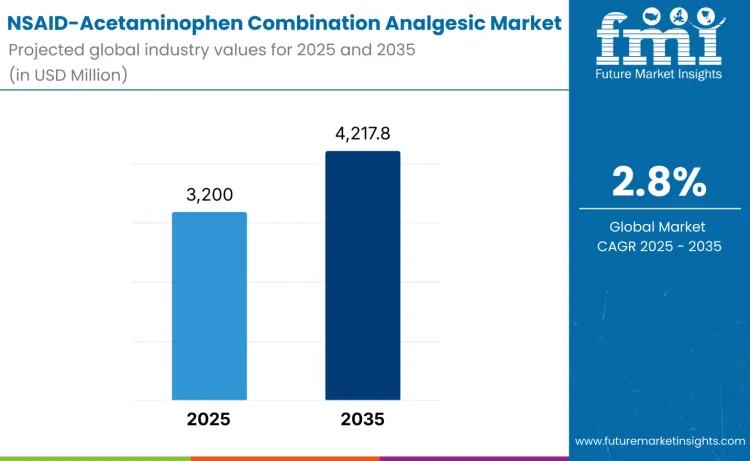
The global NSAID-acetaminophen combination analgesic market is expected to grow steadily, reaching USD 4,217.8 million by 2035 from USD 3,200.0 million in 2025, reflecting a CAGR of 2.8%. This growth is supported by rising clinical preference for non-opioid pain management, wider use of fixed-dose combinations for acute and musculoskeletal pain, and increasing adoption across primary care and ambulatory surgical settings. These combinations offer effective pain control while limiting opioid exposure. Growth is moderated by ongoing attention to hepatic safety thresholds, gastrointestinal tolerability, and increasing availability of single-agent analgesics and topical pain-relief alternatives in certain patient groups.
Market expansion mirrors evolving acute pain treatment practices, where NSAID-acetaminophen combinations are valued for their complementary mechanisms of action and improved analgesic outcomes compared with monotherapy. Patients recovering from dental procedures, orthopedic injuries, and soft-tissue trauma are increasingly managed with combination therapy, particularly in short-term postoperative and emergency outpatient settings. Clinical evidence supporting enhanced pain relief and faster functional recovery has encouraged broader use across multidisciplinary pain-management workflows and outpatient discharge protocols.
Quick Stats for NSAID-Acetaminophen Combination Analgesic Market
- NSAID-Acetaminophen Combination Analgesic Market Value (2025): USD 3,200.0 million
- NSAID-Acetaminophen Combination Analgesic Market Forecast Value (2035): USD 4,217.8 million
- NSAID-Acetaminophen Combination Analgesic Market Forecast CAGR: 2.8%
- Leading Market Segment: OTC combination analgesics (55%)
- Key Growth Regions: Europe, North America, and Asia Pacific
- Top Players: Johnson & Johnson (Tylenol combos), Bayer (Excedrin combos), Pfizer, Reckitt (OTC), major generics
Ongoing formulation innovation continues to influence competition, with manufacturers refining dose ratios, developing rapid-onset oral formats, and introducing extended-release profiles to prolong therapeutic benefit. Patient-friendly packaging and pediatric-appropriate formulations are improving adherence and convenience. Policy focus on responsible pain management, combined with hospital formulary inclusion and perioperative recovery pathways, supports continued use. Pharmacy guidance, patient preference for non-opioid options, and digital prescribing tools further strengthen the role of combination analgesics in modern pain care.
NSAID-Acetaminophen Combination Analgesic Market Year-over-Year Forecast (2025 to 2035)
Between 2025 and 2030, the NSAID-acetaminophen combination analgesic market is expected to expand from USD 3,200.0 million to USD 3,673.8 million, adding USD 473.8 million and representing 46.6% of total decade growth. Expansion is driven by wider adoption of non-opioid multimodal pain protocols, physician preference for dual-mechanism analgesia, and increased use in dental, orthopedic, sports medicine, and outpatient recovery settings. Manufacturers are enhancing competitiveness through optimized dose ratios, faster-onset formulations, and patient-friendly packaging across prescription and OTC channels.
From 2030 to 2035, the market is projected to grow from USD 3,673.8 million to USD 4,217.8 million, contributing 53.4% of overall expansion. Continued inclusion in standardized pain-management pathways, growth in ambulatory surgery and home recovery, and stronger consumer awareness of responsible non-opioid use are expected to support sustained demand.
NSAID-Acetaminophen Combination Analgesic Market Key Takeaways
| Metric | Value |
|---|---|
| Market Value (2025) | USD 3,200.0 million |
| Market Forecast Value (2035) | USD 4,217.8 million |
| Forecast CAGR (2025 to 2035) | 2.8% |
Why Is the NSAID-Acetaminophen Combination Analgesic Market Growing Worldwide?
The NSAID-acetaminophen combination analgesic market expands as clinicians seek effective multimodal pain relief that limits opioid exposure and avoids dose escalation associated with single-agent therapy. Patients treated for acute musculoskeletal injuries, post-operative pain, dental procedures, and fever increasingly benefit from balanced regimens that address pain through complementary mechanisms. Clinical studies demonstrate superior analgesic outcomes versus monotherapy, supporting broad use across emergency care, primary practice, and orthopedic pathways. Ongoing transition toward opioid-sparing protocols continues to reinforce adoption for short-term pain management.
Healthcare systems and clinical guidelines emphasize responsible analgesic use, encouraging structured inclusion across hospital formularies, ambulatory surgery, and community settings. Retail availability and pharmacist-led guidance improve access, while attention to acetaminophen dosing limits and NSAID gastrointestinal risk underscores the need for appropriate patient counseling and clinical oversight.
How Is the NSAID-Acetaminophen Combination Analgesic Market Segmented by Product Type, Application, End User and Region?
The market is segmented by product type, application, and end user. By product type, the market is divided into OTC combination analgesics, prescription combination formulations, liquid and pediatric formats, topical combinations, and others. Based on application, the market is categorized into acute pain and headache, post-operative and dental pain, musculoskeletal pain, and fever & symptomatic relief. End-user segmentation includes retail pharmacies, supermarkets & mass-market outlets, hospital pharmacies, e-commerce, and other channels. Regionally, the market is divided into Asia Pacific, Europe, North America, Latin America, and Middle East & Africa.
By Product Type, the OTC Combination Analgesics Segment Accounts for the Dominant Market Share
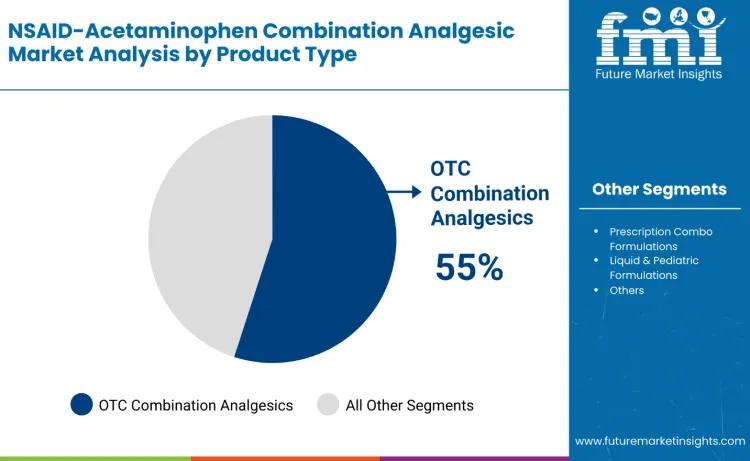
OTC combination analgesics dominate the NSAID-acetaminophen combination landscape in 2025, accounting for about 55% share. Leadership is driven by strong consumer reliance on self-managed pain relief for headaches, fever, and minor injuries, supported by rapid access and pharmacist recommendation. These products align well with non-opioid pain management preferences in outpatient and self-care settings, benefiting from high brand visibility and trust.
Prescription combinations represent 20%, used mainly in supervised post-operative, dental, and orthopedic care. Liquid and pediatric formulations contribute 10% due to dosing flexibility, while topical formats hold 8% for localized pain. Remaining share reflects emerging dosage innovations and region-specific combinations.
By Application, the Acute Pain & Headache Segment Accounts for the Largest Share
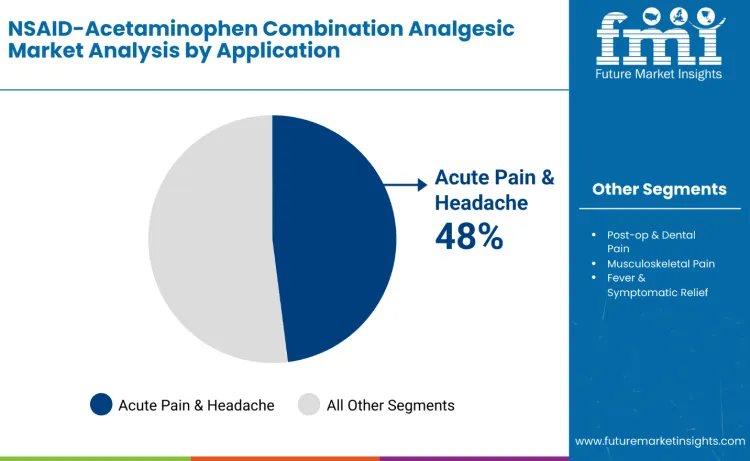
Acute pain and headache applications lead the market with 48% share in 2025, reflecting high global incidence of tension headaches, episodic pain, and daily musculoskeletal strain. NSAID-acetaminophen combinations deliver rapid pain relief and functional improvement in short-duration episodes, reinforcing first-line use across primary care, emergency discharge, and self-treatment scenarios.
Musculoskeletal pain contributes 20%, supported by trauma, sports injuries, and rehabilitation needs. Post-operative and dental pain accounts for 18% as opioid-sparing regimens gain preference. Fever and symptomatic relief represents 14%, driven by seasonal viral illness management and pediatric care. Leadership is sustained by recurrence frequency, fast onset needs, and broad demographic applicability.
By End User, Retail Pharmacies Lead Market Adoption
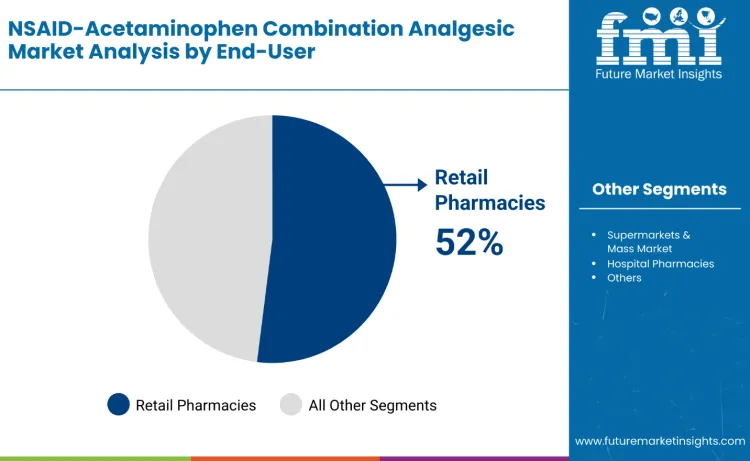
Retail pharmacies lead end-user adoption with 52% share in 2025, reflecting their central role in OTC pain management and pharmacist-guided product selection. Consumers value immediate access, trusted counseling, and clear dosing guidance for episodic pain care. Supermarkets and mass-market outlets account for 18%, supported by convenience purchasing and expanded shelf space.
Hospital pharmacies represent 12%, driven by post-operative and emergency discharge use, while e-commerce contributes 14% through digital pharmacy growth and home-delivery convenience. Other channels hold 4%. Retail pharmacy dominance is reinforced by strong stocking of branded and generic combinations, frequent patient interaction, and visibility within front-of-store pain-relief aisles.
What Are the Major Drivers, Restraints, and Emerging Trends Influencing the NSAID-Acetaminophen Combination Analgesic Market?
The NSAID-acetaminophen combination analgesic market is driven by global shifts toward opioid-sparing pain management and multimodal analgesia adoption. Health systems increasingly position these combinations as first-line therapy in acute pain protocols across surgical recovery and primary care. Rising prevalence of musculoskeletal pain, injury-related conditions, and episodic inflammatory discomfort further strengthens demand, particularly in outpatient and retail settings. Strong patient and provider preference for fast-acting, dual-mechanism, self-administered pain relief reinforces adoption, supported by expanded pharmacy consultation models and evidence-based guidance for short-duration pain management.
What Are the Major Restraints Limiting Adoption of NSAID-Acetaminophen Combination Analgesics?
Market restraints include safety considerations related to acetaminophen-associated hepatotoxicity and NSAID-linked gastrointestinal sensitivity, necessitating cautious use among elderly patients and those with comorbidities. Regulatory focus on maximum daily acetaminophen dosing and region-specific dispensing limits can influence prescribing behavior and treatment duration. In price-sensitive regions, competition from single-ingredient generics or alternative analgesics may restrict uptake. Chronic pain pathways remain tightly regulated, limiting broader use of combination analgesics beyond short-term indications and requiring greater clinician oversight for long-term pain management scenarios.
What Emerging Trends Are Shaping the Future of the NSAID-Acetaminophen Combination Analgesic Market?
Key trends include growing inclusion of NSAID-acetaminophen combinations within standardized pain-management toolkits across emergency departments, ambulatory surgery centers, dental clinics, and sports medicine practices. Expansion of digitally enabled pharmacy distribution and e-commerce platforms is improving accessibility, especially in emerging markets. Product innovation focuses on fast-dissolving tablets, pediatric and geriatric liquid formulations, and improved gastrointestinal tolerance. Concurrently, healthcare systems are strengthening patient education on safe dosing and structured non-opioid pain pathways, reinforcing responsible use and sustained adoption in acute and outpatient pain care settings.
How Are Leading Countries Driving Growth in the NSAID-Acetaminophen Combination Analgesic Market?
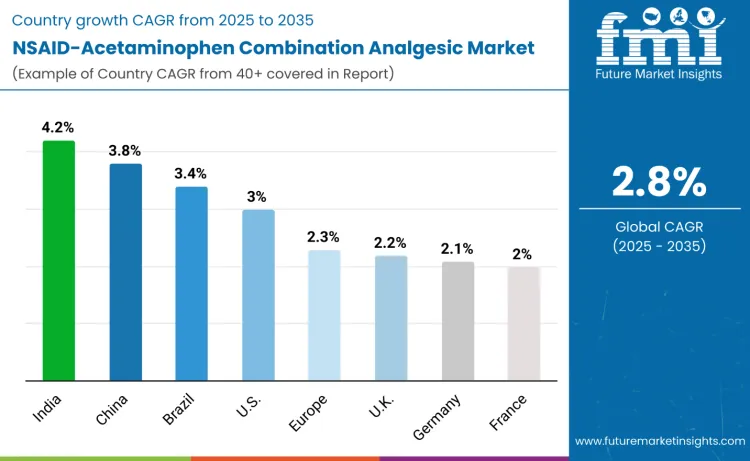
| Country | CAGR (2025 to 2035) |
|---|---|
| USA | 3.0% |
| Brazil | 3.4% |
| China | 3.8% |
| India | 4.2% |
| Europe | 2.3% |
| Germany | 2.1% |
| France | 2.0% |
| UK | 2.2% |
The NSAID-acetaminophen combination analgesic market shows steady global expansion, led by India with 4.2% growth, supported by demand for affordable non-opioid pain relief and expanding pharmacy access in Tier-2 and Tier-3 cities. China follows at 3.8%, driven by strong OTC penetration and fever management use. Brazil grows at 3.4% through community pharmacy adoption. The United States advances at 3.0% with opioid-reduction protocols. Europe posts 2.3% growth, with Germany at 2.1%, the UK at 2.2%, and France at 2.0%, reflecting regulated, pharmacist-led use.
The report covers an in-depth analysis of 40+ countries top-performing countries are highlighted below.
How Is Non-Opioid Pain Management Infrastructure Accelerating Market Growth in China?
China shows strong growth in the NSAID-acetaminophen combination analgesic segment, expanding at a CAGR of 3.8% through 2035. Momentum is driven by rising focus on accessible non-opioid pain relief across outpatient clinics, retail pharmacies, and hospital discharge protocols. Urban middle-class consumers increasingly rely on OTC solutions for fever, headache, and musculoskeletal pain, while pharmacist counseling improves safe-use awareness.
Growth is concentrated in Guangdong, Jiangsu, Zhejiang, and Beijing, supported by dense community-pharmacy networks and stronger primary-care integration. Government initiatives promoting rational medicine use, digital prescription systems, and pharmacy oversight reinforce structured adoption. Expansion of e-pharmacy platforms and smoother hospital-to-home transitions further support routine use of fixed-dose non-opioid analgesics.
Why Are Public Health and Self-Care Initiatives Enhancing Market Adoption in India?
India leads global momentum with a CAGR of 4.2% through 2035, supported by strong self-care culture and expanding pharmacy access across Tier-1, Tier-2, and Tier-3 cities. Rising incidence of headache, fever, and musculoskeletal pain drives routine demand for affordable, fast-acting non-opioid analgesics. Retail pharmacy chains, e-pharmacy platforms, and tele-consultation services improve accessibility, while pharmacist counseling reinforces safe dosing awareness.
Fixed-dose combinations are widely integrated into short-term pain pathways following dental care, minor orthopedic injuries, and outpatient procedures. Government focus on rational medicine use, digital health records, and pharmacy modernization strengthens confidence in combination therapy. Urban healthcare hubs such as Mumbai, Delhi-NCR, Bengaluru, and Hyderabad anchor consistent adoption across clinical and consumer settings.
How Do Clinical Standards and Pharmacy-Led Care Sustain Market Performance in Germany?
Germany maintains disciplined adoption of NSAID-acetaminophen combinations, expanding steadily at a CAGR of 2.1% through 2035. Utilization is guided by evidence-based prescribing practices and strong pharmacist-led patient counseling, particularly for short-duration pain management. Primary care physicians, orthopedic clinics, and dental practices rely on regulated combination formats that emphasize safety-aware dosing and gastrointestinal risk management.
Germany’s statutory health insurance coverage and organized referral systems support consistent analgesic selection across care settings. Community pharmacies play a central role in patient education on dose limits and therapy duration. Alignment with European analgesic stewardship programs further reinforces responsible non-opioid use, sustaining steady demand across acute injury, post-procedure recovery, and episodic pain scenarios.
Why Is Expanding Self-Care Culture Fueling Market Demand in Brazil?
Brazil leads Latin America with solid growth of 3.4% through 2035, driven by a strong self-medication culture and widespread community-pharmacy penetration. Consumers frequently seek pharmacist-guided OTC analgesics for headache, injury-related pain, and fever across metropolitan areas including São Paulo, Rio de Janeiro, Curitiba, and Porto Alegre. Combination analgesics are increasingly recommended in dental clinics, physiotherapy centers, and urgent-care settings where short-course, non-opioid pain relief is preferred.
Partnerships between local and multinational manufacturers expand branded and generic availability, while pharmacy associations promote dosing education and acetaminophen safety. Growing outpatient care utilization and active working-age populations reinforce steady reliance on accessible, fast-acting combination pain therapies.
How Do Established Clinical Protocols Strengthen Market Performance in the United States?
The United States demonstrates mature utilization of NSAID-acetaminophen combinations, growing at a CAGR of 3.0% through 2035. Adoption is anchored in opioid-reduction strategies and standardized multimodal pain protocols across emergency departments, ambulatory surgery centers, dental practices, and primary care. Fixed-dose combinations are commonly included in discharge regimens for orthopedic, dental, and minor surgical procedures.
Strong retail pharmacy presence and recognizable OTC brands support consumer trust, while professional medical societies reinforce acetaminophen safety education. Collaboration between healthcare systems and industry sustains evidence-based guidance on dosing and short-term use. Preference for balanced efficacy and tolerability continues to position combination analgesics as a reliable first-line option in acute pain management.
How Is Primary-Care Integration Supporting Market Growth in United Kingdom?
The United Kingdom records steady expansion at a CAGR of 2.2% through 2035, supported by strong integration of NSAID-acetaminophen combinations into primary care and community pharmacy practice. NHS clinical guidance emphasizes non-opioid strategies for short-term pain, driving routine use in dental procedures, musculoskeletal injuries, and fever management.
General practitioners and pharmacists reinforce combination therapy as first-line treatment for self-limiting pain conditions. Structured counseling programs improve patient adherence to dosing limits and therapy duration. Broad OTC availability and familiarity with trusted brands sustain demand across London, Manchester, Birmingham, and Edinburgh. Alignment with national medication-safety frameworks ensures responsible use, supporting consistent uptake across community and urgent-care environments.
How Competitive Is the Global NSAID-Acetaminophen Combination Analgesic Market and What Defines Its Structure?
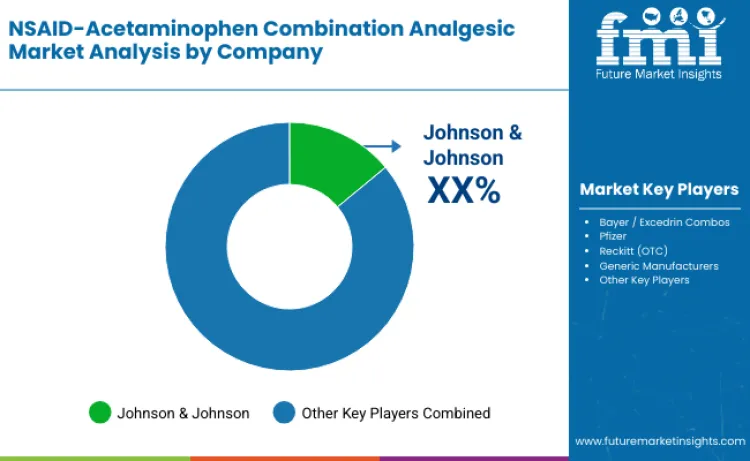
The global NSAID-acetaminophen combination analgesic landscape shows moderate concentration, shaped by a limited group of well-established consumer healthcare companies. Competitive positioning is driven less by price and more by clinical safety perception, formulation consistency, pharmacist recommendation strength, and retail visibility. Leading brands benefit from long-standing consumer trust, clear dosing communication, and strong alignment with non-opioid pain-management practices. Johnson & Johnson holds a leading position through its widely recognized TYLENOL combination portfolio, supported by deep physician endorsement, pharmacist confidence, and extensive retail penetration across everyday pain-relief categories.
Other major players such as Bayer and Pfizer sustain leadership through robust OTC franchises, proven formulation quality, and broad pharmacy and mass-retail distribution. These companies invest heavily in safety education, packaging clarity, and responsible dual-mechanism use guidance. Challenger brands and regional OTC manufacturers compete through targeted positioning, fast-acting variants, and pharmacist engagement. Generic producers also play a meaningful role by supplying high-volume, cost-efficient alternatives, particularly in pharmacy-led and emerging healthcare systems. Overall competition favors companies that balance reliability, safety communication, distribution scale, and consistent manufacturing quality.
Key Players in the NSAID-Acetaminophen Combination Analgesic Market
- Johnson & Johnson / TYLENOL combos
- Bayer / Excedrin combos
- Pfizer
- Reckitt (OTC)
- Generic manufacturers
- Others
Scope of the Report
| Items | Values |
|---|---|
| Quantitative Units | USD 3,200.0 million |
| Product Type | OTC combination analgesics, Prescription combo formulations, Liquid & pediatric formulations, Topical combos, Others |
| Application | Acute pain & headache, Post-op & dental pain, Musculoskeletal pain, Fever & symptomatic relief |
| End User | Retail pharmacies, Supermarkets & mass market, Hospital pharmacies, E-commerce, Others |
| Regions Covered | Asia Pacific, Europe, North America, Latin America, Middle East & Africa |
| Country Covered | China, India, Germany, Brazil, USA, UK, Japan, and 40+ countries |
| Key Companies Profiled | Johnson & Johnson / TYLENOL combos, Bayer / Excedrin combos, Pfizer, Reckitt (OTC), Generic manufacturers, Others |
| Additional Attributes | Dollar sales by product class and pain indications, regional trends across Asia Pacific, Europe, and North America, competitive landscape of branded OTC and generic manufacturers, dosing and safety standards, integration into multimodal pain pathways, and innovations in fast-acting, dual-mechanism, patient-centric analgesic formulations. |
NSAID-Acetaminophen Combination Analgesic Market by Segments
Product Type:
- OTC combination analgesics
- Prescription combo formulations
- Liquid & pediatric formulations
- Topical combos
- Others
Application:
- Acute pain & headache
- Post-op & dental pain
- Musculoskeletal pain
- Fever & symptomatic relief
End User:
- Retail pharmacies
- Supermarkets & mass market
- Hospital pharmacies
- E-commerce
- Others
Region:
- Asia Pacific
- China
- India
- Japan
- South Korea
- Vietnam
- Australia & New Zealand
- ASEAN
- Rest of Asia Pacific
- Europe
- Germany
- United Kingdom
- France
- Italy
- Spain
- Netherlands
- Nordic
- BENELUX
- Rest of Europe
- North America
- United States
- Canada
- Mexico
- Latin America
- Brazil
- Argentina
- Rest of Latin America
- Middle East & Africa
- Kingdom of Saudi Arabia
- Other GCC Countries
- Turkey
- South Africa
- Other African Union
- Rest of Middle East & Africa
Frequently Asked Questions
How big is the NSAID-acetaminophen combination analgesic market in 2025?
The global NSAID-acetaminophen combination analgesic market is valued at USD 3,200.0 million in 2025.
What will be the size of the NSAID-acetaminophen combination analgesic market in 2035?
The market is projected to reach USD 4,217.8 million by 2035.
How fast will the NSAID-acetaminophen combination analgesic market grow between 2025 and 2035?
The market will grow at a CAGR of 2.8% from 2025 to 2035.
Which product type leads the NSAID-acetaminophen combination analgesic market in 2025?
OTC combination analgesics lead the market with an 55% share in 2025.
Who are the major players in the NSAID-acetaminophen combination analgesic market?
Key players include Johnson & Johnson, Bayer, Pfizer, Reckitt, and leading generic manufacturers.
Preview the report firsthand - request a free sample
Get SampleGet the brochure for pricing and purchase details.
Get PDFTable of Content
- Executive Summary
- Regional Level Market Outlook
- Demand-side Trends
- Supply-side Trends
- Technology Roadmap Analysis
- Analysis and Recommendations
- Market Overview
- Market Coverage / Taxonomy
- Market Definition / Scope / Limitations
- Market Background
- Market Dynamics
- Drivers
- Restraints
- Opportunity
- Trends
- Scenario Forecast
- Demand in Optimistic Scenario
- Demand in Likely Scenario
- Demand in Conservative Scenario
- Opportunity Assessment
- Market Trade Assessment
- Products Market Assessment
- Investment Feasibility Matrix
- Value Chain Analysis
- Participants and their Roles
- Profit Margin Analysis
- Operating Margins By Region
- PESTLE and Porter’s Analysis
- Regulatory Landscape
- By Key Regions
- By Key Countries
- Regional Parent Market Outlook
- Product Launches & Development
- Technological Innovation
- Market Dynamics
- Regional Level Market Analysis 2020-2024 and Forecast, 2025-2035
- Historical Market Size USD Million Analysis, 2020-2024
- Current and Future Market Size USD Million Projections, 2025-2035
- Y-o-Y Growth Trend Analysis
- Absolute $ Opportunity Analysis
- Regional Level Market Analysis 2020-2024 and Forecast 2025-2035, By Product Type
- Introduction / Key Findings
- Historical Market Size USD Million Analysis By Product Type, 2020-2024
- Current and Future Market Size USD Million Analysis and Forecast By Product Type, 2025-2035
- OTC combination analgesics
- Prescription combo formulations
- Liquid & pediatric formulations
- Topical combos
- Others
- Y-o-Y Growth Trend Analysis By Product Type, 2020-2024
- Absolute $ Opportunity Analysis By Product Type, 2025-2035
- Regional Level Market Analysis 2020-2024 and Forecast 2025-2035, By Application
- Introduction / Key Findings
- Historical Market Size USD Million Analysis By Application, 2020-2024
- Current and Future Market Size USD Million Analysis and Forecast By Application, 2025-2035
- Acute pain & headache
- Post-op & dental pain
- Musculoskeletal pain
- Fever & symptomatic relief
- Y-o-Y Growth Trend Analysis By Application, 2020-2024
- Absolute $ Opportunity Analysis By Application, 2025-2035
- Regional Level Market Analysis 2020-2024 and Forecast 2025-2035, By End User
- Introduction / Key Findings
- Historical Market Size USD Million Analysis By End User, 2020-2024
- Current and Future Market Size USD Million Analysis and Forecast By End User, 2025-2035
- Retail pharmacies
- Supermarkets & mass market
- Hospital pharmacies
- E-commerce
- Others
- Y-o-Y Growth Trend Analysis By End User, 2020-2024
- Absolute $ Opportunity Analysis By End User, 2025-2035
- Regional Level Market Analysis 2020-2024 and Forecast 2025-2035, By Region
- Introduction
- Historical Market Size USD Million Analysis By Region, 2020-2024
- Current Market Size USD Million Analysis and Forecast By Region, 2025-2035
- North America
- Latin America
- East Asia
- South Asia
- Western Europe
- Eastern Europe
- Middle East & Africa
- Market Attractiveness Analysis By Region
- North America Market Analysis 2020-2024 and Forecast 2025-2035, By Country
- Historical Market Size USD Million Trend Analysis By Market Taxonomy, 2020-2024
- Market Size USD Million Forecast By Market Taxonomy, 2025-2035
- By Country
- USA
- Canada
- Mexico
- By Product Type
- By Application
- By End User
- By Country
- Market Attractiveness Analysis
- By Country
- By Product Type
- By Application
- By End User
- Key Takeaways
- Latin America Market Analysis 2020-2024 and Forecast 2025-2035, By Country
- Historical Market Size USD Million Trend Analysis By Market Taxonomy, 2020-2024
- Market Size USD Million Forecast By Market Taxonomy, 2025-2035
- By Country
- Brazil
- Argentina
- Rest of Latin America
- By Product Type
- By Application
- By End User
- By Country
- Market Attractiveness Analysis
- By Country
- By Product Type
- By Application
- By End User
- Key Takeaways
- East Asia Market Analysis 2020-2024 and Forecast 2025-2035, By Country
- Historical Market Size USD Million Trend Analysis By Market Taxonomy, 2020-2024
- Market Size USD Million Forecast By Market Taxonomy, 2025-2035
- By Country
- China
- Japan
- South Korea
- By Product Type
- By Application
- By End User
- By Country
- Market Attractiveness Analysis
- By Country
- By Product Type
- By Application
- By End User
- Key Takeaways
- South Asia Market Analysis 2020-2024 and Forecast 2025-2035, By Country
- Historical Market Size USD Million Trend Analysis By Market Taxonomy, 2020-2024
- Market Size USD Million Forecast By Market Taxonomy, 2025-2035
- By Country
- India
- ASEAN Countries
- Australia & New Zealand
- Rest of South Asia
- By Product Type
- By Application
- By End User
- By Country
- Market Attractiveness Analysis
- By Country
- By Product Type
- By Application
- By End User
- Key Takeaways
- Western Europe Market Analysis 2020-2024 and Forecast 2025-2035, By Country
- Historical Market Size USD Million Trend Analysis By Market Taxonomy, 2020-2024
- Market Size USD Million Forecast By Market Taxonomy, 2025-2035
- By Country
- Germany
- UK
- France
- Italy
- Spain
- BENELUX
- Nordic Countries
- Rest of Western Europe
- By Product Type
- By Application
- By End User
- By Country
- Market Attractiveness Analysis
- By Country
- By Product Type
- By Application
- By End User
- Key Takeaways
- Eastern Europe Market Analysis 2020-2024 and Forecast 2025-2035, By Country
- Historical Market Size USD Million Trend Analysis By Market Taxonomy, 2020-2024
- Market Size USD Million Forecast By Market Taxonomy, 2025-2035
- By Country
- Russia
- Hungary
- Poland
- Rest of Eastern Europe
- By Product Type
- By Application
- By End User
- By Country
- Market Attractiveness Analysis
- By Country
- By Product Type
- By Application
- By End User
- Key Takeaways
- Middle East & Africa Market Analysis 2020-2024 and Forecast 2025-2035, By Country
- Historical Market Size USD Million Trend Analysis By Market Taxonomy, 2020-2024
- Market Size USD Million Forecast By Market Taxonomy, 2025-2035
- By Country
- Saudi Arabia
- Other GCC Countries
- Türkiye
- South Africa
- Rest of MEA
- By Product Type
- By Application
- By End User
- By Country
- Market Attractiveness Analysis
- By Country
- By Product Type
- By Application
- By End User
- Key Takeaways
- Market Structure Analysis
- Competition Dashboard
- Competition Benchmarking
- Market Share Analysis of Top Players
- By Regional
- By Product Type
- By Application
- By End User
- Competition Analysis
- Competition Deep Dive
- Johnson & Johnson / TYLENOL combos
- Overview
- Product Portfolio
- Key Financials
- Key Developments
- Global/Regional Footprint
- Strategy Overview
- Marketing Strategy
- SWOT
- Analyst Comment
- Bayer / Excedrin combos
- Overview
- Product Portfolio
- Key Financials
- Key Developments
- Global/Regional Footprint
- Strategy Overview
- Marketing Strategy
- SWOT
- Analyst Comment
- Pfizer
- Overview
- Product Portfolio
- Key Financials
- Key Developments
- Global/Regional Footprint
- Strategy Overview
- Marketing Strategy
- SWOT
- Analyst Comment
- Reckitt (OTC)
- Overview
- Product Portfolio
- Key Financials
- Key Developments
- Global/Regional Footprint
- Strategy Overview
- Marketing Strategy
- SWOT
- Analyst Comment
- Generic manufacturers
- Overview
- Product Portfolio
- Key Financials
- Key Developments
- Global/Regional Footprint
- Strategy Overview
- Marketing Strategy
- SWOT
- Analyst Comment
- Johnson & Johnson / TYLENOL combos
- Competition Deep Dive
- Assumptions & Acronyms Used
- Research Methodology


