

- Market Size (2026)
- USD 42.5 Bn
- Forecast (2036)
- USD 133.0 Bn
- CAGR (2026 to 2036)
- 12.1%
Obesity Management Market Size, Market Forecast and Outlook By FMI
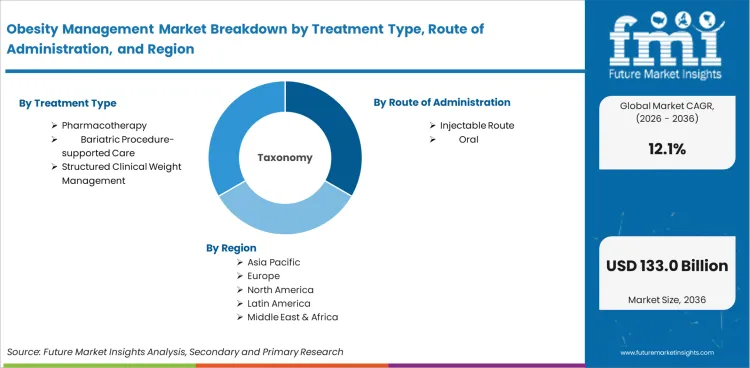
The global obesity management market is estimated to be valued at USD 42.5 billion in 2026 and is projected to reach USD 133.0 billion by 2036, registering a CAGR of 12.1% during the forecast period. Pharmacotherapy is expected to account for 74.0% of treatment-type revenue in 2026, while injectable therapies will lead route-of-administration revenue with 72.0% share.
Summary of the Obesity Management Market
- Demand and Growth Drivers
- Demand is supported by rising obesity prevalence and the shift of obesity treatment from lifestyle-only intervention to regulated medical therapy.
- Disclosed company revenue confirms that prescription obesity drugs already form a multi-billion-dollar global market.
- Clinical guidelines, payer review, and cardiovascular-risk evidence are moving obesity treatment into chronic disease management.
- Private clinics, endocrinology practices, bariatric centers, pharmacies, and telehealth channels are expanding patient access.
- Obesity management demand is no longer limited to surgery or short-term weight-loss programs. Prescription pharmacotherapy has become the largest commercial pool after the uptake of injectable GLP-1 and dual incretin therapies. This changes the scale of the parent market and makes earlier low single-digit billion estimates unusable.
- The market sits across pharmaceuticals, clinical services, and procedure-supported care. Drug revenue accounts for most commercial value, while bariatric care and structured clinical programs support patients who need procedural intervention, monitoring, nutrition management, and long-term follow-up.
- Product and Segment View
- Pharmacotherapy leads the market because branded injectable therapies carry higher per-patient annual revenue than most clinical service components.
- Dual GIP/GLP-1 receptor agonists will expand through adult obesity treatment and related cardiometabolic indications.
- GLP-1 receptor agonists will remain a core segment due to established demand for semaglutide and liraglutide products.
- Oral therapies will remain important for access, adherence preference, and lower-intensity treatment pathways.
- Injectable products account for the largest revenue share because currently approved high-value obesity medicines are concentrated in injectable formats. Oral products, including older agents and future incretin-based therapies, will expand access but will need to compete on efficacy, tolerability, price, and payer acceptance.
- Bariatric procedure-supported care remains relevant for patients with severe obesity, obesity-related complications, and insufficient response to medical therapy. However, procedure volume growth is expected to lag pharmacotherapy revenue because surgeries require specialist capacity, payer approval, and long-term follow-up.
- Geography and Competitive Outlook
- North America will remain the largest region by value due to product pricing, prescription demand, payer review, and direct access channels.
- Western Europe will expand through reimbursement decisions, specialist prescribing, and national obesity-care pathways.
- East Asia will grow through private treatment access and rising cardiometabolic disease burden.
- South Asia and Latin America will grow as diagnosis improves and private-pay demand expands.
- Middle East markets will remain important due to high obesity prevalence and private specialist-care access.
- Competition is concentrated among companies with branded incretin therapies, established chronic-care sales networks, and manufacturing capacity. Novo Nordisk and Eli Lilly set the benchmark for the pharmacotherapy segment. Other pharmaceutical companies, generic manufacturers, bariatric device suppliers, and clinical service providers compete in narrower parts of the market.
- Analyst Opinion
- "Obesity management has moved from a lifestyle-support category into a chronic medical treatment market. The forecast is now anchored by prescription-drug revenue, payer coverage, and long-term cardiometabolic risk management." - Sabyasachi Ghosh, Principal Consultant
- The market should be sized above disclosed obesity-care sales from Novo Nordisk and Eli Lilly because both companies alone already exceed older market estimates.
- Pediatric obesity management remains a child market and should stay materially smaller than the parent.
- Regulated products and clinically delivered programs should remain inside scope; wellness, supplements, and cosmetic procedures should stay outside scope.
- Forecast risk is tied to supply capacity, payer restrictions, discontinuation rates, and price pressure.
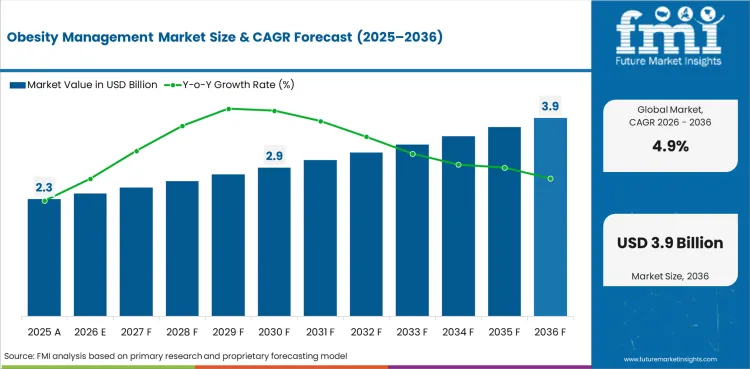
Key Takeaways, Market Size, and Forecast
- The obesity management market is projected to increase from USD 42.5 billion in 2026 to USD 133.0 billion by 2036.
- The market is expected to register a CAGR of 12.1% between 2026 and 2036.
- Pharmacotherapy is expected to account for 74.0% of treatment-type revenue in 2026.
- Injectable therapies are expected to account for 72.0% of route-of-administration revenue in 2026.
- GLP-1 receptor agonists and dual GIP/GLP-1 receptor agonists will account for the largest revenue pool due to branded drug pricing, clinical use, and wider reimbursement review.
- Bariatric procedure-supported care will remain a smaller but clinically important segment for severe obesity and obesity-related comorbidities.
- The USA will remain the largest value market due to prescription-drug uptake, payer coverage expansion, and direct-to-patient access programs.
- East Asia, India, Brazil, and GCC countries will record higher unit growth as obesity prevalence, diagnosis, and private treatment access increase.
Market Definition
The obesity management market covers regulated and clinically delivered interventions used to treat obesity and overweight with weight-related comorbidities. The market includes prescription anti-obesity medicines, bariatric procedure-supported products, and structured clinical weight-management programs delivered through hospitals, specialty clinics, pharmacies, telehealth providers, and public or private health systems.
Market Inclusions
- Prescription anti-obesity medicines approved for chronic weight management
- GLP-1 receptor agonists and dual GIP/GLP-1 receptor agonists used for obesity treatment
- Lipase inhibitors, phentermine-topiramate, bupropion-naltrexone, and other regulated therapies
- Bariatric procedure-supported products and clinical follow-up services
- Structured medical weight-management programs delivered by clinical providers
- Hospital, specialty clinic, retail pharmacy, online pharmacy, and direct-access channels
Market Exclusions
- Dietary supplements and non-prescription weight-loss products
- Fitness equipment, consumer wellness apps, and non-clinical lifestyle programs
- Meal replacements not prescribed as part of clinical obesity care
- Cosmetic body-contouring procedures
- Unapproved compounded products and adult-only medicines used off label outside regulatory scope
- General diabetes-treatment revenue not attributable to obesity management
Market Research Methodology
- Primary Research: Interviews with endocrinologists, obesity-medicine specialists, bariatric surgeons, pharmacists, payers, distributors, and clinical weight-management providers.
- Desk Research: Review of company filings, FDA approvals, WHO obesity data, prescribing guidance, payer policy signals, public health sources, and procedure utilization references.
- Market sizing and forecasting: Revenue was mapped across pharmacotherapy, procedure-supported care, and structured clinical programs, then reconciled with disclosed company sales and country-level access patterns.
- Data validation: Forecasts were checked against Novo Nordisk obesity-care sales, Eli Lilly Zepbound sales, FDA product actions, obesity prevalence, reimbursement trends, and channel behavior.
Why is the Obesity Management Market Growing?
- Obesity prevalence continues to rise across adult and adolescent populations.
- Prescription therapies have created a higher-value treatment market than earlier lifestyle-led models.
- Payers are reassessing coverage because obesity is linked to diabetes, cardiovascular disease, sleep apnea, and other chronic conditions.
- Specialist clinics, pharmacies, and telehealth platforms are expanding access to medical weight management.
The obesity management market is growing because treatment is shifting from short-term weight-loss support to chronic medical care. This shift is supported by drug approvals, clinical evidence, payer review, and patient demand for therapies that deliver clinically meaningful weight reduction.
WHO states that adult obesity has more than doubled since 1990 and adolescent obesity has quadrupled. This disease burden creates a large diagnosed and undiagnosed treatment pool. Market conversion depends on diagnosis, affordability, prescribing access, payer coverage, and therapy persistence.
Company disclosures show the commercial scale. Novo Nordisk reported DKK 82.347 billion in obesity-care sales in 2025. Eli Lilly reported Zepbound sales of USD 13.542 billion in 2025. These two disclosures alone show that the global obesity management market must be sized well above older low-billion estimates.
Market Segmentation Analysis
- Pharmacotherapy leads treatment-type revenue due to branded incretin therapies.
- Injectable therapies lead route-of-administration revenue because the largest current products are injectable.
- Dual GIP/GLP-1 receptor agonists will grow faster than older drug classes.
- Structured clinical weight-management programs support treatment adherence and follow-up.
- Bariatric procedure-supported care remains important for severe obesity and complex comorbidity cases.
Insights into the Pharmacotherapy Segment
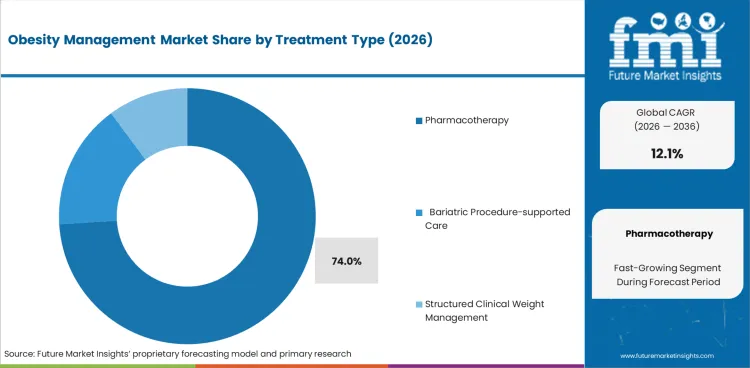
Pharmacotherapy is expected to account for 74.0% of treatment-type revenue in 2026. The segment is led by prescription therapies used for chronic weight management, especially injectable incretin-based products.
Drug revenue is the main reason the parent market needs to be rebuilt. Disclosed annual sales from obesity-care portfolios already exceed the entire value shown on the current live parent page. This confirms that obesity management is now a prescription-led commercial market, not only a procedure or lifestyle-support category.
Pharmacotherapy growth will remain tied to supply, coverage, adherence, physician acceptance, and evidence for obesity-related comorbidities. Price pressure is expected as more products enter the market, but treated-patient volume will continue to expand.
Insights into the Injectable Route Segment
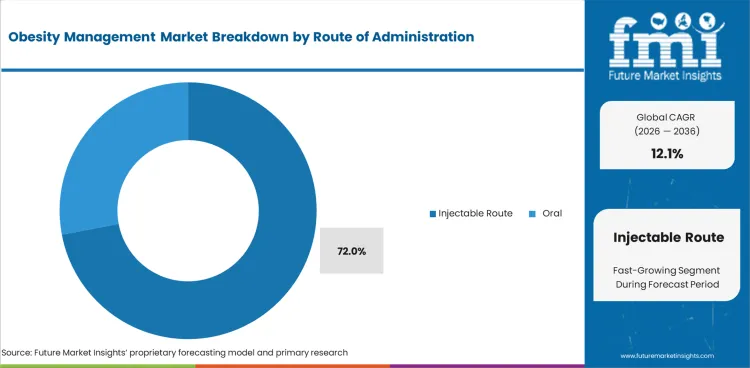
Injectable therapies are expected to account for 72.0% of route-of-administration revenue in 2026. This reflects the commercial strength of semaglutide and tirzepatide-based obesity products.
Injectable products will remain high value because they are supported by clinical outcomes, branded pricing, and established specialist prescribing. Pen devices, supply capacity, and patient training will remain important operational factors for pharmacies and clinics.
Oral therapies will gain share over the forecast period, especially if new oral incretin products show competitive efficacy and tolerability. However, injectable therapies will remain the primary revenue contributor through the first half of the forecast period.
Insights into the Structured Clinical Weight Management Segment
Structured clinical weight-management programs are expected to account for 10.0% of treatment-type revenue in 2026. These programs include physician-supervised care, nutrition support, behavioral counseling, medication monitoring, and long-term follow-up.
This segment is important because drug therapy alone does not cover the full care pathway. Obesity treatment often requires dose management, side-effect monitoring, comorbidity assessment, and maintenance support. Clinics and telehealth providers are building recurring service models around these needs.
Growth will be strongest in countries with private-pay obesity clinics, employer-sponsored care, and specialist-led metabolic health programs. Public-sector growth will depend on reimbursement and health-system capacity.
Obesity Management Market Drivers, Restraints, and Opportunities
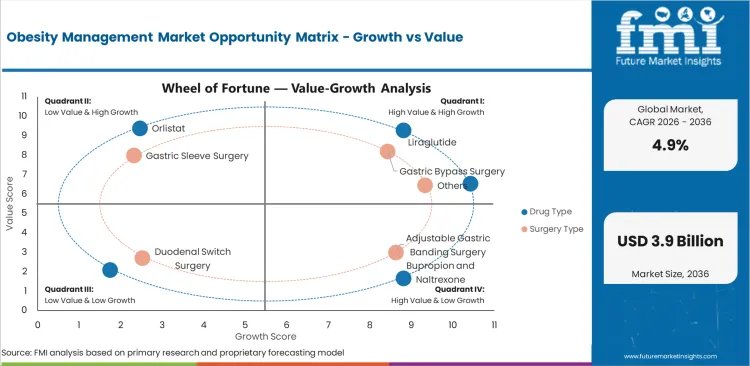
- Drivers include prescription-drug uptake, diagnosis growth, payer review, and obesity-related comorbidity burden.
- Restraints include drug cost, coverage restrictions, supply limits, adverse events, and discontinuation.
- Opportunities are concentrated in oral therapies, pediatric indications, cardiometabolic comorbidity coverage, and emerging-market access.
Prescription Drug Uptake Resets the Market Baseline
The largest driver is the scale-up of regulated obesity pharmacotherapy. GLP-1 receptor agonists and dual GIP/GLP-1 receptor agonists have moved obesity care into a high-value pharmaceutical category.
This shift changes parent-child logic for every related FMI report. Pediatric obesity, obesity treatment devices, injectable obesity drugs, and online obesity care must remain below the rebuilt parent market unless their scope is broader than regulated obesity management.
Payer Coverage and Comorbidity Evidence Shape Access
Coverage remains uneven. Some payers restrict obesity drug reimbursement because of cost, expected duration of therapy, and budget impact. Broader evidence in cardiovascular risk, sleep apnea, diabetes prevention, and other comorbidities will influence coverage decisions.
Employers, insurers, and national health systems will continue to balance clinical value against affordability. This creates different growth rates across countries even where obesity prevalence is high.
Supply and Persistence Limit Near-term Conversion
Manufacturing capacity and product availability will influence near-term sales. Drug shortages, dose escalation requirements, and cold-chain needs can limit patient starts and continuity.
Persistence is another constraint. Side effects, cost, access friction, and weight regain concerns can affect long-term therapy continuation. Service models that improve monitoring and adherence can increase patient retention.
Regional Market Analysis
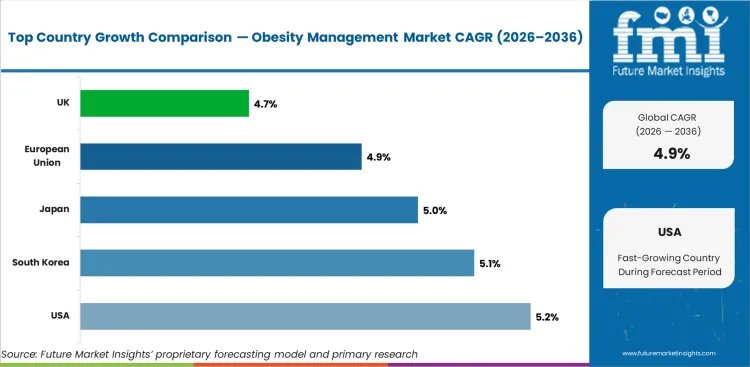
.webp "Top Country Growth Comparison Obesity Management Market Cagr (2026 2036)")
- North America will remain the largest value region due to prescription adoption and pricing.
- Western Europe will grow through reimbursement review and specialist obesity clinics.
- East Asia will expand as diagnosis and private obesity-care access increase.
- South Asia and Latin America will grow from a lower treatment baseline.
- Middle East and Africa will show mixed growth due to high disease burden but uneven reimbursement.
Demand Outlook for Obesity Management Market in the USA
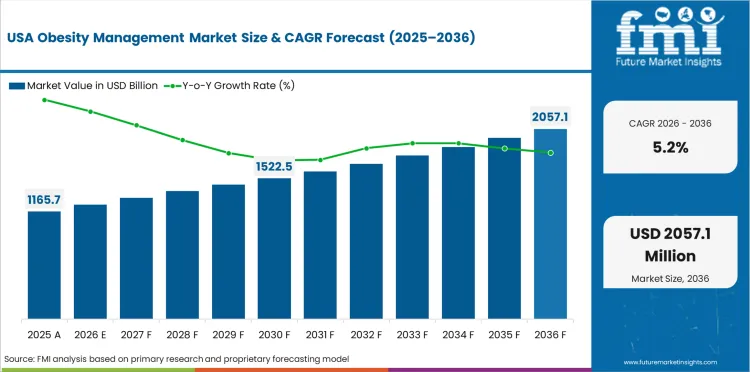
The USA is expected to grow at an 11.8% CAGR from 2026 to 2036. Demand is supported by high obesity prevalence, branded drug uptake, direct-to-patient programs, employer benefit review, and specialist prescribing.
The USA will remain the largest value market because it combines high product pricing with large diagnosed patient pools. Coverage restrictions will remain a constraint, but obesity-related comorbidity evidence is expected to support broader payer review.
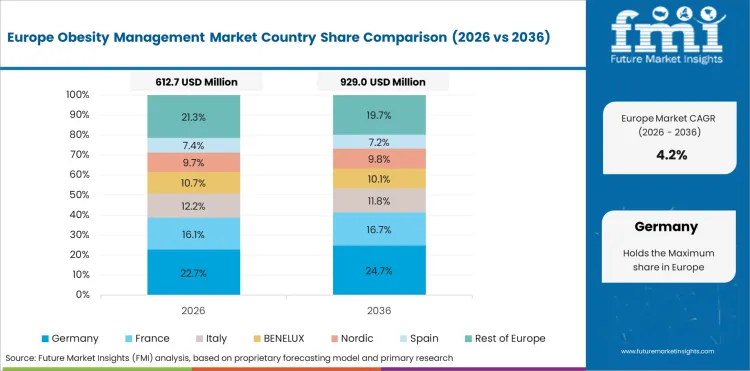
Growth Analysis of Obesity Management Market in Germany
Germany is expected to grow at a 10.4% CAGR from 2026 to 2036. Growth will be shaped by reimbursement policy, specialist prescribing, and clinical recognition of obesity as a chronic disease.
German demand will be less private-pay led than the USA, but uptake will increase as care pathways, physician acceptance, and long-term outcomes evidence improve.
Sales Analysis of Obesity Management Market in the UK
The UK is expected to grow at a 9.6% CAGR from 2026 to 2036. Demand is tied to NHS access decisions, specialist weight-management services, and private clinic adoption.
Public-sector access will depend on cost-effectiveness review and service capacity. Private demand will grow faster among patients seeking earlier access to pharmacotherapy.
Opportunity Analysis of Obesity Management Market in China
China is expected to grow at a 13.4% CAGR from 2026 to 2036. Growth is supported by rising obesity prevalence, urban private healthcare access, domestic pharmaceutical investment, and broader cardiometabolic disease management.
Local competition and pricing pressure will shape long-term value. However, large patient pools and improving diagnosis will support volume growth.
In-depth Analysis of Obesity Management Market in India
India is expected to grow at a 14.2% CAGR from 2026 to 2036. Demand is supported by rising urban obesity, private endocrinology care, diabetes clinic networks, and higher diagnosis of metabolic disease.
Affordability will remain the main constraint. Growth will depend on private-pay adoption, lower-cost branded options, domestic competition, and specialist-led care in metro markets.
Future Outlook for Obesity Management Market in Brazil
Brazil is expected to grow at a 12.8% CAGR from 2026 to 2036. Demand is supported by obesity prevalence, private healthcare access, and interest in pharmacotherapy among patients with cardiometabolic comorbidities.
Pricing and reimbursement will decide the pace of conversion from diagnosis to treatment. Private clinics and retail pharmacy channels will remain important access points.
Demand Assessment for Obesity Management Market in GCC Countries
GCC countries are expected to grow at a 13.1% CAGR from 2026 to 2036. Growth is supported by high obesity prevalence, specialist clinic access, and government focus on metabolic disease burden.
The region will remain a high-value private and institutional market. Treatment access will be shaped by reimbursement, physician capacity, and imported branded therapies.
Competitive Landscape and Strategic Positioning
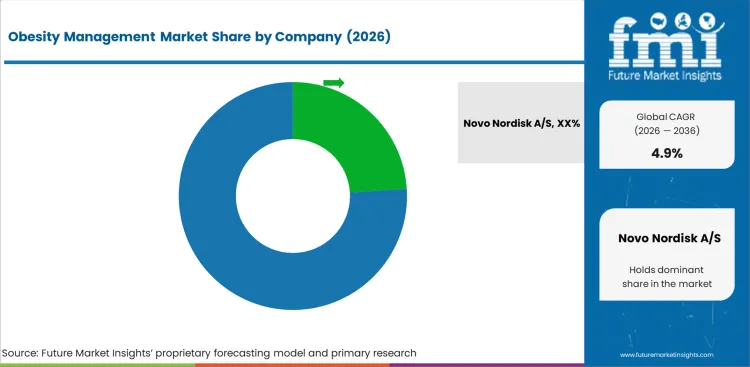
- Branded pharmaceutical companies lead revenue through injectable obesity therapies.
- Manufacturers compete on clinical outcomes, tolerability, dosing convenience, supply capacity, and payer acceptance.
- Bariatric-care providers compete through multidisciplinary care and post-procedure follow-up.
- Virtual-care and clinic-based providers compete through access, monitoring, and patient retention.
Competition is concentrated at the top of the pharmacotherapy market. Novo Nordisk and Eli Lilly are the primary revenue leaders due to Wegovy, Saxenda, and Zepbound. Their disclosed sales establish the commercial baseline for the parent market.
Other companies compete through older anti-obesity drugs, pipeline incretin therapies, oral candidates, bariatric devices, and clinical service models. Generic competition is present in older drug classes, but revenue growth is concentrated in branded therapies with stronger clinical outcomes.
Key Companies in the Obesity Management Market
Key companies in the obesity management market include Novo Nordisk, Eli Lilly and Company, Currax Pharmaceuticals, Vivus, Rhythm Pharmaceuticals, Roche, Pfizer, Amgen, Boehringer Ingelheim, Zealand Pharma, Apollo Endosurgery, Medtronic, Johnson & Johnson MedTech, WW International, Noom, and Hims & Hers Health.
Competitive Benchmarking: Obesity Management Market
| Company | Pharmacotherapy Exposure | Procedure / Device Exposure | Service / Virtual-care Exposure | Geographic Reach |
|---|---|---|---|---|
| Novo Nordisk | High | Low | Low | Global |
| Eli Lilly and Company | High | Low | Low | Global |
| Currax Pharmaceuticals | Medium | Low | Low | USA centered |
| Rhythm Pharmaceuticals | Medium | Low | Low | Rare obesity disorders focused |
| Roche | Pipeline focused | Low | Low | Global |
| Medtronic | Low | Medium | Low | Global |
| Johnson & Johnson MedTech | Low | Medium | Low | Global |
| Noom | Low | Low | High | USA centered |
Key Developments in Obesity Management Market
- In 2025, Novo Nordisk reported DKK 82.347 billion in obesity-care sales, reflecting continued Wegovy and Saxenda demand.
- In 2025, Eli Lilly reported Zepbound sales of USD 13.542 billion.
- FDA requested withdrawal of lorcaserin from the US market in 2020 due to a cancer-risk signal, so lorcaserin should not be used as an active current segmentation item.
- FDA has approved chronic weight-management therapies including Wegovy and Zepbound, supporting the regulated pharmacotherapy base of the market.
- Companies are investing in oral incretin candidates, manufacturing capacity, and broader cardiometabolic evidence to support long-term obesity-care access.
Key Players in the Obesity Management Market
Major Global Players
- Novo Nordisk
- Eli Lilly and Company
- Roche
- Pfizer
- Amgen
- Boehringer Ingelheim
- Zealand Pharma
- Rhythm Pharmaceuticals
- Currax Pharmaceuticals
- Vivus
Device, Service, and Clinical Platform Players
- Medtronic
- Johnson & Johnson MedTech
- Apollo Endosurgery
- WW International
- Noom
- Hims & Hers Health
- Teladoc Health
- Found Health
Report Scope and Coverage
| Parameter | Details |
|---|---|
| Market Value 2026 | USD 42.5 billion |
| Market Value 2036 | USD 133.0 billion |
| CAGR | 12.1% from 2026 to 2036 |
| Incremental Opportunity | USD 90.5 billion between 2026 and 2036 |
| Forecast Period | 2026 to 2036 |
| Historical Data | 2021 to 2025 |
| Base Year | 2025 |
| Estimated Year | 2026 |
| Quantitative Units | USD billion |
| Market Definition | Regulated and clinically delivered obesity treatment products, procedures, and programs |
| Regions Covered | North America, Latin America, Western Europe, Eastern Europe, East Asia, South Asia and Pacific, Middle East and Africa |
| Countries Covered | USA, Canada, Germany, UK, France, Italy, China, Japan, South Korea, India, Australia, GCC Countries, Brazil, Mexico, South Africa, and others |
| Key Companies Profiled | Novo Nordisk, Eli Lilly and Company, Currax Pharmaceuticals, Rhythm Pharmaceuticals, Roche, Pfizer, Amgen, Boehringer Ingelheim, Medtronic, Noom |
Segment Analysis by Drug Class, Treatment Type, Route of Administration, Distribution Channel, End User, and Region
Obesity Management Market by Drug Class:
- GLP-1 Receptor Agonists
- Semaglutide
- Liraglutide
- Dual GIP/GLP-1 Receptor Agonists
- Tirzepatide
- Lipase Inhibitors
- Orlistat
- Phentermine-topiramate
- Bupropion-naltrexone
- MC4R Agonists and Rare Obesity Therapies
- Pipeline and Other Regulated Therapies
Obesity Management Market by Treatment Type:
- Pharmacotherapy
- Bariatric Procedure-supported Care
- Structured Clinical Weight Management
Obesity Management Market by Route of Administration:
- Injectable
- Oral
- Procedure-supported
Obesity Management Market by Distribution Channel:
- Hospital Pharmacies
- Retail Pharmacies
- Online Pharmacies
- Specialty Clinics
- Direct-to-patient Platforms
Obesity Management Market by End User:
- Adults with Obesity
- Adults with Overweight and Weight-related Comorbidities
- Pediatric and Adolescent Patients
- Bariatric Surgery Candidates
- Employer-sponsored and Payer-managed Populations
Obesity Management Market by Region:
- North America
- Latin America
- Western Europe
- Eastern Europe
- East Asia
- South Asia and Pacific
- Middle East and Africa
Research Sources and Bibliography
- World Health Organization, obesity and overweight fact sheet.
- Novo Nordisk Annual Report 2025.
- Eli Lilly and Company Form 10-K / Annual Report 2025.
- US Food and Drug Administration, Zepbound chronic weight management approval.
- US Food and Drug Administration, Wegovy chronic weight management approval and labeling information.
- US Food and Drug Administration, lorcaserin market withdrawal request.
- Public health and clinical literature on obesity prevalence, obesity-related comorbidities, and bariatric-care pathways.
This Report Answers
- How large is the obesity management market in 2026?
- What is the expected obesity management market value by 2036?
- What CAGR is expected between 2026 and 2036?
- Which treatment type leads the market?
- Why does the parent obesity management market need to be larger than pediatric obesity management?
- Which companies are influencing prescription obesity treatment revenue?
- Which products and segments should be included in the market taxonomy?
- Which outdated products should be removed from segmentation?
Frequently Asked Questions
How big is the obesity management market in 2026?
The global obesity management market is estimated to be valued at USD 42.5 billion in 2026.
What will the obesity management market be worth by 2036?
The market is projected to reach USD 133.0 billion by 2036.
What is the CAGR of the obesity management market?
The obesity management market is expected to register a CAGR of 12.1% from 2026 to 2036.
Which treatment type leads the obesity management market?
Pharmacotherapy leads the obesity management market and is expected to account for 74.0% of treatment-type revenue in 2026.
Why is Lorcaserin removed from the segmentation?
Lorcaserin is removed because FDA requested withdrawal of Belviq and Belviq XR from the market in 2020 due to a cancer-risk signal.
Why is the obesity management parent market larger than pediatric obesity management?
The parent obesity management market includes adult and pediatric treatment demand, prescription obesity medicines, bariatric procedure-supported care, and structured clinical programs. Pediatric obesity management is a child market and must remain smaller than the total parent market.
Which companies are active in the obesity management market?
Key companies include Novo Nordisk, Eli Lilly and Company, Currax Pharmaceuticals, Rhythm Pharmaceuticals, Roche, Pfizer, Amgen, Boehringer Ingelheim, Medtronic, Noom, and WW International.
Preview the report firsthand - request a free sample
Get SampleGet the brochure for pricing and purchase details.
Get PDFTable of Content
- Global Market Outlook
- Demand-side Trends
- Supply-side Trends
- Market Overview
- Market Coverage / Taxonomy
- Market Definition / Scope / Limitations
- Research Methodology
- Chapter Orientation
- Analytical Lens and Working Hypotheses
- Market Structure, Signals, and Trend Drivers
- Benchmarking and Cross-market Comparability
- Market Sizing, Forecasting, and Opportunity Mapping
- Research Design and Evidence Framework
- Desk Research Programme (Secondary Evidence)
- Company Annual and Sustainability Reports
- Peer-reviewed Journals and Academic Literature
- Corporate Websites, Product Literature, and Technical Notes
- Earnings Decks and Investor Briefings
- Statutory Filings and Regulatory Disclosures
- Technical White Papers and Standards Notes
- Expert Input and Fieldwork (Primary Evidence)
- Primary Modes
- Qualitative Interviews and Expert Elicitation
- Quantitative Surveys and Structured Data Capture
- Blended Approach
- Why Primary Evidence is Used
- Field Techniques
- Interviews
- Surveys
- Focus Groups
- Observational and In-context Research
- Social and Community Interactions
- Stakeholder Universe Engaged
- C-suite Leaders
- Board Members
- Presidents and Vice Presidents
- R&D and Innovation Heads
- Technical Specialists
- Domain Subject-matter Experts
- Scientists
- Physicians and Other Healthcare Professionals
- Governance, Ethics, and Data Stewardship
- Research Ethics
- Data Integrity and Handling
- Primary Modes
- Tooling, Models, and Reference Databases
- Data Engineering and Model Build
- Data Acquisition and Ingestion
- Cleaning, Normalisation, and Verification
- Synthesis, Triangulation, and Analysis
- Quality Assurance and Audit Trail
- Desk Research Programme (Secondary Evidence)
- Market Background
- Market Dynamics
- Drivers
- Restraints
- Opportunity
- Trends
- Scenario Forecast
- Demand in Optimistic Scenario
- Demand in Likely Scenario
- Demand in Conservative Scenario
- Opportunity Map Analysis
- Product Life Cycle Analysis
- Supply Chain Analysis
- Investment Feasibility Matrix
- Value Chain Analysis
- PESTLE and Porter’s Analysis
- Regulatory Landscape
- Regional Parent Market Outlook
- Production and Consumption Statistics
- Import and Export Statistics
- Market Dynamics
- Global Market Analysis 2021 to 2025 and Forecast, 2026 to 2036
- Historical Market Size Value (USD Million) Analysis, 2021 to 2025
- Current and Future Market Size Value (USD Million) Projections, 2026 to 2036
- Y-o-Y Growth Trend Analysis
- Absolute $ Opportunity Analysis
- Global Market Pricing Analysis 2021 to 2025 and Forecast 2026 to 2036
- Global Market Analysis 2021 to 2025 and Forecast 2026 to 2036, By Treatment Type
- Introduction / Key Findings
- Historical Market Size Value (USD Million) Analysis By Treatment Type , 2021 to 2025
- Current and Future Market Size Value (USD Million) Analysis and Forecast By Treatment Type , 2026 to 2036
- Pharmacotherapy
- Bariatric Procedure-supported Care
- Structured Clinical Weight Management
- Pharmacotherapy
- Y-o-Y Growth Trend Analysis By Treatment Type , 2021 to 2025
- Absolute $ Opportunity Analysis By Treatment Type , 2026 to 2036
- Global Market Analysis 2021 to 2025 and Forecast 2026 to 2036, By Route of Administration
- Introduction / Key Findings
- Historical Market Size Value (USD Million) Analysis By Route of Administration, 2021 to 2025
- Current and Future Market Size Value (USD Million) Analysis and Forecast By Route of Administration, 2026 to 2036
- Injectable Route
- Oral
- Injectable Route
- Y-o-Y Growth Trend Analysis By Route of Administration, 2021 to 2025
- Absolute $ Opportunity Analysis By Route of Administration, 2026 to 2036
- Global Market Analysis 2021 to 2025 and Forecast 2026 to 2036, By Region
- Introduction
- Historical Market Size Value (USD Million) Analysis By Region, 2021 to 2025
- Current Market Size Value (USD Million) Analysis and Forecast By Region, 2026 to 2036
- North America
- Latin America
- Western Europe
- Eastern Europe
- East Asia
- South Asia and Pacific
- Middle East & Africa
- Market Attractiveness Analysis By Region
- North America Market Analysis 2021 to 2025 and Forecast 2026 to 2036, By Country
- Historical Market Size Value (USD Million) Trend Analysis By Market Taxonomy, 2021 to 2025
- Market Size Value (USD Million) Forecast By Market Taxonomy, 2026 to 2036
- By Country
- USA
- Canada
- Mexico
- By Treatment Type
- By Route of Administration
- By Country
- Market Attractiveness Analysis
- By Country
- By Treatment Type
- By Route of Administration
- Key Takeaways
- Latin America Market Analysis 2021 to 2025 and Forecast 2026 to 2036, By Country
- Historical Market Size Value (USD Million) Trend Analysis By Market Taxonomy, 2021 to 2025
- Market Size Value (USD Million) Forecast By Market Taxonomy, 2026 to 2036
- By Country
- Brazil
- Chile
- Rest of Latin America
- By Treatment Type
- By Route of Administration
- By Country
- Market Attractiveness Analysis
- By Country
- By Treatment Type
- By Route of Administration
- Key Takeaways
- Western Europe Market Analysis 2021 to 2025 and Forecast 2026 to 2036, By Country
- Historical Market Size Value (USD Million) Trend Analysis By Market Taxonomy, 2021 to 2025
- Market Size Value (USD Million) Forecast By Market Taxonomy, 2026 to 2036
- By Country
- Germany
- UK
- Italy
- Spain
- France
- Nordic
- BENELUX
- Rest of Western Europe
- By Treatment Type
- By Route of Administration
- By Country
- Market Attractiveness Analysis
- By Country
- By Treatment Type
- By Route of Administration
- Key Takeaways
- Eastern Europe Market Analysis 2021 to 2025 and Forecast 2026 to 2036, By Country
- Historical Market Size Value (USD Million) Trend Analysis By Market Taxonomy, 2021 to 2025
- Market Size Value (USD Million) Forecast By Market Taxonomy, 2026 to 2036
- By Country
- Russia
- Poland
- Hungary
- Balkan & Baltic
- Rest of Eastern Europe
- By Treatment Type
- By Route of Administration
- By Country
- Market Attractiveness Analysis
- By Country
- By Treatment Type
- By Route of Administration
- Key Takeaways
- East Asia Market Analysis 2021 to 2025 and Forecast 2026 to 2036, By Country
- Historical Market Size Value (USD Million) Trend Analysis By Market Taxonomy, 2021 to 2025
- Market Size Value (USD Million) Forecast By Market Taxonomy, 2026 to 2036
- By Country
- China
- Japan
- South Korea
- By Treatment Type
- By Route of Administration
- By Country
- Market Attractiveness Analysis
- By Country
- By Treatment Type
- By Route of Administration
- Key Takeaways
- South Asia and Pacific Market Analysis 2021 to 2025 and Forecast 2026 to 2036, By Country
- Historical Market Size Value (USD Million) Trend Analysis By Market Taxonomy, 2021 to 2025
- Market Size Value (USD Million) Forecast By Market Taxonomy, 2026 to 2036
- By Country
- India
- ASEAN
- Australia & New Zealand
- Rest of South Asia and Pacific
- By Treatment Type
- By Route of Administration
- By Country
- Market Attractiveness Analysis
- By Country
- By Treatment Type
- By Route of Administration
- Key Takeaways
- Middle East & Africa Market Analysis 2021 to 2025 and Forecast 2026 to 2036, By Country
- Historical Market Size Value (USD Million) Trend Analysis By Market Taxonomy, 2021 to 2025
- Market Size Value (USD Million) Forecast By Market Taxonomy, 2026 to 2036
- By Country
- Kingdom of Saudi Arabia
- Other GCC Countries
- Turkiye
- South Africa
- Other African Union
- Rest of Middle East & Africa
- By Treatment Type
- By Route of Administration
- By Country
- Market Attractiveness Analysis
- By Country
- By Treatment Type
- By Route of Administration
- Key Takeaways
- Key Countries Market Analysis
- USA
- Pricing Analysis
- Market Share Analysis, 2025
- By Treatment Type
- By Route of Administration
- Canada
- Pricing Analysis
- Market Share Analysis, 2025
- By Treatment Type
- By Route of Administration
- Mexico
- Pricing Analysis
- Market Share Analysis, 2025
- By Treatment Type
- By Route of Administration
- Brazil
- Pricing Analysis
- Market Share Analysis, 2025
- By Treatment Type
- By Route of Administration
- Chile
- Pricing Analysis
- Market Share Analysis, 2025
- By Treatment Type
- By Route of Administration
- Germany
- Pricing Analysis
- Market Share Analysis, 2025
- By Treatment Type
- By Route of Administration
- UK
- Pricing Analysis
- Market Share Analysis, 2025
- By Treatment Type
- By Route of Administration
- Italy
- Pricing Analysis
- Market Share Analysis, 2025
- By Treatment Type
- By Route of Administration
- Spain
- Pricing Analysis
- Market Share Analysis, 2025
- By Treatment Type
- By Route of Administration
- France
- Pricing Analysis
- Market Share Analysis, 2025
- By Treatment Type
- By Route of Administration
- India
- Pricing Analysis
- Market Share Analysis, 2025
- By Treatment Type
- By Route of Administration
- ASEAN
- Pricing Analysis
- Market Share Analysis, 2025
- By Treatment Type
- By Route of Administration
- Australia & New Zealand
- Pricing Analysis
- Market Share Analysis, 2025
- By Treatment Type
- By Route of Administration
- China
- Pricing Analysis
- Market Share Analysis, 2025
- By Treatment Type
- By Route of Administration
- Japan
- Pricing Analysis
- Market Share Analysis, 2025
- By Treatment Type
- By Route of Administration
- South Korea
- Pricing Analysis
- Market Share Analysis, 2025
- By Treatment Type
- By Route of Administration
- Russia
- Pricing Analysis
- Market Share Analysis, 2025
- By Treatment Type
- By Route of Administration
- Poland
- Pricing Analysis
- Market Share Analysis, 2025
- By Treatment Type
- By Route of Administration
- Hungary
- Pricing Analysis
- Market Share Analysis, 2025
- By Treatment Type
- By Route of Administration
- Kingdom of Saudi Arabia
- Pricing Analysis
- Market Share Analysis, 2025
- By Treatment Type
- By Route of Administration
- Turkiye
- Pricing Analysis
- Market Share Analysis, 2025
- By Treatment Type
- By Route of Administration
- South Africa
- Pricing Analysis
- Market Share Analysis, 2025
- By Treatment Type
- By Route of Administration
- USA
- Market Structure Analysis
- Competition Dashboard
- Competition Benchmarking
- Market Share Analysis of Top Players
- By Regional
- By Treatment Type
- By Route of Administration
- Competition Analysis
- Competition Deep Dive
- Novo Nordisk
- Overview
- Product Portfolio
- Profitability by Market Segments (Product/Age /Sales Channel/Region)
- Sales Footprint
- Strategy Overview
- Marketing Strategy
- Product Strategy
- Channel Strategy
- Eli Lilly and Company
- Roche
- Pfizer
- Amgen
- Boehringer Ingelheim
- Zealand Pharma
- Novo Nordisk
- Competition Deep Dive
- Assumptions & Acronyms Used


