
- Market Size (2026)
- USD 460.4 Bn
- Forecast (2036)
- USD 966.7 Bn
- CAGR (2026 to 2036)
- 7.7%
How big is Weight Management Market in 2026?
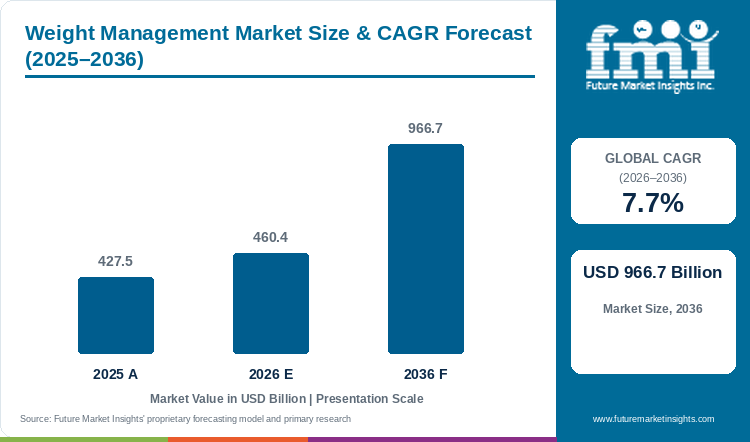
The weight management market demonstrated steady progress from USD 427.5 billion in 2025 to USD 460.4 billion in 2026, building toward a targeted valuation of USD 966.7 billion by 2036 at a CAGR of 7.7%.
According to FMI, global weight management market size stood near USD 427.5 billion during 2025 before reaching an estimated valuation of USD 460.4 billion for 2026. Over the forecast period, overall industry valuation is projected to climb to USD 966.7 billion by 2036, expanding at a 7.7% CAGR and creating an additional valuation of USD 506.3 billion between 2026 and 2036. Compared with the standalone meal replacement products sector growing at a 5.6% CAGR, the wider weight management industry is expanding faster because buyers combine doctor-prescribed weight-loss plans and coaching apps with daily protein foods, keeping low-calorie meal replacements and high-protein shakes at 36.8% of offering category demand in 2026. The demand for companion protein nutrition is supported by the rapid uptake of medical obesity treatments that reduce appetite and require users to protect muscle mass. Specifically, a July 2025 report from the U.S. CDC National Center for Health Statistics showed that 26.5% of adults with diagnosed diabetes and 32.4% of those with concurrent obesity used injectable GLP-1 medicines in 2024, which is directly pulling grocery and pharmacy orders for fortified shakes and fiber supplements [1]. However, high out-of-pocket medication costs and stomach side effects cause many users to stop treatment within a year, which acts as a restraining factor for long-term subscription retention. Even so, brands that offer affordable, good-tasting 30-gram protein shakes paired with simple telehealth diet plans will continue to drive buyer adoption through 2036.
Key Market Trends & Insights
- By offering category: Low-calorie meal replacements and high-protein shakes capture 36.8% of category share in 2026 because pre-portioned 0-to-220-kilocalorie shakes simplify daily calorie and protein tracking.
- By clinical & lifestyle application: Clinical obesity and cardiometabolic risk reduction commands 38.6% of application share in 2026 owing to doctor referrals aimed at lowering blood sugar and body fat.
- By distribution channel: Supermarkets and mass pharmacies secure 46.3% of channel share in 2026 through cold-case placement right next to pharmacy pickup counters.
- By regulatory classification: Prescription and clinician-supervised pathways hold 54.5% of classification share in 2026 driven by employer-funded telehealth clinics and bariatric care plans.
- By clinical setting: Specialized outpatient and ambulatory centers represent 50.4% of setting share in 2026 supported by weight-loss clinics that pair medical checkups with dietitian coaching.
Regional Highlights
- Fastest national expansion:Fastest national expansion: Brazil leads major tracked economies with an 8.6% CAGR through 2036 due to expanding private weight-loss clinics and urban pharmacy shake sales.
- Developed market momentum: The United States advances at a 7.4% CAGR while the United Kingdom records a 7.1% CAGR and Germany posts a 6.9% CAGR through 2036.
Market Size & Forecast
Table 1: Market Size and Forecast for the Weight Management Market (USD Billion and CAGR Percent), 2025 to 2036
| Metric | Value |
|---|---|
| 2025 Market Size | USD 427.5 billion |
| Estimated Market Size in 2026 | USD 460.4 billion |
| Projected Market Size by 2036 | USD 966.7 billion |
| CAGR, 2026 to 2036 | 7.7% |
| Incremental Dollar Opportunity, 2026 to 2036 | USD 506.3 billion |
FMI estimates that global weight management industry valuation advances past USD 427.5 billion for 2025 and USD 460.4 billion for 2026 toward USD 966.7 billion in 2036 on a 7.7% CAGR. Greater consumer awareness regarding the health risks of obesity and diabetes is shifting demand away from short-term crash diets toward year-round medical and nutrition programs. Outpatient clinics and food companies are catering to this demand by pairing GLP-1 companion meal replacements with regular body-weight checkups so users do not lose muscle while eating less food. Recent clinical data confirm this shift, as a February 2026 study by Muhundan and Dash in Advances in Therapy reported that patients achieved average weight reductions of 14.9% on weekly semaglutide and 20.9% on tirzepatide compared with 26.8% after gastric bypass surgery, which is encouraging millions of adults to enter structured weight-loss programs and buy companion nutrition products [2].
Active Participant Pool and Daily Regimen Sizing
Table 2: Active Participant Pool and Regimen Sizing for the Weight Management Market (USD Billion and Million Users), 2025 to 2036
| Metric | 2025 | 2026 | 2036 |
|---|---|---|---|
| Market size (USD billion) | 427.5 | 460.4 | 966.7 |
| Active structured weight-management users (million) | 585.0 to 620.0 | 625.0 to 665.0 | 1,080.0 to 1,150.0 |
| Daily portion-controlled servings consumed (million) | 820.0 to 890.0 | 885.0 to 960.0 | 1,650.0 to 1,790.0 |
| Average annual spend per active user (USD) | 690.0 to 730.0 | 695.0 to 735.0 | 840.0 to 895.0 |
Operational note: Participant pool estimates reconcile adult overweight and obesity cohorts actively enrolled in commercial dietary and digital coaching programs or bariatric maintenance regimens.
Stronger consumer preference toward convenient ready-to-consume protein formats is driving repeat monthly spending per active user across the market. Adults who are trying to maintain their weight loss after finishing a diet or medical treatment need steady daily protein intake so their metabolism does not slow down. To capture these repeat buyers, grocery retailers and online health platforms are bundling cardiometabolic protein nutrition into monthly home-delivery subscriptions that keep customers ordering week after week.
Per Capita & Outpatient Clinic Sizing
Table 3: Per Capita and Participant Allocation Indicators for the Weight Management Market (USD), 2025 to 2036
| Metric | 2025 | 2026 | 2036 |
|---|---|---|---|
| Global adult population (billion) | 5.9 | 6.0 | 6.6 |
| Market value per 1,000 adults (USD) | 72,457.6 | 76,733.3 | 146,469.7 |
| Annual companion nutrition spend per GLP-1 patient (USD) | 1,120.0 to 1,30.0 | 1,0.0 to 1,450.0 | 1,520.0 to 1,90.0 |
| Clinician-supervised regimen share (%) | 53.% to 54.2% | 54.3% to 54.7% | 5.5% to 60.5% |
Table 4: Outpatient Clinic & Retail Channel Indicators for the Weight Management Market (USD Billion), 2026
| Metric | Value | Institutional & Retail Reference Basis |
|---|---|---|
| Market size, 2026 | USD 460.4 billion | 2026 global industry valuation baseline |
| Outpatient metabolic clinics & pharmacies | 35,000 locations | Global accredited obesity clinics and retail chains |
| Average annual market value per location | USD 1.2 million | Annualized clinic and retail channel throughput |
| Outpatient and ambulatory setting allocation, 2026 | USD 232.0 billion | 50.4% clinical setting share allocation |
Higher corporate healthcare bills for heart disease and joint surgery are prompting employers and health plans to fund outpatient weight-management programs for their workers. When outpatient clinics combine doctor checkups with portion-controlled shakes, patients stay on their diet plans longer and avoid costly hospital visits. As a result, health insurers and self-insured companies are actively covering metabolic health meal replacements as part of workplace wellness benefits, which directly expands institutional sales volume.
Analyst Perspective
"Medical weight-loss treatments have turned weight management from a seasonal January diet business into a year-round demand for muscle-preserving protein foods. Companies that offer affordable 30-gram protein shakes with smooth taste and easy home delivery are capturing the strongest repeat sales across supermarkets and telehealth clinics."
- Anurag Sharma, Principal Consultant, Future Market Insights.
How is the weight management market segmented?
The weight management market is segmented by offering category, clinical & lifestyle application, distribution channel, regulatory classification, and clinical setting, and region. In 2026, low-calorie meal replacements, high-protein shakes & dietary products are projected at 36.8%, clinical obesity & cardiometabolic risk reduction at 3.6%, supermarkets, pharmacies & mass merchandisers at 46.3%, prescription and clinician-supervised at 54.5%, and specialized outpatient and ambulatory centers at 50.4%.
By offering category: low-calorie meal replacements, high-protein shakes & dietary products, metabolic & thermogenic weight-loss supplements & GLP-1 companion nutrition, fitness & body-composition equipment, and digital coaching, bariatric & medically supervised programs.
By clinical & lifestyle application: clinical obesity & cardiometabolic risk reduction, general lifestyle weight maintenance & toning, and post-bariatric & GLP-1 lean-mass preservation.
By distribution channel: supermarkets, pharmacies & mass merchandisers, direct-to-consumer digital subscriptions & telehealth, and weight-loss clinics, gyms & health clubs.
By regulatory classification: prescription and clinician-supervised and over-the-counter and consumer self-care.
By clinical setting: specialized outpatient and ambulatory centers, acute-care inpatient hospitals, and home-care and remote patient settings.
Why do low-calorie meal replacements account for a notable share of offering category demand?
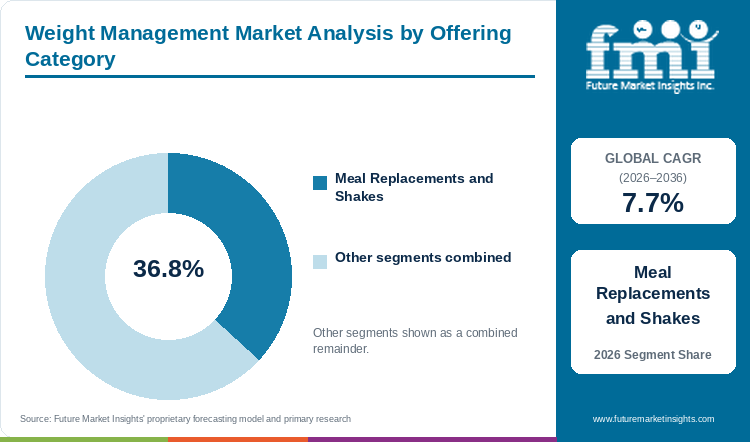
Low-calorie meal replacements and high-protein shakes capture 36.8% of offering category demand in 2026, supported by lean-mass preservation during calorie restriction.
Table 5: Offering Category Share for the Weight Management Market (Percentage Share), 2026
| Offering Category | Share (2026) |
|---|---|
| Low-Calorie Meal Replacements, High-Protein Shakes & Dietary Products | 36.8% |
| Other Offering Categories Combined | 63.2%* |
| Total | 100.0% |
*Note: Remaining offering categories sum to 100.0% of 2026 global weight management market value.
Table 6: Offering Category Leadership and Growth for the Weight Management Market (Segment and Value), 2026 to 2036
| Metric | Value |
|---|---|
| Global CAGR (2026 to 2036) | 7.7% |
| Leading Offering Segment | Low-Calorie Meal Replacements, High-Protein Shakes & Dietary Products |
FMI's segment analysis indicates that busy working adults prefer ready-to-drink protein shakes and meal bars because they take the guesswork out of counting calories while keeping hunger away. Nutrition brands are using cold-filtered native whey protein isolates to make smooth, light shakes that are easy on the stomach and pack 25 to 35 grams of protein into a single carton.
- Low-calorie meal replacements and high-protein shakes secure 36.8% of offering category share in 2026 because fixed-calorie bottles prevent portion creep during workday meals.
- According to an October 2025 clinical consensus report by Noronha and co-authors in Obesity Pillars, roughly 25% of total weight lost on obesity medications is lean muscle unless patients eat more than 1.2 grams of protein per kilogram of body weight each day, which is boosting daily shake consumption [3].
What supports clinical obesity and cardiometabolic risk reduction as a preferred choice by application?
Clinical obesity and cardiometabolic risk reduction secures 38.6% of the application category in 2026, driven by medical referrals for visceral adiposity and diabetes remission.
High rates of type 2 diabetes and high blood pressure are driving doctors and patients to treat obesity as a serious medical condition rather than a cosmetic issue. To avoid vitamin and mineral shortages while eating smaller meals, patients pair their medical weight-loss plans with daily dietary supplement regimens containing vitamin D and iron plus vitamin B12.
- Clinical obesity and cardiometabolic risk reduction commands 38.6% of application share in 2026 owing to expanding medical screening for adults with high body mass index.
- Per a May 2025 joint nutrition advisory by Mozaffarian and colleagues in AJCN, adults taking obesity medicines cut their daily food intake by 16% to 39% or about 700 to 800 calories per day, creating strong demand for nutrient-dense medical meals.[4].
How are supermarkets and mass pharmacies gaining use across applications in distribution channels?
Supermarkets and mass merchandisers command 46.3% of distribution channel share in 2026, reflecting weekly household grocery restocking of high-protein RTD shakes.
Supermarkets and club stores as well as pharmacy chains are expanding shelf space for multi-pack protein shakes right next to pharmacy counters so patients can pick up their food and medicine in one trip. Families doing their weekly grocery shopping prefer buying low-calorie ready-to-drink beverages and protein bars in store multipacks because it is cheaper than paying parcel shipping fees for heavy liquid bottles.
- Supermarkets and mass merchandisers account for 46.3% of channel share in 2026 driven by nationwide club-store pallet promotions and pharmacy loyalty discounts.
- In its October 2025 Form 10-K filing, The Simply Good Foods Company disclosed that full-year net sales rose 9.0% to USD 1.45 billion in fiscal 2025 as retail grocery demand grew for Quest protein snacks and OWYN plant-based shakes[5].
Why are buyers selecting prescription and clinician-supervised pathways within regulatory classification?
Prescription and clinician-supervised pathways account for 54.5% of regulatory classification share in 2026, owing to medical eligibility screening and telehealth titration protocols.
Adults with significant weight to lose are choosing doctor-supervised programs because medical checkups and blood tests are required to get insurance coverage and safe dose adjustments. Regular progress monitoring by a doctor and dietitian also helps patients manage stomach side effects and stay on their weight-loss plan.
- Prescription and clinician-supervised pathways hold 54.5% of regulatory classification share in 2026 supported by integrated telehealth prescribing and employer health benefit coverage.
- Meanwhile direct-selling and coaching companies are also adding digital tools, with Herbalife Ltd. reporting USD 5.04 billion in 2025 net sales per its December 2025 annual statement while launching its Pro2col digital wellness platform[6].
Which market conditions keep specialized outpatient and ambulatory centers relevant within clinical settings?
Specialized outpatient and ambulatory centers hold 50.4% of clinical setting share in 2026, reinforced by multidisciplinary dietitian coaching and body-composition monitoring.
Outpatient weight-loss centers allow patients to get body-fat scans and dietitian coaching plus non-surgical weight-loss procedures in a half-day clinic visit without paying for an overnight hospital stay. These clinics also use mobile apps to check in on patients between visits, which improves long-term diet adherence.
- Specialized outpatient and ambulatory centers capture 50.4% of clinical setting share in 2026 attributable to lower clinic visit costs and convenient outpatient care.
- In addition to this, food manufacturers are supplying dedicated clinic product lines, with Nestle S.A. reporting during its February 2026 annual investor presentation that Nestle Health Science delivered positive real internal growth in 2025 through its Boost and Orgain nutrition brands [7].
What are the drivers, restraints, and opportunities in the weight management market?
Across the weight management market, expanding incretin prescriptions lift demand for high-protein companion shakes whereas out-of-pocket medication costs restrain twelve-month persistence and bundled telehealth meal subscriptions open recurring growth avenues.
- Driver: Widespread adoption of GLP-1 weight-loss medicines compels patients to buy high-protein shakes and supplements so they do not lose muscle while eating less.
- Restraint: High monthly out-of-pocket medication costs and stomach side effects cause many users to stop treatment and regain weight within a year.
- Opportunity: Telehealth clinics that bundle online doctor prescriptions with automatic monthly home delivery of protein meals and vitamins capture steady recurring sales.
Growth Analysis and Future Potential: Incretin Companion Nutrition and Muscle Preservation
Future Market Insights notes that the rapid rise in prescriptions for appetite-suppressing obesity medicines has created a major new customer base for high-protein foods across outpatient clinics. Because these medicines slow down digestion and make users feel full quickly, patients cannot eat large plates of meat or heavy meals and instead buy whey protein concentrates and light protein shakes to meet their daily nutrition needs. In practice, a June 2025 report from the U.S. CDC Morbidity and Mortality Weekly Report showed that obesity medication prescriptions among adolescents aged 12 to 17 rose sharply across outpatient clinics as doctors expanded early weight intervention [8]. This growing pool of younger and adult patients is directly boosting retail sales of portion-controlled protein drinks.
Risk Assessment of the Weight Management Market: Discontinuation, Cost Barriers, and Weight Regain
High monthly treatment bills and frequent stomach discomfort remain the biggest hurdles holding back long-term customer retention in the weight management market. When insurance plans deny coverage or charge high copayments, many consumers stop taking their medicine after a few months and regain the weight they lost if they do not have a structured metabolic surgery long-term nutrition and exercise plan in place. According to the December 2025 ADA Standards of Care in Diabetes-2026 guidelines, about 40% of patients taking incretin medicines experience nausea or digestive side effects that require careful dose adjustments and low-fat meal changes [9]. These cost and side-effect issues limit multi-year program completion among middle-income households.
Commercial Opportunity Analysis: Hybrid Telehealth Coaching and Post-Bariatric Maintenance
Online weight-loss clinics and nutrition companies are finding strong growth opportunities by combining mobile diet-tracking apps with regular video calls from registered dietitians. When users track their daily protein intake on digital health for obesity platforms and receive home-delivered shakes in different flavors, they are much less likely to get bored with their diet and quit. Published outcome evidence supports this model, as a January 2026 study by Al-Badr and Al-Qahtani in Journal of Obesity found that pairing bariatric or medical weight-loss care with ongoing post-treatment protein supplementation helps patients keep weight off over multiple years [10]. Suppliers that offer bundled subscription boxes with coaching and shakes are winning higher customer lifetime value.
Weight Management Market by Country (2026 to 2036)
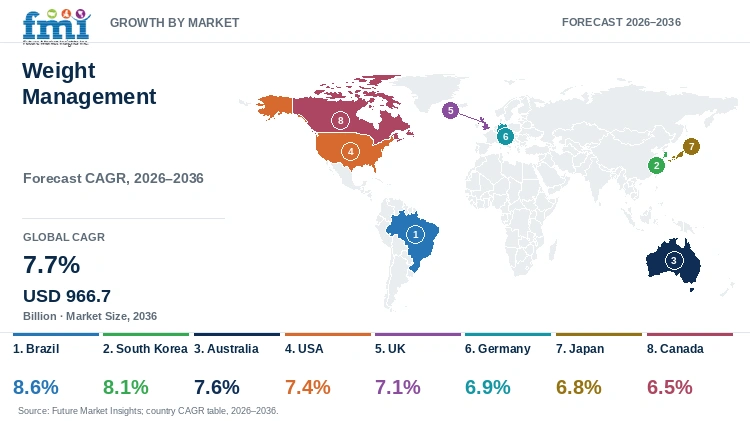
As per FMI, national growth rates across the global weight management market depend on whether health insurance covers obesity treatments and how much consumers spend on retail protein shakes. Brazil is projected to advance at an 8.6% CAGR through 2036, followed by South Korea (8.1%) and Australia (7.6%), while the United States progresses at 7.4%.
Table 7: Country CAGR and Primary Growth Levers for the Weight Management Market (CAGR Percent), 2026 to 2036
| Country | CAGR (2026 to 2036) | Primary Growth Lever |
|---|---|---|
| Brazil | 8.6% | Urban retail pharmacy GLP-1 access and single-serve whey and collagen meal sachets |
| South Korea | 8.1% | Lower Asian BMI clinical thresholds and dawn-delivery functional shake subscriptions |
| Australia | 7.6% | Pharmacy-dispensed VLCD meal replacement shakes and telehealth metabolic clinics |
| USA | 7.4% | Mass-merchandiser 30g RTD protein shake velocity and employer telehealth benefits |
| UK | 7.1% | NICE TA1026 wraparound nutritional care mandates and regulated digital pharmacies |
| Germany | 6.9% | DiGA-reimbursed digital obesity coaching apps and drugstore clean-label meal powders |
| Japan | 6.8% | Mandatory workplace Metabo waist screening and FFC visceral-fat functional beverages |
| Canada | 6.5% | Employer group telehealth obesity coverage and pharmacy-dispensed protein maintenance |
Source: Future Market Insights analysis
Brazil Weight Management Market Outlook (2026 to 2036)
By 2036, Brazil is projected to grow at an 8.6% CAGR, driven by strong retail pharmacy demand for over-the-counter weight-loss treatments and ready-to-drink protein shakes. Unlike North America where employer health plans cover prescriptions, consumers in Brazil buy weight-loss products directly out of pocket at large pharmacy chains such as Drogasil and Raia. Halpern and co-authors reported in Archives of Endocrinology and Metabolism in November 2025 that adult obesity in Brazil passed 30% for the first time in 2025, creating a large addressable population across 214 million citizens [11]. Because imported diet shakes are expensive for middle-class families, local nutrition companies are launching affordable single-serve whey and collagen powder packets.
Key takeaway:Key takeaway: In Brazil, out-of-pocket pharmacy access to incretin therapies and affordable single-serve protein sachets drive an 8.6% CAGR through 2036.
South Korea Weight Management Market Outlook (2026 to 2036)
Strong consumer interest in fitness and convenience-store functional drinks sets the weight management market in South Korea apart from Western surgical weight-loss models. National industry valuation in South Korea is projected to expand at an 8.1% CAGR between 2026 and 2036, supported by overnight home delivery of meal replacement shakes and health-store diet supplements across the country. Per the World Health Organization World Health Statistics 2026 dataset released during May 2026, Asia-Pacific health ministries are expanding early metabolic screening and nutrition guidance under lower Asian body-mass-index thresholds of 25 kilograms per square meter [12]. Although strict food advertising rules limit fat-burner claims, domestic brands win repeat buyers with clean-label grain and protein pouches.
Key takeaway:Key takeaway: In South Korea, lower clinical BMI intervention thresholds and e-commerce functional shake subscriptions support an 8.1% CAGR through 2036.
Australia Weight Management Market Outlook (2026 to 2036)
Pharmacy-led low-calorie meal replacement programs and online weight-loss clinics are the main channels driving consumer purchasing across Australia. Large retail chains such as Chemist Warehouse and Woolworths dedicate wide aisle space to doctor-recommended Optifast and plant-protein shakes for adults following structured calorie-control plans. Consequently, the weight management market in Australia is forecast to advance at a 7.6% CAGR from 2026 to 2036 under national pharmacy dispensing rules. According to the World Health Organization Regional Office for Europe and Western Pacific comparative surveillance updated in March 2026, primary-care diet counseling paired with portion-controlled shakes remains a frontline approach for adult weight control [13]. Brands use shelf-stable cartons to cut long-distance shipping costs.
Key takeaway: In Australia, pharmacy-dispensed very-low-calorie meal replacement shakes and private telehealth obesity clinics sustain a 7.6% CAGR through 2036.
USA Weight Management Market Outlook (2026 to 2036)
Demand in the United States is driven by employer health insurance coverage for obesity medicines combined with bulk buying of protein shakes at supermarkets and club stores. Millions of adults taking weekly weight-loss injections buy 30-gram protein cartons and zero-sugar hydration powders every week so they can keep their muscle strength while losing fat. Per The Simply Good Foods Company in its April 2026 quarterly earnings release, retail consumer takeaway for Quest and OWYN high-protein products rose 6.9% and 6.3% across tracked U.S. retail stores [14]. Even though insurance prior-authorization rules slow down some prescriptions, the USA market is projected to progress at a 7.4% CAGR through 2036 on strong grocery reorders.
Key takeaway: In the USA, mass-retailer protein shake velocity and telehealth GLP-1 companion nutrition programs underpin a 7.4% CAGR through 2036.
UK Weight Management Market Outlook (2026 to 2036)
The United Kingdom market is projected to expand at a 7.1% CAGR from 2026 to 2036, owing to National Health Service weight-management referrals and strong private pharmacy demand. Because NHS hospital clinics have long waiting lists, many adults in the United Kingdom use regulated online pharmacies and high-street chains like Boots and Superdrug to buy prescription weight-loss treatments and total-diet-replacement shakes. According to National Institute for Health and Care Excellence Technology Appraisal Guidance TA1026 and NHS England commissioning directives updated in 2025 and 2026, tirzepatide and low-calorie diet programs must be paired with ongoing diet and nutrition support [15]. Domestic nutrition brands like Huel capture strong companion food sales.
Key takeaway: In the UK, NICE-mandated wraparound nutritional care and regulated digital pharmacy clinics drive a 7.1% CAGR through 2036.
Germany Weight Management Market Outlook (2026 to 2036)
Because statutory public health insurance in Germany does not pay for lifestyle weight-loss drugs, consumer demand centers on doctor-prescribed digital health apps and pharmacy meal replacement powders. Market valuation in Germany is forecast to grow at a 6.9% CAGR between 2026 and 2036, attributable to reimbursed Digitale Gesundheitsanwendungen (DiGA) obesity coaching apps and over-the-counter shake sales at dm and Rossmann drugstores. According to NHS England and European comparative clinical guidance released in September 2026, pairing digital diet tracking with balanced vitamin and protein intake prevents nutrition gaps during calorie restriction [16]. Manufacturers formulate clean-label protein powders without artificial sweeteners to win health-conscious pharmacy shoppers across Germany.
Key takeaway: In Germany, DiGA-reimbursed digital obesity coaching apps and drugstore clean-label meal replacement shakes sustain a 6.9% CAGR through 2036.
Japan Weight Management Market Outlook (2026 to 2036)
Annual workplace waist-measurement checks under the national Metabo health law shape a preventive weight-management market across Japan. Rather than buying large tubs of diet powder, consumers in Japan buy Foods with Function Claims (FFC) green-tea drinks and small soy-whey protein pouches at convenience stores and drugstores to manage abdominal fat. Enabled by this workplace health screening system, the weight management market in Japan is estimated to rise at a 6.8% CAGR from 2026 to 2036. According to an August 2025 policy analysis by Lobstein and Brinsden in Nutrients, routine national metabolic screening and clear functional food labels help slow obesity growth in aging urban populations [17]. Suppliers focus on single-serve pouches for older buyers.
Key takeaway:Key takeaway: In Japan, mandatory workplace Metabo waist screening and Foods with Function Claims visceral-fat supplements support a 6.8% CAGR through 2036.
Canada Weight Management Market Outlook (2026 to 2036)
Long waiting times for public bariatric surgery and expanding private employer health benefits shape consumer weight-management spending across Canada. Employed adults covered by workplace insurance use online obesity clinics and specialty pharmacies like Shoppers Drug Mart to access prescription treatments and high-protein meal shakes. According to a primary-care obesity review by Kahan and Look published in Clinical Obesity in October 2025, adding dietitian follow-up into primary-care clinics helps patients keep weight off while waiting more than twelve months for surgery [18]. Although public provincial plans limit non-diabetic drug coverage, expected generic semaglutide competition and telehealth clinic growth keep the market in Canada advancing at a 6.5% CAGR from 2026 to 2036.
Key takeaway: In Canada, private employer telehealth coverage and pharmacy-dispensed protein maintenance regimens sustain a 6.5% CAGR through 2036.
Full report country CAGRs cover: North America; Latin America; Western Europe; Eastern Europe; East Asia; South Asia and Pacific; Middle East and Africa.
Who are the notable companies in the weight management market?
Herbalife Ltd., Nestle Health Science S.A., Abbott Laboratories, Simply Good Foods Co., WW International, Inc., Noom, Inc., BellRing Brands, Inc., and Glanbia plc are the notable companies in the weight management market.
FMI analysis indicates that industry competition is moderately fragmented across global direct-selling and clinical nutrition conglomerates, active-nutrition RTD shake and bar formulators, and subscription telehealth behavior-change platforms. Established nutrition brands and clinic operators are broadening their high-protein shake lines and coaching apps to serve consumers on medical weight-loss plans.
- Clinical & Global Nutrition Conglomerates: Herbalife Ltd. and Nestle Health Science S.A. with Abbott Laboratories scale micronutrient-complete shakes and companion GLP-1 nutrition lines across global pharmacy and distributor networks.
- Active-Nutrition Shake & Bar Formulators: Simply Good Foods Co. and BellRing Brands, Inc. with Glanbia plc command supermarket and club-store shelf space with 20-to-30-gram protein RTD cartons and low-sugar bars.
- Digital Telehealth & Coaching Platforms: WW International, Inc. and Noom, Inc. combine behavioral psychology apps with clinician-supervised incretin prescribing and home lab kits.
Competitive Benchmarking: Weight Management Market
Table 8: Competitive Benchmarking for the Weight Management Market (Qualitative Capability Ratings), 2026
| Company | High-Protein Shake & Bar Breadth | GLP-1 & Clinical Nutrition Depth | Mass Retail & Telehealth Access | Geographic Reach |
|---|---|---|---|---|
| Herbalife Ltd. | High | Medium | High | High |
| Nestle Health Science S.A. | High | High | High | High |
| Abbott Laboratories | High | High | High | High |
| Simply Good Foods Co. | High | Medium | High | Medium |
| WW International, Inc. | Medium | High | High | Medium |
| Noom, Inc. | Medium | High | High | Medium |
| BellRing Brands, Inc. | High | Medium | High | Medium |
| Glanbia plc | High | Medium | High | High |
Capability tiers evaluate high-protein and low-calorie formulation breadth across shakes and bars as well as clinical GLP-1 and bariatric micronutrient depth and multi-region retail reach.
Key Developments in the Weight Management Market
- In July 2026, Nestle S.A. reported first-half 2026 results confirming positive real internal growth in Nestle Health Science driven by Orgain and GLP-1 companion nutrition support platforms [19].
- In July 2026, The Simply Good Foods Company submitted Form 8-K for its fiscal third quarter, showing sustained retail volume expansion for Quest protein snacks and OWYN plant-based RTD shakes across North America [20].[20].
- In January 2026, Abbott Laboratories reported full-year 2025 nutrition and medical device growth, supported by Adult Nutrition demand for Ensure Max Protein and Protality shakes formulated for muscle preservation during weight loss [21].
Key Players in the Weight Management Market
Global Clinical & Direct Nutrition Leaders
- Herbalife Ltd.
- Nestle Health Science S.A.
- Abbott Laboratories
Active-Nutrition & Protein Shake Specialists
- Simply Good Foods Co.
- Premier Protein (BellRing Brands, Inc.)
- Glanbia plc
Telehealth & Behavioral Weight-Loss Platforms
- WW International, Inc.
- Noom, Inc.
Weight Management Market - Report Scope
Table 9: Report Scope for the Weight Management Market (Coverage Fields and Definitions), 2026 to 2036
| Coverage field | Report scope |
|---|---|
| Market breakdown | Offering Category; Clinical & Lifestyle Application; Distribution Channel; Regulatory Classification; Clinical Setting |
| Quantitative Units | USD Billion |
| Market Definition | Encompasses global commercial valuation of low-calorie meal replacements, high-protein shakes, metabolic weight-loss supplements, GLP-1 companion nutrition, fitness body-composition equipment, and digital/bariatric weight-management programs. |
| Regions Covered | North America; Latin America; Western Europe; Eastern Europe; East Asia; South Asia and Pacific; Middle East and Africa |
| Countries Covered | Brazil, South Korea, Australia, USA, UK, Germany, Japan, Canada, and additional countries in the full report |
| Key Companies Covered | Herbalife Ltd., Nestle Health Science S.A., Abbott Laboratories, Simply Good Foods Co., WW International, Inc., Noom, Inc., BellRing Brands, Inc., Glanbia plc |
| Forecast Period | 2026 to 2036 |
| Approach | Primary and secondary research with top-down and bottom-up market triangulation in USD Billion. |
Weight Management Market - Research Methodology
Table 10: Research Methodology for the Weight Management Market (Research Methods and Approach), 2026 to 2036
| Method | Approach |
|---|---|
| Primary Research | FMI analysts gathered input from nutrition manufacturers, telehealth providers, bariatric clinicians, retail pharmacy buyers, and subject-matter experts examining purchasing decisions, formulation evaluation, adoption barriers, and approval requirements. |
| Desk Research | Desk research covered government health statistics, CDC NCHS Data Briefs, NICE TA1026 clinical appraisals, WHO obesity registries, peer-reviewed clinical nutrition literature in PMC, SEC Form 10-K and 8-K filings, and official corporate announcements. |
| Market Sizing and Forecasting | The market assessment combined the 2025 baseline value with historical performance, segment structure, pricing and volume indicators, active telehealth subscriber cohorts, and country-level demand conditions from 2026 to 2036. |
| Country Forecasting Model | Country-level econometric projections weight adult BMI >= 30 prevalence, pharmacy incretin prescription volumes, and modern grocery RTD shelf penetration across eight evaluated national markets. |
| Operational Benchmark Traceability | Participant pool and per-capita indicators in Tables 2, 3, and 4 trace to CDC NCHS Data Brief No. 537, Obesity Pillars and AJCN clinical consensus studies, and audited corporate filings. |
| Data Validation | Estimates were checked against multiple independent indicators and locked in USD Billion with zero mixing of million units, excluding overlapping revenues to prevent double counting. |
Weight Management Market by Segments
Weight Management Market segmented by Offering Category:
- Meal Replacements and Shakes
- Metabolic Weight-Loss Supplements
- Fitness and Body Equipment
- Digital and Bariatric Programs
Weight Management Market segmented by Clinical & Lifestyle Application:
- Obesity and Cardiometabolic Care
- Lifestyle Weight Maintenance
- Lean-Mass Preservation Nutrition
Weight Management Market segmented by Distribution Channel:
- Supermarkets and Mass Pharmacies
- Digital and Telehealth Subscriptions
- Clinics and Health Clubs
Weight Management Market segmented by Regulatory Classification:
- Prescription and Clinician-Supervised
- Over-the-Counter Consumer Self-Care
Weight Management Market segmented by Clinical Setting:
- Outpatient and Ambulatory Centers
- Acute-Care Inpatient Hospitals
- Home-Care and Remote Settings
Weight Management Market segmented by Formulation Format:
- Ready-to-Drink Liquid Shakes
- Instantized Nutritional Powders
- Portion-Controlled Bars and Capsules
Weight Management Market by Region
- North America
- United States
- Canada
- Latin America
- Brazil
- Mexico
- Argentina
- Chile
- Western Europe
- Germany
- France
- United Kingdom
- Italy
- Spain
- Benelux
- Nordics
- Eastern Europe
- Poland
- Czech Republic
- Romania
- Hungary
- East Asia
- China
- Japan
- South Korea
- South Asia and Pacific
- India
- ASEAN
- Australia and New Zealand
- Middle East and Africa
- GCC Countries
- South Africa
- Türkiye
- Israel
Research Sources and Bibliography
- [1] Centers for Disease Control and Prevention (CDC) National Center for Health Statistics. (2025, July 15). GLP-1 Injectable Use Among Adults With Diagnosed Diabetes: United States, 2024 (NCHS Data Brief No. 537). U.S. Department of Health and Human Services.
- [2] Muhundan, M., & Dash, S. (2026, February 2). Bariatric Surgery in the Era of GLP1RA: A Narrative Review. Advances in Therapy, 43(3), 1082-1097 (PMC12999599).
- [3] Noronha, J. C., Van Gaal, L. F., Neeland, I. J., Fitch, A., Pfeiffer, A. F. H., Chiavaroli, L., Kendall, C. W. C., & Sievenpiper, J. L. (2025, October 24). Optimizing GLP-1 therapies for obesity and diabetes management. Obesity Pillars, 16, 100222 (PMC12661421).
- [4] Mozaffarian, D., Agarwal, M., Aggarwal, M., Alexander, L., Apovian, C. M., Bindlish, S., Bonnet, J., & Butsch, W. S. (2025, May 30). Nutritional priorities to support GLP-1 therapy for obesity: a joint advisory. The American Journal of Clinical Nutrition, 122(1), 1-15 (PMC12612741).
- [5] The Simply Good Foods Company. (2025, October 28). Fiscal 2025 Annual Report on Form 10-K: Quest, Atkins and OWYN Nutritional Brand Performance. The Simply Good Foods Company Investor Relations.Fiscal 2025 Annual Report on Form 10-K: Quest, Atkins and OWYN Nutritional Brand Performance. The Simply Good Foods Company Investor Relations.
- [6] Herbalife Ltd. (2025, December 31). Annual Report on Form 10-K for the Fiscal Year Ended December 31, 2025 (Net Sales of USD 5,037.5 Million). Herbalife Investor Relations SEC Filings.
- [7] Nestle S.A. (2026, February 19). Full-Year Results 2025 Investor Presentation: Nestle Health Science Performance. Nestle S.A. Corporate Reporting.
- [8. Obesity and Weight Management for the Prevention and Treatment of Diabetes: Standards of Care in Diabetes-2026.] Centers for Disease Control and Prevention (CDC). (2025, June 5). Prescriptions for Obesity Medications Among Adolescents Aged 12-17 Years With Obesity: United States. Morbidity and Mortality Weekly Report, 74(20), 341-347.Prescriptions for Obesity Medications Among Adolescents Aged 12-17 Years With Obesity: United States. Morbidity and Mortality Weekly Report, 74(20), 341-347.
- [9] American Diabetes Association Professional Practice Committee. (2025, December 9). 8. Obesity and Weight Management for the Prevention and Treatment of Type 2 Diabetes: Standards of Care in Diabetes-2026. Diabetes Care, 49(Suppl. 1), S145-S164 (PMC12690172).
- [10] Al-Badr, A. H., & Al-Qahtani, M. S. (2026, January 19). A Narrative Review of Weight Management Strategies and Bariatric Pathways. Journal of Obesity, 2026, 6556057 (PMC13075284).
- [11] Halpern, B., Mancini, M. C., & Cercato, C. (2025, November 14). Obesity in Brazil: 214 million reasons to act on cardiometabolic care. Archives of Endocrinology and Metabolism, 69(6), e250112 (PMC12923205).
- [12] World Health Organization. (2026, May). World Health Statistics 2026: Monitoring Health for the SDGs and Noncommunicable Obesity Indicators. World Health Organization IRIS Repository.World Health Statistics 2026: Monitoring Health for the SDGs and Noncommunicable Obesity Indicators. World Health Organization IRIS Repository.
- [13] World Health Organization Regional Office for Europe. (2026, March 23). Obesity in the WHO European Region: Epidemiological Surveillance and Prevention Policy. World Health Organization Regional Office for Europe.
- [14] The Simply Good Foods Company. (2026, April 9). The Simply Good Foods Company Reports Fiscal Second Quarter 2026 Financial Results. The Simply Good Foods Company Investor Relations.
- [15] National Institute for Health and Care Excellence (NICE). (2025, January 15). Tirzepatide for managing overweight and obesity: Technology appraisal guidance TA1026. National Institute for Health and Care Excellence.
- [16] NHS England. (2026, September 10). Tirzepatide (Mounjaro) for managing obesity: National commissioning and nutritional care leaflet PRN02305. NHS England Prevention Programme.
- [17] Lobstein, T., & Brinsden, H. (2025, August 28). Alarming Rise of Obesity: The 4th United Nations High-Level Meeting on Non-Communicable Diseases. Nutrients, 17(17), 2784 (PMC12396183).
- [18] Kahan, S., & Look, M. (2025, October 12). A Review of the Management of Obesity in Primary Care and Multidisciplinary Settings. Clinical Obesity, 16(1), e70040 (PMC12705257).A Review of the Management of Obesity in Primary Care and Multidisciplinary Settings. Clinical Obesity, 16(1), e70040 (PMC12705257).
- [19] Nestle S.A. (2026, July 23). Half-Year Results 2026: Execution Driving Real Internal Growth Across Health Science. Nestle S.A. Corporate Media Relations.
- [20] The Simply Good Foods Company. (2026, July 9). Form 8-K Exhibit 99.1: The Simply Good Foods Company Reports Fiscal Third Quarter 2026 Results. U.S. Securities and Exchange Commission EDGAR.
- [21] Abbott Laboratories. (2026, January 23). Abbott 2025 Results: Double-Digit Earnings Growth and Nutrition Portfolio Expansion. Abbott Laboratories Corporate Newsroom.
- [22] Abbott Laboratories. (2026, April 17). Q1 Progress Positions Abbott for Accelerating Growth in 2026. Abbott Laboratories Corporate Newsroom.
- [23] Nestle S.A. (2026, February ). Consolidated Financial Statements of the Nestle Group 2025. Nestle S.A. Corporate Governance.Consolidated Financial Statements of the Nestle Group 2025. Nestle S.A. Corporate Governance.
This bibliography is provided for reader reference and is not exhaustive. The full report contains the complete citation list and detailed source mapping.
This Report Answers
- How large is the weight management market in 2026 and 2036?
- How does incretin adoption reshape high-protein meal replacement purchasing?
- Why do low-calorie meal replacements lead offering demand in 2026?
- Why does clinical obesity care hold the largest application share?
- How do growth rates compare across Brazil, South Korea, and the USA?
- Which nutritional formulators and telehealth platforms lead supply today?
- What out-of-pocket cost barriers restrain multi-year program retention?
- Which protein density benchmarks govern buyer selection through 2036?
Table of Content
Table of Content
- Key Takeaways
- Market Size and CAGR
- Top Growth Driver
- Fastest Growing Segment
- Leading Region
- Key Companies
- Emerging Opportunities
- Executive Summary
- Global Market Outlook
- Demand-side Trends
- Supply-side Trends
- Technology Roadmap Analysis
- Analysis and Recommendations
- Analyst Perspective (What is happening? Why now? What should investors know?)
- Key Questions Answered
- How large is the market?
- What is the CAGR?
- What are key trends?
- Which region dominates?
- Who are the leaders?
Read More...
- Market Overview
- Market Coverage / Taxonomy
- Market Definition / Scope / Limitations
- Research Methodology
- Chapter Orientation
- Analytical Lens and Working Hypotheses
- Market Structure, Signals, and Trend Drivers
- Benchmarking and Cross-market Comparability
- Market Sizing, Forecasting, and Opportunity Mapping
- Research Design and Evidence Framework
- Desk Research Programme (Secondary Evidence)
- Expert Input and Fieldwork (Primary Evidence)
- Tooling, Models, and Reference Databases
- Data Engineering and Model Build
- Quality Assurance and Audit Trail
- Market Background
- Market Dynamics (Drivers, Restraints, Opportunity, Trends)
- Scenario Forecast (Optimistic, Likely, Conservative)
- Impact Analysis
- AI Impact
- Sustainability Impact
- Regulatory Impact
- Technology Impact
- Consumer / Buyer Analysis
- Purchase Drivers
- Adoption Barriers
- Buyer Journey
- Opportunity Map Analysis
- Product Life Cycle Analysis
- Supply Chain Analysis
- Investment Feasibility Matrix
- Value Chain Analysis
- PESTLE and Porter's Analysis
- Regulatory Landscape
- Regional Parent Market Outlook
- Production and Consumption Statistics
- Import and Export Statistics
- Global Market Analysis and Forecast, 2021 to 2036
- Historical Market Size Value (USD Billion) Analysis, 2021 to 2025
- Current and Future Market Size Value (USD Billion) Projections, 2026 to 2036
- Y-o-Y Growth Trend Analysis
- Absolute $ Opportunity Analysis
- Global Market Pricing Analysis, 2021 to 2036
- Global Market Analysis and Forecast, By Offering Category, 2021 to 2036
- Introduction / Key Findings
- Historical Market Size Value (USD Billion) Analysis By Offering Category, 2021 to 2025
- Current and Future Market Size Value (USD Billion) Analysis and Forecast By Offering Category, 2026 to 2036
- Meal Replacements and Shakes
- Metabolic Weight-Loss Supplements
- Fitness and Body Equipment
- Digital and Bariatric Programs
- Y-o-Y Growth Trend Analysis By Offering Category, 2021 to 2025
- Absolute $ Opportunity Analysis By Offering Category, 2026 to 2036
- Global Market Analysis and Forecast, By Clinical & Lifestyle Application, 2021 to 2036
- Introduction / Key Findings
- Historical Market Size Value (USD Billion) Analysis By Clinical & Lifestyle Application, 2021 to 2025
- Current and Future Market Size Value (USD Billion) Analysis and Forecast By Clinical & Lifestyle Application, 2026 to 2036
- Obesity and Cardiometabolic Care
- Lifestyle Weight Maintenance
- Lean-Mass Preservation Nutrition
- Y-o-Y Growth Trend Analysis By Clinical & Lifestyle Application, 2021 to 2025
- Absolute $ Opportunity Analysis By Clinical & Lifestyle Application, 2026 to 2036
- Global Market Analysis and Forecast, By Distribution Channel, 2021 to 2036
- Introduction / Key Findings
- Historical Market Size Value (USD Billion) Analysis By Distribution Channel, 2021 to 2025
- Current and Future Market Size Value (USD Billion) Analysis and Forecast By Distribution Channel, 2026 to 2036
- Supermarkets and Mass Pharmacies
- Digital and Telehealth Subscriptions
- Clinics and Health Clubs
- Y-o-Y Growth Trend Analysis By Distribution Channel, 2021 to 2025
- Absolute $ Opportunity Analysis By Distribution Channel, 2026 to 2036
- Global Market Analysis and Forecast, By Regulatory Classification, 2021 to 2036
- Introduction / Key Findings
- Historical Market Size Value (USD Billion) Analysis By Regulatory Classification, 2021 to 2025
- Current and Future Market Size Value (USD Billion) Analysis and Forecast By Regulatory Classification, 2026 to 2036
- Prescription and Clinician-Supervised
- Over-the-Counter Consumer Self-Care
- Y-o-Y Growth Trend Analysis By Regulatory Classification, 2021 to 2025
- Absolute $ Opportunity Analysis By Regulatory Classification, 2026 to 2036
- Global Market Analysis and Forecast, By Clinical Setting, 2021 to 2036
- Introduction / Key Findings
- Historical Market Size Value (USD Billion) Analysis By Clinical Setting, 2021 to 2025
- Current and Future Market Size Value (USD Billion) Analysis and Forecast By Clinical Setting, 2026 to 2036
- Outpatient and Ambulatory Centers
- Acute-Care Inpatient Hospitals
- Home-Care and Remote Settings
- Y-o-Y Growth Trend Analysis By Clinical Setting, 2021 to 2025
- Absolute $ Opportunity Analysis By Clinical Setting, 2026 to 2036
- Global Market Analysis and Forecast, By Formulation Format, 2021 to 2036
- Introduction / Key Findings
- Historical Market Size Value (USD Billion) Analysis By Formulation Format, 2021 to 2025
- Current and Future Market Size Value (USD Billion) Analysis and Forecast By Formulation Format, 2026 to 2036
- Ready-to-Drink Liquid Shakes
- Instantized Nutritional Powders
- Portion-Controlled Bars and Capsules
- Y-o-Y Growth Trend Analysis By Formulation Format, 2021 to 2025
- Absolute $ Opportunity Analysis By Formulation Format, 2026 to 2036
- Global Market Analysis and Forecast, By Region, 2021 to 2036
- Introduction
- Historical Market Size Value (USD Billion) Analysis By Region, 2021 to 2025
- Current Market Size Value (USD Billion) Analysis and Forecast By Region, 2026 to 2036
- North America
- Latin America
- Western Europe
- Eastern Europe
- East Asia
- South Asia and Pacific
- Middle East and Africa
- Market Attractiveness Analysis By Region
- North America Market Analysis and Forecast, By Country, 2021 to 2036
- Historical Market Size Value (USD Billion) Trend Analysis By Market Taxonomy, 2021 to 2025
- Market Size Value (USD Billion) Forecast By Market Taxonomy, 2026 to 2036
- By Country
- United States
- Canada
- By Offering Category
- By Clinical & Lifestyle Application
- By Distribution Channel
- By Regulatory Classification
- By Clinical Setting
- By Formulation Format
- By Country
- Market Attractiveness Analysis
- By Country
- By Offering Category
- By Clinical & Lifestyle Application
- By Distribution Channel
- By Regulatory Classification
- By Clinical Setting
- By Formulation Format
- Key Takeaways
- Latin America Market Analysis and Forecast, By Country
- Historical Market Size Value (USD Billion) Trend Analysis By Market Taxonomy, 2021 to 2025
- Market Size Value (USD Billion) Forecast By Market Taxonomy, 2026 to 2036
- By Country
- Brazil
- Mexico
- Argentina
- Chile
- By Offering Category
- By Clinical & Lifestyle Application
- By Distribution Channel
- By Regulatory Classification
- By Clinical Setting
- By Formulation Format
- By Country
- Market Attractiveness Analysis
- By Country
- By Offering Category
- By Clinical & Lifestyle Application
- By Distribution Channel
- By Regulatory Classification
- By Clinical Setting
- By Formulation Format
- Key Takeaways
- Western Europe Market Analysis and Forecast, By Country
- Historical Market Size Value (USD Billion) Trend Analysis By Market Taxonomy, 2021 to 2025
- Market Size Value (USD Billion) Forecast By Market Taxonomy, 2026 to 2036
- By Country
- Germany
- France
- United Kingdom
- Italy
- Spain
- Benelux
- Nordics
- By Offering Category
- By Clinical & Lifestyle Application
- By Distribution Channel
- By Regulatory Classification
- By Clinical Setting
- By Formulation Format
- By Country
- Market Attractiveness Analysis
- By Country
- By Offering Category
- By Clinical & Lifestyle Application
- By Distribution Channel
- By Regulatory Classification
- By Clinical Setting
- By Formulation Format
- Key Takeaways
- Eastern Europe Market Analysis and Forecast, By Country
- Historical Market Size Value (USD Billion) Trend Analysis By Market Taxonomy, 2021 to 2025
- Market Size Value (USD Billion) Forecast By Market Taxonomy, 2026 to 2036
- By Country
- Poland
- Czech Republic
- Romania
- Hungary
- By Offering Category
- By Clinical & Lifestyle Application
- By Distribution Channel
- By Regulatory Classification
- By Clinical Setting
- By Formulation Format
- By Country
- Market Attractiveness Analysis
- By Country
- By Offering Category
- By Clinical & Lifestyle Application
- By Distribution Channel
- By Regulatory Classification
- By Clinical Setting
- By Formulation Format
- Key Takeaways
- East Asia Market Analysis and Forecast, By Country
- Historical Market Size Value (USD Billion) Trend Analysis By Market Taxonomy, 2021 to 2025
- Market Size Value (USD Billion) Forecast By Market Taxonomy, 2026 to 2036
- By Country
- China
- Japan
- South Korea
- By Offering Category
- By Clinical & Lifestyle Application
- By Distribution Channel
- By Regulatory Classification
- By Clinical Setting
- By Formulation Format
- By Country
- Market Attractiveness Analysis
- By Country
- By Offering Category
- By Clinical & Lifestyle Application
- By Distribution Channel
- By Regulatory Classification
- By Clinical Setting
- By Formulation Format
- Key Takeaways
- South Asia and Pacific Market Analysis and Forecast, By Country
- Historical Market Size Value (USD Billion) Trend Analysis By Market Taxonomy, 2021 to 2025
- Market Size Value (USD Billion) Forecast By Market Taxonomy, 2026 to 2036
- By Country
- India
- ASEAN
- Australia and New Zealand
- By Offering Category
- By Clinical & Lifestyle Application
- By Distribution Channel
- By Regulatory Classification
- By Clinical Setting
- By Formulation Format
- By Country
- Market Attractiveness Analysis
- By Country
- By Offering Category
- By Clinical & Lifestyle Application
- By Distribution Channel
- By Regulatory Classification
- By Clinical Setting
- By Formulation Format
- Key Takeaways
- Middle East and Africa Market Analysis and Forecast, By Country
- Historical Market Size Value (USD Billion) Trend Analysis By Market Taxonomy, 2021 to 2025
- Market Size Value (USD Billion) Forecast By Market Taxonomy, 2026 to 2036
- By Country
- GCC Countries
- South Africa
- Türkiye
- Israel
- By Offering Category
- By Clinical & Lifestyle Application
- By Distribution Channel
- By Regulatory Classification
- By Clinical Setting
- By Formulation Format
- By Country
- Market Attractiveness Analysis
- By Country
- By Offering Category
- By Clinical & Lifestyle Application
- By Distribution Channel
- By Regulatory Classification
- By Clinical Setting
- By Formulation Format
- Key Takeaways
- Key Countries Market Analysis
- United States
- Pricing Analysis
- Market Share Analysis, 2025
- By Offering Category
- By Clinical & Lifestyle Application
- By Distribution Channel
- By Regulatory Classification
- By Clinical Setting
- By Formulation Format
- Canada
- Pricing Analysis
- Market Share Analysis, 2025
- By Offering Category
- By Clinical & Lifestyle Application
- By Distribution Channel
- By Regulatory Classification
- By Clinical Setting
- By Formulation Format
- Mexico
- Pricing Analysis
- Market Share Analysis, 2025
- By Offering Category
- By Clinical & Lifestyle Application
- By Distribution Channel
- By Regulatory Classification
- By Clinical Setting
- By Formulation Format
- Brazil
- Pricing Analysis
- Market Share Analysis, 2025
- By Offering Category
- By Clinical & Lifestyle Application
- By Distribution Channel
- By Regulatory Classification
- By Clinical Setting
- By Formulation Format
- Chile
- Pricing Analysis
- Market Share Analysis, 2025
- By Offering Category
- By Clinical & Lifestyle Application
- By Distribution Channel
- By Regulatory Classification
- By Clinical Setting
- By Formulation Format
- Germany
- Pricing Analysis
- Market Share Analysis, 2025
- By Offering Category
- By Clinical & Lifestyle Application
- By Distribution Channel
- By Regulatory Classification
- By Clinical Setting
- By Formulation Format
- United Kingdom
- Pricing Analysis
- Market Share Analysis, 2025
- By Offering Category
- By Clinical & Lifestyle Application
- By Distribution Channel
- By Regulatory Classification
- By Clinical Setting
- By Formulation Format
- Italy
- Pricing Analysis
- Market Share Analysis, 2025
- By Offering Category
- By Clinical & Lifestyle Application
- By Distribution Channel
- By Regulatory Classification
- By Clinical Setting
- By Formulation Format
- Spain
- Pricing Analysis
- Market Share Analysis, 2025
- By Offering Category
- By Clinical & Lifestyle Application
- By Distribution Channel
- By Regulatory Classification
- By Clinical Setting
- By Formulation Format
- France
- Pricing Analysis
- Market Share Analysis, 2025
- By Offering Category
- By Clinical & Lifestyle Application
- By Distribution Channel
- By Regulatory Classification
- By Clinical Setting
- By Formulation Format
- India
- Pricing Analysis
- Market Share Analysis, 2025
- By Offering Category
- By Clinical & Lifestyle Application
- By Distribution Channel
- By Regulatory Classification
- By Clinical Setting
- By Formulation Format
- ASEAN
- Pricing Analysis
- Market Share Analysis, 2025
- By Offering Category
- By Clinical & Lifestyle Application
- By Distribution Channel
- By Regulatory Classification
- By Clinical Setting
- By Formulation Format
- Australia and New Zealand
- Pricing Analysis
- Market Share Analysis, 2025
- By Offering Category
- By Clinical & Lifestyle Application
- By Distribution Channel
- By Regulatory Classification
- By Clinical Setting
- By Formulation Format
- China
- Pricing Analysis
- Market Share Analysis, 2025
- By Offering Category
- By Clinical & Lifestyle Application
- By Distribution Channel
- By Regulatory Classification
- By Clinical Setting
- By Formulation Format
- Japan
- Pricing Analysis
- Market Share Analysis, 2025
- By Offering Category
- By Clinical & Lifestyle Application
- By Distribution Channel
- By Regulatory Classification
- By Clinical Setting
- By Formulation Format
- South Korea
- Pricing Analysis
- Market Share Analysis, 2025
- By Offering Category
- By Clinical & Lifestyle Application
- By Distribution Channel
- By Regulatory Classification
- By Clinical Setting
- By Formulation Format
- Poland
- Pricing Analysis
- Market Share Analysis, 2025
- By Offering Category
- By Clinical & Lifestyle Application
- By Distribution Channel
- By Regulatory Classification
- By Clinical Setting
- By Formulation Format
- Hungary
- Pricing Analysis
- Market Share Analysis, 2025
- By Offering Category
- By Clinical & Lifestyle Application
- By Distribution Channel
- By Regulatory Classification
- By Clinical Setting
- By Formulation Format
- Türkiye
- Pricing Analysis
- Market Share Analysis, 2025
- By Offering Category
- By Clinical & Lifestyle Application
- By Distribution Channel
- By Regulatory Classification
- By Clinical Setting
- By Formulation Format
- South Africa
- Pricing Analysis
- Market Share Analysis, 2025
- By Offering Category
- By Clinical & Lifestyle Application
- By Distribution Channel
- By Regulatory Classification
- By Clinical Setting
- By Formulation Format
- Australia
- Pricing Analysis
- Market Share Analysis, 2025
- By Offering Category
- By Clinical & Lifestyle Application
- By Distribution Channel
- By Regulatory Classification
- By Clinical Setting
- By Formulation Format
- United States
- Market Structure Analysis
- Competition Dashboard
- Competition Benchmarking
- Market Share Analysis of Top Players
- By Regional
- By Offering Category
- By Clinical & Lifestyle Application
- By Distribution Channel
- By Regulatory Classification
- By Clinical Setting
- By Formulation Format
- Emerging Startups
- Innovation Benchmarking
- Competition Analysis
- Competition Deep Dive
- Herbalife Ltd.
- Overview
- Product Portfolio
- Profitability by Market Segments
- Sales Footprint
- Strategy Overview
- Marketing Strategy
- Product Strategy
- Channel Strategy
- Nestle Health Science S.A.
- Abbott Laboratories
- Simply Good Foods Co.
- WW International, Inc.
- Noom, Inc.
- BellRing Brands, Inc.
- Glanbia plc
- Premier Protein (BellRing Brands, Inc.)
- Herbalife Ltd.
- Case Studies
- Success Stories
- Recent Developments
- Competition Deep Dive
- Assumptions & Acronyms Used
List of Tables
- Table 1: Global Market Value (USD Billion) Forecast by Region, 2021 to 2036
- Table 2: Global Market Value (USD Billion) Forecast by Offering Category, 2021 to 2036
- Table 3: Global Market Value (USD Billion) Forecast by Clinical & Lifestyle Application, 2021 to 2036
- Table 4: Global Market Value (USD Billion) Forecast by Distribution Channel, 2021 to 2036
- Table 5: Global Market Value (USD Billion) Forecast by Regulatory Classification, 2021 to 2036
- Table 6: Global Market Value (USD Billion) Forecast by Clinical Setting, 2021 to 2036
- Table 7: Global Market Value (USD Billion) Forecast by Formulation Format, 2021 to 2036
- Table 8: North America Market Value (USD Billion) Forecast by Country, 2021 to 2036
- Table 9: North America Market Value (USD Billion) Forecast by Offering Category, 2021 to 2036
- Table 10: North America Market Value (USD Billion) Forecast by Clinical & Lifestyle Application, 2021 to 2036
- Table 11: North America Market Value (USD Billion) Forecast by Distribution Channel, 2021 to 2036
- Table 12: North America Market Value (USD Billion) Forecast by Regulatory Classification, 2021 to 2036
- Table 13: North America Market Value (USD Billion) Forecast by Clinical Setting, 2021 to 2036
- Table 14: North America Market Value (USD Billion) Forecast by Formulation Format, 2021 to 2036
- Table 15: Latin America Market Value (USD Billion) Forecast by Country, 2021 to 2036
- Table 16: Latin America Market Value (USD Billion) Forecast by Offering Category, 2021 to 2036
- Table 17: Latin America Market Value (USD Billion) Forecast by Clinical & Lifestyle Application, 2021 to 2036
- Table 18: Latin America Market Value (USD Billion) Forecast by Distribution Channel, 2021 to 2036
- Table 19: Latin America Market Value (USD Billion) Forecast by Regulatory Classification, 2021 to 2036
- Table 20: Latin America Market Value (USD Billion) Forecast by Clinical Setting, 2021 to 2036
- Table 21: Latin America Market Value (USD Billion) Forecast by Formulation Format, 2021 to 2036
- Table 22: Western Europe Market Value (USD Billion) Forecast by Country, 2021 to 2036
- Table 23: Western Europe Market Value (USD Billion) Forecast by Offering Category, 2021 to 2036
- Table 24: Western Europe Market Value (USD Billion) Forecast by Clinical & Lifestyle Application, 2021 to 2036
- Table 25: Western Europe Market Value (USD Billion) Forecast by Distribution Channel, 2021 to 2036
- Table 26: Western Europe Market Value (USD Billion) Forecast by Regulatory Classification, 2021 to 2036
- Table 27: Western Europe Market Value (USD Billion) Forecast by Clinical Setting, 2021 to 2036
- Table 28: Western Europe Market Value (USD Billion) Forecast by Formulation Format, 2021 to 2036
- Table 29: Eastern Europe Market Value (USD Billion) Forecast by Country, 2021 to 2036
- Table 30: Eastern Europe Market Value (USD Billion) Forecast by Offering Category, 2021 to 2036
- Table 31: Eastern Europe Market Value (USD Billion) Forecast by Clinical & Lifestyle Application, 2021 to 2036
- Table 32: Eastern Europe Market Value (USD Billion) Forecast by Distribution Channel, 2021 to 2036
- Table 33: Eastern Europe Market Value (USD Billion) Forecast by Regulatory Classification, 2021 to 2036
- Table 34: Eastern Europe Market Value (USD Billion) Forecast by Clinical Setting, 2021 to 2036
- Table 35: Eastern Europe Market Value (USD Billion) Forecast by Formulation Format, 2021 to 2036
- Table 36: East Asia Market Value (USD Billion) Forecast by Country, 2021 to 2036
- Table 37: East Asia Market Value (USD Billion) Forecast by Offering Category, 2021 to 2036
- Table 38: East Asia Market Value (USD Billion) Forecast by Clinical & Lifestyle Application, 2021 to 2036
- Table 39: East Asia Market Value (USD Billion) Forecast by Distribution Channel, 2021 to 2036
- Table 40: East Asia Market Value (USD Billion) Forecast by Regulatory Classification, 2021 to 2036
- Table 41: East Asia Market Value (USD Billion) Forecast by Clinical Setting, 2021 to 2036
- Table 42: East Asia Market Value (USD Billion) Forecast by Formulation Format, 2021 to 2036
- Table 43: South Asia and Pacific Market Value (USD Billion) Forecast by Country, 2021 to 2036
- Table 44: South Asia and Pacific Market Value (USD Billion) Forecast by Offering Category, 2021 to 2036
- Table 45: South Asia and Pacific Market Value (USD Billion) Forecast by Clinical & Lifestyle Application, 2021 to 2036
- Table 46: South Asia and Pacific Market Value (USD Billion) Forecast by Distribution Channel, 2021 to 2036
- Table 47: South Asia and Pacific Market Value (USD Billion) Forecast by Regulatory Classification, 2021 to 2036
- Table 48: South Asia and Pacific Market Value (USD Billion) Forecast by Clinical Setting, 2021 to 2036
- Table 49: South Asia and Pacific Market Value (USD Billion) Forecast by Formulation Format, 2021 to 2036
- Table 50: Middle East and Africa Market Value (USD Billion) Forecast by Country, 2021 to 2036
- Table 51: Middle East and Africa Market Value (USD Billion) Forecast by Offering Category, 2021 to 2036
- Table 52: Middle East and Africa Market Value (USD Billion) Forecast by Clinical & Lifestyle Application, 2021 to 2036
- Table 53: Middle East and Africa Market Value (USD Billion) Forecast by Distribution Channel, 2021 to 2036
- Table 54: Middle East and Africa Market Value (USD Billion) Forecast by Regulatory Classification, 2021 to 2036
- Table 55: Middle East and Africa Market Value (USD Billion) Forecast by Clinical Setting, 2021 to 2036
- Table 56: Middle East and Africa Market Value (USD Billion) Forecast by Formulation Format, 2021 to 2036
List of Figures
- Figure 1: Global Market Pricing Analysis
- Figure 2: Global Market Value (USD Billion) Forecast 2021-2036
- Figure 3: Global Market Value Share and BPS Analysis by Offering Category, 2026 and 2036
- Figure 4: Global Market Y-o-Y Growth Comparison by Offering Category, 2026-2036
- Figure 5: Global Market Attractiveness Analysis by Offering Category
- Figure 6: Global Market Value Share and BPS Analysis by Clinical & Lifestyle Application, 2026 and 2036
- Figure 7: Global Market Y-o-Y Growth Comparison by Clinical & Lifestyle Application, 2026-2036
- Figure 8: Global Market Attractiveness Analysis by Clinical & Lifestyle Application
- Figure 9: Global Market Value Share and BPS Analysis by Distribution Channel, 2026 and 2036
- Figure 10: Global Market Y-o-Y Growth Comparison by Distribution Channel, 2026-2036
- Figure 11: Global Market Attractiveness Analysis by Distribution Channel
- Figure 12: Global Market Value Share and BPS Analysis by Regulatory Classification, 2026 and 2036
- Figure 13: Global Market Y-o-Y Growth Comparison by Regulatory Classification, 2026-2036
- Figure 14: Global Market Attractiveness Analysis by Regulatory Classification
- Figure 15: Global Market Value Share and BPS Analysis by Clinical Setting, 2026 and 2036
- Figure 16: Global Market Y-o-Y Growth Comparison by Clinical Setting, 2026-2036
- Figure 17: Global Market Attractiveness Analysis by Clinical Setting
- Figure 18: Global Market Value Share and BPS Analysis by Formulation Format, 2026 and 2036
- Figure 19: Global Market Y-o-Y Growth Comparison by Formulation Format, 2026-2036
- Figure 20: Global Market Attractiveness Analysis by Formulation Format
- Figure 21: Global Market Value (USD Billion) Share and BPS Analysis by Region, 2026 and 2036
- Figure 22: Global Market Y-o-Y Growth Comparison by Region, 2026-2036
- Figure 23: Global Market Attractiveness Analysis by Region
- Figure 24: North America Market Incremental Dollar Opportunity, 2026-2036
- Figure 25: Latin America Market Incremental Dollar Opportunity, 2026-2036
- Figure 26: Western Europe Market Incremental Dollar Opportunity, 2026-2036
- Figure 27: Eastern Europe Market Incremental Dollar Opportunity, 2026-2036
- Figure 28: East Asia Market Incremental Dollar Opportunity, 2026-2036
- Figure 29: South Asia and Pacific Market Incremental Dollar Opportunity, 2026-2036
- Figure 30: Middle East and Africa Market Incremental Dollar Opportunity, 2026-2036
- Figure 31: North America Market Value Share and BPS Analysis by Country, 2026 and 2036
- Figure 32: North America Market Value Share and BPS Analysis by Offering Category, 2026 and 2036
- Figure 33: North America Market Y-o-Y Growth Comparison by Offering Category, 2026-2036
- Figure 34: North America Market Attractiveness Analysis by Offering Category
- Figure 35: North America Market Value Share and BPS Analysis by Clinical & Lifestyle Application, 2026 and 2036
- Figure 36: North America Market Y-o-Y Growth Comparison by Clinical & Lifestyle Application, 2026-2036
- Figure 37: North America Market Attractiveness Analysis by Clinical & Lifestyle Application
- Figure 38: North America Market Value Share and BPS Analysis by Distribution Channel, 2026 and 2036
- Figure 39: North America Market Y-o-Y Growth Comparison by Distribution Channel, 2026-2036
- Figure 40: North America Market Attractiveness Analysis by Distribution Channel
- Figure 41: North America Market Value Share and BPS Analysis by Regulatory Classification, 2026 and 2036
- Figure 42: North America Market Y-o-Y Growth Comparison by Regulatory Classification, 2026-2036
- Figure 43: North America Market Attractiveness Analysis by Regulatory Classification
- Figure 44: North America Market Value Share and BPS Analysis by Clinical Setting, 2026 and 2036
- Figure 45: North America Market Y-o-Y Growth Comparison by Clinical Setting, 2026-2036
- Figure 46: North America Market Attractiveness Analysis by Clinical Setting
- Figure 47: North America Market Value Share and BPS Analysis by Formulation Format, 2026 and 2036
- Figure 48: North America Market Y-o-Y Growth Comparison by Formulation Format, 2026-2036
- Figure 49: North America Market Attractiveness Analysis by Formulation Format
- Figure 50: Latin America Market Value Share and BPS Analysis by Country, 2026 and 2036
- Figure 51: Latin America Market Value Share and BPS Analysis by Offering Category, 2026 and 2036
- Figure 52: Latin America Market Y-o-Y Growth Comparison by Offering Category, 2026-2036
- Figure 53: Latin America Market Attractiveness Analysis by Offering Category
- Figure 54: Latin America Market Value Share and BPS Analysis by Clinical & Lifestyle Application, 2026 and 2036
- Figure 55: Latin America Market Y-o-Y Growth Comparison by Clinical & Lifestyle Application, 2026-2036
- Figure 56: Latin America Market Attractiveness Analysis by Clinical & Lifestyle Application
- Figure 57: Latin America Market Value Share and BPS Analysis by Distribution Channel, 2026 and 2036
- Figure 58: Latin America Market Y-o-Y Growth Comparison by Distribution Channel, 2026-2036
- Figure 59: Latin America Market Attractiveness Analysis by Distribution Channel
- Figure 60: Latin America Market Value Share and BPS Analysis by Regulatory Classification, 2026 and 2036
- Figure 61: Latin America Market Y-o-Y Growth Comparison by Regulatory Classification, 2026-2036
- Figure 62: Latin America Market Attractiveness Analysis by Regulatory Classification
- Figure 63: Latin America Market Value Share and BPS Analysis by Clinical Setting, 2026 and 2036
- Figure 64: Latin America Market Y-o-Y Growth Comparison by Clinical Setting, 2026-2036
- Figure 65: Latin America Market Attractiveness Analysis by Clinical Setting
- Figure 66: Latin America Market Value Share and BPS Analysis by Formulation Format, 2026 and 2036
- Figure 67: Latin America Market Y-o-Y Growth Comparison by Formulation Format, 2026-2036
- Figure 68: Latin America Market Attractiveness Analysis by Formulation Format
- Figure 69: Western Europe Market Value Share and BPS Analysis by Country, 2026 and 2036
- Figure 70: Western Europe Market Value Share and BPS Analysis by Offering Category, 2026 and 2036
- Figure 71: Western Europe Market Y-o-Y Growth Comparison by Offering Category, 2026-2036
- Figure 72: Western Europe Market Attractiveness Analysis by Offering Category
- Figure 73: Western Europe Market Value Share and BPS Analysis by Clinical & Lifestyle Application, 2026 and 2036
- Figure 74: Western Europe Market Y-o-Y Growth Comparison by Clinical & Lifestyle Application, 2026-2036
- Figure 75: Western Europe Market Attractiveness Analysis by Clinical & Lifestyle Application
- Figure 76: Western Europe Market Value Share and BPS Analysis by Distribution Channel, 2026 and 2036
- Figure 77: Western Europe Market Y-o-Y Growth Comparison by Distribution Channel, 2026-2036
- Figure 78: Western Europe Market Attractiveness Analysis by Distribution Channel
- Figure 79: Western Europe Market Value Share and BPS Analysis by Regulatory Classification, 2026 and 2036
- Figure 80: Western Europe Market Y-o-Y Growth Comparison by Regulatory Classification, 2026-2036
- Figure 81: Western Europe Market Attractiveness Analysis by Regulatory Classification
- Figure 82: Western Europe Market Value Share and BPS Analysis by Clinical Setting, 2026 and 2036
- Figure 83: Western Europe Market Y-o-Y Growth Comparison by Clinical Setting, 2026-2036
- Figure 84: Western Europe Market Attractiveness Analysis by Clinical Setting
- Figure 85: Western Europe Market Value Share and BPS Analysis by Formulation Format, 2026 and 2036
- Figure 86: Western Europe Market Y-o-Y Growth Comparison by Formulation Format, 2026-2036
- Figure 87: Western Europe Market Attractiveness Analysis by Formulation Format
- Figure 88: Eastern Europe Market Value Share and BPS Analysis by Country, 2026 and 2036
- Figure 89: Eastern Europe Market Value Share and BPS Analysis by Offering Category, 2026 and 2036
- Figure 90: Eastern Europe Market Y-o-Y Growth Comparison by Offering Category, 2026-2036
- Figure 91: Eastern Europe Market Attractiveness Analysis by Offering Category
- Figure 92: Eastern Europe Market Value Share and BPS Analysis by Clinical & Lifestyle Application, 2026 and 2036
- Figure 93: Eastern Europe Market Y-o-Y Growth Comparison by Clinical & Lifestyle Application, 2026-2036
- Figure 94: Eastern Europe Market Attractiveness Analysis by Clinical & Lifestyle Application
- Figure 95: Eastern Europe Market Value Share and BPS Analysis by Distribution Channel, 2026 and 2036
- Figure 96: Eastern Europe Market Y-o-Y Growth Comparison by Distribution Channel, 2026-2036
- Figure 97: Eastern Europe Market Attractiveness Analysis by Distribution Channel
- Figure 98: Eastern Europe Market Value Share and BPS Analysis by Regulatory Classification, 2026 and 2036
- Figure 99: Eastern Europe Market Y-o-Y Growth Comparison by Regulatory Classification, 2026-2036
- Figure 100: Eastern Europe Market Attractiveness Analysis by Regulatory Classification
- Figure 101: Eastern Europe Market Value Share and BPS Analysis by Clinical Setting, 2026 and 2036
- Figure 102: Eastern Europe Market Y-o-Y Growth Comparison by Clinical Setting, 2026-2036
- Figure 103: Eastern Europe Market Attractiveness Analysis by Clinical Setting
- Figure 104: Eastern Europe Market Value Share and BPS Analysis by Formulation Format, 2026 and 2036
- Figure 105: Eastern Europe Market Y-o-Y Growth Comparison by Formulation Format, 2026-2036
- Figure 106: Eastern Europe Market Attractiveness Analysis by Formulation Format
- Figure 107: East Asia Market Value Share and BPS Analysis by Country, 2026 and 2036
- Figure 108: East Asia Market Value Share and BPS Analysis by Offering Category, 2026 and 2036
- Figure 109: East Asia Market Y-o-Y Growth Comparison by Offering Category, 2026-2036
- Figure 110: East Asia Market Attractiveness Analysis by Offering Category
- Figure 111: East Asia Market Value Share and BPS Analysis by Clinical & Lifestyle Application, 2026 and 2036
- Figure 112: East Asia Market Y-o-Y Growth Comparison by Clinical & Lifestyle Application, 2026-2036
- Figure 113: East Asia Market Attractiveness Analysis by Clinical & Lifestyle Application
- Figure 114: East Asia Market Value Share and BPS Analysis by Distribution Channel, 2026 and 2036
- Figure 115: East Asia Market Y-o-Y Growth Comparison by Distribution Channel, 2026-2036
- Figure 116: East Asia Market Attractiveness Analysis by Distribution Channel
- Figure 117: East Asia Market Value Share and BPS Analysis by Regulatory Classification, 2026 and 2036
- Figure 118: East Asia Market Y-o-Y Growth Comparison by Regulatory Classification, 2026-2036
- Figure 119: East Asia Market Attractiveness Analysis by Regulatory Classification
- Figure 120: East Asia Market Value Share and BPS Analysis by Clinical Setting, 2026 and 2036
- Figure 121: East Asia Market Y-o-Y Growth Comparison by Clinical Setting, 2026-2036
- Figure 122: East Asia Market Attractiveness Analysis by Clinical Setting
- Figure 123: East Asia Market Value Share and BPS Analysis by Formulation Format, 2026 and 2036
- Figure 124: East Asia Market Y-o-Y Growth Comparison by Formulation Format, 2026-2036
- Figure 125: East Asia Market Attractiveness Analysis by Formulation Format
- Figure 126: South Asia and Pacific Market Value Share and BPS Analysis by Country, 2026 and 2036
- Figure 127: South Asia and Pacific Market Value Share and BPS Analysis by Offering Category, 2026 and 2036
- Figure 128: South Asia and Pacific Market Y-o-Y Growth Comparison by Offering Category, 2026-2036
- Figure 129: South Asia and Pacific Market Attractiveness Analysis by Offering Category
- Figure 130: South Asia and Pacific Market Value Share and BPS Analysis by Clinical & Lifestyle Application, 2026 and 2036
- Figure 131: South Asia and Pacific Market Y-o-Y Growth Comparison by Clinical & Lifestyle Application, 2026-2036
- Figure 132: South Asia and Pacific Market Attractiveness Analysis by Clinical & Lifestyle Application
- Figure 133: South Asia and Pacific Market Value Share and BPS Analysis by Distribution Channel, 2026 and 2036
- Figure 134: South Asia and Pacific Market Y-o-Y Growth Comparison by Distribution Channel, 2026-2036
- Figure 135: South Asia and Pacific Market Attractiveness Analysis by Distribution Channel
- Figure 136: South Asia and Pacific Market Value Share and BPS Analysis by Regulatory Classification, 2026 and 2036
- Figure 137: South Asia and Pacific Market Y-o-Y Growth Comparison by Regulatory Classification, 2026-2036
- Figure 138: South Asia and Pacific Market Attractiveness Analysis by Regulatory Classification
- Figure 139: South Asia and Pacific Market Value Share and BPS Analysis by Clinical Setting, 2026 and 2036
- Figure 140: South Asia and Pacific Market Y-o-Y Growth Comparison by Clinical Setting, 2026-2036
- Figure 141: South Asia and Pacific Market Attractiveness Analysis by Clinical Setting
- Figure 142: South Asia and Pacific Market Value Share and BPS Analysis by Formulation Format, 2026 and 2036
- Figure 143: South Asia and Pacific Market Y-o-Y Growth Comparison by Formulation Format, 2026-2036
- Figure 144: South Asia and Pacific Market Attractiveness Analysis by Formulation Format
- Figure 145: Middle East and Africa Market Value Share and BPS Analysis by Country, 2026 and 2036
- Figure 146: Middle East and Africa Market Value Share and BPS Analysis by Offering Category, 2026 and 2036
- Figure 147: Middle East and Africa Market Y-o-Y Growth Comparison by Offering Category, 2026-2036
- Figure 148: Middle East and Africa Market Attractiveness Analysis by Offering Category
- Figure 149: Middle East and Africa Market Value Share and BPS Analysis by Clinical & Lifestyle Application, 2026 and 2036
- Figure 150: Middle East and Africa Market Y-o-Y Growth Comparison by Clinical & Lifestyle Application, 2026-2036
- Figure 151: Middle East and Africa Market Attractiveness Analysis by Clinical & Lifestyle Application
- Figure 152: Middle East and Africa Market Value Share and BPS Analysis by Distribution Channel, 2026 and 2036
- Figure 153: Middle East and Africa Market Y-o-Y Growth Comparison by Distribution Channel, 2026-2036
- Figure 154: Middle East and Africa Market Attractiveness Analysis by Distribution Channel
- Figure 155: Middle East and Africa Market Value Share and BPS Analysis by Regulatory Classification, 2026 and 2036
- Figure 156: Middle East and Africa Market Y-o-Y Growth Comparison by Regulatory Classification, 2026-2036
- Figure 157: Middle East and Africa Market Attractiveness Analysis by Regulatory Classification
- Figure 158: Middle East and Africa Market Value Share and BPS Analysis by Clinical Setting, 2026 and 2036
- Figure 159: Middle East and Africa Market Y-o-Y Growth Comparison by Clinical Setting, 2026-2036
- Figure 160: Middle East and Africa Market Attractiveness Analysis by Clinical Setting
- Figure 161: Middle East and Africa Market Value Share and BPS Analysis by Formulation Format, 2026 and 2036
- Figure 162: Middle East and Africa Market Y-o-Y Growth Comparison by Formulation Format, 2026-2036
- Figure 163: Middle East and Africa Market Attractiveness Analysis by Formulation Format
- Figure 164: Global Market - Tier Structure Analysis
- Figure 165: Global Market - Company Share Analysis
Frequently Asked Questions
How big is the weight management market in 2026 and by 2036?
In the FMI report, the global weight management market size reaches USD 460.4 billion in 2026 from USD 427.5 billion in 2025 and climbs to USD 966.7 billion by 2036.
What is the compound annual growth rate for the weight management market from 2026 to 2036?
Future Market Insights projects a 7.7% CAGR between 2026 and 2036 while generating USD 506.3 billion in net expansion over the decade.
Which offering category holds a notable share of the weight management market?
Low-calorie meal replacements and high-protein shakes hold 36.8% of offering category demand in 2026 due to daily lean-mass preservation routines.
Which clinical and lifestyle application leads the weight management market?
Clinical obesity and cardiometabolic risk reduction commands 38.6% of application share in 2026 owing to physician-supervised visceral fat and glycemic management.
Which country exhibits notable expansion in the weight management market through 2036?
Brazil posts an 8.6% CAGR from 2026 to 2036 through urban retail pharmacy and private metabolic clinic growth.
Who are the key players in the market?
Herbalife Ltd., Nestle Health Science S.A., Abbott Laboratories, Simply Good Foods Co., WW International, Inc., Noom, Inc., BellRing Brands, Inc., and Glanbia plc lead commercial supply.
Preview the report firsthand - request a free sample
Get SampleGet the brochure for pricing and purchase details.
Get PDF
