

- Market Size (2026)
- USD 375.0 Mn
- Forecast (2036)
- USD 1175.1 Mn
- CAGR (2026 to 2036)
- 12.1%
How big is the OPC UA Data Broker Software Market?
The OPC UA Data Broker Software Market is projected to grow from USD 375.0 million in 2026 to USD 1175.1 million by 2036, at a CAGR of 12.1%.
The OPC UA Data Broker Software Market was valued at USD 334.5 million in 2025 and is expected to reach USD 375.0 million in 2026. Sales are forecast to reach USD 1175.1 million by 2036 at a CAGR of 12.1%. Software is projected to account for a 42.0% share by component in 2026 and OPC UA is expected to account for a 36.0% share by connectivity.
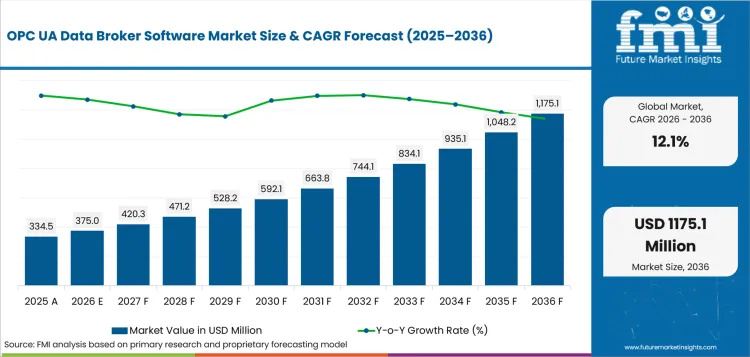
| Metric | Value |
|---|---|
| 2025 Market Size | USD 334.5 million |
| 2026 Market Size | USD 375.0 million |
| 2036 Market Size | USD 1,175.1 million |
| Forecast CAGR (2026–2036) | 12.1% |
| Featured Component | Software |
| Software Share (2026) | 42.0% |
| Featured Connectivity | OPC UA |
| OPC UA Share (2026) | 36.0% |
| Country CAGR Highlight | India |
| India CAGR (by 2036) | 14.2% |
Summary of the OPC UA Data Broker Software Market
| Market Signal | Commercial Impact |
|---|---|
| Demand and Growth Drivers | Industrial connectivity projects are accelerating demand for secure and interoperable data broker software.
|
| Product and Segment View | Software platforms, edge gateways, and OPC UA connectivity continue to lead market adoption.
|
| Geography and Competitive Outlook | Asia and Europe are expected to remain key markets for industrial data broker software.
|
| Analyst Perspective | Industrial data brokers are evolving into strategic control-layer platforms rather than standalone software tools.
— Nikhil Kaitwade, Principal Consultant, Industrial Domain, Future Market Insights |
In February 2024, OPC Foundation released UAFX specification version 1.00.02. The update strengthened offline engineering workflows that data broker suppliers must support. In January 2024, Phoenix Contact published OPC UA-related PLCnext material and samples through PLCnext Store. This is framed as technical-reference evidence for controller-level OPC UA implementation, not a standalone market launch.
Its OPC UA material frames the standard as a manufacturer-independent and platform-independent architecture for industrial communication.
Why is the OPC UA Data Broker Software Market growing?
Plants are shifting from custom PLC polling toward reusable broker layers that reduce engineering work across sites. OPC UA Field eXchange progress expands the standard from higher-level systems toward field-level data exchange.
- Plants are shifting from custom PLC polling toward reusable broker layers that reduce engineering work across sites.
- OPC UA Field eXchange progress expands the standard from higher-level systems toward field-level data exchange.
- Cybersecurity rules push buyers to replace unmanaged data links with broker software that supports certificates and roles.
Industrial buyers are changing how they connect data before they change how they analyze it. The International Federation of Robotics reported 542,000 industrial robots installed worldwide in 2024 and 4,664,000 robots in operational use. That scale increases the number of controllers, sensors, and machine cells that must share data across automation layers. A data broker becomes valuable when it reduces direct polling and preserves context between machine tags and enterprise tools. Suppliers with strong OPC UA mapping and store-and-forward design should gain wider rollout across multi-site manufacturers. The deeper driver is interoperability pressure in brownfield plants.
How is the OPC UA Data Broker Software Market segmented?
The OPC UA Data Broker Software Market is segmented by component, connectivity, application, end-use industry, and region.
- With an estimated 42.0% share in 2026, Software is expected to support By Component as broker logic carries the main value.
- Edge Gateways are projected to account for a 24.0% share in 2026 with factories keeping data handling near machines.
- OPC UA is anticipated to hold 36.0% By Connectivity share in 2026 given its secure multi-vendor data exchange role.
How does Software contribute to the component category?
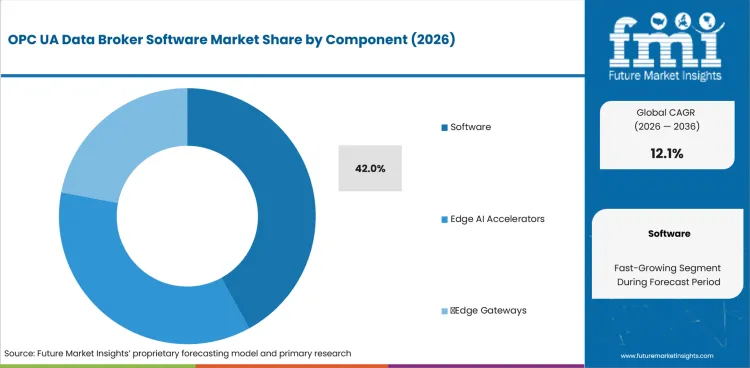
- Software is projected to account for 42.0% of By Component demand in 2026 as customers pay for driver libraries, namespace mapping, security controls, and lifecycle updates.
- Hardware choices often follow existing panel space and control-room standards. The real switching cost is broker configuration that maps tags consistently across machines.
What supports demand for OPC UA?
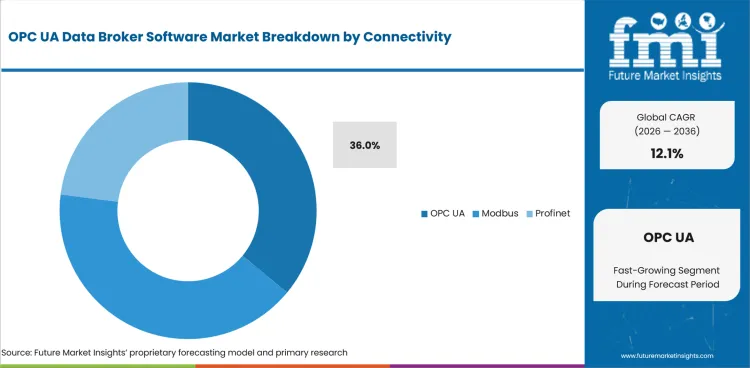
- OPC UA is estimated to hold 36.0% of By Connectivity demand in 2026 as buyers standardize secure links between PLCs, SCADA, MES, historians, and cloud tools.
- Modbus and Profinet persist in brownfield sites, so broker software wins by translating legacy protocol data into OPC UA structures without replacing controllers.
How do buyers evaluate Data Acquisition within the application category?
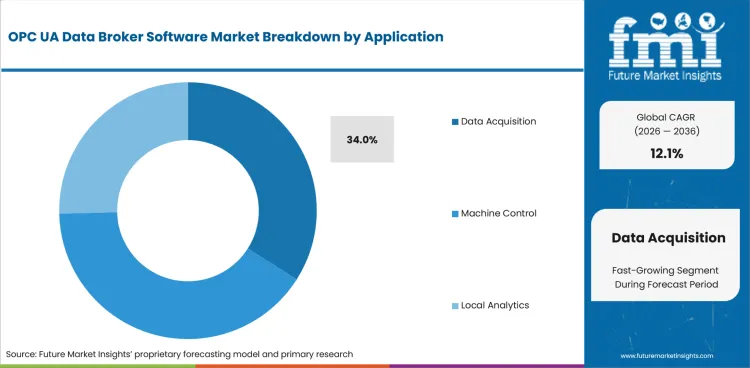
- Data Acquisition is anticipated to represent 34.0% of By Application demand in 2026 since most plants must first collect clean tags before analytics projects work.
- In robot-intensive lines, acquisition failures create blind spots in cycle-time and fault analysis. Broker software reduces this risk by centralizing data access.
What market factors influence demand for Automotive?
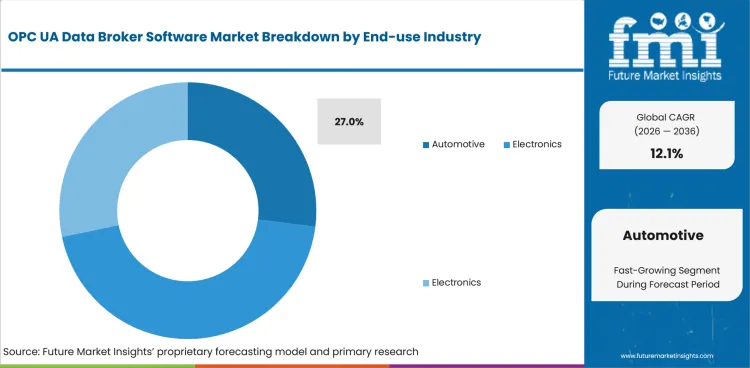
- Automotive is expected to account for 27.0% of By End-use Industry demand in 2026 as welding, painting, and assembly lines depend on stable machine data.
- Automotive buyers often qualify brokers through integrator pilots. They compare tag latency, certificate handling, and vendor support before scaling across plants.
How does Europe affect the regional outlook?
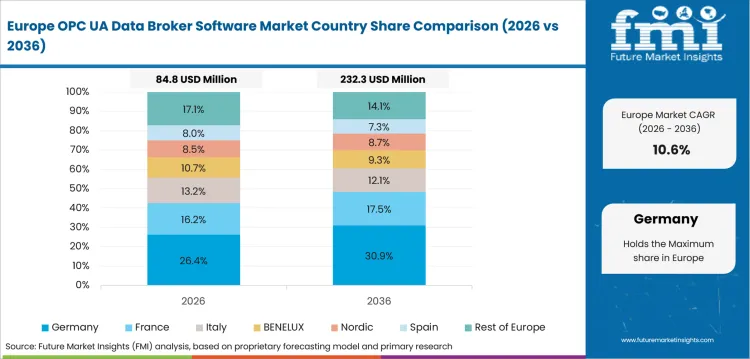
- Europe is projected to hold 31.0% of By Region demand in 2026 as German automation suppliers and standards groups shape OPC UA use.
- The OPC UA FX transition matters most in Europe as machine builders test controller-level interoperability.
What drives and restrains the market?
Driver: UAFX field-level work expands broker relevance from SCADA links toward controller and I/O exchange; restraint: Certificate management slows rollout when plant teams lack OT security ownership; opportunity: edge broker platforms can serve factories that want local processing before cloud transfer.
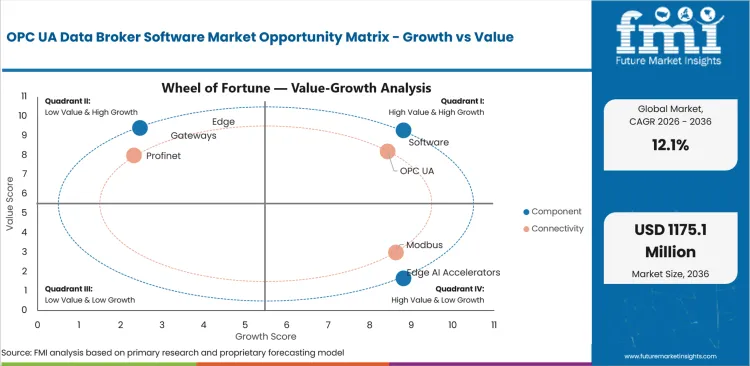
The market reflects a balance between the identified demand driver, adoption constraints, and the supplier opportunity outlined below.
- Driver: UAFX field-level work expands broker relevance from SCADA links toward controller and I/O exchange.
- Restraint: Certificate management slows rollout when plant teams lack OT security ownership.
- Opportunity: edge broker platforms can serve factories that want local processing before cloud transfer.
UAFX Field-Level Pull: The market is gaining a stronger standards trigger as OPC UA moves closer to field-level communication. The March 2024 OPC Foundation update described controller prototype testing that included UAFX connection setup, information models, structured data exchange, and PubSub security. This changes broker requirements from simple tag transfer to cross-vendor information exchange. Buyers will expect software to handle models, descriptors, and security without bespoke engineering at each line.
Brownfield Security Friction: Security is the main adoption brake for many plants. NIST’s Smart Connected Manufacturing Systems Group describes work on trusted standards-based digital threads and heterogeneous data fusion for USA manufacturers. That framing aligns with buyer concerns in mixed plants where PLCs, gateways, and enterprise systems do not share a uniform trust model. Broker software must manage certificates and access roles without adding downtime risk. Suppliers that treat security as a setup workflow should outperform tools that rely on manual certificate exchange and local scripting.
Which factors support expansion?
Commercial expansion is reinforced by the value, workflow, and recurring-demand factors below.
- Revenue is expected to rise as factories replace one-off PLC links with reusable broker layers for production data.
- Brownfield plants create repeat software demand since each machine line needs protocol mapping and tag cleanup.
- Edge Gateways are projected to hold 24.0% component share in 2026 as software often ships with rugged local hardware.
Which country markets are included in the CAGR comparison?
The selected CAGR comparison covers India (14.2%), China (13.6%), South Korea (12.8%), Germany (12.4%), and United States (11.8%) through 2036.
| Country | CAGR |
|---|---|
| India | 14.2% |
| China | 13.6% |
| South Korea | 12.8% |
| Germany | 12.4% |
| United States | 11.8% |
Source: Future Market Insights analysis based on the supplied country forecast table.
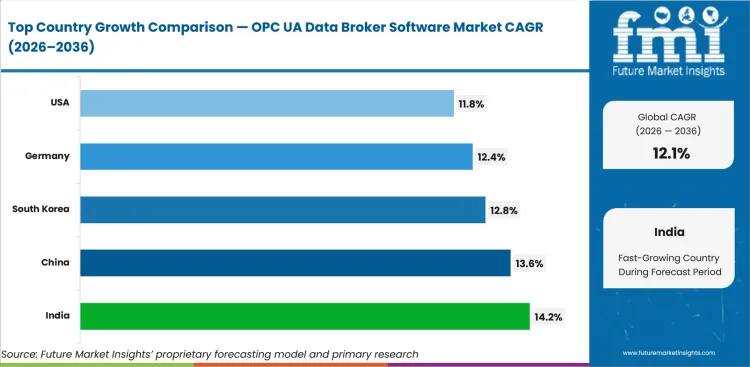
How do country-level CAGRs compare?
- India (CAGR: 14.2%): India is the higher-CAGR selected market but remains integration-sensitive.
- China (CAGR: 13.6%): China is the volume engine for this market.
- South Korea (CAGR: 12.8%): South Korea installed 30,600 industrial robots in 2024 and ranked fourth worldwide by annual installations.
- Germany (CAGR: 12.4%): Germany is the standards and machine-builder center of this market in Europe.
- United States (CAGR: 11.8%): The United States market is shaped by integrator-led modernization rather than one national automation standard.
The global OPC UA Data Broker Software Market is forecast to record a CAGR of 12.1% from 2026 to 2036. The supplied study covers 8 named country forecasts across the report regions.
How is the OPC UA Data Broker Software Market developing in India?
India is projected to record a CAGR of 14.2% through 2036. The country outlook identifies this demand signal: Automotive and component plants need OPC UA brokers for line monitoring and quality tracking.
Country Market Snapshot
| Country | India |
|---|---|
| Forecast CAGR | 14.2% |
| Automation anchor | India installed a record 9,100 industrial robots in 2024 and ranked sixth worldwide. |
| Demand mix | Automotive held 45% of India robot installations in 2024. |
| Buyer behavior | Plants value low-cost migration and local engineering support. |
| Channel route | System integrators and machine builders play a central specification role. |
| Supply signal | Siemens, Beckhoff, Advantech, Moxa, and Phoenix Contact operate through Indian automation channels. |
| Restraint | Smaller manufacturers often lack OT software budgets and data engineering skills. |
| Primary demand signal | India is the higher-CAGR selected market but remains integration-sensitive. |
Market Outlook
India is the higher-CAGR selected market but remains integration-sensitive. IFR reported India’s 2024 robot installations rose 7% to a record 9,100 units. Automotive was the notable driver with a 45% share of installations. This creates early broker demand in vehicle, component, and electronics plants where data access must be affordable and serviceable. India is projected to record a CAGR of 14.2% through 2036 as automation moves from large automotive plants into electronics and process manufacturing.
Key Growth Drivers
- Automotive and component plants need OPC UA brokers for line monitoring and quality tracking.
- Electronics manufacturing expansion creates demand for structured data from machines and test equipment.
- Local integrators can package broker software with PLC upgrades and dashboard projects.
- India is unique because the market rewards practical integration bundles before advanced enterprise architecture.
Key Restraints
- Price sensitivity limits large upfront licenses in small and mid-sized factories.
- Skills gaps in tag modeling and certificate management can delay wider rollout.
- Smaller manufacturers often lack OT software budgets and data engineering skills.
Country Market FAQs
Why should executives monitor OPC UA Data Broker Software Market demand in India?
Executives should monitor India because local buyer readiness, local use-case priorities, and service capacity can influence account timing and market-entry priorities.
What should suppliers localize for India?
Suppliers should localize proof points, pricing logic, partner coverage, and training support around system integrators and machine builders play a central specification role and system integrators and machine builders play a central specification role.
What adoption risk needs attention in India?
Executive teams should watch adoption risk because price sensitivity limits large upfront licenses in small and mid-sized factories can delay conversion from evaluation to commercial deployment.
How is the OPC UA Data Broker Software Market developing in China?
China is projected to record a CAGR of 13.6% through 2036. The country outlook identifies this demand signal: High robot installation volume creates large tag and event streams across factories.
Country Market Snapshot
| Country | China |
|---|---|
| Forecast CAGR | 13.6% |
| Automation anchor | China installed 295,000 industrial robots in 2024 and represented 54% of global deployments. |
| Supply structure | Domestic robot suppliers took 57% share of the Chinese home market in 2024. |
| Buyer behavior | Large manufacturers favor scalable data tools that can roll across many factories. |
| Policy context | Industrial automation and smart manufacturing remain strategic priorities for factory competitiveness. |
| Channel route | OEMs, local integrators, and industrial edge platform partners influence buying decisions. |
| Restraint | Data governance and local ecosystem requirements can limit foreign software expansion. |
| Primary demand signal | China is the volume engine for this market. |
Market Outlook
China is the volume engine for this market. IFR reported that China’s operational robot stock exceeded 2 million units in 2024. That number points to a dense machine-data environment where broker software must handle scale, local platform integration, and multi-vendor equipment. Fast factory automation also increases demand for data models that can support quality inspection and predictive maintenance. China is forecast to grow at a CAGR of 13.6% through 2036 as robot density and electronics automation keep increasing broker workloads.
Key Growth Drivers
- High robot installation volume creates large tag and event streams across factories.
- Electronics and automotive production need data brokering for yield, quality, and uptime programs.
- Domestic supplier growth increases need for open interfaces across mixed automation brands.
- China is unique because factory scale turns OPC UA brokering from a line-level tool into a multi-site data architecture.
Key Restraints
- Local data rules and buyer preference for domestic platforms can slow foreign vendor penetration.
- Large plants may demand customized integrations that reduce software margin.
- Data governance and local ecosystem requirements can limit foreign software expansion.
Country Market FAQs
Why should executives monitor OPC UA Data Broker Software Market demand in China?
Executives should monitor China because local buyer readiness, local use-case priorities, and service capacity can influence account timing and market-entry priorities.
What should suppliers localize for China?
Suppliers should localize proof points, pricing logic, partner coverage, and training support around oems, local integrators, and industrial edge platform partners influence buying decisions and oems, local integrators, and industrial edge platform partners influence buying decisions.
What adoption risk needs attention in China?
Executive teams should watch adoption risk because local data rules and buyer preference for domestic platforms can slow foreign vendor penetration can delay conversion from evaluation to commercial deployment.
How is the OPC UA Data Broker Software Market developing in South Korea?
South Korea is projected to record a CAGR of 12.8% through 2036. The country outlook identifies this demand signal: South Korea installed 30,600 industrial robots in 2024 and ranked fourth worldwide by annual installations.
Country Market Snapshot
| Country | South Korea |
|---|---|
| Forecast CAGR | 12.8% |
| Demand anchor | South Korea installed 30,600 industrial robots in 2024 and ranked fourth worldwide by annual installations. |
| Application mix | Electronics, semiconductors, automotive, and batteries drive broker software demand. |
| Buyer behavior | Large manufacturers expect high reliability and tight integration with plant IT systems. |
| Channel route | Enterprise account sales and specialist integrators shape software qualification. |
| Supply signal | Global automation vendors serve Korean buyers through local engineering and partner teams. |
| Restraint | Customer concentration can make sales cycles long and technically demanding. |
| Primary demand signal | South Korea installed 30,600 industrial robots in 2024 and ranked fourth worldwide by annual installations. |
Market Outlook
South Korea’s market is smaller than China by volume but highly advanced in automation intensity. IFR reported that annual installations had trended around 31,000 units since 2019. This creates a stable pool of factories that need high-quality data access across robotics, semiconductor tools, and battery lines. Broker software must meet strict uptime and security expectations.
Key Growth Drivers
- Semiconductor and electronics plants need clean equipment data for yield and fault analysis.
- Battery manufacturing lines require traceable process data across many production steps.
- Global export pressure supports investment in uptime and quality data systems.
- South Korea installed 30,600 industrial robots in 2024 and ranked fourth worldwide by annual installations.
Key Restraints
- Large accounts demand long testing cycles before adding broker software to critical lines.
- Vendor qualification can be difficult for smaller software firms without local engineering teams.
- Customer concentration can make sales cycles long and technically demanding.
Country Market FAQs
Why should executives monitor OPC UA Data Broker Software Market demand in South Korea?
Executives should monitor South Korea because local buyer readiness, south korea installed 30,600 industrial robots in 2024 and ranked fourth worldwide by annual installations, and service capacity can influence account timing and market-entry priorities.
What should suppliers localize for South Korea?
Suppliers should localize proof points, pricing logic, partner coverage, and training support around enterprise account sales and specialist integrators shape software qualification and enterprise account sales and specialist integrators shape software qualification.
What adoption risk needs attention in South Korea?
Executive teams should watch adoption risk because large accounts demand long testing cycles before adding broker software to critical lines can delay conversion from evaluation to commercial deployment.
How is the OPC UA Data Broker Software Market developing in Germany?
Germany is projected to record a CAGR of 12.4% through 2036. The country outlook identifies this demand signal: Machine builders specify OPC UA interfaces that shape software choices downstream.
Country Market Snapshot
| Country | Germany |
|---|---|
| Forecast CAGR | 12.4% |
| Automation anchor | Germany installed 26,982 industrial robots in 2024 and held 32% of European installations. |
| Standards role | German machine builders influence OPC UA information model and UAFX expectations. |
| Buyer behavior | Engineering teams value deterministic behavior, documentation, and lifecycle support. |
| Supply base | Siemens, Beckhoff, Phoenix Contact, Softing Industrial Automation, and Prosys partners are relevant. |
| Channel route | OEM machine builder specifications often decide broker software choices. |
| Restraint | Strict qualification cycles can slow supplier switching. |
| Primary demand signal | Germany is the standards and machine-builder center of this market in Europe. |
Market Outlook
Germany is the standards and machine-builder center of this market in Europe. IFR identified Germany as Europe’s substantial robot market and the fifth-substantial worldwide in 2024. That automation depth creates steady broker demand in machinery, automotive, chemicals, and metals. German buyers often ask whether a broker fits the engineering toolchain before they ask about dashboard features. Germany is forecast to grow at a CAGR of 12.4% through 2036 due to strong OPC UA supplier presence and standards maturity.
Key Growth Drivers
- Machine builders specify OPC UA interfaces that shape software choices downstream.
- Automotive and chemicals plants need broker tools with strong security and traceability features.
- UAFX testing activity supports demand for richer data exchange beyond basic tag reads.
- Germany is unique because supplier ecosystems and standards groups shape global broker requirements before many buyers issue tenders.
Key Restraints
- Certification and internal validation processes can extend software qualification timelines.
- Buyers resist platforms that add cloud dependence to plant-critical data paths.
- Strict qualification cycles can slow supplier switching.
Country Market FAQs
Why should executives monitor OPC UA Data Broker Software Market demand in Germany?
Executives should monitor Germany because local buyer readiness, local use-case priorities, and service capacity can influence account timing and market-entry priorities.
What should suppliers localize for Germany?
Suppliers should localize proof points, pricing logic, partner coverage, and training support around oem machine builder specifications often decide broker software choices and oem machine builder specifications often decide broker software choices.
What adoption risk needs attention in Germany?
Executive teams should watch adoption risk because certification and internal validation processes can extend software qualification timelines can delay conversion from evaluation to commercial deployment.
How is the OPC UA Data Broker Software Market developing in the United States?
The United States is projected to record a CAGR of 11.8% through 2036. The country outlook identifies this demand signal: Automotive and electronics plants need broker software that can support high tag volume and fast troubleshooting.
Country Market Snapshot
| Country | United States |
|---|---|
| Forecast CAGR | 11.8% |
| Automation anchor | The United States installed 34,200 industrial robots in 2024 according to International Federation of Robotics data. |
| Channel signal | Domestic robot system integrators are a key route for factory data broker projects. |
| Buyer behavior | Large manufacturers prefer pilots that prove tag stability before enterprise rollout. |
| Policy context | NIST smart manufacturing work supports trusted digital-thread and data fusion practices. |
| Supply structure | Siemens, Velotic, Inductive Automation, Softing partners, and system integrators influence specifications. |
| Restraint | Many plants import automation hardware from Japan and Europe which widens protocol variety. |
| Primary demand signal | The United States market is shaped by integrator-led modernization rather than one national automation standard. |
Market Outlook
The United States market is shaped by integrator-led modernization rather than one national automation standard. IFR reported that the United States accounted for 68% of robot installations in the Americas in 2024 and imported most robots from Japan and Europe. That mix creates a practical broker need. Plants want software that can normalize controller data across many machine brands while keeping production systems stable.
Key Growth Drivers
- Automotive and electronics plants need broker software that can support high tag volume and fast troubleshooting.
- NIST-backed digital-thread language strengthens the case for structured machine data across the lifecycle.
- System integrators create repeatable templates for OPC UA rollout across multi-site manufacturers.
- Domestic robot system integrators are a key route for factory data broker projects.
Key Restraints
- Imported machine diversity raises the cost of protocol validation and certificate handling.
- Corporate IT security reviews can slow broker approval for plant-level systems.
- Many plants import automation hardware from Japan and Europe which widens protocol variety.
Country Market FAQs
Why should executives monitor OPC UA Data Broker Software Market demand in the United States?
Executives should monitor the United States because local buyer readiness, local use-case priorities, and service capacity can influence account timing and market-entry priorities.
What should suppliers localize for the United States?
Suppliers should localize proof points, pricing logic, partner coverage, and training support around buyer access and account ownership and domestic robot system integrators are a key route for factory data broker projects.
What adoption risk needs attention in the United States?
Executive teams should watch adoption risk because imported machine diversity raises the cost of protocol validation and certificate handling can delay conversion from evaluation to commercial deployment.
Which companies are discussed in the OPC UA Data Broker Software Market?
The preview discusses Siemens, Advantech, Beckhoff, Phoenix Contact, and Moxa among the companies active in this market.
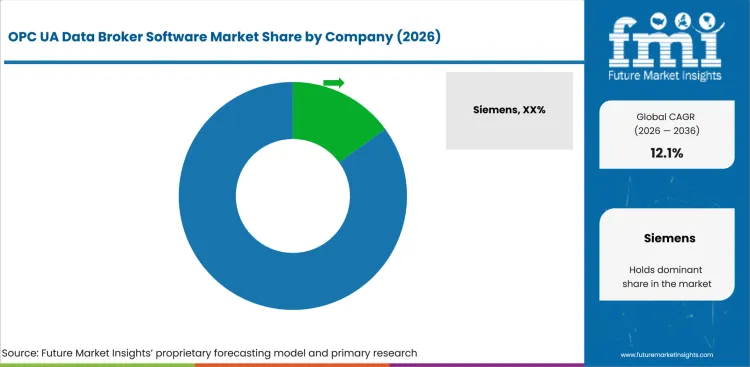
The market is moderately fragmented with automation vendors, OPC specialists, and SCADA platforms competing for plant data access. Larger suppliers support on driver depth and global support as buyers avoid untested connectors on critical production lines. Specialist firms win in brownfield aggregation where deep OPC UA knowledge matters more than broad platform scope.
Entry barriers include certification depth, protocol coverage, cyber trust, and system integrator acceptance. Large automation suppliers have an advantage when buyers want the same vendor to cover controllers, edge hardware, and broker software. Siemens released an OPC UA High Performance Connector for Industrial Edge in October 2025.
How is competition structured?
Competition reflects differences in specialization, portfolio scope, geographic reach, evidence, and customer access.
The competitive structure includes automation platform owners, industrial connectivity specialists, and SCADA software vendors.
- Automation Platform Owners: Siemens, Beckhoff, Phoenix Contact, Advantech, and Moxa compete with broker functions tied to controllers, industrial PCs, gateways, and edge software. These suppliers are strong where buyers want one vendor for hardware, protocol access, and support.
- Industrial Connectivity Specialists: Velotic, Softing Industrial Automation, Prosys OPC, and Unified Automation compete through OPC UA depth, driver breadth, aggregation tools, and information model expertise. Their strength lies in mixed-vendor plants where semantic mapping and secure tunneling matter.
- Application Platform Vendors: Inductive Automation and similar SCADA or industrial application suppliers compete by embedding OPC UA client and server functions inside wider plant software.
How do selected companies compare?
The selected companies differ in portfolio focus, geographic reach, evidence depth, and channel strength.
| Company | Competitive position |
|---|---|
| Siemens | Siemens released an OPC UA High Performance Connector for Industrial Edge in October 2025. |
| Advantech | Automation Platform Owners: Siemens, Beckhoff, Phoenix Contact, Advantech, and Moxa compete with broker functions tied to controllers, industrial PCs, gateways, and edge software. |
| Beckhoff | Automation Platform Owners: Siemens, Beckhoff, Phoenix Contact, Advantech, and Moxa compete with broker functions tied to controllers, industrial PCs, gateways, and edge software. |
| Phoenix Contact | Automation Platform Owners: Siemens, Beckhoff, Phoenix Contact, Advantech, and Moxa compete with broker functions tied to controllers, industrial PCs, gateways, and edge software. |
| Moxa | Automation Platform Owners: Siemens, Beckhoff, Phoenix Contact, Advantech, and Moxa compete with broker functions tied to controllers, industrial PCs, gateways, and edge software. |
What are the key developments in the OPC UA Data Broker Software Market?
- In February 2024, OPC Foundation released UAFX specification version 1.00.02. The update strengthened offline engineering workflows that data broker suppliers must support.
- In January 2024, Phoenix Contact published OPC UA-related PLCnext material and samples through PLCnext Store. This is framed as technical-reference evidence for controller-level OPC UA implementation, not a standalone market launch.
- In July 2024, Beckhoff published TwinCAT 3 OPC UA client guidance. This is used as technical-reference evidence for PC-based automation implementation, not a standalone market launch.
Selected Companies in the OPC UA Data Broker Software Market
Companies referenced in this preview
- Siemens.
- Advantech.
- Beckhoff.
- Phoenix Contact.
- Moxa.
- Velotic.
- Softing Industrial Automation.
- Prosys OPC.
- Inductive Automation.
- Unified Automation.
Market Scope & Definition
| Market definition | OPC UA data broker software collects, maps, secures, and routes industrial machine data between operational systems and business systems. Included products cover OPC UA servers, OPC UA clients, connector platforms, edge broker software, protocol converters, and data harmonization tools. |
|---|---|
| Functions covered | OPC UA data collection, protocol mapping, secure data routing, namespace management, edge brokering, and data harmonization |
| Applications covered | Data Acquisition, Local Analytics, Machine Control, Quality Inspection, Predictive Maintenance |
| End-use industries | Automotive, Electronics, Chemicals, Food & Beverage, Metals, Energy |
| Inclusions | Market scope covers OPC UA server/client software, connector platforms, protocol-conversion software, edge broker applications, namespace mapping, and data harmonization tools used across Ethernet/IP, Profinet, Modbus, OPC UA, and Wireless/5G connectivity for automotive, electronics, chemicals, food and beverage, metals, and energy users. Hardware is included only when supplied as an enabling deployment platform for broker software. |
| Exclusions | Market scope excludes general enterprise middleware, pure cloud analytics without OT connectors, basic PLC programming tools, standalone HMI screens, cybersecurity appliances without data brokering functions, and hardware-only industrial gateways sold without OPC UA broker capability. |
Research Methodology
| Primary Research | FMI analysts reviewed inputs from automation buyers, plant engineering teams, system integrators, machine builders, and industrial software channel partners. Interviews focused on tag volume, protocol mix, integration pain points, cybersecurity checks, and site rollout constraints. |
|---|---|
| Desk Research | FMI reviewed OPC Foundation specifications, industrial automation product information, standards-body material, company release notes, and public automation statistics. Desk work defined the addressable product pool across broker software, edge connectors, OPC UA servers, and gateway platforms. |
| Market Sizing and Forecasting | The model combined software license pricing, site rollout patterns, industrial automation density, protocol migration needs, and country-level manufacturing maturity. Forecasts were weighted by use case, end-use industry, and connectivity share. |
| Data Validation | Forecasts were checked against robot installation trends, smart manufacturing programs, company product portfolios, and public industrial software developments. Validation focused on whether the forecast fits brownfield adoption cycles and vendor evidence. |
What does the report cover?
The report covers component, connectivity, application, end-use industry, and region across the 2026-2036 forecast period in 30+ countries.
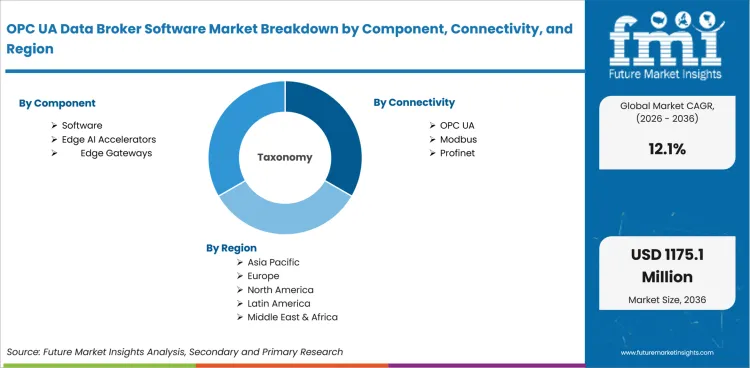
| Periods | Base year 2025; estimated year 2026; forecast period 2026-2036 |
|---|---|
| Quantitative units | USD 375.0 million in 2026 to USD 1175.1 million by 2036, at a CAGR of 12.1% |
| Segment axes | component, connectivity, application, end-use industry, and region |
| Regions | North America, Latin America, Europe, East Asia, South Asia & Pacific, Middle East & Africa |
| Countries | United States, United Kingdom, Germany, France, Japan, China, South Korea, India and 30+ |
| Companies | Siemens, Advantech, Beckhoff, Phoenix Contact, Moxa, Velotic, Softing Industrial Automation, Prosys OPC, Inductive Automation, Unified Automation |
| Approach | Hybrid bottom-up and selected-down methodology based on software pricing, site rollout rates, protocol migration, and country-level automation maturity. |
Market Segmentation Analysis
Segmented by Component
- Industrial PCs.
- Edge Gateways.
- Embedded Controllers.
- Edge AI Accelerators.
- Software.
Segmented by Connectivity
- Ethernet/IP.
- Profinet.
- Modbus.
- OPC UA.
- Wireless/5G.
Segmented by Application
- Data Acquisition.
- Local Analytics.
- Machine Control.
- Quality Inspection.
- Predictive Maintenance.
Segmented by End-use Industry
- Automotive.
- Electronics.
- Chemicals.
- Food & Beverage.
- Metals.
- Energy.
By Region
- North America.
- United States.
- Latin America.
- East Asia.
- China.
- Japan.
- South Korea.
- Middle East & Africa.
Research Sources and Bibliography
- 1. OPC Foundation. (2025, September). OPC Unified Architecture. OPC Foundation. https://opcfoundation.org/opcua-en.pdf
- 2. OPC Foundation. (2024, March). Field Level Communications Corner – Mar 2024. OPC Foundation. https://opcconnect.opcfoundation.org/2024/03/field-level-communications-corner-mar-2024/
- 3. National Institute of Standards and Technology. (2025, April). Smart Connected Manufacturing Systems Group. NIST. https://www.nist.gov/ctl/smart-connected-systems-division/smart-connected-manufacturing-systems-group
- 4. International Federation of Robotics. (2025, September 25). World Robotics 2025 report – Industrial Robots – released by IFR. IFR. https://ifr.org/ifr-press-releases/news/global-robot-demand-in-factories-doubles-over-10-years
- 5. Siemens. (2025, October). OPC UA High Performance Connector on Industrial Edge. Siemens Industry Support. https://support.industry.siemens.com/cs/document/109994633/opc-ua-high-performance-connector-on-industrial-edge
- 6. Siemens. (2025, September). Known issues of OPC UA Connector – Industrial Edge App. Siemens Industrial Operations X. https://docs.industrial-operations-x.siemens.cloud/r/en-us/v2.4/opc-ua-connector/known-issues/known-issues-of-opc-ua-connector
- 7. Beckhoff Automation. (2024, July 22). Getting started with TF6100 TwinCAT 3 OPC UA Client. Beckhoff Automation. https://www.beckhoff.com/en-en/company/news/multimedia-tutorial-getting-started-with-tf6100-twincat-3-opc-ua-client.html
- 8. Phoenix Contact. (2024, January 29). OPC UA Solutions – Easy to use. PLCnext Community. https://www.plcnext-community.net/news/opc-ua-solutions-easy-to-use/
- 9. Softing Industrial Automation. (2025, March 25). Softing Industrial releases dataFEED OPC Suite 5.40 with expanded connectivity features. Softing Industrial Automation. https://industrial.softing.com/news/news-details/softing-industrial-releases-datafeed-opc-suite-540-with-expanded-connectivity-features.html
- 10. Softing Industrial Automation. (2025, April 23). Standardized OPC UA Address Space: Softing Industrial expands OPC UA functionality across four product lines. Softing Industrial Automation. https://industrial.softing.com/news/news-details/standardized-opc-ua-address-space-softing-industrial-expands-opc-ua-functionality-across-four-product-lines.html
- 11. Inductive Automation. (2025, September 16). Inductive Automation releases Ignition 8.3. Inductive Automation. https://inductiveautomation.com/news/inductive-automation-releases-ignition-83
- 12. Prosys OPC. (2025, December 18). Prosys OPC UA Forge 1.5.4 released. Prosys OPC. https://prosysopc.com/news/prosys-opc-ua-forge-1-5-4-released/
- 13. TPG. (2026, March 17). Velotic launches to shape future of industrial & manufacturing software. TPG. https://www.tpg.com/news-and-insights/velotic-launches-to-shape-future-of-industrial-manufacturing-software
- 14. GE Vernova. (2026, March 2). GE Vernova completes sale of Proficy software business to TPG. GE Vernova. https://www.gevernova.com/news/press-releases/ge-vernova-completes-sale-proficyr-software-business
The bibliography is provided for reader reference and all sources are primary non-commercial government, regulatory, standards-body, trade-body, or official company publications.
This Report Answers
- What is the projected value of the OPC UA Data Broker Software Market in 2026?
- What value is forecast for the OPC UA Data Broker Software Market by 2036?
- What CAGR is forecast for the OPC UA Data Broker Software Market from 2026 to 2036?
- What 2026 share is projected for Software within the component category?
- What 2026 share is projected for OPC UA within the connectivity category?
- Which demand factors support the OPC UA Data Broker Software Market outlook?
- Which restraints and opportunities affect adoption in the OPC UA Data Broker Software Market?
- How are country CAGR outlooks, including India at 14.2%, compared?
- Which companies and product developments are covered in the competitive analysis?
- What is included in the market scope, and how is the forecast validated?
Frequently Asked Questions
Why should executives track the OPC UA Data Broker Software Market?
Executives should track this market because it can affect capital allocation, supplier strategy, operating risk, and competitive positioning across applications.
What business problem does the OPC UA Data Broker Software Market address?
It helps executive teams judge where customer pain, supplier capability, compliance exposure, and implementation economics justify investment, procurement, or market-entry decisions.
What should procurement leaders evaluate before selecting suppliers?
Procurement leaders should assess evidence quality, integration fit, service coverage, compliance readiness, total cost of ownership, and supplier execution capability.
What can limit return on investment for buyers?
Return on investment can be limited by low utilization, integration delays, training gaps, unclear ownership, pricing pressure, or weak fit with existing workflows.
How can suppliers build executive confidence?
Suppliers can build confidence by proving implementation speed, risk reduction, support depth, reference use cases, and measurable outcomes for budget owners.
Preview the report firsthand - request a free sample
Get SampleGet the brochure for pricing and purchase details.
Get PDFTable of Content
- Key Takeaways
- Market Size and CAGR
- Top Growth Driver
- Fastest Growing Segment
- Leading Region
- Key Companies
- Emerging Opportunities
- Executive Summary
- Global Market Outlook
- Demand-side Trends
- Supply-side Trends
- Technology Roadmap Analysis
- Analysis and Recommendations
- Analyst Perspective (What is happening? Why now? What should investors know?)
- Key Questions Answered
- How large is the market?
- What is the CAGR?
- What are key trends?
- Which region dominates?
- Who are the leaders?
- Market Overview
- Market Coverage / Taxonomy
- Market Definition / Scope / Limitations
- Research Methodology
- Chapter Orientation
- Analytical Lens and Working Hypotheses
- Market Structure, Signals, and Trend Drivers
- Benchmarking and Cross-market Comparability
- Market Sizing, Forecasting, and Opportunity Mapping
- Research Design and Evidence Framework
- Desk Research Programme (Secondary Evidence)
- Expert Input and Fieldwork (Primary Evidence)
- Tooling, Models, and Reference Databases
- Data Engineering and Model Build
- Quality Assurance and Audit Trail
- Market Background
- Market Dynamics (Drivers, Restraints, Opportunity, Trends)
- Scenario Forecast (Optimistic, Likely, Conservative)
- Impact Analysis
- AI Impact
- Sustainability Impact
- Regulatory Impact
- Technology Impact
- Consumer / Buyer Analysis
- Purchase Drivers
- Adoption Barriers
- Buyer Journey
- Opportunity Map Analysis
- Product Life Cycle Analysis
- Supply Chain Analysis
- Investment Feasibility Matrix
- Value Chain Analysis
- PESTLE and Porter's Analysis
- Regulatory Landscape
- Regional Parent Market Outlook
- Production and Consumption Statistics
- Import and Export Statistics
- Global Market Analysis and Forecast, 2021 to 2036
- Historical Market Size Value (USD Million) & Volume (Unit) Analysis, 2021 to 2025
- Current and Future Market Size Value (USD Million) & Volume (Unit) Projections, 2026 to 2036
- Y-o-Y Growth Trend Analysis
- Absolute $ Opportunity Analysis
- Global Market Pricing Analysis, 2021 to 2036
- Global Market Analysis and Forecast, By Component, 2021 to 2036
- Introduction / Key Findings
- Historical Market Size Value (USD Million) & Volume (Unit) Analysis By Component, 2021 to 2025
- Current and Future Market Size Value (USD Million) & Volume (Unit) Analysis and Forecast By Component, 2026 to 2036
- Industrial PCs.
- Edge Gateways.
- Embedded Controllers.
- Edge AI Accelerators.
- Software.
- Industrial PCs.
- Y-o-Y Growth Trend Analysis By Component, 2021 to 2025
- Absolute $ Opportunity Analysis By Component, 2026 to 2036
- Global Market Analysis and Forecast, By Connectivity, 2021 to 2036
- Introduction / Key Findings
- Historical Market Size Value (USD Million) & Volume (Unit) Analysis By Connectivity, 2021 to 2025
- Current and Future Market Size Value (USD Million) & Volume (Unit) Analysis and Forecast By Connectivity, 2026 to 2036
- Ethernet/IP.
- Profinet.
- Modbus.
- OPC UA.
- Wireless/5G.
- Ethernet/IP.
- Y-o-Y Growth Trend Analysis By Connectivity, 2021 to 2025
- Absolute $ Opportunity Analysis By Connectivity, 2026 to 2036
- Global Market Analysis and Forecast, By Application, 2021 to 2036
- Introduction / Key Findings
- Historical Market Size Value (USD Million) & Volume (Unit) Analysis By Application, 2021 to 2025
- Current and Future Market Size Value (USD Million) & Volume (Unit) Analysis and Forecast By Application, 2026 to 2036
- Data Acquisition.
- Local Analytics.
- Machine Control.
- Quality Inspection.
- Predictive Maintenance.
- Data Acquisition.
- Y-o-Y Growth Trend Analysis By Application, 2021 to 2025
- Absolute $ Opportunity Analysis By Application, 2026 to 2036
- Global Market Analysis and Forecast, By End-use Industry, 2021 to 2036
- Introduction / Key Findings
- Historical Market Size Value (USD Million) & Volume (Unit) Analysis By End-use Industry, 2021 to 2025
- Current and Future Market Size Value (USD Million) & Volume (Unit) Analysis and Forecast By End-use Industry, 2026 to 2036
- Automotive.
- Electronics.
- Chemicals.
- Food & Beverage.
- Metals.
- Energy.
- Automotive.
- Y-o-Y Growth Trend Analysis By End-use Industry, 2021 to 2025
- Absolute $ Opportunity Analysis By End-use Industry, 2026 to 2036
- Global Market Analysis and Forecast, By Region, 2021 to 2036
- Introduction
- Historical Market Size Value (USD Million) & Volume (Unit) Analysis By Region, 2021 to 2025
- Current Market Size Value (USD Million) & Volume (Unit) Analysis and Forecast By Region, 2026 to 2036
- North America
- Latin America
- Western Europe
- Eastern Europe
- East Asia
- South Asia and Pacific
- Middle East & Africa
- Market Attractiveness Analysis By Region
- North America Market Analysis and Forecast, By Country, 2021 to 2036
- Historical Market Size Value (USD Million) & Volume (Unit) Trend Analysis By Market Taxonomy, 2021 to 2025
- Market Size Value (USD Million) & Volume (Unit) Forecast By Market Taxonomy, 2026 to 2036
- By Country
- USA
- Canada
- Mexico
- By Component
- By Connectivity
- By Application
- By End-use Industry
- By Country
- Market Attractiveness Analysis
- By Country
- By Component
- By Connectivity
- By Application
- By End-use Industry
- Key Takeaways
- Latin America Market Analysis and Forecast, By Country
- Historical Market Size Value (USD Million) & Volume (Unit) Trend Analysis By Market Taxonomy, 2021 to 2025
- Market Size Value (USD Million) & Volume (Unit) Forecast By Market Taxonomy, 2026 to 2036
- By Country
- Brazil
- Chile
- Rest of Latin America
- By Component
- By Connectivity
- By Application
- By End-use Industry
- By Country
- Market Attractiveness Analysis
- By Country
- By Component
- By Connectivity
- By Application
- By End-use Industry
- Key Takeaways
- Western Europe Market Analysis and Forecast, By Country
- Historical Market Size Value (USD Million) & Volume (Unit) Trend Analysis By Market Taxonomy, 2021 to 2025
- Market Size Value (USD Million) & Volume (Unit) Forecast By Market Taxonomy, 2026 to 2036
- By Country
- Germany
- UK
- Italy
- Spain
- France
- Nordic
- BENELUX
- Rest of Western Europe
- By Component
- By Connectivity
- By Application
- By End-use Industry
- By Country
- Market Attractiveness Analysis
- By Country
- By Component
- By Connectivity
- By Application
- By End-use Industry
- Key Takeaways
- Eastern Europe Market Analysis and Forecast, By Country
- Historical Market Size Value (USD Million) & Volume (Unit) Trend Analysis By Market Taxonomy, 2021 to 2025
- Market Size Value (USD Million) & Volume (Unit) Forecast By Market Taxonomy, 2026 to 2036
- By Country
- Russia
- Poland
- Hungary
- Balkan & Baltic
- Rest of Eastern Europe
- By Component
- By Connectivity
- By Application
- By End-use Industry
- By Country
- Market Attractiveness Analysis
- By Country
- By Component
- By Connectivity
- By Application
- By End-use Industry
- Key Takeaways
- East Asia Market Analysis and Forecast, By Country
- Historical Market Size Value (USD Million) & Volume (Unit) Trend Analysis By Market Taxonomy, 2021 to 2025
- Market Size Value (USD Million) & Volume (Unit) Forecast By Market Taxonomy, 2026 to 2036
- By Country
- China
- Japan
- South Korea
- By Component
- By Connectivity
- By Application
- By End-use Industry
- By Country
- Market Attractiveness Analysis
- By Country
- By Component
- By Connectivity
- By Application
- By End-use Industry
- Key Takeaways
- South Asia and Pacific Market Analysis and Forecast, By Country
- Historical Market Size Value (USD Million) & Volume (Unit) Trend Analysis By Market Taxonomy, 2021 to 2025
- Market Size Value (USD Million) & Volume (Unit) Forecast By Market Taxonomy, 2026 to 2036
- By Country
- India
- ASEAN
- Australia & New Zealand
- Rest of South Asia and Pacific
- By Component
- By Connectivity
- By Application
- By End-use Industry
- By Country
- Market Attractiveness Analysis
- By Country
- By Component
- By Connectivity
- By Application
- By End-use Industry
- Key Takeaways
- Middle East & Africa Market Analysis and Forecast, By Country
- Historical Market Size Value (USD Million) & Volume (Unit) Trend Analysis By Market Taxonomy, 2021 to 2025
- Market Size Value (USD Million) & Volume (Unit) Forecast By Market Taxonomy, 2026 to 2036
- By Country
- Kingdom of Saudi Arabia
- Other GCC Countries
- Türkiye
- South Africa
- Other African Union
- Rest of Middle East & Africa
- By Component
- By Connectivity
- By Application
- By End-use Industry
- By Country
- Market Attractiveness Analysis
- By Country
- By Component
- By Connectivity
- By Application
- By End-use Industry
- Key Takeaways
- Key Countries Market Analysis
- USA
- Pricing Analysis
- Market Share Analysis, 2025
- By Component
- By Connectivity
- By Application
- By End-use Industry
- Canada
- Pricing Analysis
- Market Share Analysis, 2025
- By Component
- By Connectivity
- By Application
- By End-use Industry
- Mexico
- Pricing Analysis
- Market Share Analysis, 2025
- By Component
- By Connectivity
- By Application
- By End-use Industry
- Brazil
- Pricing Analysis
- Market Share Analysis, 2025
- By Component
- By Connectivity
- By Application
- By End-use Industry
- Chile
- Pricing Analysis
- Market Share Analysis, 2025
- By Component
- By Connectivity
- By Application
- By End-use Industry
- Germany
- Pricing Analysis
- Market Share Analysis, 2025
- By Component
- By Connectivity
- By Application
- By End-use Industry
- UK
- Pricing Analysis
- Market Share Analysis, 2025
- By Component
- By Connectivity
- By Application
- By End-use Industry
- Italy
- Pricing Analysis
- Market Share Analysis, 2025
- By Component
- By Connectivity
- By Application
- By End-use Industry
- Spain
- Pricing Analysis
- Market Share Analysis, 2025
- By Component
- By Connectivity
- By Application
- By End-use Industry
- France
- Pricing Analysis
- Market Share Analysis, 2025
- By Component
- By Connectivity
- By Application
- By End-use Industry
- India
- Pricing Analysis
- Market Share Analysis, 2025
- By Component
- By Connectivity
- By Application
- By End-use Industry
- ASEAN
- Pricing Analysis
- Market Share Analysis, 2025
- By Component
- By Connectivity
- By Application
- By End-use Industry
- Australia & New Zealand
- Pricing Analysis
- Market Share Analysis, 2025
- By Component
- By Connectivity
- By Application
- By End-use Industry
- China
- Pricing Analysis
- Market Share Analysis, 2025
- By Component
- By Connectivity
- By Application
- By End-use Industry
- Japan
- Pricing Analysis
- Market Share Analysis, 2025
- By Component
- By Connectivity
- By Application
- By End-use Industry
- South Korea
- Pricing Analysis
- Market Share Analysis, 2025
- By Component
- By Connectivity
- By Application
- By End-use Industry
- Russia
- Pricing Analysis
- Market Share Analysis, 2025
- By Component
- By Connectivity
- By Application
- By End-use Industry
- Poland
- Pricing Analysis
- Market Share Analysis, 2025
- By Component
- By Connectivity
- By Application
- By End-use Industry
- Hungary
- Pricing Analysis
- Market Share Analysis, 2025
- By Component
- By Connectivity
- By Application
- By End-use Industry
- Kingdom of Saudi Arabia
- Pricing Analysis
- Market Share Analysis, 2025
- By Component
- By Connectivity
- By Application
- By End-use Industry
- Türkiye
- Pricing Analysis
- Market Share Analysis, 2025
- By Component
- By Connectivity
- By Application
- By End-use Industry
- South Africa
- Pricing Analysis
- Market Share Analysis, 2025
- By Component
- By Connectivity
- By Application
- By End-use Industry
- USA
- Market Structure Analysis
- Competition Dashboard
- Competition Benchmarking
- Market Share Analysis of Top Players
- By Regional
- By Component
- By Connectivity
- By Application
- By End-use Industry
- Emerging Startups
- Innovation Benchmarking
- Competition Analysis
- Competition Deep Dive
- Siemens
- Overview
- Product Portfolio
- Profitability by Market Segments (Product/Region/Sales Channel)
- Sales Footprint
- Strategy Overview
- Marketing Strategy
- Product Strategy
- Channel Strategy
- Advantech
- Beckhoff
- Phoenix Contact
- Moxa
- Velotic
- Softing Industrial Automation
- Prosys OPC
- Inductive Automation
- Unified Automation
- Siemens
- Case Studies
- Success Stories
- Recent Developments
- Competition Deep Dive
- Assumptions & Acronyms Used


