

- Industry Size (2026)
- USD 17.15 Bn
- Forecast (2036)
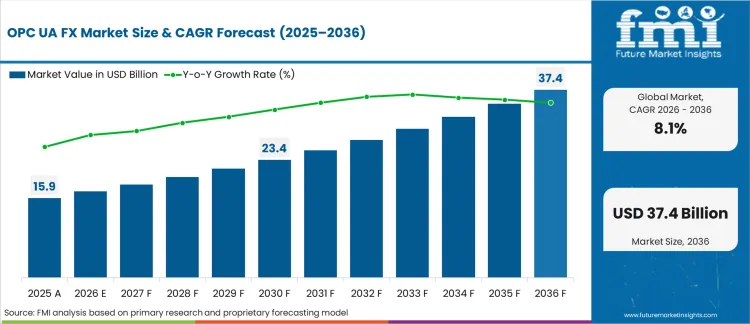
- USD 37.4 Bn
- CAGR (2026 to 2036)
- 8.10%
OPC UA FX Market Size, Market Forecast and Outlook By FMI
The OPC UA FX market exceeded USD 15.87 billion in 2025 and is projected to expand to USD 17.15 billion in 2026 and USD 37.4 billion by 2036, reflecting a sustained 8.10% CAGR. Growth trajectory is primarily driven by the accelerating global shift toward deterministic, field‑level communication architectures, as industries phase out fragmented legacy fieldbus systems in favor of unified, standards‑based interoperability. Plant operators transitioning toward Industry 4.0 frameworks reject disparate proprietary protocols, forcing industrial equipment vendors to embed native OPC UA capabilities directly into controllers and field devices to secure next-generation procurement contracts.
Capital allocation decisions are reshaping vendor qualification timelines across industrial hubs. Total private equity and venture capital investments in industrial automation reached 111 through the first three quarters of 2025 [1], signaling that interoperability infrastructure has crossed from pilot-phase testing to scaled deployment. The equipment manufacturers lacking certified Field Level Communications (FLC) support face immediate exclusion from multi-vendor factory modernization tenders.
Summary of OPC UA FX Market
- OPC UA FX Market Definition
- A standardized, deterministic industrial communication protocol framework extending the OPC Unified Architecture down to the field level, utilizing Time-Sensitive Networking (TSN) to enable seamless, real-time data exchange between controllers, sensors, and enterprise systems.
- Demand Drivers in the Market
- Smart manufacturing mandates force facility operators to abandon proprietary fieldbus networks in favor of unified semantic interoperability.
- Heightened industrial cybersecurity regulations compel automation vendors to embed certificate-based authentication directly into programmable logic controllers.
- Reshoring initiatives accelerate the deployment of high-density robotic cells requiring deterministic, low-latency communication backbones.
- Key Segments Analyzed in the FMI Report
- OPC UA servers & gateways: 58% share driven by immediate brownfield modernization needs to connect legacy assets.
- Manufacturing integration: 42% share anchored by automotive and electronics sectors requiring complex multi-vendor machine orchestration.
- Asia Pacific highlight: Rapid scaling in China and India outpaces mature European installed bases.
- Analyst Opinion at FMI
- Nikhil Kaitwade, Principal Consultant for Process Automation at Future Market Insights, opines, "Through our recent evaluation, we observed that OPC UA FX certification is no longer optional for motion control vendors. Buyers mandate native Field Exchange profiles to guarantee microsecond synchronization. Suppliers investing in integrated Ethernet-APL and TSN stacks will secure stronger positioning in upcoming smart factory retrofits."
- Strategic Implications / Executive Takeaways
- Prioritize native Controller-to-Device capabilities to defend market share against open-ecosystem automation challengers.
- Accelerate certification testing regimens to bypass lengthy buyer qualification phases during multi-vendor tender bids.
- Partner with semantic data space consortiums to capture high-value enterprise IT-OT convergence contracts.
- Methodology
- Primary Research: Direct interviews with automation system integrators, protocol stack developers, and plant IT/OT managers to determine adoption rates.
- Desk Research: Verification of certified product registries, patent filings for real-time communication, and consortium membership growth data.
- Market-Sizing and Forecasting: Analysts developed a bottom-up adoption model starting from industrial controller shipments, applying network attach rates.
- Data Validation and Update Cycle: Findings underwent cross-verification against official industrial network share reports before final forecast integration.
Procurement directors aggressively specify Controller-to-Device (C2D) compliance to ensure deterministic performance, compelling automation suppliers to overhaul legacy product lines before the 2028 operational technology upgrade cycles commence.
Lars Nagel, CEO at IDSA, opined, "Connecting the largest industrial automation ecosystem with emerging data space concepts will accelerate industry adoption. With OPC UA widely implemented in modern and legacy factories, we provide the necessary bridge to IT systems, unlocking new opportunities for data-driven innovation." [2] This commitment resets tier-1 manufacturer expectations for semantic data governance across global production networks.
Equipment suppliers entering upcoming tender cycles without pre-validated data space interoperability face a disqualification window they cannot close after shortlisting begins. Procurement teams will actively prioritize automation platforms that demonstrably collapse the IT-OT divide, shifting capital away from isolated operational technology silos.
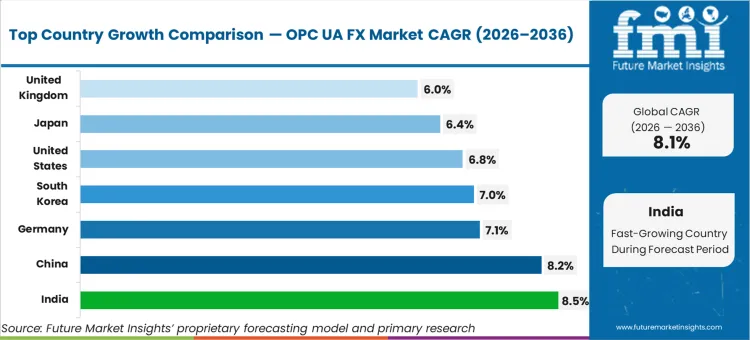
Demand across the Asia Pacific manufacturing landscape is anchored by robust expansion in India, expanding at an 8.5% CAGR, and China, registering an 8.2% CAGR, as national intelligent manufacturing initiatives mandate unified data models. South Korea follows with a 7.0% CAGR, driven by high-density electronics production requiring deterministic robotics control. Japan sustains a 6.4% CAGR through precision machinery upgrades. In Europe, Germany leads with a 7.1% CAGR rooted in aggressive Industry 4.0 standard integration, while the UK targets a 6.0% CAGR tied to resilient energy infrastructure modernizations. North American adoption is defined by the United States at a 6.8% CAGR, where massive semiconductor reshoring investments dictate secure, multi-vendor interoperability.
OPC UA FX Market Definition
The OPC UA FX (Field eXchange) market encompasses the hardware, software, and engineering services deploying the OPC Foundation's deterministic communication extensions. It defines a unified architecture utilizing Ethernet-APL and Time-Sensitive Networking to enable real-time, secure Controller-to-Controller and Controller-to-Device data exchange. The framework replaces legacy fieldbuses with a single semantic model stretching from simple field sensors to cloud-based analytics platforms.
OPC UA FX Market Inclusions
The category includes software development kits (SDKs), integrated server/client protocol stacks, and dedicated network gateways supporting Field Level Communications profiles. It covers protocol adaptation software embedded in programmable logic controllers, industrial edge devices, and safety instruments. Third-party testing, validation, and certification services specifically targeting OPC UA compliance are fully integrated into the market scope.
OPC UA FX Market Exclusions
The scope excludes general-purpose IT networking hardware such as standard commercial routers and unmanaged enterprise switches. It does not include basic industrial Ethernet cables, physical layer connectors, or legacy serial fieldbus components without OPC UA translation capabilities. Standalone SCADA systems or ERP software suites are excluded unless revenue is explicitly isolated to the licensing of the OPC UA communication module.
OPC UA FX Market Research Methodology
- Primary Research: Direct interviews with automation system integrators, protocol stack developers, and plant IT/OT managers to determine adoption rates and capability premiums.
- Desk Research: Verification of certified product registries, corporate capacity announcements, and industrial consortium membership growth data.
- Market-Sizing and Forecasting: Analysts developed a bottom-up adoption model starting from industrial controller shipments, applying historical network attach rates.
- Data Validation and Update Cycle: Findings underwent cross-verification against official industrial network share reports and regulatory technology standards before final forecast integration.
Segmental Analysis
OPC UA FX Market Analysis by Protocol/Stack Focus
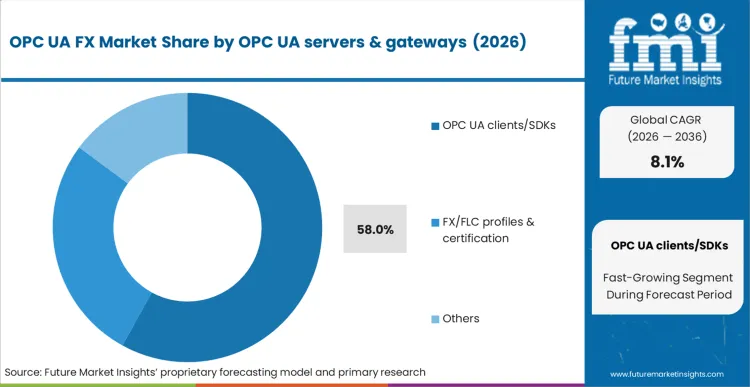
The push toward modernized industrial communication architectures establishes clear protocol focal points, with OPC UA servers & gateways commanding 58% of volumes in 2026. Facility operators are aggressively mitigating the integration chaos caused by decades of proprietary fieldbus installations. The OPC Foundation reported over 427 domain-specific information models and 350+ specifications active as of December 2025 [3], proving that the semantic definition phase has transitioned into scaled commercial deployment. Gateways act as the critical translation layer, allowing plant managers to harvest data from legacy equipment without executing complete rip-and-replace capital projects. FMI analysts opine that vendors failing to offer certified translation capabilities lose access to lucrative brownfield upgrade contracts.
- Technical Validation: High-performance controller stacks process microsecond deterministic traffic reliably.
- Procurement Shifts: Facility managers demand out-of-the-box interoperability to reduce custom engineering hours.
- Product Innovation: Silicon providers increasingly embed hardware-accelerated security profiles directly into edge gateway components.
OPC UA FX Market Analysis by Deployment
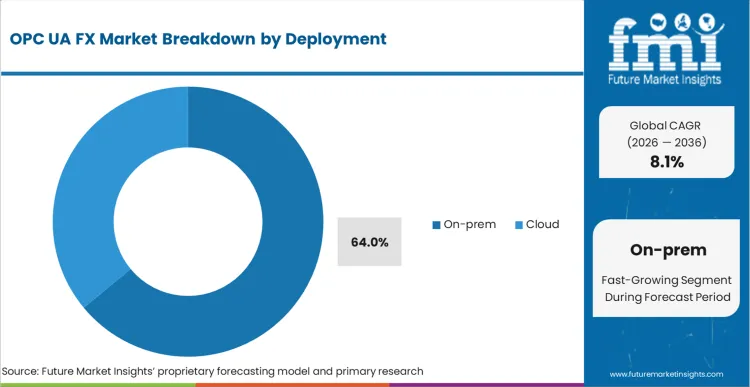
Data sovereignty concerns heavily dictate deployment architectures. The on-prem installations secure a 64% market share as manufacturers refuse to expose critical deterministic control loops to public networks. Despite cloud momentum in enterprise software, German industrial benchmarks reveal that 72 % of companies plan cloud-based system investments while maintaining strict local control for execution layers [4]. The deployment of robust industrial ethernet backbones ensures that local edge servers handle millisecond-level machine orchestration safely behind corporate firewalls. Plant directors prioritize on-premise execution to guarantee operational continuity during external network outages.
- Security Compliance: Air-gapped and localized deployments protect vital manufacturing intellectual property from external threat vectors.
- Latency Advantage: Local execution engines eliminate the round-trip delay inherent in cloud-based control architectures.
- Cost Structures: Subscription-based cloud models scale unpredictably compared to fixed-cost on-premise capital expenditures.
OPC UA FX Market Analysis by Application
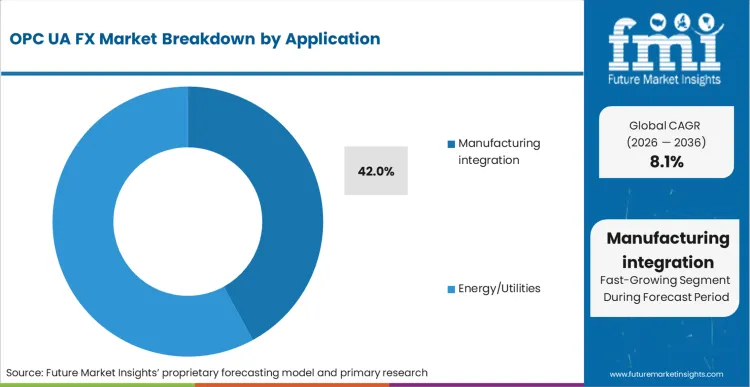
Manufacturing integration leads the application segment with 42% share, fueled by the relentless demand for flexible, modular production lines. Global robot installations are expected to grow by 6% to reach 575,000 units in 2025 [5], establishing a massive installed base that requires unified orchestration. Complex assembly environments dictate the need for time sensitive networking TSN integration to synchronize multi-vendor robotic cells without collisions.
The semantic structure of OPC UA FX allows controllers from different brands to exchange safety and motion data natively, removing the need for fragile middleware.
- Operational Continuity: Standardized semantic models allow technicians to swap failed components with alternative brands without reprogramming entire cells.
- Data Transparency: Unified architectures enable digital twin simulations by streaming high-fidelity telemetric data directly from end-effectors.
- Requalification Cycles: System integrators standardize on single-protocol designs to avoid complex factory acceptance tests.
OPC UA FX Market Analysis by Component
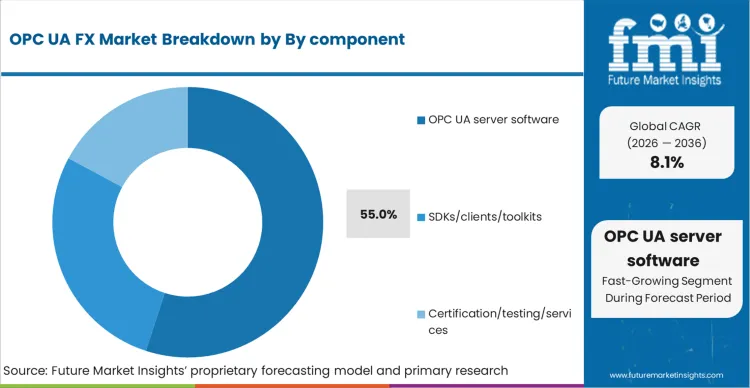
OPC UA server software constitutes 55% of the component segment, functioning as the primary data aggregation engine within modern facilities. The International Society of Automation published eight new standards focused on industrial automation and cybersecurity in 2025 [6], raising the minimum capability bar for embedded software. The process automation and instrumentation environments rely on these servers to securely federate data from thousands of field devices to supervisory systems. Buyers aggressively audit software vendors for compliance with the latest security profiles, explicitly disqualifying unsupported legacy stacks from critical infrastructure tenders.
- Ecosystem Integration: Open-source initiatives accelerate software adoption by lowering entry barriers for mid-tier equipment builders.
- Certification Necessity: Verified software components bypass lengthy cyber-audits during complex corporate procurement cycles.
- Supplier Positioning: Vendors bundle diagnostic and fleet management tools natively within the core server software package.
OPC UA FX Market Drivers, Restraints, and Opportunities
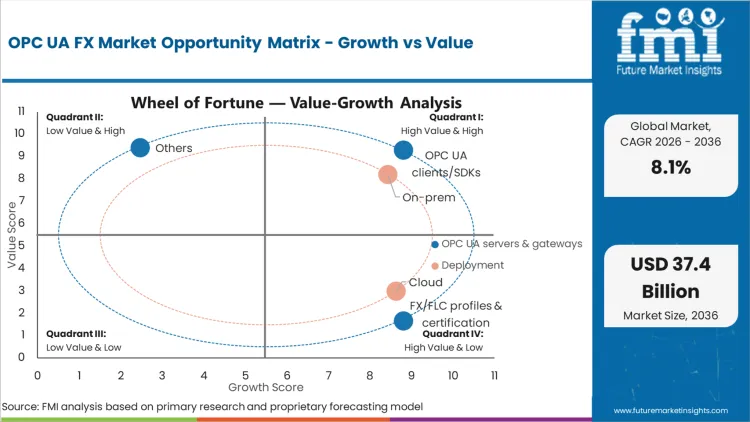
Labor shortages across advanced manufacturing economies force plant managers to substitute manual operations with highly automated, data-driven systems. An industry survey found that 80% of manufacturing executives plan to invest at least 20% of their improvement budgets in smart manufacturing initiatives [7], establishing massive capital pools for interoperability upgrades. System integrators building these automated cells utilize OPC UA to drastically reduce the engineering hours previously wasted on custom API development and proprietary protocol translation. Operations directors that fail to transition to unified semantic models face unsustainably high maintenance costs and severe limitations when scaling production capacity.
Rigorous conformance testing requirements compress margins for emerging hardware manufacturers attempting to enter the market. However, automation technologies like AI now have at least 50% of tasks automated in 15.1% of USA employment [8], allowing equipment builders to streamline compliance engineering. Equipment builders mitigate certification bottlenecks by licensing pre-certified third-party protocol stacks rather than developing software in-house, trading margin for guaranteed compliance and faster time-to-market.
- DCS Modernization Upgrades: ABB introduced the Automation Extended program integrating an OPC UA backbone for DCS continuity [9]. Legacy system operators must embrace these hybrid architectures to connect stranded field data to advanced analytics platforms safely.
- Semiconductor Ecosystem Integration: NXP Semiconductors acquired port GmbH to strengthen industrial edge server capabilities [10]. Silicon providers that embed certified protocol handling directly into chipsets will capture dominant share among device manufacturers.
- Unified Device Management: FieldComm Group announced a business combination with FDT Group to advance unified device integration supporting OPC UA [11]. Procurement teams will exclusively specify instruments adhering to these consolidated standards to simplify lifecycle management.
Regional Analysis
Based on the regional analysis, the OPC UA FX market is segmented into North America, Latin America, Europe, East Asia, South Asia, Oceania and Middle East & Africa across 40+ countries. The full report also offers market attractiveness analysis based on regional trends.
.webp "Top Country Growth Comparison Opc Ua Fx Market Cagr (2026 2036)")
| Country | CAGR (2026 to 2036) |
|---|---|
| India | 8.5% |
| China | 8.2% |
| Germany | 7.1% |
| South Korea | 7.0% |
| United States | 6.8% |
| Japan | 6.4% |
| United Kingdom | 6.0% |
Source: Future Market Insights (FMI) analysis, based on proprietary forecasting model and primary research
Asia Pacific OPC UA FX Market Analysis
Asia Pacific’s industrial landscape is rapidly reconfiguring as domestic manufacturing powers mandate open interoperability to support massive factory automation scales. Rather than relying on imported, proprietary architectures, regional heavyweights are adopting unified standards to ensure sovereign control over their production data ecosystems. Flexxbotics expanded its OPC UA capabilities with open-source contributions to support aggressive manufacturing integration [12], proving that localized software ecosystems are maturing quickly. FMI analysts opine that this shift enables massive domestic equipment builders to compete globally. Procurement teams across the region aggressively audit vendor compliance, converting semantic interoperability from a luxury feature into a rigid entry requirement for automated facility tenders.
- China: National intelligent manufacturing initiatives mandate unified data architectures, pushing the market toward an 8.2% CAGR through 2036. Equipment suppliers operating without certified compliance cannot access lucrative state-sponsored factory modernization contracts, driving integrations like Honeywell's Matrikon embedding OPC UA FX profiles in edge solutions [13]. Procurement directors must secure certified interoperability frameworks immediately to avoid disqualification from upcoming mega-factory tenders.
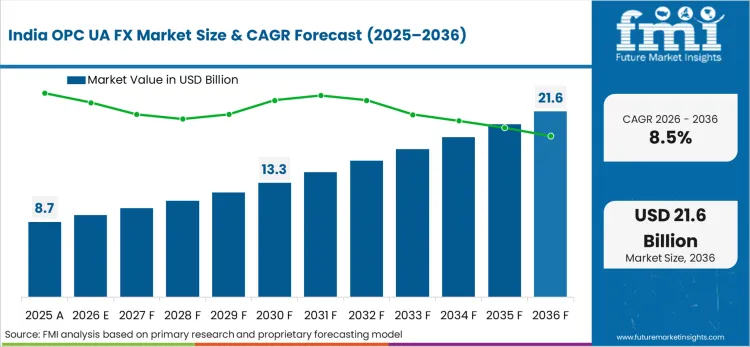
- India: Demand for smart grid and utility modernization drives extensive protocol updates, underpinning a projected 8.5% CAGR between 2026 and 2036 as regional operators abandon isolated serial connections. Domestic integrators leverage platforms like PTC's updated Kepware with enhanced OPC UA client/server support [14] to capture the expanding mid-market automation segment. Plant managers must overhaul legacy communication nodes to guarantee deterministic performance before executing planned infrastructure expansions.
- South Korea: High-density semiconductor and automotive sectors require flawless multi-vendor machine orchestration, fueling a 7.0% CAGR over the forecast period as throughput demands escalate. Facilities lacking deterministic Controller-to-Device capabilities face severe limitations, a challenge Siemens addressed by participating in multi-vendor OPC UA FX C2D prototyping [15]. Quality assurance executives must mandate millisecond-level packet delivery verification protocols to prevent catastrophic wafer processing errors.
- Japan: Precision robotics manufacturers are upgrading legacy equipment to support direct semantic data exchange, sustaining a 6.4% CAGR through 2036 as aging workforce demographics compel heavy industries to automate previously manual material handling. Machine builders align with launches of new motion control products featuring native OPC UA FX support by AVEVA to maintain export competitiveness in advanced European and North American markets. Equipment designers must migrate to TSN-capable processors to keep future automation products competitive on both price and performance.
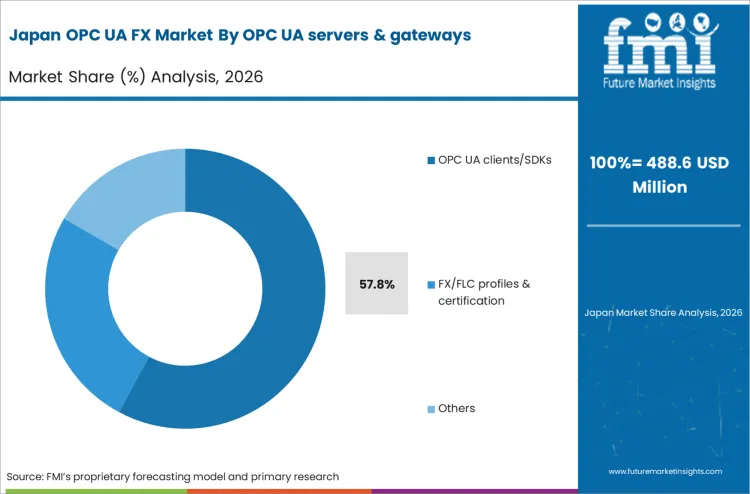
FMI's report includes comprehensive tracking of the Asia Pacific industrial modernization landscape, examining Taiwan, Vietnam, and Thailand. Across these expanding production hubs, supply chain diversification mandates compel facility operators to deploy multi-vendor equipment networks heavily reliant on standardized semantic interoperability.
North America OPC UA FX Market Analysis
North America’s automation landscape is undergoing recalibration as massive federal incentive structures align with advanced manufacturing reshoring efforts. Plant operators face acute skilled labor shortages, forcing an accelerated transition toward autonomous, data-centric production lines that require seamless horizontal and vertical integration. The USA manufacturing economy continues to see acceleration in AI and automation adoption to address labor shortages in 2025 projections [17], validating the necessity of robust data backbones. The facilities cannot deploy advanced machine learning analytics without the structured, contextualized data streams provided by modern protocol stacks.
- United States: Massive federal funding packages mandate secure, high-performance manufacturing infrastructure, generating a 6.8% CAGR as corporations replace unpatchable hardware with modern managed Ethernet switches to meet strict government compliance. Commerce awarded USD 30.9 billion across 40 projects to strengthen USA semiconductor manufacturing as of July 2025 [18]. Integrators executing these mega-projects must utilize certified, deterministic communication networks to pass strict federal cybersecurity and operational audits before facility commissioning.
FMI's report includes detailed analysis of the North American manufacturing technology sector, incorporating insights from Canada and Mexico. The cross-border automotive integration deeply relies on standardized Controller-to-Controller communication to synchronize distributed supply chain logistics flawlessly.
Europe OPC UA FX Market Analysis
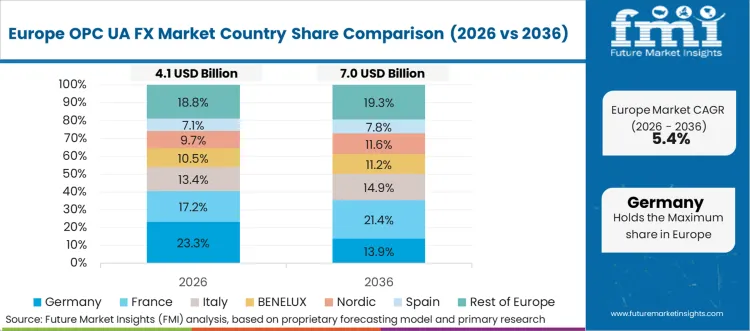
Europe functions as the technical proving ground for advanced industrial determinism under strict Industry 4.0 guidelines. Regulatory scrutiny and high labor costs compel manufacturers to deploy highly efficient, data-transparent equipment while minimizing exposure to external cyber threats. The European ecosystem heavily favors collaborative, multi-vendor interoperability demonstrations to validate new network extensions before factory deployment. This dynamic reinforces the strategic necessity for equipment builders to participate actively in consortium-led prototyping events to prove compliance. Buyers utilize these validation events as primary shortlisting mechanisms before releasing formal procurement tenders.
- Germany: The robust Industrie 4.0 ecosystem enforces strict data space integrations for automotive and chemical sectors, driving a 7.1% CAGR as original equipment manufacturers standardize on capable internal networks to eliminate data silos. Beckhoff Automation hosted an OPC UA FX Prototyping IOP event in Berlin to validate Controller-to-Device interoperability [19]. Automation vendors who cannot guarantee secure, encrypted field-level data transmission face absolute exclusion from Tier-1 industrial supply chains.
- United Kingdom: Reshoring and resilient energy infrastructure initiatives require secure grid integration, supporting a 6.0% CAGR as operators cautiously upgrade core routing infrastructure without disrupting active production schedules. Utility operators adopt practices from institutions like CESMII, which marked its strongest growth in Smart Manufacturing adoption in 2025 [20]. Operators must mandate certified profiles in all new substation equipment to ensure grid stability and defend against emerging operational technology cyber threats.
FMI's report includes comprehensive evaluation of the European protocol landscape, examining adoption metrics in France, Italy, and the Nordics. The transition toward green energy manufacturing forces battery and electrolyzer facilities to adopt unified information models for stringent traceability reporting.
Competitive Aligners for Market Players
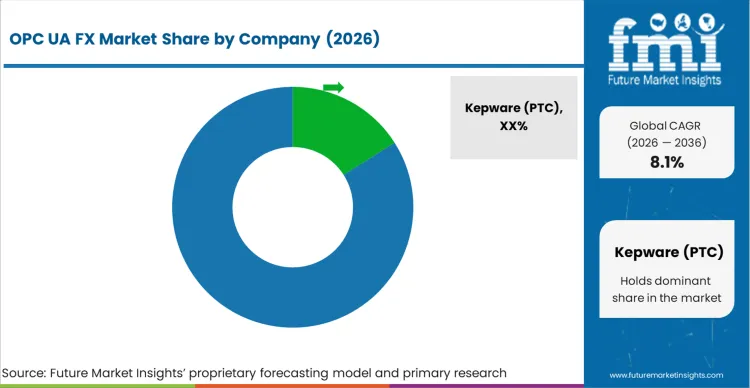
Technological capability differentiates premium automation suppliers from legacy equipment manufacturers. B&R Industrial Automation launched the ACOPOS M4 servo drive series with native OPC UA FX support for field-level deterministic communication [21]. Plant managers recognize this direct hardware integration as the definitive solution for high-speed motion control, completely eliminating the need for intermediary translation gateways. Equipment buyers specifying packaging or assembly machinery will explicitly demand this native deterministic capability to guarantee microsecond synchronization.
Strategic consortiums and standard alliances aggressively accelerate commercialization timelines for unified communication frameworks. Inductive Automation launched the Ignition technology ecosystem with founding partners emphasizing OPC UA server/gateway interoperability [22]. Instrumentation vendors participating in these consolidated roadmaps avoid stranded R&D investments by aligning with the market's dominant protocol trajectory. Procurement directors streamline vendor qualification by shortlisting only those suppliers visibly committed to these unified data models.
Vendor advantage realigns where software security and hybrid cloud integration converge. Schneider Electric released EcoStruxure OPC UA Server Expert for secure aggregation of data across cloud and on-prem deployments [23]. Integrators executing complex enterprise architectures rely on these robust server solutions to securely bridge isolated factory subnets with overarching IT analytics platforms. IT departments explicitly mandate these certified software components to enforce corporate zero-trust network policies.
Recent Developments
The report includes full coverage of key trends from competitive benchmarking. Some of the recent developments covered in the reports:
- In November 2025, B&R Industrial Automation launched the Acopos M4 servo drive, one of the first natively developed for OPC UA FX, with TSN support, X20 bus coupler, and CRA cybersecurity compliance for open automation architectures. [24].
- In February 2026, Beckhoff Automation hosted the OPC UA FX Prototyping Interoperability Plugfest (IOP) in Berlin, testing Pub/Sub Ethernet, priority mapping, and AML-based exchange with B&R, Mitsubishi Electric, Hilscher, Unified Automation, Steinbeis, Schneider Electric, and Siemens. [25].
Key Players in OPC UA FX Market
- Kepware (PTC)
- Matrikon (Honeywell)
- Siemens
- Schneider Electric
- AVEVA (Schneider Electric)
- Beckhoff Automation
- B&R (ABB)
Scope of the Report
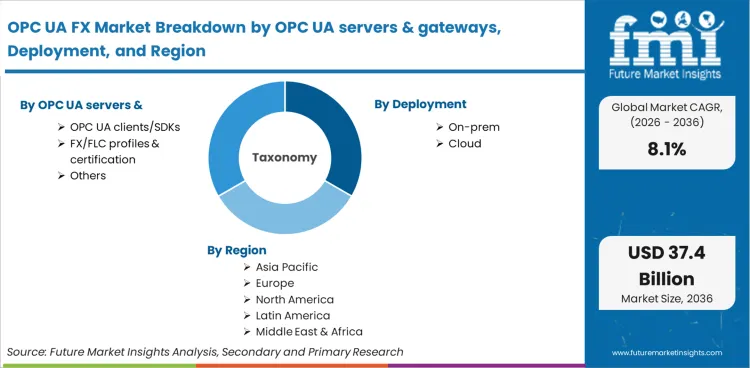
| Metric | Value |
|---|---|
| Quantitative Units | USD 17.15 billion (2026) to USD 37.4 billion (2036), at a CAGR of 8.10% |
| Market Definition | A standardized, deterministic industrial communication protocol framework extending the OPC Unified Architecture down to the field level, utilizing Time-Sensitive Networking (TSN) to enable seamless, real-time data exchange between controllers, sensors, and enterprise systems. |
| Protocol/stack focus Segmentation | OPC UA servers & gateways, OPC UA clients/SDKs, FX/FLC profiles & certification, Others |
| Deployment Segmentation | On-prem, Cloud |
| Application Segmentation | Manufacturing integration, Energy/Utilities |
| By component Segmentation | OPC UA server software, SDKs/clients/toolkits, Certification/testing/services |
| Regions Covered | North America, Latin America, Europe, East Asia, South Asia, Oceania, Middle East and Africa |
| Countries Covered | United States, Canada, Mexico, Brazil, Argentina, Germany, France, United Kingdom, Italy, Spain, China, India, Japan, South Korea, Indonesia, Australia and 40 plus countries |
| Key Companies Profiled | Kepware (PTC), Matrikon (Honeywell), Siemens, Schneider Electric, AVEVA (Schneider Electric), Beckhoff Automation, B&R (ABB) |
| Forecast Period | 2026 to 2036 |
| Approach | Hybrid top-down and bottom-up market modeling validated through primary interviews with automation integrators and standards bodies, supported by certified product registry benchmarking |
Source: Future Market Insights (FMI) analysis, based on proprietary forecasting model and primary research
Segmental Analysis
Protocol/stack focus:
- OPC UA servers & gateways
- OPC UA clients/SDKs
- FX/FLC profiles & certification
- Others
Deployment:
- On-prem
- Cloud
Application:
- Manufacturing integration
- Energy/Utilities
By component:
- OPC UA server software
- SDKs/clients/toolkits
- Certification/testing/services
Region:
- Asia Pacific
- India
- China
- Japan
- South Korea
- Indonesia
- Australia & New Zealand
- ASEAN
- Rest of Asia Pacific
- Europe
- Germany
- Italy
- France
- United Kingdom
- Spain
- Benelux
- Nordics
- Central & Eastern Europe
- Rest of Europe
- North America
- United States
- Canada
- Mexico
- Latin America
- Brazil
- Argentina
- Chile
- Rest of Latin America
- Middle East & Africa
- Kingdom of Saudi Arabia
- United Arab Emirates
- South Africa
- Turkey
- Rest of Middle East & Africa
Bibliography
- [1] Blue River Financial Group. (2025, November). Industrial Automation Q3 2025 Market Update. Association for Advancing Automation.
- [2] IDSA. (2025, March). IDSA and OPC foundation expand collaboration.
- [3] OPC Foundation. (2025, December). OPC foundation general assembly 2025 key highlights.
- [4] USA Department of Commerce. (2025). Germany advanced manufacturing commercial guide.
- [5] International Federation of Robotics. (2025). Global robot demand in factories doubles over 10 years.
- [6] International Society of Automation. (2025). ISA annual report 2025.
- [7] Advanced Manufacturing. (2025). Smart manufacturing optimism, tech talent drive growth.
- [8] Society for Human Resource Management. (2025). AI's wake-up call.
- [9] ABB. (2026, February). ABB introduces automation extended enabling industrial innovation with continuity.
- [10] NXP Semiconductors. (2025, August). NXP welcomes port GmbH.
- [11] FieldComm Group. (2025, September). Unified device integration roadmap solidified following FieldComm Group and FDT.
- [12] Flexxbotics. (2026, January). Flexxbotics news updates.
- [13] Matrikon (Honeywell). (2025). Matrikon OPC UA SDK (Embedded and PC Applications).
- [14] PTC. (2025). Kepware products.
- [15] OPC Foundation. (2025, December). Field Level Communications Corner - December 2025. [17] National Institute of Standards and Technology. (2025). What's coming for US manufacturing in 2025.
- [18] USA Government Accountability Office. (2025, December). Semiconductors: Information on Projects Funded to Strengthen USA Supply Chain (GAO-26-107882).
- [19] OPC Foundation. (2026, February). Beckhoff Automation hosted the OPC Foundation’s OPC UA FX Prototyping IOP.
- [20] Clean Energy Smart Manufacturing Innovation Institute. (2026, January). January 2026 newsletter.
- [21] B&R Industrial Automation. (2025, November 25). Direct and secure communication for field devices with OPC UA FX.
- [22] Inductive Automation. (2025). Inductive Automation launches partnership ecosystem.
- [23] Schneider Electric. (2025). EcoStruxure OPC UA server expert.
- [24] B&R Industrial Automation. (2025, November 30). B&R zündet OPC-UA-FX-Offensive auf der SPS 2025.
- [25] OPC Foundation. (2026, February 19). Beckhoff Automation hosted the OPC Foundation’s OPC UA FX Prototyping IOP
- [26] Association for Advancing Automation. (2025). Robot orders grow 6.6% in 2025.
This bibliography is provided for reader reference and is not exhaustive. The full report contains the complete reference list and detailed citations.
This Report Addresses
- Market size estimation and revenue forecasts from 2026 to 2036, supported by validated automation controller shipments and network attach rates.
- Segment and regional revenue forecasts covering critical applications like manufacturing integration and energy utilities.
- Growth opportunity mapping across deterministic software stacks and hardware gateway configurations for factory retrofits.
- Competition strategy assessment including integration models, semantic protocol development, and standards consortium positioning.
- Regulatory impact analysis evaluating strict industrial cybersecurity mandates and their direct effect on embedded software procurement.
- Product reformulation tracking covering key metrics such as deterministic latency, microsecond synchronization, and field-level profile conformance.
- Supply chain vulnerability assessment linking silicon availability and software certification bottlenecks to final equipment deployment timelines.
- Market report delivery in PDF, Excel, PPT, and interactive dashboard formats for executive and operational use.
Frequently Asked Questions
How large is the demand for OPC UA FX in the global market in 2026?
Demand for OPC UA FX in the global market is estimated to be valued at USD 17.15 billion in 2026.
What will be the market size of OPC UA FX in the global market by 2036?
Market size for OPC UA FX is projected to reach USD 37.4 billion by 2036.
What is the expected demand growth for OPC UA FX in the global market between 2026 and 2036?
Demand for OPC UA FX is expected to grow at a CAGR of 8.10% between 2026 and 2036.
Which Protocol/stack focus is poised to lead global sales by 2026?
OPC UA servers & gateways commands 58% in 2026 as facility operators deploy translation layers to harvest data from legacy equipment without full system replacement.
How significant is the role of Manufacturing integration in driving OPC UA FX adoption in 2026?
Manufacturing integration represents 42% of segment share as complex assembly environments demand unified semantic models to orchestrate multi-vendor robotic cells safely.
What is driving demand in India?
Surging smart grid utility modernizations and expanding mid-market industrial automation scale drive essential protocol updates across domestic infrastructure.
What compliance standards or regulations are referenced for India?
The International Society of Automation certification standards shape procurement frameworks for secure domestic industrial deployments.
What is the India growth outlook in this report?
India is projected to grow at a CAGR of 8.5% during 2026 to 2036.
Why is North America described as a priority region in this report?
Massive federal incentive structures and reshoring initiatives force rapid adoption of secure, data-centric manufacturing networks to combat skilled labor shortages.
What type of demand dominates in North America?
Cybersecurity-led standardization and multi-vendor interoperability integration dominate regional procurement demand.
What is China's growth outlook in this report?
China is projected to expand at a CAGR of 8.2% during 2026 to 2036.
Does the report cover United States in its regional analysis?
Yes, the United States is included within North America under the regional scope of analysis.
What are the sources referred to for analyzing United States?
Official funding data from the U.S. Government Accountability Office and automation adoption surveys form the analytical basis.
What is the main demand theme linked to United States in its region coverage?
Strict federal cybersecurity mandates shaping the deployment of secure, deterministic communication networks for reshoring mega-projects.
Does the report cover United Kingdom in its regional analysis?
Yes, the United Kingdom is included within Europe under the regional coverage framework.
What is the main United Kingdom related demand theme in its region coverage?
Resilient energy infrastructure modernizations driving the integration of certified communication profiles into new substation equipment.
Which product formats or configurations are strategically important for Europe supply chains?
Certified embedded protocol stacks that explicitly guarantee encrypted, deterministic field-level transmission hold immense strategic importance.
What is OPC UA FX and what is it mainly used for?
It is a standardized industrial communication protocol framework utilized primarily to enable real-time, deterministic data exchange across multi-vendor factory floors.
What does OPC UA FX mean in this report?
The market refers to the global deployment of software stacks, engineering services, and network hardware supporting Field Level Communications profiles.
What is included in the scope of this OPC UA FX report?
Scope includes software development kits, integrated server protocol stacks, and dedicated network gateways supporting deterministic field communication.
What is excluded from the scope of this report?
General-purpose enterprise IT hardware, standard unmanaged switches, and legacy serial fieldbus components without protocol translation capabilities are excluded.
What does market forecast mean on this page?
The market forecast represents a model-based projection built on defined industrial and technology assumptions for strategic planning purposes.
How does FMI build and validate the OPC UA FX forecast?
Forecasts combine top-down controller shipment data with bottom-up protocol attach rates, validated by primary integrator interviews and product registries.
What does zero reliance on speculative third-party market research mean here?
Primary interviews, verified product certifications, and official industry automation datasets are used exclusively instead of unverified syndicated estimates.
Preview the report firsthand - request a free sample
Get SampleGet the brochure for pricing and purchase details.
Get PDFTable of Content
- Executive Summary
- Global Market Outlook
- Demand-side Trends
- Supply-side Trends
- Technology Roadmap Analysis
- Analysis and Recommendations
- Market Overview
- Market Coverage / Taxonomy
- Market Definition / Scope / Limitations
- Research Methodology
- Chapter Orientation
- Analytical Lens and Working Hypotheses
- Market Structure, Signals, and Trend Drivers
- Benchmarking and Cross-market Comparability
- Market Sizing, Forecasting, and Opportunity Mapping
- Research Design and Evidence Framework
- Desk Research Programme (Secondary Evidence)
- Company Annual and Sustainability Reports
- Peer-reviewed Journals and Academic Literature
- Corporate Websites, Product Literature, and Technical Notes
- Earnings Decks and Investor Briefings
- Statutory Filings and Regulatory Disclosures
- Technical White Papers and Standards Notes
- Trade Journals, Industry Magazines, and Analyst Briefs
- Conference Proceedings, Webinars, and Seminar Materials
- Government Statistics Portals and Public Data Releases
- Press Releases and Reputable Media Coverage
- Specialist Newsletters and Curated Briefings
- Sector Databases and Reference Repositories
- FMI Internal Proprietary Databases and Historical Market Datasets
- Subscription Datasets and Paid Sources
- Social Channels, Communities, and Digital Listening Inputs
- Additional Desk Sources
- Expert Input and Fieldwork (Primary Evidence)
- Primary Modes
- Qualitative Interviews and Expert Elicitation
- Quantitative Surveys and Structured Data Capture
- Blended Approach
- Why Primary Evidence is Used
- Field Techniques
- Interviews
- Surveys
- Focus Groups
- Observational and In-context Research
- Social and Community Interactions
- Stakeholder Universe Engaged
- C-suite Leaders
- Board Members
- Presidents and Vice Presidents
- R&D and Innovation Heads
- Technical Specialists
- Domain Subject-matter Experts
- Scientists
- Physicians and Other Healthcare Professionals
- Governance, Ethics, and Data Stewardship
- Research Ethics
- Data Integrity and Handling
- Primary Modes
- Tooling, Models, and Reference Databases
- Desk Research Programme (Secondary Evidence)
- Data Engineering and Model Build
- Data Acquisition and Ingestion
- Cleaning, Normalisation, and Verification
- Synthesis, Triangulation, and Analysis
- Quality Assurance and Audit Trail
- Market Background
- Market Dynamics
- Drivers
- Restraints
- Opportunity
- Trends
- Scenario Forecast
- Demand in Optimistic Scenario
- Demand in Likely Scenario
- Demand in Conservative Scenario
- Opportunity Map Analysis
- Product Life Cycle Analysis
- Supply Chain Analysis
- Investment Feasibility Matrix
- Value Chain Analysis
- PESTLE and Porter’s Analysis
- Regulatory Landscape
- Regional Parent Market Outlook
- Production and Consumption Statistics
- Import and Export Statistics
- Market Dynamics
- Global Market Analysis 2021 to 2025 and Forecast, 2026 to 2036
- Historical Market Size Value (USD Million) Analysis, 2021 to 2025
- Current and Future Market Size Value (USD Million) Projections, 2026 to 2036
- Y-o-Y Growth Trend Analysis
- Absolute $ Opportunity Analysis
- Global Market Pricing Analysis 2021 to 2025 and Forecast 2026 to 2036
- Global Market Analysis 2021 to 2025 and Forecast 2026 to 2036, By OPC UA servers & gateways
- Introduction / Key Findings
- Historical Market Size Value (USD Million) Analysis By OPC UA servers & gateways , 2021 to 2025
- Current and Future Market Size Value (USD Million) Analysis and Forecast By OPC UA servers & gateways , 2026 to 2036
- OPC UA clients/SDKs
- FX/FLC profiles & certification
- Others
- OPC UA clients/SDKs
- Y-o-Y Growth Trend Analysis By OPC UA servers & gateways , 2021 to 2025
- Absolute $ Opportunity Analysis By OPC UA servers & gateways , 2026 to 2036
- Global Market Analysis 2021 to 2025 and Forecast 2026 to 2036, By Deployment
- Introduction / Key Findings
- Historical Market Size Value (USD Million) Analysis By Deployment, 2021 to 2025
- Current and Future Market Size Value (USD Million) Analysis and Forecast By Deployment, 2026 to 2036
- On-prem
- Cloud
- On-prem
- Y-o-Y Growth Trend Analysis By Deployment, 2021 to 2025
- Absolute $ Opportunity Analysis By Deployment, 2026 to 2036
- Global Market Analysis 2021 to 2025 and Forecast 2026 to 2036, By Application
- Introduction / Key Findings
- Historical Market Size Value (USD Million) Analysis By Application, 2021 to 2025
- Current and Future Market Size Value (USD Million) Analysis and Forecast By Application, 2026 to 2036
- Manufacturing integration
- Energy/Utilities
- Manufacturing integration
- Y-o-Y Growth Trend Analysis By Application, 2021 to 2025
- Absolute $ Opportunity Analysis By Application, 2026 to 2036
- Global Market Analysis 2021 to 2025 and Forecast 2026 to 2036, By By component
- Introduction / Key Findings
- Historical Market Size Value (USD Million) Analysis By By component, 2021 to 2025
- Current and Future Market Size Value (USD Million) Analysis and Forecast By By component, 2026 to 2036
- OPC UA server software
- SDKs/clients/toolkits
- Certification/testing/services
- OPC UA server software
- Y-o-Y Growth Trend Analysis By By component, 2021 to 2025
- Absolute $ Opportunity Analysis By By component, 2026 to 2036
- Global Market Analysis 2021 to 2025 and Forecast 2026 to 2036, By Region
- Introduction
- Historical Market Size Value (USD Million) Analysis By Region, 2021 to 2025
- Current Market Size Value (USD Million) Analysis and Forecast By Region, 2026 to 2036
- North America
- Latin America
- Western Europe
- Eastern Europe
- East Asia
- South Asia and Pacific
- Middle East & Africa
- Market Attractiveness Analysis By Region
- North America Market Analysis 2021 to 2025 and Forecast 2026 to 2036, By Country
- Historical Market Size Value (USD Million) Trend Analysis By Market Taxonomy, 2021 to 2025
- Market Size Value (USD Million) Forecast By Market Taxonomy, 2026 to 2036
- By Country
- USA
- Canada
- Mexico
- By OPC UA servers & gateways
- By Deployment
- By Application
- By By component
- By Country
- Market Attractiveness Analysis
- By Country
- By OPC UA servers & gateways
- By Deployment
- By Application
- By By component
- Key Takeaways
- Latin America Market Analysis 2021 to 2025 and Forecast 2026 to 2036, By Country
- Historical Market Size Value (USD Million) Trend Analysis By Market Taxonomy, 2021 to 2025
- Market Size Value (USD Million) Forecast By Market Taxonomy, 2026 to 2036
- By Country
- Brazil
- Chile
- Rest of Latin America
- By OPC UA servers & gateways
- By Deployment
- By Application
- By By component
- By Country
- Market Attractiveness Analysis
- By Country
- By OPC UA servers & gateways
- By Deployment
- By Application
- By By component
- Key Takeaways
- Western Europe Market Analysis 2021 to 2025 and Forecast 2026 to 2036, By Country
- Historical Market Size Value (USD Million) Trend Analysis By Market Taxonomy, 2021 to 2025
- Market Size Value (USD Million) Forecast By Market Taxonomy, 2026 to 2036
- By Country
- Germany
- UK
- Italy
- Spain
- France
- Nordic
- BENELUX
- Rest of Western Europe
- By OPC UA servers & gateways
- By Deployment
- By Application
- By By component
- By Country
- Market Attractiveness Analysis
- By Country
- By OPC UA servers & gateways
- By Deployment
- By Application
- By By component
- Key Takeaways
- Eastern Europe Market Analysis 2021 to 2025 and Forecast 2026 to 2036, By Country
- Historical Market Size Value (USD Million) Trend Analysis By Market Taxonomy, 2021 to 2025
- Market Size Value (USD Million) Forecast By Market Taxonomy, 2026 to 2036
- By Country
- Russia
- Poland
- Hungary
- Balkan & Baltic
- Rest of Eastern Europe
- By OPC UA servers & gateways
- By Deployment
- By Application
- By By component
- By Country
- Market Attractiveness Analysis
- By Country
- By OPC UA servers & gateways
- By Deployment
- By Application
- By By component
- Key Takeaways
- East Asia Market Analysis 2021 to 2025 and Forecast 2026 to 2036, By Country
- Historical Market Size Value (USD Million) Trend Analysis By Market Taxonomy, 2021 to 2025
- Market Size Value (USD Million) Forecast By Market Taxonomy, 2026 to 2036
- By Country
- China
- Japan
- South Korea
- By OPC UA servers & gateways
- By Deployment
- By Application
- By By component
- By Country
- Market Attractiveness Analysis
- By Country
- By OPC UA servers & gateways
- By Deployment
- By Application
- By By component
- Key Takeaways
- South Asia and Pacific Market Analysis 2021 to 2025 and Forecast 2026 to 2036, By Country
- Historical Market Size Value (USD Million) Trend Analysis By Market Taxonomy, 2021 to 2025
- Market Size Value (USD Million) Forecast By Market Taxonomy, 2026 to 2036
- By Country
- India
- ASEAN
- Australia & New Zealand
- Rest of South Asia and Pacific
- By OPC UA servers & gateways
- By Deployment
- By Application
- By By component
- By Country
- Market Attractiveness Analysis
- By Country
- By OPC UA servers & gateways
- By Deployment
- By Application
- By By component
- Key Takeaways
- Middle East & Africa Market Analysis 2021 to 2025 and Forecast 2026 to 2036, By Country
- Historical Market Size Value (USD Million) Trend Analysis By Market Taxonomy, 2021 to 2025
- Market Size Value (USD Million) Forecast By Market Taxonomy, 2026 to 2036
- By Country
- Kingdom of Saudi Arabia
- Other GCC Countries
- Turkiye
- South Africa
- Other African Union
- Rest of Middle East & Africa
- By OPC UA servers & gateways
- By Deployment
- By Application
- By By component
- By Country
- Market Attractiveness Analysis
- By Country
- By OPC UA servers & gateways
- By Deployment
- By Application
- By By component
- Key Takeaways
- Key Countries Market Analysis
- USA
- Pricing Analysis
- Market Share Analysis, 2025
- By OPC UA servers & gateways
- By Deployment
- By Application
- By By component
- Canada
- Pricing Analysis
- Market Share Analysis, 2025
- By OPC UA servers & gateways
- By Deployment
- By Application
- By By component
- Mexico
- Pricing Analysis
- Market Share Analysis, 2025
- By OPC UA servers & gateways
- By Deployment
- By Application
- By By component
- Brazil
- Pricing Analysis
- Market Share Analysis, 2025
- By OPC UA servers & gateways
- By Deployment
- By Application
- By By component
- Chile
- Pricing Analysis
- Market Share Analysis, 2025
- By OPC UA servers & gateways
- By Deployment
- By Application
- By By component
- Germany
- Pricing Analysis
- Market Share Analysis, 2025
- By OPC UA servers & gateways
- By Deployment
- By Application
- By By component
- UK
- Pricing Analysis
- Market Share Analysis, 2025
- By OPC UA servers & gateways
- By Deployment
- By Application
- By By component
- Italy
- Pricing Analysis
- Market Share Analysis, 2025
- By OPC UA servers & gateways
- By Deployment
- By Application
- By By component
- Spain
- Pricing Analysis
- Market Share Analysis, 2025
- By OPC UA servers & gateways
- By Deployment
- By Application
- By By component
- France
- Pricing Analysis
- Market Share Analysis, 2025
- By OPC UA servers & gateways
- By Deployment
- By Application
- By By component
- India
- Pricing Analysis
- Market Share Analysis, 2025
- By OPC UA servers & gateways
- By Deployment
- By Application
- By By component
- ASEAN
- Pricing Analysis
- Market Share Analysis, 2025
- By OPC UA servers & gateways
- By Deployment
- By Application
- By By component
- Australia & New Zealand
- Pricing Analysis
- Market Share Analysis, 2025
- By OPC UA servers & gateways
- By Deployment
- By Application
- By By component
- China
- Pricing Analysis
- Market Share Analysis, 2025
- By OPC UA servers & gateways
- By Deployment
- By Application
- By By component
- Japan
- Pricing Analysis
- Market Share Analysis, 2025
- By OPC UA servers & gateways
- By Deployment
- By Application
- By By component
- South Korea
- Pricing Analysis
- Market Share Analysis, 2025
- By OPC UA servers & gateways
- By Deployment
- By Application
- By By component
- Russia
- Pricing Analysis
- Market Share Analysis, 2025
- By OPC UA servers & gateways
- By Deployment
- By Application
- By By component
- Poland
- Pricing Analysis
- Market Share Analysis, 2025
- By OPC UA servers & gateways
- By Deployment
- By Application
- By By component
- Hungary
- Pricing Analysis
- Market Share Analysis, 2025
- By OPC UA servers & gateways
- By Deployment
- By Application
- By By component
- Kingdom of Saudi Arabia
- Pricing Analysis
- Market Share Analysis, 2025
- By OPC UA servers & gateways
- By Deployment
- By Application
- By By component
- Turkiye
- Pricing Analysis
- Market Share Analysis, 2025
- By OPC UA servers & gateways
- By Deployment
- By Application
- By By component
- South Africa
- Pricing Analysis
- Market Share Analysis, 2025
- By OPC UA servers & gateways
- By Deployment
- By Application
- By By component
- USA
- Market Structure Analysis
- Competition Dashboard
- Competition Benchmarking
- Market Share Analysis of Top Players
- By Regional
- By OPC UA servers & gateways
- By Deployment
- By Application
- By By component
- Competition Analysis
- Competition Deep Dive
- Kepware (PTC)
- Overview
- Product Portfolio
- Profitability by Market Segments (Product/Age /Sales Channel/Region)
- Sales Footprint
- Strategy Overview
- Marketing Strategy
- Product Strategy
- Channel Strategy
- Matrikon (Honeywell)
- Siemens
- Schneider Electric
- AVEVA (Schneider Electric)
- Beckhoff Automation
- B&R (ABB)
- Kepware (PTC)
- Competition Deep Dive
- Assumptions & Acronyms Used


